
ASC Showcase 2026 Issue 7 April

Page 1


ADHESIVE & SEALANT SHOWCASE

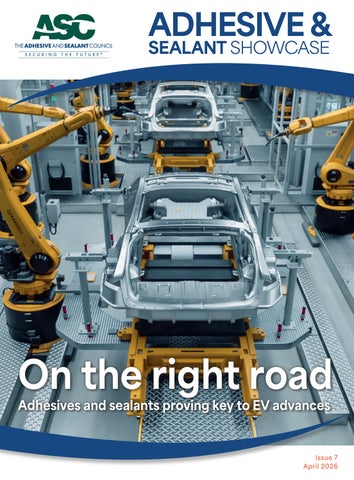
On the right road

Adhesives and sealants proving key to EV advances

H.B.

ADVERTISE IN THE NEXT ISSUE

JUNE 15-17, 2026

Book your page today to be seen at ASC’s Executive Leadership Conference

The ASC’s Adhesive and Sealant Showcase is a print and digital publication with outstanding reach and readership.

Get in touch to discuss our range of advertising opportunities to showcase your products and services and rise above the crowd.

Welcome Sticking to the future

As we gather for ASC’s Annual Convention & EXPO, the North American adhesive and sealant industry is on steady footing but faces a complex mix of headwinds and tailwinds that will test manufacturers and formulators alike. Near-term growth will require navigating regulatory, raw material, and competitive pressures.

For example, tightening environmental regulations at the state level are on the rise. For smaller manufacturers, the burden of testing, certification, and ongoing reformulation can strain resources and slow product development cycles. Trade policy uncertainty adds another layer of complexity.

When given challenges, however, our industry creates opportunities. We are silently powering the future, enabling lighter vehicles, safer consumer products, and more sustainable solutions worldwide. As ASC’s study on adhesive use in electric vehicles shows, our industry plays an essential role in innovating solutions for the markets we serve. Data center construction is booming, offering growth opportunities. The ever-expanding e-commerce economy is also a driver, with growth in packaged food and beverage segments spurring demand for reliable, high-speed adhesives.

While attending February’s Adhesion Society Annual Meeting, I listened to presentations about smart adhesives and nanotechnology enhancing product strength, durability, and precision, while improving resistance to environmental conditions.

Navigating through the challenges and opportunities in a highly competitive environment can be overwhelming. My advice: lean on ASC as your trusted, go-to source of information. For some, the annual ASC Convention is ASC. No, we are more than that. ASC’s Training Academy delivers virtual and in-person programs yearround. Our market reports and white papers provide in-depth analysis on trends and forecasts. Our quarterly Pulse Report will deliver insights into current business conditions. Actionable information at your fingertips now and into the future.

Utah set to welcome senior leaders this June

Remember to book your place for the 2026 Executive Leadership Conference, which has moved to June this year.

Taking place from June 1517, the event at Pendry Park City in Park City, Utah offers an unparalleled high-level programming and C-level networking opportunities.

after May 15, so be sure to get in early to get a discounted rate.

Registration fees increase

Learn about market drivers and trends, gain invaluable insight about effective

leadership, and discover how best to capitalize on the opportunities that lie ahead. ASC will also be inducting some more industry greats into the Hall of Fame.

And, of course, there will also be plenty of time to meet with new and familiar faces during the various social events and receptions Lead, Collaborate, and Grow at the 2026 Annual Executive Leadership Conference.

Keep checking the ASC website at www.ascouncil. org/events/2026-executiveleadership-conference for updates and news on the speaker line-up and what to expect during this incredible two-and-a-half day event.

New Market Report on sale now

Copies of the latest edition of the ASC North America Adhesive and Sealant Market Report –offering a detailed analysis of the sector from 2025-2030 – are now available directly through the Store section on the ASC website.

Published once every three years, the comprehensive study breaks down the performance of the North American market and provides the necessary data and insight to support the strategic decision-making essential for future growth.

Compiled by leading consultancy SMITHERS, the new report features more than 50 interviews with adhesive and sealant suppliers, manufacturers,

and other industry stakeholders in the value chain.

The publication examines the North American adhesive and sealant market by value and volume; segments the market by type, end-use, and

country; forecasts growth over the next five years (2025-2030); assesses the role of channels and distribution in adhesives and sealants and the impact of tariffs; and summarizes the main chemistries and end markets.

Geographies covered are the U.S., Canada, and Mexico. End-use market segments include paper, board, and related products; transportation; footwear and leather; consumer/ DIY; building and construction; woodworking and joinery; and assembly.

The Report is available now via the ASC website for $1,500 for members and $3,000 for non-members. New, first-time ASC members joining between January 2026 and December 2027 can access the report for free.

Find out more at www.ascouncil.org/ store/industry-reports or scan the QR code.

This is your chance to nominate an industry great

Do you know someone who deserves to be added to the ASC Hall of Fame?

This is your chance to nominate someone you think should be mentioned among the greats of the adhesive and sealant industry – a “giant” who has made a significant contribution to the sector.

Anyone can nominate someone for consideration, with all submissions to be received by ASC by May 1, 2026.

Simply write why, in no more than 700 words, your nominee deserves to be recognized and get it co-signed by two people who can attest to their achievements. They need to have worked at an adhesive or sealant manufacturer or supplier company(ies) in North America.

These should be emailed to ASC’s President, Bill Allmond, at bill.allmond@ascouncil.org

One to three recipients are honored each year, with the ASC Board of Directors reviewing and deciding on the successful inductees. The presentation

ceremony will take place at the ASC Executive Leadership Conference in June.

To find out more, visit www. ascouncil.org/asc-hall-of-fame

Podcast: Tune in to the latest news and analysis

Are you a subscriber to the free Connected to ASC podcast? Each month, join host and ASC President, Bill Allmond, for a bitesize breakdown of the current hot topics within the adhesive and sealant industry.

The latest episode features an exclusive preview of the upcoming World Adhesive and Sealant Conference scheduled to take place this September in London, UK.

Listen to Kristel Ons, Secretary General of FEICA – the host

of WAC 2026, as she talks through a program guaranteed to have something for everyone.

Turn to page 19 of this issue to find out more about this fantastic event.

Previous episodes have looked at the challenges associated with tariffs; how to adapt, pivot, and manage disruption to your business; and the important role of adhesives for a greener future.

The Connected to ASC podcast is completely free and can be accessed via our dedicated podcast page at www.podomatic.com/ podcasts/bill-allmond

Growing stronger

ASC is pleased to welcome the following companies to its membership so far in 2026.

• AGT Products, Inc.

• Axis Chemical

• Fischbach USA

• SealBond

• SOPREMA, Inc.

• TECHSiL

Joining ASC as a Manufacturer, Supplier, or Affiliate allows you to join a growing community and a powerful voice for the adhesive and sealant industry in North America.

Member companies not only benefit from access to invaluable resources to help grow and support their business, but also receive significant discounts on ASC event registrations, publications, educational programs, and more. Every employee of a member company receives membership benefits

The full list of member companies is available to view online on the ASC Member Directory page at www. ascouncil.org/memberdirectory

Simply click on a company profile for an overview outlining organization type, markets served, and contact information.

Any questions? Contact Brian Peters, Director of Membership & Industry Programs, at brian.peters@ ascouncil.org

The ASC Annual Convention & EXPO 2026

The always popular EXPO is a bustling marketplace where ASC members showcase their products and services to Convention attendees. Below is the list of exhibitors at the time of writing. For live updates and the latest EXPO information, visit https://homebase.map-dynamics.com/ ascexpo2026/floorplan or scan the QR code.

Exhibitors (as of March

19, 2026)

Webinars...

June 24, 2026

Moisture Effects on Adhesive Bond Performance

Sandrine Teixeira de Carvalho of Stammer Chemie GmbH examines how moisture affects different polymer systems and substrate types.

September 16, 2026

Adhesive & Sealant Outlook amidst a Structural Energy Shift

Panuswee Dwivedi, Project Manager at ADI Analytics, discusses policy trends, the EV slowdown, data center expansion, and their implications for the adhesives and sealants industry.

November 11, 2026

Lightweight Fillers for Sustainable, Durable Joint Designs

Jon Stuart, Technical Director, Kish Company, outlines formulation strategies, performance tradeoffs, and application considerations for incorporating fillers into highperformance sealants.

Diary dates...

June 15-17, 2026 2026 Executive Leadership Conference

Join the top executives in the adhesive and sealant industry in Park City, UT, to lead change, collaborate on solutions, and grow your organization.

September 21-23, 2026

2026 Testing Short Course

Join leading industry experts in Baltomore, MD, as they explore adhesion and testing, surface science, rheology, spectrocopy techniques, and more.

A shared vision

In a world where adhesives and sealants play such a vital role, the launch of ASC’s 2030 Long Range Plan aims to facilitate future growth and success

As the voice of the North American adhesive and sealant value chain, ASC’s mission is to support advocacy, education, innovation, and collaboration. Beginning in 2026, a new strategic plan will provide a robust framework to help members navigate the many opportunities and challenges that lay ahead.

“We achieved what we have set out to do in the previous three-year Long Range Plan that focused on education, sustainability, and end-user engagement,” says Bill Allmond, ASC President, “and while we still consider each of these extremely important moving forward, our new plan, which started in January and runs through to 2030, sets out some new actionable targets.”

ASC began work on the latest strategic plan in December 2024 and the Board of Directors has now given their approval. The latest plan is centered around three key strategic priorities:

• Championing member interests and enabling advocacy excellence;

• Driving industry growth and innovation; and

• Ensuring the long-term vitality and leadership of the ASC.

“Everything we've included as part of this new plan came through very specific feedback received over the past year,” continues Allmond.

“We asked all our members to identify their priorities and needs, and these three areas came out on top.”

Scarlet Oak Consulting, a strategy consulting firm based in Washington DC, was appointed to help smooth the process – facilitating all the surveys, peer groups, and interviews, and then working closely with ASC’s Strategic Planning Committee to analyze the data. The ad-hoc committee, formed specifically to develop each Long Range Plan, consists of Board Members and ASC staff.

Key priorities

The first strategic priority, championing member interests and enabling advocacy excellence, focuses on the various ways ASC offers support and guidance on regulatory and legislative policy and engages policymakers to ensure members' voices are heard, says Allmond.

Regarding growth and innovation, ASC recognizes the need for members to be kept abreast of emerging macroeconomic trends, industry issues, and ever-changing market conditions that drive strategic decisionmaking, he continues.

“Driving industry growth and innovation means having a continued focus on engaging end users, engaging their associations, engaging institutions that they support, and engaging their own communities where they are, whether it's at trade shows or at other events where our members' customers are, so that we create

Long Range Plan

partnerships to help grow the industry.”

“We want to provide business intelligence that help senior managers make faster, data-driven decisions that reduce risk, improve operational efficiency, and provide a competitive advantage. That means delivering tailored solutions and guidance. Innovation is about first understanding what the needs are and the technical challenges that need to be overcome.”

The third priority, ensuring the longterm vitality and leadership of ASC, will see the organization focus on optimizing value, enhancing communication, and being the primary educational resource for professionals working in the adhesive and sealant industry.

“For this, we'll be looking inward,” notes Allmond. “We'll be looking, for example, at how we can improve how we communicate with our members. Are we using an effective marketing strategy that enables and encourages member growth and engagement with the organization?”

“People always tell us that networking through ASC is one of the biggest benefits of being a member. We want to make sure we're delivering this to the very best of our ability – and that means enhancing those opportunities to create and drive enduring value for members.

“We also want new professionals, whether college students or people coming into the industry for the first time, to utilize ASC's resources and come to us for help,” he says. “We'll be looking at all the resources we can make available to them and how we can increase our visibility.”

Plan of action

Some of these goals will start to be addressed in the coming months, says Allmond.

“We realize we can’t do everything in the first year of the plan, so we have identified and prioritized some of the activities to start rolling

Long Range Plan

For an overview of the ASC’s Long Range Plan 2030 and how it will increase the value of membership now and into the future, scan the QR code or visit the website at https://www.ascouncil.org/about-us

“Everything we’ve included as part of this new plan came through very specific feedback received over the past year. We asked all our members to identify their priorities and needs”
Bill Allmond ASC President

out. Within those three strategic priorities, there are a number of objectives we want to accomplish in 2026.”

Initially, ASC will run a campaign to raise awareness about the new strategy. This will include updates to the ASC website with pages explaining the plans and what to expect in the months ahead.

Various initiatives will be rolled out in the coming months, says Allmond.

“For advocacy, for example, we are designing a comprehensive strategy that unites and amplifies members' efforts on critical legislative and regulatory policy issues,” he notes.

To achieve this, ASC has hired a regulatory expert to assist the process and engage with policymakers. David Wawer, a seasoned industry regulatory veteran with over 40 years working in the chemical industry, began the new role on February 2, 2026.

With extensive experience working for various companies and trade associations, Wawer has successfully led multiple legislative and regulatory advocacy campaigns. Most recently, he was the Executive Director of the Color Pigments Manufacturers Association (CPMA).

“It’s tremendous that David will be working with ASC,” says Allmond. “I've known him for the past 30 years and am really excited to have such a high-caliber advocate helping us amplify and enhance what we're already doing on regulatory advocacy.”

In line with ASC’s focus on innovation and education, a quarterly Pulse Survey is going to be published – a new study where members provide input and share how their businesses are performing from an employment and production standpoint.

“There are specific indices that we're asking them to input data on, which we're going to track on a quarterly basis,” says

Allmond. “After we aggregate the data, we’ll identify trends among the different indices and then provide a detailed report to our members.”

The aim is to gain valuable insight into how the industry is doing, how businesses are spending their money, and the hurdles they are having to overcome.

It will, for example, highlight whether investment is increasing, if wages or employment numbers are rising, and shine the spotlight on sales performance. It will ask the question, “are ASC member companies actually seeing growth firsthand?”.

All this and more will be explored and delivered to participating members free of charge, adds Allmond.

Valuable resources

In May, ASC will publish the latest update to its North American Adhesive and Sealant Market Report. Produced every three years and written by consultancy SMITHERS, this edition provides in-depth commentary and analysis for 2025-2030.

“Not only are we running a presentation at the ASC Convention with the high-level data, but new members that join this year will receive a complimentary copy of the report as a member benefit. Existing members will be able to buy the report at a discount.”

Moving forward, ASC also intends to work more closely with key organizations that represent end-user communities, whether in automotive, packaging, or building and construction.

“What we want to do is really get in front of their members and audiences about the benefits of adhesive and sealants and their specific applications,” says Allmond. “We will be publishing white papers and guides, as well as looking for opportunities to form partnerships that enable ASC to communicate directly with those markets and those communities.”

To achieve all these goals, the longterm vitality and leadership of the ASC is imperative, Allmond concludes.

For this part of the new strategy, ASC has appointed a marketing firm to conduct a thorough audit of its activities to assess whether the association is using e-blasts, social media, and other forms of communication effectively. This will make sure ASC successfully delivers key messaging to its membership and that it has the optimal impact. Results from this study are expected by the middle of the year.

From steam to sustainability

Elizabeth Staab, HHC Product Sustainability Director at H.B. Fuller, considers how manufacturing and adhesives shape modern sustainability

The evolution of manufacturing has unfolded across a series of transformative leaps that fundamentally reshaped how goods are made.

Beginning with the first steam-powered machines of the 18th and 19th centuries, factories shifted from manual craft to mechanized production. The introduction of interchangeable, standardized parts enabled true scalability by allowing components to fit reliably without custom fitting. Electrification later untethered machines from centralized power shafts, increasing layout flexibility and boosting productivity. The moving assembly line accelerated throughput and drove down cost, while industrial robots introduced unprecedented levels of consistency, precision, and safety.

In the late 20th century, Lean Production and Just in Time (JIT) reframed manufacturing around waste elimination, flow efficiency, and value creation. Today, Industry 4.0, with its

digital twins, advanced sensors, automation, and data-driven decision-making, integrates all prior advances into cyber-physical systems designed for performance, adaptability, and

“As industries advance, they increasingly rely on adhesives not only for performance, but also to help meet rising expectations for sustainability”

increasingly sustainability.

Each phase provided new capabilities that expanded what products could be made, how efficiently they could be assembled, and how well they could support societal expectations.

While these waves of industrial innovation progressed, a material revolution emerged quietly but significantly: adhesives. Their industrial use began in the late 1800s, initially for simple bonding tasks for woodworking, paper, and some packaging applications, but quickly grew more sophisticated as new chemistries, substrates, and performance requirements appeared.

Over time, adhesives established themselves as the go-to joining technology, replacing mechanical fasteners, rivets, stitches, and staples in countless applications. Today, adhesives are ubiquitous: found in shoes and clothing, packaging, furniture, automotive and e-mobility systems, electronics, medical devices and wound

Radio assembly line near Washington D.C. in 1925
H.B. Fuller

treatments, as well as beauty products, to name a few. Their impact on manufacturing efficiency and product design has been profound.

Adhesives enable lighter structures, eliminating the need for heavy hardware; they support faster production cycles through automation and high-speed dispensing; and they contribute to lower overall costs by reducing parts and simplifying assembly steps. As industries advance, they increasingly rely on adhesives not only for performance, but also to help meet rising expectations for sustainability.

Sustainability has become central to modern manufacturing, not merely as an environmental objective, but as a holistic balance of environmental, economic, and social value. Because adhesives are embedded in virtually every sector, they play a pivotal role in achieving this sustainability sweet spot.

One crucial area is end-of-life management. Packaging is a prime example: consumers interact with packaging daily, and expectations around recycling and responsible waste treatment continue to grow. The right adhesive selection directly influences recyclability. Adhesives used in cardboard boxes, glass or polyethylene terephthalate (PET) bottle labels, or monomaterial flexible packaging can be engineered

to wash off, separate, or integrate into the main material during recycling processes. Developers who understand the full recycling process can formulate adhesives that preserve the quality of reclaimed paper fibers, PET flakes, or plastic films. When combined with an effective recycling infrastructure, these tailored adhesives help maintain high-

value material cycles, reducing the need for virgin resources and lowering environmental impact.

Mattress recycling illustrates another important dimension. The pocket springs in mattresses are encased in nonwoven pockets, which are commonly bonded using hot melt adhesives. Adhesives formulated with the

Smart industry injection molding for the automotive industry
The use of adhesives in electronics supports repairs, reuse, and circularity
Separated materials for recycling
H.B. Fuller
H.B. Fuller
H.B. Fuller

end-of-life process in mind enable seamless recycling of the non-woven material. Once a mattress reaches the end of its useful life, the springs can be removed and the nonwoven material recycled with the adhesive designed for this purpose. This supports a closedloop system, reduces waste, and diminishes reliance on virgin nonwoven materials.

Beyond end-of-life, adhesives also enhance product performance, enabling safer, lighter, and more energy-efficient solutions. Consider electric vehicle (EV) batteries, where strict requirements for range, weight, safety, and thermal stability define market viability. Adhesives, coatings, and encapsulants together create a comprehensive thermal management system.

Adhesives bind internal cell components; dielectric coatings provide both electrical insulation and heat-transfer capability; structural adhesives secure cells to the cold plate to create a stable thermal pathway; encapsulant foams enable thermal exchange while isolating overheating cells; and thermally conductive adhesives help move heat between cells and cooling components. Together, these materials allow the battery pack to operate safely within its ideal temperature range, maintain low weight, and achieve a long driving range and longevity of the EV battery itself – essential factors for the success of electric vehicles.

Adhesives also transform the construction of refrigerated truck trailers, another key contributor to transportation emissions. Traditional trailers rely on metal skins fastened to heavy structural poles with rivets. By contrast, adhesive-bonded sandwich panels for the sides and roof improve insulation while creating a lighter structure. Production becomes faster and cheaper because fewer mechanical steps are involved, and the resulting lighter refrigerated trailer consumes less fuel on the road. Adhesives, in this case, deliver clear environmental, economic, and performance benefits: the sustainability sweet spot.

The construction sector offers another compelling example: insulated glass windows. Thermoplastic spacers (TPS) replace conventional spacer assemblies made of metal and silicone, delivering significantly enhanced gas-barrier properties and durability, often exceeding 50 years. TPS improves the thermal transmittance (U-value) of windows, which is critical for building energy efficiency. In high-profile architectural projects, such as One River North in Denver, the Amazon Rufus in Seattle, or The Sphere in Las Vegas: the combination of performance,

Sustainability

longevity, and design freedom makes TPS indispensable. Here again, adhesives and adhesive-like materials elevate both technical performance and sustainability.

Looking forward, the next frontier of adhesive innovation is debonding on demand: materials designed to hold firmly during a product’s life but release selectively under specific triggers, such as heat, light, magnetic induction, or mild chemicals. This paradigm shift is especially relevant in electronics, e-mobility, and automotive applications, where assemblies are highly complex.

The key question is not whether products can be disassembled, but whether is it practical, economical, and environmentally meaningful. In automotive recycling, for instance, removing seat fabrics before compressing and melting the chassis may not justify the effort. By contrast, repairing or harvesting components from electronics such as batteries, screens, or circuit boards can have substantial value.

An entire industry has developed around repairing and refurbishing cell phones, tablets, computers, and the like. For these products, design for repairability is crucial to make the best use of valuable metals, rare earths, and

other components that easily outlive the selling cycle of model updates. Adhesives engineered for controlled debonding make such targeted disassembly possible, supporting repairability, reuse, and circularity without compromising durability in use.

Across all these examples, the throughline is clear: adhesives are no longer merely functional materials for bonding. They are strategic enablers of performance, manufacturability, and sustainability.

As industries continue to evolve toward cleaner, smarter, and more circular systems, adhesives designed thoughtfully and used intentionally make this new paradigm not only achievable, but scalable.

Elizabeth Staab will be the Wednesday closing keynote speaker at ASC’s 2026 Annual Convention & EXPO. Visit the ASC website for more information. Keynote speaker

EV battery assembly: cells secured to cold plate and cooling components
H.B. Fuller

Driving innovation

New ASC study on electric vehicle manufacturing advances understanding of capabilities and captures end-user innovation opportunities

In 2025, ASC conducted a project to advance the market for adhesives and sealants use by original equipment manufacturers (OEMs) of light vehicles and batteries. ASC engaged consultancy, Industrial Market Insight, to execute the project to demonstrate how the industry has consistently solved important problems in this sector.

The primary objective was to demonstrate the unique characteristics adhesives and sealants offer for demanding applications and to enlighten industrial users about how these materials can be put to better use in the automotive industry and elsewhere.

The resulting white paper, Improving EV Battery Performance with Adhesives and Sealants, is now available to the public at

https://adhesives.org/resources-tools/ white-papers-selection-guides/

A separate report, available to ASC members, was developed concurrently to identify emerging unmet needs related to adhesives and sealants in electric vehicle (EV) battery manufacturing. The report is an excellent resource to aid in understanding the market and to focus adhesive and sealant product development on the most significant unmet needs of downstream users.

The global push to reduce the carbon footprint of light vehicles is driving sales growth of hybrid and battery EVs. Although adoption of EVs in the U.S. has lagged China and Europe, EVs have grown from 4% to 22% of U.S. total vehicle sales in the past five years.

Automotive

EVs represented 20% of light vehicle sales in early 2026, with battery-electric vehicles (BEVs) managing to capture nearly 7% share despite the deemphasizing of fuel economy by the U.S. government over the past year. With the growth of BEV sales, lithium-ion and other battery types have become increasingly important for light vehicles. Batteries can account for 30-40% of a BEV’s cost and weight, and manufacturers are working hard to reduce the size, weight, and cost of these critical components to make BEVs more economically viable for mainstream consumers.

Although EV sales in the U.S. appear to be plateauing, they are likely to increase over the long term, since battery-electric vehicles have the potential to be longer-lived and easier to maintain than gasoline vehicles. To fulfill this vision, battery costs need to fall significantly, recharging times need to more closely resemble a stop at a filling station, and the charging infrastructure needs to be built out to better serve American driving habits. This will require a

sustained effort and a private-public partnership to put the required infrastructure in place, which certainly will not happen overnight.

While significant growth in EV market share is anticipated, the time horizon is more likely to be farther down the road than originally expected. The ability to focus on the most significant unsolved problems of vehicle OEMs and battery manufacturers best positions manufacturers of adhesives and sealants to capture growth and remain an attractive innovation partner.

The voice-of-customer project was conducted to determine what problems exist, and to what degree end users are satisfied with solutions currently available to them. Subject-matter experts along the supply chain, from material suppliers to end users, were engaged in discussions. Several issues were identified, related to manufacturing, testing, and product development, and sustainability of adhesives and sealants in EV battery manufacturing.

Shrinking the battery size increases the energy density, which creates bonding challenges because higher temperatures and tighter working areas generally result. In addition, the inability to disassemble batteries often prevents rework of batteries in the OEM factory, resulting in waste of valuable materials and increased costs.

Various manufacturing issues were cited, as developing a new technology and producing it at scale, using a global supply network, brings new and unanticipated challenges. Joining new combinations of materials, reducing cycle time, and minimizing scrap were among the concerns expressed.

Finally, differences in sustainability objectives across global regions – such as restricted materials and the desire for increased bio-based content for input materials – were mentioned when discussing the difficulty of manufacturing a global vehicle platform on multiple continents.

Automotive

Despite the remarkable progress in adhesive and sealant technology and innovations that enable what was previously not achievable with EV batteries, misconceptions persist among industry professionals. Many assume that pretreatment is a prerequisite for bonding plastics or uncoated metals, or that lengthy cure times are required. Others are not aware of recent advances in reversible structural adhesives and fear that adhesive bonding will complicate repairs, rework, or material recovery at the end of a vehicle’s life.

The ASC project brings clarity through concrete examples and case studies. For instance, the introduction of removable structural adhesives has made repairs and recovery of battery materials possible, overturning the belief that bonded components are permanent and unserviceable. Additionally, advances in adhesive formulations now permit bonding without extensive pretreatment, even for challenging substrates like plastics and uncoated metals. Rapid-curing adhesives are also available, dispelling concerns about protracted production schedules and enabling

EV market trends

Marc Benevento, President, Industrial Market Insight LLC, will be presenting a summary of the new report at ASC’s 2026 Annual Convention & EXPO on April 21, 2026. Visit the ASC website for more information.

manufacturers to achieve faster cycle times.

Yet conversations with end-users and automotive stakeholders revealed that many are only familiar with a limited range of adhesive technologies. Therefore, raising awareness about the diversity of adhesive and sealant products and their capabilities is essential. By showcasing the full spectrum of solutions, the project encourages manufacturers to rethink their approach and explore new opportunities for innovation and efficiency.

ASC members shared examples of innovative solutions that have been implemented to solve problems in production. The white paper includes four success stories that show how adhesives and sealants:

• Enable safe, efficient, and low-cost manufacturing by allowing for roomtemperature curing, while eliminating the need for pretreatment and complex curing scenarios, ultimately reducing total cycle time. Advances in material science have resulted in formulations that are easier to mix and dispense.

• Allow for repair, rework, or recovery of battery materials at the end of life with removable or reversible adhesives. Removable structural adhesives, which have been on the horizon for many years, are now being introduced into production.

• Improve sustainability by reducing scrap and waste of work in progress, enabling end-of-life material recovery, and increasing the bio-based content of products to meet automotive industry targets.

The examples provided by Bostik, DuPont, H.B. Fuller, and Henkel illustrate the impact that adhesive and sealant suppliers can have on their customers’ operations. While the best results are achieved when the adhesive or sealant manufacturer is involved early

“Despite the remarkable progress in adhesive and sealant technology and innovations that enable what was previously not achievable with EV batteries, misconceptions persist among industry professionals”

in the design process, examples include troubleshooting of early-stage manufacturing that resulted in savings of millions of dollars annually due to scrap avoidance of battery modules and a significant reduction in time of bonding operations. As development partnerships and successes increase, a wider range of off-the-shelf solutions is becoming available to OEMs.

For additional information or resources, the ASC website, www.adhesives.org, is a great starting point.

A visit to https://adhesives.org/resourcestools/white-papers-selection-guides/ will provide access to Improving EV Battery Performance with Adhesives and Sealants, along with other white papers available to the public.

Please share the white paper with colleagues and customers to build awareness of the full potential of what the adhesive and sealant industry offers end users. The survey on adhesive and sealant needs in EV battery applications will remain open, and the findings will be updated as additional responses are captured.

Attendees of the ASC Conference & EXPO in Nashville, TN, are invited to participate in the presentation on April 21, which will offer the opportunity to continue the conversation and ensure your organization is equipped to meet the challenges and opportunities of tomorrow.

Visit www.ascouncil.org to learn more, download exclusive content, and register for the ASC Conference. Do not miss out on the chance to deepen your knowledge, expand your network, and advance your business with the support of ASC’s resources and initiatives.

Marc Benevento

WAC will be worth the wait

Once

every four years, the global adhesive and sealants value chain reunites for WAC, the industry’s premier event

Key industry stakeholders, including executives, formulators, suppliers, customers, researchers, and innovators, will be heading to London, UK, from September 16-18, 2026, for the 11th World Adhesive & Sealant Conference and EXPO (WAC).

Alternating between the Americas, Asia, and Europe, this year’s event will be hosted by FEICA – the association representing the European adhesive and sealant industry – in cooperation with ASC and the Asia Regional Adhesive Council (ARAC).

Taking place at The Queen Elizabeth II Centre, just a short walk from the Houses of Parliament, Westminster Abbey, and the famous London Eye observation wheel, WAC 2026 will feature more than 1,000 attendees, 50-plus exhibitors, and three information-packed days of programming.

WAC 2026, says Kristel Ons, Secretary General of FEICA, is truly a global experience – and an unmissable event for anyone working within adhesives and sealants.

“WAC 2026 arrives at a time of major geopolitical and economic change, underlining the importance of reconnecting after four years,” she says. “The last edition of WAC was in 2022 in Chicago, Illinois, and was a great event. FEICA is very honored to be the next in line to host it. This is a unique occasion to look at the

entire adhesive and sealant industry and how it interconnects.”

This year’s theme, “Reinventing the Future”, aims to explore the key role these essential products play in a rapidly evolving marketplace.

Something for everyone

The agenda has now been finalized and features keynote presentations guaranteed to resonate with the entire audience, she continues.

“Whether you’re a CEO, in R&D, or procurement – whatever your background, there will be something for everybody to look forward to and absorb,” says Ons. “The program includes quite a substantial business track where we’ll talk about markets and trends all over the world. There will also be a regulatory track, and we will talk about innovation.”

There are 16 concurrent breakout sessions planned, focusing on the biggest issues affecting the sector.

Among them will be presentations from executives at Bostik, H.B. Fuller, and Henkel, as well as regional updates from Ons about the European market; Bill Allmond, ASC President, who will look at North America; Lorna Williams of BASA – the British Adhesives & Sealants Association – discussing on the UK and Ireland; as well as Donald Hsiao, President of ARAC, who will talk about Asia.

“We’re trying to put the spotlight on the big themes, not only technology and innovation, but also strategy, business readiness, adaptiveness – and the world we live in today,” continues Ons.

“We’ve tried to arrange the program so there's always a track suitable for you. We try to cover all the adhesive and sealant markets

Event preview

– whether it's packaging, automotive, construction, industrial applications, or the different technologies we have under adhesive and sealants: hot molds, PU, and so on. There should be something for everybody.”

The big issues

There will be four plenary sessions at WAC 2026, with some of the industry’s leading experts and speakers discussing leadership, supply chains, technology, and risk management.

Opening the event, Matthew Griffin, a world-renowned futurist and polymath, will shed light on what to expect in the next 50 years of human history.

The bestselling author and Founder of the 311 Institute will explore how to lead in a world filled with volatility, uncertainty, complexity, and ambiguity.

On the second day, there will be two

Visiting WAC 2026

Keep checking the website for the latest updates on the program, speakers, and the EXPO. To register, visit https:// www.wac2026. org/registration/ registrationinformation/. Scan the QR code to download the WAC 2026 brochure.

keynote speakers. First, Dr. KeYu Jin, a global economist and author of the New China Playbook, Beyond Capitalism and Socialism, will examine how trade patterns and structural shifts, China’s and Asia’s evolving roles, policy frictions, and regionalization are reshaping risk, cost, and growth.

This will be followed by Terence Mauri who will discuss future-proof agility and having the courage to adapt and take bold strategic decisions.

Mauri is globally recognized as an authority on future readiness and helping business and government leaders turn disruption into longterm resilience, agility, and reinvention.

The final session on Friday morning will feature Peter Hinssen, a world-class speaker on technological evolution, innovation strategy, and adaptive leadership, who will consider how volatility should be viewed as a strategic asset.

An industry united

WAC provides a rare opportunity to get the international adhesive and sealant community together under one roof to share ideas, inspiration, and insight.

“A big part of the WAC is about the networking and the social events,” adds Ons. “WAC is about meeting people. It's about connecting, meeting up with old friends, and making new alliances.”

Starting with the Welcome Lunch and Cocktail Evening on the opening day, there will be plenty of opportunities between presentations to meet, relax, and discuss the hot topics affecting the industry.

A particular highlight will be the special Conference Dinner on Thursday evening,

“This is a unique occasion to look at the entire adhesive and sealant industry and how it interconnects”

FEICA

with attendees invited to experience “A Night in London”.

WAC attendees will also receive complimentary access to the EXPO marketplace. The always-popular exhibition area, spread across three floors and open throughout the meeting, will feature producers, distributors, suppliers, and service providers showcasing their products and services. Registrations have been strong, say Ons, with almost 60% of the tabletops already booked.

“If I had to summarize WAC 2026 in just one sentence, it's really about future-ready insights, global connections, innovation, and the trends that are shaping adhesives and sealants,” she adds.

This year’s WAC looks set to be the highlight of 2026. If you have not already booked your place, visit the website to find out more. Early bird tickets are still available through May 31, 2026, and ASC members also receive a special discounted rate.

Investing in our future

Since its introduction almost a decade ago, ASC’s landmark Scholarship Program has supported countless students about to start their careers in adhesives and sealants

Later this year, ASC’s Rusty Thompson Memorial Scholarship Program will have the honor of presenting 10 welldeserving undergraduates with grant checks totaling $32,000 to support their studies and to help them take their first tentative steps in the adhesive and sealant industry.

Applications for the Fall 2025 Semester are now open and must be submitted before August 30, 2026. Freshmen, sophomores, and juniors pursuing a degree in a science-related or business field of study are all eligible to apply. All recipients will be formally recognized at the ASC Annual Convention in April 2027.

ASC’s landmark Scholarship Program began in 2017, with the first grants being awarded in 2018. It aimed to further expose college students to the adhesive and sealant sector and encourage them to consider a career in this essential industry upon graduating.

“The Rusty Thompson Memorial Scholarship is another way of ASC giving back to the

industry by looking forward to future engineers, formulators, scientists, chemists, marketing, and business professionals who are in college now pursuing their degrees,” says Bill Allmond, ASC President. “It’s important for us to help them and we hope that by supporting these students, they will choose a

“We hope that by supporting these students, they will choose a career in the adhesive and sealant industry”
Bill Allmond ASC President

career in the adhesive and sealant industry.”

The scholarship was the brainchild of Thompson, a former Chairman of ASC and a member of the Board of Directors.

He had first encouraged ASC to create the Scholarship Program in recognition of Gene Simmons, a formulator at his company, Evans Adhesives, and a mentor to the college graduates who came to work in his laboratory.

The program was renamed in Thompson’s honor in 2024 after he tragically passed away.

The next generation

As in all manufacturing industries, recruitment is getting tougher and attracting top young talent is proving particularly difficult given the pull of other seemingly more appealing sectors.

“There are so many other types of industries and disciplines that may seem more attractive than working in manufacturing and the adhesive and sealant industry,” says Allmond.

Education

“Some college students or graduates still view manufacturing as dark, dangerous, and dirty – but that’s certainly not the case. The manufacturing sector is innovative and a really attractive place to be.”

About 30,000 people are employed by adhesive and sealant manufacturing in North America, says Allmond.

Yet although vitally important for the production of goods everyone uses daily, there is still a general lack of awareness or understanding about the essential roles of glues, caulks, tapes, and sealants, he continues. The sector is comparatively small compared with other areas of manufacturing, and only a small number of colleges and universities in the U.S. teach adhesion science, so it is often overlooked.

Initiatives like ASC’s Scholarship Program aim to change this by supporting the next generation and encouraging them to enter the workforce. ASC has helped more than 50 students to date with recipients going on to work for manufacturers including H.B. Fuller and Henkel, or for raw material suppliers such as Dow.

In 2025, the association awarded four grants of $3,500 each and six more at $3,000 – totaling $32,000. Funding has since increased to $37,000, says Allmond.

Selection process

ASC usually receives about 20-25 applications each year, and all are reviewed thoroughly by the Scholarship Committee to determine the best overall candidates. The six-person Committee consists of Board Members and representatives from ASC member companies.

Grants are awarded based on students’ academic achievements, the degree they are pursuing, and their future career plans related to the adhesive and sealant industry.

Successful applicants will be informed in September 2026, and a check will be sent directly to the university towards their studies.

“While the money is, of course, important to them, they also really appreciate the recognition in receiving one of these scholarships,” says Allmond. “This is something that can go on their resume to show the industry has recognized them for their efforts and their commitment.”

“The Committee comes together to exchange their ratings for each application before coming to a consensus on who should be this year’s recipients,” he continues. “These are all outstanding students and incredible achievers. For the highest rated applicants – the ones that really stand out and earn a remarkable rating in terms of their application

Apply for a scholarship

To be considered for one of this year’s grants, candidates must:

• Be a full-time freshman, sophomore, or junior at an accredited college, university, or community college.

• Be pursuing a degree in a science-related or business field of study. Students should submit a 750-1,000-word statement summarizing their key academic and extracurricular achievements; how their degree could be applied to a role within the adhesive and sealant industry; and their future career aspirations. They should also include their full name, Student Identification Number, current year (freshman, sophomore, or junior), current Grade Point Average (GPA), and the address of the college or university’s Office of Financial Aid or Bursar’s Office.

Those who have previously applied or been awarded a grant are welcome to apply again this year. Please also mention if you have a relative who works for an ASC member company. Submissions should be emailed to Bill Allmond, ASC President, at bill@ascouncil.org before the deadline of August 30, 2026. Scan the QR code to find out more.

and their achievements – we want to give them extra recognition, so they will receive a slightly higher scholarship amount of $3,500.”

In addition, recipients may also be given the opportunity to participate in a summer internship at one of ASC’s member companies.

Introduced in 2025, the work placements provide a glance behind the scenes of the adhesives and sealants sector and invaluable hands-on experience. Any members willing to take part in the scheme and support our future workforce should email Allmond directly at bill@ascouncil.org

“It really is getting tougher and tougher to choose the scholarship recipients every year because the quality of the applicants keeps on increasing. These students are all really bright, and it's becoming more and more competitive,” says Allmond.

To find out more information about the ASC Scholarship Program, visit the ASC website at www.ascouncil.org/scholarship-program

Although the initiative is primarily funded by the ASC, donations are always welcome. If you would like to offer your support, please fill out the form at www.ascouncil.org/store/ asc-scholarship-fund

SHOWCASE YOUR COMPANY

Advertise with The Adhesive and Sealant Council

Elevate your brand with ASC and reach thousands of key decision makers.

The ASC’s Adhesive and Sealant Showcase is a print and digital publication with outstanding reach and readership.

Get in touch to discuss our range of advertising opportunities to showcase your products and services and rise above the crowd.

ADHESIVES INDUSTRY

EPS delivers advanced polymers and pigment dispersions that are key to fomulating next-generation adhesive technologies, enabling manufacturers to bring innovative products to market while enhancing the performance and reliability of pressuresensitive adhesives across applications such as tapes, films, and labels.

Follow us on LinkedIn

To learn more, visit epscca.com

Turn static files into dynamic content formats.
Create a flipbook
ASC Showcase 2026 Issue 7 April by The Adhesive & Sealant Council - Issuu