An Open Letter to Teachers Who Use the Phrase “Rough Draft” Unified creates Unity
Dear teachers,
As a high school junior, I feel that it’s important that there is minimal miscommunication between students and teachers. The use of the phrase “rough draft” can be dangerous when the dictionary definition and the colloquial definition are different. You may not have noticed, but this isn’t how most of the English language works. Though sometimes differing with context, definitions aren’t typically relative to the person speaking. Rough drafts should be the same.
Merriam-Webster describes rough as “harsh,” “crude,” and “unfinished.” If your students turned in a draft with these qualities, what grade would you give them? Probably not a good one. Most teachers don’t really want a “rough draft” when they ask for it.
A “rough draft” should be one you can get splinters from, one you trip over when you read. A “rough draft” should be my thoughts on paper, harsh, crude, and unfinished as they are, simply so I can get them out of my head. The way you use the phrase “rough draft” does not fit the description. You say “rough draft” but you mean semi-final draft. You mean sanded draft and mostly-there draft and formal draft and ready-toglaze draft and polished draft. The gap between dictionary and colloquial definitions has never been so wide.
Unlike most confusion surrounding words in schools, this one is not generational. Rough isn’t a word like gay or queer or sick that has changed meaning over time or based on context. Rough is a word whose use has not changed since before the 1400s according to the Oxford English Dictionary. Rough isn’t listed in Madison Kircher’s article on new words like rizzler and yeet and cap are. Rough is not a new word.
I believe the miscommunication comes from focusing solely on the word draft. The draft spectrum ranges from the moment a writer begins
I’ve done unified basketball for three years, which is all of the years that the unified basketball program has existed at Allendale Columbia, but the program, despite its tremendous impact on me, is not about me, it is about the impact on the lives of the Creekside students Allendale Columbia School partners with to make this program possible.
Students from Creekside rarely get an opportunity to play on a sports team so participation in the unified basketball program is an invaluable opportunity that not only allows them to participate in a sport but also allows them to learn important lessons about being on a team and losing. One of the struggles many Creekside students have to overcome during their first unified season is losing.
Losing is part of a competitive sport like basketball, where one team must make a mistake or simply be unlucky, for the opposing team to score. For many Creekside students the idea of losing a game or simply the idea that the basketball can be stolen from them is a difficult one, which can result in outbursts or pouting. Over the course of the season students who struggle with losing, begin to progress beyond this over the course of competitive games and help from coaches.
As anyone’s life will have some sort of loss or frustrating element, everyone must learn to lose. The unified basketball team offers creekside students this opportunity, which they might not otherwise have. Beyond the mere element of learning life lessons, the unified basketball team provides immeasurable joy to Creekside students, evident by the fact that when they make a basket during a game their faces light up.
I am not sure how many Allendale Columbia students will participate in unified basketball next year but I know this: the Unified basketball program must continue to exist. If the unified basketball program is discontinued due to a lack of Allendale Columbia participants not only will the AC community suffer but Creekside students will lose an invaluable experience.
Photo by Wesley Tingey on Unsplash
to expand their outline to the moment their work is finished. Experience has led me to believe that anything between those two points is a “rough draft”.
The draft spectrum should have more clearly labeled, collectively recognized points between the two ends, so teachers can easily assign drafts. There should be more adjectives describing the drafts in between.
Unified TOP DOGS to Graduate
A “rough draft” should have a set definition that does not vary between teachers. Teachers asking for a “rough draft” should expect a “rough draft”. Teachers who want a smooth and formal draft turned in should be able to ask for it clearly. With college so close on the horizon, my grades and future shouldn’t be determined by a phrase that can set expectations anywhere between a bullet pointed list and a nearly finalized research paper. I can’t afford my grade dropping because you misused the word rough.
Concerned for my future, Rowan Bissonette
Works Cited Wikipedia,https://www.oed.com/ dictionary/rough_adj?tl=true. Accessed 29 April 2024.
Kircher, Madison M. “Bamboozling Elders With Terms All Their Own.” The New York Times. Accessed 29 April 2024.
“Rough Draft Definition & Meaning.” Merriam-Webster, 4 March 2024, https:// www.merriam-webster.com/dictionary/ rough%20draft. Accessed 29 April 2024.
Unified Basketball has been a program run in partnership with Creekside School for three years. This year we say goodbye to five seniors who have served the Wolfdogs well.
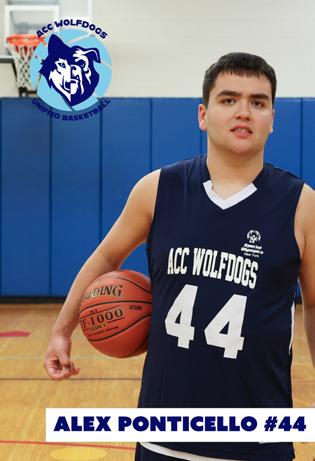
Alex Ponticello
has been on the unfied basketball team for two years. One of the most exburant players on and off the court, Alex can often be found smiling and asking to play basketball. While he likes to stay far away from the hoop, when he’s in the paint he never misses a single shot.
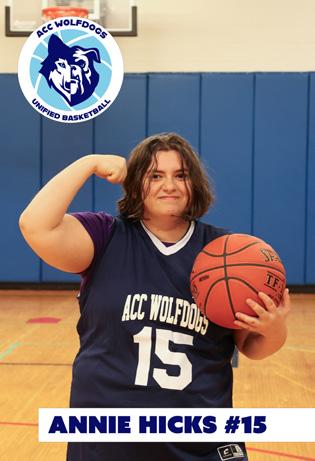
Annie Hicks
has been a player on the unified basketball team for two years. She is upbeat and positive constantly even at moments when defeat seems inevitable and the team begins to lose focus. She always brings a smile to pratice and is a relentless high fiver. On the court she plays great defense.
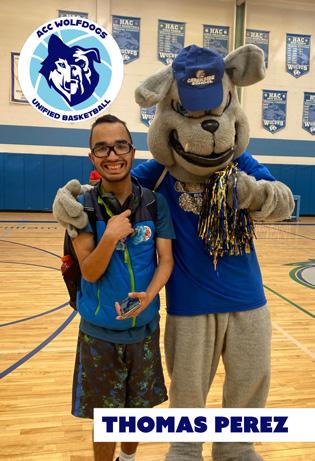
Thomas Perez
(pictured with Creeksides Bulldog mascot) has been on the Creekside School cheer team for four years and has dutifully cheered at many unified games. He is a smiling upbeat member of the cheer team and always cheers on the Wolfdogs from the sideline.
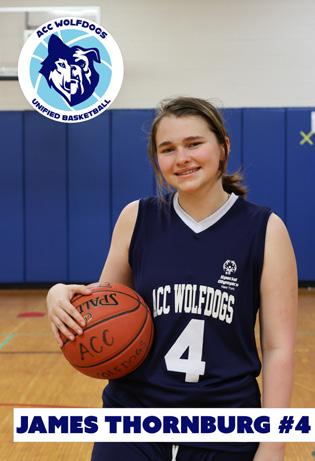
James Thornburg
has been on the Unified Basketball team for three years. They have seen many senoirs graduate from the Unified team and their only hope is that Unified Basketball becomes a permanant instution at AC. They greatly enjoy the game of basketball and leave their all on the court every game.
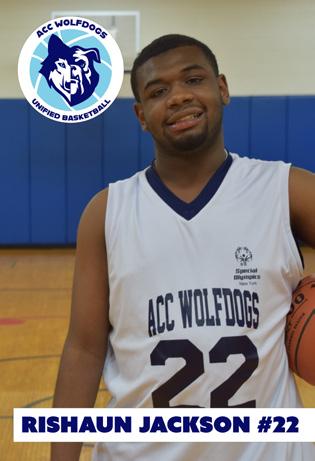
RiShaun Jackson
has been on the Unified Basketball team for three years. He can often be seen taking shots from the three point or half court line. RiShaun (often called RJ) always has a smile on his face and his love for the game is palpable. RJ has been a staple of the team since its inception and his ridiculous shots on the hoop will be missed.
JAMES THORNBURG
Photo by Mihai Fischer on Unsplash
Science Writing And Research
A Study in Pareidolia
Pronouns Playing With Perceptions
SAM ORLANDO
For my Science Writing and Research project, I researched the phenomenon of facial pareidolia. One common instance of pareidolia is when people identify figures by observing cloud shapes. Facial pareidolia is when people perceive the illusion of a face in non-human things that should not have facial features. This project began with my initial interest in the way that people react when they perceive images of different content. For example, I read an article on the uncanny valley effect where the eeriness from a humanoid robot causes an unsettling feeling.
However, instead of figuring out how to quantify emotional responses, I opted to go with testing if pareidolic faces stand out and how memorable images with these illusory faces were. For my experiment I coded a survey into a program called PsychoPy and had two grids of images appear for the participant, one to test if the pareidolic face was more captivating among those without a face and the other to test if it was easier to remember images with pareidolic faces over non-faced ones. From this, I’ve learned that facial pareidolia is a product of the facial recognition process and that illusory faces are perceived just like human faces. •
Last year I created a resume comparison experiment for my final project in AP statistics. The experiment involved two resumes, one with the name John and the other with the name James (both of which are highly common names for white men in America). A copy was then made of each resume, that had the pronouns “he/him” written next to the phone number and email on these two resumes. Participants were shown a John and James resume with the key difference being that one of the resumes they reviewed had pronouns and the other did not.
My Science, Writing, and Research project is basically modeled after that one, however with a few key changes. Participants still see two resumes, however, they do not see two resumes with the same gender.
There are a couple of reasons that I continued doing research on pronoun bias. For one, as pronouns become normalized and sometimes encouraged by employers, it is increasingly important for people in the workforce to understand the advantages and disadvantages of including pronouns in their resumes during the hiring process. This point applies greatly to transgender and queer individuals, whose pronouns might be more central to their identity.
Secondly, there is not a great body of research in this area. While there are a number of studies on discrimination against women and LGBTQ+ individuals in a variety of disciplines and industries, there are not as many on pronoun bias, as it is a somewhat emerging topic. The lack of research creates a vacuum into which right-wing content creators can claim that “smart employers are starting to not hire people that put their pronouns in their resume” (Lou Holly) or that a person who includes pronouns on their resume is “not a very hard worker.”
The data from my research study suggests that pronoun bias is different based on cisgender people’s self-identification with the label cisgender. If a cisgender person does not self-identify as cisgender the data suggests that they display more bias towards pronouns however, the opposite is true for cisgender people who self-identify with the label cisgender. •
Photo by Pascal Bernardon on Unsplash
JAMES THORNBURG
JAMMIN’ WITH GAMES PAINTING THE BATHROOM
MARCUS FRASETTO
I ran this year’s Student Led May Term Session called Game Jam. This Mayterm was part game jam part game development. If students knew how to make video games or board games they had 3 days to make one from the ground up based on a theme. If the students didn’t know how to make a video game or wanted to learn, they were taught how using Unity. Students learned basic coding skills and enhanced their problem-solving skills. Here are some of the games that were created.
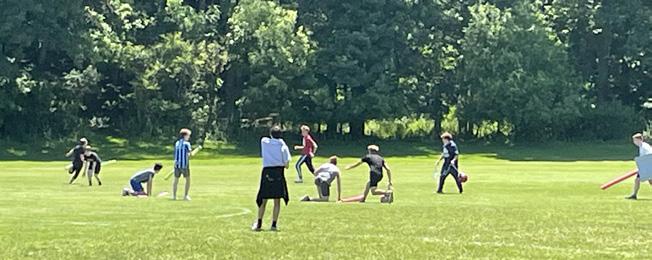
Jugger by Andy Clinton: Jugger is a contact sport where two teams of five players, outfitted with padded spars, compete to grab a ball placed in the center of the field and bring it to the opponent’s goal.
Shovel & Steal by Owen Palomaki: Shovel & Steal is a challenging game where you take the role of a gravedigger, having to complete your job of burying bodies while maybe digging up some others for more rewards.
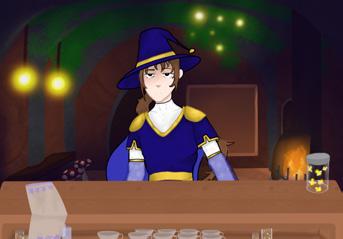
Coffee and Charms by Nora Murray and Brennan Fallen: In our game, you play as a cafe owner in the middle of an enchanted forest, where you serve various drinks to your magical clientele. Each drink order is made up of a randomized drink and a selection of add ins and toppings. Our code uses lists to build the drink icon based on selected toppings, and checks the created list against the customer’s order.
Ultimate Kanjam by Jake Crane, Vance Osness, and Cameron Conheady: The best elements of ultimate frisbee and CanJam combined with a little twist. •
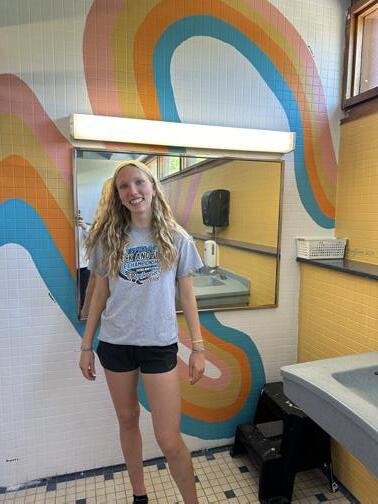
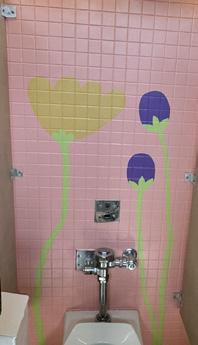
Evelyn Kacprzynski took on her final big project of the school year as she led a Student Run May Term Session. With the support of 18 students and Mrs. Davis-Bernard and Ms. Colson they completed an incredible mural that will be enjoyed for years to come in the upstairs girls bathroom.
The following students helped to paint the mural: Addy Rausch, Katie Chapados, Jess Chapados, Evie Tucker, Sivan Yosha, Lanae Vargas, Mackenzie Opira, Juliette Methot, Olivia Fowler, Kate May, Achanti Thongjang, Gabby Giambra, Leah Moscov, Carlota Muelas Valverde, Shay Hyland Houser, Aryana Saedi, Amora Thongjang, and Evelyn Kacprzynski. •
Evelyn Kacprzynski, James Thornburg, Marina Ellmaker, Caitlin Swartz, Mackenzie Opira, Kexin Cai