![]()
15 Important Paintings and Contepmporary Art including the Fairfield Trust collection and the Chris Booth collection
Total realised — $3 745 364
70. Bill Hammond Hokey Pokey 3 (1997) Realised $609 250
74. Gretchen Albrecht Plume – Red (1983) Realised $85 295
112. Guy Ngan Habitation Realised $62 143
Art+Object announces a sale of studio pottery and ceramics and now invites further entries. The catalogue will be headlined by local collector Michael Pohl’s collection of Keith Murray studio ceramics and glass. Pohl was born just three miles from the Wedgwood factory in North Staffordshire and first began collecting in the mid-1980s, immediately captivated by the simple architectural forms pared with matt glazes. He increased the collection gradually over the following 36 years, purchasing pieces from decorative arts specialists Art and Industry, as well as from Gary Langsford. Much of the collection was exhibited at the Napier Art Deco festival in the late 1980s.
Shoji Hamada
Press moulded bottle vase dry iron glaze body with poured ‘drops’ of nuka and tenmoku glazes to the front and back original exhibition label reading ‘No. 22, Made in Japan’ affixed to the base, together with a later handwritten label, reading ‘H. McCaughern - Japan, 1965’; another later handwritten ‘Shoji Hamada’ label to the shoulder 225 x 155 x 85mm
Provenance: The current owner acquired this piece directly from Hazel McCaughern, who was part of the pottery group working at Risingholme Community Centre, Christchurch in the 1960s. In 1965
Shoji Hamada visited Christchurch to attend the Pan Pacific Arts Festival, where he demonstrated pottery making, firing and glazing, and held ‘An Exhibition of Recent Works’ at the Canterbury Museum (opened 23rd February 1965). It appears that Hazel McCaughern acquired this bottle at the time of the 1965 exhibition. A copy of the exhibition buyer list shows a ‘Miss Hazel McCaughan’ as the purchaser of lot no. 22, described in the catalogue as ‘Moulded flat bottle, bisquit body with white and black glaze design’. A photocopied copy of the exhibition catalogue with a copy of the buyer list are included.
$3000 – $5000
October 31New Collectors Art with further works from the Collection of Chris Booth Studio Ceramics and Design including a Private Collection of Contemporary Craft
Ralph Hotere Black Rainbow at Matauri Bay lithograph, 22/30 title inscribed, signed and dated '88
consignments now invited
Mural for the Wairoa Centennial Library, Hawke's Bay oil on board (1961)
3500 x 3160mm
$80 000 – $120 000
Duncan Winder (1919–1970), Interior, Wairoa centennial library from the collection
Architectural photographs Courtesy of Alexander Turnbull Library, Wellington, New Zealand. Ref: DW-0301-F.
Friday 1st, Saturday 2nd and Sunday 3rd December from 11.00am to 4.00pm Monday 4th December from 9.00am – 5.00pm and the day of the sale.
John Elliot Lawford (‘Johnny’) was a mainstay of the New Zealand auction and gallery community for many years, assembling one of the country’s most extensive and interesting collections of New Zealand paintings and prints, rare books and taonga. Born in 1933, Lawford travelled extensively for some sixty years procuring orders for the family business firm CE Lawford, importers and merchants of hardware and tools. During this time he frequented salerooms all around New Zealand and the world, pursuing his passion for collecting and repatriating items to New Zealand of national signifi cance. The collection includes a major painting by William Strutt, one of the most signifi cant early New Zealand paintings in private hands, an exceedingly rare copy of Edward J Wakefi eld’s Illustrations to Adventure in New Zealand (London, 1845) with colour lithographs, a pair of 19th Century Huia birds mounted in vintage case, and a large pre-European pounamu adze.
Alpine luxury is at its finest at 275 Littles Road offering scale, aspect and sophistication. The brand new home spans over 445 square metres constructed with a thermally broken concrete slab, steel and glue-laminated framing clad in cedar timber and off shutter concrete.
Cedar garage doors open to an oversize double garage with ample space for a drying room whilst providing internal access to the architectural home. Commercial grade aluminium joinery with stainless steel handles and double glazed low E MAX performance glass open to the extremely private 4.2 hectare land holding.
Stunning elevated views capture Coronet Peak to include the Crown Range, Ben Lomond and many more significant ranges.
Four large bedroom spaces are currently configured to two masters with en-suites and two bunk rooms that can sleep up to six in each. Multiple living areas both inside and out create easy entertaining for all ages and weather conditions.
This new luxury home comes with many more features which are itemised in the full Information Memorandum available upon request.
Gary Langsford and Vicki Vuleta are undoubtedly some of Auckland’s most stylish people. They were influencers before we understood the word as such, and for many years have bought their unique mix of local and international style to New Zealand.
Since founding Gow Langsford along with John Gow in August 1987, the gallery has mounted over 500 exhibitions of contemporary art and has in large part been responsible for the strength of our local art market. They have also been leaders in bringing us some of the best international contemporary art with landmark exhibitions by Pablo Picasso, Damien Hirst, Bernar Venet and Tony Cragg among others.
With a background in interior design and tv production, Vicki established her business Design 55 to bring together an eclectic curated collection of high quality design. Sourcing furniture and decorative objects from all over the world, Design 55 is the Auckland home of world-renowned brands such as Fornasetti, Campana Brothers and Yves Klein.
Gary has always had big vision and this is far from waning. His next project, together with fellow Directors John Gow and Anna Jackson, is a new gallery space on a grand scale for Gow Langsford that will open in a couple of months. Recently Gary and Vicki have chosen to leave their large inner-city apartment to move to a smaller home, just outside Auckland, and much of their treasured collection cannot be accommodated there.
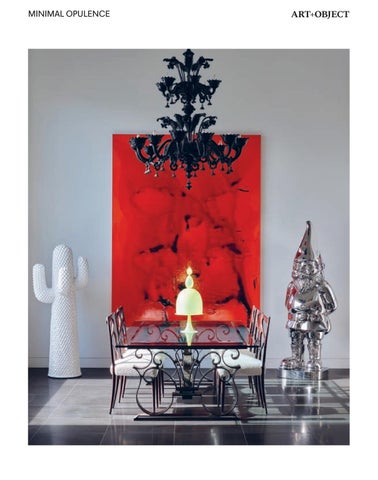
Art+Object is delighted to have the opportunity to auction such a unique collection, with fine examples of art by artists that Gary has worked with and collected over time, together with unique objects of design of international renown. I hope you will take the opportunity to view this auction in our rooms and do join us at the preview on Wednesday 13 September to celebrate Minimal Opulence: The Gary Langsford and Vicki Vuleta Collection.
Leigh MelvilleSaturday 16 September, 3pm
Since co-founding Gow Langsford Gallery in 1987 in Richmond Road in Grey Lynn, Gary Langsford has mounted over 500 exhibitions of contemporary art and been, in large part, responsible for the pioneering and growth of the contemporary New Zealand art market. He has worn many hats in his life and in the 1980s, alongside Dave Dobbyn, he was a member of the popular band DD Smash, and a decorative arts dealer specialising in Art Nouveau and Art Deco. Along with his career as one of the county's leading art dealers, Langsford has long been an inveterate collector of everything from guitars to contemporary art to classic cars and twentieth century art.
Join us for a unique conversation between Art+Object Director Leigh Melville and Gary Langsford, where they discuss his life in the rapidly-changing art world and his unique collection of art and design.
Gary Langsford and Vicki Vuleta.
Auction
Tuesday 19 September at 6pm 3 Abbey Street, Newton, Auckland
Preview
Wednesday 13 September, 5pm–7pm 3 Abbey Street, Newton, Auckland
Viewing
Wednesday 13 September
Thursday 14 September
Friday 15 September
Saturday 16 September
Sunday 17 September
Monday 18 September
Tuesday 19 September
9am–5pm 9am–5pm 9am–5pm 11am–4pm 11am–4pm 9am–5pm 9am–1pm
3. Hugo Koha Lindsay, Slashed Tyres and Big Tickets, mixed media on canvas, title inscribed, signed and dated 2016 on original Gow Langsford label affixed verso, 1500 x 1200mm. $6000 – $9000
5. André Hemer, Deep Surfacing NYC No. 7, acrylic and pigment on canvas, title inscribed, signed and dated 2017 verso, 1680 x 1270 x 80mm. $18 000 – $28 000
6. Ot tmar Hörl, Sitting Worldview, moulded plastic, MDF, white, stamped Hörl to base, 560 x 320 x 300mm. $500 – $800
7. Simone Cenedese, Ciottoli, two hand blown glass sculptures in cubic shape with blue mirrored finish, each signed to the base, 130 x 140 x 140mm and 125 x 130 x 130mm. $600 – $1200
8. Monkey Umbrella Stand, glazed ceramic, white, stamped Design55 to underside, 500 x 350 x 280mm. $600 – $900
9. Z anotta, Quaderna 710 Console, designed in 1970, honeycomb core structure coated with white resin laminate, digitally printed with black squares, 845 x 1840 x 420mm. $5000 – $8000
11. Reuben Paterson, Astro, glitter and acrylic on canvas, signed and dated 2017 verso, 1000 x 1000mm. $8000 – $12 000
16. Dick Frizzell, Have A Nice Day, oil on canvas, title inscribed, signed and dated 15/5/2005, 1000 x 1000mm. $20 000 – $30 000
21. Max Gimblett, Untitled (Skulls), metallic foils and silkscreen print on paper, artist’s studio stamp applied lower right, 755 x 568mm. $2500 – $4000
22. Max Gimblett, Pearl Lotus, unique screenprint, title inscribed, signed and dated 2021, 545 x 545mm. $1500 – $2500
23. Max Gimblett, Silver Tower, unique screenprint, title inscribed, signed and dated 2021, 545 x 545mm. $1500 – $2500
Max Gimblett is one of the country’s most celebrated contemporary painters. Active since the 1960s, he has created an extensive body of paintings, prints, drawings and objects. Gimblett is well-known for his distinctive works, and particularly for the quatrefoil motif that appears throughout his practice.
While painting is the source of much of his renown, Gimblett has consistently produced editions of prints throughout his career. Rather than always producing numbered editions of identical prints, the artist has instead favoured creating works that share common elements in unique configurations. His screen-prints have been presented on aluminium and on paper, often in his signature quatrefoil shape. Combining gestural sweeps of ink and employing various screen-printing techniques to create dynamic backgrounds, these striking works capture the essence of his practice.
Gimblett has lived in New York since 1972, though makes regular visits back to New Zealand, his home country that he greatly adores. His works are infused with the vibrancy and immediacy of life in New York, coupled with an innate ease from his Kiwi roots. He has long studied and engaged with Zen Buddhist philosophies, and this has had great influence on his practice. His connection to Zen is represented physically through the gesture and movement in his work, though also in their meditative quality.
With decades of studio practice and philosophical engagement behind them, these prints distil and capture the essence of his artmaking. Gimblett has forged a reputation as one of New Zealand’s great abstract artists. He continues to produce and exhibit artwork in Aotearoa and abroad to this day.
Through extensive periods of study and travel, Max Gimblett has developed a rich understanding of human psychology and art that transcends borders. Jungian psychology and Asian philosophies and art-making practices are central influences in his work. His study of these fields of knowledge began in the 1960s and has remained constant throughout his career. He has referred to an awakening of Western culture towards Asia, Asian art and the ideas synonymous with its culture and history as an important thread in his artistic practice.
It is through the practice of Zen calligraphy that Gimblett conceives his spontaneous, all mind/no mind gestures. He responds instinctively to the canvas, creating gestural brush strokes that blend vigorous expression with a sense of harmony. His engagement with Zen philosophy gives such mark making techniques a paradoxical reading: they become both a unique impression left by the artist, and egoless. This methodology of all mind/no mind is central to Gimblett’s artistic practice. Wystan Curnow writes, “... [Max Gimblett] does not in the usual sense watch what he is doing – there’s no time... The eye acts much as the arm does and aims to interact with it.”1 Gesture precedes thought in a burst of pigment on canvas. His paintings have the assured confidence that arises from a sustained, meditative practice.
Alongside his Eastern influences, Gimblett is acutely aware of the Western traditions that inform his work. He acknowledges that his practice aligns with other practices in the trajectory of American art history, most notably the work of painters Jackson Pollock and William de Kooning. The ideas and methods of these artists are part of the backdrop of influences that his work connects with and responds to.
Gimblett is one of few New Zealanders to have exhibited at the Guggenheim Museum, New York City. This is one of many highlights in his extraordinary, decades long pursuit of a unique artistic practice.
24. Max Gimblett, Distance Looks Our Way, gesso, acrylic and vinyl polymer, epoxy and gold leaf on canvas, title inscribed, signed and dated 2013 verso, 2030 x 1655mm. $50 000 – $75 000
26. Max Gimblett, Most Radiant Path, libragloss ink and UV gloss on aluminium, title inscribed, signed and dated 2019 verso, 1016 x 1016mm. $13 000 – $18 000
27. A pair of Murano glass Vases with gold leaf detail, clear blown glass, signed and inscribed Murano to the base, 322 x 232 x 232mm: each. $2500 – $4000
A feature of Dale Frank’s painting has been its inherent simplicity and apparent effortlessness. Summer of Love and the Swimmer problem — the sea of love broken down, crudely materialised, is just paint slipping and varnish, literally flattened. But look more closely. Is this work really that simple?
In Summer of Love Frank’s clouds of brown varnish are emblems of the enigma of perspectival space, amorphous and difficult to pin down, they seem to embody the mystery of that invisible depth that painting is somehow able to bring about on a two-dimensional surface. The tension between them is constant and eventful, full of jangling, caressing surprises that globulate. The formal dissonance of Frank’s painting is the engine of his seductiveness. Our eyes revel immersively in the contradictory effects. This is why I think Frank’s art is fundamentally conceptual, for he is just as much attempting to paint an idea — a distance that can be made visible — as anything actually visible. His work is hedged with conflicts and chances and limitations even in its moments of profligate beauty and celerity when his paint falls like loose change. You begin to understand in a word how radical he is, radically interrogating art, restlessly nagging and pushing and trying to force his painting to make good its promise. The combination of liquidity and gravity (both in the sense of ‘downward force’ and ‘seriousness’) connects Frank’s work to the poured paintings of Jackson Pollock. How do you get all that from this painting you may want to ask? You get it by looking carefully and calmly, and by noticing what isn’t there. Here’s a preliminary list: Gesture. The marks in a Frank painting result from tipping the canvas, not directly from his hand as such. The paint and the movement of it are different things, without seeming connection, this is what makes them so real. We might speak of the emptiness of the artist’s speaking position and this emptiness being somehow Australian. Frank’s paintings have been read as self-portraits and advertisements for himself but is his art more of a self-disguise than an exercise in self-expression?
Expression. Frank’s painting never functions as a commentary on anything. Sure the long and abstruse titles might seem to send you in a direction with their crude jokiness. But this is a red herring (excuse the pun). Is the emotionally fraught red of Summer of Love the red of sanguinity, bloodthirsty sharks in the sea? Where is the depiction of the ‘summer of love’ in Haight-Ashbury in San Francisco in 1967? Can we see a ‘swimmer’ in the painting drowning in love? The titles are not so much funny as ecstatically cracked — a sort of safety valve for the demonic act of painting. It is laughter in a void. Sincerity is never an issue; sentimentality is inconceivable. Frank’s paintings function instrumentally and neutrally. And yet, as I have already started to discover, and as Frank, in his artist’s statement at Roslyn Oxley Gallery, October 1986, intimates, his work contains: ‘A powerfully expressive symbolism which is so unalterable in its forms that a person uninitiated may at once recognise a work of signification without knowing its meaning.’
Drawing. There is no planning here. No preliminary drawing. Instead paint makes the painting. While it is based on stopping and starting, the choreography of the composition is not hesitant but bold and theatrical. The painting is about how it is experienced, how it works. Then it is all captured under varnish like an insect in amber. Frank’s paintings feel constantly wet, transparent like nail polish.
Decoration. A Frank painting is not a design nor designed. It’s not decoration. Decoration doesn’t involve you with thinking about how something was done. But a Frank painting lets you think about nothing else. Why way up or down does the paint run in Summer of Love? Why does the varnish slosh into globules here and here? Why do the great droopy swathes of blurred varnish suddenly stop at this point? Frank’s paintings are essentially eidectic, meaning reliant on the capacity that makes us want to see animals or faces in clouds or cracked walls. Remember the famous exchange between Hamlet and Polonius (Act 3, Scene 2):
Hamlet: Do you see yonder cloud, that’s almost in shape like a camel?
Polonius: By the mass and ’tis — like a camel, indeed.
Hamlet: Methinks it is like a weasel.
Polonius: It is backed like a weasel.
Hamlet: Or like a whale.
Polonius: Very like a whale.
Frank’s paintings evolve from the accidental properties of his materials and from the irrational associations of his viewers. It’s painting as an hallucinogenic drug. Is the artist high on varnish? Is his viewer?
Transcendence. Critics have identified a shamanic twist behind Frank’s work but his is a dubious mysticism. Apparently in his youth he was going to enter the Catholic priesthood. However, despite being promoted as an ‘outsider genius’, there is no psycho-spiritual lift-off here. These are just paintings. At the same time they seem to be asking for transcendence or asking why it cannot be in this painting. The silence of a Frank painting is the silence of listening for an answer. Maybe there isn’t an answer, just the listening.
As might be expected, Frank’s work beggars standard modes of analysis, whether formal or empirical. It ruins all my efforts here. It is as if he were saying in effect: ‘Here is some paint. Did you by chance expect something else in a painting?’ The fact that Frank’s paintings are just paintings, the radical materiality of them, is what stuns you (stupifies you) at first. Each painting is an enigmatic attempt to capture enigmatically the enigma of painting. But a Frank painting keeps on being a painting, beautiful, lively and forlorn, elusive.
Laurence Simmons
30. Dale Frank, Summer of Love and the Swimmer problem – the sea of love, acrylic and varnish on canvas, 1995-96, 2600 x 2000mm. $60 000 – $80 000
34. Dale Frank, Untitled, unique silkscreen print, signed and dated 2020 verso, 1420 x 965mm. $8000 – $14 000
3 5. Dale Frank, Untitled, unique silkscreen print, signed and dated 2020 verso, 1420 x 965mm. $8000 – $14 000
Provenance: Purchased Pablo’s Gallery, New York City. $2000 – $4000
Provenance:
38. Anthony Goicolea, Pool Pushers, type C print, edition of 6, signed verso, 1270 x 1905mm. $10 000 – $16 000
40. Sandrine Pelletier, Untitled (skeleton), latex dipped crochet, 2450 x 1500mm (installation size variable). $3000 – $6000
42. Damien Hirst, Histidyl, screenprint, 114/150, signed and editioned, stamped with Other Criteria monogram, 755 x 940mm. $20 000 – $30 000
43. Damien Hirst (British b. 1965), Palais des Papes from the series Cathedral Prints, 2007, silkscreen print with glazes and diamond dust on wove paper, 43/50, signed and inscribed with edition number, 1195 x 1195mm. Published by Other Criteria, London. Note: Modeled after the artist’s Superstition paintings of 2006, these radiating compositions of meticulously arranged butterfly wings create intricate patterns of dazzling shapes and colors that evoke the rose windows of Gothic cathedrals or the tesserae of Byzantine mosaics. By allying the fragility of the butterfly wings with the monumentality of religious art, these prints engage the big existential themes –nature, life, religion – that have defined Hirst’s career. $70 000 – $100 000
44. Abhika (Sicily), Traditional Moor head-shaped vase, Caltagirone glazed ceramic, maker’s name stamped to underside, 415 x 240 x 250mm. $1000 – $2000
45. Damien Hirst, The Hours Spin Skull – See the Light, gloss acrylic on resin with compact disc ‘See the Light’, 53/210, signed and dated 2009, facsimile signature on the original box, 200 x 200 x 130mm. $8000 – $12 000
46. C. Colizzo for OroVetro Murano, Blown glass vase, signed to the base and dated 2022, 400 x 260 x 260mm. $4000 – $7000
47. Marzio Cecchi (Italian 1940–1990), Diapason Desk for Studio Most, stainless steel cantilever desk, limited edition, 1968, 1900 x 730 x 600mm. $20 000 – $30 000
Karl Maughan’s ten years in London spanned the end of the twentieth and beginnings of the twenty-first century during the heyday of the Young British Artists (YBA). Having secured representation by Gow Langsford in 1987 when he had just graduated with his BFA from Elam, Maughan was only 30 when he arrived in England seven years later. He was quickly absorbed into the YBA scene. His successes in Britain include being one of just 48 painters chosen to be finalists out of the 1,788 British-based artists who entered the John Moores Biennial Painting Prize at the Walker Art Gallery in Liverpool in 1997, and having a painting purchased by advertising mogul Charles Saatchi for his private collection. While he lived in the United Kingdom, his nearly two metre square painting Aro Valley was bought by the Arts Council England in 1999 for its permanent collection. As if to mark the dawn of the new millennium in 2000, the Museum of New Zealand Te Papa Tongarewa responded to these English accolades by purchasing a major work of Maughan’s, the six panels of his beautifully detailed depiction of a herbaceous border, the ten-metre-long A Clear Day.
It is always a clear day in Maughan’s paintings, and flowers bask in the eternal sunshine of a spotless garden here in this vision of a brilliant day in early summer in the Welsh Marches. Like his other large works from this era, this painting impresses with its physicality. The subject is the azaleas and rhododendrons framing a path at Hergest Croft in Hertfordshire, at Kington, near the border with Wales. Open to the public only during spring and summer, from 1 April to 31 October annually, these gardens are home to the finest collection of trees and shrubs in the British Isles, with over 5000 specimens of maples, birches and zelkoves, including the oldest example in Britain of a tree introduced from China. Divided into parks, groves and glades which expand over 28 hectares, Hergest Croft has been created and maintained over 120 years by five generations of the wealthy Banks family. As it happens, the second of June 2002 (when Maughan visited and took the photographs that would form the basis for this work) was the Sunday of the long weekend occasioned by the Bank Holiday to celebrate the monarch’s birthday on the Monday. Unlike the heatwaves in June and July which Britain has experienced in recent years, in 2002 the temperature at Kington reached no more than a comfortable 22 degrees.
In Maughan’s painting, we are first drawn to how the apricot and orange blooms on the right arc away like the trajectory of a holiday weekend in summer, diminishing into the distance where they perfectly complement the greens of the orderly foliage above. While this part of Hergest Croft Gardens is famously dominated by a massive avenue of blue cedars planted in 1900, Maughan has edited out some of the trees to let us see the politely whitish-blue summer sky beyond. He has also cranked up the lumens so that the sunshine falling on petals and leaves is bright and antipodean rather than reservedly English. On the left though, the mood is quite different, with the darker colours and occluded light creating a counterpoint. It seems the sun has already passed its meridian and long shadows are cast across the grass path by the hairy blue cedar which towers above the mauve rhododendron. This introduces a psychological chill, as if some unseen threat or danger might lurk. Each brush stroke is visible and expressive, and they mass together to build the work’s emotional impact on its viewer, leaving us wondering about what lies unseen, just around the corner ahead.
can look enables in keeping also has international weight German artists were the 1960s. group, it extends to a picture and vibrantly scale, these on an entirely reflects colour. application.
Anne Ring preliminary ‘mechanised Untitled the visual only establish as an authentic enlarges the human register European text collapses. Visual pathways in a video where things linear structure, bottom. creating spraying potential object, works have composition of line and though
49. Bruce Jarvis, Mick Jagger and Keith Richards, black and white photo, 1/40, signed, 352 x 360mm. $800 – $1400
50. Gufram, Capitello seat, armchair in the form of an Ionic capital, cold-moulded, differentiated density polyurethane foam painted with Guflac, 91/500, stamped to underside, 1100 x 1200 x 820mm. $4000 – $8000
A painting is simply a screen between the producer and the spectator where both can look at the thought processes residing on the screen from different angles and points in time. It enables me to look at the residue of my thinking.1
Katharina GrosseAs a discipline, abstract painting can seem rarefied and intellectual. This is in keeping with its historical standing as a highly academicised artform, though abstraction also has immense expressive potential. German artist Katharina Grosse has built a stellar international reputation for her inventive approach to abstract painting, which holds academic weight while also disrupting conventions and presenting viewers with new ways of seeing.
Grosse’s work can be contextualised in relation to an earlier generation of German post-war artists, including Gerhard Richter, Sigmar Polke, and Blinky Palermo. These artists were at the forefront of a new focus on conceptual painting that rose to prominence in the 1960s. While Grosse’s work engages with some of the same conceptual concerns as this group, it steps further into the realm of the expanded field of painting – that is painting that extends beyond conventions of two-dimensional supports, traditional media, and containment to a picture plane.
Engagement with the expanded field is most evident in Grosse’s monumental and vibrantly colourful ‘in situ’ works. Bucking conventions of support, medium specificity, and scale, these works bring landscape and architecture into the scope of painting. 2 While operating on an entirely different scale, Grosse’s approach to the two-dimensional surface of a canvas reflects her expanded field thinking. Untitled No. 1026 is a work of complex layering and striking colour. It is noticeable for its lavish colours, runs of paint, and non-conventional methods of paint application.
In her 2010 essay Painting Spaces, Danish contemporary art professor Anne Ring Peterson states, “Grosse often spray-paints her works spontaneously and without preliminary sketches. She uses a standard tool of house painters and graffiti artists, the ‘mechanised brush’ of the spray gun.” 3 Just such a tool appears to have been used to create Untitled No. 1026. This enables the artist to work on a dramatic scale, while also transforming the visual register of the artwork. Ring Peterson adds, “By using a spray gun Grosse does not only establish a cool distance to Abstract Expressionism and the modernist myth of painting as an authentic ‘imprint’ of the artist’s hand and a direct expression of his inner life. She also enlarges the gestures of the hand, making them bigger and more powerful than the physique of the human body allows.”4
In addition to its monumental scale, Untitled No. 1026 plays into the non-linear register of painting. Written language necessarily reads from top to bottom, left to right (in European languages at least). This linear structure can’t be compromised, or the meaning of the text collapses. Paintings are read differently; one takes in the whole, then focuses on details. Visual pathways are subjective, nuanced, idiosyncratic. Grosse has discussed this general effect in a video interview, stating, “The linguistic structure urges you toward a certain order system where things follow one another, which is very linear. And I realise that painting does not have a linear structure, but the synchronicity in painting is super compelling for your thought process.” 5
In Untitled No. 1026, paint runs give the work a sense of gravity, a top and bottom. Yet, the spraypainted areas counteract this effect, drawing the viewer up and across, creating a satisfying, never fully resolvable visual play. This is an effect of both the masking and spraying techniques used, and the artist’s choice of colour. Grosse states, “I like this anarchic potential of colour. I see it very clearly that colour is actually taking away the boundary of the object, so there is no subject-object relationship anymore.”6
Two untitled acrylic paintings on paper also appear in this catalogue. These works have much more of a grid-like, linear structure than Untitled No. 1026. Through deft composition and colour selection, they present almost meditative studies on the effectiveness of line and contrast. Where Untitled No. 1026 is anarchic, these two paintings are measured, though they retain visual complexity.
51. Katharina Grosse, Untitled No. 1026, acrylic and metallic pigment on canvas, title inscribed, signed and dated 2017 verso, 2600 x 1900mm. $300 000 – $500 000
Over the past three and half decades, Grosse has developed a practice that challenges the very axioms of painting, disrupting conventions of how the artform is understood. Consequently, her work has been exhibited in highly regarded international contexts and is held in many of the world’s most esteemed collections.
Julian McKinnon
1 “Katharina Grosse” Gagosian.com, https://gagosian.com/artists/katharina-grosse/.
2 An example of this is her 2016 work Rockaway, which involved transforming an abandoned New York military building into an artwork. Grosse spraypainted the building and its surrounds to create an immersive artwork. In such works as these, one can draw parallels between her paintings and the 1970s land art of American artist Robert Smithson.
3 Anne Ring Peterson, “Painting Spaces” in Contemporary Painting in Context Anne Ring Peterson, ed. (Copenhagen: Museum Tusculanum Press, 2013), 132.
4 Ibid.
5 Ar t 21. “Katharina Grosse: Painting with Color” April 18, 2015. 4 mins 40 seconds. Quote 1:18–1:36. 6 Ibid. 3:04–3:17
55. WMF, Art Nouveau three-branch candlestick, copper and brass, 320 x 200 x 115mm. $300 – $600
56. Michael Parekōwhai, Rainbow Servant Dreaming, automotive paint on fiberglass, 2005, 670 x 240 x 165mm. $15 000 – $25 000
58. Katharina Grosse, Untitled, acrylic on paper, 1015 x 670mm. $38 000 – $55 000
Judy Millar’s paintings occupy a unique locus. They speak to a lineage of post-war Euro-American abstract painting, yet retain specificity to contemporary Aotearoa. Her practice is diverse, though she is best known for her gestural paintings. Such works energetically explore colour and contrast while clearly indexing the passage of the artist’s hand.
Millar’s process of paint layering creates an impression of spatial depth, though this is not achieved through conventional means of linear or atmospheric perspective. Instead, it arises through the contrasting colour of distinct layers. The artist’s gestural approach to applying paint results in areas of thin, semi-transparent paint work. A viewer will find themselves looking through several layers of different colours, blended through translucency. Though they will continually be drawn back to the motion of the marks on the surface. This gives rise to a perplexing and never-total sense of visual depth.
Commenting on Millar’s work, German art historian Leonhard Emmerling stated, “The structure of her paintings is achieved through multiple applications of layers of paint and wiping each application with the side of the hand, a rag, a blade, a brush or a paintbrush.”1 Further
to this, he added, “Large canvasses are filled with wide, undulating lines competing with fields of colour that appear to lie deeper, creating a tension or establishing a kind of silent opposition. Any semblance of tectonics, structure or composition is avoided.” 2 These observations on technique and content highlight Millar’s highly specific approach to painting. If one looks to this nation’s modernist pioneers, McCahon, Angus, Walters, there are no real precedents in New Zealand painting for what she does. If anything, the gestural aspects in some of Milan Mrkusich’s work is the nearest fit, though his practice bears no real relationship to hers.
In some ways, American Abstract Expressionism is a closer fit. This was picked up on by writer Anthony Byrt, who stated, “No matter how illustrative Millar’s paintings become, her physicality is a constant presence. This has led several writers […] to compare her work with Abstract Expressionism, and particularly with Jackson Pollock’s paintings.” 3 As Byrt states, there is a certain similarity between the two artists’ physical approach to making the paintings, though the differences are many.
Searching for precedents can be helpful in terms of contextualising Millar’s work, though the real experience of viewing them needs no historical roadmap. There is a joy in the sweeping colours, the energy and vitality of the gestural marks, and the shifting register of translucent overlap that surpasses any need for lineage. Millar herself has commented on this. “There’s a wonderful quote from Philip Guston, where he says that when he steps into the studio various people disappear, and if he’s lucky he disappears as well. There’s a point in the studio where I feel I’ve disappeared. Where a part of me shuts up for a while. […] You’re moving and doing, but clock time drops away. It’s difficult to give these things words, but that’s it crudely. I think these are the moments where you’re able to still that dualism, and move into a place of total presence.”4
The three works presented here are prime examples of Millar’s distinctive artwork. Two of them are from 2004 and the third from 2017, situating them either side of her major exhibition Giraffe–Bottle–Gun at the Venice Biennale in 2009. These works demonstrate the through lines of Millar’s practice – she has pursued a specific enquiry into gestural mark making for decades. They also demonstrate her ongoing evolution as an artist, the latter work featuring a more restrained palette, a more deliberate set up of depth through contrast. Viewing them together, one gets the sense that Millar’s paintings will continue to challenge, enthral, and ask questions of viewers for decades to come.
Julian McKinnon1 Leonard Emmerling, “To Stay in the Open” in Judy Millar: You You Me Me Leonard Emmerling, ed. (Bielefeld: Kerber Verlag, 2009), 27.
2 Ibid.
3 Anthony Byrt, “Things in Space” in Judy Millar: You You Me Me Leonard Emmerling, ed. (Bielefeld: Kerber Verlag, 2009), 7.
4 Judy Millar and Justin Patton, “Changing Space” in Judy Millar: You You Me Me Leonard Emmerling, ed. (Bielefeld: Kerber Verlag, 2009), 130.
61. Judy Millar, Untitled, acrylic on canvas, signed and dated 2004 verso, 2030 x 3025mm. $45 000 – $65 000
63. Shane Cotton, Kikorangi, lithograph, 35/40, title inscribed, signed and dated ‘04, 560 x 760mm. $1000 – $2000
6 4. Shane Cotton, Pararaiha, lithograph, 35/40, title inscribed, signed and dated ‘04, 560 x 760mm. $1000 – $2000
65. Shane Cotton, Moerewa, lithograph, 35/40, title inscribed, signed and dated ‘04, 560 x 760mm. $1000 – $2000
68A. Simon Ingram, Painting with a Rule, acrylic and found ruler on board, title inscribed, signed and dated 1996 verso, 610 x 408mm. $3000 – $5000
69. John Reynolds, Fuck Cancer, acrylic and paint marker on canvas, title inscribed, signed and dated 2017 verso, 100 x 100mm. $150 – $250
70. A pair of decorative glass pills, each signed and dated ‘03, H. 360mm. $300 – $500
71. Loft Design, Art is a Dirty Job But Somebodys Got To Do It, three ceramic letters in original box, 495 x 205 x 40mm. $100 – $200
75. Lynne Roberts-Goodwin, Cloud number 9, type C print, edition of 20, 490 x 490mm, accompanied by original Certificate of Authenticity. $800 – $1200
76. Lynne Roberts-Goodwin, Licorice number 9, type C print, edition of 20, 490 x 490mm, accompanied by original Certificate of Authenticity. $800 – $1200
77. Anthony Goicolea, Untitled, type C print, 205 x 205mm. $600 – $1000
80. Jeff Koons, Hoover, offset lithograph on paperboard, 27/50, signed and dated ‘95, 1010 x 710mm. $3000 – $6000
81. Jeff Koons, One Ball Total Equilibrium Tank (Spalding Dr. J Silver Series), offset lithograph on paperboard, 27/50, signed and dated ‘95, 1010 x 710mm. $3000 – $6000
82. Jeff Koons, Bourgeois Bust, offset lithograph on paperboard, 27/50, signed and dated ‘95, 1010 x 710mm. $3000 – $6000
83. Jeff Koons, Rabbit, offset lithograph on paperboard, 27/50, signed and dated ‘95, 1010 x 710mm. $3000 – $6000
85. Yves Klein (French 1928–1962), Table Bleue, International Klein blue pigment, glass, plexiglass, wood and steel, 380 x 1255 x 1000mm.
Note: this table is based on a model designed by Yves Klein in 1961. This edition began in 1963 under the supervision of Klein’s widow Rotraut Klein-Moquay. Accompanied by certificate of authenticity issued by Yves Klein Estate. $35 000 – $50 000
87. Fernando Campana and Humberto Campana, Alligator Chair from the Banquette Series, embroidered Campana No 4, 2006, stuffed animals, stainless steel, from an edition of 35, 900 x 1000 x 140mm. $30 000 – $50 000
An unbridled joy in experimentation and creativity were always central to Pablo Picasso’s interests as an artist. As one of the most significant artists in history, Picasso created many of the 20th Century’s most enduring and poignant images. Throughout the long course of his career he created more than 20 000 paintings, drawings, sculptures and ceramics, as well as numerous costume and theatre designs.
In 1946, while holidaying in the south of France, Picasso first discovered the artistic potential of ceramics whilst visiting the Madoura pottery studios in Vallauris. Over the following two decades he would experiment widely with clay, producing a diverse range of objects including vases, plates, platters, ewers and sculpture. Fascinated by the materiality of the medium he would carve and incise into the clay as well as exploring the effects of different glazes and paints in depth. His sustained investigation into the ceramics medium, eventually led to an interest into the opulence of the gold and silver dishes of the Renaissance period and the ‘repoussé’ technique of hammering a motif into low relief from the underside of the silver.
Visage Géométriques aux Traits was produced in 1956, just four years after he met Jacqueline Roque, the artist’s great muse and second wife. The playful and inventive design of his silver plates reflects the great happiness and stability he felt at this time, a marked shift after the dark and uncertain years of the war.
Despite his prolificacy, the artist produced just twentyfour designs in silver. Each is marked by a joy and whimsical nature, inspired by everything from owls and goats, Greek mythology and bull fighting, and, of course, his much loved wife, Jacqueline. The public remained largely unaware of the existence of Picasso’s silver work until the ground-breaking solo exhibition, ‘Picasso – 19 plats en argent par François et Pierre Hugo’ at London’s Lever Galleries and Paris’s Galerie Matignon in 1977. A complete set of the twenty four plates was sold at Sotheby’s in October 2021 for 1.46 million pounds.
90. Émile Gallé, Cameo glass vase on a peach ground with purple floral decoration, cameo signature, H. 630mm. $2000 – $3500
9 1. Émile Gallé, Cameo glass lamp, decorated with blue flowers motif, signed, H. 390mm. $2000 – $3000
92. Tiffany Studios Desk Lamp, gilded bronze with damascene shade, stamped Tiffany Studios, New York to the base, 500 x 250 x 180mm. $2000 – $4000
97. Keith Murray for Wedgwood, Vase, tapering lathe-turned cylindrical high-shouldered Moonstone vase, signed to base, 300 x 205 x 205mm. $1200 – $1800
98. Jaime Hayon for Metalarte, Josephine Gold Lamp, gold porcelain lamp base with conical shade, original label to underside, 760 x 250 x 250mm. Note: The form of the Josephine lamp is an homage to Baroque design, yet the singular colour and simplified form affords a contemporary edge. $300 – $500
99. Fornasetti, curved chest of drawers Palladiana, silkscreen and lacquered wood, 810 x 1000 x 540mm. Note: The contrast between the rigorous architectural design and the cabinet’s rounded forms is a tribute to the Neoclassical language of Andrea Palladio. The reproduction of an Italian garden on the top shelf is completed by hand. $30 000 – $50 000
100. Fornasetti, Viso Lamps, a pair of cylindrical metal lamps with hand-silkscreen design featuring the face of Lina Cavalieri, with brass detailing and black shades, 350 x 100 x 100mm; each (excluding shades). $4000 – $6000
101. Fornasetti, Occhio tray, aluminium tray in original carry bag, stamped Fornasetti Milano, Made in Italy, 11-93, 590 x 255mm.
$800 – $1200
102. Fornasetti, Mani paper basket, silk-screened and hand-lacquered metal with a brass rim and brass feet, 285 x 265 x 265mm.
$1000 – $2000
103. Ve rsace for Rosenthal, porcelain vase with silver lustre, original Versace labels to the underside, 185 x 210 x 120mm. $200 – $400
104. Ross Lovegrove for Gufram, a pair of Softcrete coffee tables, polyurethane foam, 450 x 450mm. $800 – $1600
105. Mo dernist side table, wood and aluminium, 525 x 500 x 550mm. $500 – $900
106. Jacopo Foggini for Edra, Cicladi marble top side table, amber alabaster top with gold pedestal base, 410 x 590 x 400mm. $3500 – $6000
107. Greg Natale, Gold silk rug, 3000 x 2500mm. $2500 – $4000
110. Donald Judd, Chair and Stool, pine, impressed signature and date 2001 to underside, 770 x 380 x 380mm (chair), 450 x 380 x 380mm (ottoman). $6000 – $9000
112. Biedermeier, Linenpress or “Secrétaire”, veneered burrwood, 19th century, 2120 x 1640 x 575mm. $4000 – $8000
116. David Trubridge, Body Raft 2000, oak, steam bent sculptural chaise lounge, 2350 x 800 x 850mm. $8000 – $12 000
117. Ve ca, Mid-century wall mirror, manufactured in Italy, 1970’s, mirror mounted onto blue glass, original maker’s label applied verso, 805 x 600mm. $1200 – $2000
118. We rner Stoff and Hans Nagel for BMF, a set of five interlocking candlesticks, 70 x 100mm: each. $400 – $700
121. Gaetano Pesce for Fish Design, Vase, moulded rubber in pink and orange, stamped Fish Design, 270 x 165 x 180mm. $500 – $800
122. Ga etano Pesce for Fish Design, Medusa vase, extra-large hand-made red rubber vase, 690 x 330 x 330mm. $1800 – $2800
123. Barovier and Toso, “Neomurrino” Vase, blown glass, signed, original Murano label to base, together with original box, 225 x 210 x 210mm. $3000 – $5000
124. It alian hand blown art glass vase by Vistosi Murano, red and green, 130 x 240 x 115mm. $600 – $900
127. G uframini, Mini Cactus, stamped to base Made in Italy, 255 x 100 x 90mm. $250 – $400
128. Ot tmar Hörl, Worldview Model III, moulded plastic, grey, stamped Hörl to base, 790 x 340 x 270mm. $700 – $1200
129. Monkey Umbrella Stand, glazed ceramic, black, stamped Design55 to underside, 500 x 350 x 280mm. $600 – $900
130. Claes Oldenburg, Geometric Mouse, Scale D, stainless steel wire, bead chains and nickel-plated fasteners on photo offset die-cut cardboard, from an edition of 155, signed and dated on the plate New York 1971, 489 x 419 x 6mm. $1500 – $2500
132. Andy Warhol, Seven Illustrated Books 1952 – 1959, in original shrink-wrapped cardboard case published by Taschen, 2017, with accompanying booklet, 525 x 370 x 70mm. $200 – $400
133. Andy Warhol, Andy Warhol’s Interview (Box/Suitcase), complete portfolio of magazines in wooden suitcase, 2004, limited edition, 7/2000, 490 x 330 x 250mm. $3000 – $5000
134. Andy Warhol, Camouflage, souvenir scarf issued as an invitation to Andy Warhol’s exhibition, Gagosian NYC, Nov 7 1998 – Jan 9 1999; cotton with silkscreen letters, 530 x 530mm. $1000 – $2000
135. Enrique Chagoya, Cannibull’s Soup, set of 10 screenprints in colour on wove paper, adhered to aluminium soup cans in original cardboard box, 30/40, published by Trillium Press, San Francisco, 127 x 406 x 171mm. $2000 – $4000
136. Bettina Rheims and Serge Bramley, Rose – C’est Paris, limited edition of 100. hardcover book (332 pages), with booklet, DVD and souvenirs in retro attaché case. Published by Taschen, signed, 425 x 370 x 95mm (case). $2500 – $4000
137. Ralph Gibson, Nude, limited edition book in hardcover case published by Taschen, 284/1200, signed by the photographer, New York City, 2009, 497 x 373 x 58mm. $1000 – $2000
138. Damien Hirst, Schuizophrenogenesis, hard cover book in original plastic packaging, 2017, 80 pages. Published by Paul Stolper and Other Criteria, 295 x 220 x 25mm. $100 – $200
139. Leah Emery, Observer No. 7, cross-stitch, title inscribed, signed and dated 2010 verso, 137 x 180mm. $1800 – $2800
140. Iain Cheeseman, fucked up, mixed media construction, title inscribed, 310 x 370 x 250mm. $1500 – $2500
141. Third Drawer Down, Ai Weiwei ‘Dropping a Han Dynasty Urn (from Triptych)’, Peter Tyndall ‘A Person Looks At A Work of Art...’, limited edition tea towels, 100% linen in original packaging. $250 – $400
Please note: it is assumed that all bidders at auction have read and agreed to the conditions described on this page. Art+Object directors are available during the auction viewing to clarify any questions you may have.
1. REGISTRATION: Only registered bidders may bid at auction. You are required to complete a bidding card or absentee bidding form prior to the auction giving your correct name, address and telephone contact and supplementary information such as email addresses that you may wish to supply to Art+Object.
2. B IDDING: The highest bidder will be the purchaser subject to the auctioneer accepting the winning bid and any vendor’s reserve having been reached. The auctioneer has the right to refuse any bid. If this takes place or in the event of a dispute the auctioneer may call for bids at the previous lowest bid and proceed from this point. Bids advance at sums decreed by the auctioneer unless signaled otherwise by the auctioneer. No bids may be retracted. The auctioneer retains the right to bid on behalf of the vendor up to the reserve figure.
3. RESERVE: Lots are offered and sold subject to the vendor’s reserve price being met.
4. LOTS OFFERED AND SOLD AS DESCRIBED AND VIEWED: Art+Object makes all attempts to accurately describe and catalogue lots offered for sale. Notwithstanding this neither the vendor nor Art+Object accepts any liability for errors of description or faults and imperfections whether described in writing or verbally. This applies to questions of authenticity and quality of the item. Buyers are deemed to have inspected the item thoroughly and proceed on their own judgment. The act of bidding is agreed by the buyer to be an indication that they are satisfied on all counts regarding condition and authenticity.
5. BU YERS PREMIUM: The purchaser by bidding acknowledges their acceptance of a buyers premium of 19% + GST to be added to the hammer price in the event of a successful sale at auction.
6. ART+OBJECT IS AN AGENT FOR A VENDOR: A+O has the right to conduct the sale of an item on behalf of a vendor. This may include withdrawing an item from sale for any reason.
7. PAYMENT: Successful bidders are required to make full payment immediately post sale – being either the day of the sale or the following day. If for any reason payment is delayed then a 20% deposit is required immediately and the balance to 100% required within 3 working days of the sale date. We accept payment via Eftpos, cash (under $5000.00) and direct credit. Visa and MasterCard credit cards are accepted, however a surcharge of 2.5% will be added. Payments over $10 000.00 must be made by direct credit to our bank account. Our bank details for deposits are 12-3107-006293400. Please use your buyer number as transaction reference. Please refer to point 7 of the Conditions of Sale in the catalogue for a detailed description of payment terms.
8. FAILURE TO MAKE PAYMENT: If a purchaser fails to make payment as outlined in point 7 above Art+Object may without any advice to the purchaser exercise its right to: a) rescind or stop the sale, b) re offer the lot for sale to an underbidder or at auction. Art+Object reserves the right to pursue the purchaser for any difference in sale proceeds if this course of action is chosen, c) to pursue legal remedy for breach of contract.
9. COLLECTION OF GOODS: Purchased items are to be removed from Art+Object premises immediately after
payment or clearance of cheques. Absentee bidders must make provision for the uplifting of purchased items (see instructions on the facing page).
10. BIDDERS OBLIGATIONS: The act of bidding means all bidders acknowledge that they are personally responsible for payment if they are the successful bidder. This includes all registered absentee or telephone bidders. Bidders acting as an agent for a third party must obtain written authority from Art+Object and provide written instructions from any represented party and their express commitment to pay all funds relating to a successful bid by their nominated agent.
11. BIDS UNDER RESERVE & HIGHEST SUBJECT BIDS: When the highest bid is below the vendor’s reserve this work may be announced by the auctioneer as sold ‘subject to vendor’s authority’ or some similar phrase. The effect of this announcement is to signify that the highest bidder will be the purchaser at the bid price if the vendor accepts this price. If this highest bid is accepted then the purchaser has entered a contract to purchase the item at the bid price plus any relevant buyers premium.
The following information does not form part of the conditions of sale, however buyers, particularly first time bidders are recommended to read these notes.
A. BIDDING AT AUCTION: Please ensure your instructions to the auctioneer are clear and easily understood. It is well to understand that during a busy sale with multiple bidders the auctioneer may not be able to see all bids at all times. It is recommended that you raise your bidding number clearly and without hesitation. If your bid is made in error or you have misunderstood the bidding level please advise the auctioneer immediately of your error – prior to the hammer falling. Please note that if you have made a bid and the hammer has fallen and you are the highest bidder you have entered a binding contract to purchase an item at the bid price. New bidders in particular are advised to make themselves known to the sale auctioneer who will assist you with any questions about the conduct of the auction.
B. AB SENTEE BIDDING: Art+Object welcomes absentee bids once the necessary authority has been completed and lodged with Art+Object. A+O will do all it can to ensure bids are lodged on your behalf but accepts no liability for failure to carry out these bids. See the Absentee bidding form in this catalogue for information on lodging absentee bids. These are accepted up to 2 hours prior to the published auction commencement.
C. TELEPHONE BIDS: The same conditions apply to telephone bids. It is highly preferable to bid over a landline as the vagaries of cellphone connections may result in disappointment. You will be telephoned prior to your indicated lot arising in the catalogue order. If the phone is engaged or connection impossible the sale will proceed without your bidding. At times during an auction the bidding can be frenetic so you need to be sure you give clear instructions to the person executing your bids. The auctioneer will endeavour to cater to the requirements of phone bidders but cannot wait for a phone bid so your prompt participation is requested.
D. NE W ZEALAND DOLLARS: All estimates in this catalogue are in New Zealand dollars. The amount to be paid by successful bidders on the payment date is the New Zealand dollar amount stated on the purchaser invoice. Exchange rate variations are at the risk of the purchaser.
Auction No. 188
Minimal Opulence: The Gary Langsford and Vicki Vuleta Collection
Auction: Tuesday 19 September 2023 at 6.00pm
This completed and signed form authorises Art+Object to bid on my behalf at the above mentioned auction for the following lots up to prices indicated below. These bids are to be executed at the lowest price levels possible.
I understand that if successful I will purchase the lot or lots at or below the prices listed on this form and the listed buyers premium for this sale (19%) and GST on the buyers premium. I warrant also that I have read and understood and agree to comply with the conditions of sale as printed in the catalogue.
Lot no.
Lot Description
Bid maximum in New Zealand dollars (for absentee bids only)
PAYMENT AND DELIVERY: Art+Object will advise me as soon as is practical that I am the successful bidder of the lot or lots described above.
I agree to pay immediately on receipt of this advice. Payment will be by Eftpos, cash (under $5000.00) or direct credit. I understand that there is a 2.5% surcharge for payment by Visa or MasterCard credit cards. I understand that payments over $10,000.00 must be made by direct credit to Art+Object’s bank account as shown on the invoice.
I will arrange for collection or dispatch of my purchases. If Art+Object is instructed by me to arrange for packing and dispatch of goods I agree to pay any costs incurred by Art+Object. Note: Art+Object requests that these shipping arrangements are made prior to the auction date to ensure prompt delivery processing.
Please indicate as appropriate by ticking the box:
FIRST NAME: ADDRESS:
HOME PHONE:
BUS. PHONE: Signed as agreed:
PHONE BID
SURNAME:
ABSENTEE BID
MOBILE:
EMAIL:
To register for Absentee or Phone Bidding this form must be lodged with Art+Object by 12pm on the day of the sale in one of three ways:
1. Email a printed, signed and scanned form to Art+Object: info@artandobject.co.nz
2. Fax a completed form to Art+Object: +64 9 354 4645
3. Post a form to Art+Object: PO Box 68345 Victoria Street West, Auckland 1142, New Zealand