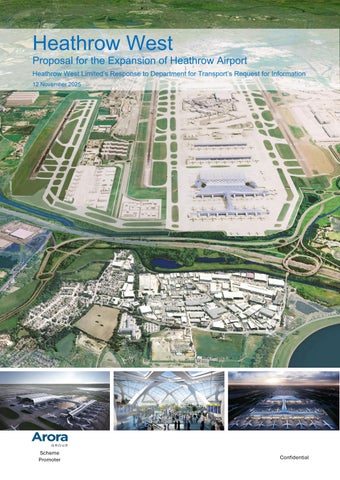
Heathrow West Proposal for Expansion Final Report dated 12 November 2025
Heathrow West
Proposal for the Expansion of Heathrow Airport
Heathrow West Limited’s Response to Department for Transport’s Request for Information 12 November 2025
Figures
Glossary
Term
2,800m Northwest Runway
Definition
A new 2,800m runway proposed by Heathrow West Limited (HWL), located northwest of Heathrow Airport, forming part of HWL’s Scheme This new runway will become known as the Northern Runway when it is completed and operational (see ‘Northern Runway’ in the Glossary)
Air Navigation Service Provider (ANSP)
Air Navigation Solutions Limited (ANSL)
Air Transport Movement (ATM)
Airports National Policy Statement (ANPS)
Arora Group (Arora)
Arrivals Manager (AMAN)
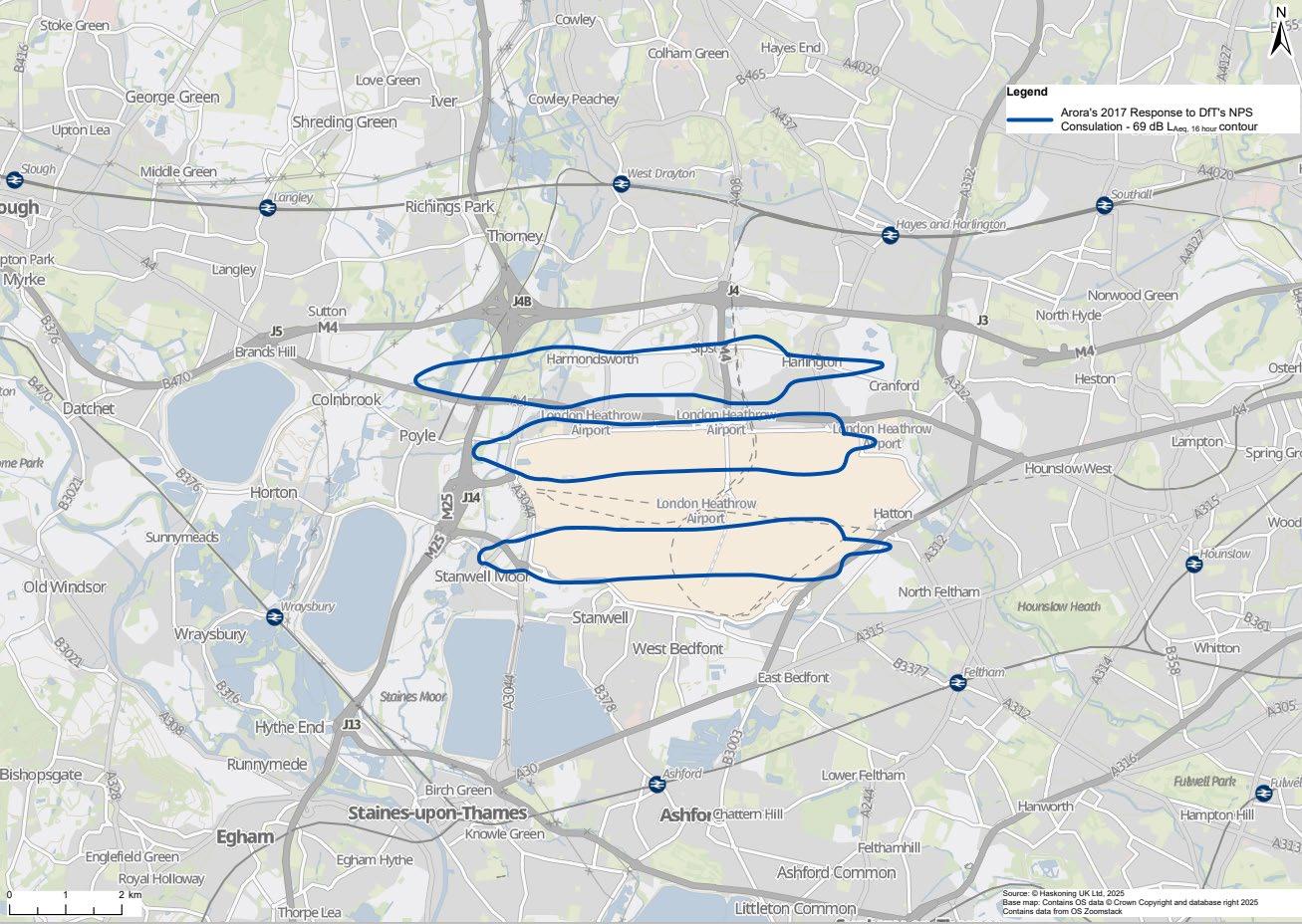
Arora’s 2017 Response to DfT’s NPS Consultation
Airport – Collaborative Decision Making (A-CDM)
Bechtel
Blight
Centre Runway
Civil Aviation Authority (CAA)
Compass-Based Runway Allocation
An organisation responsible for providing air traffic management and related services within a defined airspace or at specific airports.
A UK-based certified Air Navigation Service Provider engaged by HWL for air traffic management expertise.
An aircraft take-off or landing at an airport.
The UK Government policy supporting a new northwest runway at Heathrow Airport, setting the framework for assessing and consenting airport expansion in the South East of England.
The parent group of HWL, an independent private group operating in hotels, property, and construction, with significant presence at UK airports.
a software-based system used in air traffic control to help controllers manage the sequence and timing of arriving aircraft at an airport.
Arora’s “Heathrow North-West Runway Expansion: Response to the DfT National Policy Statement Consultation Final Report,” June 2017.
A-CDM improves airport efficiency by enabling better communication between partners like airlines and air traffic control.
Arora Group’s technical advisor engaged by HWL for construction and engineering expertise for the HWL Scheme.
The reduction in property value or quality of life due to proximity to major infrastructure projects, such as airport expansion.
The existing Northern Runway at Heathrow Airport that will become known as the Centre Runway once the new Northwest Runway is completed and operational (see ‘Northern Runway’ in the Glossary).
The UK’s aviation regulator.
Both aircraft arrivals and departures are allocated to a runway based on the geographical direction (compass)
Glossary
Term
Definition
they have arrived from or the geographical direction of initial departure route
Department for Transport (DfT) The UK Government department responsible for transport policy in England, including aviation.
Development Consent Order (DCO)
Development Consent Order Red Line Boundary
Departure Manager (DMAN)
A statutory instrument seeking consent for a project classified as a Nationally Significant Infrastructure Project.
The defined area within which the proposed development and associated works will occur.
A system used in air traffic control to optimize and sequence aircraft departures, improving runway capacity, efficiency, and predictability
Green Belt Land Protected open land around urban areas, referenced in the context of minimising land take.
Heathrow Airport (Heathrow) The existing Heathrow Airport.
Heathrow Airport Limited (HAL) The current owners and operators of Heathrow Airport and the promoter of the HAL Preferred Masterplan.
Heathrow Airport Limited’s (HAL) Scheme
HAL’s proposed development as published in “Our Proposal for Expanding Heathrow – The UK’s Gateway to Growth” (Summer 2025).
Heathrow West Limited (HWL) The promoter of HWL’s Scheme
Heathrow West Limited’s (HWL’s) Scheme
Inter-Terminal Plaza (ITP)
HWL’s proposed expansion of Heathrow Airport as described in HWL’s Proposal for the Expansion of Heathrow Airport Final Report, submitted to DfT on 31 July 2025.
A new multifunction space between Terminal 5 and the proposed new Terminal 6.
International Airline Group (IAG) A multinational airline holding company whose partner airlines include British Airways, Iberia, Aer Lingus and others.
Invitation Letter
The Secretary of State for Transport’s 26 June 2025 letter to Arora Group, inviting a proposal for Heathrow Expansion.
Local Highway Microsimulation (LHM) Model
London Terminal Manoeuvring Area (LTMA)
A detailed traffic simulation model for analysing local road and junction impacts.
The controlled airspace around London, requiring redesign to accommodate airport expansions.
Glossary
Term
Mixed Mode (DL)
Model of Travel in London (MoTiON)
Noise Contour
Northern Runway
Definition
Runway operation mode allowing both departures and landings.
TfL’s multi-modal strategic transport modelling suite for Greater London, used for assessing transport impacts.
A mapped area showing predicted noise exposure levels, used for assessing environmental impact.
The existing Northern Runway at Heathrow Airport. This runway will become known as the Centre Runway once the new Northwest Runway (to be named the Northern Runway) is completed and operational.
Northwest Runway (NWR)
Northwest Runway (NWR) Scheme
Operational Concept Scenarios A and B
Operational Readiness and Airport Transfer (ORAT)
Operational Resilience
Proposal Document
Public Transport Hub
Regulated Asset Base (RAB) model
Request for Information (RFI) Letter
Request for Information (RFI) Response
Shoulder Hours
Stakeholder Engagement Plan (SEP)
Standard Instrument Departure (SID)
The northwest runway built parallel to and northwest of Heathrow’s existing northern runway under the UK Airports Commission’s proposals.
The Government’s preferred development scheme for airport capacity expansion as identified in the ANPS.
Ground and airspace operational models tested for runway and terminal connectivity.
The process of preparing new airport infrastructure for safe and efficient operation.
The ability of airport infrastructure and processes to maintain performance under stress or disruption.
HWL’s Proposal for the Expansion of Heathrow Airport Final Report, submitted to DfT on 31 July 2025.
A new multi-modal hub located in new Terminal 6 that connects rail, London Underground, coach, and bus services, offering convenient access in all directions.
A regulatory model for financing infrastructure, where the asset base is used to determine allowed revenues and financing structure.
DfT’s Request for Information Letter to HWL, dated 22 October 2025.
HWL’s official response to the DfT’s Request for Information Letter, dated 12 November 2025.
Non-peak operational hours at the airport, typically early morning or late evening.
A plan outlining engagement with key stakeholders during project development.
A published flight procedure followed by aircraft on departure, referenced in runway operations.
Strategic Road Network (SRN) The network of major roads managed by National Highways.
Glossary
Term
Southern Runway
Definition
The existing Southern Runway at Heathrow Airport. This runway will remain known as the Southern Runway when the new Northwest Runway (to be named the Northern Runway) is complete and operational.
Surface Access Strategy (SAS) The plan for how passengers, staff, and freight access the airport by various transport modes.
Temporary Construction Land Land used temporarily for construction compounds, logistics, and railheads during project delivery.
Terminal 6 (T6)
A new passenger terminal proposed by HWL, located immediately west of Terminal 5 (T5) and forming part of HWL’s Scheme.
Traffic Management Forum (TMF) A collaborative group of stakeholders overseeing traffic management during construction.
Traffic Management Plan (TMP) A plan for managing traffic during construction to minimise disruption.
UK Airspace Design Service (UKADS)
Ultra-heavy Departures
West Terminal Campus
The entity coordinating and sponsoring future airspace changes under the UK’s airspace modernisation strategy.
Aircraft departures requiring longer runway lengths due to weight, sometimes needing reassignment to longer runways.
An integrated combination of the new T6 and adjacent T5, with related surface access and aircraft parking apron infrastructure at the west end of Heathrow.
Work Breakdown Structure (WBS) A project management tool defining scope elements for planning and tracking.
1. Foreword
Heathrow West Limited (HWL) is pleased to submit its response to the Department for Transport’s (DfT) Request for Information regarding HWL’s Scheme for the Expansion of Heathrow Airport, as set out in the DfT’s letter of 22 October 2025 (the Request for Information Letter).
HWL is a wholly owned subsidiary of the Arora Group (Arora), a UK-based, innovative organisation specialising in hospitality and service delivery in and around Heathrow Airport (Heathrow). Founded in 1999 by Chairman Surinder Arora and headquartered at Heathrow, Arora employs over 2,800 people, with over 1,700 of these people employed by businesses located at Heathrow and, 72% of its workforce living in the local community.
HWL’s Vision for Heathrow Expansion
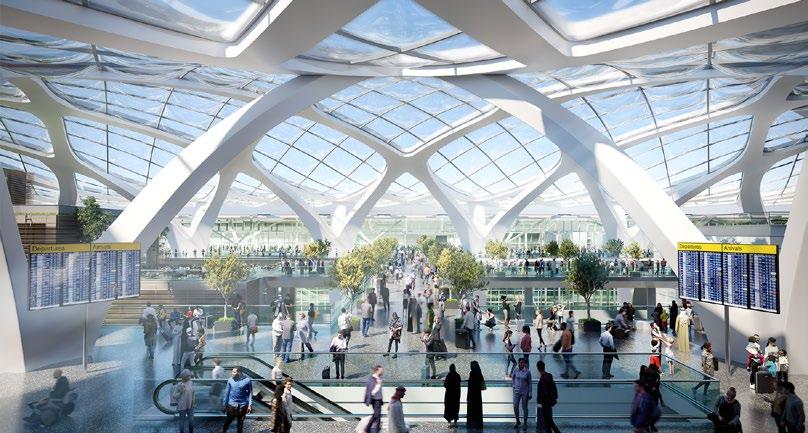
HWL’s vision for a 2,800m Northwest Runway that does not cross the M25 and a worldclass terminal at Heathrow aims to support the airport’s expansion requirements while offering passengers and airlines real choice, greater efficiency, and improved service. Drawing from Arora’s core strengths in hospitality and customer service, HWL believes this approach puts the passenger at the heart of the experience.
The vision for HWL’s Scheme is rooted in the belief that HWL has a responsibility to create a positive legacy for the UK, the region, and the local community. The proposal not only delivers additional runway and terminal capacity but also responds to local needs and environmental considerations, with a design philosophy that connects the terminal seamlessly to the wider Heathrow campus, designed from the “Outside In.”
Early engagement with the key airline stakeholders has determined that positioning new terminal capacity in the west is the most effective and efficient location and creates an optimal solution for a new gateway to the UK economy. Our design of a shorter runway, which is operationally sufficient for the vast majority of current and future aircraft operations at Heathrow, and which critically avoids the M25 crossing, has been endorsed by
Advantages of HWL’s Scheme
Specifically, key advantages of HWL’s Scheme over Heathrow Airport Limited’s (HAL) Scheme as described in HAL’s, “Our Proposal for Expanding Heathrow – The UK’s Gateway to Growth”, dated Summer 2025, include:
• The shorter runway design, which avoids constructing over the M25, is a critical advantage of HWL’s Scheme over HAL’s: it de-risks the overall expansion programme and significantly reduces cost. The airline and industry position is clear: HAL’s overall projected cost is “not sustainable nor financially viable”, and “fundamentally risks undermining Heathrow’s competitiveness and therefore the UK aviation sector and wider economy.” HWL’s Scheme provides a clear alternative which reduces “significant engineering, delivery and operational risks, as well as additional cost and programme uncertainty”.
• Minimising land take and disruption to local residents and businesses
• Enabling the development of an integrated and expanded Public Transport Hub to support environmentally sustainable travel
• Strengthening the business case through cost-efficiency benefits for passengers and airlines
• Introducing competition at Heathrow, through delivery by a party other than HAL, encouraging innovation and cost discipline for the benefit of airlines and passengers, but also through the opportunity to introduce sustainable and meaningful competition capable of addressing serious regulatory failings at Heathrow and secure the long-term economic benefits of competition
• Simplifying construction to allow earlier delivery of the new runway and of new terminal capacity
• Fostering a constructive, collaborative approach with local communities to support environmental improvements
When considering the additional information, HWL understands that DfT intends to consider the following matters in particular:
• The extent to which proposals will integrate with existing infrastructure as smoothly as possible
• The extent to which a proposal will require land acquisition and cause blight
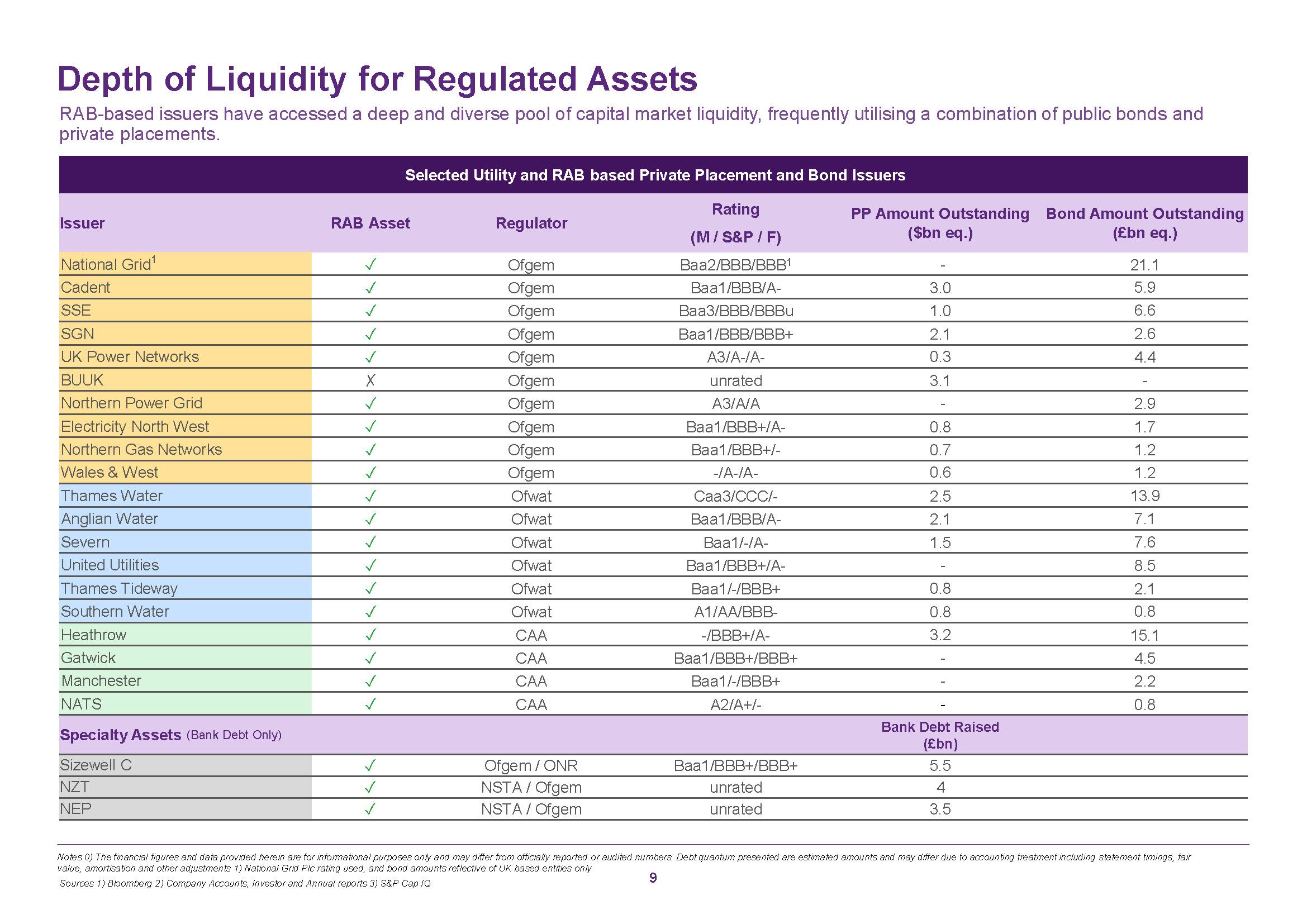
• The extent to which it has been demonstrated that the proposals are deliverable from a financing perspective
• The extent to which it has been demonstrated that surface access arrangements associated with the proposal are deliverable and minimise network disruption
• The extent of economic benefits which are expected from a particular proposal
Advisory Board
To oversee HWL’s Scheme, HWL created a London Heathrow Airport Expansion Advisory Board. Collectively, the Board brings many years of business, airline and oversight experience to the formation of HWL’s Scheme.
Lord Grade of Yarmouth. The Board is Chaired by Michael Grade, who sits as a nonaffiliated Peer in the House of Lords. A former sports journalist, he entered the television industry in 1973 when he joined London Weekend Television as Deputy Controller of Programmes. He subsequently held roles as Chief Executive of Channel 4, Executive Chair and CEO of First Leisure, Chairman of Pinewood Shepperton Film Studios, Chairman of Camelot Group and Chairman of Ocado Group. He chaired the BBC’s Board of Governors from 2004-2006, leaving to become executive Chair and CEO of ITV plc. Since 2022 he has chaired Ofcom, the competition and regulatory authority for the broadcasting, telecommunications, postal industries and online safety. He is also Chair of Imagineear, which produces digital displays for museums, galleries and live attractions.
Sir Rod Eddington AO is a pioneering Australian engineer and business leader. A Rhodes Scholar at Oxford, he earned a DPhil before building his aviation career with Cathay Pacific (MD, 1992–96), Ansett Airlines (Executive Chair, 1997–2000) and British Airways (CEO, 2000–05), notably steering BA through post-9/11 recovery. Knighted in 2005 for services to civil aviation, he was appointed Officer of the Order of Australia in 2012 and received Japan’s Grand Cordon of the Order of the Rising Sun in 2015. Now Chair of JP Morgan's Asia Pacific Council, Infrastructure Partnerships Australia and Lion, he also holds numerous non-executive board roles. Author of the “Eddington transport Study. December 2006” for the UK Government.
Robert Webb KC is a legal and corporate leader with a career spanning over five decades. Called to the Bar in 1971 and appointed Queen’s Counsel in 1988, he served as Head of Chambers at 5 Bell Yard (1988–1998) and Recorder of the Crown Court. He later became General Counsel at British Airways (1998–2009) and Rolls Royce (2012–2015). Webb held non-executive roles including Senior Independent Director of the London Stock Exchange, Chairman of BBC Worldwide, Autonomy, Darktrace, and Luminance, and trustee of Comic Relief. He joined Brick Court Chambers as door tenant in 2015.
Mike Clasper CBE CMgr CCMI is a distinguished British business leader and engineer. A Cambridge-trained engineer, he spent 23 years rising through Procter & Gamble’s ranks, culminating as President of Global Home Care. He then led Heathrow’s parent group, BAA plc, as CEO and later served as Chairman of HM Revenue & Customs (2008–12).
Subsequently he chaired Coats Group and Guinness Peat Group, and currently chairs SSP Group, Bioss International and serves on Arora’s advisory board. Honoured with a CBE in 1995, he also served as President of the Chartered Management Institute.
Mike Bannister is a distinguished airline pilot best known as Chief Pilot of British Airways’ iconic Concorde fleet. A passionate aviator, Bannister joined British Overseas Airways Corporation (BOAC), British Airways’ predecessor, in 1969. He became part of the Concorde team in 1977, accumulating nearly 9,600 flight hours on the supersonic airliner. Bannister’s leadership culminated in his appointment as Chief Pilot of Concorde in 1995, a role he held until the aircraft’s retirement in 2003. He famously captained Concorde’s final flight from New York to London on 24 October 2003, marking the end of an era in aviation history.
Michael “Mike” Street was Director of Customer Service and Operations at British Airways until 2005 and joined its Board in 2000. He oversaw global operations, 26,000 front-line staff, and key planning efforts including Terminal 5. Known for his strong rapport with employees and business acumen, he secured a critical three-year pay deal with unions ahead of the 2004 Heathrow disruptions, earning their support during leadership scrutiny. Street had a long, respected career at BA. He also served as Deputy Chair of the BA Charitable Trust, a non-executive Director of WSH, and held fellowships with the Royal Aeronautical Society and Lancaster University.
Commitment
HWL is committed to fostering competition at Heathrow, believing that choice drives efficiency and reduces costs for passengers. HWL has worked closely with the Civil Aviation Authority (CAA) to test whether competition can be delivered within the existing regulatory framework.
Government policy supports expansion at Heathrow bringing more jobs, investment, and choices for passengers. HWL believes Heathrow can be better: for passengers, for airlines, for local communities, and for the nation.
HWL appreciates the opportunity to submit this response to the DfT’s RFI and looks forward to working with Government to deliver a better future for Heathrow, the surrounding community, and the UK as a whole.
Surinder Arora, Carlton Brown, Founder and Chairman, CEO, Arora Group and Director, Heathrow West Limited Heathrow West Limited
Introduction
2. Introduction
Official DfT Notification to Promoters
On 22 October 2025, the Transport Secretary launched a review of the Airports National Policy Statement (ANPS), which will provide the framework within which any future Heathrow expansion will be considered.
Following an invitation for potential promoters to submit proposals to deliver a third runway to inform the ANPS review, the Transport Secretary has confirmed two schemes remain under active consideration.
Promoters Heathrow Airport Limited and the Arora Group/Heathrow West Limited have been asked to share additional details on their plans by 12 November 2025 to clarify associated impacts for investors, affected communities and businesses. This is so Government can make an informed decision on which single scheme should inform the remainder of the ANPS review.
The next stage of the process is not about whether a particular scheme meets a set of criteria, but a direct comparison of each scheme, based on the response received to this letter, to inform a decision that can provide certainty, as early as possible, about the scheme in the now-launched ANPS review.
DfT will take into account the responses received to this letter to inform a decision that can provide certainty, as early as possible, about the scheme in the ANPS review.
HWL’s Commitment to Meeting Government Objectives
HWL reiterates that it is fully committed to the principle of delivering the Northwest Runway at Heathrow in the desired timeframes, consistent with the Government’s preferred scheme for increasing aviation capacity in the South-East of England. HWL strongly supports the Government’s position that expanding Heathrow is essential to enhancing the UK’s global connectivity, driving long-term economic growth, and improving national infrastructure. HWL welcomes the Government’s continued focus on infrastructure development as a vital enabler of national and regional prosperity.
HWL also shares the Government’s belief that Heathrow expansion offers a strategic advantage to the UK, serving as a powerful catalyst for investment, job creation, and regional development across the country. However, HWL maintains that in order for this expansion to proceed successfully and deliver the intended benefits, the programme must meet critical tests of affordability, deliverability, and operational efficiency principles clearly reflected in the ANPS. HWL’s approach is rooted in these principles and aims to ensure that the project not only meets policy objectives but also provides lasting value to passengers, communities, and the broader UK economy.
HWL’s Goals for the Scheme
HWL’s goals for a 2,800m Northwest Runway that does not cross the M25 and a worldclass terminal are to support Heathrow’s expansion requirements while offering passengers and airlines real choice, greater efficiency, and improved service. Drawing from Arora’s core strengths in hospitality and customer service, HWL’s proposal places the passenger at the heart of the experience.
These goals reflect HWL’s responsibility to create a positive legacy for the UK, the region, and the local community. The development not only delivers additional runway and terminal capacity but also addresses local needs and environmental considerations, adopting a design philosophy that connects the terminal seamlessly to the wider Heathrow campus designed from the “Outside In.” Early engagement with key airline stakeholders has confirmed that locating new terminal capacity in the west offers the most efficient and operationally effective solution, creating a new gateway to the UK economy.
HWL’s Development Objectives
The following development objectives reflect Government’s expectations and HWL’s goals
• Improve Efficiency and Constructability: The design must meet the Government’s expectations for Heathrow expansion while improving efficiency and constructability.
• Ensure Affordability: The project must be delivered at a cost that is sustainable for airlines and affordable for passengers, supporting long-term growth and accessibility.
• Align with Airline Operations: The expansion layout must be designed around airline needs to facilitate functionality, efficiency, and operational compatibility.
• Enable Competition: Delivery by a party other than HAL must introduce healthy competition, driving innovation and cost discipline to benefit airlines and passengers and to effectively address widely publicised issues with the existing regulatory model
• Provide Delivery Certainty: The programme must offer greater assurance of timely delivery, enabling capacity growth through increased competition and user choice.
• Maintain a Balanced Approach: The scheme must balance affordability, capacity, environmental impacts and quality to promote long-term resilience and value for money.
• Support Strategic Positioning: The infrastructure must be purpose-built to strengthen Heathrow’s role as a premier global aviation hub, enabling growth in the UK economy, and ready to meet future demand and international expectations.
• Minimise Negative Impacts: The project must actively reduce adverse operational, environmental, and community impacts typically associated with infrastructure projects.
These objectives reflect HWL’s commitment to delivering a safe, sustainable, efficient, and future-ready airport that responds to the needs of passengers, airlines, local communities, and the UK economy. They emphasise operational excellence, environmental responsibility, and integration with HAL’s existing infrastructure, surrounding land uses and infrastructure, while supporting phased, financeable delivery.
Rooted in innovation and long-term thinking, the objectives aim to ensure Heathrow functions as a world-class global hub: accessible, well-connected, and designed to
enhance capacity and passenger experience. By translating this vision into clear planning priorities, these objectives aim to ensure the expansion delivers lasting value, a positive legacy, and capacity for future growth.
Outcomes Aligned with Goals and Objectives and DfT Criteria
The development goals and objectives outlined above can be realised by strategically modifying a select set of infrastructure improvements within the current expansion plans proposed by HAL. These modifications are intended to enhance both operational and cost efficiency and improve the overall quality of service delivery. HWL’s Scheme sets forth the following key improvements, which are intended to deliver measurable value, enhance operational performance, and align with both regulatory and commercial priorities:
• New 2,800m Northwest Runway: Positioned entirely east of the M25 motorway, operational by 2035 and capable of accommodating at least 260,000 additional annual Air Transport Movements (ATMs), this runway avoids the need to construct over one of Europe’s busiest motorways. This approach presents the critical advantages of significantly reducing engineering complexity, lowering construction risk, and eliminating what is widely regarded as the single greatest threat to the viability, affordability and deliverability of the project (while adequately catering for airline requirements, as confirmed
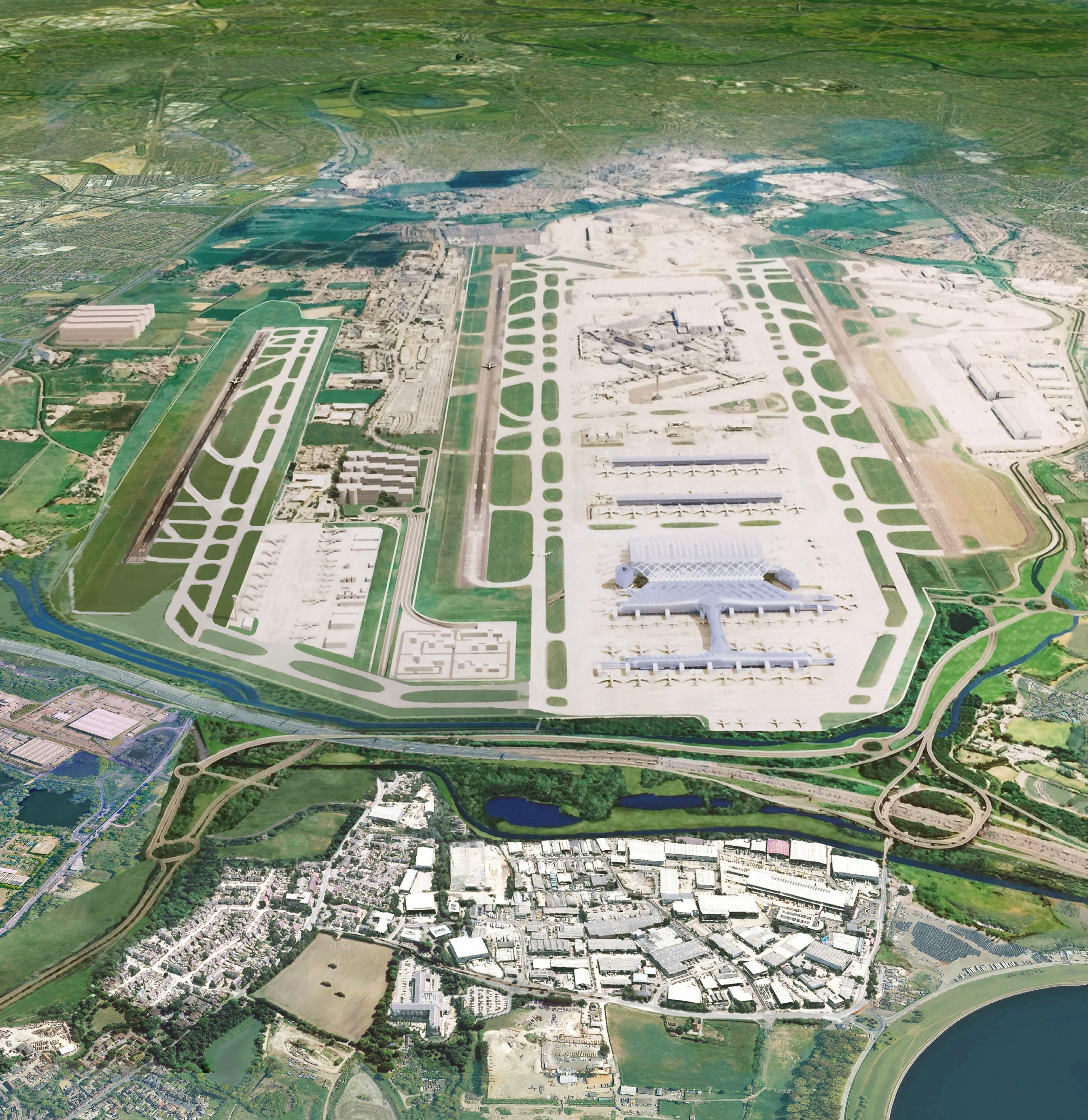
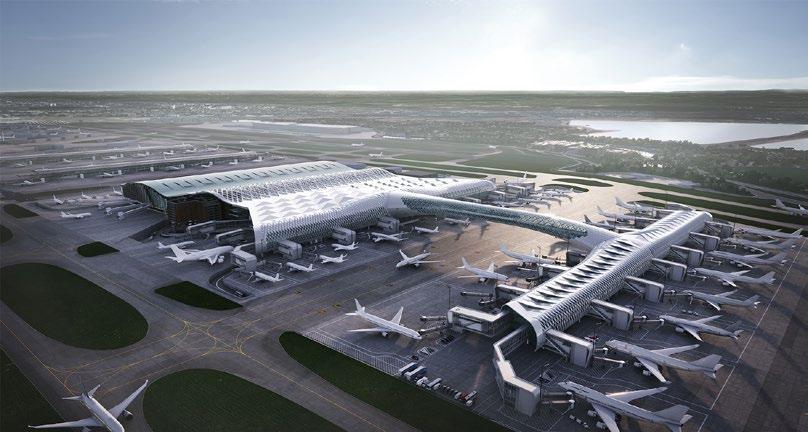
• New T6: Located west of T5, this is a single, purpose-built terminal, designed to minimise land take (and likewise compulsory purchase) and preserve Green Belt land. This straightforward approach provides the necessary terminal capacity to accommodate the additional passenger demand generated by the Northwest Runway.
• New Public Transport Hub: Designed to reduce reliance on private cars by promoting seamless access to rail and bus services, this hub supports the Government’s objective to shift more airport journeys to environmentally sustainable modes of transport. It plays a key role in meeting national carbon reduction targets while improving overall connectivity for passengers and staff.
• New Green Infrastructure: Focused primarily west of the airport, improvements provide a natural buffer between airport operations and surrounding communities. The plan includes expanded public parks and upgraded cycle and footpaths that enhance quality of life and support long-term environmental sustainability.
Together, these selected development elements form a cohesive and forward-looking proposal that delivers meaningful advantages in direct response to the criteria outlined by DfT in its Request for Information letter as follows:
1. Integration with Existing Infrastructure: HWL’s 2,800m runway supports all aircraft, seamless terminal access, flexible operational modes, external airspace assurance, and can deliver over 740,000 ATMs/year.
2. Land Acquisition: The HWL Scheme is designed to minimise land take and blight, carefully limiting property acquisition and prioritizing community engagement and environmental sensitivity, notably 43 hectares less than HAL in the central area between the existing Northern Runway and the new Northwest Runway
3. Financeability: Privately financed via RAB (or RAB-derived) model; £23 billion cost, structured with 65–75% debt, 25–35% equity; strong likely market support, robust risk mitigation, and positive capital market perception.
4. Surface Access: Phased roadworks minimise disruption, maintain continuous access; stakeholder engagement with National Highways, TfL, Network Rail; advanced multilevel transport modelling ensures resilient, efficient access and mitigates impacts.
5. Economic Benefits: Billions in national and regional growth, 100,000+ jobs, increased trade and tourism; benefits realised during construction and operational phases, supported by published economic reports and specific additional benefits derived from a lower cost proposition, enabling long-term economic benefits to be fully realised, and compounded with economic benefits from the introduction of meaningful competition
6. Other Information: HWL offers lower cost, less disruption, faster delivery, enhanced competition, sustainability, and operational runway by 2035 with Parliament-aligned consent timeline.
Purpose, Structure and Content of RFI Response
3. Purpose, Structure and Content of RFI Response
Purpose
This document sets out HWL’s responses to questions contained in DfT’s Request for Information (RFI) Letter dated 22 October 2025 regarding HWL’s Proposal for the Expansion of Heathrow Airport Final Report dated 31 July 2025 and should be read in conjunction with this report
DfT’s Specific Issues
Specific questions asked by DfT in the RFI letter include:
1. Integration with existing infrastructure: Please provide a detailed overview of:
a) what aircraft you say will be able to operate from the new runway and whether there will be any operational restrictions on the aircraft;
b) whether all terminals will be able to access the new runway;
c) the proposed operational procedures of all three runways and how they will be able to provide the respite that is set out in the ANPS;
d) details of what external assurance and engagement you have undertaken to confirm that necessary airspace will be able to be designed to meet the operational requirements and air traffic movements required in your proposal; and
e) the number of ATMs and passengers you say the airport will be able to physically accommodate by year, both in a scenario where the proposal proceeds and in a counterfactual scenario without runway expansion.
2. Land acquisition: Please provide:
a) information and maps which show the exact land required for delivery, and the number of properties that are:
i) impacted by your proposal (e.g. from blight) and
ii) require compulsory purchase, including the locations of all affected properties.
b) Furthermore, please provide details of the engagement you have had with affected communities.
3. Financeability: Please provide a detailed overview of how the runway and supporting terminals will be financed, including a breakdown of debt and equity sources, and insight from financial market engagement. This should include a breakdown of the key risks that most influence the scheme’s ability to be financed, how capital markets are likely to perceive those risks, and the strategy used to manage them to ensure the scheme is wholly privately financed.
4. Surface access:
a) To minimise unnecessary disruption, please provide additional information regarding the construction of roads schemes – In particular, we are requesting further detail on the timeline
b) level of anticipated disruption and mitigation during construction and the schemes’ overall impact on the road network (both for the Strategic Roads Network (SRN) and local roads), including use of temporary road access and offline construction
c) We require assurance of a promoter working with National Highways, Network Rail and Transport for London on their surface access schemes
d) We would also like to see a clear plan for the development of transport modelling
5. Economic benefits: Please provide:
a) information outlining what you consider the economic benefits your scheme will bring and when these benefits will be realised. This should be appropriately evidenced and referenced.
6. Other Information: Please provide:
a) any other information not provided above that demonstrates why your scheme should be the single scheme to inform the next stage of the ANPS review and
b) how your scheme will deliver an operational third runway by 2035, with applications for planning consent coming forward in time to enable decisions to be made this Parliament.
DfT’s Evaluation Criteria
When considering the additional information, DfT intends to consider the following matters in particular:
• The extent to which proposals will integrate with existing infrastructure as smoothly as possible;
• The extent to which a proposal will require land acquisition and the extent to which it will cause blight;
• The extent to which it has been demonstrated that the proposals are deliverable from a financing perspective;
• The extent to which it has been demonstrated that surface access arrangements associated with the proposal are deliverable and minimise network disruption;
• The extent of economic benefits which are expected from a particular proposal.
Structure
This RFI Response document is organised into eleven sections, each crafted to provide the clarity, technical depth, and comprehensive evidence required to inform the DfT’s review and the ongoing revision of the ANPS.
• Sections 1–4 establish the background and context for HWL’s Scheme, including alignment with Government policy, the rationale for submission, an overview of how the
proposal is structured to address the DfT’s specific information requests and a comparative table between the HWL and HAL Schemes.
• Sections 5–10 address, in detail, the items outlined in the DfT’s Request for Information Letter, ensuring that all essential information required from HWL is provided in a clear and accessible manner.
• Section 11 contains appendices with supporting documentation, technical reports, financial evidence, and stakeholder consultation records that underpin the responses in the main body of the document.
Below is a summary of the specific content included in each section:
1. Foreword
Presents a high-level statement from HWL leadership, reaffirming the company’s commitment to the Government’s vision for a Northwest Runway and readiness to deliver a viable, privately financed alternative to traditional delivery models.
2. Introduction
Introduces the official DfT Notification to Promoters, outlines HWL’s vision and objectives, and details the company’s commitment to Government policy goals for Heathrow expansion.
3. Purpose, Structure and Content of RFI Response
Explains the objective of the submission to respond to the DfT’s request for information regarding HWL’s Scheme and details how the document is organised to align with the DfT’s specific questions.
4. Comparative Assessment of Expansion Schemes
Compares HWL’s and HAL’s Schemes using DfT criteria. It scores performance in cost, delivery, and environmental impact. Results indicate HWL as the preferred scheme for the revised ANPS.
5. Integration with Existing Infrastructure
Summarises how the new runway and terminal will connect with Heathrow’s current systems, ensure operational compatibility, and meet regulatory requirements. Covers aircraft access, terminal connectivity, and seamless integration with existing airport infrastructure.
6. Land Acquisition
Details the land and property requirements for the scheme, including analysis of impacted properties, compulsory purchase needs, and the community engagement strategy.
7. Financeability
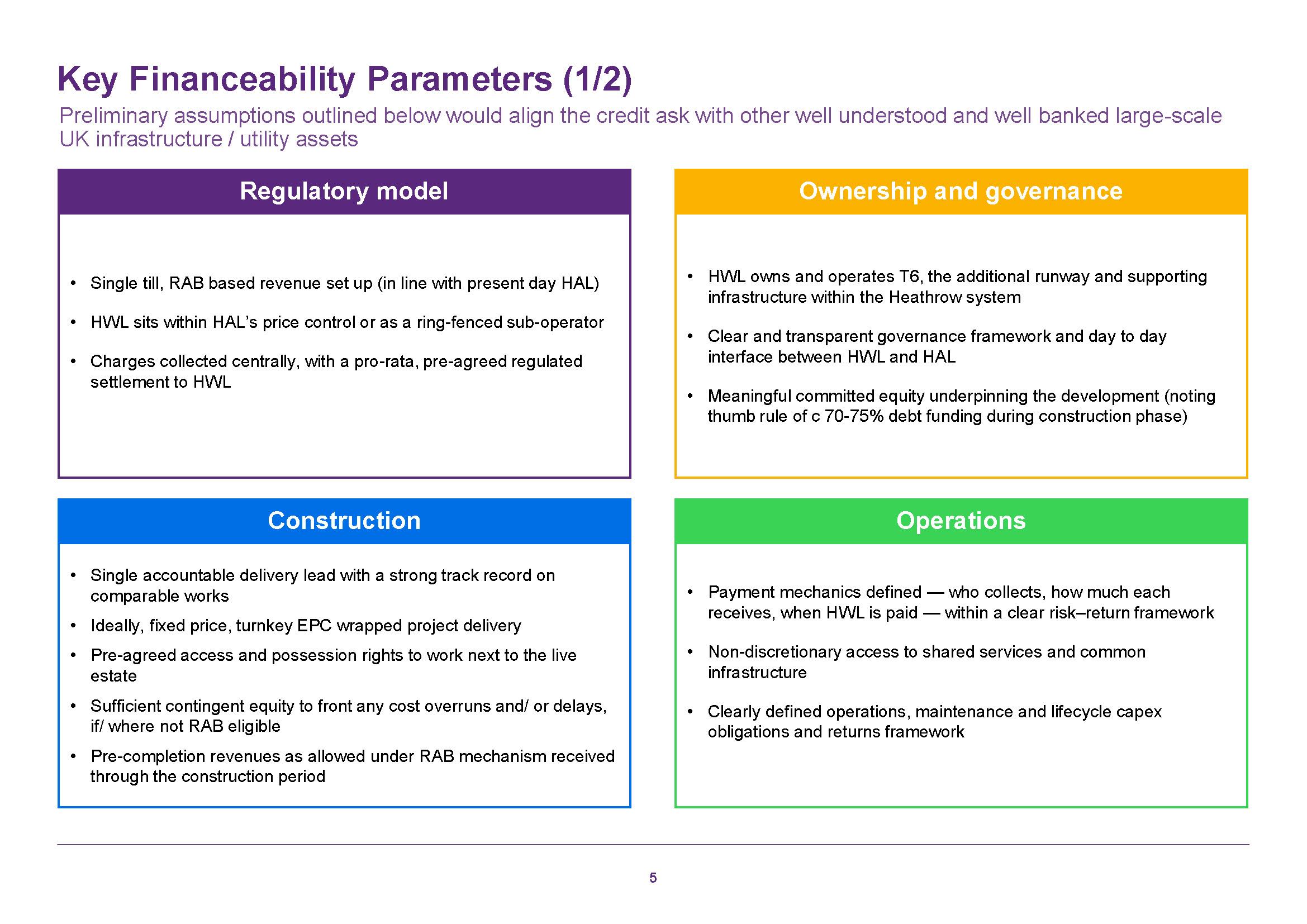
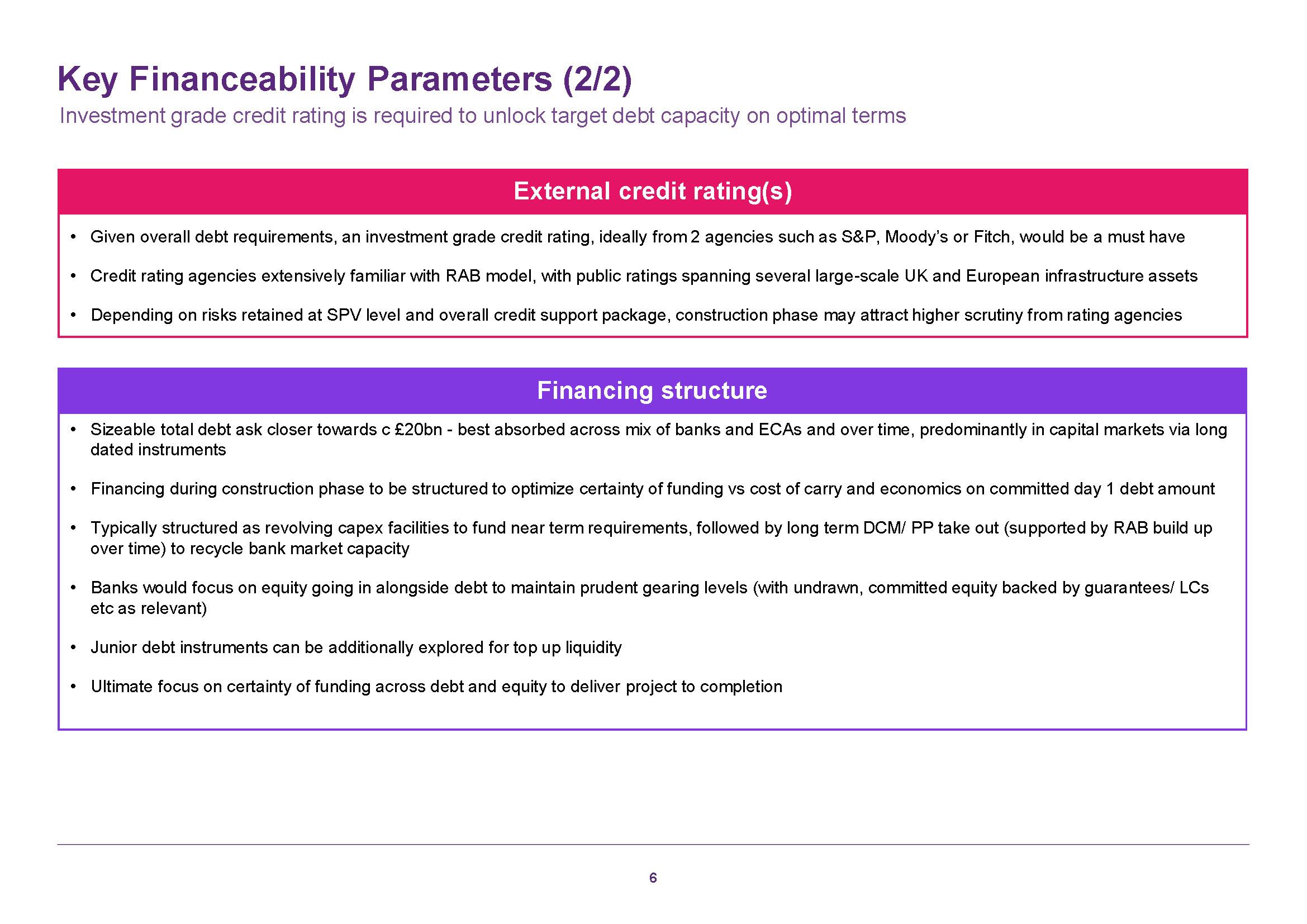
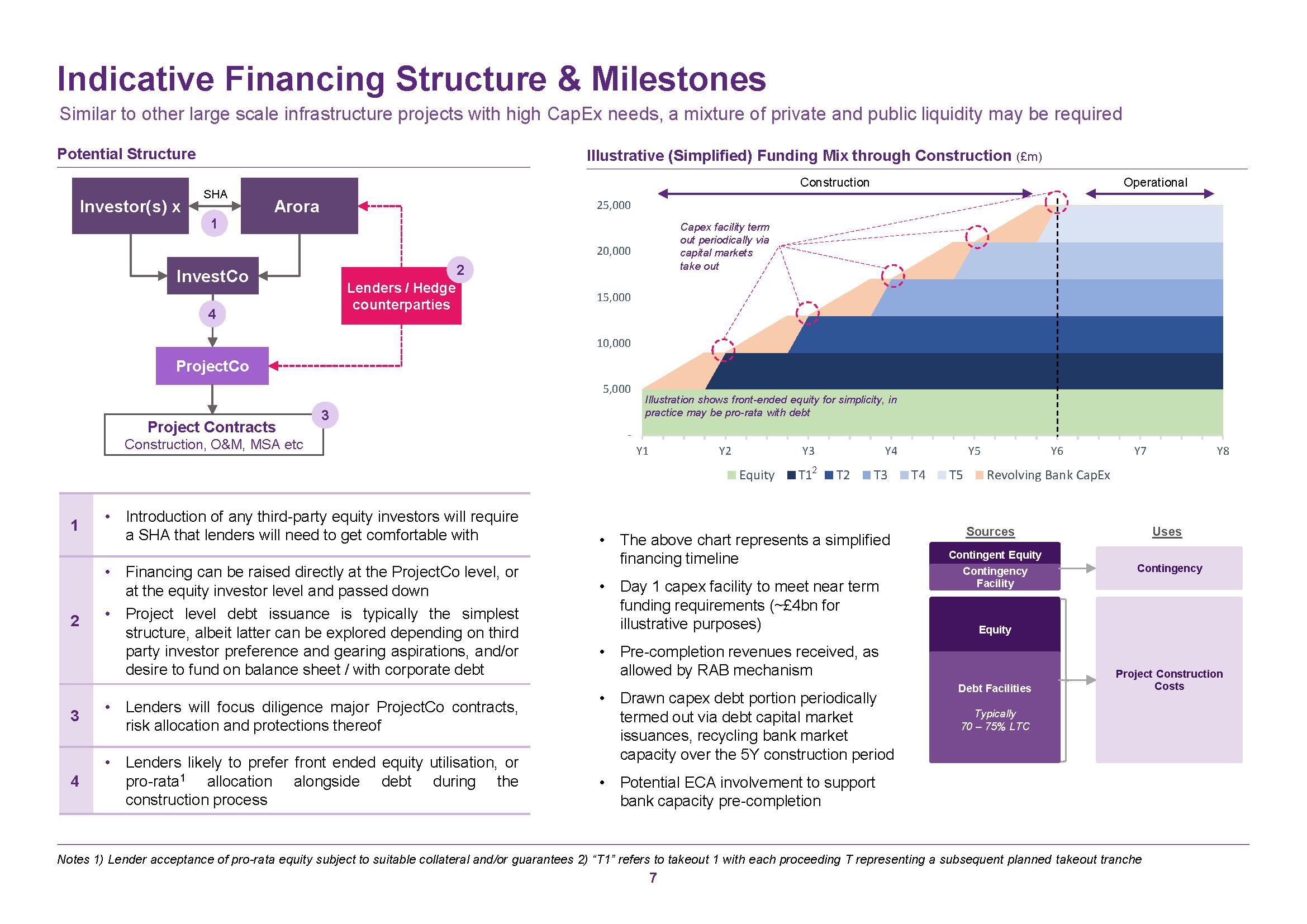
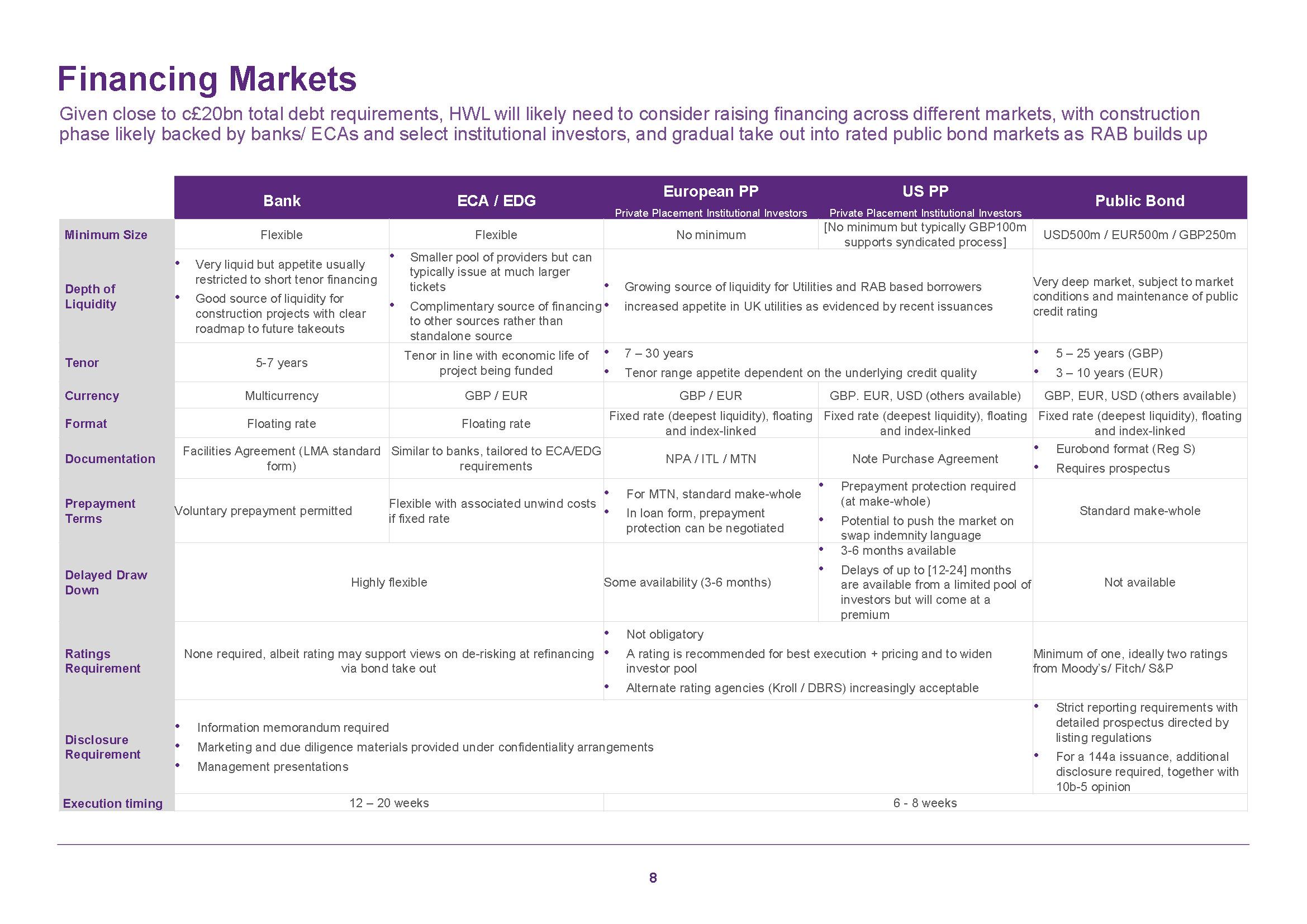
Outlines the financial strategy for the runway and supporting terminals, including regulatory and revenue framework, construction delivery and risk management, ownership, governance and payment mechanics, factors likely relevant to debt and equity investors and project structure
8. Surface Access
Describes the programme for delivery of road and transport infrastructure, including construction timelines, strategies to minimise disruption, stakeholder engagement, and the transport modelling plan.
9. Economic Benefits
Presents the economic benefits of HWL’s Scheme, including the general benefits of expansion and viability of delivery only through our scheme, economic impact and programme risks, and introduction of sustainable and meaningful competition across the entire value chain at the UK’s only hub airport.
10. Other Information
Articulates why HWL’s proposal should be selected as the single scheme to inform the next stage of the ANPS review, highlighting comparative advantages, delivery certainty, and endorsements from airlines and international airport operators.
11. Appendices
Provides supporting documents, technical notes, financial evidence, stakeholder consultation summaries, and important notices that substantiate the main responses.
Appendices include:
o Appendix A: Heathrow West – Proposals for M25 Junction 14
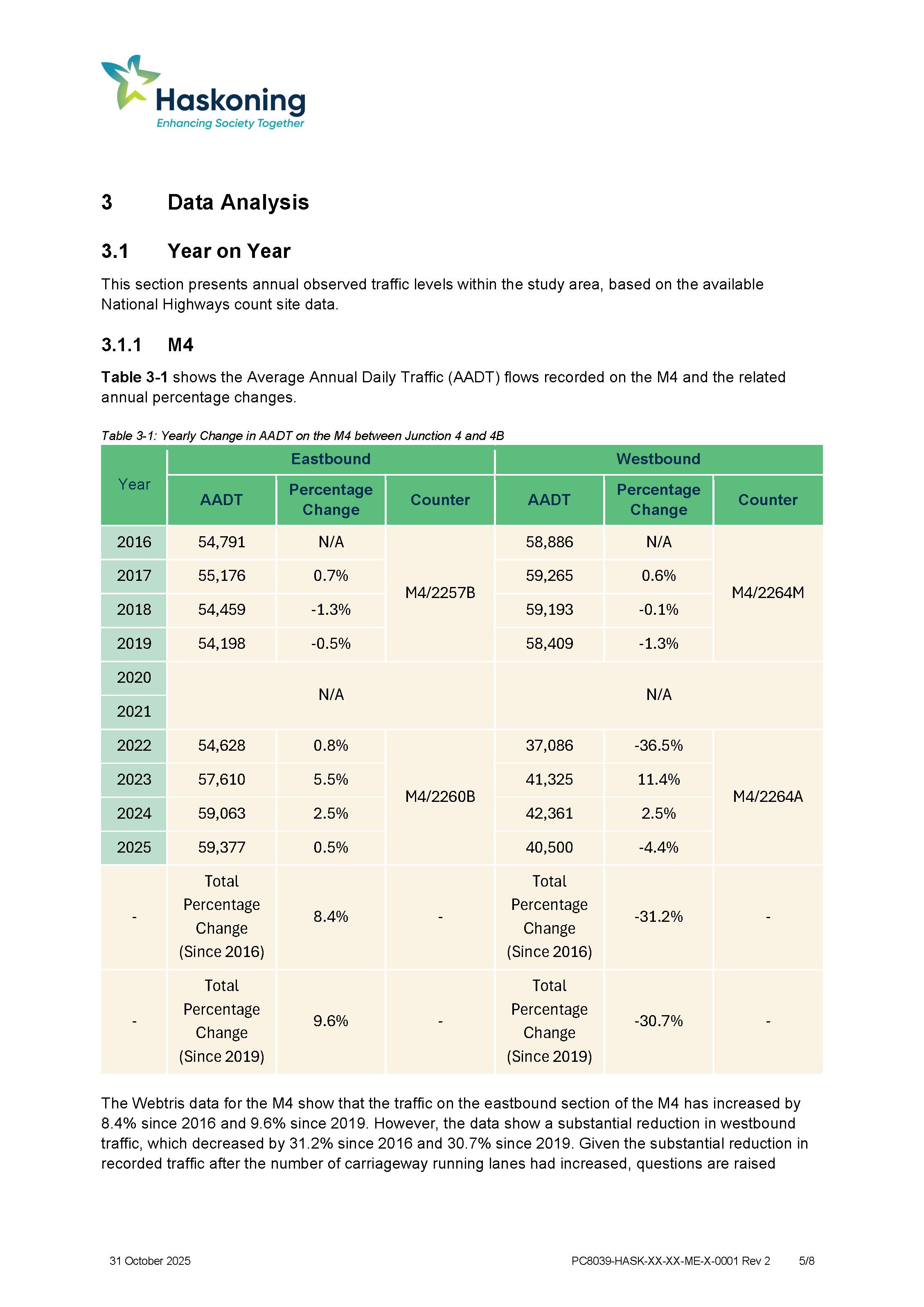
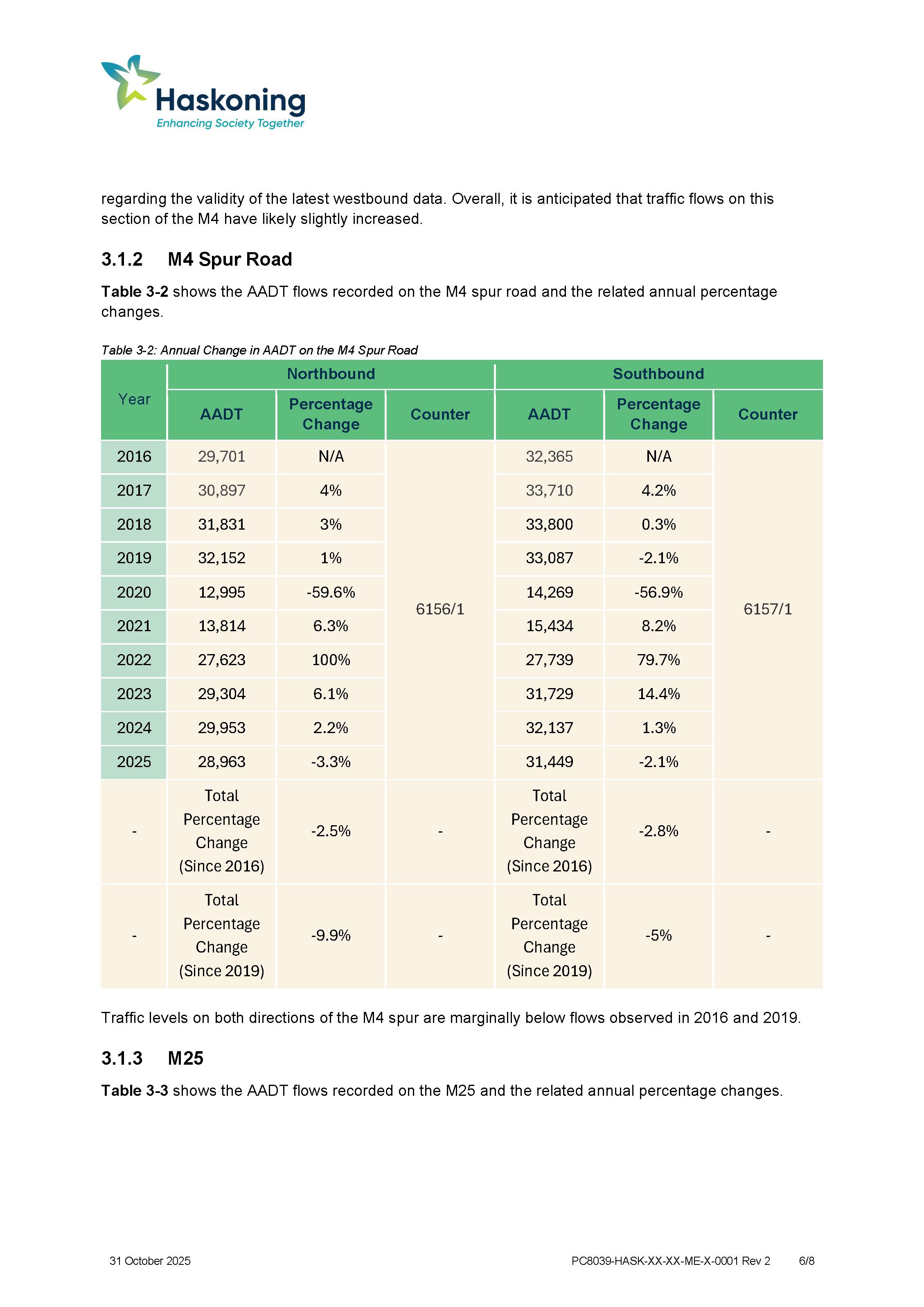
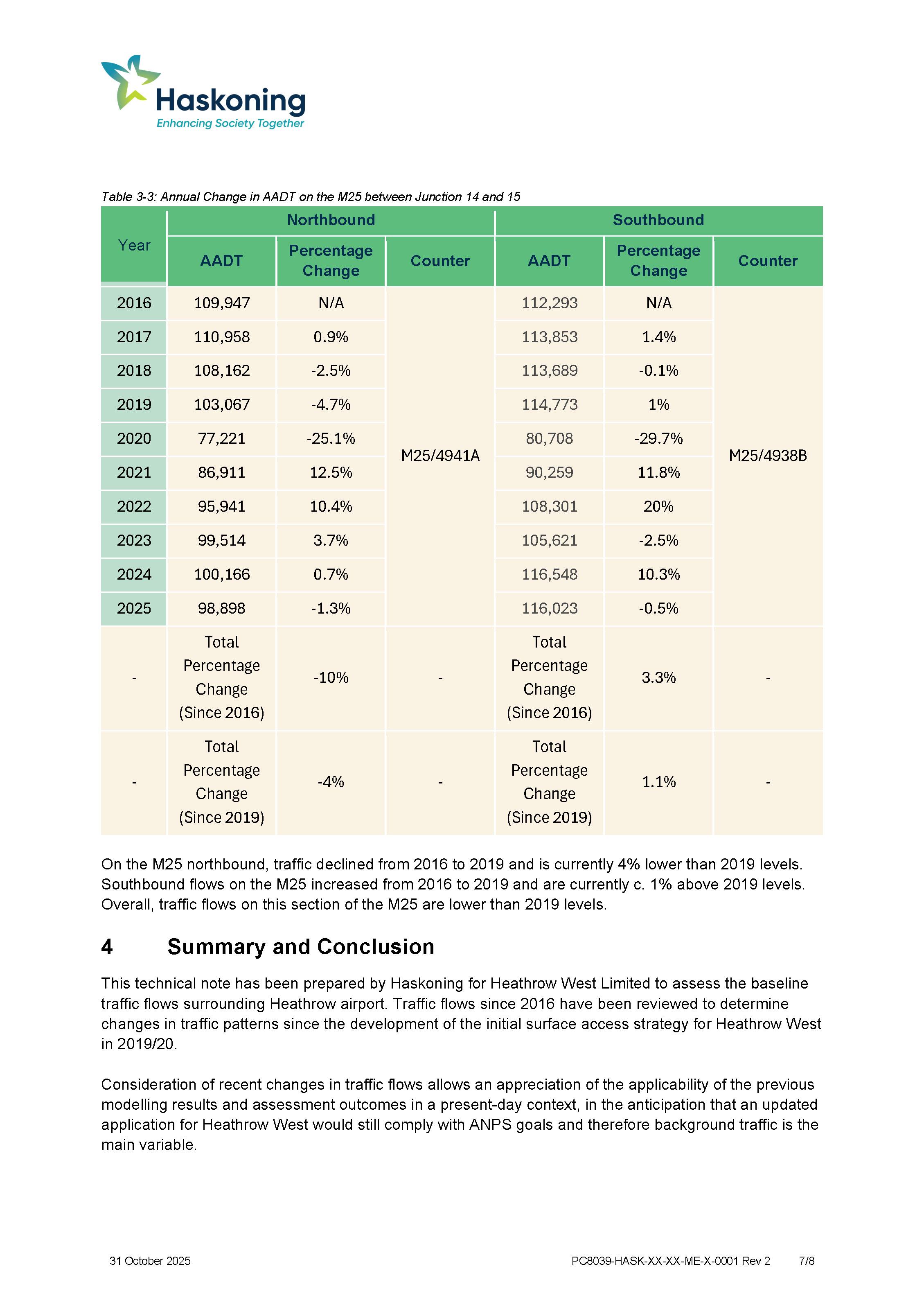
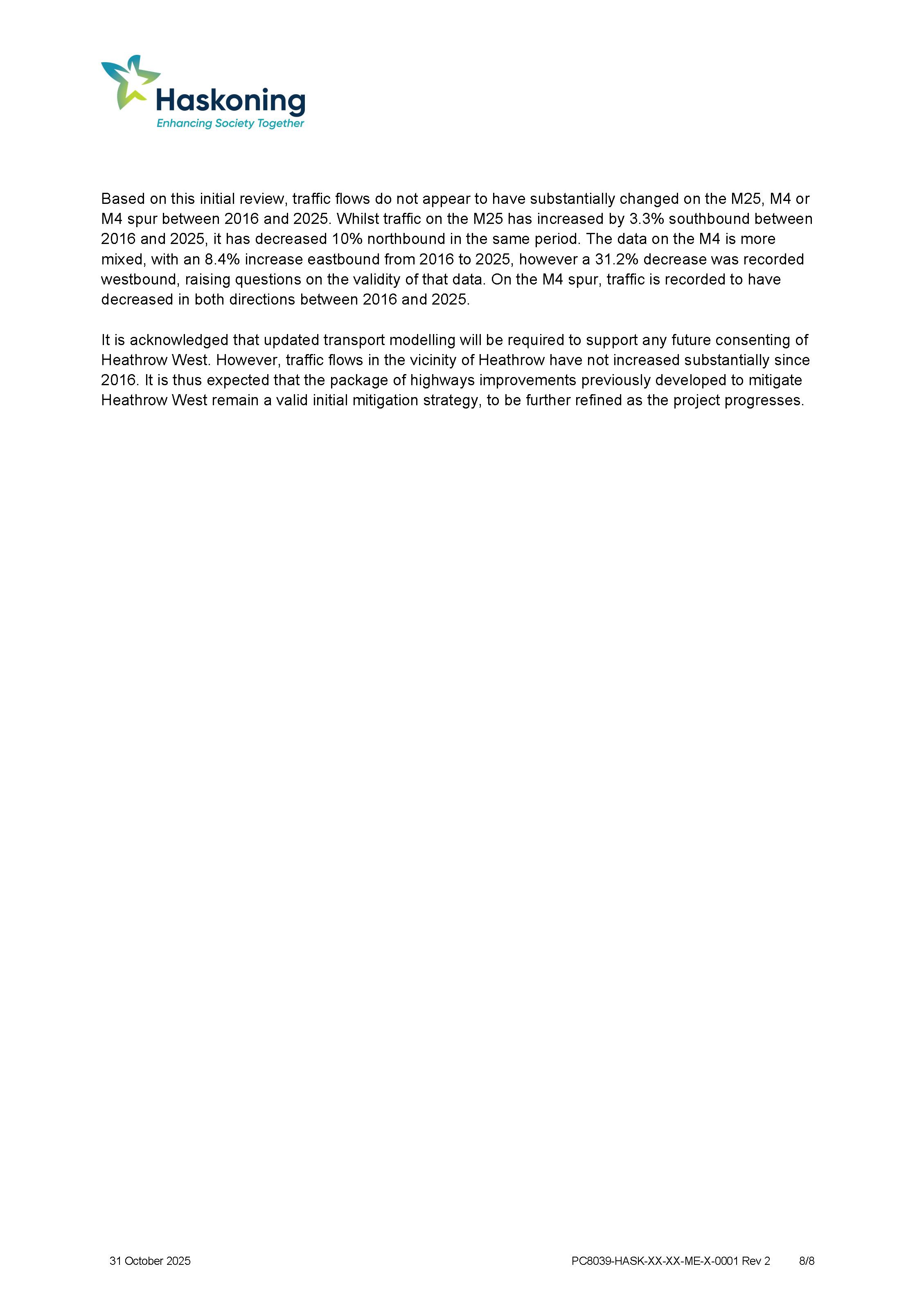
o Appendix B: Heathrow West – Traffic Flow Review
o
o
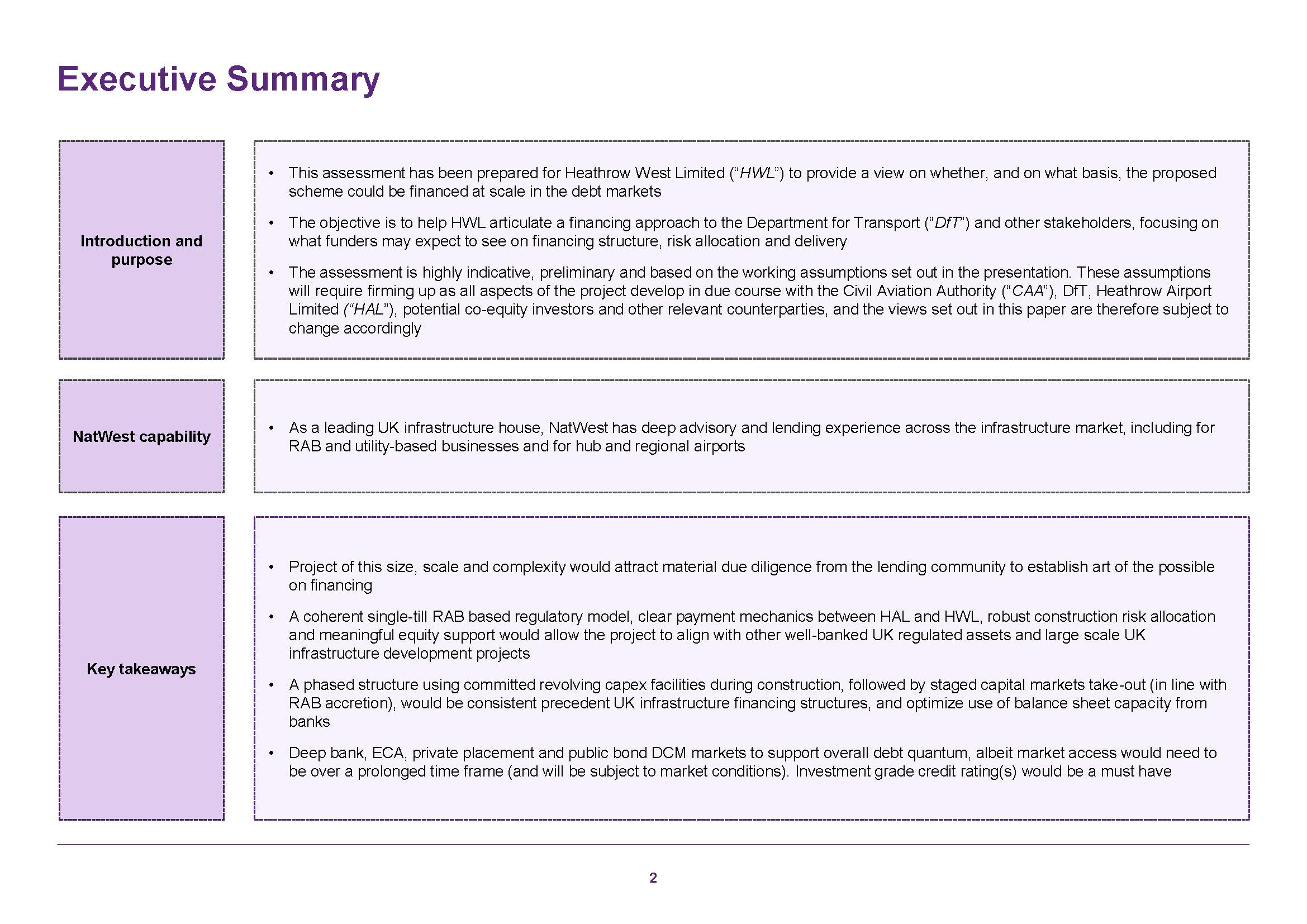
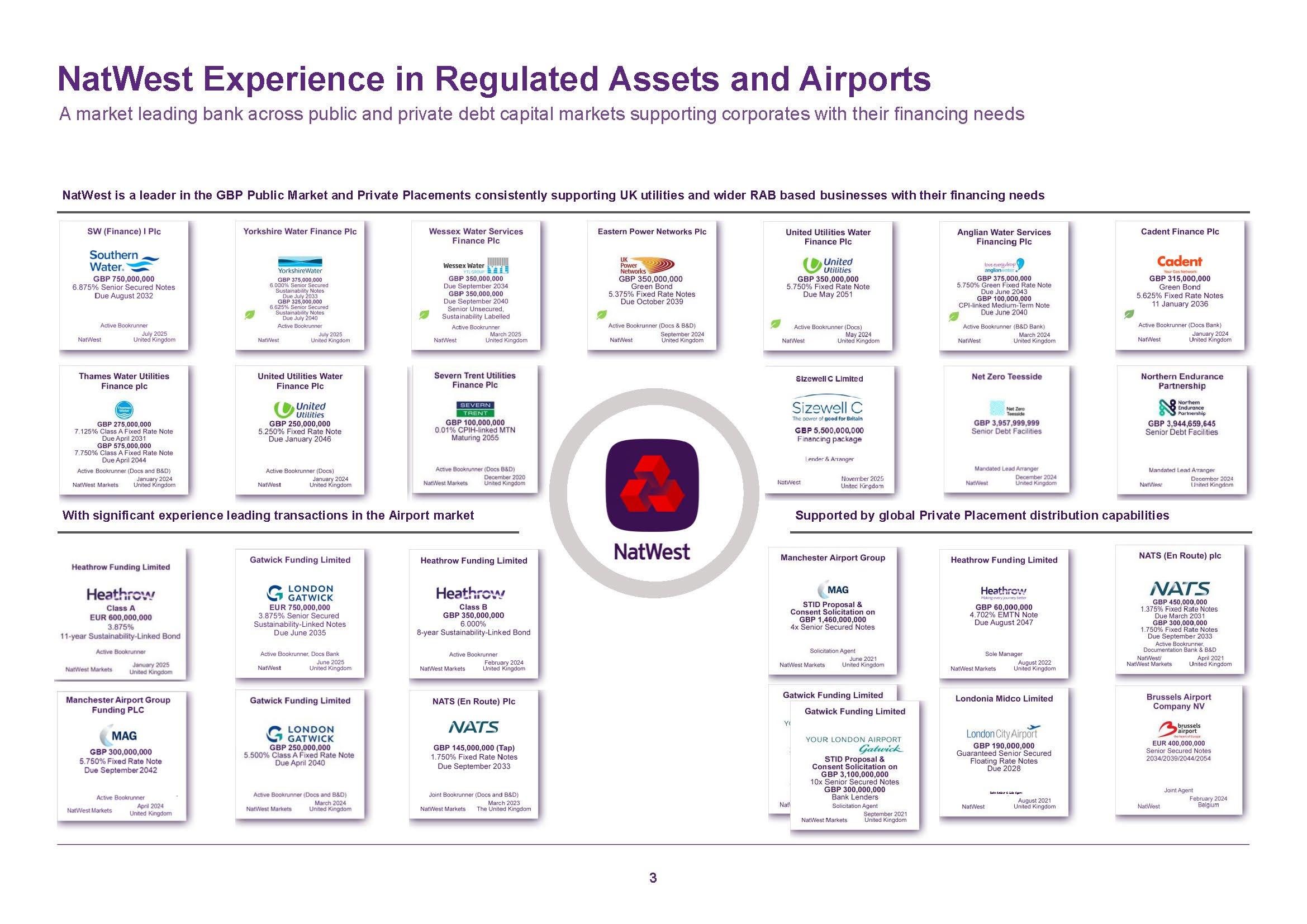
o Appendix E: NatWest Financing Assessment
o Appendix F: Land Acquisition and Engagement Strategy
This structured approach ensures that each section directly addresses the DfT’s requirements, with supporting evidence and references provided throughout to facilitate a thorough and transparent review process.
Content
The content of this report is based on technical studies, planning documents, and analyses produced by Arora and its consultants since 2017 1, supplemented by recent scenario modelling and research conducted in 2025 to address the DfT’s current requests for information. It draws on engineering, operational, and financial assessments from previous Heathrow expansion consultations, as well as updated stakeholder engagement and regulatory guidance.
The report references Government policy documents, including the ANPS, and relies upon technical appendices, land registry data, and independent reviews by aviation and infrastructure specialists. Where relevant, feedback from airlines, financial institutions, and transport authorities is included.
1 Figures and visual representations in this document may not necessarily reflect all elements of HWL’s Scheme (e.g. the proposed length and location of the runway).
Additionally, the report uses the HAL document, “Our Proposal for Expanding Heathrow –The UK’s Gateway to Growth” (Summer 2025), as the version of the HAL proposal for direct comparison with the HWL Scheme Therefore, the comparative analysis is based on the most current and relevant material. The combination of these sources intends to provide a robust, evidence-based foundation for all responses and evaluations in this RFI Response
Item 1e): The number of ATMs and passengers you say the airport will be able to physically accommodate by year, both in a scenario where the proposal proceeds and in a counterfactual scenario without runway expansion. .............................
Item
Please provide information outlining what you consider the economic benefits your scheme will bring and when these benefits will be realised. This should be
Comparative Assessment of Expansion Schemes
4. Comparative Assessment of Expansion Schemes
Introduction
This section presents a direct, scored, and ranked comparison between HWL’s and HAL’s Schemes, aligned with the evaluation criteria set out in the DfT’s RFI. Its purpose is to provide DfT with a transparent, evidence-based framework for identifying which proposal most effectively meets the Government’s policy objectives for Heathrow expansion.
Methodology
A five-point scoring system (1–5, where 5 = best performance) has been applied across four domains: technical integration, environmental impact, financial and economic performance, and programme deliverability. This approach intends to enable a fair, likefor-like assessment, presenting strengths and weaknesses clearly and objectively. The evaluation draws on the technical information within HWL’s submission, public data from HAL’s proposal, and relevant independent sources, ensuring that each score reflects verified evidence rather than opinion.
The comparative assessment supports DfT’s broader aims of promoting competition, protecting consumers, and ensuring affordability while maintaining high standards of operational resilience and environmental stewardship. By summarising both schemes within a single table, the analysis highlights where HWL’s approach provides measurable advantages in cost, risk, and constructability, and where HAL’s longer runway may offer limited performance benefits.
A score from 1 to 5 was utilised to demonstrate relative performance. The scoring regime is illustrated in Table 1
Results
The results of the assessment are set out in Table 3, showing the relative scoring, ranking, and preferred scheme for each criterion.
Applying the DfT’s matters for consideration, HWL’s Scheme demonstrates a consistent advantage over HAL’s Scheme across key measures of cost, deliverability, economic benefit, and environmental impact. This analysis shows that, overall, the greater risks in relation to financial viability, project delivery and programme certainty lies with HAL’s Scheme, a view which is shared with Heathrow Airport’s key stakeholders who also consider that HAL’s proposal undermines the competitiveness of Heathrow Airport as an international hub and accordingly the UK aviation sector and wider UK economy
HWL provides a lower-risk, more affordable solution to achieve additional runway capacity by 2035 without requiring the complex and disruptive M25 realignment central to HAL’s Scheme. It integrates seamlessly with existing infrastructure, maintains dual access routes for resilience, and delivers equivalent operational performance with significantly fewer construction impacts.
Financially, HWL’s capital cost — around 30 percent lower than HAL’s — results in significantly lower airport charges and a more cost efficient and sustainable outcome for airlines and passengers and improved investor confidence. Its simpler delivery model and modular sequencing strengthen investment confidence and enable earlier completion. Only HWL’s Scheme can deliver the significant economic benefits associated with expansion, together with additional economic benefits generated from lower disruption and programme risk, and the introduction of sustainable and meaningful competition at the UK’s only hub airport.
Environmentally, it reduces land take, community severance, and construction emissions through a compact, west-side footprint. Overall, HWL’s proposal aligns with DfT’s vision for a competitive, consumer-focused, and sustainable Heathrow Airport, introducing genuine market competition and delivering value for the UK economy.
Table 2 below summarises the final scores and ranking as shown later in Table 3. The scores reflect qualitative and quantitative assessment of DfT RFI criteria using publicly available information, previous HAL materials, and HWL technical data contained within this submission.
Table 2. Comparative Assessment Final Scores and Ranking
HWL HAL
DfT Evaluation Criteria / Key Matters
Integration with existing infrastructure – aircraft able to operate; operational restrictions
Integration – terminal connectivity to new runway
2,800m runway accommodates all aircraft types and ≥97.8% of movements; only occasional ultra heavy departures require reassignment to longer runways.
Proven routings under Scenarios A & B; all stands accessible to all runways under all alternation modes (E/W); compass based departures feasible.
Integration – operating modes and respite Four alternation modes per direction; predictable respite; minimal capacity loss when ultra‑heavy departures reallocated.
Land acquisition and blight Compact footprint west of current boundary; avoids M25 corridor works; fewer severance and displacement impacts.
Financeability –affordability and charges ~£23 billion estimated cost (≈30% below HAL’s); lower RAB growth → reduced airline and passenger charges.
Capital‑market perception / deliverability
Simpler engineering (no runway over M25); lower construction and schedule risk; lower cost; strong private finance support.
runway accommodates all aircraft types and ≥99.7% of movements; with fewer reassignment events.
Requires new runway crossing, modifications to M25 (J14, J14A and J15); significant realignment and A4 diversions.
illion indicative cost; fee increases under review.
M25 crossing; lower severance; enhanced green infrastructure west.
Competition and consumer outcomes Independent promoter introduces market competition → expected lower charges and improved service quality and innovation.
realignment under runway; major on network disruption risk.
Large macroeconomic benefits but within single promoter model.
Targets similar timeline; dependent on HAL’s ability to deliver on time.
Works within Green Belt / Colne Valley; higher local impacts.
Table 3. Comparative Assessment of HWL and HAL Schemes
A Response to Points Made by HAL
While the focus of the RFI Letter is on assessing the schemes to inform the ANPS review, and we have sought to respond accordingly, we take this opportunity to respond to points made by HAL in the summary of its proposal published in the summer of 2025 and in more recent public commentary
HWL’s Runway Plan Avoids the M25 Crossing Reducing Risk, Disruption, and Cost
In recent public commentary, Thomas Woldbye, Heathrow’s chief executive, asserted the following about building a third runway at Heathrow without crossing the M25, “if we could avoid it, we should, but it is not avoidable,” suggesting that alternatives such as the HWL Scheme would require even more complex and costly interventions, particularly over the M4 Spur, and result in greater community impact. However, a detailed review of HWL’s proposal and the comparative evidence presented in this report demonstrate that these claims are not substantiated by the facts.
First, the HWL Scheme is specifically designed to avoid the unprecedented engineering and operational risks of constructing a runway over the M25, one of Europe’s busiest motorways, which carries approximately four times the daily traffic of the M4 Spur and features 12 lanes double the width of the M4 Spur. The M25’s scale and strategic importance mean that any major intervention, such as tunnelling or realignment, introduces significant cost, disruption, and risk to both the project and the national road network. In contrast, HWL’s plan proposes a 2,800m runway located entirely east of the M25, crossing only the M4 Spur a far less disruptive and more manageable engineering challenge. HWL’s technical analysis confirms that the M4 Spur crossing can be achieved while maintaining existing traffic flows, using established construction methods, and without the need for the extensive diversions or tunnelling required by the HAL Scheme
Mr. Woldbye’s assertion that a shorter runway “requires moving more motorways” is not supported by the HWL design, which minimises land take and avoids the need for M25 realignment altogether. Furthermore, the claim that HWL’s Scheme would necessitate the demolition of more than 2,000 homes is contradicted by HWL’s detailed land acquisition analysis which calculates the number of residential properties requiring demolition at 858: while HWL’s proposal does potentially impact a greater number of properties than HAL, the overall land take is lower, and the scheme avoids the massive community severance and environmental disruption associated with the M25 crossing.
Finally, the cost argument advanced by HAL is undermined by the comparative financial analysis in this report. HWL’s Scheme is projected to be approximately £10 billion less expensive than HAL’s, with a simpler delivery model, reduced construction risk, and earlier completion. This cost efficiency, combined with the avoidance of the M25, directly challenges the notion that only a 3,500m runway over the M25 can deliver capacity and affordability for passengers.
In summary, the evidence shows that HWL’s approach avoiding the M25 and focusing on a more practical M4 Spur crossing offers a safer, less disruptive, and more cost-effective path to Heathrow expansion, directly refuting the claims made by Mr. Woldbye and underscoring the compelling advantages of the HWL Scheme Indeed this conclusion is supported by HAL’s own report dated January 2014.
Lack of Site-Specific and/or Operational Expertise
HAL’s position that as the incumbent owner and operator at Heathrow, only it has the sitespecific knowledge to integrate new capacity with existing infrastructure is not true.
Building and expanding airports is a specialised but well-understood undertaking in the global engineering community. HAL does not directly construct runways or terminals itself; it relies on contractors and expert consultants. The technical know-how to design and integrate a new runway, taxiways, and terminals is held by numerous international firms and professionals. HWL has partnered with Bechtel, a firm that has delivered nearly 200 airport projects worldwide and whose business it is to deliver complex projects in operational and space constrained sites, to draw up its scheme
Moreover, site-specific knowledge does not sit uniquely with HAL. Planning and environmental challenges in the local area are issues HWL, and the wider Arora Group, are very familiar with from decades of experience operating businesses and infrastructure at Heathrow Airport perimeter. While Heathrow’s existing layout and operations are complex, much of the necessary information (e.g. layout of runways, taxiways, utilities, airspace procedures) can be documented and shared with any qualified developer. It is standard practice for airport operators to work with external project teams to ensure integration with live operations – this was the case even when HAL built Terminal 5 (extensive planning and risk management between BAA (then HAL) and contractors ensured integration with ongoing airport operations).
In addition, HAL implies that only the current operator could integrate new capacity without disrupting airport operations. Integration challenges (connecting new runways/terminals to existing systems, ensuring safety and regulatory compliance) are surmountable with proper planning – and they would have to be addressed in any case. Many major airports have successfully integrated expansions led by third parties or separate project teams (such as terminals developed by airlines or consortiums in the United States, e.g. the redevelopment of Terminal 8 at JFK). What’s critical is information sharing and joint planning with the incumbent – something that can be contractually and/or regulatorily required. HWL would expect any regulatory mechanism or other process of coordinating works between promoters to ensure that any critical interfaces and interactions are appropriately addressed through coordination and/or information sharing (subject to appropriate safeguards). HAL’s own Terminal 5 opening issues illustrate that even the incumbent can face integration problems if not managed correctly: on T5’s first day, thousands of passengers saw baggage and service meltdowns, which a UK parliamentary inquiry attributed to insufficient communication and poor staff training and system testing.
Finally, it is also important to note that HAL does not currently operate T5. Instead, the busiest terminal at the airport, in terms of both passenger numbers and flight movements, is actually managed by British Airways, who have a direct and vested interest in ensuring terminal operations are safe, efficient and affordable
Timeline for Financing and Regulatory Change
HAL’s statement that changes to the legal and regulatory framework required to accommodate a third-party operator would time out any alternative operator is inaccurate –and overlooks questions raised regarding its own ability to finance expansion, trailed by S&P Global Ratings’ report of April 2025, which stated its view that “the new runway would be difficult to finance without strong equity backing.” Regulatory issues to accommodate a third-party operator were considered at length by the CAA during the last review of schemes, and the CAA has (re)commenced its development of a regulatory framework for expansion, including considering various alternative regulatory models. Given the time until DCO submission and that work considering these issues is already underway, we expect there is adequate time to make any licence changes necessary to accommodate HWL’s Scheme. Moreover, the CAA’s previous significant work regarding the extent of its powers to regulate a potential third party operator, set out in detail in the Technical Information Note of August 2018, is likely to provide third party funders with considerable comfort. Any regulatory model which is put in place would follow the hallmarks of UK economic regulation, including most likely a RAB based model, which is well understood within debt and equity markets. We consider it is unlikely that these developments would hold up HWL’s financing arrangements or construction works. Appendices E set out the preliminary and high-level financing views of HWL’s Scheme provided by CITI and NatWest
Risks of Fragmentation
Incidents in recent years including the fire in March 2025, caused by dependence on a single power source and resulting in airport closure, and poor management of capacity and resourcing during and following the pandemic illustrate HAL’s track record on resilience and operational management matters, with significant impact on passengers.
Heathrow Airport’s average passenger satisfaction scores have also significantly declined in the last decade, and sit below the average for airports globally, European airport and large airports (based on Skytrax ratings 2014-2024). Heathrow fell from the 8th best airport in the world in 2019 to 21st in 2024, according to Skytrax’s rankings for passenger experience. Furthermore, research conducted amongst 50 airlines operating out of Heathrow found that 67% of respondents agreed that Heathrow’s operations stifled their ability to increase investment plans. 2
2 See Airline Economics, Airlines operating at Heathrow believe airport management "hinders" its effectiveness as a hub (20 March 2025), available at: Airlines operating at Heathrow believe airport management "hinders" its effectiveness as a hub
Integration with Existing Infrastructure
5. Integration with Existing Infrastructure
Aircraft Capable of Operating from the New Runway
Item 1a): What aircraft you say will be able to operate from the new runway and whether there will be any operational restrictions on the aircraft
Introduction
All aircraft types will be able to operate from HWL’s proposed new runway because the runway and its supporting taxiway system will be designed to the technical standards of Aerodrome Reference Code 4F, as defined in UK Regulation (EU) No. 139/2014 (Aerodromes), the same as Heathrow’s two existing runways. Therefore, HWL’s proposed new runway can operate as a full component of Heathrow’s future three-runway system.
Technical Analysis
The new runway’s proposed 2,800m length is a key component of HWL’s overall proposal, enabling optimal location of the new runway and avoiding a crossing of the M25 motorway. IAG has performed a detailed technical analysis of the runway length’s potential effect on flight operations, including assessment of every British Airways flight to-and-from Heathrow Airport during 2024, with a substitution simulation for the performance of new aircraft types that will replace existing aircraft types on specific missions.
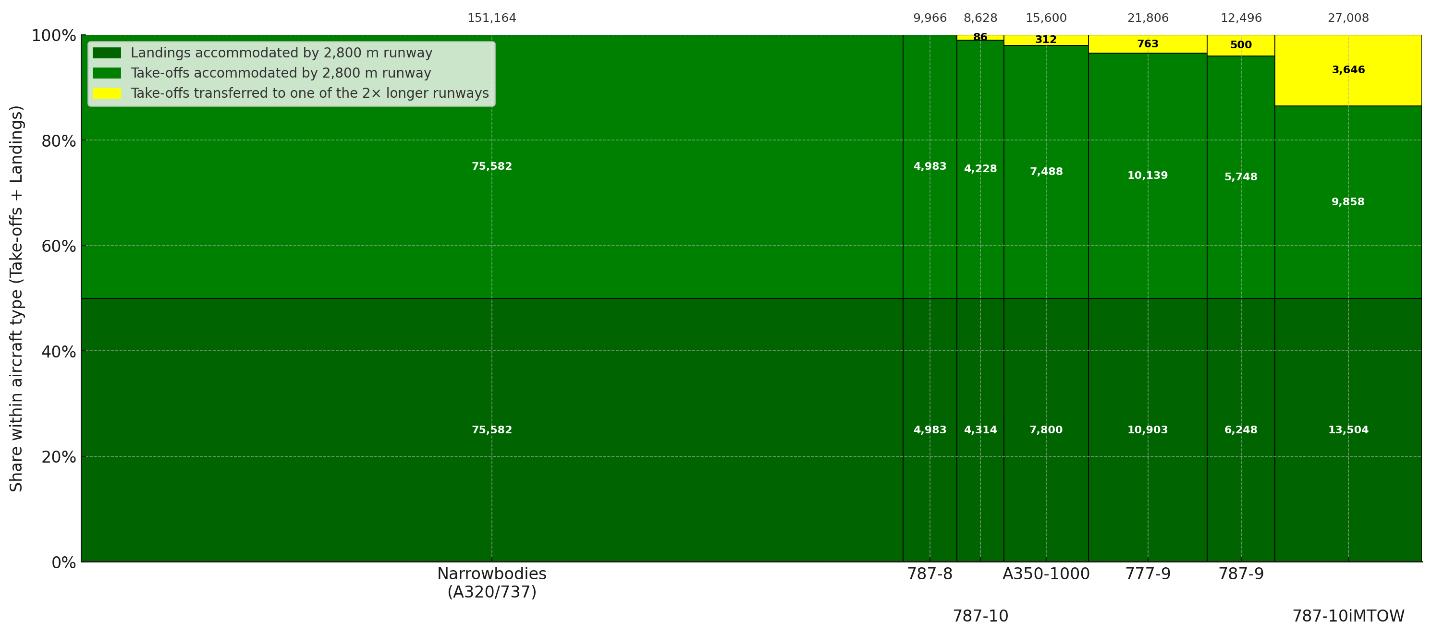
The study, which is presented in HWL’s 31 July 2025 Proposal to DfT, concludes that a 2,800m runway can accommodate at least 97.8% of all flight operations (take-offs and landings) expected at Heathrow in the future, including:
• All take-offs and landings by narrow-body aircraft
• All landings by wide-body aircraft
• The vast majority of all take-offs by wide-body aircraft, including the following percentages for selected aircraft types expected to operate at Heathrow in the future:
o Airbus A350-1000: 96%
o Boeing 787-8: 100%
o Boeing 787-9: 92%
o Boeing 787-10: 98%
o Boeing 777-9: 93%
o Boeing 787-10iMTOW variant: 73%
– Note: it is unclear how many B787-10iMTOW will actually be in operation at Heathrow and which missions/destinations will be operated (IAG has been conservative in its analysis)
IAG’s analysis also reflects operations by other airlines at Heathrow by assuming that the same percentage of take-offs by wide-body aircraft of all airlines is affected by the 2,800m
runway length as the percentage of BA flights so affected. As an example confirming the reasonableness of this assumption, NACO calculates that 97.7% American Airlines operations by wide-body aircraft could be accommodated by a 2,800m runway.
On average, out of approximately 1,000 daily departures (once at full capacity), only 14 departures would need to be re-allocated from the 2,800m runway to one of the two longer runways. These constrained flights will be known in advance and can be tactically handled, as explained in Item 1c below.
• Note: The new runway will not operate at its capacity upon its opening because flight demand will increase incrementally each year until capacity is reached. Any potential capacity reduction / demand penalty associated with the tactical re-allocation of departures from the 2,800m runway to one of the longer runways would only be seen when the airport approaches its three-runway capacity. By this time, the fleet composition at Heathrow may have changed.
Figure 1 shows how a 2,800m runway can accommodate at least 97.8% of all movements. Moreover, as explained under Item 1c) below, when this runway is operated as part of Heathrow’s three-runway system, the resulting non-standard take-offs are 0.7%.
Figure 1. Annual Take-offs and Landings by Aircraft Type and Runway Outcomes
Terminal Connectivity with the New Runway
Item 1b): Whether all terminals will be able to access the new runway
Introduction
The complexity on the ground in relation to the HWL proposal is inextricably linked to both the airspace and the alternation options providing respite. In order to conclusively answer the question, two main operational concept scenarios have been explored and the flows mapped in both directions (easterly and westerly) and for all operational (alternation) modes. On an annual basis, Heathrow operates in easterly flow approximately 30% of the year and in westerly flow approximately 70% of the year.
Given the HWL Scheme proposes a 2,800m runway necessitating occasional alternaterunway ultra-heavy departures to be re-allocated, this added element has also been
considered in each of the scenarios. (An “alternate-runway” departure refers to a departure by an aircraft which requires a runway length greater than 2,800m for a particular flight.)
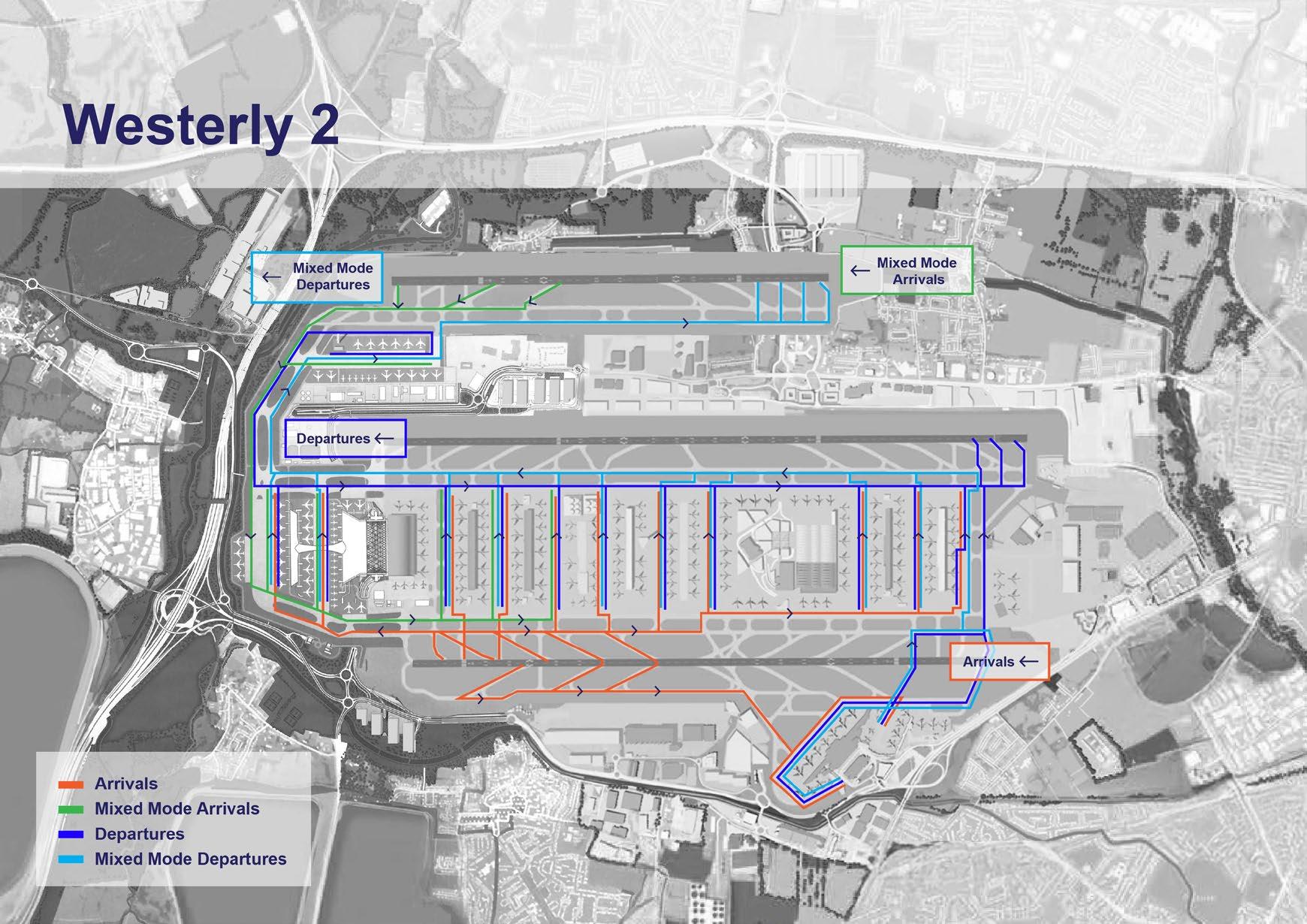
In recognition of the need for the redesign of the London Terminal Manoeuvring Area (LTMA), which is critically required to facilitate current demand and the addition of approved and future expansion schemes for the London airports, the approach chosen is one of maximum flexibility. The focus at this stage therefore is on the demonstration of compatibility of the proposed scheme with any realistic airspace operating methodology. Acknowledging the status and the anticipated complexity of the required airspace modernisation for the LTMA, it is our aim to ensure that the proposed scheme can operate in any predictable airspace design and does not impose overly constraining or narrow preconditions or requirements on the surrounding airspace. This is demonstrated by the ability to facilitate a complete compass-based allocation of arrival and departure runways which whilst increasing ground complexity, is supportable by the proposed scheme; equally the scheme is well suited to operate in a manner where arrivals are allocated the runway most suitable based on parking stand to deliver more beneficial ground performance.
Operational Concept
There is considerable pressure on the LTMA and the requirement to ensure any Heathrow third runway scheme, not only provides operational effectiveness and respite, but also fits within the wider London airports growth requirement. A new entity, the UK Airspace Design Service (UKADS) has been established as the single guiding mind to coordinate and sponsor future airspace changes under the airspace modernisation strategy. For this reason, there is still uncertainty around exactly how the airspace pertaining to Heathrow will be designed and operated in the future.
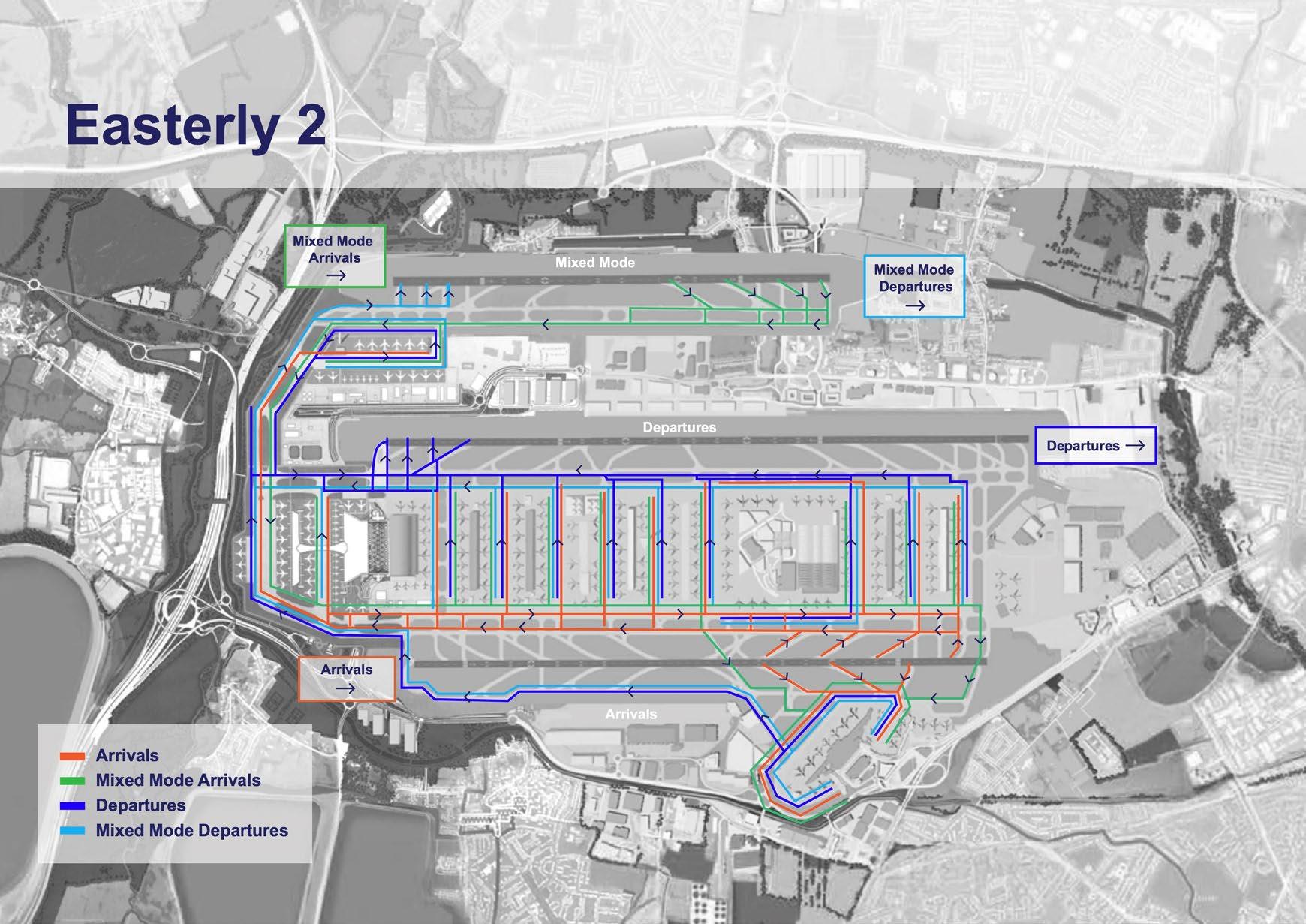
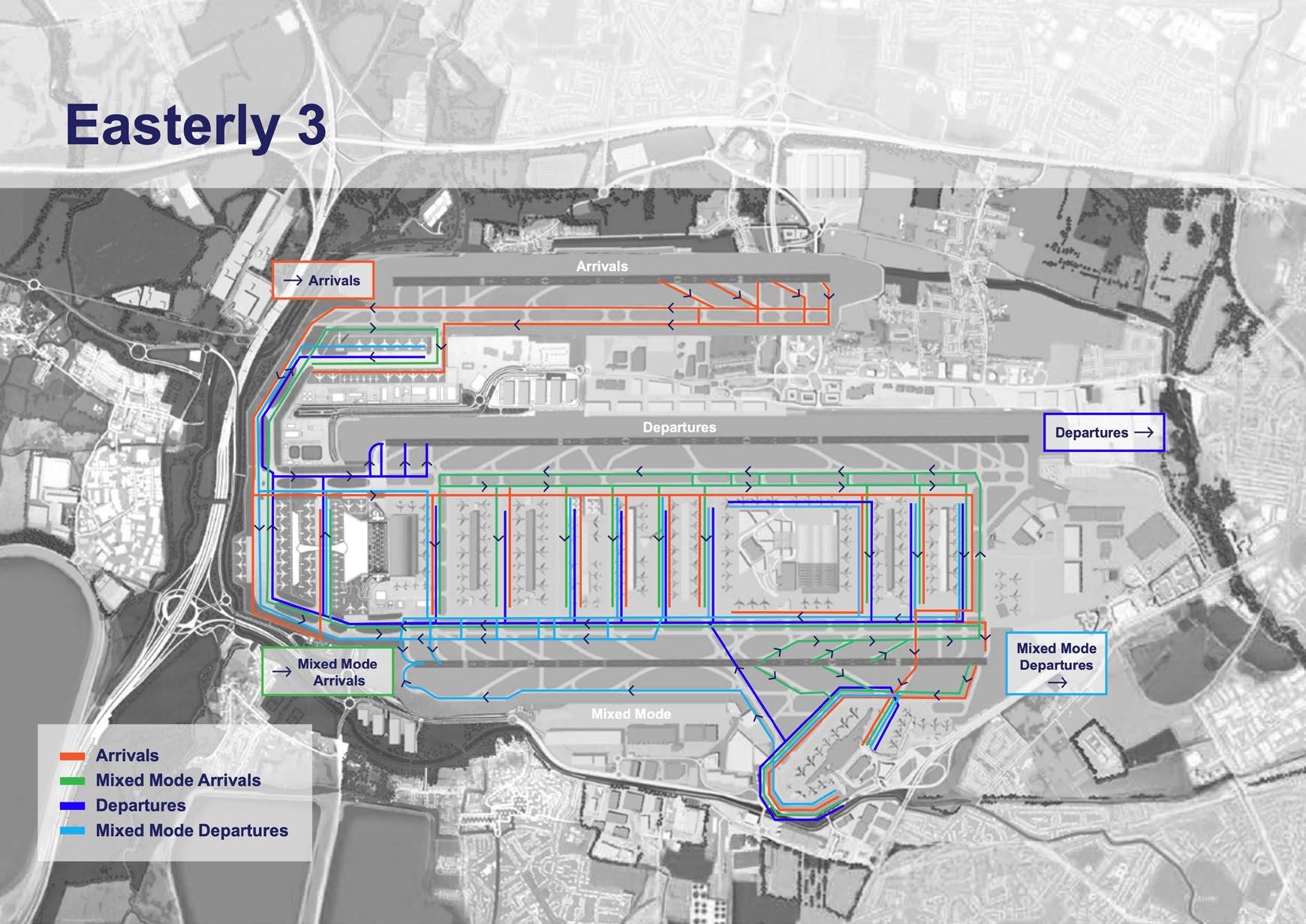
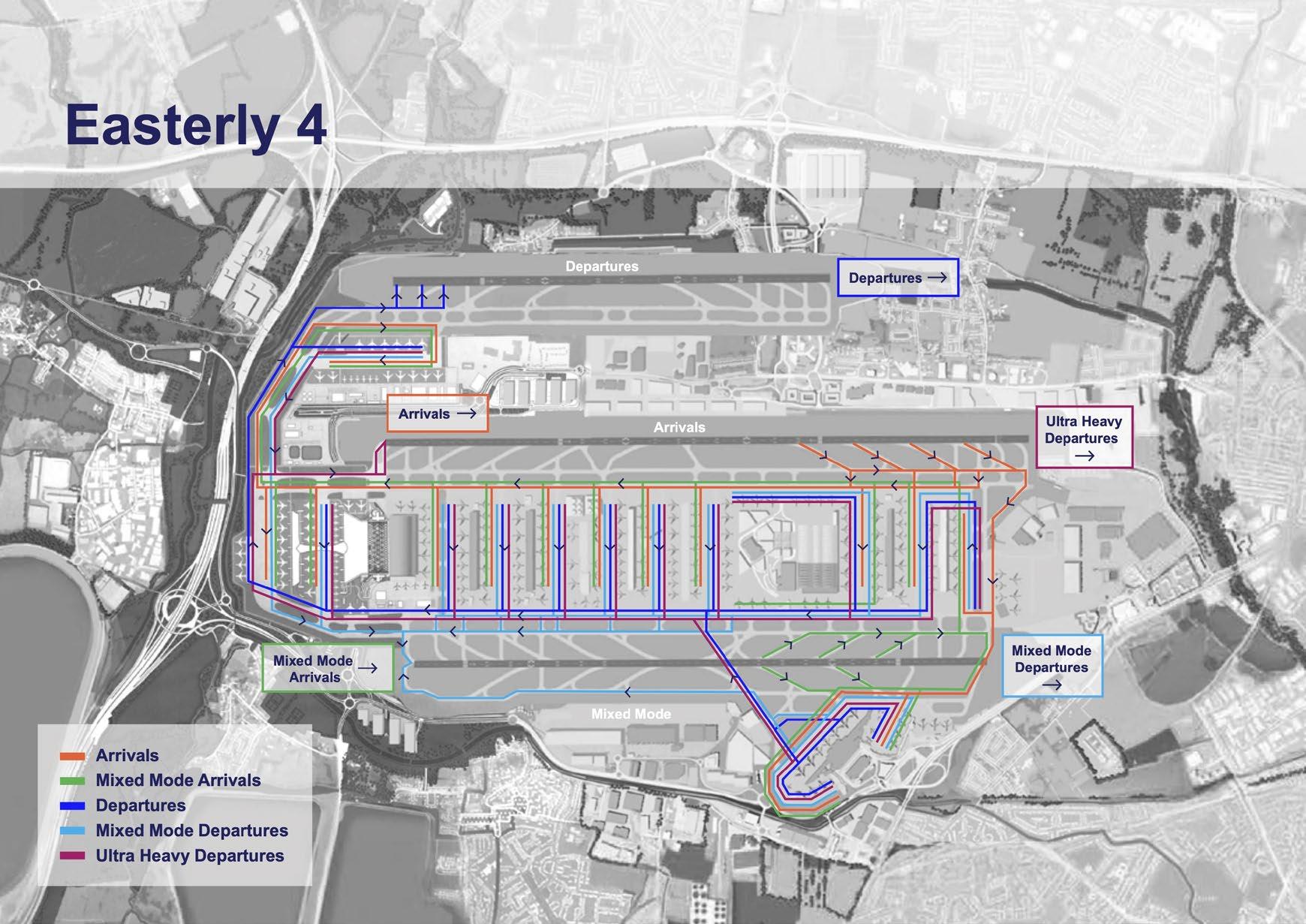
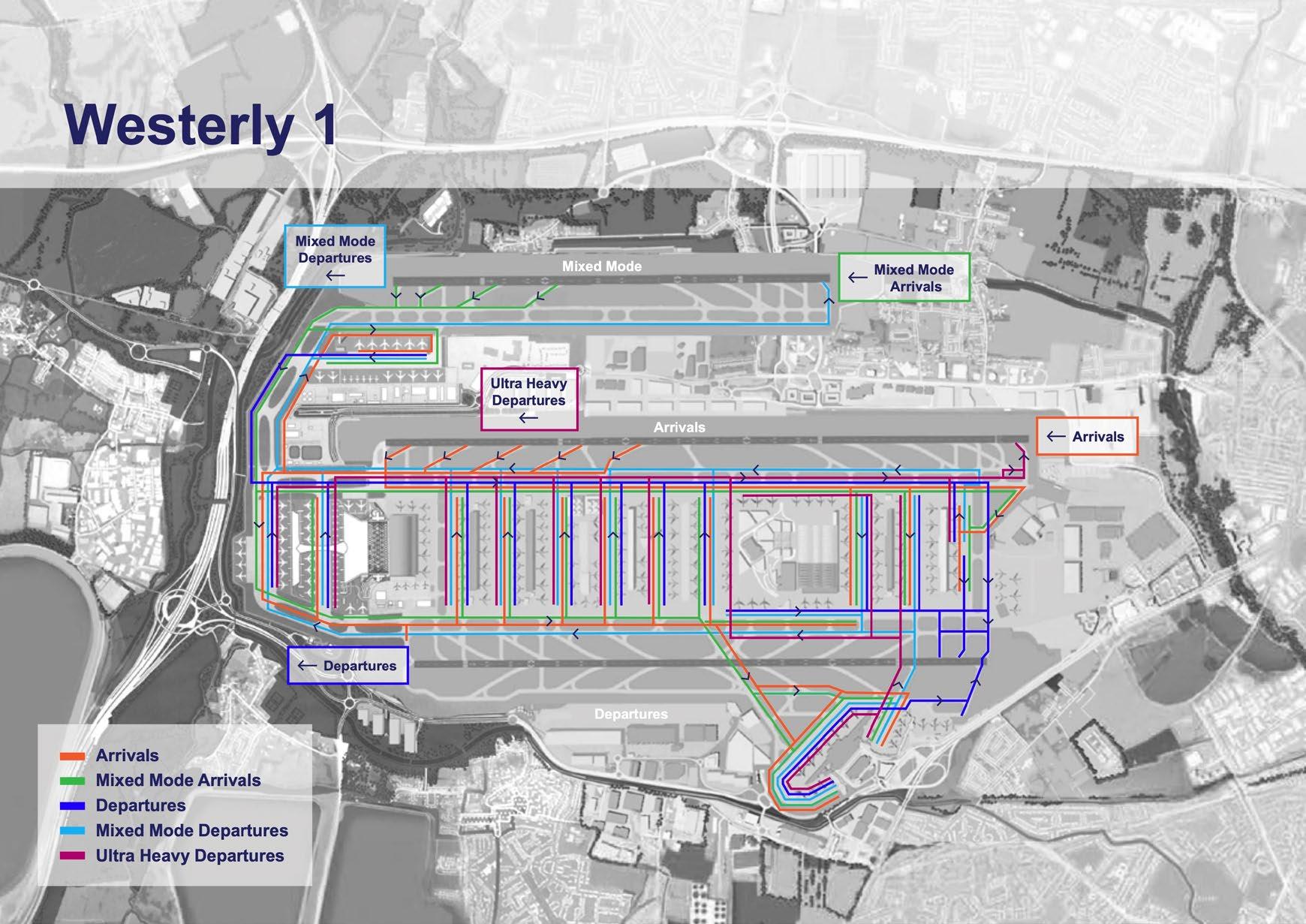
With this in mind, HWL has explored and mapped two operational concept scenarios, Scenarios A and B, to encompass the full range of potential complexity in ground and airspace operations
Scenario
A
This scenario balances complexity on ground infrastructure with that in the air (Heathrow and London TMA Airspace). The principles associated with this scenario are:
• Departures allocated to the runway closest to their initial departure route (compass based) to minimise ATM complexity in the airspace.
• Arrivals allocated to the runway most suitable for the respective parking stand to minimise complexity on the ground.
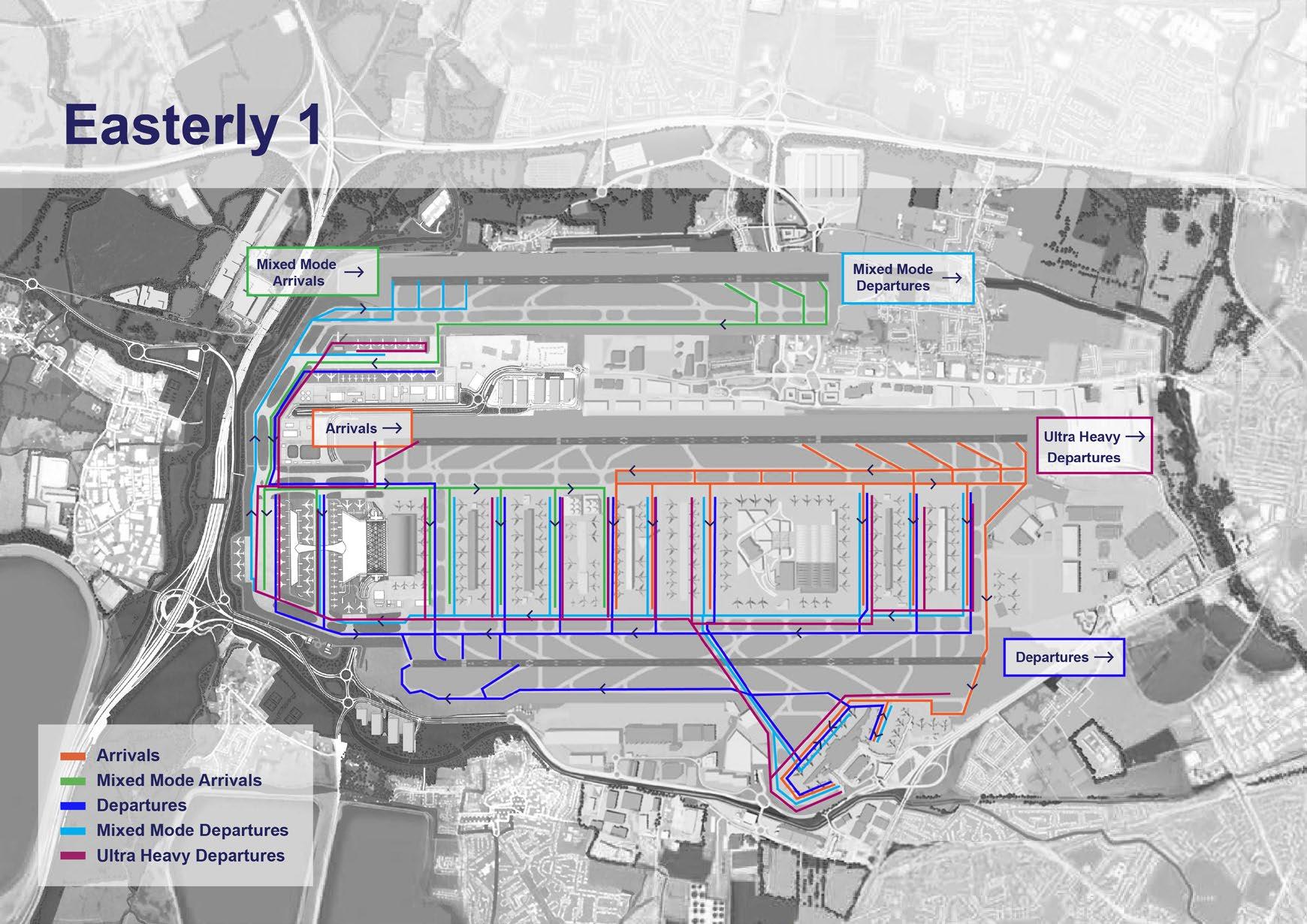
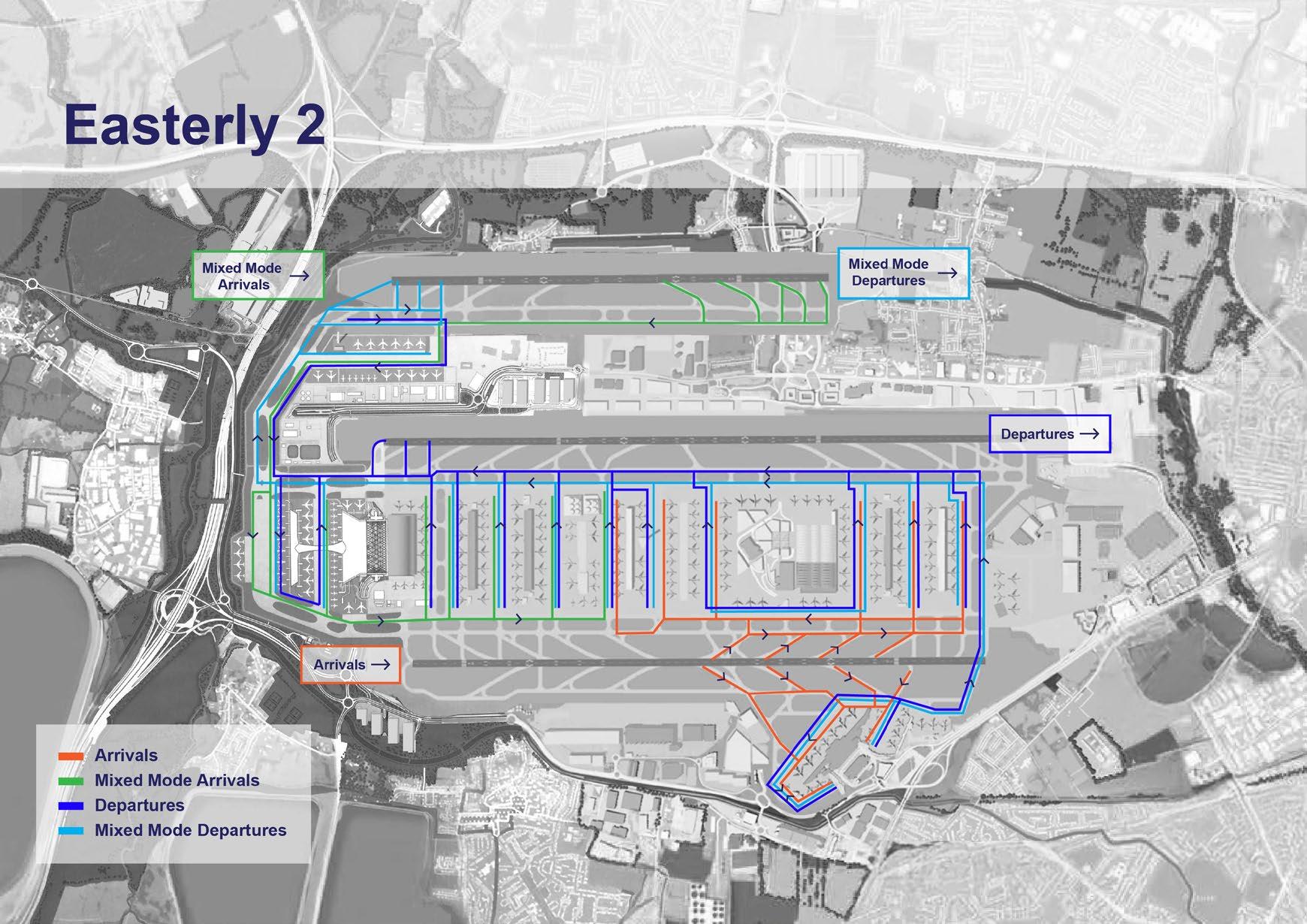
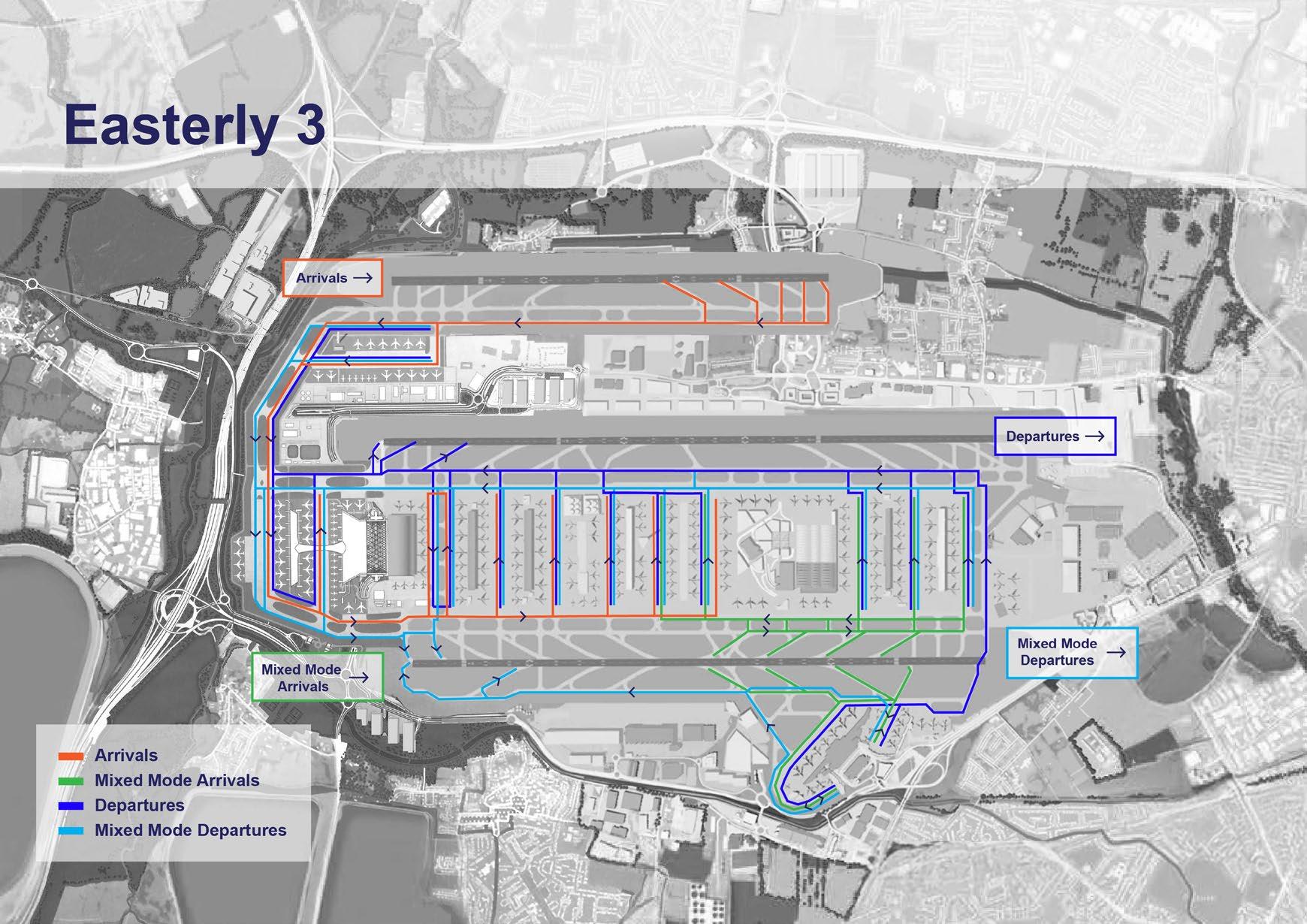
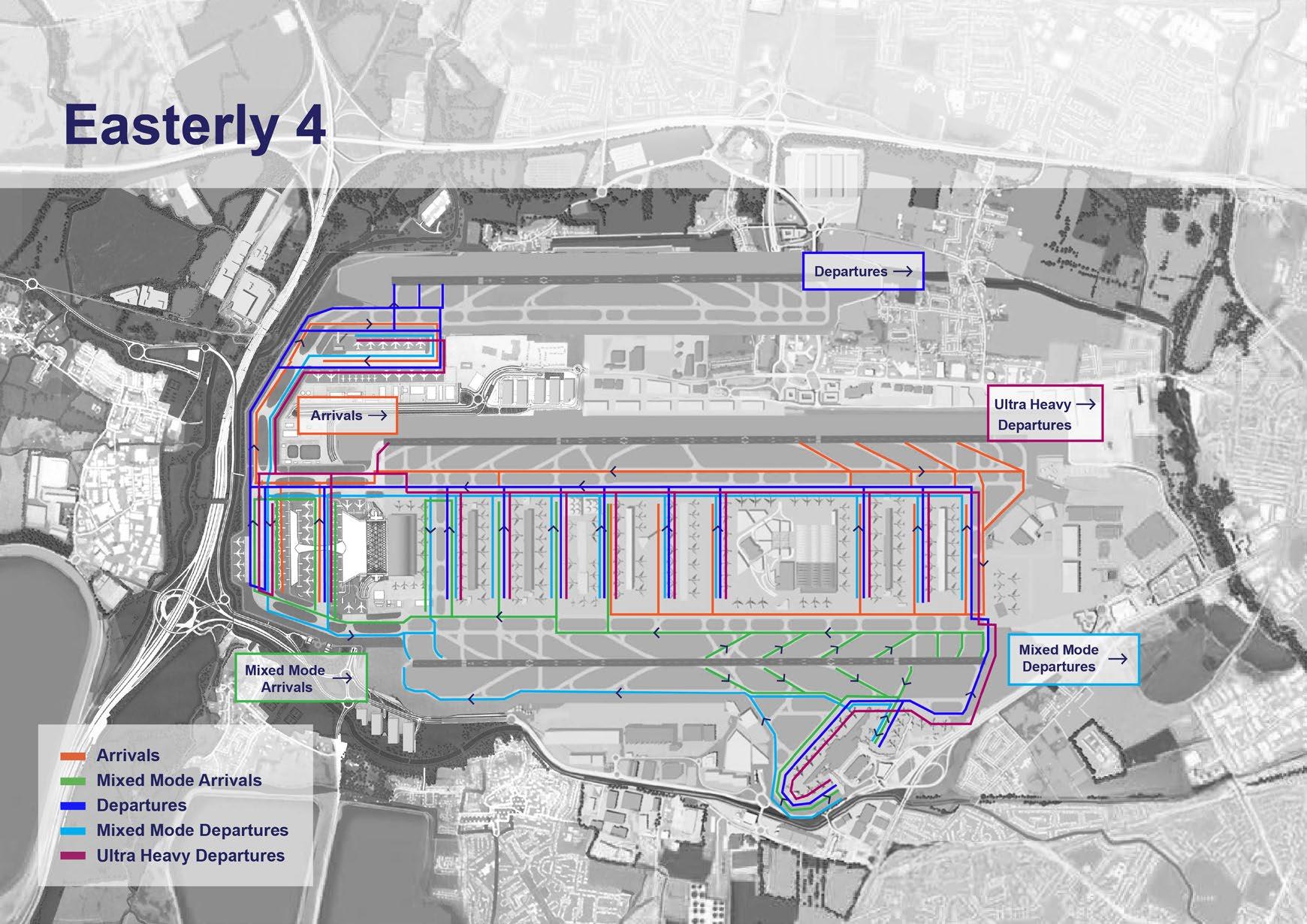
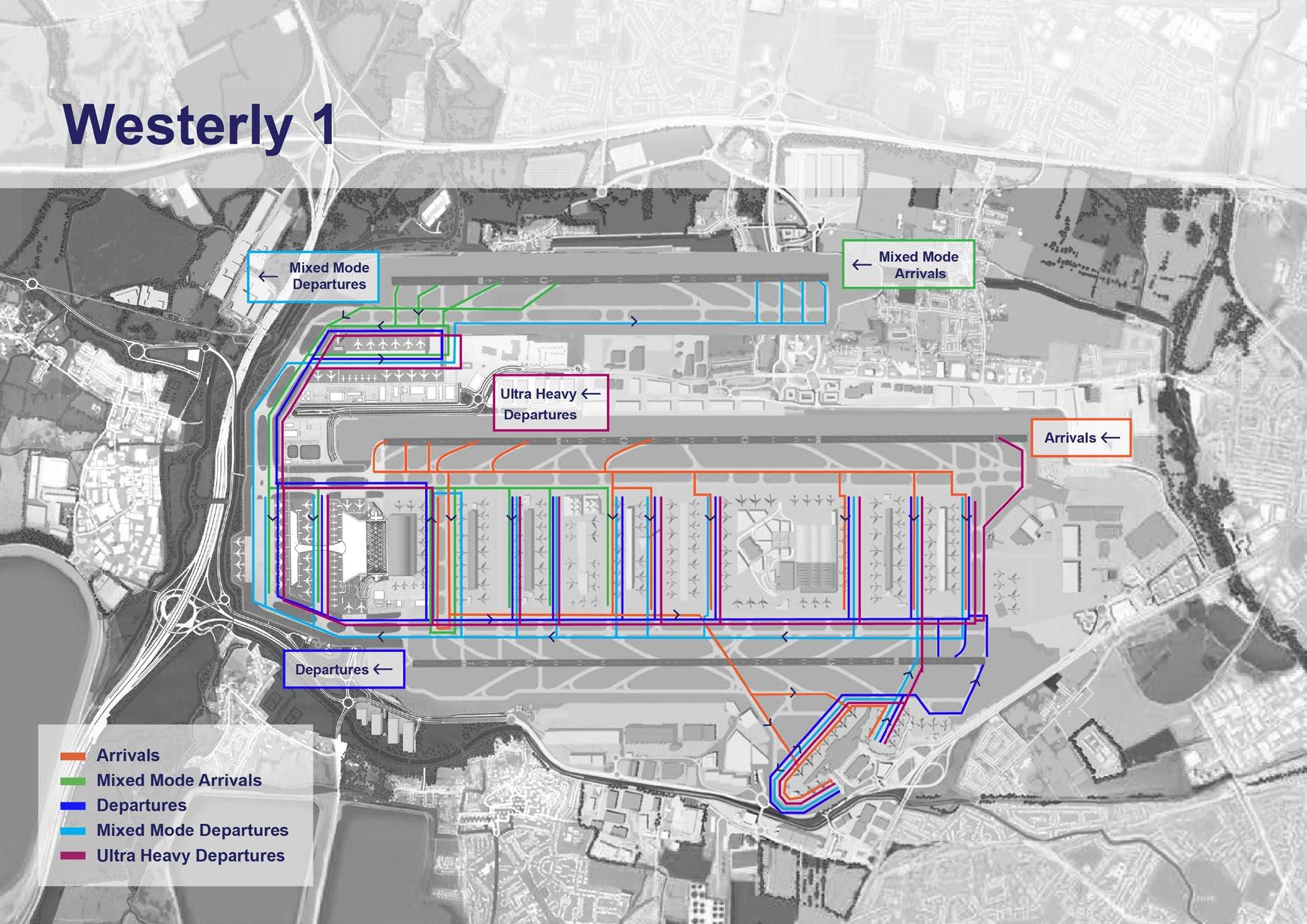
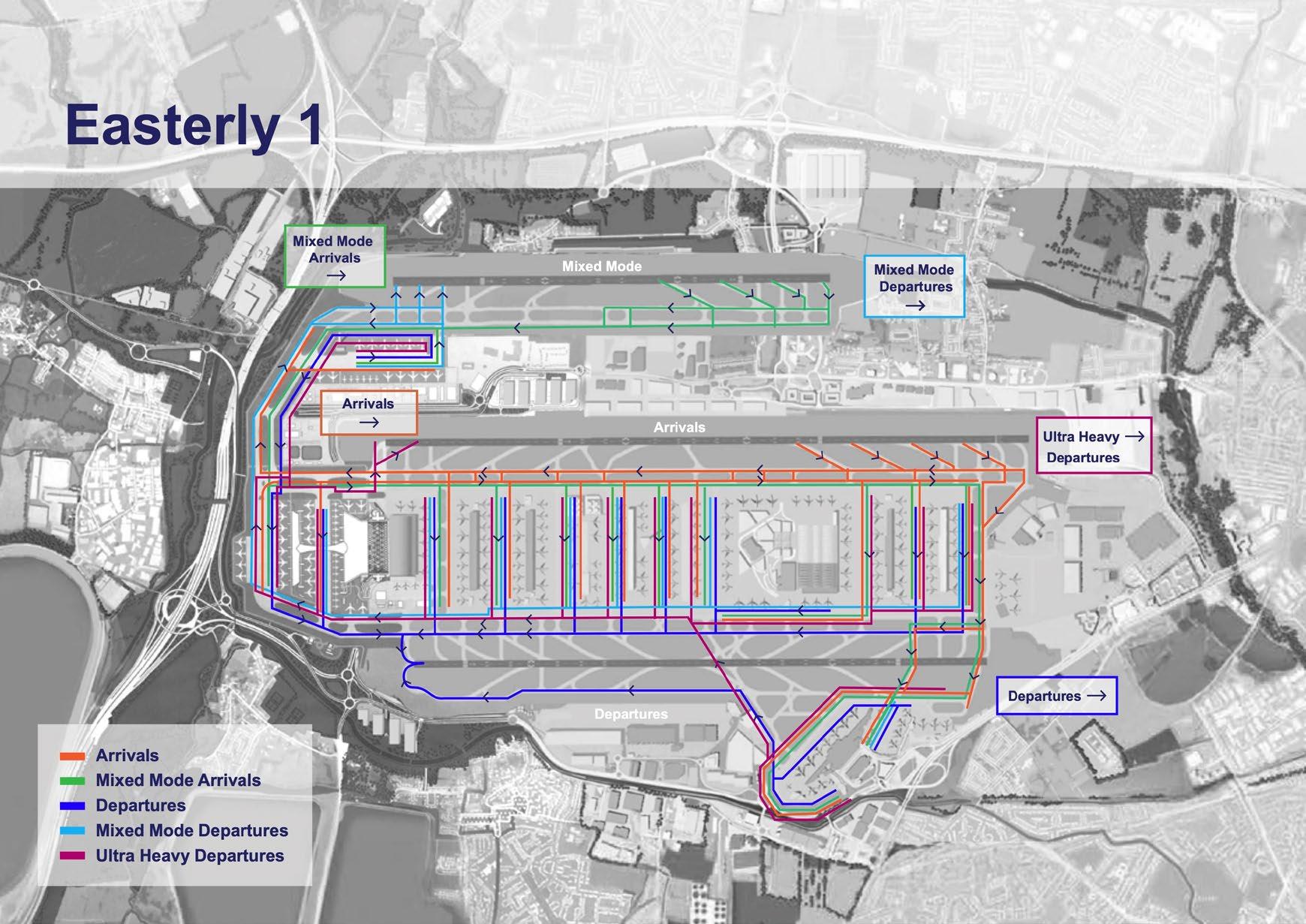
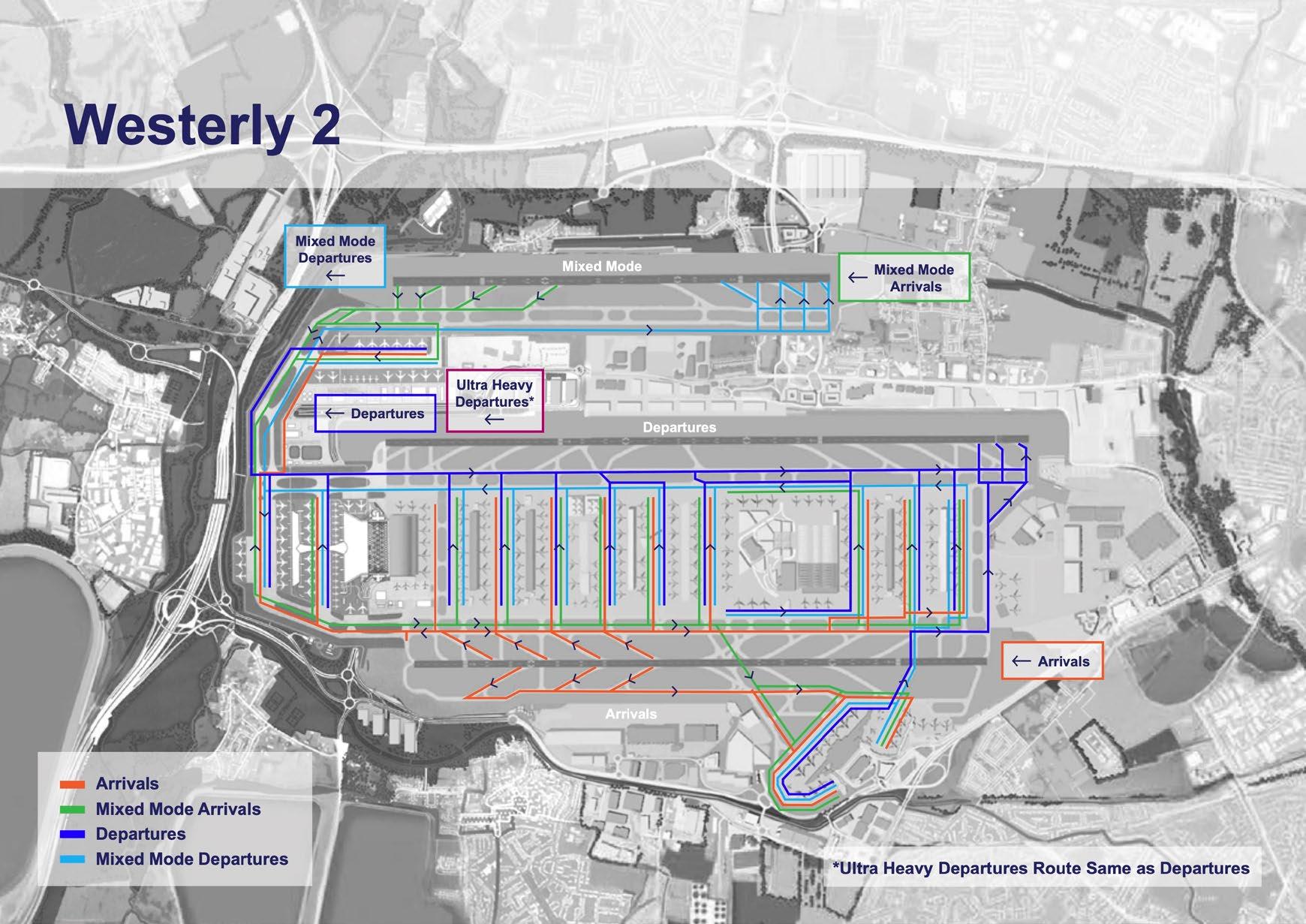
Under this model inbounds are sorted in the air and outbounds are sorted on the ground. Associated ground flow proving maps can be seen below in Figure 2–Figure 9 (Note that in all figures presented in Section 5, where “Ultra Heavy Departures” are not mentioned in the legend, the ultra-heavy departures use the same runway as other departures from either of the two existing runways.) These figures clearly illustrate that in this scenario:
• All inbound aircraft can route from every arrival runway to every parking terminal and stand in every mode in both directions.
• All departing aircraft can route from every terminal and stand to the appropriate / assigned departure runway in every mode in both directions.
Heathrow West: Proposal for the Expansion of Heathrow Airport RFI Response (12
Figure 2. Scenario A Easterly Mode 1
Figure 3. Scenario A Easterly Mode 2
Heathrow West: Proposal for the Expansion of Heathrow Airport RFI Response (12
Figure 4. Scenario A Easterly Mode 3
Figure 5. Scenario A Easterly Mode 4
Heathrow West: Proposal for the Expansion of Heathrow Airport RFI Response (12
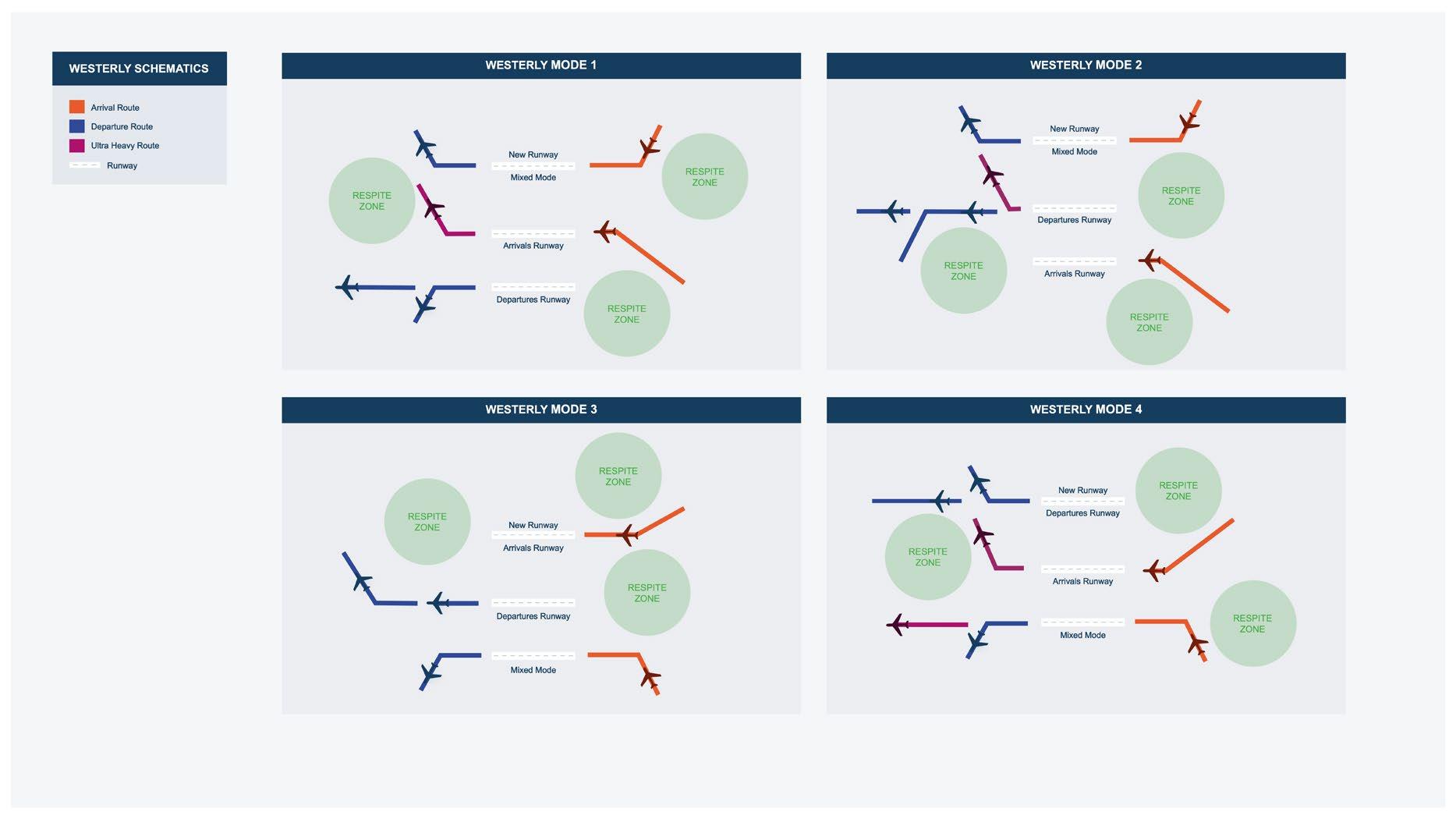
Figure 6. Scenario A Westerly Mode 1
Figure 7. Scenario A Westerly Mode 2
Heathrow West: Proposal for the Expansion of Heathrow Airport RFI Response (12 November
Figure 8. Scenario A Westerly Mode 3
Figure 9. Scenario A Westerly Mode 4
Scenario B
This scenario increases complexity on the ground infrastructure whilst minimising airborne complexity in the approach phase. The principles associated with this scenario are:
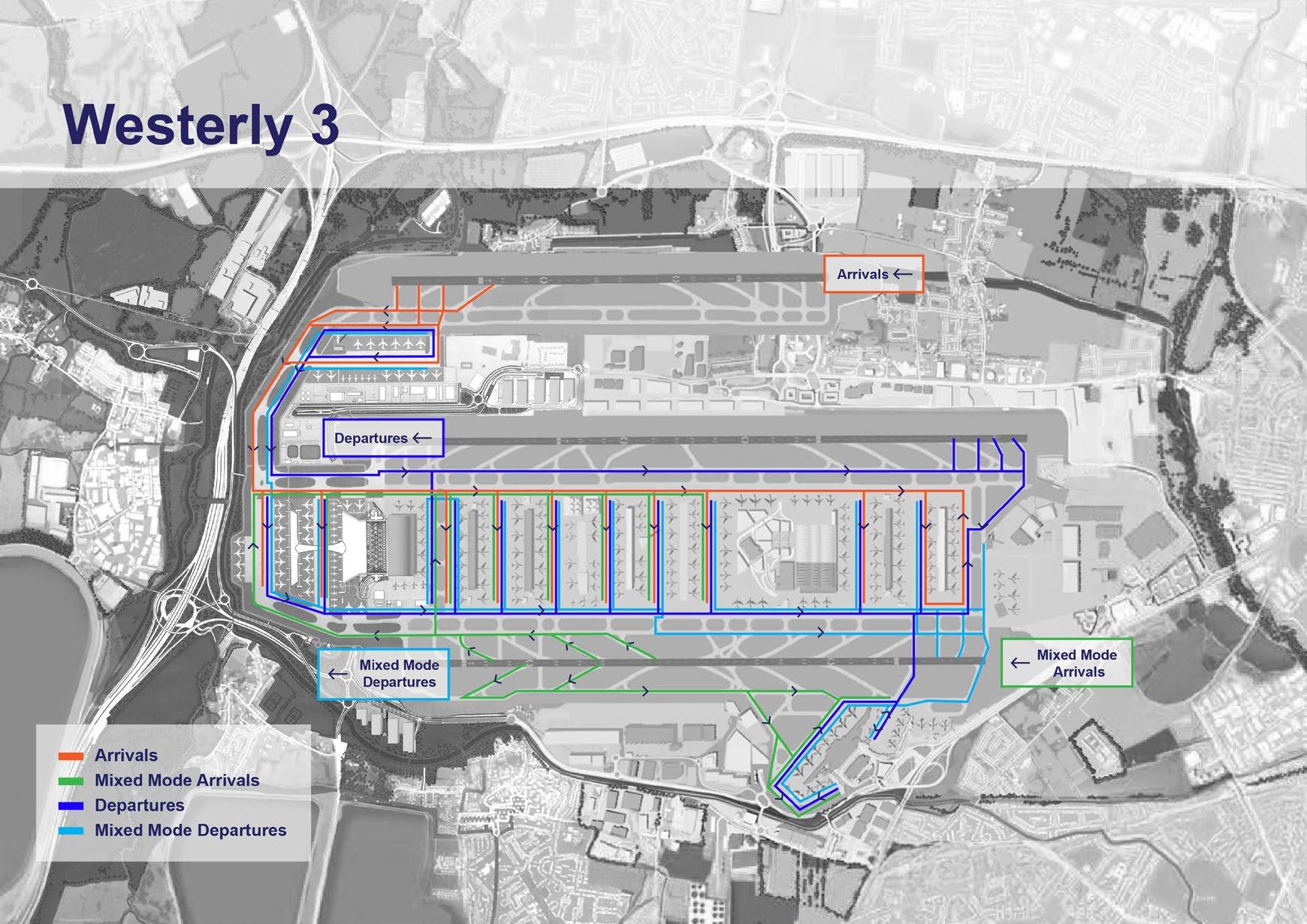
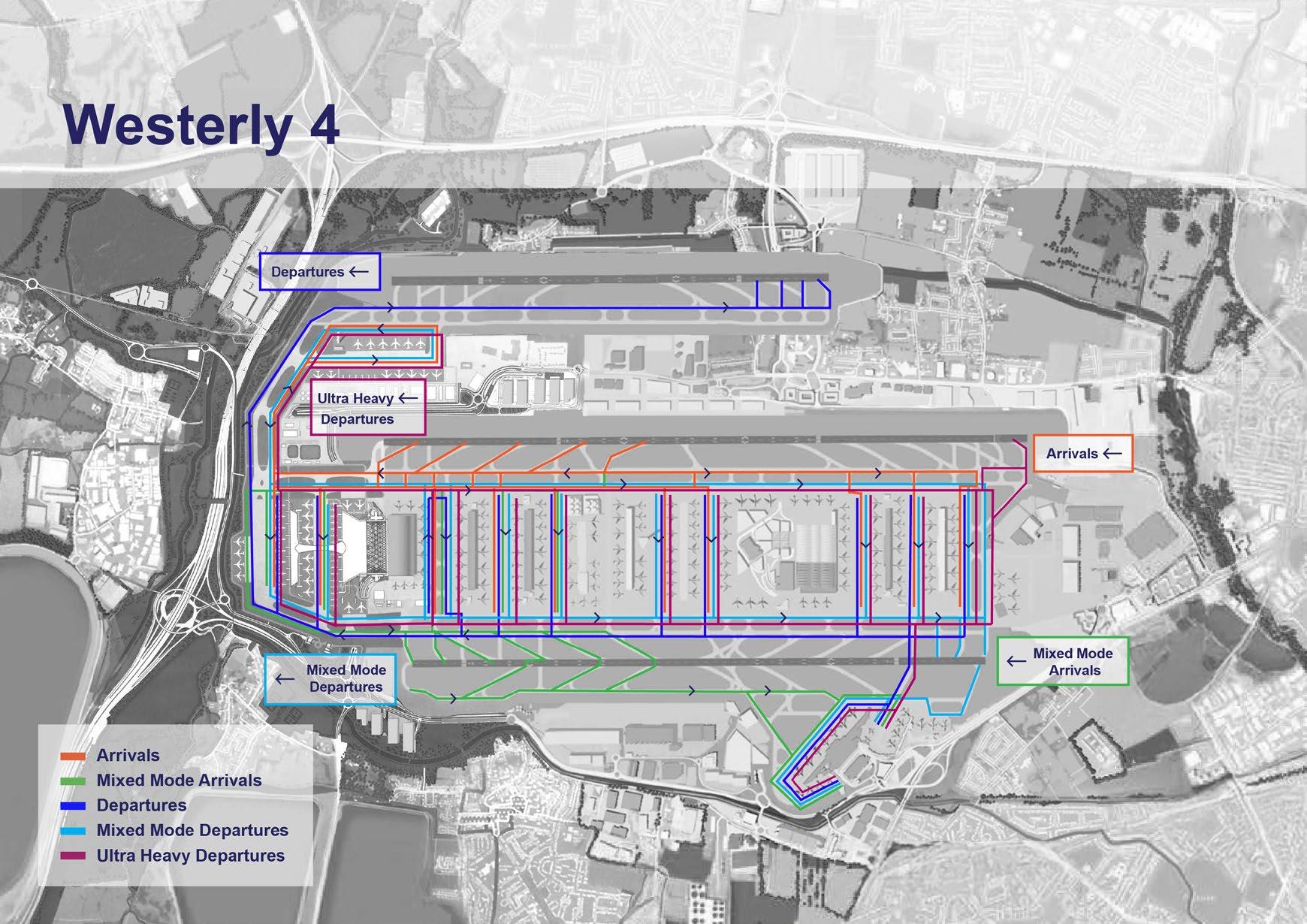
• Departures allocated to the runway closest to their initial departure route (compass based).
• Arrivals allocated to the runway closest to their geographic direction of approach (compass based).
Under this model all aircraft both arriving and departing are sorted on the ground.
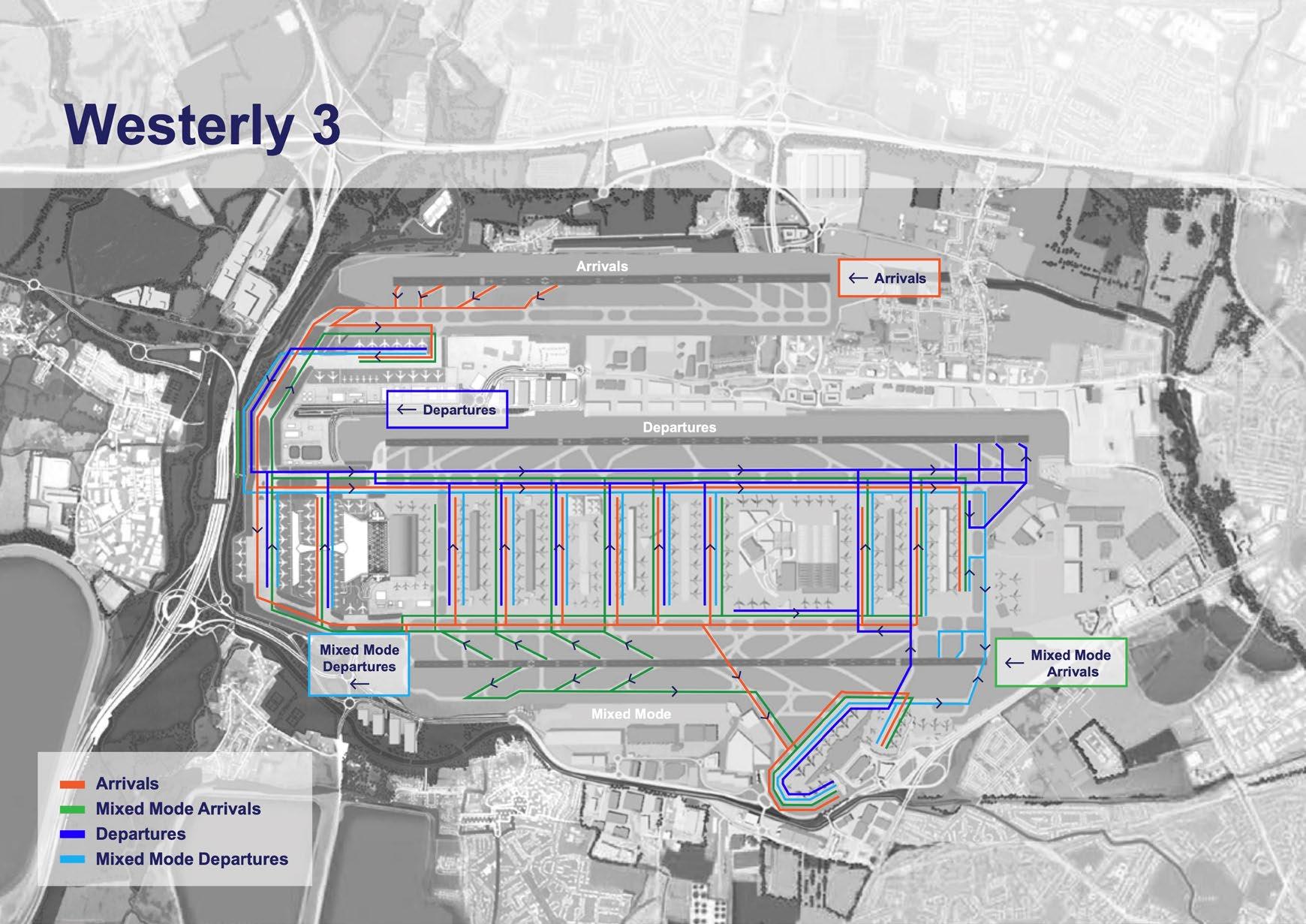
Associated ground flow proving maps can be seen in Figure 10–Figure 17. These clearly show that in this scenario:
• All inbound aircraft can route from every arrival runway to every parking terminal and stand in every mode in both directions.
• All departing aircraft can route from every terminal and stand to the appropriate / assigned departure runway in every mode in both directions.
Figure 10. Scenario B Easterly Mode 1
Heathrow West: Proposal for the Expansion of Heathrow Airport RFI Response (12
Figure 11. Scenario B Easterly Mode 2
Figure 12. Scenario B Easterly Mode 3
Heathrow West: Proposal for the Expansion of Heathrow Airport RFI Response (12 November 2025) | 5-10
Figure 13. Scenario B Easterly Mode 4
Figure 14. Scenario B Westerly Mode 1
Heathrow West: Proposal for the Expansion of Heathrow Airport RFI Response (12 November 2025) |
Figure 15. Scenario B Westerly Mode 2
Figure 16. Scenario B Westerly Mode 3
Ultra-Heavy Departures
Given the HWL proposal has a 2,800m runway, there may be an occasional departing aircraft that may need to route to a longer runway to depart.
• This will mean departing from another departure runway in which case these flights will follow the ground routes available for other departing aircraft assigned that runway as standard.
Or
• They will be required to route to and depart from the respective arrivals runway.
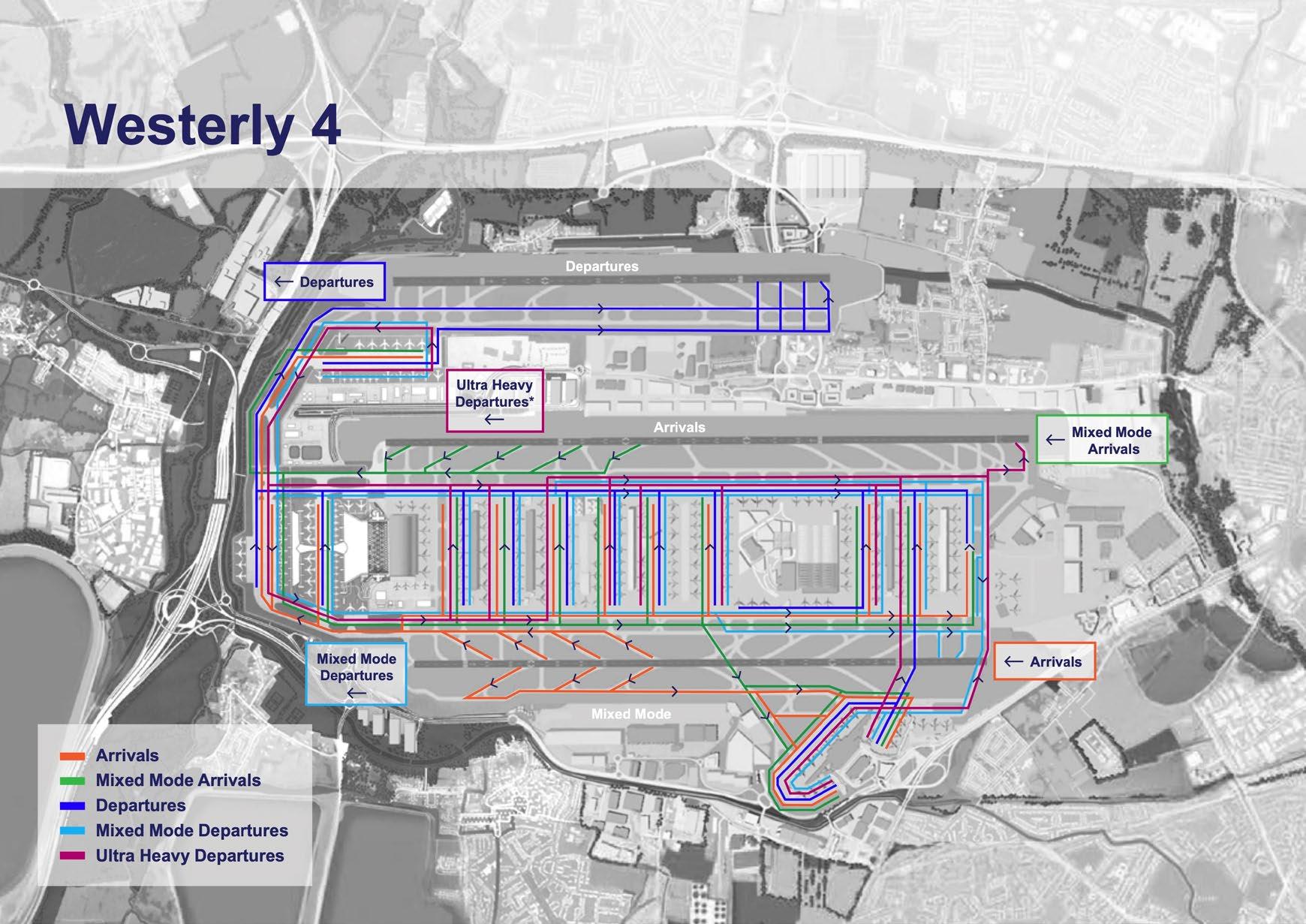
As illustrated in the figures above, all ultra-heavy aircraft can route from every terminal and stand to a longer runway in both Scenarios A and B and in every mode in both directions.
Conclusion
As both Scenarios A and B call for a compass-based departure regime, the two operational scenarios tested provide a bookend for complexity on the ground.
Assurance can therefore be provided that regardless of the airspace concept deployed all aircraft can reach all necessary points across the airport including the new runway.
In practice the actual delivery model is likely to fall somewhere in between A and B and having mapped the bookends at either end of ground complexity it can enable all scenarios in between to allow access from all terminals to and from the new and existing runways.
Figure 17. Scenario B Westerly Mode 4
Operational Procedures of All Three Runways
Item 1c): The proposed operational procedures of all three runways and how they will be able to provide the respite that is set out in the ANPS
Introduction
The three-runway system is designed to deliver multiple operating modes in order to provide the potential for predictable periods of respite from noise for local communities whilst still safely delivering effective traffic flows in viable numbers.
Runway Operating Modes
There are four operating modes in each direction as shown in Table 4
Table 4. Runway Operating Modes
D = Departing, L = Landing Rotating runway use to produce operating modes (HAL, Updated SDR Document 2, June 2019)
• Mode 1: Northern Runway is mixed mode (DL), Centre Runway is Landing (L), Southern Runway is Departures (D)
• Mode 2: Northern Runway is mixed mode (DL), Centre Runway is Departures (D), Southern Runway is Landing (L)
• Mode 3: Northern Runway is Landing (L), Centre Runway is Departures (D), Southern Runway is Mixed Mode (DL)
• Mode 4: Northern Runway is Departures (D), Centre Runway is Landing (L), Southern Runway is Mixed Mode (DL)
These four modes are valid in both easterly and westerly operations providing eight modes overall.
It should be noted that the Centre Runway is never used as the mixed mode (DL) runway when all three runways are in use (in any mode or direction) due to operational complexity and safety considerations associated with a continuous parallel operation between two parallel runways and the interaction of possible missed-approaches with departures and arrivals with other arrivals with limited or no ability to turn. A few individual ultra-heavy alternate-runway departures can, however, be accommodated safely on the centre runway when it is being used for landings (Modes 1 and 4) through coordination and generation of a suitable gap in the overall aircraft flow. A respective capacity penalty of one movement per alternate-runway departure has therefore been accounted for in ATM capacity numbers.
In each of the modes, in both directions, respite is provided to different areas around the airport, both in the immediate vicinity of the airport and into the intermediate airspace. By
alternating through the modes respite periods can be provided for different communities at predictable and specified times, consistently.
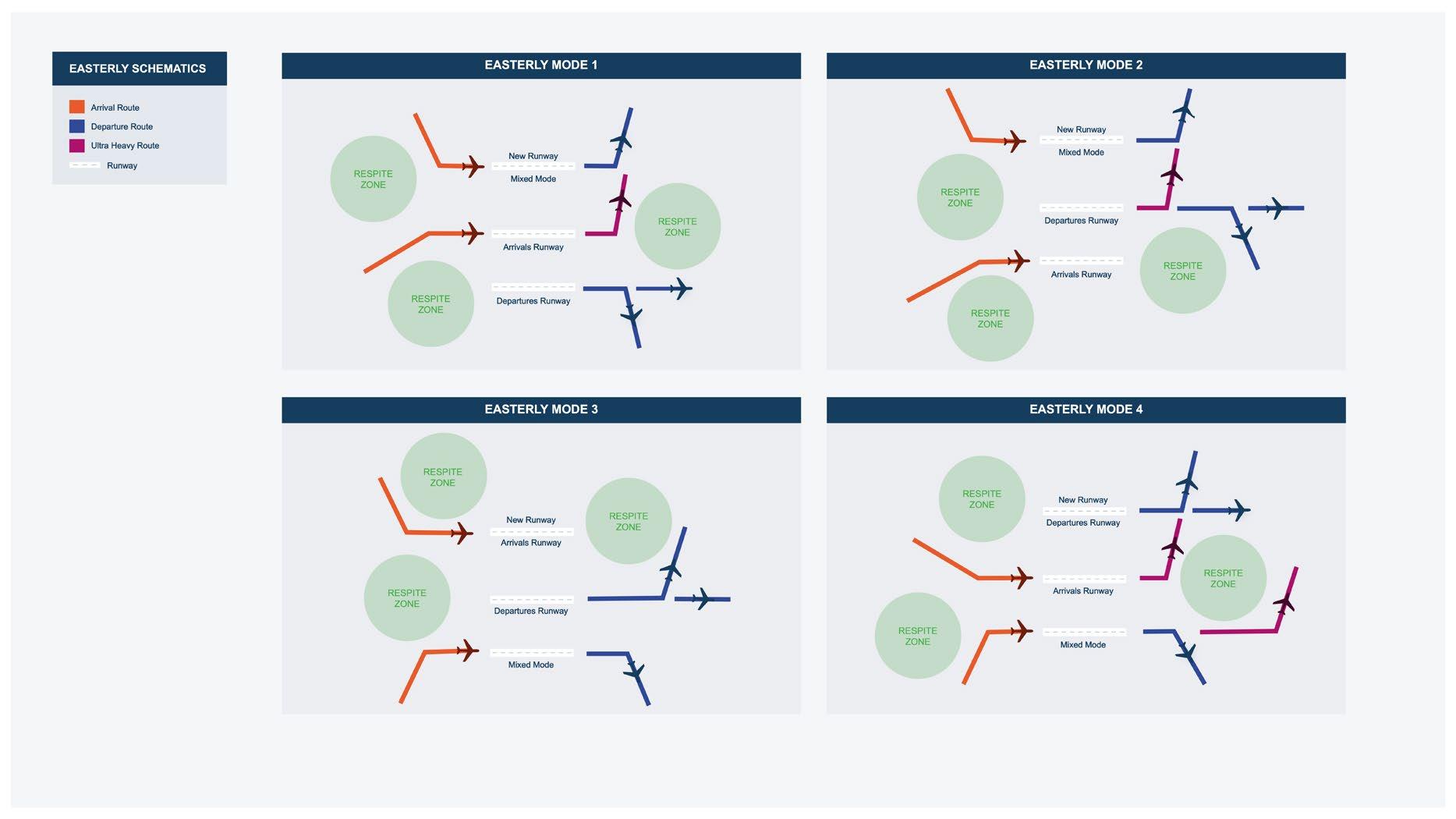
Figure 18 and Figure 19 show schematically how the operation of the different modes will work in each direction and where respite can be provided. These conceptual diagrams show how respite can be achieved but, at this stage of development, do not yet provide specific information about affected communities.
Heathrow West: Proposal for the Expansion of Heathrow Airport RFI Response (12 November 2025) | 5-14
Figure 18. Airspace Schematics Easterly
Figure 19. Airspace Schematics Westerly
Ultra-Heavy Alternate-runway Departures
The HWL Scheme features a shorter northern runway than the HAL Scheme. This shorter runway will mean very small number of ultra-heavy departures cannot accept the shortened length for take-off under certain conditions.
As presented in HWL's 31 July 2025 Proposal, International Airline Group (IAG), who operate over 50% of all Heathrow flights, determined that an average of less than 43 movements per day will be unable to depart from the shorter new runway due to take-off distance requirements. A proportion of these departures will therefore need to use one of Heathrow's two existing runways for take-off instead of the new runway, deviating from the operating mode. These occasional departures can be reallocated to an alternative, longer runway. Figure 18 and Figure 19 demonstrate that this is viable, whilst optimising traffic flows and maintaining noise respite for communities.
Based on the four operating modes described above, the effect of these ultra-heavy departure re-allocations is considered as follows:
• Mode 1: As only circa one third of departures are departing from the mixed mode northern runway (two thirds from the departure only longer southern runway), only 14 alternate-runway departures (from the arrivals runway) would be required if this mode were operated for the entire day. It is estimated the system will lose one movement from overall optimised capacity for each alternate-runway departure in this mode.
• Mode 2: As only circa one third of departures are departing from the mixed mode northern runway (two thirds from the departure only longer centre runway) only 14 alternate-runway departures (from the departure runway) would be required if this mode were operated for the entire day. It is estimated the system will lose one movement from overall optimised capacity for each alternate-runway departure in this mode.
• Mode 3: As there are no departures from the arrivals only northern runway zero alternate-runway departures will be required.
• Mode 4: As circa two thirds of departures are departing from the departure-only northern runway, circa 28 alternate-runway departures (spread across the arrivals and mixed mode runways) would be required if this mode were operated for the entire day. It is estimated the system will lose one movement from overall optimised capacity for each alternate-runway departure in this mode.
On average, as a result of the rotational use of the four operating modes and assuming equal operation of each of the modes, the average daily requirement for re-allocation of super-heavy departures is 14.
Of the total daily capacity of over 2,100 ATMs, this is a proportion of less than 0.7%. Due to this extremely low occurrence, it is the focus at this stage of the planning process to ensure that this traffic volume can be managed and processed safely. It is acknowledged that there are likely a range of solutions which can be explored as part of the detailed design, which will further mitigate or potentially eliminate the impact of these 14 average movements per day. Reflective of the maturity of surrounding planning elements, including e.g. future airspace design, airfield operating procedures, and detailed scheduling it appears prudent to avoid assuming any such mitigating solutions, as this helps to minimise
pre-conditions and dependencies also for associated processes such as the airspace redesign.
At this stage, the proposal therefore focuses on assurance that:
• All ultra-heavy departures can access the respective alternative runways from any stand on the airfield, which is evidenced in the ground flow schematics
• Respite can still be provided and is only minimally impacted by these 14 re-allocated departures, which is demonstrated in Figure 18 and Figure 19
• These 14 departures from the respective arrival or mixed-mode runway can depart without posing a risk to safety, which is achieved by assuming the coordination of a suitable gap in the overall traffic flow (e.g. a gap in the arrival flow of the parallel runway to eliminate the risk associated with a parallel go-around) and this is why a capacity reduction of one ATM has been assumed in conjunction with every such reallocated ultra-heavy departure
• The impact of this requirement to re-allocate 14 departures per day to an alternative runway has acceptably low impact on overall capacity, which is the case on the basis that the annual capacity loss (unmitigated) is an annual reduction of 5,110 ATM.
System Flex
To optimise the system the airspace can be designed to allow some flexibility in arrival streams, seeking the correct balance is achieved between the two arrival runways (mixed mode (DL) and landing only (L) runway). This is generally achieved using arrival management tools and airspace design techniques (e.g. arrival holds and instrument flight procedures). As explained under Item 1e, the actual airspace design remains an area for further work through the UKADS and in conjunction with NATS (NATS (En Route) Plc, NERL) at the next stage of proposal development.
The HWL proposal is agnostic to airspace design principles and supports a flexible operational model that aims to facilitate future airspace modernisation. For example, the model can support fully compass-based runway allocation for arrivals and departures or equally can operate on a principle of arrival runway allocation based on parking stand to alleviate ground complexity and taxi times. With identical spacing between all three runways, the proposed design does not affect the ability of the three runways operating in parallel in any manner different to the HAL proposed model and it can be delivered with identical tracks over the ground for all arriving and departing traffic. It should be noted therefore, that with regard to the surrounding airspace, this proposal differs minimally from the alternative, HAL, proposal.
Likewise, departures can be flexed between the two departure runways (mixed mode (DL) and departure only (D) runway). This is achieved by allocating Standard Instrument Departures (SIDs) to each of the runway. As an example, when the northern runway is in mixed mode in a westerly flow then likely only northerly departures depart from that runway. The southerly departure (only) runway accommodates the rest of the departure stream (southerly, westerly and easterly). If there are not enough northerly departures to maintain the optimum flow on the northern runway the easterly stream can be switched to this runway thus maintaining capacity optimisation.
As today, arrival and departure flows will be optimised by e.g.:
• airport scheduling and operational planning,
• pre-tactical decision making (supported by A-CDM and AMAN),
• co-ordination by ATC,
• the use of arrival/departure management tools.
This system flex allows system optimisation without compromising on respite opportunities as flows around the airport are still maintained as per the above schematics (easterly and westerly modes).
Conclusion
The proposed HWL concept is a three-runway alternation model. Whilst specific times and periods for respite will be decided in consultation with local communities the system allows for respite predictability.
There are a small number of alternate-runway departures that can be accommodated into the model whilst still largely maintaining the integrity of the respite areas. The system can be flexed by design to optimise capacity (both arrival and departure) whilst still maintaining the integrity of the respite areas.
External Assurance and Engagement
Item 1 d ) : Details of what external assurance and engagement you have undertaken to confirm that necessary airspace will be able to be designed to meet the operational requirements and air traffic movements required in your proposal
Introduction
HWL's DCO development during 2019/2020 featured an alternative passenger terminal concept, which was assumed to integrate with the wider airport design including runway and taxiway systems proposed by HAL. As such, the HWL proposal at the time had no impact on the surrounding airspace, apart from the capacity growth it aligned with which was going to be delivered by HAL’s Scheme. Today, it is the view of HWL that this capacity growth can be achieved more effectively, and with much reduced cost, by adapting the design and location of the new third runway and by shortening the runway so that it can be located entirely east of the M25 motorway.
Expert Support
HWL has engaged Air Navigation Solutions Limited (ANSL), a UK based and certified Air Navigation Service Provider (ANSP), with the experience of delivering Air Traffic Management services, including approach services, at some of the UK’s busiest airports. ANSL provides experience and advice to HWL regarding air traffic management and related matters and has reviewed the HWL Scheme. This provides HWL with critical input regarding the viability, and suitability of the proposed expansion design from an air traffic flows and management perspective. As a certified ANSP, ANSL operates an approved, established, and proven Safety Management System (SMS) and has comprehensive safety capabilities; ANSL’s specialists have operated and managed some of the busiest and most complex air traffic operations of the UK, including Heathrow Airport, and across Europe.
Airspace Change Process
Whilst the process of developing, presenting, and promoting the HWL proposal for an alternative Heathrow Expansion was well progressed previously, the COVID pandemic halted these activities, and Heathrow Airport expansion plans were publicly scrutinised following reduced passenger numbers after the pandemic. Only earlier this year, the DfT reinitiated activities by commencing a review of the ANPS, and it was at this point HWL presented its scheme with an alternative runway design.
In relation to the impact on and integration with the surrounding airspace, it is important to note that it is likely that the London Terminal Manoeuvring Area (LTMA) will require substantial redesign irrespective of any future Heathrow Airport expansion plans, to facilitate the committed additional air traffic movements resulting from the approved expansions/growth of Gatwick, Luton, Stansted, and City Airports. It is critical that as this fundamental redesign of the LTMA is progressed, key requirements are captured to safeguard any future Heathrow Airport expansion equally.
The UK Airspace Change Masterplan (CAP2312B, Iteration 2, v2.2) provided forecasts for the LTMA that incorporates a third runway at Heathrow. These indicate excess demand of 200,000 to 265,000 flights by 2040 compared to 2019 levels. Traditionally, any airspace change relating to an airport – especially an Airspace Change Proposal (ACP) relating to the entirety of an airport’s operation – would be sponsored by the airport operator and in the case of the LTMA would need to be delivered and implemented by NERL. Since previous engagement on the Heathrow Expansion pre-COVID, and noting HAL’s consultation in this regard in 2019, the DfT has appointed the UK Airspace Design Service (UKADS) as the single guiding mind to coordinate and be the sponsor of future airspace changes under the Airspace Modernisation Strategy. The initial focus of the UKADS will be the LTMA, with an agreed onboarding process for the existing ACPs.
Under this new arrangement, the ACP for Heathrow expansion is likely to be taken over by UKADS as part of the overall LTMA project. As such, both the HAL and HWL proposals will require to undergo engagement and formal consultation with UKADS to develop principles and initial design options that support the expected modes of operation. The process for this is yet to be determined, however, HWL will be able to support any type of partnership with UKADS that helps the development of the airspace design.
The design will need to incorporate both current and future, approved and anticipated demands. Any such design will also need to consider the entirety of Heathrow’s operation (including the anticipated new users of surrounding airspace) not only the expansion delivered by either the HAL or the HWL proposal.
In line with this process, and reflective of the timings and phasing of the current Heathrow Expansion review activities, HWL has not undertaken any further stakeholder consultation for the associated airspace. To integrate the aim that the future airspace capacity and design of the London TMA does not place an impediment on the expansion of Heathrow, HWL with its partner ANSL have focused on making the expansion design promoted by HWL compatible with all reasonable airspace operating modes and can support all likely operating principles. At its core, HWL believes that the HWL Scheme is able to balance the three competing priorities of reducing airspace complexity, reducing ground movement complexity, and providing environmental respite for neighbouring communities.
The ground flow schematics illustrated in Figure 10–Figure 17 demonstrate the ability of the design to support an operating method which minimises airspace complexity by allocating arrival and departure runways based on direction of arrival and departure respectively; aircraft are then led to and from the respective parking stands through managed routings on the ground. Equally, the second set of ground movement flows illustrated in Figure 2–Figure 9 demonstrate the ability to support an operating method where arrivals are assigned their respective arrival runway in a manner that is optimised based on the parking stand, reducing airfield ground complexities.
Finally, the airspace flow schematics illustrated in Figure 18 and Figure 19 demonstrate that either operating method is able to provide respite, and importantly, the proposed design is able to facilitate any blend between these operating methods, promoting maximum levels of flexibility.
Agnostic Approach
Acknowledging the status of the airspace change with regard to the Heathrow expansion, as described above, the approach at this stage is to make the HWL proposal agnostic to the detailed airspace design by demonstrating the ability to operate both bookends in respect of the interaction with the surrounding airspace, where the complexities of the routing of air traffic to and from their respective stand is absorbed either entirely on the airfield, or where this is shared more equally between the airspace and the airfield. Whilst there are clear and tangible implications associated with each of these operating principles, and any model in between the two, this approach aims to ensure that future airspace design development does not render the proposed Heathrow scheme non-viable and minimise the complexity the scheme introduces for the required airspace modernisation activity which will need to incorporate an extensive range of complexities already, combining the requirements of all London airports.
Ultra-Heavy Departures
It should be noted, that the HWL proposal deviates from the HAL proposal only in regard to a very low number of ultra-heavy departure operations per day. Due to the shorter third runway proposed by HWL, it has been assessed by IAG as the majority operator at Heathrow Airport, that only up to 43 aircraft movements per day will be unable to use the shorter runway. As a result, based on the alternating runway operating modes, on average 14 movements per day (an equivalent of less than 0.7%) will have to be allocated a departure runway that differs from the default allocation based on operating mode. Again, this can be accommodated by the proposed design, and is the only, minimal effect that the HWL model has on the associated airspace as compared to the HAL proposal. Detail about how these very few departures can be managed and assurance that this can be done safely and without material impact on the viability of the scheme overall, was presented in the response to Item 5c
ATMs and Passengers Physically Accommodated by Year
Item 1e): The number of ATMs and passengers you say the airport will be able to physically accommodate by year, both in a scenario where the proposal proceeds and in a counterfactual scenario without runway expansion.
Introduction
When determining the number of ATMs an airport design can accommodate the primary consideration is the runway system capacity. Runways can be operated in a number of modes and it is the combination of the runways and their associated modes that deliver the overall system capacity.
A number of factors affect runway capacity including weather, traffic mix and runway operating mode. There is also generally a small capacity loss per runway as that runway is combined into a multi runway system. Runway capacity is generally stated as an hourly range rather than an absolute.
The values stated in this report are the average sustainable hourly rates over a 17-hour day, and a 14-hour peak period (individual hours in the period may be higher or lower) and are based on:
• Operational experience of the ANSL team working and managing some of the busiest operations globally
• Mixed Mode – Using Gatwick as the busiest Mixed Mode runway (averaging 52 movements per hour) and calculating a ‘penalty’ for the higher percentage of large (‘heavy’ category) aircraft in the Heathrow scenario and therefore longer runway occupancy times.
• Applying a small penalty due to the interactions in a high intensity multi-runway set up (as opposed to a single mixed mode runway) and the crossing requirement on the southern Heathrow runway
• Departure Runway / Arrival runway – Using Heathrow as the busiest dual runway split operation (averaging 85 movements per hour) and keeping the figure similar to present values - Whilst some efficiencies are possible this is netted against a penalty for further interactions in a multi runway high intensity environment.
HWL Three-Runway System
The HWL proposed three-runway system provides for alternation to enable predictable respite for communities in surrounding areas. This assigns a mode to each of the three runways at any given time. By moving these modes between runways, but maintaining the overall system design, respite can be offered without any loss of capacity. In other words, in the HWL proposal, all alternation modes provide the same substantive capacity.
D = Departing, L = Landing
Table 5. Runway Operating Modes
Rotating runway use to produce operating modes (HAL, Updated SDR Document 2, June 2019)
We would assess the hourly sustainable capacity of the three-runway system as follows:
• Mixed Mode (DL) Runway
• Departure Runway
• Arrivals Runway
46-51 movements per hour (47)
41-46 movements per hour (43)
41-46 movements per hour (43)
The total hourly capacity of the HWL Three- Runway System in all alternation modes is therefore 128 – 143 ATM/hour
The theoretical maximum ATMs per year is therefore 17 hours x 143 movements x 365 days = 887,315 ATM/year
Current Heathrow Airport Scheduling
Looking at the current Heathrow summer schedule over a 17-hour day the 14 peak hours deliver an average of 85 ATM/hour as a combination of the arrivals runway capacity and the departures runway capacity, and the three shoulder hours produce an average of 65 ATM/hour.
If we assume a small capacity penalty for introducing an additional third runway it would be reasonable to assume that this same combination of the arrivals runway capacity (L) and the Departures runway capacity (D) in a three-runway system (before adding the mixed mode runway capacity) could deliver a peak hour sustainable capacity of 84 ATM/hour with the three shoulder hours remaining at 65 ATM/hour.
We can then add the Mixed mode Runway into the system and assign a capacity of 47 ATM/hour for the 14 peak hours and 31 ATM/hour for the three shoulder hours. This is relatively conservative for a mixed mode runway (Gatwick schedules 52 ATM/hour on average for every core hour, peaking at 55 for a number of hours) but reflects the predominance of larger aircraft at Heathrow and the small capacity penalty incurred for the interactions with the other runways.
Therefore, if we follow the same scheduling logic as today, the sustainable hourly capacity for the 14 peak hours would be 131 ATM/hour and the three shoulder hours 96 ATM/hour.
The practical daily capacity for a generic three-runway system would therefore be 2,122 ATM/day.
The practical annual capacity for a generic three-runway system would therefore be 774,530 ATM/year.
Ultra-Heavy Effect
The only apparent substantive difference between the HWL proposal, with its 2,800m third runway and a generic three-runway system, in operability terms, is the shorter length of the new runway. This could result in a very small number of ultra-heavy departures requiring a departure from a longer (based on operating modes) runway.
If we assume, based on assessments carried out by IAG that a total of 43 departures per day on average will be unable to depart from the shorter runway, this will have the following effect per day:
• Mode 1: As only circa one third of departures are departing from the mixed mode northern runway (two thirds from the departure only longer southern runway), only 14 alternate-runway departures (from the arrivals runway) would be required, over an entire day of Mode 1 operations. It is estimated the system will lose one movement from overall optimised capacity for each alternate-runway departure in this mode.
• Mode 2: As only circa one third of departures are departing from the mixed mode northern runway (two thirds from the departure only longer centre runway) only 14 alternate-runway departures (from the departure runway) would be required, over an entire day of Mode 2 operations. It is estimated the system will lose one movement from overall optimised capacity for each alternate-runway departure in this mode.
• Mode 3: As there are no departures from the arrivals only northern runway it is estimated zero non-standard departures will be required.
• Mode 4: As circa two thirds of departures are departing from the departure only northern runway, circa 28 alternate-runway departures (spread across the arrivals and mixed mode runways) will be required, over an entire day of Mode 4 operations. It is estimated the system will lose one movement from overall optimised capacity for each alternate-runway departure in this mode.
Therefore, on average there is a capacity penalty of 14 movements per day due to ultraheavy alternate-runway departures, assuming an equal utilisation of all four operating modes which is likely to be the intent in the interest of fair respite distribution.
Of the total daily capacity of over 2,100 ATMs, this is a proportion of less than 0.7%. Due to this extremely low occurrence, it is the focus at this stage of the planning process that this traffic volume can be managed and processed safely. It is acknowledged that there are likely a range of solutions which can be explored as part of the detailed design, which will further mitigate or potentially eliminate the impact of these 14 average movements per day (see ‘Design Mitigations’ below). Reflective of the maturity of surrounding planning elements, including e.g. future airspace design, airfield operating procedures, and detailed scheduling, it appears prudent to avoid assuming any such mitigating solutions, as this helps to minimise pre-conditions and dependencies also for associated processes such as the airspace redesign.
At this stage, the proposal therefore focuses on assurance that:
• All ultra-heavy departures can access the respective alternative runways from any stand on the airfield, which is evidenced in the ground flow schematics presented above in the section titled Terminal Connectivity with the New Runway.
• Respite can still be provided and is only minimally impacted by these 14 re-allocated departures, which is demonstrated in the figures in the section above titled Operational Procedures of All Three Runways
• These 14 departures from the respective arrival or mixed-mode runway can be departed with minimal risk to safety, which is achieved by assuming the coordination of a suitable gap in the overall traffic flow (e.g. a gap in the arrival flow of the parallel runway to eliminate the risk associated with a parallel go-around) and this is why a capacity reduction of one ATM has been assumed in conjunction with every such re-allocated ultra-heavy departure
• The impact of this requirement to re-allocate 14 departure per day to an alternative runway has acceptably low impact on overall capacity, which is the case on the basis that the annual capacity loss (unmitigated) is a reduction by 5,110 ATM p.a. from 774,530 to 769,420 ATM
Note: The conservatively achievable annual capacity, ahead of any enhancements achievable through technical, procedural, or design solutions, exceeds the 740,000 ATM p.a. currently required by the ANPS by over 29,000 ATM.
The practical daily capacity for the HWL three-runway system, as a result of this “worst case” condition for the management of the required re-allocations of the ultra-heavy departures, would therefore be 2,108 ATM/day
The practical annual capacity for the HWL three-runway system would therefore be 769,420 ATM/year.
Design Mitigation
There are several system design mitigations that could be adopted at the detailed design stage to limit further the very limited effect any ultra-heavy alternate-runway departures have on the overall system and to provide a more efficient and seamless integration of these flights. Examples of such potential solutions include:
• A wrap around (initially routing South before crossing north) North Bound Standard Instrument Departure (SID) from the Southern Runway to mitigate any requirement for ultra-heavy aircraft to use the centre runway whilst in arrivals mode
• Tactical Air Traffic Control coordination measures to promote an optimisation of traffic flows (i.e. “packing” arrivals on the northern runway) with the aim that non-standard departures are seamlessly integrated into the overall flow.
• Airport scheduling and operational planning
• Technical tools such as ACDM and Arrivals / Departures Management systems to facilitate stake holders plan and coordinate non-standard departures and reduce workload and complexity
• Respite patterns can be designed and adapted to minimise the need for alternaterunway departures
• Ultra-heavy specific departure routes which are deconflicted from the northern runway missed-approach
Given any of the listed exemplary mitigations reduce the impact, the 14 average movement penalty per day is a worst-case result which is prudent to be considered until at detailed design stage more clarity can be gained on possible mitigations. It would, therefore, be reasonable to assume that true impact will be lower than stated and that the stated penalty is a “worst case” scenario. Importantly, the impact is a capacity related implication only, as a consequence of the need and ability to manage safely these movements, and safety is not compromised by these movements.
Summary – HWL ATM Capacity Calculation
The maximum theoretical yearly ATM capacity of the three-runway system is 887,315 ATMs
The realistic yearly ATM capacity of the HWL proposal, based on the same scheduling principles and patterns as the present system, is 769,420 ATMs
By filling the shoulder hours, the realistic yearly ATM capacity would become 807,745 ATMs.
The future deliverable ATM capacity is likely to increase as tools and techniques are introduced to assist the air traffic control system in optimising traffic flows, reducing the effects of adverse weather and maximising runway throughput.
Please note we have calculated the maximum capacity assuming the current curfew of seven hours per day remains. In theory, each additional hour of operation could deliver an increase of yearly ATM capacity of 47,514 (6%) assuming the shoulder hours were filled.
Translation of ATM to Passengers
DfT has requested that the results of the current calculations be denominated in both ATM and passengers. HWL’s methodology for calculating ATM is described above. Translation of the ATM figures to passengers would be performed by multiplying ATM by the average number of passengers per ATM. The average number of passengers per ATM, in turn, depends on two factors: average aircraft size (denominated in number of seats) and average passenger load factor (also referred to as “cabin factor”). In the future, of course, these factors will depend on airline decisions and market conditions.
For the purposes of the current study, an HWL 2019 forecast, verified by the latest data from SABRE, assumes that future passengers-per-ATM at Heathrow is likely to remain relatively stable with current values at 177 passengers per ATM.
Application of this 177 passengers-per-ATM value to the realistic yearly ATM capacity of 807,745 ATMs yields an annual passenger volume of over 142 million
HWL notes HAL has stated that its Heathrow expansion scheme, including a 3,500m third runway, could accommodate 756,000 ATMs. HAL also states that 756,000 ATMs would result in 150 million annual passengers. Although not included in HAL’s statement, these figures translate to an average passenger load of about 198 passengers per ATM. As noted above, HWL has carefully forecast, and verified with reliable industry sources, that 2024-2025 passenger loads at Heathrow average about 177 passengers per ATM and that this average is expected to remain relatively constant through 2040, as the hub further develops. Applying an average of 177 passengers-per-ATM to HAL’s forecast of 756,000 ATM, would result in a total of only about 134 million annual passengers, and not 150 million
The apparent overstatement by HAL of 16 million annual passengers might be considered as over optimistic in isolation without further information. Regardless, the only realistic way to achieve such growth in passengers is to replace smaller aircraft with larger ones.
Counterfactual Case
Without the third runway, the counterfactual case is derived from the maximum ATM capacity deliverable from a two-runway system.
HWL considers the most effective way to manage a two-runway system from an ATM perspective is for both runways to be operated independently in mixed mode, both being used for departures and arrivals, as illustrated in Figure 20
Figure 20. Counterfactual Westerly
Heathrow’s two-runway system currently operates in split mode allowing for predictable respite. In hybrid mode (particularly if alternated) some respite is still available with capacity higher than in split mode. Full mixed mode provides little or no opportunity for respite but delivers the highest capacity. As always there is a trade-off between respite and capacity and the key to a successful Heathrow counterfactual proposal will be closely managing hour by hour demand with the appropriate runway configuration. The airspace schematic presented in Figure 20 demonstrates how a partial, alternating mixed-mode operation could continue to provide some respite, albeit at a lower overall capacity.
We would assess the hourly sustainable capacity of the counterfactual runway system as follows:
• Mixed Mode (DL) Runway 46-51 movements per hour (47)
• Mixed Mode (DL) Runway 46-51 movements per hour (47)
The total maximum hourly capacity of the 2-Runway System is therefore 92 – 102 ATM/hour.
The theoretical maximum annual capacity therefore is 17 hours x 102 ATM/hour x 365 days = 632,910 ATM/year
Current Heathrow Scheduling
A realistic hourly rate of 94 ATM/hour would be a reasonable estimate given the predominance of heavy aircraft and relatively long runway occupancy times. Heathrow currently schedules 14 hours as peak hours and three hours as shoulder hours. This would be the result of a capacity of 47 ATM/hour per mixed-mode runway.
In comparison, Gatwick Airport schedules 52 ATM/hour sustainably (cf. Gatwick Airport Scheduling Declaration Summer 2025, ACL). It should be noted however, that a higher rate of larger aircraft with an increased runway occupancy time will reduce the hourly capacity for a mixed-mode operation at Heathrow; additionally, there is a need to cross the southern runway, and a slight ‘penalty’ also applies for the operation of two mixed-mode runways rather than one.
If we follow the same schedule structure as today, the sustainable hourly capacity for the 14 peak hours would be 94 ATM/hour and the three shoulder hours would be 63 ATM/hour.
The practical daily capacity for a counterfactual two-runway mixed mode system would therefore be 1,505 ATM/day
The practical yearly capacity for a counterfactual two-runway mixed mode system he would therefore be 549,325 ATM/year.
By filling the shoulder hours, the realistic yearly ATM capacity would become 583,270 ATMs
Summary – Counterfactual ATM Capacity Calculation
Lifting the cap from 480,000 yearly ATMs in conjunction with an optimised two-runway operation would significantly increase the current capacity at Heathrow without the need for a third runway or the requirement to radically redesign the airspace (it should be noted that some airspace change, aligned to work already underway, will be required for the introduction of dual mixed mode).
The practical annual ATM capacity of a counterfactual two-runway mixed mode system would be 549,325 ATM/year This is a 14.4% increase when compared to the present maximum capacity allowed.
By filling in the shoulder hours the realistic yearly ATM capacity would become 583,270 air traffic movements. This is a 21.5% increase when compared to the present capacity allowed.
Please note we have calculated the maximum capacity assuming the current curfew of seven hours per day remains. In theory, each additional hour of operation could deliver an increase of yearly ATM capacity of 34,310 (6%).
Translation of ATM to Passengers
Application of the 177 passengers-per-ATM value to the realistic yearly ATM capacity of 583,270 ATMs yields an annual passenger volume of over 103 million based on the current average pass.
Comparison Against HAL Proposal on Integration with Existing Infrastructure
Table 6 below sets out a comparison of the HWL Scheme against the HAL Scheme on Integration with Existing Infrastructure.
Integration with existing infrastructure
What aircraft will be able to operate from the new runway and whether there will be any operational restrictions on the aircraft?
HWL Scheme
All aircraft types will be able to operate from the 2,800m runway, because it will be designed to the same standards as Heathrow’s existing runways.
When Heathrow reaches full capacity in the future, less than 0.7% of flights would require re-assignment to a longer runway.
HAL Scheme 3
All aircraft types will be able to operate from the 3,500m runway, because it will be designed to the same standards as Heathrow’s existing runways.
Very few flights would require re-assignment to a longer runway.
Comparative Ranking: HWL vs. HAL Schemes
Will all terminals be able to access the new runway?
The proposed operational procedures of all three runways and how they will be able to provide the respite that is set out in the ANPS
Yes, as demonstrated in the taxi-route diagrams in Figures 1-16
HWL’s proposal is based on a threerunway alternation model with four operating modes in each runway direction
Whilst specific times and periods for respite will be decided in consultation with local communities the system allows for respite predictability.
Proposed operational procedures are similar to HWL’s.
Details of what external assurance and engagement you have undertaken to confirm that
The need for a substantial modernisation of the LTMA is generally agreed, and both Heathrow expansion schemes critically depend on
3 Based upon information in HAL’s document “Our proposal for expanding Heathrow: the UK’s gateway to growth” dated Summer 2025 unless otherwise stated.
Scheme Promoter Technical Advisor
Heathrow West: Proposal for the Expansion of Heathrow Airport RFI Response (12 November 2025) | 5-27
Confidential
Integration with existing infrastructure
HWL Scheme
HAL Scheme 3 Comparative Ranking: HWL vs. HAL Schemes
necessary airspace will be able to be designed to meet the operational requirements and air traffic movements required in the proposal the delivery of a modernised LTMA to operate and deliver their benefits.
The two schemes differ only marginally regarding their interaction with the LTMA and are unlikely to materially impact the complexity, scale, or timescales of the LTMA modernisation.
HWL commits to fully collaborate with all Government entities and other stakeholders to support LTMA modernisation.
The number of ATMs and passengers the airport will be able to physically accommodate by year, both in a scenario where the proposal proceeds and in a counterfactual scenario without runway expansion
Key
The minor (less than 0.7%) capacity effect of the 2,800m runway is explained under Item 1e Even in light of this effect, HWL’s proposal can accommodate the same cap as proposed by HAL of 756,000 ATMs.
HAL’s has proposed an annual cap of 756,000 ATMs.
The counterfactual scenario without runway expansion, as posed by DfT, does not relate to either HWL’s or HAL’s proposal for a third runway, and is thus irrelevant to a comparative assessment of the two proposals.
Table 6. Comparison Against HAL Scheme on Integration with Existing Infrastructure
HWL Scheme performs better than the HAL Scheme
No material difference between the HWL and HAL Schemes
HAL’s Scheme performs better than the HWL Scheme
Scheme Promoter Technical Advisor
West: Proposal for the Expansion of Heathrow Airport RFI Response (12 November 2025) | 5-28
Land Acquisition
6. Land Acquisition
Land Required for Delivery
Item 2a): Please provide information and maps which show the exact land required for delivery
Information and Maps 4
Figure 21. Proposed Development Consent Order Boundary
To identify exactly which land is needed for delivery, HWL has divided the map shown in Figure 21 into four main delivery zones:
Zone 1a: Final Airport Development – Land required on a permanent basis as represented by the red shaded area shown in Figure 21 for the Final Airport Development
4 Within HWL’s analysis, land and buildings have been collectively classified as “properties.” The following assumptions have been applied: where a single title plan comprises three distinct parcels of land, this has been treated as representing three separ ate properties. Conversely, where a title plan includes a residential or commercial building together with its associated grounds or land, this has been treated as one property.
HWL have further assumed that any highways located within the red line boundary are classified as properties for the purposes of this analysis, although they are not anticipated to require compulsory purchase.
It should be noted that the analysis is limited by the information currently available from HM Land Registry. Any delay in the publication or availability of Land Registry data will therefore be reflected in corresponding delays or limitations within our analysis.
Heathrow West: Proposal for the Expansion of Heathrow Airport RFI Response (12 November 2025) | 6-1
(“The Expanded Airport”). The Final Airport Development comprises the new Northern Runway, a new terminal campus and the taxiway connections to the existing airfield.
Zone 1b: Permanent Airport Use – Land required on a permanent basis as represented by the yellow shaded area shown in Figure 21 outside the Final Airport Development boundary noted in Zone 1a to deliver a combination of commercial premises and facilities that support the wider operation of the airport such as car parks, utilities infrastructure, telecommunications equipment or installations located within Zone 1b. It also includes compulsory acquisition of the existing Grundon Waste & Energy Facility (Lakeside).
Zone 2: Highways, Waterways and Other Modifications – Land required as represented by the blue shaded area shown in Figure 21 represents a series of improvements and modifications to existing highway infrastructure, waterways, and ecological features within the Development Consent Order Red Line Boundary. This zone encompasses a range of supporting works designed to enhance connectivity, mitigate environmental effects, and integrate HWL’s Scheme with surrounding land uses.
In particular, the works within this area are expected to include highway realignments and junction upgrades to maintain efficient traffic flow during and after construction; modifications to local watercourses and drainage systems to manage surface water and flood risk and a package of ecological enhancement measures, such as habitat creation, landscaping, and biodiversity offsetting.
Collectively, these interventions form an important part of the supporting infrastructure required to deliver the overall development safely, sustainably, and in accordance with environmental and regulatory standards.
Specific works within this development boundary include:
• A capacity upgrade to junction 14 of the M25 and re-purposing of Junction 14a.
• Diversion and alterations to the immediate local road network including enhancements in capacity to the A4, A3044 and A3113, including Stanwell Moor Junction.
• Alterations and improvements to nearby minor roads and access roads including the removal and relocation of the Western Perimeter Road.
• Landscape, recreational and ecological improvements.
• Changes to river alignments, enhancements to floor alleviation and provision of ecological mitigation.
Zone 3: Temporary Construction – Land required on a temporary basis as represented by the purple shaded area shown in Figure 21 to accommodate supporting construction compounds, logistics centres, and railheads, providing essential facilities for the efficient delivery and operation of the scheme
The area identified as Temporary Construction Land in Figure 21 is required solely for the duration of the construction phase to support the delivery of the Final Airport Development. More specifically, this land will be utilised to accommodate a range of construction-related activities, including site compounds, material storage, plant operations, and logistics, all of which are essential to ensure HWL’s Scheme is delivered safely, efficiently, and on schedule.
The temporary use of this land is designed to minimise long-term impacts, with all areas being restored or integrated into the final development once construction activities are complete. This approach focuses on the land being used responsibly and efficiently, providing the necessary support for the construction programme while mitigating disruption to surrounding areas.
In particular, the Temporary Construction Land is intended to accommodate the following:
• Railhead: To support construction activities and reduce the impact on local communities near the worksite, a temporary railhead is proposed to be constructed to the south of the A3113 and east of the M25 motorway, as well as utilising the existing railhead north of the Colnbrook Bypass, owned by Segro (Colnbrook) Limited.
• Construction Logistics Centre: A temporary Construction Logistics Centre will be provided at the southern Temporary Construction Land with access to the rail network via a railhead to support the construction of HWL’s Scheme
• Compounds and Contractor Parking: There are a total of four compounds proposed around the existing airport boundary.
The Number of Impacted Properties Required Land for Development
Item 2b): the number of properties that are i.) impacted by your proposal (e.g. from blight) and ii.) require compulsory purchase, including the locations of all affected properties.
Zone 1a: Final Airport Development
Within the Zone 1a: Final Airport Development boundary, HWL has identified, and estimated that, a total of 1,183 properties are likely to be impacted by HWL’s Scheme, of which, 1,084 may require compulsory purchasing (the difference represents properties that Arora already owns and publicly owned properties that will be repurposed).
A further breakdown of the property uses within this land take is provided in Table 7 for reference.
Table 7. Land Uses Within Zone 1a: Final Airport Development Boundary
A total of 858 housing units are anticipated to be impacted by HWL’s Scheme which compares to approximately 750 for HAL’s Scheme. The majority of these properties are located within the villages of Longford, Harmondsworth and Sipson, situated within the proposed Development Consent Order Red Line Boundary.
From the analysis, HWL understands that 105 of these residential properties are currently owned by HAL, while a further 29 properties are owned by The Arora Group. The remaining properties are held by a range of private owners, representing a mix of owneroccupiers and private landlords.
The identification of these impacted residential properties forms a key element of the land acquisition strategy and will inform both the compulsory purchase considerations and community engagement efforts. Measures will be taken to minimise disruption to affected residents, and appropriate compensation and relocation support will be provided in accordance with statutory requirements.
There will be an integration of land located to the west of the airport, which lies within the existing airport boundary. Although this area forms part of the overall development footprint, it is currently assumed that compulsory acquisition will not be required due to HAL’s ownership. The implementation of this element will depend on continued engagement with HAL to facilitate an effective and seamless transition.
Zone 1b: Permanent Airport Use
Within the Zone 1b: Permanent Airport Use boundary, HWL have identified an estimated 30 properties that are likely to be impacted by HWL’s Scheme. Based on the current design and land requirements, it is anticipated that all 30 of these properties will be subject to compulsory acquisition, as permanent land take is expected to be necessary to enable the delivery of this element of the scheme.
It should be noted that no residential properties fall within this section of the development boundary. The impact in this area is therefore expected to be confined to operational and commercial land uses, with associated compensation and relocation matters to be addressed through the compulsory purchase process. A further breakdown of the property uses within this land take is provided in Table 8 for reference.
Table 8. Land Uses Within Zone 1b: Permanent Airport Use Boundary
As noted previously and consistent with HAL’s Scheme, the existing Lakeside Energy from Waste (EfW) facility and associated stack present a significant physical and operational constraint to the proposed Northern Runway. The height and positioning of the structure create an infringement on the safeguarded take-off and approach paths.
For compliance with Civil Aviation Authority (CAA) safety requirements and to maintain unobstructed flight paths for aircraft movements to and from the new runway, the compulsory acquisition of this premises will be necessary. Removal of this building will allow for the reconfiguration of supporting infrastructure and the establishment of a safe and efficient airspace environment.
This property has been included within HWL’s analysis, under commercial use, as illustrated in Figure 21
Zone 2: Highways, Waterways & Other Modifications
Within the Zone 2: Highways, Waterways & Other Modifications boundary, a total of 373 properties have been identified as being impacted by HWL’s Scheme. These properties include a mixture of highway land, agricultural holdings, commercial premises, residential premises and various parcels of undeveloped, or utility land required to facilitate the necessary supporting works.
Of these, and subject to further design process and resident engagement it is estimated that a further 234 properties could be required for compulsory acquisition, either on a permanent or temporary basis, to enable the construction, realignment, and enhancement of associated infrastructure. The remaining properties are expected to be subject to temporary possession, access requirements, or protective provisions rather than full acquisition.
A further breakdown of the property uses within this land take is provided in Table 9 for reference.
Table 9. Land Uses Within Zone 2: Highways, Waterways & Other Modifications
Zone 3: Temporary Construction Land
Within the Zone 3: Temporary Construction Land identified for temporary construction sites, a total of 24 properties have been assessed as being impacted by the proposed works. These properties include a mixture of open land, highways and commercial areas. Due to the temporary nature of their use, it is anticipated that none of these properties will require compulsory acquisition. Access and occupation of these sites will be limited in duration, and all land will be restored to its original condition or otherwise integrated into the final development once construction activities have concluded. A further breakdown of the property uses within this land take is provided in Table 10 for reference.
Table 10. Land Uses Within Zone 3: Temporary Construction Land Boundary Summary
Following the assessment of the land and property requirements associated with the scheme, HWL has identified a total of 1,610 properties located within the development boundary. Of these, it is currently anticipated that a minimum of 1,114 properties will be required for compulsory purchase to enable delivery of the scheme. In addition, a further 234 properties, situated within Zone 2 as shown in Figure 21, may also be required subject to the outcomes of the ongoing design development process.
These properties span a variety of uses and types, including commercial premises, operational infrastructure, ancillary airport facilities, and transport and utility-related land, all of which are integral to the safe, efficient, and effective delivery of HWL’s Scheme. The compulsory acquisition of these properties is considered necessary and proportionate, as it will enable the construction of the HWL’s Scheme in compliance with statutory aviation, environmental, and planning requirements.
It is important to note that the assessment distinguishes between permanent acquisition and temporary possession, with the latter allowing for land to be used during construction and subsequently restored to its original condition or integrated into the final development. Only those properties that are critical for the permanent elements of HWL’s Scheme have been identified for compulsory acquisition, reflecting a careful approach to minimising the impact on landowners and occupiers.
Comparison with HAL’s 2019 Scheme
When assessing the number of properties affected by HWL’s Scheme, it is essential to provide a clear contextual comparison with HAL’s Scheme, particularly the extent of land required as outlined in their June 2019 consultation document. This comparison helps to demonstrate the relative scale and potential community impacts of both schemes.
Within our previously submitted proposal and outlined in Figure 22 below, we referenced three key zones which must be considered when comparing HWL’s Scheme to HAL’s Scheme
Figure 22. Land Areas
Under HWL’s proposal, the runway alignment has been shifted eastwards to avoid direct interaction with the M25 motorway, a design modification aimed at minimising infrastructure conflicts and associated construction costs. This adjustment is illustrated in Figure 21, where Zone 1 identifies approximately 64 hectares of land not required for the final airport development.
Similarly, Zone 2 represents the area located north of the existing airport boundary, within which approximately 24 hectares are excluded from the expansion footprint.
Conversely, Zone 3 encompasses the village of Sipson, where around 45 hectares are required to accommodate the eastern end of the proposed 2,800-metre runway. Preliminary assessments indicate that approximately 260 residential properties within this area would be subject to compulsory purchase. This figure has been incorporated into our overall analysis.
As detailed in our previous submissions to the DfT, HWL’s Scheme results in a net decrease of approximately 43 hectares in total land take, but a net increase of around 135 residential properties that would require removal.
Therefore, the total number of properties subject to compulsory acquisition under HWL’s design may in fact exceed those included within the Compulsory Purchase Zone (CPZ) identified in HAL’s 2019 scheme, although the total land take is reduced overall.
The Number of Impacted Properties as a Result of Blight
It has been assumed that the term blight refers to the potential for off-site environmental impacts of the Final Airport Development to require HWL to offer owners of residential dwellings with compensation due to loss of property value. Such offers are only anticipated to be required due to changes in aircraft noise as this creates a worst-case envelope of the potential environmental effects. As there is no clear relationship between blight and the noise effects of the scheme, the requirements of relevant planning policy have been used. Relevant national planning policy requires that airport operators offer assistance with the costs of moving households exposed to levels of noise of 69dB LAeq, 16 hour or higher. This has been assumed to be the threshold at which blight occurs, although given there is no clear definition, HAL may apply a different threshold when carrying out similar assessments.
To determine the number of impacted properties requires detailed noise modelling, which itself requires detailed design and flight operations analysis work that would be undertaken to inform the Development Consent Order (DCO) application. At this stage it is necessary to rely on modelling undertaken in 2017 to inform HWL’s Response to the Department for Transport’s Consultation on the ANPS
800 residential properties were predicted to experience aircraft noise levels of 69dB LAeq, 16 hour or higher, due to the Final Airport Development (the ‘Do Something’ scenario showing effects for operations in 2030). This contour is shown graphically in Figure 23.
Many of the identified properties will be exposed to similar noise levels in 2030 to those which are predicted, regardless of whether HWL or HAL’s Scheme is taken forward. This is recognised by comparison with the results of predictions of 2030 aircraft noise levels undertaken by the CAA for the Airports Commission in 2015 5, which identified that 800 properties would experience aircraft noise levels of 69dB LAeq, 16 hour or higher in 2030 (although the actual area covered by the CAA 2015 and HWL 2017 contours is different). Hence, based on the information currently available, HWL’s Scheme is not anticipated to increase the number of properties that would be impacted by blight in 2030 by ongoing airport operations.
5 CAA Environmental Research and Consultancy Department (2015). Noise Modelling for the Airports Commission: Compendium of Results June 2015. H30 2R NCT, Summer average 16 hour daytime LAeq,16h
Figure 23. Noise Contour
In addition, as the main change from 2017 to 2025 is a reduction in runway length, it is anticipated that the predicted number of impacted properties is precautionary.
Future Land Strategy for DCO Process
Following the outcome of the DfT’s decision, and should HWL be successful in progressing their proposed scheme to the next stage, a further phase of detailed land referencing work will be undertaken to support the DCO application. This subsequent stage will build upon the preliminary findings and seek to ensure that all land interests within the proposed Development Consent Order Red Line Boundary are accurately identified and recorded.
The completion of this work will result in the production of a definitive book of reference, accompanied by comprehensive land plans delineating each parcel of land affected by the proposed development. These documents will collectively form a key component of the DCO submission, ensuring that the legal, ownership, and physical boundaries within the Development Consent Order Red Line Boundary are clearly established.
In parallel, a thorough justification exercise will be carried out for every parcel of land and associated rights proposed for acquisition. This will include demonstrating that each land take is both necessary to deliver HWL’s Scheme and proportionate in the context of the project’s objectives and potential impacts. Where possible, efforts will also be made to
minimise land take through design refinements and to secure voluntary agreements with affected parties in advance of the DCO submission.
Together, HWL believes these activities will provide a robust evidential basis for the compulsory acquisition powers sought through the DCO, prioritising compliance with relevant statutory requirements and Government guidance on the use of such powers.
Community Engagement Strategy
Item 2c): Furthermore, please provide details of the engagement you have had with affected communities.
Given the current timescales and the evolving nature of the proposed scheme, it has not been considered appropriate to initiate formal engagement with local communities regarding the development until further clarity is provided on the preferred airport proposals. Ensuring that engagement is both meaningful and informed is a key priority, and it is important that communities are consulted on a scheme that is sufficiently defined to allow constructive feedback.
At this stage, HWL is awaiting greater certainty on the scope, timing, and configuration of the preferred development before proceeding with any additional community engagement activities. In the interim, HWL has drawn upon historical engagement and prior consultations. This approach intends that community perspectives continue to inform the planning process, while avoiding engagement on elements of the scheme that are not yet finalised.
Future engagement will be proactive and structured, with the aim that stakeholders are fully informed and able to contribute meaningfully to the development process once the preferred proposals have been confirmed.
However, HWL has formally engaged with the Council for Independent Scrutiny of Heathrow Airport (CISHA) / the Heathrow Community Engagement Board and separately with the No 3rd Runway Coalition.
We provide more context on the previous engagement carried out at Appendix F: Land Acquisition and Engagement Strategy.
Comparison Against HAL Proposal on Land Acquisition
Table 11 below sets out a comparison of the HWL Scheme against the HAL Scheme on Land Acquisition.
Land acquisition
HWL Scheme
Number of properties that require compulsory purchase
A minimum of 1,114 properties will need to be compulsorily acquired which is broadly in line with HAL’s Scheme
HAL Scheme 6
Differences in land take There is a net reduction in land take of 43 hectares compared to HAL’s Scheme
Number of properties impacted by the proposal as a result of blight
Scoring – In the context of HWL’s Scheme
A minimum of 1,060 properties and 250 hectares of agricultural land will need to be compulsorily acquired in the “Compulsory Purchase Zone”. 7 HAL has not yet established whether further properties and land within its draft DCO limits will need to be compulsorily acquired
Increased land take due to longer runway and northern terminal satellite
800 properties impacted by blight 8 Properties falling within the redline of Annex A to the ANPS will be capable of being affected by statutory blight
6 Based upon information in HAL’s document “Our proposal for expanding Heathrow: the UK’s gateway to growth” dated Summer 2025 unless otherwise stated.
7 Based upon information in the following HAL Property & Land Acquisition and Compensation Policies: (i) Interim Commercial Properties (300 commercial properties); (ii) Interim Residential Property (760 residential properties); and (iii) Interim Agricultural Land and Property (250 hectares), all dated June 2019.
8 Being the number of properties predicted to experience aircraft noise levels of 69dB LAeq, 16 hour or higher.
Scheme
Promoter Technical Advisor
Heathrow West: Proposal for the Expansion of Heathrow Airport RFI Response (12 November 2025) | 6-11 Confidential
Land acquisition
HWL Scheme
HAL Scheme 6
Scoring – In the context of HWL’s Scheme
Details of engagement with affected communities
Key
Formal engagement with local communities not yet undertaken. HAL undertook statutory consultation in June 2019, when it also published interim property policies and it is noted that it has set up a page on statutory blight on its website
However, the full extent of HAL’s engagement with affected communities – and the extent to which it has implemented these policies and compensation schemes – is unknown
Table 11. Comparison Against HAL Scheme on Land Acquisition
HWL Scheme performs better than the HAL Scheme
No material difference between the HWL and HAL Schemes
HAL Scheme performs better than the HWL Scheme
Scheme
Promoter Technical Advisor
Heathrow West: Proposal for the Expansion of Heathrow Airport RFI Response (12 November 2025) | 6-12
Financeability
7. Financeability
Item 3: Please provide a detailed overview of how the runway and supporting terminals will be financed.
Introduction
When considered against the typical criteria used by lenders, investors and rating agencies, the Heathrow runway and supporting terminals are likely to be financeable regardless of which scheme is selected to inform the ANPS review. The prevailing market precedent draws on a coherent single-till, RAB-based regulatory construct, clear payment mechanics within the Heathrow system, robust construction risk allocation, and meaningful, committed equity support. Together, these features would allow lenders and investors to underwrite a phased, scalable financing programme aligned with other well-banked UK regulated assets and large-scale infrastructure projects. More detailed analyses of how delivery of expansion by HWL would be assessed have been carried out by NatWest annexed at Appendix E: NatWest Financing Assessment
Notwithstanding the above, it is clear that a lower cost scheme with the same benefits will be more financeable. This is also the case for delivery risk where funders will want to see derisking of programme whenever possible.
In summary, on the assumptions set out below (including a cost in the region of £20-£25 billion), the runway and terminal programme is financeable at scale. The single-till RAB framework provides an investable and familiar revenue model; the phased bank-to-bond pathway is standard for large UK regulated assets; and the depth of bank, ECA, private placement and public markets can accommodate a c. £25 billion debt need over a multi-year build. The key enablers are: (i) clear, documented payment mechanics between HAL and HWL; (ii) disciplined construction risk allocation with sufficient contingencies and equity support; and (iii) early engagement with rating agencies to calibrate capital structure and financial policies to an investment-grade outcome. With these elements in place, the project should attract strong interest from lenders and institutional investors, and achieve competitive, long-dated funding aligned to the asset’s regulatory life.
Regulatory and Revenue Framework
The analysis is based on a set of assumptions as regards the regulatory model. Under a single-till, RAB-based model consistent with Heathrow’s existing regime, charges would continue to be collected centrally with a regulated, pre-agreed settlement to HWL for its share of allowed revenues. HWL would own and operate the new runway, Terminal 6 and associated infrastructure within the Heathrow system, sit within (or be ring-fenced alongside) HAL’s price control, and benefit from non-discretionary access to shared services and common infrastructure. Critically for debt capacity and ratings, the model would provide:
• Ex-ante clarity on the calculation and timing of the settlement from HAL to HWL, including treatment of pre-completion revenues permitted under the RAB mechanism during construction.
• Transparent allocation of operations, maintenance and lifecycle capital expenditure responsibilities, with returns commensurate to those obligations across the regulatory period.
• Predictable RAB accretion as efficiently incurred and eligible capital expenditure is added, supporting progressive access to long-dated capital markets.
This framework is familiar to rating agencies and debt investors in UK utilities and regulated transport assets and is a foundational financeability pillar.
The regulatory assumptions made for the purposes of this analysis should not be read as an endorsement of the existing regulatory model at Heathrow Airport. As the DfT is aware, the Heathrow ReImagined campaign, of which Arora is a founding partner alongside the Heathrow Airlines Operating Committee, IAG and Virgin Atlantic, has called for a fundamental review of the regulatory model at Heathrow Airport. The CAA noted in its CAP 3144 consultation of July 2025 a range of possible regulatory models, including the possibility of alternative providers at Heathrow Airport. The existing RAB-based model is by no means the only possible option for regulation at Heathrow airport. By way of illustration, the CAA introduced a non-RAB version of regulation at Gatwick, based on licence-backed commitments (albeit based on a “shadow” RAB) and has stepped away from RAB-based regulation at Manchester and Stansted airports. Alternative models can provide more flexibility without undermining financeability. For the purposes of our response here, we have analysed a RAB-based model, until we have more direction as to how the CAA’s review of regulation is progressing.
Construction Delivery and Risk Allocation
To align with lender expectations for projects of this scale and complexity, construction risk should be consolidated under a single accountable delivery lead with a strong track record on comparable works at live aviation estates. An EPC-style arrangement with maximum fixed-price, turnkey scope is preferred, underpinned by:
• Defined access and possession regimes for works adjacent to the live airport.
• Robust interface management across runway, terminal and enabling works.
• Performance and delay liquidated damages sized to protect the financing case.
• Comprehensive security package and step-in rights for lenders.
• Contingent equity and/or a dedicated contingency facility to bridge cost overruns or delays to the extent not RAB-eligible.
This allocation preserves bankability through construction and supports an investment-grade profile as the project transitions to operations.
Ownership, Governance and Payment Mechanics
HWL would be capitalised with “meaningful” committed equity, with lenders typically expecting circa 25–30% equity during construction (implying 70–75% loan-to-cost on senior facilities). Equity should be drawn either front-ended or pro-rata with debt (the latter accepted where backed by suitable collateral or guarantees), with undrawn commitments supported by guarantees or letters of credit. A clear governance framework and shareholders’ agreement acceptable to lenders would govern decision-making, information
rights and restrictions on distributions until completion tests are met. Payment mechanics who collects, how much is received, and when would be codified to ensure timely, enforceable cash settlement to the project company under the regulatory model.
Financing Structure and Phasing
Given an overall debt requirement around £20 billion, the financing should be phased to optimise certainty of funding, minimise negative carry, and match RAB accretion. A well-understood structure for UK regulated assets is as follows:
• During construction: establish committed, multi-year revolving capex facilities from a syndicate of relationship banks, potentially complemented by export credit agency-supported tranches to augment bank capacity. Day-one headroom is sized to meet near-term funding needs (illustratively ~£4 billion), with incremental facility commitments and accordion options aligned to procurement milestones. Hedging is implemented to manage interest rate risk on drawn debt while limiting carry costs on undrawn commitments. Pre-completion revenues allowed under the RAB mechanism provide partial offset to construction period interest.
• Staged capital markets take-out: as the RAB builds and commissioning milestones are achieved, periodically term out drawn bank debt into long-dated instruments, recycling bank capacity over the construction period. Execution routes include UK public bonds, US and European private placements, and, where appropriate, index-linked tranches to align with regulatory revenue indexation. A sequenced set of take-outs (T1–T5, indicatively) over c. five years would progressively extend duration and diversify the investor base.
This approach balances execution certainty in early years with efficient long-term funding once construction risk de-risks and the regulated asset base has scaled.
Debt Markets and Instruments
Depth across bank, ECA, private placement and public bond markets for UK RAB-style issuers supports the required quantum, subject to market conditions and maintenance of an investment-grade profile.
• Bank and ECA facilities: 5–7 year tenors, multicurrency, floating-rate LMA-style loans with flexible delayed draw. ECA/EDG-supported tranches can extend capacity and tenor for qualifying scope. Voluntary prepayment flexibility facilitates timely capital markets take-outs.
• Private placements: 7–30 year tenors in GBP/EUR/USD, fixed-rate (with floating and index-linked options), documentation via Note Purchase Agreements. Staggered, delayed-draw structures available from a subset of investors to synchronise with capex.
• Public bonds: deep liquidity in GBP and core currencies for rated RAB-style credits, typically 10–30 year maturities (including index-linked where appropriate). Make-whole prepayment protection is standard; disclosure and listing requirements apply.
A diversified mix across these channels provides resilience to windows of execution and investor preferences, with private formats bridging earlier take-outs and the MTN market providing scale once the credit is seasoned.
Ratings and Credit Profile
Given the aggregate debt requirement, at least one, and ideally two, public investment-grade ratings from recognised agencies will be required prior to material capital markets issuance. Agencies are deeply familiar with UK RAB frameworks; the principal sensitivities they will focus on include:
• Construction risk retained and the robustness of EPC and interface arrangements.
• Visibility and stability of the regulatory model, including the payment waterfall and treatment of pre-completion revenues.
• Equity commitment, gearing during construction and at steady-state, and the quantum and accessibility of contingency.
• Financial policies on interest rate hedging, liquidity (including DSRA/RCF), and distribution lock-ups and leverage covenants through completion.
A ratings-aligned financial policy with conservative construction-period gearing, adequate liquidity, completion tests and protective distribution restrictions will be central to unlocking optimal pricing and breadth of investor appetite.
Lender Protections and Covenanting
To secure competitive pricing and broad bank participation, financing documentation would incorporate customary protections for a large regulated infrastructure build:
• Information, milestone and budget reporting; independent technical and cost monitoring.
• Completion tests tied to performance, regulatory and commissioning thresholds; distribution locks prior to completion and if leverage or interest coverage underperform.
• Security over project company shares and material contracts; direct agreements and step-in rights with the EPC contractor(s) and key O&M providers.
• Clear termination and compensation regimes aligned to the regulatory model, and standard change-in-law and force majeure constructs.
These features align with precedent for UK mega-projects and provide lenders with transparency and control through construction and ramp-up.
Equity
As referenced by , there are a number of likely potential equity providers:
• Managed infrastructure funds: These are described as the “most natural partners”. They have specialist airport/transport teams, deep familiarity with the UK RAB framework, and appetite for complex greenfield delivery. They generally seek control or co-control and can partner in a joint venture alongside an operator.
• Direct institutional investors: This encompasses pension funds, sovereign wealth funds and large insurers. They are attracted by long-duration, inflation-linked cash
flows and the profile of Heathrow Airport under a RAB regime. They typically prefer significant minority stakes with more passive governance but can scale to large ticket sizes.
• Family offices and private investors: An emerging source of passive equity seeking diversification into real assets. They would most likely take minority positions alongside larger sponsors.
• Strategic airport operators (and industrial groups with airport divisions): Global operators bring operating expertise, programme delivery capability and market signalling value. They tend to prefer control or co-control, often within a co-control JV structure with a financial sponsor.
• Airlines: In some cases, anchor airlines may take small equity stakes to influence design and secure operational alignment. Any airline participation would likely be a minority, strategic position.
In addition, the Arora Group would be willing to invest equity in the region of £1 billion and would be prepared to take some cost risk as part of the development of the runway and supporting infrastructure.
Surface Access
8. Surface Access
Introduction
A key differentiator between the HWL Scheme and HAL’s is the fact that the HWL Scheme does not require the realignment of the M25.
This is in contrast to the HAL Scheme which requires the realignment of the M25 motorway below their proposed new runway. The HAL Scheme requires the realignment of the M25 130 metres westward and for the motorway to be lowered to allow it to pass beneath their proposed runway in a new tunnel. Evidence suggests that the complexity and scale of HAL’s proposed M25 diversion scheme could exceed any previous diversions undertaken in the UK. HAL has limited experience and a track record in delivering tunnels, exceeding the allocated budget for the cargo tunnel for Terminal 4 to the central area by 4 times the approved budget (budget: £44.0 million, actual spent: £197 million). The M25 diversion’s scale and strategic importance mean that any major intervention, such as tunnelling or realignment, introduces significant cost, disruption, and risk to both the project and the national road network (with more than 210,000 daily UK motorist journeys being impacted on the M25).
HWL’s Scheme avoids this. HWL’s Scheme would instead require works to the M4 Spur. This can be achieved whilst maintaining the current elevation of the M4 Spur carriageway. This is a far less disruptive and more manageable engineering challenge. HWL’s technical analysis confirms that the M4 Spur crossing can be achieved while maintaining existing traffic flows, using established construction methods, and without the need for the extensive diversions or tunnelling required by the HAL Scheme. Notably, these works would affect approximately one quarter of the number of road users in comparison to the M25 diversion works.
For these reasons, HWL’s Scheme offers a unique alternative to delivering expansion at Heathrow whilst avoiding the significant costs, disruption to road users and programme risks that HAL’s diversion of the M25 would bring.
Construction of Roads Schemes and Associated Timelines
Item 4a): To minimise unnecessary disruption, please provide additional information regarding the construction of roads schemes. In particular, we are requesting further detail on the timeline.
HWL provides the following information about its proposed construction of road schemes and the associated timeline
Heathrow expansion will require relocation of several local roads along the airport’s north, west and south perimeters to create space for Terminal 6 and an expanded taxiway system. These works will also affect M25 Junctions 14 and 14A. In addition, special construction will be required to allow the new runway to pass over the M4 Spur.
The existing roads affected by the HWL road scheme are illustrated in Figure 24
Figure 24. Existing Roads Affected by the HWL Road Scheme
Many of the road segments included in the HWL Scheme will need to be diverted in multiple stages, including temporary segments where necessary, to accommodate HWL’s overall road and river diversion strategies and enable early start of construction on critical elements of the expansion program.
To minimise unnecessary disruption during the road construction, HWL applies the following principles:
• Each road will continue to serve its essential function at all phases of construction
• No public road segment will be closed to traffic until traffic has been diverted to a convenient alternative road, whether the alternative road is a temporary or permanent component of the road scheme.
• To the maximum feasible extent, road construction will be conducted “offline”, without impacting traffic movements on existing roads.
Section 9 of HWL’s 31 July 2025 Proposal, titled Deliverability, describes HWL’s construction strategy, including establishment of a main Southern Construction Compound with a railhead, supplemented by satellite construction compounds across the site, all connected by a network of construction roads that allow most construction-related vehicle movements to remain clear of public roads. A tunnel will connect the main compound with the central construction zone, where many of the road projects will be carried out, completely segregating construction traffic from public roads in that zone.
HWL prepared detailed construction-phasing plans for all project components during the development of HWL’s 2019-2020 DCO planning application, including the road works described in this report. The culmination of the construction-phasing plan was a 4D Construction Sequence Model. A video of this 4D model is presented in Section 9 of HWL’s 31 July 2025 Proposal. HWL’s construction planning during 2019-2020 reflects the
scope of HWL’s proposal at that time. At that time HWL’s proposal did not include a runway, and therefore did not include the works on the M4 Spur. Instead, the design of HWL’s proposal accommodated HAL’s proposed 3,500m runway and the related M25 diversion.
As part of its forthcoming DCO preparation, HWL will update its plans for the road works to reflect the current scope of its proposal, including addition of the M4 Spur works. The example descriptions presented below include:
The primary function of the A4 in the vicinity of Heathrow is to provide east-west connectivity. It connects Bath Road, in the vicinity of the M4 Spur, to the Colnbrook Bypass in the west, crossing the M25 motorway on a bridge. HWL has sought to minimise the diversion to maintain connectivity between communities, avoid severance impacts and minimise impact on the Green Belt.
The project plan requires the road to be diverted southward between Bath Road and the M25 motorway to create space for the new runway and the northern aircraft parking aprons. The plan requires the diverted A4 to cross under the M25 in a tunnel, with the tunnel also passing under the around-the-end taxiways and the permanent channel of the diverted Twin Rivers east of the M25 and under the permanent channel of the diverted River Colne on the west side of the M25. In the 2019-2020 plan, the entire tunnel could be constructed, in three separate phases, by cut-and-cover construction (the tunnel was to have been built under HAL’s M25 diversion, before the diversion was opened to traffic)
The 2019-2020 construction-phasing plan is illustrated, in five stages, in the diagrams below which were prepared to inform the 4D model. In these diagrams, the red dotted-line indicates the route of public traffic during the respective stage of construction.
Stage 1 – Initiated at beginning of HWL construction programme (Q4 2029)
The status of construction works and of the A4 right-of-way available for public use during Stage 1 are illustrated in Figure 25
Figure 25. A4 Diversion Works – Status at Stage 1
Primary works during Stage 1 include construction of temporary diversions around the site of a temporary M25 overcrossing and around the site of a new roundabout (Roundabout A), where the diverted A4 will rejoin the existing Colnbrook Bypass.
During Stage 1, public traffic will continue to use the existing A4.
When the phasing plan is updated the works related to HAL’s M25 diversion will be eliminated because under HWL’s current proposal the M25 does not need to be diverted.
Stage 2 – Initiated in Q1 2030
The status of construction works and of the A4 right-of-way available for public use during Stage 2 are illustrated in Figure 26.
Figure 26. A4 Diversion Works – Status at Stage 2
Stage 2 can commence upon completion of the temporary works undertaken during Stage 1. Primary works during Stage 2 include construction of a temporary bridge over the
diverted M25 right-of-way (before the M25 diversion is opened to traffic), construction of the western portion of the permanent A4 and Roundabout A and cut-and-cover construction of the western and eastern portions of the A4 tunnel (the portions of the tunnel under future taxiways and permanent river diversion channels).
During Stage 2, public traffic will continue to use the existing A4 except for the two short diversions constructed under Stage 1.
When the phasing plan is updated the works related to the temporary overcrossing of HAL’s M25 diversion will be eliminated because under HWL’s current proposal the M25 does not need to be diverted.
Stage 3 – Initiated in Q3 2030
The status of construction works and of the A4 right-of-way available for public use during Stage 3 are illustrated in Figure 27
27. A4 Diversion Works – Status at Stage 3
Stage 3 reflects the on-going construction programme upon completion of the temporary M25 diversion overcrossing. Primary works during Stage 3 include continued construction of the western portion of the permanent A4 and Roundabout B and continued cut-andcover construction of the western and eastern portions of the A4 tunnel.
During Stage 3, public traffic will continue to use the existing A4 together with the new Roundabout A.
When the phasing plan is updated, the works related to the temporary overcrossing of HAL’s M25 diversion will be eliminated because under HWL’s current proposal the M25 does not need to be diverted.
Stage 4 – Initiated in Q1 2031
The status of construction works and of the A4 right-of-way available for public use during Stage 4 are illustrated in Figure 28
Figure
Figure 28. A4 Diversion Works – Status at Stage 4
Stage 4 reflects the on-going construction programme upon completion of the western section of A4 and of the eastern and western sections of the tunnel. Primary works during Stage 4 include construction of the eastern portion of the permanent A4 and of the centre section of the A4 tunnel.
During Stage 4, public traffic will continue to use the eastern section of the existing A4 together with the new permanent western section of A4.
When the phasing plan is updated the construction method for the centre section of the M25 tunnel will be redefined. Under HWL’s 2019-2020 studies the centre section of the tunnel could be constructed by the cut-and-cover method, because it would have been built under the M25 diversion alignment before it was opened to traffic. Under HWL’s updated proposal, however, the centre section of the tunnel will be constructed under the live M25 motorway. It is likely that this portion of the works will be conducted by Tunnel Boring Machine.
Stage 5 – Completion of A4 Diversion, Q2 2033
The completion of A4 diversion works is illustrated in Figure 29.
Figure 29. A4 Diversion Works – Status at Stage 5
At Stage 5, the A4 diversion works are complete, including the tunnel under the M25 motorway, and the site for construction of the new runway and adjacent parallel taxiways and northern aircraft parking apron can be fully cleared.
Road Construction Plan: A3044 and A3113
Diversions
The existing road components affected by HWL’s proposed diversion of the A3044 and A3113 are illustrated in Figure 30
The primary function of the A3044 is to provide north-south connectivity. It connects the A4, in the north, to Staines, in the south, passing along the western edge of Heathrow and under the T5 Spur. This portion of the A3044 is also known as Stanwell Moor Road. A separate segment of the A3044, located north of the A4, links the A4 to Harmondsworth. This segment will be eliminated by the new runway.
The primary function of the A3113 is to link M25 Junction 14 with the Stanwell Roundabout, with links to the A3044 and the Southern Perimeter Road along the south edge of Heathrow. The A3113 is also known as Airport Way.
The project plan requires the A3044 to be diverted westward between the A4 and A3113 to create space for the new T6 and associated taxiways and aircraft parking aprons. The plan requires the diverted A3044 to cross over the M25 motorway on a bridge. In the 20192020 plan, the bridge was to have been built over HAL’s M25 diversion, before the diversion was opened to traffic, but the current proposal requires the bridge to be built over the M25 while the motorway is open to traffic.
The project plan requires the A3113 to be diverted southward along its entire length to create space for new taxiways.
The 2019-2020 construction-phasing plan is illustrated, in five stages, in the diagrams below which were prepared to inform the 4D model. In these diagrams, the red dotted-line indicates the route of public traffic along the A3044 and A3113 during the respective stage of construction, while the blue dotted-line indicates the route of public traffic moving directly between the M25 and the T5/T6 terminal zone.
Stage 1 – Initiated at beginning of HWL construction programme (Q4 2029)
The status of construction works and of the road rights-of-way available for public use during Stage 1 are illustrated in Figure 30
Figure 30. A3044 and A3113 Diversion Works – Status at Stage 1
HWL intends to initiate A3044 and A3113 construction works, including both permanent and temporary works, at multiple sites immediately upon authorisation to commence.
Permanent works started during Stage 1 include:
• Construction of Roundabout D and a link between the roundabout and the existing circulating carriageway at Junction 14.
• An overcrossing for the diverted A3113 to pass over the future M25 Spur
• Roundabout F, where the diverted A3113 will link with A3044 and the Southern Perimeter Road (this work can be commenced at approximately Month 3 of the construction programme, after completion of the temporary diversion described below)
• Link to the Southern Perimeter Road, east of Roundabout F.
Temporary works started during Stage 1 include:
• Eastward link from Roundabout D to existing A3113/Airport Way, enabling river diversion works
• A3044 diversion to the west at the Roundabout F work site, to enable construction of Roundabout F
• Diversion of A3044 south of the T5 Spur, connecting to Roundabout D at its south end, to enable commencement of works at the T6 site.
During Stage 1, public traffic will continue to use the existing T5 Spur, A3044 and A3113.
Stage 2 – Initiated in Q2/3 2030
The status of construction works and of the road rights-of-way available for public use during Stage 2 are illustrated in Figure 31
Figure 31. A3044 and A3113 Diversion Works – Status at Stage 2
Stage 2 can commence upon completion of the temporary works undertaken during Stage 1.
Permanent works continuing from Stage 1include:
• An overcrossing for the diverted A3113 to pass over the future M25 Spur
• Roundabout F, where the diverted A3113 will link with A3044 and the Southern Perimeter Road
• Link to the Southern Perimeter Road, east of Roundabout F.
Permanent works initiated during Stage 2 include:
• A3113 permanent diversion route, east and west of the overcrossing mentioned above.
• A3044 northwest section, including Roundabout C (as described above, portions of this road section, when completed, will form part of a temporary A4 diversion during the A4 Stage 4 works)
• A3044 bridge over the M25.
Temporary works started during Stage 2 include:
• Diversion of A3044 north of the T5 Spur, between the T5 Spur and the A4, to enable commencement of works at the T6 site. This work can be initiated after completion of the east portion of the A4 cut-and-cover tunnel works. Opening of this temporary route
will create space for key elements of the HWL proposal, including taxiways and support facilities north of T6.
During Stage 2, public traffic will continue to use the existing T5 Spur and A3113/Airport Way, while A3044 traffic will be diverted south of the T5 Spur.
When the phasing plan is updated the works related to the A3044 bridge over HAL’s M25 diversion will be eliminated because under HWL’s current proposal the M25 does not need to be diverted. Instead, the A3044 bridge will need to be constructed over the M25 while the motorway is open to traffic
Stage 3 – Initiated in Q3 2032
The status of construction works and of the road rights-of-way available for public use during Stage 3 are illustrated Figure 32.
Figure 32. A3044 and A3113 Diversion Works – Status at Stage 3
Stage 3 marks a major milestone in the project works when a new access route to the T5/T6 terminal zone is opened for public use. The opening of this new route, via M25 Junction 14, M25 Spur, Roundabout E and the Southern Access Road (constructed in a cut-and-cover tunnel under future taxiways) enables removal of the T5 Spur structures and roads east of the M25. Removal of the T5 Spur, in turn, enables construction of the final section of A3044 along the east side of the M25.
The key works during Stage 3 include:
• Demolition and removal of T5 Spur components east of the M25
• Construction of the permanent section of A3044 between the M25 bridge and the north edge of the T5 Spur demolition zone
• Construction of the permanent section of A3044 between the south edge of the T5 Spur demolition zone and Roundabout D.
During Stage 3, public traffic to/from the T5/T6 terminal zone will use the new southern access route, as described above. A3044 traffic will be diverted both south and north of the T5 Spur and A3113 traffic will use the new permanent route.
Stage 4 – Initiated in Q4 2032
The status of construction works and of the road rights-of-way available for public use during Stage 4 are illustrated in Figure 33
Figure 33. A3044 and A3113 Diversion Works – Status at Stage 4
Stage 4 commences upon completion of the T5 Spur demolition works. Construction works during this stage include completion of the A3044 along the east side of the M25 motorway.
During Stage 4, public traffic to/from the T5/T6 terminal zone uses the new southern access route, as described above. A3044 traffic will remain diverted both south and north of the T5 Spur and A3113 traffic uses the new permanent route.
Stage 5 – Initiated in Q1 2033
The status of construction works and of the road rights-of-way available for public use during Stage 5 are illustrated in Figure 34.
Figure 34. A3044 and A3113 Diversion Works – Status at Stage 5
Stage 5 commences upon completion of the A3044 permanent construction works, allowing opening of the full diverted permanent routes of the A3044 and A3113. The opening of these roads enables removal of the temporary A3044 diversion routes north and south of the former T5 Spur, clearing this large area for urgent T6 and taxiway works.
During Stage 5, public traffic to/from the T5/T6 terminal zone uses the southern access route while A3044 and A3113 traffic uses the new permanent route.
Road Construction Plan: Junction 14 Modifications and M25 Spur
The primary public road access to T5 is currently provided from the M25 motorway via Junction 14A and the T5 Spur. Creation of space for the new T6 and associated taxiways and aircraft parking aprons requires removal of the T5 Spur. Therefore, the new M25 Spur, located south of the relocated A3113, will replace the T5 Spur and the full functionality of Junction 14A will be replicated on a new level above Junction 14.
The design process for the Junction 14 modifications and the M25 Spur is described in Appendix A: Heathrow West – Proposals for M25 Junction 14, including the extensive stakeholder engagement conducted during 2019 that will be continued by HWL during the forthcoming DCO preparation.
The Junction 14 modifications and the M25 Spur comprise the western elements of the new public access link between the M25 motorway and the T5/T6 terminal zone. Two eastern elements complete the road link: Roundabout E, at the eastern end of the M25 Spur, and the South Access Road, to be located in a tunnel under the new south taxiways.
The existing Junction 14 is configured as a two-level junction, with the M25 motorway at ground level and a circulating carriageway one level above the motorway.
The Junction 14 modifications will include slip roads connecting both the north- and southbound M25 to the east- and west-bound M25 Spur. The four new slip roads will be built one level above the existing Junction 14 structures and outside the perimeter of the existing structures. In this way, the new construction will not affect the existing structures. Moreover, the traffic flows to be accommodated on the new slip roads will not interact with traffic on the existing levels below, in the same manner that existing traffic flows on Junction 14A/T5 Spur have no interaction with traffic flows at Junction 14. Also note that the new Junction 14 slip roads, like those that exist at Junction 14A, do not link with roads west of the junction, in the vicinity of Poyle. Instead, the only purpose of the new slip roads is to provide public road access to/from the T5/T6 terminal zone.
Because the Junction 14 modifications works do not displace any existing structures or impact existing traffic flows, construction can begin upon initiation of HWL works in Q4 2029. The initial phase of works includes construction of the most complex structures: the northbound exit slip road and the northbound entry slip road.
Stage 1 – Initiated at beginning of HWL construction programme (Q4 2029)
Stage 1 of the Junction 14 modifications and M25 Spur works are illustrated in Figure 35 These works include installation of road structures above the live M25 motorway and the related planning, design and construction will be closely coordinated with National Highways.
Figure 35. Junction 14 Modifications and M25 Spur – Status at Stage 1
Stage 2 – Initiated in Q2 2031
The status of construction works during Stage 2 is illustrated Figure 36
Figure 36. Junction 14 Modifications and M25 Spur – Status at Stage 2
Works initiated during Stage 2 include the southbound exit slip road and the cut-and-cover construction of the tunnel for the South Access Road.
Stage 3 – Initiated in Q4 2031
The status of construction works during Stage 3 is illustrated Figure 37.
Figure 37. Junction 14 Modifications and M25 Spur – Status at Stage 3
Works initiated during Stage 3 include the southbound entrance slip road and the M25 Spur. The cut-and-cover construction of the South Access Road continues from Stage 2.
Stage 4 – Initiated in Q1 2032
The status of construction works during Stage 4 is illustrated Figure 38
Figure 38. Junction 14 Modifications and M25 Spur – Status at Stage 4
Works initiated during Stage 4 includes Roundabout E. The start of Roundabout E construction was enabled by completion of the A3113 relocation and demolition of the Stanwell Roundabout. The construction of the South Access Road and M25 Spur continue from Stage 3.
Stage 5 – Q3 2032
Stage 5, completion of the Junction 14 modifications and M25 Spur, represents a key milestone in the HWL programme because the completion of these works enables opening of the public access route between the M25 motorway and the T5/T6 terminal zone. Stage 5 of the Junction 14 modifications and M25 Spur coincides with Stage 3 of the A3044 and A3113 works, described above. The status of construction works during Stage 5 is illustrated Figure 39.
Figure 39. Junction 14 Modifications and M25 Spur – Status at Stage 5
Also importantly, completion of the South Access Road enables construction of the south taxiways above the road tunnel.
Road Construction Plan: M4 Spur
Introduction
HWL’s proposal positions the third runway to the east of the M25 avoiding the need for works to realign the M25. As a consequence, the runway will cross over the M4 Spur.
Figure 40 shows the proposed location of the airfield and runway crossing of the M4 Spur. Based on the airfield parameters, the total corridor width of the runway and taxiways crossing the M4 Spur is 480 metres.
Figure 40. Proposed Conceptual Location of M4 Spur Crossing
A preliminary study has been carried out that considers conceptually the feasibility of the third runway at Heathrow crossing the M4 Spur without changing the current motorway carriageway levels, with regard to:
• Highway design standards;
• Structural requirements;
• Airfield requirements; and
• Construction methods.
Existing Situation
The M4 Spur is a north-south motorway that links the M4 motorway in the north with the A4 Bath Road to the south. The M4 Spur offers direct access from the M4 to Heathrow Terminals 2 and 3, and indirect access to Terminals 4 and 5 via Bath Road and other roads around the airport. The M4 Spur is managed by National Highways and forms part of the Strategic Road Network.
M4 Spur
Approximate Crossing Route
The M4 Spur is approximately 1.45km long and subject to a 50mph speed limit, which equates to an urban road design speed of 85kph 9. The M4 Spur is a heavy load route but is not a high load route 10
The M4 Spur comprises four southbound lanes toward the airport / Bath Road and three northbound lanes departing from the airport / Bath Road. The southbound carriageway is configured with a hard shoulder, three general traffic lanes, and an additional bus lane, while the northbound carriageway features a hard shoulder alongside three general traffic lanes. A central reserve equipped with safety fencing and street lighting separates the two carriageways. The number of lanes increases when approaching the junctions at both termini of the road.
Sipson Road crosses the M4 Spur about 300m north of the southern roundabout, while Sipson Lane crosses roughly 870m north of the southern roundabout. An overbridge from neighbouring land provides access to an NCP car park about 85m north of the southern roundabout.
The M4 Spur has gantry signs on both the southbound and northbound carriageways. There are also signs located within the verge.
According to National Highways Webtris data, the Annual Average Daily Traffic (AADT) flow on the M4 Spur in 2024 was 62,090 vehicles, with 29,953 vehicles travelling northbound and 32,137 vehicles travelling southbound.
Highway Design Requirements
Overview
The Design Manual for Roads and Bridges (DMRB) comprises the requirements and guidance documents for the design, assessment, and operation of motorways and allpurpose trunk roads in the UK. In England, the DMRB is published by National Highways. HWL’s proposal entails constructing a runway, along with runoff areas and taxiways, bridging over the M4 Spur to establish Heathrow's third runway. DMRB CD352 states ‘that a road tunnel is defined as a subsurface highway structure enclosed for a length of 150m, or more, measured along the centre line of the soffit’ 11 .
The runway cross-section (including graded strips) will exceed 150m and therefore the airfield bridging over the M4 Spur is classified as a tunnel by DMRB and the proposal must comply with this design standard. At this early design stage it is considered that the entire 480m crossing would be classified as a tunnel.
Horizontal cross-section
The M4 Spur is subject to a 50mph speed limit and has buildings and car parks adjoining; as such it is considered to be an urban motorway. It is proposed to maintain the current lane configuration, adopting current day design standards. The standard DMRB crosssection for an urban motorway comprising four lanes southbound and three lanes northbound is indicated within Table 12
9 Table 2.5 Urban road speed limit/design speed relationship, CD109 Highway Link Design, Revision 1, Highways England, DMRB, March 2020
10 Heavy and High Routes, https://nationalhighways.co.uk/media/rd1lxmfj/high-and-heavy-load-grids-map-for-abnormal-loads.pdf
11 Para 1.1, Note, CD352 Design of Road Tunnels, Version 0.0.1, Highways England, DMRB, November 2024
Source: Figure 2.1.1N1c, CD127 Cross-sections and Headrooms, V1.0.1, Highways England, DMRB, July 2021
Notably, Table 12 does not include the width of any structural supports and associated Vehicle Restraint System (VRS). It is expected that VRS will be required to protect the walls and columns from vehicle strikes. In accordance with DMRB 12, the proposed VRS set-back at the central reserve and adjacent to the wall would each be 0.6m.
The VRS will have a working width which is the maximum lateral distance between any part of a safety barrier on the undeformed traffic side, and the maximum dynamic position of any part of the barrier during impact testing. A proposed working width of 0.6m has been assumed for a 50mph road with a minimum N1 containment level and Working Width 1. The resulting central reserve widths are shown in Figure 41
Figure 41. Central Reserve Space
The full cross-section requirements for the northbound and southbound carriageways as determined from the aforementioned criteria are indicated within Figure 42.
12 Table 2.24, CD127 Cross-sections and headrooms, V1.0.1, Highways England, DMRB, July 2021
Figure 42. Horizontal Cross Section
Vertical Cross-Section
CD352 Design of Road Tunnels indicates that the maintained headroom should be determined from CD127 Cross-sections and headrooms 13 and incorporate additional clearance for equipment 14 .
The tunnel is assumed to be equivalent to an overbridge, for which CD127 requires a headroom of 5.30m. At this early stage in the design process, a maximum 15 80mm Sag curve clearance has been assumed. CD352 Design of Road Tunnels states that tunnels should provide an additional clearance of 250mm to avoid damage to electrical, mechanical, and communications operational equipment 16 .
Based on DMRB requirements, the M4 Spur tunnel would require a minimum headroom of 5.63m, as detailed in Table 13.
Table 13. Minimum Headroom
Tunnel Safety Facility Provision
CD352 17 determines tunnel safety provisions based on tunnel length and Average Annual Daily Traffic (AADT) flows. With a proposed length of 480m and a 2024 AADT of 62,090 vehicles, the tunnel is classified as Category A; requiring a radio break-in system, turning bays and an impounding sump.
Structural Design
The structure is envisioned with in-situ cast columns and a deck composed of pre-stressed prefabricated beams, topped with a runway / taxiway construction layer. The pile foundation is likely to be constructed in steel, given the anticipated high loads. The abutments will play a critical role in horizontal stability.
The central columns are proposed to be placed within the central reserve, protected by VRS. This positioning may present design challenges and will require careful consideration. Beam spans are estimated to range between 16.8 to 20.5m, for the northbound and southbound carriageways respectively. Optimising these beam spans could lead to benefits in terms of beam sizing, logistics, and overall cost-efficiency.
Given the maturity of the design, an allowance of 500mm has been made above the traffic envelope, 170mm in excess of the minimum required by DMRB. This space can accommodate lighting, traffic signage, and safety equipment. These installations may also
13 Para 4.14, CD352 Design of road tunnels, V0.0.1, Highways England, DMRB, November 2024
14 Para 4.10, CD352 Design of road tunnels, V0.0.1, Highways England, DMRB, November 2024
15 Table 4.3, CD127 Cross-sections and headrooms, V1.0.1, Highways England, DMRB, July 2021
16 Para 4.10, CD352 Design of road tunnels, V0.0.1, Highways England, DMRB, November 2024
17 Figure 3.15.2, CD352 Design of road tunnels, V0.0.1, Highways England, DMRB, November 2024
be positioned at the tunnel edges, between the ceiling and the walls, to optimise space usage. The additional headroom also allows for the Sag curve.
A space reservation of approximately 1500mm has been made for the deck structure as well as for the middle column, based on engineering judgment and experience from similar airport projects. In later stages, the structure will be calculated based on actual load conditions to validate this estimate.
The M4 Spur tunnel would be constructed on a similar horizontal alignment to the existing carriageway, substantially to the west of the existing rail tunnels serving Heathrow. It is not expected that the proposed road tunnel will directly affect the rail tunnels, given the distance between the tunnels and the M4 Spur. Future phases of design will include investigations to precisely locate the alignment of the rail tunnels and undertake further analysis to validate that the road tunnel will not influence their structural integrity.
Based on retaining the existing M4 carriageway level of 21.2 mAOD and a minimum structure height, including the runway of 8.3 metres, the centreline of the runway will be set at a minimum elevation of 29.5 mAOD, as shown in Figure 43 Exact levels of the centreline are determined by the airfield geometry.
Figure 43. Cross Section – Deck and Runway Elevation
At this stage, geotechnical investigations – including soil conditions and water levels –have not yet been conducted. Based on surrounding infrastructure and typical practices, it is likely that the structure will require a standard pile foundation. Further analysis will be carried out in subsequent phases to confirm this.
Mechanical, electrical and plumbing (MEP) systems will be designed in the next phases of the project. This includes determining the need for ventilation systems and the number of fans required.
Due to the limited headroom of approximately 5.8m, fans may be installed at the tunnel portals. If internal placement is necessary, one option is to locate them between the runway and taxiways, incorporating a “camel hump” into the deck structure. Alternatively, ventilation openings could be created in this area.
Airfield Design
Horizontal Cross-Section
The length of the runway crossing is determined by the airside geometry. The critical measurements relate to the graded strip width of 105m that is required either side of the runway centreline, with a further 25m ungraded strip beyond. A fence structure is placed at 160m from the runway centreline to remain under the Obstacle Limitation Surfaces.
On the south side a double parallel taxiway is considered where the south entrance of the tunnel is located around 30m south of the centreline of the taxiway. On the north side an external peribillion road has been shown; a 20m allowance is made for the road corridor. In total, the runway and taxiways will require a total corridor width of 480m to cross the M4 Spur.
Runway Vertical Geometry
The third runway profile shall be elevated sufficiently to cross the M4 Spur. The runway profile is determined by the UK Regulation (EU) No. 139/2014 (Aerodromes) requirements and input of the structural requirements set in the Tunnel Design section above.
Figure 44 provides a schematic longitudinal profile of the runway at the M4 Spur. A crest curve of approximately 30,000 metres is applied to cross the structure and limit the required earthworks. This increases the elevation of the centreline by around 3m compared to the existing surrounding situation. The elevation of the vertical centreline geometry is dependent on the geometry perpendicular to the runway, where the runway has a cross slope of 1.5% and graded strip a minimum of 0.5% on top of the structure. This results in a level of around 30.4 metres and is the highest point of the runway. Figure 44 also shows the relationship between the vertical geometry of the airfield and the tunnel.
Taxiways
The vertical geometry of the taxiways is less stringent than the runway requirements due to the lower design speeds. The UK Aerodrome regulations set a vertical curvature of minimum of 3,000 metres and longitudinal slope of 1.5%, which can be achieved. The elevation difference between the runway and taxiway is limited to 1.5m to enable the taxiway connections to meet UK Aerodrome stipulations.
Earthworks
Due to the higher runway profile at the crossing of the M4 Spur, more fill material is required in the vicinity of the crossing. The impact on the adjacent surrounding area is limited due to the geometry of the runway, which slopes away from the centreline and the lower taxiway constructions. Further west and east of the crossing the existing terrain elevations are higher than around the M4 Spur, and the amount of imported fill required to elevate the runway is therefore limited.
The initial runway alignment slightly increases cover over the apparent alignment of the Heathrow rail tunnels east of the M4 Spur. Future phases of design will include structural
Figure 44. Schematic Longitudinal Profile Third Runway at M4 Spur
analysis to ensure any impact of the runway loadings on the integrity of the rail tunnels are mitigated.
If required, the runway profile could be further lifted to accommodate any structural or other regulatory requirements. The overall effect on the earthworks is limited.
Figure 45 provides a comparison of the existing terrain to the new airfield elevations. The pavement and soil improvements are not considered in this.
M4 Spur Crossing Compatibility with Airfield
This preliminary study has established that at the point of the proposed runway crossing, the M4 Spur carriageway sits at an approximate elevation of 21.2m Above Ordnance Datum (mAOD). The study indicates that the runway elevation is around 30.4 mAOD, while the adjacent taxiways are at approximately 29.1 mAOD. Figure 46 shows the indicative longitudinal section of the M4 Spur crossing, including the positioning of the runway and taxiways above.
Figure 45. Schematic Cut/Fill Analysis of the Airside Geometry
Based on the calculated elevations, it is considered feasible to retain the current M4 Spur carriageway levels and construct above to accommodate the proposed third runway.
Construction
It is common practice to construct bridge / tunnel structures on existing ‘live’ highways. Examples on the M25 include the recent works to improve the A3 interchange at junction 10, and the creation of the access to the Cobham motorway services south of the A3 junction. Pertinent international examples of runways crossing major highways include Amsterdam Schiphol, where Haskoning advised on both the original A4 runway crossing, and later strengthening works to accommodate heavier A380 aircraft.
An example construction methodology has been developed to demonstrate the feasibility of constructing the M4 Spur tunnel. As the project progresses, further refinement of the methodology would be expected, reflecting further design development and input from stakeholders, especially National Highways. The methodology is shown diagrammatically as Figure 47, and described below.
Roof of Tunnel
Runway
M4 Spur Carriageway
Taxiways
SITUATION
STAGE 1 - BUILD TEMPORARY CARRIAGEWAY
Figure 47. Schematic Construction Methodology
In construction Stage 1, a temporary northbound carriageway would be built offline, west of the current alignment. A temporary western road was chosen to avoid any potential impacts to the existing Heathrow rail tunnel positioned east of the M4 Spur. Most of the temporary road would be built on the path of the future runway. Tie ins would be required to connect the temporary road back to existing M4 Spur alignment. It is expected that the northern tie in can be achieved south of the Sipson Lane bridge, which would be retained. The southern tie in is proposed to occur to the north of the existing bridge connecting the Radisson Red hotel and associated parking.
Stage 2 would begin with northbound traffic being diverted onto the completed temporary road, creating a worksite to construct the western tunnel on the vacated existing northbound carriageway. The western tunnel abutments would then be constructed, along with the central piers. To speed construction and minimise disturbance to southbound traffic, it is likely that the central piers would be constructed slightly to the west of the current central reserve. Once abutments and central piers were completed, deck beams would be installed to complete the western tunnel. The carriageway would then be surfaced / resurfaced as required.
Once the western tunnel was completed, Stage 3 would begin with southbound traffic diverted through the western tunnel temporarily. The existing southbound carriageway would then be closed to create a worksite in which to construct the eastern abutments.
STAGE 4 - TUNNELS COMPLETED
STAGE 2 - DIVERT NORTHBOUND TRAFFIC, CONSTRUCT WESTERN TUNNEL
STAGE 3 - DIVERT SOUTHBOUND TRAFFIC INTO WESTERN TUNNEL, CONSTRUCT EASTERN TUNNEL
Once the abutments were constructed, deck beams would be installed to complete the eastern tunnel. The carriageway would then be surfaced / resurfaced as required.
Southbound traffic would then be diverted onto the final alignment within the completed eastern tunnel and any necessary works undertaken at the northern and southern tie ins to complete works on the southbound carriageway.
Northbound traffic would then be diverted from the temporary carriageway into the western tunnel, and any necessary final works to the tie ins completed.
Once both tunnels are completed and traffic has been routed through them, the temporary road can be removed as required in the construction programme, as illustrated under Stage 4 above.
Summary
HWL’s proposal positions the third runway to the east of the M25 avoiding the need for works to the M25. As a consequence, the runway will cross over the M4 Spur which connects the M4 motorway with the A4 Bath Road and the Central Terminal Area of Heathrow Airport.
A review of the design standards within DMRB has resulted in the identification of a horizontal cross section as shown in Figure 48
Figure 48. Horizontal Cross Section
Review of DMRB standards has identified that the tunnel should be of at least 5.63m height from finished carriageway level to the underside of the roof. Initial concepts have allowed at least 5.80m height, allowing space for service installation. Structural reviews identified a requirement for 1.5m height deck beams supporting the runway and taxiways above and around 1.0m height of construction of the runway and taxiways themselves. Overall, the minimum total structure height would be 8.3m from carriageway to runway above.
Initial airfield alignments have been developed, compliant with UK Regulation (EU) No 139/2014 (Aerodromes) standards, which place the centreline of the runway at approximately 30.4 mAOD, whilst the M4 Spur carriageway alignment is at 21.2 mAOD, i.e. a height difference of 9.2m. The proposed crossing can thus be accommodated without the need to alter the vertical alignment of the existing carriageway. At present there is a design tolerance of 0.9m, (i.e. difference between assumed runway elevation and minimum structure height). As design of the runway and tunnel progresses, profiles will be refined to minimise fill import whilst continuing to meet UK Aerodrome regulations and DMRB standards.
An initial construction methodology has been developed to demonstrate the feasibility of constructing the crossing whilst maintaining the M4 Spur traffic. The methodology proposes to create a temporary northbound carriageway to the west of the existing alignment to create large working areas in which to construct the structure quickly and safely. The temporary road would mainly sit within the alignment of the airfield extension, with connections required to the north and south back to the existing carriageway. Once the tunnels were constructed, the temporary road would be removed during the remainder of the runway construction programme.
Conclusion
This preliminary study investigated initial concept feasibility of creating a structure over the M4 Spur to support the proposed third runway and has demonstrated this can be achieved whilst maintaining the current elevation of the M4 Spur carriageway. The initial construction methodology has also demonstrated the feasibility of constructing the scheme whilst maintaining traffic flows.
Minimising Unnecessary Disruption
Item 4b): level of anticipated disruption and mitigation during construction and the schemes’ overall impact on the road network (both for the Strategic Roads Network and local roads), including use of temporary road access and offline construction.
Responses to this request in relation to effects on traffic flow during the construction of new road infrastructure are provided in this section as follows:
• Level of anticipated disruption
• Mitigation during construction
• Overall impact on the road network
• Use of temporary road access and offline construction
Level of Anticipated Disruption
The guiding principles of road construction activity will ensure that disruption to the travelling public is kept to a minimum with:
• All existing roads maintaining their current function during all phases of construction.
• No existing road will be closed to traffic until a suitably convenient alternative road is provided, whether the alternative road is a temporary or permanent component of the road scheme.
• To the maximum feasible extent, road construction will be conducted “offline”, without impacting traffic movements on existing roads.
There will however be disruption.
Disruption will occur on those roads immediately affected by the scheme. Namely, the principal changes to the road network surrounding the airport to enable the scheme:
• A4 Bath Road Realignment
• A3044 Stanwell Moor Road/A3133 Airport Way realignment
• Junction 14 and 14A/M25 Spur Modifications
• M4 Spur modifications
In accordance with the guiding principles the function and hence capacity of each of these roads will be maintained throughout construction. However, it is expected that there will be a need for temporary speed limit restrictions at various stages of construction, particularly when transitioning traffic from existing road to either a new or temporary road. This is essential to ensure the safety of road users as well as construction personnel. This will result in a delay to vehicles although this will be a modest delay in the context of the typical journey length.
The level of disruption will be assessed through detailed traffic modelling of all construction activities prior to commencing to understand the impacts and ensure traffic management is as efficient and as effective as possible.
In addition to the roads directly affected by new road construction there will be wider effects as a consequence of the traffic management measures in place. The function of existing roads and their connections with the local and strategic network will be maintained throughout construction but some level of delay is expected. This may result in some drivers choosing alternative routes for their journeys. The road construction works are focused on the western and northern sides of the airport as noted above and therefore reassignment of traffic is most likely to result in changes of traffic flow on the M4 between Junctions 3 and 5, the interchange with the M25 and the M25 between Junction 13 and Junction 15.
As well as the strategic road network there will be effects on the local road network including across Colnbrook, Poyle and Stanwell. Local journeys within these areas will be less affected but those originating or destined for these locations will experience some delay and may choose alternative routes.
The level of disruption will vary throughout the construction period as each phase will affect different parts of the network. The road network changes will be phased and coordinated to minimise overall disruption with each scenario modelled in advance to understand the level of disruption and the programme modified accordingly.
Disruption will be focused on peak periods on the road network typically the morning and evening rush hours with seasonal variation occurring with movement to and from the airport.
All public transport routes will be maintained although bus services will be affected by road construction with temporary routes and possibly timetable changes required to provide passengers with a suitable ongoing level of service.
As well as different routes drivers are expected to choose different times to travel where this is feasible. This will assist in balancing traffic volumes across network optimising its use. Similarly, public transport (particularly the rail and Underground network) will be maintained throughout the construction period and would provide a suitable alternative for many journeys.
Mitigation During Construction
The first step to mitigating as far as possible the impacts during construction is at the planning stage.
The guiding principles provide a robust starting point for mitigating the impacts. The plans for construction that flow from those guiding principles will then be tested thoroughly through a comprehensive traffic modelling exercise. Testing will not only assess the type of traffic management proposed alongside the temporary roads and construction activity but also the phasing and sequencing of the works.
The plans will then be refined and re-tested resulting in an overall scheme of works which mitigates the expected effects to an acceptable level. Thus, during the design development phase, issues will be identified, assessed and resolved on an iterative basis as indicated in Figure 49. The process allows for solutions to minimise disruption.
Figure 49. Issues Identification, Assessment and Resolution Process
Source: Outline Traffic Management Plan for Construction (Lower Thames Crossing)
At the planning stage the level of agreement, guiding principles and objectives for the management of traffic during the works will be encapsulated in a Traffic Management Plan. Mitigation measures would be explored within the Traffic Management Plan.
However, prior to implementation it is essential that all stakeholders are working together to ensure there is a detailed plan which works for all and minimises disruption. A Traffic Management Forum (TMF) would provide an appropriate mechanism for establishing and refining detailed plans in the period leading up to implementation. It would also provide an ongoing forum to feedback on construction effects throughout the implementation period. In addition, it would enable changes, if necessary, to be made in an agreed and coordinated manner as well as include an agreed protocol for dealing with unexpected incidents or emergencies.
A TMF would be able to:
• Facilitate integrated traffic management planning involving key stakeholders with the aim that TMPs are cohesive and consider the interests of impacted stakeholders
• Review planned traffic management arrangements, receive feedback, and assess their appropriateness
• Actively monitor and review the implementation of traffic management measures
• Ensure consideration of safety measures and adherence to standards and best practices in traffic management planning and execution
• Engage with relevant local highway authorities in the planning and implementation of traffic management measures
• Coordinate the planning and implementation of traffic management measures.
This approach was developed and accepted for the Lower Thames Crossing scheme and is already established prior to the start of preliminary works in early 2026.
Prior to and during construction activity communication with the travelling public is important in minimising and mitigating the extent of disruption. It is expected that there will be a dedicated communication protocol for disseminating information through traditional and social media as well advance warning through physical signage on the routes affected. This approach has been adopted on many large-scale schemes on the Strategic Road Network. Notably, on the M25 at present with the ongoing road works at Junction 10. Here, there have been motorway closures (overnight and at weekends) which have required major diversions. These have been successfully implemented through clear planning and communication with the travelling public.
The approach to construction of changes to the road network will be designed to minimise disruption at every stage. Starting with the guiding principles which will maintain the existing function and capacity of the road network throughout construction. Continuing through the planning stages which will deliver a Traffic Management Plan that will be developed through an iterative design process that test and refines solutions until the optimal arrangement is identified. Implementing through a dedicated Traffic Management Forum which would monitor and manage all works. Each stage would involve ongoing and effective liaison with key stakeholders to ensure a collaborative and agreed approach. Alongside which a communication protocol will provide clear advance notice of works to the wider travelling public.
Thus, the overall impact on the road network will be minimised.
The overall impact will be established through detailed modelling of the wider local and strategic road network. The impact will be focused on the western and northern sides of the airport where the principal changes to the road network are proposed. All these roads will maintain their function and capacity throughout the construction period. Beyond the immediately affected road network the impact will extend to the adjoining road network as drivers respond to the changes in a variety of ways – changing routes, adjusting travel times or using alternative modes of transport. Thus, the overall impact will extend to the network as highlighted in Figure 50
Figure 50. Overall Traffic Impact Extended to the Network
The overall impact will vary from phase to phase as the extent of associated traffic management and roads affected varies. The construction activities will be sequenced to minimise disruption ensuring that any cumulative effects are similar minimised.
Use of Temporary Road Access and Offline Construction
Two of the guiding principles for the construction of changes to the road network are:
• To the maximum feasible extent, road construction will be conducted “offline”, without impacting traffic movements on existing roads.
• No existing road will be closed to traffic until a suitably convenient alternative road is provided, whether the alternative road is a temporary or permanent component of the road scheme
These principles will determine the construction strategy with a principal aim of minimising disruption.
Summary
HWL’s construction traffic management approach represents a proactive, collaborative, and technically robust strategy that protects road users, maintains mobility, and limits disruption through careful planning, stakeholder partnership, and transparent communication. The plan will incorporate current best practices from other major infrastructure projects.
HWL’s construction will be carefully phased to maintain the function of all existing roads and minimise disruption. Most works will take place “offline,” avoiding interference with traffic wherever possible. Temporary diversions and speed restrictions will be introduced only when needed for safety.
Disruption will be modest, primarily during peak periods and in limited localised areas (A4, A3044, M25 junctions). A detailed Traffic Management Plan, supported by a Traffic Management Forum of key stakeholders, will oversee planning, monitoring, and communication.
Overall, the construction approach ensures continuity of travel, public safety, and efficient coordination across agencies minimising inconvenience to the public and preserving network performance throughout the project.
Engagement with National Highways, Network Rail and TfL
Item 4c): We require assurance of a promoter working with National Highways, Network Rail and Transport for London on their surface access schemes
Stakeholder Engagement to Date
HWL intends to make an application for a DCO to the Secretary of State for the Proposed Development. Section 37(3)(c) of the Planning Act 2008 (PA 2008) requires the Applicant to undertake consultation in a prescribed manner.
A range of engagement activities have been undertaken by HWL with regard to key transport stakeholders, as summarised in Table 14 Table 14 indicates that HWL reconsulted as the scheme developed so the changes addressed stakeholder comments.
Consultee
Highways England (National Highways)
Meeting Date
16 July 2019
8 August 2019
20 November 2019
17 December 2019
Comment
Introductory meeting to present the HWL Scheme and the developing relationship between Highways England and the Applicant.
Discussion of the emerging plans and proposals regarding the Strategic Road Network (SRN) including proposed plans during construction and operation of the Scheme
Discussion of access arrangements regarding the SRN with reference to junction arrangements on the M25.
Provided an update of progress on the project including presenting assessment methodology undertaken during optioneering process.
Full day workshop covering topics and discussions including a HWL Scheme introduction, DCO planning and process, HAL integration, Masterplan, Green Infrastructure, rivers strategy, SRN access arrangements, modelling assumptions and methodology, and construction.
Consultee Meeting Date
23 September 2025
Comment
Reintroduction to the Scheme and ANPS update.
Discussion / clarification of queries raised regarding Heathrow West submission to DfT in July, including highway design, transport modelling and engagement strategy.
Transport for London
17 May 2019
27 September 2019
Introduction to the Scheme including an update of current project progress and future timeframes for delivery.
Discussion of methods to deliver against the ANPS targets with an outline of key components of the SAS.
Discussion of work undertaken since the previous meeting including development of the emerging Masterplan and SAS.
Discussions of the Masterplan rationale including discussion of car parking, access strategy.
Discussion regarding modelling techniques and processes. Confirmation that Heathrow West had adopted use of LTS.
29 October 2025 Reintroduction to the scheme and ANPS update.
Discussion regarding Piccadilly line replacement trains and potential signalling upgrade.
Discussion regarding success of Elizabeth line and potential to achieve modal shift by increasing services to Heathrow.
Network Rail
6 August 2019
Introductory meeting to discuss the scheme
Discussion of the temporary railhead, construction and freight activity and reference to the potential southern and western rail links proposed to serve Heathrow airport.
22 October 2019
6 November 2025
Department for Transport 5 September 2019
Discussion to understand the plans for the western rail link to Heathrow and provide an update on the temporary railhead proposed during construction of Heathrow West.
Reintroduction to the scheme and ANPS update.
Update discussion on Southern Rail and Western Rail
Introductory meeting to discuss the scheme.
Discussion of the temporary railhead, construction and freight activity and reference to the potential southern and western rail links proposed to serve Heathrow Airport.
Table 14. Transport Stakeholder Consultation Summary
In addition, in recent consultation with Network Rail, we learned they are concerned with the removal of the Colnbrook Branch Line south of the Colnbrook Bypass as a result of our road scheme in that location. It should be noted that we will evaluate this concern but emphasise that we are not removing the existing rail head facility north of the Colnbrook Bypass. HAL’s Scheme requires the existing rail head to be completely demolished and rebuilt north of the existing facility. It should also be noted that, in addition to the use of the existing rail head, the HWL Scheme includes a new rail head facility southeast of Junction 14 with direct tunnel access to the terminal and airfield building site, thus minimising construction road traffic to the site.
Future Stakeholder Engagement
During the planning stages there will be extensive stakeholder engagement notably with National Highways, Network Rail, Transport for London, London Borough of Hounslow, surrounding authorities and other transport operators. This will assist the development of construction plans and associated traffic management measures in an agreed manner with a shared responsibility for minimising disruption.
As HWL progresses, it is expected to continue to manage overall stakeholder engagement, so that HWL complies with the requirements set out in section 42, section 47 and section 48 of the Planning Act 2008.
The purpose of the statutory consultation will be to provide an opportunity to comment on the scheme, ahead of HWL submitting an application for a DCO, including:
• providing the opportunity for the community and consultation bodies to give feedback on the scheme proposals.
• encouraging the community and consultation bodies to help shape the scheme to maximise local benefits and minimise any impacts.
• helping local people and consultation bodies to understand the nature and impacts of the scheme.
• enabling potential mitigation measures to be considered and, if appropriate, incorporated into the scheme design before an application is submitted.
• identifying ways in which the proposals support wider strategic or local objectives
In respect of transport, it is important that key stakeholders such as National Highways, TfL, Network Rail, Local Highway Authorities, and bus and train operators remain engaged in the further development of the project. The collaborative approach undertaken to date will continue, so that the scheme addresses stakeholder comments, and stakeholders understand the balanced decisions made in the final design submitted for DCO approval.
A Stakeholder Engagement Plan (SEP) will be developed in conjunction with each stakeholder, setting out the expected engagement to be undertaken up to DCO approval. The SEPs will be dynamic documents, with regular revisions anticipated to be made as the project evolves.
The individual SEPs would agree the level of engagement each stakeholder expected, the frequency of communication and meetings / workshops, the key individuals likely to be involved and expected response times. The protocol would aim to ensure that HWL is
aware of stakeholder expectations and allow stakeholders to plan their resourcing to meet HWL and Government expectations.
A specific HWL team member will be responsible for each stakeholder, to ensure that there is a clear communication channel, and that all engagement commitments are met.
In addition to the core stakeholders referenced above, the initial mapping exercise undertaken in 2019/20 will be updated to reflect current wider transport stakeholders. The stakeholder Influence-Interest quadrant approach will be adopted to determine a rationale for engagement and to understand the most appropriate communications methods for these different groups.
As a general summary of the Influence-Interest quadrant and how this should be taken forward when considering engagement and communication methods:
• Higher Influence, Lower Interest = Keep Satisfied – Aim to keep these stakeholders updated with what is happening with HWL, they may not be as interested in the outcome, but they do still hold influence and there is a risk their influence could be used in a negative way if they become unsatisfied
• Higher Influence, Higher Interest = Manage Closely – This group of stakeholders is likely to include decision makers who may have a significant impact on the success of the project, these stakeholders will be managed closely.
• Lower Influence, Lower Interest = Monitor (Minimum effort) – It is suggested that less effort is spent on excessive communication with this group of stakeholders and instead they should be monitored.
• Lower Influence, Higher Interest = Keep Informed – Aim to keep this group of stakeholders informed and speak with them regularly to mitigate issues – This group of stakeholders may often be helpful contacts for assisting with the detail of the project
Transport Modelling Plan
Item 4d): We would also like to see a clear plan for the development of transport modelling
Introduction
This section summarises HWL’s intended transport modelling plan which would build on initial forecasting work undertaken late 2019/early 2020 to inform development of the initial proposals for the airport’s expansion. This section outlines how the initial methodology would be extended in anticipation that the evolving scheme requires additional transport modelling.
The primary aim of transport modelling work undertaken to-date was to quantify the volume of surface access trips to/from HWL and on the surrounding network, by different modes of travel and at various times. This initial work served as a basis for outline testing of anticipated transport impacts associated with the scheme, the results of which inform the evolving design of a transport service/infrastructure improvement package and an accompanying Surface Access Strategy (SAS).
It is important that the emerging transport strategy can mitigate forecast future travel demand impacts that may affect local communities and meet key Government policy
directives (linked to the mode share of future passenger and staff trips), as set out in the ANPS defined and maintained by the Department for Transport (DfT). At the time of preparing this note, the ANPS dates from 2018 and is currently subject to ongoing review. An updated ANPS is expected to be published by Government in draft by summer 2026.
A number of stakeholders have a vested interest in the potential future transport impacts of the HWL’s Scheme, who will be further engaged as the project progresses:
• National Highways is responsible for the Strategic Road Network (SRN) and has an interest in the local road network immediately adjoining the SRN
• Transport for London (TfL) is responsible for a number of major roads forming their road network, in addition to public transport and taxis
• London Borough of Hillingdon is responsible for the immediate local roads where these do not form part of TfL’s network
• A number of local authorities bordering Hillingdon, including Slough and London Borough of Hounslow, are responsible for the local road network beyond Hillingdon; these authorities collectively form part of the Heathrow Strategic Planning Group (HSPG).
In addition to the key transport stakeholders, the Civil Aviation Authority (CAA) has a regulatory interest in the future development of Heathrow Airport – recognising the influential role the airport plays in defining the commercial landscape for long haul flights to/from the UK. At the current time it is understood to be preparing a report that reviews HWL’s submission to Government in Summer 2025, which provides an alternative to that set forth by HAL.
Objectives
HWL’s transport modelling approach will need to respond to a requirement to demonstrate compliance against ANPS targets (as part of any DCO application for airport expansion), and to assess the impact of the SAS being developed for the development scheme. The approach will also need to provide input for the Environmental Impact Assessment to assess impacts on affected communities and associated sensitive receptors.
The key objectives of the transport modelling strategy are to determine:
• The capacity of upgraded transport networks and services around the expanded airport to meet the ANPS targets in respect of forecast surface access trips
• The average mode share of these trips for passengers and staff to/from the future airport
It is also important that transport models can be used to determine the local impacts arising from HWL to inform any appropriate mitigation that can be provided to local communities. It is noted that Heathrow sits on the boundary of London and the home counties, and therefore the modelling tools should consider both.
The initial 2019/20 work utilised existing modelling tools wherever possible to maximise quality assurance. This included use of Government data and tools, established transport planning software, and approved modelling standards. The approach reflected the value of using validated models which are already considered appropriate for testing by the relevant transport authorities.
2019/20 Transport Modelling Approach
The initial transport modelling work undertaken in 2019/20 used a three-level hierarchy of models:
• Surface Access Strategy (SAS) Model: This used the strategic characteristics of the airport to estimate the numbers of passengers, staff and freight surface access trips by different modes and time periods. The SAS model was designed to assess the impact of different strategies for the surface access and to test different measures against the requirements
• London Transportation Studies (LTS) Model: This was TfL’s multi-modal strategic transport model, reflecting a 2016 base year, and several forecast future years. LTS took the outputs from the SAS model and assigned trips across the transport network to produce surface access flows to/from the airport as the background network. The LTS model was chosen as a tool suitable to assess the impact on both roads and public transport
• Local Highway Microsimulation (LHM) Model: This was an initial microsimulation model which would take the assigned network flows produced by the LTS model to test the impacts on local roads and junctions on the key highway network in the vicinity of the HWL Scheme This tool was intended to fine-tune the design for local junctions and weaving lanes
Proposed Transport Modelling Approach
The proposed transport modelling approach builds upon the initial work undertaken in 2019/20, incorporating lessons learnt and associated efficiencies and accuracy improvements. It recognises the need to rebase the project to reflect post pandemic travel demand and network conditions (e.g. opening of the Elizabeth Line). Typically, transport models are expected to be validated against traffic surveys less than three years old to be considered representative. Furthermore, in the intervening period TfL has continued to develop its assessment tools, and hence the project would be expected to adopt the latest available models.
HWL has recently analysed actual traffic volume trends on the M4, M4 Spur and M25 motorways and the results of this analysis are presented in Appendix B: Heathrow West –Traffic Flow Review
As the HWL Scheme progresses toward DCO, it is planned that the following three-level hierarchy of models is used to capture the varying nuances of the multiple trip types observed at the airport and assess their impact on transport networks:
Heathrow West Surface Access Strategy Model (HWSM): A Logit-based model using the strategic characteristics of the airport to estimate the numbers of passengers, staff and freight surface access trips by different modes and time periods. The HWSM model would be designed and developed, in line with DfT’s Transport Analysis Guidance (TAG), specifically to assess the impact of different surface access strategies at Heathrow and test them against the ANPS requirements. Data inputs to HWSM would be derived from published forecast and survey data available from other stakeholders (DfT, National Highways, HAL, SABRE), which includes forecasts of air passenger flows, future staff numbers, surface access mode share percentages, and the volume of freight movements. The model would calculate generalised costs for trips by each mode of surface transport to
generate a set of trip-ends for the Heathrow Airport modelling zone encoded into the MoTiON model (discussed below) and forecast future travel patterns and movement flows resulting from scheme at Heathrow. Given the passage of time since production of the initial SAS model, the HWSM should be developed from the ground up to best reflect the currently available data.
Model of Travel in London (MoTiON) Model: This multi-modal strategic transport modelling suite for Greater London is a tool developed and maintained by TfL. It supersedes LTS and would be expected to be used instead of LTS to assess the impacts of major projects on London’s transport network, including the HWL Scheme. MoTiON uses a range of transport, land-use, economic, environmental and demographic data inputs to forecast travel in London in different futures. From previous work using LTS, it would be expected that more detail would need to be added to both the transport network and zoning around the airport area to create a ‘Heathrow Airport modelling zone’. Additional validation of nearby highways would be needed using outputs from National Highways Regional Traffic Models. This approach seeks to ensure consistency between these models at highway level. MoTiON would ingest additional outputs from the HWSM model – as adjusted trip-ends for the Heathrow Airport modelling zone – and assign these trips across the transport network to produce surface access flows to/from the airport as the background network. MoTiON is considered a suitable tool for assessing the impact of the HWL Scheme on both roads and public transport. Given TfL’s change to MoTiON, the previous LTS work is superseded and will have to be repeated using MoTiON.
Local Highway Microsimulation (LHM) Model: This is a microsimulation model (built using PTV’s Vissim tool) which uses the assigned network flows produced by the MoTiON model to test impacts on local roads and junctions on the key highway network in the vicinity of the HWL Scheme. The model is intended to optimise the efficiency and vehicle throughput and allow the fine-tuning of designs for local junctions and weaving lanes. This model also allows the impact of specific vehicle types to be modelled, such as Taxis/PHVs, which exhibit particular pick-up and drop-off behaviours in airport contexts. It is likely that the initial LHM from 2019/20 would need significant update to reflect any changes to highway designs necessary to maintain the M25 on its current alignment, and revised traffic flows output by MoTiON.
The modelling suite has been developed to allow interaction between different model elements. The HWSM interacts with MoTiON regarding the effects of changes to the network on demand by different modes of travel to/from the airport. Similarly, MoTiON feeds into the LHM, which carries out more detailed and focused analysis on the main highways and junctions in the vicinity of the airport.
This approach allows each model element to reflect the overall strategy. It uses analysis techniques established in the DfT’s Design Manual for Roads and Bridges (DMRB) and the conventions established in DfT’s Transport Analysis Guidance (TAG) and by TfL in respect of its suite of modelling tools.
Dependencies
In the flow diagram shown in Figure 51, the three components of the modelling approach are displayed including the (additional) input information.
Model Years
The modelling system requires a base year model to validate and calibrate the model. Furthermore, results are required for a year during construction, an opening year and for a year when the new runway and terminal are operating at full capacity. Four model years are thus anticipated:
• The Base year
• Three Future years
o Construction year
o Opening year
o Fully operational
During the design phase of the project multiple potential changes to travel demand, modal share and infrastructure will be explored. The scenarios to be tested will vary during development of the mitigation measures and be proportionate to the level of maturity of the measures. For some initial testing it might be sufficient to only run the HWSM to sift options. Later more mature mitigation strategies would also be tested using the MoTiON model to assess network impacts. The LHM is run for the final scenarios only to optimise the final infrastructure detailed design.
Figure 51. Flow Diagram and Dependencies
For each year beyond the base year, a reference case needs to be constructed to provide a comparator. The reference case will use base figures on the number of passengers and staff and a base accessibility of the airport. Once appropriate reference case scenarios are available the impacts of the mitigation measures can be forecast.
A pragmatic approach will be taken regarding the adoption of future years for testing. It is likely that the preferred year to be modelled will not directly align with an available year represented in the MoTiON model. In such situations, a year nearby the preferred scenario year will be selected and the trips will be adapted according to a linear slope between the two nearest years represented in the MoTiON model.
Base Year Scenario
A robust base year model is important to demonstrate the accuracy of the model against observed conditions and hence the applicability of the model for testing of future scenarios. The base year is the only scenario that can be validated and calibrated against observed data. A base year scenario is required for the HWSM and MoTiON.
The HWSM model requires a thorough refactoring and re-estimation using current year data. The data required for this is the current modal split at Heathrow and the number of passengers and staff and the accessibility of the airport by different modes. Accessibility also includes parking facilities and costs. This data is required per terminal and period of the day.
The MoTiON model has been developed by TfL using carefully collected data on population development, economic development and area developments. For application to the Heathrow West case refinement will be required to best represent the area around the airport. Both the model network and the zoning will be refined. The model will be recalibrated using additional count information around Heathrow. Where accurate count data is not available it may be possible to utilise data from the National Highways Regional Traffic Models. Such an approach would also make the MoTiON model more consistent with the National Highways Regional Traffic Model. Currently, the base year for the MoTiON model is 2019 and there is a future year for 2026. The 2026 model would be expected to be used as the base year for this project, subject to agreement with TfL.
It is not considered appropriate to develop a base year for the LHM model, given the extensive anticipated changes to local roads. Use of the LHM model will be restricted to future year testing of the effectiveness of the proposed surface access infrastructure serving the HWL Scheme.
Construction Year Scenario
The construction of the HWL Scheme will require a programme of temporary traffic management measures to facilitate access, and will attract additional vehicular trips to the area, both for materials delivery and worker commuting. The construction programme would be reviewed to determine the busiest construction period, such that an initial construction scenario can be developed.
Options to mitigate the impacts of construction would initially be explored using the HWSM. This would provide information on the total arrivals and departures per mode at the terminals and construction compounds. Several strategies would be tested using HWSM, to determine the preferred strategies for further review.
Once a limited number of possible scenarios are defined, the forecast arrivals and departures per mode together with the expected construction traffic would be input to the MoTiON model. This model will provide us with the network occupancy and bottlenecks and the number of passengers in the public transport services. A pragmatic approach will be taken to create the base traffic for this scenario as the correct year in the MoTiON model might not be available. This means a year nearby this scenario-year will be selected and the trips will be adapted according to a linear slope between the two nearest years.
Given the varying and short-term nature of construction activities, it would not be expected that the LHM would be used to assess these traffic impacts. Post DCO consent, it would be expected that LHM tests could be undertaken to finalise details of the temporary traffic management associated with the construction programme.
Opening Year Scenario
In this scenario the runway and terminal have opened but would not yet be used to their full capacity. The scenario would reflect the forecast growth in airport staff and passengers expected upon opening of the new terminal. It is likely that the scenario would include some construction activity associated with the completion of the scheme (e.g. construction of Terminal 6B); this activity would be confirmed as the construction programme is refined. Initial mitigation testing would be undertaken using the HWSM, to narrow down the measures delivering appropriate mitigation. Preferred strategies, combining mitigation measures would then be developed for testing using the MoTiON model.
It is expected that the opening year scenario would be tested using the LHM, to check whether proposed final junctions performed within capacity and journey times remained reliable.
Fully Operational Scenario
In this scenario the runway and terminal are fully operational and performing to their full capacity. Based on the expected number of passengers and staff the HWSM would calculate the total arrivals and departures per terminal per mode. Different possible strategies will be explored to satisfy the ANPS mode split requirements. Each strategy can vary the accessibility of the airport per mode and public transport costs, parking costs and other restriction and policies. The preferred strategies can then be tested using the MoTiON model.
The MoTiON model tests will provide insight in how the infrastructure and the public transport services cope with these additional trips, and allow further refinement of the mitigation strategy.
The LHM will be used to test the refined mitigation strategy. Based on the trip rates in the MoTiON model, a dynamic demand is derived that feeds into the LHM. The detailed micro simulations will provide insight into any capacity constraints on the highway network at, and nearby, the airport and allow optimisation of the highway designs. Micro-simulation would also allow detailed consideration of the complex interaction between vehicles within the inter-terminal plaza proposed between Terminal 6 and Terminal 5.
Outline Programme
An outline modelling programme has been developed, as summarised in Figure 52 The programme is divided into three main groupings; base model development, reference case model development and scenario testing. This outline programme anticipates engagement with transport stakeholders throughout to promote buy in at each stage.
Figure 52. Outline Programme
It is expected that development of the HWSM and MoTiON base models will be of approximately five to six months duration. The precise timescales to recalibrate the MoTiON model are difficult to estimate without a detailed review of the quality of the model in the area around Heathrow. A conservative estimate has been applied, assuming a significant effort is required to calibrate the model to the required quality. Whilst development of the HWSM will commence at the beginning of the programme, there will be a hiatus once the base tool is created, until outputs from the recalibrated MoTiON model are available. The MoTiON outputs will inform refinement of the HWSM and testing of the interaction of the two models.
Once calibrated base models have been developed, these will form the basis of the reference case models for future years. Development of MoTiON reference case models will commence in advance of HWSM, to reflect the later completion of the HWSM base. It is expected that reference case models are developed in months six and seven of the programme.
With completed reference case models, scenario testing can begin. The programme anticipates intensive initial testing using HWSM, to create packages of mitigation measures to then be tested in MoTiON. It is likely that the initial tests will focus on the fully operational scenario, on the basis that would include the greatest travel demand and hence need most measures. A series of iterations would then occur between HWSM and MoTiON to determine the most appropriate mitigation strategies, first for the fully operational scenario, and then working back to the year of opening and construction scenarios. It would be expected that the iteration times reduce as the strategies are refined, requiring fewer and fewer model changes between runs. It is expected that that the HWSM and MoTiON scenario tests are undertaken between months seven and eleven of the programme.
To reduce programme and potential abortive work it is proposed that the LHM is utilised to refine the final package of mitigation measures tested in MoTiON. Four months model development is programmed, such that the LHM is ready for the final MoTiON schemes at the end of month 11. Testing / refinement of scheme designs using LHM would then continue to month 14 of the programme.
Summary
The modelling methodology for HWL’s Scheme has been developed to produce a transparent process for assessing the transport impacts of the scheme. It has been developed to harness the strategic, multi-modal nature of existing, well established, transport models, augmented by bespoke models that account for the unique conditions experienced in the vicinity of Heathrow Airport. The methodology incorporates experience gained developing the 2019 surface access strategy, reflecting lessons learnt and associated efficiencies and accuracy improvements.
As the HWL proposal progresses it is expected that further enhanced modelling activity will be required, aligned with the level of design development needed for each stage of the DCO process. Given the project hiatus since the initial 2019/20 transport modelling was undertaken, it will be necessary to rebase the transport assessment using present day data (reflecting post-pandemic trends) and configure the modelling tools to reflect recent/proposed changes to local highway and public transport networks.
Comparison Against HAL Proposal on Surface Access
Table 15 below sets out a comparison of the HWL Scheme against the HAL Scheme on Surface Access.
Surface access
HWL’S Scheme
Impact on Motorways – M25 and M4 Spur
HWL’s Scheme does not require diversion of the M25.
HWL’s proposed runway will cross over the M4 Spur.
This can be achieved whilst maintaining the current elevation of the M4 Spur carriageway. It is feasible to construct the scheme whilst maintaining existing traffic flows.
Notably, the M4 Spur accommodates approximately 60,000 daily vehicular trips, around a quarter of those using the M25 at HAL’s proposed M25 diversion.
HAL’s Scheme
Comparative Ranking: HWL vs. HAL Schemes
Public road access to the T5/T6 terminal zone
Scheme Promoter Technical Advisor
HWL’s proposed road network features public road access from both the south, via a tunnel under
HAL’s Scheme requires diversion of the M25 and placement of the motorway in a tunnel under the new runway
Evidence suggests that the scale and complexity of the M25 diversion scheme could exceed any previous diversions undertaken in the UK. The complexity of the proposed M25 diversion creates potential for significant uncertainty in constructability, staging, and traffic management.
More than 210,000 daily UK motorist journeys will be impacted by the HAL Scheme on the M25.
HAL’s proposal does not affect the M4 Spur.
HAL’s proposed road network features a single public access road into the T5/T6 terminal zone,
Heathrow West: Proposal for the Expansion of Heathrow Airport RFI Response (12 November 2025) | 8-45
A4 Diversion
A3044 / A3113 Diversion
Scheme Promoter Technical Advisor Surface access
HWL’S Scheme
the new south taxiways, and from the north, via a tunnel connecting to the diverted A4. Dual public access routes substantially increase resilience and maximise public transport accessibility.
HAL’s Scheme
approaching from the south in a tunnel under the new south taxiways.
HAL’s proposal results in one vehicular access point into the T5/T6 terminal zone, creating a single point of failure.
Comparative Ranking: HWL vs. HAL Schemes
HWL’s proposed A4 diversion scheme maintains the road in approximately its existing alignment.
Retention of the A4 on a broadly similar alignment to existing minimises journey times for existing communities and reduces severance. Bus services on the A4 corridor will be increased, benefiting the airport and local communities.
HAL’s Scheme requires the A4 to be diverted from a new junction east of the Emirates Roundabout, northwards parallel to the M4 spur before crossing it just south of the M4 Junction 4.
HAL’s Scheme will substantially increase journey times along the A4 corridor due to the increased distance. Bus routes will be removed from the existing corridor, reducing accessibility to local residents and businesses, which would increase car dependency. It will also require more land be compulsory acquired.
HWL’s Scheme diverts the A3044 westward but the road remains east of the M25. The A3113 is
HAL’s Scheme requires the A3044 to be diverted to the west side of the M25. The A3113 is diverted
West: Proposal for the Expansion of Heathrow Airport RFI Response (12 November 2025) | 8-46
Surface access
HWL’S Scheme
diverted southward, near its existing alignment. The existing connectivity and capacity of each road is maintained.
HWL’s Scheme minimises the highway infrastructure provided west of the M25, allowing a green / blue buffer to be created between existing communities and the M25.
HAL’s Scheme
southward, near its existing alignment. The existing connectivity and capacity of each road is maintained.
Comparative Ranking: HWL vs. HAL Schemes
Key
Table 15. Comparison Against HAL Proposal on Surface Access
HWL Scheme performs better than the HAL Scheme
No material difference between the HWL and HAL Schemes
HAL’s Scheme performs better than the HWL Scheme
Scheme
Promoter Technical Advisor
Heathrow West: Proposal for the Expansion of Heathrow Airport RFI Response (12 November 2025) | 8-47
Economic Benefits
9. Economic Benefits
Item 5a): Please provide information outlining what you consider the economic benefits your scheme will bring and when these benefits will be realised. This should be appropriately evidenced and referenced.
Introduction
Expansion at Heathrow will deliver significant economic benefits. However, only HWL’s Scheme and its material cost savings and efficient delivery can ensure these benefits are fully realised. Furthermore, HWL’s Scheme’s lower disruption and overall programme risk costs combined with the potential introduction of sustainable and meaningful competition at the UK’s only hub airport, promise to deliver significant additional economic benefits. It is important to note that HWL has drafted this section based on its own analysis along with information available in the public domain.
Benefits of Expansion at Heathrow
HWL has always been clear that its purpose is to provide real value to UK passengers and consumers (and thus to the UK economy) through the principles of choice, quality, efficiency, and safety, and aspires to guide investment in smart, demand-led infrastructure that enables long-term flexibility and global leadership.
HWL supports the Government’s ambition of going “further and faster” to kickstart economic growth and believes there is a strong economic case for Heathrow Expansion through its scheme as set out in HWL’s Proposal Document.
Significant economic benefits flow from delivery of much needed expansion of airport capacity at Heathrow Airport. The economic benefits of expansion have been well documented in numerous reports and can be summarised into the following areas:
• National Economic Growth: The project is expected to deliver billions in economic benefits to the UK over a 60-year period. Increased capacity enables an additional 260,000 additional flights per year per the current ANPS, enhancing trade and tourism. Improved connectivity is expected to boost productivity and business investment (especially in export-oriented sectors).
• Employment Creation: During the construction phase it is estimated that tens of thousands of new jobs will be created across construction, engineering, and supply chain sectors. During the operational phase, it is estimated that in excess of a further hundred thousand long-term jobs will be created nationwide, in sectors such as airport operations, logistics, and supporting industries. Employment growth will benefit the South East and skills and manufacturing hubs in the North of England and Wales.
• Trade and Connectivity: Further runway capacity is expected to support additional routes to long-haul destinations strengthening the UK’s role as a global hub for business and tourism. Air freight capacity is estimated to increase by up to 50%, thereby supporting manufacturing and high-value industries. Improved connectivity encourages foreign direct investment and bolsters regional economic growth.
• Regional Economic Impact: Supply chain benefits are expected to reach across the UK due to support required from construction work at regional sites. Areas such as the Midlands, Northen England, and Scotland stand to gain from contracts, investment, and job creation linked to supplying/supporting the project. Billions of pounds are expected to be added in gross value added (GVA) to regional economies over the lifetime of the project.
• Tourism and Passenger Benefits: Significantly higher passenger numbers will boost the UK’s tourism sector (with an estimated benefit to the UK economy exceeding £1 billion from inbound visitors). Increased flight options and reduced congestion are also expected to stimulate business travel and consumer spending.
• Wider Economic Impacts: Major infrastructure investment will enhance skills in engineering, project management, and sustainable aviation; associated upgrades to rail and road networks will create additional economic multipliers; and environmental mitigation spending will drive innovation in green construction and sustainable aviation fuels, with potential for long-term economic returns.
• UK Global Competitiveness: The expansion represents a strategic national investment with significant potential to strengthen the UK’s global competitiveness and supports sustaining Heathrow’s position as a leading global aviation hub.
HWL’s Scheme-Specific Benefits
However, the promise of economic benefits, flowing from expansion can only be fully realised with HWL’s Scheme, through a cost efficiency benefit which excludes the risk to the financial viability of expansion brought about by HAL’s Scheme . HWL’s Scheme also yields additional economic benefits through lower disruption and overall programme risk, and the opportunity to introduce sustainable and meaningful competition at Heathrow Airport.
Material Cost Savings and Efficiency Benefit
HAL’s Scheme sits at a like-for-like cost of £33 billion versus a £23 billion HWL cost for expansion.
This cost benefit is hugely significant in the context of comparing the two schemes. HAL’s considerably more expensive scheme makes Heathrow expansion unaffordable for airlines (and ultimately passengers), jeopardising many (if not all) of the economic benefits identified above.
This would also impact Heathrow Airport’s ability to compete on the international stage as a global hub airport – which is already in decline based on the significant drop in its Skytrax rankings for passenger experience from 8th in 2019 to 21st in 2024 and a recent survey finding that 67% of airline respondents agreed Heathrow’s operations stifled their ability to increase investment plans – leading to significant consequences for the aviation sector as a whole and the UK economy.
By contrast, the £10 billion cost benefit (at current estimates) reflected in HWL’s Scheme ensures that prices for passengers will remain affordable and simultaneously ensure the delivery of the benefits of expansion to the wider UK economy, UK jobs, and UK global competitiveness discussed above.
This view of risk to delivery and anticipated benefits of expansion is consistent with analysis carried out by the Airports Commission regarding the risk delivery envelope. Any project has a degree of risk around its delivery. The larger and more complex the project, the higher the risk that the project does not realise the anticipated benefit. Indeed, some forecasts of HAL’s cost benefit analysis contained in the DfT’s Updated Appraisal Report: Airport Capacity in the South East (October 2017) showed that HAL’s expansion project could result in a negative cost benefit conclusion. HWL’s Scheme, with a lower cost and simpler construction design, presents a much higher chance of actually delivering the benefits foreseen by the ANPS.
The HWL Scheme is the only means of ensuring that the airlines’ businesses can sustain the changes, and that in turn passenger charges are not inflated to a level that makes Heathrow prohibitively expensive to fly from. This will ensure that Heathrow Airport’s status as a top global hub for passengers transit can be maintained (and indeed bolstered).
In addition to the direct benefits resulting from reduced airline costs and passenger charges highlighted above, improved cost efficiency also reduces the infrastructure risk and enhances investor confidence in the third runway project. The more cost efficient approach of HWL’s Scheme is likely to appeal to a wider range of private sector investors and allows capital to be leveraged to support funding at more reasonable levels. Further information on the cost breakdown of HWL’s Scheme can be found in the Proposal Document.
HWL considers it important to also note that, while the economic benefits identified above relate to the scheme rather than the promoter, the selection of promoter is also likely to impact the potential for such benefits to be delivered. These include:
• HAL’s track record of not delivering projects on budget and on time, listed in further detail in Section 4 above, may impair many or all of the economic benefits of any scheme and of HWL’s Scheme in particular. See Section 4 for further detail
• Diversification of financing risk. During the Covid-19 pandemic, there were concerns that HAL would be unable to finance its ongoing activities. Concentrating expansion solely via HAL exacerbates this financing risk. On the other hand, diversifying this risk between two parties, each of which will be incentivised to achieve the lowest possible cost of capital, would likely be to the benefit of passengers
Impact and Overall Programme Risk Savings
A significant additional economic benefit from HWL’s Scheme is a design which avoids crossing the M25 and reduces total land required. As well as reducing engineering complexity and cost (reducing the overall risk to programme delivery), it considerably reduces the overall economic impact of land take and disruption from the project of expansion.
HWL’s Scheme has been designed with less impact to the local area and community: the total land required for the scheme is lower and the scheme is significantly less complicated in areas such as National Highways (M25). Disruption in the above mentioned areas affect the local and national economy both during and after the project has been completed.
Area and Community
A lower land take, and therefore less businesses being displaced (see Figure 53) will result in a lower impact to the local economy. Most of the businesses that surround Heathrow are key suppliers or contractors that do business in/with Heathrow.
Figure 53. HWL Land Take Areas Disruption (M25)
HWL’s Scheme avoids building a runway over the M25. For reasons we explain at length in the rest of this response, this is a significant advantage of HWL’s Scheme over HAL’s Scheme, which not only reduces engineering complexity and cost, but we firmly believe also materially de-risks the overall project.
Specifically in terms of economic benefits, this means that HWL’s Scheme avoids the significant economic impact resulting from the disruption caused by this aspect of HAL’s Scheme
It has been proven time and time again that major works to a major motorway creates mass disruption. HWL has considerable reservations over the accuracy of HAL’s estimates of the cost of crossing the M25. Adding further complexity of building a runway over the M25 would add years and huge costs to Heathrow Expansion. By way of illustration, the recent upgrade to Junction 10 of the M25 has already caused over a £100m impact on the economy in delays and impact to local businesses. A summary of the impact of these works is set out below.
Traffic and Journey Times
(M25 Junction 10)
• Severe Congestion: The works, including multiple full weekend closures of the M25 and A3, have caused lengthy jams on both motorways and surrounding local roads.
• Significant Delays: Drivers have experienced delays of over an hour during peak disruption, with National Highways data revealing over a million hours of vehicle delays in just a six-month period.
• Disrupted Local Roads: Traffic has been displaced onto smaller local roads in areas like Cobham, Byfleet, and Ripley, leading to significant disruption and increased journey times for residents.
• Planning and Delays: The project, originally due to finish in summer 2025, has been delayed until spring 2026 due to factors like extreme weather, extending the period of disruption. We see no reason for these factors not to affect HAL’s M25 plans.
Local Business and Community
• Financial Loss for Businesses: The most publicly impacted business has been the RHS Garden Wisley, which has reported significant drops in visitor numbers and over £6m in lost income, leading them to request Government compensation.
• Access Issues: The closures and diversions have created access difficulties for local attractions and communities, with some local access points being permanently closed or re-routed.
• Noise and Air Quality: Local communities have raised concerns about increased noise, vibration, and air pollution in residential areas due to diverted traffic.
• Safety Concerns: While the scheme's goal is to improve safety, some residents and drivers have noted an increase in crashes and near misses during the construction phase, blaming narrow lanes and confusing layouts.
Economic Benefits of Competition
HWL’s Scheme is inherently premised on the introduction of competition, which is the most effective means of securing value, choice, price, quality and innovation for the benefit of customers. The economic benefits with the potential to result from the scheme would be greater still were competition allowed along the entire value chain all the way to the introduction of genuine competition at Heathrow Airport, consistent with HWL’s vision of terminal competition.
These economic benefits materialise in the form of lower prices, higher quality, greater innovation and efficiency, and better choice for customers. They stem from different forms of competition which under HWL’s Scheme are possible at various stages of expansion: from development and genuinely increased airline competition to, ultimately, competition in airport operation. These economic benefits are likely to be compounded with each additional layer of competition. It is also the only effective means of addressing serious shortcomings in the regulatory model at Heathrow Airport. Only HWL’s Scheme provides the opportunity for UK consumers to benefit from these different forms of competition.
Competition in Development
The introduction of a competing proposal to inform the ANPS review already demonstrates the benefits competition can bring in terms of price, choice, quality and innovation, leading
to a critical assessment of the optimal design to deliver expansion in line with the Government’s priorities.
Introducing competition upstream in the design of Heathrow expansion and development of a DCO application provides a greater opportunity to drive economic benefit from innovation and productivity throughout the expansion project and in the supply chain for delivery and operation, rather than focusing solely on output competition in the form of greater airline competition as in HAL’s proposal. As the incumbent operator of the UK’s only hub airport, HAL faces no apparent incentive to design demand-led infrastructure and deliver it efficiently, incentivised as it is to “gold-plate” its RAB. By contrast, HWL has strong incentives to propose a scheme best designed to meet the needs and cost appetite of its potential future customer, then (if selected) complete construction on budget and on time (in order to gain market share at an earlier stage), and manage supply chain more efficiently and productively than HAL, each of which would bring down cost of delivery and operations, and drive consumer benefits.
Competition Between Airlines
The expansion of capacity - and the resulting release of new slots - introduces the possibility for new competition between airlines – both existing Heathrow incumbents and new entrants, as well as the opportunity for a diversity of airline models.
Such competition can lead to lower fares for passengers and greater innovation, through different airline models, and more and/or new routes. This is evident from easyJet’s recent statement that expansion “represents a unique opportunity for easyJet to operate from the airport at scale for the first time and bring with it lower fares for consumers” 18
However, only HWL’s Scheme protects and maximises the possibility for such increased airline competition to manifest, in several key ways.
• Increased airline competition is only viable to the extent that airlines can bear the cost of charges associated with expansion. The lower cost of HWL’s Scheme increases the likelihood of such competition becoming effective and thereby creating greater economic value. If airlines cannot afford increased charges
at best they will not be able to afford new slots and/or expand into new routes, at worst they may need to exit (to the extent they can).
• Low-cost airlines which have chosen historically not to operate at Heathrow would be more likely to do so under HWL’s Scheme, given its lower costs but also its potentially updated and superior operational performance. Expansion provides a unique opportunity to introduce “minimum connection times” so critical to low cost airline business models and which are not currently available at Heathrow Airport (given a design that predates low cost airlines imperatives, and which the Airports Commission’s Appraisal Report in 2014 noted discourages low cost airlines from operating at Heathrow). HWL’s design, and the potential for greater operational performance, provides an opportunity to fill this gap. Furthermore, the CAA has previously noted in its No-Frills Carriers: Revolution or Evolution (CAP 770) study that
18 Sky News, Full details of Heathrow's plans for a third runway revealed (1 August 2025), available at: Full details of Heathrow's plans for a third runway revealed | UK News | Sky News
most full service carriers ‘cut costs significantly’ in response to the entry of low cost airlines into the short-haul market, whilst also increasing their load factors, and developing their fare structures and marketing campaigns. HWL’s design therefore also provides the potential to bolster airline competition.
• The lower cost base also creates more opportunity for UK domestic routes, thereby increasing competition between other UK domestic airports for routes to/from Heathrow (bringing with it the economic benefits of increased domestic connectivity). The combination of increased airport capacity, lower airport charges and more efficient airport operations as part of HWL’s Scheme would be more attractive to regional airlines (many of whom currently connect over other European hubs). The significantly higher costs of HAL’s Scheme would likely keep regional connectivity going through non-UK airports.
• A competitive design and lower cost of expansion provides an opportunity for a greater number of routes to be commercially viable from the outset – increasing choice for UK passengers.
Competition in Operation
The introduction of competition within the airport itself, such as through competing terminals, provides the ultimate means of embedding the benefits of competition into the long-term operation of the airport. Heathrow Airport’s unique status as a hub airport means HAL has no apparent incentive to set prices and invest in line with demands of the market. Economic regulation is always an imperfect substitute for effective competition and can only serve to curb HAL’s incentives to exploit its monopoly position. HWL’s Scheme provides a unique opportunity to introduce competition and properly address issues which economic regulation has been unable to effectively contain.
The potential benefits of terminal competition were envisaged by the Competition Commission in 2009 in the context of the market investigation into BAA. Since then, numerous studies have recognised its potential benefits, which include “driv[ing] improved efficiency, increased choice and driv[ing] down prices” (report by Walbrook Economics, 2019), “encourage[ing] investment in terminal capacity consistent with market demand, ensur[ing] terminal facilities are provided in an efficient manner, lower[ing] regulatory costs in the longer run, and reduc[ing] the need for price controls manifesting in incentives for both parties to keep prices low and quality high and respond to customer requirements” (report by Adam Smith Institute which makes the case for building competition in the aviation sector, 2019), “a more efficient delivery of required additional terminal capacity” (report prepared by Frontier Economics on behalf of easyJet in connection with the debate around the issues investigated by the Competition Commission’s market investigation, 2008), and most recently, a review of HWL’s pre-pandemic proposals carried out by Arcadis in 2020 which found that “evidence that such competition is in the interests of passengers”.
Shortcomings in the current regulatory model at Heathrow Airport are well documented in the Heathrow ReImagined Campaign, 19 and in WPI Economics Clipping Britain’s Wings report in May 2022 20): economic regulation is failing to constrain HAL and creating
19 See Heathrow Reimagined: A Better Hub for Britain
20 WPI Economics, Clipping Britian’s Wings: Why the CAA’s proposals for charges at Heathrow are bad for Global Britain (May 2022) Available at: Clipping-Britains-Wings-Web.pdf
incentives which harm consumers, airport users and the wider economy. The introduction of terminal competition provides an effective means of addressing such issues for the longer term, driving up innovation between operators to lower cost and yield better outcomes for airlines and passengers.
The benefits of competition are undisputed. HWL’s Scheme provides the opportunity to harness and deliver them.
Conclusion
The overall economic benefits of Heathrow expansion are significant. However only HWL’s Scheme (and its materially lower cost of delivery of £10 billion) will ensure that those benefits can be fully delivered. Furthermore, only HWL’s Scheme avoids the negative economic impacts resulting from the M25 disruption, and introduces the prospect of significant additional and long-term economic benefits from meaningful competition at Heathrow Airport, to the benefit of passengers and airport users.
Comparison Against HAL Proposal on Economic Benefits
Table 16 sets out a comparison of the HWL Scheme against the HAL Scheme on Economic Benefits.
Economic Benefits
Expansion Generally
Economic Impact and Programme Risk
HWL Scheme
HWL’s Scheme is £10 billion less expensive to deliver and thus maximising the potential benefits of expansion that can be captured
HAL Scheme
The substantial costs of HAL’s Scheme are not sustainable or financially viable, in the view of the principal airline users and representative bodies at Heathrow, meaning benefits of expansion risk not being delivered (potentially requiring Government intervention and/or taxpayer top-up)
Scoring – In the context of HWL’s Scheme
Land Take
By not crossing the M25, HWL’s Scheme has reduced engineering complexity and cost, thereby considerably reducing overall economic impact of land take and disruption from the project of expansion
HWL’s Scheme requires less land and saves more businesses
Scheme Promoter Technical Advisor
By crossing the M25, HAL’s Scheme has high engineering complexity and cost, considerable land take and disruption
HAL’s Scheme requires more land to be compulsorily
Economic Benefits
HWL Scheme
Competition Benefits Creates opportunity for economic benefits of competition at different stages of the value chain, including development, between airlines and airports (through domestic connectivity), and between terminal operators
Key:
HAL Scheme
Scoring – In the context of HWL’s Scheme purchased and more businesses to be relocated
Release of new slots could in theory allow for competition between airlines, however more expensive charges jeopardise that opportunity as well as for competition between airports. No terminal competition.
HWL Scheme performs better than the HAL Scheme
No material difference between the HWL and HAL Schemes
HAL’s Scheme performs better than the HWL Scheme
Scheme
Promoter Technical Advisor
West: Proposal for the Expansion of Heathrow Airport RFI Response (12 November 2025) | 9-10
Heathrow
Table 16. Comparison Against HAL Proposal on Economic Benefits
Other Information
10. Other Information
Why HWL’s Scheme Should be Selected as the Single Scheme to Inform the Next Stage of the ANPS Review
Item 6a): any other information not provided above that demonstrates why your scheme should be the single scheme to inform the next stage of the ANPS review
Comparative Advantages Over HAL’s Scheme
HWL believes its proposal offers significant advantages over HAL’s expansion plans, most centrally with a design which avoids constructing over the M25, critically de-risking the delivery of the overall project both operationally and financially. More specifically:
Reduced Complexity and Cost
By avoiding the need to build over the M25, we significantly reduce engineering complexity, construction risk, and overall cost.
Faster Delivery
A more simplified construction process than the HAL Scheme allows for the earlier delivery of both the new runway and terminal capacity.
Minimised Disruption
The HWL Scheme requires less land and may cause less disruption to local residents and businesses than the HAL Scheme
Enhanced Competition
Introducing a new delivery partner to Heathrow may foster innovation and cost discipline, ultimately benefiting airlines and passengers, promising to sustain economic benefits through the introduction of meaningful competition at Heathrow Airport
Sustainable Travel
An integrated Public Transport Hub (PTH) may support environmentally friendly travel to and from the airport. The PTH is designed to reduce reliance on private cars by promoting seamless access to rail and bus services. This supports the Government's objective to shift more airport journeys to environmentally sustainable modes of transport.
Community Focused
We are committed to a constructive, collaborative approach with local communities to support environmental improvements.
The Passenger at the Heart of the Experience
Drawing on our core strengths in hospitality and customer service, the Arora Group's vision puts the passenger first. We aim to create a world class terminal at Heathrow that offers real choice, greater efficiency, and improved service. Our "Outside In" design philosophy aims to ensure the terminal connects seamlessly to the wider Heathrow campus, creating a smooth and enjoyable journey for all travellers.
A Smarter, More Efficient Design
The HWL Scheme features a new 2,800m Northwest Runway and Terminal 6, strategically located to create an efficient and integrated "West Terminal Campus" with the existing Terminal 5. This innovative design offers the following key benefits:
Optimised Runway
A 2,800m runway along with the two existing runways is sufficient to accommodate 99.3% of all ATMs. The two existing longer runways are available for the small number of flights that require them. This avoids the need for a costly and disruptive M25 crossing.
Integrated Terminal
A new Terminal 6, located west of Terminal 5, will create a single, purpose-built hub that minimises land take and preserves Green Belt land. This integrated approach streamlines transfers and enhances airline connectivity.
Efficient Operations
By centralising functions between T5 and T6, we can reduce complexity, streamline processes, and promote optimal use of space and resources, avoiding unnecessary land take and costly infrastructure duplication.
A Commitment to Community and the Environment
The Arora Group's vision for Heathrow is rooted in a responsibility to create a positive legacy for the UK, the region, and the local community. Our proposal not only delivers additional capacity but also responds to local needs and environmental considerations.
Green Infrastructure
Our vision for Heathrow's expansion includes a significant focus to benefit both the environment and local communities. We plan to create a natural buffer, primarily to the west of the airport, that will help reduce the impact of airport operations.
An Experienced Team You Can Trust
HWL, a wholly owned subsidiary of the Arora Group, has assembled a highly experienced and credible team with the track record and ability to plan and deliver this landmark project. Our team includes world-renowned partners such as:
• Bechtel: Experience in delivering major airport projects globally, including Gatwick, Western Sydney International Airport, and King Salman International Airport
• Scott Brownrigg Architects: Renowned for airport design, including Heathrow Terminal 4 and Dubai Airport developments
• Doig+Smith: Specialists in cost and project management for UK airports like Heathrow, Gatwick, and Edinburgh
• Haskoning: Engineering and project management consultancy with expertise in aviation and infrastructure
• NACO: Airport planners responsible for designing major airports like Singapore Changi and Amsterdam Schiphol
• Air Navigation Solutions Limited: A UK-based certified Air Navigation Service Provider engaged by HWL for air traffic management expertise
Discussions with and Endorsements from Airlines on HWL Proposal
World-Class Airlines
HWL’s Scheme has been shaped in conjunction with other relevant parties. This includes discussions with many of the major airlines at Heathrow including American Airlines, British Airways, Heathrow’s largest airline operator, the International Airlines Group (IAG), and Virgin Atlantic about collaborating to propose alternative solutions for Heathrow’s expansion that are privately funded and defined by the needs of the airlines and their customers. These airlines support competition in the provision of expansion and have concerns whether HAL can deliver an efficient and affordable infrastructure project under the current regulatory model.
World-Class Airports
Changi Airports International
As part of its response to the DfT’s Invitation Letter to expand Heathrow, HWL has sought independent expert input to help demonstrate the credibility, viability, and quality of its scheme. To that end, HWL invited Changi Airports International (CAI), a wholly owned subsidiary of Changi Airport Group (CAG), to conduct a peer review of HWL’s Scheme. CAG develops and operates Singapore Changi Airport, which has won the World’s Best Airport award in 2025 from Skytrax – its record 13th win and ranked the 4th busiest airport in the world in terms of international traffic.
CAI’s assessment draws upon extensive experience in airport planning, design, and operations, with particular attention to feasibility and operational excellence. Below is CAI’s formal statement of findings, accompanied by a summary evaluation matrix highlighting the strengths of HWL’s Development Proposal as shown in Figure 54:
“Heathrow West Limited (HWL) has put forward a credible and robust proposal that would strengthen Heathrow Airport’s position as one of the world’s leading air hubs and would in turn enhance UK’s economic growth. HWL’s approach is aligned with DfT’s and key stakeholder’s interests, delivering the above outcomes in a way that is time- and costeffective, least disruptive to the community and environmentally sustainable. The proposed 3rd runway at 2,800m presents an optimised solution, significantly increasing ATM capacity, accommodating most aircraft types and flight ranges, while minimising developmental costs and adverse impacts to the local environment and community. The size and configuration of the new T6 and its proximity to existing T5, allow for the seamless integration between the two terminals, creating a compelling hub product for home carriers, IAG and Virgin Atlantic, and their alliances. All in all, HWL’s proposed master plan balances DfT’s strategic objectives, while maintaining affordability and convenience for all airport users, bringing much economic and strategic benefits to the UK as a whole.”
Scheme
Promoter Technical Advisor
Heathrow West: Proposal for the Expansion of Heathrow Airport RFI Response (12 November 2025) | 10-4
Figure 54. Strengths of HWL’s Scheme
Dublin Airport
In addition to the endorsement provided by CAI we are pleased to include the following letter of support from Dublin Airport. Dublin Airport has first-hand experience working closely with the Arora Group on a complex landside hotel development. Their endorsement underscores Arora’s capability to deliver high-quality infrastructure in live airport environments while maintaining operational integrity and exceeding stakeholder expectations.
Plans for Delivering an Operational Northwest Runway by 2035
Item 6b) how your scheme will deliver an operational third runway by 2035, with applications for planning consent coming forward in time to enable decisions to be made this Parliament.
Planning and Consent Timeline
The theoretical minimum timeline for the Government to complete revisions to the ANPS, the pre-application process for proponents to prepare DCO applications, including required Statutory consultation, and for the Planning Inspectorate to review and the Secretary of State to approve the DCO applications by the end of this Parliament on 9 July 2029 is approximately 47 months from the 31 July 2025 deadline for submissions of Proposals for the Expansion of Heathrow as required by the DfT.
HWL’s estimated timeline to achieve approval of a DCO by 9 July 2029 is set out in Figure 55 below. This timeline assumes that commencement of the DCO submission timeline will commence in January 2026 to overlap with the ANPS review process (if not earlier).
Delivery Schedule
The table below sets out the indicative construction and operational readiness timelines for the major components of HWL’s Scheme. These milestones form the foundation of the delivery schedule that supports the objective of achieving a fully operational third runway by December 2035. Each element runway, terminal, and associated infrastructure has been sequenced to ensure logical progression, efficient use of resources, and alignment with operational dependencies across the airport. The integrated schedule demonstrates how HWL will coordinate multiple complex workstreams while maintaining the highest standards of safety, quality, and delivery certainty.
The estimated construction timeline for HWL’s Scheme key facilities is outlined below, aligning with the Government’s ambition for the Northwest Runway to be fully operational by December 2035, as reaffirmed by Chancellor Reeves. This schedule demonstrates that the Northwest Runway and its supporting infrastructure are delivered, commissioned, and ready for full operational use by that date, emphasising HWL’s commitment to achieving the Government’s stated objective for timely, safe, and efficient expansion of Heathrow.
• 2,800m Northwest Runway
o Start Construction = Oct 2029
o Complete Construction = Dec 2034
o Complete ORAT = Dec 2035
• T6A
o Start Construction = May 2030
o Complete Construction = Jan 2035
o Complete ORAT = Jan 2036
• T6B
o Start Construction = Nov 2033
o Complete Construction = Jan 2039
o Complete ORAT = Jan 2040
• Southern Parkway Phase 1
o Start Construction = Dec 2029
o Complete Construction = Jun 2031
o Complete ORAT = Jul 2031
• Central Parkway
o Start Construction = Jul 2032
o Complete Construction = Jul 2035
o Complete ORAT = Aug 2035
• Southern Parkway Phase 2
o Start Construction = Jun 2035
o Complete Construction = Dec 2036
o Complete ORAT = Jan 2037
Delivering Heathrow Expansion with Certainty
Delivering a third runway by December 2035 and associated infrastructure at Heathrow will require an unparalleled level of planning precision, coordination, and execution discipline. The scale and complexity of this undertaking set within one of the world’s busiest airports and most constrained urban environments demand a delivery approach that instils confidence in Government, airlines, investors, and the public alike. Achieving delivery certainty will depend on the early establishment of robust processes, transparent governance, and a commitment to proven construction and program-management practices that reduce uncertainty and enhance predictability.
HWL recognises that this is not only a test of engineering excellence, but also of logistical ingenuity and market resilience. The programme must integrate seamlessly with live operations, accommodate the relocation of major utilities and road networks, and maintain
safety and efficiency throughout. To meet this challenge, HWL is applying a delivery model shaped by decades of global experience in complex aviation and infrastructure programmes one that prioritises buildability, modularisation, and digital integration from the outset.
The following sections outline how HWL will provide assurance that its proposed delivery dates can be met. They describe how HWL will drive delivery certainty through the adoption of best-practice construction methods; manage complexity through disciplined planning, integrated delivery, and experienced leadership will enable HWL to deliver the Heathrow expansion safely, efficiently, and on schedule, mitigate marketplace risk through global supply-chain engagement; capitalise on the supply chain to streamline execution; create a detailed construction programme and use 4D construction sequence modelling to visualise, optimise, and communicate the plan for delivery. Together, these elements demonstrate a credible, evidence-based approach to ensuring that Heathrow’s expansion can be delivered safely, efficiently, and on time.
Driving Delivery Certainty
HWL considers the best way to drive certainty of delivery is to identify and apply solutions that align with recognised best practices across the construction industry. The HWL team, through its extensive experience in delivering major and complex infrastructure projects, will strive to develop structures, systems, and processes that not only conform to proven industry standards but also meet the functional and operational requirements of all stakeholders.
By promoting solutions that are widely recognised and adopted within the construction industry, HWL will seek to achieve stronger predictability in cost and schedule performance, reduce technical and commercial risks, and promote greater competition in the marketplace. This approach will also open up a broader and more capable resource pool to support delivery, ensuring access to experienced contractors, suppliers, and specialists. Ultimately, this disciplined and collaborative approach will aim to secure consistent quality, timely completion, and dependable outcomes throughout all phases of the Heathrow expansion project.
Managing Complexity
Expanding Heathrow under intense physical and operational constraints tight space, live airfield operations, major road and utility relocations, and significant logistical bottlenecks will be immensely complex and challenging to execute at scale. Success will demand a highly sophisticated, multi-disciplinary delivery process, guided by seasoned specialists with deep experience in large terminal, airfield, and landside infrastructure projects. Their leadership will promote meticulous planning, seamless coordination among multiple stakeholders, and continuous optimisation of construction sequencing. This integrated approach will seek to minimise disruption to ongoing airport operations, focus on safety and efficiency, and maintain consistent progress across all work fronts, ultimately ensuring that every phase of the Heathrow expansion is delivered with precision, predictability, and resilience.
Managing Marketplace Risk
The current climate in the UK construction market is characterised by intense competition for skilled labour, materials, and specialist suppliers, driven by the scale and timing of concurrent mega-projects such as the Lower Thames Crossing and the Thames Tideway
Tunnel. These overlapping demands place additional pressure on local resources in and around London, increasing the risk of cost escalation and schedule delays.
HWL considers the most effective way to mitigate this risk is to open the marketplace to global suppliers and foster wider international competition. By engaging with a broader network of experienced global contractors, fabricators, and technology providers, HWL can access a significantly larger resource pool, enabling greater flexibility, improved supply chain resilience, and more predictable delivery performance. This approach not only enhances competition potentially leading to better value, innovation, and efficiency but also reinforces the UK’s position as a global leader in infrastructure collaboration and delivery. In a post-Brexit landscape, HWL is committed to demonstrating how the UK can attract and integrate international talent while maintaining standards of quality, safety, and sustainability in national infrastructure development.
Capitalising on the Supply Chain
Further reduction in delivery risk can be achieved through greater use of repetition, standardisation, and modularisation. By selecting proven, standard construction industry solutions and applying them repeatedly in a modular and systematic manner, HWL aims to foster a supplier environment optimised for offsite, assembly-line style production in controlled shop conditions. This approach enhances quality assurance, safety, and productivity while reducing on-site congestion and the potential for schedule delays. It is particularly important to HWL’s Scheme to maximise these opportunities given the highly constrained site, limited access routes, and the constant need to minimise disruption to Heathrow’s live operations. Offsite manufacturing and modular delivery not only reduce the interface and coordination challenges associated with on-airport construction but also enable faster installation and commissioning once components reach the site. This strategy will help aim to ensure that the project benefits from increased certainty, improved efficiency, and consistent quality throughout delivery.
Creating a Detailed Construction Programme
HWL has developed a detailed construction programme that reflects a comprehensive understanding of the permanent and temporary infrastructure elements required to deliver the Heathrow Expansion Programme safely, efficiently, and with minimal disruption to ongoing airport operations. The programme integrates all major works including the new Northwest Runway, Terminals 6A and 6B, associated airfield taxiway systems, parkways, utilities, and enabling works within a logical, interdependent sequence of activities extending from early enabling through to operational readiness and transfer (ORAT).
The programme is structured around a robust Work Breakdown Structure (WBS) that defines every scope element to a level of detail sufficient for effective planning, resource allocation, risk management, and performance tracking. The WBS links design, procurement, construction, and commissioning activities, ensuring clear accountability and traceability across all delivery partners. This structured approach enables early identification of interfaces for example, between runway and taxiway tie-ins, central and southern parkway phases, and utility diversions and supports the timely coordination of temporary works and operational mitigations essential to maintain continuity of existing terminal and flight operations.
Key milestones such as runway commissioning, terminal completion, and ORAT phases are underpinned by integrated logic and realistic durations informed by benchmark data from comparable major airport programmes. This systematic, evidence-based approach, HWL’s construction programme may help demonstrate delivery certainty, operational resilience, and alignment with Government objectives for safe and sustainable airport growth.
Using 4D Construction Sequence Modelling
To support the achievement of the project’s challenging delivery objectives noted above, 4D Construction Sequence Modelling, a powerful and dynamic tool, was used to review and modify in real-time complex project elements during the planning stage of the development process as illustrated in Figure 56. The tool provides an animation of the model prepared for the project which can be viewed by clicking on the image.
Figure 56. 4D Construction Sequence Model Animation
The tool combines the detailed construction programme described above with 3D model elements to visually demonstrate the critical aspects of project development to key stakeholders to promote better understanding of the physical relationships and delivery timing of all of the project’s permanent and temporary works. Multiple real-time animations of the construction sequencing produced directly by the 4D modelling tool were regularly shared with the development team to seek confirmation of estimates and guidance on changes required to avoid conflicts identified.
Heathrow West: Proposal for the Expansion of Heathrow Airport RFI Response (12 November 2025) | 10-11
Appendices
Appendix A: Heathrow West – Proposals for M25 Junction 14
Heathrow West: Proposal for the Expansion of Heathrow Airport RFI Response (12 November 2025) | 11-2
Scheme Promoter Technical Advisor
| 11-3
Heathrow West: Proposal for the Expansion of Heathrow Airport RFI Response (12 November 2025)
Heathrow West: Proposal for the Expansion of Heathrow Airport RFI Response (12 November 2025) | 11-4
Scheme Promoter Technical Advisor
| 11-5
Heathrow West: Proposal for the Expansion of Heathrow Airport RFI Response (12 November 2025)
Heathrow West: Proposal for the Expansion of Heathrow Airport RFI Response (12 November 2025) | 11-6
Scheme Promoter Technical Advisor
| 11-7
Heathrow West: Proposal for the Expansion of Heathrow Airport RFI Response (12 November 2025)
Scheme Promoter Technical Advisor
| 11-8
Heathrow West: Proposal for the Expansion of Heathrow Airport RFI Response (12 November 2025)
Scheme Promoter Technical Advisor
| 11-9
Heathrow West: Proposal for the Expansion of Heathrow Airport RFI Response (12 November 2025)
Scheme Promoter Technical Advisor
| 11-10
Heathrow West: Proposal for the Expansion of Heathrow Airport RFI Response (12 November 2025)
Scheme Promoter Technical Advisor
| 11-11
Heathrow West: Proposal for the Expansion of Heathrow Airport RFI Response (12 November 2025)
Scheme Promoter Technical Advisor
| 11-12
Heathrow West: Proposal for the Expansion of Heathrow Airport RFI Response (12 November 2025)
Scheme Promoter Technical Advisor
2025) | 11-13
Heathrow West: Proposal for the Expansion of Heathrow Airport RFI Response (12 November
Scheme Promoter Technical Advisor
2025) | 11-14
Heathrow West: Proposal for the Expansion of Heathrow Airport RFI Response (12 November
Scheme Promoter Technical Advisor
| 11-15
Heathrow West: Proposal for the Expansion of Heathrow Airport RFI Response (12 November 2025)
Heathrow West: Proposal for the Expansion of Heathrow Airport RFI Response (12 November 2025) | 11-16
Scheme Promoter Technical Advisor
2025) | 11-17
Heathrow West: Proposal for the Expansion of Heathrow Airport RFI Response (12 November
Scheme Promoter Technical Advisor
| 11-18
Heathrow West: Proposal for the Expansion of Heathrow Airport RFI Response (12 November 2025)
Scheme Promoter Technical Advisor
| 11-19
Heathrow West: Proposal for the Expansion of Heathrow Airport RFI Response (12 November 2025)
Scheme Promoter Technical Advisor
Heathrow West: Proposal for the Expansion of Heathrow Airport RFI Response (12 November 2025) | 11-20
Scheme Promoter Technical Advisor
| 11-21
Heathrow West: Proposal for the Expansion of Heathrow Airport RFI Response (12 November 2025)
Scheme Promoter Technical Advisor
| 11-22
Heathrow West: Proposal for the Expansion of Heathrow Airport RFI Response (12 November 2025)
Scheme Promoter Technical Advisor
| 11-23
Heathrow West: Proposal for the Expansion of Heathrow Airport RFI Response (12 November 2025)
Heathrow West: Proposal for the Expansion of Heathrow Airport RFI Response (12 November 2025) | 11-24
Scheme Promoter Technical Advisor
| 11-25
Heathrow West: Proposal for the Expansion of Heathrow Airport RFI Response (12 November 2025)
| 11-26
Heathrow West: Proposal for the Expansion of Heathrow Airport RFI Response (12 November 2025)
Scheme Promoter Technical Advisor
2025) | 11-27
Heathrow West: Proposal for the Expansion of Heathrow Airport RFI Response (12 November
Scheme Promoter Technical Advisor
| 11-28
Heathrow West: Proposal for the Expansion of Heathrow Airport RFI Response (12 November 2025)
Scheme Promoter Technical Advisor
2025) | 11-29
Heathrow West: Proposal for the Expansion of Heathrow Airport RFI Response (12 November
Appendix E: NatWest Financing Assessment
Heathrow West: Proposal for the Expansion of Heathrow Airport RFI Response (12 November 2025) | 11-31
Heathrow West: Proposal for the Expansion of Heathrow Airport RFI Response (12 November 2025) | 11-32
Heathrow West: Proposal for the Expansion of Heathrow Airport RFI Response (12 November 2025) | 11-33
Scheme Promoter Technical Advisor
| 11-34
Heathrow West: Proposal for the Expansion of Heathrow Airport RFI Response (12 November 2025)
Appendix
Heathrow West: Proposal for the Expansion of Heathrow Airport RFI Response (12 November 2025) | 11-35
Scheme
Promoter
Technical Advisor
Heathrow West: Proposal for the Expansion of Heathrow Airport RFI Response (12 November 2025) | 11-36
Heathrow West: Proposal for the Expansion of Heathrow Airport RFI Response (12 November 2025) | 11-37
Heathrow West: Proposal for the Expansion of Heathrow Airport RFI Response (12 November 2025) | 11-38
Heathrow West: Proposal for the Expansion of Heathrow Airport RFI Response (12 November 2025) | 11-39
Heathrow West: Proposal for the Expansion of Heathrow Airport RFI Response (12 November 2025) | 11-40
Heathrow West: Proposal for the Expansion of Heathrow Airport RFI Response (12 November 2025) | 11-41
Heathrow West: Proposal for the Expansion of Heathrow Airport RFI Response (12 November 2025) | 11-42
Heathrow West: Proposal for the Expansion of Heathrow Airport RFI Response (12 November 2025) | 11-43
Heathrow West: Proposal for the Expansion of Heathrow Airport RFI Response (12 November 2025) | 11-44
Heathrow West: Proposal for the Expansion of Heathrow Airport RFI Response (12 November 2025) | 11-45
Heathrow West: Proposal for the Expansion of Heathrow Airport RFI Response (12 November 2025) | 11-46
Heathrow West: Proposal for the Expansion of Heathrow Airport RFI Response (12 November 2025) | 11-47
Heathrow West: Proposal for the Expansion of Heathrow Airport RFI Response (12 November 2025) | 11-48
Scheme
Promoter
Technical Advisor
Heathrow West: Proposal for the Expansion of Heathrow Airport RFI Response (12 November 2025) | 11-49