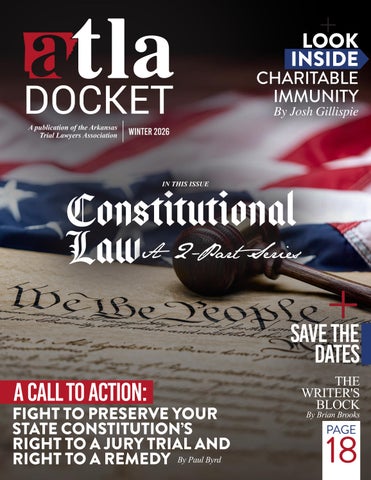
ATLA Docket - WINTER 2026_v2

Page 1


DOCKET

DOCKET

A publication of the Arkansas Trial Lawyers Association

Publisher

Stephanie Malone McLean

Editor

Katie Clifford

Graphic Designer

Dave Lewis

Advertising Manager

Jennifer Irwin

Publications Committee (2025-2026)

Co-chairs:

Taylor Chaney

Alan LeVar

George Wise

Chris Heil

Carter Stein

Sarah Jewell

Geoff Hamby

Corey McGaha

Jim Lyons

Brian Brooks

Brett McDaniel

Tim Watson

Lyndsey Dilks

Geoffrey Kearney

Whitney Cossio

Daniel Holland

ATLA Docket is published quarterly by the Arkansas Trial Lawyers Association, PO Box 3486, Little Rock, AR 72203. Telephone (501) 376-ATLA. All rights reserved. Statements or expressions of opinions are those of contributors and are not necessarily those of the Arkansas Trial Lawyers Association or the editor of ATLA Docket. The editor of ATLA Docket reserves the right to edit and condense all materials herein. All advertising copy is the sole responsibility of the advertisers.

TABLE of CONTENTS

2

4

6

CONSTITUTIONAL LAWA 2-Part Series CHARITABLE IMMUNITY

PRESIDENT’S COLUMN

Jess Virden Mallett, Esquire, ATLA President

PRESIDENT ELECT’S COLUMN

Ryan Scott, Esquire, ATLA President-Elect

A CALL TO ACTION

Hello everyone!

This year has been flying by! I got a little ahead of myself on my last column, writing about constitutional law before the constitutional law issue. So, since you’ve already read about that from my perspective, I thought I would take this opportunity to update everyone on what ATLA has been up to lately.

In October, we had a fantastic CLE at Chenal Country Club. We were honored to have Supreme Court Justice Nicholas Bronni and Pulaski County Circuit Judge Shawn Johnson join us, giving wonderful presentations and continuing with our goal to build relationships with our judges. Thank you Justin Zachary and the Program Committee for making the October CLE such a success!

The Executive Committee and the Board of Governors have also had several meetings with the ATLA Lobby Team to create a strategic plan for the 2027 legislative session. Our teams is fantastic and has its finger on the pulse of the legislature. With all of the contested races coming up, Stephanie and Katie have been out meeting and speaking with candidates, putting our issues in their minds. In consultation with the lobby team, we have a good idea of the candidates who support the constitution and their individual constituents’ rights to a jury trial. There will be many new faces at the Capitol after this election, and ATLA is doing the ground-work to be successful in the upcoming session. With this in mind, if you know a candidate we should support or meet, please let me or Stephanie know. If there are events coming up you think we should go to, let us know that as well.

One of the things we always need from our Members is stories of real people, our clients. If you have a client with an impactful story, let us know. The more the better. Our Senators and Congressmen would much rather hear from their constituents than from us. For instance, if you have a client who was severely injured with tens of thousands of dollars in medical bills hit by someone with minimum limits and the only reason they were able to get a little relief is because of the made-whole doctrine, let us know. The reason we fight so hard to protect our clients’ rights is because we all know someone, an injured individual, who would be harmed if the insurance companies were able to get all their legislation passed. Our clients’ stories are important. Their message is important. Please share it with us.

Along those same lines, primary season is upon us. By the time this is published, our PAC committee will have met and decided the best way to distribute PAC funds. But, the only way we can distribute funds is if we have them. So please, send in your PAC checks early!

Tired of the cold? AAJ’s winter convention will be February 20-24 in sunny San Diego! If you like perfect weather, nationwide networking, and top-notch CLE, the winter convention is the place to be. https://www.justice.org/ winter-convention/event-home

Finally, not as warm but closer to home, the wildly popular, some may say beloved, Oaklawn CLE will be held in Hot Springs March 5-6. Put it on your calendars and join us for 6 hours of CLE and horse racing, including the 7th Amendment Classic!

T-MINUS ONE YEAR…

As of the date of this publication, the Arkansas General Assembly is about one year from its 2027 session. This time next year, bills will be filed, hearings will be held, and votes will be taken. We are so grateful for the generous support our association members have provided thus far – monetary giving, relationship building, strategic brainstorming, fellowship, and time. This is no time to let off the accelerator.

Please keep giving. We only have a year to continue to support those legislators that share our values with financial contributions before the session starts. One way is to donate to Justice PAC. Starting January 1st, the clock resets on donation amount limits. If you haven’t donated already, please consider doing so. If you have, THANK YOU, and please consider donating when you can in 2026.

Please keep meeting. ATLA members across our state have been building relationships with incumbents and challengers alike. Primaries are in March. This means there is precious little time to get to know the candidates that will be making decisions in 2027 before the first vote is cast for them. Initiating and maintaining relationships with your local representatives (and those who you may know around the state) helps tremendously. While ATLA may not always be able to match the funding power of our opponents, our expertise in law is sought after. I personally have had candidates tell me they want input from our association members on the issues – before and during the session. When the assembly members are informed of the true intentions and effects of a bill in a respectful and honest way, our values shine through. So, please make and keep relationships with the decision makers in our state.

Please stay engaged. We are stronger together. We are blessed with an eclectic group of passionate members with a broad range of personal political views and strategic ideas. They are all welcome. Our passion as an association sets us apart. Let us keep the passion - tempered with the understanding that, while we will inevitably disagree from time to time, ATLA represents us all

when it comes to our organization’s core values. Those values include mutual respect and understanding for healthy dialogue and respect for those with whom we may disagree with from time to time.

Ryan

A CALL TO ACTION

Fight to Preserve Your State Constitution’s Right to a Jury Trial and Right to a Remedy

This article is dedicated to the memory of Bob Potroff, whose “Justice on Fire” presentation inspired this work and I have plagiarized in places.

Introduction: A Lawyer’s Duty to Protect the System

Before diving into constitutional history, consider this: every lawyer has a professional responsibility to improve the legal system. The Preamble to the Model Rules of Professional Conduct reminds us that “[a]s a public citizen, a lawyer should seek improvement of the law, access to the legal system, the administration of justice and the quality of service rendered by the legal profession.”1 Rule 6.1›s commentary specifically recognizes «engaging in legislative lobbying to improve the law, the legal system or the profession» as valuable pro bono work.2

This isn’t just about professional obligation—it’s about preserving the foundational rights that make our work possible.

The Genius of the American Civil Justice System (as explained by Bob Potroff)

Every society since the beginning of time has needed a method for resolving disputes among its members. Our American system has evolved far beyond dueling, “eye for an eye” justice, or rulings by government-appointed officers answerable to no one.

The brilliance of our system begins

with competent lawyers zealously representing their clients. 3 This structure separates disputing parties and redirects their anger away from direct confrontation. The aggrieved party focuses their energy on assisting counsel with case evaluation and preparation rather than seeking personal vengeance. Lawyers then explain applicable rules to their clients—a process that often further reduces hostile impulses. Cases settle when emotion eventually gives way to reasoned, deliberative thought.

But conflict resolution, as important as it is, isn’t the highest purpose of our civil justice system. The stakes are far greater.

Consider this: There is no meaningful freedom of speech, freedom of the press, or freedom of religion if the powerful or the government can take your printing presses, seize your church buildings, injure your health, or take your life without consequence. You can stand your ground in America because wrongdoers cannot take your home, throw you in prison, or injure you or your family without facing accountability.

Where do you go to enforce all your other constitutional rights? To court. The Seventh Amendment and your state constitution›s jury trial guarantee protect all your other rights.

The Right to Trial by Jury: A “Preeminently Political Institution”

The jury trial is nothing short of brilliant as a mechanism for diffusing anger and reducing the urge toward violence. Individual citizens—whose identities are unknown until shortly before trial—render judgment. After trial, the group disbands. Violence or threats against such decision-makers to influence a specific outcome is logistically near-impossible.

We don’t see car bombings targeting judges or kidnappings of magistrates’ families as in other systems because we have no single, identifiable decision-maker to intimidate in advance, nor a jury that still exists after rendering its verdict.

Alexis de Tocqueville, writing in 1835, understood this profound truth:

“I am so entirely convinced that the jury is pre-eminently a political institution that I still consider it in this light when it is applied in civil causes... When the jury acts also on civil causes, its application is constantly visible; it affects all the interests of the community; everyone co-operates in its work: it thus penetrates into all the usages of life, it fashions the human mind to its peculiar forms, and is gradually associated with the idea of justice itself.” 4

De Tocqueville warned that “[t]he institution of the jury, if confined to criminal causes, is always in danger; but when once it is introduced into civil proceedings, it defies the aggressions of time and man.” 5 The civil jury, he observed, «did in reality at that period save the liberties of England.» 6

The Historical Roots Run Deep

The right to jury trial didn’t originate with our Constitution. The Magna Carta, signed in 1215, established foundational principles still valid today. Clause 39 declared: “No free man shall be seized, imprisoned, dispossessed, outlawed, exiled or ruined in any way, nor in any way proceeded against, except by the lawful judgement of his peers and the law of the land.”7

Below is a quote from a historical article written in the United Kingdom on the Magna Carta:

[Of enduring importance to people appealing to the charter over the last 800 years are the famous clauses 39 and 40:

“No free man shall be seized, imprisoned, dispossessed, outlawed, exiled or ruined in any way, nor in any way proceeded against, except by the lawful judgement of his peers and the law of the land.

“To no one will we sell, to no one will we deny or delay right or justice.”

These clauses remain law today, and provided the basis for important principles in English law developed in the fourteenth through to the seventeenth century, and which were exported to America and other English-speaking countries. Their phrasing, ‘to no one’ and ‘no free man’ gave these provisions a universal quality that is still applicable today in a way that many of the clauses relating specifically to feudal custom are not.]8

The Virginia Bill of Rights, adopted June 29, 1776—just five days before the Declaration of Independence—proclaimed that “in controversies respecting property, and in suits between man and man, the ancient trial by jury is preferable to any other, and ought to be held sacred.”9

The Declaration of Independence itself lists among King George’s offenses: “For depriving us in many cases, of the benefit of Trial by Jury.”10

The Seventh Amendment, ratified December 15, 1791, enshrined this right at the federal level. 11 But the federal constitution provides only a floor, not a ceiling, for the protection of rights.

Your State Constitution: The Second Bite at the Apple

As Justice Shawn Womack and Christian Harris wrote in the Arkansas Lawyer , “This article reminds advocates that the Arkansas Constitution deserves an important place in your issue-spotting toolbox.” 12 The Arkansas Constitution often provides stronger protections than its federal counterpart.

Article 2, Section 7 of the Arkansas Constitution declares: «The right of trial by jury shall remain inviolate, and shall extend to all cases at law, without regard to the amount in controversy.» 13

It’s Cold Outside, but We are Fired Up to Help!

Since 1953, we have been turning up the heat on wrongdoers in Arkansas. If you’re worried about getting left out in the cold on your complex injury, medical negligence, environmental, or employment cases, give us a call.

Note the powerful language: “shall remain inviolate.” Similar language appears in the majority of State Constitutions, for example, the constitutions of Mississippi (dating to 1817), Tennessee (1796), and Kentucky, where the constitution states the “ancient mode of trial by jury shall be held sacred.” 14

Article 2, Section 13 provides the companion right to a remedy: «Every person is entitled to a certain remedy in the laws for all injuries or wrongs he may receive in his person, property or character; he ought to obtain justice freely, and without purchase; completely, and without denial; promptly and without delay; conformably to the laws.» 15

Read those guarantees carefully: a certain remedy , for all injuries , freely , without purchase , completely , without denial , promptly , without delay . This is the language of absolute rights. Without the Right to a Remedy, the Right to a Jury Trial stands half-fulfilled. The two together equal justice.

Full Remedy + Peer Jury = JUSTICE!

How Strong Are These Arkansas Constitutional Rights – The Government Can’t Change them! They have attempted…but they don’t have the power!

Arkansas Constitution Article 2, Section 29 answers this question decisively:

“[T]o guard against any encroachments on the rights herein retained, or any transgression of any of the higher powers herein delegated, we declare that everything in this article is excepted out of the general powers of the government; and shall forever remain inviolate; and that all laws contrary thereto, or to the other provisions herein contained, shall be void.” 16

Thus, the rights in Article 2 are “excepted out of the general powers of the government” and “ shall forever remain inviolate .” Laws contrary to them “ shall be void .” This is as strong as constitutional language gets.

Additionally, Article 5, Section 32 explicitly prohibits the legislature from capping damages: “[N]o law shall be enacted limiting the amount to be recovered for injuries resulting in death or for injuries to persons or property.” 17

Separation of Powers: The Essential Safeguard

James Madison, in Federalist No. 51, explained that America’s federal structure provides “a double security... to the rights of the people.” 18 Power is divided between federal and state governments, and within each, among legislative, executive, and judicial branches.

The Arkansas Constitution, like those of our sister states, mandates strict separation: “No person or collection of persons, being of one of these departments, shall exercise any power belonging to either of the others.” 19

Madison understood human nature: “If men were angels, no government would be necessary.”20 Because they are not, «ambition must be made to counteract ambition.»21 Each branch must jealously guard its constitutional role.

When the legislature attempts to limit damages that juries may award, it exercises judicial power. When it restricts access to courts, it infringes on the judiciary’s domain. These encroachments violate not only specific constitutional provisions but the fundamental structure of separated powers. Immunity bills often violate these provisions.

The Call to Action

Who will fight for these rights if not us? Bob Potroff’s message was clear: our profession needs lawyers in the legislature, lawyers speaking in schools, lawyers on social media, lawyers meeting with legislators, lawyers leading in their communities.

Your professional responsibility includes protecting and improving the legal system. Our constitutional system of civil justice needs advocates who understand its historical foundations and can articulate why these rights matter. These rights preserve freedoms that you have inherited and freedoms that won’t continue to exist unless you stand up now.

There is no justice on fire without you. You are fighting for your family, your children, your grandchildren— our posterity. █

Footnotes

1. Model Rules of Professional Conduct, Preamble ¶ 6.

2. Model Rules of Professional Conduct, Rule 6.1, cmt. 8.

3. See Model Rules of Professional Conduct, Rule 1.1; Rule 1.3, cmt. 1.

4. Alexis de Tocqueville, Democracy in America (1835).

5. Id.

6. Id.

7. Magna Carta, cl. 39 (1215).

8. The Contents of Magna Carta, https://www.parliament.uk/ about/living-heritage/evolutionofparliament/originsofparliament/ birthofparliament/overview/magnacarta/magnacartaclauses/

9. Virginia Declaration of Rights, § 11 (June 29, 1776).

10. Declaration of Independence (1776).

11. U.S. Const. amend. VII.

12. Justice Shawn Womack & Christian Harris, Observations and Reflections on Litigating and Judging Under the Arkansas Constitution , 57 Ark. Law. 26 (2022).

13. Ark. Const. art. 2, § 7.

14. Ky. Const. Bill of Rights § 7.

15. Ark. Const. art. 2, § 13.

16. Ark. Const. art. 2, § 29.

17. Ark. Const. art. 5, § 32.

18. The Federalist No. 51 (James Madison).

19. Ark. Const. art. 4, § 2.

20. The Federalist No. 51 (James Madison).

21. Id.

IN

First to the Party and Last to Leave

rkansas is thought to be the first state to utilize the principles of charitable immunity, in 1856, twenty years prior to Massachusetts’s formal adoption of the doctrine

in 1876. 1 Today, it is one of a very small handful of states still clinging to some form of the doctrine, along with Massachusetts, South Carolina, and Virginia. 2 It has been abolished or nearly abolished in almost

1 See Grissom v. Hill, 17 Ark. 483, 1856 WL 609 (1856)

2 Courtney Jane Baltz, When Justice Should Precede Generosity: The Case Against Charitable Immunity in Arkansas, Arkansas Law Notes (2021).

every other state. But unlike the other states where some form of the doctrine still exists, Arkansas has not placed any significant limitations on its application.

In Massachusetts, while the liability of charitable organizations is capped at $20,000 for torts committed in the course of activities directly related to their charitable purposes, there are exceptions where the tort arises from activities that are primarily commercial in nature or activities committed outside the scope of charitable purposes, such as intentional misconduct. 3 In South Carolina, a plaintiff can recover from a charitable organization up to $300,000.00, the limit set by the South Carolina Tort Claims Act. 4 Virginia’s charitable immunity doctrine exempts charitable organizations from liability for negligence claims brought by beneficiaries of the charity, but only where the organization has exercised due care in the selection and retention of its servants and agents. Nor does charitable immunity shield organizations in Virginia from liability for acts of gross negligence or willful and wanton negligence. 5

Yet here in Arkansas, the doctrine of charitable immunity continues to thrive much as it did in the 19 th century. An organization created and maintained exclusively for charitable purposes is immune, not just from liability but from suit itself, and its assets cannot be diminished by execution in favor of a person injured by the acts of the organization’s agent, period. A plaintiff cannot maintain suit against an entity entitled to charitable immunity, regardless of whether the tort arises from activities outside the scope of the organization’s charitable purpose, like intentional misconduct or abuse, and regardless of whether the organization exercised due care in the selection, supervision, and retention of the harm-causing agent.

Entitlement to the defense, however, is the would-be charity’s burden to prove. Mere non-profit status does not equal entitlement. Charitable immunity is an affirmative defense that must be specifically pled, and the burden of proving entitlement to this affirmative defense is on the party asserting

3 M.G.L.A. 231 § 85K

4 SC ST § 33-56-180

5 See Ola v. YMCA of South Hampton Roads, Inc., 270 Va. 550, 621 S.E.2d 70 (2005)

it. 6 Because it works to limit the number of potentially responsible parties whom an injured party may sue, Arkansas courts, theoretically, give the doctrine only a very narrow construction. 7 This would suggest that an Arkansas court should err on the side of denying this defense where there is a reasonable basis to do so. Whether our courts have historically done so is a matter of debate.

Regardless, in determining whether a defendant organization has met its burden, Arkansas courts look at eight factors, often referred to as the Masterson factors:

(1) whether the organization’s charter limits it to charitable or eleemosynary purposes; (2) whether the organization’s charter contains a “not-for-profit” limitation; (3) whether the organization’s goal is to break even; (4) whether the organization earned a profit; (5) whether any profit or surplus must be used for charitable or eleemosynary purposes; (6) whether the organization depends on contributions and donations for its existence; (7) whether the organization provides its services free of charge to those unable to pay; and (8) whether the directors and officers receive compensation. 8

6 Arkansas Elder Outreach of Little Rock, Inc. v. Thompson, 2012 Ark. App. 681, 425 S.W.3d 779

7 Anglin v. Johnson Reg’l Med. Ctr., 375 Ark. 10, 15, 289 S.W.3d 28, 31(2008) (quoting George v. Jefferson Hosp. Ass’n, 337 Ark. 206, 211, 987 S.W.2d 710, 712 (1999))

8 Masterson v. Stambuck, 321 Ark. 391, 902 S.W.2d 803 (1995)

No single factor is dispositive, nor is the list exhaustive. In determining whether a defendant is genuinely operating as a charitable organization and thus entitled to the immunity, the court has discretion to place greater weight on one factor to the exclusion of others.

Most Arkansas cases addressing charitable immunity in the modern era have involved the doctrine’s application to hospitals and nursing homes. In recent years, Plaintiffs have had success in denying the doctrine’s application to nursing homes where the owners of ostensibly non-profit nursing homes set up for-profit shell corporations to provide staffing and services to the nursing home, thereby transferring the revenues of the non-profit nursing home directly to the pockets of its owners. 9 Hospitals, however, have proved a more difficult hurdle, and most Arkansas decisions have recognized a hospital’s entitlement to charitable immunity.

The doctrine has faced criticism and calls for abolition, with arguments that it is against public policy. However, the Arkansas Supreme Court has consistently declined to abolish the doctrine, emphasizing that any changes to this long-standing rule should come from the legislature rather than the courts. 10

However, it was the courts, not the legislature, who created the doctrine in Arkansas. There is no Arkansas statute establishing charitable immunity. It is a crea -

9 Camden-Progressive Eldercare Services, Inc. v. Robinson, --- S.W.3d ----, 2025 Ark. App. 562, 2025 WL 3223970

10 See Sowders v. St. Joseph’s Mercy Health Center, 368 Ark. 466, 247 S.W.3d 514 (2007)

ture of the judiciary. This is so in most states. And, significantly, in almost every state to abolish the doctrine, it has been accomplished through the judiciary, not the legislature. 11

Until something changes, plaintiffs are left with the direct-action statute,

11 Courtney Jane Baltz, When Justice Should Precede Generosity: The Case Against Charitable Immunity in Arkansas, Arkansas Law Notes (2021).

whereby plaintiffs can sue a charity’s insurance carrier directly for up to the policy limits.12 The problem with this, of course, is that many charities either do not maintain liability insurance or the coverage is insufficient.

If deterrence and compensation are the fundamental purposes of the tort system, and assuming the tort system is something to be preserved, what place does a doctrine rooted in 19th century public policy have in today’s Arkansas? At what point does it no longer make sense to permit charities to act carelessly? Does there exist a case and a set of facts, perhaps outside the hospital and medical malpractice context, that could motivate the Arkansas Supreme Court to act? Time will tell. Until then, we remain a party of one.

12 Ark. Code. Ann. § 23-79-210

BLOCK WRITER’S The

Write it Shorter,

Quit Wasting Words

We waste so many words when we’re writing. Often I read a brief or an opinion in which it seems virtually every sentence begins with a transitional word prefacing the meat of the sentence. By that I mean that sentence after sentence starts with “therefore,” “moreover,” “indeed,” or some other word that is designed to transition to a point but often is nothing but a distraction.

Similarly, (now that is a logical use of a transitional word letting you know I am about to make a point that fits with the point I just made),

we tend to overuse the words “there,” “there are,” and “there is” in legal writing. These words are what I refer to as lazy words. We can use them to make a point, but they are not terribly effective and tend to make the sentences in which they reside longer, less clear, and less forceful than if the sentence is rewritten to make the same point without using those lazy words.

And then we have the tendency to redundancy, which is a good thing when building space shuttles, but not so much when writing briefs. We introduce, for example, a case that we are about to discuss in some

detail. Then, when we start to discuss the case, we reiterate that what we are discussing is the case! This approach is wasteful and not effective writing.

Okay, all of that is well and good, but how does it work in practice? How do we write around these crutches on which we have come to lean? Let’s take a look at a few phases and rework them.

Take the following several sentences, which are typical of what we see: The experts explained the standard of care, how it was breached, and the harm the breach caused.

Accordingly , when Defendants moved for summary judgment, the motion should have been denied. Therefore , it was error to grant summary judgment.

“Accordingly” and “therefore” are unnecessary. They add nothing to the clarity of the argument, add no persuasive force, and serve only to extend the word count and make the brief more taxing to read. So, let’s rewrite the paragraph. And while we’re at it, let’s reverse the illogical sequence in one sentence and make another one more concise.

The experts explained the standard of care, how it was breached, and the harm the breach caused. Defendants motion for summary judgment should have been denied. It was error to grant summary judgment.

Tschiemer Legal Briefing

Robert Tschiemer is the author of the Arkansas Bar Association Weekly Case Summaries available at www.arkbar.com

robert@tschiemerlegalbriefing.com www.tschiemerlegalbriefing.com

Better yet, delete the last sentence altogether. It is redundant. If the motion should have been denied, it was obviously error to granted it. We do not need both sentences. Cut one of them.

Cutting the “there’s,” “there are’s,” and “there is’s,” is a reasonably simple task. Take this sentence: “There are no grounds for a new trial when there is conflict in the evidence, or when the evidence is such that fair-minded people might reach different conclusions.” Now, let’s make that sentence more active and less wordy: “A new trial cannot be granted when the evidence conflicts or when fair-minded people might reach different conclusions.” We say the same thing, we just say it more forcefully and more efficiently.

Sometimes we use words when they are just not needed. “In this case” is an example. We might write, “whether the rule bars recovery in this case is a question of fact for the jury.” Of course we are discussing what should happen “in this case,” so it is simply not necessary to remind the court that we are discussing what should happen “in this case.” What case would we be discussing in our brief if not “this case?” Eliminate “in this case” from the sentence and have a more concise expression.

We tend to use a similar device when discussing cases. We might write, “the controlling case is Gonzales v. Cont’l Cas. Co., 2022 Ark. App. 501 659 S.W.3d 277. In Gonzales , the plaintiff sued the defendant hospital for medical negligence.” It is not necessary to tell the court we are talking about Gonzales when we just introduced that case. Leave out the “in Gonzales ” and go right to the explanation of the case.

Effective, concise, efficient writing sometimes calls for making one sentence into two. We might see a sentence like this one, which is too cumbersome: “The expert testified that the regulation has been the standard since 1978, and the regulation is a mandate not a suggestion.” That’s not a bad sentence but it can be made better by dividing it up like this: “The expert explained the regulation is the standard and has been since 1978. The regulation is mandatory not a suggestion.” The revision carries more force, more clarity, and is more concise.

We exist by our words. They are what lawyers do. But more words are not always better words. Don’t waste words.

I’ll see you next time from The Writer’s Block. █

ELITE MEMBERS

ATLA’s Elite Members are the members who have gone the extra mile to help preserve the jury system, promote individuals’ rights, and educate the public by supporting ATLA, Justice PAC, and AAJPAC, the political action arm of the American Association for Justice. Thanks to them, ATLA makes a difference!

PLATINUM FOUNDER — $50,000+

Rainwater Holt & Sexton

GOLD LEADER — $25,000+

Taylor King AAJ

BRONZE BARRISTER — $6,000+

Paul Byrd AAJ

Jason Hatfield AAJ

George Niblock

Carter Stein AAJ

CHAMPION BENEFACTOR — $3,000+

Rob Beard AAJ

Thomas Buchanan

Taylor Chaney AAJ

Joe Denton

Austin Easley AAJ

Paige Edgin AAJ

Bob Edwards AAJ

Craig Friedman AAJ

Joseph Gates AAJ

Josh Gillispie AAJ

Geoff Hamby AAJ

Steve Harrelson AAJ

John Houseal

Q. Byrum Hurst AAJ

Jim Jackson

Joseph P. Jaynes

Sarah Jewell AAJ

Sean Keith AAJ

Brandon Lacy AAJ

Alan Lane AAJ

CHAMPION PATRON — $1,200+

Hank Bates AAJ

Will Bond AAJ

Neil Chamberlin AAJ

Shawn Daniels AAJ

Steven Davis

Terry Dugger AAJ

Don Elliott

Bob Estes

Bruce Flint

Greg Giles

Keith Grayson AAJ

Melanie Grayson

Todd Griffin

Denise Hoggard AAJ

Bill Horton

Kenneth Kieklak

Alan LeVar AAJ

Matthew Lindsay AAJ

Bobby McDaniel AAJ

Brett McDaniel AAJ

Timothy J. Myers AAJ

Andrew Norwood AAJ

Jeff Priebe AAJ

John Rainwater

Ryan Scott AAJ

Rick Spencer AAJ

Conrad Odom AAJ

Cary Patterson

Mark Rees AAJ

Marc Stewart AAJ

Tom Thrash

Marcus Vaden

Stevan Vowell

Lorie Whitby

Chad Trammell AAJ

Jess Virden Mallett AAJ

BW Walas AAJ

Tim Watson AAJ

Les Weisbrod AAJ

Phillip Wells AAJ

George Wise AAJ

Heather Zachary

Justin Zachary AAJ

Russell Winburn AAJ

GUARDIAN OF JUSTICE — BASED ON YEARS OF PRACTICE

James Bargar AAJ

Robert Cortinez

Wesley Cottrell

Hani Hashem AAJ

Thomas Jones AAJ

Darren O’Quinn AAJ

Michael Ray

Clay Sexton

J.T. Skinner

Tim Smith AAJ

Bill Stanley AAJ

ADVERTISER’S INDEX

Triston Cross

Hanna McClendon

David Wells

Kathryn Wright

Published quarterly, The Docket is distributed to more than 1,000 attorneys and law professionals throughout Arkansas. These attorneys and professionals, in turn, contribute articles to the publication in the spirit of advancing legal knowledge and strengthening the bonds of the legal community. Members of the ATLA Communications/Publications Committee approve editorial content for The Docket. Each quarterly issue typically includes thematic articles, ATLA news, lifestyle feature, practice management information, and more.

Subscriptions to The Docket are free of charge to association members. Additional subscriptions are available for purchase by calling (501) 376-2852. For more information, or to purchase ad space, contact Jennifer Irwin at jirwin@arktla.org or by calling the number above.

Arkansas Trial Lawyers Association PO Box 3486 Little Rock, Arkansas 72203

Turn static files into dynamic content formats.

Create a flipbook