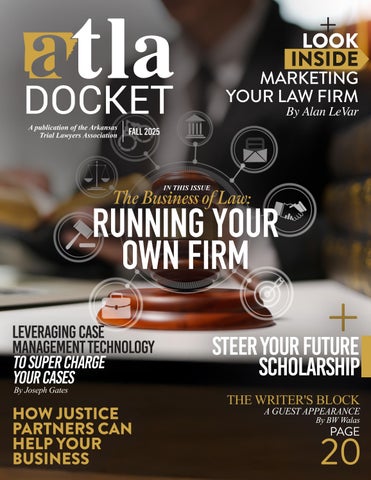
DOCKET

By Joseph Gates
![]()

By Joseph Gates


A publication of the Arkansas Trial Lawyers Association
Publisher Stephanie Malone Editor
Katie Clifford
Graphic Designer Dave Lewis
Advertising Manager
Jennifer Irwin
Publications Committee (2025-2026)
Co-chairs:
Taylor Chaney
Alan LeVar
George Wise
Chris Heil
Carter Stein
Sarah Jewell
Geoff Hamby
Corey McGaha
Jim Lyons
Brian Brooks
Brett McDaniel
Tim Watson
Lyndsey Dilks
Geoffrey Kearney
Whitney Cossio
Daniel Holland
ATLA Docket is published quarterly by the Arkansas Trial Lawyers Association, PO Box 3486, Little Rock, AR 72203. Telephone (501) 376-ATLA. All rights reserved. Statements or expressions of opinions are those of contributors and are not necessarily those of the Arkansas Trial Lawyers Association or the editor of ATLA Docket. The editor of ATLA Docket reserves the right to edit and condense all materials herein. All advertising copy is the sole responsibility of the advertisers.
PRESIDENT’S COLUMN 2
Jess Virden Mallett, Esquire, ATLA President
PRESIDENT ELECT’S COLUMN
Ryan Scott, Esquire, ATLA President-Elect

By Alan LeVar
we’re going to be talking about Constitutional law. I don’t pretend to be a scholar in Constitutional law. In fact, it seems to me that the Constitution says whatever the people on the bench say it says when a particular case is heard. That has been my impression since taking Con Law in law school and is not necessarily directed at recent decisions. There is one area of constitutional law, however, that I do feel very passionately about and would like to take a point of presidential privilege and discuss it briefly in my column.
“The degree of civilization of a society can be judged by entering its prisons.” - Fyodor Dostoevsky
It’s debated if Dostoevsky actually said those exact words, but it’s attributed to him from The House of the Dead published in 1860. It’s a fictionalized memoir of a Russian nobleman sentenced to hard time in a Russian prison and its inhumane conditions. We’ve all seen the recent videos and photos of Americans who were imprisoned in Russia, and how their health deteriorated during their time imprisoned. I’m starting to wonder if the American jail and prison system is any better.
We love putting people in jail in America. As of February this year, we are ranked fifth for prisoners per capita at 541 incarcerated persons per 100,000 people. The countries ahead of us from first to fourth are El Salvador, Cuba, Rwanda, and Turkmenistan. From 2001 to 2022, a solid 20 years, we led in per capita incarcerations. I’ll leave the debate on whether mass incarceration actually prevents crime to the politicians and those who study it. I point out how much America loves putting people in jail because we do an abysmal job of caring for them while they are there.
“But Jessica, why should we care what happens to people in jail? They’re criminals.”
Some are, maybe even a majority are. But unless they are on death row, they did not receive a death sentence. And A LOT of people in city and county jails have not been convicted and are being held pending trial. Many are too poor to afford bail and are forced to stay in overcrowded jails until the overburdened criminal justice system gives them a trial date.
The 8th Amendment (see, I’m getting to the constitutional issues), prohibits cruel and unusual punishment. In Estelle v. Gamble decided in 1976, SCOTUS established that prisoners

By Jess Virden Mallett, Esquire, ATLA President
have a constitutional right to adequate medical care under the 8th Amendment’s prohibition of cruel and unusual punishment. America, and Arkansas, is falling woefully short of this very low bar.
At convention I spoke about my Faulkner County case where my client’s sixty-year-old mother was being held in jail for an order of protection violation that she called in. They did not give her insulin as needed, and it took over three weeks for her to see a doctor. When she finally did see a doctor, he kicked her out of the examination room for being uncooperative. She was dying of sepsis at the time, which can impair mental processing. She was dragged through the facility by her arms and left in her cell until her heart stopped. She was resuscitated for long enough for her daughters to have to be the ones to make the decision to take her off of life support.
In another case, my client was being held in a county jail on drug and gun charges. (The right to bear Arms shall not be infringed, unless, of course, you’re a felon, then having a gun will be used against you to lock you up again.) He was a carrier of staph and was forced to suffer from untreated boils because he was allergic to the antibiotic the jail was trying to make him take. He was given copious amounts of ibuprofen to deal with the pain which caused him to vomit blood from acute gastritis. Over the next two weeks he was unable to eat or drink and slowly died of sepsis from starvation and dehydration.
My firm has had two cases with Type 1 diabetics in jails who were given very little insulin, inconsistently, and died from complications of diabetic ketoacidosis. In another case, a severely mentally ill client was put in solitary confinement for months until he starved to death. In yet another case, a mentally ill client was hallucinating after taking cocaine, was thrown in the drunk tank for five days with no medical evaluation or treatment, and left to die of a heart attack.
These are not isolated incidents. It occurs over and over again all across the country. For the last 20 years the state of Arkansas has had a contract with Wellpath to provide medical treatment in state run prisons. As part of the contract, Wellpath was to carry insurance to cover medical malpractice and 1983 medical deprivation claims. I’m sure it surprises no one that Wellpath had no insurance despite being paid billions of dollars from Arkansas and many other states. The care Wellpath provided was so bad that they filed bankruptcy a year ago to get out from under all of the cases that have been filed against them. They provided “insurance” documents to Arkansas that were “fronting policies” which basically is a piece of paper that says they have insurance, but they don’t. Now thousands of claims are being forced through bankruptcy in the Southern District of Texas because Wellpath provided inadequate care, killing inmates. I think Wellpath defrauded the state of Arkansas and breached their contract. There is not a state equivalent of

the Federal False Claims act, so I’m still trying to figure out a cause of action. If any of you brilliant people think of something, please give me a call.
So why do prisons and jails continue to violate the constitutional rights of their detainees? Just like most things, it all comes down to funding. There’s not enough of it. Local sheriffs generally don’t have the necessary medical training to adequately address inmates’ needs. Quorum courts don’t allocate enough money to inmate treatment so quality care cannot be provided. However, the Constitution does not say “no cruel and unusual punishment, unless it costs too much, then it’s ok.”
If we’re going to lock people up, then we have to take care of them. We can’t let people continue to die preventable deaths. The Constitution prohibits it. This is a constitutional crisis that can be solved. If we have to do it one case at a time, so be it. As trial lawyers, we make the world a safer place.
Thanks for letting me stand on my soap box this issue.
We’re pleased to announce that Grayson Hinojosa has joined our firm. With a practice focused on labor, employment, and environmental law, Grayson’s a wonderful
asset that we’re grateful to have.


If you are reading this on the first day it was circulated, it is about one month from the filing deadline for state office. A few months after that, the primaries. The outcome in many of these primaries will essentially determine who will serve in Arkansas’ 96th General Assembly. Make no mistake, the fate of issues central to our core values will be on the table in the upcoming session – equal justice under the law, a level playing field in the courtroom, and the right to a jury trial itself. It is essential that that ATLA be visible and involved. Here are a few ways to help.
Way #1: Donate to Justice PAC
The reality is financial contributions to any lawmaker that shares our values are essential. Those that would seek to tilt the legal playing field, or rig the game altogether, already know this. We must accept it too. “Money, like water, will always find an outlet.”1 Our opposition are funding candidates right now. We must too.
Way #2: Develop Relationships
The deadline to file for office is close, but not closed. And the political environment is evolving. If you haven’t met your representative or senator, now is the time to reach out. There are open seats and contested seats that provide opportunities to build relationships with potential leaders. If you would like to know if you are in one of them, contact the ATLA office. ATLA leadership is actively focused on meeting sitting members and candidates before the session

By Ryan Scott, Esquire, ATLA President-Elect
begins. If you have time for coffee, lunch, or drinks with someone you believe would have a listening ear, please let ATLA know.
We can’t do it alone. ATLA is hard-pressed to compete with our adversaries in funding. But they will never be able to match us in passion. If you can donate… donate. If you can serve… serve. If you can motivate your clients, fellow church members, neighbors to take the time to understand the issues and contact the decisionmakers… motivate them.
Please do what you can, as soon as you can, to fund Justice PAC. Justice PAC contributions open the gates to discussion, education, and, ultimately, persuasion.


By Alan LeVar


Idid not enter law school with the specific intention of becoming a business owner. While I wasn’t certain which area of law I wanted to pursue, my image of the practice of law was primarily focused on the courtroom and those associated skills. Shortly after graduation, I found myself working in a threeperson law firm where compensation was primarily based on fees brought in and expenses incurred. I was mostly unprepared for this aspect of practicing law, but I slowly began to understand the realities of running a business. My discussions with fellow associates indicate these experiences are not unique.
For trial attorneys in Arkansas, effective marketing is no longer optional—it is essential. With more clients turning to online research before selecting counsel, and with competition growing across both urban and rural markets, trial lawyers must adopt strategies that combine professionalism, compliance with ethical rules, and genuine connection with potential clients.
Traditional law firm strategies, including business cards, networking, newspaper or magazine ads, billboards, TV ads, brochures, and promotional pamphlets, are still an important part of a marketing plan. But digital marketing has taken on a much more significant role.
A professional, mobile-friendly website is the cornerstone of digital marketing. For Arkansas trial attorneys, it should clearly communicate practice areas, attorney profiles that emphasize trial experience, and educational resources that help potential clients understand their rights.
Search engine optimization (SEO) is particularly important in markets like Little Rock and Fayetteville/ NWA, but it remains vital across the state. A well-optimized site ensures
that when someone searches “Fort Smith injury lawyer” or “trial attorney near me,” your firm appears near the top. SEO can be managed inhouse, but depending on your market and budget, many firms engage private web marketing companies.
Arkansas clients increasingly engage with legal professionals through social platforms. Trial attorneys can leverage Facebook, LinkedIn, and even shortform video platforms to share updates on community involvement, highlight courtroom experience (while protecting confidentiality), and educate the public on legal issues that affect everyday life.
Content should always strike the right tone—approachable, informative, and professional. A video explaining how jury trials work, or a post discussing changes in Arkansas tort law, builds authority while providing real value.
While a strong website and organic search presence are the foundation of online visibility, paid digital advertising allows trial attorneys to reach potential clients quickly and strategically. In Arkansas—where lawyers must balance metropolitan markets like Little Rock with rural counties—paid ads can make a measurable difference.
Google Ads (Pay-Per-Click): Search ads appear at the top of Google results when someone searches for terms like “Arkansas car accident lawyer.” These ads can generate immediate traffic, but they must be monitored closely. Costs for competitive keywords can be high, so firms should track cost-per-click and conversion rates.
Local Service Ads (Google Screened): Google’s Local Service Ads place attorneys above standard search ads with a “Google Screened” badge. They operate on a pay-per-lead basis rather than pay-per-click, making them attractive for firms seeking predictable costs.
Social Media Advertising: Facebook and Instagram allow precise targeting based on geography, demographics, and interests. Short video ads often perform best, blending education with approachability.
Other Platforms: Though Google dominates, Bing still captures a
meaningful share—particularly among older users. Paid ads on Bing can be less competitive and cost-effective. Yelp ads, while less common, can help firms in urban centers build consumer visibility.
Retargeting Campaigns: These ads follow visitors after they’ve left your

site, keeping your firm top-of-mind as they decide which attorney to call.
Of course, paid ads are only part of the picture. Without a disciplined approach to budgeting and tracking, even the best campaigns can become money drains.
Effective marketing requires more than creativity; it requires discipline. Trial attorneys should approach marketing with the same rigor they bring to case strategy—by knowing their numbers.
Budgeting Wisely: Set a clear annual marketing budget, track where each dollar goes, and evaluate which channels deliver the best return. Some firms spend a percentage of total revenue; others set a preferred acquisition cost, determined by comparing average case revenue to average overhead.
Tracking is critical. For example, if you spend $1,000 on Google ads and generate five cases, your acquisition cost is $200 per case. If your preferred cost is $250, that campaign is successful. If it’s $150, your accountant may view it differently.
Like many attorneys, I’ve invested in campaigns that didn’t work. Tracking numbers allows you to recognize a losing effort earlier and pivot to something more effective. Some campaigns—like billboards and TV—are notoriously difficult to track. With those, you need a more sophisticated system or a big-picture view.
Defining the Perfect Client: Not every case is the right case. Marketing should be focused on the cases and clients that matter most, rather than trying to appeal to everyone.
While Arkansas has historically relied on local firms with community roots, the competitive landscape is
shifting. Larger firms from Texas, Louisiana, Arizona, and Florida are increasingly advertising here. Many use a “hub-and-spoke” model, funneling cases into centralized offices outside the state.
This creates two challenges for Arkansas trial lawyers:
• Visibility – Out-of-state firms often have larger marketing budgets, dominating search results and media buys.
• Client Perception – Sophisticated advertising can make distant firms seem more established, even without local experience.
For local trial attorneys, this underscores the importance of emphasizing homegrown credibility. Arkansas juries and communities value lawyers who understand local dynamics. Marketing should highlight not only legal skill but also a commitment to Arkansas clients and communities. We support local charities, schools, and businesses—our profits stay here, not with out-of-state organizations. This local reputation and accessibility are vital counterweights to the impersonal scale of larger firms.
Unlike firms in larger metro markets, Arkansas trial lawyers often practice across multiple counties and communities. Local visibility is key:
• Google Business Profiles help clients find you quickly.
• Positive reviews from satisfied clients (collected ethically) boost credibility.
• Community engagement—sponsoring events, speaking at civic organizations, or writing for local publications—helps maintain visibility.
While personal injury dominates Arkansas advertising, other practice areas also benefit from targeted, cost-
effective marketing. The strategies differ, but the core principle is the same: meet clients where they are, at the moment they need help.
Criminal Defense: Local SEO is critical. A well-optimized Google profile and positive reviews often outperform paid ads. Reputation management is vital, and content marketing such as 'What to Expect After a DWI in Arkansas' builds trust quickly.
Domestic Relations: Referrals remain strong, but digital visibility is increasingly important. Clients often search late at night, making an accessible website key. Compassionate branding and community involvement resonate with family law clients.
General Practice: In smaller towns, clients often rely on one lawyer for multiple needs. Marketing should emphasize versatility and clarity of services, while leveraging community connections. A professional website and consistent reviews can make a general practice firm stand out locally.
Ultimately, marketing cannot substitute for results in the courtroom and authentic client care. In Arkansas, where personal referrals remain powerful, trial attorneys benefit from nurturing relationships with former clients, fellow attorneys, and local leaders. A strong reputation, amplified by strategic digital marketing, allows trial lawyers to stand out in a competitive legal landscape.
Whether we envisioned it or not, every Arkansas trial lawyer is also a businessperson. Embracing that reality—by respecting ethical rules, knowing our numbers, and building trust through both digital and community presence—positions us to thrive in a changing legal marketplace. █
By Joseph Gates

As trial lawyers, we wear many hats in our life. We are spouses/partners, parents, children, friends, teammates/co-workers, fiduciaries, practitioners, and adversaries. Balancing these many hats creates stress, which can be overwhelming at times. One way to manage the overwhelm is to leverage our case management technology. There are many great options to purchase a case management system (“CMS”). This paper will not focus on which CMS to pick, but more on what a CMS does.
At its core, a CMS is a database, which simply collects and houses data to be used as the user has programmed fit. These uses, or systems, allow the user to manage the barrage of inputs that trial lawyers frequently receive. With the appropriate systems in place, we can allow the case management technology to dictate priorities so we can free our mind for higher-level thinking. These systems can define what phase a particular case is in, automate tasks and launch templates, and create reports to show which case needs priority.
Creating a system that defines the phase for each case frees us up because we can know generally in an instant where a case stands and what is needed to advance a case to resolution. While every personal injury case is unique, there are typical phases one can expect. Big picture: there are litigation cases and pre-litigation cases. Not all cases will be litigation, but all will start with pre-litigation. How quickly a case will stay in pre-litigation will require judgment from the trial lawyer. With that dividing line,
we group our personal injury cases as follows:
There is nothing particularly proprietary about the naming of our grouping system. What’s more important is the process of grouping. During a Monday morning staff meeting, there is great value in looking down the case list to see a case has been grouped as “06 Out for Service”, because that tells us a Complaint has been filed, but the Defendant has not been served. An easy way to commit malpractice is failing to serve a Complaint prior to the service deadline, especially for a case where the statute of limitations has expired. Thus, eliminating the stress of missing a service deadline allows us to think on a higher level about how to win for our clients.
Further, grouping helps a firm owner know when expenditures can be expected or when monies are coming in. For example, when our office has 10 or so cases grouped in “05 File Lawsuit”, we can expect that we will have an uptick in filing fees and service of process charges.
Finally, grouping helps a practitioner and a firm owner to know how the next 12-18 months will look like. We will discuss strategies below on how to predicate how long a case should stay in a particular phase but knowing that we have 20 or so cases grouped in “09 Depositions” means that the next quarter or two will be busy pushing discovery deadlines.
System 2:
Automate Tasks and Launch Templates
Creating a system that automates tasks and launches templates based on the phase frees us up because we do not have to constantly reinvent the wheel. Each phase above has set tasks that are autogenerated by the case management technology. This creates predictability for the firm owner, the
practitioner, and the staff to know what to expect and when to expect it.
Each case may present unique tasks, but most personal injury cases have repeatable tasks. Thus, creating automated tasks will allow basic, but necessary, functions of the law practice to operate on autopilot. Examples of repeatable tasks across personal injury cases include:
Signing the fee agreement and medical authorization; Gathering medical records/bills; Notifying the defendant/insurer of our representation; Creating demand packets; Drafting Complaints based on type of case; Serving written discovery based on type of case; Serving deposition notices and subpoenas; and Disbursing settlement funds
Conversely, these tasks and other repeatable tasks require similar forms, correspondence, and documents. To shortcut time, have your case management technology launch templates of these forms, correspondence, and documents. Generally, for templates to be useful, there will be some words/ organization of data that will never change, and then there are some words/organization of data that will interchange based on the data gathered by the case management technology. For data, a general rule is that if a piece of data is to be used at least twice in a template (like date of birth), then there must be a centralized location in the case management technology to store that data. This will cut down on mistakes (or easily find the source of the mistake) as the interchangeable data is stored in a centralized location.
System 3:
Reports to Show How Long a Case Has Been in a Particular Phase
Creating a system that launches reports showing how long a case has been in a particular phase frees us up because we can anticipate trouble coming and we can prioritize what case needs attention. To create this system, we must establish baselines for how long each phase should last in a “perfect world” which considers the typical impediments and realities of life.
In a perfect world, we get a call on Day 1, which starts the 01 New Lead/Intake phase. We gather information from the potential client, plug in the appropriate data into our case management technology, and launch a template of the fee agreement and medical authorization for the client to sign. We double check the template for any errors, and finding none, we send the package to the client to sign.1 In a perfect world, no case
1 Our CMS incorporates a “Docusign” type product, which allows us to send out this “Welcome Package” to our clients through text message and email. The client can then sign from their phone or computer, and our CMS alerts us when the client has
would sit in 01 New Lead/Intake longer than a week.
After the client hires us, we change the phase to 02A Treatment/Investigation, which launches several automated tasks such as gathering medical records/bills, gathering witness statements and investigative reports (if any), serving notice to the defendant/insurer of our representation, issuing FOIA requests, and checking in on our client no less than bimonthly to monitor medical treatment. Every injury is different so it is hard to say what is the “perfect world”, but a case should not sit in 02 Treatment/Investigation longer than 30 days after a client reaches MMI.2 As a client’s case is in 02A Treatment/Investigation, staff can be gathering medical records/bills from providers whom the client has stopped treating with (such as ambulance and ER) to save time.
If it is a case where pre-litigation negotiations would be fruitful, we transition the case to phase 03 Demand Packet once all information for the demand packet has been gathered. In a perfect world, a case would stay in this phase no longer than 30 days as this phase is primarily organizing the gathered information. After serving the demand packet, the case transitions to 04 Negotiations, which ideally would stay in this phase for 60 days (30 days to allow the insurer to review, and 30 days to negotiate).
Assuming the case does not resolve via pre-suit negotiation, then the litigation process will start. With litigation, we
completed signing. The signed document is automatically saved to our CMS. For redundancy’s sake, we download the signed welcome package to save on our document repository.
2 MMI means “maximum medical improvement”, which simply means that the client either recovered back to pre-injury health or there is no more improvement that medical treatment can attain. If the latter, the goal for the medical community is to continue treatment so as to not lose any improvements.

Medicare Set-Aside Reports and Medical Cost Projection Reports written by Medivest ensure your clients’ future medical needs are considered and accounted for during settlement.

must balance our internal desires for just compensation as quickly as possible with statutory/court deadlines. In a perfect world, it should not take longer than 60 days for a case to complete phase 05 File Lawsuit. In addition to drafting the lawsuit, the practitioner will also draft and serve the civil cover sheet, summons, and written discovery. For 06
Out for Service, the maximum time is 90 or 120 days (unless the Court grants affirmative relief), but the ideal time to serve Defendant(s) the lawsuit would be 30 days.
Once Defendant(s) is served, then one of three things will occur: (1) answer; (2) removal (if originally filed in state court);
(3) motion to dismiss. For brevity’s sake, let’s assume that Defendant(s) will simply answer. After 07 Defense Responds, then we transition to the Discovery phase, which we have broken into two separate (but sometimes, overlapping) categories – Written Discovery and Depositions. Overall, Discovery will typically last longer than any other phase in litigation, but in a perfect world, Discovery will be completed within 300 days (roughly 10 months).
After Discovery is completed, then we transition to 10 Pre-Trial/Mediations and 11 Trial. Getting the trial date as quickly as possible is the best way to get just resolution; thus, there will be plenty of obstacles in the way.
Having general baselines of how long a phase should last holds us accountable when things go awry. They also provide a goal to shorten the process. Finally, they give clients a general sense of how long things will take.
Conclusion
A database is only as good as the data being entered. Thus, we must focus on inputting good data. Assuming good data is in the case management technology, we can leverage it to lighten our stress levels through systematizing by grouping our cases by phases, by automating tasks and launching templates, and by creating reports to tell us how long a case has been in a particular phase. █
Joseph Gates
Gates Law Firm, PLLC 2725 Cantrell Road, Suite 105 PO Box 241098
Little Rock, AR 72223
(501) 779-8091 office | (479) 269-9788 fax (870) 918-9002 cell | GatesLawPLLC.com gates@gateslawpllc.com


The ATLA Justice Partner program exists to support you and your business. Each of our Justice Partners has unique ways that they can assist you in your practice. We recently asked each of these companies about the services they can provide to ATLA members, particularly when it comes to running the business of law. Here is what they said:
D. Bryan Milner, owner of Milner Settlements, and Colby Jobes have been a strong supporter of ATLA for 6 years as a Justice Partner. They specialize in structured settlements for adults, minors and attorney fee structures. They also offer various types of trusts to protect your clients’ government benefits and spend-thrift issues. There is nobody in the business who cares more about you or your client than Milner Settlements, no matter the case size. Add value to your case with their no-cost services.
When it comes to settlement, each side should engage their
own experts. The claimant is entitled to representation by a plaintiff-loyal settlement professional, rather than relying solely on a defense broker engaged by the liability insurer or self-insured defendant. Most defense brokers have alliances with the liability insurer.
The plaintiff settlement consultant is your expert and will quarterback the process including:
• Presenting all settlement options
- Instead of simply presenting the claimant with a cash lump sum, a settlement consultant will assess the specific needs of the claimant, analyze life care plans, Medicare Set-Aside reports and medical records to determine the present value of future needs and design creative plans with maximized returns. Depending on the needs of the claimant, a structured settlement and/or special needs trust may provide better long-term financial stability. The settlement consultant can remain on-call during the mediation or attend in person.
• Maximizing the payout
- A settlement consultant will consider potential pricing breaks on structured settlements such as daily rates and substandard age ratings that leverage benefits.
• Finalizing the settlement process
- Preparing settlement documents that include the required structured settlement language and reviewing any changes with the attorney.
- Coordinating documents with the defense’s structured settlement broker, as needed.
- Finalizing the structured settlement plan and locking in the quote with the life insurance company.
- Collecting copies of the fully executed settlement documents to submit to the life insurance company for policy issuance.
- Requesting the check for the annuity premium from the defense/carrier.
- Collecting and sending out the annuity policies. (Please note: It can take 4560 days for the life insurance company
to issue a policy after they receive and review the final documents.)
• Gateway to a variety of experts if needed
- This direction and guidance with aspects of the settlement process can save the plaintiff attorney valuable time.
What’s the right time to involve a plaintiff settlement consultant?
Early engagement allows the opportunity to assess the claimant’s current and future needs, to present all available settlement options and help resolve any issues that may delay the claimant’s receipt of the settlement proceeds. Milner Settlements is able to provide you with assistance at any stage.
At Mirena and Company, we focus on delivering the strategies and solutions that create the greatest impact for your practice. This may involve partnering with you to pinpoint and resolve operational challenges, assuming critical business functions so you can focus on your clients and litigation or serving as your trusted liaison to assess financing options and secure the capital required for growth. We also help you maximize the value of resources already at your disposal, such as leveraging a Qualified Settlement Fund not only for mass torts, but as a strategic tool for improving cash flow management. We recognize that law is both a business and a profession grounded in trust, expertise, and human connection, and we approach every engagement with a deep respect for that balance. See what’s possible when strategy meets execution. Let’s start the conversation today.
At First Community Bank, we are proud to support the Arkansas Trial Lawyers Association and its members. Whether you are launching a new practice or managing an established firm, our team is here to help streamline your operations and improve cash flow so you can stay focused on serving your clients. We offer a full suite
of financial solutions tailored for attorneys, including business checking accounts with comprehensive treasury management and fraud protection tools, IOLTA and trust accounts, commercial lending options, health savings accounts, and merchant services. In addition, we provide consumer banking, credit card solutions, and personal lending to meet your individual needs. Our goal is to be a trusted partner in every stage of your practice, providing the tools and expertise to help you succeed.
Forvis Mazars Private Client offers sophisticated and customized financial and wealth management strategies for individuals, families, businesses and more. We are here for your clients AND you and your firm! Our multidisciplinary team—comprised of CPAs, CFP® professionals, CFAs and others —works collaboratively to help clients grow, preserve, and protect their wealth. This approach is centered on understanding each client’s unique short- and long-term goals to deliver tailored solutions that provide peace of mind.
Personal Financial Planning
Investment Management
Retirement Planning
Education Funding Planning
Estate & Legacy Planning
Income Tax & Accounting Services
Risk Management
Trust Accounting, Tax, & Administration
If you have any questions about Forvis Mazars’ wealth management solutions, please reach out to Amy Wren, J.D. at 501.239.8874 or Amy.Wren@ us.forvismazars.com
Our mission at TriVec Group is to communicate the technical aspects of your case and show how the analysis relates to the factual evidence. We have over 20 years of experience providing services analyzing crashes, mechanical failures, and other incidents. By helping you present


the story of your case accurately and concisely, we can help to resolve cases through scientific analysis. We focus on incident reconstruction and mechanical failures, utilizing traditional and advanced tools to produce easy to follow reports and provide detailed and clear, expert testimony. Our experts are wellversed in industry standards, and when additional expertise is needed, we can connect you with trusted specialists.
You decide what services you need. It is common for an initial inspection to reveal information that leads your case in a new direction or a fast resolution. We can easily add additional services as the case develops, and the need arises. Contact us today at (479) 846-800 or get in touch through info@trivec.org email for a free initial consultation. Let us see how we can assist you in presenting the facts of your case as clearly and effectively as possible.
Have you ever wanted to send one single video so powerful it makes the other side
•
•
•
•
realize they need to settle before trial? Then you’re looking for our well sought after Trial Trailers™! We deliver a complete package that captures your client’s story, their pain, the photos, and every key detail in a way no written demand letter ever could. In addition our creative Dayin-the-Life films, and Demand Impact Videos are designed to cut through the noise at every stage of litigation. Whether you’re attaching it to your demand letter, backing up a tough email, or setting the tone for mediation, all of our video products give you the leverage you need. At Prairie Nation Creative, we elevate legal storytelling with cinematic production and strategic impact, helping you show, not just tell, why it’s time to settle. Contact us today at TrialTrailers.com to talk about your case today!
For over 20 years, The Forge Companies have guided plaintiff attorneys and their clients through the settlement planning process, planning
beyond the payout to support both immediate and long-term needs.
Starting in 2003 as Forge Consulting—a national insurance agency specializing in structured settlements and annuities—we recognized a critical need in the settlement industry for a more coordinated approach to settlement planning and financial services. Law firms were frequently forced to rely on multiple service providers, resulting in a fragmented and inefficient process. To solve this, we built a family of companies designed to support attorneys and their clients:
Forge Consulting – customized settlement planning and mediation support.
Advocacy Wealth Management – financial planning and wealth management. Advocacy Trust – trust planning and administration.
Forge Capital – financial and business support tailored to law firms.
Together, we provide law firms with a comprehensive platform that empowers


them to succeed, enabling them to deliver the best outcomes for their clients who depend on them.
Physician Life Care Planning is the nation’s leading provider of damages valuation services that specialize in the formulation of compensatory economic damages for trial attorneys in personal injury and medical malpractice cases who are representing chronically and catastrophically ill or injured individuals.
Our Life Care Planners are practicing medical doctors, Board-Certified in Physical Medicine & Rehabilitation and possess the required capacity to independently formulate and defend their medical opinions on future care needs. In addition, our team of Certified Rehabilitation Specialists, Forensic Economists, and Financial Analysts create reports to objectively quantify loss of earnings and loss of household services.
Services we provide: Free Expert Consultations
Catastrophic Life Care Plans
Present Value Assessments of Life Care Plans
Loss of Earnings Capacity Assessments
Present Value Loss of Earnings Assessments
Present Value Loss of Household Services Assessments
The Focus Firm delivers tailored, research-driven solutions for gathering meaningful feedback. Whether you’re hands-on or prefer full-service support, their offerings include DIY focus groups, fully managed sessions, and video surveys—each crafted to provide clear, actionable insights that elevate your messaging and decisions.
Client-Led Focus Group
Duration: 3 hours
You take charge of the research while The Focus Firm supplies the panel and offers support throughout the session.
Cost: US $4,500
Commissioned Focus Group
Duration: 3 hours
Fully handled by The Focus Firm—including participant recruitment, moderation, and insight delivery.
Video Survey Service
Participants provide video-based feedback; The Focus Firm manages transcription, analysis, and reporting.
Medicare compliance in liability settlements is anything but simple. The Centers for Medicare and Medicaid Services (CMS) have not issued clear guidelines for protecting Medicare’s interest in liability claims, as required by the Medicare Secondary Payer Statute. Despite this lack of direction, Medicare still expects parties to safeguard its interests regarding both past and future medical expenses. The methods for doing so vary depending on the specifics of each case. At Medivest, we specialize in guiding attorneys through this complex landscape. Our team provides the knowledge and tools you need to reduce risk for your clients and your firm. To get you started, we offer free CLE training and complimentary case consultations, ensuring you stay compliant.
For more information about the services below or to set up a free CLE training, please reach out to:
Craig Pawley – EVP of Business Development - (949) 632-0029
cpawley@medivest.com
Available Services:
Medicare Set Aside (MSA) Services
Professional Administration of MSA and non-MSA funds
Lien Resolution Services
Free Case Consultations █


There is a principle which is a bar against all information, which is proof against all arguments, and which cannot fail to keep a man in everlasting ignorance – that principle is contempt prior to investigation.
William Paley1
When I asked Brian if I could steal The Writer’s Block to speak out about the increasing use of artificial intelligence (“AI”) by lawyers to research and write briefs, I must admit that I envisioned a blazing diatribe on the evils and dangers of doing so. Yet, within days of Brian’s and the Publications Committee’s agreement to
give me the pen, a news story was circulated on the ATLA Listserv with the subject line “Arkansas Lawyer brought before Judge Brooks for using AI hallucinations in his brief.” Then I got an email announcing a CLE on AI program next year that includes a session on “Legal Research and avoiding ‘hallucinations’” —and it became readily apparent that I am not the only person concerned about the growing use of AI to write briefs.
Before I get into the ethical and practical concerns of AI-briefing, I must acknowledge that “contempt prior to investigation” is my automatic response to most anything involving technology. Because of this, I have never used AI to write a brief. In this instance, my contempt stems from years of reading “case headers” in LexisNexis, Westlaw, and Fastcase that don’t match or track the opinion language themselves. If the existing commentary within these sources isn’t correct, then how could AI-generated briefs be accurate? So I decided to try using AI to write this article and searched “lawyers using artificial intelligence to write briefs” in Google AI. The result?
Lawyers are increasingly using artificial intelligence (AI) tools as assistants to draft legal briefs, memos, and other documents, dramatically improving efficiency. However, this practice requires strict supervision


By BW Walas
to prevent ethical and legal risks, including factual errors, confidentiality breaches, and violations of a lawyer's core duty of professional judgment.
AI helps lawyers with many time-intensive aspects of brief writing, though human oversight remains essential for ensuring accuracy and ethical compliance.
Ways that attorneys use AI include (1) drafting and outlining, (2) legal research, editing and refining, citation and verification, and table of authorities.
The use of AI introduces significant ethical and legal considerations for lawyers, as illustrated by cases where AI was misused.
The ethical and legal risks include (1) “hallucinated citations” whereby the AI-program invents plausible but entirely fake legal citations and precedents, (2) breaches of confidentiality including the potential for exposing confidential client information, (3) over-reliance on AI and failure to verify all AI-generated content resulting in a violation of a lawyer’s duty of competence, (4) inappropriate billing and unreasonable fees in that lawyers may face ethical issues if they bill clients hourly for time saved by using AI, and (5) failure to disclose the use of generative AI in court filings in violation of state and local rules or court order.
To integrate AI ethically, lawyers should treat it as a powerful assistant rather than a replacement for legal expertise.
The best practices for using AI include (1) prioritizing specialized tools train on legal data and have stronger privacy protections, (2) verify all outputs, meaning every fact, citation, and legal argument generated by AI must be manually reviewed and verified by a licensed attorney before being submitted to a court or client, (3) protect client information through the use of secure, private AI systems for any tasks involving confidential client data and by understanding how that AI system handles your data, (4) maintain competence by staying informed about AI's capabilities and limitations, adopting internal policies on the use of AI, and provide training to ensure ethical use by all employees, (5) use for specific lower-risk tasks like generating initial drafts, summarizing documents, or editing for clarity, and (6) avoid relying on AI for complex legal reasoning or making final judgments.2
My thoughts? Damn, that was easy. I could stop now and say the article is written. It’s an opinion-piece after all and it doesn’t necessarily need citations. Also, I can trust that the information summarized in the article above is “accurate” because, prior to that Google AI search, (1) I researched the issue on LexisNexis and read national caselaw on the topic, and (2) I’ve attended CLEs discussing the ethical pitfalls of using AI to generate briefs.
But…
What if I wanted to file this with the Court?
What if this was a response to summary judgment?
Would I trust it?
No. And here’s why.


There is more to a brief than legal citation and facts. Briefs help tell your client’s story—the story you’ve been crafting since you drafted the complaint. Moreover, even if a brief is generated using AI, research would still have to be conducted, time must still be spent reviewing the brief to confirm that the style is written in a manner that tracks your storyline. So, in the end, I don’t think it really saves time to use AI to draft a brief.
More important than saving time is keeping our licenses. This is the major reason I encourage people to shy away from AI-generated briefing. Ethical considerations and procedural rules govern the use of AI to generate/write legal
briefs. This means that the lawyer signing the brief must confirm that the legal citations contained therein are not bogus, false, or hallucinations. There is no way to comply with this rule unless the lawyer actually does the research and reads the cases. The result of not doing so is damaging to your client’s case and unethical.
Lessons can be learned from those that have trusted AI-generated briefing. For instance, in Hatfield v. Pirani, the District Court struck two filings of the defendant (Pirani) from the record “given their flagrant violation of the rules of the Court.”3 The rule violated—Fed. R. Civ. P. 11(b)(2), which requires “that attorneys certify that they undertake a reasonable inquiry to ensure that their written filings contain legal contentions that ‘are warranted by existing law or by a nonfrivolous argument for extending, modifying, or reversing existing law or for establishing new law.’” 4
Arkansas’s Rule 11 has a similar provision.5 So what was Pirani’s obvious offense and flagrant violation of Rule 11? “[U]sing artificial intelligence to draft” motions that he signed and filed, and which “contained citations to nonexistent cases and quotations of nonexistent passages.”6 Why is this offensive and sanctionable conduct? Because the use of “fake opinions” to persuade the court or defeat an adversary’s position “is an abuse of the adversary system.”7
Judge Brooks’ warning in Hatfield v. Pirani wasn’t new. It had been voiced by numerous courts since at least 2023.8 So was my contempt warranted? Yes, even though
[a]rtificial intelligence may ultimately prove a helpful tool to assist pro se litigants in bringing meritorious cases to the courts. In that way, artificial intelligence has the potential to contribute to the cause of justice.
However, accessing any beneficial use of artificial intelligence requires carefully understanding its limitations. For example, if merely asked to write an opposition to an opposing party’s motion or brief, or to respond to a court order, an artificial intelligence program is likely to generate such a response, regardless of whether the response actually has an arguable basis in the law. Where the court or opposing party was correct on the law, the program will very likely generate a response or brief that includes a false statement of the law. And because artificial intelligence synthesizes many sources with varying degrees of trustworthiness, reliance on artificial intelligence without independent verification renders litigants unable to represent to the Court that the information in their filings is truthful.9
Or, as another court explained, “[w] hereas we understand that artificial

Robert Tschiemer is the author of the Arkansas Bar Association Weekly Case Summaries available at www.arkbar.com
robert@tschiemerlegalbriefing.com www.tschiemerlegalbriefing.com
intelligence is becoming a new tool for legal research, it can never take the place of an attorney’s responsibility to conduct reasonable diligence and provide accurate legal authority to the Court that supports a valid legal argument.”10
Simply put, using AI to generate legal briefing is a risk—and the time allegedly saved may not be worth that risk. █
Breean “BW” Walas
1. This quote is often misattributed to Herbert Spencer. See StGeorge, Michael, The Survival of the Fittest Quotation (2005), available at https://anonpress.org/spencer/index.htm (last accessed Sept. 11, 2025)
2. Google AI, “lawyers using artificial intelligence to write briefs,” (last searched Sept 12, 2025) (the original AI-generated response included bulleted lists, which have been summarized for space).
3. Hatfield v. Pirani, 2025 U.S. Dist. LEXIS 136878, *2, 2025 LX 283696, 2025 WL 1950112 (W.D. Ark. July 16, 2025).
4. Id.
5. Ark. R. Civ. P. 11(b)(2)
6. Id.
7. Id. at *2-3
8. See, e.g., Belenzon v. Paws Up Ranch, LLC, 2023 U.S. Dist. LEXIS 123020, 2023 WL 4540433 (D. Mont. June 22, 2023) (ordering that “[u]se of artificial intelligence automated drafting programs, such as ChatGPT, is prohibited”); People v. Crabil, 2023 Colo. Discipl. LEXIS 64, 2023 WL 811898 (Colo. Nov. 22, 2023) (suspending attorney’s license for one year and one day due to violations of Colorado Rule of Professional Conduct 1.1, 1.3, 3.3(a)(1), and 8.4(a) for using ChatGPT to draft a motion and never reading the cases cited or confirming their accuracy); Mata v. Avianca, Inc., 678 F.Supp.3d 443, 448-449 (S.D.N.Y. 2023) (discussing the “many harms” that “flow from the submission of fake opinions” and sanctioning counsel for “abandon[ing] their responsibilities when they submitted non-existent judicial opinions with fake quotes and citations created by the artificial intelligence tool ChatGPT, then continued to stand by the fake opinions after judicial orders called their existence into question”); Mescall v. Renaissance at Antiquity, 2023 U.S. Dist. LEXIS 203028, *1 n.1, 2023 WL 7490841 (W.D.N.C. Nov. 13, 2023) (explaining “that the use of artificial intelligence creates challenges, raises ethical issues, and may result in sanctions or penalties when used inappropriately”); Park v. Kim, 91 F.4th 610, 616 (2d Cir. 2024) (referring counsel to the Court’s grievance panel because “[t]he brief presents a false statement of law to this Court, and it appears that [the attorney] made no inquiry, much less the reasonable inquiry required by Rule 11 and long-standing precedent, into the validity of the arguments she presented” and “caution[ing] that certain technologies may produce factually or legally inaccurate content and should never replace the lawyer’s most important asset – the exercise of independent legal judgment”); Neumann v. Wells Fargo Bank N.A., 2025 U.S. Dist. LEXIS 152526, *4, 2025 LX 373381, 2025 WL 2211655 (D. Colo Mar. 17, 2025) (explaining that “[l]itigants have been sanctioned for the submission of non-existent judicia l opinions and fake citations created by generative artificial intelligence”); Willis v. U.S. Bank N.A., 2025 U.S. Dist. LEXIS 92650, 2025 LX 48333 (N.D. Tex. May 15, 2025) (issuing a standing order regarding the use of artificial intelligence).
9. Reilly v. Conn. Interlocal Risk Mgmt. Agency, 2025 U.S. Dist. LEXIS 117866, *5-6, 2025 LX 162294, 2025 WL 1726366 (D. Conn. June 20, 2025)
10. In re Neusom, 2024 U.S. Dist. LEXIS 47595, *10, 2024 WL 982508 (M.D. Fla. Jan. 12, 2024).


Board Member Sean Keith and the Keith Law Group are helping college students steer their future! Annually, Keith Law Group awards a Steer Your Future Schol-
mission stood out for its emotional impact, strength of message, and call to action against drinking and driving. His story is a poignant reminder of how one reckless decision can change — or nearly end — a life.”
come a starter for the next season. He had earned his driver’s license and his first truck — a proud milestone for any teen. But his life changed forever on the way home from a championship game when he was struck


to Arkansas Children’s Hospital with internal bleeding, a collapsed lung, a fractured femur and ankle, several fractured vertebrae, and a moderate to severe traumatic brain injury (TBI).
In the hospital, Tucker couldn’t communicate. He couldn’t sleep. He could only blink. For weeks, he remained unresponsive, and even after beginning intensive therapy, his progress was agonizingly slow. Doctors feared that he might never fully recover — even suggesting he could permanently lose the ability to understand spoken language.
But Tucker and his family never gave up.
One moment changed everything: when his mother asked him to press the number 2 on her phone if he understood her, he pressed it — again and again. That flicker of recognition was the beginning of a long, grueling comeback.
From relearning how to sit up, walk, and even spin a basketball, Tucker made small but meaningful gains every day. He was eventually released from the hospital to a hero’s welcome — his entire community gathered to celebrate his return home.
Recovery didn’t stop there. Tucker began outpatient therapy just days after discharge, traveling two hours round trip four days a week, plus one in-home session weekly. He returned to school, unable to play sports but actively supporting and managing his basketball team.
Now, two years later, Tucker is working, driving independently, and preparing to attend college. While he doesn’t often talk about the daily challenges he still faces, he has bravely chosen to share his story through this scholarship platform — in his words, it is only by the grace of God that he is here today.
Tucker’s story is not just one of resilience — it’s a sobering reminder of the irreversible damage caused by one terrible decision: drinking and driving. His life, his family, and his entire community were forever changed because someone got behind the wheel impaired.

Congratulations to Tucker Chatelain and thank you to Sean Keith and Keith Law Group for rewarding a deserving young man! Sean had the opportunity to award this scholarship to Tucker in person at Scranton’s High School Award Ceremony this past Spring.
We hope you have a great year, Tucker! █


ATLA’s Elite Members are the members who have gone the extra mile to help preserve the jury system, promote individuals’ rights, and educate the public by supporting ATLA, Justice PAC, and AAJPAC, the political action arm of the American Association for Justice. Thanks to them, ATLA makes a difference!
PLATINUM FOUNDER — $50,000+
Rainwater Holt & Sexton
GOLD LEADER — $25,000+
Taylor King AAJ
BRONZE BARRISTER — $6,000+
Paul Byrd AAJ
Jason Hatfield AAJ
George Niblock
Carter Stein AAJ
CHAMPION BENEFACTOR — $3,000+
Rob Beard AAJ
Thomas Buchanan
Taylor Chaney AAJ
Joe Denton
Austin Easley AAJ
Paige Edgin AAJ
Bob Edwards AAJ
Craig Friedman AAJ
Joseph Gates AAJ
Josh Gillispie AAJ
Geoff Hamby AAJ
Steve Harrelson AAJ
John Houseal
Q. Byrum Hurst AAJ
Jim Jackson
Joseph P. Jaynes
Sarah Jewell AAJ
Sean Keith AAJ
Brandon Lacy AAJ
Alan Lane AAJ
CHAMPION PATRON — $1,200+
Hank Bates AAJ
Will Bond AAJ
Neil Chamberlin AAJ
Don Chaney AAJ
Shawn Daniels AAJ
Steven Davis
Terry Dugger AAJ
Don Elliott
Bob Estes
Bruce Flint
Greg Giles
Keith Grayson AAJ
Melanie Grayson
Todd Griffin
Denise Hoggard AAJ
Bill Horton
—
James Bargar AAJ
Robert Cortinez
Wesley Cottrell
Hani Hashem AAJ
Alan LeVar AAJ
Matthew Lindsay AAJ
Bobby McDaniel AAJ
Brett McDaniel AAJ
Timothy J. Myers AAJ
Andrew Norwood AAJ
Jeff Priebe AAJ
John Rainwater
Ryan Scott AAJ
Rick Spencer AAJ
Kenneth Kieklak
Laura McKinnon AAJ
Conrad Odom AAJ
Cary Patterson
Mark Rees AAJ
Marc Stewart AAJ
Tom Thrash
Stevan Vowell
Chad Trammell AAJ
Jess Virden Mallett AAJ
Tim Watson AAJ
Les Weisbrod AAJ
Phillip Wells AAJ
George Wise AAJ
Justin Zachary AAJ
Heather Zachary
BW Walas
Lorie Whitby
Russell Winburn AAJ
Thomas Jones AAJ
Darren O’Quinn AAJ
Michael Ray
Clay Sexton
J.T. Skinner
Tim Smith AAJ
Bill Stanley AAJ
Kelsey Broaddrick
Caitlin Malott
Lane Reeder
Brandon Sears
Jennings Stanley
Published quarterly, The Docket is distributed to more than 1,000 attorneys and law professionals throughout Arkansas. These attorneys and professionals, in turn, contribute articles to the publication in the spirit of advancing legal knowledge and strengthening the bonds of the legal community. Members of the ATLA Communications/Publications Committee approve editorial content for The Docket. Each quarterly issue typically includes thematic articles, ATLA news, lifestyle feature, practice management information, and more.
Subscriptions to The Docket are free of charge to association members. Additional subscriptions are available for purchase by calling (501) 376-2852. For more information, or to purchase ad space, contact Jennifer Irwin at jirwin@arktla.org or by calling the number above.
Arkansas Trial Lawyers Association PO Box 3486 Little Rock, Arkansas 72203