can still be revoked or suspended if the person is caught carrying into a prohibited place like a courtroom or jail, but as seen above, the list of places where handguns are prohibited is dwindling by the year. Otherwise, thanks to Act 486, we just have to wait until that person commits a crime. By then, it’s too late. In the What Could Have Been column, we have HB 1630, by Rep. Clarke Tucker (D-Little Rock), which would have created the misdemeanor offense of “negligently allowing access to a firearm by a child” if an owner failed to secure a loaded gun or left it in a place a child could easily access. Though the bill had exemptions for hunting, sport shooting and use of firearms on a farm and had a sliding scale of penalties, with incidents involving the death or serious injury of a child at the top of the list, it went nowhere.
EDUCATION Traditional schools took licks, but the worst was kept at bay. The single worst education bill passed in 2017 was probably Act 542, sponsored by Alan Clark (R-Lonsdale), which requires school districts to sell or lease “unused or underutilized” facilities to competitor charter schools. Charters already had right of first refusal in the event a district decides to sell a building — but after Act 542 goes into effect this summer, a charter can force a district to sell or lease a building, even if the district doesn’t want to do so. If a different entity — a nonprofit, say, or a clinic or a business — wants to buy an unoccupied school building instead, that’s too bad. Act 542 requires a district to hold on to unused buildings for two years, just in case a charter comes along and wants the facility for itself. Clark pointed to a situation a few years ago in which the Helena-West Helena School District refused to sell a vacant elementary to KIPP Delta, a charter. But there are good reasons why a district wouldn’t want to hand over an asset to a direct competitor: Charter networks tend to weaken districts by bleeding away higher-performing students and public money, and they often enjoy advantages their traditional public school counterparts do not. As some opponents of the bill pointed out, the new law is tantamount to
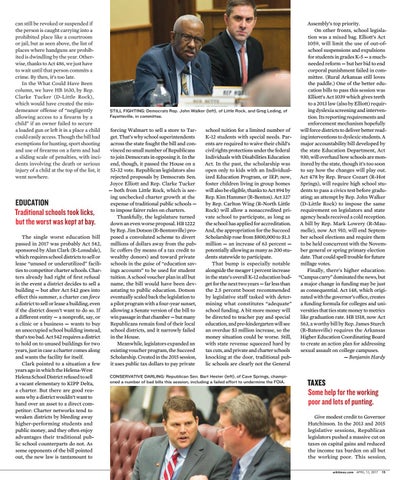
STILL FIGHTING: Democrats Rep. John Walker (left), of Little Rock, and Greg Leding, of Fayetteville, in committee.
forcing Walmart to sell a store to Target. That’s why school superintendents across the state fought the bill and convinced no small number of Republicans to join Democrats in opposing it. In the end, though, it passed the House on a 53-32 vote. Republican legislators also rejected proposals by Democrats Sen. Joyce Elliott and Rep. Clarke Tucker — both from Little Rock, which is seeing unchecked charter growth at the expense of traditional public schools — to impose fairer rules on charters. Thankfully, the legislature turned down an even worse proposal. HB 1222 by Rep. Jim Dotson (R-Bentonville) proposed a convoluted scheme to divert millions of dollars away from the public coffers (by means of a tax credit to wealthy donors) and toward private schools in the guise of “education savings accounts” to be used for student tuition. A school voucher plan in all but name, the bill would have been devastating to public education. Dotson eventually scaled back the legislation to a pilot program with a four-year sunset, allowing a Senate version of the bill to win passage in that chamber — but many Republicans remain fond of their local school districts, and it narrowly failed in the House. Meanwhile, legislators expanded an existing voucher program, the Succeed Scholarship. Created in the 2015 session, it uses public tax dollars to pay private
school tuition for a limited number of K-12 students with special needs. Parents are required to waive their child’s civil rights protections under the federal Individuals with Disabilities Education Act. In the past, the scholarship was open only to kids with an Individualized Education Program, or IEP; now, foster children living in group homes will also be eligible, thanks to Act 894 by Rep. Kim Hammer (R-Benton). Act 327 by Rep. Carlton Wing (R-North Little Rock) will allow a nonaccredited private school to participate, as long as the school has applied for accreditation. And, the appropriation for the Succeed Scholarship rose from $800,000 to $1.3 million — an increase of 63 percent — potentially allowing as many as 200 students statewide to participate. That bump is especially notable alongside the meager 1 percent increase in the state’s overall K-12 education budget for the next two years — far less than the 2.5 percent boost recommended by legislative staff tasked with determining what constitutes “adequate” school funding. A bit more money will be directed to teacher pay and special education, and pre-kindergarten will see an overdue $3 million increase, so the money situation could be worse. Still, with state revenue squeezed hard by tax cuts, and private and charter schools knocking at the door, traditional public schools are clearly not the General
CONSERVATIVE DARLING: Republican Sen. Bart Hester (left), of Cave Springs, championed a number of bad bills this session, including a failed effort to undermine the FOIA.
Assembly’s top priority. On other fronts, school legislation was a mixed bag. Elliott’s Act 1059, will limit the use of out-ofschool suspensions and expulsions for students in grades K-5 — a muchneeded reform — but her bid to end corporal punishment failed in committee. (Rural Arkansas still loves the paddle.) One of the better education bills to pass this session was Elliott’s Act 1039 which gives teeth to a 2013 law (also by Elliott) requiring dyslexia screening and intervention. Its reporting requirements and enforcement mechanism hopefully will force districts to deliver better reading interventions to dyslexic students. A major accountability bill developed by the state Education Department, Act 930, will overhaul how schools are monitored by the state, though it’s too soon to say how the changes will play out. Act 478 by Rep. Bruce Cozart (R-Hot Springs), will require high school students to pass a civics test before graduating; an attempt by Rep. John Walker (D-Little Rock) to impose the same requirement on legislators and state agency heads received a cold reception. A bill by Rep. Mark Lowery (R-Maumelle), now Act 910, will end September school elections and require them to be held concurrent with the November general or spring primary election date. That could spell trouble for future millage votes. Finally, there’s higher education: “Campus carry” dominated the news, but a major change in funding may be just as consequential. Act 148, which originated with the governor’s office, creates a funding formula for colleges and universities that ties state money to metrics like graduation rate. HB 1518, now Act 563, a worthy bill by Rep. James Sturch (R-Batesville) requires the Arkansas Higher Education Coordinating Board to create an action plan for addressing sexual assault on college campuses. — Benjamin Hardy
TAXES Some help for the working poor and lots of punting. Give modest credit to Governor Hutchinson. In the 2013 and 2015 legislative sessions, Republican legislators pushed a massive cut on taxes on capital gains and reduced the income tax burden on all but the working poor. This session, arktimes.com APRIL 13, 2017
15