2 5
APA Media Directory photo contest Guest Column: The challenge of our time By Al Cross
Arkansas Press Association
Publisher Weekly Vol. 15 | No. 17 | Thursday, April 23, 2020 | Serving Press and State Since 1873
Boozman joins others seeking help for media organizations Ashley Wimberley, executive director of the Arkansas Press Association. “We have been in contact with the senator and others in the Arkansas d e l e g a t i o n , including Rep. Bruce Westerman and Rep. Rick Crawford, all who are supportive of our industry and are seeking ways to assist all small businesses.”
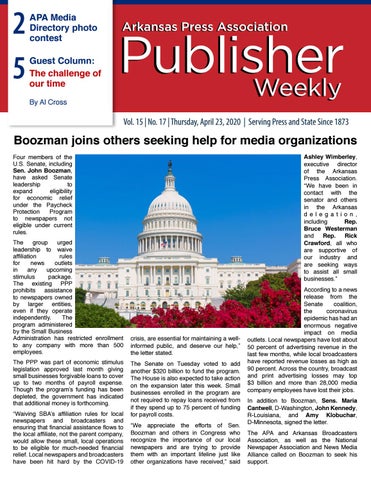
Four members of the U.S. Senate, including Sen. John Boozman, have asked Senate leadership to expand eligibility for economic relief under the Paycheck Protection Program to newspapers not eligible under current rules. The group urged leadership to waive affiliation rules for news outlets in any upcoming stimulus package. The existing PPP prohibits assistance to newspapers owned by larger entities, even if they operate independently. The program administered by the Small Business Administration has restricted enrollment to any company with more than 500 employees. The PPP was part of economic stimulus legislation approved last month giving small businesses forgivable loans to cover up to two months of payroll expense. Though the program’s funding has been depleted, the government has indicated that additional money is forthcoming. “Waiving SBA’s affiliation rules for local newspapers and broadcasters and ensuring that financial assistance flows to the local affiliate, not the parent company, would allow these small, local operations to be eligible for much-needed financial relief. Local newspapers and broadcasters have been hit hard by the COVID-19
crisis, are essential for maintaining a wellinformed public, and deserve our help,” the letter stated. The Senate on Tuesday voted to add another $320 billion to fund the program. The House is also expected to take action on the expansion later this week. Small businesses enrolled in the program are not required to repay loans received from if they spend up to 75 percent of funding for payroll costs. “We appreciate the efforts of Sen. Boozman and others in Congress who recognize the importance of our local newspapers and are trying to provide them with an important lifeline just like other organizations have received,” said
According to a news release from the Senate coalition, the coronavirus epidemic has had an enormous negative impact on media outlets. Local newspapers have lost about 50 percent of advertising revenue in the last few months, while local broadcasters have reported revenue losses as high as 90 percent. Across the country, broadcast and print advertising losses may top $3 billion and more than 28,000 media company employees have lost their jobs. In addition to Boozman, Sens. Maria Cantwell, D-Washington, John Kennedy, R-Louisiana, and Amy Klobuchar, D-Minnesota, signed the letter. The APA and Arkansas Broadcasters Association, as well as the National Newspaper Association and News Media Alliance called on Boozman to seek his support.
Government programs news publishers can use during crisis
By Danielle Coffey This article was initially published on the News Media Alliance website, www.newsmediaalliance.org
News publishers provide an essential public service by reporting the facts and keeping their communities informed during this time of uncertainty. Millions of people around the world get their information about the COVID-19 pandemic from trusted publishers, whose journalists risk their health and well-being for that mission every day. Though online traffic to news sites has spiked during the pandemic, far too many news publishers are still struggling. Thankfully, the recently enacted Coronavirus Aid, Relief and Economic Security (CARES) Act provides some relief for American businesses, including news publishers, during this challenging time.
(PPP) is a completely new program that has been accepting applications since April 3. Similar to Economic Injury Disaster Loans (EIDL), newspaper publishers with less than 1,000 employees are eligible
Here is a short summary of the important provisions of the CARES Act. The Small Business Administration’s (SBA) coronavirus relief programs now include four separate options: the Paycheck Protection Program, the Economic Injury Disaster Loans (EIDL) Emergency Advance, SBA Express Bridge Loans, and SBA Debt Relief (These are all SBA loans.) The
Paycheck
Protection
Program
to apply for PPP loans. The loans are granted by SBA-approved lenders and provide a maximum amount of $10 million or 2.5 times the average monthly payroll, whichever is lower. Since this money is
meant to incentivize keeping employees on payroll, SBA will forgive loans if all employees are kept on payroll for at least eight weeks and the money is spent on payroll, rent, mortgage interest or utilities. Due to expected high enrollment, SBA estimates that at least 75 percent of the forgiven amount must have been used for payroll. Meanwhile, the EIDL, is an existing program that allows small businesses to apply for loans of up to $2 million. Under the CARES Act, many of the qualifying requirements have been waived, making it easier for businesses to receive help. While the general small business threshold is 500 or fewer employees, to be eligible for an EIDL loan, newspaper publishers must have 1,000 or fewer employees. In addition, through the EIDL Emergency Advance program, EIDL applicants can get an advance grant of up to $10,000 three days after approval, even if their EIDL Continued on Page 3
Arkansas Publisher Weekly 2
April 23, 2020
Government programs news publishers can use during crisis Continued from Page 2
loan application is denied, providing a fast way for a business to receive financial assistance. The advance does not need to be repaid. In addition to the advance, borrowers who have been affected by COVID-19 and have an existing relationship with an SBA Express Lender can apply for an Express Bridge Loan to get up to $25,000 quickly while they wait for their EIDL application to be approved. The Treasury and Federal Reserve loan programs created under the CARES Act are designed to support larger businesses, as well as states and municipalities. In addition to direct loans to distressed businesses, the Treasury must “endeavor to seek the implementation” of a program to support bank and other lending to medium-sized businesses and nonprofits with 500-10,000 employees. While many of the details are still unclear, both of these loan programs come with many more obligations and restrictions than the SBA loans. The exact conditions vary by loan type, but include prohibitions on stock buybacks and dividend payments, requirements on workforce retainment and limitations on executive pay.
With regards to tax code changes, the CARES Act provides for employee retention tax credits. These provisions are designed to incentivize employers that were either fully or partially closed due to the pandemic, or suffered a 50 percent decline in gross receipts compared to the same quarter in 2019, to retain their employees. The provisions provide for a fully refundable tax credit of 50 percent of qualified wages paid to the business’s eligible employees between March 12, 2020 and January 1, 2021. In addition to these major benefits, the CARES Act includes multiple other provisions designed to help struggling businesses, such as news publishers, including allowing businesses to carry net operating losses from 2018 to 2020 back five years in order to reduce prior years’ income, and removing the taxable income limitation. The Act also delays the payment deadlines of employer payroll taxes, allowing employers to pay 50 percent at the end of 2021 and 50 percent one year after that. As well as payroll tax extensions, the Act
allows employers with single employer pension plans to delay payments due in 2020 to January 1, 2021 (with interest), while also providing that the plan’s status for benefit restrictions as of December 31, 2019, will apply throughout 2020. As for employees, the Act expands unemployment insurance to include independent workers who might not otherwise qualify for benefits, including independent contractors such as newspaper carriers. The Act also extends the maximum benefit period and provides an additional $600 per week for up to four months. This could impact news publishers’ retention of independent contractors during the period that increased unemployment benefits are available. These are just some of the provisions in the CARES Act designed to help American businesses. Danielle Coffey is Senior Vice President and general counsel at the News Media Alliance
Nonprofit seeks Slimp produces how-to video on freelance writers book publishing for newspapers The Arkansas Nonprofit News Network is actively generating news content available to Arkansas newspapers and its readers during the COVID-19 epidemic. As it ramps up its reporting efforts, the network seeks to expand it ranks of available freelance journalists.
there are a lot of would-be authors polishing their manuscripts and looking for a way to publish their books,” Slimp said in an announcement about the video. Slimp is the publisher of Market Square Books, which represents best-selling authors and has published several bestselling books. Newspapers should be able to begin a book-publishing business if they have InDesign or Quark, Photoshop, and a copy editor, he said.
ANNN is an independent and nonpartisan news platform with a mission of “producing journalism that matters to Arkansans.” It subsists on donations from readers and supporters. Lindsay Millar, who heads the network, said ANNN is seeking freelance writers. Millar also stressed that the ANNN’s content is free for newspapers to utilize. For more information or to connect with Millar, visit ANNN’s website, arknews.org Arkansas Publisher Weekly
Kevin Slimp, founder of Newspaper Academy and the featured speaker at this year’s planned Arkansas Press Association Convention, is offering newspaper publishers advice on how to become book publishers during the COVID-19 crisis. Book publishing for a fee from authors is called “assisted publishing,”t Slimp said. And he sees a potential revenue opportunity for newspaper owners. “Let’s face it, since the COVID-19 crisis, 3
Slimp’s video covers the ins and outs of the book publishing process, answering a number of questions including an important one for newspaper owners: “How can we make money from publishing and selling books?” A second video covers the technical aspects of designing and printing books. “Watch with your staff and bring multiple pens. You will need them,” he said. The cost of the video is $39. Purchase at newspaperacademy.com/book1/ April 23, 2020
INDUSTRY QUOTE “To say we don’t need newspapers because we have the internet is like saying we don’t need farmers because we have supermarkets.” —Peter Wagner
MARK YOUR CALENDAR APA Annual Convention September 24 & 25 Little Rock Marriott
LET’S GET SOCIAL
Newz Group to host e-editions for free Newz Group Publishing Support Services announced this week it would offer no-cost e-edition hosting for three months to any newspaper. The move is intended to support rural and community newspapers during the coronavirus epidemic. “Local journalism is the information backbone for many rural communities across America, and the pandemic has hit community newspapers hard as local advertising dollars dry up,” said Brad Buchanan, president of Newz Group. “Accurate information in small communities has never been more important, and we cannot let these publications disappear. We all need to do our bit in the face of COVID-19, and Newz Group is stepping up.”
Offering no-cost e-edition services for three months will allow newspapers to continue to provide communities with news they need, Buchanan said. Any newspaper, regardless of size, can take advantage of the program. To contact Newz Group, email Jenn Langdon at jlangdon@newzgroup.com or call (800) 474-1111.
Saline Courier dropping Monday edition The Saline Courier, a Bentonbased newspaper owned by Horizon Publications, has suspended its Monday edition because of the ongoing COVID-19 crisis, the newspaper announced to readers. For the foreseeable future, the publication frequency will be Tuesday through Sunday each week.
“This is not an easy decision, but a necessary one in light of the current business market,” said Kelly Fruedensprung, the newspaper’s publisher, in a letter to readers. “Our business model is based on advertising to cover the bulk of our expenses, primarily people and newsprint. ... When
a large portion of local retail businesses, restaurants and even service businesses closed due to the COVID-19 pandemic, their advertising budgets and marketing needs dwindled respectively.” Freudensprung said breaking news that occurs between Sunday and Tuesday printings may be accessed online at SalineCourier.com. Obituaries received after the deadline for Sunday publication will be included on the website, as well. The Courier joins several other newspapers in Arkansas reducing print frequency. Earlier this month, daily newspapers owned by Paxton Media Group dropped some publication dates.
Follow us on Facebook & Twitter
@ArkansasPressAssociation
Arkansas Publisher Weekly
@ARPressAssoc
4
April 23, 2020
Guest Column: The challenge of our time By Al Cross
Politicians have long liked to say this or that is “the challenge of our time.” It’s an overused phrase, but for those of us born after World War II, the coronavirus pandemic is surely that. And it is especially a challenge for community newspapers, because it comes on top of another unprecedented challenge they already faced. How will they respond? The first unprecedented challenge is the shift of local advertising to the digital space, where most newspapers have difficulty making enough money, so they must get more revenue from the audience – or even expand into other forms of publishing, as exemplified by David Woronoff of The Pilot, a great twice-weekly in North Carolina. Newspapers have been infamously inept with their audiences. In much the same way that daily publishers were reluctant to make readers pay for their digital products, weekly publishers have been reluctant to raise subscription and single-copy prices. In both cases, many publishers lacked confidence in the quality of their products. In some cases, that lack of confidence was justified. This country has a lot of lousy newspapers. But it has a lot of good ones, and more than ever, they are examples to follow. I believe that the essential solution to both of these challenges is quality: good journalism, including watchdog reporting and a good editorial page; sharp business practices, partnering with advertisers to innovate, including digitally; and a spirit of community service that becomes a recognized part of the newspaper’s brand. As the saying goes, people don’t care how much you know until they know how much you care. The second unprecedented challenge of our time gives community newspapers an opportunity to redouble their efforts to meet the first challenge. As David Woronoff put it in a March 23 letter to readers, “The Pilot exists for moments like this. Readers and advertisers need us — now more than ever — to be the source of fair, thorough and accurate information as well as a voice for Arkansas Publisher Weekly
compassion, civility and kindness.” In Douglas, Wyo., National Newspaper Association President Matt Adelman and his competitor of 30 years, Dennis Switzer of Douglas Broadcasting, teamed up for the first time to help the town of 6,300 and Converse County, pop. 13,600, survive the economic strain of measures designed to limit the spread of the coronavirus by reminding their audiences that “it’s up to them to help their communities’ small businesses survive the failing economy,” as Adelman said in an editorial. This wasn’t just another “shop local” campaign; it was a firebell in the night, and local businesses stepped up, buying sponsorships to support the campaign, The Douglas Budget, the Glenrock Independent and the radio stations. In a March 25 NNA webinar, Matt said they collected three and a half times as much as expected. “This really hit a nerve with people,” he said. “They recognize how important it is to shop local.” And he said they were surprised by “how important they think the local newspaper and radio station are in their life.” In other words, once they contemplated the prospect of life without them, they were willing to invest in them. And they knew, as those of us in NNA do, the quality of Matt’s papers – and presumably the radio stations, too. Converse is a county well served; it just needed reminding. “People are looking for correct information, valued information, and local news media is where they trust,” Matt said, echoing David’s letter from the editor and giving us a buck-up message in a time of tighter belts and fewer pages. When Warren Buffett went on a newspaperbuying spree in 2012, he declared, “I believe newspapers that intensively cover their communities will have a good future. It’s your job to make your paper indispensable to anyone who cares about what is going on in your city or town. That will mean both maintaining your news hole; a newspaper that reduces its coverage of the news important to its community 5
is certain to reduce its readership as well and thoroughly covering all aspects of area life, particularly local sports. No one has ever stopped reading when halfway through a story that was about them or their neighbors.” In other words, maintain quality, and you can stay in business and still render public service. Buffett apparently did not anticipate how much local advertising would shift from paper to digital, so he sold his papers recently, saying most newspapers are “toast.” I don’t believe he was thinking about most community papers. In communities without TV stations, especially outside metropolitan areas, they are still the main source of local news and information. That is still a valuable franchise, but we can’t take it for granted; its value depends greatly on the value that your audience places on your paper, and these days you need to keep reminding them of that value. We need to constantly explain the difference in news media and social media, an example of which we had on The Rural Blog at tinyurl.com/wl9oklv. Here’s a condensed version: “We practice journalism, which reports facts. To do that, we verify information, or we attribute it to someone else. That is called the discipline of verification, and it is the essence of the news media. Social media have no discipline, and hardly any verification, and they emphasize opinion. Newspapers separate fact from opinion, reserving our own views for the editorial page. Of course, our views influence what news we choose to cover, so if you think we’re not covering what should be covered, or have failed to separate fact from opinion, or make another mistake, we want you to tell us.” Al Cross edited and managed rural newspapers before covering politics for the Louisville Courier Journal and serving as president of the Society of Professional Journalists. He is director of the University of Kentucky’s Institute for Rural Journalism and Community Issues. April 23, 2020