Volume. 2 Issue. 3
$4.00
Fall 2013
Serving Contracting Firms and the Arizona Community …Then & Now
• The Valley’s Great White Elephant of 1920 • Thinking “Globally”, Building Locally: Harry J. Hagen • The City that Cotton Built • Class Act: Paradise Valley School District Centennial • A Concrete Reputation: Bill Heeter • It Was A Very “Good Year”: The Wigwam Resort Story
Branco provides the highest quality and most advanced products available in the positioning industry today. Branco has the in-house expertise to assist you in the selection of the right technology and the right products to get the job done right the first time.
Topcon Machine Control Motor Graders
Construction Rotating Lasers
Dozers
Pipe Lasers
Excavators
Automatic 3D GPS+ Technology
Scrapers
Sales, Rental, Service
Pavers
Installation &Training
3DMC² Graders & Dozers
Rental Equipment
Ground Engaging Tools
Motor Graders
3D GPS Products
Grade Tractors
2D Machine Control
Skid Steers
Lasers & Receivers
Tungsten Carbide Custom Application for: Blades, Teeth, Wear Plates, Segments, & Routers Patterns to fit your needs.
Cutting Edges For: Dozers, Loaders, Scrapers, Motor Graders sAll O.E.M. Edges sCustom Blades (Made to order)
Shanks & Teeth sAll O.E.M. Replacement Teeth sRipper Box Assemblies sReplacement Tooth Adapters
Fabrication / Repair Backhoe and Excavator Buckets
Replacement Parts for Elevating Scrapers Flights, Chains, Sprockets, Rollers, & Grouser Bar. Dozer Undercarriage
www.brancomachinery.com For More Information Call: 480-892-5657 1205 N. McQueen Rd. Gilbert, Arizona 85233
Arizona Contractor & Community Magazine Working with the following Associations Publisher William Horner Billy@arizcc.com
Alliance of Construction Trades Jim Kuliesh - Executive Director (520) 624-3002 www.actaz.net 465 W. St Marys Rd. Tucson, AZ 85701
Arizona Chapter Associated General Contractors David M. Martin - President (602) 252-3926 www.azagc.org 1825 W. Adams, Phoenix, AZ 85007
Editor Douglas Towne Douglas@arizcc.com Marketing & Sales Consultant Chuck Runbeck Chuck@arizcc.com 602-881-0907 Advertising Manager Shane Addington Shane@arizcc.com 623-826-8598
American Rental Association of Arizona Bob Nally - Executive Director (602) 272-7368 www.ararental.org 249 S. 59�� Ave, Phoenix, AZ 85043
American Subcontractors Association of Arizona Carol Floco - Executive Director (602) 274-8979 www.asaaz.com 4105 N. 20th St. Ste. 230, Phoenix, AZ 85016
Production Manager Laura Harley Laura@arizcc.com Columnists Paul Beaulieu John Bueker
Arizona Builders’ Alliance Mark Minter - Executive Director (602) 274-8222 www.azbuilders.org 1825 W. Adams, Phoenix, AZ 85007
Arizona Rock Products Association Steve Trussell - Executive Director (602) 271-0346 www.azrockproducts.org 916 W. Adams, Phoenix, AZ 85007
Contributing Writers Connor Descheemaker Roberta Graham Lee Addis
View our online magazine at: www.arizcc.com
Annual subcription $16 send check to: ACC, PO Box 6912 Glendale, AZ 85312
Printed at Lithotech National Utility Contractors Association of Arizona Connie Corder - Executive Director (480) 775-3943 www.nucaaz.org PO Box 66935, Phoenix, AZ 85082
Tucson Utility Contractors Association Ramon A. Gaanderse - Executive Director (520) 623-0444 www.tuca-az.org 1842 W. Grant Rd. Ste. 103, Tucson, AZ 85745
Published in the interest of the entire construction industry and those allied with it.
Arizona Contractor & Community (ACC) magazine is published quarterly (spring, summer, fall, & winter). ACC is a professional publication designed for the contracting industry, engineers, architects, and others interested in Arizona and its history. Content including text, photographs or illustrations may not be reproduced without the written permission from the publisher. The publisher does not assume responsibility for unsolicited submissions. ACC reserves the right to reject any editorial and advertising material and reserves the right to edit all submitted content material. Arizona Contractor & Community Copyright © 2013 All rights reserved.
Volume. 2 Issue. 3 Fall 2013
CONTENTS
8.
Editors’s Column: Monoculture Blues: the 1920 Cotton Craze - Douglas Towne
10. 20.
Construction Around Arizona - William Horner University Construction Nears $700 Million in 2014 - Eric Jay Toll
22. 25.
Association Highlights Construction Column: The City that Cotton Built - Paul Beaulieu
28.
Harry J. Hagen - Arizona Construction Pioneer - Elaine Hagen
34. 39.
Cotton and Cowboys - Roberta Graham Timeless Thrill Ride: Legend City’s 50th Birthday Party - John Bueker
40. 42. 48.
Vintage Arizona Cotton Machines Class Act: Paradise Valley School District Centennial Digging Through the Archives: The Bill Heeter Story - William Horner
52. 53.
Construction Marketplace Bid Results - Bidjudge
.
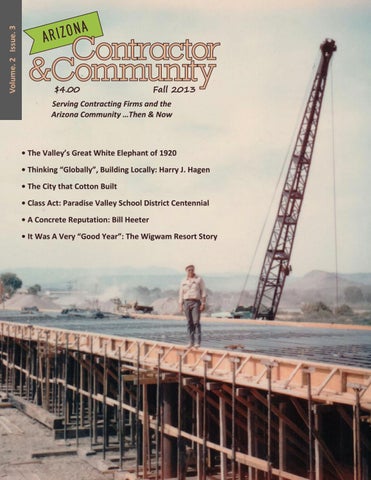
Front Cover - Harry Hagen Harry Hagen stands on one of two bridges his company built on U.S. Highway 70 between Cutter and San Carlos Arizona. See story on page 28.
Monoculture Blues: The 1920 Cotton Craze Douglas Towne
N
from World War I that began in Europe in 1914. Wartime hostilities limited shipments of Egyptian long-staple cotton. Back then, the commodity wasn’t coveted for luxury bed sheets as much as for military equipment such as tires and airplane fabrics. After the U.S. entered the conflict on the side of the Allies by declaring war on Germany in 1917, the production of domestic long-staple cotton became a priority. While limited long-staple cotton was grown in coastal South Carolina and Georgia, fortunately, cotton research had been conducted at an experimental farm in Sacaton south of Chandler in the early 1900s. Led by agronomist Thomas Kearney, Pima Indians cultivated cotton hybrids until ideal traits were achieved that grew well in the Valley. These hybrids produced long, silky fibers for a soft, dense cloth. This long-staple cotton was named Pima after the Native Americans who grew it; its commercial production in Arizona began in 1912. By 1916, only 7,300 acres of Pima cotton were planted in the Valley with a pound
bringing about $0.28. Fueled by wartime demand however, prices for a pound of Pima cotton reached an amazing $1.25 in 1919. Tempted by these escalating prices, farmers sowed cotton seed in every available field, abandoned citrus orchards, and borrowed heavily to buy additional farmland. Ranchers
Images courtesy of author
ot quite a century ago, the Salt River Valley was intoxicated with white fiber fever. Easy wealth was virtually guaranteed to be had sowing cotton whether you were an experienced farmer or merely a “cotton plunger” someone with little agricultural knowledge who purchased land eager to capitalize on the skyrocketing prices. The euphoria about “King Cotton” was as rampant and unrestrained as the Phoenix area’s recent housing boom. And cotton went bust just as fast, going from one of the original economic foundations of Arizona to overnight becoming a white elephant in 1920. Cotton, copper, citrus, climate and cattle made up the "Five C's" of Arizona’s economy at statehood in 1912. At the time, the Valley supported a diversified agricultural base of cotton, alfalfa, and citrus crops, along with dairy and beef cattle. Cropland had expanded with the copious water supply provided by the recent completion of Theodore Roosevelt Dam on the Salt River. The Valley’s bucolic agricultural setting would soon change dramatically, however, the result of global repercussions
Eight
bankrupt, business declined, and Mexican farm workers lived in poverty. The Valley soon rebounded, however, to become the Southwest’s leading agricultural region. Alfalfa, grain fields, citrus orchards and dairy herds quickly reappeared thanks to loans to farmers
made by local banks. “King Cotton” would never again so dominate local farming but continued to be a major presence in the economy – and culture – of the Valley.
Images courtesy of author
and dairymen sold their livestock and plowed under alfalfa fields. By 1920, 180,000 acres, over threequarters of the irrigated land in the Valley, was planted in Pima cotton which was forecast to reach $1.50 per pound. To manually harvest the bumper crop, cotton growers and railroad interests recruited 35,000 Mexican farm workers to temporarily relocate to Phoenix, a city of only 29,000 residents. “The high cotton prices lured people who had no farming experience into trying to grow the crop,” local historian Donna Reiner says. “Of course, most lost their shirts.” World War I ended in late 1918. Decreased peacetime needs, together with large amounts of stockpiled Egyptian cotton dumped on the market, caused prices to unexpectedly plummet in the fall of 1920. Tariffs on Egyptian cotton imports were proposed but nothing prevented the collapse of the Pima cotton market. Many Valley farmers abandoned their fields, leaving row upon row of cotton bolls to rot. The few local farmers who harvested their cotton received far less than what it cost to produce the crop. Imported Mexican laborers, despite having contracts with the growers, were turned away from the fields. “The Arizona Cotton Growers Association had promised to pay the workers and send them back to Mexico on trains free of charge,” Ruben Hernandez writes in A Legacy Lost and Found: Finding our Latino Roots in the History of Phoenix. “In reality, it did nothing; the Mexican government finally paid to bring the workers back home.” The cotton bust caused a run on banks and a short-lived economic depression in the Valley. Merchants including Korrick’s, Hanny’s, and Diamonds department stores held huge sales in order to remain viable. Many farmers went Left: Cotton harvest near Litchfield Park, 1955. Top: Phoenix postcard, 1923. Right: Model Judy Hickman poses for the Phoenix Cotton Wives marketing campaign, 1968.
Arizona Contractor & Community
Images courtesy of author
Construction Around Arizona
Construction Around Arizona Freeways • Roadways • Commercial • Residential William Horner Above: Employees of the Concrete Division of Sun Valley Masonry pose for a photo at Tolleson High School. Sun Valley Masonry had the difficult task of grading, forming, and pouring sidewalks throughout the campus, often in tight spaces between existing buildings. The project was completed on time before the start of school. Right: PacWest Field Mechanic, Zac Jackson changing out scarfire teeth on their blade. Far right: Firestop Southwest Supervisor, Charlie Crippen whose crew caulked and sealed the newly installed windows on the W.L. Gore building. See Project on page 14.
Ten
Public Auction held the 2nd Saturday of every month. Preview Every Monday – Friday 8am – 4pm. Consignments Welcome. Western Sales Management, Inc
623-936-3300
1616 S 67th Ave.
Wsmauctioneers.com
Phoenix, AZ 85043
Wsmauctionbiz@yahoo.com