In Farm Bureau Veach honored Arkansas Farm Bureau President Randy Veach of Manila was honored by the House Committee on Natural Resources during National Small Business Week (May 4-8). Veach was recognized for standing up for small businesses at an oversight field hearing in Batesville that was appropriately dubbed “Protecting the Rights of Property Owners: Proposed Federal Critical Habitat Designations Gone Wild.” In his testimony, Veach said, “Our farmers, ranchers and landowners are often overloaded with unnecessary and burdensome regulations ... Quite frankly, it will affect our lives and our livelihood.” Arkansas Farm Bureau’s involvement was one of the reasons cited for a reduction in the final critical habitat area designated for the Neosho mucket and the rabbitsfoot mussel, an area reduced by 27 percent from the original proposal. ArFB summer interns Two interns have joined Arkansas Farm
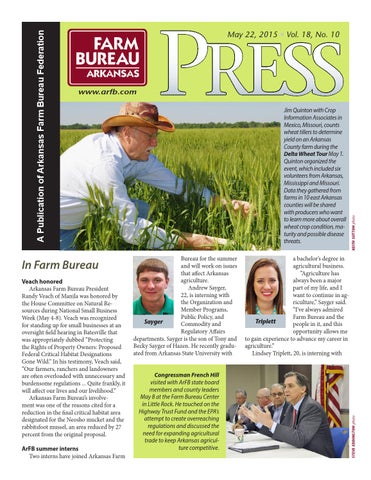
Jim Quinton with Crop Information Associates in Mexico, Missouri, counts wheat tillers to determine yield on an Arkansas County farm during the Delta Wheat Tour May 1. Quinton organized the event, which included six volunteers from Arkansas, Mississippi and Missouri. Data they gathered from farms in 10 east Arkansas counties will be shared with producers who want to learn more about overall wheat crop condition, maturity and possible disease threats. Bureau for the summer and will work on issues that affect Arkansas agriculture. Andrew Sayger, 22, is interning with the Organization and Member Programs, Public Policy, and Sayger Commodity and Regulatory Affairs departments. Sayger is the son of Tony and Becky Sayger of Hazen. He recently graduated from Arkansas State University with Congressman French Hill visited with ArFB state board members and county leaders May 8 at the Farm Bureau Center in Little Rock. He touched on the Highway Trust Fund and the EPA’s attempt to create overreaching regulations and discussed the need for expanding agricultural trade to keep Arkansas agriculture competitive.
KEITH SUTTON photo
www.arfb.com
a bachelor’s degree in agricultural business. “Agriculture has always been a major part of my life, and I want to continue in agriculture,” Sayger said. “I’ve always admired Farm Bureau and the Triplett people in it, and this opportunity allows me to gain experience to advance my career in agriculture.” Lindsey Triplett, 20, is interning with
STEVE EDDINGTON photo
A Publication of Arkansas Farm Bureau Federation
May 22, 2015 • Vol. 18, No. 10
Members of the Beebe FFA chapter hosted AgVenture Day April 29 at the ASU Beebe Farm. More than 800 pre-K to fifth-grade students from area schools learned about Arkansas agriculture at ArFB’s Ag Experience Trailer, milked the Farm Bureau cow, saw fish in the Arkansas Game and Fish mobile aquarium and got to pet and learn about farm animals. after lunch. A short spray school originally scheduled as part of the meetings has been canceled. Additional information about the meetings will be sent to county commodity chairmen at a later date.
Commodity meetings change The date and location for Arkansas Farm Bureau’s Soybeans Division and Wheat & Feed Grains Division summer commodity meetings have been changed. The meetings previously were scheduled for June 2 at the Brinkley Convention Center. They have been rescheduled for June 30 at the Lon Mann Research Station in Marianna. The divisions will meet together at 9 a.m. and will break into individual sessions
In Arkansas Rice pocket guides available The University of Arkansas has developed the “Arkansas Rice Pocket Guide” for rice producers to provide brief and specific
KEITH SUTTON photo
KEITH SUTTON photo
POPE CO. FB photo
MOLLIE DYKES photo
the Public Relations department. She is the daughter of Angela and the late Earl Triplett of Conway. Triplett is pursuing a bachelor’s degree in agricultural business with an emphasis in public relations from Arkansas Tech University. “I’m excited to combine my passions for both agriculture and communicating with people through this internship,” Triplett said. “Farm Bureau is known as the voice of agriculture, and I’m grateful to be a part of that voice.” Sayger and Triplett will work on a broad set of tasks during their 12-week internships. Sayger will work with the commodity divisions, along with the county Farm Bureaus. He’ll also work on organizational policy development. Triplett is helping the organization with a number of its summer activities and will contribute to its different publications. She’ll also work with social media and marketing strategies.
After weeks of lagging well behind the state’s five-year average in planting progress due to frequent rain, Arkansas growers have now pulled within a few percentage points of historic averages, according to a USDA crop report published May 4. Planted corn, cotton, rice, sorghum and soybeans are now each within 1-5 percent of their respective five-year averages for progress.
Zac Bradley (standing), director of public policy, national affairs, for Arkansas Farm Bureau, was guest speaker at a legislative appreciation barbecue hosted by Franklin County FB. Several dozen people attended the May 4 event at South Side Park near Ozark. Bradley updated them on Farm Bureau’s achievements at the recent general session.
Pope Co. FB held a multicounty legislative appreciation fish fry May 4 in Russellville. Among those recognized by county vice president Jason Drew (second from left) were (left to right) Rep. Ken Henderson, Sen. Greg Standridge, Rep. Mary Bently and Rep. Trevor Drown. Seventy-five people attended the event. recommendations for rice production in Arkansas. “This is a supplement to the “Arkansas Rice Production Handbook,” which provides more detailed information and support for recommendations,” said Dr. Jarrod Hardke, UA’s rice extension agronomist. “The pocket guide, on the other hand, is designed to serve as a quick reference guide for recommendations with pictures, tables and bulleted text for management decisions.” The pocket guides are available from county extension offices, or they can be downloaded in PDF format by visiting www.uaex.edu/publications/mp-533.aspx. Rice license plates A special Arkansas license plate highlighting the state’s rice industry is now available. The Arkansas Rice Council worked with the Department of Finance and Administration to develop the specialty license plate to promote rice, Arkansas’ second highest value commodity and top agricultural export. Specialty fees from the plates will help fund scholarships and education programs for students pursuing careers in agriculture or the food industry. “These plates are an easy way for any Arkansan to help promote rice throughout the state,” Arkansas Rice Council President Steve Orlicek said. “It’s a simple way to advocate for agriculture while helping sustain farming for future generations in Arkansas.”
New seed foundation facility The Arkansas Rice Research and Promotion Board recently announced plans to direct $2 million to help construct a seed foundation facility at the state’s Rice Research and Extension Center in Stuttgart. The facility will assist scientists and researchers to bring new higher-yielding, high-quality rice varieties to market so Arkansas farmers can profitably grow rice that meets worldwide demand. The center, along with the new Foundation Seed Facility, is operated by the University of Arkansas System Division of Agriculture. The new facility is expected to cost $8.6 million, and construction will begin this summer and be completed in 12 months. “The Rice Research and Promotion Board has always been forward-thinking in how it applies research to advance Arkansas agriculture, and we sincerely appreciate their commitment to ensuring Arkansas will remain the epicenter of rice production and rice research,” said Mark Cochran, vice president for UA’s Division of Agriculture, “The board has been a valuable partner with us for more than 30 years now, and our united partnership means better results for our state’s economy and all Arkansans.” The $2 million for the new facility will come through tariff rate quota funds generated for domestic rice research from the U.S.-Colombia Trade Promotion Agreement, which established an annual tariff rate quota for U.S. rice exported to Colombia. The funds are reserved only for research efforts and are allocated by the Arkansas Rice Research and Promotion Board. The Arkansas Soybean Promotion Board and the Arkansas Wheat Promotion Board have both previously made contributions to the new facility as well.
KEITH SUTTON photo
“My husband, Greg, had the idea to do the specialty rice plate after seeing the many different state plates promoting all manner of organizations and schools,” said Newport rice farmer Jennifer James. “What we hadn’t thought about initially was the amount of work it would take to make this a reality, and it did take a lot, but, now that it’s done, it’s a great visual and a constant reminder to our fellow Arkansans about the big impact our rice industry has on the state’s economy.” Any motor vehicle owner may obtain the Arkansas rice license plate for the specialty registration fee of $35. To learn more, call 501-682-4692.
Ron Atkinson of Hector (left) and Ronnie McNew of Plumerville discussed horse safety with students at the May 7 Conway County Safety Day. More than 300 third graders from four local schools visited the Jerry Scroggins farm near Springfield for the May 7 event. ArFB safety coordinators Jason Kaufman and Amanda Williams taught tractor and bicycle safety.
Recipe contest Think of that rice in your pantry as a blank canvas on which to create a dish that could win the 2015 Arkansas Rice Expo Recipe Contest. “This contest is an opportunity to show off your kitchen creativity and showcase a grain that’s a staple worldwide,” said Lonoke County extension agent Dianna Bowen who chairs the rice contest committee for the Cooperative Extension Service. The deadline for receipt of entries is June 12, and winners of the preliminary round will be notified by July 1. The fourth annual contest will be held Aug. 7 in conjunction with the Arkansas Rice Expo at the Grand Prairie Center in Stuttgart. In addition to showing off the versatility and benefits of rice, the contest is also meant to encourage safe food handling skills, advance cooking skills and showcase rice growing in Arkansas. Entry forms and complete contest rules can be downloaded at www.uaex.edu/rice-expo/ or obtained at your county extension office.
Elsewhere FAA approves drone for spraying
An unmanned aerial system (UAS) large enough to carry tanks of fertilizers and pesticides has won rare approval from federal authorities to spray crops in the United States. The UAS, called the RMAX, is a remotely piloted helicopter that weighs 207 pounds. Smaller systems weighing a few pounds had already been approved for limited use to take pictures that help farmers identify unhealthy crops. The RMAX is the first time a UAS big enough to carry a payload has been approved. The UAS already has been used elsewhere, including by rice farmers in Japan. The FAA approved it for the U.S. on May 1. “I certainly understand their cautious approach,” said Steve Markofski, a spokesman for Yamaha Corp. U.S.A., which developed the aircraft. “It’s a daunting task given our airspace is complicated.” The drone is best suited for precision spraying in places hard to reach from the ground or with larger, piloted planes. “The FAA is taking an important step forward to helping more industries in the U.S. realize the benefits drone technology has to offer, said Brian Wynne, president and CEO of the Association for Unmanned Vehicle Systems International. Editor Keith Sutton
keith.sutton@arfb.com
In the Market As of May 20, 2015:
U.S. loses final COOL appeal On May 18, the World Trade Organization (WTO) ruled U.S. country of origin labeling (COOL) noncompliant. This was U.S. final appeal of the WTO’s ruling from the trade dispute filed by Canada and Mexico in 2008. After the initial ruling against COOL, the U.S. Department of Agriculture revised the regulation in 2013. However, that revision also was found to be noncompliant in 2014, and this most recent ruling upheld the 2014 decision. The U.S. now has to either modify or repeal the program. The World Trade Organization’s Dispute Settlement Body will hold a special meeting May 29 to adopt the Appellate Body’s decision faulting U.S. COOL requirements. After that meeting, Canada and Mexico will be able to request permission to retaliate against the U.S. based on their losses because of the labeling rules. If the U.S. fails to act, Canada would be allowed to implement tariffs of around $2 billion a year in “punitive damages.” Canada will likely target U.S. exports, including rice, beef, pork, wine, cherries, pasta, corn and other products. These tariffs could be in place as early as late summer if Congress and the administration fail to act. On May 20, the House ag committee was scheduled to mark up a bill repealing U.S. country of origin labeling for beef, pork and poultry. It was expected to clear the panel, despite opposition from ranking member Rep. Collin Peterson (D-Minn.). House ag chairman Mike Conaway (R-Texas) is working with GOP House leadership to get the bill considered on the floor in early June. The outlook for the Senate is murky, as no similar bill has yet to be introduced. But Senate ag chairman Pat Roberts (R-Kan.) said that he
will consider any solution, including repeal, that would allow the U.S. to be WTO-compliant. Farm Bureau policy states, “We support Country of Origin Labeling (COOL) that conforms with COOL parameters and meets WTO requirements.” American Farm Bureau Federation President Bob Stallman said, “The World Trade Organization dispute panel has ruled that U.S. country of origin labeling regulations for meats are not in compliance with previous WTO decisions. That means we need further effort to craft an acceptable COOL program. “Farm Bureau will carefully review the decision and then determine recommended actions,” he continued. “We will work with Congress, the USDA and the office of the U.S. Trade Representative to reach the goal of an effective COOL program that conforms to international trade rules.” China lifts ban on Brazilian beef China has now lifted its 3-year-old ban on imports of Brazilian beef, Brazil’s agriculture ministry announced. Eight beef plants and one poultry plant were cleared to ship to China, with another 17 expected to gain approval in June. The approved plants represent $520 million in sales potential. Record Chinese soybean imports forecast in 2015-16 China will likely import a record 77 MMT of soybeans in 2015-16, according to the China National Grain and Oils Information Centre. This would be an increase of 5.5 percent from 2014-15 and is slightly below USDA’s estimate last week that the country would import 77.5 MMT of soybeans. China’s cotton imports down sharply this year Official customs data showed China imported 160,800 MT of cotton last month, a 28.3 percent reduction from a year ago, according to the China Cotton Association. It says the nation’s imports for the first four months of
the year stand at 609,000 MT, which is down 38.2 percent from a year ago. Buying has been limited by a lack of import quotas this year as the country has tried to prop up demand for domestic supplies. The country has said that in principle it will issue no more than the 894,000 MT of low tariff-rate quotas it has committed to under the World Trade Organization. There also have been recent rumors that China will soon release cotton reserves onto the market, although most industry participants expect the government to wait until more commercial stocks are sold. The country is estimated to have 10 MMT of cotton in reserves, more than 40 percent of the world’s inventory. Wheat prices rally, but lack demand Just in time for harvest, July wheat prices have experienced a strong rally since the first of May. Prices have rallied from contract lows near $4.60 to a high of $5.30 as weather was forecast to hurt the wheat crop. Forecast of a late frost combined with wet weather in major growing areas had the market worried about supplies and helped prices rally 32 cents in one day. However, demand remains weak and stagnant for U.S. wheat and is preventing further gains in the market. As the weather scare fades, look for the market to turn its focus back to the weak U.S. balance sheet and wheat prices to quickly fall back below $5.
CONTACT • Matt King 501-228-1297, matt.king@arfb.com.