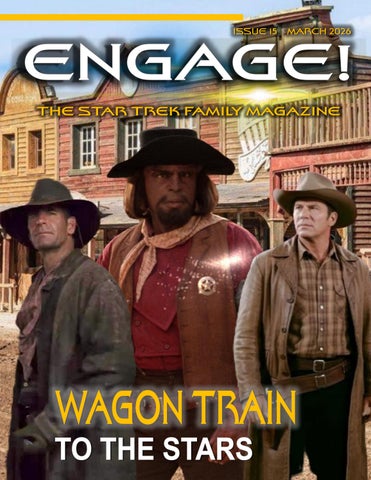
Issue 15 -- March 2026

Page 1


In 1964 when Gene Roddenberry was putting pen to paper on a new television pilot, American film and television was dominated by the American Wild West. With shows like “Gunsmoke” and “Have Gun, Will Travel,” production studios couldn’t get them fast enough! When Gene went to pitch his new show, Star Trek, he knew that he’d have a hard time selling it (after all, studios weren’t interested in science-fiction shows which were not mainstream popular).

After many rejections, his final pitch was to the first female head of a Hollywood studio, where he pitched his vision for a “’Wagon Train’ to the stars” basically, a space Western. The red-headed and tenacious executive may not have understood the pitch initially, but Lucille Ball would buy the show from Gene Roddenberry anyways. When NBC rejected the first pilot, and Desilu’s Board wanted to cancel the show entirely, Lucille Ball intervened and made sure the show got its chance.

Even though Star Trek was a ground-breaking science fiction, it shared many themes and tropes with the Westerns of the period. Many of the articles contained herein examine how themes of the American West pervade throughout The Original Series and indeed many of its successors.

We would also like to take a moment to welcome several new writers to our ENGAGE! Team: Tania Rose Bindhoff and Jonathan Talley (both of who have articles in this issue), Crissy Sampson Nower, Deborah Fisher, Marcus Albers and Christopher Kady. This magazine would not be possible without all the incredible contributions of our staff, and we are grateful for them.

Mark Sickle Founder & Host Star Trek Family

Have you always wanted to write about your love for Star Trek? We are always looking for volunteer writers to join our team! Send us an email at the ‘Contact Us’ link at left! ISSUE 15 — MARCH 2026

We are truly interested in receiving feedback from our readers and fellow fans! Really love an article that appears in our magazine? Truly disagree with someone’s take on a topic? How are we doing? Do you have suggestions for features, articles, etc.?

I

n the mid-1960s, a young television producer pitched an idea to create a new type of science-fiction show. He described it as “’Wagon Train’ to the stars”. Since then, that phrase has become one of the most frequently-used origin stories in television history, often repeated with a mix of affection and irony. This description is not just a clever sales hook designed to reassure cautious executives that science fiction could be made familiar. It was a realistic view of what Gene Roddenberry’s creative idea was for Star Trek. At its core, Star Trek was built on western themes, frontier exploration, moral conflict at the edge of civilization, rugged individualism balanced against communal responsibility, and the uneasy tension between law and justice.

Roddenberry did not just borrow superficial imagery from Westerns, he embedded their narrative structure, character archetypes and ethical dilemmas into the DNA of the show. The result was a series that felt at once futuristic and deeply rooted in American storytelling tradition. By examining Star Trek through the lens of the Western, we gain a clearer understanding of why the franchise resonated so strongly with audiences and why its themes remain enduring decades later.

The Western Roots of a Science Fiction Vision

To understand Star Trek’s Western identity, one must first understand Roddenberry’s background. Before Star Trek, Rodden-

berry worked extensively in television during the 1950s, a period dominated by Westerns. Shows like “Gunsmoke,” “Have Gun –Will Travel,” “The Rifleman” and “Bonanza” were staples of American television, and Roddenberry himself wrote scripts for western series, including “Have Gun – Will Travel.” These experiences shaped his narrative instincts and storytelling economy.

The Western was more than entertainment in midcentury America; it was a cultural mythmaking machine. It offered a romanticized vision of the American frontier where civilization met wilderness, where moral codes were tested in harsh environments, and where individuals were often forced to make ethical decisions without clear guidance from institutions. Roddenberry absorbed these lessons well. When he turned to science fiction, he did not abandon the western, he transposed it.

In Star Trek, outer space replaces the frontier plains. The Enterprise stands in for the wagon train, moving from settlement to settlement, crisis to crisis. Each planet becomes a new town on the edge of known space, complete with its own conflicts,

dangers, and moral ambiguities. The episodic nature of the original series mirrors the structure of western television: arrive, assess the situation, confront the problem, restore balance (or leave behind unresolved consequences), and move on.

The Frontier as Philosophy: Space as the New West

The concept of the frontier is central to both the western genre and Star Trek. In westerns, the frontier represents possibility and peril in equal measure. It is a place where established laws are weak or absent, forcing individuals to rely on personal codes of ethics. In Star Trek, space functions in much the same way.

The United Federation of Planets may represent civilizations and order, but the Enterprise operates far beyond its comfortable reach. Starfleet’s rules exist, but they are constantly tested by unfamiliar cultures, dangerous technologies and moral gray areas. This tension mirrors the Western sheriff who carries the authority of the law into towns where the law has not yet taken root, or where it has become corrupt. Roddenberry’s final frontier was not about conquest but

about encounters. Unlike many traditional Westerns, that glorified expansion and domination. Star Trek reframed the frontier as a place of learning and diplomacy However, the basic western framework remained intact, the frontier is where values are defined, challenged and sometimes reshaped.

Kirk, Spock and McCoy: A Frontier Trinity

No character better embodies Star Trek’s western roots than Captain James T. Kirk, whose command style mirrors the classic frontier gunslinger. Kirk operates according to a deeply personal moral compass, one that frequently brings him into conflicts with rigid authority and abstract regulations. Like the Western hero who rides into town to confront problems others cannot or will not face, Kirk is defined by action, accountability and an acceptance of consequence. His leadership balances charm with decisiveness. He

is quick with a smile, quicker with a phaser, and always willing to bear the weight of his choices. Much like the iconic figures portrayed by John Wayne or Gary Cooper, Kirk ultimately stands alone when decisions must be made even when counsel is given. That counsel comes most clearly in the form of Spock and Dr. Leonard “Bones” McCoy, whose opposing worldviews form the moral axis upon which Kirk’s command turns. Spock represents logic, restraint, and institutional order — the educated marshal attempting to impose reason and law on an unpredictable frontier. McCoy, by contrast, embodies emotion, empathy and moral instinct, resembling the frontier doctor or preacher who places human life above policy. Kirk exists between these two poles, synthesizing logic and compassion into action. Their debates are not merely character interplay but a classic Western storytelling device. The hero is caught be-

tween civilizations and instinct, law, and justice. Episodes such as “A Private Little War” and “The Apple” place this dynamic in sharp relief, presenting Kirk as a frontier lawman forced to intervene in volatile situations where neutrality is impossible and clean solutions do not exist. In these moments Star Trek embraces a Western truth, that justice on the frontier is rarely pure and often demands compromise, sacrifice and moral courage.

The Prime Directive: A Western Code Reimagined

When you first look at the Prime Directive a law banning all interference with a less developed planet would, on its face, seem unethical to the Western tone. However, the Prime Directive can be seen as a modern reimagining of the Western code of restraint.

In many Westerns, the hero understands that imposing order prematurely can do more

harm than good. Towns must sometimes find their own way, even if that path is painful. The Prime Directive embodies this philosophy, forcing Starfleet officers to confront the limits of their authority and the consequences of their power.

Episodes like “A Taste of Armageddon” and “The Return of the Archons” explore the moral complexity of intervention versus non-intervention, echoing western narratives where heroes struggle with when and whether, to act.

Law, Justice, and Moral Ambiguity

One of the most enduring western themes in Star Trek is the distinction between law and justice. Westerns frequently depict legal systems that are inadequate or corrupt, forcing heroes to act outside the law to achieve justice. Roddenberry carried this tension into Star Trek

Starfleet regulations often

clash with ethical imperatives, placing captains in impossible positions. Kirk’s willingness to bend or break the rules is not reckless; it is rooted in the western belief that moral responsibility ultimately rests with the individual. This theme becomes even more pronounced in later series, particularly The Next Generation and Deep Space Nine, but its foundation lies firmly in Roddenberry’s western sensibilities.

Civilization Versus Savagery: A Rejected Binary

Classic westerns often relied on simplistic binaries: civilization versus savagery, settlers versus “others.” Star Trek, while inheriting the frontier framework, deliberately complicates this narrative. Roddenberry rejected the idea that progress was inherently moral or that advanced societies were automatically superior.

Alien cultures in Star Trek are rarely portrayed as purely barbaric. Instead, they challenge

human assumptions and force characters to reconsider their own values. This evolution reflects Roddenberry’s desire to update the western myth for a more socially conscious era.

Technology as the New SixShooter

In Westerns, the gun is both tool and symbol, a means of survival and a measure of power. In Star Trek, technology plays a similar role. Phasers, tricorders, and starships are extensions of human agency, capable of protecting or destroying depending on how they are used. Roddenberry consistently emphasized that technology itself is neutral; morality lies in the hands of those who wield it. This idea mirrors Western narratives where the gun does not make the man but reveals him.

The Wagon Train Structure and Episodic Storytelling

The episodic structure of

Star Trek: The Original Series directly reflects its western roots. Like “Wagon Train,” each episode presents a self-contained story with recurring characters encountering new environments and challenges. This structure allows for moral experimentation, a hallmark of both westerns and science fiction.

Each planet serves as a narrative laboratory where Roddenberry could explore social issues war, racism and imperialism through allegory. The Western framework provided a familiar vehicle for these ideas, making them accessible to a broad audience.

Optimism on the Frontier

Perhaps the most significant way Roddenberry diverged from traditional Westerns was in his optimism. Many Westerns are tinged with melancholy, portraying the frontier as a place that ultimately disappears. Star Trek, by contrast, envisions an endless frontier of growth and possibility.

Roddenberry believed that humanity could learn from its past mistakes and build a better future. His frontier was not about closing the West but opening the stars. This hopeful reinterpretation is what allowed Star Trek to transcend its genre influences and become something more than a space Western.

Legacy: Western Themes Beyond Roddenberry

Even after Roddenberry’s direct involvement waned, the Western DNA remained embedded in Star Trek. Deep Space Nine’s frontier station, Voyager’s lost journey home and Enterprise’s early exploration years all revisit the Western concept in new forms.

Modern series continue to wrestle with these themes, proving that Roddenberry’s synthesis of western mythology and science fiction was not a creative shortcut but a durable narrative foundation.

Conclusion: A Myth Rewritten Among the Stars

Gene Roddenberry did not simply dress the western in futuristic costumes; he reimagined its core values for a new era. By transplanting frontier mythology into space, he created a framework capable of exploring humanity’s deepest questions about power, responsibility and morality on a cosmic scale.

Star Trek endures because it understands that the frontier is not a place, but a condition. If humanity continues to explore, to question and to struggle with its own ideals, the wagon train will keep moving no longer across the plains, but among the stars.

MICHAEL MARTIN: I’ve been a Star Trek fan since I was a kid. I grew up on The Next Generation, fell in love with Deep Space Nine and Voyager. It was one of the few shows that my father and I would watch together and still share the love for the franchise today. The show’s ideals, hope, unity and moral courage have always meant something real to me. It gives me great pleasure to see where humanity can go and what can be achieved.

Advertisement: Click Graphic to Visit

Acouple of years ago a

co-worker (who was also steeped in sci-fi culture) asked me who my favorite captain in Star Trek was. As a diehard Deep Space Nine (DS9) fan, I answered without hesitation; “Benjamin Layafette Sisko!” I was quite surprised by his response, “What? DS9? That is just a rip-off of Babylon 5!” It was then I discovered that allegations of DS9 plagiarizing Babylon 5 have persisted for over 30 years. While I had certainly seen “Babylon 5,” I had never thought about their overt similarities. This led me to do a deep dive into the roots of DS9 and lay to rest the question of “what was the inspiration behind the show?” While DS9 and “Babylon 5” may share superficial similarities, it is clear that the creators of DS9, Rick Berman and Michael Piller, drew inspiration from a radically different source.

The Roots of DS9

In the early ‘90s, Paramount was looking to wrap up The Next Generation and wanted to capitalize on its popularity by introducing a new show. The studio dictated that the show had to be different and be based on a new concept. Berman and Piller, in order to meet this edict, decided to invert the underlying Star Trek concept of “Boldly Going.” The setting of a space station was envisioned so that the universe would come to the characters rather than the characters going out into the universe. This station would literally be a frontier outpost that drew everyone to it. While the setting of DS9 could have been inspired by any Western, the creators of the series

patterned the ethos of the show after a particular classic. In 1991, studio head Brandon Tartikoff recommended that the new show be based on “The Rifleman,” a Western about a father and son out on the frontier. Berman and Piller liked this idea and they developed that concept into the show we would recognize as DS9.

This cross-genre pollination is not as unusual as it sounds; “Wagon Train to the Stars” was the initial concept for Star Trek back in the mid’60s when Gene Roddenberry was pitching it to the networks. Since that time, Star Trek has drawn deeply from the tropes and legacy of the great Westerns of mid-century American television. Even the later incarnations of the franchise maintained this relationship.

“The Rifleman,” for those not familiar with the show, was a black-and-white, half-hour Western that aired on ABC. The premise for the show was a father and son, Lucas McCain (played by actor Chuck Connors) and Mark McCain (played by Johnny Crawford), who were trying to rebuild their lives after the trauma of the Civil War and the death of Lucas’ wife. It is actually one of the first American primetime television

shows to feature a single parent. To escape the pain of his past, he moves his son from Oklahoma to the frontier of the New Mexico territory. The setting of the show is the fictional town of North Fork, which is the epitome of the dusty frontier towns. In the midst of raising a son and rebuilding his life McCain does good deeds and brings order to the lawless prairie. Instead of being a simple adventure story revolving around shoot outs (though there were a lot of those too!), “The Rifleman” was a series of morality plays that explored social and ethical issues

An examination of the fundamental concepts behind DS9 and “The Rifleman” reveals the narrative and thematic DNA that connect these two shows. This article will seek to expose and expand upon those themes.

Theme #1: Trauma and Grief

DS9 and “The Rifleman” were both precipitated by events that are catastrophic, traumatic, and shape everything that followed. Because the genesis of each show was tragedy, they both explored grief and trauma in powerful and nuanced ways. Brokenness and healing are themes

not Benjamin Sisko’s alone to bear. It was a shared trauma. The other side of this grief is the reality that Benjamin’s son, Jake, must deal with his own traumatic experience of loss. Episodes such as “Shattered Mirror” (Season 4, Episode 19) explore this dynamic of a son’s grief and longing for the love of a mother.

Beyond the Siskos’ personal struggles there were also the Bajorans who were dealing with their own species-wide trauma following 50 years of Cardassian occupation. That occupation had left deep racial scars upon the Bajoran people as they tried to rebuild their society after the Cardassians had abandoned the planet. DS9 is essentially the story of a broken man sent to heal a broken people.

The catalyst for “The Rifleman” was the American Civil War. There has not been a more devastating period in the history of the U.S. in terms of lives, psychological trauma, and societal breakdown. The legacy of the Civil War still lingers today and reminds us of the ugliness of that period.

that resound in both series

For DS9 the precipitating event was the Battle of Wolf 359 which saw the destruction of a fleet of starships and the loss of thousands of people. The aftermath of that battle would shake the Federation to its core and make it reevaluate its priorities and its place in the universe. For Benjamin Sisko the loss was personal and profound because he not only lost his ship and shipmates, it was at that encounter

that he lost his beloved wife Jennifer and the mother of his son. This tragic loss would cause a prolonged cycle of grief and anger. In the series premier episode “Emissary pt. 2” the prophets confront Sisko with his grief in a very profound way when they say “You exist here”. This simple and elegant statement helped Sisko to understand that he had been trapped in an unhealthy cycle and put him on the road to healing. However, this grief was

Lucas McCain, the protagonist of the show, was a Union cavalry officer who saw the true brutality and horror of war. Even after the conflict, he could not escape tragedy as his wife died in a smallpox epidemic in the years following the war. Historically speaking, wars and epidemics often go hand-in-hand (For example WWI and the outbreak of the Spanish Flu). This personal devastation causes McCain to leave behind everything that reminded

him of his pain and uproot his young son and move to the New Mexico territories.

Just as DS9 explored Jake’s grief as a son, “The Rifleman” recognized Mark McCain’s as well. “The Vision” (Season 2, Episode6), one of the series’ most touching and iconic episodes, explores the lingering grief that existed in Mark years after his mother’s passing.

Theme #2: Single Fatherhood

As mentioned earlier, “The Rifleman” was one of the first primetime shows to portray a single father on Television. DS9 was also groundbreaking in its positive portrayal of African American fatherhood which was rare in the ‘90’s. Fatherhood elevated their characters, adding complexity and a novel motivation beyond the usual role of a gunman or Starfleet officer. We had some glimpses of single motherhood with Carol and David Marcus or Beverly and Wesley Crusher, but Star Trek has always suffered from a lack of positive portrayals of fatherhood. Let’s be honest, James T. Kirk was not a good father. Most Starfleet officers sacrifice family for their

careers, but not Sisko. Not only did Sisko excel at being an officer, he was an even better dad.

The same could be said for McCain in “The Rifleman,” he found fulfilment and peace through fatherhood.

It has been observed by others that for Sisko and McCain their sons served as their moral compass and ultimately kept each of them grounded. No matter how crazy life on the station got, Sisko could always go home and enjoy dinner with his son or play baseball on the holodeck. In turn, McCain always focused on raising his son, which was the most important thing for him.

Theme #3: Life on the Frontier

In both series the protagonists relocate to the wild frontier and are given the opportunity to pick up the threads of their lives. As noted earlier, North Fork was the iconic western town with a saloon, hotel, sheriff, and a never-ending supply of desperadoes who come to the town to cause trouble. DS9 was modeled after that same template with all the similar trappings; albeit in a futuristic setting. Quark’s wasn’t that much different from any Old West saloon. Constable Odo was the iconic lawman or sheriff. Bajor was beyond the fringes of the Federation and embodied the frontier. In the series premier “Emissary pt. 1” Dr. Bashir even alludes to his excitement about

practicing “frontier medicine.”

Both North Fork and Bajor were lawless and chaotic places that needed leadership and guidance. New Mexico, at the time, was a sparsely populated haven for outlaws and banditos fleeing the law. In like fashion, Bajor was awash in violence and disorder after the Cardassians had left. To fill this void, Sisko and McCain each became the moral pillar and a source of stability for their respective communities.

North Fork’s sheriff was a less than stellar lawman and was ineffectual at maintaining law and order in the territory. Roving bands of desperadoes would take advantage of this leadership vacuum and cause havoc and suffering. Once Lucas McCain entered the territory he used the skills he learned during the war and harnessed them for good. He became the protector and champion for the innocent. He would almost always use the events of the episode to impart a moral lesson to his son and the people of the town.

As the Emissary of the Prophets and the station commander, Sisko was able to bring

stability and leadership to Bajor in the chaotic years following the Cardassian Occupation. More importantly, he became Bajor’s protector during a time when it was incredibly vulnerable to danger from within and without.

Theme #4: Redemption

If you were to narrow down the focus of each of these series to one central theme, it would be redemption. We frequently find characters who are given second chances and the power of forgiveness is displayed. The protagonists certainly embody this; McCain and Sisko are each given a second chance out on the frontier and they become their greatest selves because of this. Both characters are redeemed from their past and from the grief that had kept them from moving forward.

Second chances are granted throughout both shows in beautiful and nuanced ways. There are many examples of second chances, forgiveness, and redemption in “The Rifleman.” One specific example would be when McCain gave the town drunk, Micah Torrance, a

second chance and helped him regain his dignity and become a respected member of the community. Perhaps the greatest instance of redemption would be when McCain employed a former enemy and Confederate soldier on his ranch in “The Sheridan Story.” Beyond these specific examples McCain would always give desperadoes an opportunity for

redemption before he had to settle matters with his Winchester.

DS9 is also filled with redemption stories. As Sisko grew to become a great leader, he elevated those around him so that they could grow and become their best selves. Here are some of my favorite redemption arcs in the series.

Major Kira was a very angry, traumatized, and damaged individual at the beginning of the show. However, as the seasons progressed, she evolved beyond the terrorist and freedom fighter and became instead a joyful and positive individual (though she never lost her edge and could still kick butt). She even grew to a

place where she could forgive the Cardassians and understand that they were not all bad “Duet” (Season 1, Episode 19).

Even as a minor secondary character, Nog underwent the best character arc in the entire series. In the opening seasons he was a Ferengi delinquent who spent his time causing mischief on the promenade and inspiring Jake to do likewise. He was the bad influence, the kid who would never amount to anything. Yet somehow, he was not the influencer, he was the one influenced by what he saw among the Starfleet officers. He eventually joined Starfleet and became a hero of the Dominion War.

Legate Damar in the final season of DS9 had an incredible personal transformation and redemption arc. Throughout the series he was a soldier of Cardassia whose patriotism forced him to collude with evil. First, he was under Dukat’s influence and finally under the Dominion’s. He was little more than a ruffian in this role. His compromises forced him to lose his sense of purpose and self-respect. Eventually he came to his senses and led a rebellion

against the Dominion. Damar’s redemption arc saw him move from being a bully, thug, and collaborator to a folk hero who lay down his life for his people.

Conclusion

A wise man once said, “There is nothing new under the sun.” This truism is absolutely correct because everything that we enjoy is inspired by something else. There is no concept that is 100% original. Star Trek has always drawn from a variety of sources whether it was Horatio Hornblower, The Day the Earth Stood Still, or Wagon Train. As an heir to that legacy of cross-genre inspiration, DS9 was highly inspired by The Rifleman, which this article sought to demonstrate. If there is a lesson here for us, it is that we should be open to inspiration wherever wefind it.

JAMEY L. WYLIE: Jamey is a lifelong lover of all things Trek, especially the media of novels and comics. He is currently a professional school counselor and bi-vocational pastor. Jamey is married to Amanda, who enables his nerdiness.

When Star Trek: The Original Series premiered in 1966, America was in cultural flux. The Civil Rights Movement had reshaped the national conversation. Second-wave feminism was gathering momentum. The Space Race had turned astronauts into heroes, and the Moon into destiny. Into that moment stepped a starship crew that imagined a future where women stood on the bridge of exploration not as ornaments, but as officers. The women of The Original Series were not perfect representations. They were sometimes constrained by the storytelling limits of their era. Yet to dismiss them as dated is to overlook how quietly radical many of them were. In boots and bold colors, they stood on the bridge of the Enterprise and claimed space literally and culturally.

Lt. Uhura: Communications and Cultural Revolution

Any discussion of TOS women must begin with Lt. Nyota Uhura, portrayed by Nichelle Nichols.

In 1966, a Black woman

seated at the communications console of a starship was revolutionary. She was not a maid. She was not comic relief. She was not confined to the margins. She was a commissioned officer competent, multilingual, technologically adept. When Dr. Martin Luther King Jr. urged Nichols not to leave the series, telling her she was a role model for Black Americans and for women, he understood what television audiences were only beginning to grasp: Representation is propulsion.

Uhura’s presence normalized the idea that the future belonged to everyone. Her calm authority on the bridge, her ease with alien languages, and her moments of command in crisis subtly reshaped expectations. Even the much-discussed interracial kiss in “Plato’s Stepchildren,” which first aired Nov. 22, 1968, was more than a ratings stunt; it was a cultural flashpoint in a nation still grappling with the then recently struck down anti-miscegenation laws. Such laws had promoted racial segregation and prevented relationships and marriages between people of different skin colors. They were declared unconstitutional in 1967 with the U.S. Supreme Court’s Loving v. Virginia decision.

Uhura held the publicfacing post, the seat of communication between the Enterprise and the cosmos. Deeper in the ship, in Sickbay, another woman was doing equally essential work with less fanfare and no less skill.

Nurse Christine Chapel: Devotion, Voice and Presence

Christine Chapel, played by

Majel Barrett, is sometimes remembered primarily for her unrequited affection for Spock. That reading flattens her.

Chapel was a trained nurse in deep space, serving aboard the Federation flagship. She assisted Dr. McCoy in crisis after crisis, often under battlefield conditions. Her competence was never in doubt. When she challenged medical decisions or advocated for patients, she did so with authority. Her emotional life was visible, yes. She loved Spock. She grieved. She hoped. Yet she was never solely defined by that longing. She practiced medicine at warp speed. Barrett’s contributions to Star Trek extended far beyond Sickbay. She also supplied the voice of the Enterprise computer a calm, omnipresent presence that shaped the sonic identity of the series and continued across decades of the franchise as the computer’s voice on other ships and locations. The ship itself, arguably, becomes a character in Star Trek: responsive, steady, the ever-present third point in the triangle between Kirk and Spock. Through Barrett’s voice, Chapel and the Enterprise

are intertwined in a way that feels almost poetic. The woman tending to wounded bodies is also the voice of the vessel carrying them into the vast galactic unknown. Not every woman on the Enterprise operated from a position of institutional authority. Some navigated that world from within its margins and revealed its fault lines in doing so.

Yeoman Janice Rand: Dignity Under Pressure

Janice Rand, portrayed by Grace Lee Whitney, occupied a more precarious space. As Capt. Kirk’s yeoman, Rand handled reports, logistics and the daily administrative pulse of the ship. She was efficient and poised.

Rand also bore the brunt of storylines that reflected 1960s anxieties about gender and power. In “The Enemy Within,” she becomes the target of Kirk’s transporter-split alter ego. The episode is uncomfortable by modern standards, yet it places Rand’s fear and dignity at the center of the narrative. She is not blamed; she is not trivialized. The horror belongs to the corrupted version of authority, not to her.

Whitney later spoke can-

didly about her struggles and recovery, reframing Rand’s legacy through a lens of survival. Both character and actress embody resilience in a male-dominated environment. That resilience extended beyond the series itself: Whitney reprised the role in several of the feature films, including Star Trek III: The Search for Spock and Star Trek IV: The Voyage Home, allowing Rand to grow beyond yeoman duties and claim a longer arc in the franchise’s history.

If Uhura and Chapel represent two poles of TOS womanhood — the public face and the quiet sustainer Rand occupies the complicated middle ground: visible, vulnerable and ultimately unbroken. Which raises a question the series spent considerable energy wrestling with: What, exactly, did these women wear while doing all of it?

The Fashion Frontier: Hemlines and Autonomy

It is impossible to discuss TOS women without addressing

the uniforms. The brightly colored minidresses and knee-high boots have been alternately celebrated and criticized for decades. In the 1960s, the miniskirt — popularized in London by designer Mary Quant — was widely understood as a symbol of modernity and liberation. Young women were rejecting restrictive silhouettes and embracing fashion that emphasized movement and independence. Costume designer William Ware Theiss translated that sensibility into Starfleet aesthetics. The uniforms were sleek, contemporary and visually aligned with the optimistic futurism of the era.

Were they also designed with television appeal in mind? Certainly. The 1960s entertainment industry was not immune to the male gaze. Yet many actresses later noted that they felt modern and confident in those designs. These were not corseted relics of the past. They were clothes that reflected a world in transition — one in which women were as-

serting both professional ambition and bodily autonomy.

The boots in particular projected authority. The silhouette — bare legs grounded by strong footwear created a visual shorthand: feminine, yes, but also formidable.

The recurring cast wore those uniforms week after week. But TOS was equally rich in guest characters women who appeared for a single episode and left a lasting impression. Some of the most complicated female arcs in the series belong to them.

to be treated as canon by those currently working in the franchise — it gave Marla an ending. The instinct was right: she was always unfinished. That’s precisely why she stays with you. Where Marla’s downfall is rooted in emotion, another guest character faces a far more literal transformation and meets it with considerably more resolve.

the command she was denied.

Dr. Janice Lester: Ambition and the Limits of the Era

Marla McGivers: History and Seduction

Marla McGivers, played by Madlyn Rhue in “Space Seed,” may be the most unresolved woman in TOS

A historian undone by romantic idealism, she becomes enthralled with Khan Noonien Singh — not out of weakness, but out of a hunger for myth that a rational universe couldn’t satisfy. Her choice to follow him into exile is the last thing we see her do. TOS turns away and never looks back. The 2025 audio drama Khan ventured into the silence she left behind. Produced by CBS Studios with many of the same creative team behind the various Paramount+ series and confirmed

Elizabeth

Dehner: Power and Consequence

In “Where No Man Has Gone Before,” Elizabeth Dehner, portrayed by Sally Kellerman, gains godlike powers alongside Gary Mitchell. Unlike many female characters of the era, Dehner is a psychiatrist a scientist and an officer in her own right.

As Mitchell descends into megalomania, Dehner’s struggle is moral as much as physical. She recognizes the danger he poses. In the end, she acts to stop him, sacrificing herself to protect the ship. Her death is tragic, but her agency is unmistakable. She makes a choice grounded in ethical clarity. Dehner’s story ends with sacrifice freely chosen. The final episode of the series gives us a woman whose story ends very differently — one whose choices are driven not by ethics, but by a hunger for

If we are speaking honestly about TOS and women in command, we must address Janice Lester from “Turnabout Intruder,” the series’ final broadcast episode. Lester, portrayed by Sandra Smith, is a scientist who believes she was denied a starship command because she was a woman. Her desperation drives her to exchange bodies with Kirk in an attempt to seize the captain’s chair.

Modern viewers often bristle at the episode’s implication that women could not be starship captains in that era of Starfleet history. Later series would decisively overturn that notion. Yet Lester’s character reveals something telling about 1969 anxieties. Her rage is not treated as wholly irrational. It is rooted in exclusion. The episode fumbles the execution. It frames Lester’s ambition as instability rather than injustice. Still, her presence on screen makes visible the very question the franchise would eventually answer: Why not a woman in command?

Lester was not the only guest character to pose uncomfortable questions. Across 79 episodes, TOS assembled a remarka-

ble supporting gallery of women scientists, idealists, rebels, survivors each adding a different dimension to the show’s evolving portrait of the future.

Other Notable Voices

TOS offered a gallery of memorable women beyond its most prominent recurring characters.

Edith Keeler, portrayed by Joan Collins in “The City on the Edge of Forever,” embodies pacifist idealism in Depression-era New York City. Her life and necessary death anchors one of the franchise’s most heartbreaking moral dilemmas.

T’Pring challenges Vulcan tradition and Spock himself in “Amok Time,” asserting her right to choose her mate. This offered a pointed commentary on autonomy within rigid systems. Marlena Moreau, portrayed by Barbara Luna in “Mirror, Mirror,” reflects the brutal calculus of sur-

vival in the Terran Empire throwing Uhura’s poised professionalism into even sharper relief by contrast.

Each of these women whether scientist, activist, alien bride or would-be captain expanded the imaginative possibilities of who could inhabit the future.

A Future Still Unfolding

By modern standards, The Original Series reflects the compromises of 1960s television. Its women sometimes vanished from command decisions. Promotions were rare. Storylines leaned heavily on romance or peril

That said, context matters. In an era when women were still fighting for workplace equality, reproductive rights and recognition in scientific fields, TOS placed them on a starship exploring strange new worlds. They operated consoles. They practiced medicine. They made moral choices that altered timelines and toppled tyrants. One even seized the captain’s body to sit in the chair she believed should have been hers. The women of the final frontier were not flawless icons. They were pioneers on screen and off standing at the intersection of science fiction and so-

cial change. Their legacy echoes through every captain’s chair later occupied by a woman, every admiral’s rank pip earned, and every young viewer who looked at the bridge of the Enterprise and thought, “I could be there.”

MELISSA A. BARTELL: Melissa A. Bartell is a writer, podcaster, voice actor, improviser and kayak junkie currently living on Florida's Nature Coast. She has one husband, two dogs and only one kayak (so far). Find her at MissMeliss.com or on social media:

Bluesky | Facebook | Instagram | Mastodon

(CLICK THE GRAPHIC BELOW)

(Touch the Paramount Logo above to Sign up!)

I never realized before I started doing research for this article how much Dee had in common with my mother. DeForest was born in the southern United States eight days before her and lived 10 months longer. They both had a poor start in life, but that’s where the comparison goes awry. Fortunately for Dee, he had a close relationship with his father. Dee wanted to pursue medicine, like the uncle who delivered him at home, but finances were tight and his parents couldn’t afford to send him to medical school. He grew up singing in his father’s church, on radio shows and then in theater. His parents encouraged him every step of the way. Dee played football and baseball, and he worked as a car hop. He lost out to Alan Ladd for the lead in “This Gun for Hire.” Aside from chorus gigs, his acting was not going far. When he was 23, Kelley joined the U.S. Army Air Corps, where he served for three years. When he came home, it was easier to land acting roles.

He once said he might be the only actor who had to go to war first before getting a break.

I remember watching all the old shows as a kid (when we had a TV or when I was at a friend’s house). I particularly loved Westerns, and DeForest Kelley was prominent in Westerns. To name a few: “Tales of Wells Fargo,” “Death Valley Days,” “Gunsmoke,” “Have Gun – Will Travel,” “Rawhide” ... the list goes on and on. Someone even started a DeForest Kelley fan club around 1950.

In “The Spectre of the Gun,” The Original Series’ take on the gunfight at the O.K. Corral, Kelley played Tom McLaury, a member of the Cowboys gang that had repeated run-ins with the Earps. The real Tom McLaury died at that shootout, along with Wyatt, Virgil and Morgan Earp. He was only 28, and this was his first and last shootout.

In the version created by the Melkotians, McLaury survived. Of course, the whole thing was

just a test to see if the crew would revert to violence. The guns were real; people bled when shot. “Spectre of the Gun” was the fourth time Dee had portrayed someone at that fight. The first time was in 1955 (the year I was born, another shameless comparison). He portrayed Ike Clanton in the historical educational television series, “You Are There.” I think I barely remember seeing reruns of that show. Two years later, he portrayed Morgan Earp in the film

MONA MEHAS: Mona Mehas (she/her) is a retired disabled teacher in Indiana USA. Twice nominated for a Pushcart Prize (Paddler Press 2023, TV-63 Project, 2025) and Best New Poet (Lucky Jefferson 2024). Mona’s work has appeared in multiple publications and online museums. She helps edit a small press, works with an online Star Trek fan magazine, and is Indiana Co-Leader for Authors Against Book Bans. Mona is editing her second novel while perpetually distracted by her next chapbook.

https://linktr.ee/monaiv https://monamehas.net https://bsky.app/profile/monaiv.bsky.social

(Click the DONATE above or scan the QR code at left)

INTERVIEWS AND PERSPECTIVES

This month, I got a chance to sit down with Sara Mitich the talented Discovery actress behind two different characters! Sara shares her thoughts on the intimacy of working on camera, how her Star Trek costars and fans are “family”, and her newest self-help project about building emotional resilience.

Mona Mehas

MONA MEHAS: Tell us a little about your career before Star Trek.

SARA MITICH: I actually started as a ballet dancer. I attended Canada’s National Ballet School from the age of nine to fifteen. Ballet was my whole world. But I grew very quickly as a teenager and ended up leaving due to an injury. That pivot led me to theatre.

At first, I truly believed I’d spend my career on stage ideally at the Stratford Festival or the Shaw Festival in Ontario. Film and television weren’t even on my radar. But in my final semester of theatre school, we were introduced to a short oncamera acting course, and I fell in love with the intimacy of it. There’s something incredibly vulnerable and precise about the camera it captures everything.

From there, I dove headfirst into training for film and television. My early breakthrough was on Murdoch Mysteries, which opened a lot of doors for me. After that came The Expanse, which I absolutely adored and then eventually Star Trek: Discovery. In between, I worked on a number of indie projects, short films, and features that I really loved. All of it shaped me in different ways before stepping onto the bridge of the Discovery.

MM: Were you a Star Trek fan before appearing on Discovery?

SM: I wasn’t a Trekkie growing up, no though of course I knew of Star Trek. But when I booked Discovery, it suddenly felt very big. I felt a deep responsibility to the franchise and to the fans in a way I hadn’t experienced on any other project.

I tried to dive into the world as much as I could, but I only had about six weeks between booking the role and starting filming and that included all of the prosthetic prep. So it was a whirlwind.

I remember my first convention Star Trek Las Vegas in 2018 and feeling incredibly nervous. I didn’t know how I would be received. I didn’t know if I would feel like I belonged. And then, right when my autograph line opened, a woman came up to my table, knelt down to meet me at eye level, and said, “Welcome to the family.” I’ll never forget that moment. It immediately eased my anxiety. It made everything feel warm and grounded.

The fandom truly is a family. I’m still looking for that woman so I can thank her again.

MM: Did you realize at the time how important Discovery was as the first of “new Trek” after years of drought?

SM: Yes absolutely.

There was definitely an awareness that we were stepping into something historic. It had been over a decade since Star Trek had been on television, and there was both excitement and pressure around that. I think everyone involved cast and crew felt the weight of that responsibility. But what I remember most is that everyone showed up wanting to honor the legacy. We weren’t trying to reinvent the wheel; we were trying to serve it. There was a collective intention to respect what had come before while bringing something new and meaningful to the fans.

MM: You portrayed two characters back-to-back. How was that for you?

SM: It was such a unique and surreal experience and truly an honor. That’s one of the beautiful things about sci-fi: you can do things that simply wouldn’t be possible anywhere else. Getting to see Airiam from the outside in Season 2 was incredibly cool. When you’re under prosthetics for hours every day, you don’t fully experience the character visually the way others do. So walking up to Airiam and seeing her as Nilsson was almost like meeting her for the first time.

Hannah Cheesman, who took over the role of Airiam in Season 2, was wonderful. The production chose someone who physically resembled me quite closely, and Hannah and I worked together on what I had built in Season 1 but she also brought her own nuance and depth to it. Watching her step into that role and make it her own was really special.

Sara Mitich in “Dancing With The Enemy” (2014)

It’s not something many actors get to experience replacing yourself on a show and I’ll always appreciate how unique that was.

MM: Tell us about playing Airiam and why you moved to Nilsson after Season 1.

SM: It was actually a very straightforward situation.

Between Seasons 1 and 2, production approached me about a new character who would start in engineering no prosthetics and asked if I’d be interested. I loved playing Airiam. The transformation was incredible. I had never done anything like that before, and it was such a gift to inhabit a character so fully through prosthetics.

But the practical side was intense. Hours in the makeup chair every day. I couldn’t eat solid food during filming because the lips weren’t mine they were glued on. Even something as simple as laughing had to be controlled so I didn’t disrupt the prosthetics. It required a lot of physical endurance.

After deliberating with my agents, I chose to step into Nilsson. At the time, I had no idea what the arc would be. I did-

n’t know Airiam would be killed off or that Nilsson would eventually replace her on the bridge. We found out only a couple of episodes before it happened.

Filming the scene where Nilsson takes Airiam’s station was surreal. In a way, I was replacing myself. As an actor, that was a moment I’ll never forget.

MM: How was your overall experience on Discovery?

SM: It was incredible.

The cast truly became a family. We were navigating something big together new Trek, new expectations, new energy and that bonds you. And then there’s the fandom, which is unlike anything else. The warmth, the loyalty, the intelligence of Star Trek fans it’s something I’ll carry with me forever.

It was a massive period of growth for me, both professionally and personally.

MM: Favorite scenes or storylines?

SM: I loved the Mirror Universe episodes. There’s something so fun about getting to play the “other side” of a character darker, edgier, more dangerous. The costumes alone were incredible. It felt like stepping into an entirely different world.

And filming with Rainn Wilson [Harcourt Mudd] was a joy. He has this genius ability to throw out one-liners that catch you completely off guard. I remember filming a bridge scene with Rainn and Doug Jones, and Doug and I were fighting so hard not to break. I had an especially hard time because, again, I couldn’t really laugh in the prosthetics I had to physically hold my lips in place.

Those are the kinds of moments you never forget

re just trying to keep it togeth-

MM: What direction has your career taken after Star Trek?

SM: After my final season on Discovery, I went through a significant period of personal change. From the outside, everything looked like it was at a peak but internally, my life was shifting in major ways.

I made a conscious decision to step back and do what I call “the inner work.” I realized there was tension within myself in how I thought, how I reacted, how I showed up in my life. And I knew that if I didn’t take the time to address it then, I might never truly change.

That period of deep personal work led to what is now Gratitude & Growth a practice space centered around emotional regulation, presence, and inner steadiness in real life. So often we’re told to “respond instead of react,” “calm down,” or “be present,” but no one really teaches us how especially when something triggers us, when we feel overwhelmed, or when life doesn’t go according to plan. I became deeply interested in creating real tools that help people (and me!) move through emotions and return to themselves in real-life situations.

It began as a podcast honest conversations about growth and navigating difficult seasons and has since expanded into workshops, speaking engagements, and guided programs where I teach practical approaches to building emo-

tional resilience. The work isn’t about escaping life or pretending everything is positive. It’s about learning how to stay steady inside real experiences.

In many ways, it’s been just as transformative as stepping onto the bridge of the Discovery only this time, the exploration is inward.

I’ve also worked on a few feature films that are currently awaiting release details. But much of my focus in recent years has been on helping people meet life as it is, without losing themselves in the process.

MM: How can fans follow you online?

SM: You can follow me on Instagram, Facebook, and YouTube at @saramitich.

More information, including upcoming projects and Gratitude & Growth, can be found at www.saramitich.com

MM: Are you appearing anywhere in the near future?

SM: Two feature films mentioned before are coming out soon but G&G keeps me busy. Currently I have no plans to appear at a convention but I’m open to suggestions!

MM: Thank you so much for your time!

SM: It was great talking with you today.

MONA MEHAS: Mona Mehas (she/her) is a retired disabled teacher in Indiana USA. Twice nominated for a Pushcart Prize (Paddler Press 2023, TV-63 Project, 2025) and Best New Poet (Lucky Jefferson 2024). Mona’s work has appeared in multiple publications and online museums. She helps edit a small press, works with an online Star Trek fan magazine, and is Indiana Co-Leader for Authors Against Book Bans. Mona is editing her second novel while perpetually distracted by her next chapbook.

https://linktr.ee/monaiv https://monamehas.net

https://bsky.app/profile/monaiv.bsky.social

(Click to check it

(Click the DONATE above or scan the QR code at left)

A

s a lifelong Star Trek fan there has always been something especially appealing to me about those episodes that lean hardest into the franchise’s Western roots. Even before I could really understand why, I found myself drawn to the stories that felt like frontier adventures, episodes where the crew wasn’t just exploring strange new worlds, but stepping into situations that resemble dusty towns, hostage rescues, moral standoffs, or classic showdowns between right and wrong.

Space may be filled with starships, alien worlds and futuristic technologies, but some of the most memorable Star Trek episodes are those that feel strangely familiar, like something out of the American Old West. There’s a unique excitement in watching the series blend our optimistic vision of the future with the timeless atmosphere of the frontier. They captured both the danger and the uncertainty of the unknown while still delivering the character driven drama, humor and ethical complexity that makes Star Trek enduring.

This Western influence is no accident Gene Roddenberry famously pitched the original series as “Wagon Train to the stars,” signaling that the show would use the same frontier storytelling tradition that made classic Westerns so compelling. Whether it’s Kirk forced into an impossible decision, Worf trapped in a holodeck saloon, or a band of Ferengi forming an unlikely posse, these episodes have always felt like some of the most entertaining and memorable in all of Star Trek.

I have drawn up a short list of episodes throughout the seasons that stand out and are especially enjoyable because they lean fully into these Western roots. Episodes such as “Specter of the Gun”, “A Private Little War”, “ North Star” A Fistful of Datas” and “The Magnificent Ferengi” all succeed not only because they are entertaining, but because they embrace the themes that make Westerns timeless: frontier justice, moral ambiguity, the outsider hero and the tension between civilizations and lawlessness.

The Western Appeal in Star Trek

Before we get into the meat of each episode, it is worth considering why Western themes work so well in Star Trek. Westerns are stories about the edge

of society, places where rules are uncertain, danger is constraint and individuals must rely on personal ethics rather than established institutions. That is also the basic structure of Star Trek. The Enterprise functions much like the lone rider or wagon train, traveling beyond the comfort of home into unknown territory

The best Western episodes of Star Trek are enjoyable because they place familiar characters into classic frontier scenarios: hostage rescues, showdowns, towns under siege and morally complex interventions. Here is my take on these episodes and why they are good.

“Spectre of the Gun” can be described as a mythical version of the Old West. This Original Series episode traps Kirk and his crew in a distorted recreation of the gunfight at the O.K. Corall. The town is incomplete, dreamlike, and symbolic, emphasizing that the Western is not just history, but it is legend. What makes this episode enjoyable is its boldness. It is not simply Star Trek dressing up as a Western; it is Star Trek examining the Western as a cultural myth. The crew is forced into roles they cannot escape, much like characters in a tragic frontier legend.

The episode’s enjoyment comes from its atmosphere and inevitability. The gunfight becomes less about action and more about fate, fear and survival. Western stories often revolve around the idea that violence is woven into the frontier experience, and “Spectre of the Gun” captures that haunting truth.

“Spectre of the Gun” – The Mythic Western Showdown

gy rather than mere setting.

“A Private Little War” – The Dark Side of Frontier Intervention

While some Western episodes are fun and adventurous, “A Private Little War” from The Original Series represents the darker, more morally complex side of the genre. This is Kirk as the frontier mar-

by outside interference. One side has been armed by the Klingons, turning the world into a proxy battlefield.

What makes this episode so compelling is that it captures one of the oldest Western themes: the lawman trying to keep peace in a land where peace may be impossible. Kirk is forced into compromise, considering arming the opposing side just to restore balance. This is not a clean heroic victory, it is the messy reality of frontier justice.

The Western genre often acknowledges that the frontier is not civilized, and therefore moral choices are rarely pure. That is why this episode remains so powerful. It asks difficult questions about intervention, responsibility and whether doing the “right thing” is even possible when all options carry consequences.

Its enjoyment lies in its tension and depth. Like the best serious Westerns, it leaves the audience unsettled, recognizing that the frontier demands sacrifice.

“North Star” – A Frontier Town Among the Stars Enterprise’s “North Star” is one of the franchise’s most direct homages to the Western genre. The crew discovers an actual Old West-style town on an alien planet, complete with horses, saloons and a society shaped by frontier hardship. What makes this episode enjoyable is how naturally Star Trek fits into the setting. The Western town becomes a perfect stage for exploring the themes of justice, prejudice and freedom.

Like many classic Westerns, “North Star” centers on a community trapped in an outdated and unjust system. Archer and his crew function as outsiders who disrupt the status quo, much like the wandering gunslinger who rides into town and challenges the local power structure. The episode uses Western imagery to explore serious ideas about oppression and social progress.

The enjoyment comes from the fusion of genres: watching Starfleet officers navigate a world that looks like Dodge City creates both novelty and thematic resonance. It reminds viewers that the frontier is not just a historical setting, but a storytelling metaphor — one that works just as well in space as it does in the desert.

“The Magnificent Ferengi” – The Frontier Posse Story

Deep Space Nine’s “The Magnificent Ferengi” is one of the franchise’s most entertaining Western-inspired episodes, largely because it embraces the classic “assemble the posse” narrative made famous by films like “The Magnificent Seven .” In the episode, Quark and a group of misfit Ferengi must rescue Quark’s mother from the Dominion. On paper, it sounds like an action story, but in execution, it becomes a comedic Western caper. What makes the episode so enjoyable is how perfectly it mirrors the Western trope of unlikely he-

roes banding together for a righteous mission. Each Ferengi is flawed, cowardly, or absurd in their own way, yet they step into the roles of frontier gunmen. Much like the ragtag outlaws and drifters of Western cinema, they are not traditional heroes — but the situation forces them to rise to the occasion.

The Western theme here is not about lawmen versus criminals, but about ordinary individuals facing extraordinary danger on the frontier. The humor works because the Ferengi are the least “cowboylike” characters imaginable, yet the story treats them as if they are in a serious hostage-rescue Western. The result is both parody and tribute, and that balance is what makes the episode so fun.

“A Fistful of Datas” – The Classic Holodeck Western Fantasy

The Next Generation episode “A Fistful of Datas ” is perhaps the most literal Western episode

in the franchise. Set inside a holodeck program, it features saloons, bandits, gunslingers, and a final showdown straight out of a frontier town. The episode is enjoyable because it allows the audience to see Star Trek fully indulge in the cowboy aesthetic while still keeping the characters grounded.

The Western appeal comes from the archetypes: Worf is placed into the role of the stoic warrior trying to protect his son, while Data’s face becomes the image of every outlaw villain in town. The holodeck setting gives the episode freedom to play with Western tropes in a way that is both exciting and lighthearted.

What makes it more than just a gimmick is that it captures the central Western idea of proving oneself under pressure. Like a classic gunslinger sto-

ry, the episode builds toward a final duel where courage matters more than technology. Even though it is playful, it reinforces the mythic structure of the Western: the hero standing tall in the face of danger, protecting the innocent and confronting evil directly.

On a personal note, I absolutely love this episode. Brent Spiner made it even better with his acting, transitioning into several different characters.

Going from the violent gunslinger to his son and all the posse that was around. Then he tops it off by playing the bar maiden at the end which I absolutely thought was hilarious. While it didn’t have any of the real-life type of stakes that most have, I think this was a very enjoyable episode.

Conclusion: Why Star Trek’s Western Episodes Endure

These episodes remain enjoyable because Western themes are deeply compatible with Star Trek’s core identity. Both genres thrive on the frontier: a place where rules are tested, morality becomes personal, and heroes must confront danger without certainty of reward.

“The Magnificent Ferengi” delights through the posse adventure. “A Fistful of Datas” entertains through classic cowboy fantasy. “North Star” explores frontier injustice in literal Western form. “A Private Little War” delivers the grim reality of moral compromise. “Spectre of the Gun” elevates the Western into myth and symbolism.

Together, they show that Star Trek’s Western heritage is not a gimmick, but one of its greatest storytelling strengths. The final frontier has always been, in many ways, the same as the old one: a vast unknown where courage, ethics and humanity are tested under an endless sky.

MICHAEL MARTIN: I’ve been a Star Trek fan since I was a kid. I grew up on The Next Generation, fell in love with Deep Space Nine and Voyager. It was one of the few shows that my father and I would watch together and still share the love for the franchise today. The show’s ideals, hope, unity, and moral courage have always meant something real to me. It gives me great pleasure to see where humanity can go and what can be achieved.

The American Western film and TV series is a part of our culture. An example of who we are. The idea of good versus evil. Of the hero overcoming the villain. Of the meek defeating those that wish to take advantage of them. This has always been the theme which binds the stories of the old west or the “future west” together.

Sometimes it is not a western film or TV show that portrays this concept. As an example, let us look at one of the most famous western films of all times, “The Magnificent Seven.” This movie which debuted in 1960 starred a boat load of great actors, such as Yul Brynner, Steve McQueen, Charles Bronson, Robert Vaughan,

James Coburn and Eli Wallach. Yet, this film was not original in its conception. It was based on the 1954 Akira Kurosawa’s classic film, “Seven Samurai”, considered one of the greatest films of all time. Yet what does this all have to do with Star Trek? The western

theme has been a part of the original selling point of the series to TV executives. Gene Roddenberry sold the series as a “wagon train to the stars.” The western genre was not new to Gene. Before the idea of Star Trek was presented, he had worked on prior western

TV series such as “Have Gun – Will Travel” and “Wrangler” just to name a few.

The overtly staged western theme was seen in a few episodes in three different Star Trek series. In TOS we had “Spectre of the Gun” (S03 E06), in TNG we had “A Fist Full of Datas” (a play on the “spaghetti western starring Clint Eastwood - S06 E08) and in Enterprise we had “North Star” (S03 E09). Yet there was another episode of Enterprise that covertly was a “western” styled episode, and it compares nicely to “The Magnificent Seven,” this being “Marauders” (S02 E06). How so

might you ask? Well, let us delve into this episode and this famous film.

In both the film and the TV show (including “Seven Samurai”) the theme is a small village or town or colony of miners (Enterprise) are attacked or taken advantage of by a group of marauders. In the film, they are banditos; on Enterprise they are our old baddies, the Klingons. The banditos are after food and supplies; the Klingons are after deuterium. In the film, the villagers seek out a group of seven gunslingers to help protect themselves from another attack by the

banditos. In the case of Enterprise, crew members arrive after the latest threat to the miners by the Klingons who would take the deuterium by force. Archer wishes to barter for the deuterium needed for the NX-01 warp engine.

In the film, the villagers welcome the help of the gunslingers. In Enterprise, the miners wish to deal with the Klingons on their own terms, which is to give the Klingons what they want so they will leave them alone till the next time. Archer, with the assistance of T’Pol, Trip and Malchom (aka “The Magnificent Four”), being the type that will not stand and allow bullies to take advantage of others, offers weapons and training to assist the miners for the next visit by the Klingons. In the film, the gunslingers also assist the villagers by training them to stand up to the banditos.

Back on Enterprise, besides weapons training, T’Pol offers to teach them hand to hand combat, the Vulcan martial arts of “Suus Mahna” (which is close to the Armenian word for “shut up” which is “Soos Mna”). Yet this is

And so, Archer devises another plan.

Archer’s plan is to move the settlement fifty meters to the south so that when the Klingons arrive the next time, they can be lured into a trap. What other western film used this plan to trick a band of marauders into a trap? Why none other than the classic Mel Brooks western film, “Blazing Saddles.” In that movie, the village of Rock Ridge is moved as well. There are a number of other similarities between “Marauders” and “Blazing Sad-

In the end of Marauders, the Klingons fall for the trap, and when they are surrounded by flames of the deuterium wellheads, they decide to leave. The miners let them know they will be ready the next time they try to take deuterium by force.

At the end of “The Magnificent Seven,” the villagers state that the gunslingers are “like the wind, blowing over the land and passing on.” Once the Enterprise crew is repaid for their efforts by receiving ten times the amount of Deuterium they bartered for, it is

will they ever return? He replies that the engines need a lot of Deuterium, so maybe they will someday (they do not).

As with so many great western themed TV shows or movies, the hero arrives, does the good deed, and then leaves like in “Have Gun – Will Travel” or “The Lone Ranger.” And that is fine. Heroes do not need to hang around; they just need to keep moving to the next town or the next star system. I reckon

STEPHEN MIRKIN: I first learned about science fiction the moment I was able to reach the on/off knob on my parents’ black-and-white TV set. Being born in 1956, I was there on Sept. 8, 1966 to watch the first episode of Star Trek. Since then, I have watched every TV series and every movie, and I only look forward to the next great Star Trek moment.

From Bajor to Breaking

Bad, DS9 taught audiences that heroes and their stories carry consequences.

For decades, TV trained audiences to forget. Conflicts were completely wrapped up in under an hour. Characters survived moral crises unscathed. By the next week, everything reset to factory settings, almost like a holosuite program stuck on “reset after five minutes.” This wasn’t laziness: it was just how television worked. No carryovers, no trying to remember, “Oh, what happened to so and so?”, or no storyline confusion for missing an episode.

Then Star Trek: Deep Space Nine quietly changed the rules. Instead of comforting viewers with tidy resolutions, DS9 asked something riskier: what if stories remembered what you did? What if wars didn’t end neatly, institutions cracked under pressure, and heroes had to live with the consequences of choices they couldn’t undo?

DS9 didn’t just redefine Star Trek, it helped reshape modern television itself.

One of the show’s boldest moves was long-form, serialized storytelling. While early seasons still offered stand-alone episodes (Move Along Home, anyone?), multi-season arcs soon dominated: the rise of the Dominion threat, Bajor’s shifting politics, and a war that reshaped nearly every single character. Stories unfolded gradually, rewarding patient viewers with payoffs that felt earned rather than forced - like waiting for Quark to finally pay off

a Ferengi scheme gone sideways, or Worf quietly judging everyone at the mess hall.

At the time, this was a very risky move. Networks feared that serialization would lose casual viewers. DS9, however, proved the complete opposite: audiences could follow complex arcs, and they became much more deeply invested because of them. That confidence in continuity now defines modern TV, especially in a show like Battlestar Galactica which thrived on consequences, political fallout, and long-term survival stakes. Choices echoed forward for several seasons, victories came at a huge cost, and people changed (no more Mr. Nice Gaius?).

Of course, the connection between DS9 and Battlestar runs deeper than structure, and that can be attributed to writer and producer Ronald D. Moore. Both shows insisted that survival warped morality, and that even good people could do terrible things when pushed.

Battlestar made this explicit when Laura Roslin tried to steal an election to save humanity. Her actions weren’t framed as villainous, they were an act of desperation, and we all wanted her to get away with it! Was it wrong? Yes! Was it understandable? Absolutely. It’s pure DS9 DNA: Captain Sisko similarly crossed ethical lines during wartime and was forced to reconcile what worked with what was right. In both shows, actions left lasting

mises weren t reset at the end of episodes. Those choices were permanent.

This framework carries into contemporary prestige dramas, most obviously in Breaking Bad The stakes shift from interstellar survival to personal collapse, but the pattern remains: audiences watch how characters justify wrongdoing long before judging them.

Breaking Bad pushed this trajectory to its extreme. Walter White arguably started with an honorable reason: he cooked meth to leave money for his family after a terminal cancer diagnosis. It was a choice that felt painfully human, even sympathetic, just like Sisko making a tough wartime decision to protect Bajor. But, as in any good Star Trek moral experiment, the conse-

t stay

on that narrow ethical path. Fear, pride, and a hunger for control pulled him deeper into darkness, culminating in the infamous decla-

“Just as in real life, doing the right thing was not always clean and straightforward.“

ration, “I am the one who knocks!” What began as provision became obsession, manipulation, and murder - a perfect illustration of moral compromise unchecked by external checks or conscience. This gradual slide mirrors DS9’s treatment of leadership under pressure. Sisko, Kira, and certainly Garak occasionally bend the rules, exploit loopholes, or make ethically questionable choices. What DS9 taught and Breaking Bad amplified is that heroes

often cross lines incrementally, believing that their intentions justified their actions. The audience saw the rationalizations forming, watched the shift from “necessary” to “self-serving,” and were forced to confront when understanding became complicity. DS9 first trained viewers to follow that moral arc across multiple episodes; Breaking Bad made it a slow-burning character study stretched over five seasons.

DS9 also reshaped how television portrayed institutions. The Federation, long seen as nearutopian, was shown under strain. Starfleet officers faced political pressure, wartime expediency, and the temptation to abandon ideals. DS9 didn’t argue that the Federation is corrupt; it showed that ideals are fragile.

Battlestar mirrored that tension, and Breaking Bad exposed systemic failures at the personal level. Across genres, the lesson was the same: morality isn’t guaranteed by institutions; it’s fought for every single day.

Finally, DS9 changed how television handles community. A stationary space station allowed relationships to evolve slowly (hello, Odo and Kira). Characters clashed, drifted apart, reconciled, and carried the weight of their shared history. The station itself became a living record of choices -

sometimes with Ferengi schemes bubbling underneath, sometimes with Bajoran politics subtly reshaping the crew’s world, or with moments of genuine care, like Vic Fontaine helping Nog work through the trauma of losing his leg in combat. These quieter, human (and holographic) moments reminded viewers that even in a war-torn universe, healing, support, and friendship remained central to community life.

Looking back, DS9 feels less like an experiment than a hinge point. It stands between the comfort of episodic moral certainty and the messy moral terrain of modern prestige TV. It didn’t abandon hope, but it refused to treat hope as guaranteed. Ideals were tested and heroes were compromised. Just as in real life, doing the right thing was not always clean and straight-forward.

Today, this legacy shapes how we watch television. When we expect continuity, debate whether a protagonist has gone too far, and accept that moral failure can coexist with heroism, we

are reading the language that DS9 helped write. The space station on the edge of the Bajoran wormhole did more than host a war - it quietly taught television how to grow up.

TANIA ROSA BINDHOFF:

Tania Rosa Bindhoff is a mezzo-soprano and selfproclaimed “opera-singing Trekkie.” She works as a civilian for Howard County, Maryland Fire & Rescue and runs the Columbia Pawtisserie, her gourmet pet treat business. She lives with her husband and cat, and when she’s not performing or helping her community, she’s baking, cosplaying, cross-stitching, reading, and boldly nerding out where no one has nerded before. @TrekkieDiva

JonathanArcher came first on the Enterprise end is worst

Lesser known, RobertApril legend on his own now staple

On Discovery, Burnham Spock’s adopted sis jail alum

Chris Pike filled the chair high hair

The Enterprise had James Kirk along with Scotty made it work

Picard and Darmok alone

Jean-Luc learned the flute haunting tone

Widowed dad and his young son Sisko was the best job well done

Locutus of Borg lives cut short

Voyager got lost in space the Delta Quadrant unknown place

Ceritos’Captain Freeman patience of a saint zany one

Prodigy is where Dal bloomed not just a kid’s show now removed

Admiral Janeway saved the day

My dearest Carol,

It has been nearly a month since I left you and our son David for this wagon train trip to the Pacific Northwest. You know I never wanted to leave you and David, yet when my good friend and fellow captain in the Calvary, Christoper Pike, was severely injured, I had to take his place as leader of this enterprise across this great country of ours.

This first month has been both exciting and powerfully difficult. I am writing this letter to you with the hopes that we can make it to the Fort soon and that the Pony Express can quicky get this letter back to you.

The trip started out well, we had fifteen wagons ready to go and so far, all have made it to this point in the journey. The worst event we had was a dust storm that came out of nowhere and made travel nearly impossible. The dust would cling on to our skin and clothes, and it took a whole day to get us cleaned up and back to normal.

I am confident that we can make the trip as the fellow in the lead wagon and steering us along this trip is a quiet person, a Japanese man by the name of Hikaru Sulu. He seems to know how to keep us on the right path, even if there isn’t any to follow. Sitting next to him is a fellow named Pavel Chekov, he is from Russia! He is a handsome rogue who is popular with the ladies. He tells funny stories of his time growing up in Russia and he is a splendid navigator. Between him and Sulu, I know we will find our way across the unmarked trails to the west.

I was worried that if we had any issues along the trail, who would be there to help us? Well, we have an expert blacksmith named Montgomery Scott. He is from Scotland. One day, one of the wheels became warped and it affected its drive. Ol’ Scotty, as he likes to be called, told me it would take two days to fix. Well, he is a miracle worker and had it fixed in two hours. I offered him some of my Red Eye as a thank you. Instead, he shared some of his Scotch Whiskey with me. Mighty powerful stuff!

We have this very pretty woman traveling with us, she’s from Africa. Her name is Nyota Uhura. She speaks a number of

languages and seems to communicate well with just about everyone on the trip.

We are so lucky to have a doctor traveling with us. His name is Leonard McCoy. He has a nurse traveling with him by the name of Chapel. Fellow has a full-size human skeleton in his wagon, so I got to calling him “Bones.” He took a shine to it and that is what everyone calls him as well. Yet, the most strangest person on the trip is this fellow who only wants to be called Spock. I’ve sat with him on the wagon, having long conversations. He’s very smart. Knows math, history, science, just about everything, He’s quiet, soft spoken and

he has this interesting haircut. But most of all, when I wave hello to him, he just raises his right hand with the pointer and middle fingers touching and the ring and pinky fingers touching as well. He says it’s a special salute, so I guess it’s a good thing.

We did have one tragic

moment on the journey. There was this young lad who kept to himself to the point that no one knew even his name. And funny thing about him, he always wore a red shirt. Well, one day he decided to scout ahead of the wagon train and while climbing a hill, he fell and hit the ground. Doc

McCoy got to him first and when I arrived, I asked if he’d be okay. Doc said, “It’s worse than that, he’s dead, Jim!” I felt so bad, so I asked Doc what should we do next and Doc replied, “I’m a doctor, not a mortician.” Nurse Chapel, being the sweet person she is, said we need to bury him at that spot and put a marker so that other travelers will know who he was. Since none of us knew who he was, we put on the marker, “here lies the unknown red shirt.”

Well, it’s evening now and as I sit by the campfire, watching the sparks drift up to the stars, I think about you and the adventure still ahead. I know that we are going to find strange, new territories, we will see new animal life and come across new Indian and Mexican civilized people. But I know we will boldly go where it seems like no man has gone before.

I know when I get home it will seem like I’ve been gone on a five year mission, but this enterprise is worth it for the future of anyone seeking a new life in the last, great frontier.

Yours always, James T.

STEPHEN MIRKIN: I first learned about science fiction the moment I was able to reach the on/off knob on my parents’ black-and-white TV set. Being born in 1956, I was there on Sept. 8, 1966 to watch the first episode of Star Trek Since then, I have watched every TV series and every movie, and I only look forward to the next great Star Trek moment.

It’s been over two years since Star Trek: Picard wrapped up with a tantalizing tease for a new adventure, and Trekkies have been buzzing about a potential spin-off dubbed Star Trek: Legacy. This unconfirmed series would continue the Enterprise-G’s journey where Picard’s finale left off. In that final episode, Admiral Picard passed the torch to a new generation, rechristening the U.S.S. Titan as the Enterprise-G and handing Captaincy to Seven of Nine, with Raffi Musiker as her first officer. Fans and even cast members rallied around showrunner Terry Matalas’ Legacy concept, which would follow Captain Seven’s crew aboard the Enterprise-G. Yet despite all the hype (including a fan petition with over 65,000 signatures), there’s still no official greenlight. Meanwhile, we can’t help compiling a wish list of what we’d love to see if Star Trek: Legacy finally becomes a reality. First on our wish list is simply more of Captain Seven and her new crew. We’re excited to see Seven’s unique leadership style, informed by her Borg past and hard-won humanity. How will she handle the Federation’s toughest missions? With Raffi

Musiker (a resourceful intelligence officer and Seven’s close friend) as her XO, we anticipate plenty of heartfelt camaraderie and witty banter on the bridge. This pairing has the potential to anchor the show much like Kirk and Spock did in past Treks — with their own modern twist.

Seven’s bridge wouldn’t be complete without the next generation of Starfleet heroes introduced in Picard. Legacy would likely bring back young Jack Crusher, now an ensign on an accelerated track in Starfleet. Jack (the son of Jean-Luc Picard and Beverly Crusher) is just getting started, but he’s already charmed audiences with his roguish charisma and hinted-at potential. Seeing him serve under Seven’s command

could be a delightful source of character development (and, let’s be honest, occasional trouble) as he carves out his own legacy beyond just “Picard’s kid.” We’d also love to spend more time with Sidney La Forge, the gifted helmsman and daughter of Geordi La Forge, who proved her courage in Picard’s finale. These younger crew members were beginning to come into focus by the end of Season 3, so a new series could really flesh them out. Imagine episodes that delve into Jack’s adjustment to Starfleet discipline, or Sidney stepping out of her legendary father’s shadow to solve a problem her own way. The EnterpriseG’s roster offers a fresh crew we’re eager to know better and Legacy would be the perfect vehicle to turn these promising newcomers into fully realized characters.

One of the biggest appeals of setting a new series in the early 25th century is the chance to reunite with beloved characters from the ’80s-’90s Star Trek era. Star Trek: Legacy could truly live up to its name by featuring guest appearances from Trek legends the way Picard Season 3 delighted

TNG bridge crew. At the top of our list is the trickster god himself, Q.

The Picard finale’s midcredits scene gave us a jawdropping surprise: Q (John de Lancie) popping into Jack Crusher’s quarters to declare that while Picard’s trial is over, yours, Jack, has just begun. This suggests Q has more cosmic mischief in store, this time with Picard’s son as the new pet project. We’d love to see Q return in Legacy to put Jack and Captain Seven through their paces perhaps recreating some classic Q-style chaos on the EnterpriseG’s voyages. Beneath the antics, Q’s tests often carry profound themes, continuing Star Trek’s tradition of moral allegory with a wink.

galaxy of familiar faces Legacy could sprinkle into its storyline. Admiral Janeway, for instance, is active in this era (she even got a name-drop in Picard), and given her history with Seven of Nine, a cameo or mentorship role would make perfect sense. We can just picture Janeway advising Seven on the finer points of captaining a Federation flagship, with a coffee in hand, of course. Another fan favourite is Worf, who had a memorable role in Picard Season 3; we’d welcome the Klingon warrior back for a guest spot. The possibilities are vast: maybe Legacy could visit Deep Space Nine and catch up with Colonel (maybe now General?) Kira Nerys, or have Geordi La Forge swing by to check on his

have hinted that the Legacy concept would involve cameos galore Jonathan Frakes’ Will Riker was envisioned to recur, with “other legacy Star Trek stars expected to pop in and out” of the story. That means everyone from Voyager’s Doctor and DS9’s Dr. Bashir to perhaps even TNG icons like Chief O’Brien could plausibly drop by if the story calls for it. The ’90s Treks were a golden era, and there are so many characters, factions, and unfinished storylines from that period “crying out to be expanded upon”. A Legacy series set in 2402ish could finally give us closure or continuations we’ve dreamed of for years, all while telling new stories.

Of course, any reunions should serve the story (nobody wants cameos just for nostalgia’s sake), but done right, they’d firmly tie Legacy to the rich tapestry of Trek history. One especially fun fan suggestion: send the Enterprise-G back to the Delta Quadrant. With Seven in command and Starfleet’s latest tech at her disposal, why not have her crew check in on some of the civilizations Voyager encountered dec-

ades ago? Imagine Seven revisiting an alien species she helped in her younger days, now as a confident Starfleet captain it’d be both nostalgic and a great character study. Whether it’s a small cameo (a subspace call from Admiral Janeway) or a full episode arc (Q whisking the crew to meet godlike beings from TOS, perhaps), Legacy could really flourish by embracing its position in the timeline to bridge Trek’ s past and future.

In recent years, Star Trek shows (like many streaming series) have shifted to 10-episode seasons with high production values and tightly serialized plots. While these cinematic seasons have given us gorgeous visuals and epic story arcs, a lot of fans (especially those who grew up on The Next Generation and Deep Space Nine) are craving a return to the longer, meatier seasons of old. Back in the day, a Trek season ran 24-26 episodes, which meant plenty of room for both grand adventures and smaller, characterfocused tales. With Legacy, we’d love to see a case made for a long-

er season or a more episodic format that lets the story breathe. After all, part of what made us fall in love with characters like Data, Kira, or The Doctor was those “filler” episodes that weren’t really fillers at all they were windows into the characters’ lives. What kind of adventures should Star Trek: Legacy undertake? In a word: varied. One criticism of recent Trek instalments is that each season often centres on a single, massive threat (hello, universe-ending crisis again!).

With the Enterprise-G’s crew, we’d love to see a return to a wider range of mission types much like the classic Trek recipe of exploration, diplomacy, mystery, and occasional comic relief. The early 25th century setting offers a sandbox of story possibilities. The Federation is still rebuilding trust after the Dominion War and the synth attack on Mars; there are likely new alliances to forge and old wounds to heal. Perhaps Captain Seven might lead a mission of diplomacy to Cardassia, helping to solidify the peace that DS9 left on a hopeful note. Or the Enterprise-

G could be dispatched to investigate strange phenomena on the frontier (cue the spirit of discovery that defined the original Star Trek). We could encounter new alien species as well as follow up with known ones: for instance, help the Romulans deal with the destruction of their home planet. Crucially, a new series can combine the forward-looking optimism of Star Trek with respectful nods to its legacy. Picture an episode where the crew finds a derelict Starfleet vessel from decades past an opportunity to reflect on how far the Federation has come (and sneak in an easter egg or two for eagle-eyed fans). Or perhaps a two-parter where the Enterprise-G faces a moral dilemma reminiscent of something Picard or Sisko once faced, allowing our new heroes to make their own mark on those ethical questions. The Legacy era is also perfect for tackling modern themes through a Trek lens. Past series broke ground with episodes on social issues. A fresh crew could confront contemporary questions of their own maybe the rights

of synthetic lifeforms (after the events of Picard Season 1) or how Starfleet handles post-war trauma among its officers. Seven of Nine herself embodies a powerful theme of overcoming prejudice and trauma (remember, many inuniverse still eye ex-Borg like her with suspicion). Seeing her lead could open storylines about acceptance and growth, both for herself and those she inspires.

And let’s not forget humour Star Trek is at its best when it has a little fun. Whether it’s Q snapping his fingers to create chaos, or a lower-decks crew member accidentally turning the captain into a salamander (it wouldn’t be the strangest thing that’s happened on a starship), a dose of levity would keep the tone light-hearted and human.

The bottom line is that Star Trek: Legacy has incredible potential to satisfy long-time fans and new viewers alike. It’s the chance to have the best of both worlds: the familiarity of the Next Genera-

tion/DS9/Voyager era, and the fresh perspective of new characters forging their own legacy. Fans know it, the cast knows it even Picard’s showrunner Terry Matalas has said he had plans on the shelf, just waiting to be used. The enthusiasm is real: no less a Trek icon than Jeri Ryan has expressed interest in reprising Seven for Legacy (she reportedly turned down a different spin-off pitch because it “was not the Legacy show that I know the fans are asking for, that I want to do”). When actors and fans are on the same page, you know there’s something special in the air.

Yes, the television landscape has changed budgets are tighter and schedules shorter but if any franchise can adapt and thrive, it’s Star Trek. The powers that be at Paramount have a unique opportunity here. As one blogger noted, fans are clamouring for Legacy with as much fervour as they did for Strange New Worlds a few years ago. The stars

(and Starfleet) have aligned to give us a perfect jumping-off point for a new series; now we just need the go-ahead. Until then, we’ll keep dreaming up storylines and debating them over Romulan ale. From bringing back Q to exploring uncharted nebulae, from 24episode seasons to charactercentric hours – this wish list represents the hopes of a fandom that’s ready to engage at warp speed. Here’s hoping Star Trek: Legacy can one day make all these wishes come true.

Make it so, Paramount the fans have the Enterprise-G fuelled up and ready to boldly go!

MARTIN RANDALL: Martin is a freelance software developer, a serial technophile, and prides himself on his encyclopedic knowledge of Star Trek. He lives in Wakefield, UK with his wife Hazel, their two children, and three cats.

I

n the recent episode of Starfleet Academy episode 5 titled “Series Acclimation Mil” (Spoiler alert!) many believe the legacy of Captain Benjamin Sisko was put to a rest. This is not an ending to the Emissary’s legacy nor was it an end to the Sisko story. It opened another thread of storytelling for the Sisko family through Jake. Yes, Jake shows up in Holographic form at first and what may be a astral /photonic projection in SAM’s mind later, but it shows there was more to the story in between the bookends of the DS9 premiere and the latest SFA homage.

How does this work you may ask and what signifies this?

The Doctor had a great line that shows he eventually meets and becomes acquainted with Jake later after returning to the Alpha Quadrant on Voyager. So, we know somewhere after 2377 and the early 25th century they meet. This alone opens up the imagination and hopefully for future television shows to delve into this time period and utilize these characters in another iteration.

For the last 30 years I have wondered if Sisko would return.

He did in spinoff novels and recently in comics that now seem to be null and void. Are they really?

I agree Ben showing up and having a lead presence in the comics doesn’t gel with current on -screen canon but that doesn’t mean he didn’t show up or have a back seat influence in other adventures that just never got documented in the last 800 years or so. We all want to see the current Star Trek: Legacy show that sits in limbo come to life and this could be another cog of storytelling for that series or something similar that Jake has a part of . Whether in book form or on screen there is always possibilities of seeing him obsess with communicating with his father or coming to terms with what hap-

I personally would like to see that Jake has his own experience with the prophets due to his lineage even though maybe not as pronounced as his father. Interactions with other legacy characters and their own progeny would be a

I know there are many who believe that the recent episode was a disservice to the DS9

things happen. Nothing goes as hoped or planned so the story played out against what many of our fan hopes were. We should be happy to at least see a show take the time to address the open ending of DS9 and do it with love.

I still have high hopes we will see more of Jake and the Sisko story. DS9 always had a way of meshing Religion and Science together and who is to say Ben may not assist SAM in the 32nd century or anywhere else in the timeline. I would settle for a voice and clouds that appear in the sky resembling him at that point. If you watched the ending of the recent episode, you get my drift.

So, here’s to the possibilities and always live long and prosper.

JONATHAN TALLEY:

Jonathan is a longtime Trekkie since 1978 when he first glimpsed Spock on his father's black and white television. He has been working in medical device manufacturing and side hobby 3D printing Trek related models.

After saving Earth from the threat of V’Ger, James T. Kirk is called again to the final frontier. His new mission: to lead a valiant group of settlers to a distant world, to defend the struggling colony from alien threats, and to explore the diverse mysteries and dangers of a strange new Earth!

Far from the Federation, a newly discovered M-class world has been eyed as a potential home by a group of hardy and determined colonists. StarFleet can spare only one starship to escort the would-be settlers on their perilous voyage, but that ship is none other than the legendary Starship Enterprise, commanded by the most well-known captain in the quadrant. Now Kirk finds himself responsible for the lives of 30,000 men, women, and children a task that grows all the more difficult when the expedition is caught in the middle of an ancient feud between two dangerous alien races!

Released on June 1, 2000 by Pocket books, this 352 page book is the first of six novels in a much larger adventure of colonists heading off to a far flung planet that they believe is open for settling. The book is a sequel to The Motion Picture, with a key scene involving both the classic pajama style uniforms and the “Monster Maroons” that premiered in Star Trek II and begins with Kirk having returned to his Admiralty desk and being convinced to return once again to the bridge of his beloved Enterprise. This of course is an easy argument, as Kirk is naturally itching for the chance to get back to

space and what better way to do it than with his crew of trusted senior officers we all know and love?

The key to this adventure is that there’s over thirty thousand colonists that are going to be making this journey with or without the direct support of Starfleet and begrudgingly accept Enterprise tagging along for protection of their fleet. The colonists had already hired their own protection in the form of some rather unsavory privateers that in theory are there for safety but in reality may be more of a problem than they’re worth. To add even more drama to the mix, there’s political intrigue from well known conmen that Kirk knows are up to no good, but can’t prove it until certain machinations are put into motion and the key question is if Kirk and his crew are able to put preventative measures in place in time to head off deadly catastrophes. There’s times that this set up works well, particularly with the political and confidence peddlers, but at times the story can roam a bit too freely with the alien races and their alien thought patterns and language. There’s several sections of the book that do a fair bit of world building that can be confusing or off putting if you weren’t expecting to be thrown head first into a conflict between two unfamiliar space faring empires but if you pay attention to their first interactions (and who they interact with!) there’s a few satisfying payoffs by the end of the book.

This novel wraps up the story of the journey to the new planet in a refreshing way that

highlights Kirk’s actual abilities in comparison to the legend that had been built up about him in universe and sets the stage for the next five novels as written by Dean Wesley Smith,L.A. Graf,Jerry Oltion, Kathy Oltion, and Kristine Kathryn Rusch with the final book being written again by Diane Carey.

ADAM SELVIDGE: Adam has long loved Star Trek and grew up watching The Next Generation and set a personal mission to own every piece of printed Star Trek material. You can join him on his journey (and track your own collection!) at www.startrekbookclub.com

Of all the episodes of Star Trek: Deep Space Nine that were thought to be groundbreaking, none were as controversial as “In The Pale Moonlight.” To summarize, the episode begins with a lone Captain Sisko entering a personal log about his dilemma and through a series of ethical questions ultimately ends with Captain Sisko getting exactly what he wanted what he NEEDED to get.

As the episode opens, The Dominion War is in full swing and enemy forces are beginning to get the upper hand. Captain Sisko, emotionally drained from reading the constant deluge of Casualty Reports asks Dax what she thinks is needed for the tide to shift in the war. After a mock back-andforth with Dax as the “pro-consul” Sisko sees clearly what he needs to do. "That was the moment I made the decision. It was like I had stepped through a door and locked it behind me. I was going to bring the Romulans into the war." The Emissary of The Prophets decides he will do what is needed to change the course of the war and save millions of lives in the process.

But it is HOW he achieves this goal that is his dilemma. First, he consults plain, simple tailor Elim Garak to find out how to plan. Garak, known to be a former member of The Obsidian Order tells Sisko that he can get the in-

formation he needs, but will probably require all of his resources on Cardassia Prime to accomplish it. Sisko, already resigned to “doing what has to be done” tells Garak to proceed.

A few days go by; Sisko then checks in with Garak to see if he's made any progress. Unfortunately, Garak tells Sisko that any of the operatives on Cardassia that may have been willing to help have suddenly come up missing or deceased. This news of course Sisko finds disparaging. Garak suggests that they manufacture the required evidence after encouraging Sisko to keep on his personal mission. After contracting an imprisoned hologram programmer at Garak's request and creating a forged recording on a “secure” data rod the Romulan Senator who pushed for a non-aggression treaty is invited to DS9 and to Sisko's shock figures out the whole plan and storms back to Romulus supposedly to expose the hoax. He never made it though because, conveniently enough, his shuttlecraft was destroyed en-route to Romulus from his treaty negotiations prior to his stop-off at DS9.

When the news is conveyed to Sisko, he storms into

Garak's shop in a blind rage. Striking Garak upon entry he furiously tells Garak that he knows what happened and believes it was Garak's intent the whole time. Ultimately, the Romulans inspect the lone surviving piece of evidence the data rod and come to the conclusion on their “own” that the Romulans must join with the Federation and Klingons to fight against the Dominion. Romulus has entered the war.

A few ethical questions do arise with this episode. First of all being How far do you need to go to get what you want? This question has one answer in this context: Too Far.

Another question asked is Is it worth compromising your personal beliefs for the greater good? Children are taught early on that lying, stealing and cheating is wrong. Often, in

school those children are punished for doing those very things, thus reinforcing the moral truth. But Sisko, he isn't a child anymore, Is it acceptable to lie if lives are saved in the process? Or, “Is it really unacceptable if I cheat to win?” For most of us, that answer is a very hard NO. But Sisko can't win against the Dominion threat if he doesn't cheat. Or so he thinks. At one point, Sisko is asked by Garak if he can procure biomimetic gel, which is highly restricted by Federation Law. Sisko orders Bashir to dispense the requested supplies and Bashir knowing it is wrong protests but still gives Sisko the gel. It can be argued that this is stealing. Fostered by Garak and Enforced by Sisko.

So now we ask, “Is stealing acceptable if it saves lives?” Something like bread being stolen by a poor person trying to provide for their family. But this isn't family and we're not talking about bread. Knowing it was wrong, Sisko pushed on anyway. Swallowing the pain of betrayal down. Pressing on.

Sisko ignored his first duty as a Starfleet Officer. The first duty of any Starfleet Officer is to the truth. Whether its scientific truth, or historical truth, or personal truth! He's lied to more than one person, not counting his Superiors

at Starfleet Command. He looked Senator Vreenak in the eye and assured him the data on the rod was in fact true. He's cheated by forging fake security video footage, stolen by distributing highly restricted materiel to an unknown recipient, and ultimately was an accessory after the fact to the murder of Senator Vreenak when Garak confirms he sabotaged Vreenak's shuttle.

Sisko even realizes all of the ethical issues he's waded through during this entire debacle. Right before he deletes his log entry, he confesses to all that he's done:

“At 0800 hours, station time... the Romulan Empire formally declared war against the Dominion. They've already struck fifteen bases along the Cardassian border. So, this is a huge victory for the good guys! This may even be the turning point of the entire war! There's even a "Welcome to the Fight" party tonight in the wardroom!... So... I lied I cheated… I bribed men to cover the crimes of other men cessory to murder damning thing of all... I think I can live with it... And if I had to do it all over again... I would. Garak was right about one thing guilty conscience is a small price to pay for the safety of the Alpha Quadrant. So, I will learn to live with it... Because I can live with it... I can live with it.

This is the point that Trek: Deep Space Nine its own standalone in the Trek franchise. sodes usually went by the book mostly (with the exception of those pesky Prime Directive epi-

sodes). DS9 demonstrated its ability to step outside the box, or, in this case, blow the wall completely off the box. Fans will always discuss the right vs. wrong of this episode. Ben Sisko showed us that for as perfect as the United Federation of Planets purports itself to be, there is no straight line or clear path to that greater good. Sometimes people get hurt, or get killed, or lie, lied to, or cheated out of something. For Sisko, the ends justified the means, and so... he can live with it.

TJ JEZNACH: TJ Jeznach is the podcast host of the Jupiter Station podcast and a regular contributor to ENGAGE! Magazine.

(Click on the graphic above to buy yours)

My heart's in it, I promise I'm trying

All my attempts make me feel like crying

An artist I am not I've given it a fair shot

Though I doubt, my faith remains undying

I was not chosen as department head

That thought for a moment filled me with dread

She's a good engineer

That fact is quite clear

Her attitude I might have misread

Let's trek through the stars, adventure awaits

Who among you has what it takes

You'll make all kinds of new friends

On each other you'll depend

There is so much to do out here in space

An updated list of events and conventions from all across the world. Marina is recognized in the Star Trek fandom as an expert on conventions, and a much beloved presence at Trek events!.

Marina Kravchuk

Links are clickable

11-12: Missouri Comic Con (in-person convention; Jonathan Frakes, Ron Perlman, Armin Shimerman, Brent Spiner, Chris Sarandon attending)

11-12: SC Comic Con (in-person convention; Anson Mount, Ron Perlman, Mark Sheppard attending)

11-12: FACTS in Belgium (in-person convention; Simon Pegg, Doug Jones attending)

12: KentCon (in-person convention; Marina Sirtis, Robert Pine attending)

15-17: Star Trek: The Wrath of Khan screenings in NC, VA and TN, followed by William Shatner appearance

17-19: Huntsville Comic & Pop Culture Expo (in-person convention; Denise Crosby, Walter Koenig, Ron Perlman, William Shatner, Wil Wheaton, LeVar Burton, Kim Rhodes, Anson Mount attending)

23-26: Calgary Expo (in-person convention; John Rhys-Davies, Gates McFadden, William Shatner, Brent Spiner attending)

-26:

24-26: CCXP Mexico (in-person convention; Peyton List, Ella Purnell, Christopher Lloyd attending)

24
Sci-Fi on the Rock (in-person convention; Garrett Wang, Chase Masterson, Anthony Montgomery attending)

Turn static files into dynamic content formats.

Create a flipbook