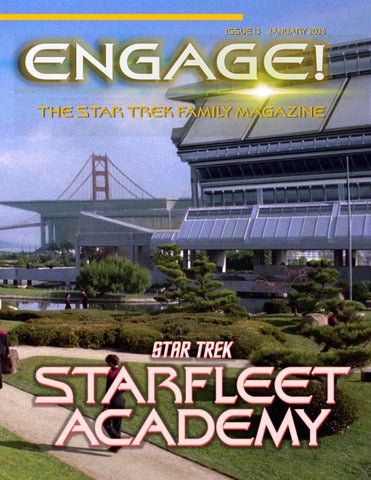
It is January 2026 the start of a new year. We also have the start of a brand new Star Trek series with the premiere of the long-awaited Star Trek: Starfleet Academy
By the time of this publishing, four episodes of Starfleet Academy will be out, and I am already overjoyed at the quality and content of this series. The concept behind this show has been long rumored, going as far back as the late 1980s.
For 60 we have watched as our favorite Starfleet heroes have gone where no one has gone before. But they didn’t become Starfleet heroes overnight there was always, in concept, the formative years of their careers, their training as cadets at the vaunted Academy.
Throughout the various shows we have gotten glimpses of life at the Academy Wesley Crusher and his flight studies (and mishaps) with Nova Squadron; Nog and his struggles to fit in with Red Squad; and Sisko and Odo at the Academy ferreting out changeling infiltrators. Yet aside from these brief glances, we’ve never been able to dive deep into what the cadets go through.
Now with the new series coming out, I am elated beyond belief that we are finally getting to see this. Resetting and rebuilding the Federation after The Burn, we will get to see Starfleet’s next generation of Starfleet heroes as they learn new skills and form new friendships. Engage!
Mark Sickle Founder & Host Star Trek Family

Have you always wanted to write about your love for Star Trek? We are always looking for volunteer writers to join our team! Send us an email at the ‘Contact Us’ link at left! ISSUE 13 — JANUARY 2026
We are truly interested in receiving feedback from our readers and fellow fans! Really love an article that appears in our magazine? Truly disagree with someone’s take on a topic? How are we doing? Do you have suggestions for features, articles, etc.? CONTACT US


** The Star Trek Family is a free, not


(Touch the Paramount Logo above to Sign up!)


L
ife at Starfleet Academy: Forging the Minds and Morals of Starfleet Starfleet Academy is more than a university; it is the philosophical and moral crucible of the United Federation of Planets. Located in San Francisco overlooking the Golden Gate Bridge, the Academy represents the Federation’s belief that exploration, diplomacy, science and ethics are inseparable pursuits.
Every Starfleet officer, whether destined to command a starship, conduct a first contact, or engineer miracles under pressure, passes through this institution and emerges fundamentally changed. Life at Starfleet Academy is demanding, inspiring, and often painful, designed to prepare cadets not merely for space travel, but for responsibility on a galactic scale.
Through rigorous academics, intense physical training, ethical trials and simulations designed to break even the most confident students, Starfleet Academy shapes officers who must make life-and-death decisions while representing the Federation’s highest ideals. The experiences of James T. Kirk, Jean-Luc Picard, Benjamin Sisko, and Kathryn Janeway illustrate how the Academy molds vastly different personalities into leaders, each carrying the lessons and scars of their time there throughout their careers.
Admission and the Weight of Expectation
Gaining admission to Starfleet Academy is itself an extraordinary achievement. Candidates are evaluated not only on intellectual aptitude, but also psychological resilience, ethical reasoning, adaptability and interpersonal skills. The Academy accepts humans and nonhumans alike, reflecting the Federation’s diversity, but the standards are universally unforgiving. Cadets arrive knowing they are among the best minds of their generation, and that many of their peers will not graduate.
From the moment cadets set foot on campus, the pressure is relentless. Failure is not treated as shameful, but it is also not cushioned. Starfleet believes that the galaxy will not grant second chances lightly, and neither will the Academy. This environment fosters

intense
but also fierce competition, pushing cadets to confront their limits early.
James T. Kirk entered the Academy already brimming with confidence and ambition. Known for his competitive nature, Kirk thrived under pressure; but also struggled with the Academy’s insistence on discipline and humility. His rivalry with fellow cadets and instructors shaped his early reputation as a rulebender, though one whose brilliance could not be denied.
Jean-Luc Picard, by contrast, arrived as a serious, introspective young man with a strong sense of duty but little patience for recklessness. Picard viewed
admission not as a victory, but as a responsibility, one that demanded restraint, excellence and respect for institutional authority.
Academic Life: Science, Strategy and the Unknown
Academics at Starfleet Academy are notoriously demanding. Cadets study astrophysics, warp theory, exobiology, Federation law, diplomacy, engineering and tactical strategy, often simultaneously. Classes emphasize not memorization, but application under uncertainty. Students are routinely placed in scenarios where data is incomplete, communications are compromised, or moral consid-


Instructors frequently remind cadets that real space is hostile, unpredictable and indifferent to intention. A correct answer in theory may still lead to disaster in practice. This philosophy is reflected in constant examinations, group problem-solving exercises and field simulations that blur the line between classroom and crisis.
Kathryn Janeway excelled academically, particularly in the sciences. As a cadet, she demonstrated an almost obsessive dedication to understanding theoretical concepts, believing that knowledge was the best defense against chaos. Her professors recognized her as a natural scholar, though some questioned whether her idealism would survive command-level responsibility.
Benjamin Sisko’s academic experience was more complicated. Though intellectually capable, he initially resisted the Academy’s emphasis on command ambition. More interested in engineering and problem-solving than prestige, Sisko often clashed with instructors who believed he was underestimating his own potential. His time at the Academy planted the seeds of leadership he would later accept reluctantly but fully.
Physical Training and Discipline
Life at Starfleet Academy is not confined to lecture halls. Physical condi-
signed to prepare cadets for hostile environments, low-gravity operations, combat situations and emergency survival. Obstacle courses, zero-gravity drills, hand -to-hand combat training, and endurance exercises are part of daily life.
Cadets are expected to push past exhaustion, fear and pain, not to glorify suffering, but to build trust in themselves and their teammates. Injuries are treated, but they are also lessons. Starfleet officers must function when injured, frightened or isolated, and the Academy ensures that cadets experience these conditions in controlled environments.
Discipline at Starfleet Academy is not enforced through fear or humiliation, but through consequence, accountability and reflection. The Academy does not exist to protect cadets from failure; it exists to ensure that those who graduate understand the weight of their actions before lives depend on them. Rules are strict, violations are documented, and discipline follows cadets long after graduation through permanent service records. Innovation is encouraged but never exempt from oversight.
One of the most famous examples of Academy discipline involves James T. Kirk and the Kobayashi Maru. When Kirk reprogrammed the no-win simulation to make it winnable, his actions were
ed to a formal disciplinary review for cheating and violating Academy regulations. Only after investigation did the Academy acknowledge his reasoning, issuing a commendation for original thinking while still maintaining a notation in his record. The lesson was clear: Starfleet values creativity, but no cadet is above the rules. Discipline precedes recognition, not the other way around. Jean-Luc Picard’s most formative disciplinary lesson occurred outside official training but carried lifelong consequences. As a cadet, Picard instigated a violent confrontation with Nausicaans during a bar fight, an act of arrogance and poor judgment that resulted in him being stabbed through the heart. The injury required an artificial heart to replace his own. While not a formal Academy punishment, Starfleet did not erase or soften the incident. Picard’s record reflected recklessness, and he was forced to confront the reality that command authority begins with self-control. Picard later acknowledged that this experience taught him restraint more effectively than any Academy lecture. Discipline is also enforced through psychological evaluation and mandatory reflection. Cadets who fail the Kobayashi Maru through conventional means Picard, Sisko and Janeway among them are required to undergo


The USS Athena as the backdrop for Starfleet Academy, allows the students access to learning environments both on and off Earth.


Instructors assess not only tactical decisions but emotional responses to failure, grief and helplessness. The Academy treats emotional instability or denial as serious deficiencies. Cadets are not punished for losing, but they are held accountable for how they process loss.
Benjamin Sisko experienced a subtler form of disciplinary enforcement. Though academically capable, he resisted command-track advancement, preferring engineering roles and technical problemsolving. Rather than allowing avoidance, Academy instructors repeatedly placed Sisko into leadership scenarios, effectively denying him the option to remain anonymous. This enforced responsibility served as corrective discipline, compelling Sisko to confront leadership not as ambition, but as obligation. The Academy’s message was unmistakable: refusing leadership can be as dangerous as abusing it.
Physical discipline at the Academy often takes the form of restricted advancement rather than punishment. Kirk, known for exceeding safety limits during training exercises, received multiple reprimands and was required to repeat simulations under tighter constraints. His instructors made clear that bravery without judgment disqualifies command authority. Advancement was
restraint, as well as courage. Ethical violations are treated with the greatest severity. Cadets who lie during investigations, cover up failures, or violate Federation principles face expulsion or permanent reassignment away from command tracks. The Academy’s stance is uncompromising: technical excellence cannot compensate for ethical failure. This philosophy is reflected in multiple Academy-era cases, reinforcing that Starfleet would rather lose a cadet than risk empowering an untrustworthy officer.
One such case involves a group of Starfleet cadets, including Wesley Crusher, who involved in a cover up of the truth in the episode ”The First Duty.” After a shuttle accident claims the life of a member of Nova Squad, a group of elite cadets, one of which was Wesley Crusher. Through the investigation it was discovered that the group conspired to cover up the truth and put blame on the crewmember that had perished. After Picard and the crew of the Enterprise realize what happened they convince Wesley to come clean. The leader of Nova Squad, Nick Locarno, came clean and took full responsibility and was expelled from Starfleet and the others were forced to be held back a year.
All disciplinary actions academic, physical, psychological, or ethical
record. These records influence initial postings, promotion eligibility and command recommendations. Kirk, Picard, Sisko and Janeway each carried Academy discipline into their careers, shaping how superiors evaluated their readiness for command.
At Starfleet Academy, discipline is not about control. It is about trust. Every reprimand, review and consequence serves a single purpose: ensuring that when an officer gives an order, that order is grounded in responsibility, selfawareness and respect for the lives placed in their care.
The Kobayashi Maru and Ethical Conditioning
No discussion of Starfleet Academy is complete without the Kobayashi Maru. The infamous no-win scenario is designed not to test tactical skill, but character. Cadets are placed in a simulated rescue mission where all available options result in failure, loss of life, or violation of Starfleet principles. The goal is not victory, but self-examination.
The test forces cadets to confront helplessness, loss and moral ambiguity, realities that define life in space. Instructors analyze not only the cadet’s decisions, but their emotional response afterward.
James T. Kirk famously repro-

grammed the simulation to make it winnable, an act that resulted in disciplinary review but also begrudging admiration. The Academy recognized that Kirk had not rejected the lesson, but redefined it: he refused to accept inevitability. This mindset would define his command style for decades.
Picard, Sisko and Janeway each faced versions of the Kobayashi Maru and emerged shaken but changed. Picard learned acceptance of limits; Sisko learned the burden of command loss; Janeway learned that principles often demand sacrifice. None of them forgot the experience.
Social Life, Rivalries and Camaraderie
Life at Starfleet Academy is defined as much by relationships as by rigor. Cadets live, study, and train together under extraordinary pressure, and in that environment, friendships form quickly and intensely. Shared exhaustion, failed simulations and small victories create bonds that often last for decades. Starfleet understands that officers who will one day face isolation in deep space must first learn how to live and work within a community.
The Academy campus is designed to encourage interaction beyond the classroom. Cadets gather in cafés and lounges overlooking San Francisco Bay, in holodeck recreation programs, and on
athletic fields where Parrises squares, fencing and hand-to-hand combat tournaments are fiercely contested. Music recitals, debate societies, cultural exchanges and informal study groups offer moments of relief from constant evaluation. These activities are not treated as distractions but as essential training in teamwork, stress management, and cross -cultural understanding, skills vital for officers who will represent the Federation to unknown worlds.
James T. Kirk thrived in this competitive social environment. He forged friendships through rivalry, constantly measuring himself against other high-
performing cadets in command simulations and physical trials. Late-night strategy debates and sparring matches became his proving ground. Kirk’s social circle sharpened his instincts and confidence, but it also reinforced his tendency to treat life as a contest to be won. Instructors frequently warned him that competition must never eclipse responsibility, a lesson he struggled with but gradually absorbed.
Sisko did have a very intense rivalry with a fellow cadet, a Vulcan named Solok. Solock believed that all humans were inferior and made no effort to hide it from everyone, so after a night


of drinking at a bar Sisko challenged Solok to a wrestling match in which Sisko lost and was injured. Solok would then enhance the rivalry by writing research papers that always included that match, making Sisko infrared.
Romantic relationships were not forbidden at the Academy, but they were quietly discouraged from interfering with duty. Cadets were expected to demonstrate emotional maturity, knowing that jealousy, heartbreak and divided loyalties could compromise judgment. Such experiences were treated not as scandals, but as lessons in balancing personal attachment with professional responsibility, an essential skill for future commanders.
At the same time, the Academy discouraged emotional dependency. Cadets were reminded that not everyone they trained with would graduate. Some would wash out. Others would die in service. This sobering reality hung over friendships, giving them urgency and depth. Bonds were precious precisely because they were fragile.
Social life was also where Federation ideals became lived experience
Humans trained alongside Vulcans, Andorians, Tellarites, Trill and countless other species. Misunderstandings were common, cultural clashes inevitable. Yet through shared meals, debates and
teamwork, cadets learned that unity was not about sameness, but about respect. The Academy itself became a living microcosm of the Federation.
Ultimately, the social world of Starfleet Academy taught cadets how to lead and follow, how to compete without cruelty, and how to care without losing focus. The friendships, rivalries and latenight conversations shaped officers as deeply as any exam or simulation. When graduates stepped onto their first starships, they carried not only knowledge and discipline, but the memory of those who stood beside them when the future was still uncertain.
Failure, Consequence and Growth
Failure at Starfleet Academy is not uncommon, and it is not hidden. Cadets are allowed to fail exams, simulations and even moral judgments, provided they learn from them. Some repeat years; others leave Starfleet entirely. The Academy views this not as waste, but as ethical responsibility. The galaxy is too dangerous for unprepared officers. Each of the four captains carried Academy failures into their command years. Kirk learned restraint, Picard learned humility, Sisko learned acceptance of destiny, and Janeway learned the weight of responsibility when cut off from support.


Starfleet Academy does not produce identical officers. It produces thinkers, leaders and survivors shaped by shared ideals and deeply personal trials. Its graduates leave with mastery of science and strategy, but more importantly with an internal compass forged by failure, discipline, camaraderie and sacrifice. The true legacy of the Academy is not what cadets learn, but who they become.
For James T. Kirk, the Academy forged a leader who refused to accept inevitability. From relentless competition with his peers to the discipline imposed after reprogramming the Kobayashi Maru, Kirk emerged believing that rules matter but that courage and imagination can redefine what is possible. His legacy is that of a captain who challenged fate itself, carrying the Academy’s lessons of accountability even as he pushed against its limits.
For Jean-Luc Picard, the Academy cultivated a philosopher-captain bound by ethics and restraint. The scars of youthful arrogance, the artificial heart that beat in place of his own, and the sobering failures of command simulations taught him that authority begins with self-mastery. Picard carried the Academy’s legacy as a moral compass, using its lessons to guide not only his
For Benjamin Sisko, the Academy revealed leadership as obligation rather than ambition. Forced into command roles he did not seek, shaped by teamwork and responsibility, Sisko learned that leadership is not about standing apart, but standing for others. The Academy’s imprint followed him to Deep Space Nine, where he forged community from division and accepted a destiny larger than himself.
For Kathryn Janeway, the Academy instilled unwavering commitment to principle and intellectual rigor. Through relentless study, ethical trials, and bonds formed in debate and collaboration, Janeway learned that knowledge must be tempered with compassion and resolve. Cut off from Starfleet in the Delta Quadrant, she became the living embodiment of the Academy’s legacy, proof that its values endure even when its support is gone.
Yet beyond these four captains, the Academy’s legacy lives in every officer who carries its lessons into the unknown. It lives in the discipline that checks impulse, in the friendships that echo across light years, and in the quiet moments when a commander chooses principle over expedience. Starfleet Academy shapes not just careers, but the
Life at Starfleet Academy is difficult because it must be. It tests the body, mind and soul, demanding that cadets become more than they were. Those who graduate carry their legacy forever, into the stars, into command, and into history.

MICHAEL MARTIN: I’ve been a Star Trek fan since I was a kid. I grew up on The Next Generation, fell in love with Deep Space Nine and Voyager. It was one of the few shows that my father and I would watch together and still share the love for the franchise today. The show’s ideals, hope, unity and moral courage have always meant something real to me. It gives me great pleasure to see where humanity can go and what can be achieved.


Starfleet Academy stands as one of the most iconic institutions of the United Federation of Planets, a beacon of hope, unity and progress in a galaxy defined by diversity and challenge. For centuries, it has been the crucible where the ideals of the Federation are forged into reality, transforming ambitious cadets into the officers who will chart the unknown, protect the vulnerable, and uphold the values that bind countless worlds together. But what is the true purpose of Starfleet Academy, and what promise does it hold not only for its students, but for the galaxy itself?
A Legacy Born of Necessity
The history of Starfleet Academy is inseparable from the history of the Federation. Founded in 2161, the Academy’s establishment followed the creation of Starfleet itself, which emerged as the exploratory and defensive arm of the newborn Federation. In those early days of interstellar diplomacy and discovery, the need for a unified training program one that could prepare representatives from vastly different worlds for the rigors of service became abundantly clear.
Earth’s own military and scientific institutions provided a model, but the Academy was quickly envisioned as something more than a mere officer school. It would be a place where Andorians, Vulcans, Humans, Tellarites and eventually hundreds of other species could learn from one another, forging bonds that would transcend the old boundaries of home world and culture. Over

time, the Academy became not just a training center, but a microcosm of the Federation itself a place where the future was not only taught but lived.
The Purpose: More Than Just Training
At its core, Starfleet Academy’s purpose is to prepare cadets for the challenges of service in Starfleet. This means rigorous academic study science, engineering, diplomacy, medicine, tactics as well as practical training in everything from zero-gravity maneuvers to first contact protocols. But the Academy’s true mission reaches deeper than curriculum.
The Academy exists to cultivate the values that define Starfleet: curiosity, courage, compassion and integrity. These are not just abstract ideals, but essential qualities for those who will face the unknown. The Academy seeks to instill in its cadets a sense of duty not just to their own people, but to the greater good. As

once said, “Our mission is not to conquer, but to understand.” This ethos is woven through every aspect of Academy life. Cadets are challenged to collaborate across cultural lines, to question their assumptions, and to confront ethical dilemmas that have no easy answers. The Kobayashi Maru simulation, perhaps the most famous (and feared) of all Academy tests, is not about winning or losing, but about revealing character in the face of no-win scenarios.
Diversity as a Strength
Perhaps nowhere in the galaxy is diversity more celebrated, and more vital, than at Starfleet Academy. The Federation includes members from hundreds of worlds, each bringing unique perspectives, abilities, and traditions. At the Academy, these differences are not something to be overcome, but something to be cherished and integrated. It is not uncommon for a

emotional expression, or for a Denobulan’s medical expertise to complement the tactical instincts of a Tellarite. Instructors come from across the Federation, and the curriculum is constantly evolving to reflect new scientific discoveries, diplomatic developments and cultural insights.
This commitment to diversity is not without its challenges. Cultural misunderstandings and personal biases can surface, especially among younger cadets unaccustomed to such a cosmopolitan environment. But the Academy regards these conflicts as opportunities for growth. Mediation, dialogue and mutual understanding are emphasized, and many cadets emerge from their time at the Academy with lifelong friendships and a broadened sense of identity.
The Promise to the Federation
The promise of Starfleet
of countless backgrounds can come together in pursuit of a common good. Every graduating class is a testament to this hope, taking their places aboard starships, in research outposts, and at diplomatic tables across the galaxy.
Academy graduates have been at the forefront of nearly every major event in Federation history. They have made first contact with new civilizations, brokered peace between warring worlds, and even faced down existential threats to all life. The Academy’s commitment to science and exploration has led to breakthroughs that have benefited countless species, from advances in warp technology to new medical treatments.
But perhaps the Academy’s greatest promise is its role as a moral compass. In an era when the Federation has faced internal divisions, external threats, and the
of ethical reasoning and critical thought. Its alumni are expected not only to follow orders, but to question them when necessary, to stand up for what is right even when it is difficult.
Challenges and Controversies
No institution is perfect, and Starfleet Academy has faced its share of criticism and controversy. Some have argued that its focus on Federation ideals can sometimes gloss over the realities of interstellar politics or the particular needs of member worlds. Others have raised concerns about the stress and rigor of Academy life, which can take a toll on cadets’ mental health. The Academy has also faced difficult questions about inclusivity and access. For many non-humanoid or telepathic species, the standard curriculum or environment can present obstacles. In recent decades, the Acad-

Squadron accident, in which a group of elite cadets covered up a fatal error, have underscored the importance of transparency and accountability. The Academy’s response reforms, counseling and a renewed emphasis on ethics demonstrates its ongoing commitment to learning from its mistakes and evolving with the times.
Innovation and Adaptation
Starfleet Academy is not a static institution. Its curriculum and methods have evolved to meet the changing needs of the galaxy. From the earliest days of sublight exploration to the current era of transwarp travel and quantum communications, the Academy has stayed at the forefront of technological and scientific progress.
Virtual reality simulations,
the Klingon Defense Force and the Romulan Free State, have broadened cadets’ perspectives and fostered interstellar cooperation. The Academy has also embraced new challenges, such as training officers for deep-space assignments lasting years or even decades. Specialized programs in xenobiology, temporal mechanics and emergency response prepare cadets for the unpredictable hazards of space.
The Cadet Experience
Life at Starfleet Academy is demanding, exhilarating, and transformative. Cadets are expected to maintain high academic standards while participating in physical training, leadership exercises and extracurricular activities ranging from music to martial arts. The campus itself
Academy with a sense of awe, knowing they are walking the same halls as legends like James T. Kirk, Spock, Benjamin Sisko and Kathryn Janeway. They form study groups, compete in friendly rivalries, and push one another to excel. The bonds formed during these years often last a lifetime, creating a network of support that extends far beyond graduation. Mentorship is a key component of the Academy experience. Upperclassmen and instructors guide younger cadets, sharing hard-won wisdom and providing a model of the values Starfleet seeks to uphold. For many, the Academy is not just a school, but a second family.
Graduation and the Journey Beyond
Graduation from Starfleet

Academy is both an ending and a beginning. Cadets become ensigns, entrusted with the responsibilities and privileges of Starfleet service. For some, this means immediate deployment to starships or starbases; for others, it is the start of advanced training or specialized research.
The transition can be daunting. The universe is unpredictable, and the challenges faced by Starfleet officers are as varied as the stars themselves. Yet the Academy’s promise endures: that its graduates are prepared not just for the tasks at hand, but for the ethical and emotional complexities that come with wielding power in the name of peace.
A Symbol for the Ages
Beyond its practical role, Starfleet Academy has become a symbol a reminder of what the Federation aspires to be. Its crest, emblazoned with the words “Ex
Astris, Scientia” (“From the stars, knowledge”), adorns not only uniforms and diplomas, but the hopes of billions.
In times of crisis, the Academy has opened its doors to refugees, served as a center for scientific collaboration, and provided leadership in the face of uncertainty. Its alumni have risen to the highest ranks, become ambassadors and heroes, and sometimes sacrificed all for the greater good.
Conclusion: The Ongoing Mission
As the Federation looks toward its next century, the purpose and promise of Starfleet Academy are more vital than ever. In a galaxy where new dangers lurk on every frontier, and where the bonds of alliance must be continually renewed, the Academy stands as a bulwark of wisdom, unity and hope.
To walk the grounds of
Starfleet Academy is to step into the future a future where knowledge, courage and compassion are the greatest weapons of all. Its mission is never truly complete, for the work of building a better galaxy is a task with no end. Yet with every class of cadets, and every ship that launches into the unknown, the Academy’s legacy grows. It is a legacy not just of learning, but of becoming. For in the halls of Starfleet Academy, the stars themselves are not the limit they are only the beginning.

MARK SICKLE: Mark Sickle is an Egyptologist (archaeologist) by day, diehard Trekkie all the time. Founder of the Star Trek Family. Lives in West Virginia with his beautiful wife Lisa, puppies Odo, Kira, Wesley and Jadzia; and kitties Nala, Cymba, Cena, Elleadora and Aeolia.


ORDER YOUR COPY TODAY!


With the new Starfleet Academy series on the horizon, it feels natural to look back at two characters whose formative years at the Academy still echo across the franchise. Wesley Crusher and Nog entered Starfleet from opposite ends of Federation experience one a prodigy raised on a starship bridge, the other a Ferengi teenager fighting to break free of cultural limits yet their journeys reveal how universal growing up can be.


The Gifted Kid And The Weight Of Expectation
Wesley Crusher’s trajectory once looked inevitable. By fifteen he was already solving engineering puzzles on the Enterprise-D and earning a field promotion to acting ensign. He absorbed warp theory the way most teenagers memorized lyrics, and adults routinely expected him to perform at their level. However, Wesley’s early life lacked something crucial: peers. Living aboard the flagship surrounded him with scientists, officers, and specialists, training him to converse fluently with adults while leaving him unsure around other kids his age. That imbalance didn’t just shape him socially; it shaped how he understood himself. He was used to excelling, used to being the standout, used to carrying expectations that few 15-year-olds ever faced. One overlooked moment in Wesley’s development came in “Pen Pals,” when Picard let him lead a planetary survey team. It gave him a taste of command a real mission, with real decisions long before he ever saw the inside
of a cadet dormitory. Wesley learned quickly, succeeded quickly, and internalized the message that he could rise to any challenge. It was a gift, but it also set the stage for the shock he felt later, when the Academy expected him not to lead but to blend in.
Once he arrived at the Academy, Wesley was no longer a prodigy with a station on a starship’s bridge. He was one brilliant cadet in a sea of brilliant cadets a classic overachiever suddenly surrounded by others who had also been the smartest in their schools, ships or colonies. For the first time, he felt the tug of selfdoubt that comes when excellence is no longer exceptional.

Layered under all of this was the Traveler’s quiet influence. From the moment they met, the Traveler suggested that Wesley’s gifts were something beyond academic talent intuitive, perceptual, almost metaphysical. Wesley
never fully understood what that meant, but the knowledge followed him. It nudged him toward a life larger than Starfleet even as he tried to follow the path everyone assumed he would take. His Academy journey wasn’t smooth. He took the entrance exam twice — the first attempt ending in heartbreak during “Coming of Age.” He earned his way in the second time, after months of proving himself as an acting ensign. Once enrolled, he struggled not with coursework but with the pressures that came with living up to an image others had created for him. “The First Duty” stripped away the illusion that brilliance protected him from poor choices or moral pressure. By the time the Traveler returned, Wesley wasn’t fleeing Starfleet. He was answering the call he had sensed for years. His departure didn’t undo his Academy story; it completed it. He finally chose a life on his own terms.
The Underdog Who Rewrote The Rules
Nog began miles and light years — from where Wesley started. He grew up hustling on Deep Space Nine, navigating Ferengi expectations that never

quite fit. Wanting more for himself, he asked Benjamin Sisko for the chance to join Starfleet, and that single moment reset his entire arc.
Before any Academy ambitions took shape, Nog had Jake Sisko — an anchor, a foil and a friend who gave him space to imagine a different version of himself. Their bond steadied Nog long before he stepped into a cadet uniform.
Nog’s journey was built not on ease but on effort. He endured remedial tutoring with Chief O’Brien. He fought through cultural misunderstandings that Starfleet coursework never fully prepared him for. Every victory

was earned, not granted. By the time he served aboard the USS Valiant, Nog was already an ensign on field rotation. The Red Squad cadets who commandeered the ship represented everything Nog was not: elite, insular and convinced their status conferred automatic authority. Nog respected their skills but sensed the danger in their unchecked ambition. When their commanding cadet pushed for an impossible tactical triumph, Nog’s insistence on survival over spectacle probably saved lives.
The Dominion War forced Nog’s Academy years into a crucible. His injury at AR-558 and his emotional recovery in Vic Fontaine’s holosuite remain some of the franchise’s most compassionate explorations of trauma. Nog rebuilt his future the same way he built his Academy career steadily, determinedly, without letting go.
TWO CADETS, ONE UNIVERSAL
STORY
Wesley entered Starfleet with every privilege; Nog entered fighting the weight of cultural expectation. Yet both felt pressures that threatened to smother them. Wesley was expected to succeed. Nog was expected to fail. Both arrived at moments when the Academy stopped being about grades and became a mirror instead. Each discovered that the most meaningful part of their journey wasn’t the uniform it was choosing who they wanted to be while wearing it.
Looking Back To Look Forward
As the new Starfleet Academy series begins its run, the stories of Wesley Crusher and Nog continue to resonate. Their paths were uneven, flawed, earnest and deeply human. They remind us that becoming an adult is never a straight line. It’s stumbling and shining in equal measure. It’s choosing again and again who you want to become.
Starfleet Academy may be a setting of the future, but its most enduring lessons including those from Wesley and Nog — are timeless.

MELISSA A. BARTELL: Melissa
A. Bartell is a writer, podcaster, voice actor, improviser and kayak junkie currently living on Florida's Nature Coast. She has one husband, two dogs and only one kayak (so far). Find her at MissMeliss.com or on social media:
Bluesky | Facebook | Instagram | Mastodon


(Click on the graphic above to buy yours)


“I remember my time at the Academy…”
We have heard this throughout the franchise about how Starfleet Academy influenced the lives and careers of those serving in Starfleet. Attending Starfleet Academy was the beginning of the adventure of their lives. This was true of some of the most influential captains ever in Starfleet’s history: Capt. James T. Kirk, Capt. Jean-Luc Picard, Capt. Kathryn Janeway and Capt. Benjamin Sisko.


Their gateway into Starfleet was the heralded Starfleet Academy. It was no easy entry, regardless of whether you came from a Starfleet family legacy, from the historic section of New Orleans, or a vineyard in France. The common trait among these captains was the determination to make the galaxy a better place and wanting to contribute to Starfleet and the Federation. This began with the goal to make it into Starfleet Academy. Once there, they developed friendships, learned about themselves, and solidified their purpose for their roles in Starfleet. Reading their autobiographies, each looked upon their time at Starfleet Academy with pride. They were proud of what they accomplished and how it pushed them to grow, not just as officers but as people.
Starfleet Family Legacy
Each captain was introduced to Starfleet in their childhood by one of their parents or family members. For example, Capt. Kirk came from a heavy Star-
fleet background. His grandfather was part of the first graduating class of Starfleet Academy. His grandmother was part of the third graduating class of Starfleet Academy. Add that Capt. Kirk’s parents both served at one point in Starfleet; it was natural for him to follow that path with pride after hearing about their time in Starfleet. Yet, his father left a brilliant career in order to take care of his family. Seeing his father’s sacrifice, Capt. Kirk’s goal was to enter Starfleet and carry on the career his father didn’t get to finish.
As for Capt. Janeway, her grandparents served in Starfleet, and her father served in Starfleet during her childhood. Most notably, her father was a vice admiral and knew the intricacies of Starfleet. Capt. Janeway admired her father and wanted to follow in his footsteps. Since he was a vice admiral, when he was home, there were times when he had other Starfleet officers join him. There, Capt. Janeway peppered them with questions about Starfleet overall and how to be prepared for Starfleet Academy.
Both captains Kirk and Janeway set their sights on becoming a captain of a starship. Anticipating what Starfleet Academy required, they each began their own personal training. Kirk decided to focus on academics and martial arts. Janeway wanted to forge her own path by increasing her level of academics with the goal of graduating a year early from high school to take the Starfleet entrance exam. Both families encouraged their efforts, though Janeway had to make a case as to why she had to graduate early.

Her goal after graduating high school was to start a two-year program of study to prepare for entrance into the Academy. Janeway’s singlemindedness paid off, and she entered Starfleet Academy at 17 years old. Even though they both came from highly respected Starfleet families, their backgrounds did not matter when it came to the entrance exam into Starfleet Academy. Merit was valued over nepotism. Janeway, in particular, wanted to get into Starfleet Academy because of all the hard work she did, not because her father was a vice admiral.
A Luddite Beginning
Not everyone was introduced to the full spectrum of technology in the 24th century as children. Both Capt. Jean-Luc Picard and Capt. Benjamin Sisko came from backgrounds where technology was discouraged. These families valued the original culture of their forefathers.

In Picard’s family, his father wanted to grow his vineyard the same way it had been cultivated for centuries. This also meant keeping a simple lifestyle. Sisko’s father and grandparents wanted to preserve New Orleans culture the way it had been before the wars. Both captains, in their childhoods, ate real food. No replicated food was allowed. For example, the Siskos and their family restaurant’s dedication to making real food made them stand out in the culinary field and be respected in their community for keeping the traditions alive.
However, for all the low tech in their lives, both were still introduced to the possibilities of Starfleet, interestingly, through making model versions of starships. Picard wanted to make his mark in the universe and saw his way out of the vineyard was through Starfleet. As he built a model of the Enterprise NX-01, he initially wanted to be the helmsman. However, his mother let him know the real power was in the person who gave the command: the captain. Picard took this suggestion and began to envision a
future as a captain in Starfleet. Sisko was injured as a child and kept in stasis while his back healed. The only thing he could do was make model ships and read the books his stepmother brought to him. As he made the model ships, he was intrigued by how ships were constructed. It was then that he wanted to be an engineer in Starfleet so he could design and build starships.
Starfleet’s reach was far and wide with its sterling reputation for helping the Federation and exploring the galaxy. These Starfleet officers made a significant impact on the general populace, even those with limited technology.
Entry Into Starfleet Academy
Each captain focused his or her preparation on their academics to get into Starfleet Academy. The breadth of subjects taught at Starfleet Academy was vast. They also knew their chances of getting into the academy were slim, as 2 percent of those who applied were admitted. Both Capt. Kirk and Capt. Picard, in addition to their academics, added physical training to their academic preparations.
After all the preparation, it boiled down to three gruelling days of testing. Among the tests were galactic history, warp physics and astrobiology, as well as the tactical test and the psych test. Not all of the captains passed the first time. Captain Picard failed the first time he took the entrance exam in the psych test. It was a lesson in humility as he was sure he would make it into the Academy on his first try.
It took eight weeks to get notification of whether you made it into the Academy. For Capt. Janeway, it was a tense time; she was a little unsure of whether all the years of planning to get into the Academy had helped. Yet, for her, she not only passed, but she passed with distinction. After admittance, there was induction day. During Kirk’s time, the first day at the Academy began with Plebe Summer. It was a time when first-year cadets were put through a gruelling hazing ritual before the academic year began. While the focus on Starfleet was exploration, in Kirk’s time, they were also working to create soldiers at Starfleet Academy. The hazing was by upper classmates with the goal to weed out those who couldn’t handle the physical and psychological stress of being in Starfleet. Many dropped out. By the time Picard, Janeway and Sisko made it to the Academy, Plebe Summer was abolished. Starfleet refocused on exploration and not creating soldiers.


Friendships and Relationships
Each captain gained friendships while in Starfleet Academy. There was a bond in the cohort they joined when they began at the Academy. Starting on Day 1 with their roommate, it set the tone for the rest of their time at Starfleet Academy.
Captain Kirk and Capt. Janeway got along with their roommates on Day 1. Captain Picard, shy with his limited tech knowledge, held his new roommate at bay. Thankfully, his roommate didn’t give up on having Picard as a friend, even showing up when Picard ran the annual Academy Marathon C tially didn’t get along with his roommate. However, when Sisko made real jambalaya, his roommate became more agreeable. Each of these relationships lasted long after they graduated from the Academy.
What was inevitable at the Academy was also creating romantic bonds. Each captain had a special relationship while attend-
ing the Academy. Yet, with each captain came a crossroads in the relationship where it was choosing their Starfleet career or their partner.
In some instances, like Kirk, Janeway and Picard, this ultimatum came from a space of insecurity on the partner’s side. Kirk was unwilling to change course from his goal of making captain as he was truly determined to make up for the deficit of his father’s derailed career. Choosing a relationship might mean losing focus.
For Kirk, Janeway and Picard, they had envisioned themselves in Starfleet while studying hard for the Academy. Hope and ambition would not be deferred for anyone. Sisko’s relationship was different in that Sisko’s partner saw the potential of his career not being in engineering, but in command. Since he couldn’t see it, she didn’t want him to hold her back and broke off the relationship. Choosing their career path over the relationship was never
made lightly. They had their moment of loss, but at the end of the day they were on their path of being Starfleet officers.
Mentorship
Being an academic institution, it’s natural to gain mentors. Some mentors are found by accident. Captain Picard’s mentor was Prof. Galen in archeology. Picard didn’t intend to be in an archeology course, but grew to enjoy the subject. Galen saw Picard’s talent in archeology and offered him a once-in-a-lifetime opportunity to go on an archeological dig on Dinasia. Picard wrestled with the idea. He now loved archeology, but he wanted to be captain of a Starfleet starship. Going on the archeology dig meant giving up his Starfleet career.
Then there’s Boothby, the Academy’s head gardener, who was an unintentional mentor to many cadets. Picard’s defining interaction with Boothby came after the cadet carved initials into a


tree. His punishment was to work with Boothby for two months. While Picard was conflicted about the choice Prof. Galen gave him, he was still working with Boothby. It’s unknown how Boothby knew about Picard’s decision, but he encouraged him to stay with his career in Starfleet. Boothby saw his potential even if Picard didn’t. Picard needed that extra push to have the resolve to say, “No.” While Prof. Galen was disappointed, Picard thanked Boothby years later for that bit of advice and encouragement.
Some mentorship is intentional. Sisko’s mentor was through the engineering program on Starbase 137. Master Chief John Diviticus West. Sometimes known as The Rock, his program was on the mostly oceanic planet of Moser IV, where West trained cadets about engineering using the ancient tools of that planet. It wasn’t an easy assignment, and there were challenges at every step. However, it gave Sisko the
chance to demonstrate not only engineering skills but command, as well.
The command track at the academy assigned mentors, and Capt. Janeway was assigned to Adm. Parvati Pandey, who gave Ethics of Command sessions. This allowed Janeway to get a firm foundation in ethics that she was able to lean into when she was lost in the Delta Quadrant on Voyager.
The Takeaway
After reading about these captains and their adventures in Starfleet Academy, it made me appreciate the captains they became. From rigorous academics to the mentors and friendships, they came away with a strong sense of self. They knew who they were, knew what they were capable of accomplishing, and how they would contribute to their future assignments.
Their training forced them to think outside the box. They
were being prepared for the unknown and how to make an unworkable situation winnable. Not just with cleverness, but with hard work.
The Academy also taught them to value relationships as much as they did academics. The friendships formed in those days would be seen time and again as they leaned on each other for support. That also helped them learn how to make connections with others that would help in a wide variety of situations. These captains have every reason to look back on their Academy days with pride.

FELICIA WATKINS KIMBLE: Felicia
Kimble is a wife and mom of three, and works for an environmental nonprofit in her Ready Room at home. An avid Trek fan, she’s a crew member of the USS Monocacy, part of Star Trek: The Fleet


Star Trek has long inspired audiences with its vision of a future where humanity ventures boldly into the cosmos. But beyond the iconic phrase “to boldly go where no one has gone before,” the franchise wrestles deeply with the moral and ethical complexities of exploration. The ethics of exploration, as imagined by Star Trek, are not just about technological prowess or scientific curiosity, but about the responsibilities and dilemmas that come with encountering the unknown. In a universe teeming with possibility and peril what guides the moral compass of explorers?
This question is far from academic. As space agencies and private enterprises make real strides toward Mars and beyond, the issues that Star Trek has grappled with for decades become increasingly relevant to our own world. By examining the ethical quandaries faced by Star Trek’s explorers, we can illuminate the path forward for humanity’s reallife journey into the stars. The series’ compelling stories serve as both inspiration and warning, balancing optimism with a frank acknowledgment of the moral weight carried by those who chart new territories.
The Prime Directive: NonInterference as a Guiding Principle
Central to Star Trek’s ethical framework is the Prime Directive, a law that prohibits Starfleet personnel from interfering with the natural development of alien civilizations. This principle is designed to prevent cultural imperialism and to respect the

autonomy of other societies, echoing real-world debates about colonialism and intervention. The Prime Directive isn’t just a rule; it’s a recurring source of tension. Captains like Kirk, Picard and Janeway often struggle with its implications: Should they allow a civilization to suffer or even perish if interfering could save lives? Is it ethical to withhold technology, medicine, or knowledge if it might alter the natural course of a society?
These stories force both characters and viewers to confront the weight of unintended consequences. In The Next Generation episode “Who Watches the Watchers,” the crew’s inadvertent exposure to a pre-warp civilization leads to the formation of a cargo cult around Captain Picard. The episode highlights how even wellintentioned actions can have profound, unpredictable effects on less developed societies. Star Trek’s exploration is thus tem-
pered by humility — a recognition that explorers are not omniscient, and their presence can be disruptive.
Cultural Relativism and Universal Rights
The variety of civilizations encountered by Star Trek’s crews is a narrative device that lets the series interrogate the boundaries between respecting cultural diversity and defending fundamental rights. With each new world or species, the crew must ask: when is it appropriate to intervene, and when does intervention become cultural arrogance?
Exploring the universe means encountering not just new life, but new ways of life. Star Trek uses its alien species Klingons, Vulcans, Bajorans and many more to probe questions of cultural relativism and universal rights. Should the Federation respect every custom, no matter how abhorrent it may seem, or does it

have an obligation to stand for certain universal values?
Episodes like “Half a Life” confront this dilemma directly. In this story, the Enterprise visits a society where elderly citizens are expected to commit ritual suicide at age 60. The crew is torn between respecting an alien tradition and advocating for individual autonomy and dignity. The episode offers no easy answers, illustrating the complexity of negotiating between respect for difference and the assertion of universal human (or sentient) rights.

The Burden and Privilege of Knowledge
With exploration comes knowledge and power. Star Trek is acutely aware that the information and technology possessed by Starfleet can be both a blessing and a curse. The series often asks: Who gets to decide when and how to share knowledge? What are the risks of unleashing technologies that a society is not ready to handle?
In “Bread and Circuses,” the crew encounters a planet resembling Ancient Rome but with 20th-century technology. The episode serves as a cautionary tale about the dangers of introducing advanced technology into societies not prepared for it. Star Trek’s explorers must continually weigh curiosity and compassion against the dangers of cultural contamination and dependency.
Exploration as an Act of Empathy and Growth
Beneath the dilemmas and directives, Star Trek champions exploration as an act of empathy and self-discovery. The series frames the voyage into unknown worlds as a mirror for humanity’s own struggles with prejudice, fear and hope. Encounters with the unfamiliar challenge the crew’s assumptions and prejudices, pushing them and the audience toward greater understanding. Episodes like “Darmok” showcase this beautifully: Captain Picard must learn to communicate with an alien captain whose cul-

ture speaks entirely in allegory. The episode is a parable about the patience, creativity and humility required to bridge divides, and the rewards of persisting in the face of mutual incomprehension.
Conclusion: Charting an Ethical Course
Star Trek’s vision of exploration is not one of conquest or exploitation, but of responsibility, restraint, and respect. The show’s moral compass is constantly test-
ed by the unknown, but it always points toward a future where curiosity is balanced with caution, and where the pursuit of knowledge is guided by empathy. In a universe as vast and varied as Star Trek’s, the greatest challenge and the greatest adventure — is not discovering new worlds, but learning how to live ethically within them. As humanity contemplates its own future among the stars, Star Trek’s lessons remain urgent and relevant: To explore is to en-
counter the other, and to do so morally is the boldest journey of all.

MARK SICKLE: Mark Sickle is an Egyptologist (archaeologist) by day, diehard Trekkie all the time. Founder of the Star Trek Family. Lives in West Virginia with his beautiful wife Lisa, puppies Odo, Kira, Wesley and Jadzia; and kitties Nala, Cymba, Cena, Elleadora and Aeolia.


F
ew concepts in science fiction are as iconic, debated or ethically complex as Starfleet’s Prime Directive. Established as Starfleet General Order 1, the Prime Directive prohibits interference with the natural development of less-technologically advanced civilizations, particularly pre-warp societies. Over nearly 60 years of Star Trek storytelling, it has served as a narrative crucible through which captains have been tested, sometimes elevated as paragons of ethical restraint and other times revealed as fallible beings forced to choose between policy and conscience.
What is the history of the Prime Directive and how did the four most important captains James T. Kirk, Jean-Luc Picard, Benjamin Sisko, and Kathryn Janeway wrestle with the consequences of both following and breaking Starfleet’s highest law.
THE BIRTH AND PURPOSE OF THE PRIME DIRECTIVE
The Prime Directive emerged from Starfleet’s early experiences with exploration, diplomacy and first contact. Even in Star Trek’s original series, it was clear that despite good intentions, “advanced” societies, like the Federation, could accidentally (or intentionally) alter or destroy lessdeveloped cultures simply by interacting with them. The Directive was created to prevent cultural contamination, ensure natural societal and technological evolution, avoid repeating past mistakes, and establish a moral philosophy for Starfleet.
Any pre-warp civilization needs to progress at their own
pace. Starfleet should not give advanced technology to planets that are not ready to use, because it could cause wars, and several possible disasters to a society that does not understand how the new technology works. Also, by doing so to a less advanced culture it could also result in a cultural shift in a planet’s belief system
From the beginning, the rule was absolute, at least on paper. In practice, it was anything but simple. As each captain discovered, real situations forced agonizing choices where no outcome was clean or morally perfect. The Prime Directive is less a rulebook than a test of character.

CAPTAIN JAMES T. KIRK: THE REBEL WHO KNEW THE COST OF INTERFERENCE
James T. Kirk is often caricatured as the captain who broke the Prime Directive whenever it got in his way. While he did violate it more openly than later captains, his decisions were rarely reckless. Kirk lived at the frontier of Starfleet’s expansion, and the Prime Directive itself was still evolving. His era involved interpreting a still-new ethical concept in situations where lives were often immediately at stake.

When Kirk Broke the Prime Directive “The Apple” (TOS)
The Federation classifies the planet’s inhabitants as primitive, yet Kirk destroys their god-like machine “Vaal,” freeing the people from technological stagnation but irreversibly altering their culture. Kirk justifies his actions by arguing that Vaal keeps them in perpetual slavery but the cost is undeniable cultural disruption.
“A
Taste of
Armageddon” (TOS) Two planets wage war through simulated computers. Citizens “selected” as casualties report to disintegration chambers. Kirk interferes by destroying the war computers, forcing societies to negotiate real peace instead of ritual slaughter. Kirk defends this as saving lives, but it blatantly violates non-interference, forcing cultural change with no guarantee of success.
When Kirk
Upheld the
Prime Directive at Great Personal Cost “The Return of the Archons” (TOS)
Kirk initially resists interfering with the society ruled by Landru. Even when the crew is threatened and the planet seems under authoritarian control, he hesitates and attempts diplomacy. Only after gathering evidence that society’s oppression is the result

of an artificial system gone rogue, and that the planet will eventually self-destruct, does Kirk justify intervention. While he ultimately acts, his restraint demonstrates the moral weight he places on the Directive, even in life-threatening circumstances.

CAPTAIN JEAN-LUC PICARD: THE MORAL PHILOSOPHER OF THE PRIME DIRECTIVE
If Kirk tested the Prime Directive through bold interpretation, Jean-Luc Picard became its greatest defender. Picard sees the Directive not as a rule but as a moral compass, a recognition that even benevolent interference carries unpredictable consequences. His commitment to these principles is nearly absolute, even when it causes pain, loss or moral injury.
When Picard Broke the Prime Directive
Picard violated the rule far less often than Kirk, but when he did, it was usually unavoidable.
“Who Watches the Watchers?” (TNG)
A hidden Federation outpost observing a Bronze Age civilization is accidentally exposed, causing the Mintakans to believe Picard is a god. To fix the contamination, Picard takes the unprecedented step of personally revealing himself and explaining Federation non -interference. Although the goal is to restore natural cultural development, the act still violates the Directive the damage is already done.
“Justice” (TNG)
The Enterprise visits the planet Rubicon III home to a pre warp civilization known as the Edo whose culture is one of pleasure, peace and love. However, there are some taboos with the Edo which bring the death penalty if violated. Wesley Crusher unknowingly violates one of their taboos by accidentally damaging a holy building. After much deliberation and thought, Picard decides to rescue Wesley. This interference in Edo laws was a violation of the Prime Directive. Picard felt that
their laws were unjust however and did not want to sacrifice Wesley upon the altar of the Prime Directive.

When Picard Upheld the Prime
Directive at Great Emotional Cost “Homeward” (TNG)
Picard faces a crisis: an entire pre-warp culture is about to perish due to atmospheric destruction. Worf’s brother, Nikolai Rozhenko, wants to save them, but Picard refuses, insisting that natural disasters, even catastrophic ones, must be allowed to run their course. His refusal causes the needless deaths of nearly the entire population. This may be Picard’s most painful adherence to the Directive, as it forces him to accept the extinction of an entire race to preserve ethical consistency. It is one of the starkest portrayals of the Prime Directive as a morally punishing law rather than a heroic principle.

CAPTAIN BENJAMIN SISKO: THE
Benjamin Sisko is a different kind of captain, one shaped by diplomacy, war, and faith. As commander of Deep Space Nine, he stood at the crossroads between the Federation, the Bajorans and the Dominion. His relationship with the Prime Directive is defined

by pragmatism. He respects the law, but he also understands its political and strategic limits. When the Directive conflicts with the survival of the Federation or the stability of Bajor, Sisko bends before he breaks.
When Sisko Broke the Prime Directive — “The Circle” Trilogy (DS9)
When Bajor faces a coup, Sisko interferes in internal political turmoil, technically a violation of non-interference. He covertly helps expose the Cardassian involvement behind the coup leaders. While he does so to protect Bajor and maintain Federation presence, he still interferes in a sovereign world’s internal affairs.

“Accession” (DS9
)
A Bajoran poet from the past returns, demanding the reinstatement of an ancient caste system. As the Emissary, Sisko technically has influence he shouldn’t use, but he does interfere by interpreting prophetic visions to prevent Bajor from reintroducing the caste order. He steps beyond Federation protocol, driven by his role in Bajoran society.
When
Sisko Upheld the Prime Directive Despite Pressure “The Quickening” (DS9)
Dr. Bashir desperately wants to cure a population afflicted by a Dominion-engineered plague. Sisko supports humanitarian assistance but forbids interference that would alter the planet’s development beyond medical aid freely accepted by the locals. Even as Bashir fails repeatedly and witnesses horrific suffering, Sisko holds to non-interference boundaries, refusing to let Starfleet impose solutions or technology society cannot sustain This adherence is emotionally grueling for everyone involved.
CAPTAIN KATHRYN JANEWAY: THE GUARDIAN OF PRINCIPLE IN ISOLATION
Of all Starfleet captains, Kathryn Janeway faces the most extreme circumstances. Stranded in the Delta Quadrant far from Federation support, she must uphold Federation values with no oversight, no reinforcements, and no guarantee her decisions will ever be reviewed. The Prime Directive becomes both her anchor and her burden.

When Janeway Broke the Prime Directive “Caretaker” (VOY)
In the very first episode, Janeway destroys the Caretaker’s array to prevent the Kazon from misusing its technology. This ensures the survival of an undeveloped civilization but leaves Voyager stranded 70,000 light-years from home. This violation of noninterference, introducing technological scarcity into Kazon territory, shapes the entire series.

“Prime Factors” (VOY)
The Sikarians possess technology that could return Voyager home instantly but refuse to share it because their own version of the Prime Directive forbids such transfers. Janeway refuses to steal the technology, but Tuvok does so independently. Janeway ultimately destroys the stolen device to
honor the principle. Although the crew's desperate desire to go home pressures her to ignore policy, she holds the line, but the attempt itself nearly becomes a forced violation.

When
Janeway Upheld the Prime Directive at Great Personal Cost “Prototype” (VOY)
Janeway discovers a sentient robot species facing extinction because their creators are dead. They beg her to produce a new “prototype” that could allow them to reproduce. Janeway refuses, citing the Prime Directive, the Federation cannot become enmeshed in a potential arms race or political conflict. As a result, an entire artificial species may cease to exist. The emotional toll on Janeway is profound: helping them would violate Starfleet ethics, but refusing condemns them.

“Time and Again” (VOY) Voyager witnesses the aftermath of a world destroyed by a polaric energy accident. When Janeway and Paris travel back in time (due to temporal accident),
they could prevent the explosion. But Janeway insists on finding a solution that does not alter the society’s natural timeline strict, literal adherence to non interference, even if it means allowing the disaster to occur.
THE ETHICAL PARADOX AT THE HEART OF THE PRIME DIRECTIVE
Across these four captains, several recurring moral tensions emerge. The Prime Directive forces Starfleet officers to wrestle with impossible dilemmas: Should a Starfleet crew allow a civilization to die from natural or internal causes? Where is the line between rescuing a society and NonInterference. Picard’s interpretation according to “Homeworld” would say yes sometimes it is necessary to do nothing to a doomed society even if is heartbreaking. According to Kirk, however, it is OK to interfere if there are lives at stake.

James T. Kirk: “Humanitarian interventionist”
Kirk believes the Directive is valuable but flexible. He prioritizes life, freedom and the dismantling of harmful authoritarian systems — even at the cost of cultural disruption.

Next, when does simple observation turn into contamination? While studying pre-warp cultures, Starfleet will hide to closely observe a society. However, when accidents occur such as “Who Watches the Watchers” this could cause cultural shifts that the Directive is meant to prevent. Janeway’s actions in “Caretaker” show how principles can conflict with survival, forcing captains to choose which value defines Starfleet’s identity. Sisko’s experiences reveal that noninterference sometimes undermines stability, and that political realities can force ethical compromise.
HOW EACH CAPTAIN IS DEFINED BY THE PRIME DIRECTIVE
For Picard, the Prime Directive symbolizes humility that the Federation must not become galactic meddlers. He endures emotional pain rather than violate its ethics.
Benjamin Sisko: “Pragmatic strategist” Sisko respects the Prime Directive but places the survival of Bajor and the Federation above abstract ideals. His interpretations are situational, reflecting the realities of wartime leadership.


Kathryn Janeway: “Principled survivor”
Janeway clings to the Directive as a moral compass in isolation. She breaks it only under
extraordinary circumstances and upholds it even when doing so harmful to her crew’s chances of returning home.
THE PRIME DIRECTIVE AS STAR TREK’S ULTIMATE ETHICAL MIRROR
The Prime Directive is more than a rule in Star Trek, it is a lens through which characters confront power, responsibility, humility and the consequences of action versus inaction. Each captain embodies a different facet of this ethical struggle: Kirk champions justice, even when it breaks the rules, Picard upholds the rules even when they break his heart, Sisko chooses the path that protects the greater good, even when it means bending principles, and Janeway strives to preserve Starfleet ideals in the most isolated and desperate conditions imaginable.
Together, they illustrate that the Prime Directive is neither perfect nor easy, it is a moral challenge meant to remind Starfleet that exploration requires not only courage, but restraint, empathy and a profound respect for the rights of all cultures to shape their own destinies.

MICHAEL MARTIN: I’ve been a Star Trek fan since I was a kid. I grew up on The Next Generation, fell in love with Deep Space Nine and Voyager. It was one of the few shows that my father and I would watch together and still share the love for the franchise today. The show’s ideals, hope, unity and moral courage have always meant something real to me. It gives me great pleasure to see where humanity can go and what can be achieved.


In the sprawling universe of Star Trek , where starships soar and empires clash, greatness is often measured in captains grand battles, and the names of worlds discovered. Yet, among these titanic figures and cosmic events, there exists a character whose legacy is woven quietly into the very fabric of Starfleet: Boothby, the unassuming groundskeeper of Starfleet Academy.
For decades, Boothby has tended not only to the Academy grounds but to the hearts and minds of countless cadets who have passed through its storied halls. His gentle wisdom, pragmatic advice and genuine care for students have made him a legend whose influence has reached the farthest corners of the galaxy. This tribute explores Boothby’s enduring impact on Star Trek , his memorable encounters with famous officers, and why his humble presence continues to resonate with fans and characters alike.

remain immaculate. Yet, it is his knack for nurturing the cadets who stroll through those gardens that truly sets him apart. Boothby spots the troubled, the ambitious, and the lost, offering them a moment’s pause and a few words that often carry more weight than any lecture or reprimand.
The Man Behind the Roses
First introduced in the Star Trek: The Next Generation episode “The First Duty,” Boothby is played with understated brilliance by Ray Walston. He appears as the Academy’s groundskeeper, a man with dirt under his fingernails and a lifetime of stories etched in the lines of his face. But beneath the surface, Boothby is so much more a sage, a mentor and, in many ways, the beating heart of Starfleet Academy.
Boothby’s primary role is deceptively simple: he tends to the Academy’s gardens, ensuring the roses bloom and the lawns
A Mentor to Legends
Many of Starfleet’s illustrious officers owe a debt to Boothby. Captain Jean-Luc Picard, one of the most respected captains in the fleet, famously credits Boothby with helping set him on the right path after a tumultuous period during his Academy years. When Picard speaks of Boothby, it is with a reverence usually reserved for the likes of Sarek or Guinan.
In “The First Duty,” Boothby’s mentorship is extended to Wesley Crusher. When Wesley becomes entangled in a cover-up following a fatal accident, Booth-
by’s gentle prodding and unwavering morality serve as a moral compass. He doesn’t scold or lecture; instead, he nudges Wesley toward self-reflection and, ultimately, the truth. It’s a testament to Boothby’s understanding that the most important lessons are often learned through quiet introspection rather than public admonition.
Captain Kathryn Janeway, too, acknowledges Boothby’s influence. In Star Trek: Voyager , she recalls his advice and kindness, emphasizing that his wisdom continues to guide her decisions, even light-years from Earth. Through these interactions, Boothby is revealed not as a simple gardener but as a cultivator of character, a steadying presence whose roots run deep in the soil of Starfleet’s ideals.
Wisdom in Simplicity
What makes Boothby so enduring is his approachability. He

wields no rank and carries no phaser. His authority arises from experience and empathy, not regulation. Boothby’s garden is a microcosm of the galaxy itself: complex, ever-changing, and in need of careful tending. His lessons are rarely direct, often couched in gardening metaphors that blossom in the minds of those who hear them.
In a world obsessed with advancement, Boothby reminds us that wisdom is not always found in the stars but in the soil. He teaches that greatness is cultivated through humility, patience, and the willingness to learn from mistakes. His conversations are laced with humor and honesty.
“The first duty of every Starfleet officer is to the truth,” he reminds Wesley Crusher, echoing a sentiment that reverberates through-
Boothby s wisdom is timeless and universal. He understands that cadets are saplings, not yet grown but full of potential. His encouragements are subtle, his criticisms gentle. He never seeks credit for the successes of those he’s helped, content to remain in the background, pruning and watering, watching as his charges grow strong and true.
A Symbol of Starfleet’s Ideals
Perhaps Boothby’s greatest contribution to Star Trek is the way he embodies the core ideals of the Federation. In a universe where technological marvels and alien wonders are commonplace, Boothby is a touchstone for the simple values that underpin Starfleet: integrity, compassion, and a commitment to truth. His presence at the Acade-
my serves as a steady reminder that every officer, no matter how celebrated, began as a cadet facing uncertainty and self-doubt. Boothby’s garden is a place of reflection, a sanctuary where future leaders confront their flaws and aspirations. It is no coincidence that some of Starfleet’s finest have sought his counsel at pivotal moments in their lives.
Boothby’s humility is perhaps his greatest lesson. He never seeks recognition, content to let the roses speak for themselves. Yet, his impact is undeniable. Through small acts of kindness and quiet wisdom, he has shaped the destiny of the Federation in ways that no starship captain or diplomat ever could.
A Legacy That Endures
Though Boothby’s appearances in Star Trek are few, his in-


M
om,
Boy, they weren’t kidding. My first day at Starfleet Academy has been exhausting!
I am lying on my bed in the dorm room with 30 other cadets for this new year at the Academy. I’m sending this message to you and the rest of the family on my assigned tablet to be used for all my correspondence.
Wow! It’s hard to believe that I’ll be away for the next four years and today was just the first day. I know I’ll get leave time in the next few months, so I will have lots to say by then. But for now, let me tell you about this first day. And it was a doozy!
The shuttlecraft that picked us up at the recruiting office yesterday took us directly to San Francisco! Frisco! I always wanted us to visit it, yet I’m going to be cooped up with so much to learn that I don’t even know if I’ll be able to see a game.
I’m getting ahead of myself. So let me begin at the beginning.
They woke us at 5 this morning and we got assigned our cadet uniforms. I guess those extra socks you sent with me are going into storage for some time. Anyway, we were ushered into the mess hall where they have the most advanced food replicators in the world. Maybe the galaxy! I just said, “scrambled eggs, bacon, toast and juice” and bam it was there. It tasted really good.
From there we were taken to a big auditorium where the lecturer gave us a brief history of Starfleet. Most of us already
knew this from grade school, but we humored him as he was a captain. Didn’t want to be written up for insubordination on my first day.
Next we were taken to the actual reproduction of the bridge of the USS Enterprise. That’s where we will be taking the Kobayashi Maru test. It was just like it was from when we took the trip to the Starfleet Starship Museum and we got to be on the bridge. Exactly the same. The history about the lesson was told to us by none other than an image of Captain Kirk! And the officer in charge of the simulation told us that what is taught

there is based on the events when the NX-01 Enterprise had to deal with the actual attack on
the freighter before the Romulan War began*. Now that was something they don’t teach us in school. It was so real that I was expecting Captain Spock to come through the main doors. I guess we don’t get to see our heroes right away, but maybe in the future?
We were then taken to the armory to see the latest version of the hand phasers. We were always taught to be careful around those things and man, when the instructor unleased the power that it has, well I sure want to always be on the right side of that thing. It blew a fivefoot hole in solid steel!
By then it was back to the mess hall for lunch and once again I was impressed by the quality of the food. I’ve got to be careful or I am going to put on a few pounds. Well, that might not be an issue as the next part of the tour was to the PT or physical training room. There the instructor showed us the exercises we are going to have to do and some of the physical tasks we are expected to perform. I guess if you


est, I mean the coolest thing, is we are going to be trained on using the Klingon Bat’leth! We got to hold one and man, is it heavy. And sharp! But don’t worry, we get rubber versions for our lessons.
Next, we were shown our classrooms where we will learn astrophysics, navigation, intergalactic law (boring!) and above all, the lessons about the Prime Directive. That one is going to interest me the most. We are going to learn about the mistakes that were made when the PD was not followed or those times it was not followed and it did save lives.
Finally, we got to where we are going to train for flight

be until the third or fourth year. Something to look forward to!
By then it was time for dinner and for dessert I got the same pecan pie that Commander Trip Tucker got onboard the NX-01. It was great. OK, not as great as the pecan pie you made for us, but it was really, really good. It might be my go-to dessert for the next four years.
After dinner we were given time to meet more of my fellow cadets. So many different species from so many different worlds. Thank goodness for our universal translators. I know I’m going to make some lifelong friendships and who knows, one day one of them might be my Number One when I get my own command of a starship. I can dream, can’t I?
Well, the duty officer has told me it’s lights out and you know something, I am tired! That pillow is going to feel great. So let
ways be your little boy.
Love, Tommy
(*Author’s note: read the Star Trek: Enterprise book “Kobayashi Maru” by Michael A. Martin and Andy Mangels for the full story. It’s a great read.)

STEPHEN MIRKIN: I first learned about science fiction the moment I was able to reach the on/off knob on my parents’ black-and-white TV set. Being born in 1956, I was there on Sept. 8, 1966 to watch the first episode of Star Trek Since then, I have watched every TV series and every movie, and I only look forward to the next great Star Trek moment.


(Click the page to get yours!)


Greetings, Rookies! I am Lieutenant Junior Grade Vince Ceraso, and let me be the first to welcome you to Starfleet! Your first ship posting is the USS Cerritos, part of Starfleet’s Californiaclass, the Alpha Quadrant’s coolest starship line. Despite naysayers, we are just as awesome as the Galaxy, Luna, and Akira-class ships. To quote the Californiaclass motto: EUREKA!
Your first duty is to memorize our comprehensive ship manual, “Star Trek: Lower DecksCrew Handbook”. (Your other first duty is to the truth.) Fail to complete this task and you’ll be on Holodeck biofilter-emptying duties for two weeks. This book is your survival guide to the Cerritos and your best friend.
My favorite kind of Star Trek books are ones that are told through an in-universe perspective. Take for example “Star Trek Federation: The First 150 Years”, written as an official history book of the birth of Starfleet and the United Federation of Planets. We have the Autobiographies of Captains Picard, Janeway, Sisko

and Kirk, along with Ambassador Spock. I’m still waiting for an Autobiography of retired admiral and Federation president Jonathan Archer.
Titan Books, who published the Autobiographies, returned to Federation space in 2023 to bring us “Star Trek: Lower Decks - Crew Handbook”. With author Chris Farnell at the helm, and written and illustrated in the style of a PADD, this humorous reference book provides a behind-the-scenes look into life on the decks of the USS Cerritos, the little ship with a big heart.
LTJG Brad Boimler is on orders from Captain Carol Freeman to create a handbook for new Cerritos officers like you! Much to his frustration, LTJG Beckett Mariner comically overannotates and vandalizes some of

Hear about how officers re not on duty. Check the social board for what clubs are having meetings. Read about what really goes on in the Rubber Ducky Room in a recently declassified document by Mariner. Notetaking is strictly prohibited. Oh, and promise us you t disturb Commander Jack
We hope you’re ready for Dr. T’Ana’s medical questionnaire. Don’t you even think about trying to blow it off. That may have worked on Dr. McCoy, but now you’re up against a Caitian with a higher tolerance for pain and lower level of patience, if that were possible.
There’s a section on Federation founders, allies and enemies. So, even if you’ve never seen Lower Decks, this reference book provides plenty of traditional Star Trek backstory and lore that’s beautifully illustrated while being digestible for new Trekkies and more importantly Cerritos crew members. But don’t lose count of all the Dooplers. The Tribbles were bad enough; just ask the crew of The Original Series! Each character weighs in with their commentary and occasional legacy reference. All done via annotations, making the handbook read like an unfinished project. You might catch T’Lyn’s concise quips, or Tendi clarifying that not all Orions are pirates. Maybe even how LTJG Sam Rutherford spends his buffer time in the repair bay. If things get out of hand, Captain Freeman may have to step in and get her crew under control. These annotations result

in gut-busting moments between the show’s beloved scrappy underdogs and senior officers. Stay on your toes, because Badgey 2.0 has found his way into this handbook. If you’re not careful, he’ll have you trying to solve problems extensively organized in complex decision trees. Each scenario is crafted using data from Starfleet logs. That includes your academy reports from your cadet days, Ensign. Badgey 2.0 knows how many times you failed the Kobayashi Maru.
Learn to speak beluga whale and take a swim in Cetacean Ops. If you want to choose between fourteen varieties of tomato soup, take a pit stop at the mess hall. For peace and quiet, spend a day or two or thirty in the brig. (Actually, don’t. Plus, we still haven’t cleaned all of Mariner’s wall doodles.) If you’re lucky enough, you might run into legacy Starfleet officers. The visiting cap-
tain with the trombone made last week’s uneventful crew lounge talent show livelier.
One of my personal favorite parts of the handbook is the history on all the ships of the ritos family tree. Beginning with a mid- 20th century airplane, all the way to the late 24th century. Ships are the backbone of the fleet and that includes support ships like those of the class.
“Star Trek: Lower Decks Crew Handbook with many laughs and insightful (but not always moral or legal) advice from experienced explorers to prepare you for a life in space. On behalf of Starfleet, we thank you for your service on the Federation Starship Cerritos

VINCE CERASO:
sistant Features Editor of Rowan University the writing staff for STARFLEET International also a member of Exoplanet Watch (NASA) and The Planetary Society.


MONA: Keith, I enjoyed meeting you at the Starbase Indy convention! Tell our readers a little bit about yourself, your books, etc.
KEITH: I was born in New York City in 1969 and raised by a roving pack of feral librarians. (This is only a slight exaggeration.) My parents read to me all the time when I was an infant, and when I was old enough to read on my own, I was given things like J.R.R. Tolkien’s The Hobbit and Ursula K. Le Guin’s “Earthsea” trilogy and Robert A. Heinlein’s YA fiction and P.G. Wodehouse’s Jeeves & Wooster stories. I was pretty much doomed. The first “book” I wrote was when I was six years old, a small piece I put together called “Reflections in My Mirror.” It was terrible I was six but it’s what got me started. I’ve pretty much been writing ever since, though it took a bit longer before folks started paying me for it. I started writing nonfiction for Library Journal, The Comics Journal, Publishers Weekly, and Creem in the early 1990s and then in 1994 I sold my first short story, with my first novel in 1998. It’s all been downhill from there, with more than 60 novels, more than 125 short stories, and more than 75 comic books to my credit, as well as a metric buttload of nonfiction…
MONA: How did you first discover Star Trek and science fiction in general? What draws you to it?
KEITH: The same parents who fed me Le Guin, Heinlein, Tolkien, and Wodehouse also watched Star Trek with me every weeknight. I love exploring other worlds, whether it’s fantasy or science fiction, and how you can write about our world through the lens of another one. With Star Trek in particular, I love the fact that the solution to the problem of the episode is almost always one of compassion, of communication, and of conversation. It’s almost never about who has the biggest gun or wins the space battle or the fistfight, it’s about understanding and finding common ground.
MONA: I know you have seen every iteration of Star Trek at least once. Could you give me a sentence or two about each of the shows? I will attach my rendering of the Star Trek Universe. Say anything you would like, just try to keep it to 1 or 2

sentences each, even if it’s “didn’t like it” or “didn’t see it”.
KEITH: Star Trek: The Original Series the template, the original, what makes it all work.
Star Trek: The Animated Series greatly underrated, did lots of wonderful things, especially with more interesting aliens.
The Next Generation — expanded the universe and gave it substance, and also a superlative set of characters.
Deep Space Nine brilliantly built on what came before and gave it complexity, and an even more superlative set of characters.
Voyager sadly never truly embraced its premise but did some superb high-concept individual stories.
Enterprise the first spinoff to fail in the marketplace, and deservedly so, as it did pretty much everything wrong and failed to properly execute any of its concepts (yes, including the fourth season, which blew the landing every time).
Discovery was only mediocre as a prequel in
its first two seasons but was magnificent as a look at the far future of the Federation in its final three, and I love that it always embraced with both arms, the general Trek notion of science-ing the shit out of things. Short Treks: deeply missed, as the short-form format provided some great storytelling opportunities.
Picard first season had some interesting notions that were worth exploring, which were then all trashed for an incomprehensible second season and a self-indulgent third season that was a triumph of fan-service over coherency.
Lower Decks once it settled into being a Trek comedy (as opposed to a 21st-century office comedy sledgehammered into the 24th century), it got much better and gave us some absolutely fabulous characters.
Prodigy — absolutely brilliant, a great introduction to Trek for a younger audience and showing what the ideal of the Federation is like from the outside looking in.
Strange New Worlds: the prequel we never knew we needed, has done a wonderful job of retroactively sowing the seeds for the original series and recontextualizing many parts of it brilliantly.
MONA: I purchased a copy of the first book in your new series. To be truthful. I haven’t had time to start it yet. Tell our readers about the series, Supernatural Crimes Unit.
KEITH: It’s about a division of the NYPD that handles crimes involving magic and monsters. They’re a special unit in a building on 106th Street with specialized cells and wards and things. The unit is only about five years old or so, having been formed after a vampire very publicly killed a mayor’s aide, forcing the creatures and magic-users out in the open where they’d stayed under the radar before. The cops in the unit struggle with closing difficult cases and dealing with the fact that many people still think what they do is in the realm of fiction.
MONA: Are you making any personal appearances in the near future?
KEITH: Goodness, yes. I have four appearances in January and February alone: MarsCon in Virginia Beach, Farpoint in Towson, Maryland, Boskone in Boston, and the Brooklyn Books & Booze Book Fair here in New York. I plan to be at (at the very least) Trek Long Island, Origins Game Fair, Dragon Con, Shore Leave, Starbase Indy, Philcon, ConnectiCon, C2E2, New York Comic-Con, and probably some others I’m forgetting.
MONA: Where can our readers find you on the interwebs?
KEITH: An online search for “keith decandido” will only turn up me, so I’m easy to find. I’m on Facebook (search for my name), Patreon (ditto), TikTok (keithradec), Instagram (krad418), Blue Sky (kradec.bsky.social), Threads (@krad418), Twitter/X (@KRADeC), YouTube (KRAD readings), and my blog (decandido.wordpress.com). You can also find a great deal of my pop-culture commentary on Reactor Magazine (reactormag.com).
MONA: Thank you (for speaking with me)!

MONA MEHAS: Mona Mehas (she/her) is a retired disabled teacher in Indiana USA. Twice nominated for a Pushcart Prize (Paddler Press 2023, TV-63 Project, 2025) and Best New Poet (Lucky Jefferson 2024). Mona’s work has appeared in multiple publications and online museums. She helps edit a small press, works with an online Star Trek fan magazine, and is Indiana Co-Leader for Authors Against Book Bans. Mona is editing her second novel while perpetually distracted by her next chapbook.
https://linktr.ee/monaiv
https://monamehas.net
https://bsky.app/profile/monaiv.bsky.social


There are three questions that should never be answered. Those questions are:
• Do these jeans make my butt look big? Never answer this question. No matter what you say, it will be the wrong answer. It is best just to look down at your shoes and silently walk away.
• Which one of your children do you love the most?
Once again, never answer this question. Whichever one you choose, the other children will probably include a chapter in their biographies stating what a terrible parent you are and you will be ridiculed for the remainder of your life.
• What is your favorite Star Trek episode?
If you are around another fan of Star Trek or two or three or 1,000, you are going to be told you are wrong and why you are wrong.
Well, I have always responded to the first two questions by not answering either. The first question is a landmine. But if needed, it should be a “no” reply. To the second question, the answer is: I love you all the same (and that is the truth). However, for the third question, I can answer that with total conviction. The answer is simply, “Shuttlepod One.”
In all of the over 900 episodes of various seasons and

series of Star Trek that have appeared, I can say, without hesitation or fear of ridicule that “Shuttlepod One” is my all-time favorite. Is that really possible? It is.
In the April 2025 issue of “ENGAGE!” I listed my top five episodes of Star Trek: Enterprise and “Shuttlepod One” was listed as an honorable mention, not one of the top five. If you go back and read that article (as you should read all articles in all issues of “ENGAGE!”), I describe that the episode is more like a Broadway stage production. The acting, writing and direction were all topnotch work. So, let me go and give a reason-by-reason explanation as to why this is my favorite episode of all time.
Reason #1 – Originally this was to be just a “bottle episode". That is, an episode that was cost conscious and could save on production costs for the entire first season. That made it more like a Broadway play for a 100-seat theater Minimal sets (just the interior of Shuttlepod One), with only two actors doing most of the scenes and just a few special effects shots to make the episode
complete. If you have ever seen Samuel Beckett’s production of “Waiting for Gadot,” you’d understand what I mean.
Reason #2 – Writing, writing and of course, writing. Written by Rick Berman and Brannon Braga, who created the series, they knew their characters better than anyone. In it, we get to see the true “Mutt and Jeff” (Google it) of the series. Two distinctly different people who see the situation as an oxygen tank “half empty and half filled.” And, as in great writing, we see the characters transition from one to the other. To begin, Malcolm accepts that they are to perish in space with less than 10 days of air, while Trip sees that opportunity is just around the corner. Malcolm writes his obituaries to friends and loved ones while Trip spends his time trying to repair the ship’s radio. When it looks like hope is on the way and not having enough air for both, Trip is ready to sacrifice his life as he feels that there is no other way for either of them to survive. Yet Malcolm will not allow this to happen, saying that there is still a chance they can be saved. Only knowing your

characters as well as Rick and Brannon do would cause great story telling like this to happen.
Reason #3 – Direction. Veteran director of so many episodes of Star Trek, David Livingston was tasked with making this episode. In plans for production, he asked the crew if the shuttlepod could be cut in half to get better interior shots. It was done and what we got were some amazing close-up shots of the actors so that real expressions of happiness, grief, friendship, sadness, silliness (aka drunk) and joy could be seen. This comes with a great director giving great directions to his actors.
Reason #4 – Actors, ya gotta love ‘em. When Enterprise

first aired, we had to get to know the different characters in the series. Archer the strong captain. T’Pol the icy Vulcan. Phlox, noble and caring. Travis was the go-to guy and Hoshi was the scared one, yet she was someone with inner strength. As for Malcolm, he was the distant one and Trip was the “puppy dog” (and so was Porthos). Dominic and Connor’s own personalities shine as Malcolm and Trip, making them both fan favorites. Given the script and the directions handed to them, they both made the most of it and secured their appeal in other episodes as the goofy twosome like in “Two Days and Two Nights.” At most conventions, they will sit next to each other, appear on stage together or appear on a podcast together like “Shuttlepod One” (aptly named).
Reason #5 – T’Pol’s bum. If there was a defining moment in all of Enterprise, it was when a
drunken Trip and Malcolm’s discuss T’Pol’s posterior. It established that these were real people that could share real thoughts, even if they were written for them. It was a lighthearted moment that allowed the progression of Trip’s feelings for T’Pol to be rejected and then, as the series progressed, developed. And, as Dominic wrote on a photo I got from him some years ago at a convention, “She has a really nice bum, Dominic.” ‘Nuff said.

STEPHEN MIRKIN: I first learned about science fiction the moment I was able to reach the on/off knob on my parents’ black-and-white TV set. Being born in 1956, I was there on Sept. 8, 1966 to watch the first episode of Star Trek. Since then, I have watched every TV series and every movie, and I only look forward to the next great Star Trek moment.


ORDER YOUR COPY TODAY!


*** There are spoilers, in this

Episodes 1 & 2 ***
Starfleet Academy
Season One, Episodes 1 and 2
Review: A show with potential but will it make it to graduation day?
Part 1: Introduction to the Starfleet Academy in 2025
I knew Starfleet Academy would be coming out in 2026, but I didn’t know that I’d get the unique opportunity to enjoy the excitement of the new Star Trek series early. I’m referring to a chance encounter in October of 2025 that might not even have happened if my friend Lawrence Chin didn't mention to me to look out for Starfleet Academy at an upcoming Con.
I went to the Con not knowing what to expect. Fortunately , I had the chance to see Paramount's Starfleet Academy booth at the New York City ComicCon in 2025. While waiting in line to enter the Starfleet Academy booth, I saw detailed lists of the names of famous Starfleet Crew members and their ranks which we also got a glimpse of in the newly released trailers. It was impossible to ignore them, and I found myself taking photos of myself in front of these displays.
When I reached the end of the line and was able to finally enter the booth, I saw several stations that were kiosks where you had to input your information.
I realized that the booth was an interactive fan enrollment into Starfleet Academy!

I was pleasantly surprised and excited mainly because of the level of detail involved in the process and also because I was unaware that this would be available to the fans.
The experience at this booth required participation from fans. After you entered your name and email address, you had your photo taken and were allowed to enter the inner areas of the booth. The first section in the booth looked like a futuristic looking laboratory and kiosk section and you had an interactive display

where you would solve problems and learn a bit about what the cadets might be doing at Starfleet Academy.
At the end of the Starfleet Experience Booth, you receive a Starfleet Academy Badge with your name and photo on it along with a communicator pin, official orders and a clear bag.
I went through a system of questions and answers in the booth so my interests and strengths could be focused on. Please keep in mind that these questions were for entertainment purposes only and I did enjoy the novelty of it.
They made an attempt to assign me to one area, and I was eventually assigned to OPS.
Up until that point, no one had ever told me that I would be good at OPS.

But I actually wanted a commander position. It’s fun to get into these conversations, and I wouldn't even be talking about what kind of position I would hold in Starfleet if I had not gone to this Interactive Starfleet Academy booth at the NYC Comic-Con.
It was so much fun to have an interactive booth based on an upcoming show.
It’s true this interactive experience encouraged me to

want to see the show.
A great marketing strategy like this does matter and from what I was told, it was only available for NYC Comic-Con 2025 attendees. Those are the types of things that make events and premieres fun.
Part 2: Starfleet Academy World Premiere 2026 at the American Museum of Natural History in New York City.
Fast forward to Jan. 6, 2026, I was lucky enough to go to the world premiere of Starfleet Academy at the American Museum of Natural History in New York. Thanks to the NYC Away Team’s Michael Nguyen and Paramount Studios for making the tickets available to us and other Star
Trek Fans nationwide.
I also was glad that he (Nguyen) reminded me about the Starfleet Academy Badge along with my Starfleet Academy communicator pin and the bag they gave us at the Con.
I wore the badge and pin to the premiere and thought “I'm in the Academy. I am a Starfleet cadet.”
We got to see the stars of the TV show walk the blue carpet on a screen in the theatre and then got to sit with most of the cast and crew to watch the premiere. Many fans were able to walk up to the cast and crew, take photos and chat.
Alex Kutrzman came up on stage giving kudos to the production team and crew including Tawny Newsome. To be honest
with you, as soon as I found out that she was involved in Starfleet Academy, I got very excited because I realized this show might have her touch.
Kurtzman made a point of acknowledging Paul Giamatti, who was also in attendance, mentioning how much Giamatti was a fan of the show and how he wanted


When the lights went down and they started the episode, it felt more like a movie than a TV show.
I was hooked right away on this story and wanted to see more.
No one can deny the strength of the bond between a child and their mother, and I love that they gave us a story with this theme in the premiere.
We have that intense connection portrayed so well with Tatiana Maslany (as Caleb’s mother) and the main protagonist Caleb Mir (played by Solen Morales and later Sandro Rosta).
Now that the cruel reality of The Burn has been extinguished and it feels as if there is a much more promising tone of the future of space exploration, it turns out
this family is being held for questioning as suspects committing a crime.
It is odd that as the mother is questioned, her young son is there standing beside her and witnessing everything. What’s even
more disturbing is when we realize that this mother and son were tricked or misled and now are being held as conspirators with Nus Braka, a con man/villain played by Paul Giamatti.
As much as I’m a fan of


Giamatti, I don’t think he is a convincing villain here. In this role Giamatti comes off as a small-time con man rather than a scary character whom people would be terrified of, or perhaps that is the writer's intention.
Regardless, It’s pretty clear from the beginning that the lead character is one you can believe in and can care about.
Which makes it so hard to realize that he’s going to be separated from his mother as Nahla Ake (played by Holly Hunter) herself gives the order for Caleb’s mother to be sent to prison.
While Maslany's time on screen is short, it’s incredibly effective and I found myself wondering what happened to his mother until the very end. Hunter is perhaps perfect for this role. My favorite movie of hers is “The Piano.” In that movie she played a passionate nonverbal pianist who risks everything to get
her piano, and to get Harvey Keitel too, which is edgy and artful, despite the cost.
Ake falls in love with this boy that she essentially orphans, and I admit I fell in love with him too. This level of caring we witness from Hunter makes it hard to believe Ake would do what she did to the boy's mother — condemn her to prison and make it highly unlikely that she’d ever see her son again.
After you wrap your head around the cruelty of that incident, we see Ake many years later taking care of children at a school and no longer making those lifechanging decisions in the court. She’s doing this as an altruistic gesture and also because she’s realized that by separating that boy from his mum so many years ago, she inevitably made one of the biggest mistakes of her life. It was a decision that ironically repeated what happened to her
and her son in a manner of speaking as we learn she lost her boy in The Burn.
As the story continues 15 years later, Ake is reunited with the boy. He’s in a prisoner transport (that feels like it’s from the “Chronicles of Riddick”), where after performing leaps and bounds trying to escape, he manages to gain control of the ship transporting him. He’s eventually apprehended and Ake can confront him. Caleb is a young beautiful man who has a rap sheet that clearly was made looking for the most important person in his life, his imprisoned mother.
When Ake finally confronts Caleb, he’s now a man. Despite his troubles he looks youthful and masculine. He’s eager and filled with so much energy and intensity, almost an inner light that you can’t turn your eyes away from.
Ake places herself with Caleb alone and wonders if she

can convince this young man that she’s the only hope he has of ever finding his mother.
Hearing him ask her, and I’m paraphrasing here because I forgot the exact words, “Why are you helping me?” It felt at this point as if she was helping her own son. Ake tells him that she lost someone and knows what it means and how much it hurts to be separated from someone you care about.
Given the circumstances, Caleb has to join Starfleet Academy to avoid going to prison and to pursue his career/education. He’s clearly startled by it all and so was I at this point.
We don’t know what Caleb’s been through, and even though she’s been looking for him for 15 years, she decides to take this gamble on a perfect stranger who may justifiably despise her.
Ake didn’t offer Caleb anything other than a get-out-of-jail-
card and a training course of unknown potential. What if he joins Starfleet Academy and he’s treated like a prisoner?
How can he function like this with so many unknowns? He agrees to go with Ake (rather than go to prison) and to start his life in Starfleet Academy.
Ake brings Caleb to her ship, the USS Athena, which is the Academy. It looked familiar to me. I wondered about this and realized that the ship they were on had interiors and stations that looked like the Starfleet Academy booth in NYC Comic-Con.
With well-seasoned staff, instructors and crew, Caleb’s essentially thrown into the ship along with other Starfleet Academy cadets and into situations relatively unprepared. In fact, the majority of the episode is cadets and their trial by fire.
With this being said, there’s no real time for hazing or
smack talk. It does occur but with no real malice as it’s actually used for pair bonding and friendship. We see Cadets share what they believe in: for example having a propensity for finding the beauty and philosophy in a damaged galaxy (something that had been lost in previous series). We see specific characters who have incredible stamina, for example a cadet who can survive in a vacuum (or harsh atmospheric conditions of/absence of atmospheric conditions of space without protection), which made me think about the “Alien” species or K2S0 from “Star Wars.”
Whatever the intent, it was initially confusing to me a few months ago to hear that this new cadet Caleb didn’t want to be there but given the context of the story now, it makes more sense. I had to ask myself; will we get the full character development we need here because there

is quite a bit of set up for this character and I don’t know if Caleb’s Quest, if you will, could actually be achieved in this manner.
Can the writers of Starfleet Academy be making an attempt to give us that level of depth here with Caleb?
He’s ambitious to a fault, as we see him attempt to start an unauthorized subspace transmission to contact his mother, that in turn makes the ship a target to the same character that seems to plague him, Braka. I again wasn’t frightened by Braka 15 years later. But the way Braka behaves towards Ake and the crew implies he wants to kill them or harm them, it certainly wasn’t a happy reunion; however, it felt odd. Did Giamatti add a bit of comedy to his delivery of the Braka character on purpose?
I wasn’t laughing in the beginning of the show when we
saw Braka had hustled the boy's mother into committing crime. I was just simply startled that the mother would even fall for his dishonesty, which came across more as antics.
Now I was supposed to believe this person was going to kill them, right after Braka flicked his tongue at Ake? With what that means in our century, let alone what it might mean then?
That odd tongue flick threw me even more and shifted Braka to that of a comedic one and made me take much of what I saw less seriously than I think the writers intended.
Robert Picardo did not disappoint, making another appearance as The Doctor. I was over the moon to see yet another exploration of holographic life in a cadet named SAM (Series Acclimation Mil), whose eager joy of just being there and being included was fun to watch.
Seeing SAM ignored also made me wonder why they would do that to her since at this point in society, holos are so important to regular day-to-day functions. I enjoyed Kerrice Brooks’ portrayal of that character, and I’d love to see more going forward. She is like a breath of fresh air and could possibly have her own show or spinoff if done correctly.
Overall, Lura Thok, who is half Klingon and half Jem’Hadar (played by Gina Yashere) along with the rest of the actors were entertaining to watch.
As we see the cadets work together with the rest of the crew of the USS Athena, Braka is defeated, for now.
It was an enjoyable premiere and with that being said, the show did have some flaws.
The first thing I would change with the show is the fact that the main character made mistakes (sending the unauthor-

ized message) too soon in the show. It would have been more probable and effective for this to happen in perhaps the third or fourth episode and then see Braka return and confront Caleb after Caleb was comfortable at the academy and throw Caleb out of that comfort zone. Essentially what they did here was to make Caleb appear to be more reckless than I believe the character is or intends to be. I think when his classmate discovered what he was doing, she should have stopped him, and this could have been picked up later in the series as they become closer. Instead, Braka shows up and we learn that Caleb's mother escaped from prison and Braka may have had a hand in this escape before Caleb has a chance to learn what being a cadet really means. Right now, the only thing motivating Caleb is to find his mother, but I think we all want him to be motivated for his future in Starfleet as well. We hope Caleb won’t jump ship but it feels as if the temptation to follow Braka may be a more intense motivator.
Another thing that also feels off is the fact that while a trial by fire is believable for a wellseasoned crew, it doesn't come across as credible for these cadets as it’s clear they don't know each other well and suddenly they have this level of synergy. We see their inexperience as their drill sergeant has to make some of them do PT as a punishment to help them think like cadets on their way to becoming officers. We haven’t learned enough about these characters to believe they can handle this challenge nor do we believe they can handle a medical emergency and a real-life threat from a villain who wants to kill them. Certainly, they have the potential to do wonders, but this class has just been formed. It feels rushed and with a bit more time, a plot like this could form more organically and make the scenario more convincing.
The final thing I noticed was the way the Braka character was portrayed; it did not convince me that he was a legitimate threat. Braka comes off as a comedic character who is not intimidating in the manner we normally see villains. I’m ambivalent as to how to feel about Braka when in one scene he’s arguing in front of Ake ineffectively and then we see him teasing Ake and then trying to shock Caleb to get him to react. What is Braka’s motivation and shouldn't we know what that is after 15 years? Is he trying to kill Ake or date her? Is he trying to hurt Caleb or recruit him? I wish they had paced this out a little better. I’m hoping it will make more sense after we see more of the series.
Final thoughts:
This series is off to an exciting start with many strong new characters (Caleb, Ake and SAM). Some of the other characters have the potential to blossom. While the actions of the cadets seem incredulous, the more seasoned crew (Picardo) are stellar and with the right character development can enrich the rest of the story.
The ‘face off’ of some of the characters is portrayed as comedic and/or serious, which adds more uncertainty to the tone of the show.
The rushed plot does not add to the depth of the story but rather diminishes it. These actionpacked episodes will stimulate your senses but they need to fix those flaws to graduate with honors.
Final rating is 7/10.

RIMO: RiMo is a documenter of Electronic Dance Music events, genre fandom and pop culture. Her work includes providing thoughtprovoking analysis that celebrates the significance of EDM culture and the community of the fandom. An avid social media creator and writer, RiMo explores the lore and the stories behind them focusing on the fascination and evolution of entertainment media in the digital age.


For over half a century, Star Trek has transported audiences into the far reaches of the galaxy, blending high concept science fiction with human drama. With the launch of Star Trek: Starfleet Academy, the franchise embarks on a new journey — this time, to the formative halls where future Starfleet officers are shaped. Yet, before a single line is spoken, it is the world itself the sets, the architecture, the tangible future that immerses viewers in the experience. Here’s an in-depth look at how the visionary set designers behind Starfleet Academy brought this fictional institution to life, blending Federation tradition with contemporary design.
A Legacy Reimagined
From its inception, the set design for Starfleet Academy was more than an exercise in aesthetics; it was a balancing act between legacy and innovation. Production designer Jennifer Maguire, a Trek veteran, knew that the Academy was as iconic to fans as the bridge of the Enterprise. “We wanted the sets to evoke a sense of history and continuity,” Maguire explains, “ to feel fresh like a campus that grows and adapts with each generation.”
The challenge: Create environments that feel authentically Starfleet while opening new visual territory. The design team combed through decades of Trek lore from The Original Series’ sleek, primary-colored corridors to the neoclassical grandeur glimpsed in The Next Generation’s Academy flashbacks. They sought inspiration from real-world univer-

sities like MIT and Oxford, infusing the set with a blend of tradition, innovation, and optimism.
The Heart of the Campus: The Academy Atrium
The center of the Academy set is the sprawling, light-filled Atrium — a hub that visually anchors the series. Sunlight (or its futuristic equivalent) pours through soaring windows, illuminating banners of the United Federation of Planets and holographic displays of distant star systems. The Atrium’s design draws on both classic Trek aesthetics and modern university architecture: sweeping staircases, open study
notes. The set’s modular construction allows for quick transformations: banners can switch to reflect different departments, while movable walls hide pop-up classrooms or simulation pods. The result is a living, breathing campus environment, bustling with cadets of every species and background.


Key to the Atrium’s appeal is its versatility. “It’s a space for ceremonies, casual encounters, even covert meetings,” Maguire
Classrooms of Tomorrow
The classrooms of Starfleet Academy are a far cry from chalkboards and wooden desks. Here, the set designers embraced the possibilities of 32nd-century pedagogy. Holographic projectors, interactive displays and transparent touchscreens dominate the learning spaces. Yet, the designers were careful not to let technology overwhelm the human element.
“We wanted to show that Starfleet’s greatest asset is its people,” says art director Raul

Chen. “So we built learning environments that foster discussion and teamwork.” Circular seating and flexible furniture encourage collaboration, while walls can be reconfigured to simulate everything from the bridge of a starship to the surface of a hostile planet. Many classrooms feature windows that overlook the Golden Gate Bridge, anchoring the futuristic setting in the familiar geography of San Francisco.
Living Quarters: Personalizing the Future
Viewers get an intimate look at life as a cadet through the Academy’s living quarters. Each dormitory suite is a unique blend of uniformity and individuality. “Starfleet has a certain standard, but we wanted to let cadets’ personalities shine through,” Maguire says. The designers encouraged actors to contribute personal touches alien artifacts, family
photos or cultural decorations to their rooms.
The layout reflects Starfleet’s values: privacy balanced with camaraderie. Shared common rooms feature Federation art and programmable display walls, while private sleeping pods use subtle lighting and soundproofing for comfort. The designers worked closely with the costume department to ensure that the colors and textures of the sets complemented the new Academy uniforms, creating visual harmony
onscreen.
The Bridge Simulator: Where Cadets Become Captains
No Starfleet show would be complete without a starship bridge, and Starfleet Academy delivers with its flagship simulation lab. The set is both a love letter to Trek’s iconic bridges and a playground for the Academy’s next generation. “This is where the stakes feel real,” says Chen. The simulator is fully functional — consoles light up, screens respond


to touch, and the entire room can shake to simulate turbulence or battle.
The bridge’s modular design allows it to represent different classes of Federation ships, keeping the training sequences fresh and unpredictable. The team even incorporated Easter eggs for eagle-eyed fans: a dedication plaque, the classic red alert lighting, and audible hums reminiscent of past Trek starships.
Sustainability and the Federation Ethos
Reflecting Starfleet’s commitment to a better future, the set design also embraced sustainability. Many elements were constructed from recycled materials, and digital backdrops reduced the need for physical waste. “It’s important that our production lives up to the ideals we’re portraying,” Maguire says. The crew worked

with environmental consultants to implement green practices without compromising creative ambition.
Alien Diversity: Designing for All Species
Starfleet Academy is a melting pot of cultures, and the set design reflects this diversity. Hallways are sized to accommodate taller or multi-limbed species, and communal spaces feature seating for a variety of physiologies. Signage appears in multiple Federation languages, and artwork throughout the campus celebrates both human and alien achievements.
For scenes depicting alienspecific training, the designers crafted specialized labs like a gravity manipulation chamber for Andorian recruits or an underwater lecture hall for aquatic species. These details reinforce the series’ message: in the Federation, everyone belongs.
Behind the Scenes: Collaboration and Innovation
The success of Starfleet Academy’s set design lies in the seamless collaboration between
departments. Visual effects artists work hand-in-hand with set builders to integrate digital elements like cityscapes or shuttles in flight — into physical environments. Prop masters ensure that everything from PADDs to replicators feels both futuristic and functional.
“It’s a constant dance between what’s physically possible and what we can create with technology,” says Maguire. The result is a world that feels layered and lived-in, inviting both new viewers and lifelong fans to imagine themselves walking those hallowed halls.
Bringing It All Together
The sets of Star Trek: Starfleet Academy are more than backdrops they’re storytelling tools, shaping the journeys of the next generation of Starfleet’s finest. By honoring tradition while boldly innovating, the design team has created a campus that feels as real as any university, yet utterly unique to the Star Trek universe.
As the series beams audiences into the heart of Starfleet’s most prestigious institution, one thing is clear: the future, as always, is built one inspired detail at a time.

MARK SICKLE: Mark Sickle is an Egyptologist (archaeologist) by day, diehard Trekkie all the time. Founder of the Star Trek Family. Lives in West Virginia with his beautiful wife Lisa, puppies Odo, Kira, Wesley and Jadzia; and kitties Nala, Cymba, Cena, Elleadora and Aeolia.


“Star Trek: Academy” Hitting
The Books
Since the first season of Star Trek in 1996, fans have wondered what the crew was like during their time at Starfleet Academy and since the series went off the air there’s been a hunger for making a television series featuring cadets in school. Was Kirk really the victim of a prankster while he had his nose stuck in a book? Did Spock ever settle for a B in his quantum mechanics class? Did Chekov get into arguments with his professors over inventions he absolutely knew were invented by a Russian? With each new television series the number of questions and fan theories multiplied until we finally got what we were asking for, albeit through the written word and not on the silver screen. The titles of the various Academy books aren’t all that unique, with at least four of them named just “Starfleet Academy,” but there are some exceptional stories to be read in them and they’re well worth your time to check out.

“Star Trek: The Next Generation: Starfleet Academy”
The first and arguably most successful attempt at a Starfleet Academy series, it ran for 14
novels from 1993 to 1998. The first three books were by well loved author Peter David with followup entries by John Vornholt, V.E. Mitchell, Michael Jan Friedman, Barbara Strickland, Brad Strickland, Patricia BarnesSvarney, Bobbi JG Weiss, David Cody Weiss, Brad Ferguson and David Cody Weiss. Written for a middle school to early high school audience, the series explores the Starfleet Academy days of the TNG crew, starting with a threebook adventure with Worf, then moving on to Geordi, Data, JeanLuc Picard, Beverly Crusher, Riker and Troi with their own cadet adventures.

Star Trek: Starfleet Academy
Right in the middle of the publication of the TNG Academy series, 1996 had three books by Barbara and Brad Strickland, John Vornholt and Diane Carey featuring formative moments for Spock, McCoy and Kirk before or during their admission to the Academy. They’re quick reads, but the adventures are captivating.
Star Trek: The Next Generation: The Best And The Brightest
Published between the 13th and 14th entries of the TNG Academy series in 1998, this novel by Susan Wright is a collection of

glimpses into the lives of a brandnew group of cadets who brush up against characters we know and love. It’s written to a more mature audience, upper high school or college, but still has the sense of adventure that the younger books captured so well.

The
Starfleet Academy Entrance Exam
A less than official collection of Star Trek trivia written by Peggy Robin and presented as a humorous entrance exam to the Academy. Questions are for all the series and movies until Star Trek: Voyager, which had just begun its first season in 1995 when this book was published.
Star Trek: Starfleet Academy
In 1996 Star Trek returned to Marvel Comics and for 19 glorious issues written by Chris Cooper we followed cadets in Starfleet Academy and all their adventures. The Paramount / Marvel agree-


ment ended just as quickly as it began, leaving some of the stories from the ongoing Star Trek series without a proper ending. If you’re able to track down issue #133 of the Eaglemoss Graphic Novel Collection, you’ll find some outlines for how the story was intended to end.
Star Trek: Voyager: Starfleet Academy
With three books released in 1997, this trilogy is aimed at young adults and is by authors Bobbi JG Weiss and David Cody

Weiss, Diana G. Gallagher and Martin R. Burke, and Patricia Barnes-Svarney. It focuses solely on future Captain Janeway and her trials and tribulations as an over-achieving daughter of a Federation Admiral determined to prove that she can make it through merit and not just her name.
Star Trek: Starfleet Academy 1997 brought us a rare adaptation by Diane Carey of a Star Trek video game of the same name and doubly rare in that it

was told in first person. You follow a new character as they go through the Academy, get to punch out Kirk, then eat some humble pie when your solution for the Kobayashi Maru test doesn’t land as well as you had hoped. It’s a much less interactive experience than the game, but certainly much quicker.
Star Trek: Academy: Collision Course
William Shatner had released several other books with authors Garfield and Judith Reeves-Stevens by

2007, but this was their first attempt at writing the story of Kirk and Spock at the Academy. The story follows two conflicted teenagers by the name of Kirk and Spock who uncover a mysterious conspiracy that threatens the Federation.

Star Trek: Kelvinverse: Starfleet Academy
The Kelvinverse Academy books began in 2010 just under a year after the first movie came out and we were given four books by Rick Barba, Rudy Josephs, Alan Gratz. The focus is on Kirk, Spock, Uhura and Bones figuring out assassination mysteries, murder attempts, medical impossibilities and heart throbbing adventure with a dash of romance sprinkled in.

Star Trek: Starfleet Academy
In this five issue mini series from 2015, Mike Johnson and Ryan Parrott write a temporally split story about a centuries old mystery that only someone with keen ears and a taste for mystery can solve.
Conclusion
These are just a few of the books that take a glimpse at our enterprising heroes before they were known throughout the galaxy for the brash and adventurous Federation officers they would eventually turn out to be. There’s many other books that don’t necessarily have Starfleet Academy in the title, but still give us that peek, including Greg Cox’s recent novel “Strange New Worlds: Asylum" (Una Chin-Riley), Julia Ecklar’s “Star Trek: #47 The Kobayashi Maru,” any of the “Star Trek Captains Autobiographies” (Spock, Kirk, Picard, Janeway or Benjamin Sisko), Christopher L. Bennett’s “In Living Memory” (Uhura), or a few of the Kelvinverse comics during 2013.


Star Trek Book dot Com is a stellar website where we cover all the latest and greatest in the Star Trek literary universe. From book reviews to Author interviews, find out everything you’ve ever wanted to know about the worlds of Star Trek novels!


ADAM SELVIDGE: Adam has long loved Star Trek and grew up watching The Next Generation and set a personal mission to own every piece of printed Star Trek material. You can join him on his journey (and track your own collection!) at www.startrekbookclub.com


Starfleet Academy is Star Trek’s most idealized institution. It is far more than just a school, it is a rite of passage and a transformative experience for the characters that inhabit the Star Trek universe. For these reasons it has vast narrative potential. With the release of the new Starfleet Academy series, Paramount is attempting to tap into this potential in a meaningful way. A decade earlier, IDW Comics successfully mined “Starfleet Academy” as a source for creating new and engaging Star Trek stories.
“Starfleet Academy” was a five-issue miniseries published by IDW in 2015. It has since been collected in various trade paperbacks and in the “Star Trek Graphic Novel Collection” by Eaglemoss. This miniseries was produced by a fantastic creative team of storytellers. It was written by Mike Johnson and Ryan Parrott and the art was by Derek Charm. Each of these creators have contributed a lot to the Star Trek universe.
Mike Johnson is an absolutely phenomenal storyteller who was instrumental in IDW’s efforts in adapting the Kelvin timeline to comics. Johnson’s contributions to the Star Trek universe are almost too numerous to mention. He is most noted for his work on the “Star Trek Ongoing” series (20112016) in which he wrote all 60 issues (In my opinion Mike’s stories are the very best that the Kelvin timeline has to offer, so do yourself a favor and check out his catalog from IDW.) He has also partnered with Kirsten Beyer on several Trek-related projects.
Ryan Parrott is a bestselling comic book writer and cre-
ator who has worked for practically every major publisher. He is perhaps best known for his run on Boom! Studios’ “The Mighty Morphin Power Rangers” series. Parrott has contributed to the universe of Star Trek through two mini series published by IDW Comics (“Starfleet Academy” and “Strange New Worlds: The Scorpius Run”).
Derek Charm is an Eisner Award winning comic artist with a distinguished background in illustration and animation. In the Star Trek universe he is best known for being the artistic talent behind the Eisner-nominated (and hilarious) “Star Trek: Day of BloodShax’s Best Day” and its sequel “Star Trek: Lore War-Shax’s Worst Day.” His portfolio also includes work for DC Comics, IDW Comics, Marvel Comics, Archie Comics, Warner Bros Animation, and Dream Works Animation. Please check out his website https:// derekcharm.co/ for more information about this amazing artist.
The narrative of the miniseries revolves around two connected plots in the Kelvin timeline. The secondary plot takes place in 2258 when Uhura and company were still in the academy. During the course of her studies, Uhura discovers a mysterious repeating subspace signal coming from a starship that had disappeared a century prior. Wishing to unravel the mystery of this signal, Uhura enlists the aid of fellow cadets James Kirk and Pavel Chekov yet each discovery points to an ominous coverup within Starfleet itself!
The primary plot follows a new group of cadets three years

later (circa 2261, during the Academy's centennial celebration) The main protagonist is a young Vulcan cadet named T’Laan, who is struggling with her place in the universe since the destruction of her home planet in the 2009 Star Trek film. T’Laan, along with a group of other cadets, are chosen to represent Starfleet Academy in a competition (ala “Harry Potter and the Goblet of Fire”). These students are each the best and brightest, literally the cream of the crop, desperate to prove themselves. Through the challenges of the Inter-Academy Exploratory Competition the cadets learn to work together, unravel a 100 year old mystery of a lost starship, and discover a thing or two about themselves along the way.
“Starfleet Academy is just a really fun story, filled with” action, mystery, humor and great characters. The action of the story is pure Star Trek. It pays homage to the best Star Trek tropes: space anomalies, last-minute escapes, and of course, a bit of time travel.

I believe, from a literary standpoint, it has the perfect balance of tension and release (action and levity). There are genuinely humorous moments where the cadets play off of one another in the vein of The Original Series. The humor is very meta as it recognizes what makes levity work in a Star Trek story. The cadets featured in “Starfleet Academy” are not generic parodies of Starfleet cadets but are well developed, fun, and have a satisfying charac-

ter arc. I am left wanting more of these characters.
Any review of “Starfleet Academy” must mention the artwork of Derek Charm. The artwork, no pun intended, is simply charming. Charm’s style is more “cartoony” than most Star Trek comics, which tend to be more realistic. This stylistic choice was perfect for “Starfleet Academy” because it is able to capture the youthful energy, fun, and shenanigans of the characters in a delightful way. Through the artwork, we catch a glimpse of Charm’s personal influences and experience, as he harnesses the best aspects of “Archie Comics” and brings that energy to the Star Trek universe.
I highly recommend “Starfleet Academy” for all of the above reasons, however I feel that there is a greater reason why you should give this miniseries a chance. “Starfleet Academy” is a wonderful coming-of-age story that focuses on the perennial topics of identity and belonging. Almost everyone can identify with a time in their life when they were
trying to figure out who they were and their place in the universe, making this story poignant and relatable. The conclusion of “Starfleet Academy” demonstrates that anyone can find a home as long as there is acceptance and friendship. This is simply what makes “Starfleet Academy” a touching and authentic Star Trek story. At its core, Star Trek has always been about friendship overcoming adversity and finding a place to belong. I give it 5 deltas.

JAMEY L. WYLIE: Jamey is a lifelong lover of all things Trek, especially the media of novels and comics. He is currently a professional school counselor and bi-vocational pastor. Jamey is married to Amanda, who enables his nerdiness.


(Touch the Paramount Logo above to Sign up!)


Have you ever wondered what it’s like to be a passenger aboard the Star Trek Cruise? I’ve got all the details for you in this “ship’s log” I kept during the last voyage of Entertainment Cruise Production’s Star Trek Cruise VIII , which left from the Port of Miami in February 2025 and sailed to Costa Maya, Cozumel, and Belize City. As of this writing, Star Trek Cruise IX is sold out, but there are usually a few passengers selling their cabins privately, so if you’re lucky, you may still be able to snag one! If not, get yourself on the waiting list for Cruise X in 2027, because this is the most fun any Star Trek fan can have, cruising the beautiful Caribbean with your favorite actors, scientists, musicians, and technicians.
My husband and I stayed at the “host hotel” in Miami the night before debarkation. As a guest, I have chosen accommodations at both the official “host hotels” as well as at other nearby properties and have had good experiences either way. The host hotel (usually the Radisson Resort at the Port in Port Canaveral) will typically offer a pool party the night before sailing with drinks, DJ, and lots of opportunities to socialize with fellow Trekkies! Even if you aren’t a guest at the host hotel, you are welcome to come and enjoy hanging out with your fellow cruisers for this event.
If you prefer a quieter location from which to begin your Star Trek: The Cruise journey, it’s perfectly acceptable to choose different accommodations away from the “party atmosphere” that the host hotel usually generates. For the last cruise, we en-

joyed being at the host, Hilton Blue Lagoon. As Star Trek fans arrived, we enjoyed seeing some of their cosplay and themed Tshirts, meeting new friends, looking for our friends from past cruises, and soaking up the Star Trek energy. By the morning of Sunday, Feb. 23, “Embarkation Day,” excitement was building in the lobby as eager guests gathered to wait for their rides to the cruise terminal, creating a “buzz” of activity.
Many of the guests will show up on Embarkation morning wearing the official cruise T-shirts sold by ECP. Several members of the Star Trek Family Facebook group were wearing Star Trek Family Cruise T-shirts. A lot of cruisers will elect to show off Tshirts from past cruises. We ran into many of our past friends and some who are Star Trek Cruise famous, such as Mary Beth Aich and her companion, Spock Bear. We saw Sean David and Galadriel, his service dog who is always at his side and cosplays better than any human I know! Sometimes a few of the actors will stay at the host hotel and can be seen in the
lobby or at the Sail Away Pool Party. Travelers have come from all over the world, and most are weary, but smiles abound. Here, everyone is family! Even waiting for a ride to the port is an enjoyable part of the experience.
As my husband remarked while we stood in the lobby, “Now it is time for the worst part of the entire vacation… getting ON the ship!” This statement turned out to be entirely too prophetic, as you will soon read.
Shuttles were hard to come by because so many people from the host hotel were heading to the port at the same time, and the Uber and Lyft prices kept jumping higher and higher due to demand. The Port of Miami is quite busy on most days, but on this particular Sunday there were six large ships berthed at once and the surface traffic ground to a halt all around downtown Miami and the Port. The line for the shuttles was snaking all around the front of the hotel’s driveway so we decided to hire an Uber for about $65 because we didn’t want to keep waiting.
What ensued may have

been the worst Uber ride of our lives. We crawled along the surface roads as our driver tried to conjure up shortcuts through downtown. Texting with friends in similar situations revealed that the average ride from the host hotel to the port was nearing two hours in length! We soon discovered that the annual Miami Marathon was taking place at exactly the same time that we were all heading to the port, and was disrupting not only local traffic, but necessitating the closure of the Miami tunnel that leads to the port from the mainland. Naturally, this was merely horrendous timing and not a typical occurrence, but we all joked upon arrival that we should start production on a group T shirt that read: “I survived the Star Trek Cruise VIII trip to the Port of Miami!” Once aboard the ship, we
received our beautiful souvenir guide to the week’s activities and were welcomed by the “morale officers.” These lovely ladies are usually dressed in TOS-era uniforms for Embarkation Day and serve to make all who board the ship feel TRULY welcomed. Instantly, one is “transported” from the difficulties and stress of the outside world to a fun-filled and relaxing atmosphere filled with joy and warm, family-like vibes. My husband and I noticed several of the celebrities having a drink at the bar, and we smiled and waved at friends from previous cruises. We hurried to our cabin as it was already available, and I wanted to decorate our door as quickly as possible. For the past several cruises I have offered a Star Trek magnet display, allowing other guests to create funny sentences and stories on our door
and along the metallic wall. It is always a hoot to see what people will create! We also have postersized pictures of us from past cruises as well as some artwork and mementos we like to display. Some cruisers set up trivia games on their doors, complete with daily prizes. Some offer giveaways and small tokens with signs that invite passers-by to keep one as a gift.
Passengers who are lucky enough to reserve a “Promenade View” room have a special opportunity to decorate the large window that overlooks the interior esplanade below. Door decorating contests have evolved to include window decorating contests, and now it is possible to compete with other cruisers for awards based on the creativity of your window display! On Cruise VI, we had Promenade view rooms on the

standee that held one of the puffy creatures while others rained down upon him, attached to the stateroom ceiling with fishing wire and magnets. I was one of the prize-winners that year, and still proudly display my Saru bust on the shelf in my office. I enjoy strolling along both the Promenade and the individual decks, admiring the door and window decorations when we have free time! My favorite door from last year’s cruise was Chez Sandrine from Voyager, complete with French music playing through a speaker in the display!
Once we had finished hanging up our decorations, we hurried to the science panel, passing friends and neighbors from
or spreadsheet-like listing of the events you are particularly interested in. This helps with making dining reservations at the exclusive restaurants on board, or with visiting the gym and spa, or with scheduling shore excursions. There are so many activities planned for the week-long journey that it’s impossible for one guest to participate in ALL of them. The best thing to do is sketch out a rudimentary plan and include the nightly theme on each segment so that you’ll know if and when you need to retire to your stateroom to change into your cosplay or outfit for the evening. As I continue this log, you will see an example of how my husband and I handled this year’s sailing.
mation about theme nights, decorating contests, and specialty dining options. The week before sailing, you’ll get an email that contains the tentative daily schedule, and this helps immensely with planning. This schedule isn’t set in stone, and you’ll see updates in your daily program which is delivered to your stateroom every night when you’re at dinner, along with the day’s “swag” offering.
Our first day of Cruise XIII was hectic only because of the traffic issues in Miami and the late arrivals of most of the guests and some of the celebrities. The departure of the ship was held for about an hour, something I’ve never experienced before as a cruiser. This caused the “Sail

Away” party to be pushed back, and we really wanted to attend a Science Squad panel, so we spent our first couple of hours on board catching up with friends, strolling the halls looking at the fantastic door decorations, and sampling various specialty drinks at the themed bars. We love the Science Squad, because as medical professionals we enjoy learning from the consultants who contribute so much to the Star Trek universe.
Dr. Mohamed Noor is one of our favorites, but unfortunately he was taken ill right before the sailing and had to miss. We managed to secure a makeup appointment with Thomas Suprenant right before joining the Science Squad discussion and settled in for a great chat about all things Trek and science related.
After the science discussion, we headed to the gym to see what equipment they had and discovered there was a hot tub inside the gym. We then returned to the stateroom to change into pajamas for Theme Night #1 before the 7:30 trivia show with JG Hertzler, who memorably played General Martok on DS9. I grabbed a good seat at the Star Lounge, a smaller venue, for trivia and waited for my husband to join me. During the trivia show, I learned that Hertzler had auditioned for the role of Martok by speaking in Latin for Jonathan Frakes, and that he LOVES chocolate ice cream!
Next, it was time for the official Star Trek Cruise Welcome Show, featuring “Family Feud,” Star Trek-style, honoring Voyager.
Trivia ended just before the theater opened for the welcome show, so we hurried to get a space in line. We’d made the decision on past cruises to forgo the “VIP Dilithium Pass” option, due to the extra expense, and we have not had issues getting good seats for any of the shows. The theater is well-arranged and almost any seat offers an excellent view. The cruise-goers who elect to pay for the VIP pass will get preferred seating for the nightly shows in the Palace Theater, complete with personalized chair covers, and will have priority admission to photo and autograph lines, allowing them to bypass the longer waits. There are also some special invitation-only events for pass -holders, and luncheons and cocktail parties exclusively reserved for

200 members). The best feature for the Dilithium pass-holders, in my opinion, is the early access to the Federation Trading Post onboard the ship for limited edition cruise merchandise. So many of these items sell out quickly, and if you are a fan of collecting swag and official merchandise, the Dilithium pass might be a good option for you. A concierge is also included, as well as priority boarding and disembarking. The cost for the pass as of 2026 was $900 per person, and new for this year, can be spread across your cruise payment plan. In the past, this has been an extra expense that my husband and I decided to do without because we felt that we could better spend those dollars on excursions, souvenirs and meals at
er, we may plan to join the VIP group going forward depending on our discretionary spending! It is an entirely personal choice for cruisers and I feel that no matter what experience you choose, the excitement and enjoyment of the Star Trek Cruise will be evident throughout the week!
The game shows that the cruise puts on with the help of JT Watters, our intrepid cruise director, are ALWAYS my favorite part of the entertainment on board. The actors join in and show off their comedic skills and generally put on a great show with lots of laughs and memorable moments. After so much hysteria, we were starving (having skipped our dinner seating in favor of the trivia show) so we ran up to the Johnny
rings, followed by a viewing of the First Contact movie under the stars on the pool deck along with a variety of cocktails from the pool bar.

ELAINE KELPIEN FEDERICO:
Elaine Kelpien Federico is a Master’s level therapist in private practice in Canton, GA, and lives with her husband, son, daughter, two cats and German Shepherd therapy dog named Orion. Her love of Star Trek was passed down to her by her aerospace engineer father, and the Kelpien species was named after her by her high school friend, executive producer Aaron Harberts.”


On Jan. 24 of 2025 we were all finally able to watch the result of five-plus years of planning and waiting. Star Trek: Section 31 was originally supposed to be a series and was even renewed for a second season, according to my research. Unfortunately, the series that could have been was claimed as one of the countless casualties of the COVID-19 pandemic.
It was decided in April of 2023 that Section 31 would instead be released as a movie, which meant all that hard work had to be condensed into a 90minute feature. That length was all we were allowed to have. Perhaps if they were allowed a bigger budget and a longer running time they could have addressed, even minimally, some of the concerns that people have about the movie.
Is it a perfect movie? No, it is not. Did I enjoy the ride I was taken on, despite all my hopes for what I wanted to see? Yes, I did. It felt a bit like “Mission Impossible,” with some “Guardians of the Galaxy” vibes. Having seen Michelle Yeoh’s Georgiou on Discovery, I knew I’d get more of the kind of things I loved about her in this new format, and I was not disappointed. She made me laugh like she always does, I felt her conflicting emotions regarding her old love, and she knocked it out of the park for me like she does in all her roles. Her supporting cast members were great. I believed their relationships, and they made me laugh on multiple occasions. Honestly, the “chaos is my friends with benefits” will always make me chuckle.

Visually I thought it looked great. I loved the bar set (both inside and the look of it outside) especially. Did we need that many fight scenes? Probably not, but I enjoy watching Michelle kick a little ass, so I didn’t mind all that much. If we could have had what we were supposed to, we would have had so much more, but I try not to let that take away my enjoyment of what we did get. Unfortunately, from the moment it launched positive opinions like mine are in the extreme minority. The vast majority of opinions, both in print and reviews I’ve seen on YouTube, have been overwhelmingly negative. Everything about this movie has been derided, ripped apart, you name it.
One of the most common criticisms I saw is that we don’t get enough time to get to know the characters, so it’s hard to be sad when one is killed. My response to this is we would have if we had been allowed to get the series we were initially promised, there would have been proper introductions of everyone.
Another is that it seems like the story is too rushed and
choppy. Again, my response is the same as the last, the movie was a result of taking a season’s worth of story and condensing it into a far too short movie. I’m assuming the “Coded Transmission” title cards were originally meant to be individual episodes. We are in a time where it seems that if you don’t like something, then no one else can either, and you can’t for the life of you understand or accept that others do like it. Eventually I had to stop reading and watching reviews of Section 31 because it was honestly hurting my heart to read/listen to so much negativity. One year and 18,000 votes on IMDB later and it still has a 3.8 rating. For perspective, the lowest rated episodes are “Shades of Gray” ( 3.3) and “Sub Rosa” (4.8). My love of “Sub Rosa” is a topic for another day, but I don’t believe Section 31 deserves a 3.8 rating. The sheer volume of votes for Section 31 versus those two infamous episodes is shocking as well to me: 18,000 votes for Section 31, versus 4,400 votes for “Shades of Gray” and 3,600 votes for “Sub Rosa.” I lost count of how many

times I saw the phrase “this is not Trek” in reviews, and it’s this that angers me the most. Like life, not all corners of Trek are bright and shiny. Sure, the world of Trek in general is something we should all aspire to, but there are dark corners of that world that just haven’t been explored much yet and those stories deserve to be told. DS9 got decently dark at times, Discovery went there as well, and even Strange New Worlds (which has been much better received) got REALLY dark. I really liked seeing those shades of the Trek world, because I enjoy all the colors of the Star Trek rainbow. If
you, for instance, were to only have one flavor of ice cream all the time you would get tired of it. Variety is necessary for our collective sanity, or at least mine.
To those who say that Section 31 is “not Trek,” I beg to differ. Is it your kind of Trek? Maybe not. But it IS still Trek. I fully acknowledge that this may be an unpopular opinion, but I have to defend it. It’s become the butt of too many jokes, and it just makes me sad. I’m sad for everyone involved in bringing what we saw to our screens, because they see all this negativity too and it’s not any easier on them. This movie is not for everyone, so I humbly ask those of you who don’t like it to not make those few of us who do enjoy it feel bad about liking it. There was so much potential in what could have been. I’m certain that after the reception Section 31 received we most liket get any more, but I feel deserves a second chance. Even if Michelle is too expensive to be

there for the whole thing, put her in as either a cameo or perhaps the voice on the recording giving the team their mission. I’d love to see more of Rachel Garrett and the others; there are so many things we could have them do. And while hoping for more might be a fool’s hope, I will keep a small hope candle burning in the back of my mind for that possibility, however futile that hope may be.
I fully realize that my feelings on this are firmly in the minority, but maybe there are others out there who liked it too and they are welcome to join me in the Land of Unpopular Opinions. As the Queen of this land, allow me to welcome you home.

CARRIE SCHWENT: I am a crazy crafter, a crazy Chicago Cubs fan, and crazy for Star Trek. I am married, with one son and three cats (two of them are Jake and Nog).

(Click


Thought I'd check out those Cali-Class engines
I hoped my morale boost would ease tensions
I attacked that poor Ensign
That was not my intention
The whole thing was a misapprehension


Helping Harry beam up the away team
A malfunction combined both their streams
Tried to stop with no success
Now I am feeling distressed
The incident will likely haunt my dreams


We come to this place to start our careers

We will share our joys, our hopes, and our fears

We can't wait to get going


To get ideas flowing


We'll learn a lot these next four years


(Or Click the graphic above)


An updated list of events and conventions from all across the world. Marina is recognized in the Star Trek fandom as an expert on conventions, and a much beloved presence at Trek events!.