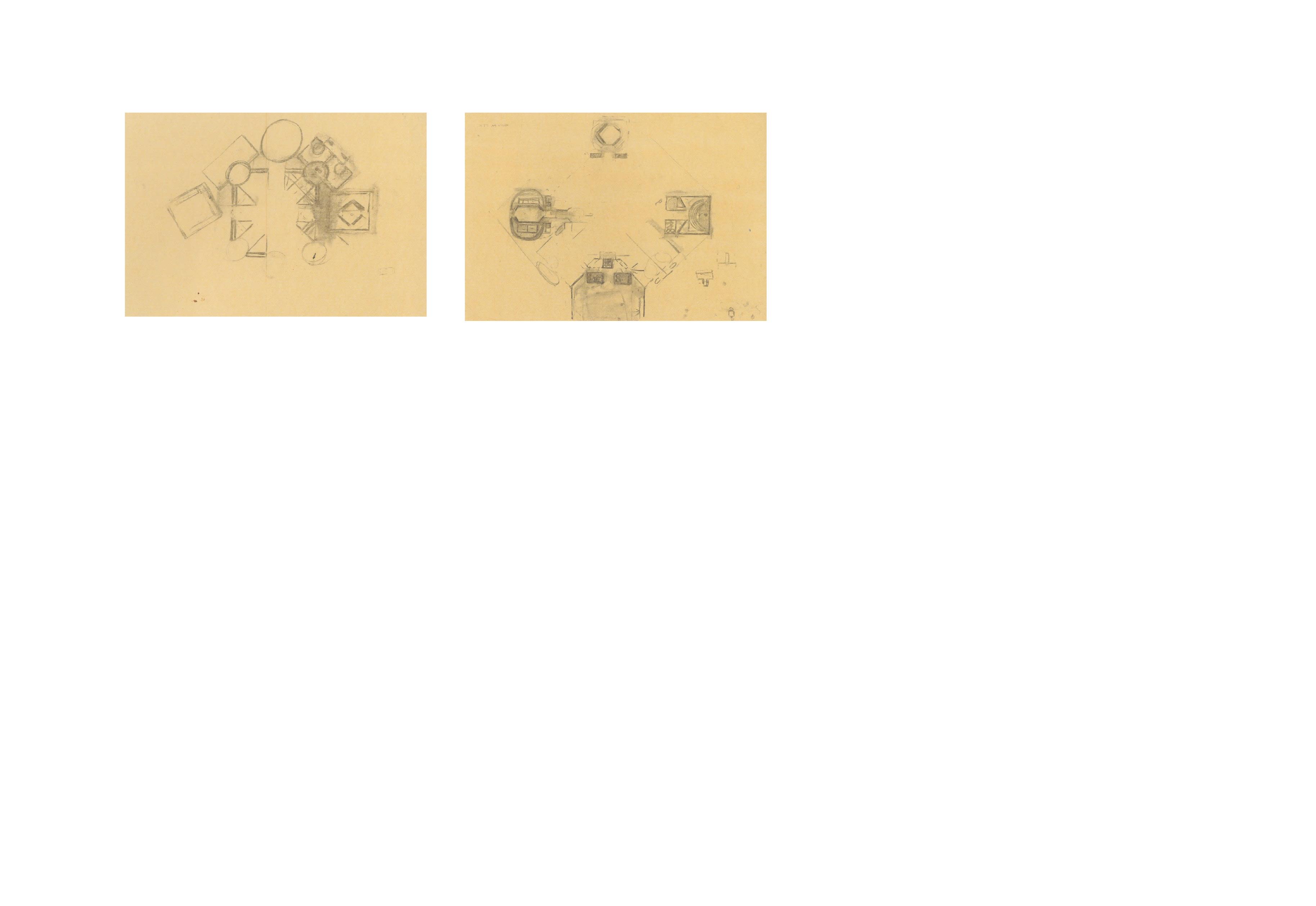
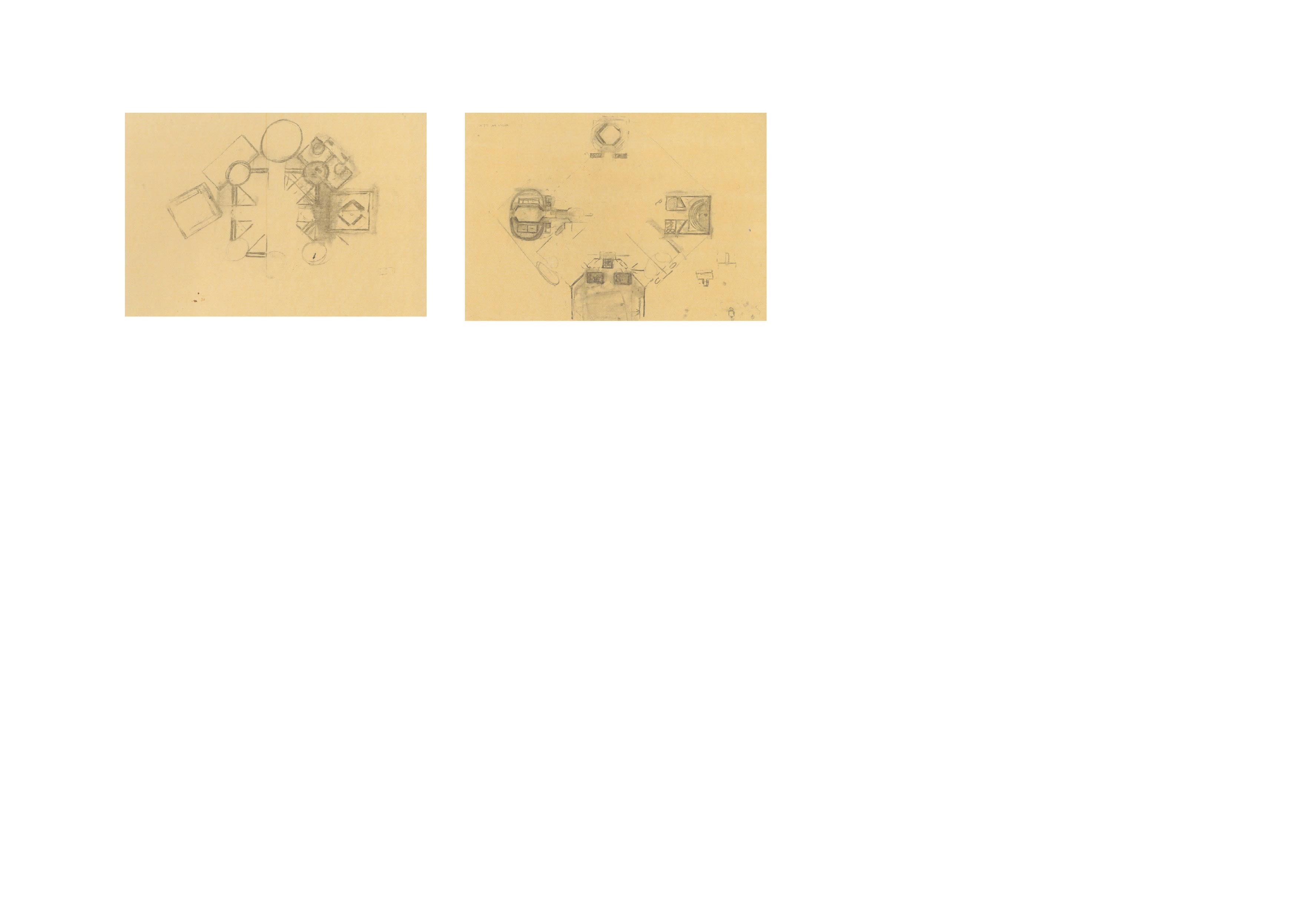
Observing the Unseen exploring the pedagogy of Flores & Prats Architects
Arabella Fane
MA(Hons) Architecture Dissertation 10,225 words 2024/2025 s1906228
Acknowledgments
Firstly, I would like to thank my supervisor, Mark Cousins, for his guidance, encouragement, and enthusiasm throughout the development of my dissertation study and research. I also thank Harriet Nixon for her consistent support and kindness in our work together throughout this writing period. To both, thank you for your efforts in making this team on the dissertation course an enjoyable one.
I also thank Eva Prats and Ricardo Flores for hosting me in the studio in Barcelona and showing their interest in me as a student and collaborator over the last year. It has been a privilege to receive your mentorship and guidance at this stage in my academia. Thank you, especially, for gifting me Through the Canvas, and for giving me the time to discuss this writing project with you. Without it, this dissertation would not have come to be.
Thank you also to Michael Tawa, for taking the time to respond to many questions about his role in the Through the Canvas workshop, and for giving such insightful answers.
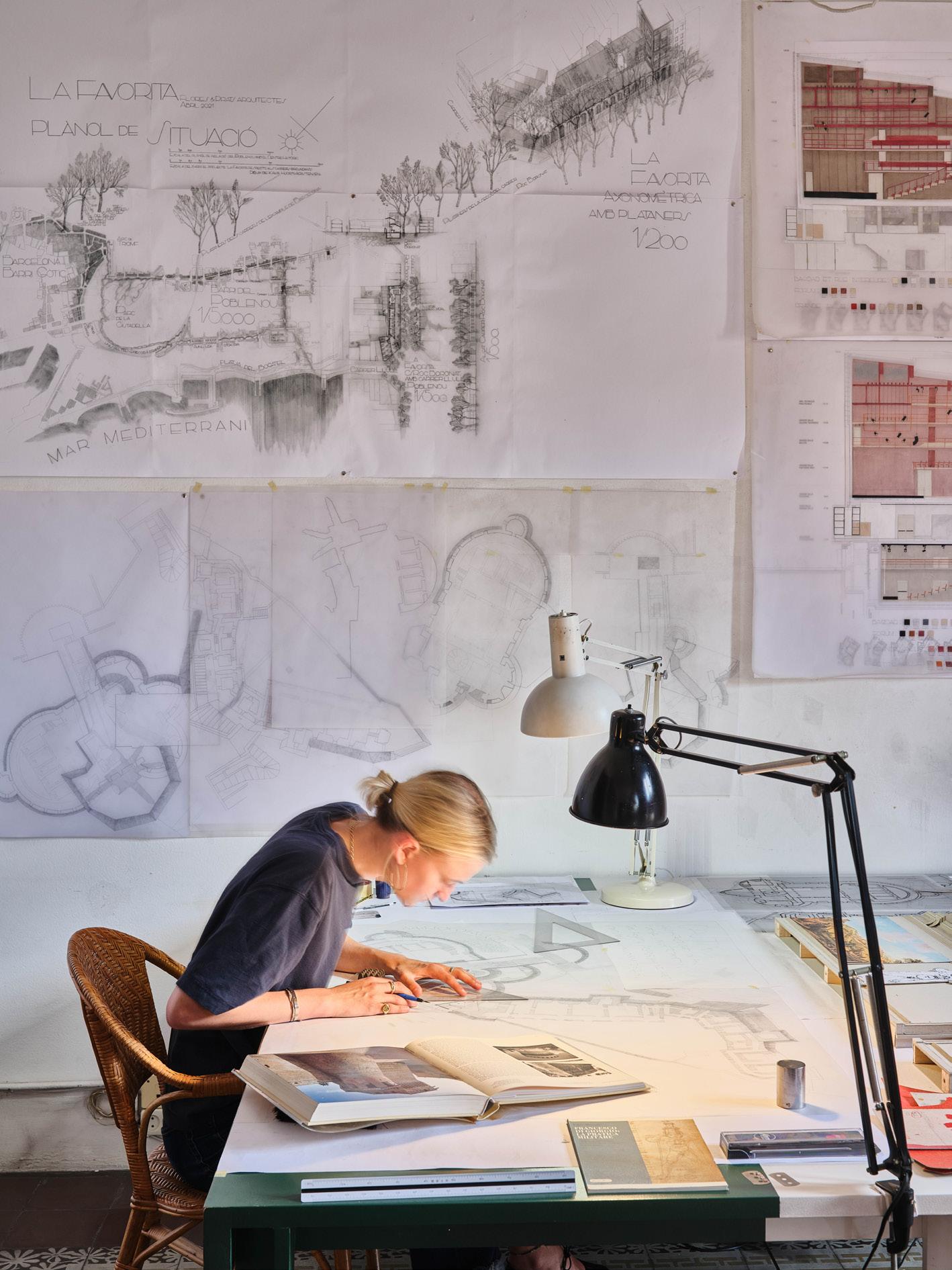
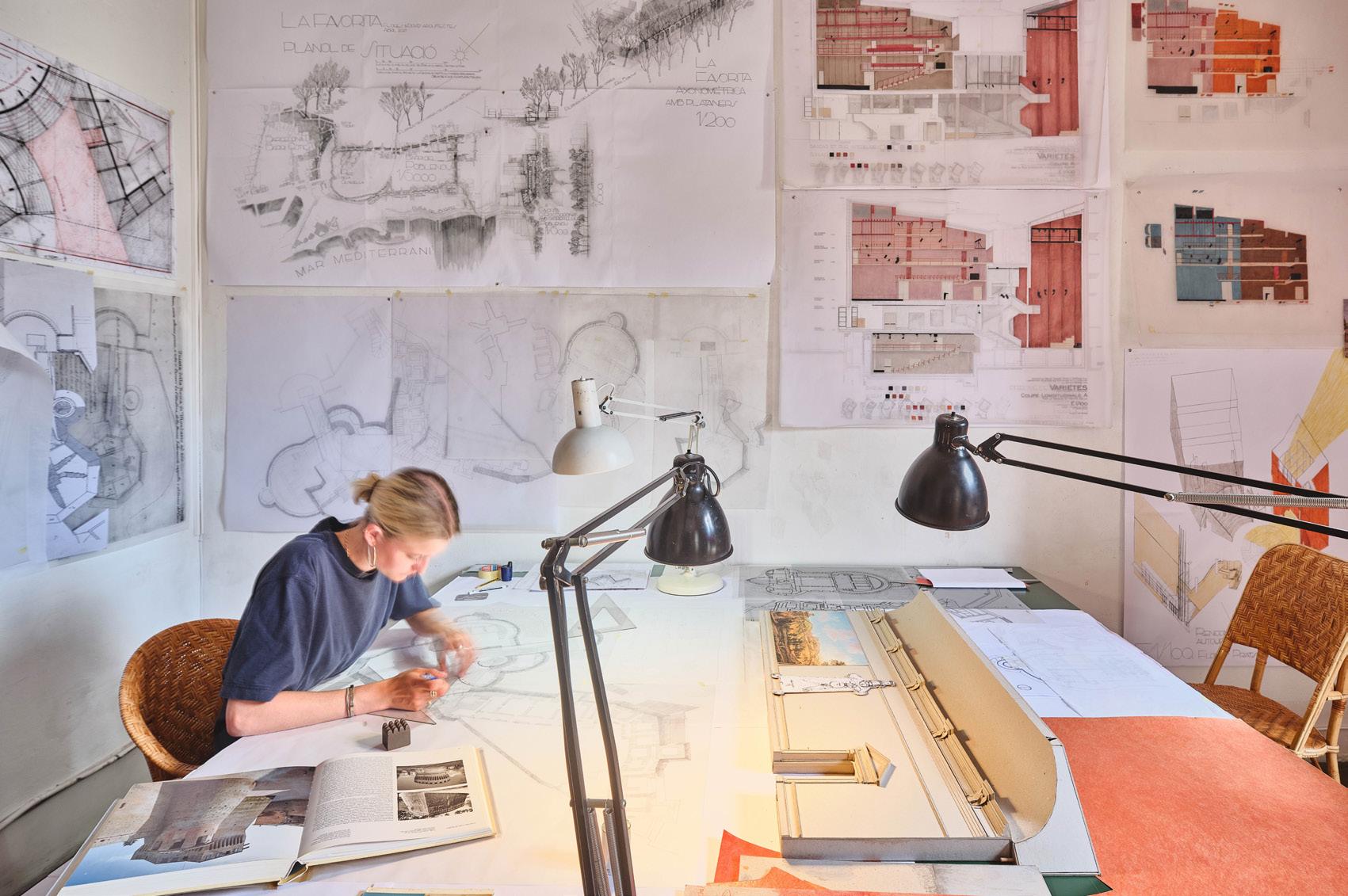
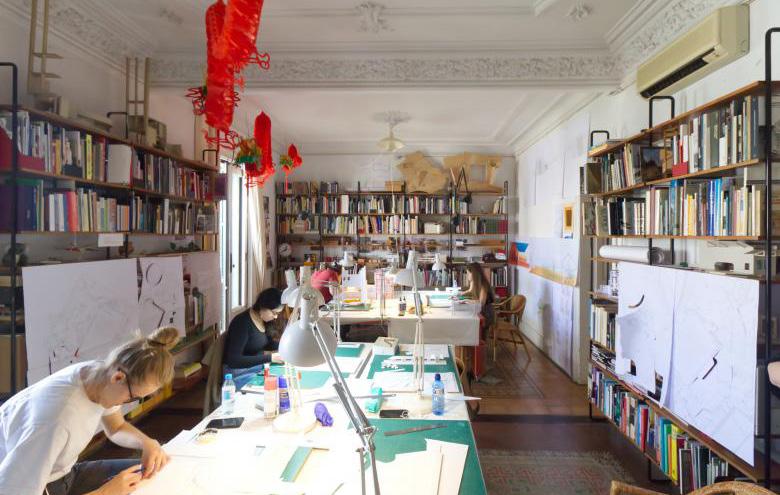
Photograph of the author in the studio of Flores & Prats, photograph taken by Adrià Goula. Barcelona, 2024.
Preface
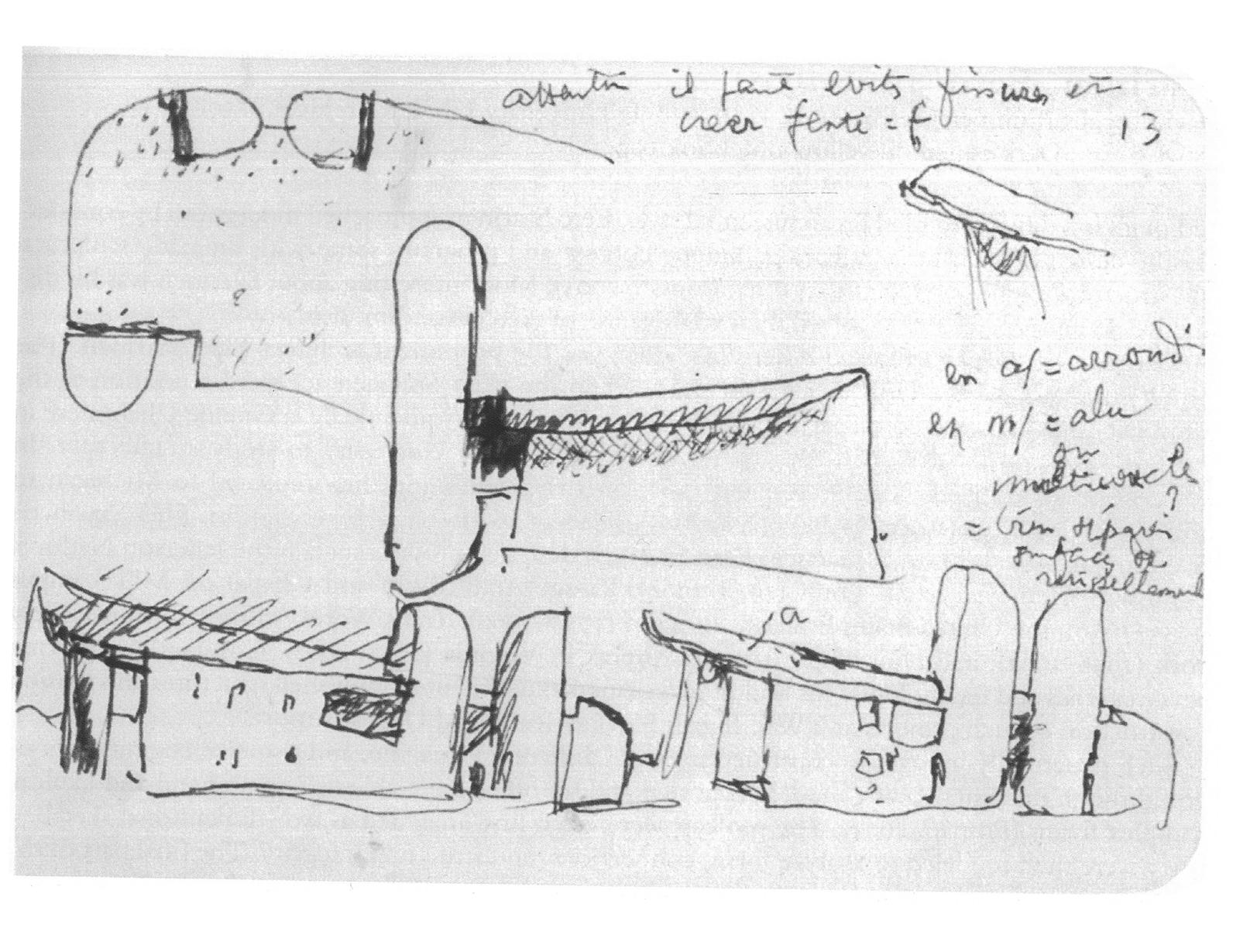
One of the travel sketches by Le Corbusier (1.1) depicts the early design stages of the Chapel Notre-Damedu-Haut (1955). The simple line drawing explains the complex gesture of the arc of the chapel in plan and elevation.1 His fluid and uneven lines reveal his thought processes and sketching techniques, providing us with some insight into his approach to retain visual information and his thoughts2 at that current moment in time. His sketches were filled with annotations, unique to his design approach, to remember specific elements of a passing thought, and his sketchbooks were sites for him to have a discussion with himself alone, to explore his curiosity and his approach to architecture.3
This drawing embodies two significant ideas – or rather, two gestures – highlighting the drawing’s potential as a ‘physical site’ for our ideas to develop and the drawing as a location where our curiosity, observation, and approach to the existing come together to create a physical reflection of our minds. It is this idea that became the preliminary basis and curiosity for Observing the Unseen.
To begin, this sketch (1.1) depicts Le Corbusier’s sketches that explore the chapel in plan and elevation freely as a method of exploring his imagination of design – an obvious point perhaps, but the use of a single line to explain the arc of the chapel is something important to the briefness of the sketch,4 as it was something for him to recall on, to remember his design intentions. What we now know as a historic piece of architecture was once a singular line that originated in his mind. His travel sketches were not simply about being fast and concise with his drawings. They were detailed representations of what he was imagining with a scaled and meticulous approach that he could hopefully recreate in a separate location. From this sketch, we can see Le Corbusier annotated his thoughts while he was drawing; the words interact with the drawing and become a part of the sketch. Our perception of the drawing is it is all one sketch, all contained by the borders of the page, but the composition of this sketch, in his sketchbook, contains all of the ideas he hoped to execute in his architecture in the future.
His annotations, one of which being the ‘a’ on the sketch above, were unique to Le Corbusier’s imagination for his architecture. We do not know what he denotes by symbols, except by what he allows us to. In his drawing legend, he translates this letter to arrondi, ‘round’, a brief annotation but something to remind him of his design intentions towards the more complex elements of his architecture that would require more subsequent examination,5 the arc roof. What you draw is what you get; everything you draw is your base, and from there, you move on and develop.6 His drawings were already telling him the key elements of how to extend on from, and which design features should be retained.
1. 1 Plate #322, Sketchbook 18, Volume 2, sketch of Notre-Dame-duHaut, Ronchamp, February 1951, Le Corbusier Foundation/ARS, Carnet E18, 15 x 10cm, Ink on Sketchbook paper
Eva Prats and Ricardo Flores, also known as Flores & Prats Architects, practice the belief in the capacity of drawing by hand to generate multiple and complex layers of knowledge about a space or a place.13
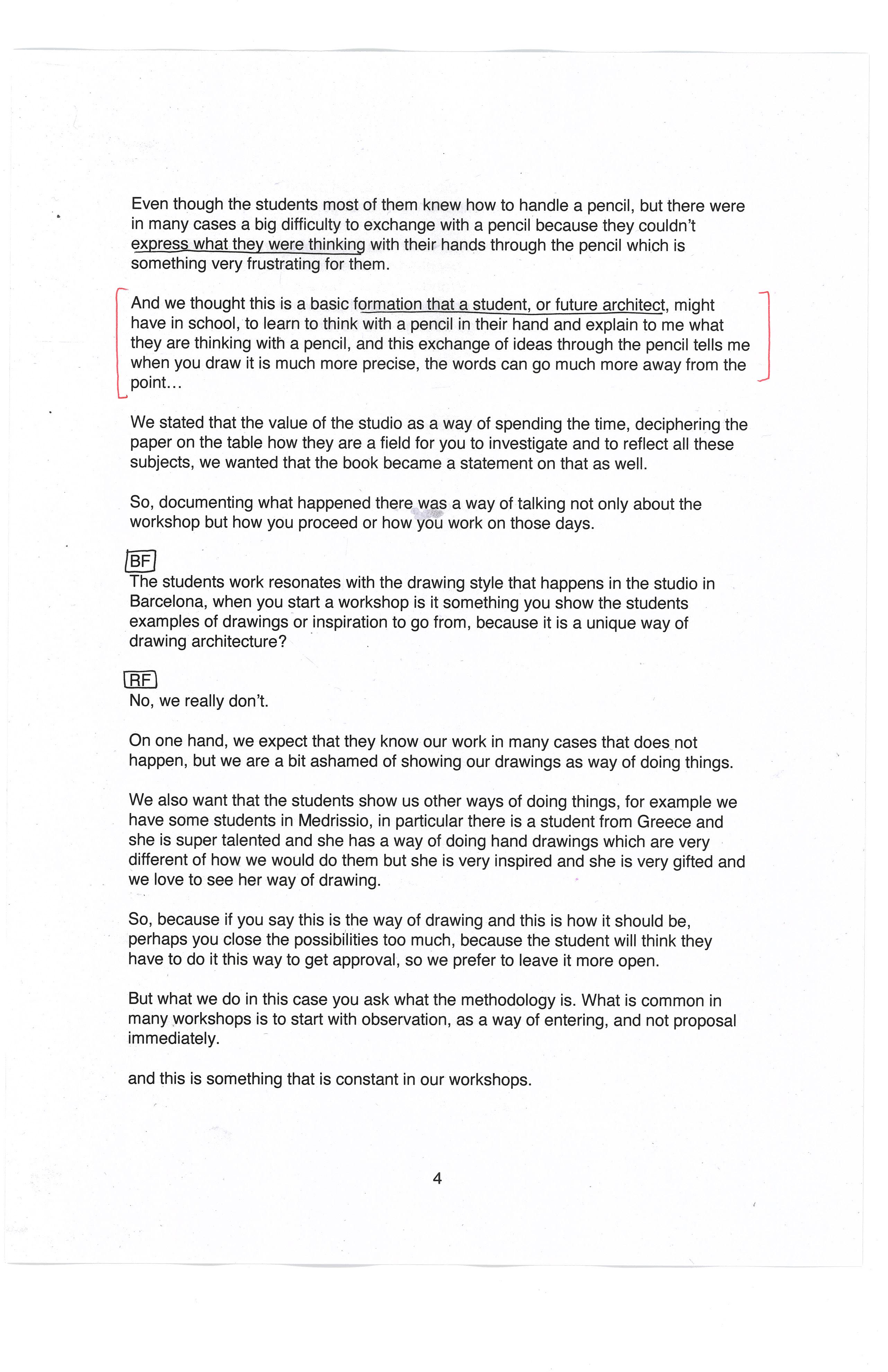
As architects and educators, they are devoted to resisting the rejection of traditional architectural representation tools. The fast-paced culture today of architectural production pushes the fluidity and freedom of hand drawing to, perhaps, the beginning of a project, at best. What once was the only method to produce architecture is now only a method of concept design. Their work as teachers in architecture schools embeds a lasting trail behind them in the students, who, before being met with the essence of Flores & Prats, may not have been aware of the opportunities that thinking with your pencil to paper can offer you in a design process. Flores & Prats believe that a student, who will become a future architect should have the basic formation to learn to think with a pencil in their hand and have the capacity to explain to another what they are thinking.14 The pedagogy of Flores & Prats overflows with appraisal to learning through drawing and developing the skills to observe a project and translate it according to the brief.
Flores & Prats have, over the years, been invited to different academic institutions to teach their unique approach to architectural design and theory. In March 2021, among the many, the duo were invited to give a workshop to students at the Edinburgh School of Architecture and Landscape Architecture (ESALA).15 Due to the nature of the pandemic, it was delivered online, but the pair were still able to communicate their analogue approach to the students through the computer, which is an achievement in itself.16
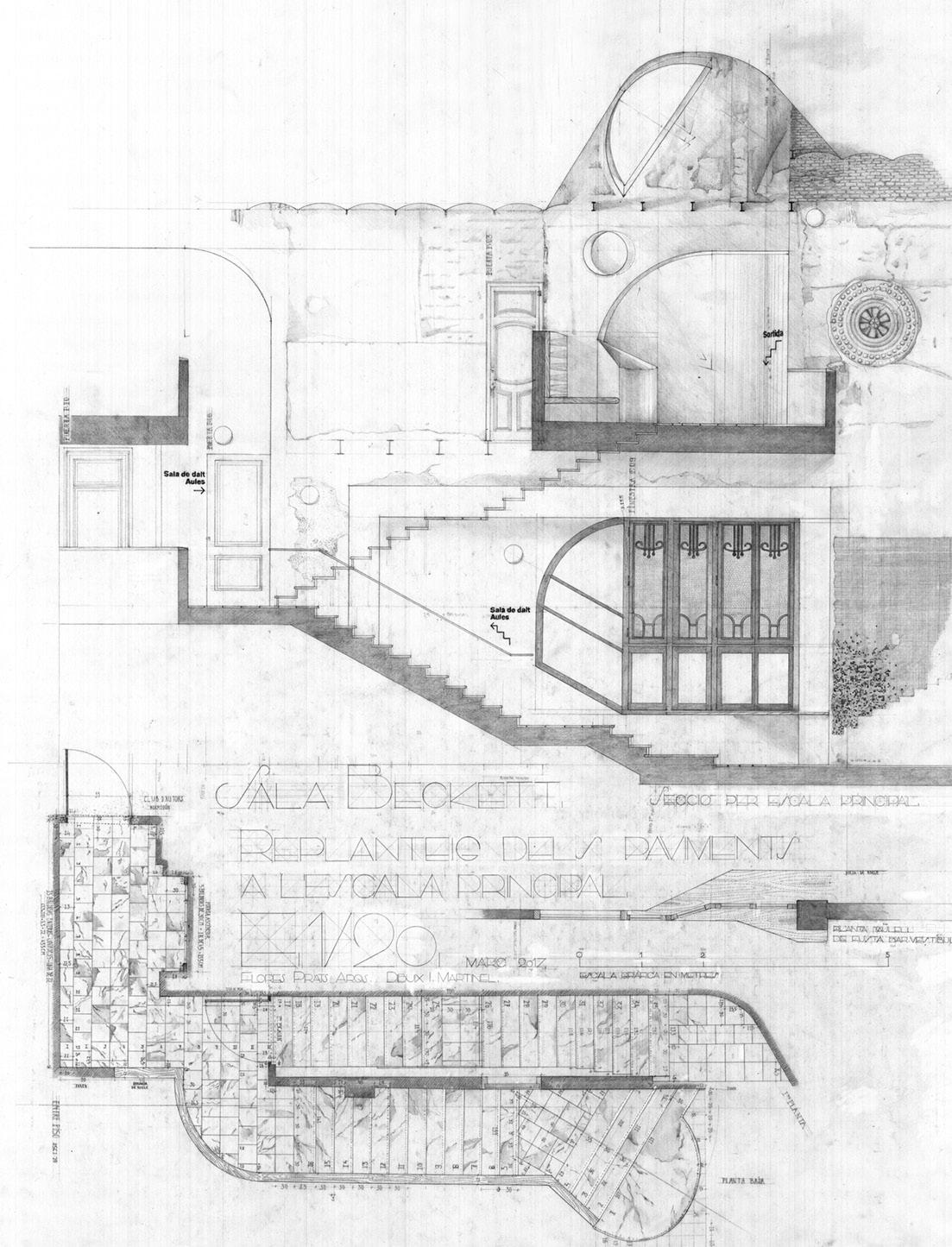
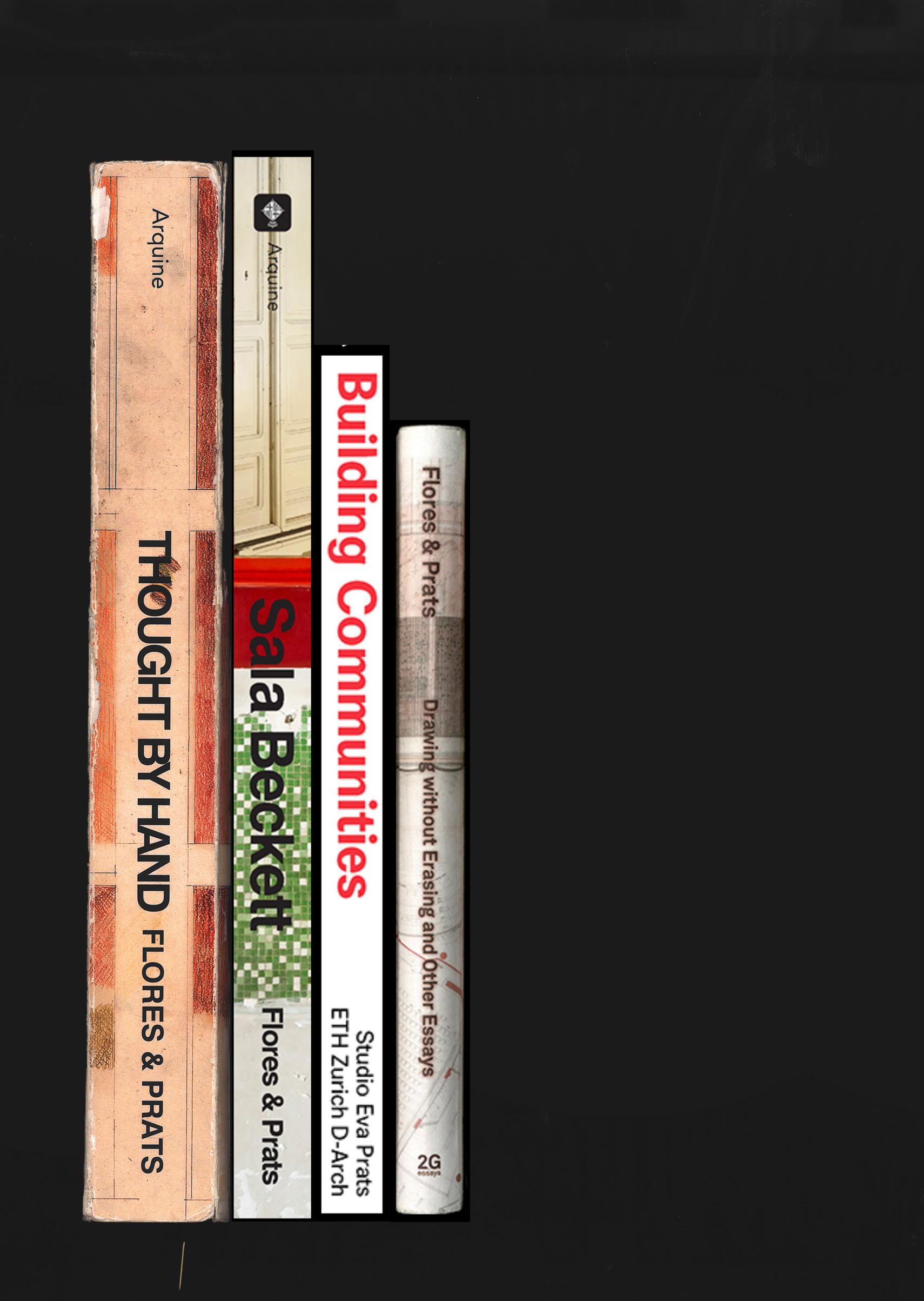
Unfortunately, this occurred the year before I joined ESALA, which meant I was unable to take part in the workshop and meet the duo. But, the trail of Flores & Prats was indeed left, after their departure, in the people in the school. It is, therefore, no surprise to me that their work was introduced to me in my first semester at ESALA in Autumn 2021. The form of this impactful introduction was a drawing (1.4)
Detailed Section of the Main Staircase with the Lightwell (1.4) was the first piece of work by Flores & Prats that I encountered, during my first year of studies. Its high level of detail, character, and textures, similar elements of excitement to the travel sketch of Le Corbusier, were unlike any I had viewed in contemporary working architecture practices. From this point, I became fixated on learning the methods they practised as architects, using all books and drawings produced by the office to enrich my own architecture education in Edinburgh.17 After two and a half years of this meticulous manifesting and working towards a goal, I was offered the opportunity to join the Barcelona office for a 6 month period as an intern to work alongside Eva Prats and Ricardo Flores, from February to August 2024.18
1.4 Plan and Section of the Main Staircase with the Lightwell, Sala Beckett Project, Flores & Prats Architects, 2016.
The writing and imagery contained in Observing the Unseen attempt to capture the allure of traditional hand drawing in architecture and the act of drawing in connection to the hand and mind. The purpose of this research is to explore where the mind and hand connect on a page and to develop an understanding of why it is important for a student of architecture to learn these traditional techniques and methods of practice.
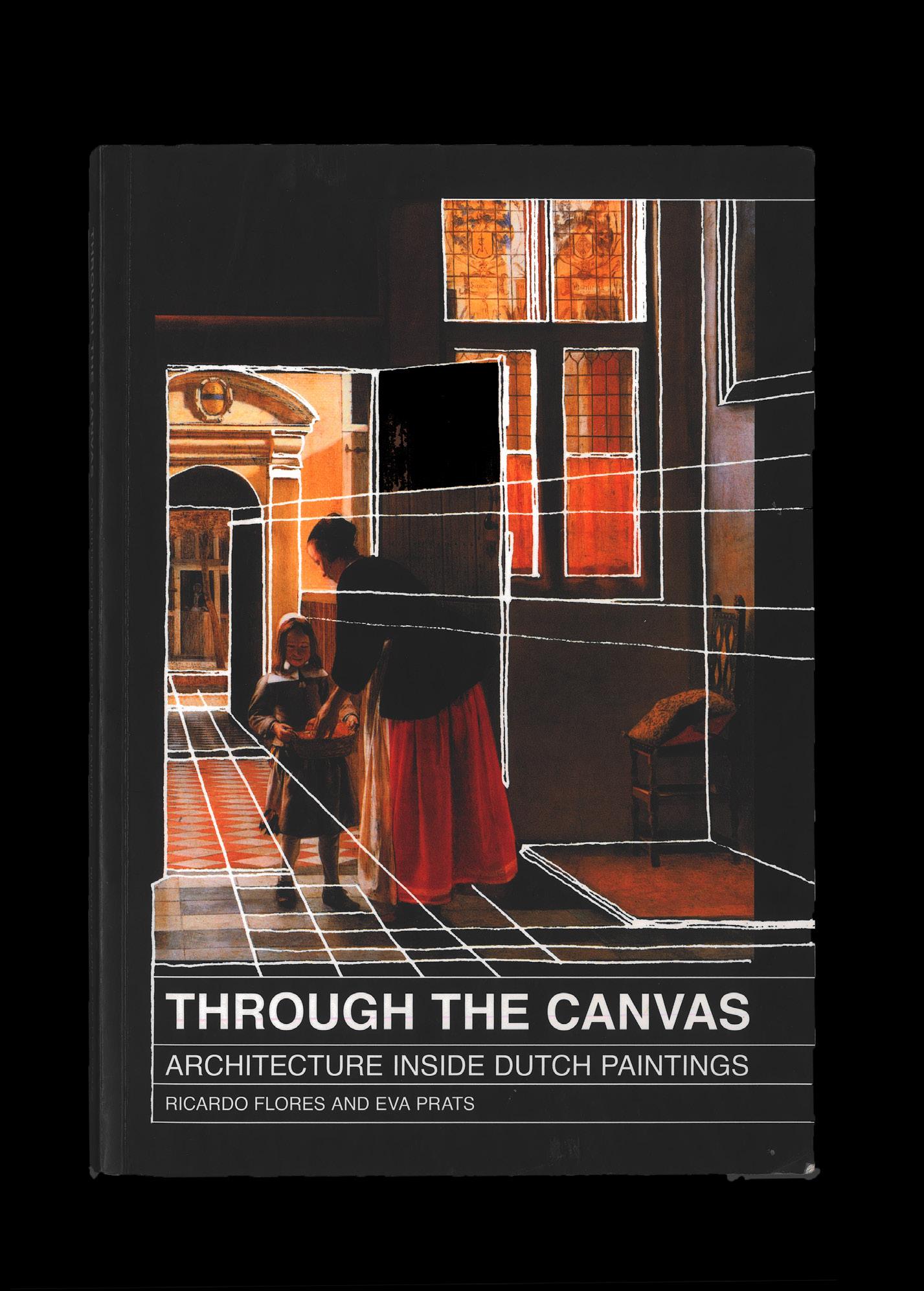
Observing the Unseen has focussed itself on the publication of Through the Canvas by Flores & Prats (1.6).
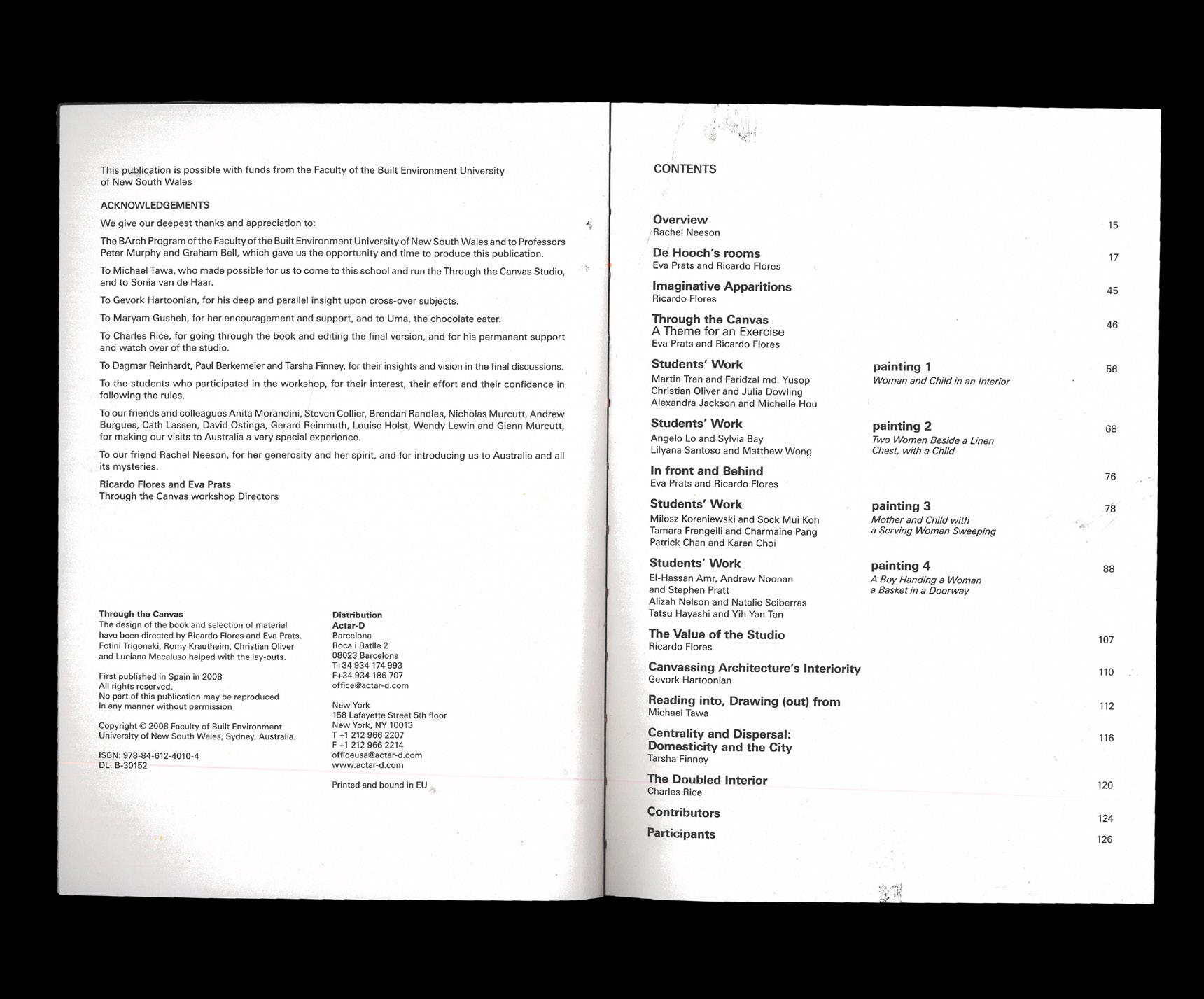
This book is an archive of a workshop taught by Flores & Prats, which required students to design a small house inspired by the architecture painted by seventeenth-century Dutch genre painters.19 This publication was my first introduction to reading about workshops taught by architects to students, in which they embraced a workshop approach which encouraged students to think and work in the same manner as the studio. The book is important to the development of this paper, as it will provide a framework for writing through the use of its chapter headings (1.7) for the discussion around observation and drawing.
1.5 Flores & Prats, Photograph of the Author in the Studio of Flores & Prats, August 2024, August 2024.
1.6 Printer Scan of Through the Canvas Book Front Cover. November 2024.
1.7 Printer Scan of Through the Canvas Book’s Contents Page. November 2024.
Notes
1. Kendra Schank Smith, Architects’ Drawings: A Selection of Sketches by World Famous Architects through History (Massachusetts: Architectural Press, 2005), p. 181.
2. Ibid., p. 181.
3. Ibid., p. 181.
4. Ibid., p. 181.
5. Ibid., p.181.
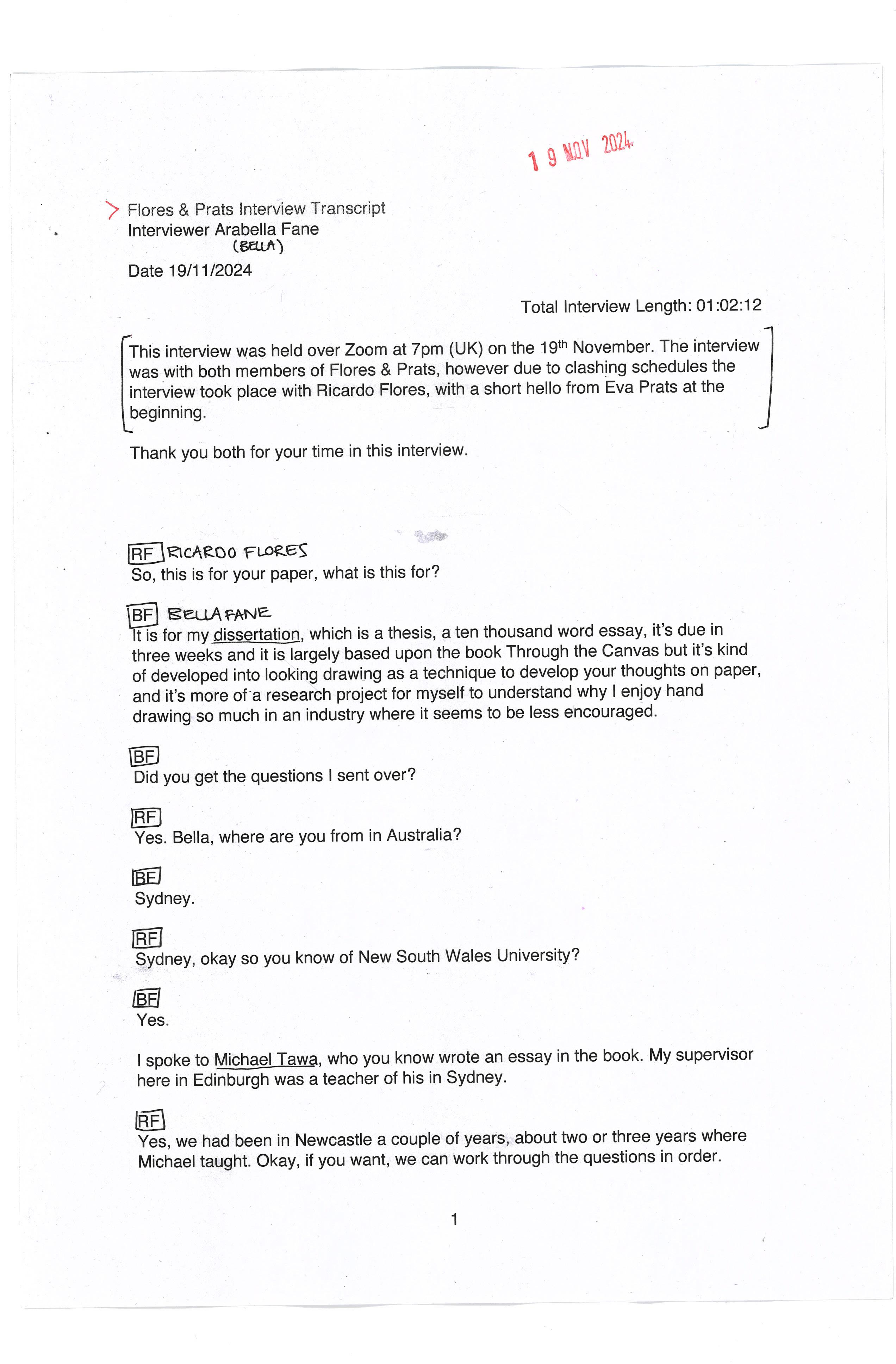
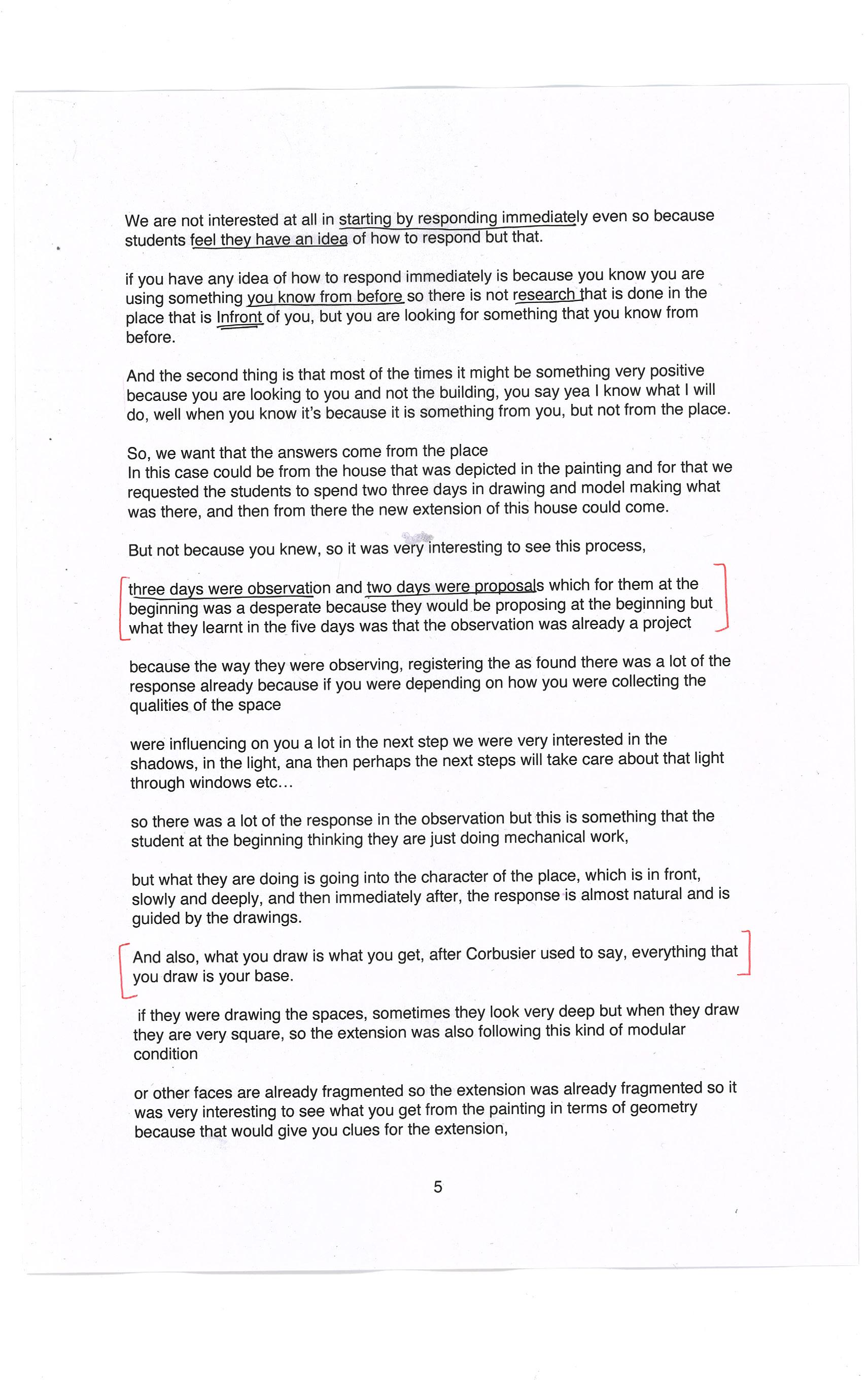
6. Ricardo Flores and Eva Prats, Flores & Prats Interview, interview by Arabella Fane, November 19, 2024, p. 5.
7. Adrian Forty, Words and Buildings: A Vocabulary of Modern Architecture (New York: Thames & Hudson, 2000), p. 29.
8. Paul Emmons, Drawing Imagining Building: Embodiment in Architectural Design Practices (New York: Routledge, Taylor and Francis Group, 2019), p. 1.
9. Ibid., p. 1.
10. Ibid., p. 1.
11. Paul Emmons, Drawing Imagining Building : Embodiment in Architectural Design Practices (New York : Routledge, Taylor and Francis Group, 2019), p. 2.
12. Ibid., p. 2.
13. Flores & Prats Architects, Drawing without Erasing and Other Essays, ed. Moisés Puente (Barcelona: Puente Editores, 2023), p. 11.
14. Ricardo Flores and Eva Prats, Flores & Prats Interview, interview by Arabella Fane, November 19, 2024, p. 4.
15. Flores & Prats , “Through the Drawing, ESALA Flores I Prats,” Flores i Prats, 2021, https://floresprats.com/academic/ through-the-drawing-esala-2021/.
16. Ricardo Flores and Eva Prats, “Pan Scroll Zoom 2: Flores & Prats,” ed. Fabrizio Gallanti, drawingmatter.org, September 1, 2020, https://drawingmatter.org/pan-scroll-zoom-2/.
17. See appendix for more information on this progression, a series of drawings done by the author.
18. This internship took place during our placement period. This period to work is offered to all students at ESALA, given in their second semester of the third year of the undergraduate architecture degree. It is upon the student to organise where they will spend this period.
19. Flores & Prats Architects, Thought by Hand (Mexico: Arquine, 2020), p. 17.
Introduction
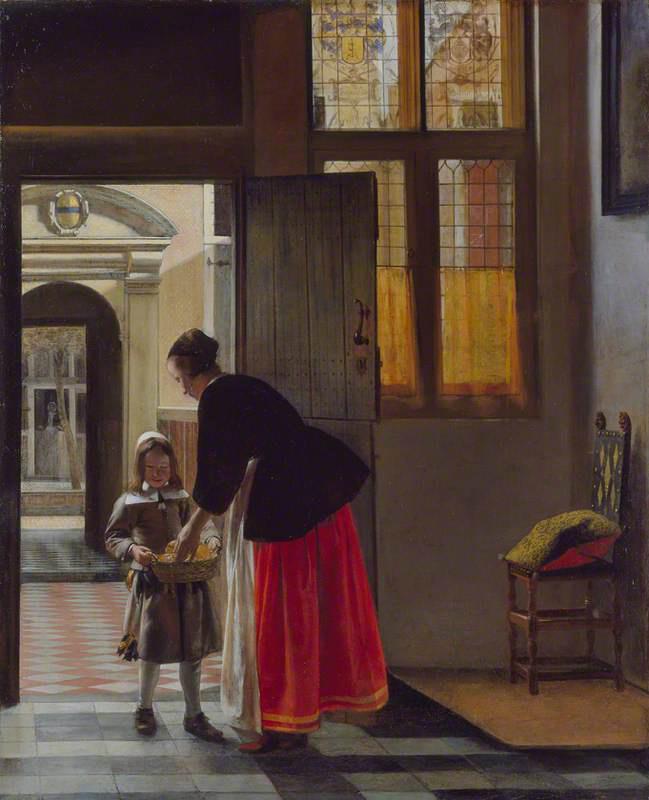
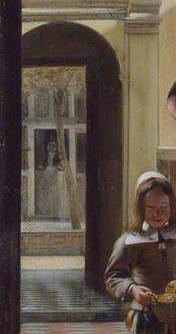
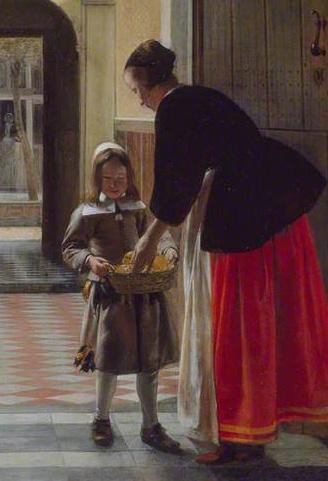
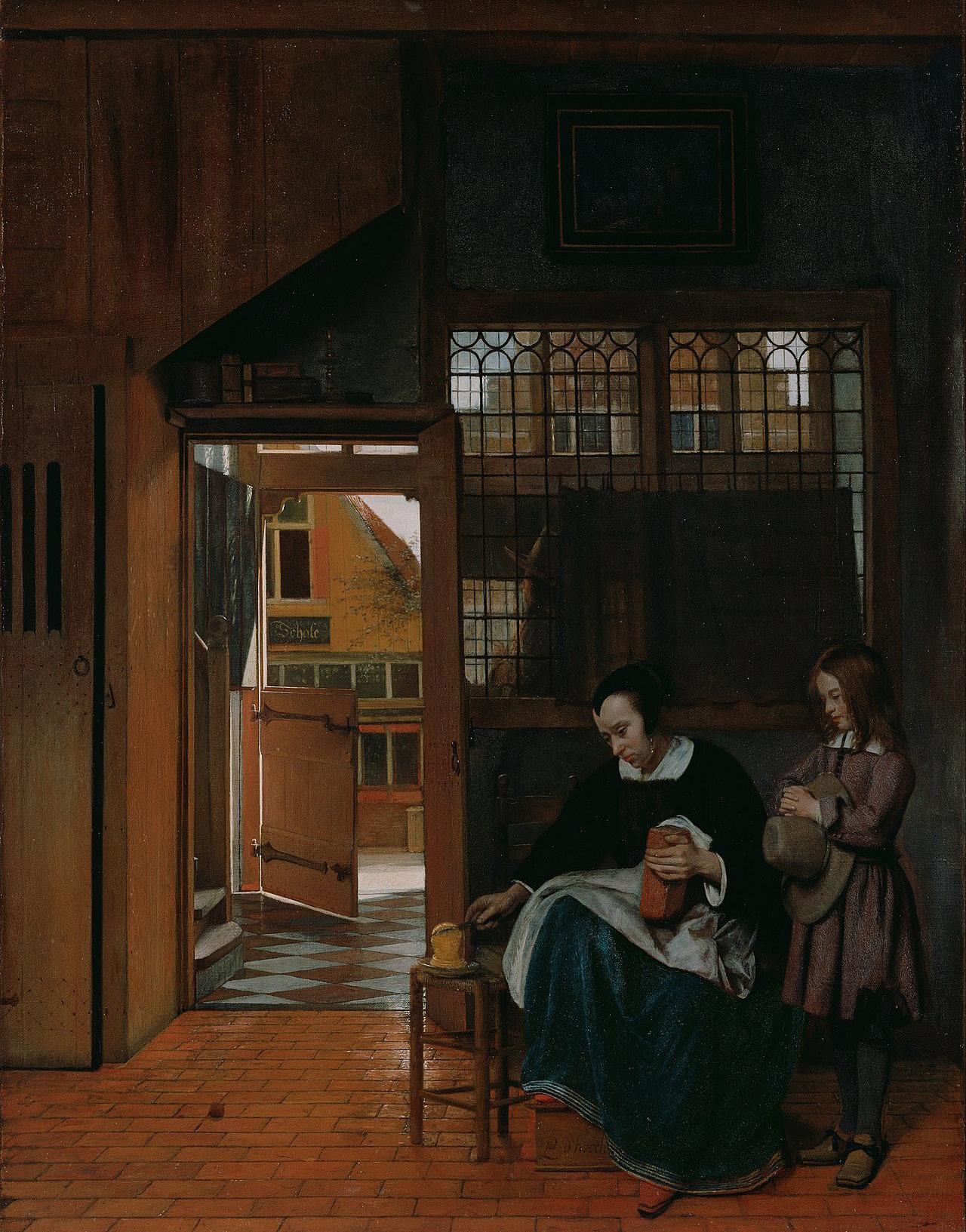
The discussion begins with an artwork created by Dutch Painter Pieter De Hooch (1629 – 1684) titled A Boy Bringing Bread (2.2). A classic example of Dutch Genre Age painting that captures everyday scenes in a domestic setting with curious detail and naturalistic light. The painting depicts a boy bringing bread to a woman standing in the doorway of the Voorhuis, 20 where another woman, possibly the boy’s mother, observes the scene from across the canal. The painting was constructed in an effort to navigate the viewer’s gaze through the ‘different’ layers of the scene. Our central focus is on the interaction between the boy and the woman, an expression of simple, everyday exchange. But it would seem that De Hooch is more interested in showing the viewer what lies behind this common activity in the household. De Hooch’s paintings always contain a depiction of a series of spaces in connection to each other.
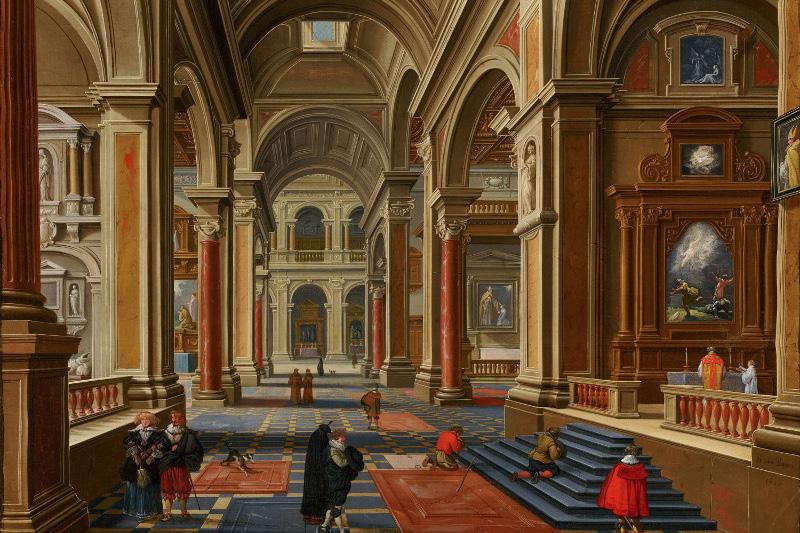
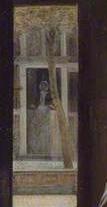
In A Boy Bringing Bread, you have a door through which you see another space (2.3), through which you see the street far away (2.4), with the canal running through the public sphere and another row of houses (2.5), where the boy may be travelling from. There is a difference in thresholds between the house and the street, the interior and exterior. His paintings are always speaking about thresholds and connecting spaces, doing this successfully by the use of a vanishing point.21 Perspective in Dutch paintings was achieved by the manipulation of spatial configurations and atmospheric effects to evoke a sense of depth in the canvas and remove the awareness of an end point.22 In St Antoniuskapel in the St Janskerk (2.1), converging lines, drawn as the tiles, disappear further away and lose their form, removing the structural formation of the space portrayed, and therefore removing our understanding of how far in we have ‘moved to’.
2.1 St Antoniuskapel in the St Janskerk, Utrechy, Pieter Jansz. Saenredam, 1645, 41.7 x 34 cm., Central Museum, Utrecht.
2.2 A Boy Bringing Bread, Pieter De Hooch 1663, Painting, London, The Wallace Collection.
2.3 Fragment of A Boy Bringing Bread, Doorway.
2.4 Fragment of A Boy Bringing Bread, Doorway to the exterior.
2.5 Fragment of A Boy Bringing Bread, Canal across the road.
In response to this, is it justifiable to assume that we are interested in knowing what continues beyond what the painting portrays simply because of the way the painting has been laid out? In a discussion with Ricardo Flores, he explained that when trespassing through the image, you can go into and explore the whole world behind what is portrayed in front of you.23 That said, we have the opportunity to harness that curiosity we show for understanding and imagining what we do not know or see. To draw this curiosity is to visually articulate what it is that we observe in our imagination stemming from the painting. This is the precise exercise proposed by Flores and Prats in the workshop written in Through the Canvas
The word trespass, although seemingly misplaced in this context, can now be understood in a different manner. Flores defines trespassing as “while our thoughts stay in front, reasoning and drawing what our eyes can see, our imagination trespasses the canvas, trying to recompose how the rest of the house would be.”24 Flores speaks of trespassing as the imaginative act of moving beyond what’s visually confined. By trespassing, the architect doesn’t merely recreate a scene but embarks on a journey of discovery, envisioning spaces that unfold beyond the visible edges.
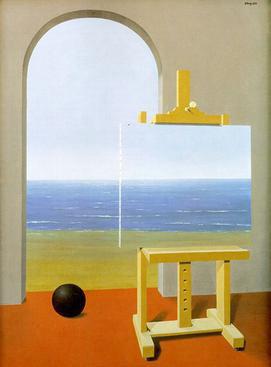
Paintings by René Magritte (1898 – 1967) might aid us in picturing the idea of what it is to trespass the edge of the frame. The Human Condition (2.6) depicts a canvas within a room, positioned in front of a window, seamlessly aligning with the landscape outside. It challenges us to define the boundary between what is ‘inside’ and ‘outside.’ Where does reality start in this painting? The boundary of the canvas is permeable rather than fixed, which may already present us with the opportunity to blend reality and abstract together without realising. Eventually, the elements metamorphose from reality and painting to an imagined plane. Removal of the physical nature of a frame, in which the canvas is bound, already acts as a gateway into allowing us to trespass into the artist’s work. It is within the architect’s nature to take this curiosity and develop it into something “new”.
Observing the Unseen has primarily focused on interior spaces and their architectural representation over time, forming the basis for a discussion that delves into our curiosity about drawing and its exploratory nature. It looks towards the physical representation of the interior, in drawing and painting, and will precede to understand what it is these drawings do for us and our imagination. To analyse the act of drawing, this paper will visually analyse drawings and paintings to ignite the reader's thinking about how we might perceive an image presented in front of us. Questions will then begin to be asked about why it is that we want to imagine beyond what is in front of us. What can we learn when combining perception and physical drawing together? Is this the moment in which the imagined plane25 comes into being?
How far can drawing take us? To answer this question, the drawing itself will not necessarily be interrogated but rather the psychological and actual relationship between drawing and mind. This relationship takes on another persona, which is translation.
2.6 The Human Condition, Rene Margarite, 1935, Painting 100 x 81 cm.
20. Voorhuis translates to the front room of a Dutch house.
21. The vanishing point refers to the location on the horizon line where parallel lines seem to meet as they extend further away. In De Hooch’s work, this point blends into the background, so much so that we lose our awareness of whether we are looking at the interior or exterior.
22. Jonathan Janson, “The History of Perspective,” Essentialvermeer.com, 2015, https://www.essentialvermeer.com/technique/perspective/history.html.
23. Ricardo Flores and Eva Prats, Flores & Prats Interview, interview by Arabella Fane, November 19, 2024, p. 3.
24. Ricardo Flores and Eva Prats, Through the Canvas (Barcelona: Actar D, 2008), p. 45.
25. The imagined plane is a conceptual space where the physical and abstract worlds of ideas intersect.
Overview
“The studio explored domesticity – the psycho-spatial concept of dwelling – and sponsored an approach to the design of the residential interior that escapes the usual assumptions about how we live.
The project is discovered through the precise drawing and redrawing of what already exists. The discovered fragments initiate a narrative – the possible scenarios of imagined lives –that directs their work, imbuing it both with rigour and with whimsy.”26
Through the Canvas, Flores & Prats
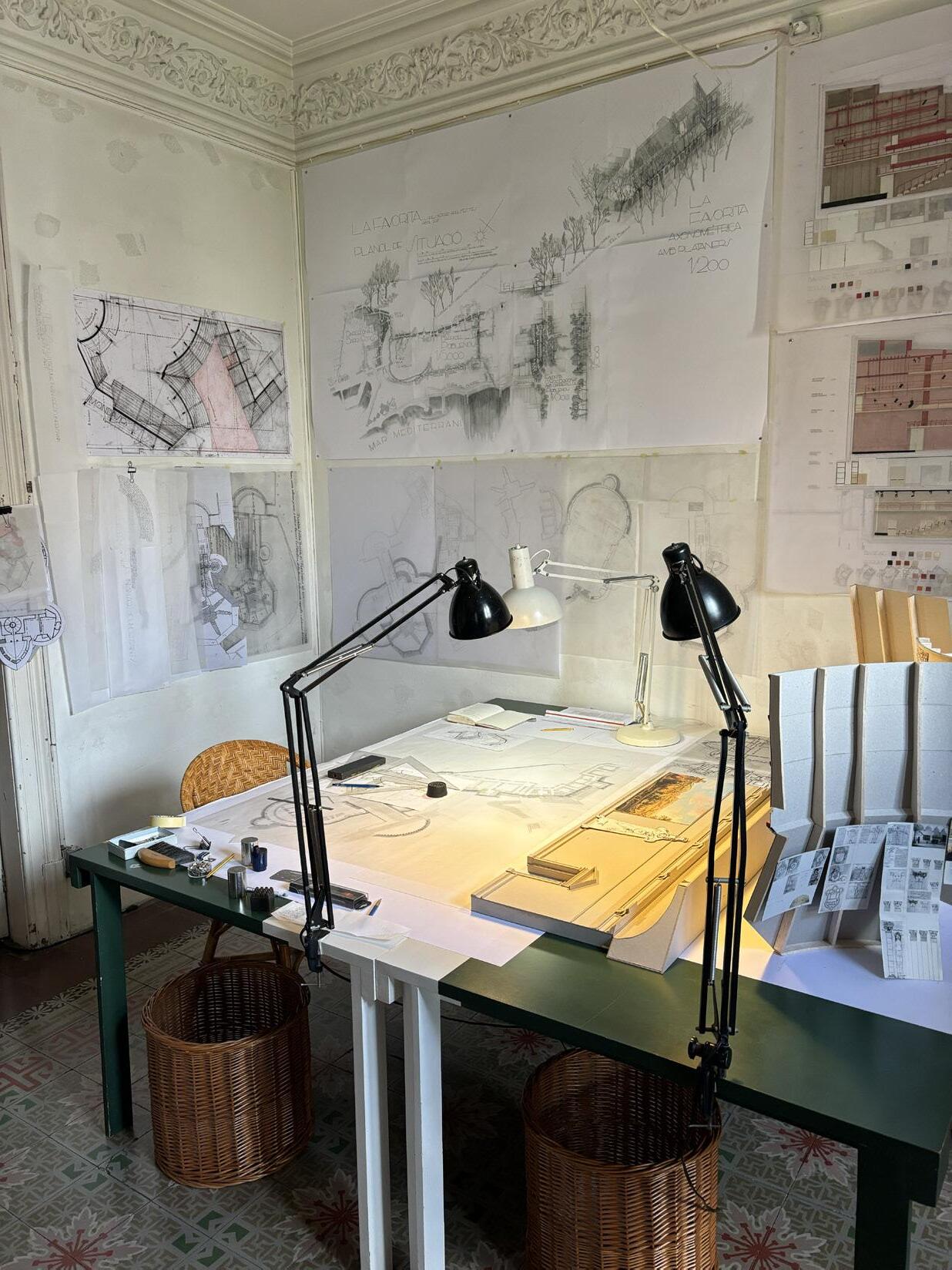
3.1 Photograph of the working desks in the studio of Flores & Prats containing drawings and models. Taken by the author, June 2024.
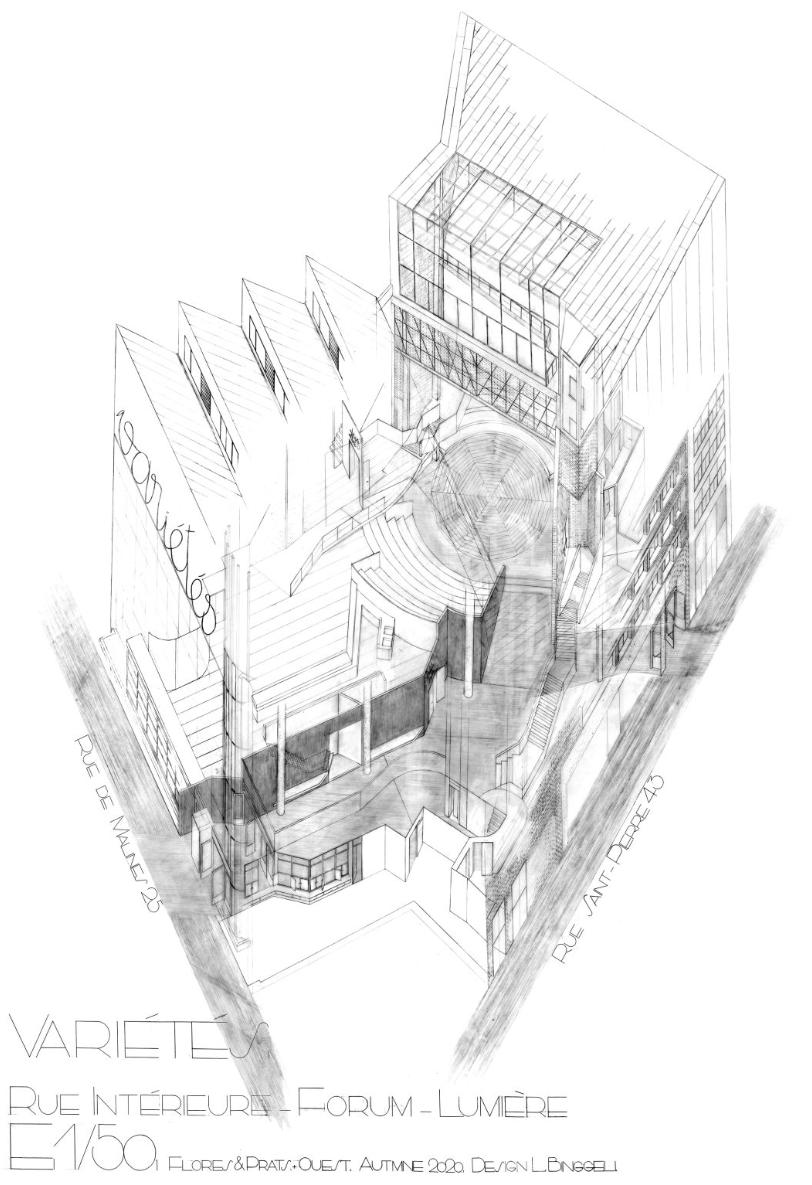
Flores & Prats Architects, established in 1998 by Ricardo Flores and Eva Prats, are celebrated for their distinctive approach to architecture, which blends academic research with practical design.27 Both architects emphasise a balance between creativity and the responsibility of construction; this dual focus manifests in their dedication to adaptive reuse when they breathe new life into existing structures, highlighting their historical and cultural significance. At the heart of Flores & Prats’ methodology is a commitment to the analogue process. The sketches produced in the studio are often layered and intricate, featuring stylised annotations that transform the drawing into an image with a narrative, which invites viewers to explore the subtleties of each project (3.2). The drawings adopt an immersive approach that can reveal hidden stories embedded within the architecture, creating a dialogue between the past and the present and future.
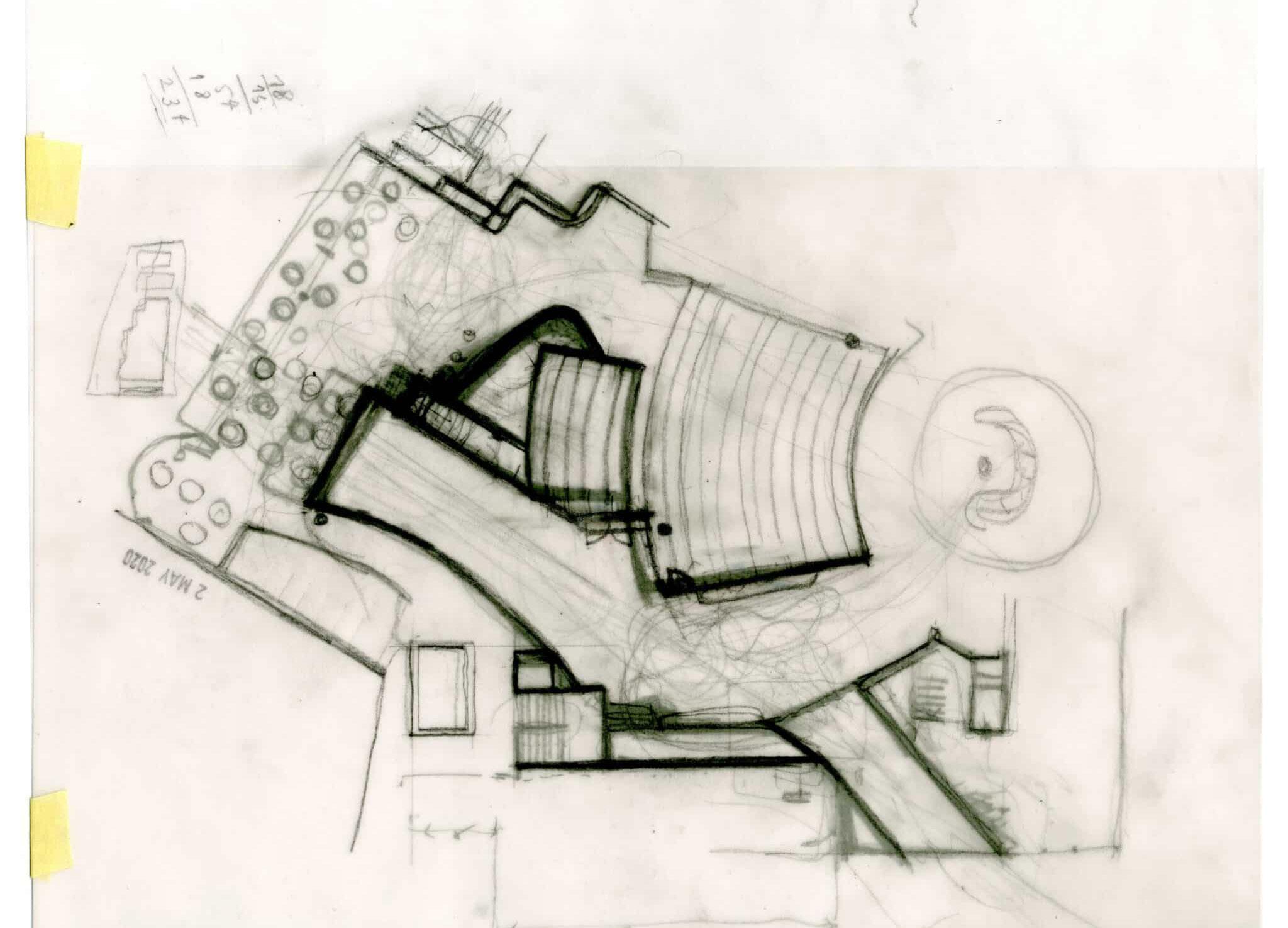
The architectural office’s work is characterised by a profound attention to detail and a reverence for the existing built environment. Flores & Prats practice that to understand and adapt a building effectively and respectfully, you must intimately understand it.28 This understanding is refined through a careful process of observation, often expressed through extensive hand drawings that capture the essence of a project and its history. Advocating for a respectful intervention with the architectural heritage provided, Flores & Prats aims to enhance architecture rather than overshadow it.29 When they work in the initial design stages of a project, the design process usually begins with a series of quick free-hand drawings that are records of first thoughts. All mistakes and discoveries made during the drawing process are embraced rather than feared, as these drawings share an openness to imperfection in observation, which enables them to explore alternative solutions and rethink initial interpretations while understanding why it was they got there.
This type of drawing process was best described in an essay titled Drawing without Erasing by Ricardo Flores, in which he discussed the result of this drawing process and named it Dirty Drawings30 (3.3). Dirty drawings are the kinds of drawings that “buzz with ideas,” said Flores.31 Although these drawings are not tidy and exact, they represent all their doubts and comings and goings of thought in drawn form, as well as the architect’s characteristics and approach to design. The fluidity of the combination of a thicker pencil and trace paper removes the boundaries that refined architectural drawings create, this is a method of testing, getting thoughts out as soon as they come into mind. This type of drawing acts as a form of critical reflection. Continuously revisiting these drawings results in discussions between colleagues about a certain part of the project.
3.2 Théâtre des Variétés, Drawing by L.Bnggeli, Flores & Prats Architects. 2020
3.3 Dirty Drawings, 2020, Flores & Prats Architects, Théátre des Variétés.
This brings us to the book Through the Canvas. This publication documents a unique architectural design studio led by Flores & Prats architects in 2004 for architecture students at the University of New South Wales (UNSW) in Sydney.32 In the studio course detailed in Through the Canvas, Flores & Prats emphasised the role of drawing as an act of observation rather than representation. The course was based on the observation of Dutch Paintings by Pieter De Hooch, in which Flores & Prats proposed an exercise strongly associated with the making of things by hand.33 The design course presented each group of students with a brief and a painting by De Hooch in which, over a five-day period, the students undertook deep observation of the “ruin”34 and proposed extensions in the form of a 2-bedroom family house. The painting acts as the site where this extension would take place.
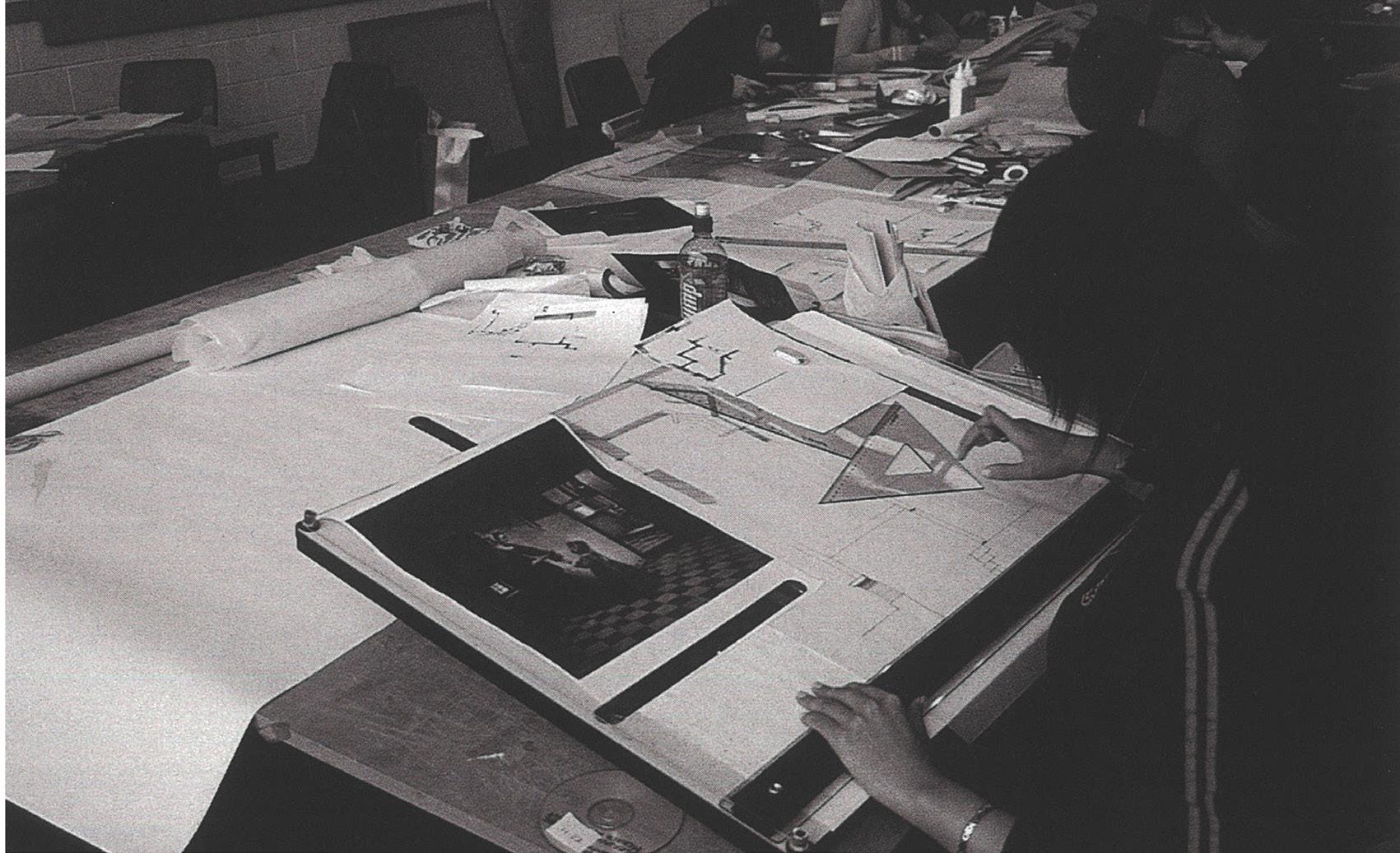
The exercise proposed that the students observe and draw the scene within the painting, an exercise of observation they completed over three of the five days (3.4).35 In a discussion with Flores & Prats, they noted that it was interesting to observe the students’ reactions towards the exercise asked of them. This was the first time they had taught Through the Canvas workshop, and they noted they had never done this type of exercise before, in which students were asked to use more time to observe than propose.36 The students seemed sceptical of being allotted a longer period for observation than for their proposals.37 This scepticism stemmed from a lack of understanding and familiarity to this approach; through observation, they would already be making creative decisions that would later shape their proposals. In this observation period, the students had the opportunity to explore the scene’s character deeply and then draw it on large scales on big sheets of paper. They were strategically making decisions subconsciously so that when it came to the proposals, their response was almost natural as it was solely guided by the observation drawings made before.
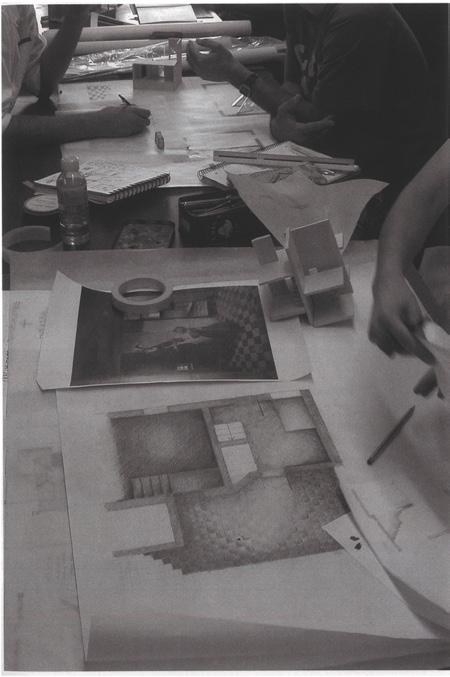
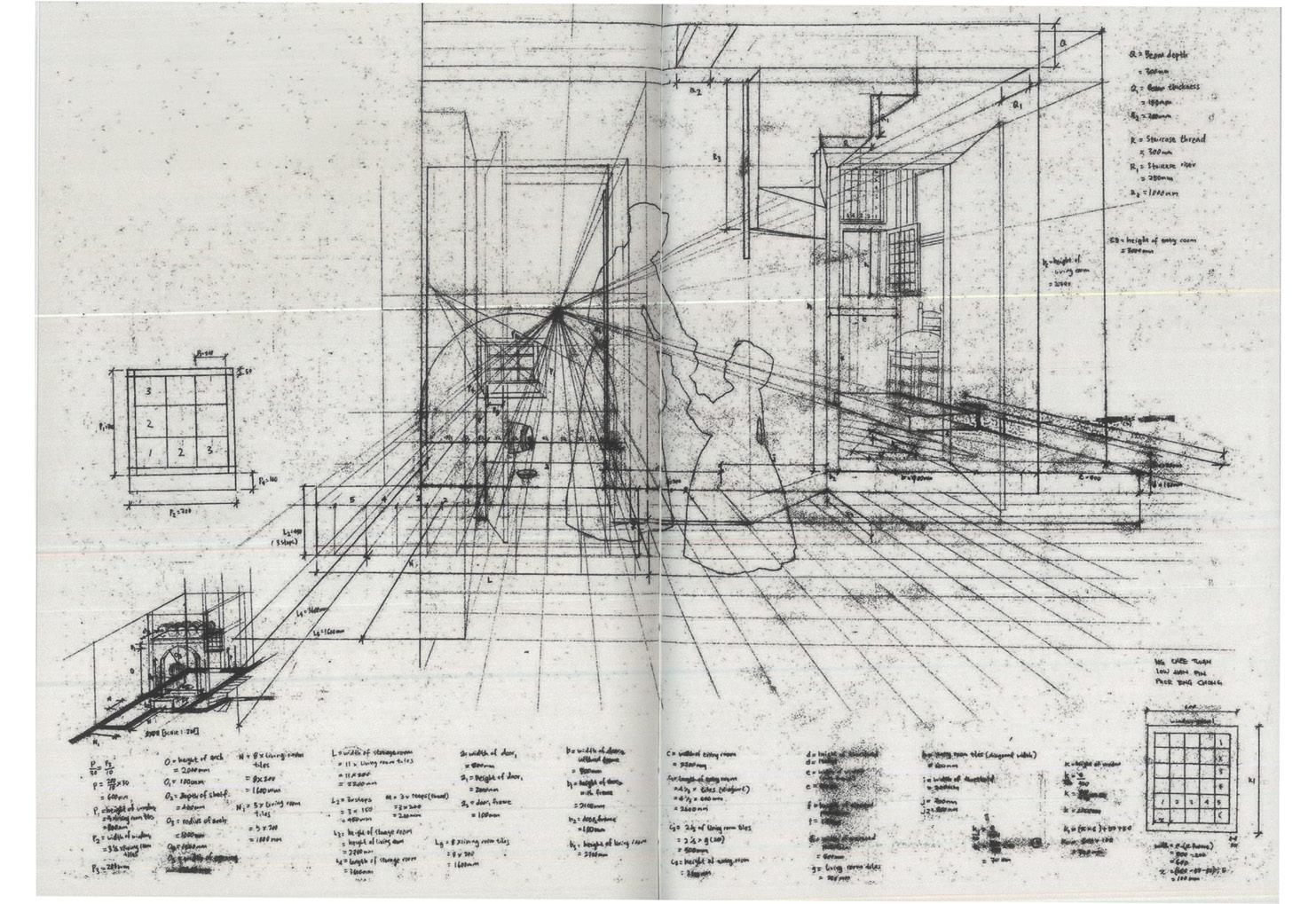
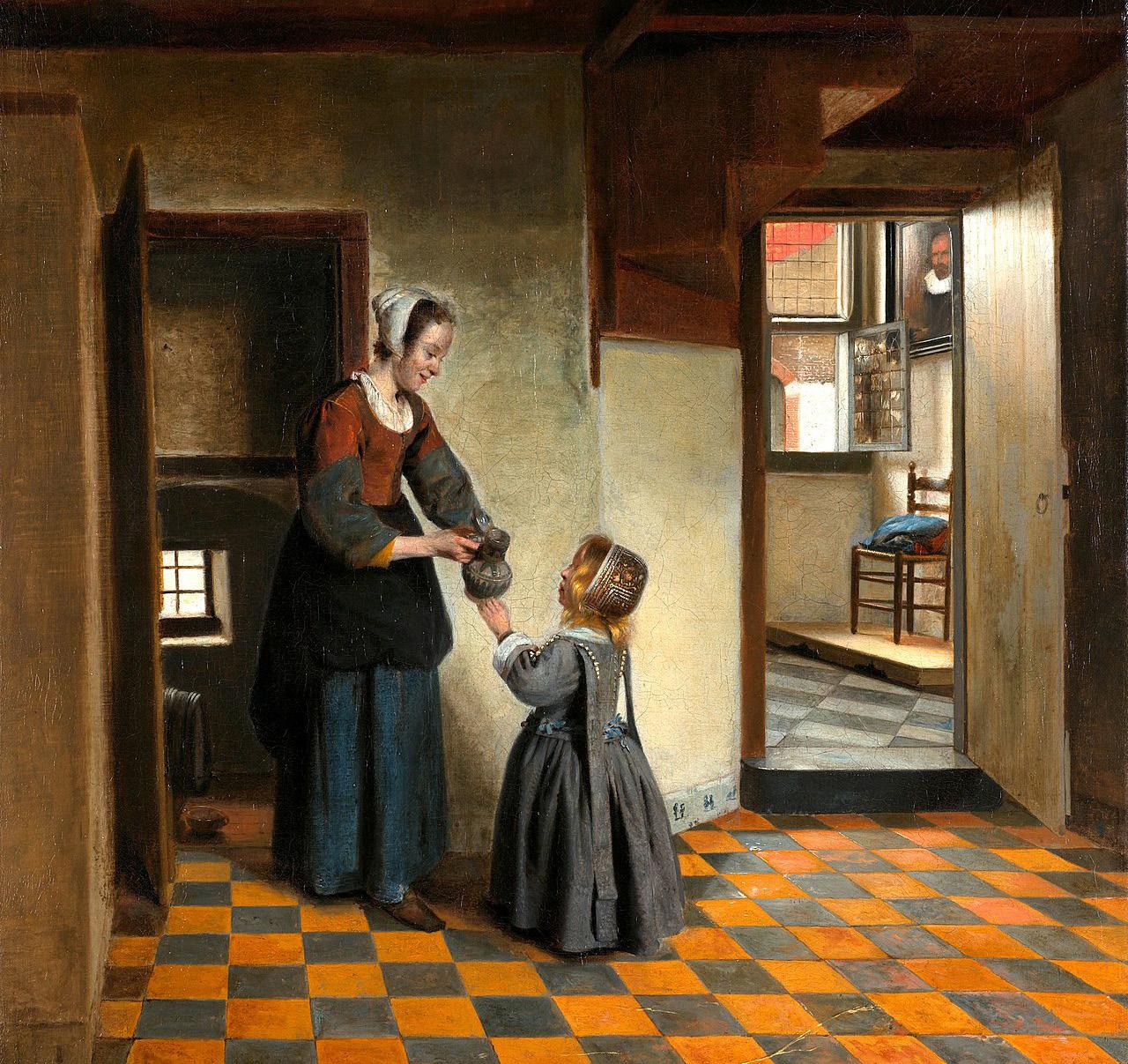
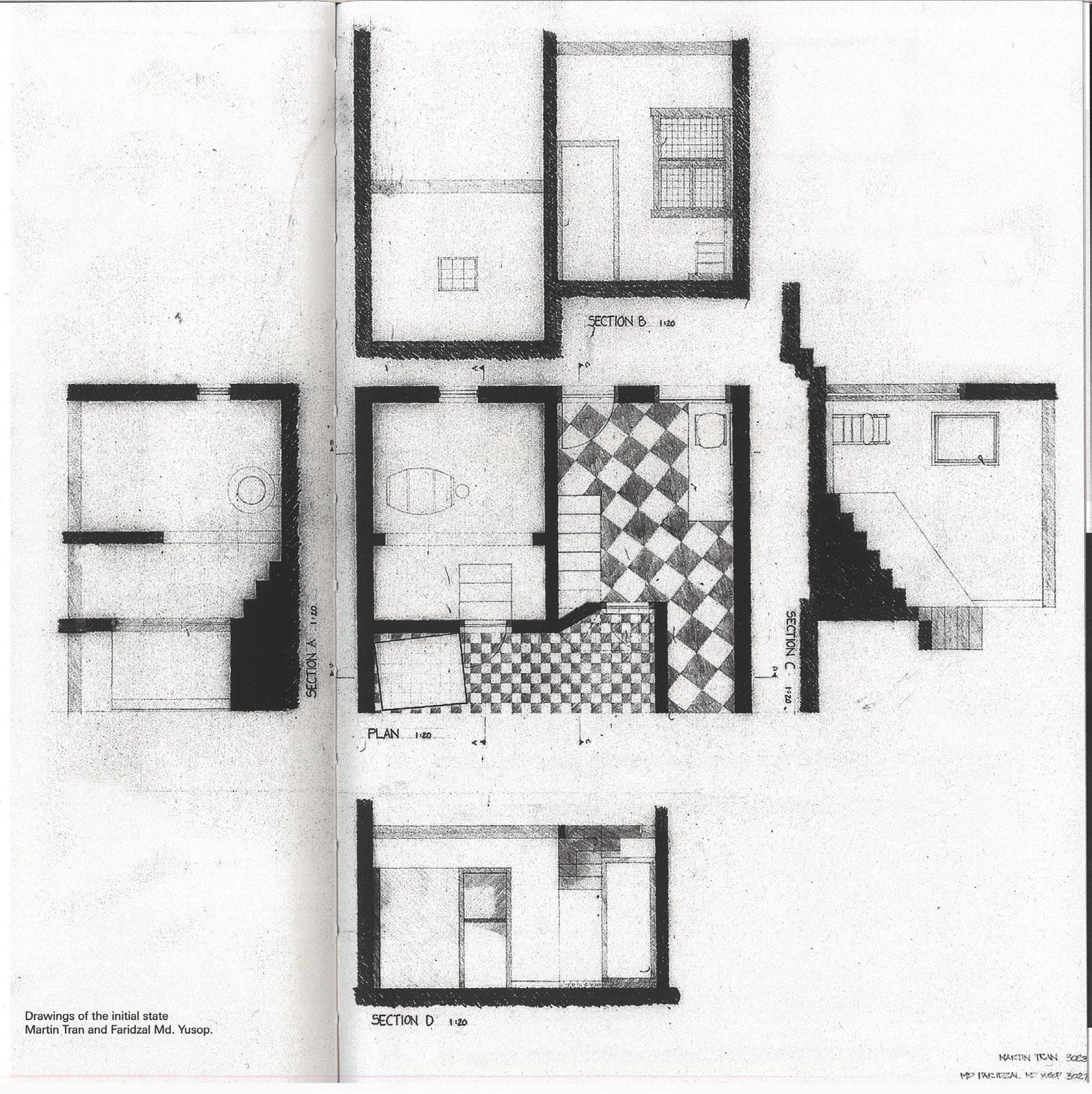
During this observation period, the students’ personal preferences and reflections about the paintings slowly became a part of the drawing as they were reflected on the paper. Two students, Martin Tran and Faridzal Yusop,38 for example, undertook the task of deconstructing the image to its geometric bones. This analysis through drawing allowed them to create plans and sections with precise dimensions (3.7). What might have initially seemed like a mechanical exercise in replicating the painting's geometries soon transformed into a profoundly reflective process.
3.4
Photograph of the students at work during the Through the Canvas Workshop, 2003, Flores & Prats Architects.
3.5 Perspective Analysis Drawing of Woman and Child in an Interior drawn during the Through the Canvas workshop. Drawing by Martin Tran and Faridzal Yusop, 2003.
3.6 Woman and Child in an Interior, Pieter De Hooch, 1658, Painting.
It was as if each line drawn became an act of deliberate thought. The students analysed every corner and surface of the ruin and made interpretive decisions about it. The methodological approach acted as an effort to decode the painter’s construction of space. Their observation slowly became its own project within the overall project. The chequered tiled floor provided a clear and measurable grid that demonstrated the principles of linear perspective, an ideal starting point for analysing depth, scale, and proportion. By first representing the tiles in perspective (3.5), they were able to understand how De Hooch used the floor pattern to lead our eye into the composition.
Reproducing the floor in plan and section (3.7) further allowed the students to translate the visual cues from the painting into architectural terms. As they drew the tiles, a structural base for the room began to emerge, with the floor acting as a visual anchor for positioning walls, doorways, and furniture. The elements the students observed during their initial observation (the perspective) were now reflected in the sections and plans, showing how the students had begun to respond to their own interpretations rather than the original painting. Flores & Prats emphasise that to extend or adapt a project, one must know it first, and to truly know it, one must draw it.39 Through meticulous drawing and re-drawing, the students began to internalise and make the paintings their own.
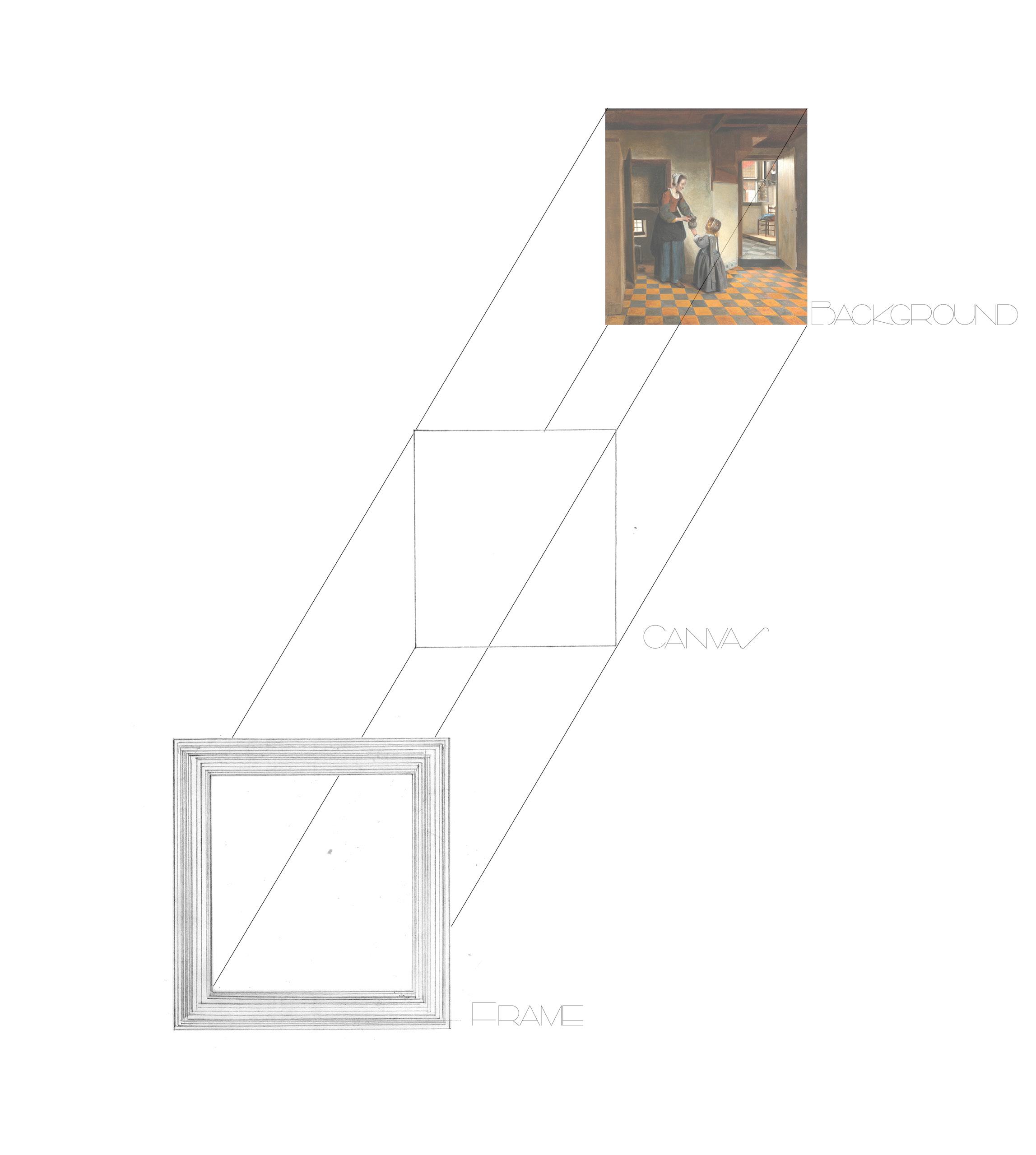
If the painting were categorized into a series of layers, one might begin to explore the relationship between the observer (the student), the canvas (the paper), and the scene (De Hooch paintings), questioning where they begin and end or whether such a definitive boundary exists at all. These layers could be the frame, the canvas, and the background (3.8). The frame serves as a physical border, the canvas represents an imagined plane, and the background withholds the scene in the painting.
3.7 Plan and Section drawn as an analysis of Woman and Child in an Interior, drawn during the Through the Canvas workshop. Drawing by Martin Tran and Faridzal Yusop, 2003.
3.8 Drawing to show the layers contained within the painting, Frame,
Canvas and Background. The drawing makes use of Woman and Child in an Interior to represent the Background. Drawing by Author, 2024.
Wolfgang Lotz helps develop these layers of the painting: frame, canvas, and background, in his writing on Rendering the Interior 40 He explores the viewer’s relationship with the architectural space portrayed within a drawing, emphasising how one's perception can be influenced by the boundaries imposed by the drawing itself 41 (referred to here as the frame). Lotz likens this concept to looking into a building’s interior through a glass wall, where the baseline of the drawing represents the base of the wall, serving as a boundary for the viewer’s imagination.42 The frame functions as the transition point between the depicted architectural space and the surface plane of the imagination. It shapes the viewer’s understanding of the depicted interior in the painting, as the baseline inherently defines the ground upon which the image is constructed. Beyond this baseline, the imagination is constrained, unable to move freely around or beneath it.
In this way, Lotz’s discussion resonates with the tasks undertaken by students in the Through the Canvas workshop by Flores & Prats. The students were asked to observe and draw what they see within the painting, framing their interpretations through their vantage points. If we think of the metaphorical glass wall as being placed at the students’ feet, the act of drawing becomes an exercise in understanding space from a fixed, situated perspective. The students’ assumptions about the room in front of them were conditioned by the frame of the painting (a frame that establishes two walls and a roof while defining the ground below as the ground upon which the students are standing). Much like Lotz’s viewer, the students were restricted from imagining beyond the bottom edge of their chosen painting, focusing instead on the layers of space that extend outward from their position toward the canvas. The act of drawing could become an exercise in translating spatial experience into a layered, interpretive image, constrained by the frame and shaped by their embodied perspective.
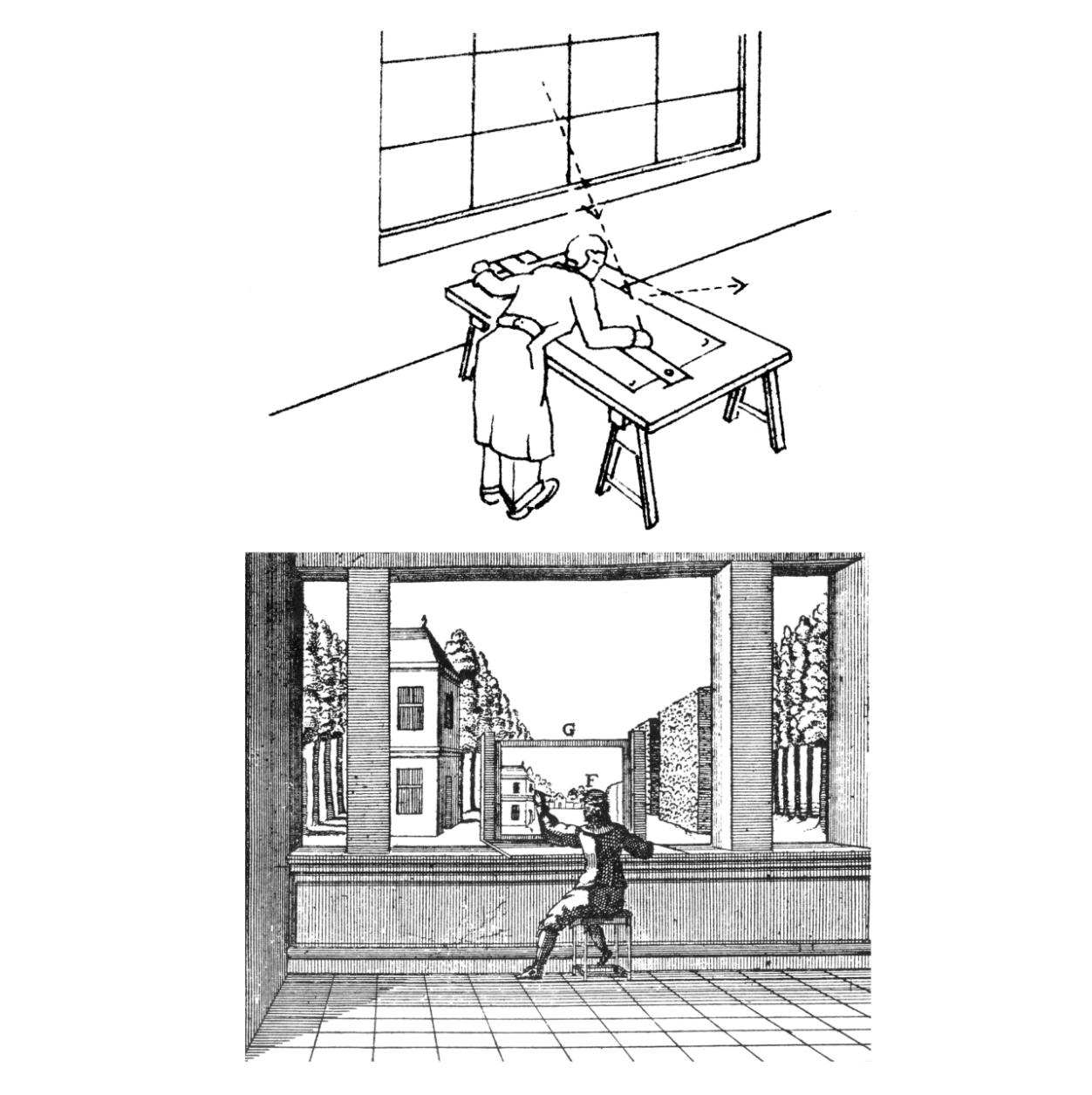
Paul Emmons, in Drawing Imagining Building, extends this exploration of perspective by delving into the physical and imaginative relationships between the architect, the drawing and the design process.43 Emmons emphasizes the embodied nature of architectural drawing, describing how the slight tilt of the drafting board positions the lower edge of the drawing closest to the drafter’s body (3.9).44 Emmons explains “a plan is always laid out with the front of the building located closest to the drafter to facilitate imaginatively entering the project realm.”45 This positioning reflects an act of imaginative apparitions,46 wherein the architect’s physical body is anchored to the table while their imaginative body projects itself into the represented space, traversing its interiors as if physically present.
Both Lotz and Emmons seem to agree there is a recurring theme of embodiment, the idea that architectural representation is inseparable from the physical and imaginative positions of the viewer or drafter, or in this case, the students. This theme is found to be vividly expressed in the workshop exercises. Just as Lotz’s viewer is guided by the glass wall and baseline, and Emmons’ architect imaginatively enters the design through the drawing edge, the students in the workshop negotiated their own spatial and imaginative boundaries as they drew. Their work became a dialogue between what is seen and what is imagined, grounded in their embodied engagement with both the site and the act of drawing.
The students in Through the Canvas engaged in a parallel process, combining observation and imagination to reinterpret the painting they encountered. Their task of drawing a house extending from the painting involved both a literal act of observing and a figurative act of inhabiting space through their representations. Like Emmons’ architect, the students relied on their embodied position in relation to their drawing tools and materials, with the baseline of their sketches marking the entry point into the imagined architecture. The student’s act of drawing is, therefore, a performative act of both exploration and construction, a negotiation between their physical experience of the building and the imaginative world they construct on paper.
3.9 Standing architect leaning over an angled horizontal drawing board square with the window wall. Bauentwurfsllehre (Bauwelt –Verlag, 1936) 168, Figure 4.
3.10 Detail of an artist’s vertical drawing frame. Jacque Dubreuil, La Perspective Patique (Dezallier, 1679)1, 118.
26. Ricardo Flores and Eva Prats, Through the Canvas (Barcelona: Actar D, 2008), p.15.
27. Ricardo Flores and Eva Prats, “ CV Flores I Prats,” Flores i Prats, accessed November 25, 2024, https://floresprats.com/cv/.
28. Ricardo Flores and Eva Prats, Flores & Prats : Sala Beckett: International Drama Centre. (Mexico: Arquine, 2020), p. 64.
29. Flores & Prats Architects, Thought by Hand (Mexico: Arquine, 2020), p. 32.
30. Flores & Prats Architects, Drawing without Erasing and Other Essays, ed. Moisés Puente (Barcelona: Puente Editores, 2023), p. 16.
31. Ibid., p. 16.
32. Ricardo Flores and Eva Prats, Through the Canvas (Barcelona: Actar D, 2008), p. 15.
33. Ibid., p. 15.
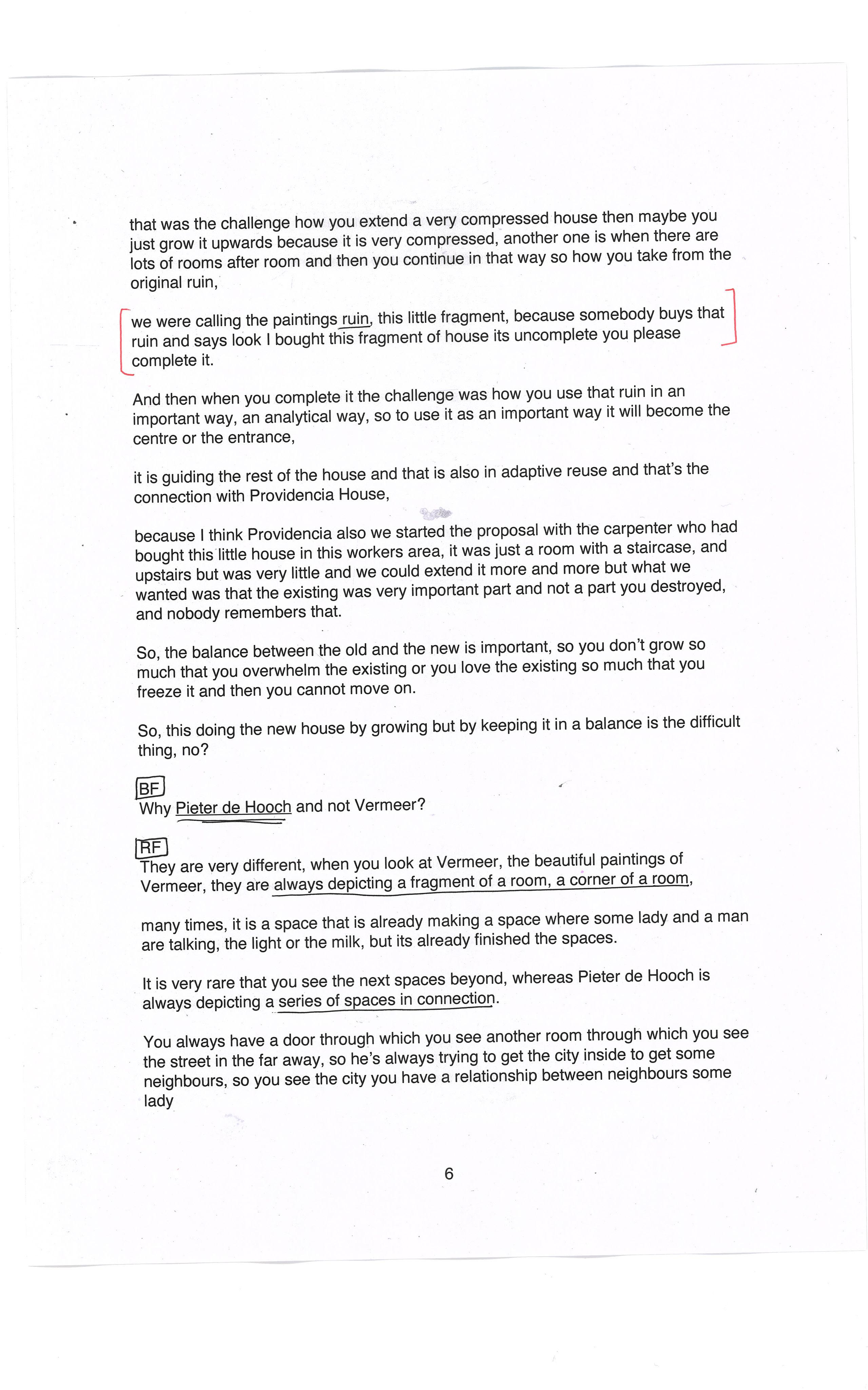
34. The term “ruin” was coined by Flores & Prats and mentioned to the author in their interview. They referred to the paintings as ruins because they are small fragments of a bigger picture within the painting. “A ruin is something someone usually buys and, in turn, asks themselves or someone else to complete it. Then when you complete it, the challenge was how to use that ruin in an important and analytical way, we ask the same of the students.” Ricardo Flores and Eva Prats, Flores & Prats Interview, interview by Arabella Fane, November 19, 2024, p. 6.
35. Ricardo Flores and Eva Prats, Through the Canvas (Barcelona: Actar D, 2008), 47.
36. Ricardo Flores and Eva Prats, Flores & Prats Interview, interview by Arabella Fane, November 19, 2024, p. 2.
37. Ibid., p. 5.
38. Ricardo Flores and Eva Prats, Through the Canvas (Barcelona: Actar D, 2008), p.60.
39. Ricardo Flores and Eva Prats, Flores & Prats : Sala Beckett: International Drama Centre. (Mexico: Arquine, 2020), p. 64.
40. Wolfgang Lotz, “The Rendering of the Interior in Architectural Drawings of the Renaissance,” in Studies in Italian Renaissance (Massachusetts: MIT Press, 1981), p.11.
41. Ibid., p. 11.
42. Ibid., p. 11.
43. Paul Emmons, Drawing Imagining Building : Embodiment in Architectural Design Practices (New York : Routledge, Taylor and Francis Group, 2019), p. 41.
44. Ibid., p. 41.
45. Ibid., p. 41.
46. A term coined by Flores & Prats meaning “when the world created by the painter allows us to get inside…into actions frozen for a moment.” Ricardo Flores and Eva Prats, Through the Canvas (Barcelona: Actar D, 2008), p. 45.
De Hooch’s Rooms
"De Hooch’s paintings represent the actions that belong to the everyday domestic activity within a house. Yet each daily duty is rendered and lit as if it were a ritual, a celebration. This defines the theme of these paintings: the celebration of the everyday." 47
Through the Canvas, Flores & Prats
De Hooch’s Rooms aims to discuss how De Hooch’s methods of representing the interior in his paintings affected the students’ observation and, in turn, how their representation of the fragment of the interior in the paintings was influenced by its architectural layout and surfaces.
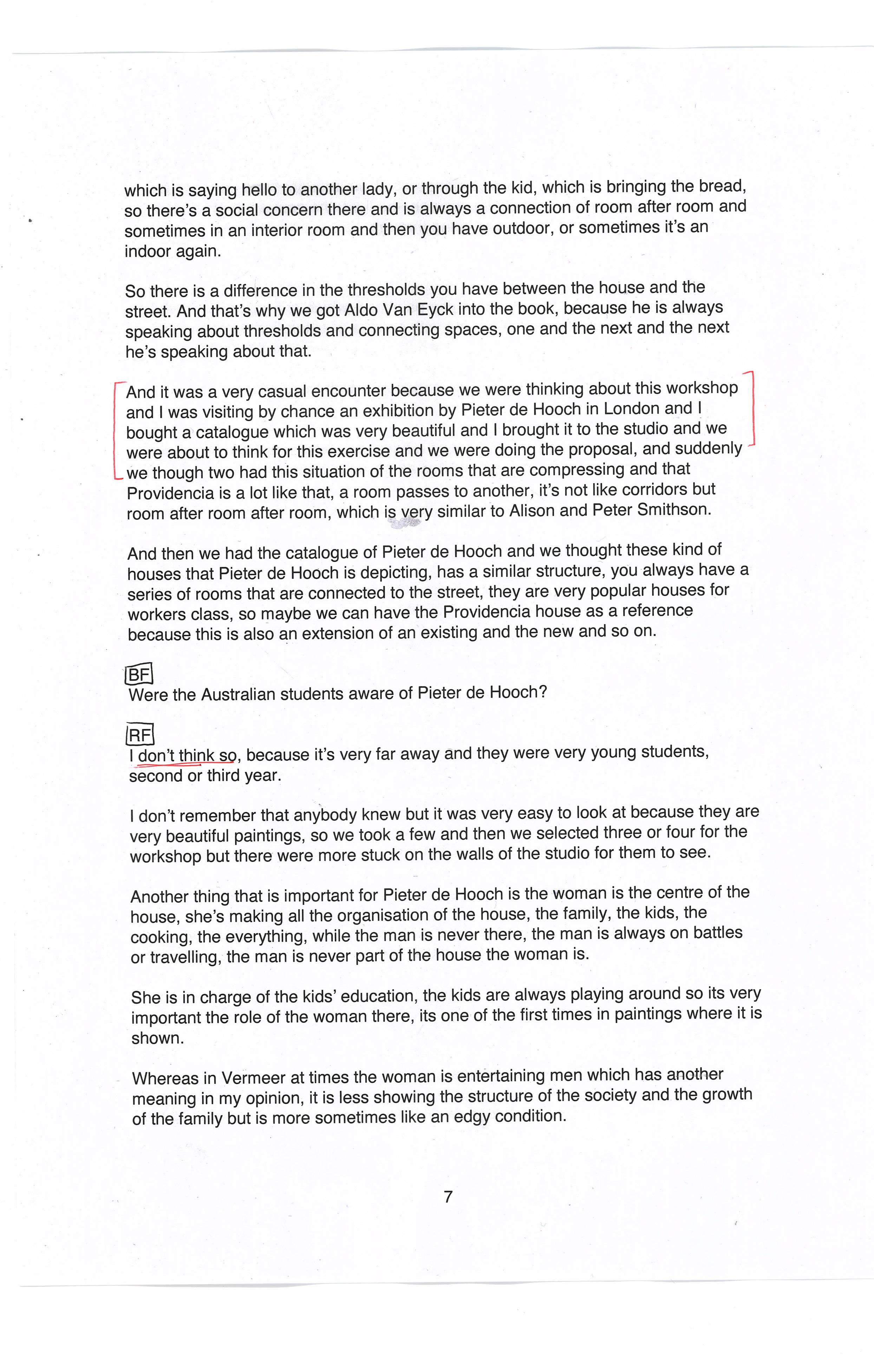
In conversation with Flores & Prats, they explained the decision to use Pieter De Hooch’s paintings for the Through the Canvas exercise as a casual one.48 After visiting an exhibition of De Hooch’s work in London, Flores purchased the accompanying catalogue, which showcased the artist’s exceptional use of illusion to construct scenes of the interior within his paintings. Flores & Prats place significant value on their collection of books, a collection that this catalogue was now a part of, as these books serve as ongoing sources of inspiration and reference in their architectural practice.49 The studio workspaces in Barcelona, surrounded by bookshelves, integrate these volumes into the daily processes of design and ideation. These books are not merely archival but active participants in the development of architectural practice.
In this context, the De Hooch catalogue was situated on a desk amidst preparatory materials for the Sydney workshop as well as the studio’s active architectural project, Providencia House. This project (4.1), an extension of a former working-class home in Badalona, exhibited spatial parallels to de Hooch’s interiors (4.2). Both architectures shared elongated, narrow layouts with sequences of interconnected spaces linked by windows and corridors. Flores & Prats identified these visual affinities in the workshop brief and strategically utilised Providencia House as a reference point to anchor the theoretical framework of the workshop.50 The decision enabled the students to situate their observations and explorations within a concrete architectural precedent. The key requirement of the exercise was that students’ proposals incorporate the fragments (ruins) from De Hooch’s paintings into their designs for the house’s extension.51 The paintings each displayed a different point of departure, and the series of spatial fragments allowed for a wide range of proposals from the group of students.
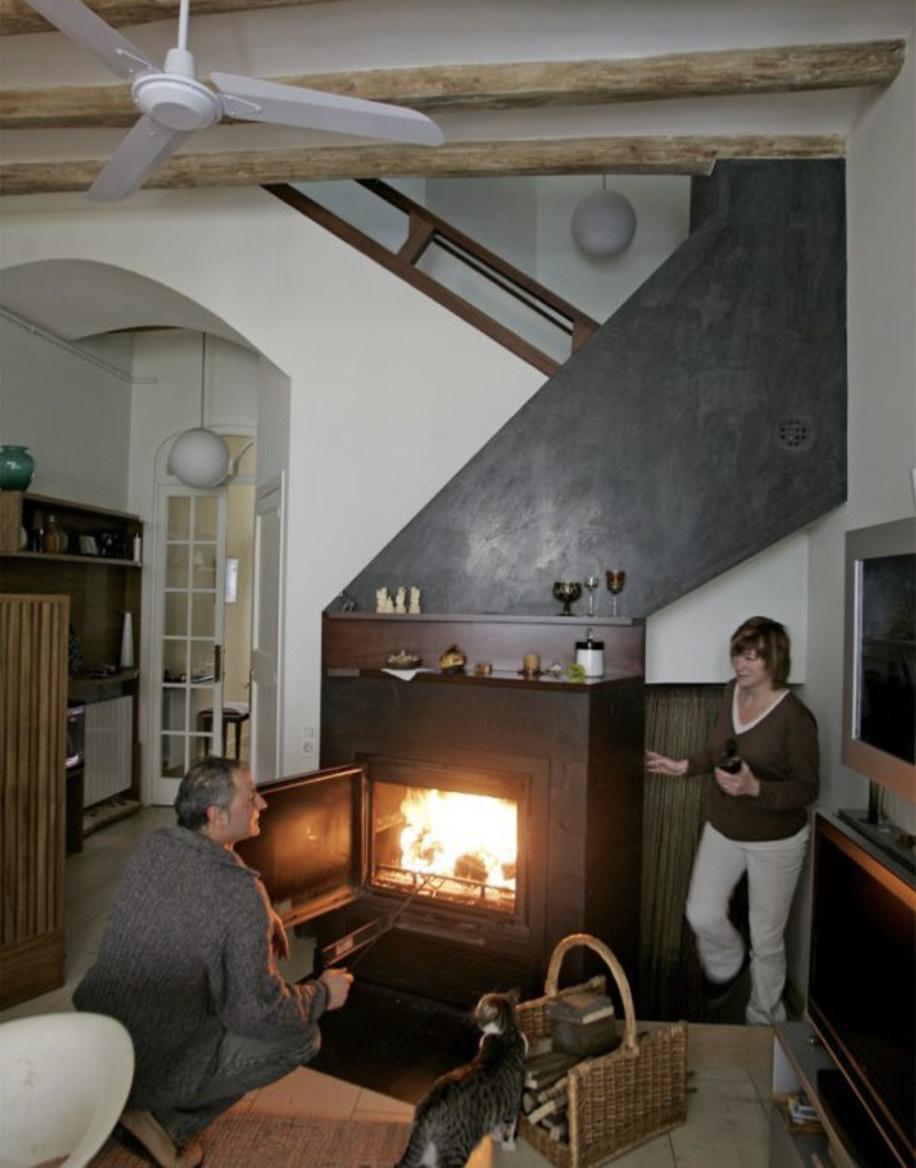
4.1 Photograph of the interior in Providència House, Flores & Prats Architects, 2002, Photograph by Àlex García.
4.2 A Woman with a Young Boy Preparing for School, Pieter De Hooch, 1660-1663. Painting.
Johnathon Crary’s Techniques of the Observer offers insight into the relationship between the concepts of “observer”52 and “representation.”53 I believe these ideas will help structure our understanding of De Hooch’s depiction of interior surfaces and their influence on the students’ observations. Crary defines the observer as a historically specific construction of the individual who perceives the world under sets of rules and practices; we, as observers, are influenced by our surroundings.54 Crary argues that the observer is an active participant in the process of seeing, shaped by cultural developments.55 In the workshop, students engage with the painting not merely as a visual object but as a stimulus that actively informs their observational process, prompting them to perceive and interpret the spaces in a way that acknowledges both their subjective position as observers and the historical context of the represented interiors. Relating this to De Hooch, Crary’s argument indicated how De Hooch’s paintings do not display static images; they draw viewers into the painting by never depicting closed rooms or corners, leaving the spaces within his works inviting and perpetual. And it is precisely this perpetuality that Flores & Prats can exploit in their teaching so pertinently.
His paintings celebrate everyday domestic life, continually portraying scenes of domestic activities (eating, drinking, dancing), portraying middle-class society with elegance. The student's position as observers meant they were now becoming a part of this fragment in the painting, as they were establishing their personal perspectives on it via drawing and actively engaging with this role of observation. In turn, creating a bridge between the historical artwork and modern architectural dwellings.
While Crary largely discusses the concept of representation in the context of the fifteenth to the eighteenth centuries in the book, what is interesting for this dissertation is his argument that the nineteenth century marked a rupture in this paradigm of representation. The introduction of new technologies and theories revealed representation not as a medium for accessing an objective reality but as a subjective, unstable, and fragmented process.56 The depiction found in De Hooch’s artwork can be interpreted as a collection of layered compositions that create a separation from the outside world. Simultaneously, these works establish an internal structure that both interacts with and diverges from the adjacent street.
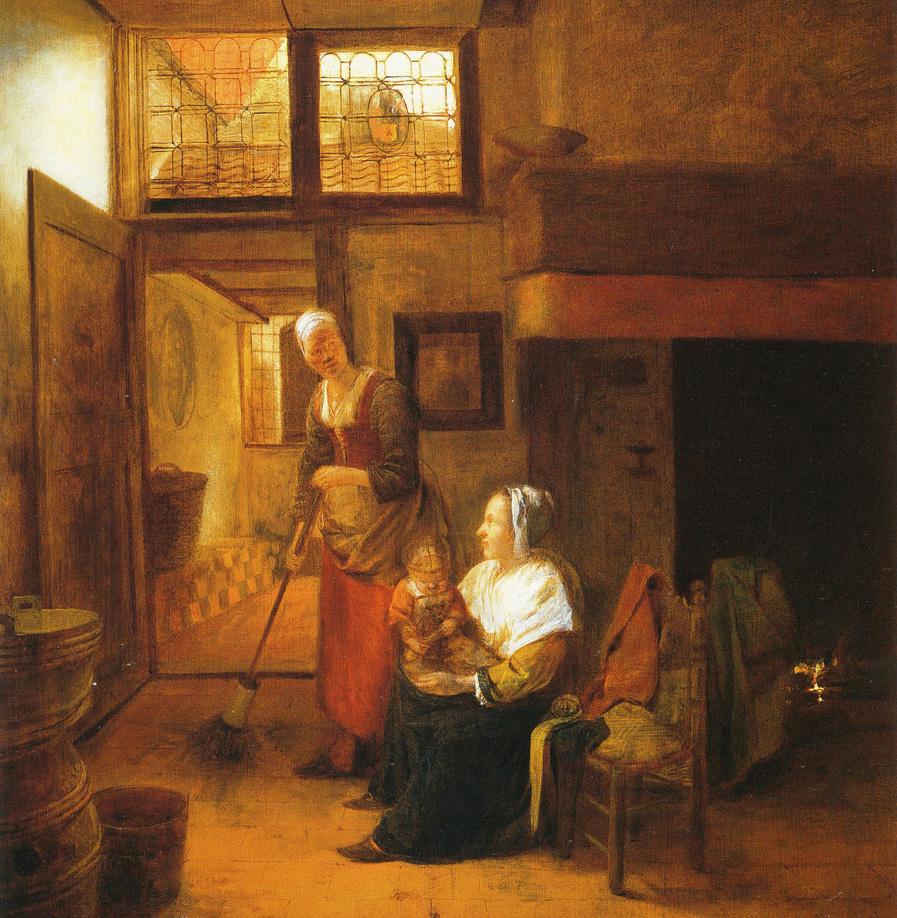
4.3 Mother and Child with a Serving Woman Sweeping, Pieter De Hooch, 1655 – 1657. Painting.
In his paintings, he depicts the in-between spaces, the areas that create a visual conversation between inside and outside.57 While an interior space may not entirely shut itself off from the outside, it is connected through the relationship between its inhabitants and their private realm in relation to the city(4.5)58
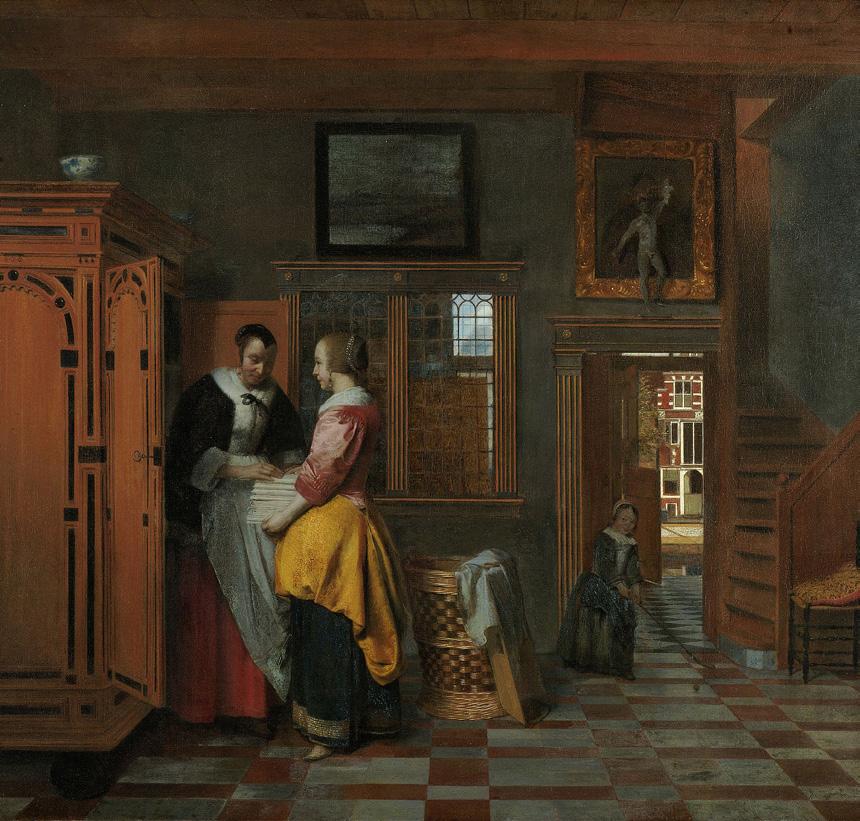
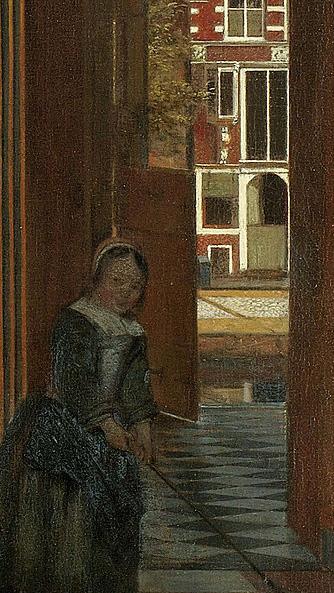
By examining the interaction between the representation of the interior and the speculative process of imagining its exterior, we can better articulate the way students expanded upon these scenes and transformed them into a more comprehensive vision of a house. For students to effectively propose a house extension based on the painting, it is essential to analyse how the interior transitions into exterior space and how the interior itself becomes a defining element in shaping the character of the architecture. This analysis can reveal how the observed interior serves as a foundation for conceptualising and extending the structure outward using drawing. Charles Rice’s Emergence of the Interior helps to explain the differences between interior and exterior in architectural representation, which may be important to this discussion.
The interior is discussed as an entity that, while distinct from the exterior, remains connected to it through the inhabitant’s engagement with the broader and public realm.59A passage that I found particularly
4.4 Two Women Beside a Linen Chest, with a child, Pieter De Hooch, 1663. Painting.
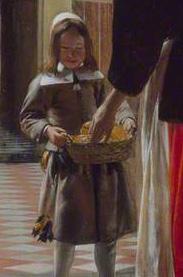
4.5 Fragment of Two Women Beside a Linen Chest, with a child, Figures and relations to the city.
compelling for this discussion is the idea of the “labour of collecting,”60coined by Charles Rice. Rice suggests that “objects become domesticated via the collection,”61 implying that an object brought into a home takes on a new, domestic role. De Hooch frequently positions his figures in moments of exchange, an object, or a conversation (4.6). This concept prompts us to consider the origins of these items, and when objects are handed to figures in the painting (such as bread) we might interpret this architectural framing as suggesting the movement of the object into another room or even back outside. De Hooch’s method of depicting an active, interactive interior effectively invites us to imagine what lies beyond the confines of the scene and to wonder how these scenes continue over time.
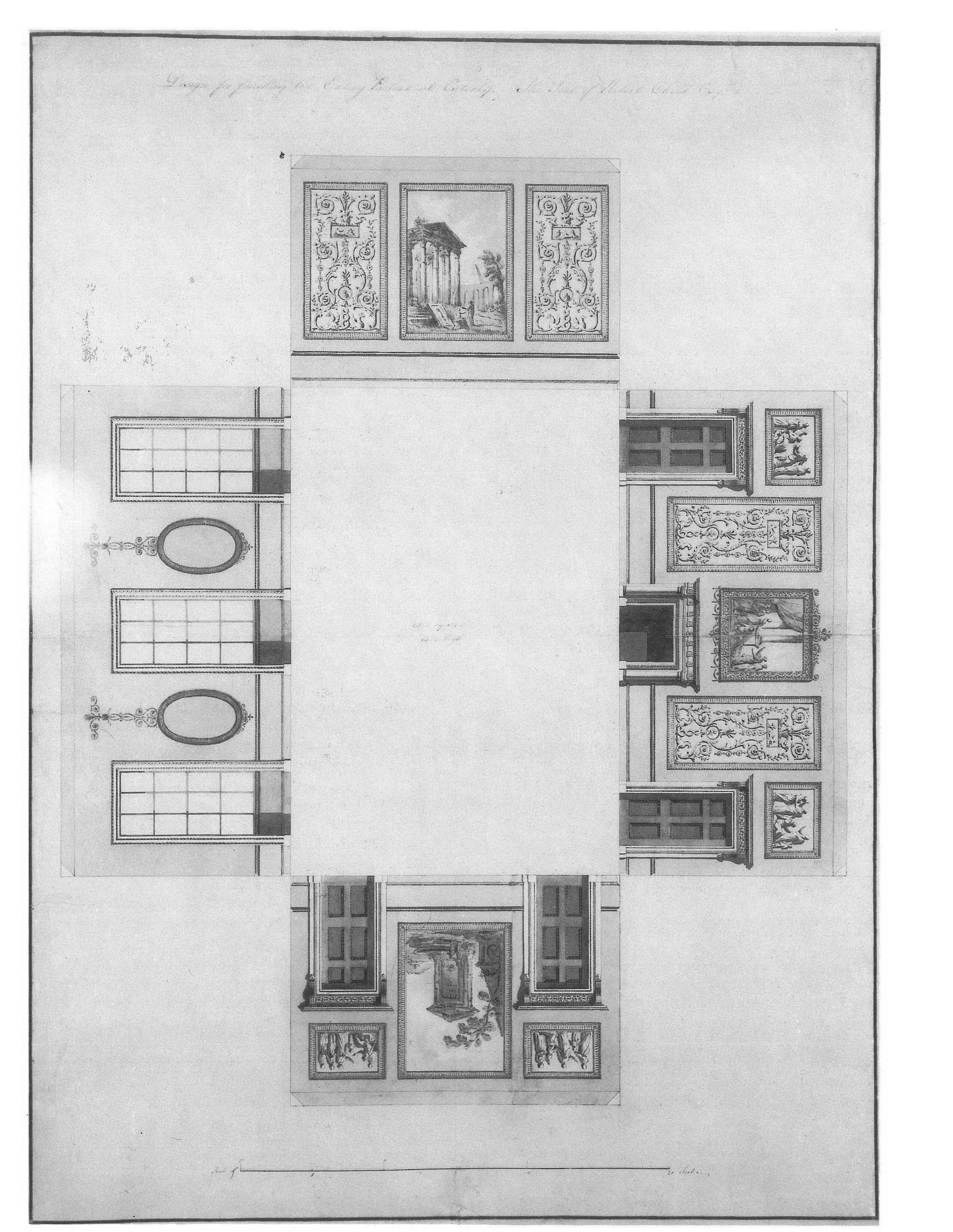
In a similar manner to this, Robin Evans discussed the evolution of the interior’s representation in architecture in The Developed Surface 62 We might now wonder how the representation of the interior in architectural drawings helps us to imagine what the exterior would look like, as the students would have done for the painting. Evans discussed that the interior, or the room, attained legibility in architectural drawings with difficulty, as it was emerging as a new subject matter from the mid-eighteenth century.63 He noted that this change in representation was marked by the advance of the “developed surface drawing,”64
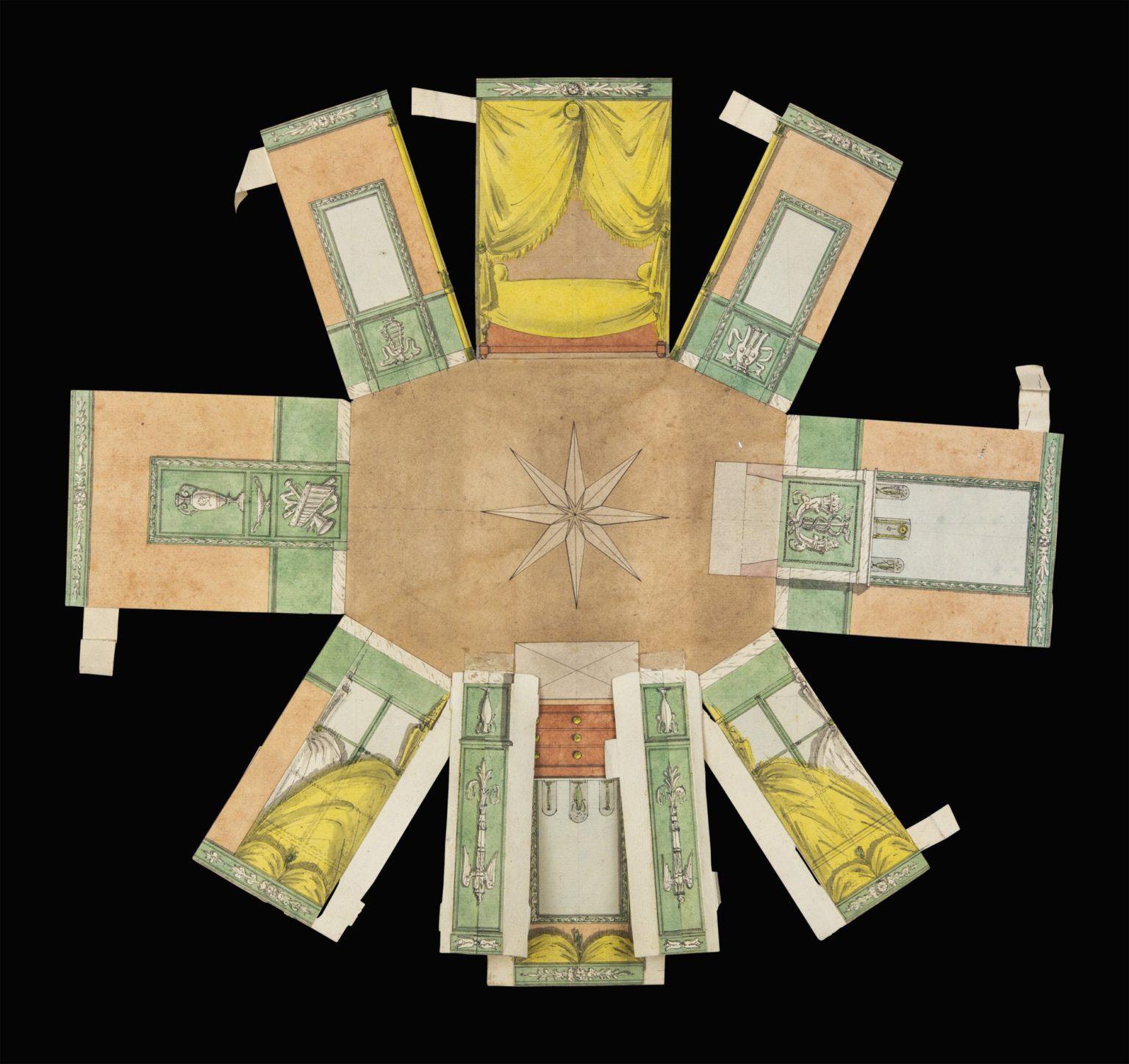
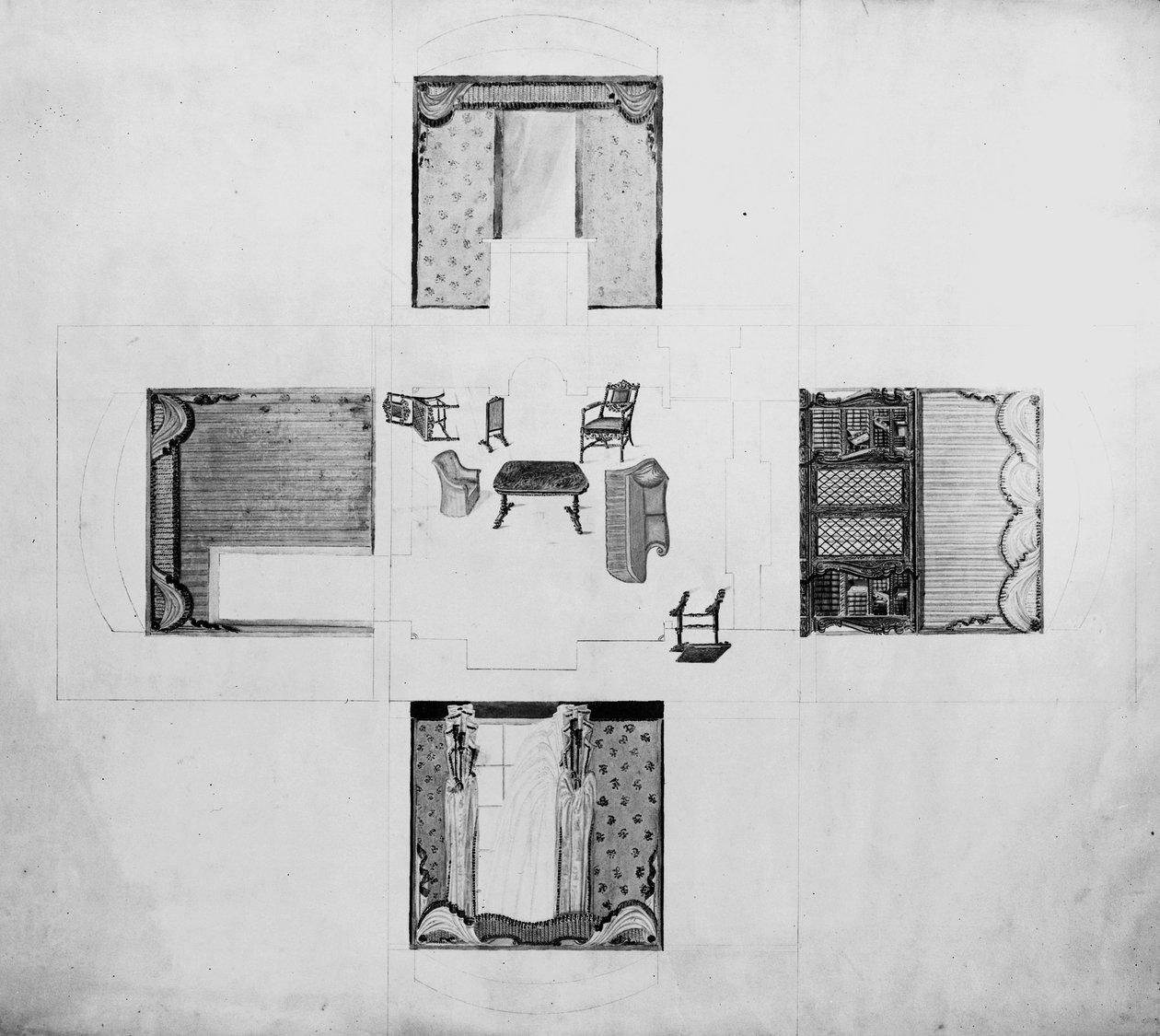
an eighteenth-century drawing technique that emphasises the surface qualities of interior space while disregarding the structural elements of the building, a favoured style of drawing by Robert Adam. (4.7). The developed surface technique disrupts the continuity of spaces, with a three-dimensional room displayed on a two-dimensional paper, removing the depth that the room might have into a connecting space.66 This technique became a way of turning the architecture inside out.67 What is interesting in Evans’s discussion of the developed surface is different modes of representation can “make it possible to see some things more clearly by suppressing other things: something gained, something lost.”68 Our field of visibility is misguided,69 which appears to be the intention behind this style of architectural drawing, as well as the paintings of Pieter De Hooch. The observer’s sense of place is obscured, compelling them to navigate the space according to the rules established by the artist or architect.
4.6 Fragment of A Boy Bringing Bread, Handing over Bread.
4.7 Design for the Dining Room, Design for funrnishing the Eating Parlous at Osterly. The Seat of Robert Child Esqr. Robert Adam (1967).
4.8 Drawing model for a Music Room, Pierre-François-Léonard Fontaine (1762–1853), c.1803. Pen, ink and watercolour on paper, 120 × 185 × 144 mm. DMC 2081.
4.9 Furnishings for a small drawing room. Gillows and Co. 1822.
Notes
47. Ricardo Flores and Eva Prats, Through the Canvas (Barcelona: Actar D, 2008), p. 17.
48. Ricardo Flores and Eva Prats, Flores & Prats Interview, interview by Arabella Fane, November 19, 2024, p. 7.
49. Flores & Prats Architects, Thought by Hand (Mexico: Arquine, 2020), p. 28.
50. Ricardo Flores and Eva Prats, Through the Canvas (Barcelona: Actar D, 2008), p. 28.
51. Ibid., p. 48.
52. Jonathan Crary, Techniques of the Observer; on Vision and Modernity in the Nineteenth Century (Massachusetts: MIT Press, 1992), p.6.
53. Ibid., p.6.
54. Ibid., p.6.
55. Ibid., p.7.
56. Jonathan Crary, Techniques of the Observer; on Vision and Modernity in the Nineteenth Century (Massachusetts: MIT Press, 1992), p. 1.
57. Ricardo Flores and Eva Prats, Through the Canvas (Barcelona: Actar D, 2008), p. 21.
58. The boy (figure number ), positioned in the “deepest” part of the painting at the threshold between interior and exterior, gazes directly at the observer, acknowledging their presence and inviting them to journey through the house from their position to the street at the back. Ricardo Flores and Eva Prats, Through the Canvas (Barcelona: Actar D, 2008), p. 68.
59. Charles Rice, The Emergence of the Interior; Architecture, Modernity, Domesticity (London: Routledge, 2007), p. 4.
60. Ibid., p.13.
61. Ibid., p.13.
62. Robin Evans, “The Developed Surface; an Enquiry into the Brief Life of an 18th-Century Drawing Technique,” in Translations from Drawing to Building and Other Essays (London: AA Publications, 2023), p.176.
63. Ibid., p.176.
64. Ibid., p.177.
65. Iris Moon, “Fontaine: Hide-And-Seek,” drawingmatter.org, November 1, 2019, https://drawingmatter.org/hide-and-seek/.
66. Robin Evans, “The Developed Surface; an Enquiry into the Brief Life of an 18th-Century Drawing Technique,” in Translations from Drawing to Building and Other Essays (London: AA Publications, 2023), p. 184.
67. Iris Moon, “Fontaine: Hide-And-Seek,” drawingmatter.org, November 1, 2019, https://drawingmatter.org/hide-and-seek/.
68. Ibid., p. 175.
69. Ibid., p. 175.
Observing the Unseen
In Front and Behind70
"To fix thoughts and reflections upon the paintings by drawing allows a dialogue between the mind and the hand. It is a process of compiling all the observations and reflections made of a painting, like a “visual record” through drawing."71
Through the Canvas, Flores & Prats
A drawing – working or final – will contain several inherent records of conversations. These conversations are sketched onto paper, printed as photographs, or scribbled onto the corner of an illustration. Moreover, they are often layered on top of one another, on a desk, or hung on the wall in such a way as to depict the timeline in which these conversations occurred. Throughout this creative process, some ideas will inevitably become more visible than others; one example of how this could be elucidated is when ideas are drawn over repeatedly in an act to remember what it was you were trying to picture at that moment.
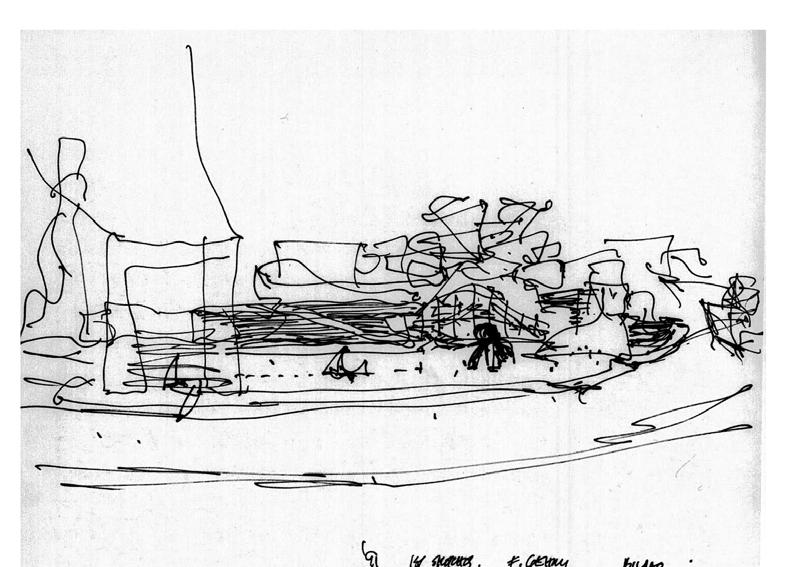
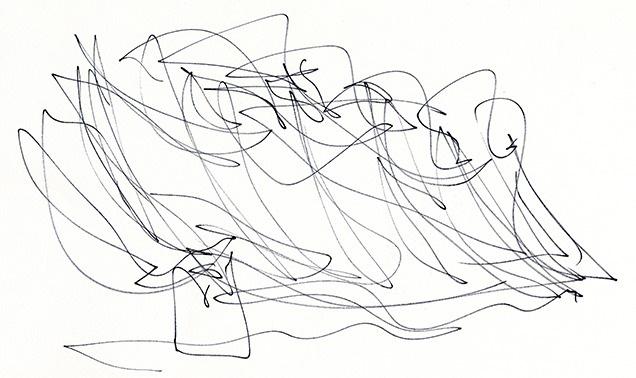
When examining our drawings, we may find ourselves uncertain about what we are attempting to convey or comprehend. Even when a drawing appears ‘complete,’ we might still struggle to discern what lies within it. This is true of Frank Gehry, who claimed to struggle to discover his buildings within his own drawings.72 Gehry explained that if you were to catch him when he is “really drawing”73 it became a “frantic kind of searching”74 for the idea he’d embedded within the drawing. Gehry’s suggestion here is an apt portrayal of
5.1 Students at work observing the paintings, using drawing tables, set squares and photographs. 2003, Flores & Prats Architects.
this layered, intangible ‘jumble’ that drawings exhibit; his proposal of frenzied inquisition indicates that to view drawings as a singular, simple narrative would be to misunderstand what it means to be drawn.
An architect’s skillset, naturally, lies in the ability to successfully translate ideas from the mind onto paper and ultimately into a building. Gehry’s acknowledgement that he struggled to find his ideas in the sketches (as one can see from the images below) is not to state that he did not know how to translate his thoughts to paper but to appreciate the technique of drawing and translating. Through recognition of how the movement of our hand on paper can become a tool for uncovering and shaping our creative thoughts, we need not become so focused on searching for exact ideas within the work.
This approach is precisely what Flores & Prats sought to teach the students in the Through the Canvas workshop. As they wrote, “One basic aspect of this exercise was proposing a working method that emphasised the presence of drawings as a fundamental tool to think through the projects.”75 The workshop explored the concept of ‘in front’ and ‘behind.’ Students’ imaginations depicted what lay ‘behind’ the painting, while the observable reality represented what was ‘in front.’ Thinking about both ‘in front’ and ‘behind’ simultaneously occupies an uncertain space between abstraction and reality, a space where ideas take form. This space that exists between ‘in front’ and ‘behind’ is filled with conversations in drawings that emerge as representations of translated observations and realities. This space can further be understood as analogous to the relationship between architectural drawings and buildings that represent them.
5.2 Guggenheim Museum Bilbao, Frank Gehry, 1991, Bilbao, Spain.
5.3 Foundation Louis Vuitton, Frank Gehry, 2006, Paris, France.
In alignment with Evans’ propositions, Louis Kahn underscores the necessity of cultivating a personal architectural language, asserting: “We must learn to see things for ourselves, to develop a language of self-expression. The capacity to see comes from persistently analysing our reactions to what we look at. The more one looks, the more one comes to see.”84 Kahn’s emphasis on the act of ‘looking’ and ‘seeing’ highlights a skill that should be integral to architectural education, as the ability to translate conceptual ideas onto paper remains a cornerstone of architectural design. However, the growing reliance on digital tools in contemporary architectural practice appears to be influencing pedagogical approaches within architecture schools. This shift raises concerns about the extent to which students can develop the nuanced skill of observation solely through digital means. One would then argue that the acts of ‘looking’ and ‘seeing’ are best cultivated through the intuitive practice of hand drawing.
Therefore, Evans’s notion of translation suggests that architects operate within the interpretive space between ‘in front’ and ‘behind’, acting as translators who must negotiate between abstract and reality, with the subsequent result being a drawing. Real architectural drawings are just expressions of deep architectural thinking,85 with the architect inside the drawing in a circle of infinite interpretation and discovery.
5.4 The large front room facing Carrer de Trafalgar, with employees building models for a deadline. Photo: John Hill/World Architects, 2022.
In Front and Behind
Notes
70. The essay In Front and Behind in the book Through the Canvas, explores the methods students use to visualise what lies behind the painting by carefully observing its front, all the clues about what could be concealed are embedded within the visible surface.
71. Ricardo Flores and Eva Prats, Through the Canvas (Barcelona: Actar D, 2008), p. 76.
72. Esther da Costa Meyer, Frank Gehry: On Line (New Jersey: Princeton University Art Museum, 2008), p.26.
73. Ibid., p. 26.
74. Ibid., p. 26.
75. Ricardo Flores and Eva Prats, Through the Canvas (Barcelona: Actar D, 2008), p.77.
76. Robin Evans, “Translations from Drawing to Building,” in Translations from Drawing to Building and Other Essays (London: AA Publications, 2023), p. 141.
77. Ibid., p. 141.
78. Ibid., p. 141.
79. Adrian Forty, Words and Buildings : A Vocabulary of Modern Architecture (New York: Thames & Hudson, 2000), p.31.
80. Robin Evans, “Translations from Drawing to Building,” in Translations from Drawing to Building and Other Essays (London: AA Publications, 2023), p.142.
81. Ibid., p. 141.
82. “Definition of Transfer,” Merriam-webster.com, 2019, https://www.merriam-webster.com/dictionary/transfer.
83. Robin Evans, “Translations from Drawing to Building,” in Translations from Drawing to Building and Other Essays (London: AA Publications, 2023), p. 142.
84. Quote by Louis Kahn in, Michael Merrill, Louis Kahn: The Importance of a Drawing (Zurich: Lars Müller Publishers, 2021), p.49.
85. Kendra Schank Smith, Architects’ Drawings: A Selection of Sketches by World Famous Architects through History (Massachusetts: Architectural Press, 2005), p. 1.
Reading Into Drawing Out From86
“…each depiction implies an indefinite series of completions, so that the possibilities are fundamentally innumerable, and the process fundamentally interminable. In this sense, drawing and design become the indefinite finishing of what is always already there.”87
Through the Canvas, Flores & Prats
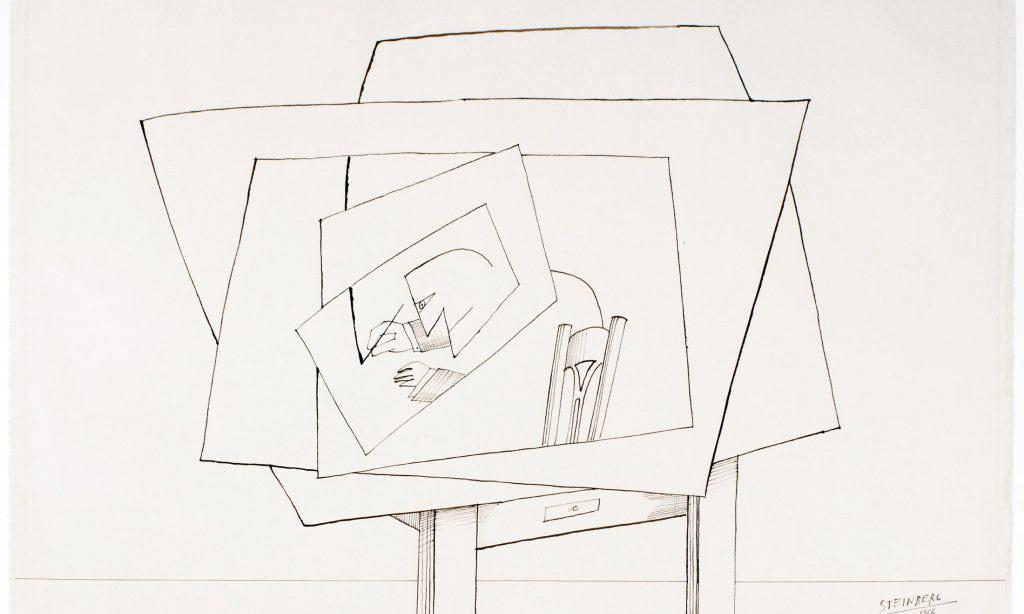
An architect’s mind is projective.88 Projective refers to the understanding that architects think and create with a forward-looking vision; they imagine spaces and structures that do not exist yet. This mindset involves anticipating how spaces will be used and experienced in the future, considering the behaviours, needs, and emotions of those who will inhabit them. A drawing serves as an extension of the architect’s mind, allowing those projective thoughts to be interwoven and developed until the drawing itself embodies those ideas. As this process unfolds, the boundary between the architect and the drawing can blur, making it increasingly challenging for the architect to step back and observe the original idea that had initiated the work.
6.1 Drafter at the drawing board, Saul Steinberg, The Spiral (1966). Ink on paper, 19 x 25. The Menil Collection, Houston.
Observing the Unseen
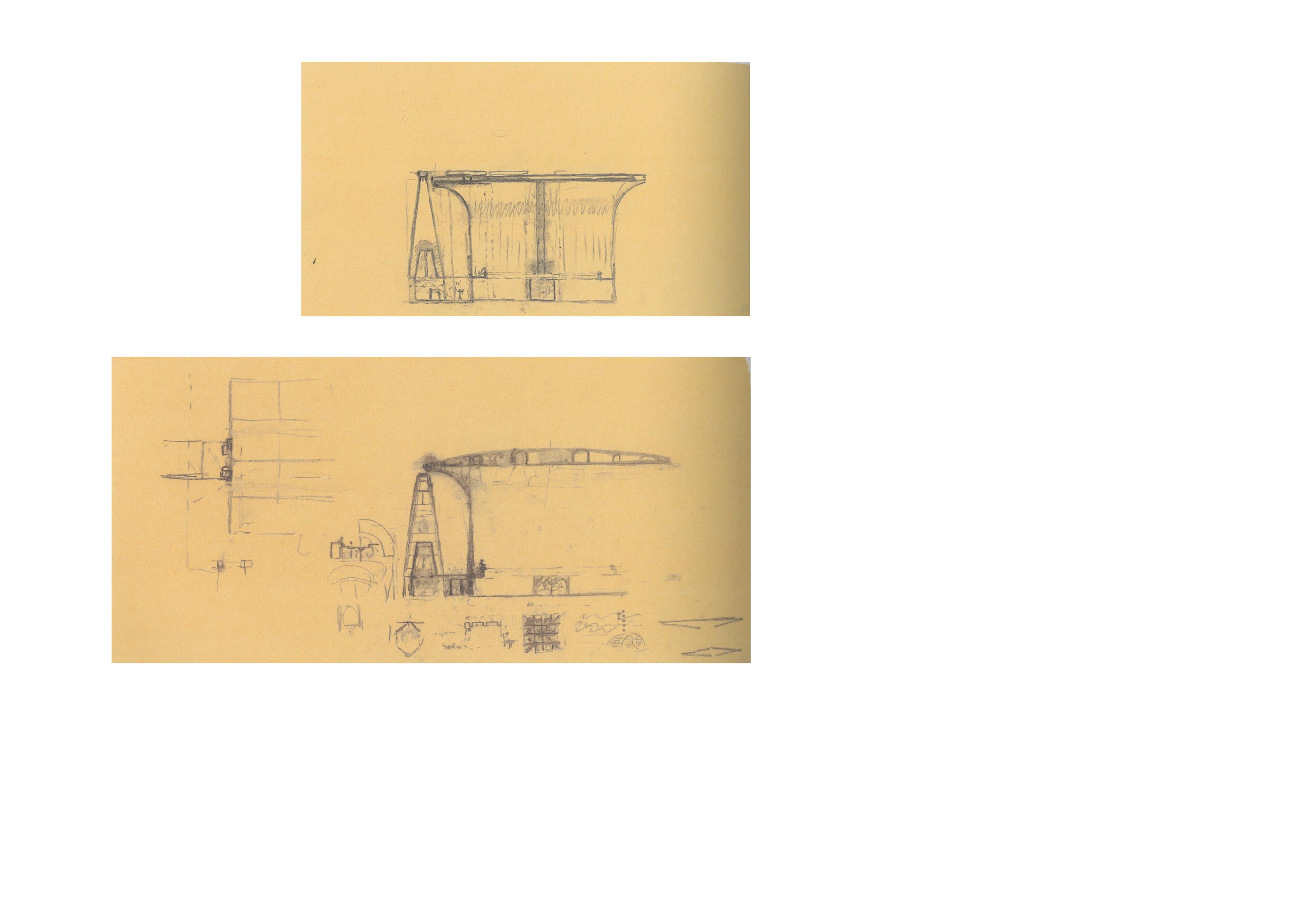
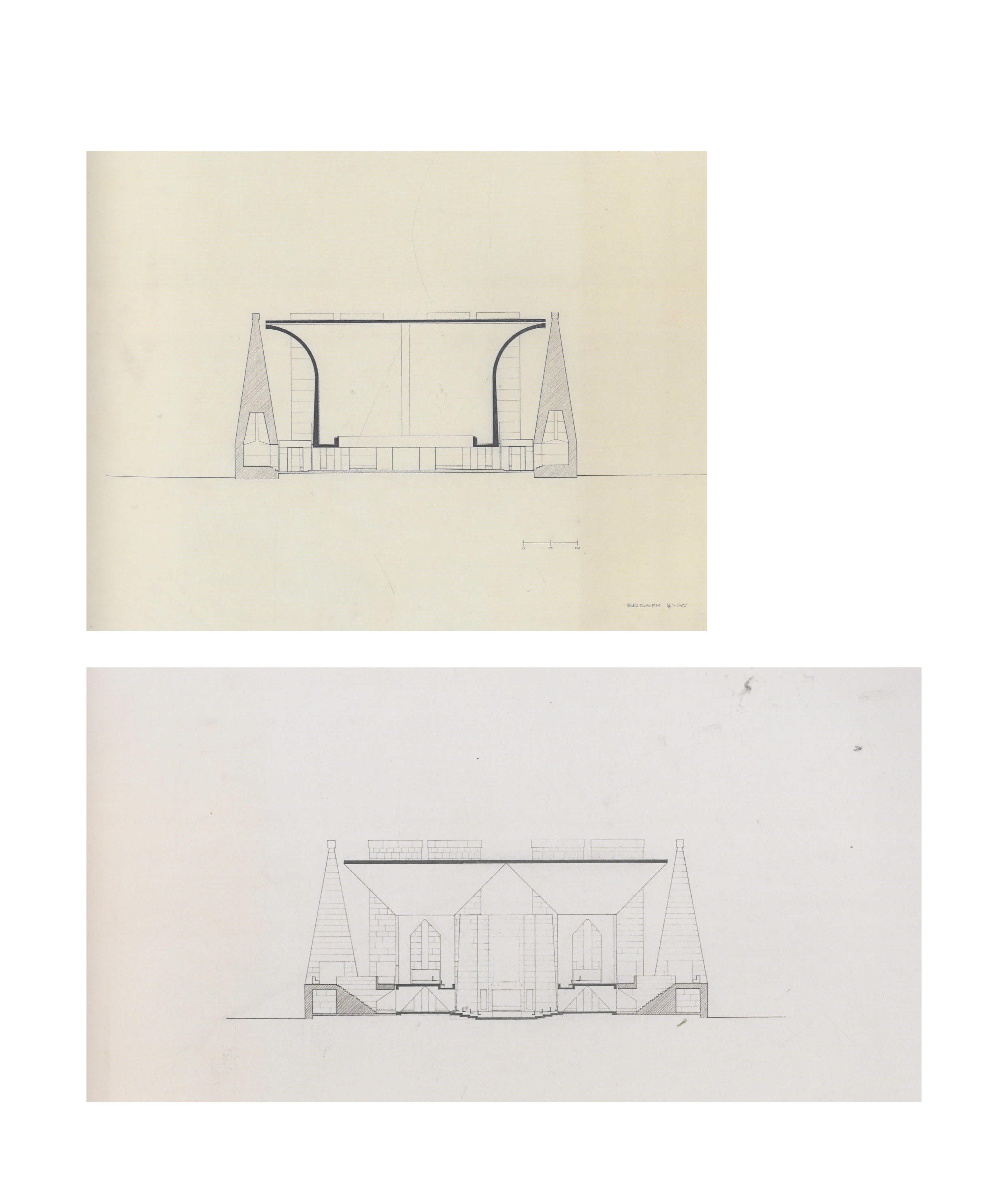
This discussion leads us to Michael Merrill’s reflection on Louis Kahn’s essay The Value and Aim in Sketching, where Kahn introduces the notion of the imagined plane95– a conceptual space where the physical and abstract worlds of ideas intersect. It is a site where the act of drawing becomes more than just a representation of observed reality – it also embodies feelings, thoughts, and interpretations.96 It transcends the act of drawing as a direct imitation of observed reality, positioning the drawing instead as a vessel for layered meaning: a bridge between the tangible and intangible, the seen and the imagined.
For Kahn, drawing becomes a medium that is alive with potential, creating a realm where the physical world and abstract realm of imagination coexist (6.2). A drawing, once created, holds within it both the moment of its creation and an invitation for further translation. It remains still, unchanged in form, like a painting. Yet it continues to live through time, gathering new interpretations, insights, and meanings as others engage with it. The imagined plane therefore acts as an architectural space for thought, one where reality and imagination can combine and evolve over time. This cyclical nature of drawing and interpretation mirrors the iterative process of architecture itself, where ideas are revisited, reinterpreted, and built upon.
Kahn’s imagined plane resonates with Flores & Prats’ pedagogical approach; their teaching emphasises learning the ability to look beyond what is immediately presented to us. This skill requires not only acute observation but also an openness to perceive hidden possibilities and narratives– those elements that exist in the gaps between the visible and the invisible, the explicit and the implicit. In the workshops, students are encouraged to engage with what is ‘absent’ or not yet articulated, training their minds to navigate and interpret the imagined plane.
Flores & Prats emphasise the importance of drawing as a tool for discovery, much in the same as Kahn’s philosophy. The practice sees drawings as the method to unlock what might otherwise remain unseen. Through layering, tracing, and reinterpreting, the act of drawing becomes a process of uncovering hidden meanings and potential within a space, an object, or an idea. This practice echoes Kahn’s idea of the imagined plane as a space for translation, where the physical act of drawing reveals not just what is visible but also what is imaginable. In both Kahn’s and Flores & Prats’ approaches, drawing transcends its role as a static representation. It becomes a living, evolving medium that embodies the meeting place of reality and imagination, the seen and unseen. By teaching students to look beyond the existing, Flores & Prats prepare them to engage with the intangible qualities of architecture – qualities that exist not only in the material world but also within the imagined plane.
Observing the Unseen
6.4 Hurva Synagogue Sections, Second Proposals. Louis Kahn, 196869.
6.7 Mikveh Israel Synagogue, Philadelphia, Louis Kahn, 1961-72.
Reading Into Drawing Out From
Notes
86. Reading into Drawing Out From is an essay written by Michael Tawa for the book Through the Canvas. Tawa, a professor at UNSW, invited Flores + Prats to run the studio in Sydney based on the recommendations from his colleagues. This chapter title was chosen for the final chapter of this dissertation because it aligns with and helps address the question: where does architecture begin?
87. Ricardo Flores and Eva Prats, Through the Canvas (Barcelona: Actar D, 2008), p. 112.
88. Paul Emmons, Drawing Imagining Building: Embodiment in Architectural Design Practices (New York: Routledge, Taylor and Francis Group, 2019), p. 216.
89. Michael Tawa, Through the Canvas; Thesis Inquiry, email interview by Arabella Fane, November 7, 2024, p. 1.
90. Ibid., p. 1.
91. Adrian Forty, Words and Buildings : A Vocabulary of Modern Architecture (New York: Thames & Hudson, 2000), p. 29.
92. Ibid., p. 32.
93. Ibid., p. 32.
94. Ibid., p. 32.
95. Michael Merrill, Louis Kahn : The Importance of a Drawing (Zurich: Lars Müller Publishers, 2021), p. 42.
96. Ibid., 42.
Building on Evans’ ideas, this study has argued that the process of drawing is less about translation and more about extension, according to the rules of what is already there and imagining the unseen within the seen. Recognising drawing as a process rather than merely a finished outcome has been central to this dissertation, as it positions drawing as an independent platform, distinct from the physical architecture that gets built.
However, it is important to note that this dissertation extends beyond a mere explanation of the architect as a ‘translator’. It offers a vision of how one might apply this methodology in the case of teaching and learning. To cease exploring the developmental abilities of drawing without an explanation of how such themes can be practically applied would represent a shortcoming in the aim of this dissertation. Building upon the themes in Through the Canvas ensures its ideas continue to evolve and resonate beyond this study.
Can drawing be understood as a process of imaginative explorations beyond physical space? This dissertation has explored the argument that drawing is not only a tool for representation but also a skill to assist in understanding and discovering. This paper has not necessarily interrogated the physicality of the drawing process but rather the psycho-spatial relationship between the drawing and the mind.
Observing the Unseen
Notes
97. Michael Merrill, Louis Kahn : The Importance of a Drawing (Zurich: Lars Müller Publishers, 2021), p. 49.
98. Robin Evans, “Translations from Drawing to Building,” in Translations from Drawing to Building and Other Essays (London: AA Publications, 2023), p. 141.
Bibliography
Allmer, Patricia. René Magritte, beyond Painting. Manchester: Manchester University Press, 2009.
Bryan Jay Wolf. Vermeer and the Invention of Seeing. Chicago: University Of Chicago Press, 2001.
Canales, Fernanda . “Drawings as Cosmovisions.” Drawingmatter.org, 2017. https://drawingmatter.org/ drawings-as-cosmovisions/.
Cook, Peter. Drawing: The Motive Force of Architecture. Chichester: John Wiley & Sons Ltd, 2008.
Costa Meyer, Esther da. Frank Gehry: On Line . New Jersey: Princeton University Art Museum, 2008.
Crary, Jonathan . Techniques of the Observer; on Vision and Modernity in the Nineteenth Century. MA: MIT Press, 1992.
Emmons, Paul. Drawing Imagining Building : Embodiment in Architectural Design Practices. New York : Routledge, Taylor and Francis Group, 2019.
Evans, Robin. “Seeing through Paper.” In The Projective Cast. MA: MIT Press, 1995.
———. Translations from Drawing to Building and Other Essays. London: AA Publications, 2023.
Flores & Prats . “Through the Drawing, ESALA Flores I Prats.” Flores i Prats, 2021. https://floresprats. com/academic/through-the-drawing-esala-2021/.
Flores & Prats Architects. Drawing without Erasing and Other Essays. Edited by Moisés Puente. Barcelona: Puente Editores, 2023.
———. Thought by Hand. Mexico: Arquine, 2020.
Flores, Ricardo. “Drawing without Erasing.” Drawing Matter, October 21, 2024. https://drawingmatter. org/drawing-without-erasing/.
Flores, Ricardo , and Eva Prats. “Pan Scroll Zoom 2: Flores & Prats.” Edited by Fabrizio Gallanti. drawingmatter.org, September 1, 2020. https://drawingmatter.org/pan-scroll-zoom-2/.
Flores, Ricardo , and Eva Prats. Flores and Prats Interview. Interview by Arabella Fane, November 19, 2024.
Flores, Ricardo, and Eva Prats. Flores & Prats : Sala Beckett: International Drama Centre. Mexico: Arquine, 2020.
———. Through the Canvas. Barcelona: Actar D, 2008.
Flores, Ricardo, and Eva Prats. “ CV Flores I Prats.” Flores i Prats. Accessed November 25, 2024. https:// floresprats.com/cv/.
Forty, Adrian. Words and Buildings : A Vocabulary of Modern Architecture. New York: Thames & Hudson, 2000.
Franits, Wayne E. Seventeenth-Century Dutch Genre Painting : Its Stylistic and Thematic Evolution. New Haven: Yale University Press, 2004.
Fraser, Iain , and Rod Henmi. Envisioning Architecture: An Analysis of Drawing. New York : Van Nostrand Reinhold , 1994.
Hill, John. “Studio Visit: Flores & Prats .” World Architects, June 2, 2022. https://www.world-architects. com/en/architecture-news/insight/studio-visit-flores-and-prats.
Janson, Jonathan. “The History of Perspective.” Essentialvermeer.com, 2015. https://www. essentialvermeer.com/technique/perspective/history.html.
Kendra Schank Smith. Architects’ Drawings : A Selection of Sketches by World Famous Architects through History. MA: Architectural Press, 2005.
Loos, Adolf, and Adolf Opel. Ornament and Crime : Selected Essays. Riverside, Calif.: Ariadne Press, 1998.
Lotz, Wolfgang . “The Rendering of the Interior in Architectural Drawings of the Renaissance.” In Studies in Italian Renaissance. MA: MIT Press, 1981.
Merriam-webster.com. “Definition of Transfer,” 2019. https://www.merriam-webster.com/dictionary/ transfer.
Merrill, Michael. Louis Kahn : The Importance of a Drawing. Zurich: Lars Müller Publishers, [New York, 2021.
Moon, Iris. “Fontaine: Hide-And-Seek.” drawingmatter.org, November 1, 2019. https://drawingmatter. org/hide-and-seek/.
Picon, Antoine. Digital Culture in Architecture : An Introduction for the Design Professions. Basel: Birkhäuser, 2010.
Prats, Eva. “On Drawing by Hand.” Stoá 2, no. 2 (2021).
Rice, Charles . The Emergence of the Interior; Architecture, Modernity, Domesticity. London: Routledge, 2007.
Rowan, Alistar . Robert ADAM. London: Victoria and Albert Museum, 1988.
Tait, A.A. Robert Adam: The Creative Mind: From the Sketch to the Finished Drawing. London: Sir John Soane’s Museum, 1996.
Tawa, Michael . Through the Canvas; Thesis Inquiry. Interview by Arabella Fane, November 7, 2024.
Tschumi, Bernard. Architecture and Disjunction. MA: MIT Press, 2001.
Figures
1.1 Plate #322, Sketchbook 18, Volume 2, sketch of Notre-Dame-du-Haut, Ronchamp, February 1951, Le Corbusier Foundation/ARS, Carnet E18, 15 x 10cm, Ink on Sketchbook paper.
From: Kendra Schank Smith, Architects’ Drawings : A Selection of Sketches by World Famous Architects through History (MA: Architectural Press, 2005).
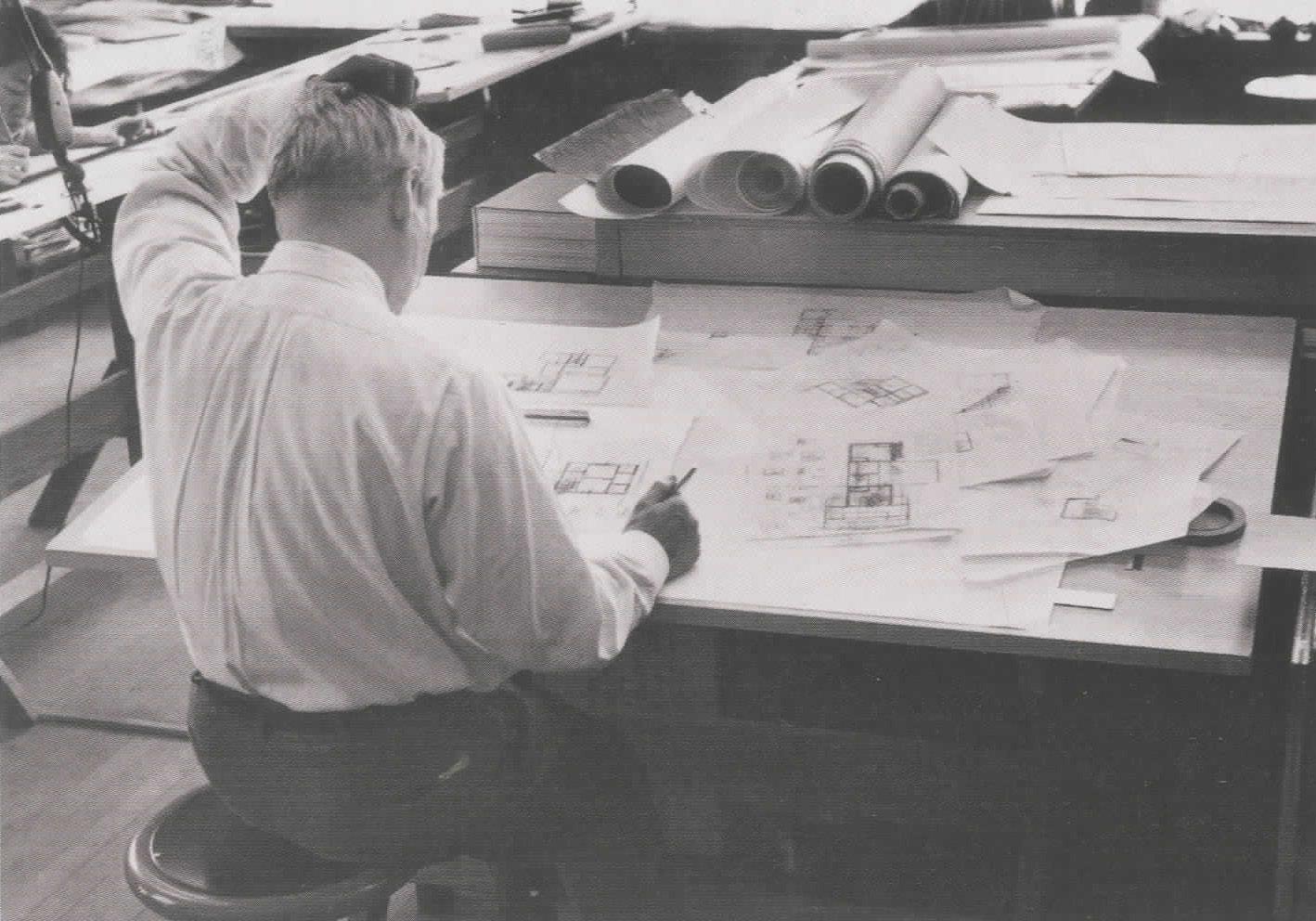
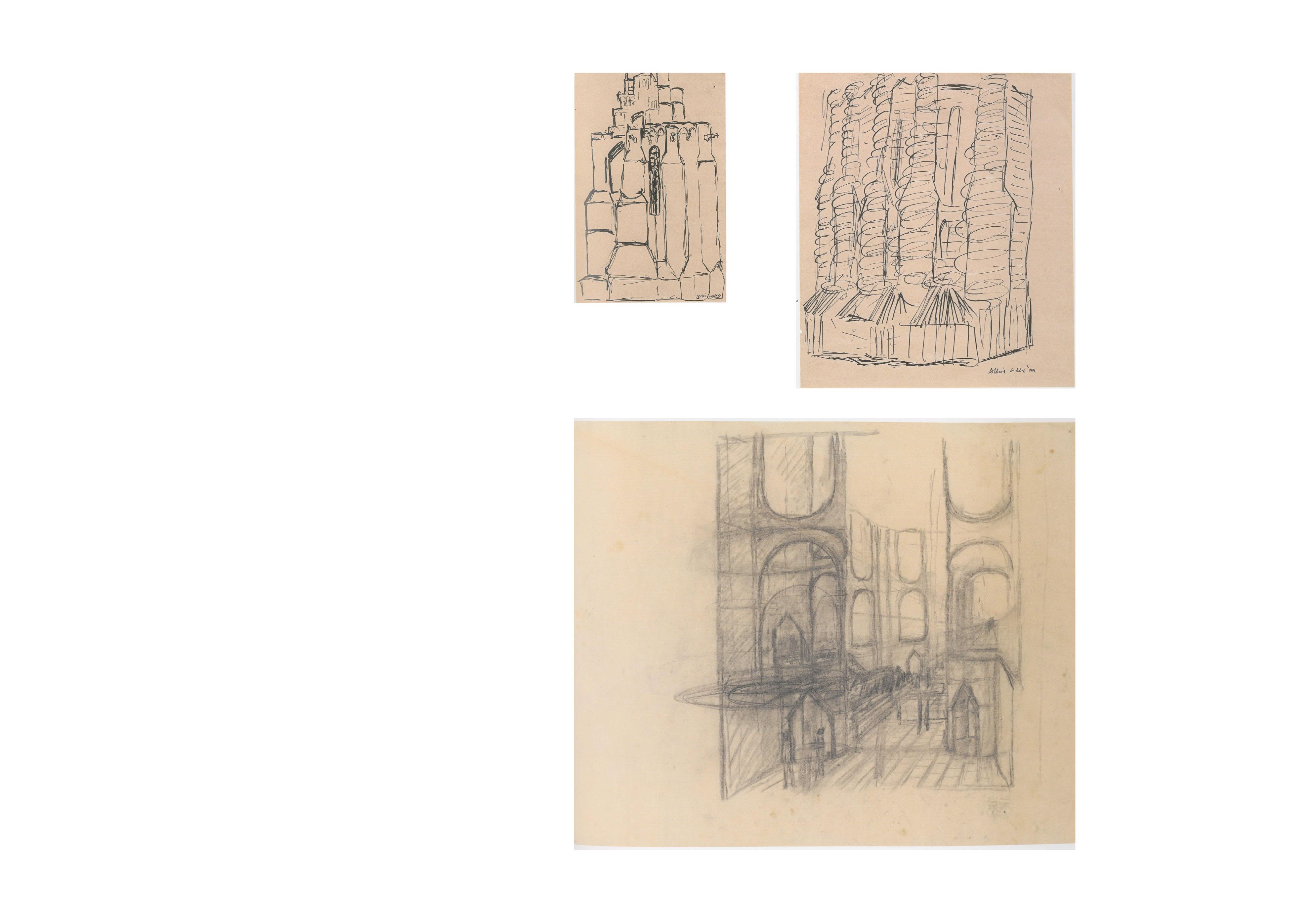
1.2 Louis Kahn, at the drawing board. Kahn was another architect whose sketches and drawings have received recognition and will be important to this study in Reading into Drawing Out From
From: From: Merrill, Michael. Louis Kahn : The Importance of a Drawing. Zurich: Lars Müller Publishers, 2021, p. 11.
1.3 National Assembly, development of the plan, Sher-e-Bangla Nagar, Dhaka, Bangladesh, Louis Kahn, 1963 – 64.
From: From: Merrill, Michael. Louis Kahn : The Importance of a Drawing. Zurich: Lars Müller Publishers, 2021, p. 11.
1.4 Plan and Section of the Main Staircase with the Lightwell, Sala Beckett Project, Flores & Prats Architects, 2016.
From: Flores, Ricardo, and Eva Prats. Flores & Prats : Sala Beckett: International Drama Centre. Mexico: Arquine, 2020.
2.1 St Antoniuskapel in the St Janskerk, Utrechy, Pieter Jansz. Saenredam, 1645, 41.7 x 34 cm., Central Museum, Utrecht.
From: Janson, Jonathan. “The History of Perspective.” Essentialvermeer.com, 2015. https://www. essentialvermeer.com/technique/perspective/history.html.
2.2 A Boy Bringing Bread, Pieter De Hooch 1663, Painting, London, The Wallace Collection. From: Flores, Ricardo, and Eva Prats. Through the Canvas. Barcelona: Actar D, 2008, p. 21.
2.6 The Human Condition, Rene Margarite, 1935, Painting 100 x 81 cm.
From:
Allmer, Patricia. René Magritte, beyond Painting. Manchester: Manchester University Press, 2009.
3.2 Théâtre des Variétés, Drawing by L.Bnggeli, Flores & Prats Architects. 2020
From: Flores & Prats Architects. “Théatre Des Variétés.” Flores Prats. Accessed December 10, 2024. https://floresprats.com/archive/theatre-des-varietes/.
3.3 Dirty Drawings, Flores & Prats Architects, Théâtre des Variétés, 2020.
From: Flores, Ricardo. “Drawing without Erasing.” Drawing Matter, October 21, 2024. https:// drawingmatter.org/drawing-without-erasing/.
3.4 Photograph of the students at work during the Through the Canvas Workshop, 2003, Flores & Prats Architects.
From: Flores, Ricardo, and Eva Prats. Through the Canvas. Barcelona: Actar D, 2008, p. 49.
3.5 Perspective Analysis Drawing of Woman and Child in an Interior drawn during the Through the Canvas workshop. Drawing by Martin Tran and Faridzal Yusop, 2003.
From: Flores, Ricardo, and Eva Prats. Through the Canvas. Barcelona: Actar D, 2008, pp. 58 – 59.
3.6 Woman and Child in an Interior, Pieter De Hooch, 1658, Painting.
From: Flores, Ricardo, and Eva Prats. Through the Canvas. Barcelona: Actar D, 2008, p. 57.
3.7. Plan and Section drawn as an analysis of Woman and Child in an Interior, drawn during the Through the Canvas workshop. Drawing by Martin Tran and Faridzal Yusop, 2003.
From: Flores, Ricardo, and Eva Prats. Through the Canvas. Barcelona: Actar D, 2008, p, 61.
3.9. Standing architect leaning over an angled horizontal drawing board square with the window wall. After Ernst Neufert, Bauentwurfsllehre (Bauwelt – Verlag, 1936) 168, Figure 4.
From: Emmons, Paul. Drawing Imagining Building : Embodiment in Architectural Design Practices. New York : Routledge, Taylor and Francis Group, 2019, p. 40.
3.10 Detail of an artist’s vertical drawing frame. Jacque Dubreuil, La Perspective Patique (Dezallier, 1679)1, 118.
From: Emmons, Paul. Drawing Imagining Building : Embodiment in Architectural Design Practices. New York : Routledge, Taylor and Francis Group, 2019, p. 40.
4.1 Photograph of the interior in Providència House, Flores & Prats Architects, 2002, Photograph by Àlex García.
From: Flores & Prats Architects. “Providència House.” Flores Prats. Accessed November 20th, 2024. https://floresprats.com/archive/casa-providencia/.
4.2 A woman with a Young Boy Preparing for School, Pieter De Hooch, 1660-1663. Painting.
From: Flores, Ricardo, and Eva Prats. Through the Canvas. Barcelona: Actar D, 2008, p. 20.
4.3 Mother and Child with a Serving Woman Sweeping, Pieter De Hooch, 1655 – 1657. Painting.
From: Flores, Ricardo, and Eva Prats. Through the Canvas. Barcelona: Actar D, 2008, p. 22.
4.4 Two Women Beside a Linen Chest, with a child, Pieter De Hooch, 1663. Painting.
From: Flores, Ricardo, and Eva Prats. Through the Canvas. Barcelona: Actar D, 2008, p. 47.
4.7 Design for the Dining Room, Design for funrnishing the Eating Parlous at Osterly. The Seat of Robert Child Esqr. Robert Adam (1967).
From: Rowan, Alistar . Robert ADAM. London: Victoria and Albert Museum, 1988, p. 73.
4.8 Drawing model for a Music Room, Pierre-François-Léonard Fontaine (1762–1853), c.1803. Pen, ink and watercolour on paper, 120 × 185 × 144 mm. DMC 2081.
From: Iris Moon, “Fontaine: Hide-And-Seek,” drawingmatter.org, November 1, 2019, https:// drawingmatter.org/hide-and-seek/.
4.9 Furnishings for a small drawing room. Gillows and Co. 1822.
From: Evans, Robin . “The Developed Surface; an Enquiry into the Brief Life of an 18th-Century Drawing Technique.” In Translations from Drawing to Building and Other Essays. London: AA Publications, 2023, p. 191.
5.1 Students at work observing the paintings, using drawing tables, set squares and photographs. 2003, Flores & Prats Architects.
From: Flores, Ricardo, and Eva Prats. Through the Canvas. Barcelona: Actar D, 2008, p. 77.
5.2 Guggenheim Museum Bilbao, Frank Gehry, 1991, Bilbao, Spain.
From: Costa Meyer, Esther da. Frank Gehry: On Line . New Jersey: Princeton University Art Museum, 2008, p. 50.
5.3 Foundation Louis Vuitton, Frank Gehry, 2006, Paris, France.
From: Costa Meyer, Esther da. Frank Gehry: On Line . New Jersey: Princeton University Art Museum,
2008, p. 30.
5.4 The large front room facing Carrer de Trafalgar, with employees building models for a deadline. Photo: John Hill/World Architects, 2022.
From: Hill, John. “Studio Visit: Flores & Prats .” World Architects, June 2, 2022. https://www.worldarchitects.com/en/architecture-news/insight/studio-visit-flores-and-prats.
6.1 Drafter at the drawing board, Saul Steinberg, The Spiral (1966). Ink on paper, 19 x 25. The Menil Collection, Houston.
From: Emmons, Paul. Drawing Imagining Building : Embodiment in Architectural Design Practices. New York : Routledge, Taylor and Francis Group, 2019, p. 218.
6.2 Hurva Synagogue, Sections, Louis Kahn, 1969.
From: Merrill, Michael. Louis Kahn : The Importance of a Drawing. Zurich: Lars Müller Publishers, 2021, p. 198.
6.3 Hurva Synagogue Sections, First Proposal. Louis Kahn, 1968-69.
From: Merrill, Michael. Louis Kahn : The Importance of a Drawing. Zurich: Lars Müller Publishers, 2021, p. 199.
6.4 Hurva Synagogue Sections, Second Proposal. Louis Kahn, 1968-69.
From: Merrill, Michael. Louis Kahn : The Importance of a Drawing. Zurich: Lars Müller Publishers, 2021, p. 199.
6.5 St. Cecile Cathedral, Albi, France, Louis Kahn, 1959.
From: Merrill, Michael. Louis Kahn : The Importance of a Drawing. Zurich: Lars Müller Publishers, 2021, p. 61.
6.6 St. Cecile Cathedral, Albi, France, Louis Kahn, 1959.
From: Merrill, Michael. Louis Kahn : The Importance of a Drawing. Zurich: Lars Müller Publishers, 2021, p. 61.
6.7 Mikveh Israel Synagogue, Philadelphia, Louis Kahn, 1961-72.
From: Merrill, Michael. Louis Kahn : The Importance of a Drawing. Zurich: Lars Müller Publishers, 2021, p. 61.
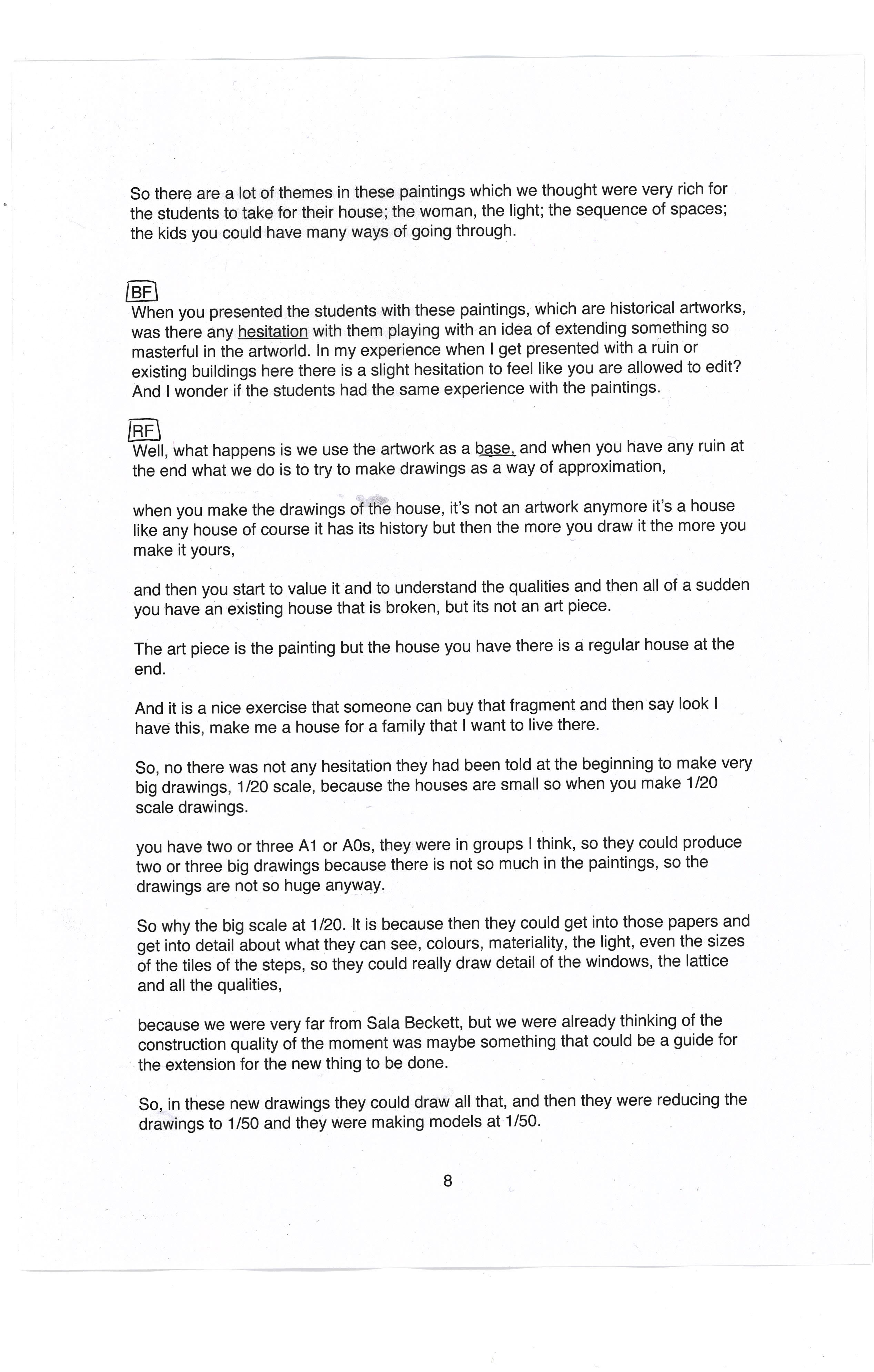
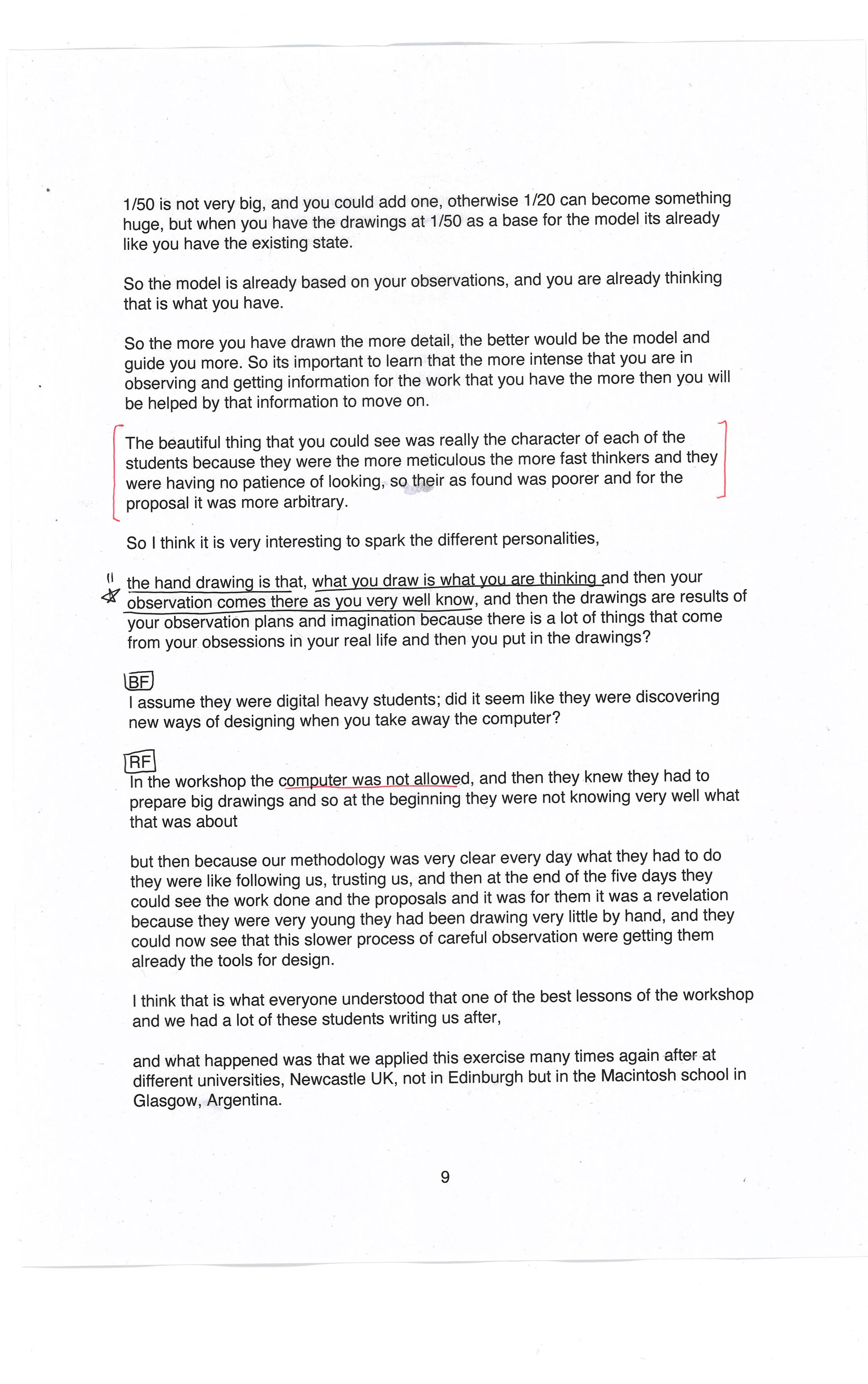
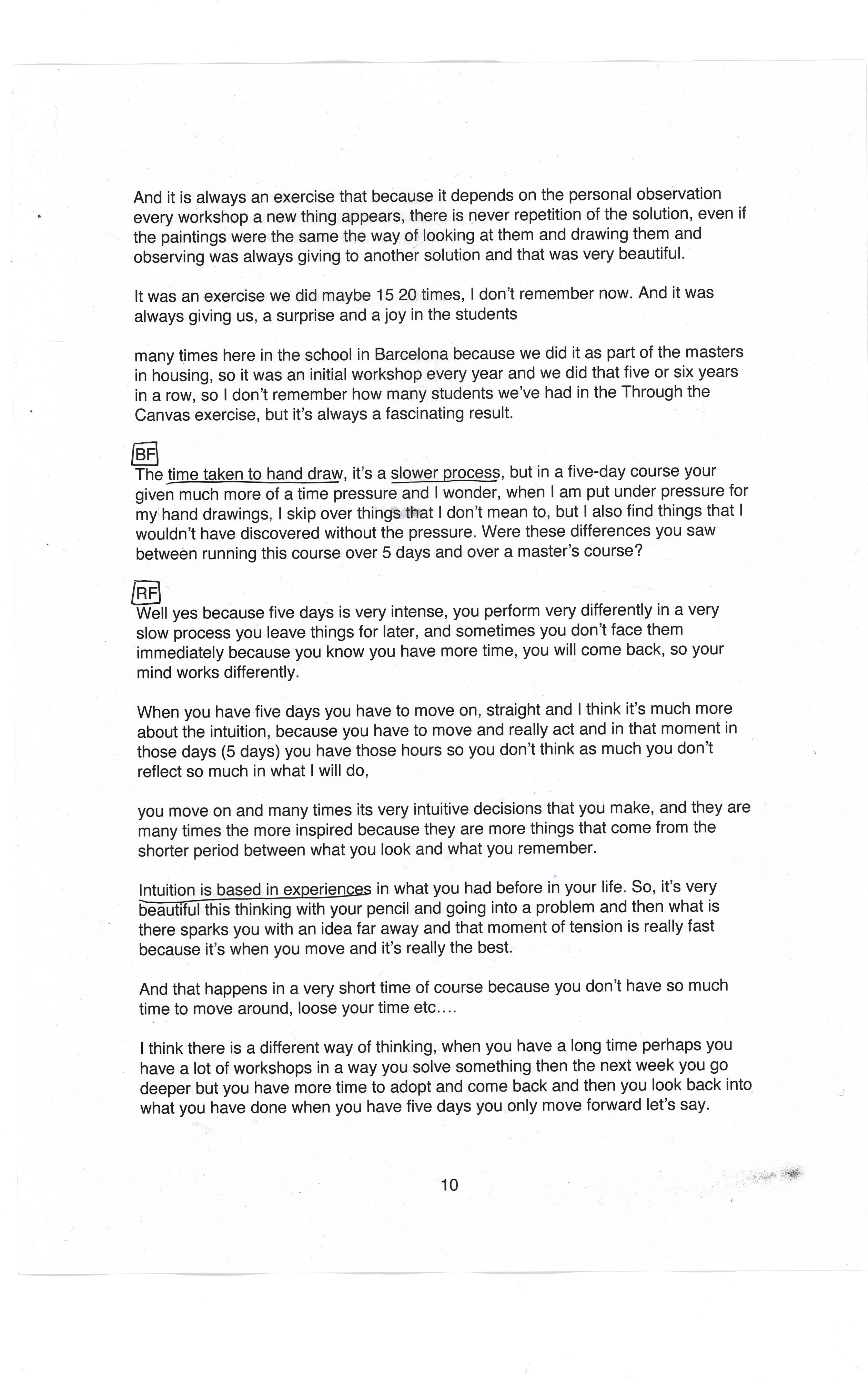
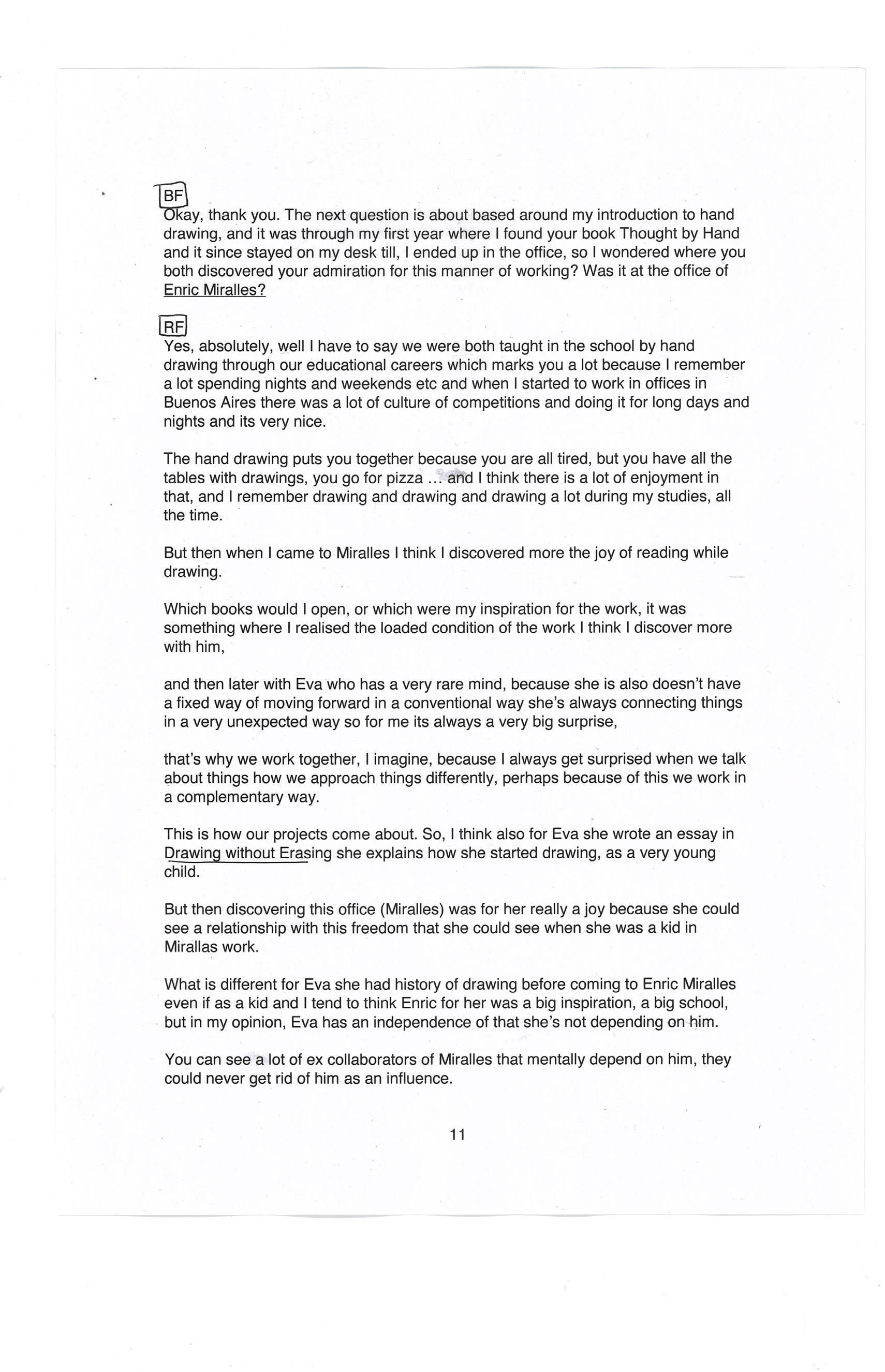
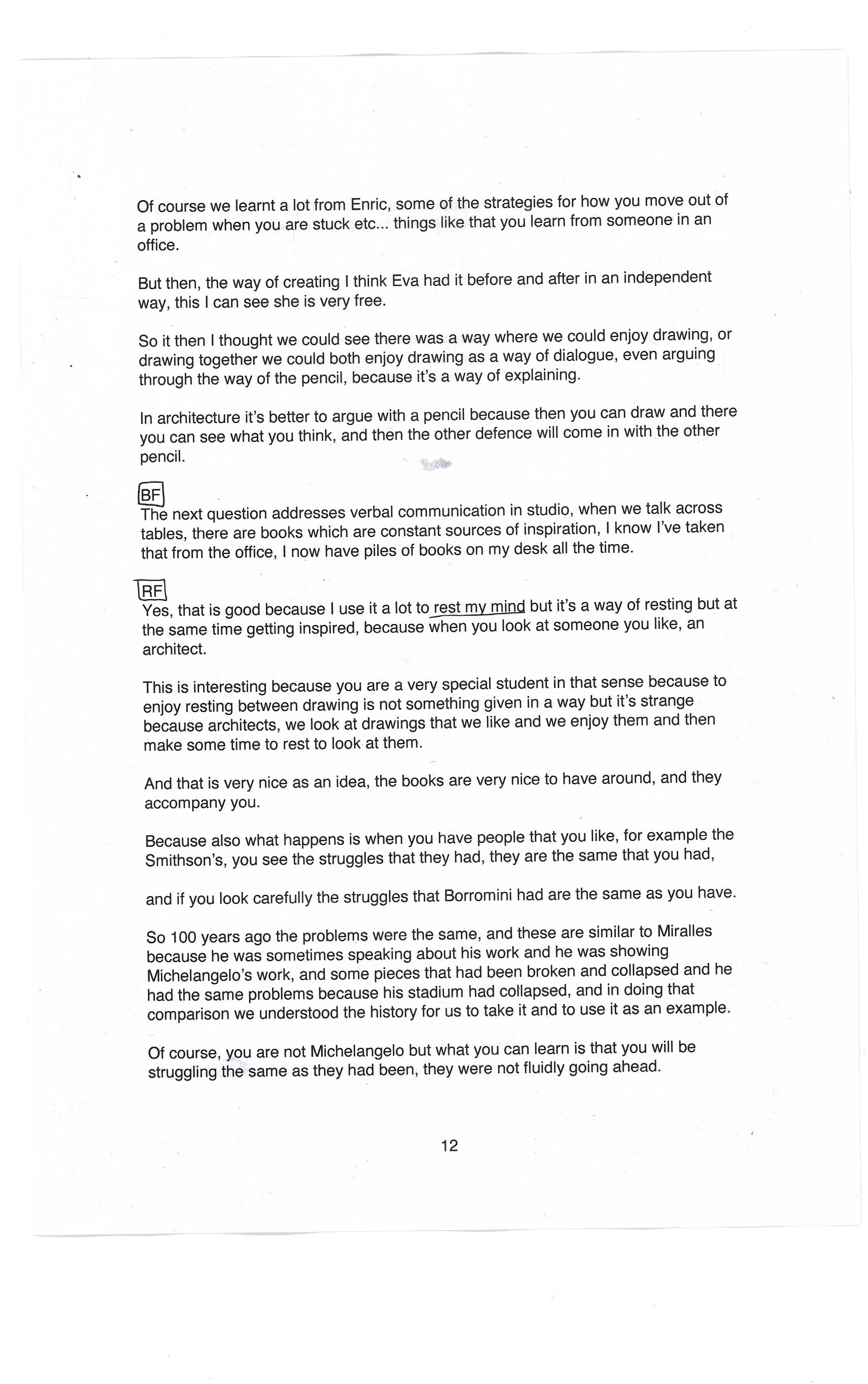
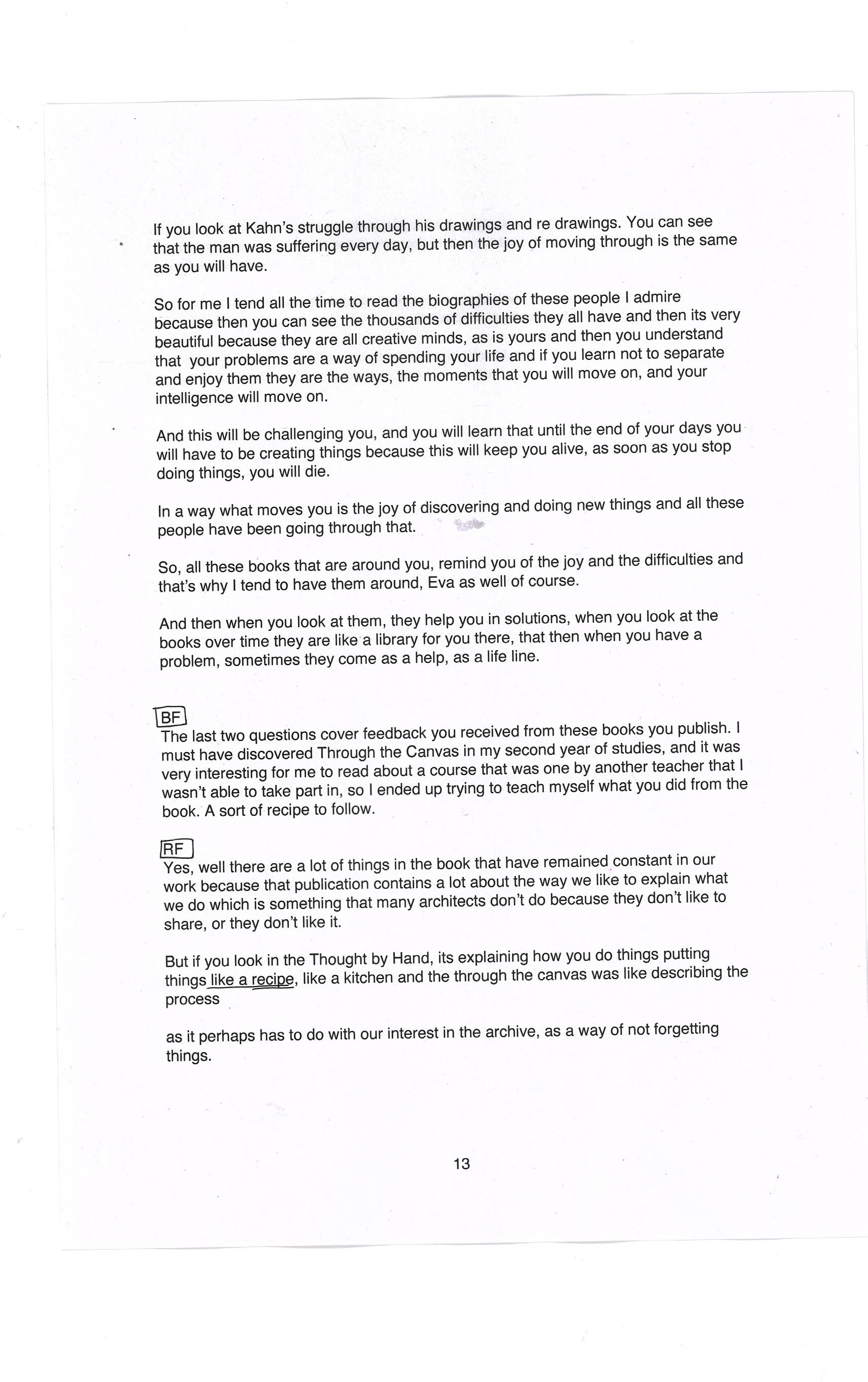
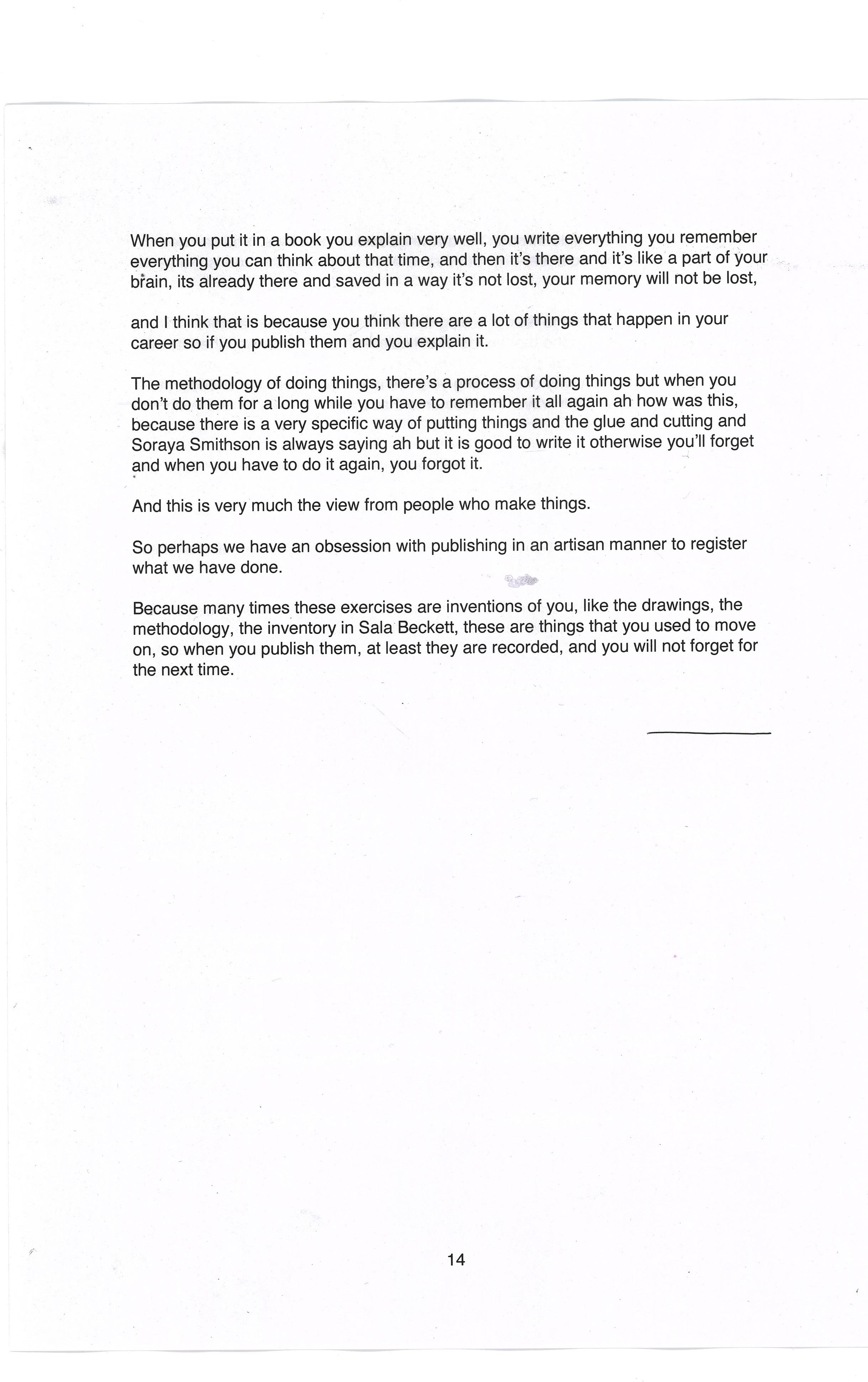
Flores & Prats Interview Transcript
Flores & Prats Interview Transcript, Page 1.
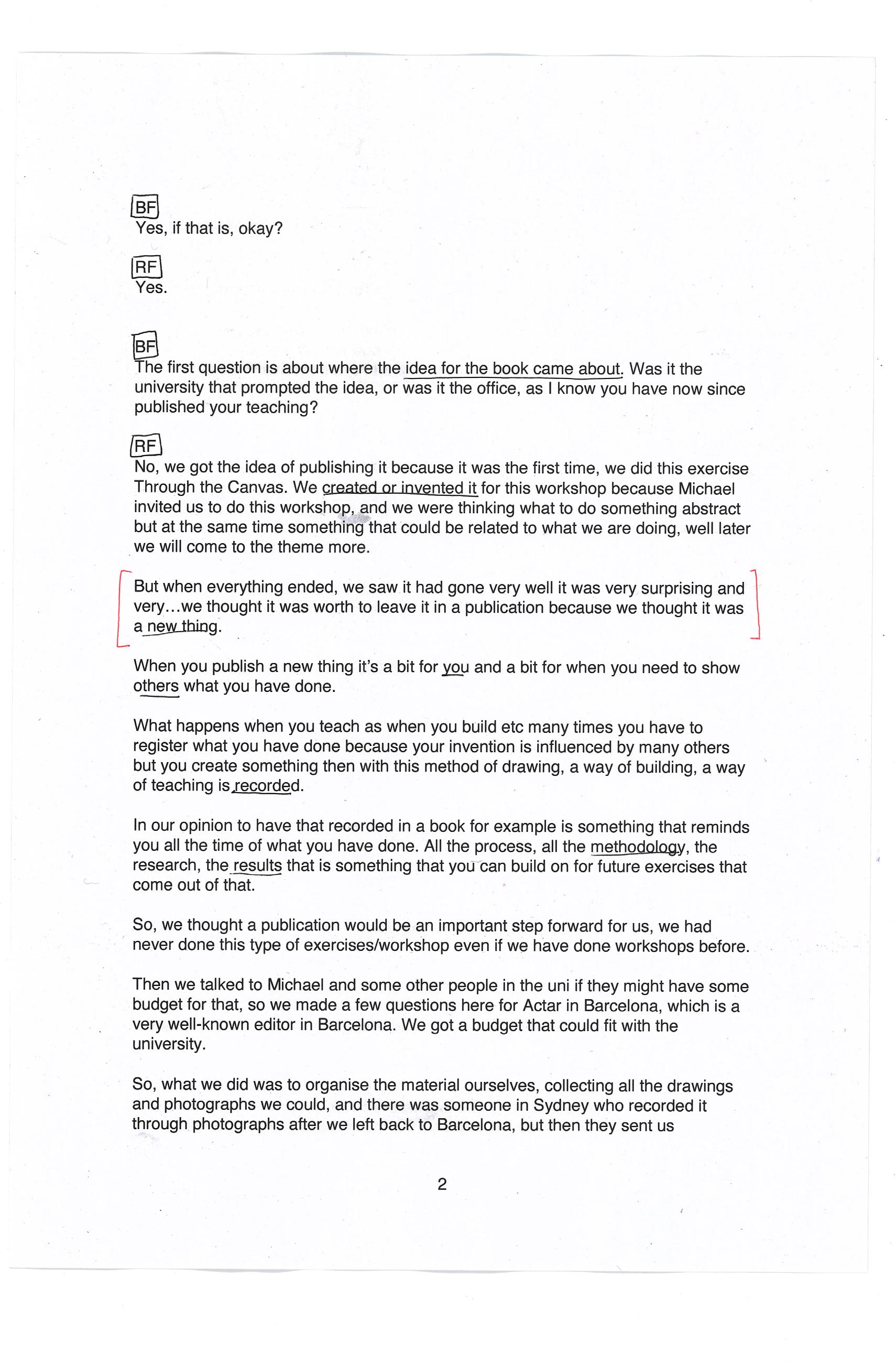
Flores & Prats Interview Transcript, Page 2.
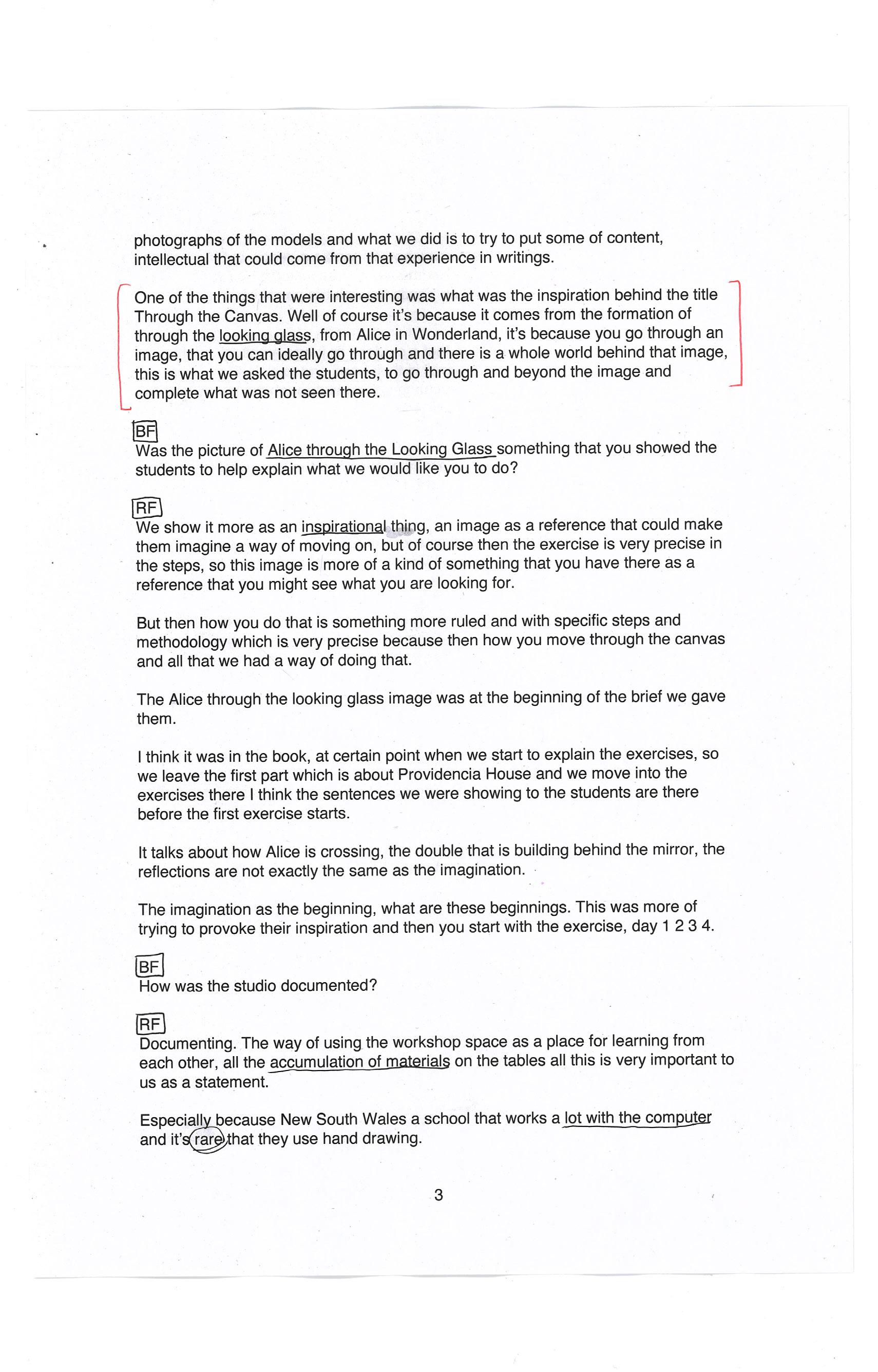
Page 3.
Flores & Prats Interview Transcript,
Flores & Prats Interview Transcript, Page 4.
Flores & Prats Interview Transcript, Page 5.
Flores & Prats Interview Transcript, Page 6.
Flores & Prats Interview Transcript, Page 7.
Flores & Prats Interview Transcript, Page 8.
Flores & Prats Interview Transcript, Page 9.
Flores & Prats Interview Transcript, Page 10.
& Prats Interview Transcript, Page 11.
Flores
Flores & Prats Interview Transcript, Page 12.
Page 13.
Flores & Prats Interview Transcript,
Flores & Prats Interview Transcript, Page 14.
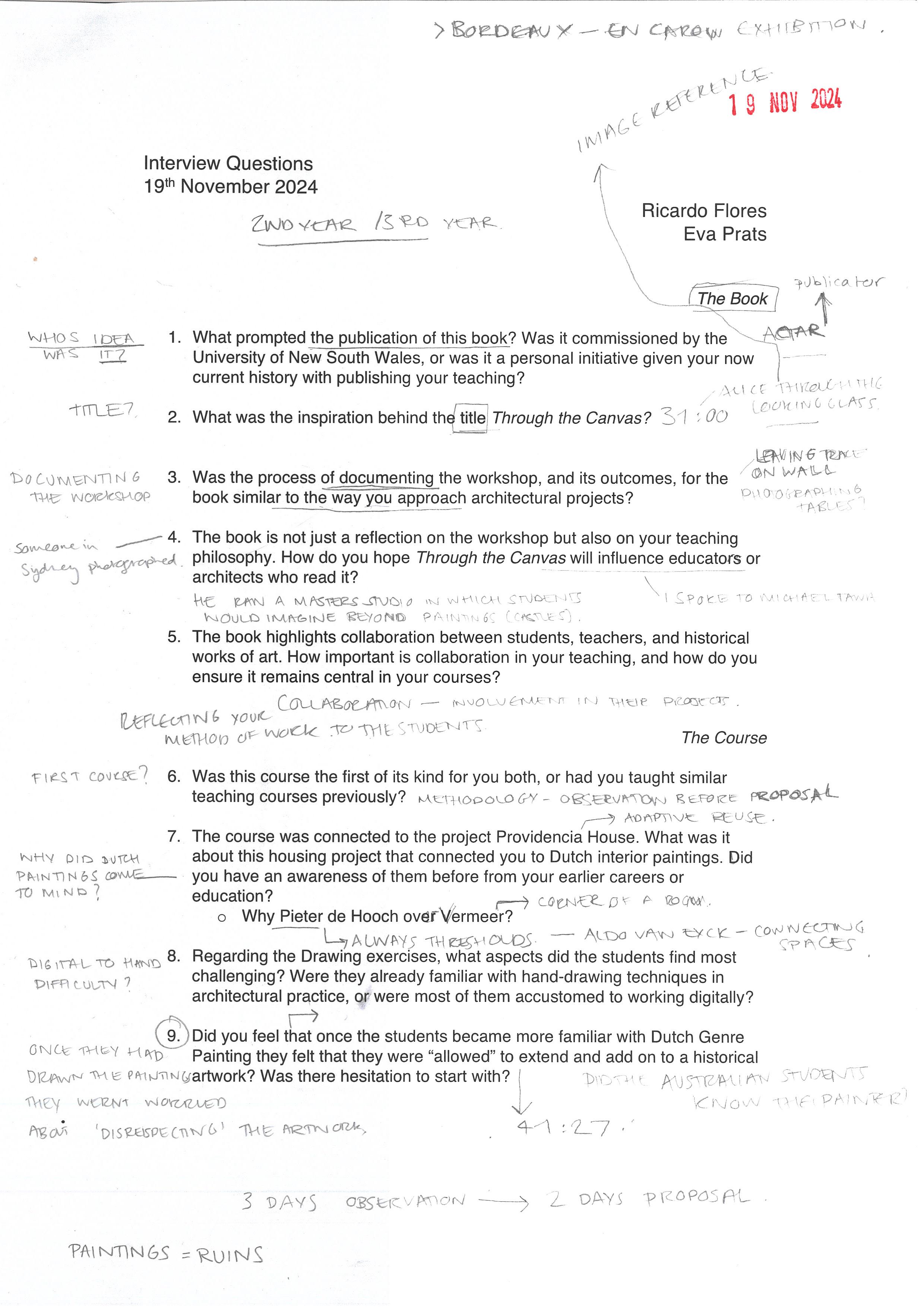
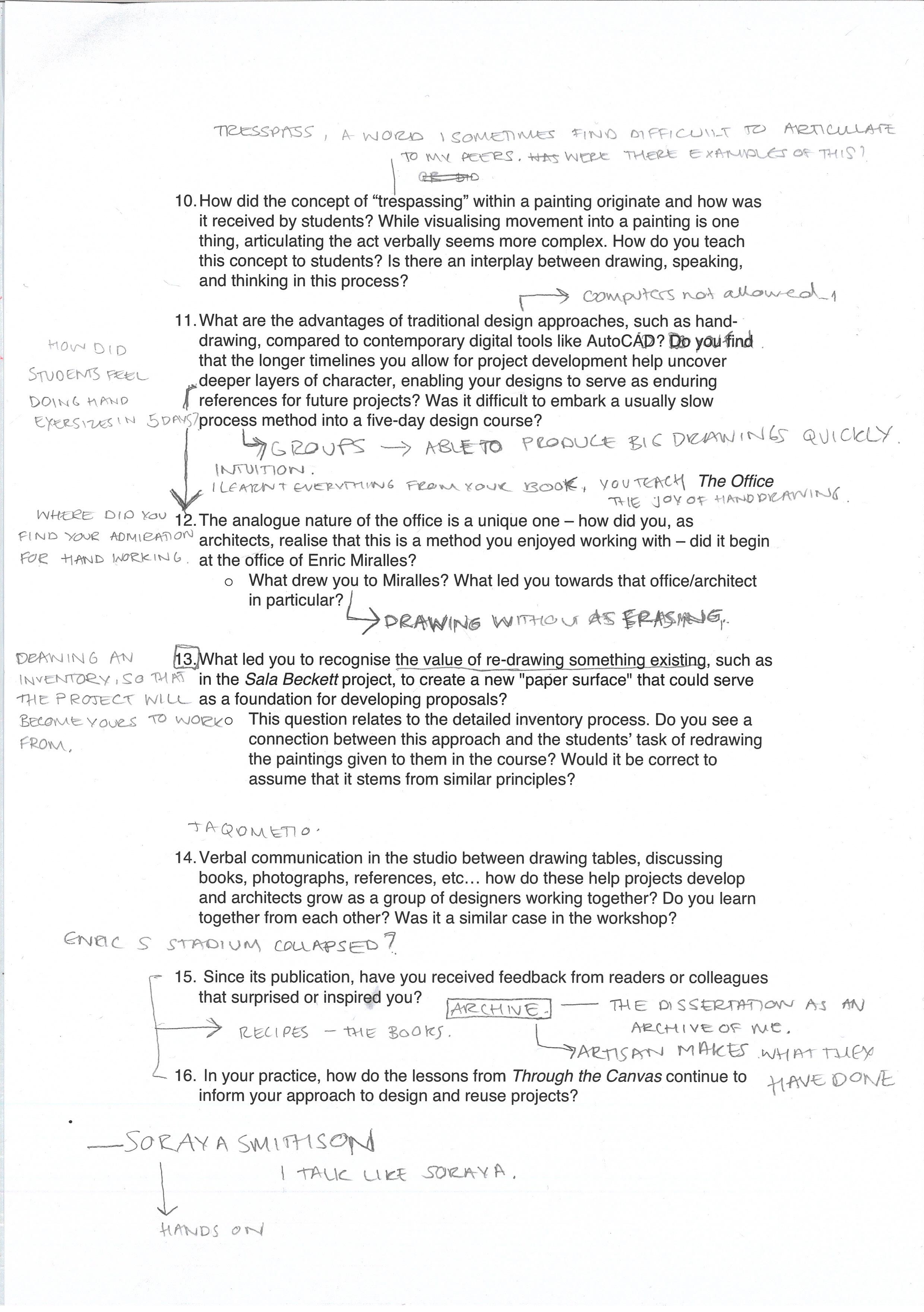
Annotations made during the interview.
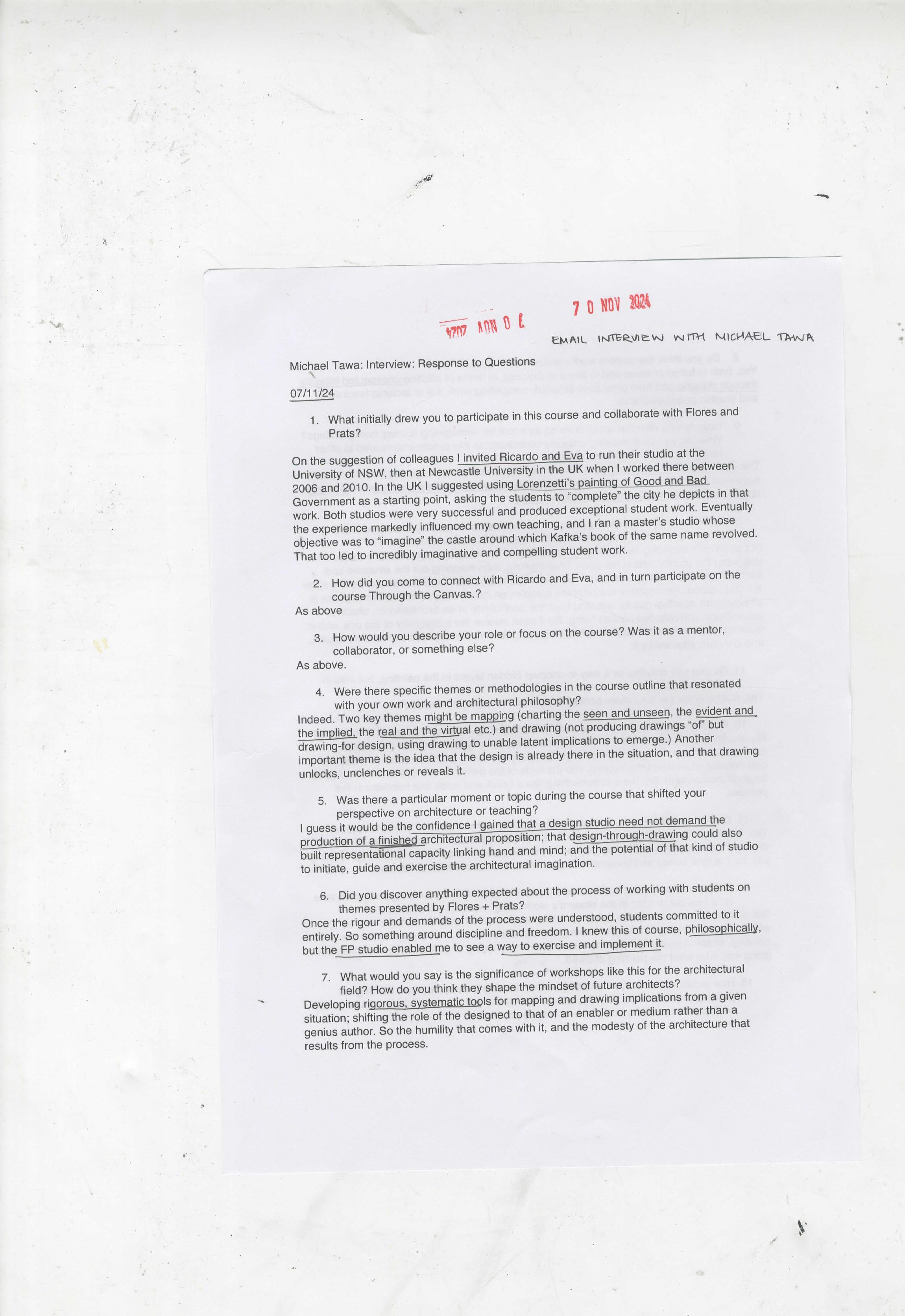
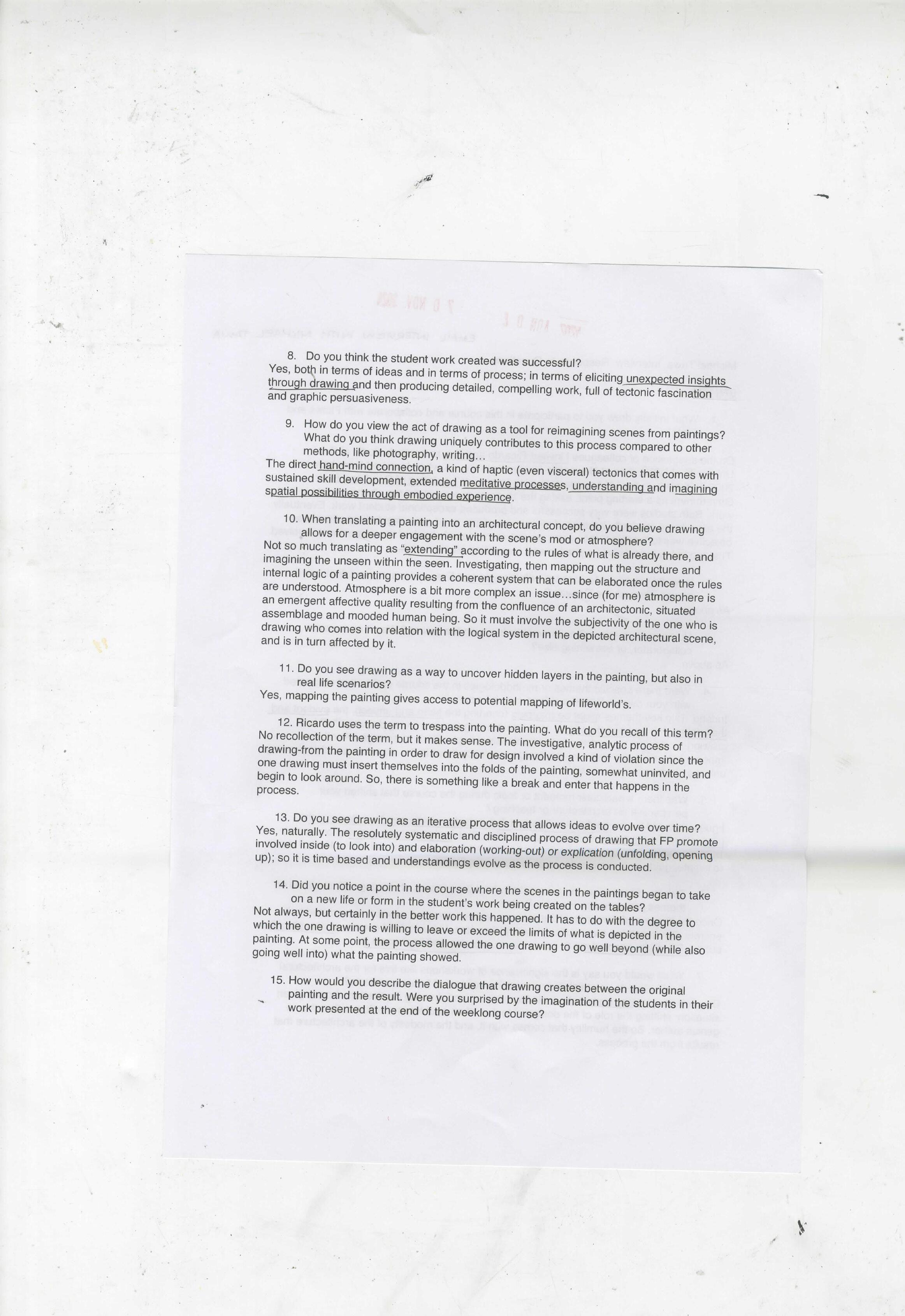
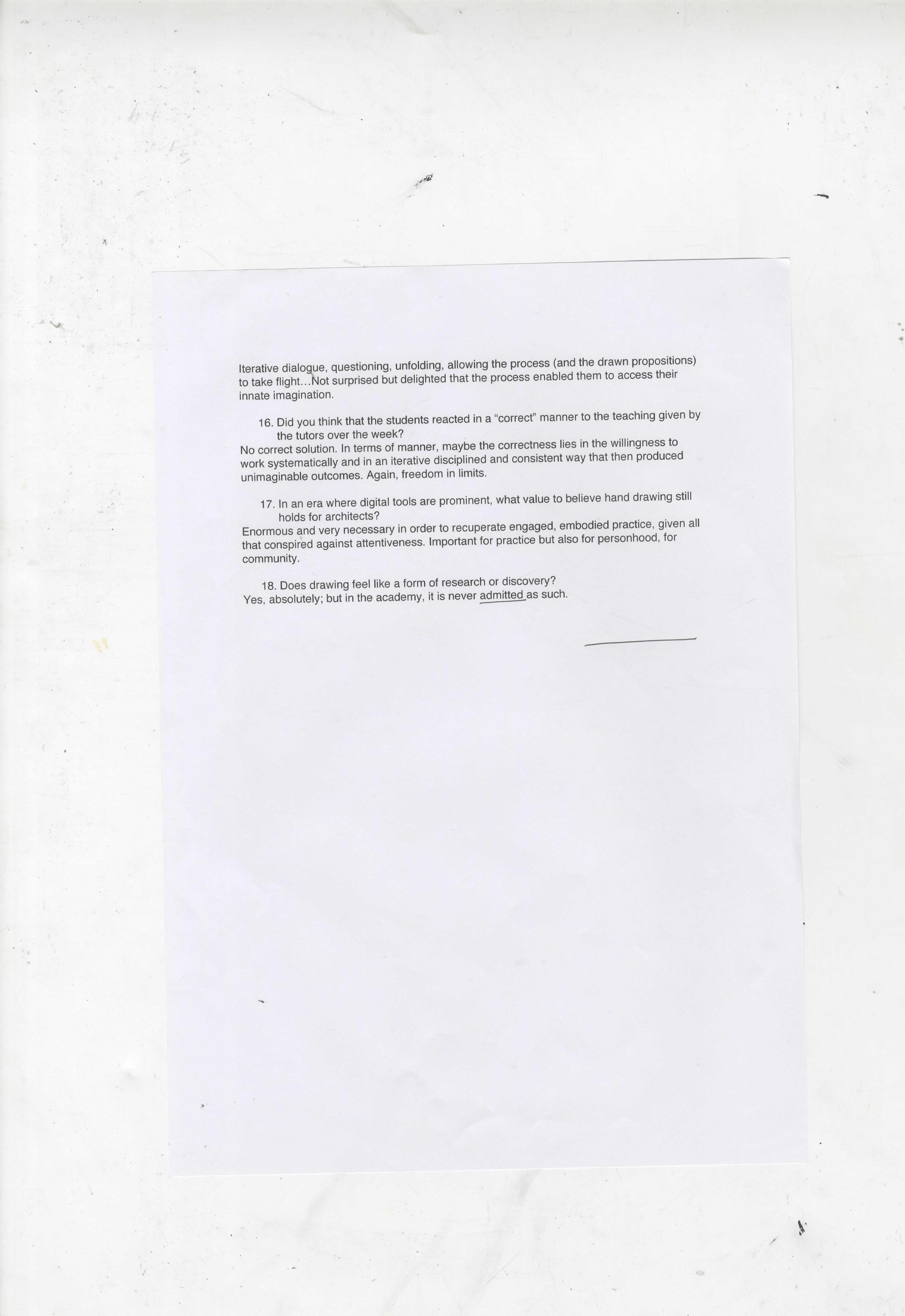
1.1Michael Tawa Interview, Page 3.