Vol 14 Issue 2 April 2022
AQUAFEED Advances in processing & formulation An Aquafeed.com publication
FEED ADDITIVES FOR TILAPIA Corn fermented protein Extrusion technology Micro-ingredients Published by: Aquafeed Media, S.L.U. www.aquafeed.com info@aquafeed.com
IF YOU THINK ALL LYSOPHOSPHOLIPIDS ARE THE SAME...
TAKE A CLOSER LOOK AT AQUALYSO®!
ADISSEO,
LEADER IN LYSOPHOSPHOLIPID SOLUTIONS FOR AQUACULTURE Dedicated production platform Superior product specifications Scientifically proven mode-of-actions Hands-on application expertise Effective feed cost reduction More sustainable production
www.adisseo.com
3
AQUAFEED
VOL 14 ISSUE 2 2022
Contents
NEW GENERATION OF PHYTASE IMPROVES GROWTH PERFORMANCE IN TILAPIA 14 Data from feeding trial in tilapia showed that supplementation with phytase improved the overall performance criteria of tilapia.
CORN FERMENTED PROTEIN 19
THE WEAR SIDE OF EXTRUSION 32
DEVELOPMENT OF AQUAFEEDS 39
An alternative protein for use in ration formulation for a range of aquaculture species.
How premium metallurgy offers higher wear and corrosion resistance for all three zones of the extruder.
Two series of articles describe the changes in the history of the nutrition of aquaculture species and the production of commercial aquafeeds.
Aquafeed: Advances in Processing & Formulation Vol 14 Issue 2 2022
4
AQUAFEED CONTACT US Editorial: editor@aquafeed.com Editor/Publisher: Lucía Barreiro Consulting Editor: Suzi Dominy Technical Editors: Peter Hutchinson, Albert Tacon, Ph.D Assistant Editor: Marissa Yanaga Conferences and webinars: info@aquafeed.com Advertising enquiries/request media pack: sales@aquafeed.com Accounts & all other enquiries: info@aquafeed.com
SUBSCRIBE Digital editions are free to industry subscribers. You may also purchase print copies. Subscribe at Aquafeed.com to receive your own digital copy of our publications. https://bit.ly/AQUASUBSCRIBE
FOLLOW US
VOL 14 ISSUE 2 2022
Contents 6
Interview with Yoav Rosen
10
News Review
16 New generation of phytase improves growth performance in tilapia
20
Corn fermented protein: Healthy, sustainable nutrition for aquaculture
24 A mix of 17 free amino acids enhances performance of Nile tilapia *Cover story
33
Extruder technology: A view from the wear side
36 The challenge of an essential and expanding market 44
Supporting the replacement of marine animal ingredients: Improving palatability and performance in whiteleg shrimp diets
We are grateful to the following companies for sponsoring this issue of the magazine. Their support allows us to make our publications available without charge. Adisseo...................................................................................... 2 Evonik........................................................................................... 5 Extru-Tech.................................................................................... 8 MixScience.................................................................................. 9 Wenger......................................................................................13 Huvepharma............................................................................15 Danish Technological Institute...............................................19 Phytosynthese...........................................................................23 BCF Life Sciences.....................................................................27 ISFN2022.....................................................................................32 Sparos......................................................................................38 Blue Food Innovation Summit................................................43 Aquaculture Experience........................................................60 INFOFISH.....................................................................................65 WAS ..........................................................................................66
Aquafeed Media, S.L.U., Ames, 15220 A Coruña, Spain. Copyright© Aquafeed Media, S.L.U., 1998-2022 All rights reserved. Privacy Policy & Terms of use.
47
Endotoxins: Why aquaculturists must not turn a blind eye
53
Bile acids: Normalization in aquaculture
56
N atural astaxanthin nutrition for better health and profitability
61
A staxanthin: An important micro-ingredient in aquaculture feeds
Columns 28 Ronald W. Hardy – History of fish nutrition. Part I: 1900-1958 39 Louis D’Abramo & Thomas R. Zeigler - Development of aquafeeds: Reflections and future perspectives I. The foundational years: 1940-1979 50 Albert Tacon – Suggested criteria for sustainable aquafeeds 59 Hans Boon – My insect dilemma
64
Calendar of events
To read previous issues in digital format or to order print copies, visit: www.aquafeed.com
Aquafeed: Advances in Processing & Formulation Vol 14 Issue 2 2022
Don’t take the bait
We can’t promise you a big catch, but we can guarantee that 65 units of MetAMINO® will achieve comparable performance* to 100 units of MHA-FA. Change to MetAMINO®, take the savings and benefit from additional advantages. Trust in science. Trust 65.
er Discov the new INO® MetAM ATLAS
Download the MetAMINO® ATLAS 2022 with scientific trials here: www.metamino.com *For references and the proposition of the guarantee, please contact us or visit our website.
Yoav Rosen is Global Marketing Director, Aqua, ADM Animal Nutrition.
INTERVIEW with Yoav Rosen AQ: What has been your journey in aquafeeds? How did you get to where you are today? YR: I started my wonderful journey in the aquaculture sector working at the hatchery level, optimizing the usage of live feed in marine fish operations. This rich experience helped me understand the fundamentals of our industry. Later in my career, I had the opportunity to take part in the development of feed additives, vaccines and other solutions for the sector. Overall, I’m lucky to have almost 20 years in the field of marine environment and aquaculture, both in the academy and at international companies. I also hold a Bachelor of Science in Marine Science and attended the Tel Aviv University in Israel where I graduated with a Master of Business Administration.
AQ: ADM provides nutritional and farming solutions to aquaculture farmers, hatcheries and feed millers around the world. After recent acquisitions, such as Neovia, where is the company now in terms of size, markets served and volume for feed additives and aquafeeds? YR: ADM has an international presence with local agility, tailoring our science-based nutrition solutions to specific aquaculture farming conditions. Our primary focus is shrimp, tilapia and marine fish in the APAC and LATAM regions, and we have a global network of research and development facilities. ADM’s aquaculture business is distinct in that we have the expertise and portfolio to address the nutritional needs of aquaculture at all life stages, from hatchery to harvest. Furthermore, we are committed to building a more sustainable value
Aquafeed: Advances in Processing & Formulation Vol 14 Issue 2 2022
7
chain by developing alternative protein formulations, minimizing waste, improving water quality, enhancing animal welfare and optimizing feed efficiency for improved fish and shrimp production. AQ: Ocialis is the aquafeed brand for the Asia Pacific and Latin America. What are the main targeted species and markets in Asia Pacific and does ADM plan any expansions and feed developments for this region? YR: Many of our APAC customers are located in Vietnam, the Philippines, Indonesia and China. Ocialis products deliver precision nutrition to shrimp, marine and freshwater fish. For example, Vanalis Pro is a functional feed that delivers an active probiotic combined with a blend of specialty feed additives to enhance immune function and improve gut health. Our shrimp product is commercially available and we’re currently launching a tailored formulation for fish. AQ: What about LATAM? What is the focus for this area? YR: In LATAM, as in Asia, we serve hatcheries, farmers and feed millers. Brazil, Ecuador, Mexico and Central America are the main countries we support by providing nutrition solutions for shrimp and tilapia aquaculture. To help farms keep animals in good health, we are developing and providing feed additives and functional feeds, such as AquaTrax, a new functional ingredient for resilience and performance support in the shrimp industry. To help optimize business operations and performance, we offer a variety of high-quality feed formulations, such as seasonal feed, which are nutrition formulations tailored to support different environmental conditions. Additionally, early life nutrition is a key focus area for ADM. We understand that the development of fish and shrimp, as with all organisms, at their early life stages is critical in determining lifelong development. The better the nutrition during the early life stages, the better the growth performance will be in the grow-out stages. We are invested in developing the best nutrition for fish and shrimp broodstock and larvae fingerlings. AQ: ADM developed a shrimp farming model for more sustainable and high-tech farms. Would you tell us more about BIOSIPEC? YR: BIOSIPEC is the Bio-Secure Intensive Shrimp Production system launched by ADM in 2017. It’s ideal
for areas with poor water sources, including low salinity and disease-prone areas. BIOSIPEC applies several innovative technologies, including water treatment to improve biosecurity and prevent disease outbreaks, an aeration system to reduce energy cost and optimize water aeration, and a customized feed formulated to improve shrimp growth and maintain water quality. A BIOSIPEC demonstration farm is located in southern Vietnam, allowing Asian farmers to discover different technologies for successful and sustainable intensive shrimp production. The solution helps to reduce farming risks and environmental impacts and maximizes profitability for shrimp farmers. AQ: BernAqua is the hatchery feed brand of ADM with a long presence in the market. Is there any specific goal in terms of production, geographic reach or product development, such as Recirculating Aquaculture Systems (RAS) feeds? YR: BernAqua is ADM’s solution for high-performance nutrition during the critical early life stages of fish and shrimp, in hatchery and nursery phases. Our R&D centers around the globe are continuously exploring better nutrition solutions for cultivated fish and shrimp, such as highly digestible raw materials and microextrusion processing technology for superior buoyancy and particle quality. As Recirculating Aquaculture Systems are common in many hatcheries around the world, we can find BernAqua products being used in these types of systems. We believe the bigger question is about the expanding use of RAS in the grow-out level of different aquaculture species, including shrimp. We are tracking the development in this field and closely monitoring the nutritional needs for RAS. AQ: ADM recently opened an aquaculture innovation lab in the US. What will this center add to the other capabilities the company has in other regions? YR: The new Aquaculture Innovation Lab is housed within our state-of-the-art Animal Nutrition Technology Center. It’s also strategically positioned near another ADM research facility and our production facilities. Our aqua researchers have access to a pilot lab that enables rapid prototyping of new technologies, such as feed ingredients and additives that can increase production efficiency, mitigate environmental impact and improve
Aquafeed: Advances in Processing & Formulation Vol 14 Issue 2 2022
8
animal resilience and welfare. What’s really unique about this lab is its flexibility: trials can be conducted with a variety of target species and segments, including various water temperatures and salinities with tight control over water quality conditions, fish performances, behavior and health status. The upstream research and development that occurs in the U.S. will directly benefit our activities in other parts of the world. AQ: ADM partnered with Nuseed for omega-3 canola processing in the US. Does ADM use or plan to use alternative ingredients in its aquafeeds? YR: Innovating aqua nutrition with alternative ingredients is crucial to maintaining protein security and the health of our oceans. Fishmeal and oil are finite resources, so reducing their use is a critical mission for the entire aquaculture industry. Specifically, at ADM, we are focusing on developing sustainable solutions on two levels. First, by developing functional specialties that help reduce FCR and optimize feed utilization, which helps reduce the number of resources needed in the production of fish and shrimp. Secondly, we develop and supply high-quality protein meals as a source of digestible amino acids and that do not contain animal protein. Our alternative nutrition solutions are backed by scientific research and are produced with our formulation expertise and technical ingenuity. We also work directly with farmers to incorporate transparent and traceable sourcing practices across the supply chain, which ultimately helps our customers reduce their environmental impact.
AQ: How about sustainability? What are ADM sustainability goals? YR: Sustainability is built into every aspect of our business at ADM. As a global leader in the industry, we’re committed to supporting the decarbonization of the ag and food value chains. Our scale, supplier relationships and partnerships help deliver a collective impact. Specifically, we’re working toward our Strive 35 sustainability goals for energy use, greenhouse gas emissions, water use and waste management. Over the last decade, we’ve achieved a 15% reduction in greenhouse gas intensity across our global footprint. We’re also aiming to reduce our Scope 3 greenhouse gas emissions by 25% by 2035. AQ: Finally, where would you like to see the aquaculture industry in the next ten years? YR: The aquaculture industry has evolved in so many aspects in the last few decades, from small family farms to more sophisticated, larger operations that access veterinary and nutritional knowledge. We are in a very exciting period in this development as we see technology and know-how driving the industry forward. With evolutions in data management, water management and RAS, genetics, nutrition, veterinary treatments and vaccines, we should expect big advancements in the next ten years. As such, I would like to see a sustainable aquaculture industry in ten years. I envision an industry with solid fish and shrimp health and performance management programs and one that relies on zero wild resources from the oceans.
Master Your Aquafeed Universe OUR UNIVERSE Sub 1 Millimeter
EXTRU-TECH AQUAFEED UNIVERSE
Sinking to floating. Sub-millimeter to pellet. When you select an Extrusion Processing System from Extru-Tech, you have a complete Universe with the ability to maintain size yields over 95%. As your business evolves, you have the flexibility to change your finished product without the need for significant capital expenditures.
Pellet
Contact Extru-Tech and optimize your flexibility and profitability.
ET-338B.indd 1
Aquafeed: Advances in Processing & Formulation Vol 14 Issue 2 2022
P.O. Box 8 100 Airport Road Sabetha, KS 66534, USA Phone: 785-284-2153 Fax: 785-284-3143 extru-techinc@extru-techinc.com www.extru-techinc.com
1/28/21 8:48 AM
OUR OBJECTIVE: To support our customers to combine sustainability and economical performance
A COMPLETE SOLUTION BASED ON 4 PRODUCTS
1
is a blend of natural products dedicated to stress management based on natural defenses stimulation and control
thanks
to
anti-inflammatory
and
antioxidant effects.
2 is a blend of unique oleochemicals and active matrix selected for aquaculture application to help the reduction of parasitic challenges.
is a natural solution
specially
developped
for Aqua challenges leading to better economical results thanks to a wide spectrum modes of actions essentially linked to the
4 is a blend of Bacillus spp. strains dedicated to biocontrol in all aquaculture farming systems.
gut balance modulation. Find miXscience on
contact@mixscience.eu
© Marketing miXscience - Avril 2022
3
10
NEWS REVIEW Highlights of recent news from Aquafeed.com Sign up at Aquafeed.com for our free weekly newsletter for up-to-the-minute industry news
Nicovita to invest $80 million in its shrimp feed plant in Ecuador
Trouw Nutrition’s remote access and data logging services for feed mills Trouw Nutrition introduced remote data and logging capability services to its Selko Feed Additive solutions. The remote access and logging technology allow dosing engineers to monitor, troubleshoot and adjust product dosing during feed production 24/7 via “the cloud”. The remote capabilities expand upon Selko’s earlier development of precision dosing and application equipment.
The USD 80-million facility will expand 45% of the company’s production capacity and will make the Guayaquil plant, one of the largest production centers of balanced feed for shrimp in the world. This new investment will be the most important of a series scheduled for the coming years that would allow Nicovita to reach a production capacity of one million tons of balanced feed.
Feed companies to include algae oil in their feeds
Atlantic Sapphire partnered with Skretting to include Veramaris algal oil in its feed from Q4 2021, reducing the fish oil content in its salmon feed by approximately 25% and accelerating the process
of eliminating the use of marine-derived feed ingredients by 2025. Cargill has supplied feed containing omega-3 from algae to customers under request. The company has now entered into an agreement that gives access to larger volumes and will include algae as part of the oil mix in all Norwegian fish feeds from April. BioMar Australia has recently commissioned a new dedicated algae oil facility at its Wesley Vale factory in northwest Tasmania that will help the company make Corbion’s AlgaPrime DHA more readily available for the Tasmanian salmon and Australian and New Zealand aquaculture industries.
Aquafeed: Advances in Processing & Formulation Vol 14 Issue 2 2022
11
Evonik releases the first edition of MetAMINO Atlas Evonik has published the first edition of the MetAMINO® ATLAS. The report displays the results of 15 performance trials investigating the relative bioavailability of supplementary methionine sources in animal diets. The trials were conducted in eleven countries under different climatic, geographic and farming conditions, in experimental settings as well as at commercial farms with broiler chickens, laying hens, swine and aqua species. Evonik will also build a methyl mercaptan plant at its site in Mobile, Alabama, U.S. The investment aims for a reliable and cost-optimized supply of DL-methionine to North and South American markets as it reduces the carbon footprint of transportation.
DSM-Novozymes alliance unveils new generation phytase Scoular opens fishmeal facility in Myanmar Scoular recently opened a new fishmeal facility in Myanmar. The facility will provide a hub for high-quality, consistent products and justin-time shipment to Asian feed markets. The opening follows Scoular’s launch in September of Encompass™, the new brand for Scoular’s growing global fishmeal business.
HiPhorius™ is a complete phytase solution designed to help aquaculture producers achieve sustainable and profitable protein production. It will improve the market standard for phytase technology and enable access to high potency phytase, giving producers more flexibility in diet optimization. HiPhorius™ enables producers to expect increased efficiency, improved thermostability and access to digital services, giving producers opportunities to reduce feed costs.
Famsun new developments Famsun recently rolled out a robust, flexible and efficient grinding machine, FSBP700 Non-Stop Automatic Screen Change Hammermill. In addition to high capacity, low maintenance and reduced production cost, the new mill can process production orders of many specified recipes and feed ingredients from a wide range of resources without stopping the machine for frequent screen changeovers. The company also developed the online system, FAMSUN Multifunction Online Particle Size Analyzer, to improve the grinding process and product quality in feed mills. It can measure the shape and size of both coarse and fine particles in size distribution between 0.4 mm and 6 mm, covering the grinding requirements of all raw materials in feed mills.
Aquafeed: Advances in Processing & Formulation Vol 14 Issue 2 2022
12
Benson Hill partnerships to raise aquaculture sustainability
Benson Hill partnered with Riverence Holdings, the largest land-based producer of steelhead and rainbow trout in the Americas, to enhance the sustainability of aquaculture supply chains using Benson Hill’s innovative soy ingredients. Benson Hill’s proprietary ingredients will be incorporated into the aquaculture diets manufactured by Riverence’s supplier Rangen, a brand of WilburEllis Nutrition. Benson Hill also plans, together with Denofa, to introduce its sustainable soy protein ingredients into the Northern European aquaculture feed market.
Devenish introduces moisture management tool for feed production Devenish partnered with specialty chemicals innovator, Perstorp, to launch a new patented technology that will help animal feed mills improve milling efficiency, prevent loss of volume, and ultimately reduce energy consumption and wastage during the milling process. SmartMoisture is a moisture management product designed to maintain target moisture levels during the manufacturing process which delivers a range of production, performance, and economic benefits.
Cargill to acquire 24.5% of Multi X Cargill has agreed to purchase 24.5% of the shares of salmon producer Salmones Multiexport S.A. (Multi X), the subsidiary of Multiexport Foods S.A. Mitsui, a shareholder of Multi X since 2015, will increase its shareholding by 1.13%, to 24.5%. Multiexport Foods S.A. maintains control of Multi X with 51% of the total shares.
SPAROS introduces two hatchery feeds for marine fish SPAROS launched two novel nutritional solutions for marine fish hatcheries within its hatchery feed range. ENRico is an all-in-one enrichment for Artemia and rotifers formulated with a balanced nutritional content for optimal larval development. WIN Wrasse is a premium weaning microdiet tailor-made for ballan wrasse larvae.
Lallemand unveils functional hydrolyzed yeast Lallemand Animal Nutrition introduced YELA PROSECURE, a specifically designed hydrolyzed yeast. It offers highly digestible and functional nutrients that support animal performance, digestive care and feed palatability while contributing to the feed protein balance. YELA PROSECURE is an innovative feed material (Regulation (EU) No 68/2013) that can be used in all animal species.
Aquafeed: Advances in Processing & Formulation Vol 14 Issue 2 2022
13
War in Ukraine impacts the feed industry The Russian invasion of Ukraine on February 24 has impacted the European and international feed industry that was still struggling after COVID pandemic supply chain disruptions. The Black Sea region represents an important supply of grains and oilseed products for the world market. Ukraine in particular exports about 60 million tonnes of grain to the world. It was expected, in the current marketing year, that Ukraine would export about 33 million tonnes of corn and 24 million tonnes of wheat. Disruption in grain supplies is expected in the countries where Ukraine exports and the first impact will be in the animal feed market. Western sanctions against Russia have followed the invasion. An impact is expected in fertilizers and future crops as Russia is a major exporter of nitrogen, potassium, and phosphorus fertilizers. Meanwhile, raw materials and energy prices reached record highs generating very high additional operating costs and squeezing profit margins for feed producers and farmers. Following the invasion of Ukraine, BioMar Group shut down all trade activities
with Russia. The decision includes sales of finished products as well as the sourcing of raw materials and applies to all BioMar entities around the globe. The ban is a major step for the company, as substituting raw materials and losing sales volume will have a significant impact. Nutreco, including Skretting, and parent company SHV will not undertake new investments, new projects and new exports to Russia for now. Cargill has stopped investment in Russia and will continue to operate its food and feed facilities in the country. ADM will scale down operations in Russia that are not related to the production and transport of essential food commodities and ingredients. The European Union, one of the most affected regions, also plans to improve its food security by reducing dependencies on key imported agricultural products and inputs, in particular by increasing the EU production of plant-based proteins, and has issued two packages of measures to support the aquaculture sector hit by war. Meanwhile, Russia plans to build new salmon feed mills to reduce imports.
CUSTOM AQUATIC FEED SOLUTIONS ARE WAITING Surround Yourself with Unparalleled Resources for Extrusion and Drying Systems Do you know what aquatic feed you need to produce – but unsure of the next steps? Wenger will put unsurpassed technology and process expertise to work, developing flexible solutions specific to your operation. We expertly evaluate and guide the development and processing applications for floating, sinking, shrimp and micro aquatic feeds. Every one of our systems is customized, serving you best by going beyond a standardized approach.
FLOATING
SINKING
Let us help you solve production challenges now. Email us at info@wenger.com today.
SHRIMP
SALMON
MICRO
PHONE: 785.284.2133 | EMAIL: INFO@WENGER.COM | WENGER.COM USA
|
BELGIUM
|
TAIWAN
|
BRASIL
|
CHINA
Aquafeed: Advances in Processing & Formulation Vol 14 Issue 2 2022
14
Study finds “fish-free” feed for largemouth bass feasible and economically viable Total replacement of fishmeal and fish oil in largemouth bass feed is both feasible and economically viable, according to a new study published in the journal Aquaculture Research. The fish fed experimental feeds without fishmeal or fish oil also had higher DHA-to-EPA ratios than those fed commercial feeds, with algae oil having the highest ratio. Consumers ultimately benefit from these higher amounts of heart and brain-healthy DHA and EPA from eating the fish. The vast majority of the farm-raised largemouth bass is cultivated and consumed in China – an estimated 432,000 tons in 2018, according to the China Fishery Statistics Yearbook. As the world’s largest producer of farmed fish, China is working toward more sustainable farming practices nationwide. “This will also come as good news for fish farmers in China at a time when consumers are shifting their appetites toward high-value species like largemouth bass that consume large amounts of fishmeal and fish oil,” said Ewen McLean, lead author of the study and principal at Aqua Cognoscenti. “Switching to locally sourced, and often cheaper feed ingredients could help put more money in the pockets of fish farmers.” The price of fishmeal has increased 3.4-fold over the last 20 years, and the present-day cost is around $1,429. On the other hand, the price for soybean meal, an often-used substitute for fishmeal in aquafeeds, has risen 2.8-fold over the same timeframe and is roughly half the price according to Index Mundi. Alternatives to fish oil, such as soybean and canola oils are on average less expensive as well. During the 10-week feeding trial conducted in a recirculating aquaculture system at Texas A&M, McLean and colleagues compared weight gain, survival rates, feed conversion ratio and fillet quality of fish fed fishmeal, fish-oil free experimental diets against two commercial feeds (Huifu, Xinxin Tian'en Company, Zhejiang Province, PR China and Alltech Coppens, Leende, The Netherlands), specifically designed for juvenile largemouth bass (Micropterus salmoides). At the end of the trial, all fish fed the experimental fishmeal- and fish oil-free diets
Photo credit: Texas A&M University
had similar weight gain and survival rates matching those fed the Xinxin commercial feed. The Coppens commercial feed had the lowest growth and survival rates. The experimental diets also had excellent feed conversion ratios. According to a 2018 study in Nature Sustainability, if the current use of fishmeal and fish oil by the animal feed sectors remains the same, forage fish populations will be overextended by 2050, or before. Commercially valuable species, such as salmon, cod and tuna, as well as marine mammals and seabirds, depend on forage fish in the wild. Since over 50% of seafood is farmed, the variety of seafood on consumers’ plates could shrink without innovation in “fish-free” feeds, since they rely on wild-caught resources. This study is a step toward removing the supply chain bottlenecks by testing more available and sustainable ingredients that will make seafood available in the future. Largemouth bass, which is native to North America, was first introduced into mainland China in 1983 and today is a major freshwater aquaculture product throughout the county. The study was supported by the F3 – Future of Fish Feed’s Feed Innovation Network.
Aquafeed: Advances in Processing & Formulation Vol 14 Issue 2 2022
Shaping aquaculture solutions ▶ Our enzyme expertise now applied in aquaculture ▶ The right enzyme for each species ▶ Presence in the main feed production regions
www.huvepharma.com ShapingAquacultureSolutions_Ad_Preview4.indd 1
20.04.22 16:11
16
New generation of phytase improves growth performance in tilapia Daniel Arana, Huvepharma
According to the FAO, aquaculture has projected growth to produce nearly 109 million metric tonnes by 2030. The global trend to be more sustainable is paramount in the aquaculture industry and is leading to better use and optimization of all the ingredients often used in the feed industry. It is known that phytase enzymes maximize the phosphorous (P) availability in plant-based ingredients
and also afford cost-effective feeds by optimizing the animal’s use of the nutrients in raw materials. This is also valid for omnivorous fish species produced and consumed around the world. Tilapia is the second most cultivated fish in the world, just after carp and ahead of salmon. Production is growing at an estimated 7% annually over the last decade. This growth demands more resources
Table 1. Dietary treatments.
Dietary treatments
OptiPhos Plus®
T1 NC
Low fishmeal level covering total P requirement (0.90%) but slightly below available P needs (0.48% feed)
-
T2 OPP
NC + OptiPhos® Plus at 1500 FTU/kg feed administered via the feed post-pelleting (oil coating)
300 g/tonne
T3 MCP
NC + monocalcium phosphate (MCP) at 1.9% (available P requirements)
-
Aquafeed: Advances in Processing & Formulation Vol 14 Issue 2 2022
17
Table 2. Feed composition, ingredients (%) and calculated analysis (%) for each diet.
Ingredients (%)
NC
OPP
MCP
Soybean meal
25.0
25.0
25.0
Wheat bran
25.0
25.0
25.0
Maize gluten 60
15.9
15.9
16.1
Maize
13.7
13.7
12.4
Rapeseed meal
10.0
10.0
10.0
Fishmeal
5.00
5.00
5.00
Monocalcium phosphate
0.81
0.81
1.90
DL Methionine
0.006
0.006
0.007
Soy oil
1.80
1.80
1.80
Salmon oil
1.80
1.80
1.80
Vitamin & mineral premix
1.00
1.00
1.00
OptiPhos Plus 5000L
0.00
0.03
0.00
Calculated analysis, % Moisture
11.5
11.5
11.3
Protein
33.0
33.0
33.0
Fat
7.00
7.00
7.00
Fibre
5.40
5.40
5.40
Ash
5.60
5.60
6.50
Ca
0.55
0.55
0.74
P
0.98
0.98
1.22
Av P
0.40
0.40
0.60
GE (MJ/kg)
18.1
18.1
18.1
and the sector must be compliant with better and sustainable production. Technical performance focusing on better nutrition is a key area for improvement as well as decreasing phosphorous discharged into the environment. Recent studies estimate that as much as 75% of phosphorous contained in fish feed used in intensive aquaculture production is excreted into the environment.
OptiPhos® Plus in tilapia OptiPhos Plus® is the latest generation phytase developed by Huvepharma® based on its know-how of enzyme technology. It was developed by screening phytase variant libraries (based on OptiPhos®) for improved thermal stability while keeping other favorable OptiPhos® properties (ideal pH profile, pepsin
resistance and fast action). Huvepharma’s® research demonstrates that apart from being the fastest phytase on the market, OptiPhos® Plus secures stability. The product formulation is presented in liquid form for PPLA (post-pelleting liquid application) processes in aquaculture feed. Our recent research demonstrated that OptiPhos® Plus improves the growth performance in Nile tilapia (Oreochromis niloticus) during a trial completed in a Recirculating Aquaculture System (RAS). The total duration of the trial was 93 days, starting with juveniles of 13.3 ± 0.80 g. A total of three diets by quintuplicate (five-fold) were evaluated on a total of 450 fish. All diets were produced by extrusion. The trial setup is described in Table 1. Fish were fed in three daily meals (09:00, 14:00, 17:00) ad libitum. Feed was measured and
Aquafeed: Advances in Processing & Formulation Vol 14 Issue 2 2022
18
Table 3. Statistical analysis.
NC
OPP
MCP
P Value
Survival (%)
100.0 ± 0.0
100.0 ± 0.0
100.0 ± 0.0
-
IBW (g)
13.3 ± 0.1
13.3 ± 0.1
13.4 ± 0.1
0.459
FBW (g)
74.6 ± 1.5
a a
101.2 ± 2.5
c
2.18 ± 0.02
c
96.6 ± 1.9
b b
<0.001
SGR (%/d)
1.85 ± 0.03
FI (% ABW/d)
1.65 ± 0.05
1.56 ± 0.05
1.62 ± 0.05
0.074
FCR
1.10 ± 0.04 b
0.95 ± 0.03 a
0.99 ± 0.03 a
<0.001
PER
2.74 ± 0.11 a
3.17 ± 0.09 c
3.03 ± 0.10 b
<0.001
2.13 ± 0.02
<0.001
distributed per tank daily to allow accurate recording and to avoid feed wastage during manual feeding. The measurements recorded were the feed conversion ratio (FCR), protein efficiency ratio (PER, which is the weight gain of the test groups divided by the protein consumed by the test group), specific growth ratio (SGR) and water quality parameters. In addition, health and mortality were monitored daily.
Figure 1. Changes in body weight (BW) after 93 days of feeding.
Figure 2. Changes to FCR after 93 days of feeding.
Aquafeed: Advances in Processing & Formulation Vol 14 Issue 2 2022
Results Results (Table 3) showed that, when using OptiPhos® Plus at 1500 FTU/kg feed, fish body weight (FBW), protein efficiency ratio (PER) and specific growth ratio (SGR) are significantly higher (P<0.05) than the treatment with MCP added. The treatment with OptiPhos® Plus at 1500 FTU/kg feed also showed a higher fish body weight (FBW), protein efficiency ratio (PER) and specific growth ratio (SGR) than the NC group (P<0.05). Changes in the body weight (BW) and feed conversion ratio (FCR) alongside the complete trial are shown in Figures 1 and 2, respectively. Assuming that MCP contains 21% aP, we can demonstrate that 11 kg of monocalcium phosphate can be replaced with OptiPhos® Plus included at 300g/ tonne. Recently, monocalcium phosphate prices have increased. Considering an average price of €1,000/tonne for
19
monocalcium phosphate, we can estimate that replacing MCP with OptiPhos® Plus saves about €11 per tonne of feed.
Conclusion After 93 days of experimental feeding, data shows that supplementation with OptiPhos® Plus improved the overall performance criteria of tilapia. The weight achieved with the OptiPhos® Plus treatment is significantly higher than the weight observed for the negative control group as well as the group receiving the treatment with MCP. For all the parameters measured in the study, OptiPhos® Plus improved the zootechnical performance of Nile tilapia. The use of OptiPhos® Plus at 1500 FTU/kg feed can reduce costs of up to €11 per tonne of feed produced.
More information: Daniel Arana Global Product Manager Aquaculture Huvepharma E: daniel.arana@huvepharma.com
PILOT SCALE EXTRUSION OF FISH FEED Production of extruded fish feed for test of ingredients, raw materials and stability At Danish Technological Institute you can develop your fish feed recipes and test new ingredients or additives in our state-of-the-art pilot plant. Based on your needs we will help you design your products and identify the right ingredients. As a result, the final product is designed to obtain the right shape, texture, density and porosity. Both our expertise and equipment are available to you during the entire development and production process: from proposal to decision of recipe, purchase of ingredients, grinding, mixing and subsequently extrusion and packaging.
We offer: • Development of extruded fish feed • Test productions (40 kg/hour) for research use • Pre- and posttreatments • Documentation of the production process • Consultancy on ingredient mixtures and process optimization
Contact: Consultant Mette Thomsen I +45 7220 1436 met@dti.dk I www.dti.dk
Aquafeed: Advances in Processing & Formulation Vol 14 Issue 2 2022
20
Corn fermented protein: Healthy, sustainable nutrition for aquaculture Peter E.V. Williams, Green Plains Inc. As the aquaculture industry continues its rapid global growth, reliable sources of protein will be increasingly necessary.
Corn fermented protein (CFP) is the new, highly versatile evolution of sustainable, plant-based proteins designed to add value for aquaculture feeds. CFP is a product of the ethanol industry, which has realized the value in creating consistent, high-quality ingredients at commercial scale through the traditional fermentation process. A new wave of technologies has been introduced to the industry that puts ingredients like CFP at the forefront. Through leading-edge biological, enzymatic and mechanical separation processes, this transformation has truly unlocked new potential in corn and other grain products and provides a growing portfolio of value-added ingredients, ideal for fish nutrition.
The process Traditionally, the feed coproduct of an ethanol plant was distillers dried grains with solubles (DDGS), which contains the remaining protein, fiber and fats after fermenting the starch component of a corn kernel into alcohol. DDGS were never designed as a product for any particular feed use and this, together with the perceived variability in the composition of the product, has severely limited the application of a valuable ingredient for feed formulation. The Maximized Stillage Co-Products™ technology (MSC™), developed by Fluid Quip Technologies, was designed specifically to capitalize both on grain protein and the yeast generated during fermentation
Aquafeed: Advances in Processing & Formulation Vol 14 Issue 2 2022
21
to produce an intentional, valuable, alternative highprotein product: CFP. The fermentation process at a typical ethanol plant will generate approximately 14,000 tons of yeast annually. Most of the ethanol in the United States is produced at dry-grind ethanol plants, where the whole corn kernel is ground and goes into fermentation. In the wet-grind process, which is significantly more capital intensive, the germ is removed prior to fermentation to produce corn gluten meal. Wet-grind plants, however, can generate more ingredients. The MSC TM process allows conventional dry-grind ethanol plants to produce additional ingredients similar to wet-grind plants in that regard. In addition, the MSC TM process employs the same gentle drying method used in the production of corn gluten meal. The ring dryer is a non-contact form of drying that reduces the risk of thermally damaging the protein’s digestibility (Fig. 1). Product retention time in a ring dryer is less than 10% (30 seconds compared with six minutes) of that in a rotary dryer and the maximum product temperature is also 5 degrees Fahrenheit lower in the ring dryer. No heat damage to the CFP results from a ring dryer, and available lysine is more than 97% of total lysine. Aside from the major scale (1 million metric tons predicted for 2022), the CFP product has more than 50% crude protein (as received) and recent process developments have raised the protein concentration to more than 60%. Research shows that exposure of corn protein to fermentation further improves digestibility. The 60-hour fermentation time from the alcohol production process exposes the entire kernel to a mixture of carbohydrate enzymes, which improve the overall digestibility of the final products. Furthermore, CFP contains up to 25% spent yeast (Saccharomyces cerevisiae) in the dry matter. Yeast is typically 44% to 48% protein in the dry matter and 11.5% of the amino acid content of CFP is a protein derived from yeast. The remainder of the protein is corn protein
as found in corn gluten meal with the additional benefits of fermentation.
Yeast in diets Nutritional yeasts are used as supplements in animal feeds due to their relatively high protein and amino acid levels, energy and micronutrient content. Compared with common grain-based feeds, yeast cells and cell walls have been shown to possess many nutritional and health benefits. Yeasts serve as a valuable source of nutrients such as lysine, threonine, B-vitamins, nucleotides, β-glucans, mannans and metabolizable phosphorus. The digestive health benefits of yeast may contribute to the improved intestinal histopathology that was recorded in fish when 10% CFP replaced soy protein concentrate in diets fed to post-smolt Atlantic salmon. The fish fed 10% CFP diets had significantly healthier gut conditions than fish fed the control diet, based on the absence of inflammation and lower percentages of severe mitotic figures and goblet cells. Sustainability of CFP Increasing global demand for protein, coupled with the needs of the feed industry to formulate diets with high concentrations of protein, has prompted the search for new and more nutritionally versatile sources of protein. But identifying alternative sources of protein is a challenge. Increasing crop yields, which tends to reduce protein concentration, and expanding on acreage may not be the best solutions to providing more protein. Burton et al. (2021) found that using CFP as a replacement for imported soybean meal in feed formulation reduced the carbon footprint of feed formulation by 14%. CFP is a rare solution to the growing protein demand that allows refining and improving existing resources already welladapted to U.S. agronomy. Additionally, unlike many plant-based options, CFP does not contain any antinutritional factors.
Aquafeed: Advances in Processing & Formulation Vol 14 Issue 2 2022
22
Table 1. Summary of aquaculture trials performed using CFP to replace combinations of animal protein and soybean meal and soybean meal concentrates.
Salmon 1: CFP% inclusiona
0
5
10
15
20
P
WG (g)
425
408
446
385
358
0.04
TGC
0.196
0.185
0.2
0.179
0.169 0.01
FCR
0.98
0.93
0.93
0.97
0.97
0.28
NS
Salmon 2: CFP% inclusionb
0
7.5
10
15
WG (g)
692
681
649
651
0.47
NS
TGC
0.25
0.247
0.24
0.24
0.45
NS
FCR
1.04
1.04
1.04
1.07
0.36
NS
Trout 1: CFP% inclusionc
0
6
12
18
24
WG (g)
212
216
215
224
216
SGR %
3.2
3.2
3.21
3.24
3.21 NS
FCR
0.89
0.9
0.91
0.87
0.97 NS
Trout 2: CFP% inclusion
Commercial Control
Corn Gluten meal 18%
Corn protein concentrate 18%
CFP18
WG%
626.7
676.1
578.8
701.7
SGR %
2.83
2.94
2.74
2.99
d
Tilapia: CFP% inclusione
0
10
20
30
WG (g)
633
637
635
569
FCR
1.2 1.18 1.19
Shrimp 1: CFP% inclusion
f
0
10
20
<0.05
1.22 NS
30
Final biomass
225.8 204.6 191.4
199 NS
FCR
1.61a 1.72a 2.05b
2.12b
76.7 73.3 80
85.8
Survival
Shrimp 2: CFP% inclusion
0
6
12
Final biomass
41.9
46.8
FCR
1.81
1.67
82.5
87.5
g
Survival
Shrimp 3: CFP% inclusion
h
Final biomass
18
24
46.2
41.5
37.6
1.74
1.94
2.1
90
90
87.5
0
20
<0.05
30
12.91
13.43
15.4
FCR
3.07
3.16
3.1 NS
NS
Survival
70
82
84 NS
40% animal protein: replacement of soy protein concentrate 15% fishmeal: replacement of protein concentrates c 21% fishmeal: replacement of soy protein concentrate d 18% inclusion comparison of protein concentrates e 5% fishmeal: replacement of soy bean meal f Total replacement of 11% fish meal plus partial replacement of soybean meal g Total replacement of 12% fish meal plus partial replacement of soybean meal h 6% fishmeal: replacement of soybean meal a
b
Trials CFP has been in production for over 10 years. The ileal digestibility of CFP measured using the modified Guelph-system to collect fish feces in Atlantic salmon is more than 95%, confirming its high digestibility.
During the development of CFP, 10 samples selected from different production facilities over a period of five years were tested in caecectomized cockerels. The mean in vivo standardized protein digestibility of 16 amino acids was 89.14% ± 1.8%, demonstrating the
Aquafeed: Advances in Processing & Formulation Vol 14 Issue 2 2022
23
remarkable consistency of the product over time and across plants. CFP has been extensively tested in 30 university and commercial trials. The results of eight trials with shrimp, tilapia, rainbow trout and Atlantic salmon are summarized in Table 1. In the trials, CFP was used in an isonitrogenous manner to replace a number of different proteins ranging from partial or total replacement of either fishmeal, soy protein concentrates or soybean meal. Without exception, the results demonstrate that CFP is an excellent alternative protein for use in ration formulation for a range of aquaculture species.
Conclusion In 2021, aquaculture saw the strongest growth of any primary food-producing species, particularly in Asia, Latin America and Oceania. In order to maintain this growth, the sector needs access to a reliable source of high-quality protein. Corn fermented protein can fill this requirement and is an exciting development for the aquaculture industry.
This new wave of products brings along benefits in health, sustainability, supply and consistency. As aquaculture and the global demand for protein continue to grow, corn fermented proteins will provide a solution to supplying sustainable feed formulations for this important sector.
References Burton E., Scholey D., Alkhtib A., Williams P. (2021) Use of an Ethanol Bio-Refinery Product as a Soy Bean Alternative in Diets for Fast-Growing Meat Production Species: A Circular Economy Approach. Sustainability 2021, 13, 11019. https://doi.org/10.3390/su131911019
More information: Peter Williams, BSc MSc PhD. Senior Nutritionist Green Plains Inc. E: Peter.williams@gpreinc.com
PHYTO AQUAMERIC A NATURAL PHYTOGENIC SOLUTION
FOR GUT HOMEOSTASIS IN FISH & SHRIMPS GUT MICROBIOTA
LUMEN
GUT INTEGRITY
EPITHELIAL CELLS
LAMINA PROPRIA
Phyto Aqua, natural & sustainable products for aquaculture
IMMUNO MODULATION
For more Phyto Aqua products → https://www.linkedin.com/company/phytosynthese/
Securing performances & cost efficiency
WWW.PHYTOSYNTHESE.COM Encart pub_Aquafeed_DemiPage.indd 1
06/04/2022 11:53:32
Aquafeed: Advances in Processing & Formulation Vol 14 Issue 2 2022
24
A mix of 17 free amino acids enhances performance of Nile tilapia Pierrick Kersanté, BCF Life Sciences, Eakapol Wangkahart, Mahasarakham University, Guillaume Le Reste, Halieutica
To date, more than 30 studies have been conducted by BCF Life Sciences in partnership with research centers, universities and numerous studies directly on farms (60 studies in 2021) that underline the positive effects of Kera-Stim®50, a natural mix of free amino acids (MFAA), on zootechnical parameters for shrimp. On this strong basis and with the objective to identify MFAA effects on tilapia farming performances, we have recently conducted a trial in partnership with Mahasarakham University, Thailand. In this trial, 450 healthy tilapia juveniles, 4.7g of initial body weight (IBW), were allocated in cages, at 30 fish per cage and
3 repetitions per treatment. Animals were fed five diets (control, control+0.25%, control+0.50%, control+0.75%, control+1.00%, MFAA) for 8 weeks with application of the MFAA into the pellet mix. Results underline the positive effects of MFAA on a wide range of parameters (Wangkahart et al., 2022). MFAA supplementation of the feed influenced zootechnical performances, with an increase in growth parameters, final body weight (FWB) and FCR reduction. In relation to these observations, positive effects on feed utilization and body condition indices with significant improvements in protein efficiency
Aquafeed: Advances in Processing & Formulation Vol 14 Issue 2 2022
25
biomass and was adjusted every 2 weeks, according to fish growth.
Evaluated parameters Feed utilization and body condition indices Growth parameters were measured including final weight, weight gain (WG; g); specific growth rate (SGR; % day-1) and feed conversion ratio (FCR). Additionally, the following indices were calculated: Protein efficiency ratio (PER; %) = 100 × (total final body weight – total initial body weight) / (dry feed intake × protein content in the feed) and VSI (%) = 100 × visceral wet weight/ body wet weight).
Figure 1. Lab color measure system.
ratio, viscerosomatic index (VSI) and carcass yield were observed. MFAA addition also influenced fillet composition and color.
Digestive enzymes activity Amylase activity was measured according to Nater et al. (2006). The determination of proteinase activity was determined using the azocasein hydrolysis assay according to the method of Ivergen and JØrgensen (1995). The activity of lipase was determined following the method of Pencreac'h and Baratti (1996).
Animal husbandry and feeding protocol Four hundred and fifty healthy juvenile tilapia (O. niloticus), 4.76 ± 0.05 g IBW, were allocated in 15 cages (30 fish per cage and 3 repetitions per treatment) for a 56-day trial. High-quality feed was formulated (32% protein, 4.2% fat, 2.8% fiber, 9.7% ash) and used as a basal diet. Four different concentrations of KeraStim®50 were supplemented and tested: 2.5 g/kg of feed, 0.25%, 5 g/kg of feed 0.50%, 7.5 g/kg of feed, 0.75% and 10 g/kg of feed, 1.00%. The MFAA was included in the pellet mix, before pelletizing. Fish were fed twice a day to apparent satiation (8:00, 16:00). The feeding rate applied was 5% of the
Analysis of fillet composition and color At the end of the trial, 45 fish were randomly sampled and 9 additional fish (3 fish/tank x 3 tank/group) were collected from control and all treatment groups. These fish were filleted resulting in butterfly fillets. Fillet color was measured with a CR400 chroma meter (Minolta, Japan) where the redness index or a* (red-green intensity), yellowness or b* (yellow-blue intensity), and lightness or L* (dark to light) (Fig. 1).
Table 1. Growth performance, amylase activity, body condition indices and fillet composition of Nile tilapia fed experimental diets for 8 weeks.
Parameters WG (g) SGR ADG FCR PER VSI (%) Carcass yield (%) Amylase (U/mg) Crude lipid (fillet composition) L value (fillet dorsal region)
MFAA0
MFAA0.25
MFAA0.50
MFAA0.75
MFAA1.0
48.19 ± 0.02b
49.37 ± 0.38ab
56.97 ± 0.37a
60.56 ± 0.08a
63.39 ± 2.60a
b
4.03 ± 0.01
b
0.80 ± 0.04
a
1.92 ± 0.07 1.54 ± 0.00
d
10.04 ± 0.18 58.0 ± 0.90 4.36 ± 0.19 2.74 ± 0.6
b
b
b b
61.5 ± 2.1
a
4.02 ± 0.04
ab
ab
0.82 ± 0.01
ab
1.85 ± 0.02
1.55 ± 0.00
d
b
8.12 ± 0.57 59.8 ± 1.84
ab b
4.20 ± 0.08
a
0.95 ± 0.03 1.62 ± 0.10
b c
1.78 ± 0.01 8.60 ± 0.48 61.7 ± 1.56
4.90 ± 0.28
b
a
62.0 ± 1.8
ab
b
ab
4.34 ± 0.23 2.88 ± 0.4
a
b
4.44±0.5 65.6±1.6
ab
a
4.35 ± 0.02
a
1.01 ± 0.01 1.53 ± 0.10
b b
1.84 ± 0.00
b
8.53 ± 0.42
a
62.6 ± 1.13
a
5.88 ± 0.25
a
5.15 ± 0.1
a
65.9 ± 0.1
0.024
a
0.047
a
0.033
b
0.020
a
0.000
b
0.019
a
0.018
ab
0.010
a
0.001
a
0.048
4.39 ± 0.06 1.06 ± 0.02 1.46 ± 0.14
1.99 ± 0.01 8.08 ± 0.45
63.4 ± 0.68 5.30 ± 0.42 4.47 ± 0.4
P-value
66.7 ± 0.8
Aquafeed: Advances in Processing & Formulation Vol 14 Issue 2 2022
26
Figure 2. Weight gain and SGR in tilapia fed on different MFAA treatments.
Data were submitted to ANOVA and in case of significance (P≤0.05), a Duncan test was performed. Statistical analyses were made with the SPSS software.
Results Interestingly, growth parameters underlined better zootechnical performances for animals fed with MFAA, with significant gains in biomass evolution. More precisely, MFAA included at 1.0% (equivalent to 10 kg/ton of feed), generated the best results with improvements in the final weight (+28.9%), WG (31.5%), SGR (8.9%) and an FCR reduction of 24% after 8 weeks (Table 1). In addition, feed efficiency and body condition indices underlined better zootechnical performances for MFAA treatments, with significant gains in protein efficiency
ratios, carcass yields and a reduction of the VSI (i.e. more muscle per kg of fish). All MFAA treatments induced significant improvements in those parameters. A dose effect was noteworthy observed. MFAA included at 1.00%, 10kg/ton of feed improved PER by 29.2% and carcass yield by 9.3%. It also reduced the VSI by 19.5%. We can hypothesize that this last parameter is directly related to better utilization of the feed and energy assimilation ensuring less fat deposition around the viscera. The digestive enzyme activities, amylase, lipase and proteinase, were significantly increased with treatments including 0.75%, and 1.00% of MFAA, respectively from 34.9%, 10.4% and +9.9%, in relation to the improved feed utilization.
Figure 3. Crude lipid fillet composition and VSI in tilapia fed on different MFAA treatments.
Aquafeed: Advances in Processing & Formulation Vol 14 Issue 2 2022
27
The fillet composition analysis underlined a significant influence of MFAA with increased lipid composition in the fillet (+88% with 0.75% MFAA addition). According to these observations, the fillet color measured in ventral and dorsal regions was also significantly influenced by a higher value of L*, in relation to the lightness and white color of the fillet (respectively +13.7% and +7.2% for the L* value of the fillet ventral and dorsal regions with 0.75% MFAA addition). According to these observations, we can underline that there was no difference in the b* value (yellowness) for the fillet color.
Conclusion During this study, we underlined particularly interesting effects of MFAA when applied to the feed for Nile tilapia fingerling. Firstly, regarding growth parameters with positive effects on biomass and feed utilization. Interestingly, strong improvements in body conditions indices, such as VSI, fillet composition and fillet color, were also observed. All those results suggest better feed assimilation and better use of the energy by the digestive system. In addition, we can hypothesize that the more pronounced white color of the fillet is probably in relation to a reduction of fat oxidation. Interestingly, the reduction of the VSI can be linked with higher amylase activity generating a better utilization of the polysaccharides inducing less fat deposition around the viscera and more lipid content into the fillet. The strong effects of Kera-Stim®50 on digestive enzymatic parameters open new development possibilities to improve fish feed utilization, farming performances and tilapia meat quality. Mixes of free amino acids obtained from poultry keratin extensive hydrolysis are sustainable and efficient ingredients to improve fish farming performances.
Free Amino Acid mixes for a
AQUACULTURE More information: Pierrick Kersanté R&D Aquaculture Manager BCF Life Sciences E: pkersante@bcf-lifesciences.com
FABRIQUÉ EN FRANCE
FABRIQUÉ EN FRANCE
Scan me to access the brochure
Aquafeed: Advances in Processing & Formulation Vol 14 Issue 2 2022
Création : © Com d’Happy
SUSTAINABLE
COLUMN
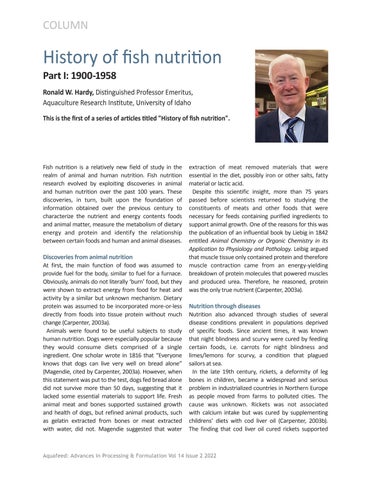
History of fish nutrition Part I: 1900-1958 Ronald W. Hardy, Distinguished Professor Emeritus, Aquaculture Research Institute, University of Idaho This is the first of a series of articles titled "History of fish nutrition".
Fish nutrition is a relatively new field of study in the realm of animal and human nutrition. Fish nutrition research evolved by exploiting discoveries in animal and human nutrition over the past 100 years. These discoveries, in turn, built upon the foundation of information obtained over the previous century to characterize the nutrient and energy contents foods and animal matter, measure the metabolism of dietary energy and protein and identify the relationship between certain foods and human and animal diseases.
Discoveries from animal nutrition At first, the main function of food was assumed to provide fuel for the body, similar to fuel for a furnace. Obviously, animals do not literally ‘burn’ food, but they were shown to extract energy from food for heat and activity by a similar but unknown mechanism. Dietary protein was assumed to be incorporated more-or-less directly from foods into tissue protein without much change (Carpenter, 2003a). Animals were found to be useful subjects to study human nutrition. Dogs were especially popular because they would consume diets comprised of a single ingredient. One scholar wrote in 1816 that “Everyone knows that dogs can live very well on bread alone” (Magendie, cited by Carpenter, 2003a). However, when this statement was put to the test, dogs fed bread alone did not survive more than 50 days, suggesting that it lacked some essential materials to support life. Fresh animal meat and bones supported sustained growth and health of dogs, but refined animal products, such as gelatin extracted from bones or meat extracted with water, did not. Magendie suggested that water
extraction of meat removed materials that were essential in the diet, possibly iron or other salts, fatty material or lactic acid. Despite this scientific insight, more than 75 years passed before scientists returned to studying the constituents of meats and other foods that were necessary for feeds containing purified ingredients to support animal growth. One of the reasons for this was the publication of an influential book by Liebig in 1842 entitled Animal Chemistry or Organic Chemistry in its Application to Physiology and Pathology. Leibig argued that muscle tissue only contained protein and therefore muscle contraction came from an energy-yielding breakdown of protein molecules that powered muscles and produced urea. Therefore, he reasoned, protein was the only true nutrient (Carpenter, 2003a).
Nutrition through diseases Nutrition also advanced through studies of several disease conditions prevalent in populations deprived of specific foods. Since ancient times, it was known that night blindness and scurvy were cured by feeding certain foods, i.e. carrots for night blindness and limes/lemons for scurvy, a condition that plagued sailors at sea. In the late 19th century, rickets, a deformity of leg bones in children, became a widespread and serious problem in industrialized countries in Northern Europe as people moved from farms to polluted cities. The cause was unknown. Rickets was not associated with calcium intake but was cured by supplementing childrens’ diets with cod liver oil (Carpenter, 2003b). The finding that cod liver oil cured rickets supported
Aquafeed: Advances in Processing & Formulation Vol 14 Issue 2 2022
29
the concept that minor constituents of foods were essential in the diet. In Asia, beriberi, a polyneuritis condition, afflicted prisoners in some prisons in Indonesia but not in other prisons. A Dutch physician, Conrad Ejikman, was tasked with identifying the cause of beriberi. It was noted that chickens grown in prisons where beriberi was prevalent in prisoners developed a similar condition. Chickens were fed left-over food that was mainly cooked rice. In prisons where unpolished (brown) rice was fed, neither prisoners nor chickens developed polyneuritis, whereas, in prisons where polished (white) rice was fed, beriberi was present in both prisoners and chickens. Many years later, the active, anti-beriberi substance in rice polishings was found to be thiamin, the first B vitamin to be identified. Sailors deprived of fresh food on long sea voyages developed a disease condition called scurvy. Although it was known for centuries that consuming fresh citrus fruits cured scurvy, the mechanisms involved were unknown. One theory was that sea air clogged skin pores preventing the escape of poisons and that pores were unclogged by eating lemons and limes. Many decades later, the active material in limes and lemons that prevented scurvy was identified as ascorbic acid, named Vitamin C.
First determination of nutritionally essential components The next stages of nutrition research led to the discovery of essential dietary nutrients and influenced fish, animal and human nutritional concepts to this day. Foods that cured nutritional diseases were subjected to various processes to characterize active fractions, such as assessing sensitivity to heat treatment or whether the activity was reduced after extraction with water or other solvents. This approach produced concentrated extractions fractions that were added to diets containing purified ingredients to determine if they contained nutritionally essential components. Further fractionation and refinement showed that some fractions contained several compounds that were necessary to support animal growth and health. This highly productive and intellectually challenging period in nutritional science is summarized in a wonderful series of review articles by Carpenter (2003a; 2003b) that
contain interesting details and historical contexts for their interpretation. These articles should be essential reading for any aspiring fish, animal or human nutritionist.
First aquaculture nutrition studies Although aquaculture is an ancient practice, writings about fish feeds only began to appear in the second half of the 19th century associated with trout and carp farming in North America and Europe (Stickney, 1996). Farm-made feeds were produced using locally available materials, such as organ meats from animal slaughterhouses, milk curd, fresh chopped fish and chicken eggs (Rumsey, 1994). Feeds were generally combinations of wet and dry ingredients, so the aim was to combine ingredients that increased the water stability of feed particles. Commercial pelleting practices had not yet been adopted, so it was important that feed particles stuck together long enough to be consumed by fish. One concept that influenced feed formulations for trout was based on the observation that wild trout were carnivores, consuming insects, aquatic invertebrates and small fish. An early study of the natural diet of trout involved analysis of the stomach contents of wild fish (Embody & Gordon, 1924). They found that the diet of wild trout was 49% crude protein, 15-16% fat, 8% crude fiber, and 10% ash, expressed on a dry weight basis. Therefore, the thinking went, trout feeds should only contain animal-based ingredients that were formulated to have a similar proximate composition. It was several decades before fish culturists changed their thinking and began to accept the concept that fish feeds should be formulated to supply essential nutrients (Page, 1985, cited by Rumsey, 1994). Even then, it was essential to supplement trout fed early feeds with fresh animal liver to support fish growth and prevent mortality. At first, two active fractions extracted from foods were prepared and called fat-soluble A and watersoluble B. The unknown compounds in the extracts were named vitamins by the pioneering nutrition researcher, Dr. Casimir Funk, because they were thought to be derived from ammonia and were thus “vital amines” (Funk, 1912). Each extract was thought to contain a single compound essential to life, but subsequent refinement of extracts showed
Aquafeed: Advances in Processing & Formulation Vol 14 Issue 2 2022
30
that each contained multiple active components. Fat-soluble A was found to contain four vitamins, A, D, E and K, known as the fat-soluble vitamins. The water-soluble B extract contained a number of vitamins that were named in order of discovery, i.e., B1 (thiamin), B2 (riboflavin), B3 (niacin), B5 (pantothenic acid), B6 (pyridoxine) and B7 (biotin), B9 (folic acid) and B12 (cobalamin). It took decades of research to identify and characterize all of the B vitamins, with the structure of the last one, B12, only being described in 1948. Each vitamin appeared to have one or more specific and distinct functions in metabolism that were essential for normal growth and health in animals, poultry and humans. When any of these vitamins was omitted from the diet, clinical deficiency signs appeared that could be cured by restoring the vitamin to the diet. A major development in fish nutrition was the establishment of the research partnership between Cornell University, the New York Department of Conservation and the U.S. Bureau of Fisheries. A fish nutrition research program was located at the Cortland National Hatchery in New York and began in 1932. Cornell University was a leader in poultry nutrition research, and this influenced the direction of fish nutrition research. Scientists at the Cortland Hatchery adopted the rigorous approaches and new technology in used in animal and poultry nutrition at Cornell. However, fish proved to be challenging research subjects because they are poikilothermic and are thus sensitive to water temperature as well as other environmental conditions, such as photoperiod and water quality. Also, due to their aquatic existence, fish excrete ammonia rather than urea from protein metabolism. Further, they obtain some essential minerals directly from rearing water and must maintain internal electrolyte homeostasis in either hypotonic or, for marine fish, hypertonic conditions. These factors made it necessary to modify methods and approaches used in nutrition research with chickens, rats or other laboratory animals. Another potential complication with fish nutrition research was that fish cannot be fed ad libitum like rats or chickens. Researchers must decide how much and how often to feed fish, and differences in these experimental factors complicate the interpretation of fish nutrition studies, especially between different laboratories.
Development of practical fish feeds Up until the late 1950s, feeds for hatchery-reared trout and Pacific salmon were made on-site at federal, state and private hatcheries using locally available ingredients. Since the nutritional requirements of fish were not yet known, except in broad terms, feed formulations were developed by trial and error by state and federal fisheries agencies, and university researchers. Successful feed formulations supported fish growth, maintained rearing water quality and prevented clinical signs of nutritional deficiencies. As mentioned, fresh byproducts of animal slaughter, mainly beef liver, were considered essential dietary constituents to prevent nutritional deficiencies. Feed formulations were developed empirically, rather than on the basis of meeting nutritional requirements which were, at the time, unknown. For example, in the first feed evaluation trial conducted at the Cortland Hatchery, these four diet formulations were tested: • Diet 1: 50 parts cottonseed meal, 50 parts raw beef liver and 50 parts dried skim milk • Diet 2: 50 parts cottonseed meal, 50 parts raw beef liver and 50 parts dried buttermilk • Diet 3: 50 parts cottonseed meal, 50 parts raw beef heart and 50 parts dried buttermilk • Diet 4: 50 parts cottonseed meal, 50 parts raw beef spleen and 50 parts dried buttermilk The next round of trials was conducted using similar formulations but containing skim milk from different suppliers, substituting peanut meal for cottonseed meal and replacing beef parts with sheep plucks (viscera) or with dried meat scraps. From this work, researchers concluded that skim milk and buttermilk were similar in value as ingredients. However, trout health could not be maintained longer than eight weeks unless feeds were supplemented with raw animal liver or heart (Cortland Hatchery Report Number 1, 1932). Over the next 10 years, 809 feed ingredients were tested in trout feeds at the Cortland Hatchery to develop formulations that hatchery personnel could use to prepare economical diets from commonly available ingredients. However, no matter what combination of dry ingredients was used, raw beef liver or other organ meat had to be included in the diet to prevent early mortality of the trout.
Aquafeed: Advances in Processing & Formulation Vol 14 Issue 2 2022
31
Nutritional requirements Concurrently with studies to develop feed formulations for hatcheries, research was being conducted to explore the nutritional requirements of trout. For example, Tunison and McCay (1935) investigated the calcium requirement of trout, showing that the calcium content in the whole body of trout was higher than could be accounted for by the calcium content of the feed they consumed. They concluded that trout could obtain calcium directly from rearing water. A major research topic was anemia, a widespread problem in hatchery-reared trout and salmon that was prevented by feeding beef liver. Liver was thought to contain an anti-anemia component that McCay named Factor H. Six B vitamins (thiamin, riboflavin, pyridoxine, pantothenic acid, niacin and biotin) were hypothesized to comprise Factor H. However, supplementing these vitamins in a trout diet, either alone or in various combinations, did not prevent anemia (Cortland Hatchery Report, No 13, 1944). At that time, folic acid, an essential vitamin, had not yet been identified. Beef liver is a rich source of folic acid and was therefore hypothesized to be Factor H but later studies in which folic acid was supplemented with semi-purified diets did not prevent anemia in trout. It was only after vitamin B12 was shown to be the missing nutrient associated with Factor H that anemia could be prevented without supplementing trout diets with the fresh liver. The 1920s and 1930s were a period of rapid progress in the discovery and characterization of vitamins, facilitated by using rats and mice as experimental animals (Carpenter, 2003c). Researchers used semipurified diets to determine requirements for individual vitamins and, in the late 1940s, fish nutritionists adopted this approach, first using semi-purified diet formulations that were used in rat nutrition studies. However, rat semi-purified diets consisting of casein and sucrose with vitamin and mineral supplements proved unsuitable for trout unless the fish received dried beef liver (McLaren et al., 1946). After much trial and error, a semi-purified diet that supported trout growth and health in short-term studies was developed (McLaren et al., 1947). Using this diet, B vitamins and ascorbic acid were omitted one-by-one from the vitamin mixture and added back in increments to the experimental diets, enabling scientists to make broad
estimates of dietary requirements of trout for thiamin (1-10 mg/kg), riboflavin (5-15 mg/kg), pyridoxine (1-10 mg/kg), pantothenic acid (10-100 mg/kg), nicotinic acid (1-5 mg/kg), choline (50-100 mg/kg), inositol (250-500 mg/kg), biotin (0.05-0.25 mg/kg), folic acid (1-5 mg/kg) and ascorbic acid (250-500 mg/kg). To estimate the vitamin requirements of trout more accurately, semi-purified diets had to be vitamin free. The semi-purified diets used in the McLaren et al. studies were not totally vitamin free because they contained casein and crab meal; both contained low levels of vitamins. An improved semi-purified diet was developed that contained casein, gelatin, lard, cooked potato starch, cellulose flour and minerals (Wolf, 1951). This diet supported trout with reasonable growth rates over a 25-week period equivalent to contemporary practical diets that contained beef liver. Commercial casein still contained small amounts of B vitamins, but when vitamin-free casein, made by extracting casein with solvents, was substituted for commercial casein, trout refused to eat the diet. Regarding the need for vitamin supplementation, Wolf (1951) reported that deletion of pantothenic acid resulted in cessation of growth and gill disease after eight weeks of feeding. Likewise, deletion of folic acid slowed fish growth and resulted in anemia, and deletion of vitamin B12 resulted in fish mortality and anemia. While the Cortland Hatchery was focusing on trout nutrition, salmon nutrition became a focus of study in the western USA at the University of Washington, Oregon State University and at regional state and federal fisheries agencies, notably the US Fish and Wildlife Service. Starting in the 1930s, dams for irrigation and hydroelectric power generation were constructed on major rivers in the western USA, especially in the Columbia River system. The dams blocked a large proportion of Pacific salmon migratory corridors to upstream spawning and juvenile nursery areas. To mitigate the loss of spawning and salmon nursery habitats, many hatcheries were constructed, creating a need to provide suitable feeds to rear juvenile Pacific salmon for release as smolts to maintain salmon fisheries. Chinook (Oncorhynchus tshawytscha) and coho (O. kisutch) salmon were the main species raised in hatcheries, although sockeye salmon (O. nerka),
Aquafeed: Advances in Processing & Formulation Vol 14 Issue 2 2022
32
Check out worldwide industry job openings at Aquafeed.com Job Center
www.aquafeed.com
chum salmon (O. keta) and pink salmon (O. gorbuscha) were also raised. After spending several years at sea, salmon migrate to coastal areas where they enter commercial, tribal and recreational fisheries. A high smolt to adult return ratio was the primary goal of hatchery programs, and as a result, the focus of fish nutrition research was on developing feed formulations to produce healthy, robust juveniles likely to survive after hatchery release. The cost of feed was secondary to the goal of producing smolts that contributed to fisheries. Feeds cannot be precisely formulated without information on the nutritional requirement, so research focused on identifying the dietary nutritional requirements of juvenile salmon. The substantial investments made in research capacity led to the development of standards for fish nutrition research worldwide during the second half of the 20th century, providing the foundation for the development of the global aquaculture industry decades later. References available on request.
XX INTERNATIONAL SYMPOSIUM ON FISH NUTRITION AND FEEDING TOWARDS PRECISION FISH NUTRITION AND FEEDING 5th - 9th June 2022 | Sorrento, Italy Chair: Alessio Bonaldo, University of Bologna
ORGANIZING SECRETARIAT VET INTERNATIONAL SRL FRANCESCA.MAZZUCCHELLI@VETINTERNATIONAL.EU
www.isfnf2022.org
Aquafeed: Advances in Processing & Formulation Vol 14 Issue 2 2022
33
Extruder technology: A view from the wear side Katharina Diehl, Carl Aug. Picard GmbH, Albert Keun, Pro-Consult Kolding Aps
Extrusion of aquatic feeds is a very broad and highly complex process considering the number of different aquatic species being farmed in the world today. Feeds for shrimp, eel, trout, salmon, catfish, carp, tilapia, milkfish, yellowtail, frog, etc. are some of the major aquatic feeds manufactured on either a single-screw or twin-screw extruder. Aquatic feeds can be defined as floating feed, suspended feed and sinking feed. Cold-water fish, like salmonids and trout, normally are top feeders and require a highly expanded floating feed that must be stable in water for at least 10-15 minutes – the time required for top feeders to consume their feed. Seabass and seabream require suspended feed – they are not top or bottom feeders. Usually, warm-water fishes like carp, eel, tilapia, milkfish, shrimp, etc. are bottom feeders and require a denser sinking feed that must be stable in water for at least 30-60 minutes – the time required for bottom feeders to consume their feed. Extruded aquatic feeds with good water stability are important for maintaining water quality and good conversion ratios.
Figure 1. Material portfolio wear parts for single screw extruders.
Extrusion The pre-set screw and barrel configurations represent many years of analytical design, research and comprehensive testing and have their own specifications to produce floating aquatic feeds, semimoist aquatic feeds, slowly sinking aquatic feeds and sinking aquatic feeds. The first 25% of the extruder length normally is the transport section which utilizes twin flight transport screw elements. Then, the mixing and kneading zones come, utilizing cut flight reverse screw elements and both single and twin flight screw elements. The single flight screw elements serve the need to hold the pressure generated within the mixing,
kneading and cooking zones constant and stable. The last 25% of the extruder length, called the cooking zone, utilizes single-flight feeding screw elements just before the die plate. Moisture levels of 25-30% in the form of steam and water are a catalyst in extrusion. This moisture combined with the accumulated pressure from the cooking, mixing and kneading zones results in extraordinary wear of the screw elements starting at the outlet. Therefore, the choice of metallurgy used for both screw elements and barrel liners is extremely important. C.A.PICARD® does not only offer a wide range of metallurgies for aquatic feeds, pet food, plastics, etc., but have also optimized its
Aquafeed: Advances in Processing & Formulation Vol 14 Issue 2 2022
34
Figure 2. Material portfolio elements for twin screw extruders.
Figure 3. Material portfolio liners/barrels.
through-hardened martensitic stainless steel screw elements that have proven to minimize both wear and abrasion in comparison to the metallurgies used on the market today. Figures 1-3 show C.A.PICARD®’s
materials evaluations based on C.A.PICARD®’s experience, material analyses and information provided by the customers. To tackle abrasive wear and the corrosive attack caused by steam, water or acid, C.A.PICARD®’s throughhardened stainless steels with enhanced carbon content can be applied. The through-hardened stainless steel used within each zone can be categorized into three groups depending on the wear resistance. The first category is standard through-hardened stainless steel with low carbon content defined as “05” in C.A.PICARD®’s code. It has very good corrosion resistance but exhibits no special resistance against abrasion. It can be used within extruder transport zones where abrasive wear plays a tangential role. Should the abrasive wear be higher within the pressure build-up zones, then through-hardened stainless steel with an increased carbon content is used to protect the screw elements (C.A.PICARD®‘s code EE). The steel heat treatment plays a crucial role to find the right balance between hardness and corrosion resistance. However, there are instances in which this steel solution is not suitable. Then C.A.PICARD® can offer its premium metallurgy (C.A.PICARD®’s code 25) which is a combination of high carbon content and many other carbide-building elements with a sufficient chromium content to build a passive layer protecting the material against corrosive attack. In Figure 5, the wear resistance of these three C.A.PICARD®‘s metallurgies is compared.
Different approach It is well known that tribology always is a system property. That means the combination of product, screw configuration and liners/barrels must be considered. Originally, widespread common tool steel is used for the liners/barrels manufacturing aquatic feed. C.A.PICARD® takes a different approach originating in their vast manufacturing experience and knowledge of working with twin-screw extruders. The liner within the barrel should have a longer lifetime than the screw elements as it is much more expensive to replace the liner than to replace the screw elements. Therefore, C.A.PICARD® recommends utilizing its premium metallurgy which offers a much higher wear and corrosion resistance that perfectly fits with all three zones of the extruder. Long downtime can be avoided, which will finally increase profitability.
Aquafeed: Advances in Processing & Formulation Vol 14 Issue 2 2022
35
Figure 4. Product range Extruder Technology Division C.A.PICARD®.
manufacturing aquatic feed. C.A.PICARD® supplies a full range of screw elements, barrels/liners, shafts, etc. for BioMar A/S’s twin- and single-screw extruders. The introduction of high chromium, vanadium and nickel contents in C.A.PICARD®’s liners increased the life cycles and profitability of the liners noticeably. With the supply of extruder consumable spares for all brands of extruders (single and twin screw), C.A.PICARD® has achieved and accumulated a vast portfolio of knowledge within the aquatic feed manufacturing technologies for both warm- and coldwater fish species.
Figure 5. Wear resistance of C.A.PICARD®‘s metallurgies.
Furthermore, consultancy services are included in C.A.PICARD®’s supply to improve screw configurations leading to improved finished product quality, increased throughput and less extruder consumable spares. More information:
Supply C.A.PICARD® supplies extruder consumable spares for all leading extruder brands manufacturing aquatic feed. One of the numerous customers of C.A.PICARD® is BioMar A/S, one of the world's market leaders in
Katharina Diehl Development Engineer Carl Aug. Picard GmbH E: Katharina.diehl@capicard.de
Aquafeed: Advances in Processing & Formulation Vol 14 Issue 2 2022
36
The challenge of an essential and expanding market Hadrien Delemazure, Clextral
The most recent study from the Food and Agriculture Organization of the United Nations (FAO, 2020) confirms that 52% of the consumed aquatic animals in the world, including finfish, mollusks and crustaceans, come from aquaculture. With a world population of 7.8 billion people, the average fish consumption, including mollusks and crustaceans, was estimated in 2018 to be 20.1 kg/inhabitants. The process of feed manufacturing for finfish and shrimp represents a key issue for ensuring the delivery of consistently high-quality granulates for these intensive breeding processes; for example, it is estimated that over 60% of the production expenses for farmed salmon come from the feed cost. Additionally, we have to face challenges, such as limited resources of fishmeal and fish oils worldwide and a temperature increase in the earth’s environment creating irregular conditions for fish capture, uncertain cereal and pulse harvests on earth (used more and more to partially replace fishmeal in recipes), and the risks to delicate offshore aquaculture breeding facilities (waves, winds, storms, currents, pollution, etc.).
The potential of twin-screw extrusion Fish is known as a high-value food for humans, with health benefits that include long-chain unsaturated fatty acids, vitamins and minerals and a well-
balanced protein supply. In 2017, fish supplied 17% of animal protein in the world. Moreover, 3.3 billion people received 20% of their animal protein from fish origin. Therefore, fish feed processing technology plays a particularly important role in this industry. It requires: • Easy adaptation to any change in raw-material composition: moisture content, lipid content, particle size distribution. These are due to various sources of raw materials (for example, soy flour can be purchased in many parts of the world), transport and storage conditions, and the grinding process. • Flexibility to adjust the sinking/floating properties of the granulates to follow as closely as possible the food habits of each animal family. • Processing a wide range of recipes to respond to industry demand for foods with low or high amounts of lipids, vegetable proteins, or various sources of protein to meet the specific nutritional fish requests and adapt to rapid environmental changes. • Flexibility to adjust the shear, cooking and shaping conditions in the extruder and apply precise drying and coating parameters during the entire production process. • Ensuring a high hygienic standard, to avoid any contamination during the feed manufacturing process.
Aquafeed: Advances in Processing & Formulation Vol 14 Issue 2 2022
37
Taking these considerations into account, combined with good manufacturing/breeding practices, scientific education and adapted legislation, we can nurture high-quality aquatic animals that offer health benefits to people around the world, using local production to ensure low carbon footprints and maintain reasonable sales prices.
Co-rotating twin-screw extruder Single screw extrusion technology has offered a simplified method of continuous cooking of doughs under controlled processing conditions for many decades. Sixty years ago, some industry pioneers developed an alternative process: co-rotating twinscrew technology applied to food production, which offered much greater flexibility than single screw machines due to its intensive mixing ability with precise shear and temperature control. With the evolution of electronic PLCs, mechanical features, gauges, drives, and metallurgy, together with heavy R&D investment, these pioneers offered the fish feed industry more sophisticated systems, allowing the industry to move quickly into new areas, such as recipes with high amounts of fat and vegetable protein. Clextral, a major player in twin-screw technology for food and feed applications, has launched innovations that offer even greater opportunities for the fish farming industry to process original recipes and use raw materials, such as new pulses, proteins, insects, krill meals and possibly processed animal proteins, seaweeds, etc. One of these innovations relates to intelligence of the machine and the ability of the auto-adaptive extruder to adjust to potential raw material variations.
Advanced Thermal Control (ATC) The Advanced Thermal Control (ATC) is a self-learning, proprietary software solution that ensures absolute precision in temperature control of the barrel assembly of the Evolum+ extruder. ATC continuously monitors production parameters to ensure process and product consistency. ATC is proven to enhance process stability up to 70%, with energy savings averaging 20% by eliminating repeated heating/ cooling cycles to maintain process temperature setpoints in all circumstances. Combined with an automatic start-up and shut down procedures, this system represents a powerful tool to enhance the productivity of the extrusion line. Preconditioning: Higher efficiency and improved product texture Another innovation refers to the preconditioning process, a key operation in fish feed manufacturing. Preconditioning allows moistening of the powdered mix and pre-gelatinization of the starch molecules through the addition of water and steam, thereby, increasing the pellets' water stability, enhancing production capacity and reducing wear on the extruder. Clextral’s patented Preconditioner+ improves heat and mass transfer to the product due to the Advanced Filling Control device (AFC). It interacts directly with the material inside the mixing chamber and enables the filling ratio to be adjusted. The AFC system uses an exclusive conveying screw inside the tank and adjusts the flow by a partial and controlled recycling of the material being processed from the outlet to the entry point, thus intensifying the specific preconditioning functions.
Aquafeed: Advances in Processing & Formulation Vol 14 Issue 2 2022
38
Laboratory tests have proven that the final hardness of fish feed pellets increased between 7% and 29% using the same recipe and adjusting the bottom-screw speed. During the cleaning procedure, the bottom-screw rotation is reversed to facilitate the emptying and the cleaning of the preconditioning chamber.
Hygiene Finally, today much attention is focused on hygienic extruder design as food security is a key parameter for the fish feed and food industries. Fish feed manufacturers want to be able to clean their extruder from the outside using hot water and sometimes with cleaning agents. The stainless steel, hygienic Evolum+ frame structure is designed to avoid water stagnation and all the extruder areas are easily accessible. The internal processing assembly of the twin-screw extruder must be cleaned easily as well: the complete quick barrel extraction device is today a paradigm in the industry. It offers access to the screws and barrels in only a few minutes and is a state-of-theart solution that simplifies preventive maintenance, wear monitoring and cleaning processes. Density control system Clextral has developed a system for instantly varying the density of the material within the extruder. It is possible, for example, (depending on the recipe) to quickly pass from an extruded pellet of 350 g/L to 750 g/L. This fully automated tool ensures the control of the pellets' density and the ability to produce sinking or floating aquatic feed.
With the density control system, the cooking degree and resulting density of the final product can be adjusted according to customer specifications. By adding steam or through the generation of a vacuum, the density control system ensures the precise density and proper degree of expansion in the product. The main advantages of this process: • Precise density adjustment and control. • Reduced product moisture levels. • Generate high-density products. • Fines recovery back to preconditioner. • Ideal for aquatic feed production. Recent process innovations that allow expanded ingredient availability are bringing many opportunities for feed processors. Processors can easily make a range of feeds that satisfy the nutritional requirements and feeding styles of many aquatic species. In turn, fish farmers will be better equipped to optimize their feeding operations and grow healthy fish and shrimp using sustainable practices to supply the growing global demand.
More information: Hadrien Delemazure Process Engineer and Feed Expert Clextral E: hdelemazure@clextral.com
Aquafeed: Advances in Processing & Formulation Vol 14 Issue 2 2022
COLUMN
Development of aquafeeds: Reflections and future perspectives I. The foundational years: 1940-1979 Louis R. D’Abramo, Professor Emeritus, Department of Wildlife, Fisheries and Aquaculture, Mississippi State University Thomas R. Zeigler, Senior Technical Advisor, Past President and Chairman, Zeigler Bros., Inc. This is the first of a series of articles titled "Development of aquafeeds: Reflections and future perspectives".
As global aquaculture production continues to grow, the life history stages of many farmed species are fed manufactured feeds. Basic knowledge of aquatic animal nutrition has been acquired, enhanced, and correspondingly applied in the production of aquafeeds. However, a basic historical summary of the development and manufacture of aquafeeds in union with the ongoing progress in the understanding of nutrition is lacking. Therefore, the goal of this effort is to achieve something that has been overtly lacking in the education and training of emerging researchers in aquatic animal nutrition and aquafeed management, a historical perspective that highlights this coevolving history. This knowledge is essential as it instills an appreciation and respect for the 60-year path of how we got here today. It also nourishes a vital insight toward meeting the challenges of future improvement of physical characteristics and nutrient composition of feeds and their provision. This article consists of three parts offered sequentially within three separate issues of Aquafeed Magazine. The content is descriptive of what we consider to be impactful highlights or paradigm changes in the history of the nutrition of aquaculture species and the production of aquafeed for commercial enterprise. The content is by no means comprehensive and therefore is
not written as a review. The combined articles represent reflections and perspectives from our extensive careers in aquatic animal nutrition research and commercial production of aquafeeds as influenced by technology and the state of aquatic animal nutrition at that time in history. The individual parts are divided into narratives of the early decades of development (the foundational years, 1940-1979), the years responding to the rapid expansion of global aquaculture (the transformational years, 1980-2019), and the years forthcoming, whereby we speculate and offer recommended directives about where the path of the future should lead (the sustainability years, 2020- ).
The origins of aquafeeds In 1954, the efforts to gain and apply knowledge about fish nutrition were inaugurated in a trout hatchery in Cortland, NY. Three entities, the NY State Conservation Department, the US Bureau of Fisheries, and Cornell University joined forces to initiate a program designed to meet the needs of developing a practical diet that would be an integral part of trout hatchery management. This recognition of the critical importance of a feed based on knowledge of nutrition to grow juvenile trout was complemented on the west coast of the U.S. by similar acknowledged needs to develop
Aquafeed: Advances in Processing & Formulation Vol 14 Issue 2 2022
40
nutritionally complete diets to grow juvenile Pacific salmon for release as part of a fisheries management program. Again, a group of cooperators, specifically the University of Washington, Oregon State University, and regional and state fishery agencies that notably included the US Fish and Wildlife Service were collectively involved. These goals to develop practical diets were particularly noteworthy because they represented a true desire to develop a knowledge of fish nutrition based on efforts to identify specific nutrient requirements. Fish feed preparation originally started with indiscriminate attempts to feed fish with aggregations of ingredients such as ground animal waste in combination with a ground plant-derived meal. With the advent of the pellet mill, particles of different sizes and densities could be manufactured. With the inception of a vastly improved methodology to produce feed, a major paradigm change occurred. Suddenly, the potential of feeding fish directly via pellets containing ingredients based on knowledge of nutrient requirements of aquatic animals was in the realm of reality. Finally, it was time to move from essentially feeding ponds with concoctions of undescriptive content to feeding fish more precisely.
Foundational laboratory studies of aquatic animal nutrition Aquatic animal nutrition commenced in the late 1940s when B. A. McLaren was able to achieve rainbow trout growth with a semi-purified diet that was used to widely estimate the requirements of an array of water-soluble vitamins as published in Archives of Biochemistry in 1947. With the advent of a semi-purified diet for experimental studies, knowledge of the nutritional requirements of aquatic organisms began to substantially increase. Thus, the semi-purified diet represented a principal turning point in the history of aquatic animal nutrition. It consisted of chemically defined ingredients that were specifically used to serve as a supply of specific macro- and micronutrients. Examples of ingredients of semi-purified diets are casein, dextrin, corn and cod liver oils and mixtures of vitamins and salts (micro and macroelements). In the late 1950s, Dr. John Halver and Dr. John Coats, under the auspices of the Western Fish Nutrition Laboratory and the Bureau of Sport Fisheries and Wildlife, used a vitamin-free semi-purified diet to define the water-soluble vitamin requirements of coho salmon. Also, in 1957, Halver et al. identified the
A feed mill, circa 1958 after it had been modernized with new bulk tanks to increase automated manufacture of pelleted feeds.
requirements of nine watersoluble vitamins for chinook salmon fingerlings. In 1957 and 1960 publications, Halver et al. established the qualitative dietary requirements of 10 amino acids for chinook salmon and sockeye salmon respectively. Feeding trials consisted of different experimental diets consisting of graded levels of a specific essential amino acid within the mixture of other essential amino acids. The estimated requirement was determined by using a response variable, commonly growth; however, where appropriate, other physiological responses were evaluated in an attempt to further validate the growth results. These qualitative essential dietary amino acid requirements were complemented by studies that used 14 C whereby the lack of metabolic incorporation of 14 C into a particular amino acid indicated lack of synthesis and thus its dietary essentiality. The ten essential amino acids were commonly required by both fish and crustaceans. The first investigations of nutrient requirements of crustaceans using a semi-purified diet began approximately 25 years after the vitamin requirements of coho salmon were published. Published studies of nutrient requirements of the prawn Penaeus japonicus began to appear in the 1970s and were conducted by Japanese investigators, most notably Drs. Akio Kanazawa and Shin-ichi Teshima at Kagoshima University and Drs. Osamu Deshimaru and Katsunobu Kuroki at the Prefecture in Kagoshima. These researchers embraced the use of semi-purified diets that contained intact reference proteins in combination with a mixture of essential amino acids in crystalline form. Kanazawa,
Aquafeed: Advances in Processing & Formulation Vol 14 Issue 2 2022
41
protein/starch particles that could be suspended within a liquid phase that contained an array of water-soluble nutrients which in mixtures of salts, amino acids, nucleic acids, and vitamins. The water-soluble nutrients within the liquid phase were absorbed by the microcrustacean as a byproduct of the removal of the suspended particles by filtration. This pioneering work validated information about qualitative requirements of nutrients such as cholesterol and many B vitamins. Additionally, research results, first published in the late 1970s and into the early 1980s, described different growth rates in response to different dietary fatty acid mixtures that were included in the particulate phase and mimicked the composition of different phylogenetic groups of algae. This work preceded investigations devoted to the understanding of the dietary requirements of fish and crustaceans for certain fatty acids.
Pelleted feeds were packaged into 100 lb burlap bags. At this mill, circa 1958, a fish feed was produced for the Michigan Department of Conservation according to the formula called Michigan 2B. These pelleted feeds were not nutritionally complete and primarily consisted of some fishmeal, cottonseed meal and wheat mailings.
Teshima and Shigeru Tokiwa published the results of a series of investigations, notably the relationship of dietary lipids and their corresponding fatty acid composition to the growth of shrimp. In 1974, Deshimaru and Kuroki reported the results of an investigation designed to establish the most effective combination of nutrients fed to Penaeus japonicus with the ultimate goal of producing a “purified diet” through the evaluation of formulations consisting of different ingredients. Using the best “purified” diet, they estimated the cholesterol requirement of P. japonicus. The nutrient requirement studies of Kanazawa, Teshima, Tokiwa, Deshimaru, and Kuroki during the 1970s were complemented by some unique laboratory investigations. Dr. Luigi Provasoli of Haskin Laboratories and Yale University expanded his research devoted to the understanding of the nutrient requirements of species of algae under axenic (bacteria free) culture conditions to include the microcrustacean Moina macrocopa. The nutritional food source was described as a biphasic medium composed of a particulate phase consisting of
Early advances in aquafeed development Regarding feed manufacture, a good example of a prototypical feed was the Oregon Moist Pellet (OMP). Specifically developed in 1954 as a hatchery feed for salmon by Agricultural and Environmental Services (AES) researchers at the Seafood Laboratory of Oregon State University, OMP was unique because its formula was open, thereby being commonly available to feed manufacturers for commercial production. This characteristic lack of a propriety formulation eliminated the need for feed to be independently produced at each hatchery. The OMP consisted of a dry mix (fishmeal, cottonseed meal, wheat germ meal, dried whey, corn distillers dried solubles, and vitamin and mineral premixes) and a wet mix (pasteurized wet fish, marine oil and 70% choline chloride). Produced by a cold pelletization process the OMP had a comparatively high moisture content (26-28%) which required shipment as a frozen product for distribution. During the decade of 1941 to 1950, the first feeds for commercial catfish and trout farming were produced by pelleting to achieve a larger particle size. During the 1950s and 1960s, commercial catfish farming in the U.S. was notably increasing and by the 1980s, production practices, post-harvesting processing, and marketing had reached an impressive level. Pelleted feeds were also being produced for the burgeoning trout and salmon farming enterprises. During the 1950s, the manufacture of some feeds shifted to a new manufacturing process,
Aquafeed: Advances in Processing & Formulation Vol 14 Issue 2 2022
42
extrusion. With the manipulation of the qualitative and quantitative carbohydrate content, extrusion successfully produced a desired floating feed that evidenced comparatively higher water stability. The floating nature of the feed permitted evaluation of nutritional and possibly pathological states of the fish by observation of change in feeding behavior at the water surface. During the extrusion process, the starch contained in the feed was gelatinized, a condition that improved overall digestibility. Another benefit of extrusion was that vitamins included as mixtures in a feed formulation were less susceptible to loss of activity. During the 1950s, companies such as Berger, Silver Cup, Zeigler, Glencoe Mills, Purina and Rangen began the commercial production of fish feeds characterized by specific manufacturing processes. Attention was directed to the provision of suitable crude lipid and protein levels as well as the moisture content. Extruded feeds were eventually followed by the introduction of expansion feeds that originated in Europe. The manufacture of expansion feeds differed from that of extruded feeds by incorporating less moisture and more shear to meet the objectives of improved digestibility and the ability to include more lipid (15-20%) in formulations. The increased levels of dietary lipid introduced the ability to increase amounts of available dietary energy and thereby reduce the overall level of required dietary protein (sparing protein). The nutritional value of feeds was improved through changes in ingredient composition that were based on the ever-increasing knowledge of aquatic animal nutrition and other benefits derived from advances in feed manufacturing technology.
Meeting the needs of education, research and training The recognized benefits of research devoted to the understanding of nutrient requirements and its application to the manufacture of aquafeeds during the 1950s through the 1970s led to the need for supportive educational and research opportunities that were established at several universities and institutes in Europe. A few examples of this movement follow. In Bergen, Norway, a fish nutrition research program was added to animal and human nutrition programs. The prominence of this area of research has continued as a part (Feed and Nutrition) of the Aquaculture,
Environment and Technology division of the Institute of Marine Research in Bergen. In France, Dr. Pierre Luquet was instrumental in establishing the study of fish nutrition within the animal nutrition group at the National Institute for Agricultural Research during the early 1970s. As part of the University of Stirling in the UK, the Institute of Aquaculture was founded in 1971 and has become a leading international center that fosters aquaculture education, research, and innovative technology. Dr. Colin Cowey, educated in zoology and biochemistry, joined the Unit for Research in Fish Nutrition in Aberdeen in the UK in the late 1950s. There and later at the Institute of Marine Biochemistry in Aberdeen, his renowned fish nutrition research contributions received global recognition.
Feed ingredients to serve a growing aquaculture industry The success of aquaculture enterprises was integrally dependent on the success of aquafeeds. The inherent objectives in aquafeed design were the provision of balanced nutrition to produce healthy fish at economically practical growth rates aligned with the efficient conversion of feed to tissue. The decades of the 1950s, 1960s and 1970s (1951 through 1979) established the foundation for the development of feeds that were originally intended to produce stocks for fishery enhancement/restoration. The obvious need to base feed composition on knowledge of aquatic animal nutrition created a foundation for extending these efforts to address the needs of the growing global aquaculture enterprise. Feeds, specifically for salmon, catfish and trout, led to formulations and feed manufacturing processes designed to increase the nutrient value and utilization efficiency of the ingredients as guided by cost considerations. The understanding of essential amino acids, fatty acids and water-soluble vitamin requirements was accompanied by a focus to identify superior commercial sources of protein, lipid, and carbohydrate. Marine-derived proteins from meals produced from menhaden, anchovy, squid liver, and shrimp heads, and oils from cod liver, menhaden, catfish offal were some of the primary ingredients evaluated. Plantderived sources from meals derived from soybean, peanut, and cottonseed, and oils from corn, canola and rapeseed also received attention as aquatic feed
Aquafeed: Advances in Processing & Formulation Vol 14 Issue 2 2022
43
ingredients. A significant amount of research was devoted to the digestibility of the macronutrient composition of the various feedstuffs with the goal of providing nutrients that were most efficiently utilized by the different aquaculture species in association with their natural diets. Most of the feeds tested as part of laboratory experiments focused on strategies for the successful grow-out of juveniles. Knowledge of nutrient requirements and their satisfaction in feed for both larval and broodstock life history stages lagged behind as evidenced by a continued dependence on live feeds, either complete or as supplements. Species of algae and rotifers and Artemia nauplii were the preferred foods for larval species of fish and crustaceans and much effort was devoted to the identification of essential fatty acids, particularly the long-chain polyunsaturated fatty acids (LC-PUFA). Live or frozen animal feeds continued to be an integral part of the successful culture of shrimp broodstock. However, the nutrient composition derived from these sources was recognized as being subject to change. It was obvious that a controlled nutrient vehicle
that reliably and consistently satisfied the nutrient requirements at all life stages was needed.
To be continued – Part II Part II of the history of the development of aquafeeds will follow in the next issue and highlight the need to organize the knowledge that was vastly accumulating. Notable efforts were launched to share these data through groundbreaking meetings and publications. More species of fish and crustaceans were identified as potential candidates for commercial aquaculture. In response to this significant upsurge of knowledge, the emergence of additional species of interest, and the unique life stage-dependent production needs, aquafeeds would correspondingly need to develop and improve to effectively meet these requirements. Specific feed additives and the presence of anti-nutritional factors in feedstuffs would take on added significance with the intent of meeting the overall objectives of increasing efficiency, enhancing immunocompetence, and achieving the desired pigmentation.
Aquafeed: Advances in Processing & Formulation Vol 14 Issue 2 2022
44
Supporting the replacement of marine animal ingredients: Improving palatability and performance in whiteleg shrimp diets Rui A. Gonçalves, Sofia Morais, Lucta
World aquaculture production of Litopenaeus vannamei was over 4.9 million tons in 2020, representing 53% of crustacean production (FAO 2020), and is expected to continue to increase in coming years. To keep the expected production growth, the shrimp aquaculture industry faces several challenges. The need for consistent and predictable supplies of ingredients is possibly the most critical challenge and its successful accomplishment will be influenced by several factors other than just economics.
Shrimp farming black box Shrimp are mostly cultivated in environments with low A
visibility and rich in dissolved chemicals. Furthermore, shrimp are slow and selective feeders, which further increases the risk for high nutrient leaching and feed wastage. In recent years, the utilization of technology in shrimp farming has increased but it’s still complex to get accurate information about fluctuations in production parameters, feed intake, environmental impact, etc. Shrimp notoriously depends on highly specialized chemosensory systems to identify, locate and ingest food. Therefore, the shrimp industry is aware that formulated diets must be chemically attractive to aid in the rapid localization and ingestion of feed pellets. Palatability enhancement of diets helps to reduce the
B
Figure 1. Palatability trial with individually-housed shrimp (n=15 ± SEM), with pellet intake assessed at 30 minutes (A) and 90 minutes (B) after providing the feed. Experimental diets were formulated to have 8.4-8.7% CF and 35.5-36.0% CP, including increasing levels of fishmeal (15-20%) balanced by decreasing levels of soybean meal (30-23.0%) and varying levels of wheat flour (35.2-37.3%). Poultry byproduct (10.0%) was also included. Asterisks indicate results of t-tests of paired comparisons: ****P<0.0001; ***P<0.001; **P<0.01; ns – non-significant (P>0.05).
Aquafeed: Advances in Processing & Formulation Vol 14 Issue 2 2022
45
leaching of nutrients, not only reducing economic losses but also contributing to a lower waste output and better nutrition of the shrimp.
Traditional use of marine palatants The complexity of the environment in which shrimp are grown, associated with their natural behavior and highly sensitive chemosensory systems, makes the replacement of marine ingredients a difficult task. Traditionally, the availability and economical soundness of fishmeal and fish oil allowed including these ingredients at levels at which feed intake was optimal. More recently, due to increasing prices and sustainability concerns of fishmeal and fish oil, their utilization as “attractants” was in part replaced by the use of byproducts from fishery and aquaculture processing industries. However, such products often have variable composition and quality due to seasonality and/or little control over processing conditions. In addition, there can be issues with the limited or unpredictable availability of these byproducts. Therefore, there is a need for products that could guarantee optimization of palatability in a context where the inclusion of marine animal ingredients is reduced. The present article shows the results of a concentrated product containing selected sources of amino acids and nucleotides, among other flavoring substances, none of animal origin (derived from yeast extracts, vegetable protein hydrolysates or synthetic sources), tested as a palatability enhancer (PE) in white shrimp, Litopenaeus vannamei, diets where a range of marine ingredients was substantially reduced or replaced. Context: Fishmeal reduction To test the efficacy of the PE in a fishmeal reduction context, two experimental diets were formulated to have 15% or 20% fishmeal. The diets were tested without (FM15%, FM20%) or with supplementation of 0.2% PE (FM15%PLUS, FM20%PLUS). Two positive and negative controls (PC and NC, IMAQUA proprietary formulation) served as references of high and low palatability to validate the assay. The palatability study, performed at IMAQUA (Belgium), used individually housed shrimp (10-L aquarium, 20 ppt, 27 ± 1°C, 1.5 g, n=15/treatment) in intermold. Each shrimp received 20 pellets of one treatment and the number of uneaten pellets was evaluated 30 and 90 minutes after providing
Figure 2. Palatability study with group-housed shrimp (n=12 ± SEM), with pellet intake assessed 3 hours after providing the feed. Different letters indicate significant differences between treatments (P<0.05, one-way ANOVA followed by LSD posthoc test). The experimental diets contained 7.1% CF and 34.5% CP coming from soybean meal, wheat meal, wheat gluten, and poultry meal as the only animal protein - no fishmeal was included. Standard commercial control (CC) contained a minimum of 8% CF, 40% CP, and 5% squid meal.
the feed. At the end of the trial, shrimp were weighed and the number of pellets ingested per gram of body weight was calculated. At the 15% FM level, supplementation with PE (FM15%PLUS) significantly and substantially increased the ingested pellets at 30 min (↑ 91%) and at 90 min (↑ 42%), compared to the FM15% control. When the FM20% was supplemented with PE, a numerical (nonsignificant) increase was observed at 30 minutes (↑ 3.5%) and at 90 minutes (↑ 11.5%). By comparing diets FM20% and FM15%PLUS, it was possible to verify that despite having 5% lower fishmeal, FM15%PLUS treatment ingested 17.7% more feed than FM20%. Therefore, PE supplementation was able to more than compensate the reduction in fishmeal from 20% to 15% (Fig. 1).
Context: Zero fishmeal A palatability study was performed at Georgia State University, USA (Prof. Charles Derby’s laboratory) testing four diets: 1) a negative control with no fishmeal and without added feeding stimulants (NC), two diets with similar basal composition as the NC but supplemented with 2) 5% krill meal (KM) or 3) 0.3% PE and 4) a standard commercial control (CC). Juvenile shrimp (average 5.3 g) were group-housed (15 to 30 shrimp per 80-L aquarium, 33-35 ppt, 24-25°C). For each diet, 12 groups of shrimp were tested, giving
Aquafeed: Advances in Processing & Formulation Vol 14 Issue 2 2022
46 Table 1. Growth and feeding performance of shrimp at the end of the 8-week trial (n=3 ± SEM). Means in the same row with different superscripts are significantly different (Fisher’s LSD test; p<0.05).
Control Initial weight (g) Weight gain (%)
S1
0.91 ± 0.00
S3
0.90 ± 0.00 a
581.51 ± 16.99
615.90 ± 18.60
S1+PE0.1
0.90 ± 0.00 ab
602.95 ± 18.16
0.90 ± 0.00 ab
654.31 ± 5.28
b
S1+PE0.15
PE0.1
0.90 ± 0.00
0.90 ± 0.01 ab
637.76 ± 20.59
603.42 ± 26.20
PE0.15 0.89 ± 0.01 ab
SGR (% day-1)
3.37 ± 0.04a
3.45 ± 0.05ab
3.42 ± 0.04ab
3.54 ± 0.01b
3.50 ± 0.05ab
3.42 ± 0.07ab
Feed intake (g/shrimp)
9.52 ± 0.08a
10.21 ± 0.19b
9.84 ± 0.02ab
10.04 ± 0.08ab
10.04 ± 0.24ab
10.25 ± 0.32b
653.28 ± 10.30b 3.54 ± 0.02b 10.36 ± 0.12b
FCR
1.90 ± 0.09
1.87 ± 0.05
1.89 ± 0.08
1.75 ± 0.01
1.75 ± 0.03
1.99 ± 0.15
1.87 ± 0.07
Survival (%)
92.22 ± 4.44
96.67 ± 3.33
94.44 ± 2.94
93.33 ± 1.92
98.89 ± 1.11
92.22 ± 4.01
92.22 ± 2.22
them 13 g of pellets and allowing 3 hours to feed, after which the remaining pellets were collected, dried, and weighed. Palatability was quantified as milligrams of pellets eaten per shrimp, corrected for the change in dry mass of pellets in water. Results indicate that during the three-hour palatability study, 0.3% PE was significantly more effective (↑ 75%) than 5% krill meal as a feeding stimulant and the PE diet was 88% more consumed than the NC. Furthermore, zero fishmeal PE-supplemented pellets were significantly (↑ 49%) more palatable than the commercial (CC) diet (Fig. 2).
Context: Squid paste replacement A higher feed palatability does not necessarily mean an improved growth performance. Therefore, to test the performance-enhancing efficacy of the PE, an 8-week growth study was conducted at the Laboratory of Fish Nutrition, Ningbo University, China. Shrimp paste is commonly used in China as a feeding stimulant and the study evaluated PE as an alternative to partially or completely replace squid paste in shrimp diets. Whiteleg shrimp (0.9 g; n=30, triplicate) were grown in an indoor flow-through system (300 L tanks; 27-35°C; 24.7-29.1 ppt). Shrimp were hand-fed three times daily. Experimental diets with 43% CP and 8% CL were formulated containing 20% fishmeal, 67% vegetable meal and 5% poultry meal (CTR), and were further supplemented with a squid paste (Ningbo Tech-Bank Aqua Feed Co., Ltd.) at either 1% (S1) or 3% (S3), a combination of 1% squid paste and the PE at 0.1% (S1+PE0.1) or 0.15% (S1+PE0.15), or the PE alone at 0.1% (PE0.1) or 0.15% (PE0.15). At the end of the trial, intestine and hepatopancreas samples were collected for enzyme (lipase and protease) activity and histology analysis. Supplementation of 1% squid paste with 0.1%
PE (S1+PE0.1) or total replacement of squid paste with 0.15% PE (PE0.15) significantly improved growth over the control. In addition, the highest feed intake (significantly different from the control) was obtained with PE alone (at 0.1% or 0.15%) or with S1 (Table 1). Functional effects were also observed (Zhu et al., 2019), with an enhancement of hepatopancreatic protease activity (U/ mg protein) in S1+FPE0.15, compared to the control or S1. Furthermore, intestinal fold heights were significantly increased in PE0.1 or PE0.15, compared to S1.
Conclusions The tested palatability enhancer is highly effective as a concentrated (high intensity) chemostimulant that increases the ingestion of feed pellets where different marine ingredients (fishmeal, krill meal or squid paste) have been reduced or replaced. Furthermore, the enhanced palatability is reflected in higher growth performance and improved functionality (protease activity and intestinal histomorphology) of shrimp. References available on request. More information: Rui A. Gonçalves Aquaculture Innovation Manager and Business Development Lucta E: ruialexandre.goncalves@lucta.com
Sofia Morais Innovation Aqua Team Leader Lucta E: sofia.morais@lucta.com
Aquafeed: Advances in Processing & Formulation Vol 14 Issue 2 2022
47
Endotoxins: Why aquaculturists must not turn a blind eye Iris Kröger, Dr. Eckel Animal Nutrition GmbH & Co. KG Endotoxins are the proverbial Sword of Damocles when it comes to aquaculture. While livestock producers are beginning to recognize the serious risks endotoxins pose to animals and farms, they are still widely ignored in fish and shrimp production. This neglect could prove very costly.
Due to the intensification of feeding methods, the impact of endotoxins increases in all major livestock species. Why? Because high-performing animals are fed energy- and protein-rich diets to meet their requirements. These diets result in a shift towards gram-negative bacteria in the microflora of the gastrointestinal tract and, ultimately, in the accumulation of endotoxins. Subsequently, endotoxins are absorbed through the intestinal wall and transported to the liver. If the level of endotoxins exceeds the liver’s capacity to detoxify them, endotoxins trigger heavy immune reactions in the animals (Mani et al., 2012). Consequently, feed efficiency declines significantly, by up to 27% (Pastorelli et al., 2012). This is because the immune reactions triggered by endotoxins cost a lot of energy - energy that is no longer available for growth and performance. Furthermore, endotoxins are a risk
Figure 1. The risks of endotoxins in aquatic species are still largely ignored. Photo credit: Dr. Eckel.
factor for periparturient diseases, necrosis and increase the susceptibility of animals to pathogens. In livestock, awareness of the detrimental effects of endotoxins has increased significantly of late. In
Figure 2. Anta®Catch, the effective triple mode of action against detrimental effects of endotoxins.
Aquafeed: Advances in Processing & Formulation Vol 14 Issue 2 2022
48
Table 1. Feeding groups in the trial.
Feeding groups
Endotoxins
Anta®Catch (g/t)
No endotoxins 0 g/t
0 µg/L
-
No endotoxins 100 g/t
0 µg/L
100
No endotoxins 1 kg/t
0 µg/L
1000
Endotoxins 0 g/t
100 µg/L
-
Endotoxins 100 g/t
100 µg/L
100
Endotoxins 1 kg/t
100 µg/L
aquaculture, however, the topic of endotoxins is discussed in more diverse ways. While the harmful effects of various toxins following algae blooming are well-noted (Merel et al., 2013), the impact of endotoxins originating from gram-negative bacteria in the digestive tract of aquatic species is still largely ignored. This might be due to the contradicting results about the impact of endotoxins in aquaculture that have been published in recent years. While some authors claim that aquatic species are not as susceptible to endotoxins as higher vertebrates (Iliev et al., 2005), others even recommend the use of endotoxins as immunostimulants in aquaculture to increase the resilience of fish to pathogens (Selvaraj et al., 2009). This is a risky procedure, as some results in aquatic species are in line with the damaging effects of endotoxins in all livestock species and show that endotoxins have immunological and pathological effects
in aquatic species (Swain et al., 2008). In conclusion, despite the sufficiently well-known adverse impacts of endotoxins on the health, welfare and performance of livestock, the impact of endotoxins in aquatic species appears to be highly underestimated.
Endotoxins in aquaculture In order to better understand the effects of endotoxins in aquaculture, the multidisciplinary R&D team of Dr. Eckel Animal Nutrition has spent more than two years on intensive research on this topic. In this project, fundamental research confirmed the detrimental effects of endotoxins in fish and shrimp. In addition, an innovative solution supporting livestock and aquatic animals against the negative effects of endotoxins was developed. The product by the name of Anta®Catch reduces the amount of free endotoxins in the gastrointestinal tract, supports the gut barrier by its prebiotic components and supports the liver with phytogenic compounds (Fig. 2). To determine the effects of endotoxins on survival rate and performance and reveal if Anta®Catch could reduce the performance-limiting effects of endotoxins in aquaculture, a trial in fish was performed in collaboration with the Faculty of Fisheries at Kasetsart University, Thailand. 1000
Figure 3. Effects of endotoxins and Anta®Catch on the survival rate of tilapia. *p<0.05.
Aquafeed: Advances in Processing & Formulation Vol 14 Issue 2 2022
49
Figure 4. Effects of endotoxins and Anta®Catch on the ADG of tilapia. *p<0.05.
Damaging impact of endotoxins on performance and survival rate A trial with 1,000 Nile tilapia (initial size 2—2.5 cm) was conducted for 45 days. Fish in the control groups received no endotoxins (control; 0 µg/L), while tilapia in the treatment groups received an endotoxin dosage of 100 µg endotoxins/L in the feed. Diets of control and endotoxin groups were fed 0, 100 or 1000 g/t Anta®Catch. The treatments of different groups are shown in Table 1. Survival rate was determined every 10 days. At the end of the trial, data on survival rate and average daily gain (ADG) were statistically compared using a t-test. Results showed that endotoxins decreased the survival rate of tilapia by 21 % on average (Fig. 3). Furthermore, the endotoxin challenge reduced the ADG of tilapia by up to 0.24 g/d (p < 0.05; Fig. 4). This shows that endotoxins have major detrimental effects on survival rate and performance in tilapia. In addition, trial results revealed beneficial effects of Anta®Catch on survival rate and performance. Without artificial endotoxin challenge, the feeding of Anta®Catch improved the survival rate of tilapia by up to 8.4% (p<0.05; Fig. 3). When tilapia were challenged with endotoxins, the effect of Anta®Catch on survival rate became even more visible and the survival rate was increased by up to 21% (p<0.05; Fig. 3). This underlines the potential of Anta®Catch to protect fish from endotoxin-related mortality.
Furthermore, results showed that Anta®Catch increased ADG in tilapia. Thus, the ADG of the Anta®Catch group was increased by up to 0.09 g/d under natural conditions and by up to 0.03 g/d during artificial endotoxin challenge (p<0.05; Fig. 4). This shows that Anta®Catch can visibly improve the performance of fish under natural conditions and in environments contaminated with endotoxins.
Conclusion As the results of this trial confirm, endotoxins are an important risk factor for low performance and survival rate in aquaculture. Aquaculturists would be well advised to take up measures to safeguard their production and businesses against this risk. Innovative solutions like the feed additive Anta®Catch are a powerful aid in protecting aquatic species from endotoxin-related mortality and reduced performance. References available on request.
More information: Iris Kröger Technical Sales Manager Dr. Eckel Animal Nutrition GmbH & Co. KG E: Produktmanagement@dr-eckel.de
Aquafeed: Advances in Processing & Formulation Vol 14 Issue 2 2022
COLUMN
Suggested criteria for sustainable aquafeeds Albert G. Tacon, Ph.D. Dr. Albert Tacon is a Technical Editor at Aquafeed.com and an independent aquaculture feed consultant. E: agjtacon@aquahana.com
Feed represents the single largest operating cost item for most fed fish and crustacean farming operations and as such plays a pivotal role in determining the sustainability of any farming operation. According to the FAO, sustainable development is the handling and conservation of natural resources and the orientation of technological and institutional change in such a manner as to ensure the continuous satisfaction of human needs for present and future generations. Such sustainable development conserves land, water, plant and animal genetic resources, is environmentally nondegrading, technically appropriate, economically viable and socially acceptable.
For sustainable feed it follows therefore that the whole feed production chain must be considered, from the choice and sourcing of individual feed ingredients, the formulation and manufacture of the aquaculture feeds, the handling and management of aquaculture feeds on the farm by the farmer, to the nutritional wholesomeness and safety of the aquaculture products produced using the feed to the consumer. Thus, the major sustainability issues facing the aquafeed sector can be viewed at four levels, namely: 1) feed formulation and feed ingredient selection, 2) feed manufacture and feed quality, 3) on-farm feed use and impacts, and 4) aquatic product quality and food safety.
Aquafeed: Advances in Processing & Formulation Vol 14 Issue 2 2022
51
Aquafeed: Advances in Processing & Formulation Vol 14 Issue 2 2022
52
The above presentation is based on the presentation made at the Second Expert Consultation on the Development of the Guidelines for Sustainable Aquaculture (GSA) on 18-22 October 2021 (Virtual, Italy), and my publication on Future feeds: suggested guidelines for sustainable development, published in Reviews in Fisheries Science & Aquaculture, DOI: 10.1080/23308249.2021.1898539.
Aquafeed: Advances in Processing & Formulation Vol 14 Issue 2 2022
53
Bile acids: Normalization in aquaculture Kayla Wong, Manuka Biotech
Fats and oils possess the highest caloric value of all nutrients compared to carbohydrate and protein feedstuff sources. Hence, fats are widely added to animal diets to meet the high energy demands of highly productive animals. However, there are several factors that would limit digestion and absorption of dietary fat, and this is apparent in young animals with underdeveloped digestive systems and limited bile and digestive enzymes secretion or animals with very short digestive tracts. Furthermore, with the high energy inclusions in aquatic feeds, the majority of farmed aquatic animals, including fish and shrimp, are often met with liver or hepatopancreatic dysfunction. The types of feed additives used in aquatic feeds are very diverse and usually have functional properties, such as antioxidants, mold inhibitors, emulsifiers, stabilizers, binders, feed stimulants, attractants, growth promoters, molting inducers, immunomodulators,
antibiotics, probiotics, prebiotics, mycotoxins, pigmentation agents, antimicrobial compounds, organic acids, bile acids, herbal extracts, etc.
Functions of bile acids Bile acids are produced in the liver and are the major constituents of bile. It is secreted into the intestines where they promote fat utilization as a natural emulsifier, activating lipase to improve fat digestibility, and protecting the animal liver. Besides that, it also has many other functions that are somewhat less emphasized but equally important. Facilitate fat and fat-soluble vitamin digestion and absorption. 1. Emulsify fats. Bile acids are biosurfactants that allow fat to be emulsified into microdroplets. This greatly increases the total surface area of fat, increasing its availability for digestion by lipase.
Aquafeed: Advances in Processing & Formulation Vol 14 Issue 2 2022
54
Figure 1. Effects of supplementing Macrobracium rosenbergii with 250 g of bile acids with 30% purity per ton feed on survival (A), plasma ALT and AST content on day 60 (B). Conclusion: Bile acid supplementation increased the survival rate of giant freshwater prawn and enhanced liver health.
2. Activate lipase. Bile salt-dependent lipase cleaves triglycerides when combined with micelles to hydrolyze fat. 3. Promote fat absorption. Only the formation of bile acids and fatty acids could facilitate fatty acids to reach the surface of small intestinal villi and be absorbed into the bloodstream. 4. Emulsifiers only act in the first step in fat digestion, which only emulsifies the fat into microdroplets. However, bile acids can further activate lipase and promote the digestion of fat. Lipid, glucose and energy metabolism. 1. Through the activation of FXR (Farsenoid X Receptors): a. Bile acids reduce triglyceride levels. b. Induce fatty acid oxidation. c. Regulate cholesterol homeostasis. d. Lower blood glucose levels by increasing glycogen synthesis in the liver. e. Regulate insulin sensitivity. 2. Bile acid synthesis is the major pathway for cholesterol catabolism. Enhance hepatopancreas health and immunity – improve survival rate. 1. Improve disease resistance of shrimp by inhibiting pathogenic organisms and lowering intestinal pathogen load via antibacterial effects. a. Bile acids have been shown to inhibit the growth of
bacteria in the small intestine (Inagaki et al., 2006). b. Conjugated bile acids regulate the expression of host genes which promotes innate defense against luminal bacteria. c. Unconjugated bile acid also has a high antibacterial ability shown in vitro (Hofmaan & Eckmann, 2006). 2. Prevent accumulation of toxins – promote liver/ hepatopancreas health. a. Eliminate bilirubin and waste products (drugs and toxins) via secretion into bile and elimination in feces. b. Increase efflux both across the canalicular and basolateral membrane thus preventing the hepatic accumulation of bile acids and liver damage. Prevent softshell/abnormality during molting. 1. Bile acid facilitates improved nutrient and energy absorption and accumulation for molting and growth. 2. Prevent bacterial infections which can occur during molting as shrimp are at their weakest. Increase growth and frequency of molting. 1. Molting hormones are synthesized from cholesterol and cholesterol catabolism and absorption are affected by bile acids. 2. Long-term supplementation of bile acid accelerates the speed of growth and metamorphosis, as bile acid can increase the molting frequency and promote shrimp growth.
Aquafeed: Advances in Processing & Formulation Vol 14 Issue 2 2022
55
Table 1. Feeding groups in the trial.
Product
Color
Origin
Production process
Manuka Biotech Milky white Bovine & Ovine
Homogenized, coated: Made entirely of emulsifiers, high potency
Other companies Brown Poultry & Swine
Carrier dilution: easily neutralized by alkaline substances in feed or destroyed by stomach acid
Table 2. Differences between regular emulsifiers, Lipotech BA and Lipotech Omega 3 Plus.
Product Regular Emulsifiers Lipotech BA Lipotech Omega 3 Plus
Emulsifying fat / lipid, forming emulsion droplets
Activate lipase improves fat digestion
Facilitate fatty acid transportation
Contain EPA and DHA
P P P
O
O
O
P P
P P
O
P
Prevent diseases such as white feces syndrome/white gut disease and hepatopancreas necrosis. 1. Bile acids protect the hepatopancreas of shrimp and reduce the pathogen load which reduces the occurrence of white feces syndrome/ white gut disease and hepatopancreas necrosis. Our bile acid is extracted from bovine and ovine sources from New Zealand, a country well known to be relatively disease-free. Therefore, there is a reduced risk of homologous infections.
Conclusions In conclusion, exogenous bile acids bring many benefits to aquaculture as they can effectively improve utilization and digestibility of fat thus providing animals with more energy which leads to increased production performance, lowering feed costs, prevention of fatty liver, liver protection and promotes intestinal health. Seeing the lengthy benefits of exogenous bile acid supplementation, bile acid should be a staple, especially in aquaculture feeds as it not only supports feed efficiency and animal health but also supports a more green and sustainable way to produce aquatic produce. Manuka Biotech provides high-quality bile acid extracted from bovine sources from New Zealand – Lipotech BA and a patented product combining premium bile acid with EPA and DHA – Lipotech Omega 3 Plus (Table 2). Lipotech BA is a unique product made
Bile acid promotes the molting of crustaceans such as shrimps and crabs.
entirely of emulsifiers to ensure its potency as products made with carrier dilution can be easily neutralized by alkaline substances in feed. Lipotech Omega 3 Plus on the other hand is a water-soluble product suitable for top dressing on complete feed in farm applications. While bile acids allow for liver recovery, the EPA and DHA in the product also stimulate liver function and immunity simultaneously. References available on request.
More information: Kayla Wong Technical Specialist Manuka Biotech E: enquiry@manukabiotech.com
Aquafeed: Advances in Processing & Formulation Vol 14 Issue 2 2022
56
Natural astaxanthin nutrition for better health and profitability Patricio Hidalgo, Atacama Bio Natural Products S.A.
Current trends in the aquaculture feed industry are generating an increasing demand for natural and organic products due to new regulations, shifting market preferences, and consumer demands. One product that has seen a surge in interest is natural Astaxanthin from microalgae, particularly among premium brands and consumers (Guerin, 2019). Natural astaxanthin has struggled to position itself in the market because of unawareness of its superior antioxidant characteristics and health benefits and the lack of suppliers capable of satisfying demand in a timely and permanent manner. RedMeal is a whole meal rich in microalgal astaxanthin available for large-scale aquaculture that provides natural nutrition for increased health and better pigmentation.
A natural and potent antioxidant Astaxanthin from microalgae Haematococcus pluvialis (Hp) is part of the natural pigments known as carotenoids, and it exhibits superior antioxidant properties to any known natural antioxidant. As a
carotenoid, it can be used as a colorant while providing a wide range of health benefits. Hp astaxanthin is what gives salmon, crabs, shrimp, and flamingos their characteristic reddish color. This extraordinary molecule is the only type of Astaxanthin that has been present in the human and animal food chain for millennia. Astaxanthin is the only antioxidant protecting the cells from within, unlike other molecules such as B-Carotene, Vitamin C, and Vitamin E. This molecule spans the phospholipid bilayer creating a shield that attaches to the cellular membrane, protecting it against oxidative damage. Hundreds of scientific studies and tests using Hp astaxanthin support its benefits and safety in animals in general and humans alike. Aquaculture is the following promising field where Hp astaxanthin can take over as the to-go choice for premium, all-natural nutrition.
Astaxanthin sources are not equal Hp astaxanthin is, in many ways, a unique molecule as a result of three main factors.
Figure 1. Astaxanthin permeates and spans the cellular membrane.
Aquafeed: Advances in Processing & Formulation Vol 14 Issue 2 2022
57
Figure 2. Haematococcus pluvialis exclusively produces the (3S, 3’S) astaxanthin enantiomer.
First, and most important, molecules that share the same chemical formula can produce significantly different effects due to differences in structure and arrangement; this is called isomerism. The astaxanthin molecule has two asymmetric carbons that make three different isomers: (3S, 3’S), (3R, 3’S), and (3R, 3’R). Each of these differs in the direction in which they rotate polarized light, hence called optical isomers or enantiomers. Hp Astaxanthin is 100% (3S, 3’S) enantiomer, while synthetic is a mix of the three, adding isomers foreign to the natural food chain. Biochemical behavior can be very different when reacting with biologically active molecules that are also optical isomers, such as enzymes, amino acids, proteins, DNA, and sugars. Relevant to aquaculture, effects on the deposit and distribution of pigment in the flesh tissue are linked to isomerism. The strength and extent of the weak bond that binds the astaxanthin isomer to the actomyosin and alpha-actinin proteins of the fish muscle cells as well as to the crustacyanin protein of shrimps are affected by this phenomenon. Other functions that might be affected by non-natural isomers are the reproductive response, survival, growth, and immune modulation. Hp microalgae produce not only astaxanthin but also a whole complex of substances to ensure its survival. This complex consists of 85% astaxanthin, 4% lutein, 6% beta-carotene, and 5% canthaxanthin. The concomitant substances work synergistically to enhance the effect of astaxanthin and thus provide a far more effective antioxidant effect than synthetic and fermented astaxanthin, which lack this carotenoid complex. Moreover, fermented astaxanthin contains two alien carotenoids not present in natural astaxanthin.
Finally, Hp astaxanthin comprises 95.7% esterified molecules (both mono- and di-esterified) and, consequently, is more stable (Yang et al., 2020). In contrast, both synthetic and fermented astaxanthins are free of esterification. Altogether, the “nature identical” claim of astaxanthin that is not derived from microalgae is invalid, as exposed above. Moreover, there is evidence that the antioxidant activity is up to 90 times higher than synthetic, measured with the singlet oxygen quenching and free radical scavenging tests (Capelli et al., 2019).
Hp astaxanthin in aquaculture Currently, astaxanthin is used to color salmon, trout, ornamental fish, and shrimp. However, synthetic dominates the market almost entirely due to its lower price. Hp astaxanthin is relegated to niche markets where “synthetic-free” labeling predominates or where synthetic astaxanthin does not work, such as the coloration of some shrimp species. However, new consumer trends and growing awareness among producers of the profits of increased health (survival, growth, reproduction, pigmentation) are driving an increasing demand for Hp astaxanthin. The solution: RedMeal Atacama Bio has formulated a product line for animal feed, RedMeal, which uses the entire Hp cell rich in astaxanthin and its supporting carotenoids. Furthermore, it is an excellent source of energy, proteins, carbohydrates, essential fatty acids, vitamins, nucleotides, and minerals, with the only astaxanthin that has always been in the natural food chain. RedMeal is offered in oil and powder formats, both perfectly
Aquafeed: Advances in Processing & Formulation Vol 14 Issue 2 2022
58
Table 1. Empirical evidence in shrimp farming using RedMeal.
Development Stage Hatchery
Dose / kg of feed
Results reported
Microalgae, rotifer, and Artemia enriched with RedMeal
Survival of postlarvae up to PL12 increased by 5-15%
40 gr of RedMeal Broodstock Larvae and postlarvae
Astaxanthin absorption seen as black color of body, no wounds / fast healing after crashing, overall healthy broodstock, active mating, better egg quality, and quantity
Microalgae, rotifer, and Artemia enriched with RedMeal
Vigorous PL12 with lipids in large dark hepatopancreas, excellent positive retroaxis
Nursery PL12 to PL37 3 to 5 gr of RedMeal
Noticeable stress resistance to low salinity, molting, and diseases with over 90% survival rate at PL37
On-growing 3 to 5 gr of RedMeal
Improved immunity within the 25 first days of supplementation, reaching up to color 27 on the salmon fan color scale
Figure 3. Litopenaeus vannamei shrimp fed with RedMeal. Courtesy of TMAC Company Ltd.
suitable for formulations intended for premium products because they are 100% natural. In addition, RedMeal can be used compliantly in diets containing non-GMO plant-based proteins and algal DHA to obtain a suite of health benefits, such as enhanced immunity, better reproduction rates, and less mortality, among others. It can also replace any additives used to obtain pigmentation, creating a superior market value due to differentiation by addressing public concern about synthetic and GMO products.
Trials supporting RedMeal A consensus from our customers in the shrimp and premium trout industries is that the empirical evidence supports the science regarding the health benefits obtained besides pigmentation. Our products and formats have resulted in friendly handling and easy inclusion in diets and previous formulations with an excellent acceptance in their usage.
Conclusion The growing chemical-free market creates new opportunities with free-range tendencies, environmental awareness, and respect for natural models. Products 100% natural and produced as nature intended have additional room for marketability and increased profitability. Atacama Bio has worked for over a decade to establish and strengthen a proprietary Hp astaxanthin production “as nature intended.” Using an optimal, costeffective production process with a minimal carbon footprint allows us to offer the best market prices for Hp astaxanthin products at the volumes the aquaculture industry needs. References available on request.
More information: Patricio Hidalgo Technical Sales Specialist Atacama Bio Natural Products S.A. E: phidalgo@atacamabionatural.com
Aquafeed: Advances in Processing & Formulation Vol 14 Issue 2 2022
OPINION
My insect dilemma Hans Boon Hans Boon is founder of aquafeed consultancy company, Aquaculture Experience. Special thanks for the contribution of Karin van de Braak from Sustainable Aquaculture Solutions for input in this column. E: hboon@aquaculture-experience.com
Let us know what you think about insects in aquafeed at editor@aquafeed.com
Being involved in the aquaculture industry, it is impossible to ignore the global insect buzz. “Waste to Food”, the “Natural and sustainable alternative protein” and “Replacing fishmeal in aquafeed”, to name just a few of the insect meal quotes hinting at the permanent optimism about how insects and their larvae will soon tackle the global feed and food issues. It is very possible and likely that future generations will extend their diet with insects and in the short term, this applies small scale for our (agricultural) animals, including fish and shrimp from aquaculture. As a fish nutritionist, I don’t like the wording “replacing fishmeal in aquafeed” in the first place. When formulating diets, we use the nutrient composition of all the ingredients at our disposal to compose the perfect formula that meets all the nutritional and physical requirements of the species that we want to grow, with or without fishmeal. For many, if not most, of the aquaculture species today it is not necessary to include fishmeal or fish oil in their diets. The “alternative ingredients” may be a bit costly and the end consumer is not always ready to pay the premium price for such farmed fish. Especially, the most widely farmed fish species, such as carp and tilapia, for instance, are fish that thrive on a vegetarian diet, possibly supplemented with some animal byproducts. On the other hand, there are hundreds, if not thousands, of scientific publications on novel aquafeed ingredients to replace fishmeal so if scientists are “replacing fishmeal” it is no wonder that the insect sector uses the same vocabulary. Insects have the potential to convert organic waste into high-value protein. This protein can be used as a feed ingredient for aquaculture or land animal production. Thus insects have a very strong point as a net producer of protein from “waste” materials. In the
European Union, however, only feed grade raw materials are approved to feed farmed insects and thus these ingredients could also be used to feed farmed (land and aquatic) animals directly. In the European scenario, farming insects as an intermediate step in the feed chain is just adding another trophic level with a considerable energy waste as a result. One may argue however that many agriculture byproducts are not suitable as a feed ingredient for many species due to their high content of carbohydrates, fiber and in some cases, anti-nutritional factors. Insects or their larvae are bio-converters that upgrade lower nutritional quality plant material to better utilizable feed ingredients. Actually, insect meal is already small scale successfully applied in salmon diets, for example. Having said that, I also wonder if insects are the most efficient converters of agriculture waste and byproducts. How do they compare to, for example, single-cell protein sources such as fungi, bacteria and yeast? Especially bacteria, and to a lesser extent yeast, have proved their suitability as feed ingredient but also to exert health benefits that contribute to the efficiency of fish and shrimp production. Outside the European Union, the picture is quite different where in many countries food waste may be used as a feed source for insects. In that case, insects are converters of “useless” byproducts and convert these into feed ingredients although still, the efficiency argument holds that other organisms may be more efficient converters than insects. Literature also shows the potential of Black Soldier Fly larvae (BSF) to convert animal manure as a component of waste management in low and middle-income countries. Direct rendering of food waste streams such as poultry byproducts that are sometimes used as insect feed is from an energy perspective much more efficient. It
Aquafeed: Advances in Processing & Formulation Vol 14 Issue 2 2022
60
should be kept in mind that the production of insects requires energy as well, especially in mass production under fully controlled conditions. Afterward, they are processed to separate proteins from fats and dried (in the case of the meals) to increase shelf life and enable efficient distribution to (aqua) feed plants. Thus, to truly evaluate the sustainability of insect farming, the total energy balance should be considered. Other environmental impacts of mass rearing of insects are largely unknown. More than in any other livestock production system, the risk of farmed insects (accidentally) escaping and interacting with wild local species is real. Such incidents could contribute to biodiversity loss while a globally rapid decline of specific insects is reported in scientific reviews. Like in any innovative and especially high-density production system, farmed insects will at some point get diseases as well. Outstanding questions include whether reared insects that fall sick will get veterinary treatment and how, what are the risks of disease transmission to other insects and other animals, consumers or the environment? Other critical questions are on how insect wastes are disposed of and if and how animal welfare should be measured in insects as well. Besides a sustainable source of protein, insects have also been presented as a cheap alternative. However, from an economic perspective at this moment insect meals are too expensive in Europe to compete with conventional feed ingredients (fishmeal, soybean meal, poultry byproduct meal, hemoglobin meal, etc.) or other innovative sources such as single-cell proteins (yeasts, bacteria and fungi), algae, plant proteinconcentrates, etc. Ingredient value for an aquafeed formulator is, first of all, determined by its profile of macro and micro-nutrients. Additional aspects, such as carbon footprint, water consumption, rainforest-safe, GMO-free and total life cycle analysis are increasingly important and add value in feed formulations. These requirements need to be met, but successful implementation depends on whether the end consumer is prepared to pay a premium for the final product. So insects (and any other potential alternative ingredients) compete in (aqua) feed formulas on many aspects, such as nutritional composition, sustainability aspects and public perception. Insect farming is still in its infancy and there are still many
unknowns. Therefore, we need to be careful, but it also offers scope for innovations that make the sector more sustainable and ethical. We need to study and discuss things in a critical manner. Let’s try to learn from the mistakes we made in the intensive farming systems, otherwise, we risk creating another industry that replaces one (environmental) problem with another. We still have the opportunity to get things right from the start. Let’s focus on an effective approach because we have also seen that it is much harder to undo the damage afterward. My biggest dilemma with regards to the use of insects as an aquafeed ingredient is the ethical question of whether we should cultivate one animal to feed another animal. A growing part of the population, especially in the western world, is moving away from eating meat, fish and dairy products not in the last place because of ethical considerations, apart from environmental arguments of course. Introducing insects into aquafeed formulas in that context seems weird to me. On the contrary, I think that there may be a good scope for insects as a new food item. Insect burgers might be more acceptable by vegetarians, vegans or flexitarians than chicken nuggets or fish fingers.
30 YEARS OF EXPERIENCE I N T H E AQ UA F E E D I N D U S T RY Aquaculture Experience is the leading Dutch aquafeed consultancy. Hans Boon of Aquaculture Experience offers independent consultancy services to the international aquafeed and aquaculture industry. • AquaFEED • Aquafeed INGREDIENTS • Aquafeed BUSINESS
Aquaculture Experience AQUACULTURE-EXPERIENCE.COM
Aquafeed: Advances in Processing & Formulation Vol 14 Issue 2 2022
A
61
Astaxanthin: An important microingredient in aquaculture feeds Terry W. Snell, Matthew Carberry, John Carberry, Tim Wilson, Sustainable Aquatics
Based on 20 years’ experience breeding hundreds of marine species in our Sustainable Aquatics hatchery, we conclude that adding di-esterified 3S, 3’S astaxanthin as a feed micro-ingredient makes fish more resistant to disease, eliminates the need for antibiotics in the hatchery, improves fish survival, increases growth rates, boosts reproduction and provides exceptional color. We have learned how to produce di-esterified 3S, 3’S astaxanthin from Haematococcus pluvialis oil that is highly bioavailable and low cost. Astaxanthin from the green alga H. pluvialis is synthesized at an end of the green phase to prepare for encystment of cells so that they can survive desiccation (Kobayashi et al. 1997). This encystment converts the algal cell into a 60 µm cyst which is indigestible and resistant to UV. The widely used supercritical CO2 astaxanthin extraction process breaks cysts down to 5 µm, but denatures astaxanthin in the process. Astaxanthin is most bioactive and stable if it is esterified and not exposed to high temperatures. We have patented a low-temperature extraction process to break H. pluvialis biomass into particles less than 100 nanometers. The hydrophobic astaxanthin
naturally associates with fatty acids, becomes esterified, and self-assembles first into micelles and then liposomes. This lipid-rich, nano-emulsion allows astaxanthin to transit the digestive tract and bloodstream, increasing its bioavailability from 48-700 times.
Astaxanthin requirements in salmon A recent demonstration of the value of astaxanthin as a feed additive in aquaculture is illustrated in our work with Atlantic salmon. Sustainable Aquatics has been developing husbandry, water engineering and nutrition protocols for salmon RAS aquaculture. When attempting to improve salmon feeds, it is important to understand the natural diet of all phases of the salmon life cycle. Salmon juveniles start exogenous feeding after about 420 degree-days in the gravel of river bottoms (redd) where they were originally spawned (Solberg et al. 2014). In contrast, the industry typically starts exogenous feeding at 840-degree days at 6°C. This feeding regime starves the alevins for about 110 days
Figure 1. Atlantic salmon growth from 5 through 25 weeks post-hatch.
Aquafeed: Advances in Processing & Formulation Vol 14 Issue 2 2022
62
Figure 2. Atlantic salmon growth in Sustainable Aquatics RAS system week 25 through week 53 post-hatch.
compared to natural salmon populations. Starvation during this period of growth and development is particularly damaging because salmon grow allometrically (Fukuwaka, 1996). Allometric growth means that different body parts grow and develop at different rates. For example, the eyes, mouth, gills, liver and tail are the first to develop and become fully functional because these structures are essential for life as salmon emerge from the redd, capturing prey and avoiding predators. The rate of allometric development is genetically programmed, but if nutritional requirements for this growth are not adequate, salmon are handicapped for their entire lives. Smoltification is another critical stage in salmon development that is strongly influenced by astaxanthin in the diet. As salmon leave rivers and enter the sea, they begin to consume large amounts of krill and shrimp. These prey are especially rich in astaxanthin
which contributes to salmon’s red flesh color, rapid growth rate, strong immune system, and minimizes deformities. If aquaculture diets do not provide adequate quantities of this critical micronutrient during this developmental stage, salmon will not realize their full growth potential, disease resistance, or flesh color.
Salmon trials in RAS systems If land-based RAS systems are going to be successful in salmon production, diets need to be adjusted to fully supply all nutritional requirements and satisfy the needs of managing high water quality. Sustainable Aquatics uses a patented micronutrient delivery system called Amplifeed Topcoat that contains the right amounts of highly bioavailable astaxanthin and several other important micronutrients like taurine, folate, and selenium. We have demonstrated that commercial salmon diets coated with Amplifeed Topcoat produce
Figure 3. Salmon growth in Sustainable Aquatics RAS system compared to Atlantic Sapphire and Mowi.
Aquafeed: Advances in Processing & Formulation Vol 14 Issue 2 2022
63
Figure 4. Flesh color of a 500 g, 50-week-old Atlantic salmon raised with Amplifeed ™ Topcoat in Sustainable Aquatics’ RAS system.
salmon with high survival, that grows and matures quickly, resists disease without vaccinations, and has few deformities. Salmon produced on such a diet also has strong, attractive color and excellent taste. Salmon rearing trials conducted in RAS systems at Sustainable Aquatics hatchery have demonstrated these principles. Salmon fed a diet with TopCoat on this schedule, developed from alevins to smolts to healthy adults with virtually no deformities. Salmon growth followed an exponential model (y = 0.083e0.190x) from week 5 through week 25 post-hatch (Fig. 1), when we culled about 25% of the population (fish less than 10 g). Average fish size at 25 weeks was 14 g. During this phase, fish were maintained at 14°C in 200-liter tubs and fed a diet of 10:1 coated with Amplifeed Topcoat. In week 25, salmon were transferred to a 12,000liter pool for continued grow-out. Growth continued according to an exponential model (y = 0.988e0.129x) through week 53 when the average salmon in this cohort weighed more than 600 g (Fig. 2). Lower than predicted growth after week 49 was probably due to increased crowding as stocking density approached 50 kg/m3. Based on this model, we predict the harvest of 5 kg of fish at 64 weeks. Salmon growth rates in Sustainable Aquatics’ RAS system can be compared to published data from industry leaders (Fig. 3). There are many differences in these systems that contribute to their marked difference in performance. Chief among them is Sustainable Aquatics’ 14°C temperature, early exogenous feeding of fry, and the use of Amplifeed Topcoat on the fish feed. Salmon feeds with Amplifeed Topcoat produce fish with a strikingly deep red color (Fig. 4). Figure
4 illustrates the flesh color of a 500 g, 50-week-old Atlantic salmon reared in Sustainable Aquatics’ RAS system and fed a diet of standard Skretting salmon feed with Amplifeed Topcoat. This color corresponds to a value of 34 on a salmon color chart. Preliminary taste tests with experienced salmon consumers indicate that they found it difficult to distinguish the taste of these salmon from wild caught. We have made great progress designing diets for rearing salmon in RAS systems and now can produce an excellent quality product, quickly, reliably, and cost-effectively. Diet, however, is not the only variable contributing to this success. Effective management of water quality through innovative engineering has also played a key role, but this is a topic for another story. References available on request.
More information: Terry W. Snell Professor Emeritus Georgia Institute of Technology E: terry.snell@biosci.gatech.edu
John Carberry CEO Sustainable Aquatics/Nutrition E: johnc@mosseycreekenterprises.com
Aquafeed: Advances in Processing & Formulation Vol 14 Issue 2 2022
64
Industry Events
Send your meeting details to: editor@aquafeed.com
2022 MAY 3 – 5:
Aquaculture UK
www.aquacultureuk.com
22 – 24:
Alltech ONE Conference
one.alltech.com
24 – 27:
World Aquaculture 2021, Mexico
www.was.org
25 – 26:
Aquafarm, Italy
www.aquafarm.show
26 – 27:
Design of Food Extrusion Dies, Norway
www.fie.com.au
30 – June 1:
Aquafeed Extrusion Technology, Norway
www.fie.com.au
31 – June 2:
VICTAM & VIV Europe, The Netherlands
victaminternational.com
JUNE 5 – 9:
XX International Symposium on Fish Nutrition and Feeding, Italy www.isfnf2022.org
8 – 10:
Aquaculture Symposium Guatemala
8 – 10:
INFOFISH World Shrimp Trade Conference an Exhibition. Virtual. infofish.org
12 – 16:
Insect to Feed the World, Canada
ifw2020.org
14 – 15:
Blue Food Innovation Summit
bluefoodinnovation.com
20 – 22:
Applied Food & Feed Extrusion, Thailand
www.fie.com.au
27 – 28:
Bühler Networking Days, Switzerland
www.buhlergroup.com
7 – 8:
Extrusion Scale-Up & Process Transfer, Switzerland
www.fie.com.au
11 – 13:
38th Meeting of Fish Feed & Nutrition Workshop, USA
www.eventbrite.com
19 – 21:
AQUA EXPO El Oro, Ecuador
aquaexpo.com.ec
3 – 5:
ILDEX Vietnam
www.ildex-vietnam.com
15 – 18:
Aquaculture Canada & WAS North America 2022, Canada
www.was.org
export.co.gt
JULY
AUGUST
SEPTEMBER 5 – 7:
Aquafeed Extrusion Technology, Chile
www.fie.com.au
8 – 10:
VICTAM Asia & VIV, Thailand
www.victam.com
8 – 9:
Food & Feed Drying Technology, Chile
www.fie.com.au
27 – 30:
Aquaculture Europe 2022
www.aquaeas.org
Aquafeed: Advances in Processing & Formulation Vol 14 Issue 2 2022
SHRIMP 2022
INFOFISH WORLD SHRIMP TRADE CONFERENCE AND EXHIBITION (VIRTUAL) “Recovery through resilience and innovation”
8-10 June 2022 Jointly Organised by:
Network of Aquaculture Centres in Asia-Pacific (NACA)
Supported by:
Media Partners:
www.shrimp.infofish.org
China Aquatic Products Processing and Marketing Alliance (CAPPMA)
AUG. 15 - 18, 2022
ST. JOHN’S CONVENTION CENTRE
May 24 -27, 2022
ST. JOHN’S NEWFOUNDLAND AND LABRADOR, CANADA
Mérida, Mexico Centro Internacional de Congresos de Yucatán, CIC Annual global meeting of the World Aquaculture Society
WAS Premier Sponsors
For details: aquacultureassociation.ca | was.org | naia.ca
Aquaculture America
2023
Food For The Future February 23-26, 2023 New Orleans Marriott New Orleans, Louisiana SPONSORED BY:
World Aquaculture Singapore 2022
Nov. 29 - Dec. 2, 2022
Singapore EXPO Convention & Exhibition Centre and MAX Atria The Annual International Conference & Exposition of World Aquaculture Society Asian Pacific Aquaculture 2022 – Annual Meeting of Asian Pacific Chapter, WAS Hosted by Singapore Food Agency
WAS Premier Sponsors
Conference Sponsors Temasek Polytechnic, Nanyang Technological University National University of Singapore, James Cook University Republic Polytechnic 3rd International Symposium on Perch and Bass WAS Premier Sponsors
Associate Sponsors World Aquatic Veterinary Medical Association Aquacultural Engineering Society Aquaculture Association of Canada Global Seafood Alliance International Association of Aquaculture Economics and Management Latin American Chapter WAS • US Trout Farmers Association
WA2020 Partner @WASAPC
@WASingapore WASAPC
Associate Sponsors Aquaculture Engineering Society International Association of Aquaculture Economics & Management WorldFish
For More Information Contact:
Conference Manager | P.O. Box 2302 | Valley Center, CA 92082 USA Tel: +1.760.751.5005 | Fax: +1.760.751.5003 | Email: worldaqua@aol.com | www.was.org Trade Show Contact: mario@marevent.com WA 4 show AD 210x297mm.indd 1
4/4/22 4:18 PM