4
News
Repositioning Indonesian aquaculture up to 2024 T
here is a strong drive for seafood products to be one of the top ten exports in Indonesia and to contribute to the national economy. At a growth rate of 2.5% annually, market research indicated that the global seafood market is now at USD159 billion and is poised to rise to USD193 billion by 2027. In 2019, Indonesia’s seafood exports rose to USD4.91 billion and the major markets were the US, China, Japan, ASEAN and EU. To be among the top five global seafood exporters, Indonesia needs to strategize to export more than USD8 billion in value. With aquaculture’s growth at 12% annually and fisheries growing at only 4%, the aquaculture sector will have to take the lead to achieve this mandate. In 2020, aquaculture production was 5.53 million tonnes valued at IDR143.9 trillion (USD10 billion). In terms of volume, tilapia was leading at 22%, followed by the Clarias catfish, 18%, milkfish, 13% and common carp, 9%. In terms of value, marine shrimp led at 32% of total value, followed by tilapia at 17%. In March, at the event Fisheries Outlook 2021: Repositioning of Indonesian Aquaculture Products on the World Stage, aquaculture stakeholders discussed the way forward for a successful aquaculture industry in Indonesia. Director General of Aquaculture, Ministry of Marine Affairs and Fisheries (MMAF), Dr Slamet Soebjakto highlighted the strategies to increase aquaculture production and to reposition Indonesia in the global seafood map. MMAF has identified three commodities: shrimp, seaweed and lobster. There are also village level community economic development programs focusing on freshwater and brackish water aquaculture.
Exports led by marine shrimp
Shrimp export in 2019 was 207,703 tonnes valued at USD1.7 billion, rising to 239,230 tonnes valued at USD2.04 billion in 2020. Shrimp takes top position as the commodity with the highest value at 38% of the total seafood export value. Plans are ahead to increase production of farmed shrimp and contribute to seafood exports by 2024.
In 2019, productivity levels were 30 tonnes/ha for intensive culture systems and 10 tonnes/ha for semi-intensive systems. To grow the industry, MMAF looked at how farms areas can shift from semi-intensive to intensive systems and for productivity of intensive systems to increase to 45 tonnes/ha. According to MMAF, only 0.3% of the area under shrimp farming (300,500ha) is under intensive farming. By 2024, it wants to increase this to10%. The shrimp estate concept is a cluster farming system and will be implemented all over the Archipelago. An example is a 10,000ha shrimp estate with 10 clusters in Aceh province, Sumatra. All facilities from hatchery to cold storage and processing will be available in each cluster. The idea is to raise the productivity of traditional farms with smaller and lined ponds and adapt to new technology and innovations.
Millennial Shrimp Farming
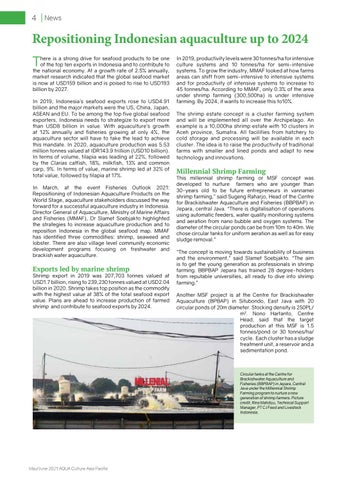
This millennial shrimp farming or MSF concept was developed to nurture farmers who are younger than 30-years old to be future entrepreneurs in vannamei shrimp farming,” said Sugeng Raharjo, Head of the Centre for Brackishwater Aquaculture and Fisheries (BBPBAP) in Jepara, central Java. “There is digitalisation of operations using automatic feeders, water quality monitoring systems and aeration from nano bubble and oxygen systems. The diameter of the circular ponds can be from 10m to 40m. We chose circular tanks for uniform aeration as well as for easy sludge removal.” “The concept is moving towards sustainability of business and the environment," said Slamet Soebjakto. “The aim is to get the young generation as professionals in shrimp farming. BBPBAP Jepara has trained 28 degree-holders from reputable universities, all ready to dive into shrimp farming.” Another MSF project is at the Centre for Brackishwater Aquaculture (BPBAP) in Situbondo, East Java with 20 circular ponds of 20m diameter. Stocking density is 250PL/ m2. Nono Hartanto, Centre Head, said that the target production at this MSF is 1.5 tonnes/pond or 30 tonnes/ha/ cycle. Each cluster has a sludge treatment unit, a reservoir and a sedimentation pond.
Circular tanks at the Centre for Brackishwater Aquaculture and Fisheries (BBPBAP) in Jepara, Central Java under the Millennial Shrimp Farming program to nurture a new generation of shrimp farmers. Picture credit, Rina Mahdiyu, Technical Support Manager, PT CJ Feed and Livestock Indonesia.
May/June 2021 AQUA Culture Asia Pacific