5 minute read
Sexual Harassment and Assault in University Contexts

Anastasia Powell Associate Professor, RMIT University, Co-author of the NSSS 2021 reports
Advertisement
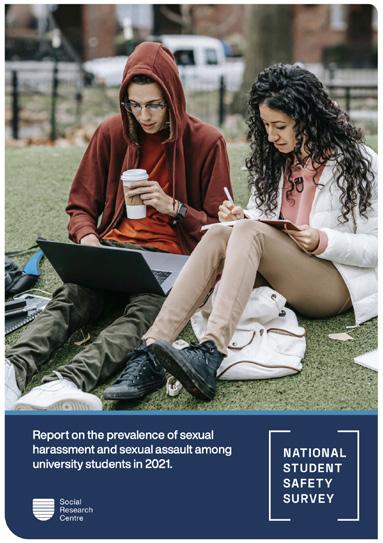
On the 23rd March 2022, Universities Australia launched two reports into sexual harassment and sexual assault experienced by tertiary students in university contexts. The research included a national survey of students enrolled in 28 member institutions during 2021, as well as qualitative responses from many victim/survivors of sexual harassment and assault. It was funded under Universities Australia’s Respect. Now. Always. initiative, and built upon a legacy of work to address sexual harm in university contexts including the 2017 Change the Course report by the Australian Human Rights Commission. One of the key findings from our 2021 National Student Safety Survey (NSSS) report is that one in three university students (30.6%) have experienced sexual assault at least once in their lifetime (Heywood et al., 2022). The survey further found that one in 20 (4.5%) had been sexually assaulted in a university context since starting their studies. Sexual harassment was more common, with one in six students (16.1%) experiencing these harms since starting their studies. Overall, women, transgender and non-binary students were much more likely to have experienced sexual harassment or sexual assault in a university context. Importantly, the research acknowledged that ‘university contexts’ are not only places specific to physical campuses, but include other places both off campus and online where university students live, learn and socialise together.
Unfortunately, student accommodation and residences were commonly reported by students as the setting where their most impactful experience of sexual assault took place. Indeed, of those students who disclosed information about their most impactful experience of sexual assault in a university context, one in four (25.3%) said that it occurred in a student accommodation or residence setting (Heywood et al., 2022). The other most common settings, were clubs and society events and spaces (one in four, 25.8%) as well as private homes or residences (one in six, 18.4%).
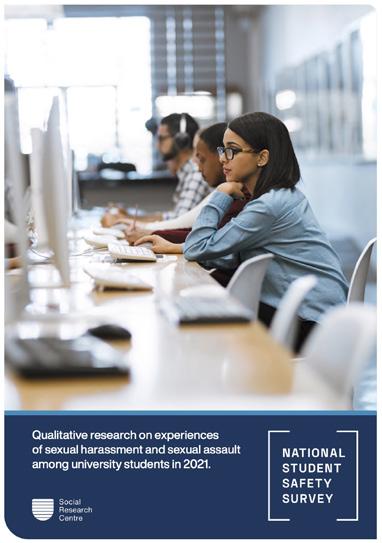
In our qualitative research with over 1,800 students, many further described the circumstances of sexual assault in student accommodation or residence settings. These ranged from assaults by Residential Advisors (RAs) or peer leaders, to those by fellow students at residential colleges, to assaults in other student accommodation settings (Nisbet et al., 2022, p.16). For some of these students, when they tried to
report the incident, they felt unsupported and even dismissed by leadership and/or management within their accommodation, college, or residence. Some students further described problematic sexually harassing behaviour from the perpetrator, that had escalated over time leading up to the assault. Another important finding from the qualitative research was that students who had been bystanders to sexual harassment or assault, or had heard disclosures from their peers, described some student residential settings as having an inherent ‘culture’ of sexual harassment and assault (Nisbet et al., 2022, p.19).
Sexual harassment and assault is a human rights issue, and one that disproportionately effects women as well as sexuality and gender diverse people. For university students, these harms have particular implications for student wellbeing, equity and inclusion. As such universities have an important role to play in responding to seeking to prevent sexual harassment and assault. This requires a concerted effort both to provide traumainformed responses to sexual violence when it occurs, as well as proactive measures to address the underlying causes of these harms within our universities. The World Health Organisation, the US Centers for Disease Prevention and Control, and our own National Plan to Reduce Violence Against Women and their Children, all acknowledge that gender inequality lays the foundation for sexual violence. The evidence also suggests that where this inequality is reinforced by attitudes that condone or excuse violence, organisational practices that minimise violence and/or discourage reporting, and peer cultures of sexism and disrespect, violence and abuse are more likely to occur (Our Watch, 2021).
Student accommodation and residence settings are just one part of the shared responsibility to address and prevent sexual harassment and assault. But these settings also present an opportunity to proactively build cultures of equality, respect, inclusion and safety within student communities. University students themselves want this change. In our qualitative research, students told us that they want to see university settings actively challenge the cultures, attitudes and practices that normalise or excuse sexual harassment and assault. Students told us there is a need for greater awareness, as well as better policies and processes for reporting sexual violence and for supporting victim/survivors. There needs to be clearer accountability for perpetrators, so that the harms of sexual harassment and assault are not minimised through either inaction or lack of transparency. These are all efforts that many universities and student accommodation settings are already engaging in – but clearly the need for these efforts continues. There is however support available for those wanting to take more proactive steps to prevent sexual harassment and assault. There are guidelines for action developed by Universities Australia for instance, as well as tools and resources developed by Our Watch – Australia’s national organisation for the prevention of violence against women and their children (Our Watch, 2022). The importance of the 2021 NSSS research is ultimately two-fold. It sheds much needed light on the ongoing harms of sexual harassment and assault experienced in university settings – but crucially, it presents us with a case for action. And now it is up to all of us who work with university students, and across a range of university contexts, to be part of this movement for change.
In our qualitative research, students told us that they want to see university settings actively challenge the cultures, attitudes and practices that normalise or excuse sexual harassment and assault. Students told us there is a need for greater awareness, as well as better policies and processes for reporting sexual violence and for supporting victim/survivors.
References Heywood, W., Myers, P., Powell, A., Meikle, G., & Nguyen, D. (2022). National Student Safety Survey: Report on the prevalence of sexual harassment and sexual assault among university students in 2021. Melbourne: The Social Research Centre. Available at: https://www.nsss.edu.au/results
Nisbet, L., Halse, G., van Esbroek, E., Heywood, W., Powell, A. & Myers, P. (2022). National Student Safety Survey: Qualitative research on experiences of sexual harassment and sexual assault among university students in 2021. Melbourne: The Social Research Centre. Available at: https://www.nsss.edu.au/results
Our Watch. (2021). Change the story: A shared framework for the primary prevention of violence against women in Australia (2nd ed.). Melbourne, Australia: Our Watch. Available at: https:// www.ourwatch.org.au/change-the-story/
Our Watch. (2022). Respect and Equality in Tertiary Education. Online toolkit: https:// tertiaryeducation.ourwatch.org.au/
For confidential information, advice and referral to support services for people impacted by sexual assault, domestic or family violence, please contact:
1880 RESPECT – 1800 737 732
1800respect.org.au