STUDENT ACCOMMODATION
PP324494/0062
THE OFFICIAL JOURNAL OF APSAA
June 2022 Volume 6, Issue 2
STU DE N T WE L L BE ING
CONTENTS
Contents
APSAA HOME OFFICE PO Box 7345 Beaumaris VIC 3193 T: 03 9586 6055 F: 03 9586 6099 E: admin@apsaa.org.au ADVERTISING APSAA Office T: +61 3 9586 6055 E: manager@apsaa.org.au DESIGNER Perry Watson Design DISCLAIMER This journal is copyright and all rights are reserved. Apart from any use as permitted under the copyright Act 1968, no part may be reproduced without prior written permission. All reasonable efforts have been made to obtain permission to use copyright material reproduced. Every effort has been made to obtain accurate information for this publication. The views expressed in this journal are those of the authors and do not necessarily reflect those of APSAA.
16 NEWS President’s Welcome
4
From the Editor
5
Industry Movements
5
APSAA Aotearoa Update
6
APSAA Asia Update
7
Professional Development Committee Update
10
Industry Advancement Committee Update
11
PSAA Board Update
12
ACKNOWLEDGEMENT OF COUNTRY Australia: APSAA acknowledges Aboriginal and Torres Strait Islander people as the Traditional Owners of Country throughout Australia. We recognise Aboriginal and Torres Strait Islander people’s continuing connection to lands, waters and communities; and we pay our respect to them and their cultures and to Elders past, present and emerging. Aotearoa | New Zealand: APSAA honours Te Tiriti o Waitangi | The Treaty of Waitangi as Aotearoa | New Zealand’s founding document and recognises the special place of Māori in Aotearoa as mana whenua.
FEATURES
30
An International Perspective on Wellbeing Programming from University College London
13
Fostering a Safe and Respectful Environment at Deakin
16
Sexual Harassment and Assault in University Contexts
20
APSAA 2022 National Conference
22
Creating Cultures and Environments for Safety
28
Centering Wellbeing is Core to Creating a Safe College Environment
30
Alpha Generation Challenges for Organisations
32
Enhancing Wellbeing Strategies and Mental Health Conversations in University Residential Communities
34
34 Student Accommodation June 2022 3
NEWS
President’s Welcome Welcome to the June edition of Student Accommodation. Marion Bayley APSAA President; CEO, Deakin Residential Services
F
ollowing the release of the National Student Safety Survey (NSSS), APSAA (Asia Pacific Student Accommodation Association) felt it was important to highlight resident safety and wellbeing in our June journal, the featured articles provide some great insight and whilst there continues to be so much work to do in ensuring our campuses are safe and inclusive, it is evident that the members who are sharing their knowledge and experience are representative of our industries commitment to effect positive change. Over the last few weeks, I have been in contact with several professionals that are either new to the industry or who have joined new teams and structures and one thing has been noticeably clear – the hunger for knowledge, sharing of ideas and collaboration has never been greater or more important. It is with this in mind that I also reflect on what has been a wonderful few weeks of regional networking events in person and I was delighted to hear so much positive feedback about the benefits of this from the East to West coast. You will read more about the much-anticipated return of our Annual Conference being held at Rydges, Sydney in September – plans are well underway, registrations open as well as the opportunity to submit a paper for presentation and network with your colleagues from across the Asia Pacific Region. There is much excitement about this conference, so I encourage you to ensure
4 www.apsaa.org.au
you secure your place early. Once again, I thank our industry partners for their ongoing support, engagement, and willingness to continue to support APSAA and its members, allowing us to deliver a conference off the back of what has been an incredibly challenging few years. Having recently returned from the USA where I attended the ACUHO-I conference in Pittsburgh, PA it was apparent that the great resignation and staff recruitment and retention struggles we are facing in our region are being felt by the industry globally. It comes as no surprise that there is also a consistency in reports of increased mental illness both in staff and students and discussions on how we equip our residential communities to manage this. I am sure that these topics will be well documented and discussed at our own conference as we look for a variety of solutions from within Asia Pacific and around the globe. Thank you to all of you who took time out to attend the APSAA AGM (Annual General Meeting) it is wonderful to be able to introduce you to the 2022/2023 board in this edition and we are excited to welcome Rachel, Kate, and Sue as they commence their first term as APSAA Directors. Please enjoy this edition and I look forward to the opportunity to see many of you in person soon. Best wishes, Marion
NEWS
From the Editor Jacob Waitere Chair – APSAA Communications and Engagement committee; APSAA Vice-President; General ManagerCanterbury Portfolio UniLodge
Welcome to the second edition of Student Accommodation for 2022. We are half way through the year and it is certainly going by quickly. In this edition you will get an update on board members and committees and articles around our theme of creating cultures and environments of safety. This theme seemed fitting as our colleagues in Aotearoa respond to
implementing the updated Code of Practice for Pastoral Care and across the ditch our Australian members are responding to the outcomes of the NSSS. All of our members will be committed to ongoing support and development in this area, and we hope that you can find some new information, motivation, or interesting facts in this edition of the journal.
Our next edition will feature a focus on sustainability, so please if you feel like contributing your ideas, please email communication@apsaa.org.au.
INDUSTRY MOVEMENTS
University of Auckland:
QLD: University of Queensland:
• Stephanie Harris promoted to Manager, Accommodation Solutions
• Matthew Talbot appointed Director of UQ Residences
• Arcady Hall, Christchurch
• Ian Leaupepe promoted to Resident Coordinator
UniLodge NZ:
• Sinead Fisher promoted to Accommodation Coordinator
• Rhona Henderson joins St John’s College UQ as the Registrar after holding the equivalent role at The Women’s College UQ.
AOTEAROA New member:
• Laura Hitchon and Jacob Edy appointed Community Manager • Rae Rossiter appointed Senior Residential Life Manager • Tessa Morse, Rosie Neale and Ana-Maria Visa appointed Customer Service Coordinators Arcady Hall: • Bruce White appointed Assistant Principal University of Canterbury: • Loretta Dixon appointed Accommodation Wellbeing Advisor
AUSTRALIA NSW: University of Wollongong • Mark Potgieter appointed to Senior Manager, Student Residence
• Rob Leach has been appointed to St Andrew’s College as the new Principal, having previously been Vice Master and Provost at Ormond College. VIC: Scape • Tim Glass appointed State Manager, Victoria
WA: University of Western Australia
SA: Aquinas College
• Angela Nino Benitez appointed Administration Assistant, University Hall
• Sean Brito-Babapulle appointed Rector
Student Accommodation June 2022 5
NEWS
Aotearoa Update Kia Ora Koutou Katoa
Jacob Waitere Chair, Aotearoa Advisory Group; APSAA Vice-President; General Manager, Canterbury, UniLodge
W
here is 2022 going? The dominating feature so far for 2022 has been the response to COVID-19 becoming normalised in the community. APSAA has heard so many stories of our colleagues around the country supporting hundreds of cases in our Halls and Residences. We know that this will be taking a toll on your energy and we would like you to know that we are thinking of you. Waiho i te toipoto, kaua i te toiroa | Let us keep together and not apart. This whakataukī is in the spirit of keeping bonds amongst people close and this sums up the work of the APSAA Aotearoa Advisory Group (AAAG). The AAAG has been meeting and discussing ways we can reconnect as a group of professionals now our COVID-19 traffic light settings allow. We are excited to announce that we will
have the Aotearoa Summit from 5-6 December, 2022. Monday 5th December will start with a half day study tour of Halls at the University of Canterbury and then Tuesday the 6th will feature our summit content of keynote and member presentations. The theme for the summit is ‘Reconnecting’, which is fitting considering the last summit we had was in 2019 before the pandemic. We hope to welcome many of you to the mighty Canterbury region. This journal focuses on creating environments and cultures of safety in our accommodation. In NZ we have seen media attention continue the code of practice, responding to sexual misconduct and providing equitable environments. These will always be areas of continued work for our organisations. Throughout NZ there have been some exciting innovations coming
through. The University of Auckland has launched their ‘Welcome to the Village’ programme for residential Pasifika Scholars, University of Canterbury Halls are embarking on a new bicultural journey, and all institutions focus on their student voice and processes and procedures. At our summit we hope to hear and see the exciting mahi our members have done. We also welcome a new member to APSAA and we are pleased to have Arcady Hall at the University of Canterbury join the APSAA whānau. Nau mai ki te APSAA! I would also like to thank the AAAG for their work. Abigail (UC), Tara and Melissa (UoA), George (Knox) and Martin (WSRT) – ngā mihi nui ki a koutou katoa ō mahi! Thank you for your work and support over the last half a year. Kia pai te rā! Jacob Waitere
The University of Auckland has launched their ‘Welcome to the Village’ programme for residential Pasifika Scholars, University of Canterbury Halls are embarking on a new bicultural journey, and all institutions focus on their student voice and processes and procedures.
6 www.apsaa.org.au
NEWS
APSAA Asia Update ASEAN Situation
Daniel Lee APSAA Board Member; Director, The Purple House, Malaysia
T
here are now positive signs that the latest Covid-19 wave has peaked in many SoutheastAsian countries. The Omicron variant has been dominant in the latest wave but while this variant is more easily transmissible than the Delta variant, its milder symptoms and the fact that vaccination rates are up in the region has resulted in generally lower number of deaths and hospitalisation cases compared to previous waves. This has of course prompted countries that are highly dependent on tourism to reopen their borders and even lowering or removing quarantine requirements in a bid to revive their economies. As most ASEAN countries are classified as either emerging or developing countries, economic headwinds are expected as the International Monetary Fund (IMF) has recently forecast inflation to hit 8.7% for emerging and developing countries in 2022. This is the fastest inflationary increase since the 2008
GION
Global Financial Crisis. However, the IMF does predict that this will be a one-off situation. In contrast, inflation in advanced/developed countries has been forecast by the IMF to hit 5.7%, which is a 38-year high. Global supply chain issues are also contributing to higher inflation, as both manufacturers and producers are unable to meet a rebound in global demand due to the closure of factories, port restrictions, international shipping congestion, shipping container shortages and manpower shortages.
Malaysia Situation As Malaysia transitions to endemicity, the government has removed most of its Covid-19 restrictions including social distancing and the wearing of face masks outdoors. Instead, it has announced six highly relaxed key regulations which involve the wearing of face masks, social distancing, premises check-ins/ vaccination status, Covid-19 positive case management, international traveler requirements and previously restricted activities. …continued next page
EG
ION
ASIA
N
RE
Source: The ASEAN Post
ASIAN R
Student Accommodation June 2022 7
NEWS
APSAA Asia Update Continued from previous page
Source: The Malay Mail
The easing of Covid-19 restrictions is largely in line with the significant drop in the number of new Covid-19 cases over the past three months- the number of new cases peaked in early March 2022, which saw more than 30,000 cases a day and now has dropped to below 3,000 cases a day towards the end of April 2022.
Rising Costs – Ukrainian Conflict While there has been good news on the health front, as trading nation, Malaysia is not immune to global economic shockwaves due to the recent Ukraine-Russia conflict as well as the Covid-19 pandemic. The Ukrainian conflict has caused higher energy and commodity prices, impacting items such as wheat, corn, chemicals and fertilizer. Domestically, this has led to higher food prices, particularly a food staple like chicken meat as Malaysia imports both wheat and corn, which are both used as chicken feed. In addition, a prolonged conflict could worsen the disruption of the global supply chain, making logistics and shipping prices more expensive and increasing input and raw material costs. The domestic flow-on effect would mean rising business costs which would in turn reduce production and lower business margins.
8 www.apsaa.org.au
Source: JHU CSSE Covid-19 Data
Rising Costs – Foreign Worker Shortage Over the past two years, Malaysia has frozen the hiring of foreign workers to curb the spread of Covid-19. This has led to an acute manpower shortage especially in the palm oil industry which have seen major plantations suffering billions of dollars in lost income. This is also evident in the housekeeping/ cleaning industry where the shortage of cleaners has caused housekeeping costs to increase significantly. In early April 2022, there are 1.17 million registered foreign workers in Malaysia, which is 31% less than the 1.7 million registered foreign workers before the pandemic. However, the government re-opened the country’s borders on 1 April 2022, and is this is expected to help ease the manpower shortage situation.
Rising Costs – Rise in Minimum Wage Beginning from 1 May 2022, the Malaysian government has raised the national minimum wage to RM1,500 (US$345). While this has been mostly welcomed by trade unions, some businesses and employers grown concerned that this will negatively impact the country’s economic recovery. The increase in the monthly minimum wage from the previous
rate of RM1,200/RM1,100 to RM1,500 would mean a significant increase of 25%-36% in salary costs for businesses which will subsequently affect the overall economy. Both domestic and imported Inflation is expected to go up this year– the Ukrainian conflict, global supply chain issues, shortage of foreign workers and the increase in minimum wages are all contributing to inflationary pressures in Malaysia. The higher than usual inflation will have an impact on the domestic student housing industry.
Impact on Student Housing The reopening of campuses nationwide and the move to endemic phase has been positive for student housing in Malaysia. It is interesting to note that there has been a significant shift in student preference for single occupancy rooms as compared to sharing rooms with others due to the pandemic. Despite the higher rental rates for single rooms, demand has skyrocketed due to health concerns while twin/quad sharing rooms have seen a drop in demand in the first quarter of 2022. Student housing providers are now faced with the choice of either raising prices for single rooms or converting shared rooms into single rooms in order to keep occupancies up.
NEWS
Source: Nook Co-Living, Sunway House
Due to the inflationary pressures described above, the student housing industry is expected to experience rising operational costs which will likely cause general rental rate increases in the future. In addition, the rising cost of building materials and maintenance items will also impact capital
Source: The Purple House
expenditure on new and existing buildings. This will also likely delay or stall the growth of new purpose-built student accommodation projects this year. Public universities are also put in a difficult position as the government has recently
announced a freeze in tuition fees for 2022. While this is good news for students, university operating costs are expected to increase overall and on-campus student housing at public universities will be impacted.
Let us take care of your parcels so you can take care of your residents RESIDENT BENEFITS Parcels from any courier company 24/7 Welcome Pack pick-up Contactless equipment exchange Peer-to-Peer delivery
OPERATIONAL BENEFITS Courier-direct delivery Operations efficiency Staff time re-channeled Lower operational costs
GROUNDFLOORDELIVERY.COM AU +61 3 4050 7660 NZ +64 9 801 0011
Student Accommodation June 2022 9
NEWS
Professional Development Committee Update Cameron Bestwick APSAA PD Committee Chair; Manager, Student Accommodation, University of Melbourne
I
t is hard to believe half the calendar year is already gone! Time has flown inside the committee as it undoubtedly has for members carrying out day-to-day work in their respective residences. Since the March issue we were able to celebrate a wonderful milestone: we saw the resumption of face-to-face professional development! The first such opportunities were state events held in Queensland and Victoria in May. In Victoria, members recently gathered at Dwell Village Melbourne City to hear from Study Melbourne, within Global Victoria, about international student arrival data as well as its plans for trade promotion in international education. Members also enjoyed discussion groups and valuable networking time. With so many updates for one another it was clear that members were able to enjoy all-time high levels of interaction, networking and value. In the online space, our webinar series has continued to evolve by taking on more interesting and challenging topics (often at the suggestion of members – our thanks for these). Building on the success of our Student Voice panel last year, our most recent webinar was also
10 www.apsaa.org.au
a student panel but focusing on the needs and experiences of First in Family (FiF) students. People often point to higher education as a great ‘equaliser’ in our society, but if FIF students are not supported to succeed, then higher education will unfortunately do the opposite. To have held an insightful panel on this topic was a true pleasure and a marker of the growing maturity of our profession. We would also like to thank the student panellists for their openness. Looking forward, we can expect pastoral care to remain a theme over the short term. Many residents of our communities are in their first year of study and, not only are they (on average) less prepared for university life than generations past, but they are not benefitting from the stabilising presence of older peers as much. The next webinar focus on supporting younger students, and further PD activities will address opportunities to improve the overall climate of inclusion and sexual safety in student residences. And finally of course the annual conference will be held soon, and it will surely resume its former place as our richest source of professional development. On the committee, we
are anticipating that the learning opportunities available at the conference will be the best ever. This might seem like a bold claim, but having witnessed the blistering pace of on-the-job learning by members for the past years, and noting the build-up of backlog member presentations from the previous two deferrals of the conference date, we are confident this will be the case. If you are interested in attending the conference, the best things you could be doing now is making a case to your supervisor to attend, or sharpening your member presentation proposal. With some regret, I will sign off from this PD Committee update for the last time. I have recently concluded my term as a Director on the APSAA board, and I will hand over the Chair of this committee this month, to allow myself to take advantage of a new PD opportunity outside of the sector. I will remain an enthusiastic supporter of APSAA’s outstanding efforts to support and develop our profession; I would like to thank all my colleagues from the past three committees for teaching me so much through their amazing contributions; and I wish the new committee the very best for the future.
NEWS
Industry Advancement Committee Update Simone Gallo APSAA Board Member & IAC member, National Manager Student Accommodation, Australian Catholic University
The Industry Advancement Committee (IAC) has remained in place this year to contribute to the broader conversation about the current and future issues faced by the student accommodation industry as we move into this recovery phase. Susan Helyar showed excellent leadership ability as the Chair of this committee by creating a workplan for the committee which outlined several goals, along with a strategy to achieve each one. Susan sadly left the industry and APSAA earlier this year, but the committee will continue this work. APSAA through the IAC will remain focussed on strengthening advocacy on the operational and strategic issues facing students’ accommodation services, with a significant focus on the quality agenda, and factors influencing student access and satisfaction. This can be achieved by updating APSAA Industry Guidelines, and through targeted professional development.
APSAA through the IAC will remain focussed on strengthening advocacy on the operational and strategic issues facing students’ accommodation services, with a significant focus on the quality agenda, and factors influencing student access and satisfaction.
We will also seek out opportunities to participate in government submissions and roundtable discussions on issues such as changes to Residential Tenancies legislation, housing affordability, student incomes and other regulatory issues. There is also a push to create stronger dialogue and partnerships with affiliated associations on issues critical to our industry. In this way we may strengthen our voice, build relationships, and create opportunities for collaboration.
As a member of APSAA, you can be supported by bringing an issue to the committee. We can scan our committee and Board members to assist you. Also, if you have created a relationship in your state which might be of benefit to more members and assist to move any of these initiatives forward, please reach out to manager@ apsaa.com.au to send a message to the committee or to join.
Simplify payments for your international students Simple, fast and affordable ways to pay accommodation fees Easily track and manage your international residents’ payments Streamline reconciliation and reporting
Scan to find out more © 2022 Convera Holdings, LLC. All rights reserved. Convera is a global leader in providing foreign exchange products and services and payment solutions and does business in Australia through Western Union Business Solutions (Australia) Pty Limited trading as Convera (“Convera”) ABN 24 150 129 749 and AFSL 404092. Convera accepts payments and provides foreign exchange services on behalf of its educational institution clients and not as a payment service provider for student payors. Convera is not affiliated with The Western Union Company and plans to change its name to Convera Australia Pty Ltd in 2022. The Western Union Company or its affiliates own all rights in the Western Union name. V-22-0117-2022-06
Student Accommodation June 2022 11
NEWS
APSAA Board Update
F
ollowing the AGM held on 18 May 2022, APSAA is pleased to provide members with the following updates on our Board.
Sue Fergusson, Kate Stock and Rachel Overton have been elected as newly appointed directors. We welcome Sue, Kate and Rachel to the Board, and look forward to collaborating with them on APSAA initiatives. We also congratulate
Marion Bayley, President
Jacob Waitere on his re-election to the Board. They join continuing Board members Marion Bayley, Paterson Boyd, Daniel Lee, Carolyn Mee, and Jack Thomson. Marion Bayley and Jacob Waitere will continue to serve as President and Vice President of APSAA following their re-election by the Board, and we congratulate them on their appointment.
APSAA would also like to acknowledge outgoing Board members Cameron Bestwick, Simone Gallo, Tomas Johnsson, Jodie Lawer, and Andre Lee for their wonderful service to the Association and thank them for sharing their skills and expertise for the benefit of our members.
Jacob Waitere, Vice President UniLodge
Paterson Boyd
Deakin Residential Services
Sue Fergusson Scape Australia
Daniel Lee The Purple House
Carolyn Mee Aquinas College
Rachel Overton University of Canberra
Kate Stock UniLodge Australia
Jack Thomson University of Sydney
12 www.apsaa.org.au
Emmanuel College
STUDENT EXPERIENCE AND WELLBEING
Mitesh Vagadia Head of Student Support and Wellbeing University College, London
An International Perspective on Wellbeing Programming from University College London Mitesh Vagadia has an important and varied job. Working as Head of Student Support and Wellbeing at the largest university in the United Kingdom sees him collaborating with all areas of the University including residential halls with over 6000 residents, as well as working with external providers and government divisions to enact key wellbeing initiatives and drive positive cultural change. We spoke to Mitesh to gain some insights into his work: Tell us about your role at University College London (UCL) I have been at UCL for nine years now, and am currently working in two roles, or wearing two hats. In my student support and wellbeing work, I lead the development of wellbeing and health campaigns and projects including things like our consent education campaign. Our focus is really putting student support and wellbeing at the forefront and helping students understand the services available within the University and externally, and ensuring that students are confident to come forward to get help.
The wellbeing and safety of our students are of the greatest importance, and we continually strive to do better in creating an inclusive environment for all members of the UCL community.
We also do a lot of work around helping students to build their life skills including resilience, wellbeing, personal growth to support them in being successful during their time at university and after graduating. In my role as a warden for our residential halls, my focus is offering another level of support in our residences, including out-ofhours wellbeing and mental health support and emergency crisis support to residential students. In addition to our security support in residential halls, the Student Resident Advisors (SRAs) offer out-of-hours support to our students. I manage a team of 60 SRAs across the halls, and a big part of their role is offering peer support to the students as well as pro-actively bringing students together through events to help them get to know each other to ease them settling into life in London.
What are the demographics and numbers like in your University and student residences? As the biggest university in the country, we have around 46,000 students. Of those, around 50% are international students, which includes EU students. Around 30% of students in halls are postgraduates and a large number of our residential halls are home to our undergraduate students.
What are some of the ways your team have approached education and reduction of sexual harm at the University? The wellbeing and safety of our students are of the greatest importance, and we continually strive to do better in creating an inclusive environment for all members of the UCL community. This means acknowledging when harm happens, and both doing more to respond effectively and to prevent harmful behaviours. …continued next page
Student Accommodation June 2022 13
STUDENT EXPERIENCE AND WELLBEING
An International Perspective on Wellbeing Programming Continued from previous page
We worked closely with Rape Crisis London in 2019 to create an online consent module to teach students and staff about what consent means. We wanted as many people as possible to complete it, so we ran a campaign in partnership with the student union. For these campaign initiatives, students are often our greatest advocates, so it’s very important to get the student union and student voice involved. The student union encouraged all their clubs and societies to promote it by running competitions within each club and society to see who could complete the most training. The group with the most completions would get something in return. It made it quite a competitive thing, quite a fun thing, but importantly it brought this issue to the forefront and drove student engagement with the topic. Part of this consent campaign was the ‘Report + Support’ tool – a central point on our website for people to report incidents of sexual assault and other abuse – which we were promoting at the same time. Following a victim/survivor empowerment approach, we offer multiple avenues for reporting bullying, harassment, and sexual misconduct to allow those who have experienced harm to select the reporting route that feels safest, of which Report + Support is one option, and often the first port of call. It’s a tool we actively promote to students at the beginning of each academic year, and throughout the year, and we are pleased to say that it is well known and used by our student community. Students can either report anonymously, which is useful in highlighting a particular issue in a residence or department, or they can provide contact details if they would like support from an advisor or mediator.
14 www.apsaa.org.au
Our Student Support and Wellbeing Services provide a safe, confidential, and nonjudgemental space, in which our students can discuss any issues that may be affecting their ability to study. Students who have experienced harassment, violence, or abuse are guided how to access a wide range of support should they need it, including support via a referral to specialist external organisations. The adviser will talk through UCL’s procedures and inform how to make a complaint through our Student Disciplinary Procedure, should the student want to. In 2018 Student Union UCL created the Active Bystander Programme. A prevention programme for new and returning UCL students with the objective of building students understanding of consent, busting myths surrounding sexual misconduct and developing practical skills for challenging misconduct should they witness it at UCL or in the wider community. The Active Bystander Programme managed to exceed expectations by training over 30,000 UCL students. Another tool we have is a ‘student of concern form’ which can be filled out by anyone who is worried about a student,
it could be family, friends, a GP or even another student. They fill out the form, give us as much detail as possible and the student welfare team will follow up.
What are some of the external services you work with to support and refer victim survivors of sexual harm, and how successful have these collaborations been? We work closely with Rape Crisis London, who provide specialist support to UCL students who have been a victim survivor of sexual assault, and we also work closely with Survivors UK for any victim/survivors who are male. In collaboration with us, Rape Crisis London visit our campus and offer support to our students. Our students have found this a really helpful service as they get access to specialist support and some feel more comfortable seeking this from a provider that is external to the university. Having an external support is maybe another step for them to feel reassurance that there is a level of confidentiality and that information that is shared with the service won’t come back to UCL unless it needs to and if that student has provided consent.
STUDENT EXPERIENCE AND WELLBEING
What are some other programs or initiatives that you have in place to support students’ wellbeing? Having seen the value of this consent module, our Equality, Diversity and Inclusion team is working on a series of modules that students would complete before they arrive at university as part of their welcome induction. These modules will help students understand the values of UCL, including free speech and consent. We are continuing to grow our Active Bystander Programme, which has been running successfully for seven years, and we are also developing a new Student Respect and Inclusion module that sets out expected behaviour and consequences for misconduct. Another initiative we are proud of is the STaRT (Student Triage and Referral Tool). The STaRT was a project created by the Student Health and Wellbeing Community of Practice. STaRT is a digital tool for any UCL staff member worried about the wellbeing of a current UCL student. It provides tailored guidance and signposting, allowing staff to direct students to the most appropriate information and services depending on their individual situation.
What kind of initiatives are you currently working on in the wellbeing space? We are planning a big campaign around drug awareness. Similar to sexual harm prevention and management, we believe it’s a common issue across all universities and it’s something we want to have an open discussion about in terms of how we support students with addiction to drugs and also gambling or other addictions. We want to take an education and information approach and will work with the Students’ Union to inform this. We’ve also worked closely with the National Health Service (NHS) in partnership with UCL’s Division of Psychology and Language Sciences to introduce something called the ‘Changing Unwanted Behaviour (CUBE) clinic’, which is an onsite clinic that supports students with any sort of addiction that they’re struggling with, through therapy and counselling. We’re pleased that it opened on our campus in January this year.
Over the last 5-10 years, what changes have you seen in the wellbeing issues presenting from students, and the way the University addresses them? There has been a big change in the wellbeing and mental health issues we see in our students, which has been exacerbated by COVID and the pandemic. We know that the younger generation is facing a mental health crisis and that is reflected in the more complex mental health issues that students come to us with, which we were not seeing five or ten years ago.
overstretched already. We need to make sure there are resources within the NHS to support those students. We can support students at the university who have a low level of mental health issues, but there is a certain level where you need intervention from an external service within the NHS. We’re hoping that they will get more resources to meet this demand.
Is there anything else you’d like to share? At UCL we are in a fortunate position to work with world leading academic experts to help inform and develop trailblazing and specialist support for students.
There are a number of reasons – previously there wasn’t as much of a spotlight on mental health in the UK and people were less likely to come forward and discuss the issues they are facing openly. Thankfully, this has changed and at UCL, we encourage anyone struggling with their mental health and wellbeing to contact Student Support and Wellbeing to speak to an adviser. As a result, we are seeing an increase in people feeling more comfortable about seeking support when they get here, as opposed to when they are back home where they may not feel like they can ask for support for whatever reason.
I think it’s also important to mention that UCL has been really great at championing mental health awareness and services and investing in that area. The student support and wellbeing team has grown exponentially over the last seven years – more than tripled in size. One of the new things they’ve recently introduced is 37 new student advisors sitting locally within each department to offer support for undergraduates with the transition to university. That’s an example of how we’ve grown as a service, and that was the most recent investment in mental health at the University.
This is a good thing. It’s a great thing that these students are coming forward, but at the same time it’s having the resources to support them, and not just university resources but external mental health services that are
We thank Mitesh for sharing his insights about some of the important wellbeing work being done at University College London and wish him all the best for current and future projects.
Student Accommodation June 2022 15
STUDENT EXPERIENCE AND WELLBEING
Laura Burge Manager Respectful Communities, Deakin University
Fostering a Safe and Respectful Environment at Deakin
S
exual harm prevention and response has remained a key area of focus and improvement for universities and student accommodation providers for many years now, gaining particular attention in 2017 as part of the Australian Human Rights Commission Change the Course Report, and again more recently, with the release of the results of the National Student Safety Survey (NSSS). Regrettably, despite endeavours by universities and residences to foster respectful behaviours and communities through various activities, campaigns and initiatives, both reports highlight that sexual harassment and sexual assault are common experiences for Australian university students, particularly within student accommodation at a national level.
The release of the results of this most recent survey provides an opportunity for staff working across all areas pertinent to this field to review, reflect and reassess prevention, response and support programs in place to support students, and to share examples of best practice across the sector.
Deakin University has in place a range of programs and initiatives which contribute towards the University’s goal of providing a safe, respectful and inclusive study, work and living environment. The Diversity, Equity and Inclusion (DEI) division coordinates Deakin’s respect and sexual harm program of work.
“University contexts should be safe and inclusive spaces that not only provide learning opportunities but the development of life-long professional networks and friendships.” (P. 5 National Student Safety Survey Quantitative Report)
Artwork created and shared by Lea Piskiewicz of the Deakin CloudFirst Team, and two Students as Partners: Stephanie Liew and Nishta Rai
16 www.apsaa.org.au
STUDENT EXPERIENCE AND WELLBEING
University-wide key initiatives in past years have included, but are not limited to: • Creation of a primary point of contact (Safer Community) for anyone to disclose or report sexual harm and be connected to free, confidential and professional support. • Implementation a confidential internal database to record disclosures of sexual harm. • Establishment of a Vice-Chancellor’s Advisory Group, which reviews sexual harm prevention and response plans and activities. • Provision of training and education programs for student leaders from Deakin’s Student Association, student clubs and peer leadership programs. • Provision of additional training and support for staff who work directly with students, including a compulsory module on ‘Responding to Disclosures of Sexual Harm’.
A Respect and Sexual Harm Strategy and Annual Action Plan guides Deakin’s proactive program of work. Recent initiatives of note include the introduction of a refreshed online Respect at Deakin module which takes a strengthbased approach, inviting students to learn more about how they can contribute to a positive and respectful culture at the University, whilst supporting them to study, work and socialise in a safe and supportive environment. The module also provides valuable information regarding rights and responsibilities, intersectionality, gender equality, healthy relationships, enthusiastic consent, different forms of harm, bystander intervention and provides information about useful support services. All existing and commencing Deakin students (approximately 80,000) have been enrolled in the module which takes 20 – 30 minutes to complete. …continued next page
Early feedback from students has been very positive
*% agree/strongly agree
Student Accommodation June 2022 17
STUDENT EXPERIENCE AND WELLBEING
Fostering a Safe and Respectful Environment at Deakin Continued from previous page
(Child Safety, Sexual Harm and Family Violence), Bystander Intervention, LGBTIQ+ Awareness, Disability Awareness, Positive and Respectful Supervisory Relationships, and Unconscious Bias amongst others. The Guest Lecture program offers the services of an expert DEI staff member to provide interactive workshops, webinars or guest lecture(s) on a range of diversity, equity and inclusion topics to students tailored to their course of study and future professional careers.
Student Accommodation at Deakin
This collaborative university-wide project featured input and involvement from talented Deakin students who provided support through feedback, graphic design and were also involved in filming new videos for the module, including a very powerful ‘Privilege Walk’ on Deakin’s rainbow coloured Pride Stairs at our Geelong Waurn Ponds campus.
Deakin was also selected as one of two Victorian universities to participate in the Safer Online: Awareness to Resilience (SOAR) Project. Jointly facilitated by the e-Safety Commissioner and Universities Australia this project focuses on preventing online abuse and improving the safety of students while studying and socialising online.
As the results of the National Student Safety Survey (NSSS) have again recently highlighted, student accommodation remains a key area of focus in regard to student safety. In addition to complying with all university policies and procedures and supporting the work of the broader university, Deakin Residential Services (DRS) has its own set of protocols and practices to foster respect and ensure appropriate student behaviours.
Higher Degree by Research (HDR) students and supervisors also have access to a tailored ‘Respect at Deakin – HDR: Respectful Supervisory Relationships’ module, including coverage of power and authority, constructive feedback and what constitutes a positive and ethical supervisory relationship.
Finally, Diversity, Equity and Inclusion have also recently launched new training and professional development training programs for staff and students, an exciting pilot Guest Lecture Program. Training includes coverage of Understanding and Responding to Interpersonal Violence
All student accommodation at Deakin is owned and managed by Deakin Residential Services, an entity of the university, with staffing around-theclock and security available at all times. Relevant staff are trained in responding to disclosures, Mental Health First Aid
‘Privilege Walk’ on Deakin’s rainbow coloured Pride Stairs at our Geelong Waurn Ponds campus.
18 www.apsaa.org.au
STUDENT EXPERIENCE AND WELLBEING
and incident reporting, with additional training in ASSIST Suicide Prevention, Respectful Relationships and Bystander Intervention for those responsible for campus life. Volunteer student Residential Leaders responsible for providing peer support are also provided with extensive training prior to commencing in the role. DRS’s own RESPECT values have long guided community expectations and standards within the residential community, and in addition to the module provided by the University, all residents are required to complete an online induction program prior to arriving on site. Within 24 hours of checking-in, residents attend a compulsory briefing reiterating key messages and students new to the residences attend a compulsory ‘Safe Partying’ presentation. An additional six compulsory meetings are facilitated with attendance tracked throughout the year.
Focus for the Future Deakin, like all universities and student accommodation providers, acknowledges that there is always more work to be done to improve student safety and to prevent sexual harm in our communities. We all have a role to play in creating a university experience where students and staff can feel respected, safe and included. Like for many others, focus now turns to carefully analysing and reviewing the results of the NSSS, and implementing new initiatives, programs, activities to change attitudes and behaviours that lead to further incidents, building a safer and more respectful community, and enhancing student awareness and accessibility to university and external report and support pathways.
Further information For further information about any of Deakin’s Respect or Sexual Harm program of work, please contact Laura Burge, Manager, Respectful Communities, L.Burge@deakin.edu.au
Student Accommodation June 2022 19
STUDENT EXPERIENCE AND WELLBEING
Anastasia Powell Associate Professor, RMIT University, Co-author of the NSSS 2021 reports
Sexual Harassment and Assault in University Contexts
O
n the 23rd March 2022, Universities Australia launched two reports into sexual harassment and sexual assault experienced by tertiary students in university contexts. The research included a national survey of students enrolled in 28 member institutions during 2021, as well as qualitative responses from many victim/survivors of sexual harassment and assault. It was funded under Universities Australia’s Respect. Now. Always. initiative, and built upon a legacy of work to address sexual harm in university contexts including the 2017 Change the Course report by the Australian Human Rights Commission.
One of the key findings from our 2021 National Student Safety Survey (NSSS) report is that one in three university students (30.6%) have experienced sexual assault at least once in their lifetime (Heywood et al., 2022). The survey further found that one in 20 (4.5%) had been sexually assaulted in a university context since starting their studies. Sexual harassment was more common, with one in six students (16.1%) experiencing these harms since starting their studies. Overall, women, transgender and non-binary students were much more likely to have experienced sexual harassment or sexual assault in a university context.
Importantly, the research acknowledged that ‘university contexts’ are not only places specific to physical campuses, but include other places both off campus and online where university students live, learn and socialise together. Unfortunately, student accommodation and residences were commonly reported by students as the setting where their most impactful experience of sexual assault took place. Indeed, of those students who disclosed information about their most impactful experience of sexual assault in a university context, one in four (25.3%) said that it occurred in a student accommodation or residence setting (Heywood et al., 2022). The other most common settings, were clubs and society events and spaces (one in four, 25.8%) as well as private homes or residences (one in six, 18.4%). In our qualitative research with over 1,800 students, many further described the circumstances of sexual assault in student accommodation or residence settings. These ranged from assaults by Residential Advisors (RAs) or peer leaders, to those by fellow students at residential colleges, to assaults in other student accommodation settings (Nisbet et al., 2022, p.16). For some of these students, when they tried to
20 www.apsaa.org.au
STUDENT EXPERIENCE AND WELLBEING
report the incident, they felt unsupported and even dismissed by leadership and/or management within their accommodation, college, or residence. Some students further described problematic sexually harassing behaviour from the perpetrator, that had escalated over time leading up to the assault. Another important finding from the qualitative research was that students who had been bystanders to sexual harassment or assault, or had heard disclosures from their peers, described some student residential settings as having an inherent ‘culture’ of sexual harassment and assault (Nisbet et al., 2022, p.19). Sexual harassment and assault is a human rights issue, and one that disproportionately effects women as well as sexuality and gender diverse people. For university students, these harms have particular implications for student wellbeing, equity and inclusion. As such universities have an important role to play in responding to seeking to prevent sexual harassment and assault. This requires a concerted effort both to provide traumainformed responses to sexual violence when it occurs, as well as proactive measures to address the underlying causes of these harms within our universities. The World Health Organisation, the US Centers for Disease Prevention and Control, and our own National Plan to Reduce Violence Against Women and their Children, all acknowledge that gender inequality lays the foundation for sexual violence. The evidence also suggests that where this inequality is reinforced by attitudes that condone or excuse violence, organisational practices that minimise violence and/or discourage reporting, and peer cultures of sexism and disrespect, violence and abuse are more likely to occur (Our Watch, 2021). Student accommodation and residence settings are just one part of the shared responsibility to address and prevent sexual harassment and assault. But these settings also present an opportunity to proactively build cultures of equality, respect, inclusion and safety within student communities.
In our qualitative research, students told us that they want to see university settings actively challenge the cultures, attitudes and practices that normalise or excuse sexual harassment and assault. Students told us there is a need for greater awareness, as well as better policies and processes for reporting sexual violence and for supporting victim/survivors.
University students themselves want this change. In our qualitative research, students told us that they want to see university settings actively challenge the cultures, attitudes and practices that normalise or excuse sexual harassment and assault. Students told us there is a need for greater awareness, as well as better policies and processes for reporting sexual violence and for supporting victim/survivors. There needs to be clearer accountability for perpetrators, so that the harms of sexual harassment and assault are not minimised through either inaction or lack of transparency. These are all efforts that many universities and student accommodation settings are already engaging in – but clearly the need for these efforts continues. There is however support available for those wanting to take more proactive steps to prevent sexual harassment and assault. There are guidelines for action developed by Universities Australia for instance, as well as tools and resources developed by Our Watch – Australia’s national organisation for the prevention of violence against women and their children (Our Watch, 2022). The importance of the 2021 NSSS research is ultimately two-fold. It sheds much needed light on the ongoing harms of sexual harassment and assault experienced in university settings – but crucially, it presents us with a case for action. And now it is up to all of us who work with university students, and across a range of university contexts, to be part of this movement for change.
References
Heywood, W., Myers, P., Powell, A., Meikle, G., & Nguyen, D. (2022). National Student Safety Survey: Report on the prevalence of sexual harassment and sexual assault among university students in 2021. Melbourne: The Social Research Centre. Available at: https://www.nsss.edu.au/results Nisbet, L., Halse, G., van Esbroek, E., Heywood, W., Powell, A. & Myers, P. (2022). National Student Safety Survey: Qualitative research on experiences of sexual harassment and sexual assault among university students in 2021. Melbourne: The Social Research Centre. Available at: https://www.nsss.edu.au/results Our Watch. (2021). Change the story: A shared framework for the primary prevention of violence against women in Australia (2nd ed.). Melbourne, Australia: Our Watch. Available at: https:// www.ourwatch.org.au/change-the-story/ Our Watch. (2022). Respect and Equality in Tertiary Education. Online toolkit: https:// tertiaryeducation.ourwatch.org.au/
For confidential information, advice and referral to support services for people impacted by sexual assault, domestic or family violence, please contact: 1880 RESPECT – 1800 737 732 1800respect.org.au
Student Accommodation June 2022 21
APSAA National Conference 5-7 September 2022 Rydges Sydney Central, New South Wales
A
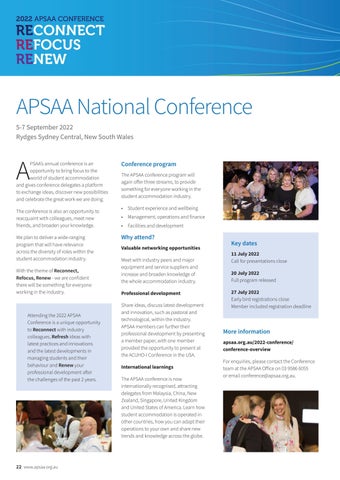
PSAA’s annual conference is an opportunity to bring focus to the world of student accommodation and gives conference delegates a platform to exchange ideas, discover new possibilities and celebrate the great work we are doing. The conference is also an opportunity to reacquaint with colleagues, meet new friends, and broaden your knowledge. We plan to deliver a wide-ranging program that will have relevance across the diversity of roles within the student accommodation industry. With the theme of Reconnect, Refocus, Renew - we are confident there will be something for everyone working in the industry.
Attending the 2022 APSAA Conference is a unique opportunity to Reconnect with industry colleagues, Refresh ideas with latest practices and innovations and the latest developments in managing students and their behaviour and Renew your professional development after the challenges of the past 2 years.
22 www.apsaa.org.au
Conference program The APSAA conference program will again offer three streams, to provide something for everyone working in the student accommodation industry. • Student experience and wellbeing • Management, operations and finance • Facilities and development
Why attend? Valuable networking opportunities Meet with industry peers and major equipment and service suppliers and increase and broaden knowledge of the whole accommodation industry. Professional development
Key dates 11 July 2022 Call for presentations close 20 July 2022 Full program released 27 July 2022 Early bird registrations close Member included registration deadline
Share ideas, discuss latest development and innovation, such as pastoral and technological, within the industry. APSAA members can further their professional development by presenting a member paper, with one member provided the opportunity to present at the ACUHO-I Conference in the USA.
More information
International learnings
For enquiries, please contact the Conference team at the APSAA Office on 03 9586 6055 or email conference@apsaa.org.au.
The APSAA conference is now internationally recognised, attracting delegates from Malaysia, China, New Zealand, Singapore, United Kingdom and United States of America. Learn how student accommodation is operated in other countries, how you can adapt their operations to your own and share new trends and knowledge across the globe.
apsaa.org.au/2022-conference/ conference-overview
Call for presentations Are you interested in presenting?
Style of presentations
Please submit your Presentation Abstract online by 11 July 2022.
Member Presentations (45 minutes)
Why submit a presentation? APSAA needs the imaginative input of its members in order to be truly relevant and productive for student accommodation professionals. Presenting your work at the conference is a way to explore new ideas, receive feedback on your work, develop your professional confidence and standing and open new discussions. It is important to note that not all presentations are formal or require expertise in public speaking. Enthusiasm and willingness to share information on a topic of choice is all that is required. Members of the APSAA Conference Committee are happy to speak with members to discuss potential topics and provide advice. All those who submit for a member presentation will be eligible to receive the ACUHO-I Award for Best Paper and $1,000 towards attendance at the next ACUHO-I Conference in the US. Eligibility is subject to the following: • Authors will be asked as part of the selection process if their institution is willing and able to provide the nominee with support to attend the ACUHO-I conference the following year • The primary presenter must be a member of APSAA • Membership of ACUHO-I is not required to be considered • Applicability to the ACUHO-I strategic plan and body of knowledge is desired
• Presented at a time concurrent with other presentations • Formal lecture style presentation in front of a smaller audience • Content must be evidence based (via industry or institutional research, qualitative or quantitative data) • Effort should be made to encompass any challenges, key learnings and transferability as part of the presentation • Must include an opportunity for questions (10 minutes) • May include 1 – 3 speakers • Eligible for the ACUHO-I My Favorite Student Best of Program Award Member Workshops (45 minutes) • Presented at a time concurrent with other presentations
Presentation topics APSAA’s Professional Development Committee has developed an extensive list of potential topics to help you decide what to present if you’re not sure. These can be found at www.apsaa.org.au/2022conference/call-for-presentations/ Multiple presentation submissions per person will be accepted. We are seeking a varied range of topics in the three broad streams of the conference program:
• Informal and interactive facilitated discussion and group-work
• Student experience and wellbeing
• The facilitator will usually introduce the topic (no more than 20 minutes) and then encourage smaller group discussions/brainstorming
• Facilities and development
• Provide an opportunity for the group to reconvene to debrief
• Management, operations and finance
For more information and to submit your application go to apsaa.org.au/2022conference/call-for-presentations/
• May include 1 – 3 facilitators Member 20:20 Ignite Presentations (6 minutes and 40 seconds) • Presented in a plenary session • Presenters prepare 20 slides, which you must set to automatically advance every 20 seconds. The result is a fast and fun presentation. Student Accommodation June 2022 23
Top 5 reasons why you should attend the APSAA Conference There are more than just the take-aways from attending speaking sessions themselves. For a start, you will get out from behind your screen to meet industry people face-to-face. Here’s a list of the top five reasons to attend the APSAA Conference:
5
To stay up to date
4
Build your Attending the APSAA conference will build your credibility and give you plenty of opportunity to establish thought personal brand leadership. There will be endless opportunities to utilise content from the conference on social platforms,
Knowledge and norms in every industry move forward and the student accommodation industry in the Australia-Pacific region is no exception. Every player within the industry is creating new ways of managing their business and streamlining approaches for service delivery for students. Many such initiatives will be shared as a part of the conference program.
such as LinkedIn and Instagram (be sure to add the APSAA Conference hashtag!). Or, you may be inspired after attending the conference to write an article for the APSAA Journal about your area of expertise. You could also post in our Newsletter about what you have learned or implemented in your residence post-conference.
3 2 1
Networking Opportunities
There will be industry professionals attending the conference from across the country. The contacts you will make at the conference can assist to collaborate or share knowledge on everything from new suppliers, new business, new partnerships, and new perspectives. Wouldn’t you love to have colleagues you can call r meet up with to discuss changes in the industry or specific issues which arise?
Increase your knowledge of the Industry
Most of us work in a specific area of our industry, the conference will open you and your team up to exposure to people working in other disciplines/roles as well as different organisation types. The beauty of APSAA is that we can learn from each other to raise practice standards. Given the student accommodation industry is relatively new in the Australia-Pacific and industry practices are still being formalised, there is always room to grow. This is true whether you are new to student accommodation or a seasoned pro.
Be inspired and motivated
Now, more than ever, we need to understand the “WHY” of what we do to feel inspired and motivated. You will be around other talented student accommodation professionals sharing stories which will either affirm that your current work practices align with the best or you might find tweaks you can make for better results. Either way, you will walk away feeling energised. Use this energy when you return to the office. Work with your team to have attendees share their take-aways from the sessions and the networking, create a game plan to bring the learnings into your organisation.
We are looking forward to seeing you at the conference www.apsaa.org.au/2022-conference
24 www.apsaa.org.au
Keynote speaker
DR RICHARD HARRIS SC OAM Dr Richard “Harry” Harris has worked in anaesthesia, diving and aeromedical retrieval medicine, based in Adelaide, South Australia. His passion for cave diving goes back to the 1980s and has taken him to the corners of the globe in search of new adventures. Harry and his colleagues have explored caves to 245m depth, and shipwrecks to over 150m, in dives lasting over 16 hours. He is an enthusiastic underwater photographer and videographer who is now also building a career in documentary films. Harry has a professional and voluntary interest in search and rescue operations, establishing the first sump rescue training course in Australasia. By building relationships with emergency services locally he has been preparing for such an event. The 2018 Thailand cave rescue was an opportunity to put this training to work. In 2018 he received the Star of Courage, Australia’s second highest civilian award for bravery, and the medal of the Order of Australia for his role in the Thailand cave rescue. Harry was the 2019 Australian of the Year for South Australia and the joint 2019 Australian of the Year with his dive partner Craig Challen. Student Accommodation June 2022 25
APSAA Awards Each year, APSAA offers a range of scholarships and awards that recognise outstanding performance and innovative ideas from our members. These awards are presented each year at the APSAA Conference. Some awards may not be awarded each year if there is no deserving nominee.
APSAA Excellence Awards
The endorsements shall be:
The APSAA Excellence Awards recognise members that have excelled in the award category. The APSAA Excellence Awards are:
• College
• Excellence in marketing and communications - awarded to an individual or institution who introduced or managed a marketing or communication campaign which has achieved notable success or produced quantifiable benefits. • Excellence in facility development or management - awarded to an individual or institution demonstrating innovation in the development of a completed student centric accommodation facility. • Excellence in student experience awarded to an innovative project or initiative that has positively enhanced the student experience, either in their academic lives or personal wellbeing. • Excellence in customer service - awarded to a project or initiative which has greatly improved or enhanced customer service. • Excellence in sustainable development goals - awarded to an operation that has shown innovative development and innovation in delivering the UN Sustainable Development Goals. • The Association may award up to three recipients for each area of excellence (one in each of the below endorsements). The Association may also choose to award none, one, or all three in a year.
26 www.apsaa.org.au
• University • Corporate Fran O’Brien Award for New Professionals Awarded to a person who has worked in student housing for a period of less than four years and who has made significant achievement in (or has introduced) an innovative or outstanding work practice or outstanding service with definable benefits to students/staff in their residence/college. The recipient of the Fran O’Brien Award for New Professionals receives a certificate and trophy as well as complimentary registration to the following years APSAA Conference. Joe Massingham Award for Meritorious Services Awarded to a person who has contributed to the Association by committee representation, conference attendance and being a positive professional influence during their time as an APSAA member and is selected by representatives of the APSAA Board. The recipient’s name is engraved on a perpetual shield.
APSAA
AWARDS OF EXCELLENCE 2022 Michael O’Leary Award for Innovation The purpose of this award is to recognise a member or team who has introduced significant innovation that has substantially influenced the Association or the industry as a whole. This award is not awarded if it is decided there is no deserving nominee. The recipient’s name is engraved on a perpetual trophy and the recipient receives a small trophy. The My Favorite Student Best of Program Award This award is a recognition program of ACUHO-I and the ACUHO-I Foundation, and is designed to help presenters bring their session to the ACUHO-I Annual Conference and Exposition each year. The Best of Program Award is made possible by the gracious sponsorship of My Favorite Student. The recipient receives funding up to the value of $1000 USD to offset the cost of attending the ACUHO-I Annual Conference and Exhibition to present their paper.
Previous APSAA Award receipients
APSAA Scholarship The APSAA Scholarship is awarded to an APSAA member who can illustrate that by attending an ACUHO-I conference, their learning will benefit APSAA. The recipient of the APSAA Scholarship receives a certificate, trophy and funding towards registration to the ACUHO-I conference in the year of receiving the award. ACUHO-I New Professional Award This award is offered to help new professionals in student housing (with less than five years full time in the industry) to attend the ACUHO-I conference in the United States. The award has a value of up to $1,500 USD.
Fred Johnson Award for Best Practice / Professional Achievement in Aotearoa This award is for members based in Aotearoa/New Zealand. The recipient will be able to demonstrate success in the introduction of an innovative or outstanding work practice and/or can show how they have given outstanding service with definable benefits to students/ staff in their residence/the industry. Nominations for the award will be first considered by the Aotearoa Advisory Group, before final recommendations are presented to the Executive Committee (or the delegated committee) for ratification.
Recipients of an APSAA Award receive national and international peer recognition, official acknowledgement (in the form of trophy or certificate), publication of their details in APSAA’s Student Accommodation Journal, E-News bulletin and APSAA webpage and public acknowledgement at the annual APSAA Conference. For more information about APSAA awards visit apsaa.org.au
Student Accommodation June 2022 27
STUDENT EXPERIENCE AND WELLBEING
Creating Cultures and Environments for Safety Dr Hester Wilson Senior Researcher, Student Life Research, St Andrews College
R
ecommendation 9 of the 2017 ‘Change the course’ national report by the Australian Human Rights Commission (AHRC) recommended ‘university-owned, or affiliated student accommodation undertake their own research to understand the current environment and to assess the effectiveness of implementation of the AHRC report’s key recommendations.’
In response to this recommendation, ACU Student Accommodation commissioned Student Life Research in 2020 to undertake an independent, expert-led review of their accommodation. They sought to assess implementation of the AHRC Report recommendations, the current experience of students living in ACU Student Accommodation, and any factors which may contribute to adverse culture and safety including sexual misconduct. Due to the impact of the Covid-19 pandemic in 2020, the research was delayed until 2021 and completed in early 2022. The research included an anonymous survey and focus group. Twenty-nine percent of the student population completed the survey. They were representative of the student population as a whole. Half were in their first year of residence and first year at university, one in six had a disability or were international students, one in five had diverse cultural background and one in four were the first in their family to attend university.
28 www.apsaa.org.au
ACU Student Accommodation has sites in Sydney, Ballarat and Canberra and in 2021 offered accommodation to 238 students (at 68% capacity due to Covid). Each site employs Residential Advisors (RAs). RAs are students, living on site, who undertake a vital pastoral care role in each residence, offering positive peer support and ensuring discipline and safety for all students. RAs can struggle to manage the dual role of discipline and pastoral care and need ongoing support and training to ensure they have the skills necessary to effectively undertake their role. Each residence faces unique challenges. Some of the residences are made up of individual houses at some physical distance from each other. This layout may adversely affect the sense of community for students and is seen as a challenge by RAs trying to ensure student safety and support. In 2021, one residence experienced significant staffing issues and this adversely affected the smooth running of the residence.
STUDENT EXPERIENCE AND WELLBEING
‘…living here I have had a pretty positive experience…going to the events makes a massive difference about whether you feel … lonely or you’re making friends … and so I try and go to a lot of those… it’s good here, I find it’s a really easy balance between work and … social, because you have your own room… so you can just go study and then … socialise down at events or go to the common rooms…’ RAs felt less supported by staff, training was less effective and there was greater turnover of RAs as a result. ACU Student Accommodation remedied this in late 2021. All students resident at ACU Student Accommodation undergo a range of training each year that covers behavioural expectations, respectful relationships, the code of conduct, consent and sexual misconduct policy and available support structures. This training was successful in creating excellent resident awareness of the ACU code of conduct and sexual misconduct policies. The vast majority knew where to seek support, how to make a complaint or formal report and where to find policies. The quality of the ACU sexual misconduct policy and supporting documentation is excellent. Trauma informed, rights based and easily accessible, it is clear that a huge amount of work has been put into ensuring the quality of these documents. Students living in ACU Student Accommodation reported a very strong sense of belonging and affiliation with their residence. They felt strongly supported by RAs, staff, and other students and were
comfortable taking part in activities and events at their residence. Women, domestic and first year students felt this sense of belonging particularly strongly. International students felt lower levels of affiliation with other students but felt strongly supported by staff. There were no issues with negative RA power and students did not feel disparaged by their university for living in ACU student accommodation. The vast majority of students reported that they felt emotionally and physically safe in their residence. Alcohol was not perceived as a huge issue and was not an impediment to safety. No student reported that they had been the target of homophobic or racist insults or felt pressured to participate in rituals or traditions organised by the students of their residence. Four students reported that they had experienced unacceptable behaviours and two reported that they had experienced sexual harassment. While students sought support after these experiences, no student made a formal complaint. One student reported that they were aware of the sexual harassment of another student. No student reported sexual assault in the survey, while two students in the focus group reported knowledge of two sexual assaults that had taken place in their residence.
They were aware of the complexities of sexual misconduct and noted that these incidents were reported to ACU Accommodation administration and responded to quickly with appropriate outcomes for perpetrators and good support and leadership from staff for everyone involved. While it is difficult to compare results, the ACU Student Accommodation survey results appear to compare favourably to the 2017 AHRC review and the 2022 National Student Safety Report. Students resident in ACU Student Accommodation reported much higher levels of knowledge about where to seek support and where to find policies. There may also be lower levels of sexual misconduct and the organisation responded appropriately to reports of sexual misconduct. ACU Student Accommodation is to be commended on the work they have done to date to ensure a safe and inclusive culture. There is more work to do and students are still unlikely to come forward with complaints. Ongoing training and support of all students, RAs and staff is integral to this success, now and into the future.
‘I don’t think it really had too much to do with being in (ACU Accommodation) like it could have, I feel like that kind of incident could have happened .. anywhere… it was just two people by themselves. And it’s just that one person’s word versus the other, that kind of thing. But I think they did the right thing here… getting rid of the student, and they weren’t able to live here anymore so the person, the girl felt a lot safer here, because they were not allowed on the premises or anything as well, so they sorted it out very quickly and had the investigation done within a couple of weeks.’
Student Accommodation June 2022 29
STUDENT EXPERIENCE AND WELLBEING
Centering Wellbeing is Core to Creating a Safe College Environment By Alice Draffin, Dean of Student Wellbeing, St John’s College and Adele Johnston, Dean of Student Wellbeing, King’s College
A key purpose of universities is to educate students. But when transitioning to university, students also face challenges such as homesickness, time management, partying, budgeting and making new friends which can all affect their mental health and wellbeing.
A
ccording to Beyond Blue over 75% of mental health problems occur before the age of 25. Therefore, focusing on wellbeing in residential colleges can help students to establish positive habits and lay the foundations for strong relationships and good decision making that will serve them in their future. Additionally, residential colleges contribute to the development of the person in a way that extends beyond simply the academic. Baxter Magolda’s self-authorship theory follows a person as they build their “internal capacity to define one’s beliefs, identity, and relationships” (Baxter Magolda, 2009, p. 631). The theory postulated that young persons in their late teens to early twenties (traditional college aged students) will begin asking key questions of themselves to determine the path of their life (Patton, Renn, Guido, & Quaye, 2016). These questions include; How do I know? Who am I? How do I want to construct relationships with others? (Patton et al., 2016). As these questions are being answered, a student may find themselves on the path of self-authorship, ultimately moving from external definitions of self, to internal self-definition (Patton et al., 2016). This theory has been used consistently in higher education to promote wellbeing initiatives for students, with a strong focus on identity formation, mental and physical health, social and emotional intelligence, and leadership development.
The new ‘Deans of Student Wellbeing’, Alice Draffin and Adele Johnston
30 www.apsaa.org.au
STUDENT EXPERIENCE AND WELLBEING
The wellbeing program at St John’s College UQ, ‘Living. Well. Being’
Two residential colleges within the University of Queensland; St John’s College and King’s College, have recently taken the intentional step of developing and resourcing a role called Dean of Student Wellbeing. Alice Draffin (St John’s College) and Adele Johnston (King’s College) are working specifically in the wellbeing space with students, ensuring holistic support, development, and education is at the forefront of the student experience.
At Kings College, the process is supported by providing an immersive and transformative experience in which students can develop as scholars but also as whole people. The approach is to apply the principles of positive psychology at a whole college level, consisting of a 5-pillar strategy: Measure it; Learn it; Lead it; Live it; Embed it.
According to Beyond Blue over 75% of mental health problems occur before the age of 25. Therefore, focusing on wellbeing in residential colleges can help students to establish positive habits and lay the foundations for strong relationships and good decision making that will serve them in their future.
At St John’s College, a new ‘Living. Well. Being’ program is being implemented, with an intentional focus on the physical, mental, social, and educational wellbeing of students through a range of training, education, and physical as well as mental health initiatives. References
Baxter Magolda, M. B. (2009). The activity of meaning making: A holistic perspective on college student development. Journal of College Student Development, 50(6), 621-639. doi:10.1353/csd.0.0106 Patton, L. D., Renn, K. A., Guido, F. M., & Quaye, S. J. (2016). Student development in college: Theory, research, and practice (3rd ed.). San Francisco, CA: Jossey-Bass.
Student Accommodation June 2022 31
STUDENT EXPERIENCE AND WELLBEING
Dr Diane Spencer-Scarr
Alpha Generation Challenges for Organisations The Alpha Generation are those born in the 21st century. They face unprecedented challenges because they have grown up in a duality of environments: the digital and real-world. As a result of this duality, the Alpha and future generations may well have two sets of behaviours, values and decision making processes to accommodate the first principles of each environment.
F
irst principles are the fundamental ‘truths’ that humans’ intrinsically know from their lived and inherited experience within the environment they evolve. In the real world, humans have had millions of years to develop an understanding, interpretation and their intuitive response to core concepts like time, space, memory, trust, love. The digital environment is in its infancy and humans are only just beginning to acknowledge that it is a distinct environment, and have not yet begun to broach the topic of the impact of differences created by first principle concepts. However, research is beginning to confirm the significance of dual environments and its impact on human behaviour. Two recent proprietary studies conducted by university residential colleges in New South Wales incidentally supported the dichotomy of behaviours in the Alpha Generation. The first being a three-year study examining what students felt was needed to assist their transition to the workforce and the second examined the culture of four residences in New South Wales.
32 www.apsaa.org.au
The first study showed that this generation required human support in the form of peer mentoring, skill development for the real world, and cross-generational networking for career understanding and development. With regard to the impact of technology on this cohort, the study found that the pervasiveness and transparency created by technology not only increased the amount of competition for work, but that it escalated students’ anxiety levels. Technology was also affecting their intuitive responses which was enhancing generational differences due to the appearance of students’ inconsistent behaviours. The student comments in this study were consistent with research
into the impact of technology on human behaviours in the business environment which led to development of the concept of a duality of environments. The second study conducted by ACU Student Accommodation revealed an interesting and unexpected insight related to the dichotomy of this generations’ needs: On the one hand to be treated as an autonomous entity but on the other requiring close nurturing. The study showed ACU’s Sydney campus was very successful in providing a safe ‘space and place’ for students in the form of their ‘front desk’. The reason for their success was identified in the following statement by Male-1 when discussing how an incident was handled.
“I think that they [front-desk] dealt with it really well here at Australia Street. The person [complainant] came forward straightaway to the front desk, and it was sorted. Bang everything sorted.” Male-1 19:37
STUDENT EXPERIENCE AND WELLBEING
“I think maybe the big difference … is because we have the reception team.” Female-3 54:20
There was no hesitation on the part of the complainant. The complainant instinctively knew of a safe, accessible, and familiar place that they could go to for help. Where there was a friendly, familiar, and informed person who could, and would help them – like Mum and Dad. This was confirmed by a Sydney participant after hearing about the challenges of another campus. Examination of the student’s experience of the ’front-desk’ revealed that the Sydney campus front-desk was familiar and managed by friendly, sincere and observant people who proactively engaged with residents they thought required assistance. In essence the front-desk of the Sydney campus provides a nurturing parental role for residents as they transition to adulthood. In contrast where students had the ‘adult experience’ of independent living, with no ‘front-desk’, no intermediary familiar loving parent zone there were more issues among students. In these environment isolated silos of students occur. It was found that ‘gathering zones’ were not conducive to providing care and support because the layout of the accommodations which made it extremely hard for support teams to successfully execute their role.
The challenge for university colleges when supporting the Alpha generation in this regard becomes two fold. Firstly, they need to provide some form of ‘frontdesk’- physical space where pastoral monitoring can take place. Secondly, this space needs to be manned by carefully selected and trained peers. Selection and training of these students should be a collaborative effort between experienced Alpha and non-Alpha generations. A study of 414 participants to identify the behavioural characteristics of the Alpha generation in order to identify characteristics that would affect an organizational environment found that creativity, dynamism, leadership, and a strong connection to technology were the key components. These behaviours they felt would affect organisations in the following way. Traditional hierarchal management will no longer be appropriate in future organizations and active student participation will be inevitable and strongly influenced by the dynamic influence of technology. This will be a challenge for non-Alpha generations unless we can acknowledge and understand the effects of the duality in which we now live. We need to understand that the new generations are more
intuitively advanced in some regards (digital environment) while simultaneously being naïve in others (real-world environment). This means we need to know when to mentor and when to stand back. We need to take time to train this cohort in basic real world skills while developing our intuitive online response skills. Most of all we need to be aware that technology is of its very nature pervasive and invasive. Most of all we need to know that it can and will amplify human behaviours – that is its nature. With knowledge, understanding, self-reflection, and adaptation we can harness this new duality to the advantage of ourselves and future generations. References:
dos Reis, T.A., Study on the alpha generation and the reflections of its behavior in the organizational environment. Quest Journals J Res Humanit Soc Sci, 2018. 6: p. 9-19. Spencer-Scarr, D., Digital engagement: An investigation of how Information and Communication Technology professionals engage with technology and why digital engagement affects them differently, in School of Media, Culture and Creative Arts. 2016, Curtin University: Perth, Australia. p. 322. Spencer-Scarr, D., H. Wilson, and D. Raward, What Graduates Need to Transition to the Workforce. Journal of Media Psychology 2022(Emerging Adulthood and Media Use: Adding a Developmental Perspective). The ‘ACU Student Accommodation RNA External Review: Response to Recommendation 9 of 2017 AHRC Report’ was drafted by: Student Life Research (PL). Contact: Simone Gallo, National Manager, Student Accommodation.
“Front-desks’ are the most lovely people we’ve met, they genuinely want to talk to you and find out about you, … they notice when things are off as well. I felt like this motherly love kind of thing from the front desk, and I feel like that kind of makes it a bit more like home.” Male-1 21:24
Student Accommodation June 2022 33
STUDENT EXPERIENCE AND WELLBEING
Ashley Gurney Managing Director and Founder, Alcohol and Drug Education Specialists
Enhancing Wellbeing Strategies and Mental Health Conversations in University Residential Communities
E
very single university residential location is unique, with its own culture and diverse communities. One thing every university residential location does have in common is the need to support the mental health and well-being of its residents. Alcohol and Drug Education Specialists (ADES) was founded in 2010, working under the organisation name of AlcoCups. ADES’ aim is to increase alcohol and drug knowledge in the community through resources, in particular the standard drink measure cup called The AlcoCup. In December 2010, ADES provided just over 2000 AlcoCups and 2000 standard drink magnets to LaTrobe University accommodation services for their arrival packs. In January of 2011 ADES then delivered our first customised alcohol and drug education training session to approximately 40 staff and student leaders at LaTrobe University accommodation services.
34 www.apsaa.org.au
One thing that stood out when we started working in the university residential sector was that different residential locations were all dealing with similar issues – alcohol culture, mental health issues, drug trends, consent, sexual assault, and sexual harassment. Many university residential locations were seeking support to address these areas of concern, yet limited specialised services were available. With the support of numerous staff in the university residential sector from all over Australia and New Zealand, ADES began developing customised alcohol, drug, and well-being sessions, relevant to the unique sector that is university residential living. Fast forward just over 11 years, and ADES now provides more than 280 university residential locations with training and services throughout Australia and New Zealand. The change in university residential culture since has been incredible and extremely positive.
One memorable example was a specific residential location in Melbourne which had 73 alcohol related incidents during the seven days of orientation week in 2012, including some that were quite severe. Through open and genuine conversations with the residential staff and the student leader team, specialised training and support was provided by ADES. The following year, in 2013, only five alcohol related incidents were reported during the seven days of orientation week. This university residential location deserves much credit, as the returning residents certainly made it a challenge in that first year of alcohol cultural change. However, the decrease in alcohol related incidents sure does outweigh the push back. And then in 2014, only three alcohol related incidents were reported, and incredibly there was no push back from returning students.
STUDENT EXPERIENCE AND WELLBEING
Over the past 11+ years the changes which ADES have observed throughout the university residential sector have been incredibly positive to say the very least. One thing which university residential locations do well is implement change and address identified cultural issues. This is evident in the changes to orientation week programs and events, wellness weeks throughout the year, specialised support staff being assigned to mental health and the response to the Australian Human Rights Commission (AHRC) report, Change the Course: National Report on Sexual Assault and Sexual Harassment at Australian Universities (2017). This example highlights just how quickly positive cultural change can occur in the university residential sector, especially in regard to alcohol, drugs and mental health. The common concern for university residential locations is that the push back from returning students and past alumni will be severe. Also, that the traditions and identity of their unique residential location will be lost. What we have observed over the years is quite the opposite, student leaders and residential staff can enhance the identity, evolve the traditions, and leave a positive footprint on the residential location. In 2016, ADES started to notice another huge, positive change in the entire residential sector in Australia and New Zealand. Thanks to a strong society stand around breaking stigma around mental health, with organisations such as Beyond Blue, Headspace, Black Dog Institute, and Mindful Australia, individuals and communities have been empowered to speak up and feel comfortable discussing the topic of mental health.
ADES developed the nationally accredited Mental Health First Aid course (MHFA) and ADES staff have been delivering this course since December 2020. All ADES staff have a vast wealth of knowledge and understanding of the residential sector, ensuring the scenarios, discussions and conversations through the accredited course are relevant and relatable to the participants. Over the last 12 months alone, the ADES team have provided the accredited MHFA course to more than 500 university staff and residential leaders. Evaluations consistently show that MHFA training is associated with improved knowledge of mental illnesses, their treatments and appropriate first aid strategies, and confidence in providing first aid to individuals with mental illness. It is also associated with decreased stigma and an increase in help provided.
In regard to the AHRC report, there is still so much to implement from the recommendations which have come out of this report but I would like to acknowledge the work that has already been done in changing decades of cultural attitudes, norms and behaviours. ADES are excited for what the future holds for the university residential sector, a sector which is not afraid to change to ensure that residents are part of a safe and inclusive environment which allows them to thrive. To all staff in the university residential sector, thank you. Continue to observe your culture and explore how it can be further enhanced for the benefit of current and future residents.
ADES offers this training either on site at a residential location, or it can be delivered virtually via Zoom. Please contact ADES directly if you’d like more information about offering this course at your residential location.
We noticed residential locations were placing more emphasis on the mental health and well-being of university residents. Furthermore, more investment into training, education and programs was being implemented throughout the year. Providing residential staff and student leaders with strategies, techniques, and confidence to deal with mental health and well-being of residents ensures that the residential location is a safer and more inclusive community.
Student Accommodation June 2022 35
Student Accommodation June 2022 Phone: +61 3 9586 6055 Email: admin@apsaa.org.au apsaa.org.au