This journal is copyright and all rights are reserved. Apart from any use as permitted under the copyright Act 1968, no part may be reproduced without prior written permission. All reasonable efforts have been made to obtain permission to use copyright material reproduced. Every effort has been made to obtain accurate information for this publication. The views expressed in this journal are those of the authors and do not necessarily reflect those of APSAA.
ACKNOWLEDGEMENT OF COUNTRY
Australia: APSAA acknowledges Aboriginal and Torres Strait Islander people as the Traditional Owners of Country throughout Australia. We recognise Aboriginal and Torres Strait Islander people’s continuing connection to lands, waters and communities; and we pay our respect to them and their cultures and to Elders past, present and emerging.
Aotearoa | New Zealand: APSAA honours Te Tiriti o Waitangi | The Treaty of Waitangi as Aotearoa | New Zealand’s founding document and recognises the special place of Māori in Aotearoa as mana whenua.
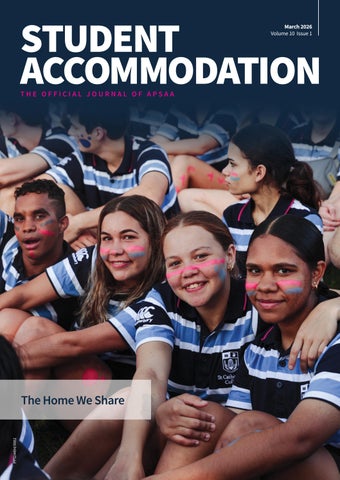
DESIGNER Perry Watson Design COVER Dandjoo Darbalung residents from St Catherine’s College, UWA participating in O’Week activities.
President’s Welcome
Tēnā koutou katoa – hello everyone
As the new academic year begins across much of our region – or the steps to the end of the academic year for our colleagues in Asia, our residences once again come to life. Corridors fill with new friendships, kitchens become places of shared stories, and communities begin forming in ways that are both familiar and new each year. It is one of the great privileges of working in student accommodation to see these moments unfold, knowing the impact that a safe and supportive home can have on a student’s journey.
This issue of the APSAA Student Accommodation Journal is a special one. In 2026 we begin celebrating the 35th year of APSAA. That milestone invites us to reflect on how far our sector has come. Over the past three and a half decades student accommodation has grown from a relatively small part of the higher education landscape into a recognised profession that plays a critical role in student success. Our communities are more complex, our expectations are higher, and our responsibility to students has never been greater.
One of the most visible changes is the diversity of the students who now call our residences home. Across the Asia Pacific region our communities are more culturally rich than ever before. Students arrive with diverse cultural backgrounds, languages, faiths and life experiences. For many, residence is their first experience of living away from home and often their first experience of living alongside people whose backgrounds are very different from their own.
Our operations have also changed significantly. In just the last two years alone we have seen rapid evolution in the way accommodation is designed, managed and supported. New models of residential education, wellbeing support, digital systems and partnerships are reshaping the way we create student communities. When we reflect across the full 35 years of APSAA’s history, the scale of that change is remarkable.
For me personally, this moment is bittersweet as my time with APSAA comes to an end. It has been a privilege to serve this association for a decade in governance roles, including as President for the last two years and previously as President of NZATEAP from 2016-2019. I am proud to have represented our region internationally and in government inquiries related to the NZ Code of Practice for Pastoral Care, while also guiding the association through key developments such as the Universities Accord and the GBV Code in Australia, and supporting important milestones including the introduction of the Residential Experience Standard, the growth of our membership and professional activity, the launch of Student Accommodation Essentials, the publication of our first journal focused on Indigenous affairs, and the introduction of the Excellence Award for the SDGs. Together we have more than doubled the activity offers APSAA has to members. It has also been an honour to serve as the first New Zealander and the first Indigenous person to chair the APSAA Board.
None of this work happens alone. I want to acknowledge the many APSAA Board members I have had the privilege of serving alongside, as well as Melinda Dallas and the team at Association Professionals for their steady support of the association. More importantly I want to thank every single member that has supported the association and allowed me to have the professional experience of the lifetime in giving back to our profession. Nga mihi nui ki a koutou!!!
As we begin this 35th year of APSAA, I look forward to seeing the continued growth of our community and the impact our profession will have for students across the region.
Mā te wā – see you again,
Jacob Waitere President | Tumukai APSAA
JACOB WAITERE
General Manager
Portfolio – Canterbury, UniLodge Aotearoa; APSAA President
From the Editor
As we begin a new year, we also begin a milestone moment in the life of our association. 2026 marks the 35th anniversary of APSAA, thirty-five years of supporting members, strengthening our profession, and championing excellence in student accommodation across the Asia Pacific.
It feels fitting that our March edition opens this anniversary year with the theme The Home We Share, exploring cultural inclusion and the ways our communities are enriched by difference. Student accommodation is often the first place students experience life beyond familiar cultural and social boundaries. When we create environments where individuality is valued and diversity is celebrated, we do more than provide housing, we foster belonging, understanding, and growth.
The articles in this edition highlight the thoughtful and innovative work our members
are undertaking to cultivate home-like environments where every student can thrive because of the uniqueness they bring to their community. From culturally responsive practices to programs that elevate student voice and identity, these contributions remind us that inclusion is not an initiative, it is a daily practice.
This year also brings opportunities for us to come together and celebrate our shared purpose. Our 35th Anniversary Conference in Adelaide promises to be a truly special gathering, bringing colleagues from across the region together to learn, reconnect, and reflect on the progress of our sector. As someone fortunate enough to now call Adelaide home, I am especially excited to welcome you to a city known for its warmth, accessibility, and strong sense of community.
Looking ahead, the June edition will be an extra-special Anniversary issue, one that honours our history, recognises the leaders who shaped our association, and
Industry Movements
WA
Kathy-Mae Tondut has moved from Regional General Manager at CLV WA over to Director of Student Life at UWA.
Tom Mitchell has retired, leaving St Thomas More College after over 13 years as Head of College
Melissa (Mim) Jones has taken on the role of Head of College at St Thomas More College Ian Smith is the new Head of College and CEO at Trinity Residential College
NSW/ACT
Jakia Sultana has commenced as Accommodation Coordinator at ACU Canberra
VIC
Itai Avisar has moved into the role of Campus Life Coordinator at Deakin Residential Services Burwood
SIMONE GALLO
National Manager
Student Accommodation, Australian Catholic University; APSAA Vice President; Communications and Engagement Committee Chair celebrates the innovation that will carry us into the future. It is one not to miss.
As we commence this landmark year, I hope this edition inspires you to continue building communities where every student feels at home, respected, and empowered to belong.
Thank you for the work you do each day to make that vision a reality.
Simone Gallo
National Manager, Student Accommodation – Australian Catholic University; APSAA Vice President; Communications & Engagement Committee Chair
Stay connected with the latest people and career updates across the student accommodation sector.
APSAA’s Industry Movements captures staffing changes from across our member community, including new appointments, promotions, and role transitions. These updates help keep the sector informed, recognise professional achievements, and strengthen connections across our network.
If you or your organisation have a staffing update to share, please submit the details via the QR code or by clicking HERE.
The Communications and Engagement Committee (CAE) has continued to champion APSAA’s strategic goals through intentional storytelling, member-focused communications, and a strong emphasis on sustainability, accessibility, and consistency.
Building on the momentum of 2025, the past year has been marked by a significant evolution in how APSAA presents itself to members, prospective members, and the broader sector. Our work has focused on refreshing core communication assets, strengthening APSAA’s brand presence, and ensuring our content platforms support both engagement and long-term sustainability.
A key achievement has been the transition of the APSAA Student Accommodation Journal to an online-only format to promote sustainability alongside the launch of refreshed communication and marketing templates.
Key Initiatives and Progress
Sustainable Delivery of the APSAA Journal
In response to strong member uptake of the digital Journal and with sustainability front of mind, APSAA has moved to a more environmentally responsible model by delivering the APSAA Student Accommodation Journal as an online resource.
This transition supports wider accessibility, allows for more flexible content delivery, and aligns APSAA’s communications practices with contemporary member expectations. The Journal continues to be a flagship APSAA publication, showcasing thought leadership, research, and lived experience from across the student accommodation sector.
Refreshed Communications and Marketing Templates
SIMONE GALLO National Manager Student Accommodation, Australian Catholic University; APSAA Vice President; Communications and Engagement Committee Chair
The Committee is pleased to report the launch of a suite of refreshed communication and marketing templates, providing a cohesive and contemporary foundation across APSAA’s key channels. These include:
• Newsletters – improved structure, readability, and calls to action to support stronger engagement;
• Social media templates – consistent, flexible designs to strengthen brand recognition and storytelling;
• Website content alignment – this project continues with the support of Association Professionals to create clearer positioning and improved navigation to support member access to information;
• Prospective and new member collateral – welcoming, informative materials that clearly articulate APSAA’s value and opportunities for involvement;
Together, these assets ensure APSAA communications are clear, professional, and reflective of the maturity and influence of the Association.
Supporting APSAA Committees and Member Value
The CAE Committee is keen to play a stronger role in amplifying the work of APSAA’s other committees and Branches. In 2026, we will actively support the promotion of committee initiatives, outputs, and opportunities for member involvement across APSAA’s communication channels.
This includes a planned refresh of the APSAA website content positioning, with a more targeted approach to highlighting the depth and quality of resources available exclusively to members.
Looking Ahead
A focus for 2026 of the committee will be the rebranding and promotion of the APSAA Streaming to APSAA On Demand. This change will better reflect how members engage with APSAA’s professional learning and resources on their own schedule, in a format that suits their needs.
APSAA On Demand is now positioned as a central member benefit, bringing together webinars, recordings, and exclusive content that support continuous professional development across the sector.
Additionally, the Communications and Engagement Committee will focus on:
• Refreshing APSAA website content to more clearly promote memberonly resources and benefits;
• Supporting cross-committee visibility and storytelling;
• Continuing to strengthen APSAA’s brand consistency across all channels; and
• Ensuring APSAA’s communications remain sustainable, accessible, and member-focused.
Acknowledgements
The work of the Communications and Engagement Committee continues to be characterised by energy, collaboration, and creativity. We have so much fun coming together to produce these communications for our members and I think that comes through in what we deliver. I would like to sincerely thank the Committee for their ongoing commitment and generosity of ideas.
A special thank you to Vice-Chair Jess Rokobaro (University of Newcastle) for her enthusiasm and leadership.
Professional Development Committee Report
ANDREA ROHDE
Deputy Principal, Flinders Living, Flinders University SA; APSAA Board Member; Professional Development Committee Chair
Purpose
The Professional Development (PD) Committee provides the Board with advice and guidance on issues relating to the strategy and delivery of APSAA’s Professional Development Program.
Summary
The PD Committee continues to expand APSAA’s professional development offerings in alignment with the Association’s strategic goals. Over the past quarter, new initiatives have proposed and successful programs have been delivered with strong member engagement.
Key Initiatives and Outcomes
Community of Practice – Mental Health
• In 2025 the Community of Practice (CoP) in Mental Health was launched and well received. Engagement has been good.
• The PD Committee plans to run another 4 CoP in 2026.
Speaker Series
• The Speaker Series continues to attract strong attendance including non members
• The PD Committee plans to run another 4 Speaker Series in 2026, with the first scheduled for the 4th March.
New initiatives
Gender
based violence seminars
The introduction of the Code has generated significant discussion and impact across the Australian student accommodation sector. As the peak industry body, the PD Committee believes there is a clear opportunity for APSAA to provide specialised
training and targeted support to our members in navigating these changes.
To assist with this, Simone Gallo has proactively approached Avyon Consulting to deliver a series of four webinars tailored specifically for our members. These sessions will offer expert guidance, practical insights, and opportunities for members to engage with key considerations arising from the Code, ensuring they feel confident and wellprepared in their implementation approach.
The sessions will cover 4 different topics and be held approximately 1 month apart:
• Drivers of Gender Based Violence and Actions to Take in Preventing and Responding to Gender Based Violence 11 March 2026
• Managing Behaviour and Conduct Effectively 15 April 2026
• Embedding Trauma Informed Approaches and Restorative Practices 13 May 2026
• Building Community and Creating the Culture You Want 10 June 2026
Leadership series
The PD Committee is exploring the introduction of a dedicated Leadership Webinar Series. This would complement the existing CoP and Speaker Series offerings and follow a similar delivery model to the Gender-Based Violence seminars. The intent is to provide targeted, practical leadership development opportunities for members across the sector.
The Committee will continue refining the scope, structure, and objectives of this series before formally presenting a proposal to the Board.
Challenges for the Committee
While there is a strong and committed core group within the PD Committee, attendance from several members who nominated following the AGM has been intermittent. Moving forward, clearer expectations regarding participation and attendance will need to be established to ensure the Committee can operate effectively and sustainably.
In 2024/25, the Committee commenced a project to compile a centralised repository of resources beneficial to APSAA members. While this remains an active priority, progress has been limited and will require renewed focus in the coming year.
Reflections and Acknowledgements
I would like to sincerely thank all members of the PD Committee, particularly those who have taken on responsibility for organising and facilitating both Communities of Practice and Speaker Series sessions.
A special thank you to Vice Chair
Wendy Fleming and to Simone Gallo for championing new initiatives and driving innovation within the Committee’s work.
Committee Reports
Research and Knowledge Committee Report
As we move through the first quarter of 2026, the Research and Knowledge Committee is pleased to provide an update on the APSAA Sector Guidelines and related initiatives currently underway.
APSAA Sector Guidelines
Following the December update, Board feedback has now been incorporated into the revised draft of the APSAA Sector Guidelines. The updated version was resubmitted to the APSAA Board in February for final review and endorsement.
This work represents over eighteen months of drafting, consultation and refinement.
MARK POTGIETER General Manager
Accommodation Operations, The University of Sydney; APSAA Board Member; Research and Knowledge Committee Chair
Throughout the process, the committee has remained focused on ensuring the guidelines provide clear, principle based direction that is practical across a range of accommodation models and operating environments throughout Australia and New Zealand.
Subject to final Board approval, the committee is now working toward a formal launch of the Sector Guidelines at the APSAA Conference in May 2026. The Conference will provide an opportunity to introduce the guidelines in person, outline their intent and structure, and support members in understanding how they may be applied within their own contexts.
In preparation for release, the next phase will include final formatting, design and the development of supporting communication materials.
Internationalisation Special Interest Group
The Internationalisation Special Interest Group, led by Greg Scott from the University of Canterbury, continues to refine its priority areas for 2026. The group is focused on supporting APSAA’s broader strategy in responding to international student trends and strengthening intercultural capability within student accommodation communities.
Partner with us
APSAA industry partners have the opportunity to connect and collaborate with our growing membership across the region and leverage with affiliate associations around the globe.
To meet the needs of both our members and sponsors, APSAA has evolved the way in which we facilitate advertising, communications and engagement activities. Through advertising in our quarterly industry journal, our monthly newsletter and webinar series, or through our website and social media platforms, advertisers will have the opportunity to engage meaningfully with stakeholders across the sector.
These are unique and highly targeted opportunities that will put your brand front-and-centre for leaders and staff across the Student Accommodation Industry in the Asia-Pacific region.
Cultural Capability in Student Accommodation
JESS ROKOBARO
General Manager
Student Living, Academic Division
The University of Newcastle
Supporting respectful and inclusive communities
Across the university accommodation sector, cultural capability is increasingly recognised as essential to creating culturally responsive and respectful residential communities. Developing cultural capability among staff and residents is critical to fostering belonging, supporting wellbeing, and strengthening community.
The approach taken by the Wollotuka Institute at the University of Newcastle provides a strong model for the sector, demonstrating how structured cultural capability training can embed respect for Aboriginal and Torres Strait Islander peoples, histories, and perspectives across an institution. This approach was highlighted as best practice in University Australia’s Indigenous Strategy (pg 50) and demonstrates how cultural capability goes beyond awareness. It involves developing the knowledge, skills, and behaviours needed to interact respectfully and effectively across cultures.
Within student accommodation, culturally capable staff and student leaders can:
• Create culturally safe and welcoming living environments
• Support Aboriginal and Torres Strait Islander students’ sense of belonging
• Foster respectful intercultural relationships among residents
• Respond appropriately to cultural needs and misunderstandings
• Strengthen community cohesion and inclusive practices
Institutions that prioritise cultural capability contribute to reconciliation and help students develop a broader worldview.
The University of Newcastle’s Cultural Capability Framework provides a roadmap for becoming a culturally responsive institution.
It emphasises that cultural knowledge and understanding influence teaching, student support, leadership, and partnerships.
The framework supports truth-telling and encourages staff to build culturally responsive environments through individual capability and institutional practice.
Importantly, the University commits to all students graduating with knowledge of Aboriginal and Torres Strait Islander history, cultures, and perspectives.
For student accommodation providers, a similar framework can guide community standards, staff training, and resident education initiatives.
University of Newcastle’s staff cultural capability training package includes:
• Part 1: Online Modules – Three modules (1–1.5 hours each) building foundational knowledge of First Nations histories, cultures, and contemporary issues.
• Part 2: Face-to-Face Workshop – A threehour workshop designed to deepen understanding and provide tailored advice relevant to workplace contexts.
• Part 3: On-Country Experience
– Opportunities to learn directly from Country and community knowledge holders.
The program is co-designed with local Aboriginal communities including Awabakal, Worimi, Wonnarua, and Darkinjung representatives, ensuring authenticity and community partnership. This collaborative approach strengthens trust, accuracy, and cultural integrity.
Cultural capability is not limited to staff and the University has implemented a compulsory online Cultural Capability Module for
students, equipping them with foundational understanding of Aboriginal and Torres Strait Islander cultures and histories.
In residential settings, this shared learning foundation can:
• Establish common expectations of respect and inclusion
• Support intercultural dialogue among residents
• Encourage peer accountability and understanding
• Reduce cultural misunderstandings and bias
When residents share a baseline cultural understanding, community standards become easier to uphold.
As universities expand their commitment to truth-telling and inclusion, student accommodation providers play a vital role in translating institutional values into everyday living environments.
Key considerations include:
• Embed cultural capability training for accommodation staff and student leaders
• Provide resident education modules to establish shared understanding
• Partner with local Aboriginal communities to ensure authenticity
• Integrate cultural capability into community standards and programming
• Measure impact through student belonging and wellbeing indicators.
Shifting Tides
TAUTAIOLEFUE
BRAD WATSON
Brad is the Tautiaki-Piki (Deputy Warden) at Selwyn College, Te Maru Pūmanawa in Dunedin. He holds the high chief title, Tautaiolefue, from the village of Tufulele in Samoa.
Rethinking Cultural Capability in Collegiate Communities – A Pacific Perspective
Residential colleges are inherently Pacific.
At first glance, this statement may seem counterintuitive, particularly given the recognised need to continue strengthening cultural capability across collegiate and higher education environments. I offer it, however, not as a literal claim, but as an invitation to reconsider the dominant narratives through which we understand residential colleges and pastoral care.
Pacific approaches are often treated as additions – frameworks or practices brought in when working with Pacific students. This article suggests a different starting point. What if many of the values and relational logics that underpin residential colleges already align closely with Pacific ways of being? And what if Pacific frameworks could help us strengthen pastoral care for all students, rather than sitting at the periphery?
Rethinking colleges as relational spaces
Epeli Hauʻofa’s influential essay “Our Sea of Islands” offers a useful lens for this discussion. Hauʻofa challenged deficit portrayals of the Pacific as small, isolated, and peripheral, arguing instead for a view of the region as deeply interconnected:
This shift in thinking is instructive for residential colleges, which are often framed as physical infrastructure or accommodation rather than as relational, cultural ecosystems.
In my own context as Tautiaki-Piki (Deputy Warden) at Selwyn College | Te Maru Pūmanawa, an affiliated college of Ōtākou Whakaihu Waka | University of Otago, this idea becomes tangible. Selwyn College, established in 1893, is the oldest residential college at Aotearoa New Zealand’s first university. Its large brick buildings and long institutional history do not immediately read as ‘Pacific’.
Yet, as a Samoan, I see familiar patterns. From the view of my office window, the college quad resembles the malae – the communal heart of a Samoan village. The college chapel echoes the centrality of faith and spirituality, the tennis court recalls village recreational spaces, and the surrounding buildings containing accommodation, dining hall, and leadership offices reflect communal living, shared responsibility, and relational leadership. Although Selwyn looks distinct from a Samoan village, the principles that shape community life within it are strikingly similar.
Even without this physical layout, residential colleges are fundamentally communal environments. They rely on shared norms,
There is a world of difference between viewing the Pacific as ‘islands in a far sea’ and as ‘a sea of islands’… a perspective in which things are seen in the totality of their relationships.
relationships, collective responsibility, and a sense of belonging. These are also core values within Pacific families and communities. Recognising this alignment provides a powerful entry point for strengthening cultural capability and challenges the idea that Pacific practice sits outside the mainstream.
Repositioning Pacific ways of knowing in pastoral care
If residential colleges are inherently relational spaces, then pastoral care must also be holistic and relational. This is where the Fonofale Model offers important guidance.
Developed by Fuimaono Karl PulotuEndemann through extensive consultation with Pacific communities in Aotearoa New Zealand, the Fonofale Model presents wellbeing as a Samoan fale (house). At its foundation is family, representing relationships, connection, and collective identity. In a college context, this speaks directly to the importance of community and belonging in student wellbeing.
The roof of the fale represents culture, which provides meaning, protection, and coherence. Culture shapes how students
understand help-seeking, success, and authority. In colleges, culture is not an overlay added when required; it is created and reinforced daily through traditions, language, and expectations.
The pou (posts) represent interconnected dimensions of wellbeing: physical, mental, spiritual, and other factors such as finances, identity, or life circumstances. The strength of the Fonofale Model lies in its insistence that these dimensions cannot be separated. Pressure on one affects the stability of the whole.
Surrounding the fale are time, context, and environment, recognising that wellbeing is shaped by transition and change. For students navigating the complexities of residential college life, this perspective is particularly relevant.
More recent revitalisations of the model incorporate the concepts of tapu and noa. Tapu refers to states of vulnerability or imbalance, while noa represents restoration and balance. From a pastoral perspective, our role is not to ‘fix’ students, but to walk alongside them as they move from spaces of tapu toward noa.
Beyond the ‘add-on’
Although the Fonofale Model is grounded in Pacific contexts, its relevance is not limited to Pacific students. Many non-Pacific/ non-indigenous approaches to wellbeing have historically focused on individual issues in isolation. Yet those working in residential colleges know that wellbeing is deeply interconnected – academic stress, financial pressure, relationships, identity, and belonging all intersect.
The Fonofale Model gives language to what effective pastoral care in communal environments already requires. It legitimises holistic, relational practice and challenges assumptions about independence and neutrality.
The question, then, is not whether Pacific approaches can be applied more broadly, but why they are so often positioned as supplementary rather than foundational. What might change if Pacific frameworks were treated not as an add-on, but as a dominant way of understanding and enacting pastoral care in residential colleges?
Strengthening cultural capability involves more than learning about ‘other’ cultures. It requires interrogating the frames we take for granted and being willing to see familiar spaces differently. Residential colleges may not look Pacific – but when we attend closely to how they function, we may find that Pacific ways of knowing have been there all along.
Works Cited/Further Reading
Pulotu-Endemann, Karl. 1995. Fonofale model of health. Published in ‘Strategic directions for mental health services for Pacific Island people’, Ministry of Health (ed). Young, Cameron., et al. 2022. The revitalised Fonofale as a research paradigm: a perspective on Pacific sexuality and reproduction research. Pacific Dynamics: Journal of Interdisciplinary Research.
Selwyn College Quad
View from my office of the Quad, College Chapel, Tennis Court & Accommodation
Cultural Competency and Residential Leaders
Residential communities are often the first place students experience life away from home. They’re shared spaces where different cultures, identities, values, and lived experiences come together every day. In kitchens, corridors, study rooms, and during late night check ins. For many students, this is their first time living alongside people who don’t look like them, think like them, or live the way they do. For Residential Leaders (RLs), navigating this diversity isn’t an added extra or a “nice to have”. It’s core to the role.
In student accommodation, we talk a lot about inclusion and belonging. They’re values we genuinely care about, and they’re often written into our strategies and frameworks. The challenge is making sure those values show up in everyday moments, especially when things are messy, uncomfortable, or unclear. One of the most effective ways to support this, is through RL training that treats cultural competence as something lived and practised, not a single session delivered during induction and never revisited.
Cultural competence starts with cultural intelligence. At its simplest, this is about recognising that a student’s background can shape how they communicate, how they respond to stress, how they engage with authority, and how comfortable they feel asking for help. In a residential setting, this shows up in small but important ways. Who approaches an RL, who holds back, who speaks up, and who might need a bit more time or reassurance.
RL training isn’t about expecting leaders to know everything about every culture they’ll encounter. That’s unrealistic and not particularly helpful. Instead, it’s about building curiosity, self-awareness, and flexibility. A big part of this is asking RLs to reflect on their own norms and assumptions, many of which feel invisible because they’re
familiar. These might be shaped by family expectations, education, language, or previous leadership experiences. When RLs start to notice what feels “normal” to them, it becomes easier to understand that the same situation may feel very different to someone else. That awareness alone can shift how leaders show up in everyday interactions.
Students don’t experience their identities in neat categories. Culture intersects with things like race, gender, disability, socioeconomic background, and migration history, and those intersections shape how safe and supported a student feels. In residential life, this often comes to the surface during everyday situations — a conflict between housemates, a noise complaint, a welfare check in, or a conversation about rules and expectations. Good RL training encourages leaders to slow down in these moments. Instead of jumping straight to enforcement, RLs are supported to consider context and ask what might be going on beneath the surface.
This is where scenario based training is incredibly valuable. Working through realistic situations gives RLs a chance to practise responding with empathy while still holding clear boundaries. It reinforces that consistency and compassion aren’t opposites, they need to exist together. This balance doesn’t come naturally to everyone, and it’s not something you learn by reading
a policy. It’s a skill that develops over time, through practice, reflection, and support.
Another area that comes up frequently in residential communities is microaggressions. These are often subtle, unintentional comments or behaviours, and they’re regularly minimised as jokes or misunderstandings. For students on the receiving end, their impact can build over time and affect their sense of belonging. RLs are often the first people students turn to in these moments, which makes training critical.
RLs need support to recognise microaggressions, feel confident addressing behaviour when appropriate, and know how to check in with students afterwards. Responding well doesn’t mean having the
ITAI AVISAR Campus Life Coordinator Deakin Residential Services
Photo cerdit: @Getty Images/Hispanolistic
perfect words every time. Often, it’s about staying calm, being clear, and modelling respectful behaviour without escalating the situation. Just as importantly, training should normalise accountability. RLs will get things wrong, and that’s okay. Creating space for reflection, apology, and learning helps build psychological safety for everyone involved.
Culturally inclusive leadership isn’t something that’s achieved in one session. It’s ongoing. RL training is most effective when cultural competence is revisited across training camps and mid-year refreshers. As RLs gain real-world experience, these conversations take on more meaning. Training becomes less about theory and more about reflecting on what’s actually happening on the ground and how leaders want to show up.
“In an increasingly diverse higher education landscape, cultural competence isn’t optional for residential leaders. It’s central to student wellbeing and community life.”
Communication is another space where cultural competence plays out daily. RLs are constantly communicating. In conversations, messages, emails, and through body language. Cultural norms influence how direct communication feels, how feedback is received, and how authority is interpreted. Training that focuses on active listening, inclusive language, and flexibility in communication style helps RLs adapt their approach to different students. Simple things like explaining acronyms, avoiding jargon, checking for understanding, and being mindful of tone can make a real difference to trust and connection.
Often, cultural competence shows up not in having the “right” response, but in knowing when to listen. Being present, open, and willing to learn goes a long way.
When RL training is designed this way, its impact extends beyond individual leaders. It shapes residential culture. When leaders consistently model curiosity, accountability, and care, those behaviours ripple through the community. Students feel safer and more respected, RLs feel more confident navigating complex situations, and organisations move closer to aligning their everyday practice with their values around inclusion and belonging.
In an increasingly diverse higher education landscape, cultural competence isn’t optional for residential leaders. It’s central to student wellbeing and community life. Embedding cultural intelligence into RL training in practical, reflective, and ongoing ways helps create residential communities where difference isn’t just accommodated, it’s genuinely valued
MARITZA KLOPPERS Resident Manager
University of Auckland
Ako
Strengthening Academic and Cultural Support for Pasifika Residents
Ako is an accommodation-based initiative dedicated to supporting the academic success and well-being of first-year Pasifika residents.
Established in 2025, the programme was developed in response to a growing need to ensure Pasifika school leavers are able to remain academically engaged while transitioning into a residential university environment.
Student Accommodation has a long-standing commitment to supporting Pasifika students. From as early as 2022, initiatives such as Study Fono provided structured academic support through a collaborative partnership between Student Accommodation, Campus Care, the Scholarships Office, and the Office of the Pro Vice-Chancellor Pacific. Study Fono operated successfully for three years before its funding concluded in 2024. With its conclusion, accommodation identified a significant gap in support for incoming Pasifika residents and recognised the
importance of maintaining consistent academic and culturally grounded assistance.
Planning for a new initiative began in early 2025. In February of that year, Residential Experience Officer Ian Leaupepe, with the support of Head of Operations Tara Baker and Resident Manager and Study Fono founder Melissa Leaupepe, established Ako as a renewed model of academic and cultural support within Student Accommodation.
Ako operates as a peer-supported study session held every Monday throughout Semesters One and Two, excluding study breaks. The programme carries forward the ethos of Study Fono, grounded in the concept of a collective “village” of support. Staff and student mentors from a wide range of academic disciplines work collaboratively to
create an environment where learning is both inclusive and culturally responsive. In its first year, Ako recruited nine mentors representing faculties including Law, Arts, Business and Commerce, Science, Health Sciences, Biomedical Science, and Engineering.
Each session is structured to align with the rhythm of the academic year. Evenings begin with notices to keep students informed about key academic deadlines, accommodation activities, and wider university events. During Semester One, these notices place particular emphasis on supporting students to navigate university systems and access available support services, assisting with their transition into both academic and residential life.
Pasifika communities are deeply rooted in values of family, connection, and collective responsibility. For many students, moving into university accommodation can feel isolating and culturally unfamiliar. Ako addresses this by offering more than an academic study space; it provides a sense of belonging. Students attend not only to work on assignments but also to build meaningful relationships with mentors and staff who understand their lived experiences. Mentors draw on their own academic journeys to support students with course content, effective study strategies, and engagement with university support services. Ian Leaupepe is present at every session, providing consistent oversight and pastoral support for both mentors and residents.
Unlike its predecessor, Study Fono, Ako is not linked to scholarship requirements.
Participation is entirely voluntary, allowing students to engage in ways that suit their individual schedules and needs. While this flexibility supports student autonomy, it also results in fluctuating attendance. During Semester One, average attendance was approximately 35 students per session, reflecting the heightened need for support during the transition period. In Semester Two, attendance averaged around 15 students per session as students became more settled and confident in their academic routines.
Although Ako is primarily promoted to first-year Pasifika residents, participation is not restricted to this group. Student Accommodation has welcomed non-residents into the programme, acknowledging that the need for culturally grounded academic support extends beyond residential halls.
Ako continues into 2026 with new developments aimed at strengthening communication and enhancing responsiveness to student needs. A dedicated Microsoft Teams channel has been established to enable ongoing connection between students and mentors outside of weekly sessions, as well as to share regular updates and announcements. This initiative reinforces
Ako as an ongoing support network rather than a once-a-week programme, extending its impact beyond the physical study space.
Acknowledgements
Student Accommodation acknowledges Sharon Televave, Professional Teaching Fellow, who volunteered as a facilitator for Ako during Semester Two. We also recognise the contributions of Tara Baker, Head of Operations; Melissa Leaupepe,
Resident Manager and founder of the Study Fono initiative; and Ian Leaupepe, who established and continues to lead the Ako mentoring initiative within the University of Auckland Accommodation. Their collective leadership and commitment have been instrumental in the ongoing success of Pasifika academic support initiatives.
International Night
A Tradition of Cultural Celebration at University Hall
Background
Since its inception in 1975, University Hall’s annual International Night has been a defining tradition that celebrates cultural diversity and fosters community engagement. Originally known as Asian Night, the event was initiated by Asian students who organised a dinner and cultural showcase for the entire hall. This pioneering effort introduced residents to new cuisines, performances, and traditions, creating an atmosphere of inclusion and curiosity.
Impact on Community
Historical accounts from students of the time highlight the profound social impact
of the event. Following Asian Night, residents observed a marked shift in the hall’s social climate. Confidence grew, interactions increased, and friendships flourished across cultural boundaries. What began as a single cultural evening evolved into a catalyst for community cohesion and intercultural understanding.
Evolution of the Tradition
Today, University Hall is home to students from 58 different nationalities, and International Night has adapted to reflect this diversity. Each year, the theme celebrates a significant cultural group within the community. Recent examples
include Canada and Africa, offering residents immersive experiences through authentic cuisine, music, and cultural presentations.
The event remains a highlight of the University Hall calendar. A signature feature is the flagbearing ceremony, where students proudly carry their national flags, a powerful symbol of identity and unity. This tradition continues to inspire pride and belonging among residents.
SASCHA STONE Community Engagement Manager University Hall, UWA
Key Outcomes
• Enhanced Community Engagement: International Night consistently strengthens social bonds and encourages intercultural dialogue.
• Increased Confidence and Participation: Students report greater confidence and willingness to engage following the event.
• Sustained Cultural Awareness: The tradition reinforces University Hall’s commitment to diversity and inclusion.
Looking Ahead
As University Hall continues to welcome students from across the globe, International Night stands as a testament to the enduring value of cultural celebration. It is more than an event, it is a tradition that shapes the social fabric of our community and exemplifies the inclusive spirit of University Hall.
MARTIN THOMAS General Manager, Hatch Student Living
Practical Guidance for Student Accommodation Staff
Introduction – from observation to understanding
Recent sector discussions1 have highlighted that accommodation staff are increasingly observing students who struggle to cope with everyday challenges. At the same time, staff also continue to encounter many students who demonstrate strong resilience. This contrast highlights an important reality: resilience is not something that students either possess or lack. Rather, it develops over time and is shaped by personal experience, relationships and the environments in which students live and study.
Student accommodation is a particularly influential setting for this development. It provides a combination of support, structure and real-world demands that can strongly shape how students learn to cope with pressure, navigate social complexity and gradually take on adult responsibilities.
Within a tertiary accommodation context, resilience generally refers to a student’s capacity to manage academic demands, cope with both failure and success, regulate emotions, respond constructively to social challenges and progressively assume greater independence. Importantly, resilience does not mean the absence of distress. Feeling anxious, upset or overwhelmed at times is a normal part of development. What distinguishes resilience is the ability to recover and continue to function effectively despite difficulty.
For accommodation staff, this distinction is critical. Emotional discomfort alone does not necessarily indicate risk and attempts to remove all sources of stress may unintentionally limit students’ opportunities to develop coping skills.
The following sections outline key psychological and psychosocial contributors to reduced resilience in student populations, together with practical implications for staff intending to facilitate growth in student resilience.
Psychological factors that can reduce resilience
Developmental stage and the transition to independence
Many tertiary students are in a developmental period commonly described as emerging adulthood. This stage is characterised by identity exploration, changing relationships and increasing independence. Neurological development, particularly in areas associated with emotional regulation, impulse control and long-term planning, continues well into the mid-twenties. As a result, many students arrive in accommodation still developing skills such as managing frustration, regulating emotions, considering others’ perspectives, and solving problems independently.
When adult systems and expectations are applied without recognising this developmental context, normal developmental immaturity can be interpreted
as a lack of motivation or responsibility. Conversely, when staff and systems compensate too heavily for students’ difficulties, students may lose opportunities to practise and strengthen these skills.
Accommodation staff can support development by framing struggle as a normal part of learning rather than as failure, by using language that treats responsibility as a skill to be learned rather than a character trait, and by scaffolding independence through the gradual increase of expectations rather than the removal of challenge.
Heightened anxiety and threat sensitivity
Anecdotally, anxiety levels among tertiary students appear to have risen in recent years, and chronic anxiety can significantly affect how students interpret everyday situations. When anxiety is elevated, cognitive flexibility is reduced and ordinary setbacks may feel threatening or overwhelming. Students may avoid tasks that involve uncertainty, interpret feedback as personal criticism, seek frequent reassurance from staff or family, and struggle to tolerate ambiguity or minor failures.
Although avoidance can temporarily reduce anxiety, it also limits opportunities to develop coping strategies and confidence. In practice, staff play an important role in distinguishing between normal levels of emotional stress and genuine risk. Encouraging students to engage with manageable challenges and guiding them
to identify small, achievable next steps can be more beneficial than offering direct solutions or removing the stressor entirely.
Externalised responsibility and control
A tendency has been noted by some students to predominantly attribute outcomes to external factors such as institutional rules, staff decisions, or parental intervention. When systems frequently intervene to resolve difficulties on a student’s behalf, this externalised sense of control can be reinforced. Over time, students may struggle to accept responsibility, expect others to resolve problems, and become frustrated when outcomes are not immediately favourable.
Accommodation staff can help counter this pattern by explicitly linking actions and decisions to consequences, encouraging students to generate their own possible solutions before staff provide guidance, and reinforcing effort and problem-solving strategies rather than focusing solely on outcomes.
Psychosocial contributors to reduced resilience
Parenting patterns and prolonged dependence
Many current-day students may have experienced high levels of parental involvement in adolescence. Students from such backgrounds may have had limited opportunities to practise autonomy and decision-making. In accommodation settings, this may be reflected in parents contacting staff about routine matters, students deferring decisions to family members, or heightened distress when parental support is not immediately available.
Effective practice involves respectfully but clearly communicating the respective roles of students, staff, and parents, redirecting problem-solving to the student wherever appropriate, and acknowledging parental concern while reinforcing the student’s responsibility for managing everyday issues.
Social connection and belonging
A strong sense of belonging is widely recognised as a protective factor for resilience. However, many students, particularly in their first year, report loneliness, social anxiety or difficulty forming meaningful peer relationships. When students lack supportive social networks, stressors can have an intensified impact where helpseeking may be delayed, and emotional regulation can become more difficult.
Accommodation environments can support resilience by intentionally creating opportunities for low-pressure social connection, such as peer mentoring or shared task-based activities, and by encouraging peer-to-peer problemsolving rather than positioning staff as the primary mediators of everyday conflict.
Academic
and social performance pressures
Students are also navigating significant academic expectations, financial pressures and continual social comparison, often amplified by digital and social media. Within this context, mistakes and setbacks are frequently experienced as catastrophic rather than as a normal part of the learning process. Perfectionism, fear of failure, and defensive responses to feedback are common manifestations of this pressure.
Staff can support healthier student responses by framing mistakes as useful opportunities for improvement, sharing stories of growth and recovery rather than focusing only on success, and modelling balanced and constructive responses to setbacks in their own professional practice.
Foundational enablers for effective practice
Understanding the limits of the accommodation role
Accommodation staff are not mental health clinicians, and resilience-building practices must never replace appropriate professional care. Effective support depends
on early recognition of concerning changes in behaviour, clear referral pathways and staff confidence in escalation processes. Organisational support is essential and should include accessible wellbeing and counselling services, training such as Mental Health First Aid, clear guidance on warning signs that require escalation, and regular opportunities for supervision or debriefing.
Protecting staff wellbeing
The capacity of staff to support student resilience is closely linked to their own wellbeing. Ongoing exposure to student distress without adequate boundaries and organisational support can contribute to burnout and compassion fatigue. Consistent team approaches to common issues, reliable documentation and handover processes, and access to reflective practice and professional development are essential to sustaining staff capability and confidence.
Using challenge safely and intentionally Accommodation staff have previously identified that some well-intentioned practices may unintentionally weaken resilience. Research2 consistently indicates that resilience develops through exposure to manageable challenges rather than through the complete absence of difficulty. When staff routinely remove consequences, resolve problems prematurely or prioritise immediate comfort over learning and growth, students may have fewer opportunities to build adaptive capacity.
A shift from a predominantly problemsolving approach to a coaching-oriented approach can support healthier development. This should be implemented carefully. Support should not be withdrawn abruptly, particularly for students who are vulnerable or experiencing significant distress. Psychological safety must be maintained alongside clear expectations, and staff responses should be calibrated to the student’s developmental readiness and level of risk.
Understanding Student Resilience – Practical Guidance for Student Accommodation
Conclusion
Resilience should be understood as a dynamic process shaped by the interaction between individuals and the environments in which they live and learn. Interventions that focus solely on individual coping skills are unlikely to be effective if broader systems do not also support growth and recovery.
When increasing numbers of students experience difficulty, more productive questions focus on the demands being placed on students, the developmental stages at which these demands occur, and the availability of appropriate supports and opportunities for recovery.
Accommodation staff influence student development in powerful but often unrecognised or understated ways. Everyday interactions, boundary-setting and responses to difficulty communicate messages about capability, responsibility and belonging. By adopting a developmentally informed, psychologically safe and intentionally challenging approach, accommodation staff can contribute meaningfully to the development of resilience that extends well beyond students’ time in residential accommodation.
References
1 ‘Resilience Issues in Residential Communities’, APSAA Student Accommodation Journal, December 2025, pp 20-22.
2 Refer to Item 1 under Useful Resources and Further Information
Useful Resources and Further Information
1. A fully annotated and referenced sevenpage academic version of this article.
2. A one-page Resilience Cheat Sheet for Accommodation Staff, and
3. A three-page Resilience Resource List.
Resources developed by Esmae McKenzieNorton and are available from Martin Thomas martin.thomas@wintec.ac.nz
Resilience Cheat Sheet for Accommodation Staff
Understanding resilience and practical tools to support students
What Resilience Is (and Is Not)
Resilience is: a dynamic process shaped by context, relationships, development, and opportunity. It involves ordinary adaptation under stress, not exceptional toughness.
Resilience is not: endless endurance, moral strength, or simply coping with harmful conditions. Distress often signals overload, not failure.
Think of Resilience Like a Muscle…
Growth requires manageable load plus recovery. Too little challenge leads to weakness; too much without recovery leads to injury. Psychological distress often reflects overload or lack of support, not low resilience.
Common Signs of Reduced Resilience
• Emotional reactivity or avoidance
• Excessive reassurance-seeking
• Difficulty accepting responsibility
• Strong fear of failure or perfectionism
• Social withdrawal or loneliness
• Reliance on parents or staff to fix problems
What Staff Can Do
• Normalise struggle as part of development, not a personal failure
• Scaffold independence by increasing expectations gradually
• Use coaching questions rather than directives
• Distinguish emotional distress from actual risk
• Redirect problem-solving back to the student
• Encourage peer connection and belonging
• Frame mistakes as learning opportunities
Role Boundaries Matter
Accommodation staff are supporters and skill-builders, not counsellors. Use referral pathways early and confidently. Protecting staff wellbeing is essential to supporting student resilience.
Key Takeaway
Our role is not to remove all struggle, but to create conditions where students can meet challenge safely, develop skills, and recover.
Esmae Mckenzie-Norton Bio
(She/Her)
Registered Applied Psychologist
BSocSci (hons)
MAppPsych (Community)
PGDipPracPsych
Cert Exec Coaching
Esmae is a workplace psychologist known for her expertise in resilience, leadership development, and strategy. A strategic psychologist and seasoned advisor, her work in health, government, and consultancy has involved leading complex projects and initiatives that have transformed systems for real-world impact.
With a passion for supporting people to thrive in their communities and workplaces, Esmae is known for her no-fluff insights and practical tools. From Navy training to national commissions, Esmae has cultivated a career rooted in discipline, empathy, and systems thinking.
Esmae is the Director at Nexilis, where she operates as a consulting psychologist supporting complex projects that span organisational change, strategic planning, and community wellbeing. esmae@nexilis.co.nz
Esmae also holds a role as a Principal Psychologist at Glia Workplace Psychology where she works with organisations to build psychologically healthy workplaces. esmae@glia.co.nz
Contribute to future editions of the APSAA Student Accommodation Journal
APSAA welcomes topic suggestions, content ideas and sector updates for future editions of the Student Accommodation Journal.
Whether you are interested in contributing an article, proposing a topic, or sharing news such as staff movements or facility updates, we encourage you to get involved.
Scan the QR code to submit your ideas or indicate your interest in contributing. All submissions are reviewed by APSAA, and contributors may be contacted for further information.
ANDREA ROHDE Deputy Principal | Flinders Living; APSAA Board Member; Conference Committee Member
This year’s APSAA Conference in Adelaide will bring the sector together to explore how we can continue driving excellence in every encounter, from first impressions and daily operations to leadership, wellbeing, and community building.
One of the highlights is the study tour, offering delegates the opportunity to experience the city through a student accommodation lens. The tour will give delegates the chance to explore a range of residential colleges and PBSAs across Adelaide, showcasing how different models of accommodation operate in practice. It will also highlight innovative developments and local partnerships that influence how students live, learn, and connect, reinforcing the importance of place in shaping exceptional experiences.
We are delighted to welcome Jelena Dokic as a keynote speaker. Jelena’s powerful insights into resilience, mental health, and high performance speak directly to the encounters we navigate every day with students, colleagues, and stakeholders. Her keynote will challenge and inspire delegates to lead with empathy, strength, and purpose.
The conference will also deliver engaging sessions from industry leaders, focused on elevating standards across operations, service delivery, and student experience. These sessions will provide practical strategies and future-focused thinking to help members deliver excellence at every touchpoint.
Looking for opportunities to connect extend beyond the program? Delegates are spoilt for choice with the Informal Networking Dinner, Welcome Reception and Gala Awards Dinner, these social events will encourage meaningful
encounters, collaboration, and shared learning across the sector.
On a personal note, the APSAA Conference is one of my yearly highlights. The networking opportunities are truly invaluable, and I always leave feeling inspired, energised, and equipped with new ideas to bring back to my work.
With a strong thematic focus, leading voices, and my home city of Adelaide as host, this conference promises to inspire excellence in every encounter that matters. I look forward to seeing you there!
ACCOMMODATION
Reduced accommodation rates at a selection of hotels conveniently located near the conference venue. Delegates can access these special rates by booking accommodation during the online registration process. Availability is limited, so we recommend booking early to secure your preferred hotel.
SOCIAL PROGRAM
The conference has a jam packed social program in addition to sessions which is a fantastic opportunity to connect with delegates.
Welcome Reception
(included in all full registrations)
Monday 4 May 2026, 6.00pm - 8.00pm, Adelaide Convention Centre
The Welcome Reception provides an ideal opportunity to reconnect with colleagues, establish new professional relationships, and engage with exhibitors presenting the latest products and services. Guests will enjoy canapés and beverages in the APSAA Exhibition Hub.
Networking Dinner
Tuesday 5 May 2026, 6.30pm9.30pm, The Gallery, Adelaide
Back by popular demand, our muchloved Networking Dinner is set to shine again in 2026! After a spectacular evening in 2025, this year’s event promises even more connection, celebration, and fun.
Enjoy a two-course meal with beverages as we recognise the outstanding contributions of CPD professionals, certification achievers, and committed volunteers.
It’s the perfect chance to unwind, catch up with peers, and celebrate excellence — all in a warm, welcoming atmosphere.
Gala Awards Dinner
(included in all full registrations)
Wednesday 6 May 2026, 6.30pm - 11.30pm, Adelaide Convention Centre
Join us for the Gala Awards Dinner, the premier event of the conference. Inspired by the elegance and allure of Old Hollywood, this distinguished evening honours the outstanding achievements and visionary contributions of this year’s APSAA Award recipients.
After the formal presentations, guests will enjoy live entertainment and dance the night away in an atmosphere of refined celebration and timeless sophistication.
SIMONE GALLO
National Manager, Student Accommodation – Australian Catholic University; APSAA Vice President; Communications & Engagement Committee Chair
Getting the most out of the 2026 APSAA Conference
A newcomer’s guide
On behalf of the Asia-Pacific Student Accommodation Association, we are delighted to welcome you to the 2026 APSAA Conference. For 35 years, APSAA has supported the people behind student accommodation through professional development, shared learning, and a collective commitment to best practice. This conference reflects the strength of our community and a place where experience is shared generously, new voices are encouraged, and collaboration drives progress across our sector. We are pleased you are joining us and look forward to the conversations, insights, and connections the week will bring.
The 2026 APSAA Conference brings our sector together under the theme Driving Excellence in Every Encounter, a reminder that the student accommodation experience is shaped by thousands of everyday interactions. This year’s program highlights innovative practices, strategic insight, and forward-thinking approaches designed to elevate both service delivery and operational excellence.
As our sector continues to evolve, the conference provides an important space to reflect, share ideas, and strengthen collaboration across the Australia-Pacific region. Whether this is your first APSAA Conference or your first step into the profession, you are joining a community committed to learning from one another and raising standards across the industry.
Adding to the significance of this year’s gathering, APSAA celebrates 35 years of supporting best practice and professional development for the people who make our industry what it is today.
So how can you make the most of the experience?
1
Start before you arrive
Review the program and identify sessions that align with your current priorities and add a few that sit outside your usual focus. The biggest breakthroughs often come from perspectives beyond your day-to-day role.
If you are attending the Study Tour, treat it as an opportunity to observe operations in action and ask practical questions you can take back to your residence.
2
Introduce yourself early and often
It can feel daunting walking into a room full of unfamiliar faces, but this is one of the most welcoming professional communities you will encounter. Every year APSAA holds an event exclusively for newcomers to our conference prior to the Welcome Reception. When registering for the conference you will be asked to indicate if this is your first conference. This event gives you a great chance to meet others who are new to APSAA plus be introduced to the Board Directors of the association.
From the Welcome Reception through to the Gala Dinner, each social event and
meal break offers opportunities to build connections that often develops into trusted professional relationships.
3
Learn beyond the sessions
The formal program is only part of the experience. Some of the most valuable insights are shared in hallway conversations, over coffee, or during the Informal Networking Dinner.
Use these moments to ask peers how they are tackling challenges such as occupancy pressures, student wellbeing, staffing models, or operational efficiency.
Visit with our sponsors and partners in the Exhibition Hall. Not only do they have a great prizes and giveaways, but they also have a wealth of industry knowledge; some have been sponsoring APSAA for all our wonderful 35 years of existence.
4Capture ideas while they’re fresh
Keep notes throughout the conference, not just key takeaways, but ideas sparked by conversations or examples you’d like to explore further.
Consider:
• What could we trial at our residence?
• Who should I follow up with after the conference?
• What resources or suppliers should we explore?
These notes become invaluable once you return to the pace of daily operations.
2025 APSAA Conference experience
Gabby Rawsthorne
Conferences can be intimidating, especially for someone at the (relative) beginning of their career, venturing into a new city alone, to learn about some pretty heavy content matter. So, I did what any corporate girlie would do, I dressed to impress. I was in my best formal wear: a handme-down blazer, flared pants that almost reached my ankles (I’m 6’, shopping is hard), a little bit of makeup to try and age my baby face, and I even cleaned my docs. Dressing the part is a big portion of feeling the part, and I was convincing myself as much as those around me. I stepped off the train and into the freezing Melbourne winter, eager to learn, connect and explore new ways of thinking.
However, APSAA 2025 wasn’t the intimidating, crazy formal conference I was scared to expect, it was better! From the moment I entered, the environment was warm and welcoming, people were friendly and I didn’t feel like the fish out of water I thought I would. I was welcomed with open arms, reconnected with past colleagues and introduced to new ones. I loved the setup of the day, a mix between collaborative workspaces, informative talks and opportunities to network. It was so inspiring to see the work
5
Share what you learn
One of the most powerful ways to embed value from the conference is to share insights with your team.
Consider hosting a short debrief session or preparing a summary of:
• key ideas and innovations
• useful contacts made
• opportunities for improvement
• quick wins worth trialling
This extends the benefit of your attendance across your organisation.
that is being done in the sector, the innovative ways my colleagues are addressing issues and improving the everyday lives of their students.
What was intimidating though, was the content matter on the day I attended, the new reforms surrounding the Gender Based Violence Crisis in Australia. This topic hits a little close to home than I would like it to, and I was a little anxious about how it would be handled, and how I would react. Something that I didn’t expect but really should have after working in this industry with such amazing people, is how safe the environment felt. I was encouraged to bring fidgets to keep my hands busy, encouraged to take time to myself as needed, and was constantly checked on. This is such a widespread issue in Australia, and everyone involved in APSAA is laying the groundwork needed to continue to provide a safe environment for students. The respect shown in those talks created an environment where everyone could share their input in a safe and supportive matter, free of judgement. We were and continue to be united by a common goal- to create a safe community for all students to complete their studies in a place where they can learn and thrive.
“We were and continue to be united by a common goalto create a safe community for all students to complete their studies in a place where they can learn and thrive.”
I’m beyond excited to attend the entirety of the APSAA 2026 conference, I learnt so much attending one day in 2025, so the full conference is a completely different ballgame. I’ve grown so much in the role since the 2025 conference and feel better equipped to take on the next one, entering with a fresh perspective and a much deeper understanding of the highs, lows and turmoil of student accommodation. I’m excited to learn from those who have more experience than myself, to network and collaborate with others in the field and to leave the conference with a fresh perspective and the drive to create the very best experience possible.
6
Allow yourself to be inspired
The APSAA Conference is energising. You will hear stories that affirm your work, challenge your thinking, and spark new ideas.
Take that energy home. Use it to start conversations, test improvements, and strengthen your team’s shared sense of purpose.
Whether you arrive with years of experience or brand new to the field, the APSAA Conference offers space to learn, contribute, and connect. We look forward to welcoming you and celebrating 35 years of shared commitment to excellence in student accommodation.
GABBY RAWSTHORNE Campus Life Officer Deakin Residential Services
Walking Together
Embedding Cultural Inclusion in Residential College Life
In Australia, cultural inclusion within residential colleges must engage meaningfully with Aboriginal and Torres Strait Islander peoples as the First Peoples of this country. It cannot be delivered through programming alone. It must be visible in everyday life, in leadership, in shared spaces and in the voices that shape community.
At St Catherine’s College, Dandjoo Darbalung has shaped this work for more than a decade. Since 2012, it has supported more than 400 Aboriginal and Torres Strait Islander students to pursue higher education within a culturally safe residential environment. Today, nearly 100 Aboriginal and Torres Strait Islander students call the College home, representing 10 per cent of the residential community. Nationally, Aboriginal and Torres Strait Islander students account for approximately 2.2 per cent of all university enrolments across Australia (Department of Education, 2024).
Statistics matter. But lived experience matters more.
Dandjoo Darbalung is grounded in Culture, Community and Belonging. The purposebuilt Banksia Building and Cultural Centre provide spaces for study, gathering and cultural practice. The rooftop fire pit hosts Yarning Circles with Elders. Cultural Immersion Workshops during Orientation and NAIDOC Week are delivered by Dandjoo students themselves, positioning Aboriginal and Torres Strait Islander voices at the centre of the residential experience. Closing the Gap Formal Halls create further opportunities for shared learning and reflection across the College.
For some students, inclusion begins with transition.
Braeden Taylor, a former Ranger Coordinator from the Kimberley now
studying a Bachelor of Marine Science at UWA, describes returning to study after years in the field as a significant shift.
“Moving from hands-on work in the Kimberley to full-time study was not easy,” he said.
“But having support at College and through Dandjoo Darbalung helped me adjust and build new skills. It gave me the confidence to take on opportunities, like speaking at an international conference in Peru about Indigenous fire management and completing a 12-week summer placement with Woodside’s environmental team.
“I also make the most of the tutoring support available and try to be a role model for younger Dandjoo students where I can. If you have been through that transition, you understand how important that support is.”
Academic success is reinforced through tailored mentoring and tutoring within a
RACHEL DALTON Director of Advancement
St Catherine’s College, UWA and Curtin
residential community that understands diverse educational pathways. In 2024, pass rates reached 87 per cent, reflecting sustained academic momentum. Beyond graduation, outcomes remain strong: 68 per cent of alumni are employed and a further 16 per cent continue their studies.
“Dandjoo Darbalung is not just an initiative. It is a community of advocates and allies. No matter where you come from, whether the desert, the bay or the bush, you begin your university journey knowing you have a network behind you that is genuinely excited to see you grow.”
Graduates are now contributing across medicine, marine science, law, education, policy, corporate leadership and the arts.
For Reilly Cockburn, studying Economics at UWA and recipient of the 2025 Geoff Rasmussen Scholarship, cultural strength and academic ambition are inseparable.
“Studying Economics has shown me how systems shape opportunity. I want to use what I learn to contribute to structural reform that benefits our communities. Being part of Dandjoo and living at St Catherine’s has reinforced that my academic goals and my cultural identity are not separate. They strengthen each other.”
Leadership extends beyond academic achievement. Residents compete in
Indigenous Nationals, serve as Residential Advisors, represent the College publicly and lead outreach visits to secondary schools across Western Australia.
Taleah Ugle, studying a Bachelor of Science at UWA, reflects on the leadership opportunities she embraced during her time at College:
“While completing my degree, I took on several leadership roles, including Women’s Officer for the UWA Student Guild and CoChair of the Referendum Working Group. Those experiences showed me how powerful advocacy and collaboration can be in shaping better outcomes for our communities. Being part of St Catherine’s College gave me a strong network of peers walking similar paths. The friendships and shared experiences I have built here will become lifelong connections
Walking Together: Embedding Cultural Inclusion in Residential College Life
and, I hope, a network of future Aboriginal leaders. Receiving the Aboriginal and Torres Strait Islander STEM Student of the Year award at the 2025 Premier’s Science Awards was an incredible honour. It recognised not only my academic work, but the communities and mentors who have guided me.”
The influence of Dandjoo Darbalung extends well beyond College life. Students deliver mentoring and cultural workshops on campus and in secondary schools, strengthening pathways into higher education. Through internships and professional placements across corporate, government and community sectors, they build career trajectories while contributing to meaningful change.
For Emmanuel Richardson, studying a Doctor of Medicine at UWA, that collective support is foundational.
“Dandjoo Darbalung is not just an initiative. It is a community of advocates and allies.
No matter where you come from, whether the desert, the bay or the bush, you begin your university journey knowing you have a network behind you that is genuinely excited to see you grow. People want to see you thrive, not only at College or university, but as a person stepping into a new chapter of life.”
“When students see their identity recognised as a strength within higher education, confidence grows. That confidence translates into academic success and leadership.”
For Maxine Brahim, Dandjoo Darbalung’s Director of Culture and Community Engagement and proud Ngarluma women from the Pilbara region of Western Australia, academic outcomes are inseparable from cultural strength:
“Dandjoo Darbalung was established to provide comprehensive support for Aboriginal and Torres Strait Islander students, but its impact lies in how culture is embedded in residential life,” she said. “When students see their identity recognised as a strength within higher education, confidence grows. That confidence translates into academic success and leadership.”
As Diego Rico, Dean of Culture and Community at St Catherine’s College, adds:
“Cultural inclusion benefits the entire residential community. At St Catherine’s College, approximately 30 per cent of residents are international students, representing 38 countries. Aboriginal and Torres Strait Islander leadership strengthens shared understanding and respect. Dandjoo Darbalung does not sit alongside residential life. It shapes it.”
In 2026, Dandjoo Darbalung expanded to the College’s Curtin campus, extending this commitment across both communities.
Dandjoo Darbalung offers one model of how Aboriginal and Torres Strait Islander leadership can shape not only individual outcomes, but the culture of an entire residential community.
Focus on facilities
New build – University of Newcastle
Newcastle CBD
Time to opening – 12 months
City Campus Student
Accommodation – Project Update
Construction of the University of Newcastle’s City Campus Student Accommodation continues to advance at pace, with the project now transitioning from early structural works into vertical construction. This landmark development will deliver 445 much-needed student beds in the Newcastle CBD, helping to address the region’s ongoing student housing shortage while strengthening the vibrancy of the city centre.
Since our last update, the project has achieved several significant construction milestones and is building strong momentum on site.
On the ground: site progress
In-ground services have now been fully installed and integrated into the ground floor slab, ensuring critical infrastructure is in place to support the building’s ongoing construction and future operations.
By the end of January, the ground floor slabs were successfully poured, marking a major milestone and providing the structural base for the levels above.
Progress has continued steadily, with the first pour for Level 1 completed last week.
Looking ahead
With the structural frame now underway, the building will begin to rise rapidly over the coming months as successive levels are formed.
At the same time, the design team is nearing completion of the final fitments and finishes selections, working closely in consultation with the University to ensure the interior environment supports student wellbeing, functionality, and a high-quality living experience.
Further updates will be shared as the structure takes shape and the project continues its progression toward completion.
JESS ROKOBARO General Manager, Student Living, Academic Division
The University of Newcastle
APSAA 2026 Journal Student Q+A for students and student leaders from diverse cultural backgrounds
Sarwar Taki
Master of Information Technology, Major in IT Management, 2nd Year
Q1. Tell us about yourself, what are you studying and what’s the favourite thing you’ve brought from home to have on ‘Res?
I’m a second-year Master of IT Management student at and I live at Murdoch University Village. I’m from Bangladesh, and my favourite things from home are my culture and food, they make me feel comfortable and connected.
Q2. What does cultural awareness or cultural safety mean to you in a residential context?
It means respecting everyone’s background and making sure all students feel welcome, safe, and accepted where they live.
Abella Wah
Q3. What is something great that your residence does to promote cultural diversity, and build a sense of belonging and connection for people of diverse cultures?
At Murdoch Uni Village, they organise different cultural events and programs and often provide free food. These activities help students meet each other, share cultures, and feel more connected
Q4. From your perspective, please share an idea that if implemented in student accommodation could improve the experiences for culturally diverse students. More mixed social events between local and international students would help, because
Bachelor of Science/Doctor of Veterinary Medicine, 3rd Year
Q1. Tell us about yourself, what are you studying and what’s the favourite thing you’ve brought from home to have on ‘Res?
I’m Abella, from Singapore, and I’m currently in my third year of Vet School. My favourite thing I have brought from home is this bouquet of crochet flowers my parents have gotten me before I came to Perth which I have placed on my windowsill.
Q2. What does cultural awareness or cultural safety mean to you in a residential context?
I think cultural awareness/ safety is being respectful, non-judgmental and understanding of cultures different from mine.
Q3. What is something great that your residence does to promote cultural diversity, and build a sense of belonging and connection for people of diverse cultures?
I believe all apartments have residents from different countries and hence different cultures, being able to live with residents from different cultures allows residents to bond over their similarities and differences. Other than that, we do host events to celebrate important days, for example, we have Chinese New Year, Deepavali and Eid, but most importantly, everyone is welcome regardless of race, religion or culture.
Q4. From your perspective, please share an idea that if implemented in student accommodation could improve the experiences for culturally diverse students. We could organise an event for residents with different cultures to share the things they usually do or eat during their special celebrations with other residents in the rec room.
many international students find it hard to connect with locals.
Q5. What is the most important space in your residence to help build a sense of community and cultural inclusion? Please tell us about it and why it’s important.
The common areas where people gather to talk, play pool, and relax together. It’s important because it gives everyone a chance to connect naturally and build friendships.
Q5. What is the most important space in your residence to help build a sense of community and cultural inclusion? Please tell us about it and why it’s important.
We host multiple events at the rec room and pool lounge, but I believe the pool lounge is the most important space in my residence. The pool lounge has multiple facilities like the pool table, table tennis table, a big television, a table soccer table and plenty of benches for everyone to bond and to gather. The location of the pool lounge is also quite centralised and it’s convenient for both the north and south residents. It’s air-conditioned which is great for summer. The pool is only a walk away and there are electrical grills for anyone who would want to host BBQs with their friends.
APSAA 2026 Journal Student Q+A for students and student leaders from
diverse cultural backgrounds
Sameera Shafi
Masters in Counselling, 2nd Year
Q1. Tell us about yourself, what are you studying and what’s the favourite thing you’ve brought from home to have on ‘Res?
Hi, I’m Sameera and I’m currently studying a Masters in Counselling at Murdoch University. I’m originally from India but grew up in Dubai, so I’ve always been surrounded by so many different things from home. But one of my favourite things I brought from home are my fairy lights, it reminds me of my room, the love of my life my cat, who loves playing with the hanging light strings. The lights remind me of my family being in my room with me.
Q2. What does cultural awareness or cultural safety mean to you in a residential context?
To me, cultural awareness in a residence means recognising and respecting that everyone comes from different backgrounds and experiences. Cultural safety is when students feel comfortable being themselves. It’s that feeling of still being home away
Jacie May
Nursing, 3rd Year
Q1. Tell us about yourself, what are you studying and what’s the favourite thing you’ve brought from home to have on ‘Res? My name is Jacie, and I am a 3rd year Nursing student. Out of all the little knick-knacks and memorabilia I have brought from home, the most meaningful and memorable item would be a photo album containing polaroids and photo strips of all my friends and family back home in Singapore.
Q2. What does cultural awareness or cultural safety mean to you in a residential context?
To me, cultural awareness and cultural safety mean the willingness to learn. Living with people of different cultural backgrounds, one needs to be willing to
from home. And having people who are relatable who they can reach out to for help.
Q3. What is something great that your residence does to promote cultural diversity, and build a sense of belonging and connection for people of diverse cultures?
I think the shared events and communal spaces really help bring people together. When residents cook, celebrate events, or just spend time in common areas, it creates opportunities to learn about each other’s cultures naturally. These small interactions make it easier to feel connected and included. It also brings in a lot of cultural awareness among everyone, where all residents learn to accept and respect different cultures during social events.
Q4. From your perspective, please share an idea that if implemented in student accommodation could improve the experiences for culturally diverse students.
One idea could be organising informal cultural sharing nights where residents can talk about traditions, festivals, or even food from their home countries. It doesn’t have to be a big formal event, just a safe space where people feel comfortable sharing and learning from each other.
Q5. What is the most important space in your residence to help build a sense of community and cultural inclusion? Please tell us about it and why it’s important. The most important space in my residence for building inclusion and community would definitely be the rec room where most of the events happen. I personally have made lots of friends from different cultures through these events. It’s a great place to share food, make friends and vibe to great music!
learn about said cultural backgrounds and be willing to accept and accommodate.
Q3. What is something great that your residence does to promote cultural diversity, and build a sense of belonging and connection for people of diverse cultures? My residence encourages students to explore and learn about other cultures.
They hold events for Ramadan, Diwali and even held a Around the World potluck. This allows residents to immerse themselves in cultures that their peers grew up in.
Q4. From your perspective, please share an idea that if implemented in student accommodation could improve the experiences for culturally diverse students.
Rebecca Toth Dwell Master of Accounting
Q1. Tell us about yourself, what are you studying and what’s the favourite thing you’ve brought from home to have on ‘Res?
I’m Rebeka, currently studying a Master of Accounting. My favourite things I brought from home are Hungarian spices and photos of my family, which make my space feel warm and familiar.
Q2. What does cultural awareness or cultural safety mean to you in a residential context?
I understand that coming to a new country means adapting to its culture, but I appreciate being able to express who I am within the country’s rules without having to explain or defend my background.
Q3. What is something great that your residence does to promote cultural diversity and build a sense of belonging and connection for people of diverse cultures? My residence does a great job of celebrating different cultures through community events
and shared meals. These moments help students connect beyond surface level and feel genuinely welcome.
Personally, a Harmony Day that allows international residents to show off their traditional costumes, foods and games would be a fun event.
Q5. What is the most important space in your residence to help build a sense of community and cultural inclusion? Please tell us about it and why it’s important.
The common rooms on residence bring me so much joy. Many friendships started there and these friendships mean so much to me. This space became a place where everyone hangs out and learn of about each other, forming stronger bonds that play a huge role in our university life.
Q4. From your perspective, please share an idea that if implemented in student accommodation could improve the experiences for culturally diverse students. When events are held with cultural elements, such as food or DIY activities, it would be great if the event manager briefly explained the cultural customs or shared a short story behind them. This helps students learn about different cultures in a more meaningful and
respectful way, and allows students from that culture to feel more at home and accepted.
Q5. What is the most important space in your residence to help build a sense of community and cultural inclusion? Please tell us about it and why it’s important. The shared kitchen is the most important space for building community and cultural inclusion. On one hand, many events are held there, and on the other, food naturally brings people together, sparks conversations, and allows cultures to be shared in a warm, everyday way.
“Food naturally brings people together, sparks conversations, and allows cultures to be shared in a warm, everyday way.”
2026 APSAA CONFERENCE
Driving Excellence in Every Encounter
4-7 MAY 2026
Adelaide Convention Centre
Join us as we celebrate 35 years of connection, collaboration, and innovation in student accommodation.
Under the theme Driving Excellence in Every Encounter, APSAA’s 2026 Conference will bring together industry leaders, fresh perspectives, and valuable networking opportunities from across the Asia-Pacific.
March 2026
program released 04 May 2026 One-Day Adelaide Study Tour 04 - 07 May 2026 APSAA Conference
Scan the QR code for more information and to register