June 2021
issue 03
E&D NEWS
Produced by
Take Pride in Autism
By Ingrid Abraham, Curriculum Manager and E&D Group Chair
This month we are raising awareness of and offering support with autism. What do you know about autism? The brains of autistic people work in a different way from other people. Autism is not an illness or disease, it is something you are born with and if you are autistic, then you are autistic your whole life. Autism is a spectrum which means everyone with
autism is different. (Source: nhs.uk) Many autistic people have intense and highly focused interests and can go on to become experts in their special interests such as Greta Thunberg who said: “I have Aspergers and that means I’m sometimes a bit different from the norm. And - given the right circumstances- being different is a superpower.”
Click to play...
in the news By Saskia Parish, Training Centre Advisor
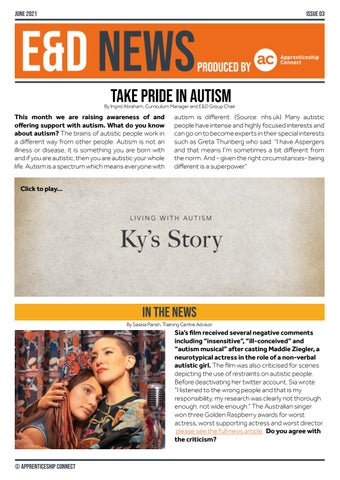
Sia’s film received several negative comments including “insensitive”, “ill-conceived” and “autism musical” after casting Maddie Ziegler, a neurotypical actress in the role of a non-verbal autistic girl. The film was also criticised for scenes depicting the use of restraints on autistic people. Before deactivating her twitter account, Sia wrote “I listened to the wrong people and that is my responsibility, my research was clearly not thorough enough, not wide enough.” The Australian singer won three Golden Raspberry awards for worst actress, worst supporting actress and worst director. please see the full news article. Do you agree with the criticism?
© Apprenticeship connect
Learning corner
By Rafiq Adebambo, Director and Tori Weller, Central Services Manager
• Sensitivity (Extreme sensitivity to or significantly lower sensitivity to various sensory stimuli. For example, visual recall of physical structures with a high level of detail, noticing seemingly ‘unnoticeable’ information)
Image credit: https://www.altogetherautism.org.nz/what-is-autism/
The autism spectrum is wide and affects children and adults very differently. The following list comprises of common examples of autistic behaviour: • Repetitive movements • Routine (A preference for sameness and difficulty with transition or routine) • Fixation (Rigid or highly restricted and intense interest in things, for example, this could be specific activities like art, video games or duties at work)
June 2021
• Highly focused interests (Autistic people may have intense and highly-focused interests, often from a fairly young age. These can change over time or be lifelong and can be anything) • Sensory overload (This can lead to extreme ability to absorb and remember a lot of information for some, or very limited ability to recall information for others) • Social skill deficits • Behavioural difficulties People with autism are up to 50% more likely to be excluded from school. However, this is often due to schools lack of understanding about autism and autistic children’s acute learning needs, sensitivity and sensory overload.
AUTISM IN THE UK
Autism is a lifelong developmental disability which affects how people communicate and interact with the world. One in 100 people are on the autism spectrum and there are around 700,000 autistic adults and children in the UK.
1 in 100
PEOPLE HAVE AUTISM AUTISM IS 3 X MORE PREVALENT IN MALES THAN FEMALES
22%
143,500
ONLY 22% OF AUTISTIC PEOPLE ARE IN EMPLOYMENT
SCHOOL-AGED CHILDREN WITH AUTISM ARE STATED AS SEN
Sources: https://www.beyondautism.org.uk/ https://www.autism.org.uk/
issue 03
TOOLKIT
By Olivia Doyle, Business & IT Analyst
Click on the tiles below to take you to the handy resources...
We want to hear from you! At AC we believe collaboration is key and learning from others is a great way to improve how we work. We want to help each other and so we’re looking to feature you in future E&D News editions. Each edition we’ll be focussing on the great work you’re doing to promote equality and diversity in your workplace. Perhaps you too have launched an internal steering group, or maybe you’ve released a new company procedure to remove biases. Whatever you’re doing to improve equality and diversity we want to hear it! If you’d be interested in featuring in our next edition, please get in touch by emailing callback@apprenticeshipconnect.co.uk to tell us more about the work you’re doing! June 2021
issue 03