
FACILITIES MANAGER




Striding Into Fall
Message
From The CEO
By Lalit Agarwal

Fall has always been my favorite time of year. The summer heat gives way to crisp mornings, students return to campuses buzzing with energy, football and volleyball seasons are underway, and of course the leaves remind us of nature’s beauty as they change colors. It’s the circle of life—and a season of both reflection and renewal.
From APPA’s perspective, this fall also marks a season of renewal for our association. In September, we launched our new website and member database. This transformation was more than a technical upgrade—it was about making APPA more accessible, user-friendly, and responsive to the needs of our members. The streamlined website makes it easier to find resources, while the modernized database simplifies engagement for everyone: individual members, volunteer leaders, and APPA’s staff team.
And we’re not stopping there. Later this fall, we will launch a new learning management system. This exciting step will expand the modalities available for delivering APPA’s professional development programs—ensuring that whether you learn best in person, online, or through hybrid experiences, APPA has an offering that meets you where you are.
As the seasons turn, APPA remains committed to innovation, accessibility, and professional growth for our community. Just as campuses come alive each fall with new beginnings, we at APPA are energized by the opportunities ahead to better serve you and support your work in educational facilities.
I look forward to all we will accomplish together. ■
Lalit Agarwal serves as the President & CEO of APPA. With a deep commitment to advancing the facilities profession, Lalit brings a strategic mindset, operational clarity, and a focus on innovation to lead the organization. He is passionate about empowering teams, integrating emerging technologies, and fostering a strong professional community across institutions. Under his leadership, APPA continues to evolve as a dynamic, mission-driven organization supporting excellence in educational facilities management.
Bookshelf
By Ted Weidner
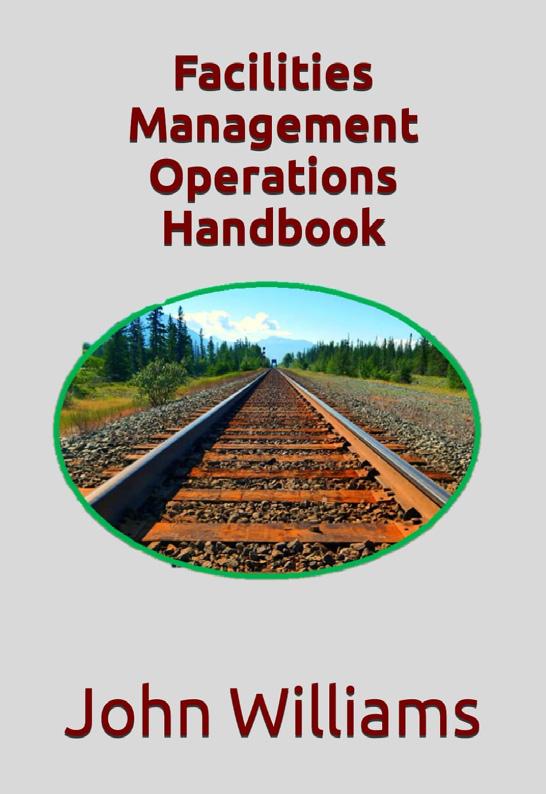
FACILITIES MANAGEMENT OPERATIONS HANDBOOK
AUTHOR: JOHN WILLIAMS; SELF-PUBLISHED BY AUTHOR, 2024; 788 PAGES, $30.
The scope and breadth of facility management is big, and describing it frequently requires hundreds of pages to be sufficiently thorough and informative. Because of its large breadth authors often begin with planning the facility and then work their way through design, construction to operations inserting topics of HR, leadership, and metrics in different sequences. This book is different.
This is the first book about facility management where the major areas are arranged alphabetically. Assets lead the way followed by BAS and boilers, all the way to Worms for Waste Removal. It’s a long list. Each of these major areas includes many individual topics that comprise the area. Each topic consists of a description of the components and how they are used in the facility. Many of the component descriptions include a photo/picture of the component. There are also several tables, diagrams, and portions from other sources that contribute to the facility management function. There are six major areas that are covered more extensively. These are also areas that command a lot of attention.
Energy management is an important area for facility managers. Since utility bills must be paid, finding ways to reduce the cost of consumption of energy and other utilities is one of the facility manager’s most valuable tools to deal with budget limitations. Understanding how the utilities are consumed, where they are consumed, why they are consumed, and how they are measured are important for customer satisfaction, comfort, and success. While there are many facility components that consume
energy there also are components available that generate energy. Understanding how all these components work creates opportunities for the facility manager. While this area does not go into the interactions between energy-using components, the list is thorough and provides an opportunity for further investigation using more focused resources. Other important areas addressed at length include FM Business Planning, Health & Safety, Hospitals, HVAC, and Operations Mobilization. Each area consists of a variety of informative photographs, charts and tables that describe the activities or components that make up the facility management area addressed. They are handy and help the reader understand the full scope of facility management, its complexities, and interrelationships with the organization, the people served, and the physical infrastructure that make up the facility.
Overall, the book is less of a handbook and more of a sophisticated glossary of facility management. The descriptions inform the reader of what makes up the facility and provide enough information so the reader can move to more detailed information if needed. Individuals new to the facility management profession or ones who would like to broaden their knowledge of the profession’s complexities will find Facilities Management Operations Handbook a useful addition. ■
Ted was an FM professional at several universities over a 30-year career. Now he is a faculty member at Purdue University teaching students about facilities and construction.
Proactive Power
Partnering for Electrical Reliability at Oberlin College
By Matt Yunker
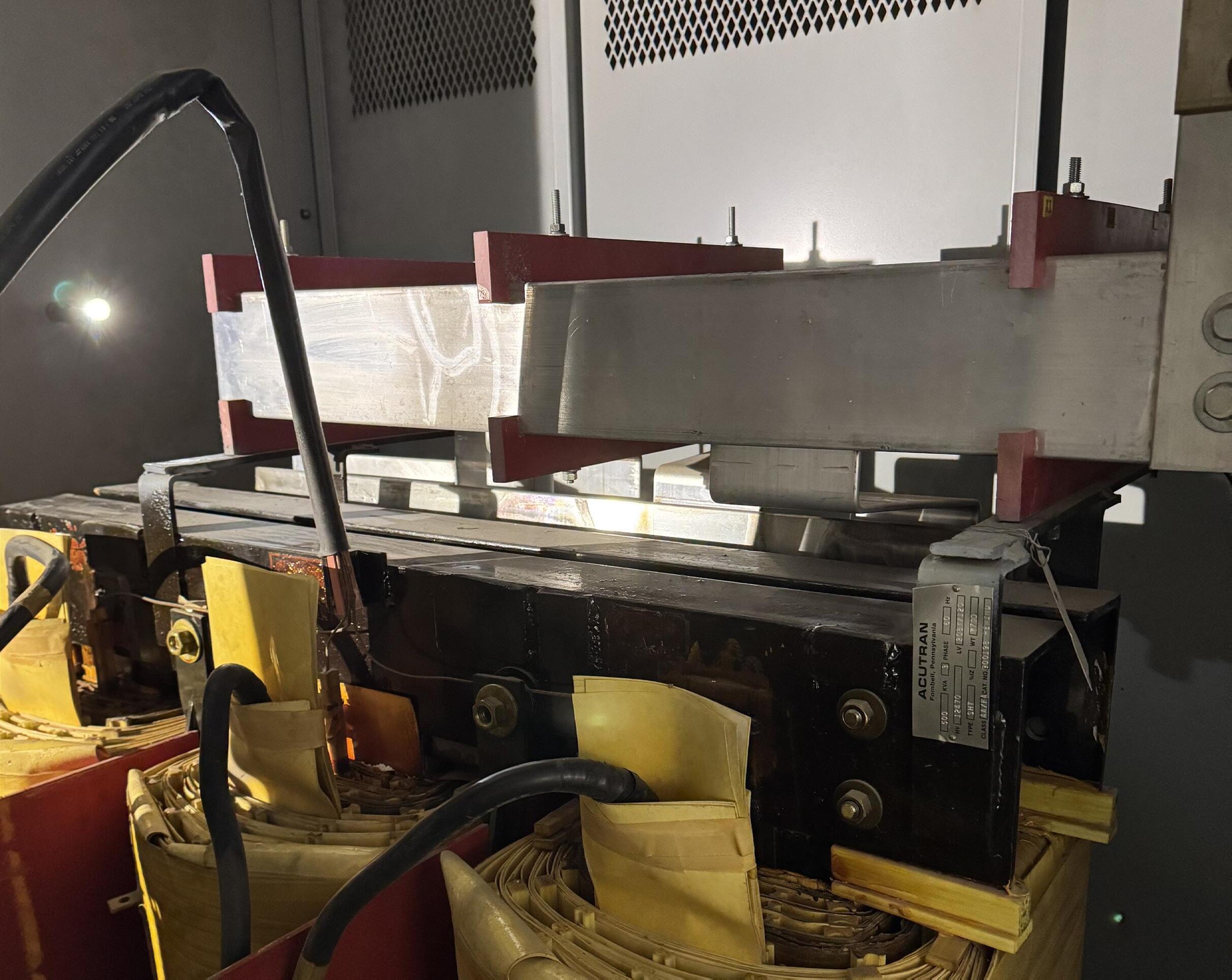
Over the summer months, Oberlin College Facilities Operations, in partnership with GEM Inc., Great Lakes Testing LLC, and Oberlin Municipal Light and Power System, completed a comprehensive testing and maintenance initiative targeting one of the most critical, and historically overlooked, components of campus infrastructure: electrical transformers.
The effort involved an exhaustive test and inspection of more than 50 transformers across campus, most of which had not been formally evaluated in decades. In addition to improving system reliability and documentation, the project has positioned Oberlin to proactively manage risk, prioritize repairs, and reduce the likelihood of future outages.
A Legacy of Service Meets a Modern Approach
Transformers are often taken for granted until something goes wrong. At Oberlin, many of these assets had quietly performed for 30-40 years without a significant inspection, let alone systematic preventive maintenance.
“Some of these transformers are vintage to the buildings dating back to the ’80s or earlier,” said Kevin Brown, Oberlin College Chief Facilities Officer. “We knew we were due for a full evaluation, but what made this project a success was the level of planning and the quality of our partnerships.”
That planning included developing a phased approach that combined both deenergized and
energized maintenance, balancing the need for thorough testing with the reality of keeping the campus running.
A Two-Pronged Testing Strategy
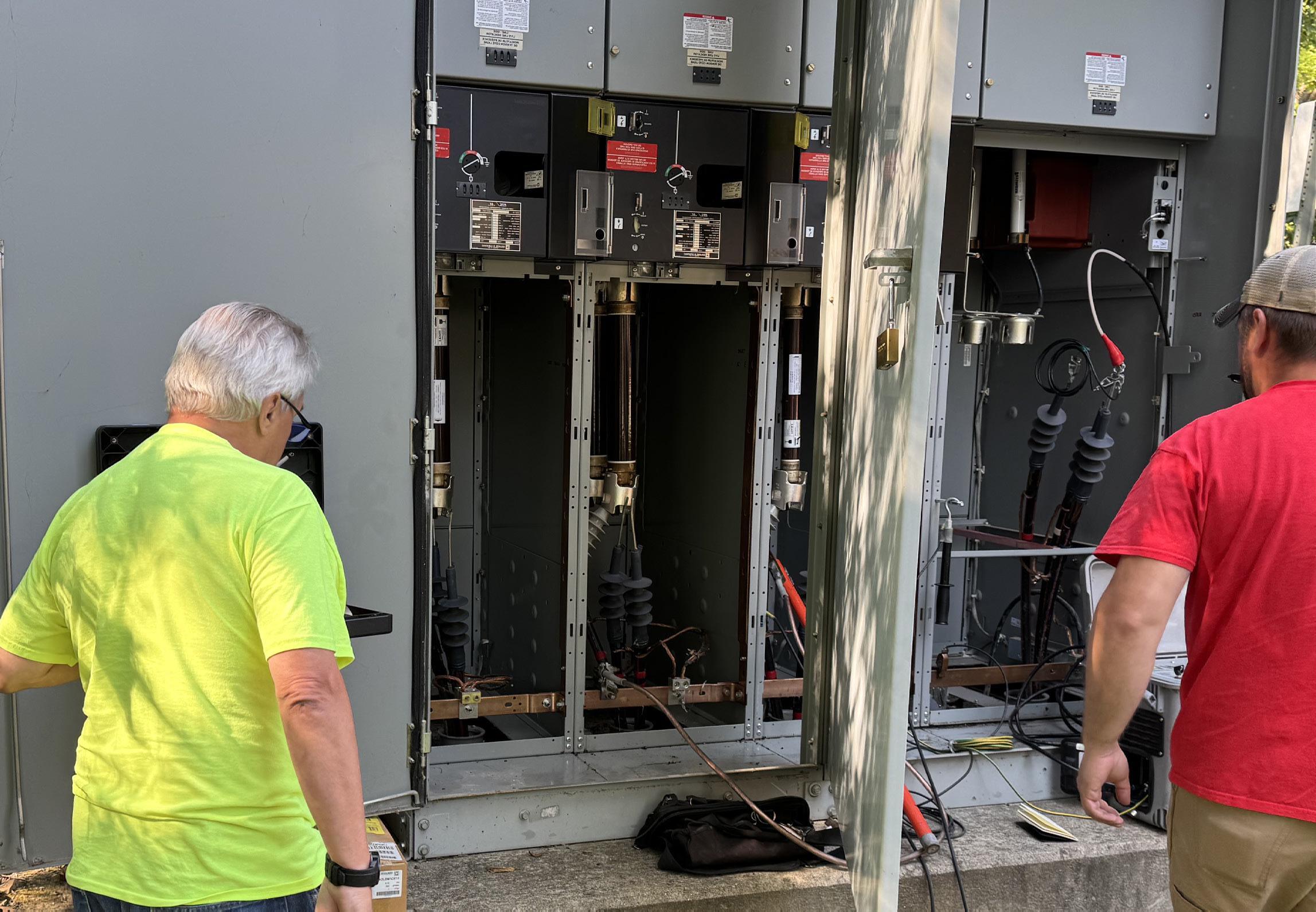
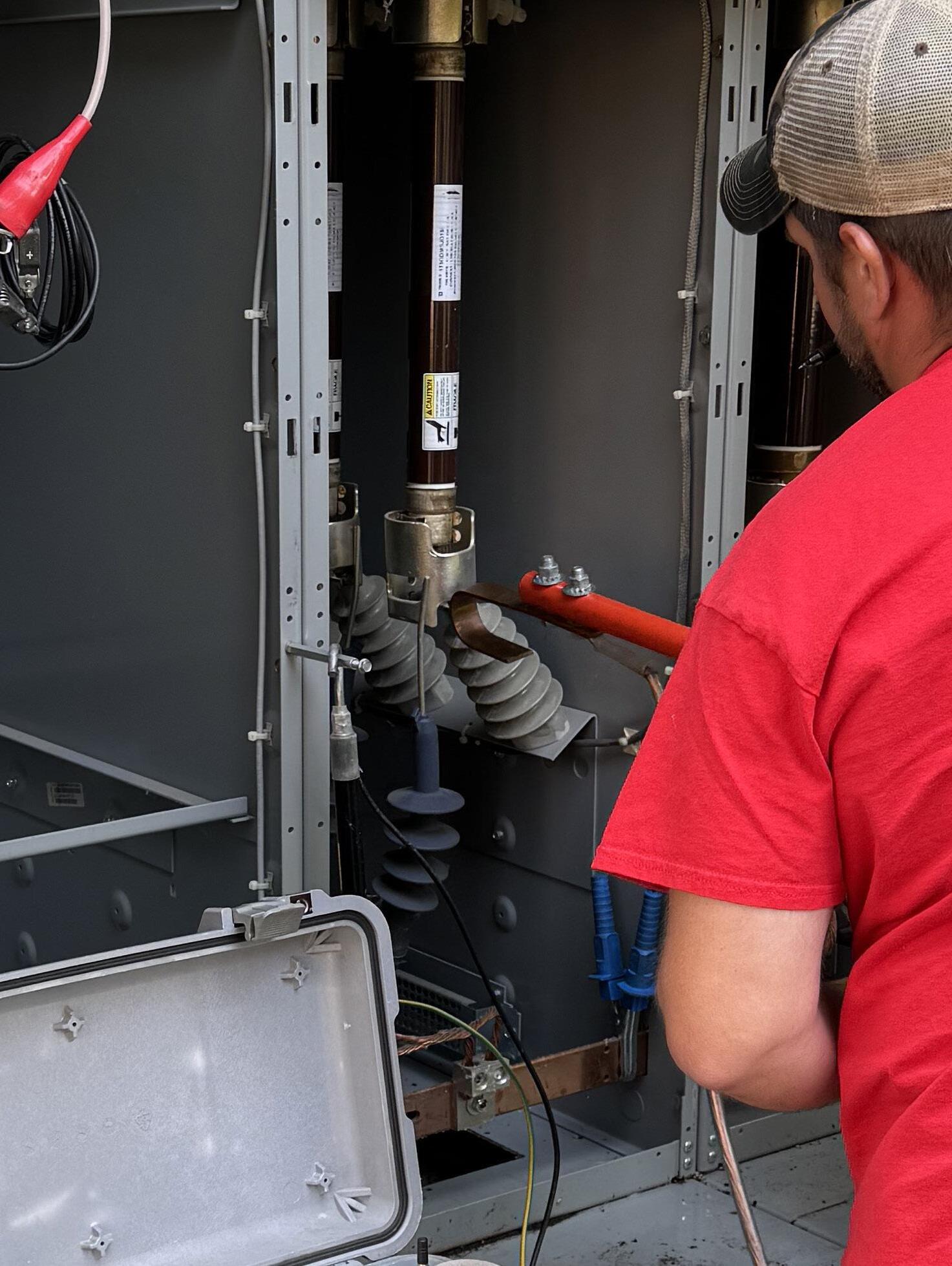
The work began with deenergized testing, where equipment was safely powered down to allow for a deeper level of inspection and maintenance. GEM Inc. provided all safety equipment, instruments, and technical labor needed to carry out testing in line with NETA Maintenance Testing Specifications, an industry standard for reducing safety hazards and preventing electrical failures.
During these deenergized sessions, technicians:
• Performed critical oil sampling and dissolved gas analysis (DGA) on 26 oil-filled transformers
• Cleaned and torqued electrical connections
• Inspected the physical and electrical integrity of 18 MV dry-type transformers and 36 switches
• Identified and documented signs of corrosion, misalignment, and potential safety hazards
“Periodic inspection, cleaning, and testing of these systems allows us to help Oberlin College identify and correct deficiencies before they become a bigger issue,” said Steve Rister, GEM Inc. General Foreman.
In tandem, energized testing, performed while systems remained active, provided real-time insights into electrical load and component condition. This included infrared thermography and ultrasonic inspections, tools used to detect high resistance, overloaded circuits, or faulty breakers that could lead to fire, arc flash, or other hazards.
From Data to Action: Real-Time Repairs and LongTerm Planning
The testing phase did not just generate hundreds of pages of data, it led directly to corrective action. Several high-priority issues were identified during the project, including a major fault in the transformers supporting the Terrell Main Library.
Thanks to the real-time coordination between Oberlin’s Facilities team, GEM Inc., and Great Lakes Testing, LLC, these issues were immediately scheduled for repair.
“We were able to catch and correct issues that could have shut down the entire building for a much longer period of time,” said Dawn Maple, Facilities Manager. “That kind of responsiveness is the product of strong
planning and mutual trust.”
At the conclusion of the project, Oberlin received a complete analysis of each component tested, along with recommendations to improve reliability, safety, and efficiency across the entire system. Each report included:
• Full test results and diagnostics
• Photographic documentation of deficiencies
• Recommendations for near-term repairs and long-term asset management
• Equipment inventory to support future maintenance planning
A Model for Preventive Maintenance in Higher Education
While many wait until a failure occurs to act, Oberlin’s proactive approach stands out as a best practice in the realm of facilities management. This project was not just about fixing what was broken, it was about shifting the campus mindset toward prevention and resiliency.
“Electrical infrastructure is easy to ignore, until it’s not,” said Brown. “By being proactive, we’re protecting people, safeguarding academic continuity, and ultimately saving money.”
The project also reinforced the importance of internal-external collaboration. GEM Inc.’s certified technicians, trained in both low- and mediumvoltage systems, worked side by side with campus electricians, documenting findings and even addressing minor issues in real-time when safe to do so. All infrared testing was performed by Level III Certified Thermographers, ensuring both compliance and accuracy.
Looking Ahead
Oberlin College now has a baseline for the health of its electrical distribution system, and a clear
roadmap for how to maintain and upgrade it over time. Add-ons like VLF cable testing and infrared view port installation were also part of the project, which will further streamline maintenance and reduce costs in the future.
“This project has allowed our teams to more clearly understand the existing MV distribution network across campus which in turn creates a roadmap for future planning,” Rister added.
As Oberlin continues to invest in resilient infrastructure, this project sets a high standard for thoughtful execution, strong vendor relationships, and the critical importance of proactive planning in facilities operations. ■
Matt Yunker is Director of Facilities Operations at Oberlin College.
Smarter Every Day
Using Generative AI to Drive Continuous Improvement in Educational Facilities
By Margaret Murphy
When you hear “artificial intelligence,” you might think of self-driving cars or futuristic robots. But in educational facilities, AI is quietly transforming how we train our workforce, document our processes, and solve everyday operational challenges.
Like many APPA member institutions, our facilities
organization faces familiar challenges: balancing limited resources with growing demands, ensuring knowledge transfer as experienced staff retire, and maintaining consistency in our documentation and training. We’ve found that generative AI—when paired with sound instructional design practices—can help make our work faster, more consistent, and easier to share across teams.

CASE STUDY
From SOP Chaos to SOP Clarity
Many teams were juggling dozens of Standard Operating Procedures (SOPs) in different formats and locations. Some were outdated, others incomplete, and few followed a consistent structure.
Using my Align–Design–Refine instructional model, we:
• Aligned SOP topics with operational priorities and compliance needs.
• Designed a standard template that was used for every SOP, ensuring clear steps, definitions, and resource links.
• Refined drafts using generative AI to simplify complex language, ensure tone consistency, and adopt gender-neutral, inclusive language.
Sidebar Text Suggestion: Sample AI Prompt Used:
“Rewrite the following SOP in plain language suitable for new facilities employees, keeping all technical steps intact. Ensure gender-neutral and inclusive language.”
Impact: Staff reported that the new SOPs were easier to follow. The standardized format made onboarding new employees smoother and allowed updates to be easily integrated whenever changes occurred.
CASE STUDY
Training Announcements That Get Read
Even the best training program can miss its mark if no one engages with it. For various reasons, our training announcements were not catching the interest of potential learners.
By using AI to reframe the messaging, we could quickly create multiple versions and choose the one that felt most relevant to our audience.
Sidebar Text Suggestion: Sample AI Prompt Used:
“Review the training outline pasted below and create three concise, engaging training announcements in under 100 words, targeting facilities staff with varied literacy levels. Include one with a casual funny tone, one with a formal tone, and one with a motivating call to action.”
Impact: Creating training announcements became faster and more efficient, with content easily adapted for email, posters, or newsletters—making it simpler to share opportunities across multiple channels. We used Ai to generate images and graphics which saved time and drew attention to our messaging.
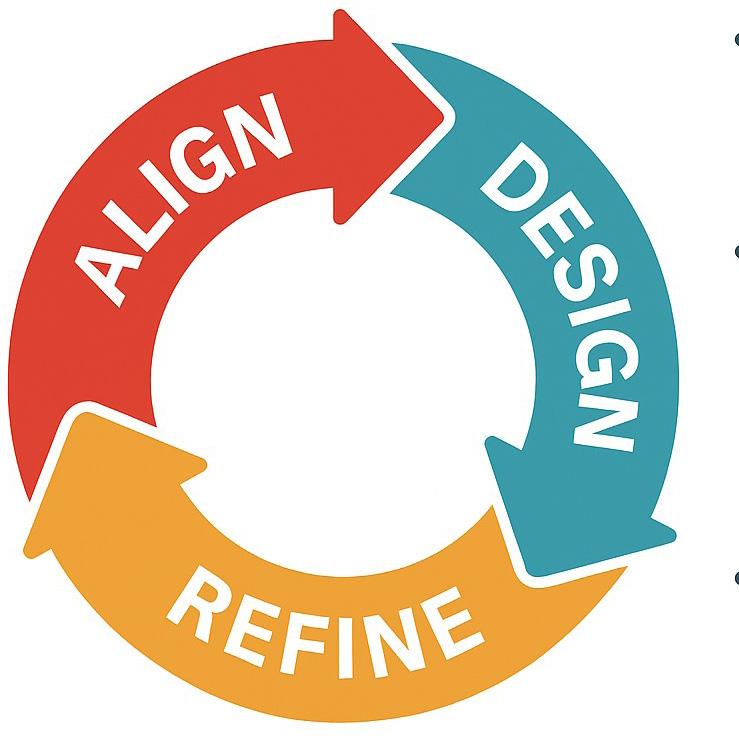
Align
Aligned SOP topics with operational priorities and compliance needs.
Design
Designed a standard template that was used for every SOP, ensuring clear steps, definitions, and resource links.
Refine
Refined drafts using generative AI to simplify complex language, ensure tone consistency, and adopt gender-neutral, inclusive language.
“If AI can get the first draft to 90% complete, I can spend my time refining details for the final draft. What a great timesaver!”
Best Practices for Using AI in Facilities Management
• Start Small, Then Expand – Begin with lowerstakes projects like rewriting communications before moving into technical documentation.
• Pair AI with Human Oversight – Always review AI outputs for accuracy and compliance.
• Save and Reuse Good Prompts – Develop a prompt library for repeatable success.
• Respect Data Privacy – Avoid sharing sensitive campus information with AI tools unless using approved secure platforms.
• Teach Prompting Skills – The quality of the output depends on the clarity of your input.
Five AI Prompt Ideas for Facilities Teams
• For SOPs: “Create a step-by-step checklist for [process] in bullet points, written for new hires with no prior experience.”
• For Reports: “Summarize this monthly energy usage report into three key insights for a nontechnical audience.”
• For Meeting Summaries: “Condense these meeting notes into a bulleted list of action items with owners and deadlines.”
• For Maintenance: “Generate a seasonal preventive maintenance checklist for a campus in [location] considering local weather patterns.”
• For DEI in Training: “Revise this training outline to include culturally relevant examples and ensure gender-neutral language.”
The Human Impact
AI isn’t here to replace the skill and knowledge of facilities professionals—it’s here to free them up for the work that requires judgment, creativity, and collaboration. One colleague put it best: “If AI can get the first draft to 90% complete, I can spend my time refining details for the final draft. What a great timesaver!”
Final Thoughts
Continuous improvement doesn’t always mean major overhauls. Sometimes, it’s about small, strategic changes that make everyday work smoother and more effective. By combining proven instructional design methods with the flexibility of generative AI, facilities teams can improve efficiency, strengthen communication, and build a culture of shared knowledge—one smart step at a time. ■
Margaret Murphy is the Learning & Development Manager in the Division of Facilities Planning & Management at the University of Wisconsin–Madison, specializing in instructional design, workforce training, and process improvement. She is the creator of the Align–Design–Refine model for sustainable training development and serves on the MAPPA Professional Development Committee.
Elbows
By Lindsay Wagner, PhD
Andrea Gibson once wrote, “You have no idea where I am. I guarantee I am somewhere thinking about the people who choose the middle seat on an airplane. When our elbows touch my heart goes so fast. I dare myself to not pull away. It’s the point of life. Don’t let anyone tell you different. The point of life is increasing the amount of time you can get your elbow to stay.”
I’ve been thinking a lot about elbows lately—not just the literal kind that brush against me in the crowded economy cabin, but the metaphorical elbows of working in a space that’s tighter, leaner, and under more financial strain than ever before.
The Middle Seat of Higher Education
In many ways, facilities managers are the middle seat occupants of academia. We’re squeezed between the aspirations of faculty and students on one side, and the hard realities of funding on the other. The legroom is shrinking—budgets cut, deferred maintenance piling up, energy costs rising—but our job is still to hold the space, to make the ride tolerable, even meaningful, for everyone else onboard.
Sitting in that middle seat requires resilience. Like Gibson’s poem suggests, it’s about daring not to pull away when things get tight. When my elbow brushes against someone else’s—be it a department chair needing a lab renovation, a student hoping for safer study spaces, or a custodian trying to stretch too few supplies—I remind myself that these small points of contact are the point.
Holding the Contact
Budget reports don’t measure the comfort of a campus when the heating system works just right on the first cold day. They don’t capture the safety a student feels when the library is well-lit at midnight, or the relief in a professor’s voice when the leaky ceiling is finally fixed. These are the “elbow touches” of our work—the fleeting, fragile, human connections that happen when we refuse to retreat even as resources grow scarce.
When funding shrinks, the temptation is to retreat, to pull the elbow back, to focus only on what’s measurable and defensible. But Gibson reminds
us that the point of life, of work, is to increase the amount of time we can hold that contact. To stay present in the squeeze. To find humanity in the narrow space between constraints.
Redefining Success
Maybe the measure of our success as facilities managers isn’t how many square feet we can maintain per dollar, but how long we can keep that elbow touching:
• How long we can keep a dialogue open with faculty even when we can’t promise immediate fixes.
• How long we can keep students feeling safe and cared for, even if our facilities aren’t shiny or new.
• How long we can support staff morale when every maintenance backlog feels like a growing mountain.
The squeeze of reduced funding isn’t going away anytime soon. But perhaps the work is less about escaping the middle seat, and more about staying steady within it—heart racing, elbow touching, daring not to pull away. Because, as Gibson says, that’s the point of life, and also the point of this work. ■
Lindsay Wagner, Ph.D serves as the VP of Strategic Programs for APPA, leading APPA Advisors, FPI, and managing content for key publications. Lindsay is a educator, consultant, and facilities management leader with over two decades of experience in higher-ed, strategic planning, sustainability, and organizational transformation. Prior to this role with APPA, Lindsay founded The Knowledge Collaborative.

Data-Driven Culture
How a Data-Driven Culture Improves Maintenance & Operations
By Matthew Pace
Facilities teams are often the unsung heroes of their organizations. They keep buildings safe, assets running, and stakeholders comfortable. Yet their work often goes unnoticed or undervalued because it’s difficult to capture and communicate its impact without data.
A data-driven culture changes that. By embracing modern reporting tools and practices, facilities teams make smarter decisions, operate more efficiently, and demonstrate their value.
Why data matters in maintenance and operations
Data is the lifeblood of a successful maintenance and operations team. It allows them to shift from costly behaviors and tasks toward optimized, cost-reducing measures. This direction change impacts the bottom line and creates better outcomes for stakeholders.
Without data, teams often engage in reactive maintenance practices, responding to emergencies
Insights improve administration
communication and the student experience
Reports and dashboards make it easier for facilities leaders to capture and share the story of their work. By tracking and visualizing key metrics, teams can showcase completed tasks.
Data-backed leaders highlight completed work orders, demonstrate completed preventive maintenance, and show responsiveness. These data points allow them to deliver meaningful updates by providing administrators with digestible, databacked reports to reinforce trust and credibility.
The additional transparency strengthens relationships with university administrators and school board officials. And even students. At the University of Nebraska, staff noticed marked improvement in its relationship with students after adopting data-driven facilities software. The shift to leveraging data allowed them to communicate work order completion times and keep students informed
“One of our mottos is that every student, every interaction matters... It’s been very meaningful for the work we do.”
instead of planning. According to industry estimates, these repairs cost two to three times more than preventive maintenance.
Additionally, a lack of data makes it difficult for leaders to justify staffing levels and budget requests. Because data-deficient departments lack visibility into workloads, completion rates, and response times, it can be impossible for managers to ask for appropriate headcount or demonstrate their current team’s value. This lack of transparency creates inefficiencies and weakens trust with administrators and stakeholders. Data fills that gap, providing evidence to support decisions and elevating the department’s role.
about their requests.
“One of our mottos is that every student, every interaction matters,” said University of Nebraska Senior Associate Director - Auxiliary Capital Planning Patrick Edwards. “Now, we can look at the end of the quarter or the year and say that on 98% of work tickets, we had an intentional interaction with a student. It’s been very meaningful for the work we do.”
Driving operational efficiency
Beyond communication, data is a powerful operational tool. Dashboards and reporting platforms allow facilities leaders to identify workload
imbalances by spotting teams or individuals carrying a disproportionate load and redistributing tasks accordingly.
They also make it easier to track labor efficiency, helping leaders understand where their team spends time and resources. Data supports budget requests by clearly showing gaps in staffing or equipment, making the case for additional funding more compelling.
At the same time, centralizing asset information streamlines daily operations, extends asset life, and enables faster responses, which reduces cost. This forward-looking approach reduces costs and positions facilities as a strategic partner in long-term planning.
The University of Nebraska’s shift to data-backed facilities management has illuminated asset costs, labor trends, and completion rates. Data has empowered teams across the university to optimize their time, improve cost metrics, and increase efficiency.
“Time is money in the facilities world. Facilities don’t generate revenue, said Edwards. “The way we contribute is by saving money,” said Patrick.
From reactive to proactive management
Traditionally, many facilities teams have operated in a reactive mode, fixing problems only after they arise. With the right data practices, leaders shift to proactive management. By scheduling preventive maintenance, they can reduce breakdowns before they occur. They can also forecast capital needs, ensuring teams replace assets before failure.
Additionally, analyzing historical trends helps leaders more accurately plan staffing levels and seasonal workloads. This forward-looking approach reduces costs and positions facilities as a strategic partner in long-term planning.
Effectively leveraging data-driven proactive facilities management allows organizations to uncover additional revenue streams and contribute to growth conversations. The University of Alabama Huntsville housing team generated additional revenue for the school by utilizing proactive maintenance practices.
They’re now using data to inform decision-making in residence halls, which has resulted in 120 fewer
unoccupied beds per year. Despite new off-campus housing, students are now choosing to live in university housing at a higher rate. This translates into an additional $929,000 in revenue per school year.

Data as a leadership tool
Ultimately, reporting tools are more than just operational aids. They are leadership assets. They allow facilities leaders to advocate more effectively for resources, build credibility with administrators and stakeholders, and align their teams with organizational goals.
When data becomes part of a department’s culture, it transforms how teams operate, collaborate, and communicate their impact.
Adopting a data-driven culture for maintenance and operations teams isn’t just about implementing software or tracking metrics. It’s about reshaping how the department is viewed and valued. Data provides the visibility, transparency, and foresight needed to move from reactive firefighting to proactive leadership.
By turning information into action, facilities teams can secure the resources they need, strengthen relationships across the organization, and ensure the long-term success of the communities they serve. ■
Matthew Pace resides in Phoenix, AZ and serves as Industry Practice Leader at FMX. He was formerly the Director of Maintenance and Operations at Queen Creed USD. He can be contacted at matthew.pace@ gofmx.com.
Starting with Data
Strategic Facilities Planning for Colleges That Can’t Afford to Guess
By Katie Gramajo
Community colleges educate nearly half of all U.S. undergraduates, yet they often operate with the leanest resources in higher education. Their facilities teams juggle a perfect storm: aging buildings, overbooked classrooms, ambitious sustainability mandates, and budgets that lag behind needs. National data shows that deferred maintenance backlogs at many community colleges exceed $140 per gross square foot, and over 40% of higher ed facilities leaders say budget pressure is their top operational challenge.
As catalysts for workforce development, when community colleges facilities falter, the impact is felt well beyond campus. In this environment, the hardest question isn’t how to fund facilities projects, but rather, which projects to fund first. Without a clear basis for prioritization, urgent repairs compete with long-term capital projects, leaving leaders to make high-stakes decisions without the right data. Reactive response models amplify this chaos, trapping teams in emergency mode while their campuses slowly deteriorate around them.
The solution requires leaders to put a stop to guesswork and instead pursue fact-based planning that is powered by data – the kind that helps leaders shift from reactive firefighting to strategic prioritization, make stronger cases for why funding is so critical, and ultimately deliver safer, more reliable learning environments.
From
‘Fix-it”
to Fact-Based Planning
Historically, community colleges have adopted the “wait until it breaks” model of facilities management, because they don’t have access to the resources needed to be truly proactive. However, over time, this method can be extremely unreliable and disruptive, leading to higher repair bills, more downtime, and safety risks. By operating in emergency mode at all times, facilities teams struggle with rapid deterioration that can significantly hurt the relationships with all stakeholders, from the funders providing resources to enrolled students.
However, by setting up a Facilities Conditions Assessment (FCA), facilities leaders are offered a way forward. An FCA is the process of analyzing the conditions of a facility or group of facilities, from age and materials to design and assets, equipping leaders with detailed baselines of asset condition, lifespan, and replacement cost. This visibility provides a level of transparency that arms facilities leaders with an inventory of the assets they own, and how healthy they are, helping them move from instinctual reactive decisions to proactive calls that are strategic, and evidence based. With the data in hand, colleges can prioritize strategically and build trust with administrators, students, boards, legislators, and community members.
Take Iowa’s Kirkwood Community College (Kirkwood), for example. In partnership with Brightly, Kirkwood used an FCA to catalogue 5,000 assets across 2 million square feet and seven locations. This dataset became the foundation for an asset management system that centralized work orders, tracked maintenance in real time, and connected capital planning to actual asset performance. As a result, Kirkwood completed 80% of reactive repairs within seven days, allowing leaders to reallocate resources toward preventative maintenance, and in turn, reduce risk and improve reliability.
Kirkwood serves as a prime example of how, when there is access to reliable, robust data, community colleges are better able to prioritize safety and compliance and strengthen credibility with every level of stakeholder.
Structuring Data That Drives Funding and Efficiency
While data is the key to establishing a baseline understanding of where things stand, reports alone don’t drive change unless tied to daily workflows. Rather, it all comes down to actionability that ties to day-to-day work and long-term capital planning. Kirkwood illustrates the point: its FCA data fed directly into an enterprise asset management (EAM)
system, enabling leaders to monitor performance and progress. This integration boosted preventive maintenance from 44% to 50% of work completed, while still closing out several urgent repairs within a week.
This mirrors the strategy for K-12 institutions. Boston Public Schools used asset data to improve budget approvals, while Waco Independent School District was able to secure $355M in bonds by using actionable data to document facilities needs and plead their case for more funding. These K-12 wins underscore that when schools can demonstrate their
needs with evidence, funders respond. The same goes for higher education. Structured data is a secret weapon to build strong funding cases and show, not tell, the ROI of facilities dollars. In a world where funding is increasingly difficult to secure, having the data to back up why it’s needed, and how every dollar spent contributes to measurable improvements, helps strengthen the business case for external funding, which is essential as nearly 3 in 4 Americans agree schools are struggling with budget constraints. All of this is to say that structured, connected data drives efficiency and increases chances of securing funding.
“...Kirkwood used an FCA to catalogue 5,000 assets across 2 million square feet and seven locations. This dataset became the foundation for an asset management system that centralized work orders, tracked maintenance in real time, and connected capital planning to actual asset performance.”
Turning Data into Student and Stakeholder Wins Strategic facilities planning isn’t just about saving money and making resources go further, it’s about creating learning environments where students thrive and stakeholders, community members, faculty, etc. trust in the safety of their local institutions. When HVAC systems fail during summer classes or labs have to close because of leaks, students’ learning experience suffers. Proactive facilities management reduces these disruptions, improves safety, and supports the core mission of community colleges – to set up their students for professional and personal success.
For stakeholders, data-driven planning improves transparency, which inherently builds trust. In fact, according to a new Brightly Software survey, if people were more aware of the different challenges school facilities are facing, 67% would be willing to pay more in taxes for air ventilation, and 70% would do the same for air conditioning.
Once leaders start to demonstrate how every facilities dollar is being spent strategically, they not only build support for future funding, but also build out their institution’s accountability. Over time, this shift from reactive response to proactive maintenance can trigger a cultural shift and change how community colleges are perceived, not as institutions constantly in need, but as proactive planners that are doing everything possible to protect taxpayer dollars, and most importantly, students’ ability to thrive. ■
Katie Gramajo is Senior Education Specialist at Brightly Software, a Siemens Company.
Shop Spotlight
F&S Roofers’ Safety in the Sun
By Shane G. Carr
When you’re serious about safety, you’ll find solutions for everything. Including the sun.
Roofers spend their working hours in the open, on top of a building rather than in it. So, when the F&S roofers shop was tasked with tearing off the old and laying the new, foreperson Shane Carr knew he’d have to address sun and heat safety. After all, the roof is 28,600 square feet on top of the Large Animal Clinic at the Veterinary Medicine complex.
While a horse neighed and a goat chomped on hay, nearby, a back parking lot was loaded with five semi-truck trailers worth of material to become the new roof. There were 183 giant bundles of insulation and 14 pallets of roofing membrane material and accessories.
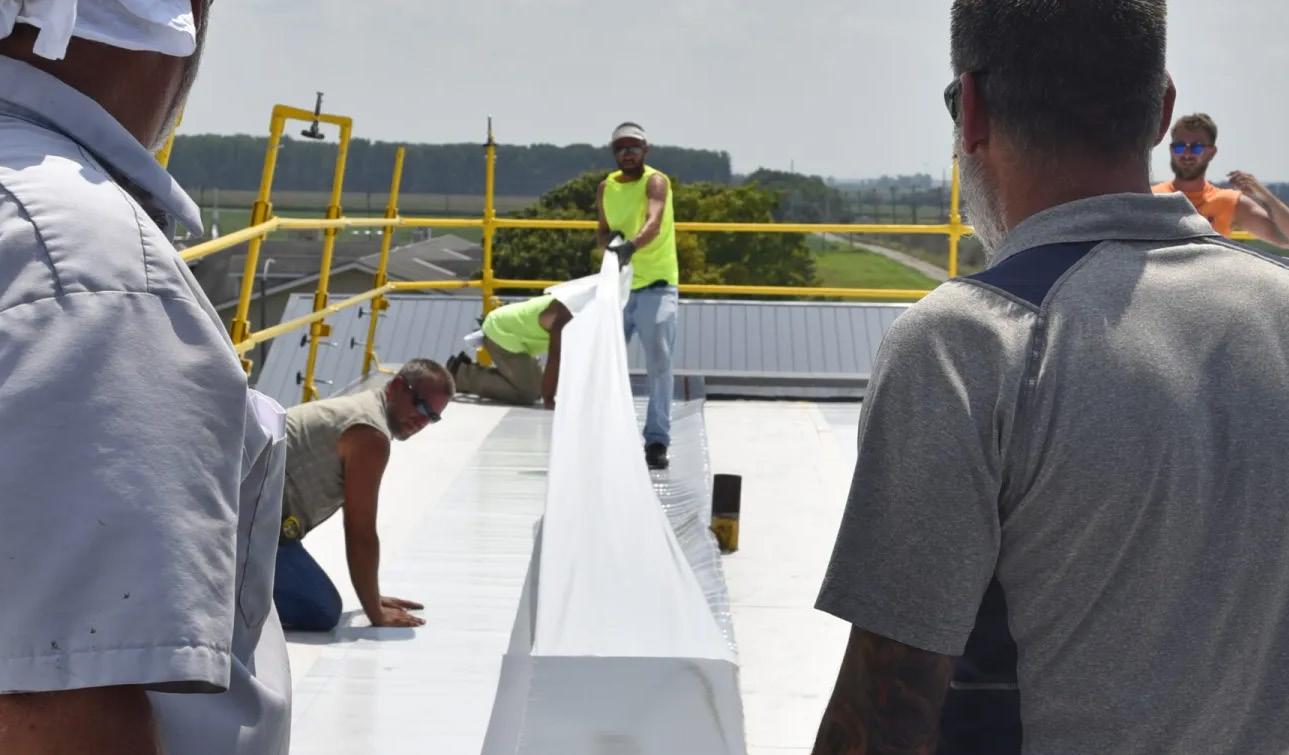
Safety materials had to make their way up there, too. Inside the yellow safety railing installed along the entire edge of the building envelope so workers can walk around without being tied down, there are tents, a giant fan, and coolers with water.
Each roofer was also encouraged to wear wide brim hats, sunglasses, hats, reflective arm sleeves, shirts and pants that keep UV rays out, keep the person cool and wick away sweat, three cooling vests, which bring the wearer’s core temperature down if someone overheats, hard hats for high sun that can save 20 degrees of heat, and cooling neck towels.
“We’re taking every measure to keep our people as cool as possible. We want cool equipment and cool clothing,” said Carr.
The roofers worked efficiently, undeterred by the heat. As they tackled the task of removing the old roof, adding insulation, and installing the polyvinyl chloride (PVC) membrane, each member of the crew contributed, helping the job to progress smoothly.
The project started on July 30 and workers finished up on October 30. Despite the quick-moving pace, the quality of the roofer’s work never faltered. Each
crew member held themselves and each other accountable, not only in their craftsmanship but also in their efforts to stay cool. Carr never missed an opportunity to compliment the crew’s work, constantly admiring their handiwork.
Transforming Campus Roofing: Craftsmanship Meets Innovation
At the University of Illinois Urbana-Champaign, Facilities & Services (F&S) keeps the campus running. Among its many skilled shops, the Roofers Shop stands out for its history, expertise, and forward-looking approach to maintaining more than 5 million square feet of campus roofing. The team has grown from 2 to 10 in less than five years and is now scheduled out with work through 2030.
Built on a Strong Foundation
Roofers have been part of the University of Illinois Urbana-Champaign since 1938 when two tradespeople joined the Sheet Metal Shop. Over the decades, the shop has become a full-service team covering everything from slate and tile to rubber, plastic, and modern liquid-applied systems.
“We’re not just patching leaks. We’re protecting the university’s future.”
Certified for Excellence
The Roofers Shop is the only university-based roofing team in the country certified by Sika USA, a global leader in resilient and sustainable roofing. That certification provides access to industry-leading warranties and expertise, giving every project longterm value and confidence. The team is identified as “Authorized Roofing Applicators,” meaning a full roof system warranty comes from the company that includes not only a warranty on the materials, but also a 20–30-year labor warranty. Before, the roofer’s shop could only get a material warranty. Additionally, the shop can work on and repair any Sika SarnafilTM installed roof system by outside contractors without voiding the warranty.
Expanding What’s Possible
Of the ten team members who make up the roofers’ shop, four are SPRAT (Society of Processional Rope Access Technicians) certified, which is the organization that sets standards and awards certifications regarding rope safety. F&S experts from the Building Maintenance division aid the initiative and coordinated with a Chicago-based company, Elevated Safety, to identify equipment
needs and provide SPRAT level 1 technician training. Foreperson Shane Carr and colleagues were featured in the Illinois “Be Safe” campaign, which focuses on how photography is used to expose what kinds of work relate to campus safety.
Carr is certified to operate drones, which allows for faster and safer roof inspections. The drones can take photos to show the building manager or other occupants. Carr operates a drone to find leaks in the building envelope, the most outer layer of a building that can include cracks in windows, masonry, or through utilities access points. Older buildings, like many on the Urbana campus, may develop imperfections over several years or from heavy storm damage. The drone camera, Carr noted, can detect wet spots under the roof. These capabilities improve efficiency, reduce risks, and strengthen collaboration across F&S.
A Measurable Difference
Keeping work in-house delivers significant results. Those savings are redirected to deferred maintenance and other critical needs.
The shop also supports daily safety and accessibility, from clearing snow off ADA ramps in the winter to installing railing systems that earned them
recognition as the 2019 F&S Team of the Month.
A Model for Others
The Roofers Shop success and growth shows what is possible when universities invest in their own skilled trades. A dedicated roofing shop not only saves money but also extends the life of facilities, advances sustainability, and builds a culture of teamwork across campus operations.
Looking Forward
Guided by the F&S values of trust, respect, accountability, integrity, teamwork, safety, and perseverance, the Roofers Shop continues to blend craftsmanship with innovation. Their work ensures that the University of Illinois Urbana-Champaign has the strong and sustainable infrastructure it needs to support learning, research, and public engagement for generations to come. ■
Shane G. Carr is a Roofer Foreperson in Facilities & Services at the University of Illinois Urbana-Champaign, working within the Building Maintenance (Crafts & Trades)
Reimagining Utility Management
Controlling Skyrocketing Expenses Through Innovation
By Marilyn Koziatek & Michael Kadlick
Utility expenses can be runaway costs for any institution, but it is possible to rein in costs with creative strategies. Beginning in 2023, Pepperdine University reimagined utility management in a step-by-step implementation, resulting in a reduction in usage and stabilization of costs. After operations and maintenance costs skyrocketed during the pandemic, it became a focus to reduce the pressure on operating costs, even while experiencing an increase in enrollment and demands on higher-quality services, especially custodial services to meet post-pandemic standards. The University turned its attention to seeking cost reductions in utilities including gas, electricity, potable and reclaimed water expenses. The gas provider doubled the per Million British Thermal Units (MMBTU) billing rate and electricity costs experienced 5-6% increase per kilowatt hour (KWH) billing rate year over year.
To better analyze the University’s utility costs, the University reimagined the staffing of the energy manager position, expanding the role’s scope from electricity to all utilities. For decades, Pepperdine has integrated sophisticated energy management protocols in its Building Management System (BMS), but the billing costs were not fully tabulated until after they were paid. Launching a utility management software that scrapes billing and usage data automatically from invoices for all utilities (electricity, gas, reclaimed water, potable water, and sewage) became a high priority. With this, Pepperdine secured the first building blocks to build a robust utilities management program with reliable and accurate data.
Equipped with real-time information, the utilities manager began sifting through potential cost savings initiatives and strategies, beginning with electricity usage, as the most expensive commodity.
After conducting break-even analyses on a series of products and services, some did not move forward, including alternative electricity generation, cloudbased leak detection technology, and outsourced energy management services. Electricity costs account for 60% of all utility expenses, with lighting and cooling being the largest consumption of the load. This led the utilities manager to analyze alternative energy generation options such as hydrogen fuel cells, which could reduce reliance on fossil fuels and energy suppliers. While an attractive solution, campus space constraints, reliance on gas that could be disrupted during wildfires, and initial start-up permitting and cost hurdles made the solution infeasible. The field of energy and utility management is crowded with many vendors, and some offer compelling cases to fully outsource services. A detailed analysis proved that the monthly service fees could not justify the expenses without tangible scopes and keeping all initiatives selfserviced and in-house was the better path forward. Outside of electricity and gas, water consumption is the third-highest priority expense. Cloud-based solutions for leak detection and water usage are prevalent in the marketplace, but the system installation would require subtle drops in pressure. Pepperdine’s vibrant housing and residence life community is central to the mission of the school, and maintaining quality superseded the benefits of the technology - especially considering the robust oversight through the utility management software and well-staffed plumbing maintenance department.
Sorting through the noise of energy and utility vendors and solutions required time and attention,
but proved worthwhile when the math of the break-even analysis penciled out. By successfully researching and implementing a series of programs, including integrating technology and software, Pepperdine utilized data efficiently for decision making, updated billing resources with the electricity provider, and generated revenue.
Integrating technology and software
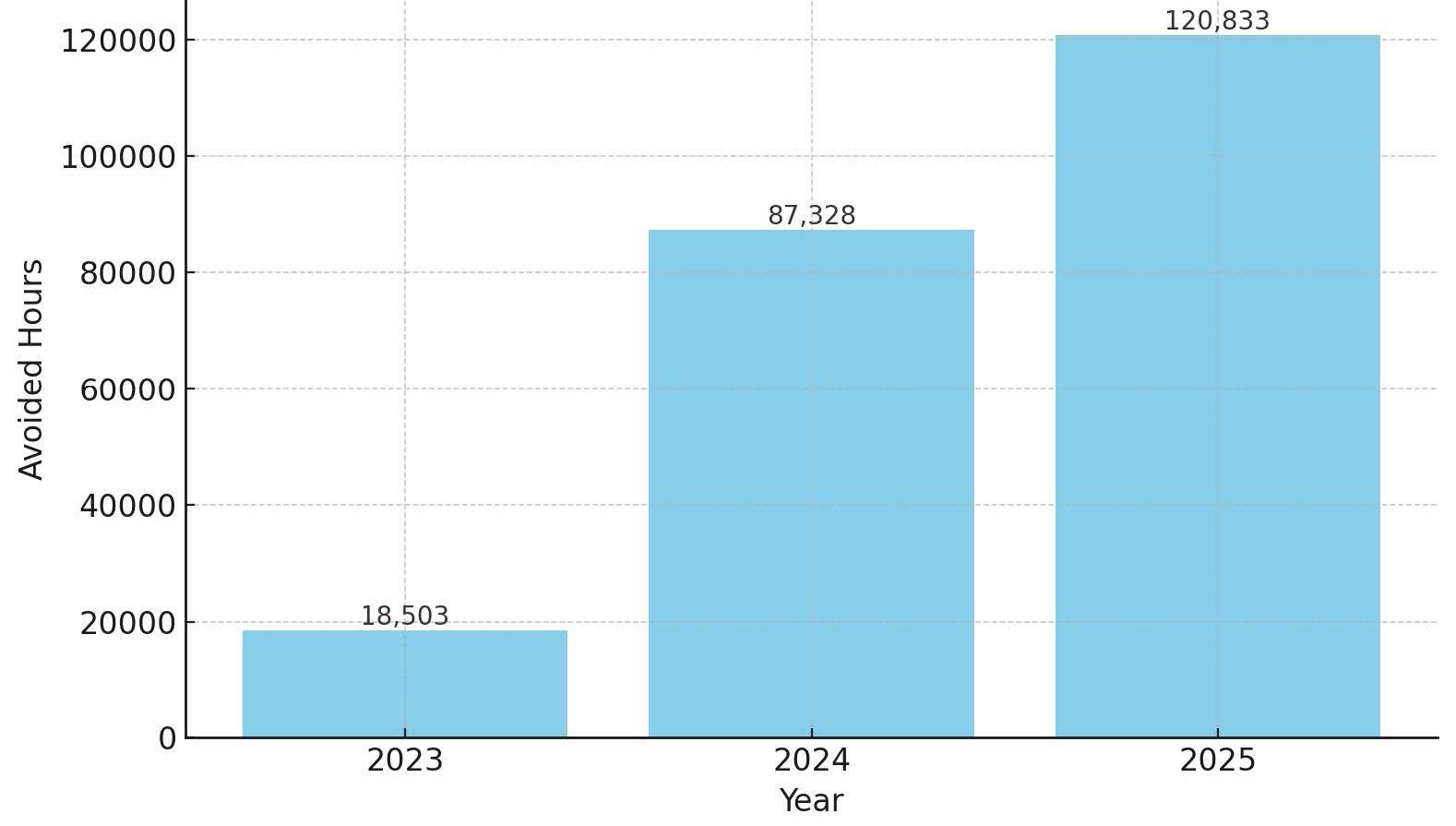
Classrooms, conference and auditoriums are reserved through a software (25Live) offering an integration (Events2HVAC) between the campus-wide scheduling software and the building management system. This allows the University to set HVAC systems to an unoccupied setting when not in use. By integrating the 25Live calendar with Events2HVAC, Pepperdine automates HVAC zoning across campus— reducing electricity costs through optimized runtimes, minimizing equipment wear and tear, and lowering technician labor associated with manual scheduling.
Furthering HVAC efficiency can include equipment and materials modernization. Technologies exist that increase the efficacy of HVAC filters through ionized technology by sourcing electrically enhanced air handler filter frames. It can enable an institution to reduce electricity usage, labor costs from filter changes, and equipment wear and tear, all while maintaining high air quality standards for stakeholders. Other components of the ventilation system can offer energy efficiency including power transmission belts that lose less energy due to bending in comparison to wrapped uncogged belts.
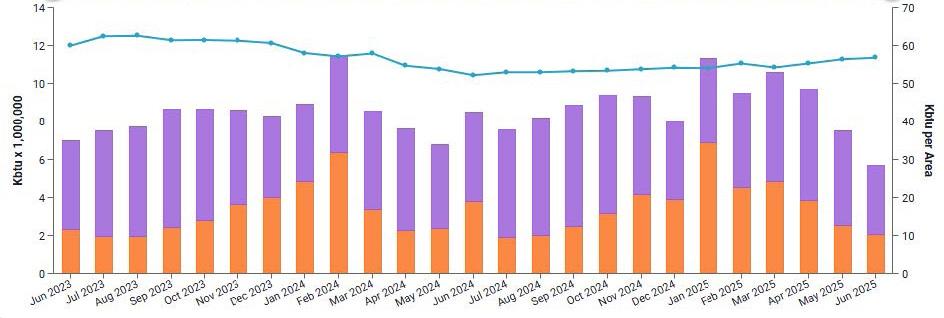
Above: Energy Use Intensity (EUI) is a benchmarking metric that measures how much energy a building uses relative to its size. For a university, the benchmark for “efficient” is around 60-65.
This graph demonstrates the downward trend and efficiency relative to the campus size.
Opposite: Pepperdine Avoided HVAC Hours
Campus-Wide Energy Use Intensity (Electric & Gas)
Revenue generation
Beginning in 2014, Pepperdine installed six chargers for electric vehicles (EVs) through a community partnership initiative. Eleven years later, EV charging ballooned on campus to 75 chargers, resulting in a significant investment in both infrastructure and electricity costs. After carefully reviewing electricity, maintenance and extended warranty costs, Pepperdine introduced a fee structure to offset costs and break even, thereby ensuring this amenity is sustainable for years to come, striking the perfect balance of offering EV charging at an affordable rate for the entire community, while also implementing time limits to ensure the amenity is accessible to everyone throughout the day.
Utilizing data efficiently for decisionmaking
Submetering individual buildings is an effective strategy to better tailor future energy management and collect better data for decision-making.On most campuses, the electrical feed is metered by the utility provider at the substation. To effectively manage Pepperdine’s electrical usage across 63 individual buildings across campus, more specific data was needed. Building-level electric submetering enables efficient troubleshooting of energy inefficiencies,
supports break-even analysis for future upgrades, and provides a clearer understanding of energy usage across campus.
Billing anomalies can tell a story that enables maintenance staff to troubleshoot plumbing leaks and HVAC inefficiencies. For example, Pepperdine’s billing error detection system identified unusually high water and electricity usage in the health center building. Upon investigation, the issues were traced to a broken fill valve in a seldom-used restroom and a scheduling error with the HVAC equipment. By addressing these problems promptly, Pepperdine was able to prevent further waste and unnecessary costs.
Updating billing resources with the electricity provider
In many states, institutions can purchase electricity directly from suppliers, instead of the utility company, for significant cost savings. In California, the Direct Access (DA) electricity model allows institutions to collaborate with both Southern California Edison (SCE) and DA providers, creating a more cost-effective approach to powering the campus. By leveraging market competition and alternative procurement strategies, it is possible
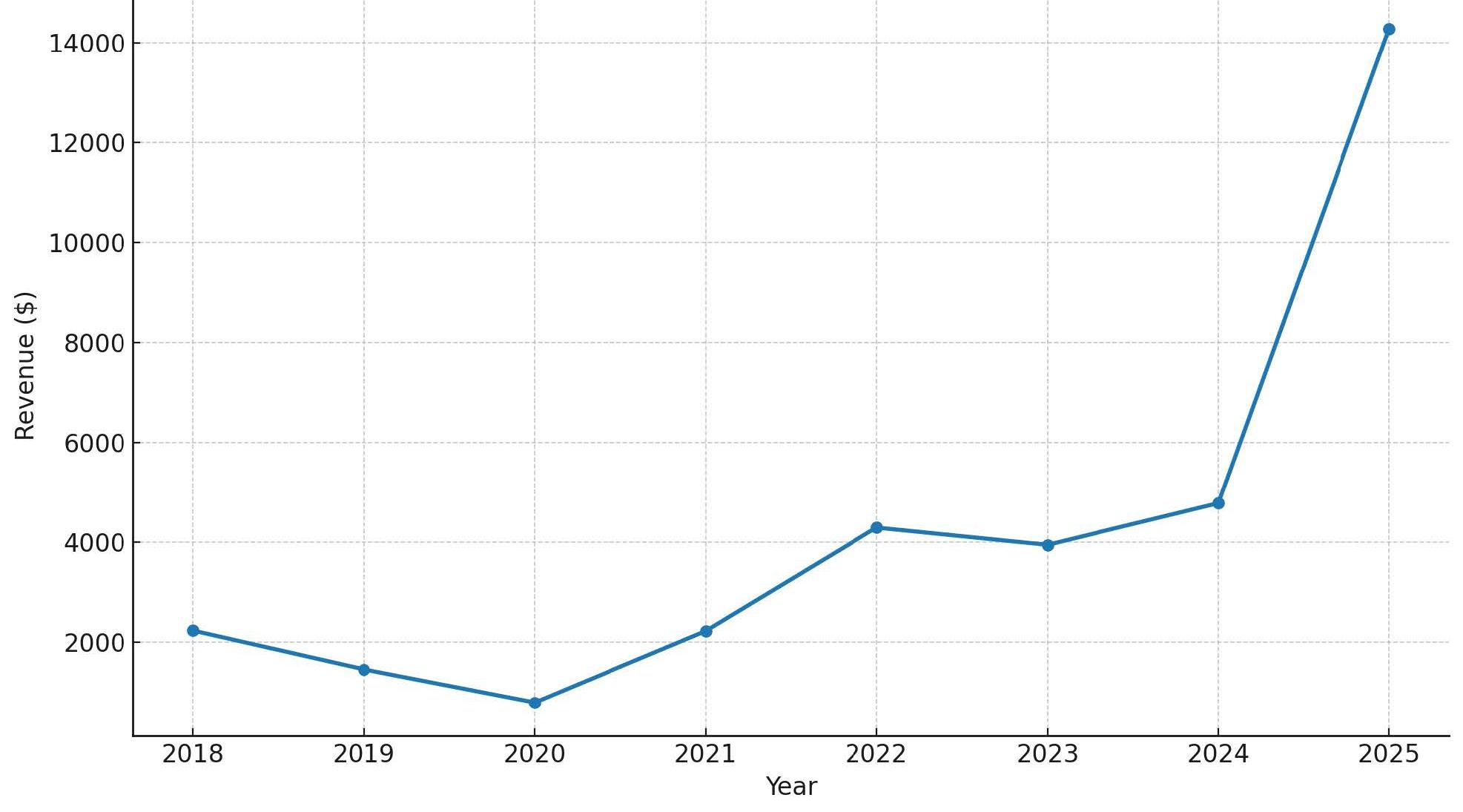
Pepperdine Revenue by Year
“Sorting through a crowded marketplace of energy and utility services and vendors can be time-consuming, but it’s time well spent. Pepperdine’s recent efforts have resulted in a cumulative savings of $500,000 out of $6M in annual expenses and was able to operate more efficiently while making financial gains through methodical analysis, partnered with a healthy dose of innovation and creativity.”
to secure electricity generation at lower rates than traditional utility pricing, similar to shopping for the best deal in a competitive marketplace. At the time of this publication, Pepperdine was waiting on approval from SCE on the change which is awarded through a lottery application annually.
To further manage utility costs, contacting the electricity distributor to do an analysis of “grandfathered” billing tiers with newer rate tiers to negotiate savings. By analyzing and comparing grandfathered SCE utility rates with other available options, Pepperdine was able to make quick, strategic adjustments that save thousands of dollars annually.
Sorting through a crowded marketplace of energy
and utility services and vendors can be timeconsuming, but it’s time well spent. Pepperdine’s recent efforts have resulted in a cumulative savings of $500,000 out of $6M in annual expenses and was able to operate more efficiently while making financial gains through methodical analysis, partnered with a healthy dose of innovation and creativity. ■
Marilyn Koziatek, CEFP, Senior Manager, Facilities and Campus Operations
Michael Kadlick, Associate Director, Facilities Logistics
Improving Service Delivery
Improving Service Delivery Through Facilities Alignment and Service Level Agreements
By John Edwards & Dr. Timothy Carey
Facility managers (FMs) face many challenges in the delivery of services to the institutions they support, such as high customer expectations, chronic underfunding of facility needs, and difficulties in recruiting and retaining qualified staff members. While it may be tempting to point the finger at others (“Our customers don’t understand how many obstacles we have to overcome,” or “The university just doesn’t fund us the way it should”), we have found that it is important for FMs to manage expectations.
Creating service level agreements that are aligned with anticipated resources, supported by leadership at organizational levels above the facilities department, and clearly communicated to facility stakeholders helps to bridge this gap and ensure customer expectations and service delivery are aligned.
What is a Service Level Agreement?
A service level agreement (SLA) defines the services to be provided by the facilities organization, the targeted standards for those services, the method of measuring achievement of the standards, and the responsibilities of both the facilities organization and its customers in achieving the outcomes described by the SLA. An SLA can be an overarching agreement for the entire campus, a series of agreements that address unique needs or requirements of specific colleges or departments, or both.
For example, a campuswide SLA might define custodial task frequencies and outcomes for traditional classrooms, while a department level agreement may be needed for cleaning
services to support the teaching and research mission of a specialized space such as a cadaver laboratory or computing center. The specialized cleaning protocols and training required for the custodial staff to meet department needs and ensure compliance with local, state, or federal regulations, along with any associated costs that are agreed to be borne by the receiving organization, should be clearly defined so that all parties have a shared understanding of responsibilities for service outcomes.
As another example, the University of Connecticut (UConn) implemented an SLA with Residential Life as the Building Services group of Residential Life was merging with Facilities Operations. The SLA was designed to reduce the administrative burden associated with billing for individual maintenance and service requests throughout the year, while also ensuring consistent service levels as staff transitioned to Facility Services oversight. After implementing this first SLA, additional SLAs were set up with other auxiliary units.
Getting Started with SLAs: Leadership Buy-In
While it may be tempting to jump in and start writing SLAs, it is crucial that FMs first get the backing of the organization they support before engaging in SLA discussions with their customers. A facility strategy, whether expressed as a formal Facility Strategic Plan or in an informal briefing to leadership, is essential for setting clear facility objectives that align with broader organization’s goals. Having a defined facility strategy lays the groundwork for FMs to then:
• Present to leadership the level of service standards being proposed
• Define the resources needed to sustain the standards
• Gain consensus that university or school district leadership concurs that the proposed standards are acceptable to the organization and will be funded accordingly
Without the endorsement of leadership, FMs run the risk of agreeing with customers on levels of service that are not in line with organizational constraints imposed on the facilities department or of not being able to deliver on the SLAs they make.
Leveraging APPA’s Levels of Service
Facilities departments are built upon a customer service mindset, and FMs understand that facility services enable the critically important mission of the institution. Additionally, FMs recognize that the recruitment and retention of students, faculty, and staff are influenced by the appearance,
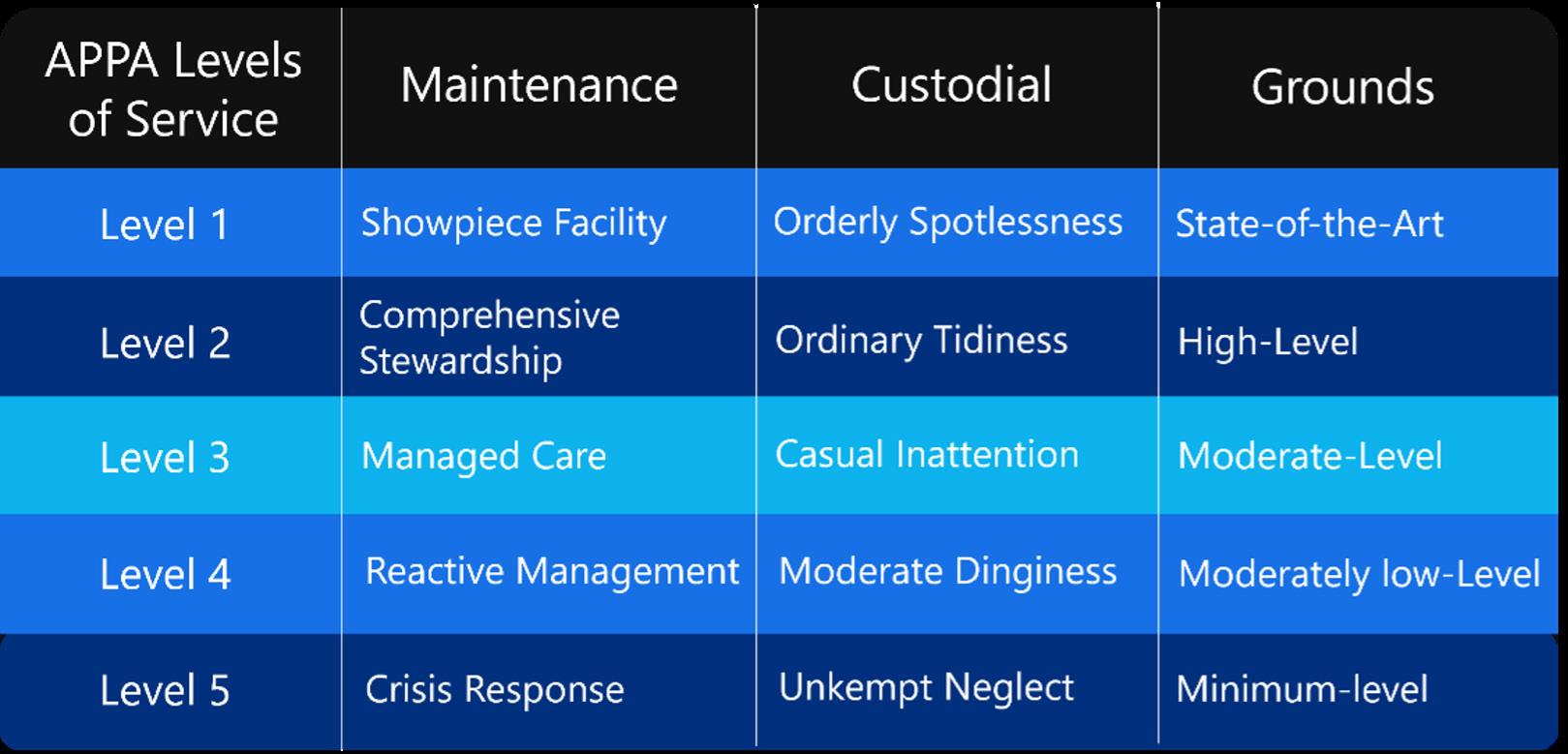
cleanliness, and ongoing maintenance of our campuses. The APPA level of service definitions for maintenance, custodial, and grounds provide an excellent framework for describing outcomes and defining the resources needed to meet or exceed the agreed SLA standards. Figure 1 shows the top-level descriptors for each of five levels of service defined by APPA.
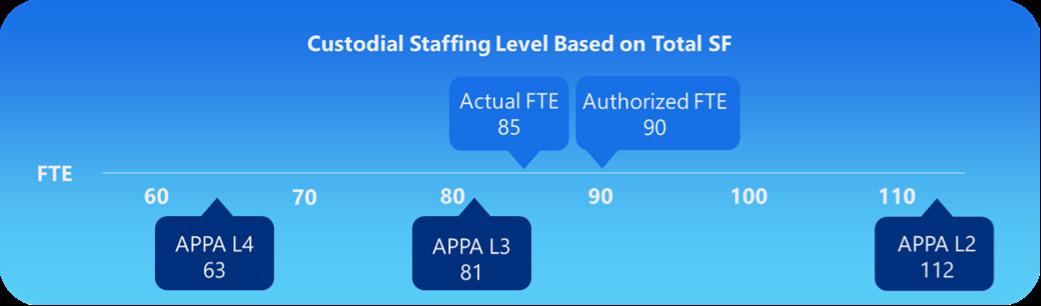
APPA’s Operational Guidelines for Educational Facilities provide FMs with a great resource for a deeper dive into the multiple characteristics that define each service level and the tools to estimate the staffing and budget needed to sustain each level. For example, if an institution determines that their current staffing count enables the delivery of Casual Inattention (Level 3) custodial services, but customer SLAs require Ordinary Tidiness (Level 2) outcomes on a consistent basis, FMs can estimate the Full Time Equivalent (FTE) staff and requisite funding to move to Level 2 service. Figure 2 illustrates the snapshot results of a hypothetical staffing analysis that could be used in the development of an SLA or for requesting resources to meet a targeted level of service.
Figure 1: Figure 1 shows the top-level descriptors for each of five levels of service defined by APPA.
The implication of this illustration is that the onboard count of 85 custodial FTE staff should be able to consistently provide APPA Level 3 service outcomes. To improve service and provide APPA Level 2 outcomes, custodial staffing would need to increase to about 112 FTE. FMs can use this suggested increase to estimate other non-personnel budget needs that are required to elevate custodial outcomes, such as additional cleaning supplies or equipment.
Preparing the SLAs
Once the facilities department has determined the targeted APPA levels of service and secured the resources to deliver such, the creation of the SLAs can begin. This should be a collaborative initiative with the stakeholder departments. While the specifics of each agreement can vary, effective SLAs have the following traits:
Focus on Customers: Including verbiage in the SLA that speaks to the mission of the department enables the facilities team to underscore their customer service mantra.
Although many of the components of an SLA will be standard, the unique activities of various departments can be woven into each SLA. For example, a music department may require strict humidity level monitoring to preserve expensive instruments whereas an admissions welcome center may require only general occupant comfort; however, the appearance level of the admissions welcome center may be of much greater importance because of the number of outside visitors that enter that facility.
Educate Campus Leaders: FMs clearly understand that there are limits to what they are staffed and budgeted to provide in the way of service. The reality, unfortunately, is that some of their campus colleagues do not. A written SLA that is linked to APPA service
levels enables a “teachable moment.” As many have shared with their campus colleagues, “We would love to provide APPA Level 1 service, but unfortunately we are not funded nor staffed at that level.” The clarity and understanding that ensues from these kinds of discussions is overwhelmingly positive and helpful to the SLA development process.
Document Responsibilities: While it is obvious that the tasks and associated frequencies that will be executed by the facilities team will be outlined in the SLA, so too should tasks and responsibilities that are the responsibility of the department being served. Asking the academic and administrative departments to utilize the electronic work order system to submit all non-emergency requests for service, to not use tape or glue to affix flyers to windows or painted surfaces, and to turn off
Figure 2: Figure 2 illustrates the snapshot results of a hypothetical staffing analysis that could be used in the development of an SLA or for requesting resources to meet a targeted level of service.
manually-controlled lights when spaces are not occupied are a few examples of reasonable expectations to place on the customers being served. For UConn, they found that the SLAs between Facilities Operations and auxiliary units also helped maintain clear separation of funding responsibilities and ensured clean accounting for financial statement reporting purposes. The Central Budget Office allocated permanent funding to Facility Services and centrally recovered the relevant funding from the auxiliary units.
Include Examples of “What If” Scenarios: Snow removal efforts and unplanned emergencies – such as a broken pipe causing a flood in a nearby building – can require facilities leaders to pull staff from their assigned duties and may impact cleaning or maintenance routines. Include these potential scenarios in the SLA so customers are not surprised when these types of circumstances inevitably arise.
Perform Regular Reviews: Annual or semiannual meetings to review the agreement and to incorporate any needed changes ensures the SLA is a “living” document and further forges a positive and collaborative relationship between the facilities department and its campus colleagues. UConn also reviews and adjusts their SLAs annually to reflect any increases in salaries, service contracts, material costs, or actual work order activity.
Ensure Ownership: Facilities supervisors and front-line staff and the department head of the office or functional unit for whom the SLA has been crafted should be listed as signatories on the document. This not only ensures a common understanding but also facilitates a professional and collaborative relationship between the facilities department and those being served.
Keeping the Momentum Going
Although the process to create SLAs may seem formal and cumbersome to manage, the exact opposite is the case. Once a facility department establishes a template of an SLA, it is a straightforward and replicable process
to amend and adjust to meet the requirements of an academic or administrative department. One strategy to commence the process is to create and share a global, campus-wide SLA that explains the APPA service levels model and the corresponding level at which the facilities department is budgeted and staffed. The need for department specific SLA’s – a logical outgrowth of the campus-wide document – will emerge as departments request services that are additive or different from those detailed in the global document.
Benefits of SLAs
The need to level set expectations with the realities of an evolving facilities landscape is more apparent today than ever – particularly as our industry undergoes significant challenges. The “pandemic years,” for example, continue to influence task frequencies and methodologies. There are additional forces impacting service delivery capabilities such as an inability to retain talented staff, difficulty filling vacant positions, and declining student enrollment (and institutional budgets). Each of these factors are adversely impactful to facilities organizations; however, the reality that all these issues have emerged simultaneously necessitates a proactive approach that can be pursued collaboratively to ensure a common understanding of service capabilities.
After all, customers need – indeed deserve – to be kept informed about the services they can expect. Creating SLAs that are aligned with organizational standards and linking them to APPA levels of service accomplishes this critical need. ■
John Edwards, P.E., CFM, FMP is Chief Executive Officer of FEA, a small business that works with its clients to plan and provide efficient, effective, and enduring environments. In addition to multiple roles at FEA, John’s 40-year career in facilities management includes service as a Navy Civil Engineer Corps Officer and a Senior Analyst for the U.S. Government Accountability Office.
Dr. Timothy Carey is a retired facility professional. Tim previously served as the Senior Facilities Officer at Ithaca College (NY), and more recently worked as a Senior Facility Management Consultant with FEA, a position that enabled him to assist numerous FMs with improving their departments and organizations.
OVERLOOKED
5 Overlooked Components for Building a Thriving Facilities Workforce
By Lauren Lanzillo
Facility management is a team sport. Success depends on many people working together to deliver service excellence. However, building a strong and efficient team is no easy feat.
As Vala Afshar famously said, “You are not a team because you work together. You are a team because you trust, respect, and care for each other.” In an industry comprised of diverse jobs, cultures, skills, and languages, this can seem particularly difficult to achieve — unless FM leaders on higher education campuses prioritize their employees and focus on building excellence in 5 key areas: Respect, Empathy, “All-Hands” Culture, Training, and Employee Empowerment.
Foster Mutual Respect
Everyone wants to be treated as though they and their opinions matter. In a SHRM survey, respondents said respectful treatment of all employees at all levels is the most important factor contributing to their job satisfaction. Nearly half
ranked their immediate supervisor’s respect for their ideas as very important.
When FM leaders treat employees with respect and attend to their concerns with the same level of urgency they provide to faculty, administrative staff, students, and visitors, it not only reflects positively, but it also models how employees should treat others. For instance, do not just tell staff to do something, explain why. Acknowledge their efforts and say thank you. Show how it is possible to disagree with others’ opinions and beliefs without being judgmental.
Treating others how you would like to be treated also impacts job performance: 38% of people who felt disrespected intentionally decreased their work quality and 25% admitted to taking their frustrations out on customers.
Unfortunately, too often in busy FM environments, respect can fall by the wayside unintentionally. Sometimes this is because people are so focused

on their jobs that interactions become brief and curt. Sometimes it is due to cultural and language differences that make it more difficult to interact with others.
To ensure everyone can communicate clearly, consider having a translator as part of team meetings and, if needed, one-on-one meetings. This person should be conversant in English and other languages common to team members. When using presentations such as PowerPoint or Google Slides, spell out key messages in several languages.
Model Empathy
Having empathy is critical in every FM job, at every level. Managers can foster this by reminding team members that no one truly knows what is going on with their colleagues on a personal level. They may be caring for sick relatives or dealing with financial stress or other tensions. All this can impact how they perform and interact on any given day. That is why giving employees and co-workers – as well as faculty, students, and guests – the benefit of the doubt is so important.
Modeling empathy also requires actively discouraging rumors and gossip. Leaders can use the telephone game we all played as kids to demonstrate how even innocent remarks can spiral out of control. During a team meeting, have participants whisper a message from one to another around the room. Odds are the final message will be different from the starting one. Leaders can use this to exemplify how words can easily get distorted. Discuss how harmful and unfair this can be, and what it truly means to walk in someone else’s shoes.
Instill an “All-Hands” Culture
With FM teams often including janitorial, facility engineering, grounds crew, and mailroom staff, it is not surprising that people in one job may feel they don’t need to — or can’t — help those in another role. This makes sense if they don’t have the appropriate technical skills. But overall, an “it’s-not-my-job” attitude leads to resentment and poor service quality. Everyone must be willing to pitch in, especially in a dynamic educational institution where situations are constantly changing and often need quick attention. For instance, an engineer who sees a spill on the dining room floor or dorm lobby when no custodians are available should grab a mop and clean it up. A mailroom worker who notices fallen tree branches
on a walkway should move them to the side rather than step over them and leaving it for someone else to take action.
Managers must also be willing and able to do anything an employee does. Nothing should be “beneath” them, whether picking up trash, mopping up spills, or checking on equipment status. When teams are short-staffed, and even when they’re not, it’s important to roll up the sleeves and work alongside employees.
Not only does this help managers better understand and empathize with employees, but it also fosters the feeling that everyone is on the same team, working towards the same goals.
Focus on Training and Retention
Workforces can’t be strong if they’re comprised of poorly skilled employees or experience too much turnover. Unfortunately, the FM industry, which generally suffers from high turnover, is set to lose even more veteran workers. More HVAC, electrical, and plumbing technicians are expected to retire than enter into the skilled trades (this year, 53% of open HVAC technician jobs may be unfilled). With 73% of managers saying turnover places a heavy burden on existing employees, it’s not surprising that it impacts FM performance.
All of this points to the need to understand your team’s career aspirations and the technical and power skills they need to fulfill their goals and your organization’s requirements. Hold ongoing career conversations focused on the employee’s goals, development, and concerns. This shows you truly care and want them to succeed. It also helps them to become long-lasting, valuable members of your FM organization.
It pays to commit to training and developing employees so they can do their best work and deliver service excellence. Offer formal opportunities to build knowledge and become subject matter experts, as well as tailored personal development programs that help them fulfill their own career goals at your institution.
Mentorship can also be incredibly valuable, although it is often overlooked. Institute mentorship programs where the flow of information is two-way; not just from veteran employees to new ones, but also from younger generations who can teach more seasoned
employees new approaches and technologies.
Empower Employees
Too often, FM supervisors feel the need to micromanage team members in order to ensure quality work. However, skilled employees need to feel empowered to do their best work and be passionate about their jobs: 70% of employees say being empowered to take action when a problem or opportunity arises is an important part of their ability to feel engaged.
To combat the micromanaging instinct, make sure all employees have current job descriptions that clearly define their responsibilities and the intended results of their work. Specify what level of effort is typically needed to achieve those results and solicit their thoughts on steps they might take to overcome obstacles. Use tools such as talent, strength, and personality assessment tests to help employees garner insights about themselves and team members. This will enable them to leverage their strengths in ways that serve everyone’s goals and collaborate most effectively with others
Then take a step back and see how they perform when empowered. Praise their decisions and actions – and remember that mistakes do happen. Cultivate a mindset of embracing mistakes as learning opportunities. After all, a culture of continuous learning is not only important for students, but also a key ingredient for the long-term success of FM individuals, teams, and educational institutions.
Higher ed facilities management is intrinsically centered around people. Organizational success requires a strong, cohesive team comprised of people who respect and, ideally, enjoy working together. Consciously modeling the right behaviors and advocating for your employees will pay the kind of dividends your institution needs to thrive. ■
Lauren Lanzillo is Vice President of Culture & Community at UG2.
A STRATEGIC
SHIFT
INNOVATIVE COLLABORATION EMPOWERS THE UNIVERSITY OF MISSISSIPPI TO MAKE DECISIONS BASED ON LIFE CYCLE COST ANALYSIS
BY DEAN HANSEN, P.E. & MIKE DUNNAVANT
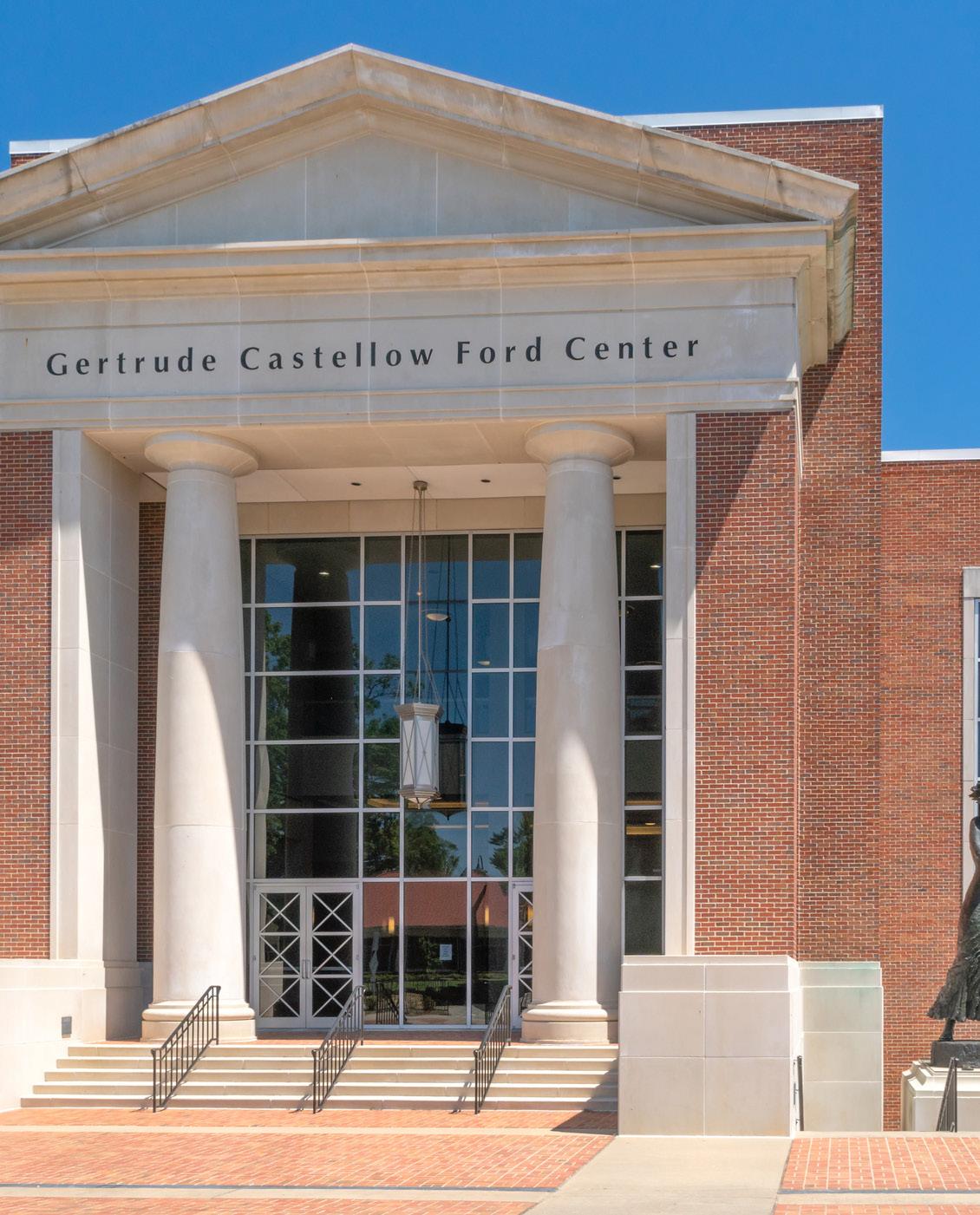
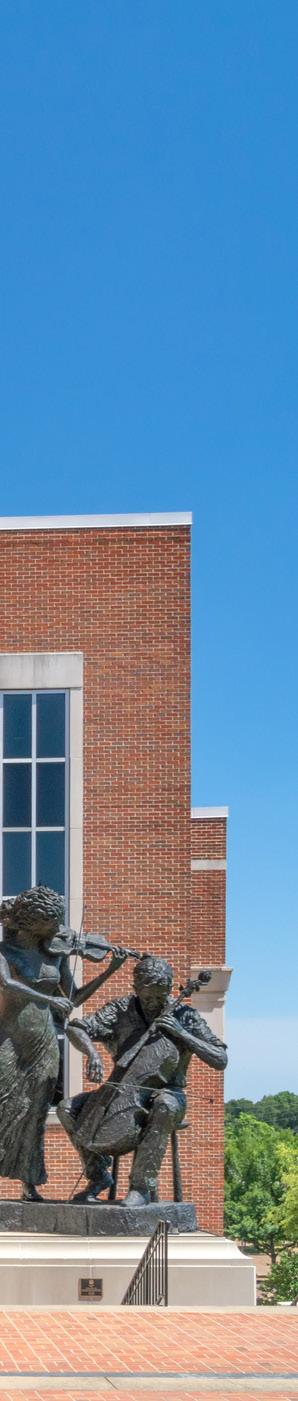
When the University of Mississippi faced aging infrastructure and unsustainable utility costs, it chose a bold strategy: prioritize Life Cycle Cost Analysis over traditional first-cost purchasing. Thanks to Mississippi’s Energy Efficiency Services legislation (§31-7-14), Ole Miss was empowered to select a visionary partner who prioritized long-term value over short-term savings—reshaping the campus both economically and sustainably.
The multi-phase ESPC program (Energy Savings Performance Contract) with Trane Energy Services is affording the university a path to make upgrades across campus in a strategic manner, while leveraging energy savings, utility incentives from TVA (the Tennessee Valley Authority) and potentially Investment Tax Credits available through the Inflation Reduction Act.
Why Life Cycle Cost Analysis Matters
Traditional procurement prioritizes the lowest bid, ignoring the full spectrum of ongoing costs—energy, maintenance, replacement, and productivity loss. Ole Miss broke from this pattern after years of frustration with underperforming systems and fleeting vendor relationships. Instead, they adopted LCC Analysis, which has become the guiding principle behind most infrastructure decisions on the existing campus.
“We had to shift our mindset,” said Dean Hansen, Associate Vice Chancellor for Facilities Management. “The true cost of ownership became our north star.”
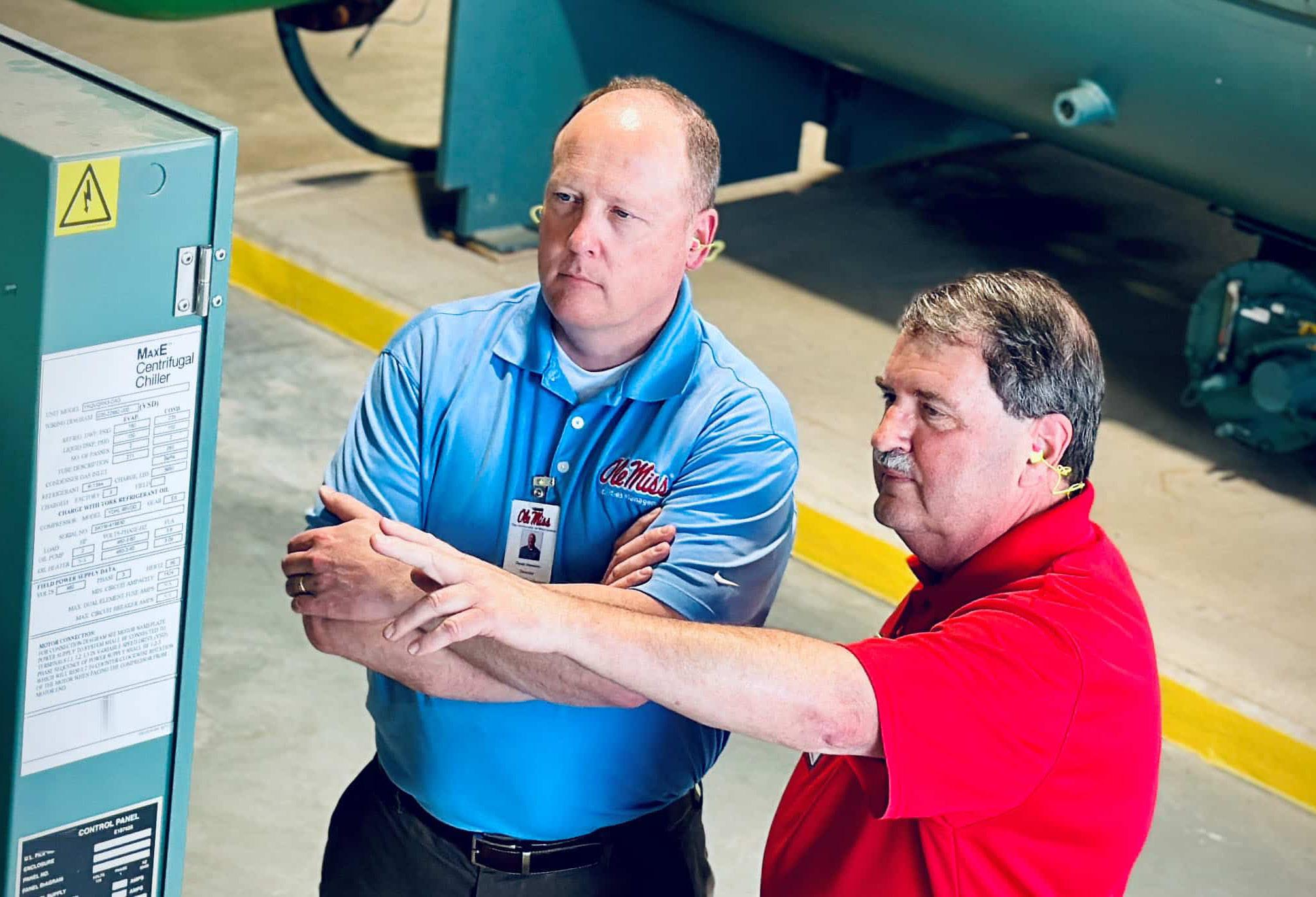
A perfect illustration: the design of a 3,000-ton chilled water plant. Rather than selecting the lowest bidder, the university invested in ultra high-efficiency equipment that would deliver decades of performance and energy savings—minimizing operational disruptions and environmental impact over time.
Life Cycle Value Realized Breakdown Across ESPC
Phases
Each of the five phases to date in the university’s ESPC journey was shaped by decisions rooted in life cycle economics and what is best for the university long-term. Here’s how...
Phase 1: Building Controls Upgrades
Scope: Replacement of old pneumatic controls with centralized automation systems for climate, and occupancy controls – Library, Faser & Natural Products Buildings Contract: $5.9 million
Annual guaranteed energy savings: $98,000 (averaged over the 20-year term)
LCC Impact:
· Selected premium-grade controls with open BACnet architecture for future scalability and standardization on the Ole Miss Automated Logic Campus-standard
· Reduction in technician hours and maintenance costs through standardization
· Reduction in material cost due to standardization
· 20-Year value: $1.46 million in avoided energy and repair costs
Phase 2: LED Lighting Upgrades Across 93 E & G Buildings
Scope: Retrofit of existing lighting to high-efficiency LED fixtures
Contract: $9.9 million
Annual guaranteed energy savings: $810,742 (averaged over the 20-year term)
Annual material cost savings: $215,628/year (averaged over the 20-year term)
LCC Impact:
· Chose LEDs with extended warranties and rated lifespans 4x longer than fluorescents
· Reduced lighting energy use by more than 60%
· Drastically reduced labor costs tied to frequent bulb replacements
· 20-Year Value: $13.8 million in combined utility and material savings
Phase 3: High-Efficiency Central Plant Equipment
Scope: Upgraded mechanical systems for chilled water distribution
Contract: $1.9 million
LCC Impact:
· Worked with design engineer to select the highest efficiency chillers possible
· Avoided costly overhauls of aging chillers by investing in future-ready systems
· Reduced failure risk and emergency repair spending
· Lowered kWh usage per ton of cooling
· 20-Year Value: $1.9 million in capital avoidance and efficiency gains
Phase 4: Ford Theater LED Lighting Upgrades
Scope: Modernization of stage and facility lighting in performance venues
Contract: $350,000
LCC Impact:
· Transitioned to programmable LED rigs requiring minimal cooling and less energy
· Avoided full rewiring costs due to adaptive design
· 20-Year Value: $300,000 in avoided capital expenses and utility savings
Phase 5: HVAC Upgrades and Building Automation Installations
Scope: HVAC Upgrades and Building Automation Installations
Contract: ~$10 million
Annual guaranteed energy savings: $583,000 (averaged over the 20-year term)
Annual material cost savings: $139,000/year (averaged over the 20-year term)
LCC Impact:
· Installation of modular HVAC systems with lifecycle-based replacement planning
· Fully automated control systems tied to the campus standard Automated Logic System
· Enhanced occupant comfort, reducing productivity loss in classrooms
· 20-Year Value: $10.58 million in verified energy and operational savings
“The journey toward long-term infrastructure resilience doesn’t end with the current ESPC phase.”
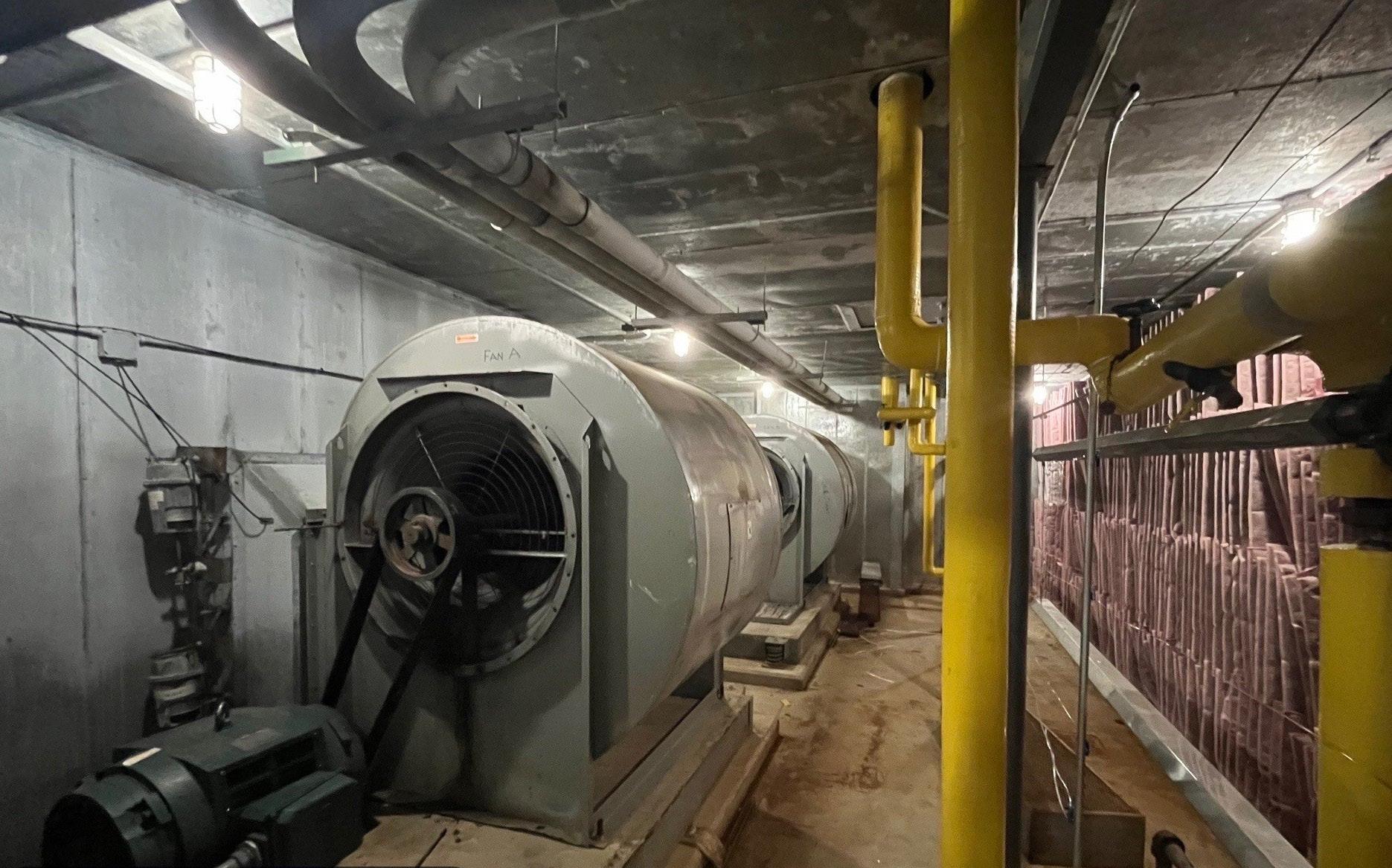
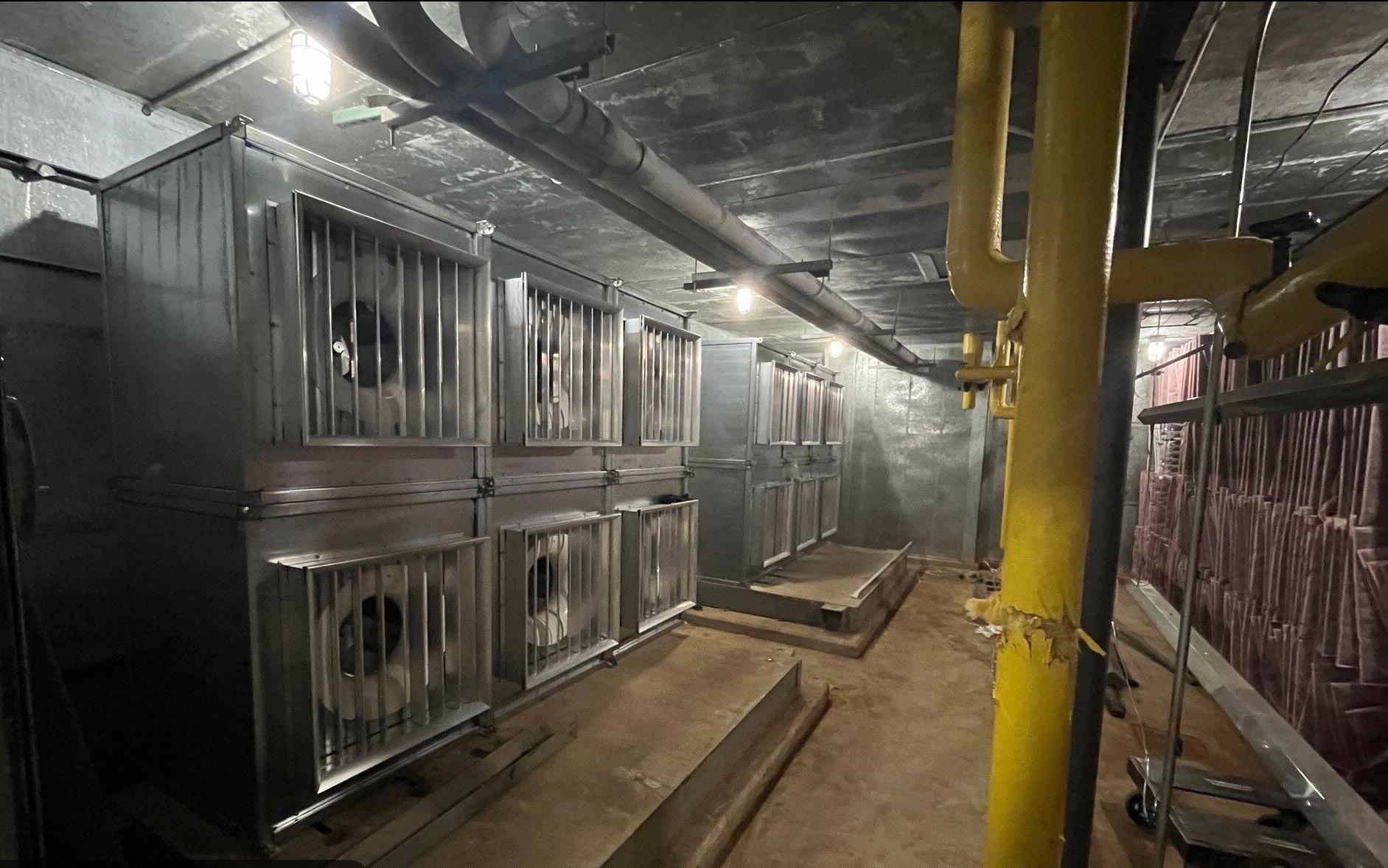
Before March 26, 2025
Looking Ahead to Future Phases Informed
by Investment Grade Audit Results
The University of Mississippi’s journey toward long-term infrastructure resilience doesn’t end with the current ESPC phase. In fact, the foundation for future upgrades is already being laid through the comprehensive Investment Grade Audit (IGA) that was completed by the university’s ESCO partner earlier this year. The IGA is an ASHRAE (American Society of Heating, Refrigerating and Air Conditioning Engineers) Level III Audit, which is a deep-dive analysis of campus-wide energy usage, system performance, and deferred maintenance.
The IGA serves as a strategic blueprint, identifying high-impact opportunities for future phases based on life cycle economics. Rather than reacting to aging systems or budget cycles, Ole Miss is proactively assembling a roadmap that aligns capital investments with long-term value.
What the IGA Enables
• Data-Driven Prioritization: Systems are ranked not just by age or condition, but by total cost of ownership and ROI potential.
• Bundled Efficiency Strategies: Opportunities are grouped to maximize operational synergies and minimize disruption.
• Deferred Maintenance Mitigation: High-risk assets are flagged for early intervention, reducing emergency repair costs.
• Scalable Design Planning: Future phases are structured to accommodate growth, evolving technologies, and campus needs.
“The IGA gives us clarity,” said Hansen. “It’s not just about what’s broken—it’s about what’s costing us the most over time.”
Potential Future Phase Concepts
• Campus-Wide Boiler Replacements: Replacing old hot water boilers with new high-efficiency condensing boilers
• HVAC Upgrades: Miscellaneous HVAC upgrades, retrofits and modifications across campus
• Controls Upgrades: Continuation of replacing old pneumatic control systems and other antiquated systems with new DDC controls – tied to the campus standard ALC system
• Refrigerant Modernization: Analysis across campus of old legacy R-22 systems for potential upgrades to new refrigerant technologies
• Renewable Energy Integration: Evaluating solar PV and battery storage options based on LCC and grid impact.
Each of these future phases will be evaluated through the lens of life cycle cost—ensuring that every dollar spent delivers measurable, enduring value.
Student Capstone Projects Aligned with IGA Scopes
One of the most innovative aspects of the University of Mississippi’s infrastructure modernization strategy is its integration with academic programming—specifically through student capstone projects with the school of engineering. This handson collaboration bridges the gap between classroom theory and real-world application, giving students direct exposure to the complexities of energy systems, sustainability planning, and life cycle cost analysis.
Team members from Ole Miss Facilities Management and their Energy Services partnerTrane have been working closely with groups of mechanical engineering students since the inception of their ESPC program. To date, 22 Ole Miss students have been executed Capstone Projects that are components of the Trane / Ole Miss ESPC Program, and 10 students have been hired upon graduation by Trane.
In 2023, a group of students assessed the potential of replacing a large Air Handling Unit’s fan with a Fan Wall Array. This project was completed in the Fall of 2025.
Following the success of student involvement in Phases 1–5, the university is expanding this model to future scopes identified in the Investment Grade Audit (IGA). These scopes will serve as the foundation for multidisciplinary capstone projects across engineering, environmental science, business, and public policy programs.
How It Works
• Real Data, Real Decisions: Students analyze actual IGA findings, including energy usage profiles, deferred maintenance logs, and system performance metrics.
• LCC-Focused Evaluations: Projects emphasize life cycle cost modeling, comparing alternatives based on long-term value rather than first cost.
• Cross-Functional Collaboration: Teams work alongside facilities staff, energy consultants, and academic advisors to develop actionable recommendations.
• Presentation to Stakeholders: Final deliverables are shared with university leadership, influencing future ESPC phase design and prioritization.
“Our students aren’t just learning—they’re contributing,” said Hansen. “Their work has shaped real decisions on this campus.”
Examples of Capstone Project Themes
• Optimization strategies for needed HVAC upgrades
• Comparative LCC analysis of Solar PV vs. traditional grid upgrades
• Building envelope retrofits and their impact on HVAC load profiles
• Demand-response automation protocols for peak shaving
This approach not only enhances the educational experience—it cultivates a pipeline of futureready professionals who understand the strategic importance of life cycle economics in infrastructure planning.
Planning for the Next 20 Years
The University of Mississippi’s commitment to Life Cycle Cost Analysis transformed their infrastructure planning from reactive to proactive. Instead of chasing short-term savings, they are making strategic investments that pay dividends across generations of students and faculty.
The lesson? Life Cycle Costing isn’t just a financial technique—it is a mindset. One that builds resilience, fosters sustainability, and makes institutions futureready. ■
Dean Hansen, P.E. is the Assistant Vice Chancellor and Chief Facilities Officer at the University of Mississippi Mike Dunnavant is the Director of Facility Services at the University of Mississippi
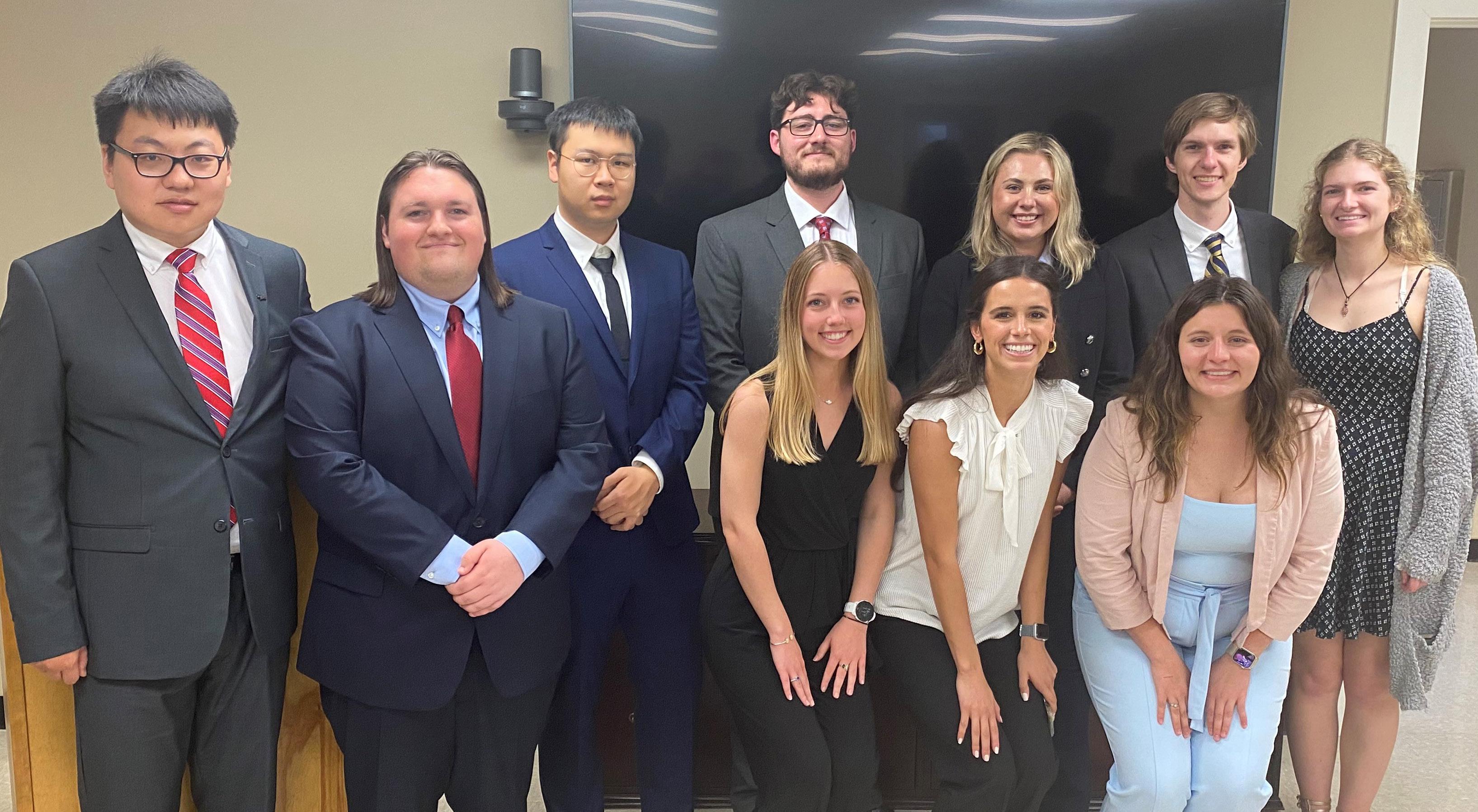
Analyze. Compare. Improve. FPI
APPAʼs Facilities Performance Indicators (FPI) program empowers educational institutions with trusted benchmarking tools to evaluate facility operations, performance, and spending.
Access Detailed, Customizable Reports with Benchmarking Data By
✅ Region and climate zone
✅ Carnegie Classification
✅ Enrollment size
✅ Energy sources
✅ Staffing levels across custodial, grounds, maintenance, and more
Why Participate in FPI?
Access decades of comprehensive facilities data
Benchmark your performance against peer institutions
Pricing
APPA Institutional Members (Participants)
Access: Non-anonymized Price: Free
Gain insights on costs, staffing, energy use, and space utilization
Drive strategic decisions with evidence-based insights
APPA Institutional Members
Access: Anonymized Price: $2,000
The Annual Benchmarking Process
Non-Member Institutions
Access: Anonymized Price: $5,000
Business Partners
Access: Anonymized Price: $10,000
✅ Bronze: 10% ($9,000)
✅ Silver: 15% ($8,500)
✅ Gold: 20% ($8,000)
✅ Platinum: 25% ($7,500)




August–October
Data collected from institutions





November Review and outlier identification
To purchase reports email: analytics@appa.org Learn more about FPI at www.appa.org/analytics/fpi/


December–January Participant follow-up and clarification
February–March Report released to participants
ACTION ITEMS TO WIN THE AI RACE
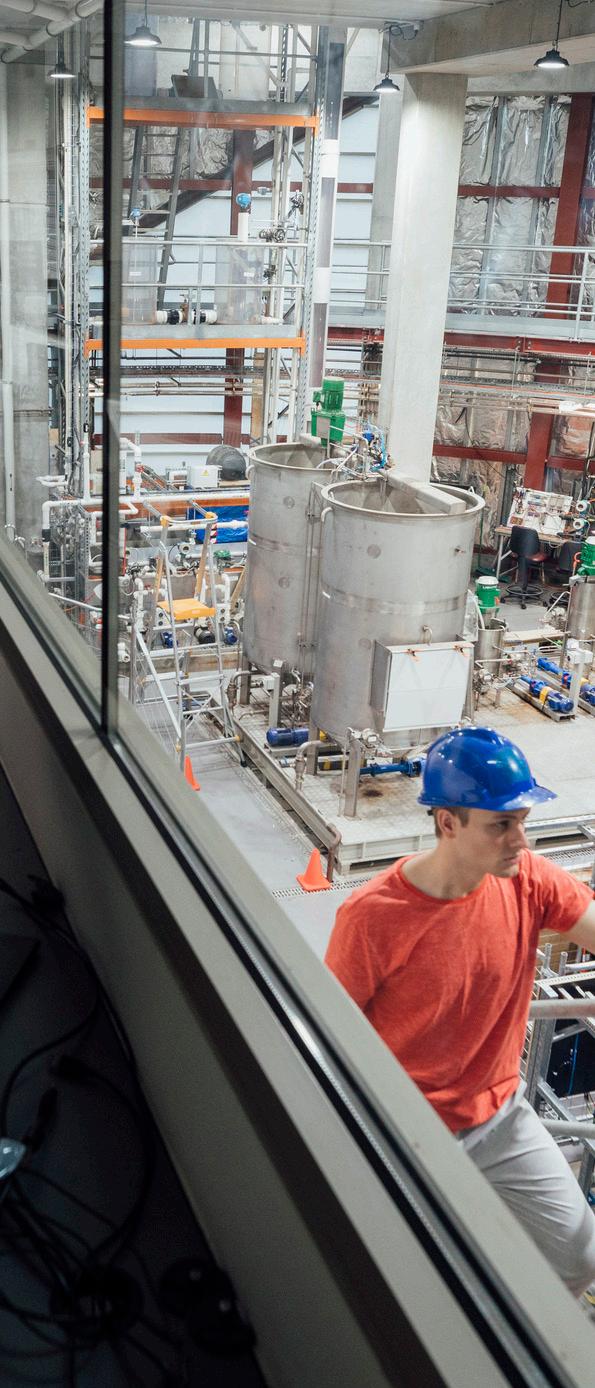
What Physical Plant Administrators must do to support America’s AI Action Plan
By Sid Thatham
The need for rapid development of Artificial Intelligence (AI) in the US has dramatically increased the demand for reliable energy on a large scale in the next few years. A significant portion of the American utilities industry workforce is nearing retirement. Power engineering programs across the country have been in decline for a long time. To train the next generation of the utilities-workforce, there are gaps in the academic pipeline that need to be addressed. This list of converging, time-sensitive, issues open the door for collaboration between physical plant administrators and the academia to expand the country’s talent pipeline in the energy sector and support the goals of America’s AI Action Plan (Action Plan).
Energy Needs
The widespread public availability of generalpurpose AI has led to the development of White House’s Action Plan, which was released on July 23rd, 2025. Anthropic’s Build in America (BIA) was also released on the same day. Both documents highlight the important role of AI in shaping the future of America’s global influence and emphasize a strategic call to action to address the challenges, especially with respect to data centers and the increase in demand for energy in the country, to stay globally competitive.
In 2024, the U.S. generated 4,387.26 TWh of electricity, up by 65% since 1985 (2,657.15 TWh). In comparison, China’s power generation went up 410.69 TWh in 1985 to 10,072.60 TWh in 2024, a staggering +2,353% relative change. [1] At present, the US and China are the top
Electricity Generation
Total electricity generated in each country or region, measured in terawatt-hours.
two contenders in the race to AI dominance and China’s energy infrastructure is seemingly well in place to support major strides in scaling up its AI development. The relatively stagnant US energy capacity [2] needs to change and will require at least 50GW by 2028 for similar strides in AI, the majority of which will be necessary to train frontier models. [3] Therefore, substantial investments, especially in the energy sector and workforce development, are imperative. While industry experts and policy makers focus on grid modernization, transmission, and energy-supplychain challenges, this presents an opportunity to various physical plant administrators and educational facilities across the US to recognize this emerging national priority and proactively support the cause by advancing workforce development.
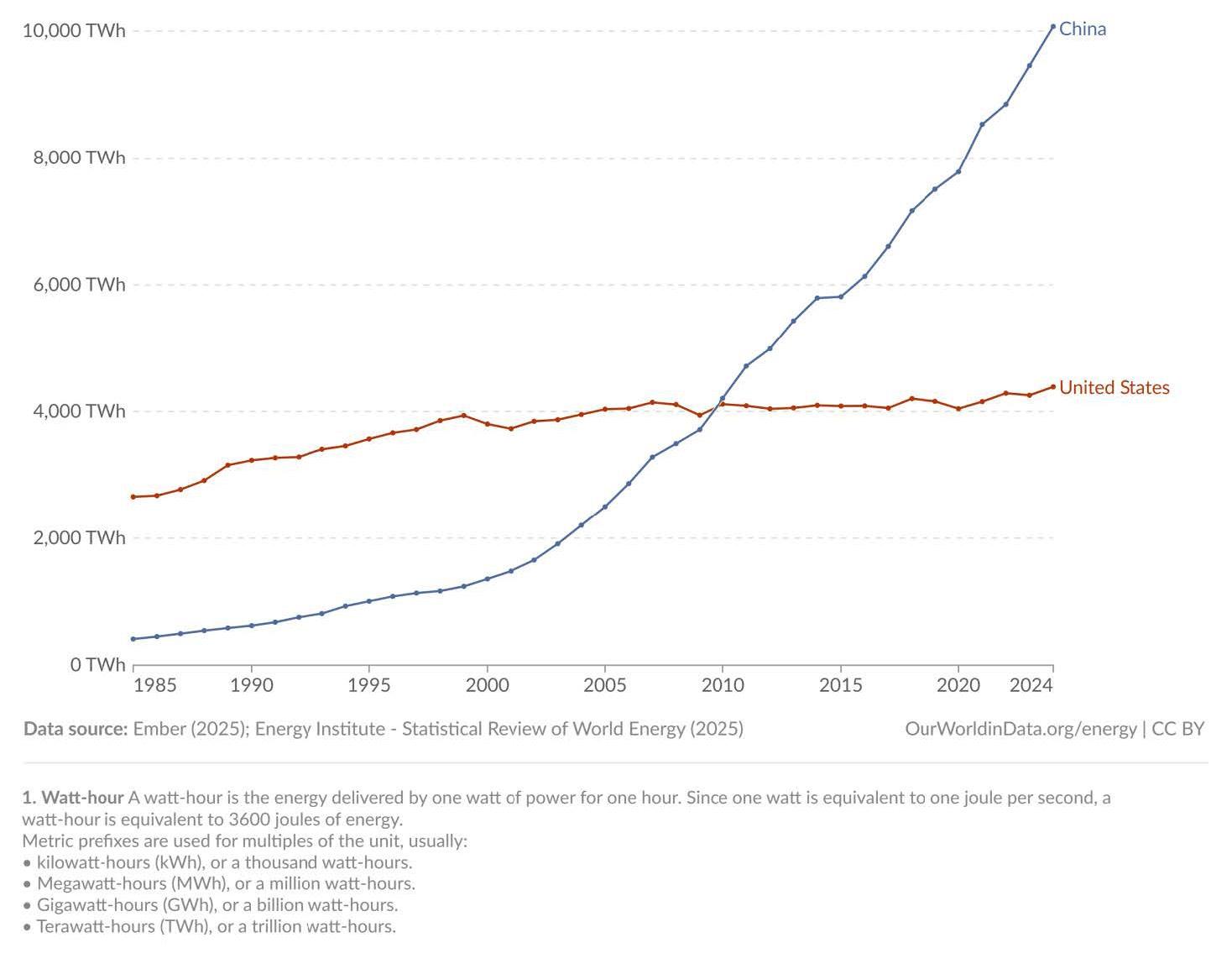
Looming Workforce Crisis
A significant portion of the PJM generation capacity is at the risk of retirement. Capacity costs and therefore, costs passed on to the customers skyrocketed from $2.2 Billion to $14.7 Billion in a single year. [4] MISO electricity demand is projected to grow by 2.2% each year over the next five years. [5] ERCOT may have to plan for new interconnection load up to 70.5 GW by 2028. [6] It is estimated that up to 10% of the electricity in California could be consumed by data centers. [7]
Changes to policies, regulations, and technological advancements are only a part of the solution because skilled human expertise will still be necessary to run the power plants and maintain the grid. White House’s Action Plan says that in addition to algorithms, models and data centers, global competitiveness in the field of AI will need a skilled workforce that builds, operates and maintains the energy infrastructure, for which there is a shortage. [2]
The success of the ambitious plans to expand the energy infrastructure depends heavily on a workforce that is facing a steep decline. Due to a shortage of skills, non-retirement job turnover continues to remain high. [8] It is estimated that nearly half of the utilities workforce will retire within the next decade. [9] An assessment of the utilities industry by the Department of Energy (DOE) found that 25% of employees may retire within five years. [9] Other research also states that over 50% of the utilities industry is 45 years old or older, over 67% is over 40. The age of an average power plant worker is ~ 46 and only 4% are aged between 20-30. [10][11] The significant increase in demand for power, the need for new energy infrastructure, along with the looming exodus of skilled workers and loss of institutional knowledge poses a major threat to energy reliability in the US, and therefore, potentially a threat to American leadership in the field of AI.
Opportunity
While STEM education continues to face various challenges in the US, the DOE reported that Power Engineering programs have experienced a steady decline and retiring faculty experts have not been replaced. In 2009, the “Preparing the U.S. Foundation for Future Electric Energy Systems: A Strong Power and Engineering Workforce” Report
included an action plan to address this issue, but most reports to conclude that these programs need investment. [12] This presents a powerful opportunity for educational institutions with district energy systems to reposition utility operations as an important career path and in creating a pipeline for preparing the next generation of the workforce critical to America’s future in energy and AI.
Collaborative Work
It is not uncommon for power plants and facilities on campus to operate in isolation from academic programs, perhaps due to operational reasons, understaffing, and various other reasons. Such facilities may not be expected by the institutions to actively engage in teaching and learning.
Step one in supporting workforce development is for the leadership at educational institutions to recognize that there is pedagogical value in collaborating with campus utilities and facilities beyond a one-off plant tour. Such energy systems offer opportunities for teaching and learning complex, real-world energy operations that hourlong tours, simulations and in-class instruction cannot offer in a familiar and supportive environment of one’s own educational setting.
Formal Education and Training
Plant operators and engineers have real-world, “industry” expertise that complements theoretical knowledge. Institutions must encourage a collaborative development of curriculum / course design for semester long courses that cover everything that the plants have to offer at a very minimum. This may bridge the gap between learning about Chillers, Boilers and Turbines in a classroom and knowing how they operate in real life. Such courses are more likely to provide a more grounded understanding of energy systems that will help them have more realistic expectations of complex topics such as energy transition.
Formal college courses may require support from administration, a flexible course design and an understanding that faculty and power plant personnel will have to dedicate time and effort towards teaching a proper course which will have a significant payoff in the long run.
For instance, University of Cincinnati’s course, “Energy, Environment and Society”, educates
students from all disciplines about energy technologies, policies, and practices globally through debates, tours, presentations, etc. Faculty from the College of Engineering and Applied Sciences and personnel from the department of Utilities co-teach this course. A unique aspect is its study-abroad program in Scotland, where students compare international energy perspectives with domestic ones, gaining insights from various sectors. This course was recognized with an EcoChampion Award for “Most Creative Energy Project” of the year. Work is in progress to develop a course specific to plant operations at the university.
College courses for credit are only a part of the solution and collaborative work must also focus on pre-apprenticeship programs for early career exposure at middle and high-school levels that serve as points of entry into the facilities and energy operations workforce. Power plant operations, HVAC work, electrical roles and other skilled-trade work on American campuses, in coordination with community colleges, can serve as great places for hands-on learning,
real-world training and reduce barriers of entry. In addition to formal education and training, plant administrators and educational institutions must also strive to increase the visibility of these careers through participation in guest lectures and seminars, engagement through tours of the facilities. Mentorship, job shadowing, internships, summer research/student capstone projects are other ways to continue offering real-world insight.
The AI race presents some formidable challenges related to the energy infrastructure; but also presents a massive opportunity for American educational institutions, especially the ones with physical plants. By embracing strategic imperatives for workforce development, they can play a central role in shaping the energy industry in the US, upon which America’s leadership in AI can be built and sustained for years to come. ■
Sid Thatham is an Energy Engineer at the University of Cincinnati.
Our World in Data. (2025, June 27). Total electricity generation (Ember, 2025; Energy Institute - Statistical Review of World Energy, 2025) [Data visualization]. Retrieved July 25, 2025, from https://ourworldindata.org/grapher/electricity-generation?tab=line&country=CHN~USA&mapSelect=CHN~USA&tableSearch=China White House (2025, July 23) Winning the Race: America’s AI Action Plan. https://www.whitehouse.gov/wp-content/uploads/2025/07/Americas-AI-Action-Plan.pdf Anthropic. (2025, July 23). Build AI in America. https://www-cdn.anthropic.com/0dc382a2086f6a054eeb17e8a531bd9625b8e6e5.pdf
Thatham, S. (2025). Increased electric demand due to data center proliferation driven by artificial intelligence and cloud computing and its impact in the Pennsylvania-New Jersey-Maryland (PJM) region. International Journal of Energy Management, 7(3).
Howland, E. (2025, June 9). MISO resource outlook improves; surplus expected next summer. Utility Dive. https://www.utilitydive.com/news/oms-miso-resource-adequacy-survey-midcontinent/750140/
Electric Reliability Council of Texas. (2024, December 20). 2024 report on existing and potential electric system constraints and needs. https://www.ercot.com/files/ docs/2024/12/20/2024-report-on-existing-and-potential-electric-system-constraints-and-needs.pdf
Electric Program Investment Charge (EPIC). (2024). Demonstration of low-cost data center liquid cooling (Publication No. CEC-500-2024-061). California Energy Commission. Updated June 14, 2024.
Rocha, V. A. (2024, February 6). Survey: Energy sector job turnover remains high amid skills shortage. National Rural Electric Cooperative Association. https://www.cooperative.com/ news/Pages/Survey-Energy-Sector-Job-Turnover-Remains-High-Amid-Skills-Shortage.aspx
McAuliffe, G. (2022, June 22). Addressing the challenges presented by a retiring utility workforce. POWER Magazine. https://www.powermag.com/addressing-the-challenges-presented-by-a-retiring-utility-workforce/
U.S. Department of Energy, Quadrennial Energy Review (QER) Task Force report, second installment titled “Transforming the Nation’s Electricity System.” Chapter V: Electricity Workforce of the 21st-Century: Changing Needs and New Opportunities. January 2017. Zippia. (n.d.). Power plant operator demographics and statistics in the US. Zippia. Retrieved August 17, 2025, from https://www.zippia.com/power-plant-operator-jobs/demographics/ A. Grice, J. M. Peer and G. T. Morris, “Today’s aging workforce — Who will fill their shoes?,” 2011 64th Annual Conference for Protective Relay Engineers, College Station, TX, USA, 2011, pp. 483-491, doi: 10.1109/CPRE.2011.6035641

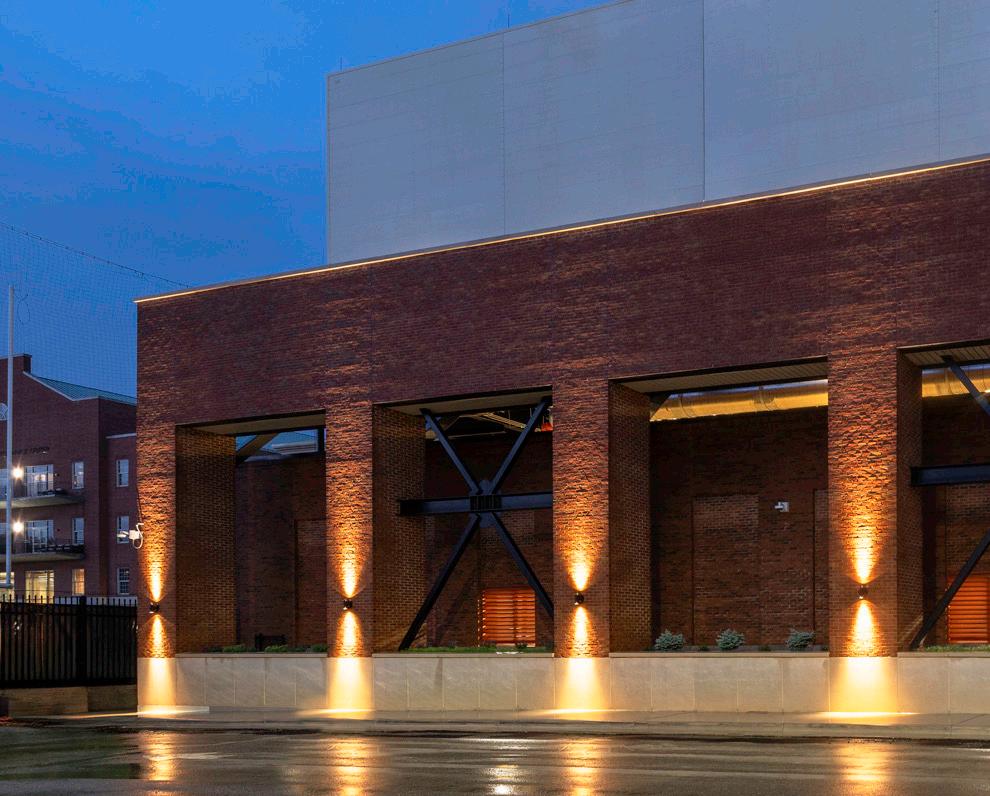
BUILDING UP OUT vs
OPTIMIZING CAMPUS UTILITIES WITHOUT COMPROMISING
BY CHASE DAVIS, JIMMY NIFONG & KEN MCDANIEL
The custom towers of the chiller plant sit on top of the new superstructure spanning over the existing plant, which is sheathed in brick to blend with nearby buildings.
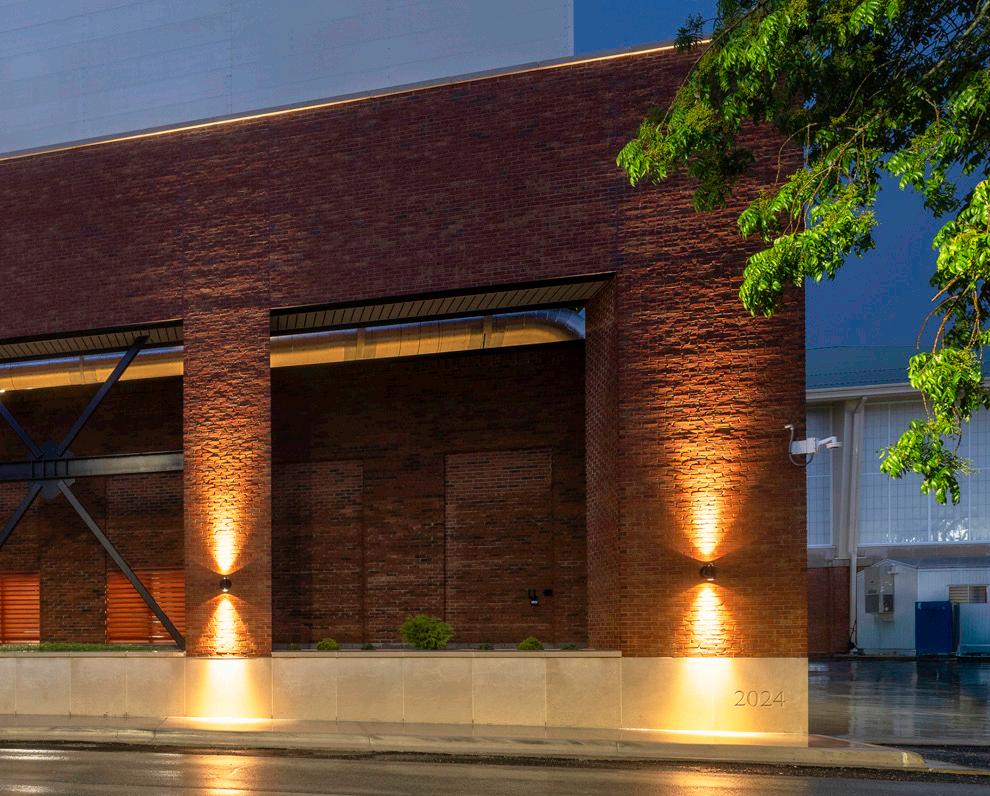
Wake Forest University (WFU), a private research university in Winston-Salem, North Carolina, relocated its campus from the town of Wake Forest nearly 70 years ago. Today, they operate a robust district chilled water system with two chiller plants, North Plant (2,400 tons) and South Plant (4,800 tons), that serve facilities housing more than 9,000 students and faculty.
When RMF Engineering was approached to upgrade WFU’s South Chiller Plant, goals
included minimal disruptions to campus services and the preservation of campus aesthetics. This led to an important step in the plant’s renovation: building vertically to free up real estate while expanding cooling capacity and bringing much-needed improvements in resiliency and efficiency for WFU’s main campus.
The project included the replacement of the two existing 600-ton chillers with two 1200-ton chillers which, with the two other
Peter Brentlinger
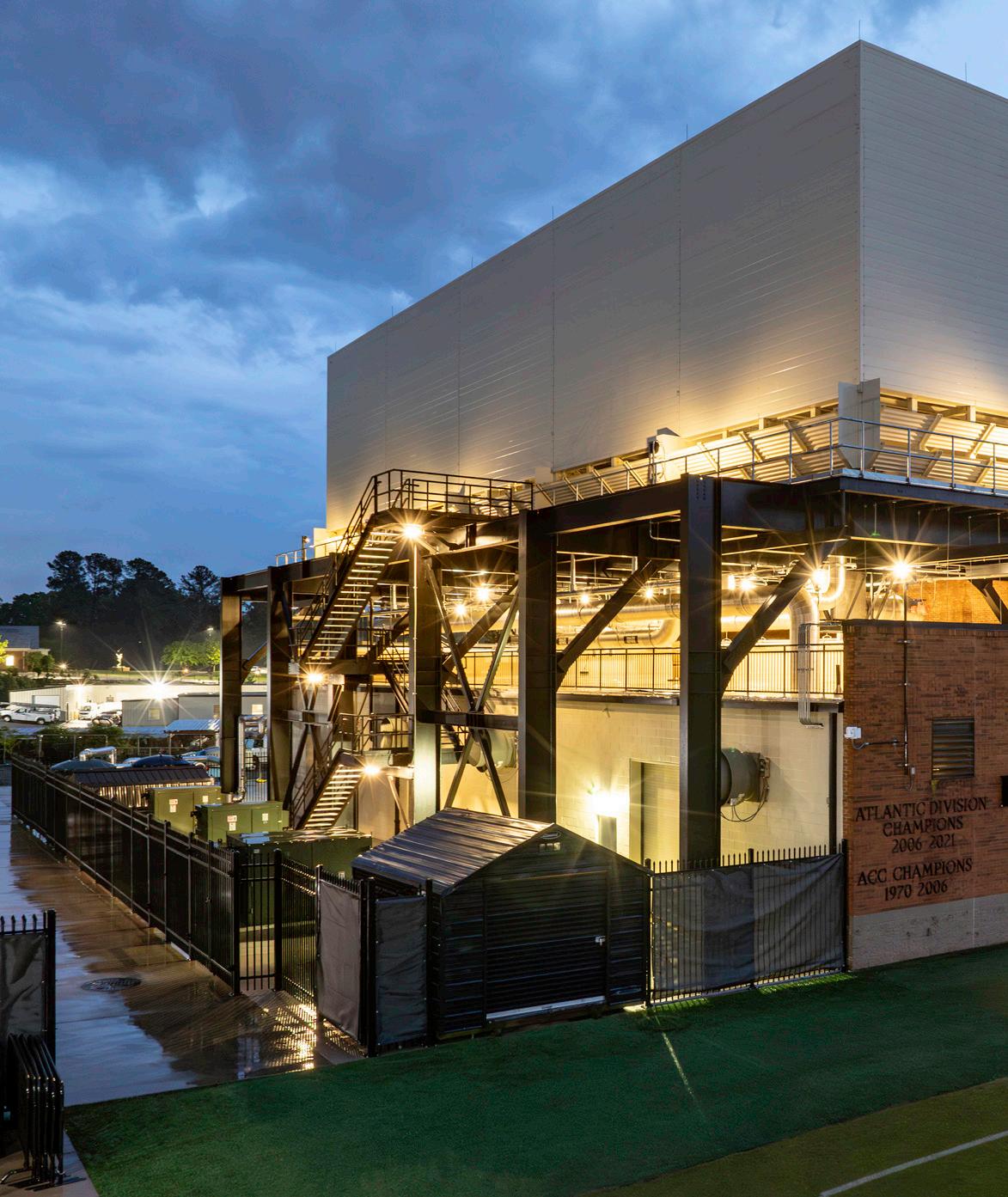
existing 1,200-ton chillers, increased the plant’s capacity by 33% from 3,600 to 4,800 total tons. The plant includes the four new custom towers, condenser water pumps, and piping, upgrading its operational capacity and efficiency to evolve alongside the growing student population. Due in part to the plant’s location, the towers were designed to sit on a new superstructure that spans over the existing plant. The superstructure is sheathed in brick to blend in with nearby buildings.
The plant represents a critical milestone in the University’s journey to optimize chilled water systems, which started in 2015. The plant had existing controls optimization in place through Optimum Energy but was limited in performance by the aging equipment. Alongside the completion of the North Plant renovation in 2019, the completion of the South Chiller Plant signals that WFU has now successfully upgraded and optimized their entire chilled water generation system. As of September 2025, WFU is already seeing a reduction of 0.2 kW/ ton (conservatively well over $100K per year in savings) during peak summer operation of the South Plant from the incorporation of the new variable speed chillers, variable flow condenser water, and custom towers with further reductions anticipated as the plant’s variable speed equipment enables further optimization through the off-peak season.
Building Up: The Decision to Go Vertical
The decision to go vertical was not originally a part of the plan. Placing the towers over top of the building with a steel superstructure was nearly the last of a dozen 3D modeled design concepts generated during the feasibility study, the benefits of which cannot be overstated. Once presented, however, it became clear this configuration addressed not only WFU’s operational needs, but provided added benefits for land space and aesthetics. This concept may not have come to fruition without the initial study, as an initial commitment to budget and
Attention to aesthetic detail was critical in successfully blending the utility plant with the new athletics facilities, executed seamlessly leveraging Michael Graves’s familiarity with the campus.
Peter Brentlinger
duration may have already been made and the pressure to not deviate could have prevented the plant we have today from becoming a reality.
The towers were originally planned for an area next to the plant building at ground level in the location of the existing towers, but there were concerns about the amount of space they would occupy in such an important area of campus for WFU’s expanding athletics programs. Additionally, the University had concerns about the duration their largest chiller plant would need to be offline. Utilizing insights from the feasibility study, the decision was ultimately made to shift the towers to above the existing building with a steel superstructure, which freed up land space for athletics or campus operations usage.
Each decision in the process, from planning to execution, was made with the intent of blending the plant to the campus while minimizing the chilled water system disruption, especially through the intensity of a Carolina summer. Naturally, these decisions came with cost and schedule implications, making it essential to engage the WFU team on each of the decisions, equipping them with the context and justification to sell the project to leadership. The prominence of the elevated equipment further made the case for custom built field-erected towers to mitigate impacts to the surrounding area such as aesthetics and noise control.
Uninterrupted Service Through Electrical Design
A key element of the project was the redesign of the entire plant power feed. The medium voltage switch and transformers needed to be upsized as a result of the capacity increase and relocated to a more concealed location. Additionally, the footings for the large superstructure columns were in the path of the duct bank to the plant, which required the medium voltage rework be the first phase of the project. As a result, the new
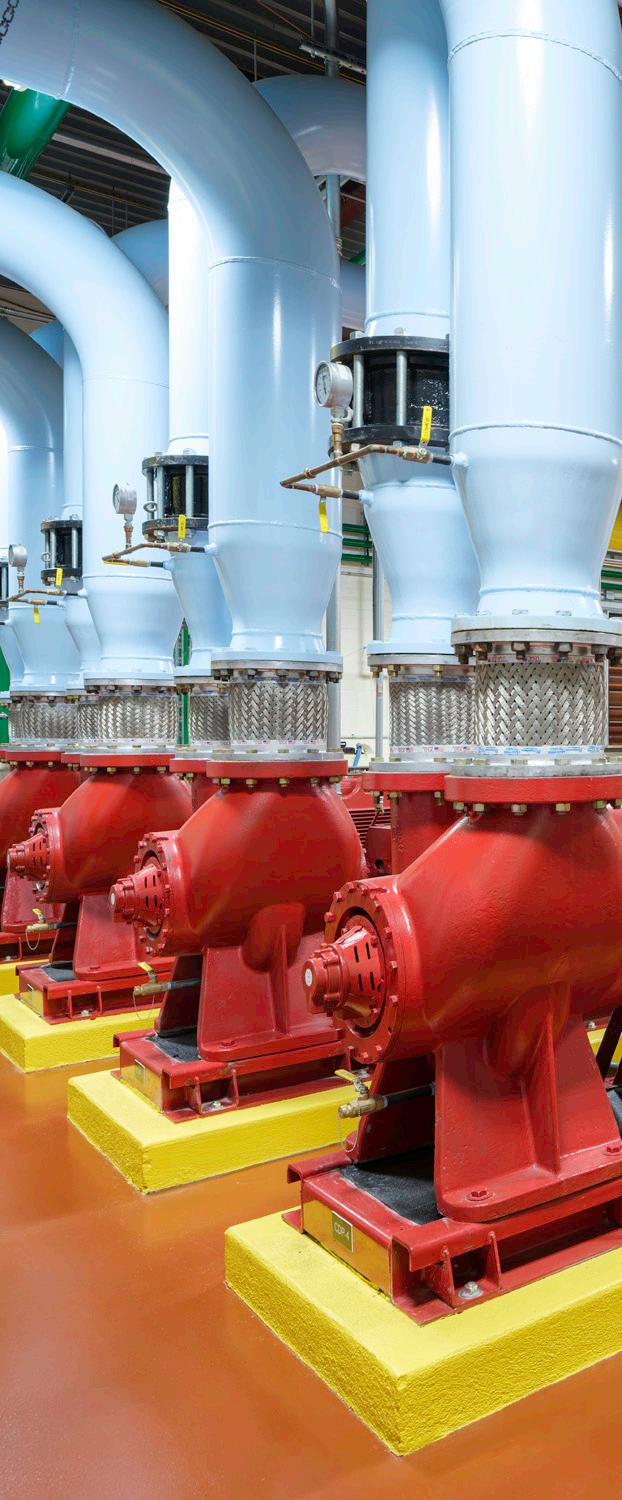
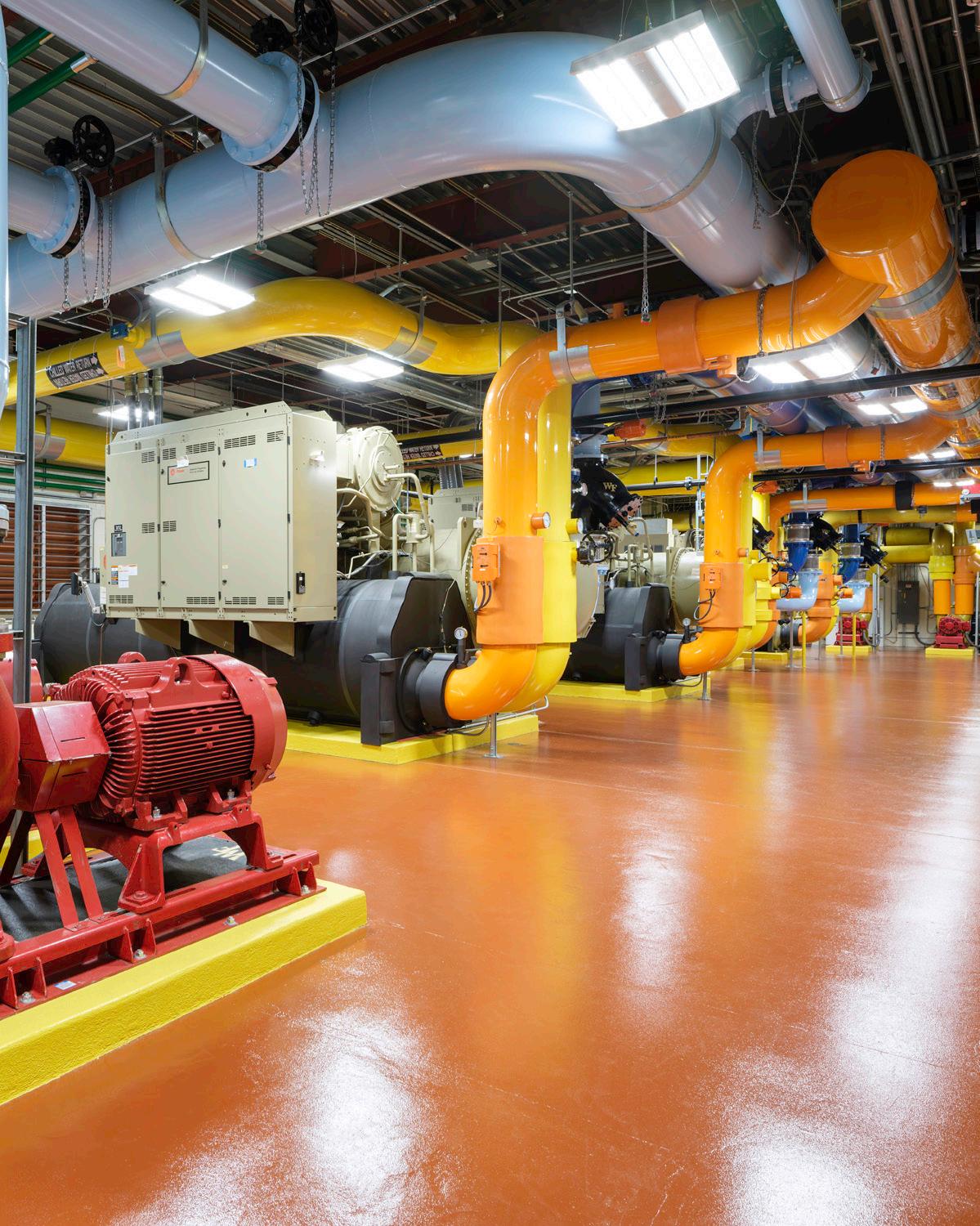
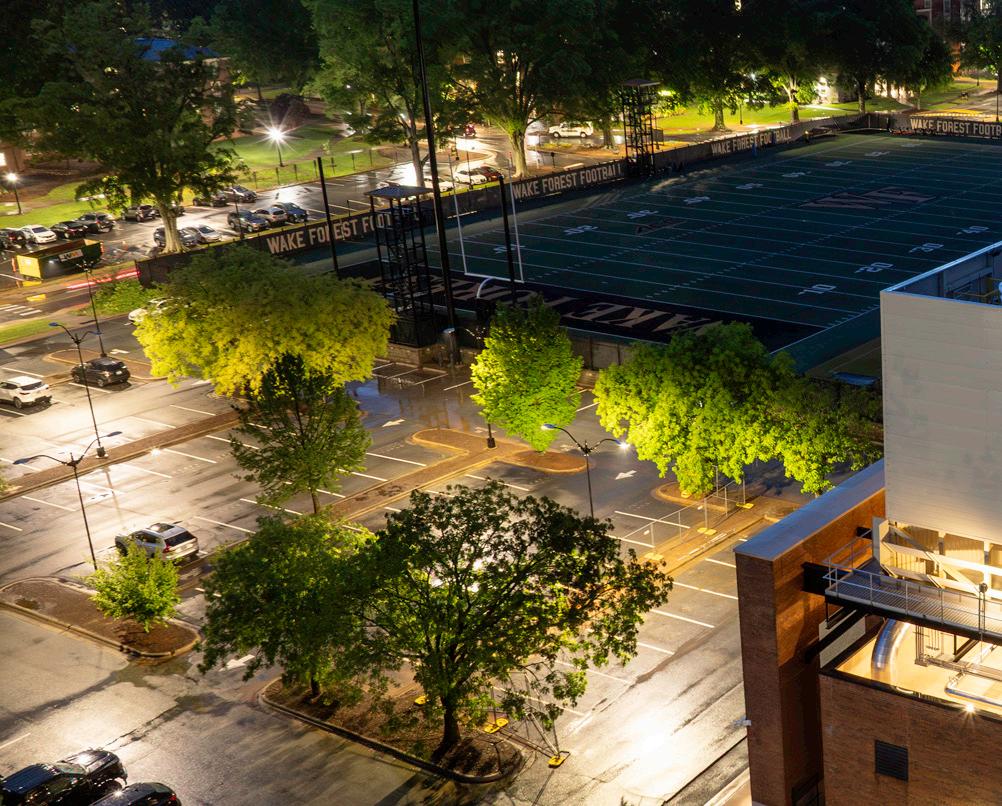
pad mounted switch and two 2,500 kVA transformers were the first items to be procured and installed.
Given the scale of operations and users on campus, emergency contingency planning was a central consideration of the engineering design approach, ensuring infrastructure was in place for little to no interruption to service under a variety of conditions. The plant is designed to still be at least partially operational even if one of its two 2,500 KV transformers goes offline, maintaining 2,400 tons of cooling to the campus. The South Plant is the larger of the two plants located on WFU’s campus,
underscoring its importance especially during peak summertime electric and cooling times. The North Plant features 2,400 tons but can only carry the campus for about half the year.
Partnering with the Designer for Maximum Look & Efficiency
RMF worked closely alongside Michael Graves to integrate the vertical tower into the aesthetic language of the campus, seamlessly blending the addition into campus sightlines through a thoughtful approach to architecture and materiality.
Through a thoughtful approach to architecture and materiality, the structure seamlessly blends into the design language and sightlines of campus.
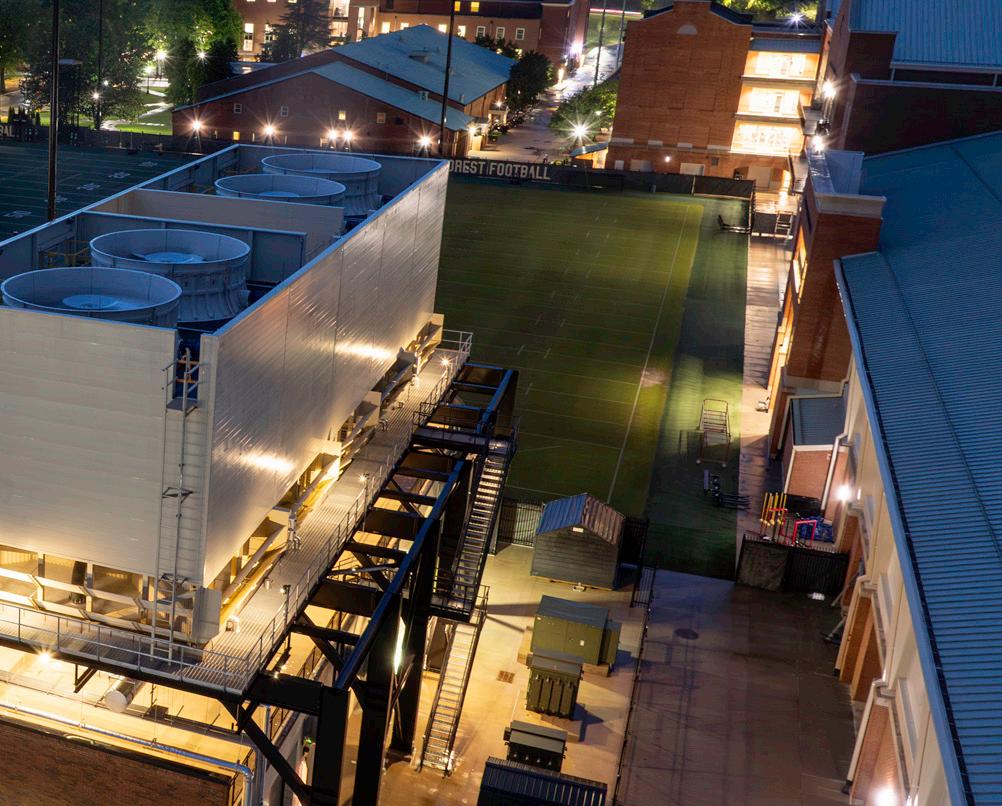
The vertical addition needed to free-span the existing chiller plant, allowing the existing facility to be maintained while creating an adequate platform for the proposed new infrastructure to be screened from view. Cladding the steel super-structure in traditional campus building materials was also necessary to give the addition an appropriate scale and context to the adjacent facilities. Michael Graves was selected primarily for their role in the adjacent athletic buildings, which they had designed and recently completed when work on the plant began. It was clear that attention to aesthetic detail would be critical in successfully blending a utility
plant with the new athletics facilities, requiring a familiarity with the campus and its design language.
Structural coordination proved to be a significant challenge for the project. Though the engineering largely focused on mechanical-electrical, putting a sizable steel superstructure around and over the building in coordination with the cooling towers was a delicate balancing act that required considerable planning from the inception of the design through construction.
The location of each member required careful
Peter Brentlinger
coordination in both functionality and appearance. The large columns facing outward to campus had to be symmetrical and aligned with the key tower load point and equipment access paths. The 40-inch-deep horizontal beams needed to be high enough to allow access to large piping hidden from view under the tower but also avoid a noticeable gap between the existing building and new structure. When cross bracing was needed between the columns, RMF’s in-house structural engineering team worked with Michael Graves to incorporate the look into the design, which added further character to the building.
Then there was the issue of the tower itself: blending a 110ft x 25ft x 40ft piece of mechanical equipment into the architectural context of the campus. This is where the benefits of a custom tower become apparent, as the design team was able to make every decision with intention, including the piping connections, enclosed access stairs, and air intake louver design. The use of fiberglass reinforced polymer (FRP) in the tower materials enabled the selection of custom colors, and the selected color was a precise match to the adjacent building. The front side of the towers were outfitted with an ultra-smooth, flat finish to facilitate eventual use as a billboard to display custom branded graphics. Finally, a detailed rendering was created which served as a useful tool for executive leadership communication as well as provided a vision for everyone on the construction team to follow as it was posted throughout the team trailer.
Since its completion, the changes to the plant have been well received by the WFU community, demonstrating the importance of close collaboration between engineering and architecture visions to deliver infrastructure improvements that are not only operationally efficient, but visually cohesive with the design language of its environment.
Takeaways and Insights
Planning for WFU’s chilled water modernization journey began in 2019, and the South Plant cooling tower replacement represents an important milestone for the long-term initiative. Through each phase of the project, the highly integrated team remained rooted in WFU’s commitment to resilience, efficiency and campus impact, and the need for addressing both functionality and
aesthetics in the final approach. The upfront concept development was especially important, as it allowed the facilities team at WFU to establish a clear vision that could not have been conceived if the project only proposed funding on a replacein-kind basis. The commitment to this vision was made even more apparent as the post-COVID supply chain issues challenged construction schedules and budgets.
This process included the engagement of WFU’s primary chiller plant operator, who was involved from the onset, providing a firsthand operations perspective that influenced the design. These professionals, who will work with the equipment every day for years to come, have the ability to think ahead, understanding what’s plausible for
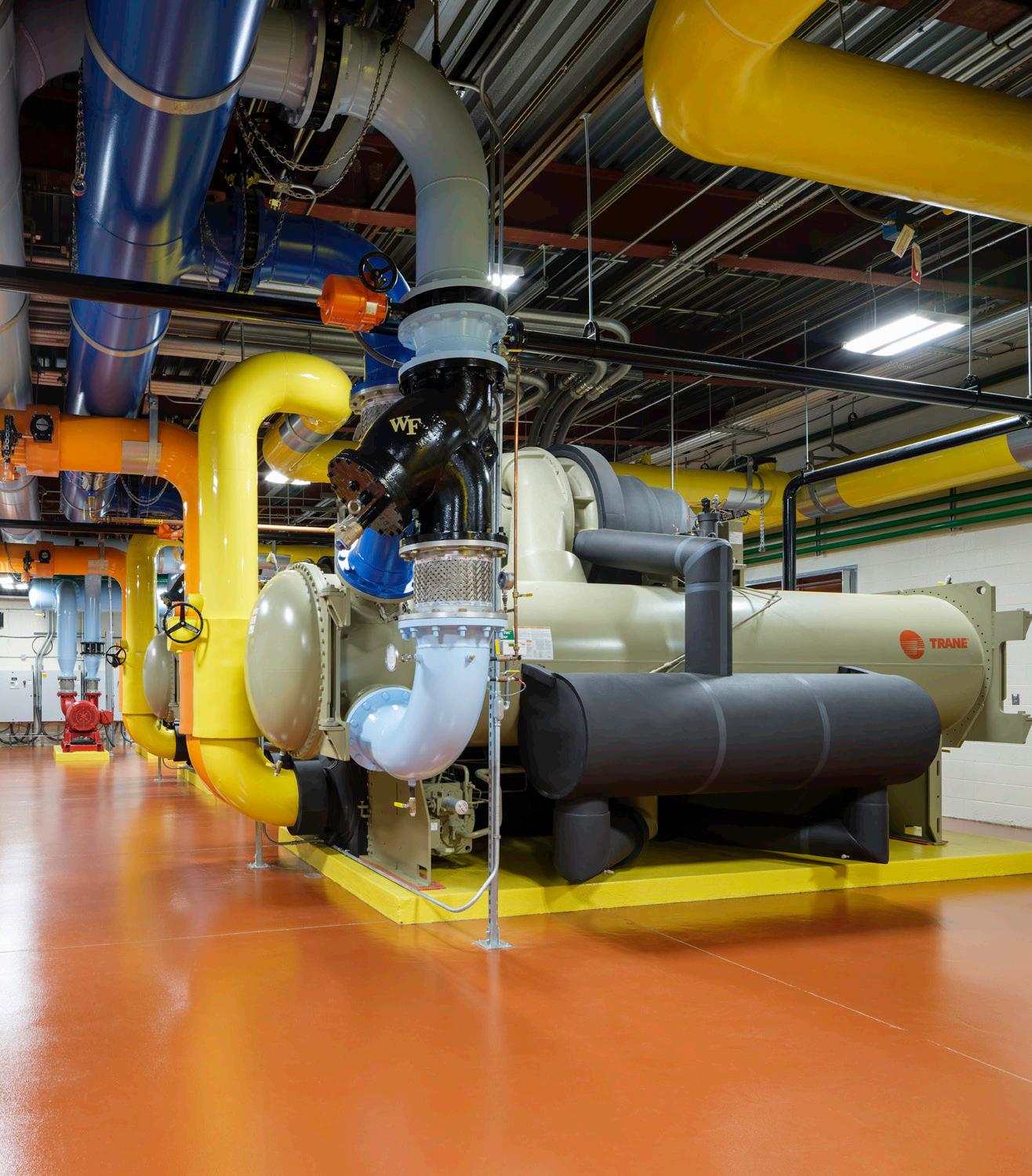
application, maintenance, and evolution.
The mechanical and electrical expansion of WFU’s South Chiller Plant presents a compelling case that emphasizes the importance of advanced planning and collaboration between engineering teams and all other project partners, from architects and designers to university operations personnel. Through a deep understanding of each component’s impact and operations, the project successfully meets the intersectional needs of campus aesthetics, power, and maintenance, facilitating not only its successful execution, but its longevity as a reliable resource for years to come.■
Chase Davis, PE, CEM, is a Mechanical Engineer and Project Manager at RMF Engineering.
Jimmy Nifong is Assistant Director of Utility Operations at Wake Forest University.
Ken McDaniel, AIA, Principal at Michael Graves Architecture.
FAST-TRACKING the
FUTURE
Scalable Engineering Solutions for Higher Education Campuses
BY JOHNATHAN WOODSIDE & PAUL GREEN
As colleges and universities strive to modernize their campuses, they face an intricate balancing act: upgrading aging infrastructure quickly and cost-effectively while maintaining the continuity of academic life. Fixed academic calendars, constrained budgets, growing enrollment, and deferred maintenance all place pressure on facilities to deliver high-performance environments that can adapt to new demands. In this context, engineering solutions must be not only technically sound but also agile, strategic, and scalable.
Today’s higher education environment increasingly demands facility upgrades that move at the pace of innovation. From phasing complex building system upgrades to reimagining the role of commissioning, engineering teams are finding new ways to help campuses modernize with minimal disruption and maximum long-term value.
Balancing Time, Budget, and Expectations
Higher education institutions across the country are contending with aging infrastructure under significant operational pressure. Decadesold mechanical and electrical systems are losing functionality, and many facilities operate with outdated controls, limited energy performance, and rising maintenance costs. At the same time, schools are being asked to compete for students and faculty with facilities that reflect modern standards for comfort, technology, and flexibility.
A major factor shaping every campus project is timing. The academic calendar dominates construction windows, often limiting major work to summers, winter breaks, or even weekend shutdowns. These compressed timelines leave little room for error, so engineering teams must deliver solutions that align closely with calendar constraints while accounting for

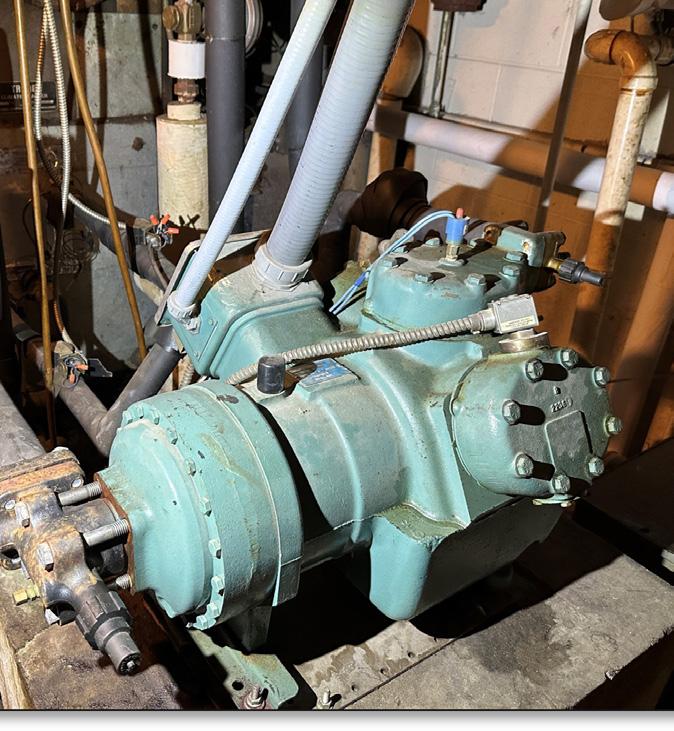

long equipment lead times, phased logistics, and evolving campus needs.
To meet these demands, scalable engineering strategies such as phased construction, prefabrication, and early procurement are becoming standard practice. Success hinges on tight collaboration between design teams, contractors, and facilities leadership, with a shared focus on speed, precision, and long-term impact.
Phasing Work Without Disrupting Learning
Phased implementation is a proven strategy in higher education facilities projects, enabling campuses to maintain operations while performing critical upgrades. Mechanical, electrical, and plumbing (MEP) system upgrades, often necessary but disruptive, benefit especially from this approach.
At Virginia Tech (VT), the Owens Hall chilled water loop had been expanded to serve multiple buildings, including dormitories and Owens Hall’s food services. As demand increased, some dorms began experiencing cooling shortfalls and a detailed system assessment revealed that over-pumping in newer buildings was reducing flow to others. By rebalancing the pumping strategy and optimizing controls based on return water temperature, the engineering team restored performance without
disrupting facility use or the need to add another chiller.
At Middle Tennessee State University (MTSU), construction is carefully phased around academic breaks, minimizing operational impact and optimizing contractor efficiency. Major efforts like the Central Energy Plant and Campus Utilities Upgrades are scheduled for summer and winter, when buildings are least occupied. Heating systems are addressed during summer and cooling systems during winter, allowing for temporary shutdowns with minimal impact on student comfort and safety.
Other institutions have adopted similar approaches, timing chilled water or mechanical upgrades during low-demand months or academic breaks. Chilled water systems might be replaced in winter, or noisy air handling unit installations could be scheduled during semester breaks. When thoughtfully structured, phased work offers a path to modernization without forcing building shutdowns or altering class schedules.
Designing for Flexibility and Future Use
While budget and time constraints dominate planning conversations, adaptability remains a vital consideration in engineering decisions. Facility upgrades that account for future growth or system
expansion deliver long-term value, avoid redundant work, and support resiliency as campuses evolve.
At MTSU, system flexibility and accounting for future growth were critical goals. The engineering team collaborated closely with university staff and trade partners to optimize pump performance, introduce high-performance valves for easier maintenance, and build a scalable chilled water system. These improvements aligned with a 10-year master plan to support more than 60 new buildings on campus. They not only resolved current inefficiencies but also laid the groundwork for smooth and cost-effective expansions.
Even within the scope of a basic system replacement, opportunities often exist to lay the groundwork for smarter controls, load growth, or eventual use conversion. Creating options for future flexibility is especially critical in research and science buildings, where program needs can shift dramatically over time.
Campus engineers and their consultant partners are increasingly balancing short-term fixes with strategic decisions that support the institution’s broader master planning, sustainability targets, and lifecycle expectations.
Rethinking Commissioning as a Continuous Process
Commissioning has traditionally been viewed as a final step on an operational punch list completed near the end of construction. However, many institutions are reimagining commissioning as a performance-based approach that extends far beyond project completion.
Vanderbilt University treats commissioning as a strategic, ongoing process rather than a final checklist. Early engagement, contractor collaboration, and active owner participation ensure that performance goals are identified from the outset and are monitored well beyond occupancy. The result is lower energy use, fewer post-construction issues, and more informed facilities management.
By integrating commissioning early and emphasizing post-occupancy monitoring, campuses can reduce energy waste, improve system functionality, and enhance the daily experience of building occupants. For operations teams, it provides a deeper knowledge base and decision-making tool, minimizing downtime and unnecessary costs.
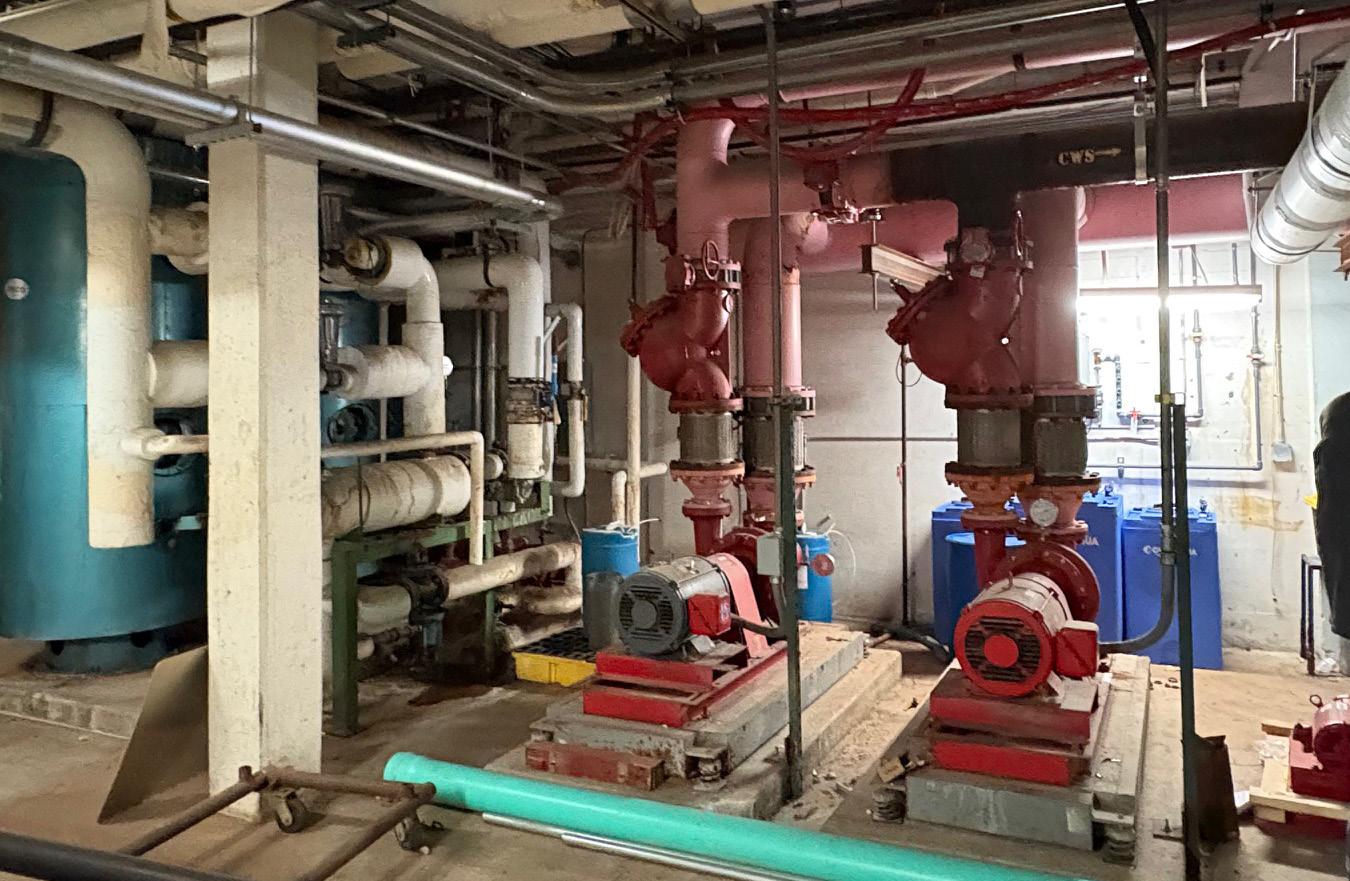
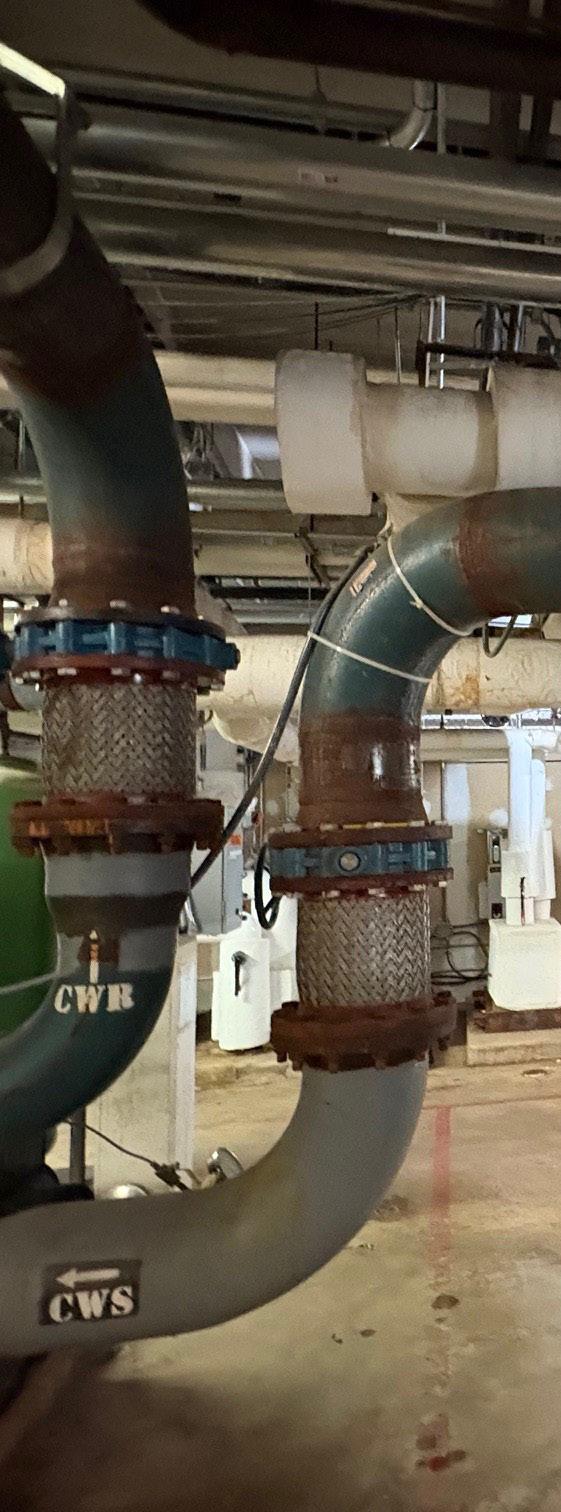
“While budget and time constraints dominate planning conversations, adaptability remains a vital consideration in engineering decisions. Facility upgrades that account for future growth or system expansion deliver long-term value, avoid redundant work, and support resiliency as campuses evolve.”
Lessons Learned and Key Considerations
Across a range of projects in higher education, several consistent themes have emerged that inform successful outcomes:
• Phasing is essential. Aligning scopes with academic schedules avoids disruption and prevents delays.
• Early coordination saves time. Long lead items, shutdown windows, and access logistics must all be addressed well in advance.
• Think beyond immediate needs. Even within limited budgets, small decisions like routing spare conduit or planning controls integration can accommodate future change efficiently.
• Commissioning is a strategic asset. Treating it as an ongoing process improves performance and builds internal operational capacity.
Engineering in Service of Education
Modernizing higher education campuses prioritizes not just replacing systems, but also creating safe, resilient, and comfortable environments where learning and discovery can thrive. Scalable engineering strategies that minimize disruption and maximize flexibility help institutions bridge the gap between current limitations and future goals. ■
Johnathan Woodside, P.E., C.E.M., CxA, is Building Engineering Vice President at Gresham Smith in Nashville.
Paul Green is Project Manager at Gresham Smith and is based out of Jackson, MS.
ADVISORS
Strategic Guidance for Facilities Excellence in Higher Education
In todayʼs fast-evolving higher education landscape, facilities organizations are facing unprecedented pressures—from budget constraints and shifting public perceptions to workforce turnover, technological advancement, and the long-term impacts of the pandemic.
APPA Advisors offers peer-driven, scalable consulting services tailored exclusively for educational institutions. Our team of seasoned facilities leaders helps you adapt, align, and thrive in this complex environment.
Why APPA Advisors?
Experienced Leadership
Our Advisors are current or retired senior FM executives with proven success in higher education.
Higher Ed Expertise
We understand your environment—its structure, culture, and pace—unlike generalist firms.
Custom-Tailored Support
Focused advice on a single issue to full organizational assessments, our services are scaled to your needs.
Faster Engagements
As a nonprofit professional association, APPA helps most institutions bypass lengthy RFQ/RFP processes.
Strategic Organizational Assessments
Comprehensive reviews of operations, structure, and service delivery models based on the Evaluation Program criteria.
Executive Coaching
Personalized mentoring for senior leaders navigating complex challenges.
Targeted Performance Reviews
Quick, high-impact evaluations of key areas with actionable recommendations.
Training
Our Process
Consultation
Scoping
Training & Professional Development
Custom sessions for frontline staff to executive leadership.
Talent Management Assessments and plans for workforce development, succession, and team readiness.
FROM BRUTALIST TO BELONGING
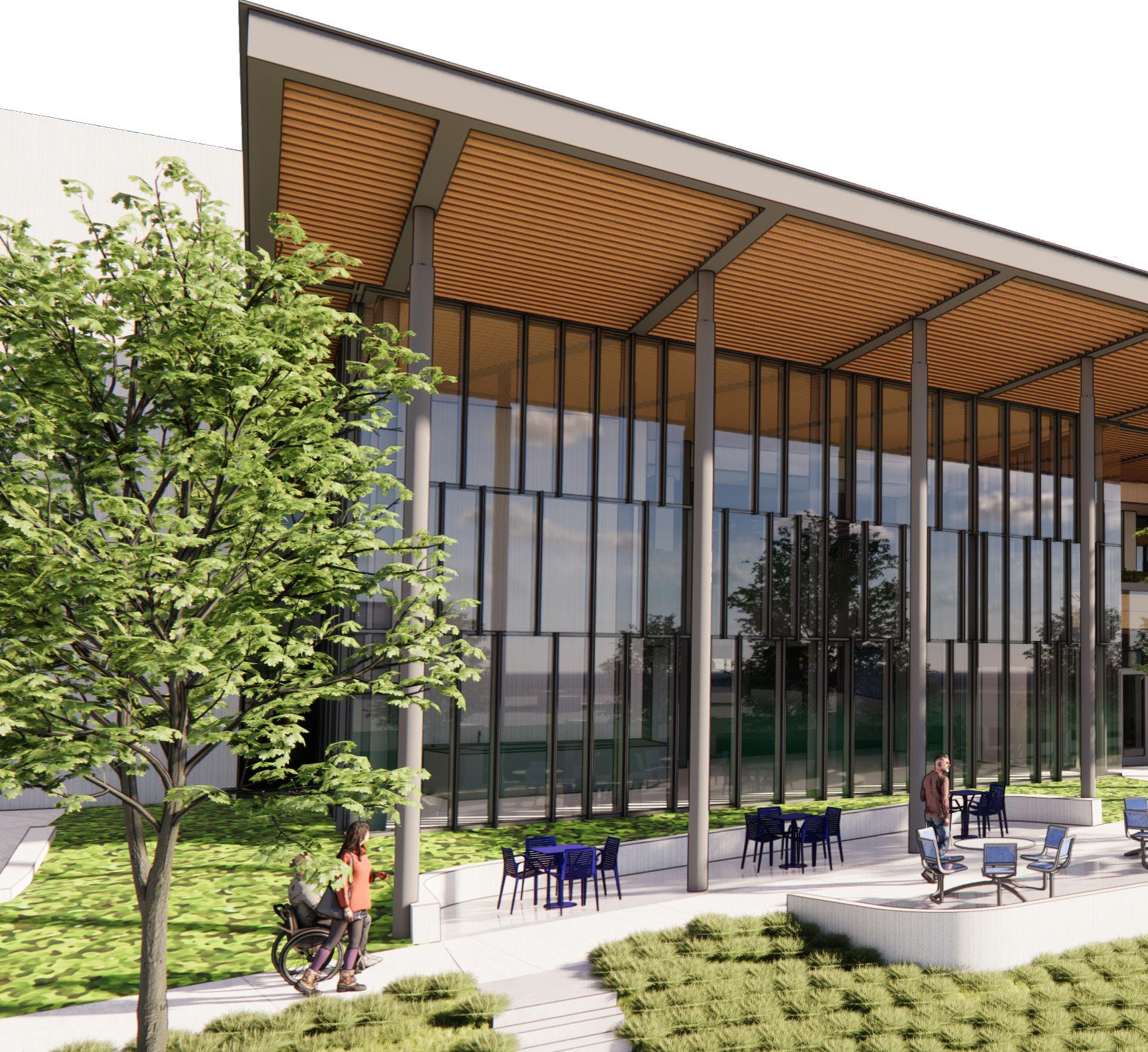
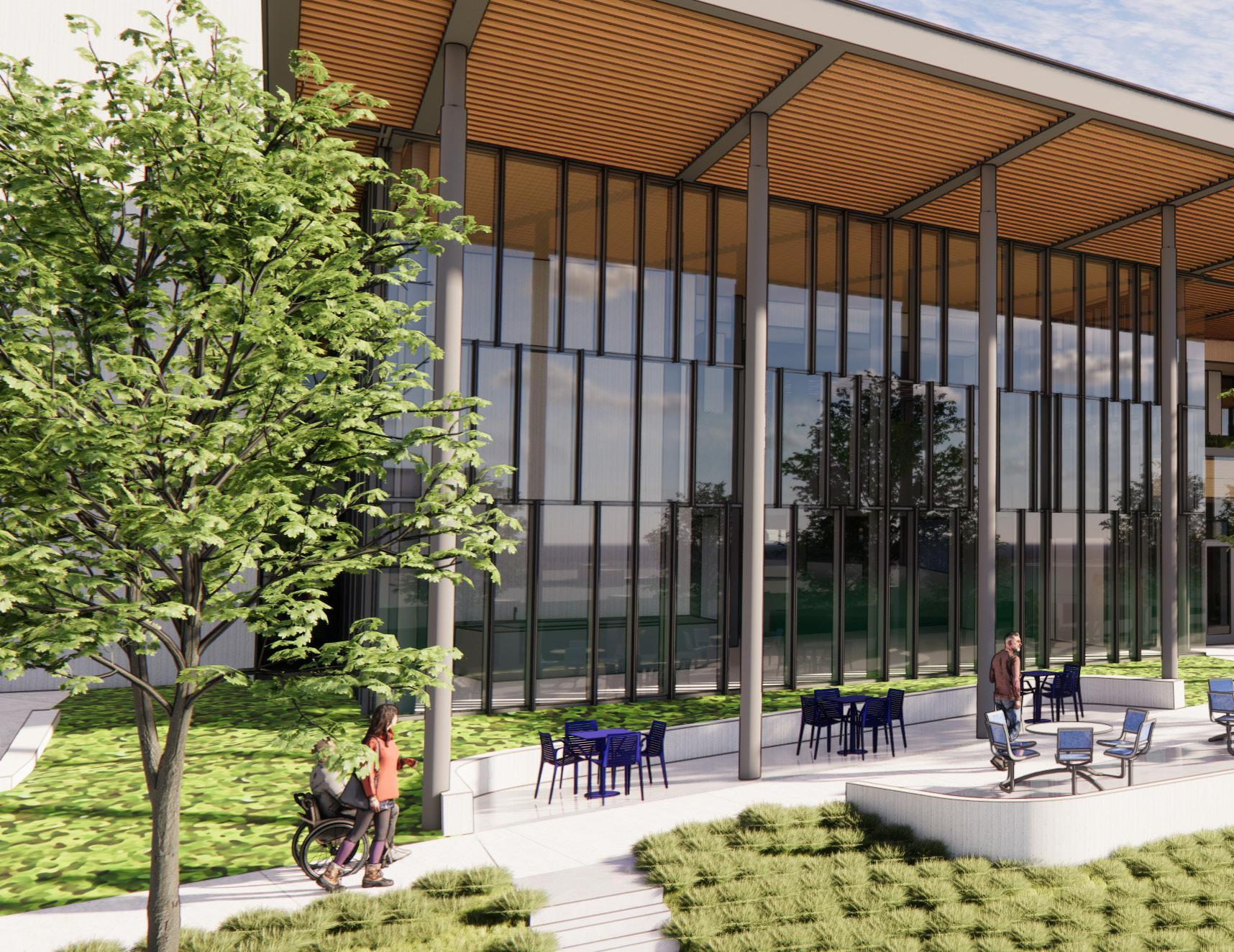
How a 1970s Brutalist concrete library was transformed into a truly studentcentric infrastructure of care— through journey mapping, traumainformed engagement, biophilic design, visible sustainability, and operational practices that align with its ethos.
Project At A Glance
Grand Rapids Community College (GRCC) is transforming its 1972 Brutalist, all-concrete 60,000-square-foot Learning Resource Center
Tutoring (AST), Academic Testing Services (ATS), Counseling and Career Development (CCD), Disability Support Services (DSS), Inclusion and Multicultural Affairs (IMA), Information and Media Technologies (IMT), and Library. The library was once one of GRCC’s most frequently used student hubs, but it has become dated and difficult to navigate— complete with a literal (concrete) “barrier to entry.”
The Challenge: Not Just Space—Trust
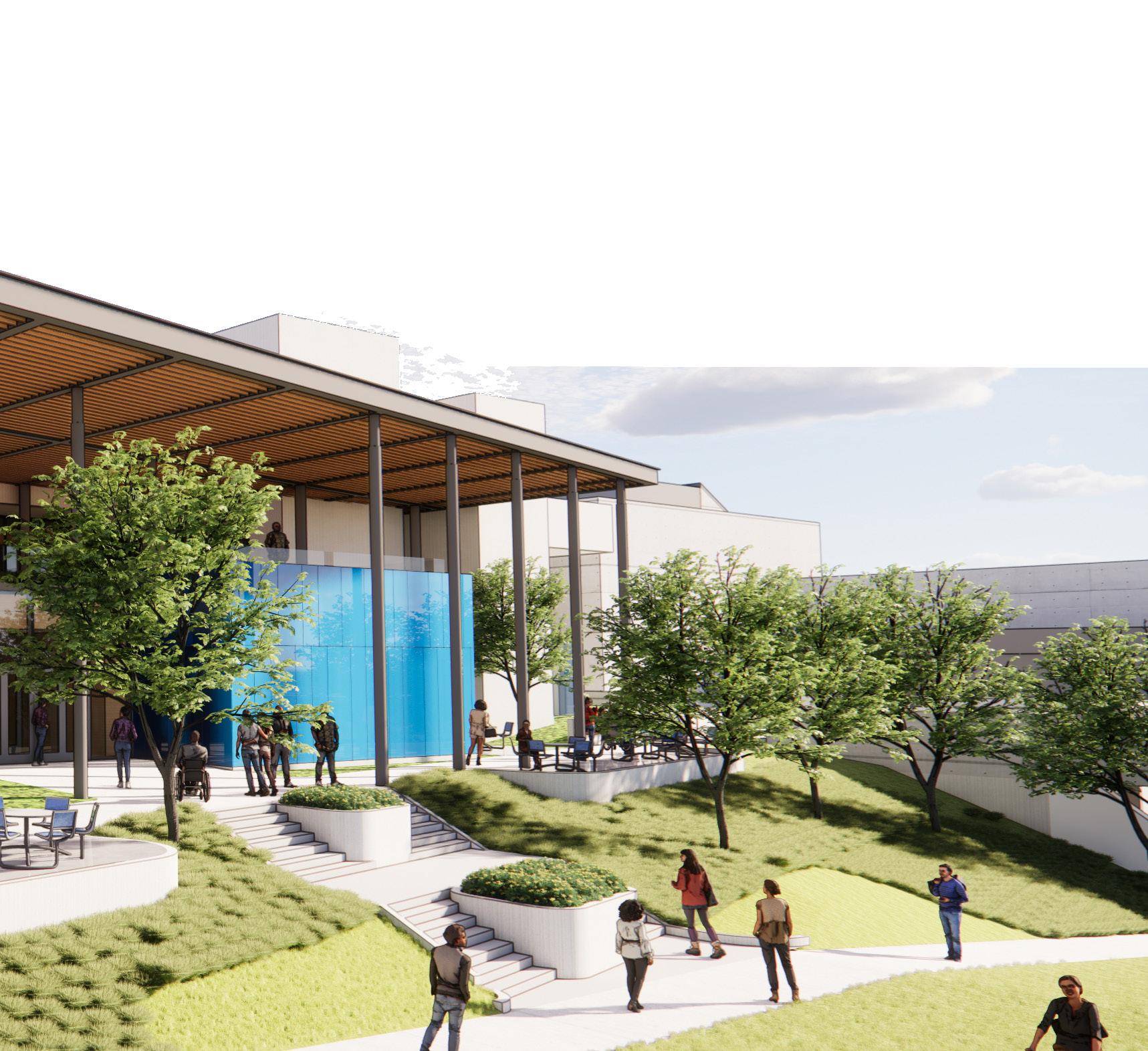
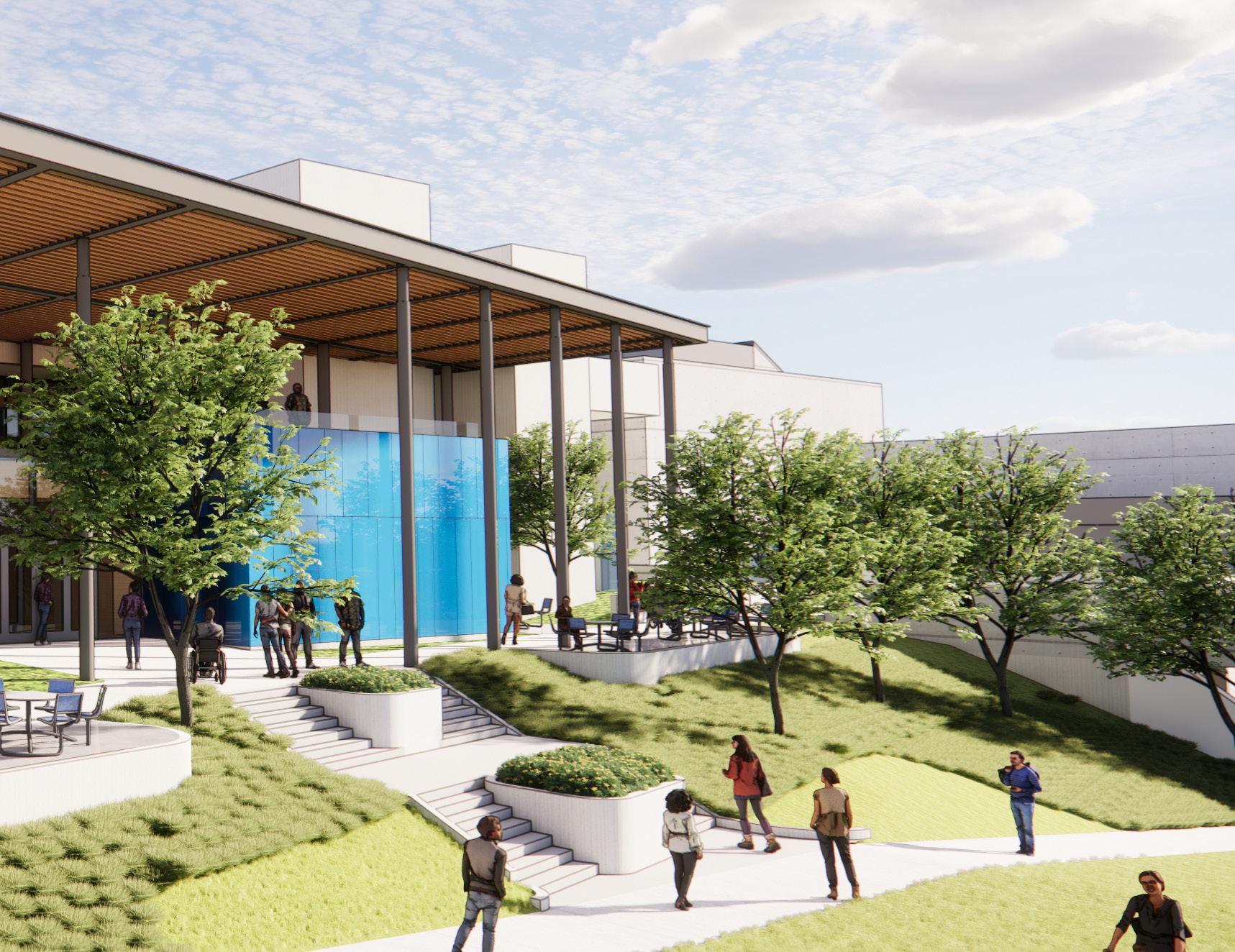
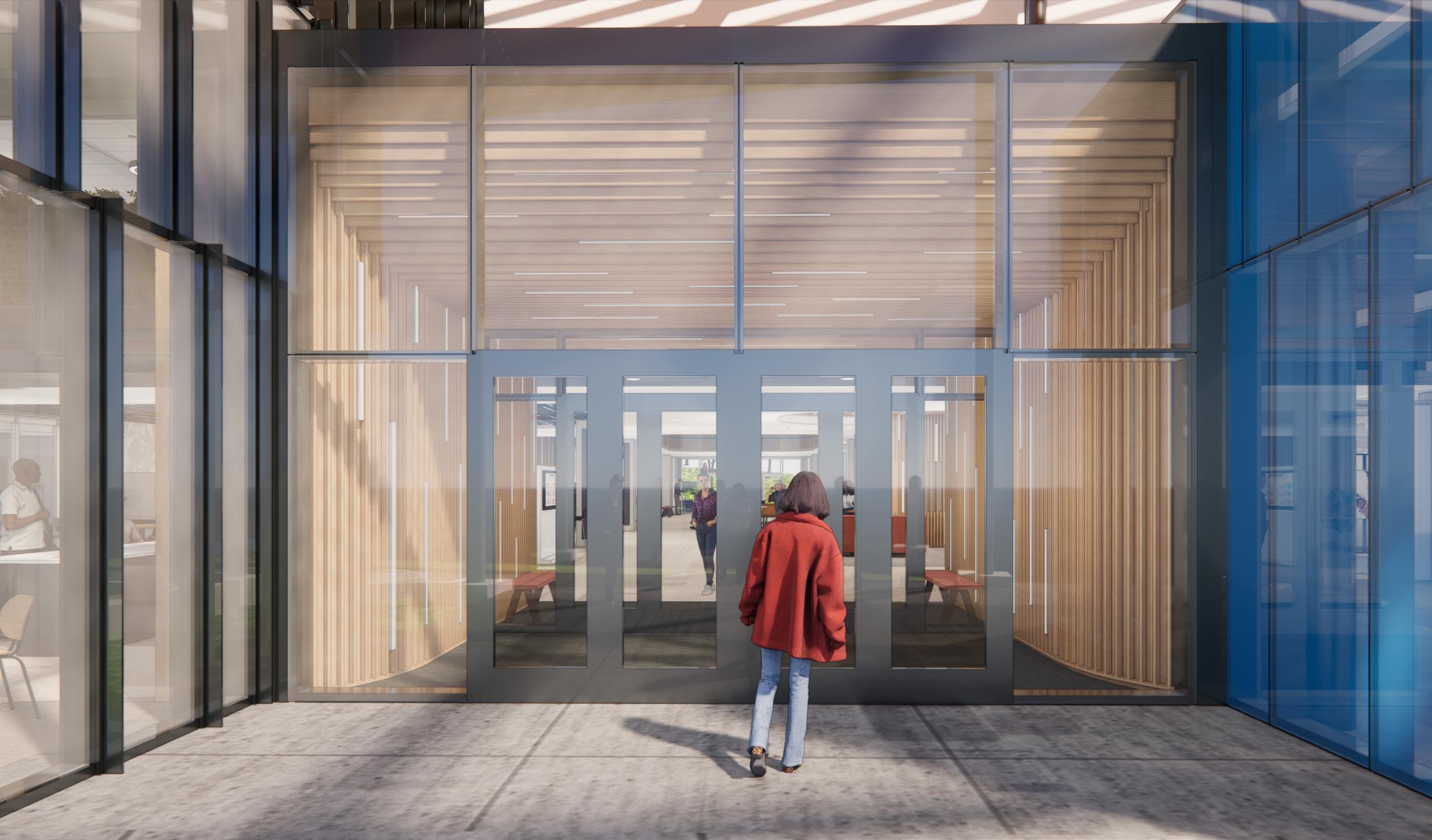
concept was noteworthy and remarkable for its time, the challenge was that it struggled to evolve to meet the changing needs of the students.
In listening sessions, students and staff named what the building made them feel—surveilled upon entering, disoriented at arrival, and general feelings of placelessness within. Some avoided seeking help because the route to help felt too exposed. Others described the space as “efficient but indifferent,” a place that delivered services without signaling care.
Faced with this feedback, the project team reframed the project brief. The task wasn’t to “update a library” or relocate a few departments. It was to design an infrastructure of care that creates clear outcomes for the people it serves, in a way that empowers learning. That meant centering on belonging, trust, and the mental and physical health needs of the student—and those of faculty and staff who encourage the learning on campus—as the drivers of every decision, not as
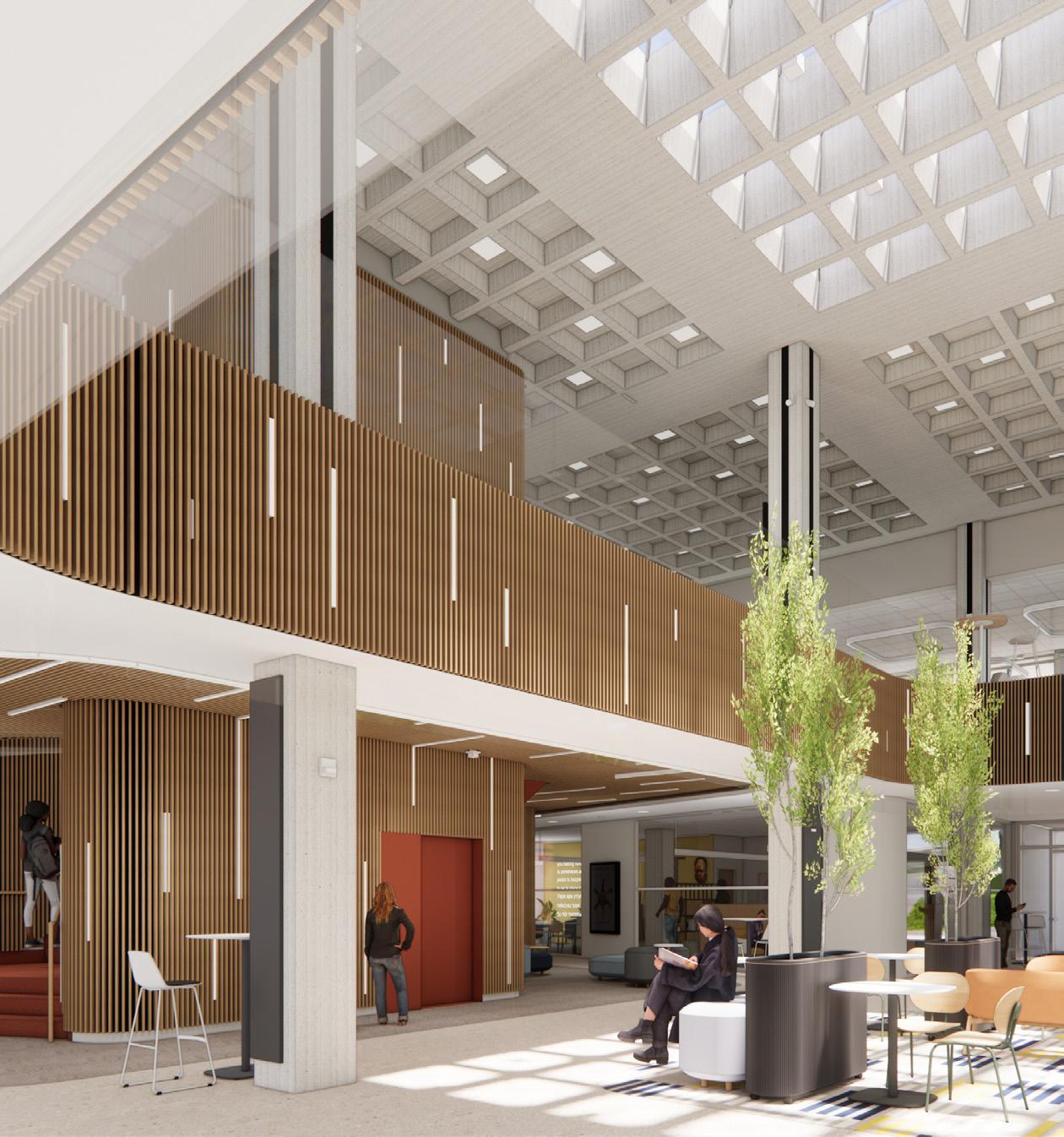
Above: Rendering of the new Entry at the LRC.
Bottom Left: Reimagined atrium under the existing skylight, filled with biophilic design and universal design interventions.
Bottom Right: Demo of the existing skylight, after the inaccessible mezzanine was removed
afterthoughts or amenities.
Every design decision would now start with a single question: Does this help students feel they belong here, trust this place, and believe their college is fighting for their future as hard as they are?
Method: Trauma-Informed + Journey Mapping
The process began with listening rather than counting rooms. Unconscious bias training, paired with trauma-informed sessions, engaged students, faculty, and staff across departments slated for relocation. These conversations generated privacyprotective composite personas and mapped critical user moments: crossing the threshold for the first time, the awkwardness of asking for help, the latenight sprint before an exam, and the student who needs support without appearing vulnerable.
Pattern analysis revealed consistent friction points— arrival, orientation, wayfinding, and privacy—which became the design brief.
• “Dee” (visual strain, wheelchair user) required autonomous choice of entry points at the door and instantly legible navigation routes.
• “Robert” (single father, food insecurity) needed discrete basic-needs support integrated within study areas.
• “Carli” (temporary injury, on crutches) required mixed-posture settings within sight of peers and easy-to-reach resting spots near the entrance.
• “Drake” (seasoned professor, hyflex anxiety) needed visible, approachable tech support and clear operational workflows.
To translate these needs into the space, the project team paired the journey maps with a sciencebased biophilic lens, informed by Terrapin Bright Green’s 14 Patterns of Biophilic Design, ensuring the building could be perceived as humane before a user even entered the space. The task wasn’t to “design for everyone,” but to design from lived experience, addressing real needs, and then empowering operations to carry this ethic forward every day.
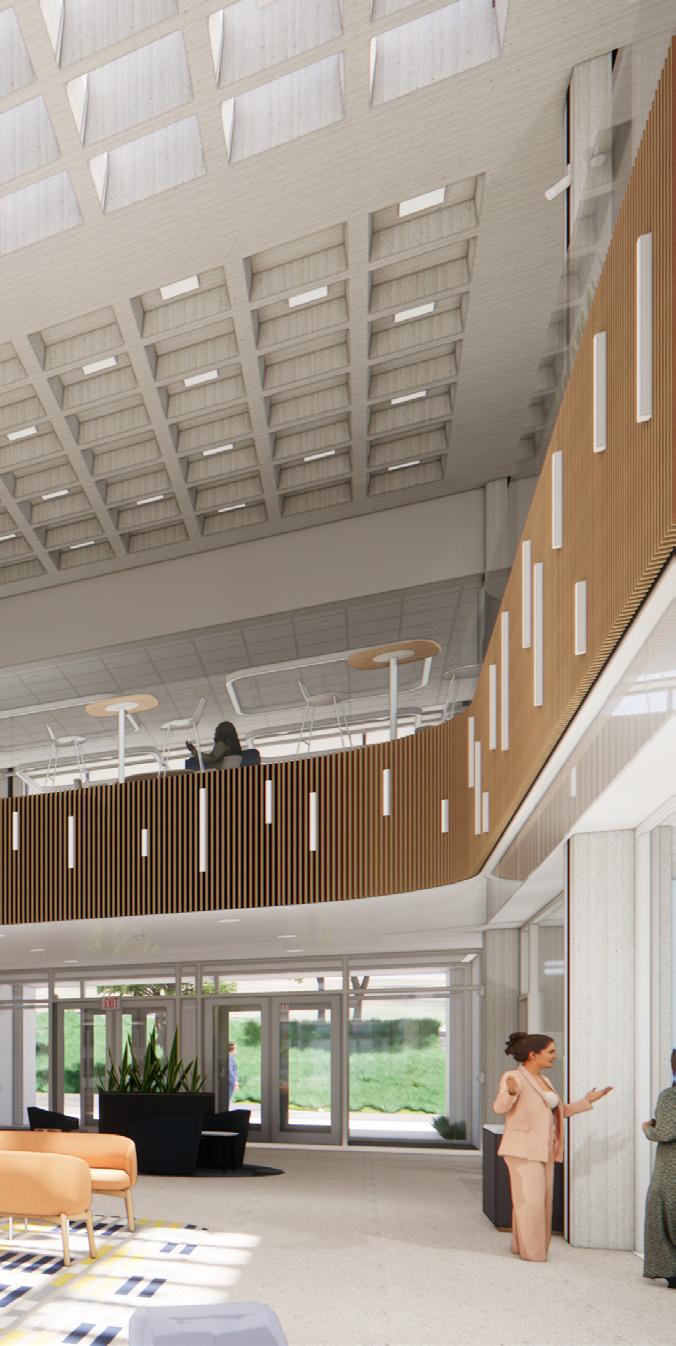
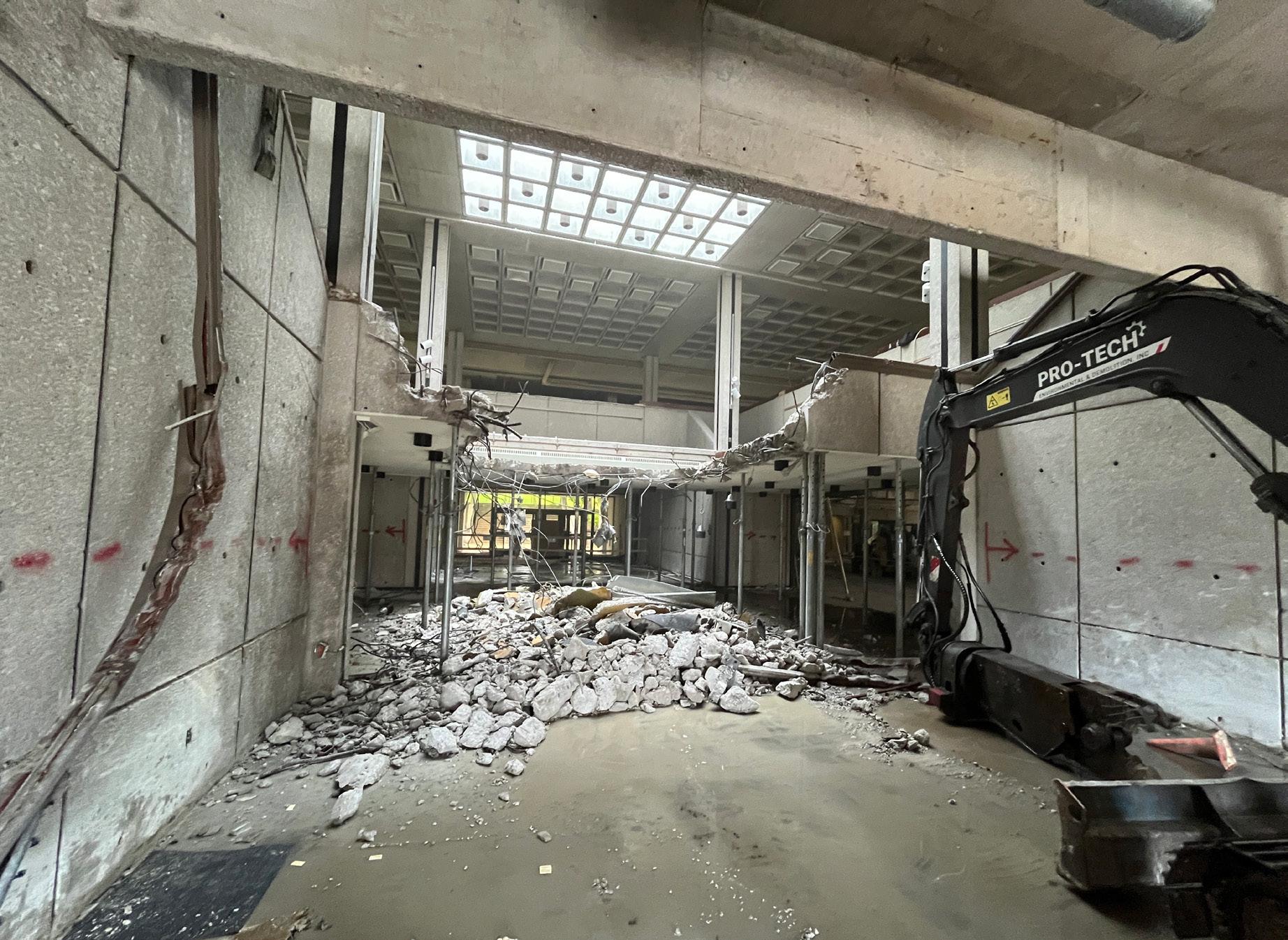
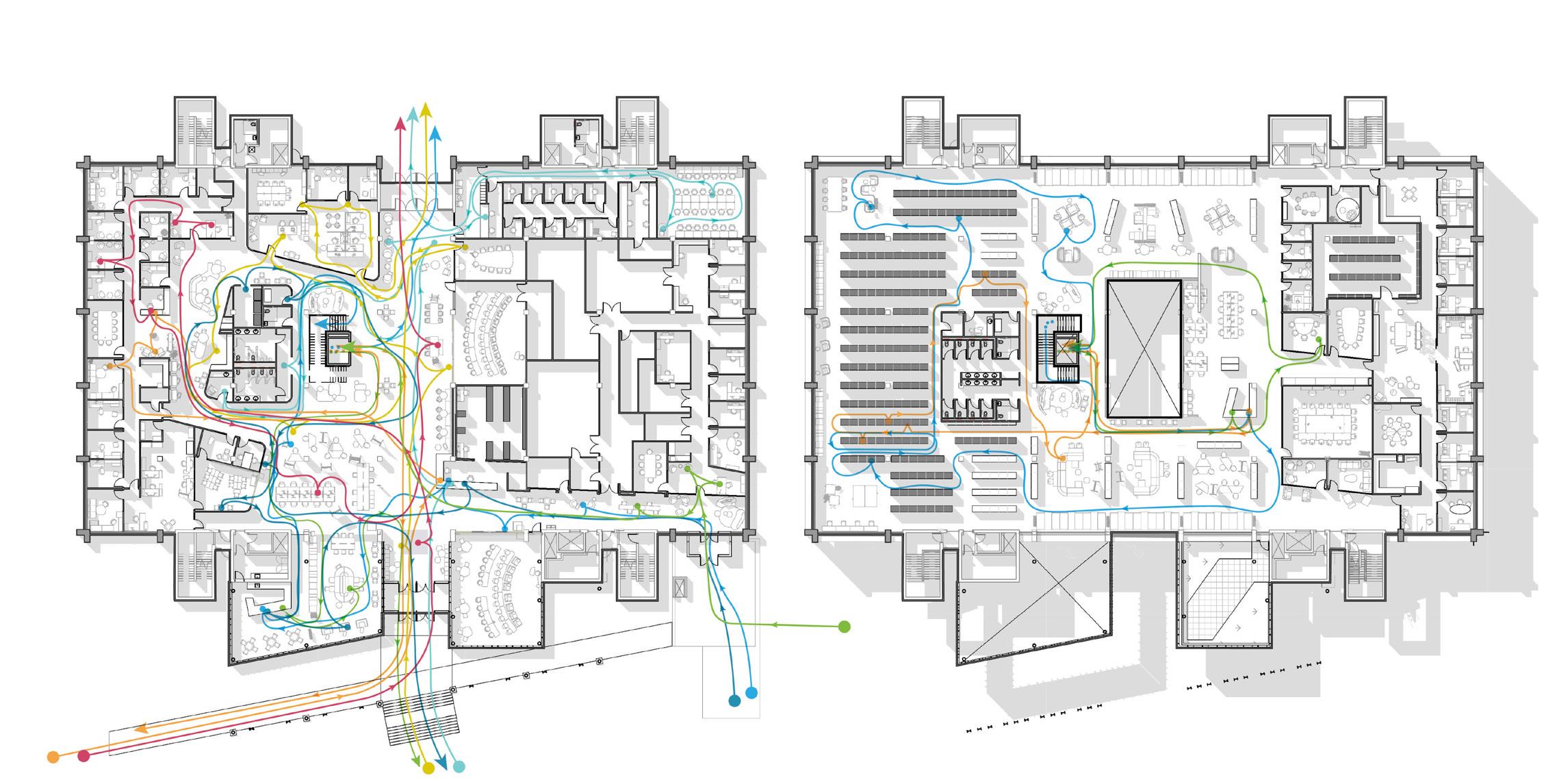
Insight: Beyond Cosmetic Biophilia
Biophilic design is too often a finish palette—plants, wood, green paint—spread a mile wide and an inch deep. This project team chose a method, not a mood. The methodology combined service-design tools (trauma-informed listening, personas, journey mapping) with the specificity of biophilic patterns (Prospect/Refuge, Dynamic & Diffuse Light, Material Connection, Complexity & Order).
Personas & journey maps told us where stress spikes: building arrival, initial orientation, wayfinding decisions, and privacy needs. Biophilic patterns told us which environmental factors reduce stress in the body: softer lighting, a protected place to withdraw, clear views without being on display, and paths that teach themselves. The project team then implemented targeted interventions at these critical moments and developed operational protocols to maintain their effectiveness: welcome desk staffing, space booking policies, regular glare assessments, and maintenance schedules.
The result is a more strategic and cost-effective allocation of capital. This evidence-based methodology places fewer, more targeted design elements that create greater user impact.
From Brutalist To Belonging:
Biophilic Design As Infrastructure Of Care
The project team didn’t sprinkle “nature” on top of concrete. We used nature’s logic to teach the building how to host. Working within a community college budget and a Brutalist concrete shell, the project concentrated high-impact biophilic interventions at locations identified through user journey mapping.
Welcoming Entry Point Arrival now offers three distinct pathways: discrete entry, self-service wayfinding, or staffed assistance. Users can access help without feeling exposed or scrutinized.
Universal Access Design: The previous stairs-andretaining-wall “barrier to entry” was transformed into a gently sloped path, a universal entrance for all users. The path follows intuitive lines of travel, allowing users to navigate the grade with or without mobility devices effortlessly, and demonstrates complexity and order at the campus scale.
Optimized Lighting Systems: The lighting strategy replaced harsh glare with layered, bounce-rich daylight and task-tunable fixtures. Testing rooms and focus spaces utilize even, low-contrast lighting to reduce eye strain, while collaboration zones feature brighter fields with controlled highlights, allowing groups to collaborate with one another without visual fatigue.
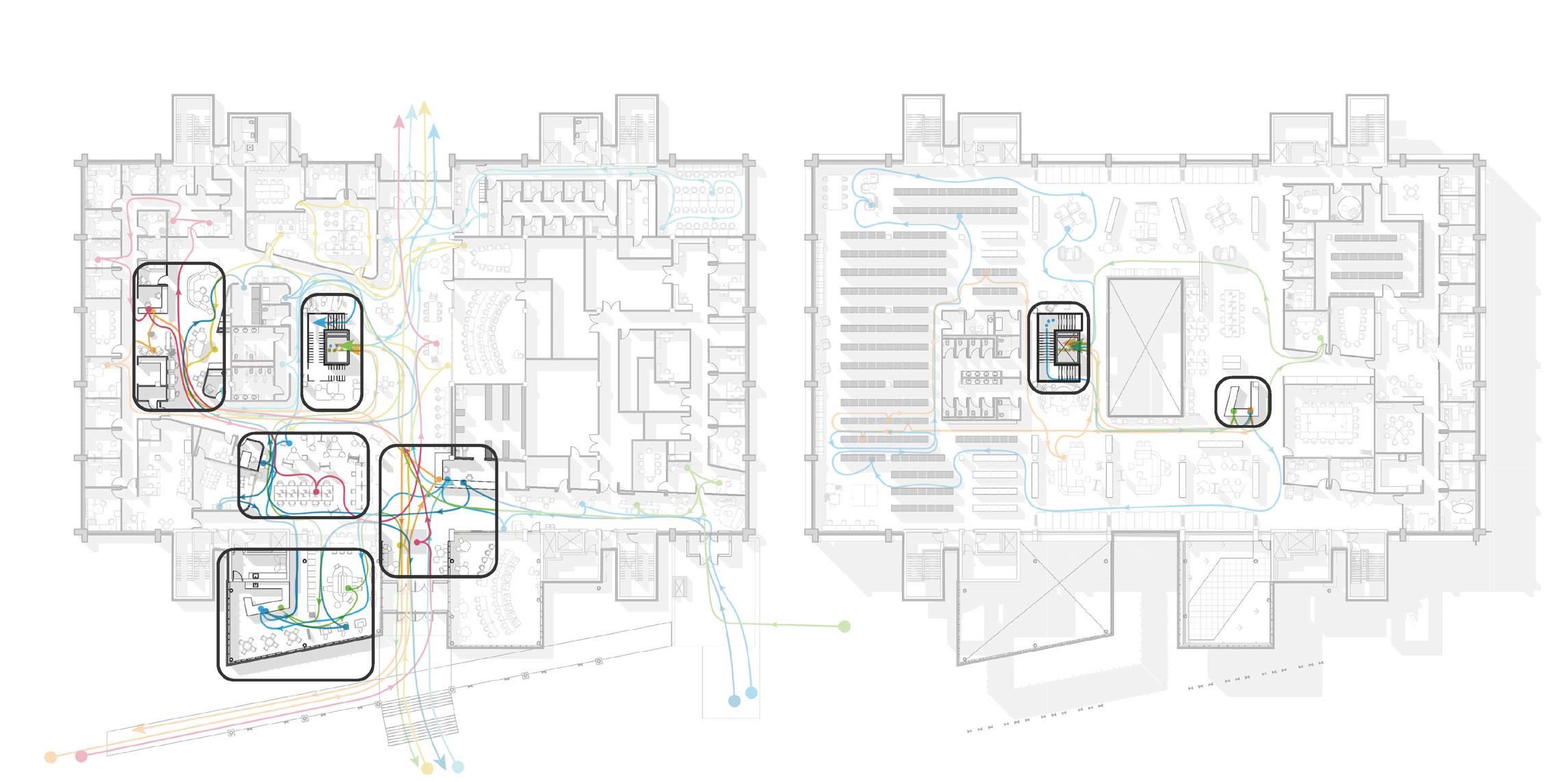
Strategic Refuge Spaces: Small decompression alcoves sit near high-stress destinations, including Counseling and Testing Services, while tucked study nooks live at the edge of the “Knowledge Market,” a peer-to-peer safe space of information exchange. This approach gives users agency over their spatial choices rather than creating surveillance-like environments.
Tactile Material Strategy: Material connections appear at human contact points, such as wood elements at handrails, counters, and work edges, with non-toxic finishes where people gather. Users learn the building by feel, rather than signage dependence.
Acoustic Zoning: Study rooms utilize structural decoupling so collaborative energy and focused work can coexist. The goal was to prioritize optimal signal-to-noise ratios that support different cognitive styles, rather than enforcing silence.
Climate-Responsive Exterior: The new entrance canopy acts as a “forest edge”, behaving like a tree line with filtered light, softened edges, and shade that allows users to pause without obstructing circulation. State requirements for an “open” structure were met through tuned member depth and spacing that maintains openness while reducing solar heat gain on the critical façade.
Central Orientation with Cultural Permanence: A luminous yellow-glass wall anchors the heart of the building. It draws people in, communicating institutional permanence and welcomeness.
Micro-Environment Organization: Interior spaces are organized into refuge nooks, collaborative clearings, and sheltered areas to accommodate various work styles.
Operational Integration: Each design intervention is intentional and includes operational protocols, such as cross-trained hospitality desk staffing, booking policies that prevent single-access rooms for sensitive users, routine semester lighting audits, and wayfinding standards that utilize rhythmic markers and color families. This biophilia design serves as the delivery system for belonging outcomes
Air, Light, Carbon, And Comfort: Energy In Service Of Care
Early stakeholder engagement led to insights into how the building felt. But conversations with counselors named what sat beneath it—a nearly exponential increase in the number of students coming to campus with significant mental-health challenges, exacerbated by climate anxiety. As another extension of the “student-first” ethos of the project, the project team connected those dots:
Above: Rendered Floor Plan showing all the “hot spots” of stress points.
Below: Rendering of the entry canopy shading the addition.
if belonging is the brief, climate action must be something students can see and feel, not just read about on a spreadsheet.
So, we treated air, light, and thermal comfort as care—and let carbon savings be the by-product. Instead of rebuilding, GRCC retained nearly the entire 1970s concrete frame and envelopes, showcasing reuse and avoiding an estimated 3,100 metric tons of upfront carbon (40% less than a typical new build). Inside, learning spaces bring in more outside air within existing equipment; daylight is diffused to cut glare; and the new porch canopy filters the sun like trees in a forest. Making climate care visible the moment you walk in.
The same ethic also appears in subtle ways that building users might not notice: low-toxicity materials where people linger, quiet mechanical background noise that doesn’t amplify stress, and thoughtful and intentional acoustic separations that empower folks with different energies to coexist. Comfort, care, and carbon reduction move together here—because that’s what a student-first building should do.
Building users will see the continuity of the Brutalist frame they inherited, now carrying a different ethos: caring for people and climate is caring for the same system.
Budget limitations forced the project team to think creatively, leading them to ask better questions. Instead of asking what systems this project could afford, the team asked what students would feel every day: clear air, steady light, calmer rooms.
Learning spaces now circulate more outside air because fresh air is shown to clear the head. The design projects about a 15% reduction in overall energy use through envelope tuning, daylight control, and a functional shaded front porch.
Partnerships And Process Shifts
This work was co-created with GRCC Facilities, operations leaders, and Progressive Companies— extending into policy itself. The new, departmentagnostic hospitality role at the entry required cross-unit coordination, rewritten job descriptions, and budget alignment. It’s now adopted as standard practice, with training tied to counseling and DEI, so the welcome is consistent in tone and equipped to address varied needs.
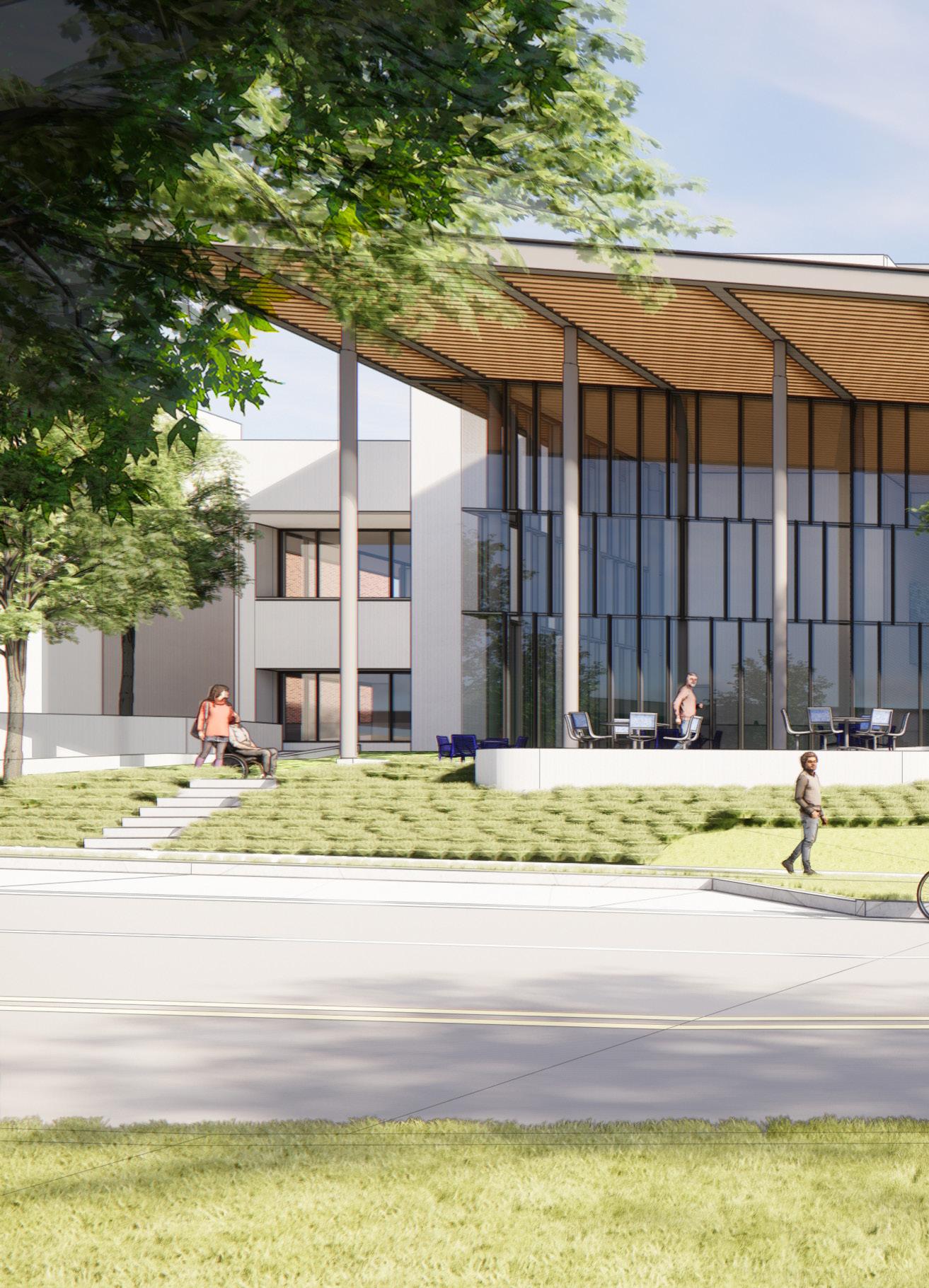
The project team also aligned hours and staffing with commuter patterns, using student data from the persona evidence rather than the inherited historical schedules. Room-use policies eliminated one-wayin rooms for sensitive uses. Wayfinding shifted from prohibited signs that say “don’t” to directional cues that say “this way”—rhythmic markers, color families, and sightlines that make direction intuitive.
As the work progressed, the design process itself became a teaching tool. What started as capital planning has been distilled into a Belonging Toolkit now shared with peers across multiple venues. The toolkit documents the method the project team used on this project—a combination of trauma-informed, universal, and biophilic design frameworks. Combined, this toolkit helped the project team listen with humility, map stress point journeys, translate into spatial and operational changes, and measure behavioral changes.
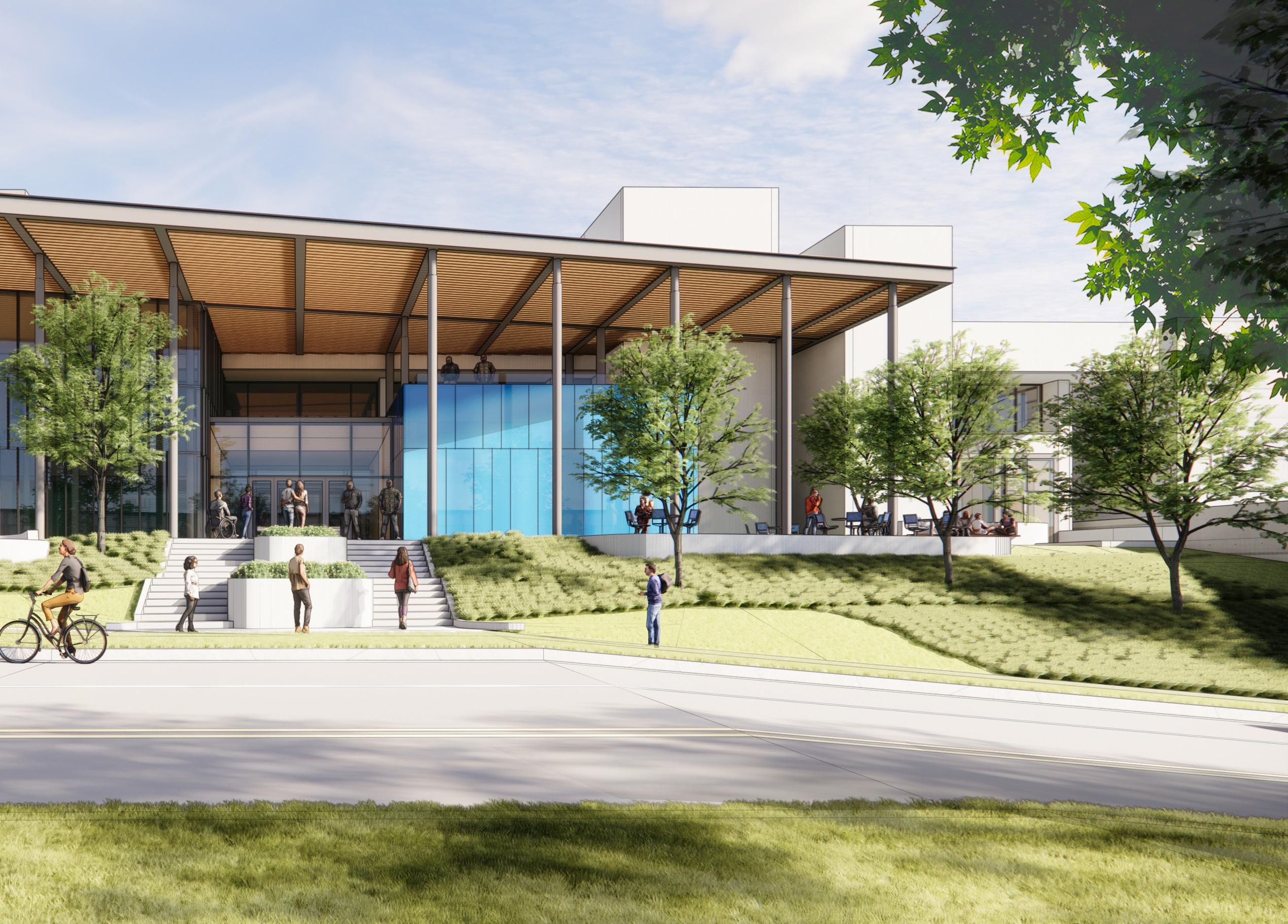
Early Outcomes (Pre-Occupancy)
This project is still under construction, so the team isn’t making post-occupancy claims. But several institution-facing outcomes are already visible:
Welcome Hospitality adopted and staffed, with cross-training across units.
Programs reorganized as an interdependent system of care—library, tutoring, counseling, disability support, media services. Departmental redundancies were minimized, while interdepartmental coordination streamlined the student experience
Wayfinding logic simplified; the Universal Design approach has solved a decades-old challenge for a campus on a hill.
Stakeholder culture moved from divergent preferences to shared priorities through listening and translation.
The Belonging Toolkit, developed for the project, is traveling—evidence that our “student-centric” approach to pre-design is deeply relevant and designing for multicultural belonging is an underserved component of facilities planning across the country, fulfilling an informal goal of the community college of being a national model of transformation.
Lessons For Facilities Leaders
Start with lived experience. Use journey mapping to diagnose actual student friction, then translate findings into thresholds, adjacencies, sightlines, acoustics, and sensory cues. Treat biophilic elements—gentle light, landing spaces, intuitive paths—as the means of belonging, not decorative add-ons.
Try this on your next project: Work with
departments that the program will be serving. Build three unique personas and map their first visits: Arrival → Engagement → Flow → Pause → Exit. Circle the stress points. Those circles are your design brief.
Let operations carry the ethos. The hardest renovations aren’t walls—they’re norms. If the entry behaves like a checkpoint, no amount of warm wood will feel like an invitation. Align hours, welcome staffing, room-use rules, security posture, and maintenance routines with the building’s intent so the space keeps its promise.
Try this on your next project: Put the welcome script and the security script next to each other. If they send mixed messages, rewrite them together. Empower staff to prioritize harmony and dignity at decision points.
Make climate action legible. Building reuse is climate action on display. Materially. It reduces embodied carbon and quietly builds trust in the institution’s commitments. Pair it with elements that building users can feel—ventilation, daylight, shade, and material choices that lower chemical exposure—and explain why those decisions were made for them.
Try this on your next project: Put a one-line placard where reuse is visible: “This structure was kept reducing carbon and keep tuition dollars working.” Legibility is a service.
Design for multicultural belonging. Move beyond
symbolic inclusion toward spatial justice. Create stewarded zones that students can count on, storytelling surfaces with community authorship, and identity anchors that convey, “You belong, right here.” Support privacy without isolation and visibility without exposure. Conduct thorough research to anticipate the diverse user needs proactively, so they don’t have to request accommodations to use the space.
Try this on your next project: Identify one place where a community is invited but not empowered. Give them stewardship of a small, central zone, with resources to care for it, and watch what happens to participation.
The LRC’s transformation doesn’t ask users to infer that they belong. It shows them. A library built in another era now behaves like a true host, welcoming users and staff into an environment where they can equally thrive. The environmental factors go beyond meeting code to actively support cognition and tranquility. Reuse becomes a visible public commitment, not a hidden metric. Operations align with architectural intent, so the building shares its truths and delivers on its design promises
Amid rising academic, social, and climate anxieties, this is the kind of project that demonstrates that when climate action is put on display and belonging is woven in from the beginning, the built environment stops being a passive container and becomes active infrastructure for care. That is the new promise this Brutalist artifact now keeps. ■
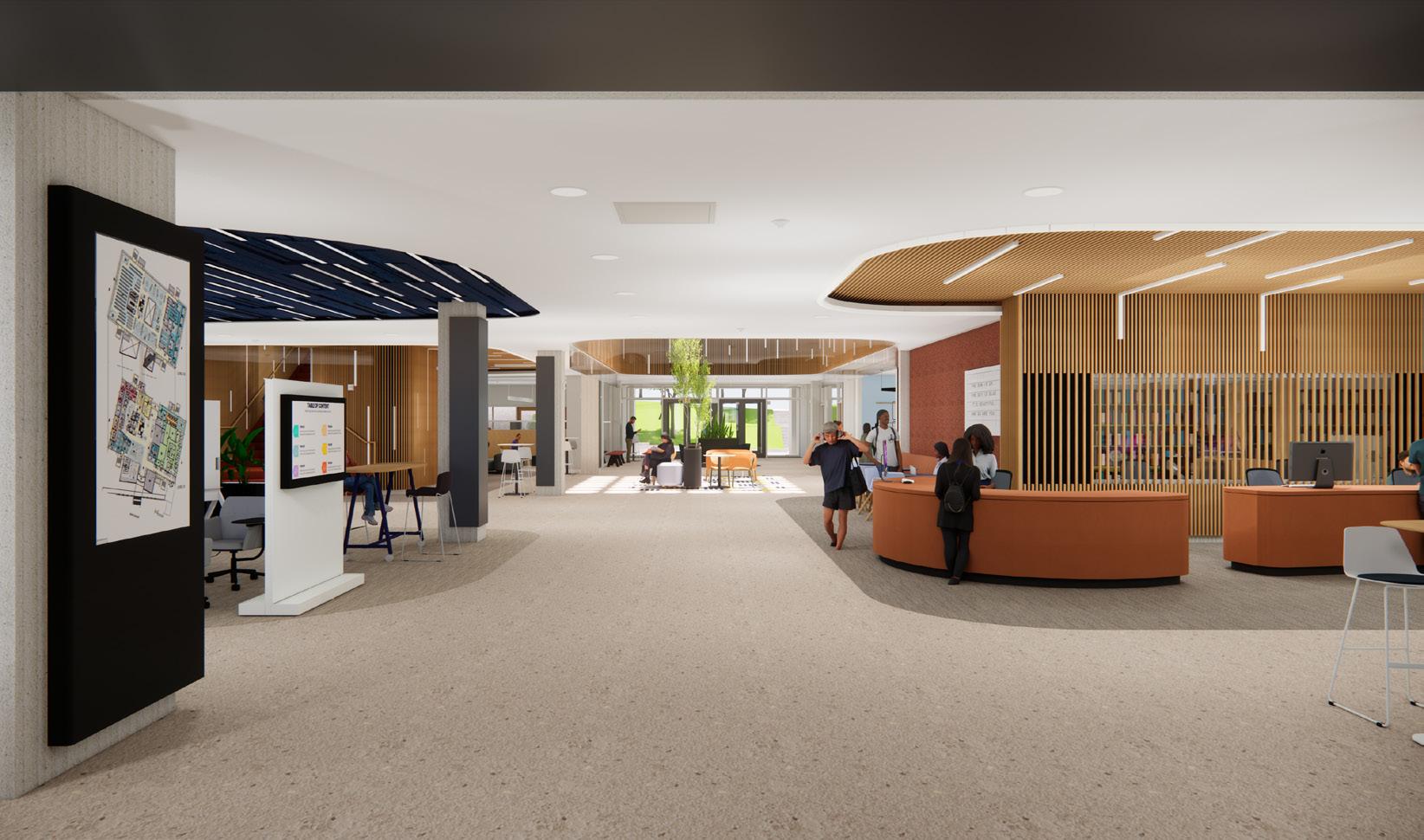
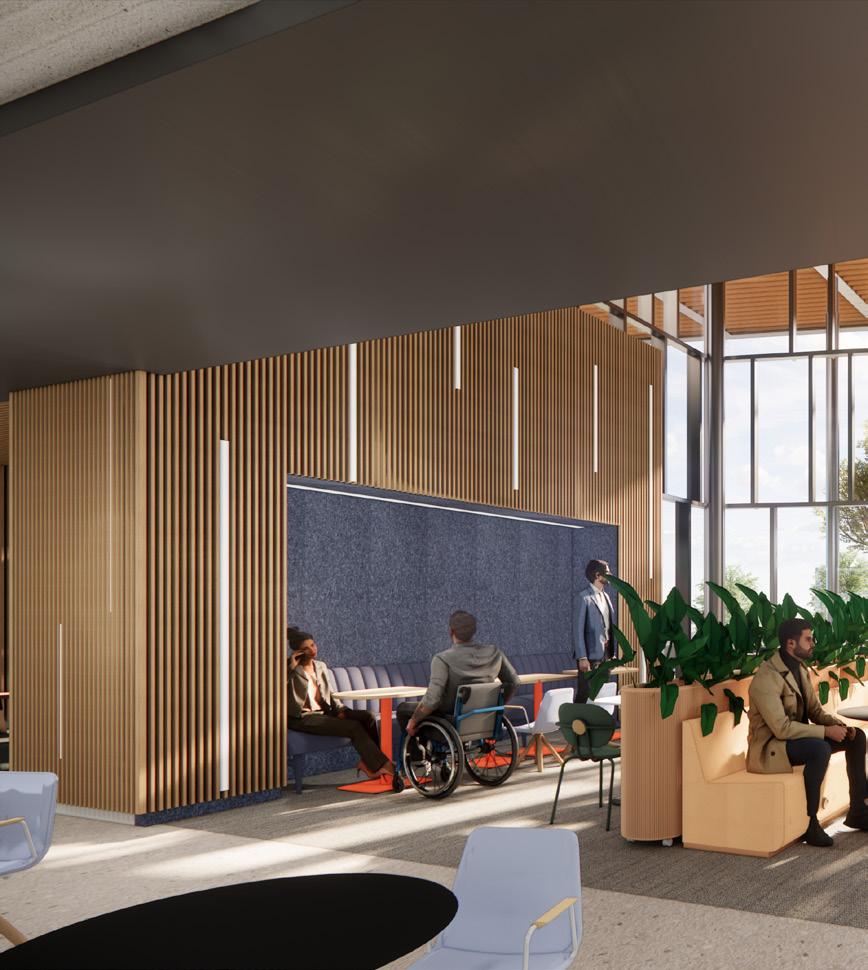
Matthew VanSweden, LFA, WELL AP, is a Sustainability Lead at Progressive Companies, driving the firm’s strategic direction toward regenerative, inclusive, and decarbonized climate-responsive design solutions.
Project Credits
Owner: Grand Rapids Community College
Facilities & Ops: GRCC Facilities (with Counseling, Multicultural Affairs, Disability Support Services, Library, Tutoring)
A/E: Progressive Companies (site/civil, architecture, interiors, engineering)
Scope: 60,000-sf renovation + 4,000-sf addition; envelope improvements; universal design site approach; biophilic design; commons canopy; cultural anchors.
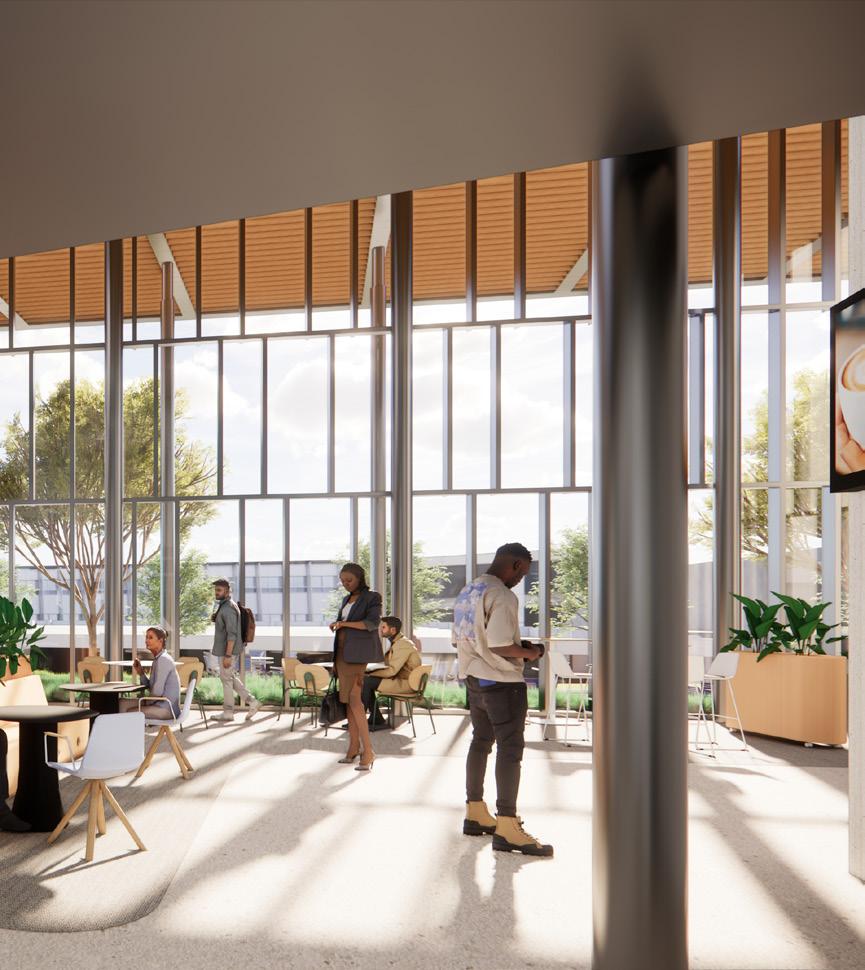
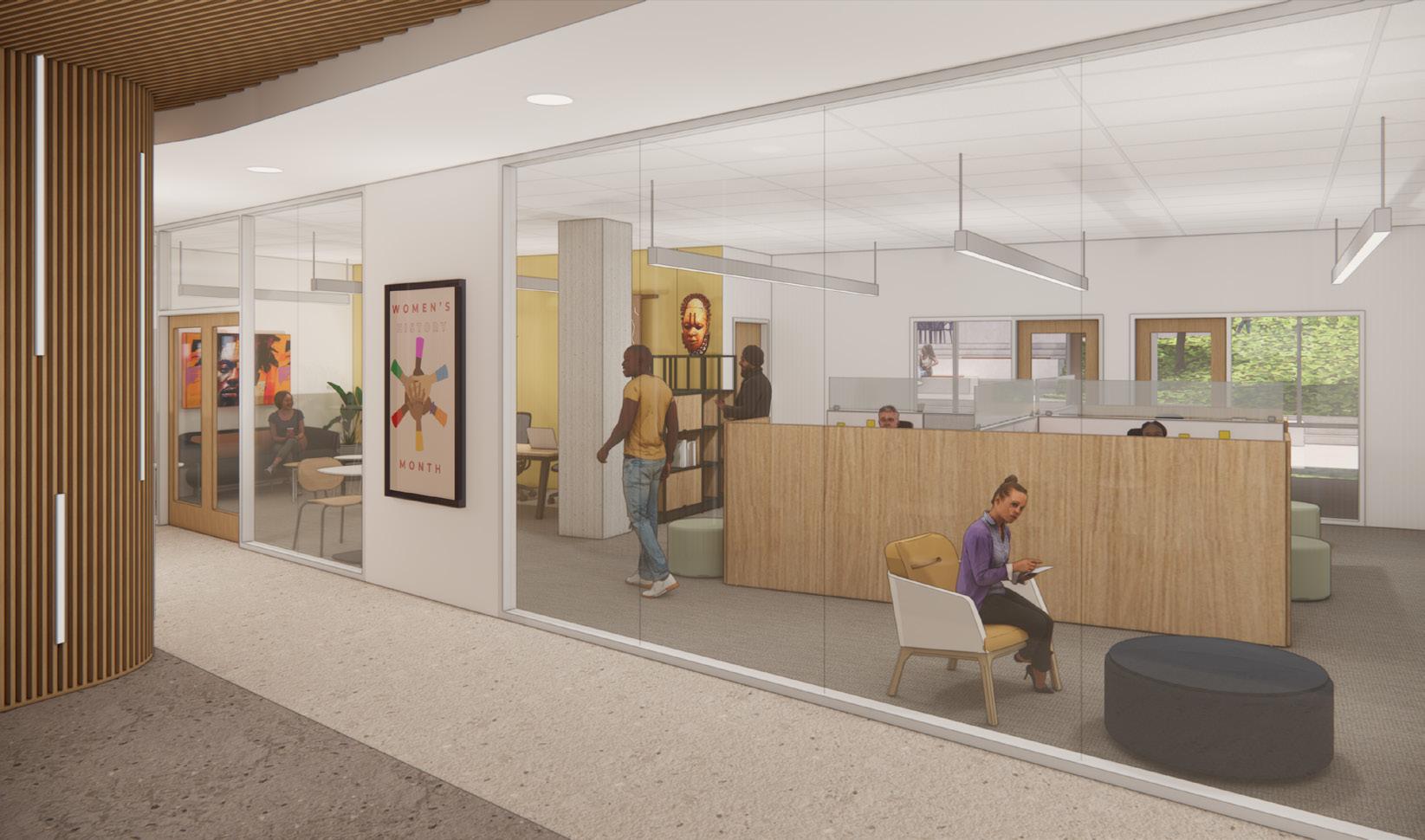
Left: Rendering of the arrival experience. Middle: Rendering of the Commuter Café within the “Knowledge Market.”
Right: Rendering of the Inclusion and Multicultural Affairs entry.
YOUR
PROFESSIONAL DEVELOPMENT
JOURNEY
EXPLORE APPA’S PROFESSIONAL DEVELOPMENT PROGRAMS: REVIEW YOUR PATH, DEFINE YOUR DIRECTION, AND TAKE THE NEXT STEP WITH PURPOSE.
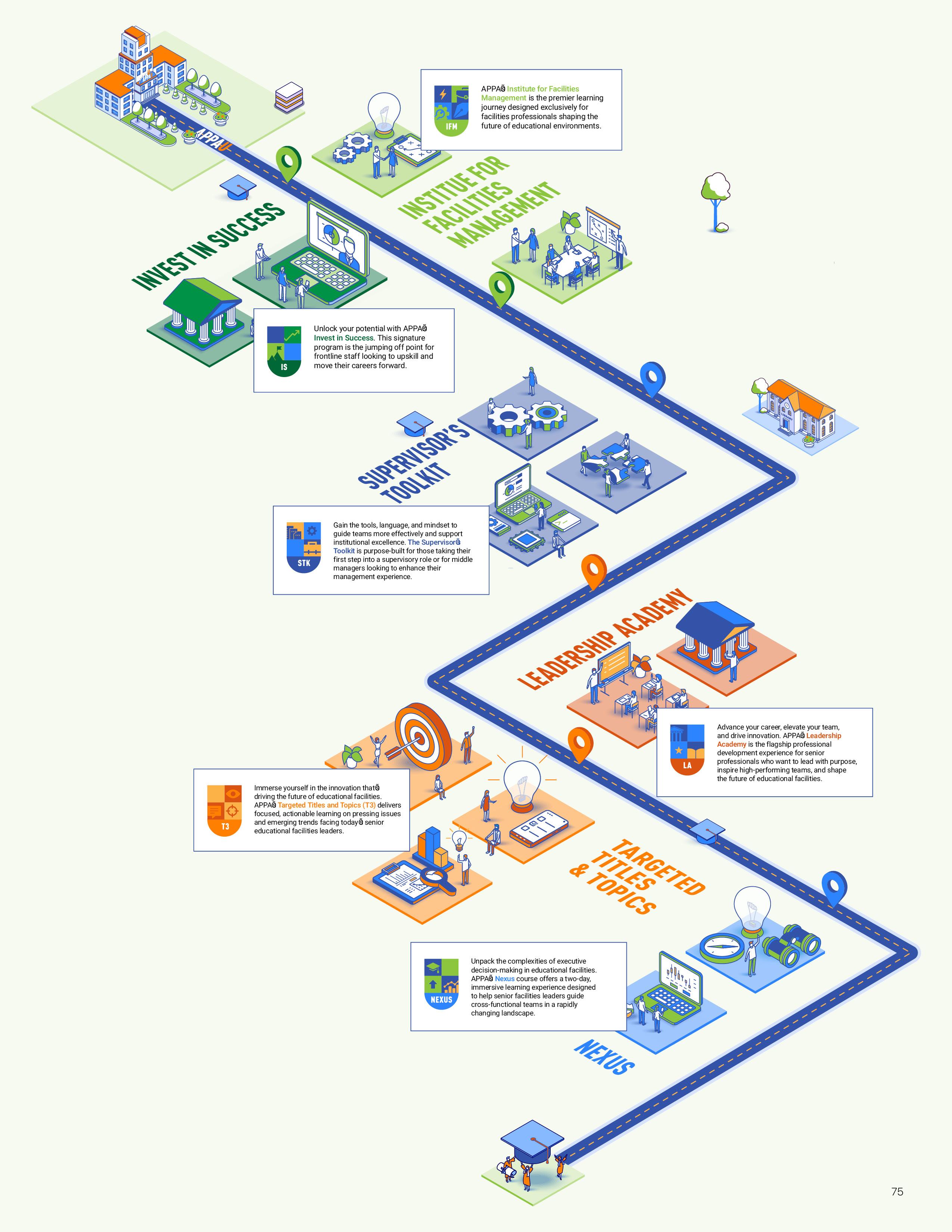
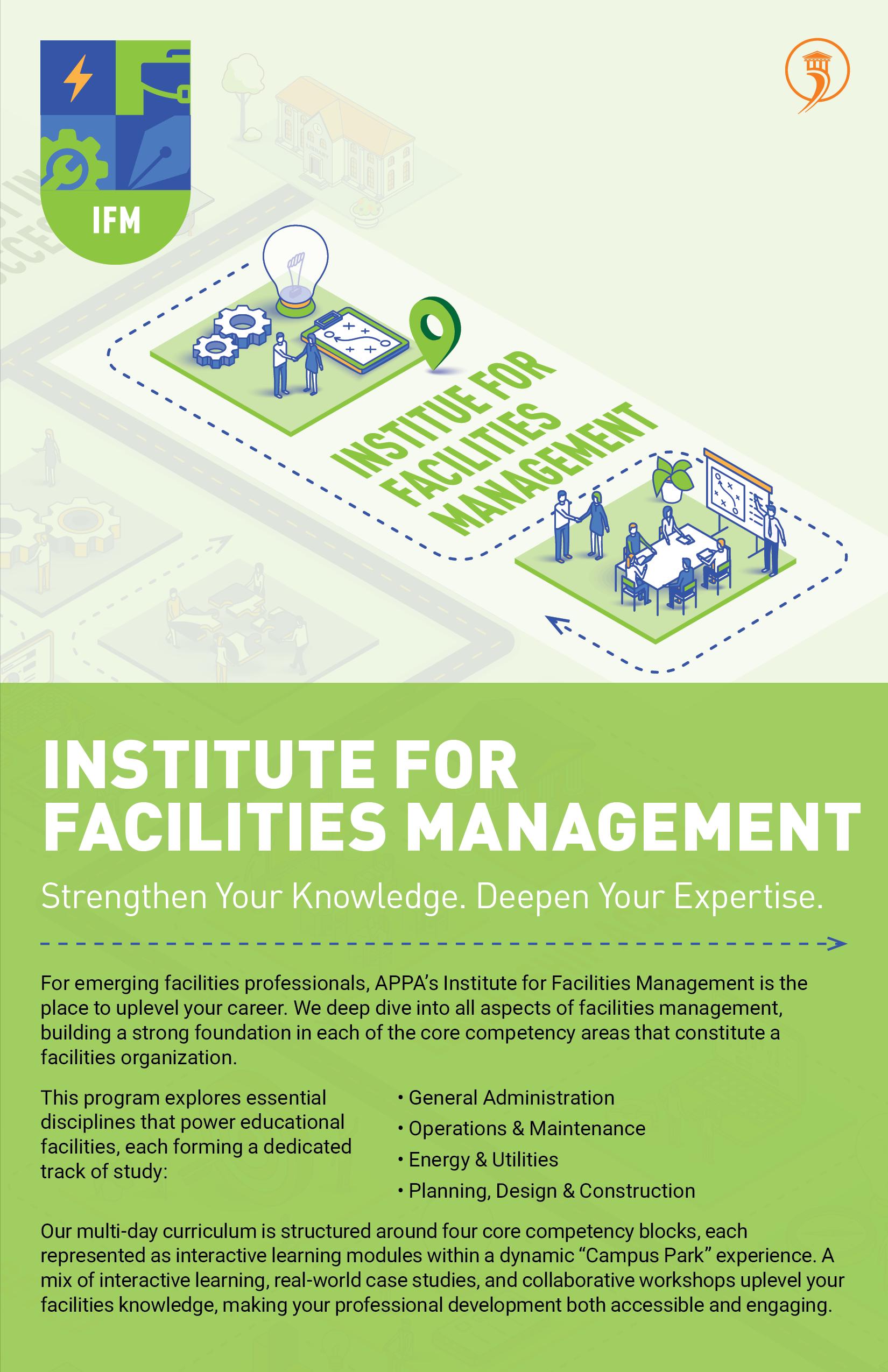
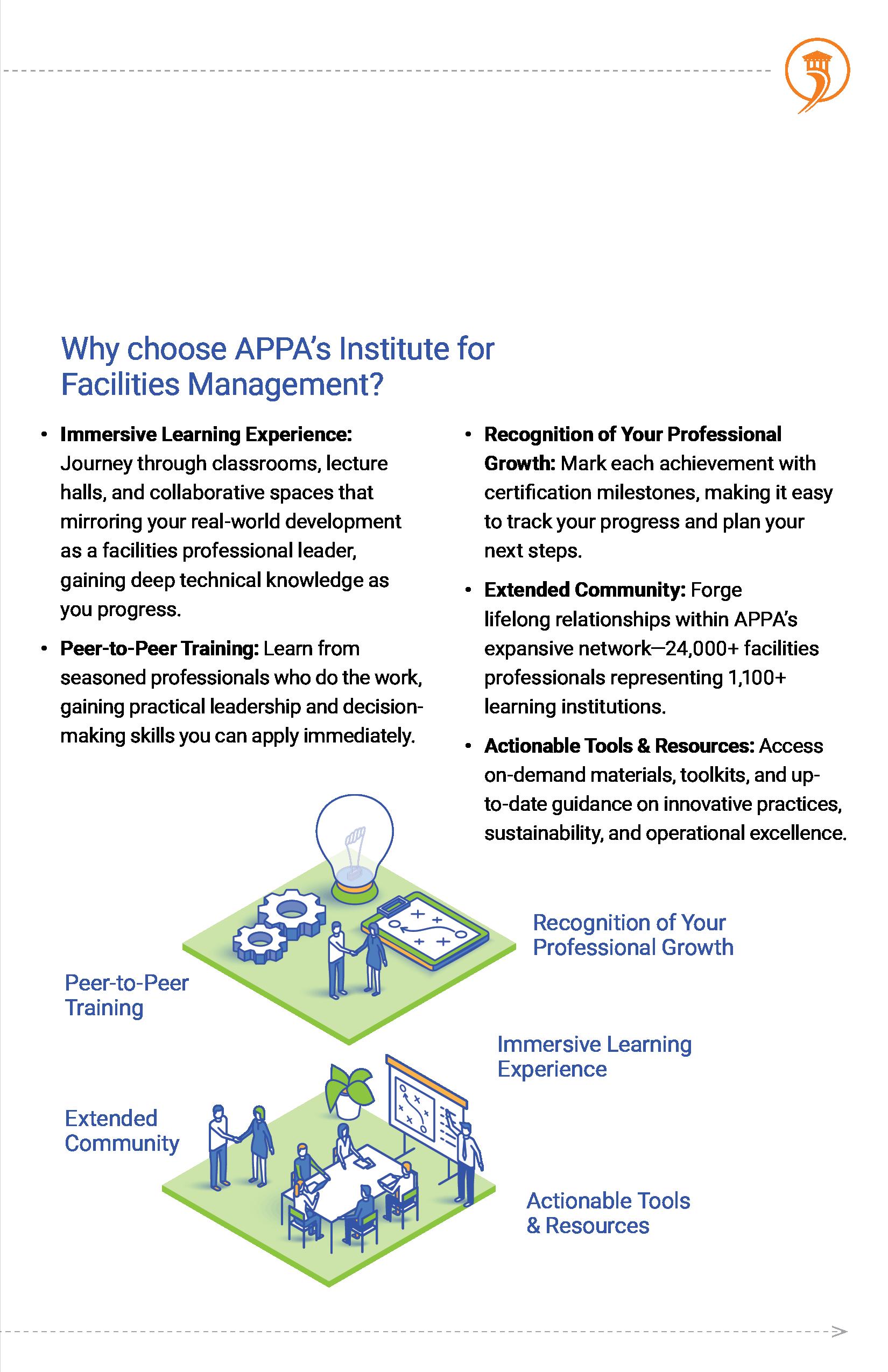
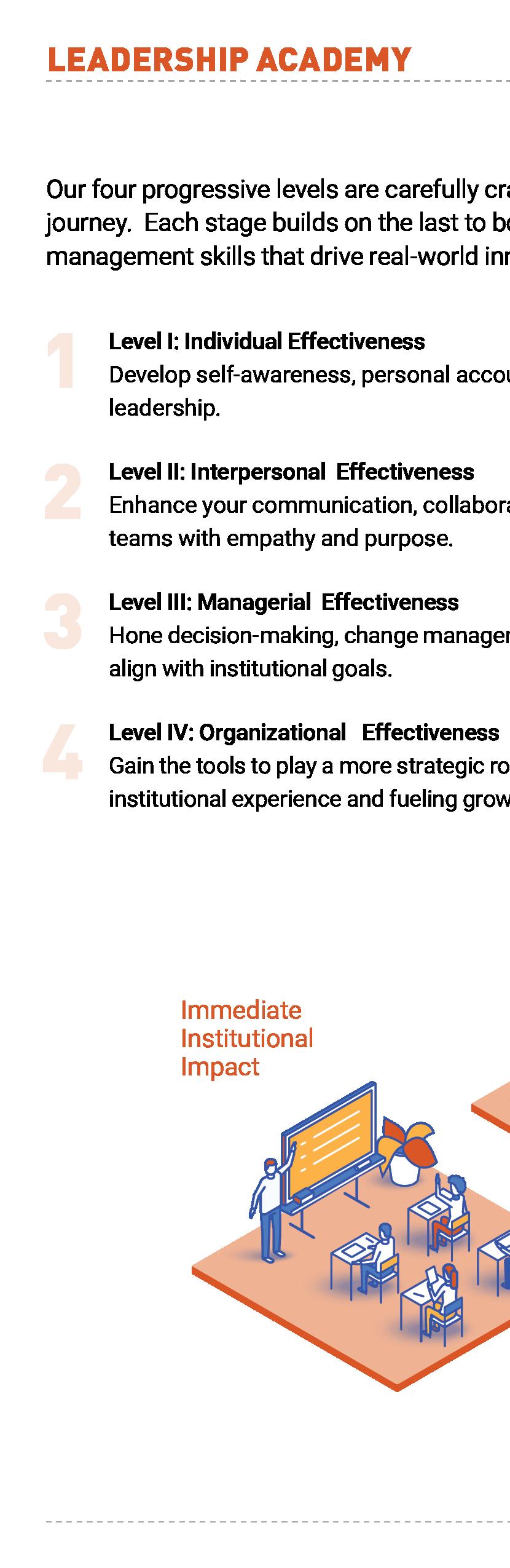
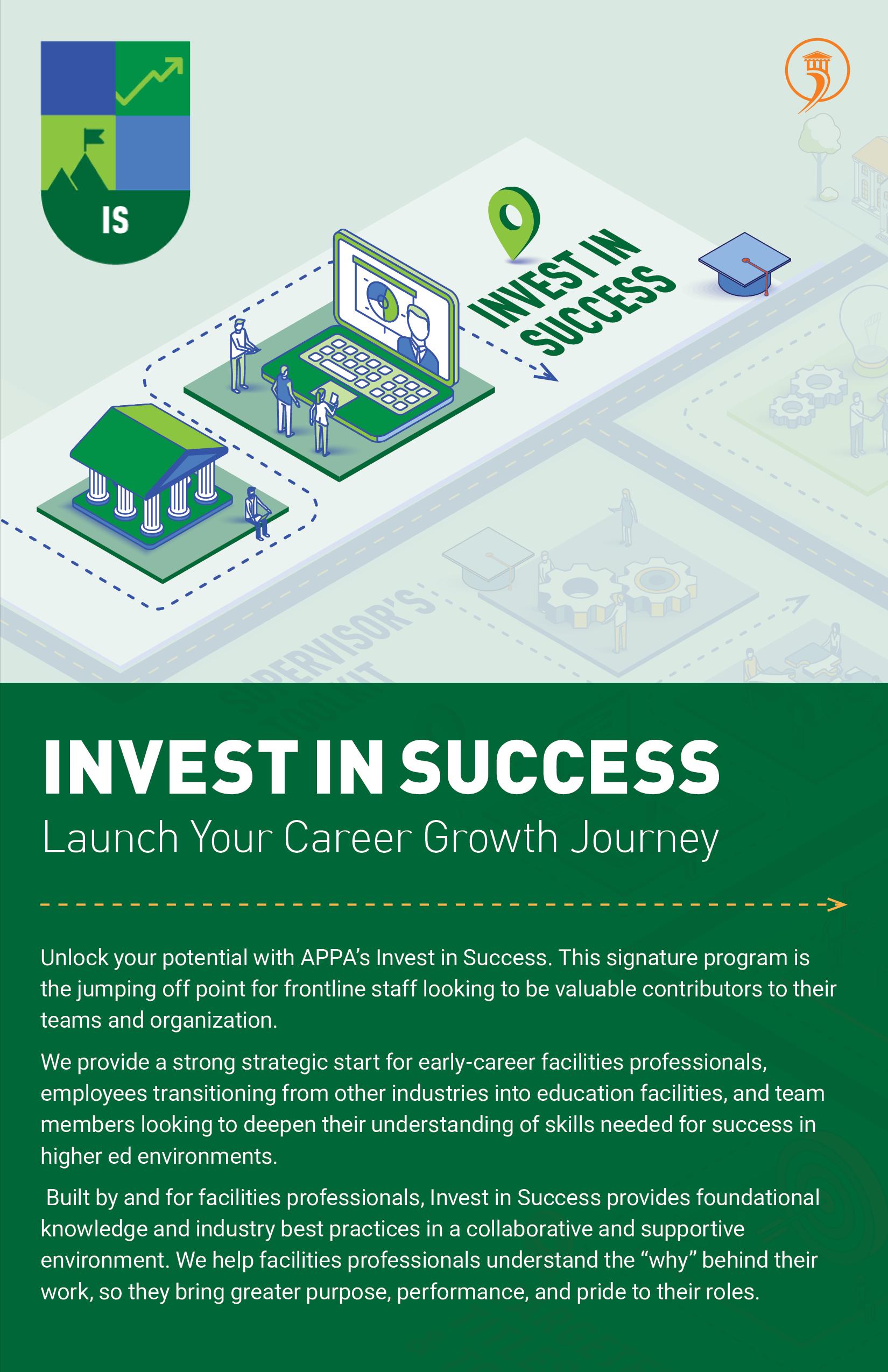
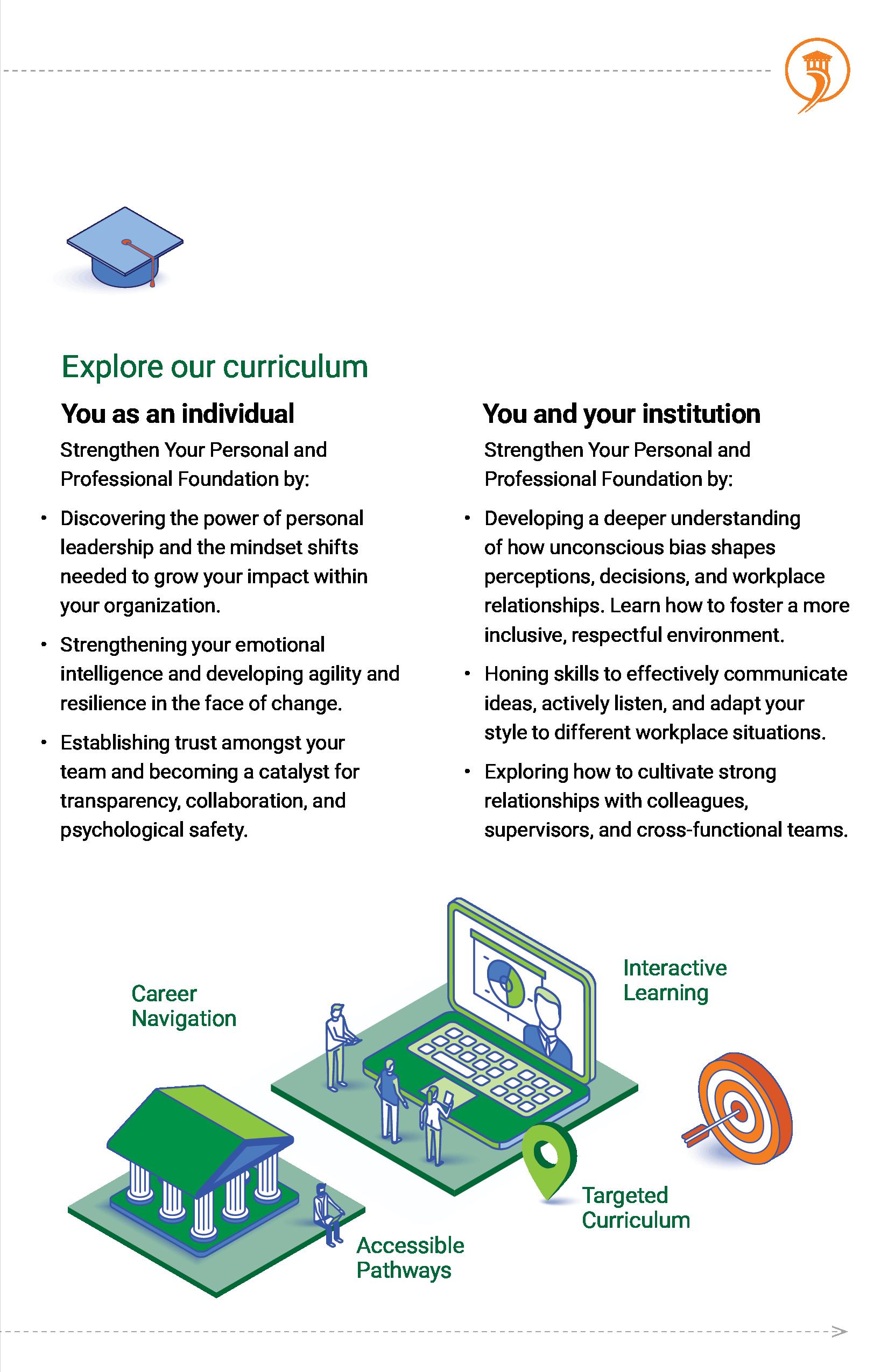
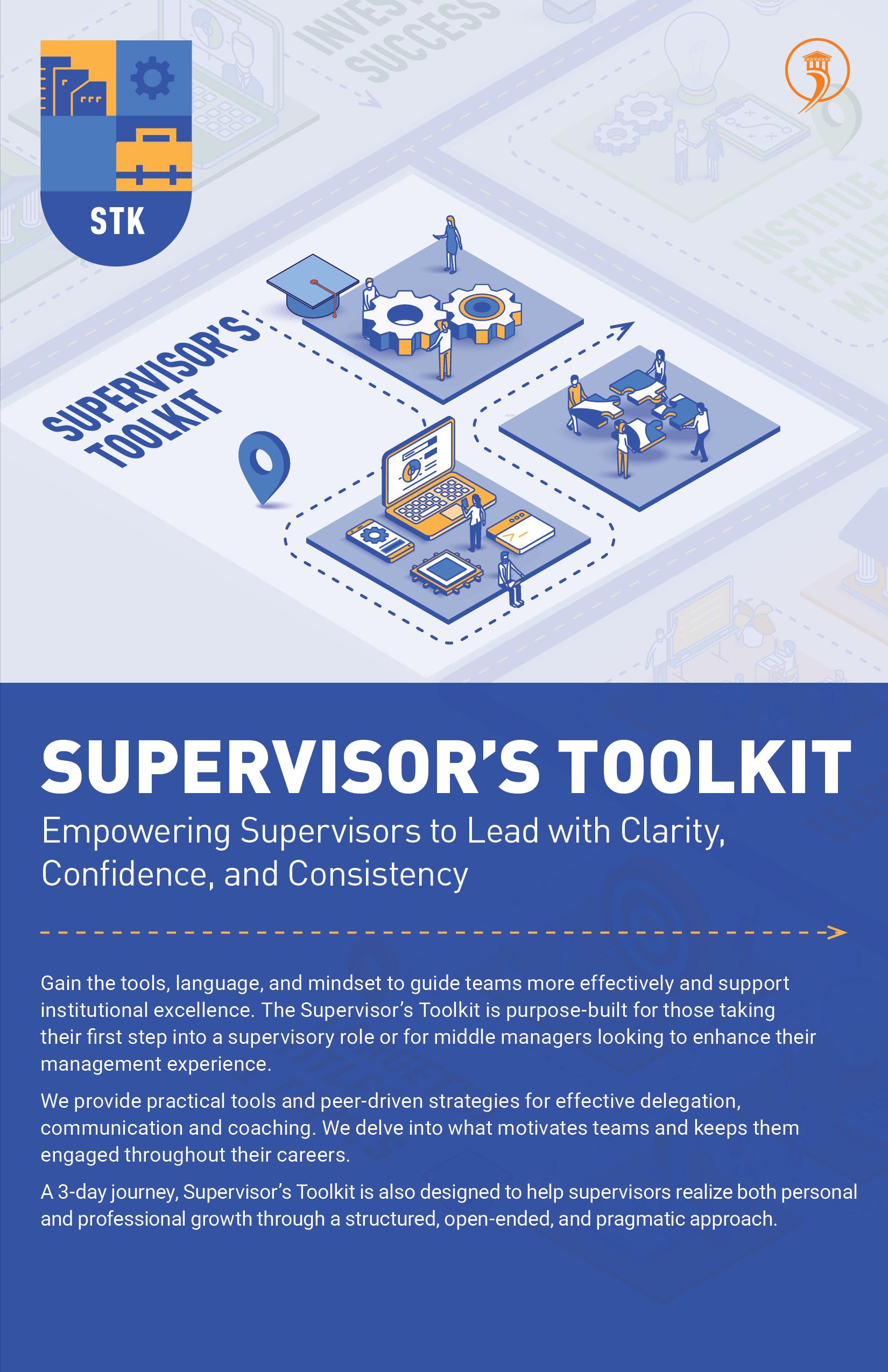
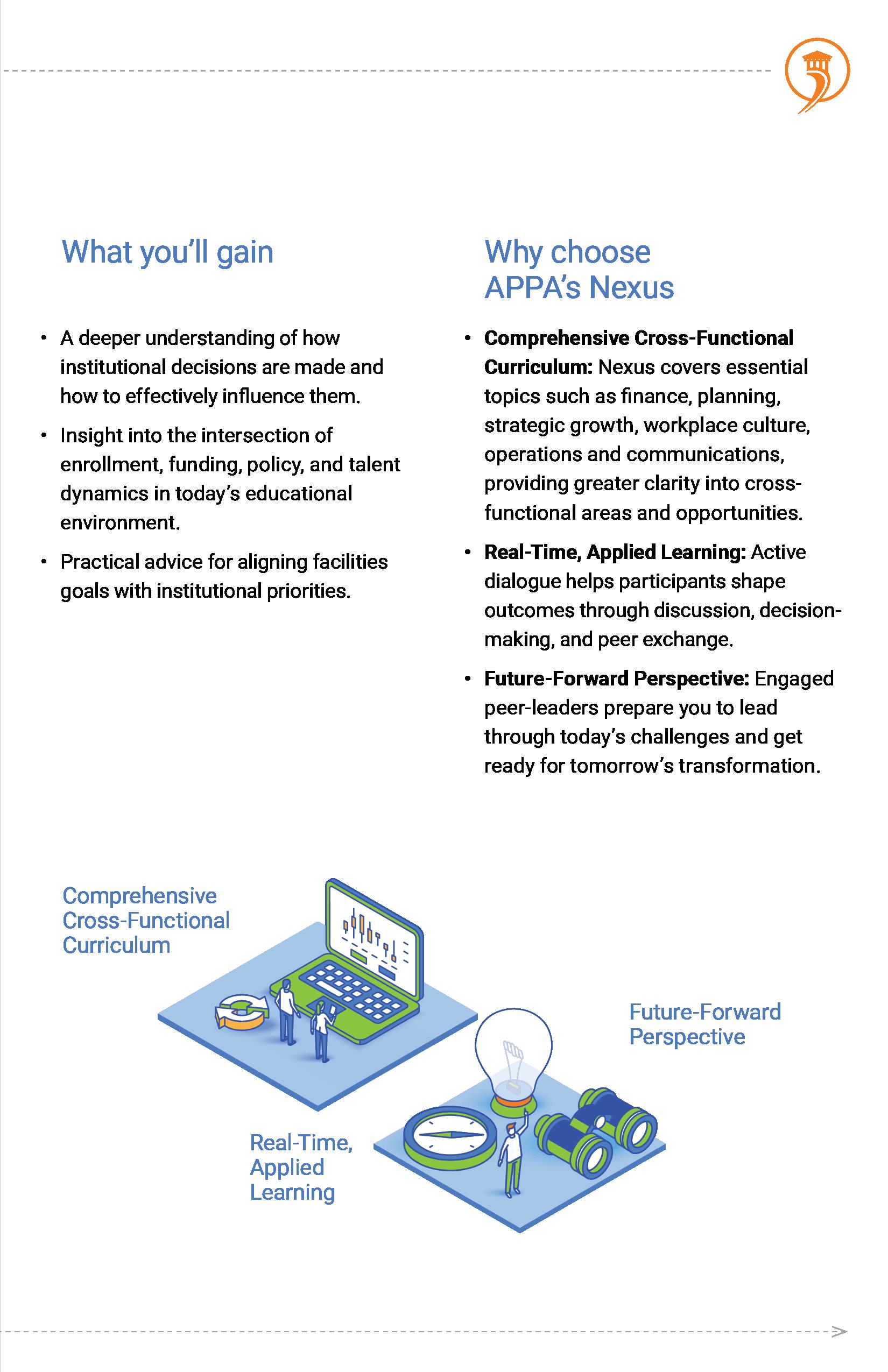

Membership Facts
Institutional Membership
Includes full-year access for all employees at your institution.
Included Benefits
Professional Development
• Discounted event registration (e.g., APPAU, Annual Conference)
• Discounted programming (e.g., Leadership Academy, Institute for Facilities Management)
Access to Supervisor’s Toolkit and Invest for Success programs
• Discounted CEFP certification
Publications & Resources
• Subscription to Facilities Manager magazine
InsideAPPA newsletter
• Access to Supervisor’s Toolkit and Invest for Success programs
• Access to APPA Whitepapers
Full access to APPA Body of Knowledge (BOK)
• Free APPA-hosted Webinars and Town Halls
• Discounted Bookstore Purchases
• Access to CEFP certification study materials
Career & Networking
Job Express postings and searches
• Volunteer opportunities and leadership roles
• Industry benchmarking data and tools
• Policy resources for regulatory updates
APPA Community
Membership Updates
APPA has adopted a rolling renewal system, meaning your membership renewal date aligns with your institution’s prior renewal cycle. If you would like to change your renewal date, please contact our membership team.
In 2025, the APPA Board of Directors approved a 3% dues increase to adjust for inflation. Some institutions may see adjustments based on updated IPEDS data reflecting enrollment and expenditure changes. Use our Membership Dues Calculator to confirm your institution’s dues.
Membership Support
Email us at membership@appa.org
Learn more at www.appa.org/membership/
Membership Facts
Included Benefits
Discounted event registration
• Access to APPA’S Membership Directory
• Discounted advertising rates
• Discounted bookstore purchases Access to APPA Body of Knowledge (BOK)
• Discounted whitepaper publishing on the APPA website • Discounted CEFP
• APPA-hosted webinar opportunities
• Social Media Spotlight (ranging from $500 to $150 based on the
• Sponsorship and exhibitor opportunities with tiered discounts Increased visibility with education facilities decision-makers
• Thought leadership through Facilities Manager magazine and
webinars
more at www.appa.org/business-partner-membership/ Membership Tiers
Join us at APPAU FEBRUARY
Monday, February 2, 2026 to Thursday, February 5, 2026 at the Renaissance Phoenix Downtown Hotel
APPAU is APPA’s premier professional development opportunity—offering multiple training courses together at a single location.
Spend 3-days attending one of APPA’s signature training programs: Institute for Facilities Management or Leadership Academy — both are long-standing and highly successful programs that expand students’ facilities management acumen and leadership skills. Both programs include full days of classes Tuesday through Thursday.
APPAU offers the convenience of both educational opportunities in one location with teaching faculty from across the country to help students envision the full spectrum of the facilities management profession. APPAU’s reputation for preparing facilities management professionals and their teams with the tools to meet competing priorities and deadlines within budget constraints and sustainability goals makes it a valuable educational experience. Students attending the APPAU 3-day program will choose one of the Institute for Facilities
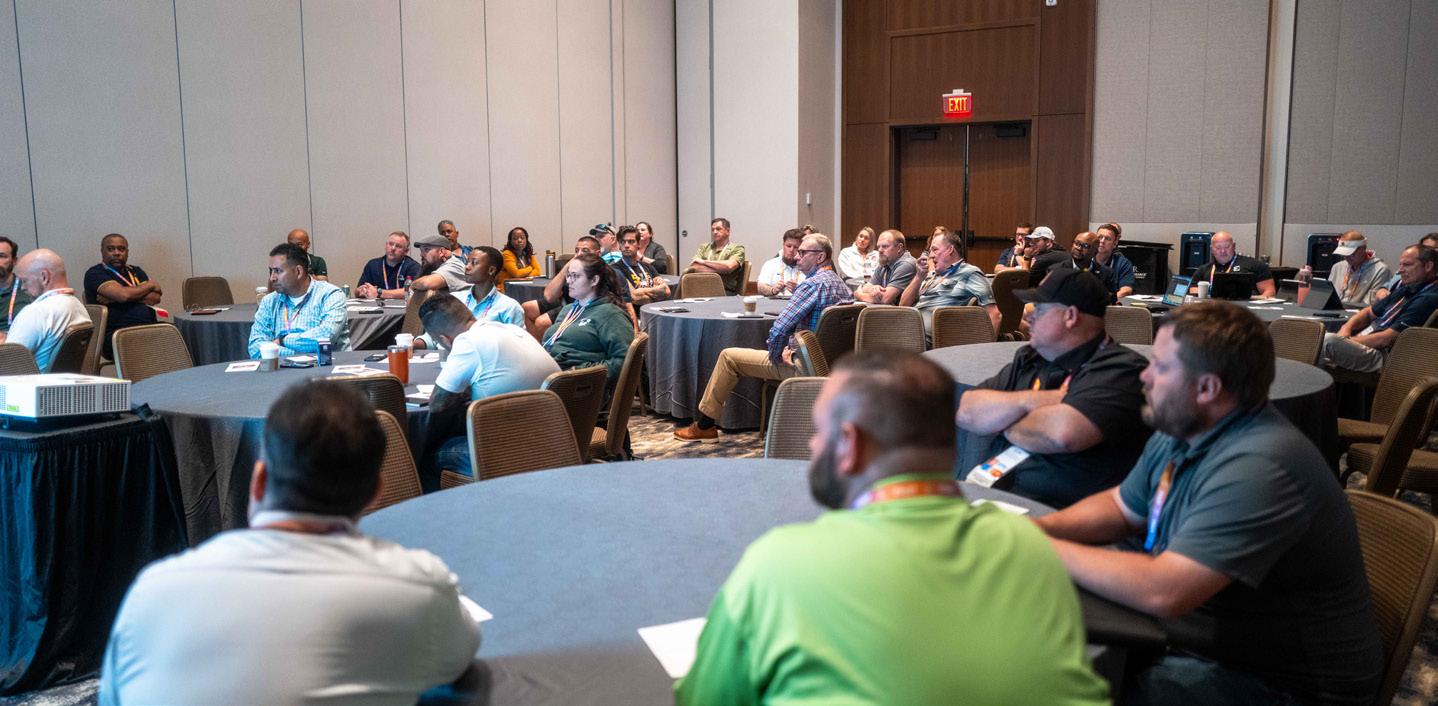
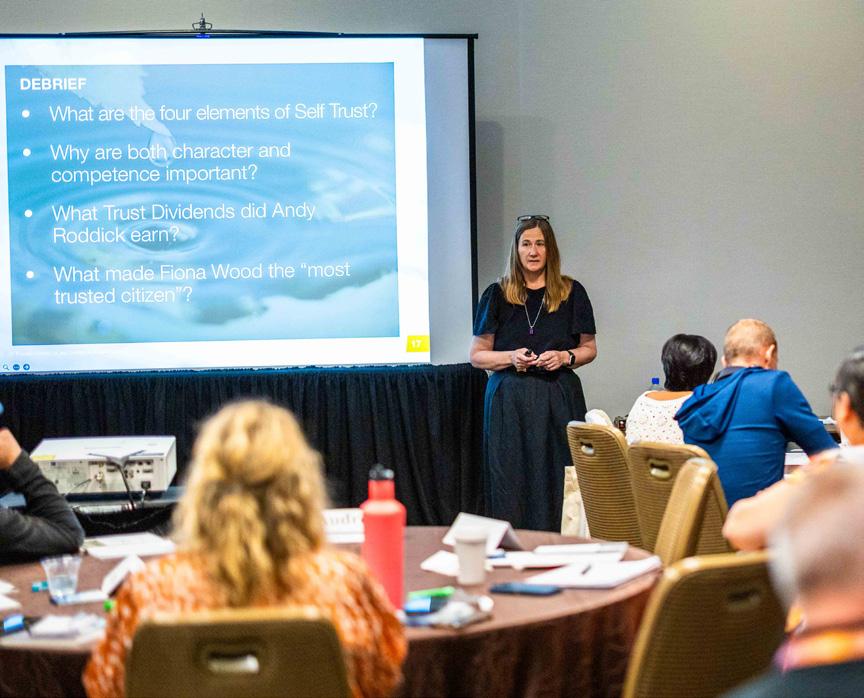
Management core tracks or one of the Leadership Academy levels to attend throughout the 3-day event.
In APPA’s Nexus program, senior facilities leaders participate in an interactive 2-day program designed to explore the complex landscape of budgeting and financial decision-making in higher education. This program is perfect for professionals who have completed the Institute for Facilities Management program or are looking for a rich learning
environment focused on executive decision-making in facilities management. The Nexus program runs Tuesday and Wednesday.
For more information on programs, pricing and registration visit www.appa.org.