Chair
Charles A. Bittenbender
Chair emeritus
James B. Rosenthal
Vice Chair
Michael J. Meehan
Noha Ryder
Treasurer
Ryan Siebel
Assistant Treasurer
Meng “Locky” Liu
Secretary
Andrew Gordon-Seifert
Jeffrey P. Barnett
Karl Bekeny
Amy K. Carlson
Thomas Clark*
Patricia Costante
Nicole Divall**
Ka-Pi Hoh, Ph.D.
Thomas Forrest Kelly, Ph.D.
Richard J. Lederman, M.D. Ph.D.
John Olejko
Linda M. Olejko
Shay Olson
Kim S. Parry
William A. Powel
David J. Reimer
Phillip Rowland-Seymour
Elisa Ross, M.D.
Jeannette Sorrell*
Kathie Stewart**
Rebecca Storey
Herb Wainer
David Walker*
Ed Weber, D.O.
Apollo’s Fire Chicago
Elisa Ross M.D.
President
Katrina Pipasts
President Emeritus
Doug Miller
Vice President
Patricia (“Patti”) Skigen
Secretary
Shay Olson
Treasurer
Michael Angell
Charles A. Bittenbender
24 - 26
Stephanie Champi
Patricia Costante
Blondean Davis, Ed.D.
Marietta McPike
Michael J. Meehan
Florence Nelson
Carlos E. Romero
Phillip Rowland-Seymour
Marlon Rucker
James C. Sheinin, M.D.
Jeannette Sorrell*
David Walker*
Community Advisors
Rodrigo Lara Alonso
Nathália Montezuma
Dianna White-Gould
Akron Advisory Board
Thomas Clark, chair
Theron Brown
Esther Cooper
Susan Delahanty
Barbara Feld
Ashlee Foreman
Bill Foster
Walter Keith
Geraldine Kiefer
George Litman, M.D.
Kenneth Shafer, M.D.
Sandra R. Smith
Libby Upton
The Ambassadors Council
Mitchell G. Blair
Frances E. Buchholzer
Robert Conrad
William E. Conway
Samuel S. Hartwell
Vivian Henoch
Rabbi Roger C. Klein
Annette Lowe
Deborah H. Nash
Robert Reynolds, M.D.
Allison Richards
Kasia G. Rothenberg, M.D.
Sandra R. Smith
Susan Troia
Edward Weber, D.O.
*ex officio
**Musicians’ Representative
FENCING MATCH: Apollo's Fire vs. The Brits!
Friday, April 24, 7:30pm - St. Martin-in-the-Fields, London
Sunday, April 26, 7:00pm - Snape Maltings, Aldeburgh
A musical duel between Apollo's Fire and members of the world-renowned English Baroque Soloists.
BAKLAVA BASH: A Middle Eastern Celebration (Late-Night Bistro Concert in the Crypt)
Friday, April 24, 10:00pm - St. Martin-in-the-Fields, London
Israeli recorder virtuoso Daphna Mor and Palestinian-American oud master Ronnie Malley join friends Alan Choo, Emi Tanabe, and Tina Bergmann to evoke a Middle Eastern café in 1700.
O JERUSALEM! Crossroads of Three Faiths
Saturday, April 25, 7:30pm - St. Martin-in-the-Fields, London
The troupe of 26 international artists brings Jeannette Sorrell's acclaimed program to London's most beautiful baroque venue.
Jeannette Sorrell, harpsichord & direction
Kathie Stewart, flute
Daphna Mor, recorder
Alan Choo, Freya Creech, Carrie Krause, & Emi Tanabe, violins
Thurday, April 16, 7:30pm
Avon Lake United Church of Christ
ANTONIO VIVALDI (1678-1741)
Allegro from Concerto Grosso in D Major, RV 564
GEORG PHILIPP TELEMANN (1681-1767)
Concerto in E minor for Recorder and Flute, TWV 52:e1
Largo – Allegro – Largo – Presto
Daphna Mor, recorder | Kathie Stewart, traverso
JOHANN SEBASTIAN BACH (1685-1750)
Concerto in D minor for Two Violins, BWV 1043
Vivace – Largo ma non tanto – Allegro
Alan Choo & Freya Creech, violins
MARIN MARAIS (1656–1728)
Suite from Alcione
Chaconne – Tempête – Marche des Matelots
VIVALDI
Concerto in A minor for 2 Violins, RV 522
Allegro – Larghetto e spiritoso – Allegro
Alan Choo & Carrie Krause, violins
VIVALDI, arr. Jeannette Sorrell (b. 1965)
La Folia (“Madness”)
Alan Choo & Emi Tanabe, violins
‘Fencing’
Jeannette Sorrell
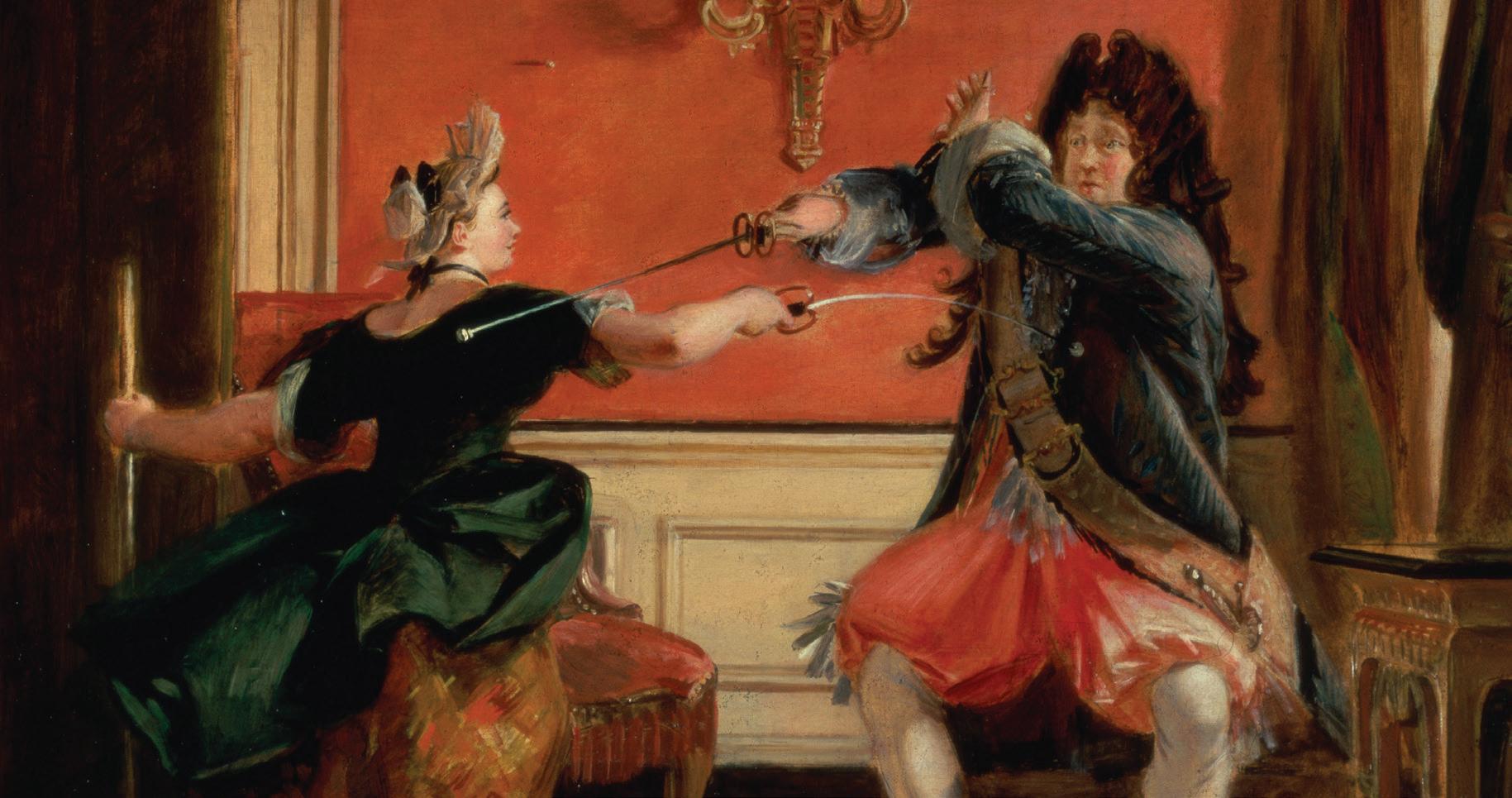
In the 18th century, the art of fencing began to transition from a selfdefense skill to a more refined, genteel recreation. Thrusting techniques, as taught in the aristocratic fencing schools of France, emphasized grace, posture, and elegance. In fact, young women began to practice this skill as well as men.
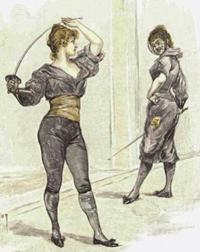
The etiquette of the fencing schools fostered a culture of courtesy and friendship. Swearing, drinking, smoking, and mocking other students was strictly prohibited. Gloves were required. Before engaging in a drill with another student, or before an assault, the students performed a reverence/salute to each other and anyone who may have been watching. This obligatory salute was intended to show respect to the adversary. It is striking (no pun intended) how much this stylized etiquette resembles the musical genre of 18th-century double-concertos. As developed by J.S. Bach, Telemann, and Vivaldi, these concertos showcase two soloists engaged in dramatic and rhetorical dialogues (often in the first movement of a concerto), gentle conversations (in slow movements), and fiery, spirited arguments (fast movements). The spirit of friendly competition reigns as the two soloists challenge each other to fierce feats of virtuosity in one moment, and then in the next, offer a graceful hand in courtesy. One can easily imagine a soloist shouting “en garde!” before launching into the third movement.
Bach and Telemann were close friends, despite the inevitable competition between them. They also shared an admiration for their renowned colleague to the south, Antonio Vivaldi. Our program brings these three mutual admirers together in an evening that highlights their thrilling contributions to the double-concerto genre.
Bach and Telemann seem to have met when both were in their 20’s. In 1714, Telemann became godfather to Bach’s son Carl Phillip Emmanuel. Bach paid tribute to Telemann by transcribing and performing his music. Though Telemann was four years the elder, he was definitely the more trendy and forward-looking of the two composers. His sense of musical humor, lightness, and use of folk elements greatly endeared him to the public. In fact, Telemann received four times as much space in 18th-century German music encyclopedias as Bach did.
The composer whose music Bach most often studied and transcribed was Antonio Vivaldi. There is no surviving record of any meeting between Bach and Vivaldi, but Bach’s admiration for Vivaldi must have been very great. He arranged at least seven of Vivaldi's violin concertos into keyboard pieces.
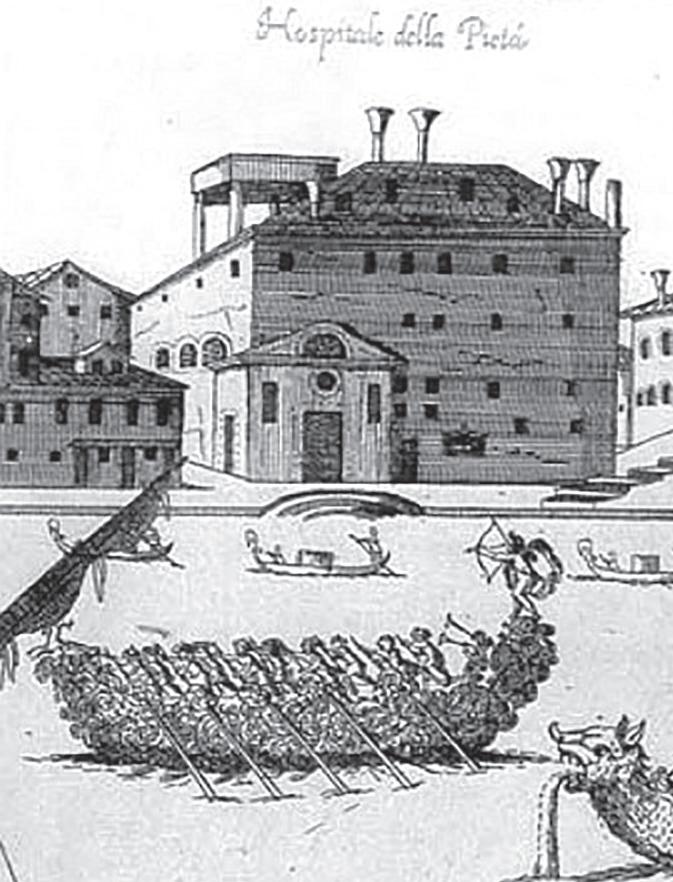
Vivaldi was considerably more famous than Bach during the first half of his career. As music master at the prestigious Ospedale della Pietà in Venice (a special school for orphaned girls and illegitimate daughters of the nobility, with an extraordinary emphasis on music), Vivaldi attained great honor throughout Europe. Tourists from as far as England flocked to Venice to attend the concerts of the "redhead priest" and his girls. By 1725, Vivaldi was celebrated throughout Europe.
Vivaldi served as music-master to the top-level orchestra of the orphanage – the showcase ensemble. In this role, he composed about 500 concertos for his young female protégés. In writing these concertos for the Pietà orchestra, Vivaldi was the great developer of ritornello form – the form that became the model for concerto-writing by all European composers of the century, including Bach. The Italian word “ritornello” means something that returns. The same word is used to mean the refrain in pop music – and indeed, Vivaldi’s ritornellos convey the bold and driving sense of rhythm that is more commonly associated with pop music. Like pop composers today, Vivaldi was writing for teenagers.
The Allegro from Vivaldi’s Concerto Grosso in in D Major sets the stage for our musical fencing evening, as Vivaldi provides fiery solo/duo writing interwoven with a spirited ritornello.
We then move to Telemann’s Concerto in E Minor for Flute & Recorder. The opening Largo is, in my view, a free and expressive prelude, where the two soloists get acquainted in a gentle conversation. This bursts into a fiery, fugal Allegro, with virtuoso episodes for the two soloists alternating with bold orchestral statements. The folk-inspired Presto (finale) reflects Telemann’s 3-year stint at the court of a Polish count, where summers were spent in the Polish countryside. There, Telemann became acquainted with the folk music of Polish peasants and developed a love for its “barbaric beauty.” The drone bass in this rustic movement suggests outdoor musettes or bagpipes, bringing this concerto to a raucous conclusion.
As with most of Bach’s concertos, the ever-popular Concerto for Two Violins had most likely been written for Cöthen, but Bach revived it for the Leipzig Collegium. The dramatic dialogue of the first movement and the red-hot finale show the influence of Vivaldi in their fiery ritornellos. The serene Adagio in F major is a gentle conversation between the two soloists, like two old friends.
Vivaldi's Concerto in A Minor for Two Violins is a dramatic and eloquent conversation between two soloists – almost operatic in its emotional range. The second movement evokes a mystical ambiance: a repeated ground-bass pattern begins with all strings in unison, then moves into the upper strings as a repeating mantra while the two soloists weave a celestial conversation around it.
Marin Marais studied composition with Lully and often conducted his teacher’s operas, while also achieving a reputation as a virtuoso viol player. Alcione premiered in 1706 at the Théâtre du Palais-Royal in Paris, and is well known today particularly for its inventive orchestral writing. The graceful Chaconne harks back to
the Lully’s influence, and ends the entire opera on an optimistic note. The Act IV tempest scene is widely regarded as one of the earliest portrayals of a storm in opera, and takes place as Alcione dreams of the evil fate awaiting her beloved Ceyx. The Marche des Matelots (Sailor’s March) from Act III draws its tune from an ancient French carol, known today most widely as “Masters in This Hall.” We close the program with my arrangement of Vivaldi’s trio sonata, La Folia (“Madness”). The traditional folia tune and dance served as inspiration for Vivaldi as well as several other baroque composers (Corelli, Marias, Geminiani, and C.P.E. Bach.) Scholars believe that the dance originated in Portugal, where young girls would engage in the “folly” or “madness” of a wild dance around the fire. The folia is a triple-meter ground bass, beginning in a haughty sarabande-like rhythm and traditionally growing faster and faster toward the end. The tune is full of the dramatic tension of courtship and seduction. Vivaldi’s version of La Folia, which I believe is the finest of them all, was originally a trio sonata; I arranged it as a concerto grosso so that all of us could join in the fray.
© Jeannette Sorrell, Cleveland, 2026
For further reading: The Historical Fencer: Etiquette in the 18th-century Fencing Schools https://historicalfencer.com/etiquette-in-the-18th-and-19th-century-fencing-schools-part-i-18th-century/
7 programs brought to your doorstep in Northeast Ohio. Full details will be available soon – visit apollosfire.org or call 216.320.0012 to make sure you are on our mailing list!
OCT Ben Franklin in Paris - Music that was performed in Paris during Franklin's 9-year stay including works by Mozart, Bologne and Rameau.
NOV Vivaldi's Four Seasons rediscovered – The storylines of Vivaldi’s masterpiece come to life with joy and surprises!
Echoes across the Atlantic (SPECIAL EVENT) – Legendary Trinidadian soprano Jeanine De Bique joins Apollo's Fire.
DEC Handel's Messiah – Apollo's Fire's dramatic interpretation of Messiah, filled with spirituality and musical storytelling.
JAN Fiddle Virtuosity from the Pubs of Old London – Virtuoso violinist Alan Choo and friends invite you on a delightful romp.
MAR Bach's St. Matthew Passion – Apollo’s Fire and Jeannette Sorrell are thrilled to return to Bach’s masterpiece on its 300th anniversary.
APR Vivaldi on Fire – Francisco Fullana and Apollo’s Fire set sparks flying with virtuoso concertos, including the famous “Il Grosso Mogul.”
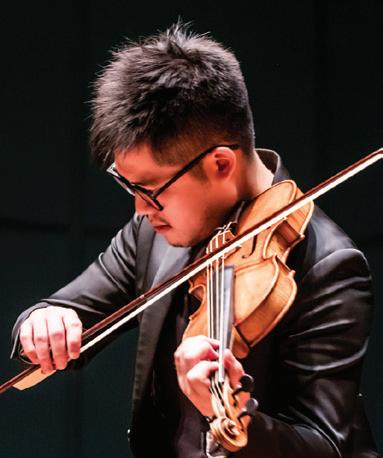
Violinist ALAN CHOO
“was a dynamo, delivering lines with panache. He exemplified virtuosity” (Cleveland Plain Dealer). The Concertmaster and Associate Artistic Director of Apollo’s Fire, he made his solo debut with the ensemble at the Tanglewood and Ravinia Music Festivals in 2017. His solo album of Biber's Mystery Sonatas with Apollo’s Fire was released on AVIE Records in 2024 and debuted at #2 on the Billboard Classical chart, earning a double 5-star review from BBC Music Magazine, and receiving rave reviews from The Strad (UK) and Classica Magazine (France). Alan is also Founder and Artistic Director of Red Dot Baroque, Singapore’s first professional baroque ensemble and Ensemble-in-Residence at the Yong Siew Toh Conservatory. As a soloist, he has appeared with the FVG Orchestra (Italy), St. Petersburg Symphony Orchestra, Singapore Symphony Orchestra, Singapore Chinese Orchestra, Tafelmusik Winter Institute Orchestra, and more. He holds a Doctorate in Historical Performance Practice from CWRU.
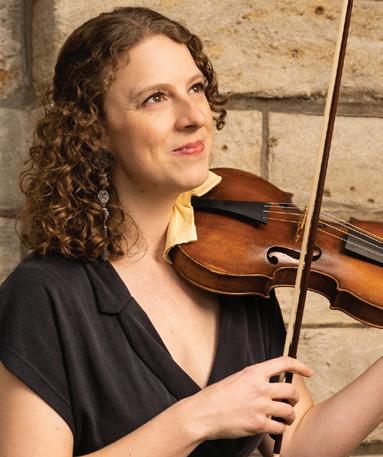
FREYA CREECH, violin, performs widely across North America and her native UK. This season includes appearances with Opera Lafayette, Apollo’s Fire, The Thirteen, and as Principal Second Violin with Washington Bach Consort, and she also plays regularly with the Smithsonian Chamber Academy on their renowned collection of Strads. Freya collaborated with True Concord Voices & Orchestra on their most recent record, which earned a GRAMMY® nomination (2025) and she has also produced two albums of little-known solo violin music.
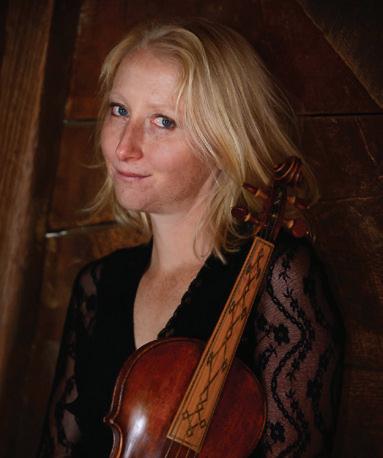
CARRIE KRAUSE, violin, performs with ensembles across the country and on international series. She has appeared as concertmaster and soloist with Seattle Baroque, Juilliard 415, New Trinity Baroque, Pacific Baroque, and the San Francisco Bach Choir, as well as principal with The Thirteen in D.C., Oregon Bach Festival, and Spire in Kansas City. Carrie is concertmaster of the Bozeman Symphony and founder of Baroque Music Montana. She holds degrees from Carnegie Mellon, Cleveland Institute of Music, and The Juilliard School.
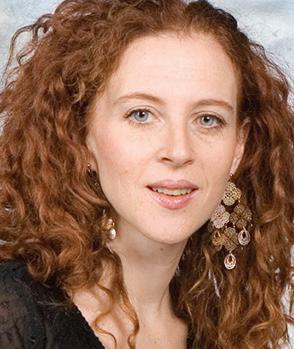
DAPHNA MOR, recorder, is an Israeli-American baroque musician and a specialist in music of the Jewish diaspora. Known for her “astonishing virtuosity” (Chicago Tribune), she has appeared as soloist with Apollo’s Fire, the New York Collegium, the New York Early Music Ensemble, and as a guest member of the New York Philharmonic. She has also appeared in a duo with Joyce DiDonato on the singer’s tour In War and Peace. As a performer and teacher of Jewish liturgical music, Ms. Mor serves as the Music Director of Beineinu, a New York initiative dedicated to the modern cultivation of Jewish culture. She is also co-director of the ensemble East of the River with Nina Stern. Their latest album IJA MIA, Music of the Sephardic Diaspora, was released in 2024 on AVIE records. She can be heard on Sting’s album If on a Winter’s Night for Deutsche Grammophon, and on O Jerusalem! with Apollo’s Fire on AVIE.
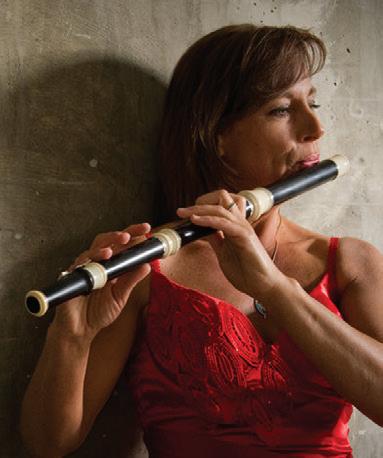
KATHIE STEWART, traverso, is Curator of Historical Keyboard Instruments and Teacher of Baroque Flute at the Indiana University Jacobs School of Music. She is a founding member and principal flutist of Apollo’s Fire, and has performed with ensembles including The Cleveland Orchestra, Tafelmusik, Portland Baroque, Philharmonia Baroque and the Washington Bach Consort. She is also Assistant Director of the Seattle Baroque Flute Workshop. Kathie is an avid proponent of Celtic music, playing Irish flute and whistle on several Apollo’s Fire recordings.
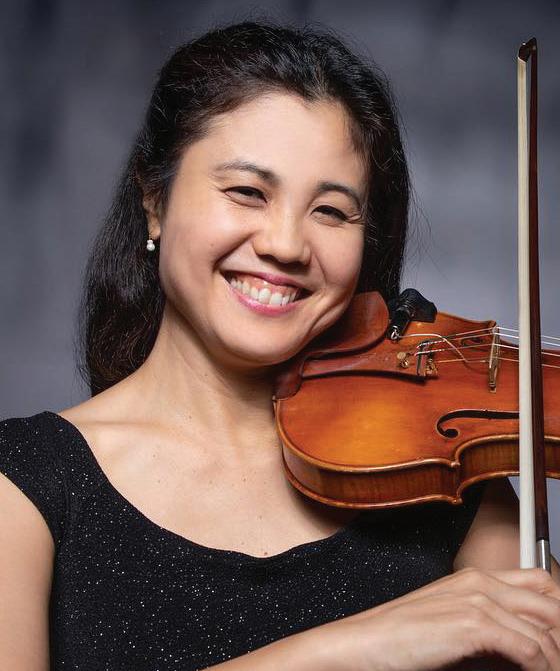
EMI TANABE, violin, enjoys a multi-faceted career as a baroque violinist and a solo crossover artist. In addition to being a core member of Apollo's Fire, she performs with the Chicago-based period group Haymarket Opera. With Apollo's Fire, she has performed on tour across the U.S. and Europe. Her facility with world music styles and improvisation has led to many solo violin performances with Tango, Flamenco, Celtic, and jazz ensembles across the country. She has appeared with such groups as the renowned Surabhi Ensemble, the GRAMMY®-nominated children’s music band Wendy&DB, and the dinner theatre production “Teatro ZinZanni." Emi is a native of Japan and holds degrees in violin performance from the University of North Texas and Roosevelt University.
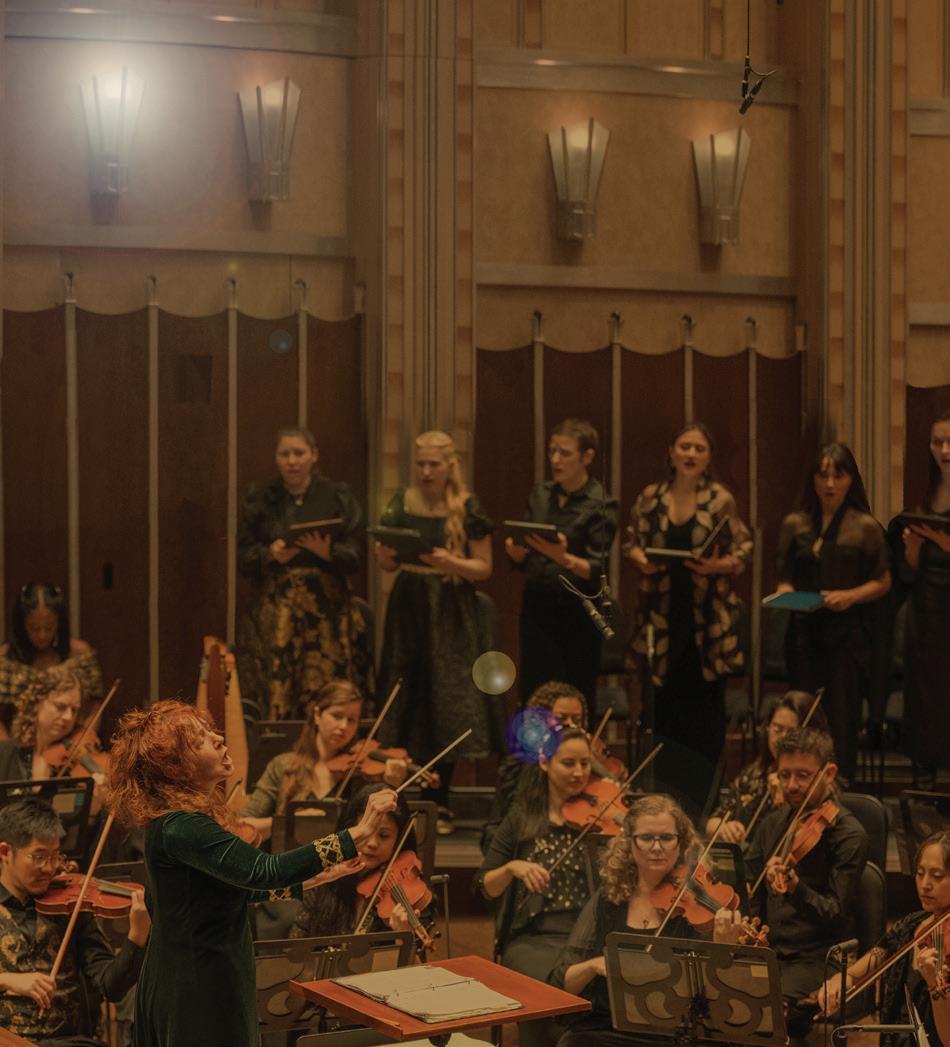
APOLLO’S FIRE invites you to its annual gala INCANDESCENCE
Hosted by Gala Chair David Reimer
Honoring Herb & Jody Wainer
SUNDAY, MAY 31
THE TUDOR ARMS HOTEL 10660 CARNEGIE AVENUE
For more information visit apollosfire.org/cleveland-gala or call 216.320.0012 x 3.
JEANNETTE
Artistic Director, Conductor & Harpsichordist
“Sorrell is an absolute dynamo onstage and a pleasure to see conduct... a force to be reckoned with.”
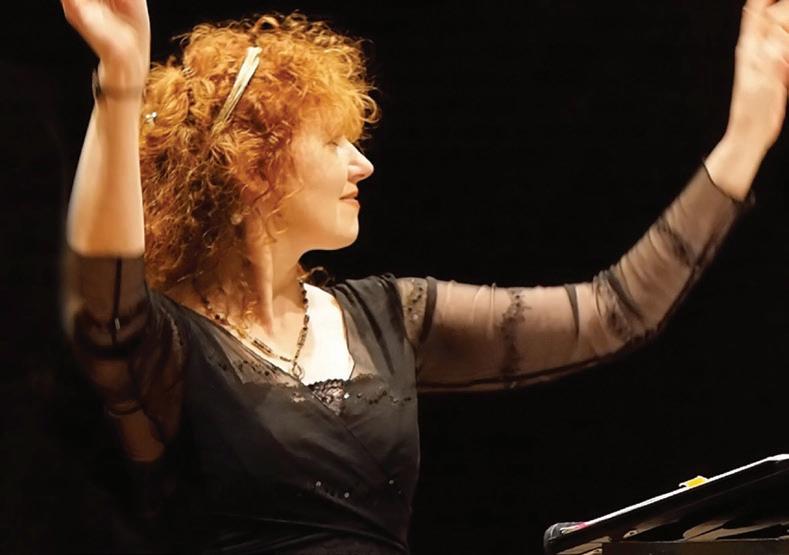
GRAMMY®-winning conductor Jeannette Sorrell is recognized internationally as one of today’s most compelling interpreters of Baroque and Classical repertoire. She is the subject of Oscar-winning director Allan Miller’s documentary, PLAYING WITH FIRE: Jeannette Sorrell and the Mysteries of Conducting, commercially released in 2023.
Bridging the period-instrument and symphonic worlds from a young age, she studied conducting under Leonard Bernstein, Roger Norrington and Robert Spano at the Tanglewood and Aspen music festivals; and studied harpsichord with Gustav Leonhardt in Amsterdam. She won First Prize in the Spivey International Harpsichord Competition, competing against over 70 harpsichordists from four continents.
As a guest conductor, Sorrell has led the New York Philharmonic three times since her acclaimed debut there in 2021. She has repeatedly conducted the Pittsburgh Symphony, St. Paul Chamber Orchestra, Seattle Symphony, Los Angeles Chamber Orchestra, Philharmonia Baroque in San Francisco, and New World Symphony, among others; and has also led the Philadelphia Orchestra, Royal Scottish National Orchestra, Royal Liverpool Philharmonic, Festival Orchestra of Lincoln Center (NYC), Baltimore Symphony, the National Symphony at the Kennedy Center, Houston Symphony, Indianapolis Symphony, New Jersey Symphony, Royal Northern Sinfonia (UK), and the Orchestra of St. Luke’s at Carnegie Hall, among others. Her 2025-26 schedule included return engagements with the New York Philharmonic, Detroit Symphony, and Indianapolis Symphony, as well as debuts with the Manchester Hallé Orchestra (UK) and the Oregon Symphony.
As founder and conductor of APOLLO’S FIRE, she has led the renowned ensemble at London’s BBC Proms, Carnegie Hall, and many international venues. Sorrell and Apollo’s Fire have released 34 commercial CDs, including 13 bestsellers on the Billboard classical chart and a 2019 GRAMMY® winner. Her CD recordings of the Bach St. John Passion and Vivaldi’s Four Seasons have been chosen as best in the field by the Sunday Times of London (2020 and 2021). Her Monteverdi Vespers recording was chosen by BBC Music Magazine as one of “30 Must-Have Recordings for Our Lifetime” (2022).
With over 23 million views of her YouTube videos, Sorrell has attracted national attention and awards for creative programming. She received an honorary doctorate from Case Western Reserve University and an award from the American Musicological Society.
“Sorrell and her dazzling period band… are incandescent”
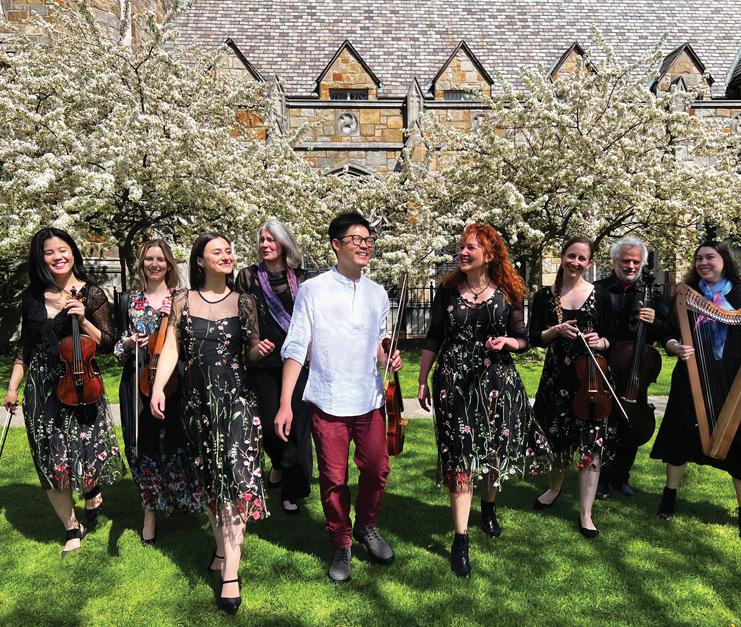
GRAMMY®-winning ensemble
Apollo’s Fire is praised as “the USA’s hottest baroque band” (Classical Music Magazine, UK). Led by award-winning harpsichordist and conductor Jeannette Sorrell, the periodinstrument orchestra is dedicated to the baroque concept of moving the passions of the listeners.
Apollo’s Fire has performed six European tours, with sold-out concerts at the BBC Proms in London, Madrid’s Royal Theatre, Bordeaux’s Grand Théàtre de l’Opéra, St Martin-in-the-Fields, the Heidelberg Spring Festival, the National Concert Hall of Ireland, and venues in Germany, France, Italy, Austria, and Portugal. Chosen by the DAILY TELEGRAPH as one of London’s “Best 5 Classical Concerts of the Year,” Apollo’s Fire’s 2014 London performance was praised for “superlative music-making... combining European stylishness with American entrepreneurialism.”
North American tour engagements include Carnegie Hall (twice), the Tanglewood and Ravinia festivals (several times), the Metropolitan Museum of Art in New York City (several times), the Boston Early Music Festival series, the Aspen Music Festival, Library of Congress, the National Gallery of Art, and major venues in Toronto, Los Angeles, and San Francisco. Apollo’s Singers have twice performed with the New York Philharmonic under the baton of Jeannette Sorrell, winning rave reviews.
At home in Cleveland and Chicago, Apollo’s Fire enjoys sold-out performances at its series, which has drawn national attention for creative programming.
With over 23 million views of its YouTube videos, Apollo’s Fire has released 34 commercial CDs and won a GRAMMY® award in 2019 for the album Songs of Orpheus with tenor Karim Sulayman. Thirteen of the ensemble's CD releases have become best-sellers on the classical Billboard chart, including Vivaldi’s Four Seasons, Monteverdi Vespers, Bach's Brandenburg Concertos, and Sorrell’s crossover programs including Sacrum Mysterium – A Celtic Christmas Vespers; Sugarloaf Mountain – An Appalachian Gathering; Sephardic Journey –Wanderings of the Spanish Jews; and Christmas on Sugarloaf Mountain.
VIOLIN
Alan Choo, concertmaster
Emi Tanabe, principal
Freya Creech
Carrie Krause
Andrew Fouts
*Ann Yu
VIOLA
Elizabeth Hagen, principal
Yaël Senamaud-Cohen
CELLO
René Schiffer, principal
Macarena Sánchez
CONTRABASS
Sue Yelanjian
RECORDER
Daphna Mor
TRAVERSO
Kathie Stewart
THEORBO & GUITAR
William Simms
HARPSICHORD
Jeannette Sorrell
PERCUSSION
Anthony Taddeo
*Young Artist Fellow
ELIZABETH HAGEN, viola, is a graduate of Northwestern University and now enjoys an active career performing on modern and baroque violas in Chicago. She is principal violist of Music of the Baroque, Haymarket Opera and The Callipygian Players. She has performed with Lyric Opera of Chicago, Rembrandt Chamber Players, Chicago Opera Theatre, The Joffrey Ballet, The Newberry Consort and The Chicago Philharmonic. For the past nine summers, she has played with The Grant Park Symphony.
ANDREW FOUTS, violin, has been noted for his “mellifluous sound and sensitive style” (The Washington Post). In 2008, he won the American Bach Soloists’ International Baroque Violin Competition. He is coartistic director of Pittsburgh’s Chatham Baroque and a frequent concertmaster of the Washington Bach Consort. Andrew performs regularly with Apollo’s Fire, Opera Lafayette, Four Nations Ensemble, and Ars Lyrica. His teachers included Charles Castleman at the Eastman School of Music and Stanley Ritchie at Indiana University Jacobs School of Music.
MACARENA SÁNCHEZ, cello, is an award-winning cellist from Spain. She graduated with honors in cello performance by the Professional Conservatory of Music in Madrid and holds degrees in Romantic cello from The Superior Conservatory of Music of Castilla y León and in Baroque cello from The Royal Music Conservatory in Madrid. In 2009 she was recognized for her outstanding performance at the Community of Madrid Music Performance Competition.
RENÉ SCHIFFER, cello, is praised for his "interpretive imagination and patrician command of the cello" (Cleveland Plain Dealer). A native of Holland, he toured internationally with Sigiswald Kuijken's La Petite Bande for 16 years. He has also performed and recorded with the Amsterdam Baroque Orchestra and in over 50 projects with Tafelmusik. As a concerto soloist, he has performed at Carnegie Hall and many international venues. He can be heard on over 40 CD recordings across 6 labels.
YAËL SENAMAUD-COHEN, viola, is recognized for her versatility in a wide variety of musical styles, including modern and baroque viola, baroque violin, and viola d’amore. She is Principal Viola of the South Carolina Philharmonic and of the Jackson Symphony, and has been a member of Apollo’s Fire, Indianapolis
Baroque, and CityMusic Cleveland. She also regularly collaborates with Les Siècles, a period orchestra based in France. She is a graduate of the Conservatoire National de Paris and Peabody Institute.
WILLIAM SIMMS, theorbo & guitar, appears regularly with Apollo’s Fire, The Thirteen, Heartland Baroque, Indianapolis Baroque, The Arcadia Players, and The Washington Bach Consort. He has performed numerous operas and oratorios with such ensembles as The Washington National Opera, Opera Philadelphia, and American Opera Theater. Venues include Carnegie Hall, The Kennedy Center, The Barns of Wolf Trap, Tanglewood, and the National Cathedral. He performed on the GRAMMY®-winning Songs of Orpheus with Apollo’s Fire and Karim Sulayman.
ANTHONY TADDEO, percussion, is a percussionist and composer based in Cleveland. He has studied with world- renowned percussionists such as Jamey Haddad, Kendrick Scott, and Jimmy Cobb. He has toured North America and Europe extensively and his versatility has led him to be featured on over thirty albums with diverse musicians and genres. Amongst film score work, his most recent compositions can be heard in his group, Alla Boara, which seeks to bring recognition to Italy’s richly diverse folk music.
ANN YU, violin, is praised for her “full bodied, rich, and warm tone” (Cleveland.com), and finds limitless inspiration in exploring multiple genres and musical styles in the historical and modern musical worlds, leading her to unique projects with the Poiema Trio and the Caroga Arts Collective, among others. She received her bachelors and masters degrees from the Cleveland Institute of Music studying with Jaime Laredo, Jan Sloman, and William Preucil, and currently studies baroque violin with Julie Andrijeski.
SUE YELANJIAN, contrabass, has performed with many of the leading North American baroque orchestras, including Relic, Tafelmusik, the Handel & Haydn Society, and Chatham Baroque. She has performed at the Carmel Bach Festival, Tanglewood, and Ravinia, as well as the Sturm und Drang Festival in Germany. She attended Oberlin Conservatory and received degrees from the Cleveland Institute of Music and Boston University.