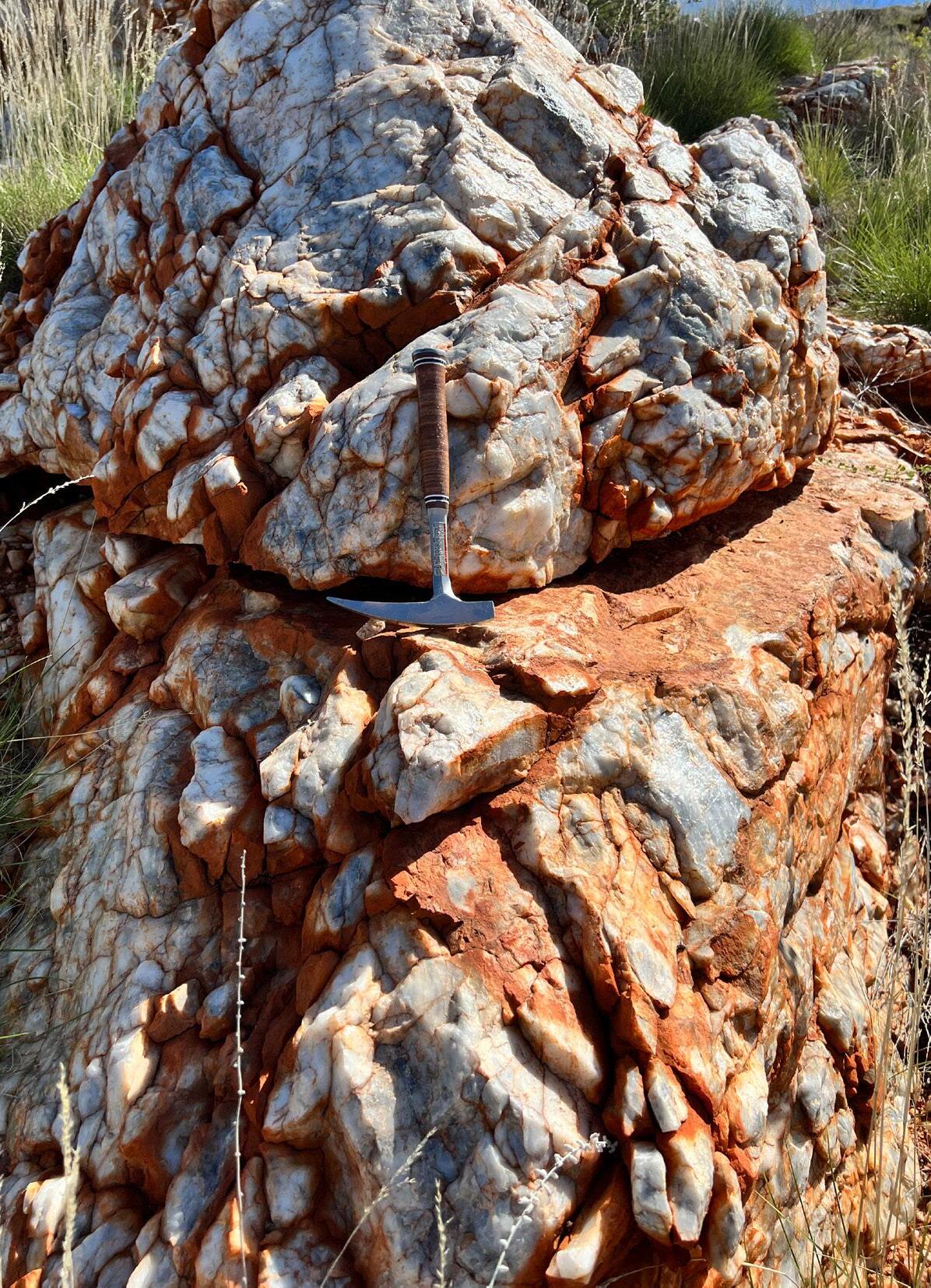
Excellent metallurgical results were achieved from samples at the Lepidolite Hill project Demonstrating an 80.5% lithia recovery to a lepidolite concentrate grading 3.75% Li 2O using a combination of magnetic separation and conventional flotation.
A 1:10 consolidation of capital was carried out to result in a more appropriate and effective capital structure for the Company.
LITHIUM PROJECT
LEPIDOLITE HILL LITHIUM PROJECT
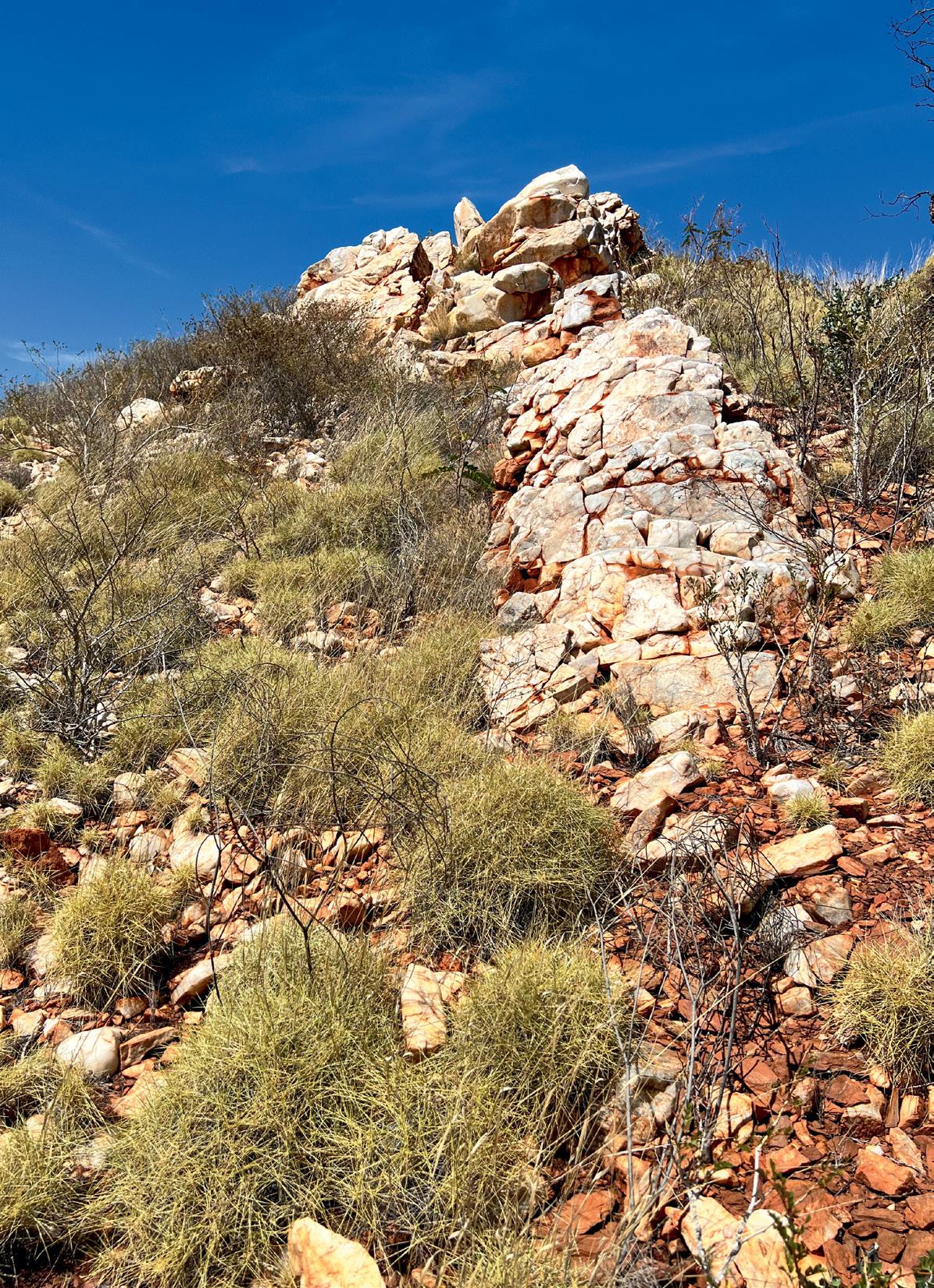
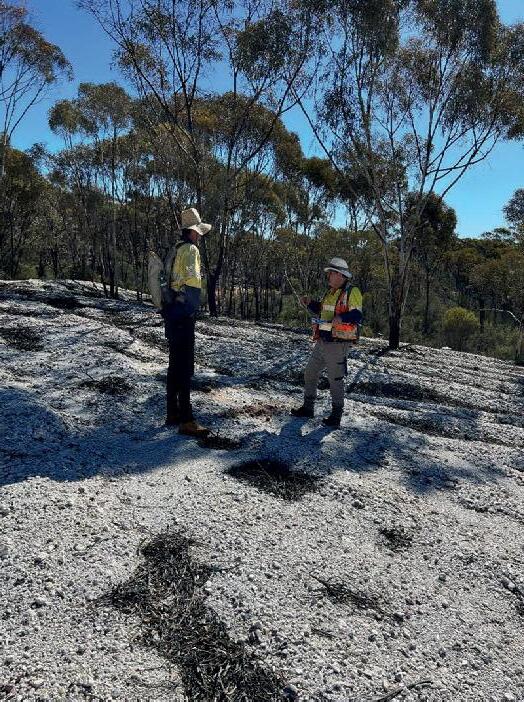
The Lepidolite Hill Lithium Project is within the Coolgardie Domain of the Kalgoorlie Terrane. Post -orogenic granitepegmatites within the district are prospective for lithium, beryl and tantalum - niobium. Lithium-rich pegmatites are common in the Project area.
The Project was a historical old lepidolite and petalite mine in the early 1970’s An exploration drilling program conducted by Lithium Australia Ltd in 2019 discovered further lithium mineralisation at the Project. Pegmatite horizons were encountered in all drill holes and visual lepidolite and/or petalite were recorded in 19 out of the 35 reverse circulation (RC) holes, with an outstanding result of lithium bearing pegmatite grading 18m @ 1.45% Li2O from 5m within drill hole LHRC023 (refer to Company announcement dated 8 May 2023)
In March quarter 2024, the Company completed a drilling program for a total of 37 RC holes for 4,744m with pegmatites recorded in 33 holes. The assay results from the 22 drillholes demonstrate significant high -grade lithium mineralisation hosted by shallow lithium-bearing pegmatites along over 1 km of strike and extending to a minimum of 154m below surface. Drilling has intersected lithium min eralisation up to 31m in thickness at 0.86% Li2O (ref ASX: EFE 18 April 2024). The assay results from drill samples in the drilling program confirmed continuity and thickness of lithium mineralisation with multiple stacked shallow north-west dipping lithium-bearing pegmatites to a depth of at least 154m below surface.
During the reporting period (“Period”), the Company conducted metallurgical testwork on samples from the Lepidolite Hill Lithium Project, which the Company has a 70% interest in and Livium Ltd (ASX:LIT) retains a 30% interest.
The metallurgical program was designed to test the ability to produce a commercial lithium concentrate. Nagrom, an experienced metallurgical laboratory, was engaged to design and conduct the works.
Excellent metallurgical results were achieved in the preliminary test work, demonstrating that recoveries range between 80% to 82% producing a 3.7% Lithia in lepidolite concentrate could be achieved using a combination of magnetic separation and conventional flotation.
Results Summary
A summary of recoveries and grades for lithium (Li 2O) and iron (Fe2O) are presented in Table 1
Table 1: Flotation Results
Metallurgical Test Work Overview
A batch of 27 kg composite samples selected from the Project were delivered to Nagrom to conduct test work. The program was designed to test the ability to produce a commercial lithium concentrate by conventional multi-stage separation and floatation technology.
Flotation
Flotation is the most widely used technique for the beneficiation of lithium -bearing minerals and is more suited to the processing of fine particle size feed. The processing route selected was as follows:
Stage Crush (~20kg) to P100 =3.35mm
Grind (17x 1kg) to P80= 0.106mm
Cyclone Deslime (17kg) to produce one (1) Overflow and one (1) Underflow fraction, with target Cut -Point @D50 =1020μm
WHGMS145 (~15kg) to produce one (1) Overflow and one (1) Underflow fraction, at 3000 Gauss
Sighter Multi-Stage Flotation (1kg) to produce up to ten (10) fractions
All tests were done in Perth tap water
All samples were analysed via ICP/XRF for Li2O, Fe2O3, CaO, K2O, MgO, Al2O3, SiO2, Na2O, Ta2O5, Nb2O5 and LOI1000.
TRIGG HILL LITHIUM PROJECT
The Trigg Hill Lithium Project is located in East Pilbara, Western Australia. A historical old tantalum and tin mine was operated during the 1960s and early 1980s within the project area A significant number of pegmatite outcrops have been mapped over an area of 3km strike by up to 1.2km in the Trigg Hill Lithium Project including the East Curlew lithiumcaesium-tantalum (“LCT”) pegmatites, which extend for up to 1 .8km.
Rock-chip confirms extensive LCT pegmatites, with results up to 2.28% Li2O, 1,552ppm Cs2O, and 514ppm Ta2O5 from the Trigg Hill project (refer to the Company announcement dated 8 July 2022). Drilling in 2022 intercepted anomalous lithium which are confirmed to contain spodumene. Peak assay of 1.41% Li2O from 54m within drill hole ECRC009 (ref ASX: EFE 11 January 2023).
During the financial year, the Company conducted an additional soil sampling program at the Project
This soil sampling program covered the untested area which had not received any modern exploration analysis and assessed the prospectivity of the area to obtain an understanding of zonation and lithium mineralisation.
The program provided geochemical coverage over the northwest area of the Project where lithium bearing pegmatites had been identified at Trigg Hill and East Curlew prospects.
Sampling was undertaken on eight lines and collected on a nominal 200m X 80m regional grid, immediately west and northwest of the Curlew ML.
OTHER LITHIUM PROJECTS
The Yalgoo West and the Lake Johnston Projects were surrendered due to the lack of potential for a significant lithium resource in those tenements.
NOWA NOWA IRON PROJECT
During the financial year the Company advanced a range of permitting processes that form part of the Environmental Effects Assessment (“EES”) process. The ESS is an all -inclusive permitting approach including all planning and operating licence requirements for the development and operation of the Nowa Nowa Iron project.
The following assessments have currently been undertaken: Aboriginal Cultural Heritage Impact assessment, Ecology Impact assessment, Traffic Impact and a Groundwater Impact assessment. A range of other assessments are underway.
NOWA NOWA COPPER PROJECT
No exploration work was carried out during the financial year
NEW PROJECTS SEARCH AND ACQUISITION
The Company reviewed a number of opportunities and progressed due diligence on exploration projects prospective for precious metals. Commercial discussions with various parties are at an early stage and the likelihood of the Company finalising an acquisition is uncertain. The Company is committed to exploration projects that will add to shareholder value.
CORPORATE
CONSOLIDATION OF CAPITAL
During the financial year, a 1:10 consolidation was carried out. The aim of the consolidation was to reduce the Company’s shares on issue by creating a share count below one billion, resulting in a more appropriate and effective capital structure for the Company and a share price that is considered more appealing to a wider range of investors. Meanwhile, a range of Director and executive performance rights and/or options were restructured consistent with the consolidation. After the consolidation, the capital structure of the Company is as set out below:
Reference to the Company’s previous ASX announcements:
18 October 2024: Proposed consolidation of capital
20 November 2024: Consolidation of capital
22 January 2025: Excellent metallurgical test results - Lepidolite Hill
7 May 2025: Project Update - Trigg Hill
Competent Persons Statement
The information in this report that relates to Exploration Results, Mineral Resources and Ore Reserves of Nowa Nowa Iron Proj ect is based on information compiled by Greg De Ross, BSc, who is a Fellow of the Australasian Institute of Mining and Metallurgy a nd a consultant of Eastern Resources Limited and has sufficient experience which is relevant to the style of mineralisation and type of deposit under consideration and to the activity which he is undertaking to qualify as a Competent Person as defined in t he 2004 Edition of the “Australasian Code for Reporting of Exploration Results, Mineral Resources and Ore Reserves”. Mr De Ross consents to the inclusion in the report of the matters based on this information in the form and context in which it appears.
The information in this report that relates to the Exploration Results of the Trigg Hill Project and Lepidolite Hill Project is based on and fairly represents information and supporting documents complied by Mr Glenn Coianiz, consultant to the Company Mr. Coianiz is a Registered Professional Geoscientist and Member of the Australian Institute of Geoscientists. Mr. Coianiz has sufficient rele vant experience that is relevant to the style of mineralisation and type of deposit under consideration and to the activity being undertaken to qualify as a Competent Person within the definition of the 2012 Edition of the Australasian Code fo r Reporting of Exploration Results, Mineral Resources and Ore Reserves (“JORC Code). Mr Coianiz consents to the inclusion in this report of the matters based on this information in the form and context in which it appears.
The information in this report that relates to Metallurgical Results is based on, and fairly represents, information and supp orting documentation prepared and reviewed by Mr Noel O’Brien, FAusIMM, MBA, B. Met Eng. Mr. O’Brien is a consultant of the company and is a Fellow of the Australasian Institute of Mining and Metallurgy. He has sufficient experience with the style of proces sing response and type of deposit under consideration, and to the activities undertaken, to qualify as a competent person as defin ed in the 2012 edition of the “Australian Code for the Reporting of Exploration Results, Mineral Resources and Ore Reserves” (JORC Code). Mr O’Brien consents to the inclusion in this report of the matters based on this information in the form and context i n which it appears.
ENVIRONMENTAL,
Lithium Projects
Eastern Resources has chosen to focus its exploration efforts on the identification of lithium mineralisation. This strategy is reflective of the Board’s belief that financial reward for stakeholders, especially shareholders, can be achieved whilst supporting initiatives to reduce carbon emissions and create a better world for everyone. Lithium is a key input into the battery production process and exploration success could allow EFE to deliver lithium into the projected lithium supply shortfall in coming years.
Stakeholder Processes
The Company engages across a broad range of external stakeholder groups, some of which are addressed below.
Native Title
With projects in Western Australia and Victoria , Eastern Resources is committed to communicating and negotiating effectively and fairly with the relevant native title groups in the areas of its activities. The company currently has a number of exploration access agreements in place and is negotiating others.
Regional Stakeholders
The Company regularly communicates with stakeholders in its projects including relevant government departments and landholders. The Company supports the communities in which it has activities, through its commercial activities ( e.g. purchase of goods and services, accommodation and the like).
Licences
Eastern Resources is the holder of a number of exploration and/or prospecting licences and mining lease application s The Company has processes in place to ensure the ongoing retention / maintenance and adherence to its tenement obligations, ensuring that its relationship with the regulator remains sound. This includes full rehabilitation after exploration activities have been completed.
Shareholder Communications
Regular communication with shareholders and the investment community is through the ASX announcements platform, it’s website and shareholder meetings. Further details are provided in the Corporate Governance Statement.
Governance
The Company’s Corporate Governance Statement details the broad scope of governance measures applied by the Company.
TENEMENT SCHEDULE AND RESOURCE SUMMARY
TENEMENT SCHEDULE
Nowa Nowa Project in Victoria
Trigg Hill Project in Western Australia
Lepidolite Hill Project in Western Australia
EL: Exploration Licence
RL: Retention Licence
MIN: Mining Licence
E: Exploration Licence
Gippsland Iron Pty Ltd and Eastern Lithium Pty Ltd are wholly owned subsidiaries of Eastern Resources Ltd.
Notes: 1. Eastern Lithium Pty Ltd has 70% ownership and Livium Ltd has 30% ownership of the Tenement 2. During the Period, the following tenement was surrendered: E59/2653, E59/2654, E63/2175, E63/2211, E63/2212, and E63/2219
RESOURCE SUMMARY
NOWA NOWA, VICTORIA
Note decimals do not imply precision and are used to avoid rounding errors Resource is estimated at a lower cut -off of 40%.
This report has been approved by and fairly represents information and supporting documents compiled by Mr Greg De Ross, BSc. Mr De Ross is a consultant of Eastern Resources Limited and is a Fellow of the Australasian Institute of Mining and Metallurgy and is bound by and follows the Institutes codes and recommended practices. He has sufficient experience which is relevant to the styles of mineralisation and types of deposits under consideration and to the activities being undertaken to qualify as a Compete nt Person as defined in the 2012 Edition of the “Australasian Code for Reporting of Exploration Results, Mineral Resources and Ore Reserves”.
The information in this table that relates to Estimation and Reporting of Mineral Resources has been prepared by and is based on and fairly represents information and supporting documents compiled by Mr Rupert Osborn BSc, MSc who is a member of the Australasian Institute of Geoscientists, a full time employee of H&S Consultants and an indepe ndent consultant to Eastern Resources Limited . Full details of the Nowa Nowa Resource estimate including Table 1 details and competent person consents were published on 21 May 2014 under the guidelines of the JORC 2012 Code in a report to the ASX titled “Resource Upgrade at Nowa Nowa Iron Project”.
Eastern Resources Limited confirms that it is not aware of any new information or data that materially affects the information included in this report and that all material assumptions and technical parameters underpinning the Mineral resource Estimates in the report continue to apply and have not materially changed.
Your Directors submit their report for the year ended 30 June 2025
DIRECTORS
The names and details of the Company’s directors in office during the financial year and until the date of this report are as follows. Directors were in office for this entire period unless otherwise stated.
Director Qualifications and Experience
Ariel Edward King BComm, BEng (Mining – Hons)
Non-Executive Chairman
Myles Fang
Executive Director
Appointed July 2017
Mr. King is a qualified Mining Engineer. Mr. King holds a Bachelor of Commerce and Bachelor of Engineering from the University of Western Australia.
Mr King is an experienced director of publicly listed companies where he specialises in the technical and financial analysis of resource projects for investment and acquisition. Mr King is also a director of CPS Capital Group, one of Australia’s most activ e stockbroking and corporate advisory firms specialising in small to medium high growth companies.
During the past three years, Mr. King held the following directorships in other ASX listed companies:
Noble Helium Limited (ASX: NHE) – appointed 15 December 2021, resigned 17 February 2025
Bindi Metals Limited (ASX: BIM) – appointed 27 May 2021
M3 Mining Limited (ASX: M3M) – appointed 16 November 2020
Queensland Pacific Metals Limited – appointed 26 March 2018
Ragnar Metals Limited (ASX: RAG) – appointed 10 February 2017
Rubix Resources Limited (ASX: RB6) – appointed 30 June 2021
Great Northern Minerals Limited (ASX: GNM) – appointed 1 March 2023
Westar Resources Limited (ASX: WSR) – appointed 27 March 2025
Appointed March 2018
Mr Fang is an engineer with more than 20 years experience in business development, corporate & project management, project finance, and M&A, including 15 years’ experience in mining industry, both in Australia and overseas.
He has experience on all the aspects of project development through exploration, feasibility studies and resources development and mining in commodities such as iron ore, coal, base and precious metals, and mineral sands.
Mr Fang has been a senior executive of WPG Resources Ltd, and Aard Metals Ltd.
During the past three years, Mr Fang has not served as a director of any other listed companies.
Jason Hou
Non-Executive
Director
Appointed September 2021
Mr Hou has a professional background in finance and accounting sectors.
He has extensive experience and connections in Australia and China and has been involved in numerous M&A transactions for listed and private companies with a focus on restructuring and capital sourcing on inward China and Hong Kong based investment in the resources sector. Mr Hou was one of the co-founders of Bligh Resources Limited. Mr Hou also played a leading role in the A$110 million listing of Stonewall Resources Limited on the ASX.
During the past three years , Mr Hou has not served as a director of any other listed companies.
DIRECTORS
Mark Calderwood
Non-Executive Director
Appointed January 2023
Mr Calderwood is a highly experienced resource executive with more than 30 years experience in exploration and production. He is the former managing director and CEO of Perseus Mining, where he led Perseus from a micro -cap explorer to an ASX100 company with a market capitalisation of $1.6 billion.
He has significant experience with LCT pegmatites, lithium exploration and mine development. Overseeing the discovery and development of the Bald Hill lithium mine in Western Australia and is a co-author of a guidebook to the pegmatites of Western Australia.
During the past three years, Mr Calderwood held the following directorships in other ASX listed companies:
Midas Minerals Ltd (ASX: MM1) – appointed 1 July 2022
Kairos Minerals Limited (ASX: KAI) – appointed 26 May 2022
COMPANY SECRETARY
Heath Roberts
Appointed February 2022
Mr Roberts is a commercial solicitor with over twenty -seven years of ASX listed company management and operational experience, from Company Secretary to Executive Director level. He has particular strength in corporate compliance, exploration, feasibility and mining activities, due diligence/acquisitions, joint venture structuring / management and fundraising.
DIRECTORS' INTERESTS IN SHARES, OPTIONS AND PERFORMANCE RIGHTS
As at the date of this report, the interests of the Directors in the shares and options of Eastern Resources Limited were:
Directors
Shares directly and indirectly held Options directly and indirectly held
Ariel King 1,103,684 1,400,000
Myles Fang 1,849,975 1,400,000
Jason Hou 1,173,684 1,400,000
Mark Calderwood 2,261,588 1,000,000
PRINCIPAL ACTIVITIES
The principal activity of the Group is the exploration for and delineation of battery minerals, iron ore, precious and base metals resources in Australia/Asia Pacific region and the development of those resources into economic, cash flow generating mines.
RESULTS
The net result of operations after applicable income tax expense was a loss of $ 1,081,725 (2024: $843,974). There was $528,549 exploration and evaluation expenditure written off during the year (2024: 396,289)
DIVIDENDS
No dividends were paid or proposed during the period.
REVIEW OF OPERATIONS
A review of the operations of the Company during the financial period and the results of those operations commence on page 1 in this report.
SIGNIFICANT CHANGES IN THE STATE OF AFFAIRS
The Directors are not aware of any significant changes in the state of affairs of the Group occurring during the financial period, other than as disclosed in this report.
SIGNIFICANT EVENTS AFTER THE BALANCE DATE
There were, at the date of this report, no matters or circumstances which have arisen since 30 June 2025 that have significantly affected or may significantly affect the operations of the Group, the results of those operations, or the state of affairs of the Group, in future financial years
LIKELY DEVELOPMENTS AND EXPECTED RESULTS
As the Company’s areas of interest are at an early stage of exploration, it is not possible to postulate likely develop ments and any expected results. The Company is hoping to identify other battery minerals exploration and evaluation targets.
SHARES UNDER OPTION OR ISSUED ON EXERCISE OF OPTIONS
Details of unissued shares or interests under option for Eastern Resources Limited as at the date of this report are:
The holders of these options do not have the right, by virtue of the option, to participate in any share issue of the Company or of any other body corporate or registered scheme.
ENVIRONMENTAL PERFORMANCE
Eastern Resources and its wholly owned subsidiaries hold an exploration licence, a retention licence and a mining licence application issued by the Victorian Department of Economic Development, Jobs, Transport and Resources. The Company also has an obligation on an exploration licence issued by the Western Australia Department of Mines, Industry Regulation and Safety. The Company’s operations are subject to specific guidelines for environmental impacts in relation to exploration activities. The licence conditions provide for the full rehabilitation of the areas of exploration in accordance with the Department’s guidelines and standards. There have been no significant known breaches of the licence condition s.
INDEMNIFICATION AND INSURANCE OF DIRECTORS AND OFFICERS
Indemnification
The Company has not, during or since the end of the financial period, in respect of any person who is or has been an officer of the Company or a related body corporate indemnified or made any relevant agreement for indemnifying against a liability incurred as an officer, including costs and expenses in successfully defending legal proceedings except for the Company Secretary who has been granted an indemnity for services provided under his contract
Insurance Premiums
During the financial period the Company has paid premiums to insure each of the Directors and officers against liabilities for costs and expenses incurred by them in defending any legal proceedings arising out of their conduct w hile acting in the capacity of Director or officer of the Company, other than conduct involving a wilful breach of duty in relation to the Company.
The premiums paid are not disclosed as such disclosure is prohibited under the terms of the contract.
REMUNERATION REPORT (AUDITED)
This remuneration report for the year ended 30 June 2025 outlines the remuneration arrangements of the Company and the Group in accordance with the requirements of the Corporations Act 2001 (the Act) and its regulations. This information has been audited as required by section 308(3C) of the Act.
The remuneration report details the remuneration arrangements for key management personnel (KMP) who are defined as those persons having authority and responsibility for planning, directing and controlling the major activities of the Company and the Group, directly or indirectly, including any director (whether executive or otherwise) of the parent company
Details of Key Management Personnel
Details of KMP including the top five remunerated executives of the Parent and Group are set out below.
Directors
Ariel King
Myles Fang
Jason Hou
Mark Calderwood
Key Management Personnel
Heath Roberts
Remuneration Philosophy
Non-executive Chairman
Executive Director
Non-executive Director
Non-executive Director
Company Secretary
The objective of the Company’s remuneration framework is to ensure reward for performance is competitive and appropriate for the results delivered. The framework aligns executive reward with achievement of strategic objectives and the creation of value for shareholders. The Board believes that executive remuneration satisfies the following key criteria:
Competitiveness and reasonableness.
Acceptability to shareholders.
Performance linkage/alignment of executive compensation.
Transparency.
Capital management.
These criteria result in a framework which can be used to provide a mix of fixed and variable remuneration, and a blend of short and long term incentives in line with the Company’s limited financial resources.
Fees and payments to the Company’s Non -Executive Directors and Senior Executives reflect the demands which are made on, and the responsibilities of, the Directors and the senior management. Such fees and payments are reviewed annually by the Board. The Company’s Executive and Non -Executive Directors, Senior Executives and Officers may be offered to receive options under the Company’s Employee Share Option Scheme.
Non-Executive Director Remuneration Arrangements
Directors are entitled to remuneration out of the funds of the Company but the remuneration of the Non -Executive Directors (NED) may not exceed in any year the amount fixed by the Company in general meeting for that purpose. The aggregate remuneration of the NED’s has been fixed at a maximum of $250,000 per annum to be apportioned among the NED’s in such a manner as the Board determines. Directors are also entitled to be paid reasonable travelling, accommodation and other expenses incurred in consequence of their attendance at Board meetings and otherwise in the execution of their duties as Directors.
Effective from 1 May 2022 the base fee for all Non-Executive Directors including the Chairman was increased from $60,000 p.a to $72,000 p.a plus an additional $24,000 p.a is paid for the Chairman consulting fee with no additional payments for chairing Board Committee
Service Agreements
Remuneration and other terms of employment for key management personnel are formalised in employment contracts and contractor agreements. Details of these agreements are set out below.
Executive Director – Myles Fang
Contract term: Rolling contract. The Company may terminate the agreement with 120 days’ notice, or the contractor may terminate the agreement with 30 days’ notice.
Remuneration: Effective from 1 July 2024 Mr Fang’s contract is $330,000 p.a. excluding GST Mr Fang is entitled to be paid reasonable travelling, accommodation and other expenses incurred in execution of his duties as Executive Director.
Termination payments: The Company may make a cash payment in lieu of part or all of a notice period of an amount equivalent to the Cash Service Fee or Share Service Fee that would have been payable if the Engagement had continued during that period.
Company Secretary – Heath Roberts
Contract term: Rolling contract. Either party may terminate the agreement with one months’ notice.
Remuneration: Effective from 1 July 2024 to 31 December 2024 and effective from 1 January 2025 to 30 June 2025 retainer amount of $4,000 per month and $2,000 per month respectively Plus $175 per hour plus GST for services outside of an agreed scope of work.
Termination payments: Nil
Directors and Key Management Personnel Remuneration for the Year Ended 30 June 2025
Performance based remuneration granted during the 2025 financial period was the Performance Rights issued which vest if the company achieves a 20 day volume weighted average price of $0.10 within 3 years after the date of their issue The Performance Rights expire on 28 December 202 9.
Directors and Key Management Personnel Remuneration for the Year Ended 30 June 2024
– Key Management Personnel
Performance based remuneration granted during the 2024 financial period was the Performance Rights issued which vest if the company achieves a 20 day volume weighted average price of $0.014. The Performance Rights expire on 18 December 2028. The Performance Rights were cancelled during the year ended 30 June 2025.
Share-Based Compensation
Employee Share Option Plan
The Company has established the Eastern Resources Employee Share Option Plan (“Plan”) to assist in the attraction, retention and motivation of employees of the Company. There are no options granted under the Plan as at the date of this report. The Plan will be administered by the Board in accordance with the rules of the Plan, and the rules are subject to the Listing Rules.
A summary of the Rules of the Plan follows All full-time employees will be eligible to participate in the Plan. The allocation of options to each employee is at the discretion of the Board. The options will be issued for nil consideration and are nontransferable, except with the consent of Directors. However, at the time of accepting the offer to participants of the Plan, the eligible employee may nominate anoth er person in whose favour the options should be granted. If permitted by the Board, options may be issued to an employee’s nominee (for example, a spouse or family company).
Each option is to subscribe for one fully paid ordinary share in the Company and will expire five years from its date of issue An option is exercisable at any time from its date of issue. Options will be granted free.
The exercise price of options will be determined by the Board. The total number of shares the subject of options issued under the Plan, when aggregated with issues during the previous five years pursuant to the Plan and any other employee share plan, must not exceed 5% of the Company’s issued share capital.
If, prior to the expiry date of options, a person ceases to be an employee of a Group company for any reason (other than termination with cause), the options held by that person (or that person’s nominee) must be exercised within one month thereafter otherwise they will automatically lapse. The Plan may be terminated or suspended at any time.
Except with the consent of the Directors, options may not be transferred. The Company will not apply for official quotation of any options. Shares issued as a result of the exercise of options will rank equally with the Comp any’s previously issued shares.
If there is a bonus share issue to the holders of shares, the number of shares over which an option is exercisable will be increased by the number of shares which the optionholder would have received if the option had been exercised before the record date for the bonus issue. The options or exercise price of the options will be adjusted if there is a pro -rata issue, bonus issue or any reconstruction in accordance with the Listing Rules. If there is a pro -rata issue (other than a bonus share issue) to the holders of shares, the exercise price of an option will be reduced to take account of the effect of the pro-rata issue. If there is a reorganisation of the issued capital of the Company, unexercised options will be reorganised in accordance with the Listing Rules.
Subject to obtaining required members’ approval to authorise the granting of financial assistance to a participant, the Directors can make loans to eligible employees in connection with shares to be issued upon exercise of options under the Plan.
The Board may amend the Plan Rules subject to the requirements of the Listing Rules
Compensation Options: Granted and Vested During the Year
Share-based Payments held by Directors and Key Management as at 30 June 2025
J Hou
The value of options granted during the period is recognised as compensation over the vesting period of the grant, in accordance with Australian Accounting Standards.
For details on the valuation of the options, including models and assumptions used, please refer to Note 10
There were no alterations to the terms and conditions of options granted as remuneration since their grant date. There were no forfeitures during the period.
MEETINGS OF DIRECTORS
The following table sets out the number of Directors’ meetings and meetings of Committees of Directors, held during the financial year and the number of meetings attended by each Director:
The duties of the Corporate Governance Committee were carried out by the full Board at Board meetings for the 2025 financial year.
*During the period the Board passed three circular resolutions.
Auditor's Independence Declaration
To the directors of Eastern Resources Limited
As engagement partner for the audit of Eastern Resources Limited for the year ended 30 June 2025, I declare that, to the best of my knowledge and belief, there have been:
i) no contraventions of the independence requirements of the Corporations Act 2001 in relation to the audit; and
ii) no contraventions of any applicable code of professional conduct in relation to the audit.
Partners
Anthony Dowell Partner
17 September 2025
Email
bdj@bdj.com.au
BDJ
Non-audit services
The Company’s auditor, BDJ Partners did not provide non-audit services for Eastern Resources during the financial year ended 30 June 2025 (2024: Nil). The Directors are satisfied that the provision of non -audit services is compatible with the general standard of independence for auditors imposed by the Corporations Act 2001. The nature and scope of each type of non-audit service provided means that aud itor independence was not compromised.
Signed 17th day of September 2025 in accordance with a resolution of the Directors.
Ariel Edward King Chairman
CONSOLIDATED
The Consolidated Statement of Comprehensive Income should be read in conjunction with the accompanying notes.
The Consolidated Statement of Financial Position should be read in conjunction with the accompanying notes.
CONSOLIDATED STATEMENT OF CASH FLOWS
flows from operating activities
(used
Cash flows from investing activities
Payments
(used
Cash flows from financing activities
(1,313,593)
Proceeds from issue shares (net of costs) - -
Proceeds from exercise of options - -
Net cash flows from financing activities -Net increase/(decrease) in cash
The Consolidated Statement of Cash Flows should be read in conjunction with the accompanying notes.
CONSOLIDATED STATEMENT OF CHANGES IN EQUITY
The Consolidated Statement of Changes in Equity should be read in conjunction with the accompanying notes.
1. CORPORATE INFORMATION
The financial report of Eastern Resources Limited (the Company) for the year ended 30 June 2025 was authorised for issue in accordance with a resolution of th e Directors on 17 September 2025
Eastern Resources Limited is a company limited by shares incorporated and domiciled in Australia whose shares are publicly traded on the Australian Securities Exchange Ltd using the ASX code EFE.
The consolidated financial statements comprise the financial statements of Eastern Resources Limited and its subsidiaries (the Group or Consolidated Entity).
The nature of the operations and principal activities of the Consolidated Entity are described in the Directors’ Report.
2. MATERIAL ACCOUNTING POLICY INFORMATION
Basis of Preparation
The financial report is a general purpose financial report, which has been prepared in accordance with the requirements of the Corporations Act 2001 and Australian Accounting Standards. The financial report has been prepared on a historical cost basis. All amounts are presented in Australian dollars.
Statement of Compliance
The financial report is a general purpose financial report which has been prepared in accordance with the Corporations Act 2001, Accounting Standards and Interpretations, and complies with other requirements of the law. Accounting Standards include Australian equivalents to International Financial Reporting Standards (AIFRS). Compliance with AIFRS ensures that the financial statements and notes of the Group comply with International Financial Reporting Standards (IFRS).
Basis of Consolidation
The consolidated financial statements comprise the financial statements of Eastern Resources Limited (Eastern Resources or the “Company”) and its subsidiaries if applicable (“the Group”) as at 30 June each year. The financial statements of subsidiaries are prepared for the same reporting period as the parent company, using consistent accounting policies. Adjustments are made to bring into line any dissimilar accounting policies that may exist.
All inter-company balances and transactions, including unrealised profits arising from intra -group transactions, have been eliminated in full. Subsidiaries are fully consolidated from date on which control is transferred to the Group and cease to be consolidated from the date on which control is transferred out of the Group.
Going Concern
The financial report has prepared on the going concern basis that the Group has the ability to pay its debts as and when they become due and payable for at least the next 12 months from the date of issuing the financial report.
For the year ended 30 June 2025, the Group incurred a loss from continuing operations after tax of $ 1,081,725 (2024: $843,974). The Group had operating cash outflows of $ 325,435 (2024: $278,468). The Group’s net cash outflow from investing activities was $257,700 (2024: $1,313,593). The Group’s net current assets were $3,588,164 (2024: $4,230,196).
The Group is continuing to optimise cash usage in its operations, balancing preservation of cash with the need to advance its exploration interests.
At 30 June 2025, the Group had a cash balance of $ 3,730,643. From a cash flow forecast for the next 12 months prepared by management, the Directors believe that the Group will have sufficient working capital to meet its project development and administrative expenses as and when they are due, and therefore, the fi nancial report has been prepared on the going concern basis.
Financial Liabilities
The financial liabilities of the Group comprise trade and other payables
Joint Arrangements
Joint arrangements are bound to contractual arrangements The arrangement gives two or more parties joint control of the arrangement Joint arrangement is either Joint Operation or Joint Venture.
Joint control is the contractually agreed sharing of control of an arrangement, which exists only when decisions about the relevant activities require the unanimous consent of the parties sharing control.
An entity shall determine the type of joint arrangement in which it is involved. The classification of a joint arrangement as a joint operation or a joint venture depends upon the rights and obligations of the parties to the arrangement.
NOTES TO THE CONSOLIDATED FINANCIAL STATEMENTS
Joint Operation
A joint operation is a joint arrangement whereby the parties that have joint control of the arrangement have rights to the assets, and obligations for the liabilities, relating to the arrangement. Those parties are called joint operators.
Joint operator shall recognise in relation to its interest in a joint operation:
(a) its assets, including its share of any assets held jointly;
(b) its liabilities, including its share of any liabilities incurred jointly;
(c) its revenue from the sale of its share of the output arising from the joint operation;
(d) its share of the revenue from the sale of the output by the joint operation; and
(e) its expenses, including its share of any expenses incurred jointly.
A joint operator shall account for the assets, liabilities, revenues and expenses relating to its interest in a joint operati on in accordance with the Standards applicable to the particular assets, liabilities, revenues and expenses.
Joint Venture
A joint venture is a joint arrangement whereby the parties that have joint control of the arrangement have rights to the net assets of the arrangement. Those parties are called joint venturers.
A joint venturer shall recognise its interest in a joint venture as an investment and shall account for that investment using the equity method in accordance with AASB 128 Investments in Associates and Joint Ventures unless the entity is exempted from applying the equity method as specified in that standard. A party that participates in, but does not have joint control of, a joint venture shall account for its interest in the arrangement in accordance with AASB 9 Financial Instruments, unless it has significant influence over the joint venture, in which case it shall account for it in accordance with AASB 128.
Exploration, Evaluation, Development and Restoration Costs
Exploration and Evaluation
Exploration and evaluation expenditure incurred by or on behalf of the Group is accumulated separately for each area of interest. Such expenditure comprises net direct costs and an appropriate portion of related overhead expenditure, but does not include general overheads or administrative expenditure not having a specific connection with a particular area of interest.
Exploration and evaluation costs in relation to separate areas of interest for which rights of tenure are current are brought to account in the year in which they are incurred and carried forward provided that:
Such costs are expected to be recouped through successful development and exploitation of the area, or alternatively through its sale.
Exploration and/or evaluation activities in the area have not yet reached a stage which permits a reasonable assessment of the existence or otherwise of economically recoverable reserves.
Once a development decision has been taken, all past and future exploration and evaluation expenditure in respect of the area of interest is aggregated within costs of development.
Exploration and Evaluation – Impairment
The Directors assess at each reporting date whether there is an indication that an asset has been impaired and for exploration and evaluation cost whether the above carry -forward criteria are met.
Accumulated costs in respect of areas of interest are written off or a provision made in the Income Statement when the above criteria do not apply or when the Directors assess that the carrying value may exceed the recoverable amount. The costs of productive areas are amortised over the life of the area of interest to which such costs relate on the production output basis, provisions would be reviewed and if appropriate, written back.
Development
Development expenditure incurred by or on behalf of the Group is accumulated separately for each area of interest in which economically recoverable reserves have been identified to the satisfaction of the Directors. Such expenditure comprises net direct costs and, in the same manner as for exploration and evaluation expenditure, an appropriate portion of related overhead expenditure having a specific connection with the development property.
All expenditure incurred prior to the commencement of commercial levels of production from each development property is carried forward to the extent to which recoupment out of revenue to be derived from the sale of production from the relevant development property, or from the sale of that property, is reasonably assured.
NOTES TO THE CONSOLIDATED FINANCIAL STATEMENTS
No amortisation is provided in respect of development properties until a decision has been made to commence mining. After this decision, the costs are amortised over the life of the area of interest to which such costs relate on a production output basis.
Restoration
Provisions for restoration costs are recognised when the Group has a present obligation (legal or constructive) as a result of a past event, and it is probable that an outflow of resources embodying economic benefits will be required to settle the obligation and a reliable estimate can be made of the amount of the ob ligation. If the effect of the time value of money is material, provisions are determined by discounting the expected cash flows at a pre -tax rate that reflects current market assessments of the time value of money and, where appropriate, the risks specific to the liability. When discounting is used, the increase in the provision due to the passage of time is recognised as a finance cost.
R&D Tax Offset
The R&D Tax Offset attributable to capitalised exploration expenditure is offset against the deferred exploration and evaluation expenditure asset.
Share-Based Payments
In addition to salaries, the Group provides benefits to certain employees (including Directors and Key Management personnel) of the Group in the form of share-based payment transactions, whereby employees render services in exchange for shares or rights over shares (“equity -settled transactions”). There is currently an Employee Share Option Plan in place to provide these benefits.
The cost of these equity-settled transactions with employees is measured by reference to the fair value at the date at which they are granted. The fair value of the options is determined by using the Black -Scholes option pricing model. In valuing transactions settled by way of issue of options, no account is taken of any vesting limits or hurdles, or the fact that the options are not transferable. The cost of equity-settled transactions is recognised, together with a corresponding increase in equity, over the period in which the vesting conditions are fulfilled, ending on the date on which the relevant employees become fully entitled to the award (the vesting period).
The cumulative expense recognised for equity -settled transactions at each reporting date until vesting date reflects:
The extent to which the vesting period has expired.
The Group’s best estimate of the number of equity instruments that will ultimately vest.
No adjustment is made for the likelihood of market performance conditions being met as the effect of these conditions is included in the determination of fair value at grant date. The income statement charge or credit for a period represents the movement in cumulative expense recognised as at the beginning and end of that period.
No expense is recognised for awards that do not ultimately vest, except for awards where vesting is only conditional upon a market condition.
If the terms of an equity-settled award are modified, at a minimum an expense is recognised as if the terms had not been modified. In addition, an expense is recognised for any modification that increases the total fair value of the share -based payment arrangement, or is otherwise beneficial to the employee, as measured at the date of modification. If an equitysettled award is cancelled, it is treated as if it had vested on the date of the cancellation, and any expense not yet recognised is recognised immediately. However, if a new award is substituted for the cancelled award and designated a replacement award on the date it is grante d, the cancelled and the new award are treated as if there was a modification of the original award, as described in the previous paragraph. The dilutive effect, if any, of outstanding options is reflected as additional share dilution in the computation of earnings per share except where such dilution would serve to reduce a loss per share.
Revenue
Revenue is recognised to the extent that it is probable that the economic benefits will flow to the Group and the revenue can be reliably measured. The following specific recognition criteria must also be met before revenue is recognised:
Interest
Revenue is recognised as the interest accrues (using the effective interest method, which is the rate that exactly discounts estimated future cash receipts through the expected life of the financial instrument) to the net carrying amount of the financial asset.
Income Tax
Current tax assets and liabilities for the current and prior periods are measured at the amount expected to be recovered from or paid to the taxation authorities. The tax rates and tax laws used to compute the amount are those that are enacted or substantively enacted at the reporting date.Deferred income tax is provided on all temporary differences at the reporting date between the tax bases of assets and liabilities and their carrying amounts for financial reporting purposes.
NOTES TO THE CONSOLIDATED FINANCIAL STATEMENTS
Deferred income tax liabilities are recognised for all taxable temporary differences:
Except where the deferred income tax liability arises from the initial recognition of an asset or liability in a transaction that is not a business combination and, at the time of the transaction, affects neither the accounting profit nor taxable profit or loss.
In respect of taxable temporary differences associated with investments in subsidiaries, associates and interests in joint ventures, except where the timing of the reversal of the temporary differences can be controlled and it is probable that the temporary differences will not reverse in the foreseeable future.
Deferred income tax assets are recognised for all deductible temporary differences, carry -forward of unused tax assets and unused tax losses, to the extent that it is probable that taxable profit will be available against which the deductible temporary differences, and the carry forward of unused tax assets and unused tax losses can be utilised:
Except where the deferred income tax asset relating to the deductible temporary difference arises from the initial recognition of an asset or liability in a transaction that is not a business combination and, at the time of the transaction, affects neither the accounting profit nor taxable profit or loss.
In respect of deductible temporary differences associated with investments in subsidiaries, associates and interests in joint ventures, deferred tax assets are only recognised to the extent that it is probable that the temporary differences will reverse in the foreseeable future and taxable profit will be available against which the temporary differences can be utilised.
The carrying amount of deferred income tax assets is reviewed at each reporting date and reduced to the extent that it is no longer probable that sufficient taxable profit will be available to allow all or part of the deferred income tax asset to be utilised.
Deferred income tax assets and liabilities are measured at the tax rates that are expected to apply to the year when the asset is realised or the liability is settled, based on tax rates (and tax laws) that have been enacted or substantively enac ted at the balance sheet date. Income taxes relating to items recognised directly in equity are recognised in equity and not in the income statement.
Other Taxes
Revenues, expenses and assets are recognised net of the amount of GST except:
Where the GST incurred on a purchase of goods and services is not recoverable from the taxation authority, in which case the GST is recognised as part of the cost of acquisition of the asset or as part of the expense item as applicable.
Receivables and payables are stated with the amount of GST included.
The net amount of GST recoverable from, or payable to, the taxation authority is included as part of receivables or payables in the statement of financial position
Cash flows are included in the Cash Flow Statement on a gross basis and the GST component of cash flows arising from investing and financing activities, which is recoverable from, or payable to, the taxation authority, are classified as opera ting cash flows.
Commitments and contingencies are disclosed net of the amount of GST recoverable from, or payable to, the taxation authority.
Currency
Both the functional and presentation currency is Australian dollars (A$).
Impairment of Assets
The Group assesses at each reporting date whether there is an indication that an asset may be impaired. If any such indication exists, or when annual impairment testing for an asset is required, the Group makes an estimate of the asset’s recoverable amount. An asset’s recoverable amount is the higher of its fair value less costs to sell and its value in use and is determined for an individual asset, unless the asset does not generate cash inflows that are largely independent of those from other assets or groups of assets and the asset’s value in use cannot be estimated to be close to its fair value. In such cases the asset is tested for impairment as part of the cash -generating unit to which it belongs.
When the carrying amount of an asset or cash -generating unit exceeds its recoverable amount, the asset or cashgenerating unit is considered impaired and is written down to its recoverable amount.
NOTES TO THE CONSOLIDATED FINANCIAL STATEMENTS
In assessing value in use, the estimated future cash flows are discounted to their present value using a pre -tax discount rate that reflects current market assessments of the time value of money and the risks specific to the asset. Impairment losses relating to continuing operations are recognised in those expense categories consistent with the function of the impaired asset unless the asset is carried at a revalued amount (in which case the impairment loss is treated as a revaluation decrease).
An assessment is also made at each reporting date as to whether there is any indication that previously recognised impairment losses may no longer exist or may have decreased. If such indication exists, the recoverable amount is estimated. A previously recognised impairment loss is reversed only if there has been a change in the estimates used to determine the asset’s recoverable amount since the last impairment loss was recognised. If that is the case the carrying amount of the asset is increased to its re coverable amount. The increased amount cannot exceed the carrying amount that would have been determined, net of depreciation, had no impairment loss been recognised for the asset in prior years. Such reversal is recognised in profit or loss unless the asset is carried at revalued amount, in which case the reversal is treated as a revaluation increase. After such a reversal the depreciation charge is adjusted in future periods to allocate the asset’s revised carrying amount, less any residual value, on a sy stematic basis over its remaining useful life.
Significant Accounting Judgements, Estimates and Assumptions
The carrying amounts of certain assets and liabilities are often determined based on estimates and assumptions of future events. The key estimates and assumptions that have a significant risk of causing a material adjustment to the carrying amounts of certain assets and liabilities within the next annual reporting period are:
Share-Based Payment Transactions
The Group measures the cost of cash-settled share-based payments at fair value at the grant date using the B lack-Scholes formula taking into account the terms and conditions upon which the instruments were granted, as detailed in Note 10
Capitalisation and Write-Off of Capitalised Exploration Costs
The determination of when to capitalise and write -off exploration expenditure requires the exercise of judgement based on various assumptions and other factors such as historical experience, current and expected economic conditions.
Accounting Standards Issued But Not Yet Effective
Australian Accounting Standards and interpretations that have been issued or amended but are not yet effective have not been adopted by the Consolidated Entity for the year ended 30 June 2025. The Consolidated Entity plans to adopt these standards at their application dates.
It is anticipated that the application of these standards will not have a material effect on the Group’s results or financial report in future periods.
The director’s assessment of the impact of all standards applied during the current year is that they have not had a material impact on the financial report of the Group
FOR THE YEAR ENDED 30 JUNE 202 5
STATEMENTS
No provision for income tax is considered necessary in respect of the Group as at 30 June 2025 The Group has a deferred income tax liability of Nil (2024: Nil) associated with exploration costs deferred for accounting purposes but expensed for tax purposes. This liability has been brought to account and offset by deferred tax assets attributed to available tax losses No recognition has been given to any deferr ed income tax asset which may arise from available tax losses, except to the extent offset against deferred tax liabilities. The Group has estimated its losses at $17,954,127 (2024: $13,118,681) as at 30 June 2025 There was no adjustment to deferred tax during the year A benefit of 25% (2024: 25%) of approximately $4,488,531(2024: $3,279,670) associated with the tax losses carried forward will only be obtained if:
The Group derives future assessable income of a nature and of an amount sufficient to enable the benefit from the deductions for the losses to be realised.
The Group continues to comply with the conditions for deductibility imposed by the law.
No changes in tax legislation adversely affect the Group in realising the benefit from the deductions for the losses.
5. CASH AND CASH EQUIVALENTS
Bank negotiable certificates of deposit, which are normally invested between 30 and 365 days were used during the period and are used as part of the cash management function.
6. RECEIVABLES – CURRENT
7. DEFERRED EXPLORATION AND EVALUATION EXPENDITURE
The above amounts represent costs of areas of interest carried forward as an asset in accordance with the accounting policy set out in Note 2. The ultimate recoupment of deferred exploration and evaluation expenditure in respect of an area of interest carried forward is dependent upon the discovery of commercially viable reserves and the successful development and exploitation of the respective area s or alternatively sale of the underlying areas of interest for at least their carrying value. Amortisation, in respect of the relevant area of interest, is not charged until a mining operation has commenced.
8 PAYABLES – CURRENT LIABILITIES
9 CONTRIBUTED EQUITY
(a) Share capital
Fully paid ordinary shares carry one vote per share and carry the right to dividends.
(b) Options and
(a) There were 20,350,000 options at $0.004 each not exercised and lapsed on 30 September 2023
(b) There were 1,500,000 options at $0.008 each not exercised and lapsed on 7 December 2023.
(c) Allot of 46,500,000 options to Directors and consultants under Performance Rights at nil consideration approved by shareholders at the AGM on 21 November 2023
25 November 2024 (19,000,000) - 28 Nov 27 (19,000,000) - (e)
25 November 2024 (46,500,000) - 18 Dec 28 (46,500,000) - (f) 29 November 2024 6,550,000 - 28 Nov 29 6,550,000 - (g)
(d) Reduction of 18,688,967 options from 10:1 consolidation.
(e) Cancellation of 19,000,000 Performance Rights at nil consideration.
(f) Cancellation of 46,500,000 Performance Rights at nil consideration.
(g) Issue of 6,550,000 Performance Rights to Directors and consultants at nil consideration approved by shareholders at the AGM on 21 November 2024
Weighted average disclosures on options and performance rights
Terms and Conditions of Contributed Equity
Ordinary Shares
Ordinary shares have the right to receive dividends as declared and, in the event of winding up the Company, to participate in the proceeds from the sale of all surplus assets in proportion to the number of and amounts paid up on shares held. Ordinary shares entitle their holder to one vote, either in person or by proxy, at a meeting of the Company.
Options and performance rights
Options and performance rights do not carry voting rights or rights to dividend until they are exercised.
10. RESERVES/SHARE-BASED PAYMENTS
NOTES TO THE CONSOLIDATED FINANCIAL STATEMENTS
The share-based payment plans are described below. There have been no cancellations or modifications to any of the plans during 2025 and 2024
Types of Share-Based Payment Plans
Share-Based Payments
An Employee Share Option Plan (ESOP) has been established where selected officers and employees of the Company can be issued with options and performance rights over ordinary shares in Eastern Resources Limited. The options and performance rights, issued for nil consideration, will be issued in accordance with a performance review by the Directors. The options and performance rights cannot be transferred and will not be quoted on the ASX.
Summary of ESOP Options and Performance Rights Granted By The Parent Entity
Outstanding at the beginning of the year 69,275,001 44,605,001 Granted during the year 6,550,000 46,500,000 Cancelled/expired during the year (69,275,001) (21,830,000)
Outstanding at the end of the year 6,550,000 69,275,001
Options/Rights Pricing Model and Terms of Options/Rights
The following table lists the inputs to the options /rights model and the terms of options /rights granted:
Black-scholes Black-scholes (a) (a) There were 6,550,000 options issued to Directors and consultants under Performance Rights at nil cash consideration approved by shareholders at the AGM on 21 November 2024
The options vested on grant date
11. EARNINGS PER SHARE
The weighted average ordinary share numbers above have been adjusted as if the 10:1 share consolidation occurred on 1 July 2023.
12 KEY MANAGEMENT PERSONNEL
Key Management Personnel Compensation
The aggregate compensation made to key management personnel of the Group is set out below:
Shareholdings of Key Management Personnel
Fully
Holdings of Key Management Personnel
at the end of the year/on vacating office
but not exerciseable at the end of the year/on vacating office Vested and exercisable at the end of the year/on vacating office
TO THE CONSOLIDATED FINANCIAL STATEMENTS
Balance at start of the year/on appointment Granted as compensation during the year Issued during the year Exercised during the year Expired during the year
Balance at the end of the year/on vacating office
Balance vested at the end of the year/on vacating office
Vested but not exerciseable at the end of the year/on vacating office
Vested and exercisable at the end of the year/on vacating office Options vested during year
13 RELATED PARTY DISCLOSURES
Subsidiaries
The consolidated financial statements include the financial statements of Eastern Resources Limited (the Parent Entity) and the following subsidiaries:
14. AUDITORS’ REMUNERATION
15. FINANCIAL REPORT BY SEGMENT
The operating segments identified by management are as follows:
Exploration Projects Funded Directly by Eastern Resources Limited (“Exploration”)
Regarding the Exploration segment, the Chief Operating Decision Maker (the Board of directors) receives information on the exploration expenditure incurred. This information is disclosed in Note 7 of this financial report. No segment revenues are disclosed as each exploration tenement is not at a stage where revenues have been earned. Furthermore, no segment costs are disclosed as all segment expenditure is capitalised, with the exception of expend iture written off which is disclosed in Note 7.
Financial information about each of these tenements is reported to the Board as a whole, on an ongoing basis.
Corporate office activities are not allocated to operating segments as they are not considered part of the core operations of any segment and comprise of the following:
Interest revenue.
Corporate costs.
Depreciation and amortisation of non -project specific property, plant and equipment.
16 CONTINGENT LIABILITIES
The Group has provided guarantees totalling $20,000 in respect of an exploration tenement in Victoria This guarantee in respect of an exploration tenement is secured against deposits with Victorian Department of Economic Development, Jobs, Transport and Resources with a banking institution The Group does not expect to incur any material liability in respect of the guarantees.
17. FINANCIAL INSTRUMENTS
The Board as a whole is responsible for reviewing the Group’s policies on risk oversight and management and satisfying itself that Senior Management have developed and implemented a sound system of risk management and internal control. The Group’s risk management policy has been designed to identify, assess, monitor and manage material business risks to ensure effective management of risk. These policies are reviewed regularly to reflect material changes in market conditions and the Group’s risk profile.
The main risks identified in the Group’s financial instruments are capital risk, credit risk, liquidity risk, interest rate risk and commodity price risk. Summarised below is information about the Group’s exposure to each of these risks, their objectives, policies and processes for measuring and managing risk, the management of capital and financial instruments.
Capital Risk Management
The Group manages its capital to ensure that it will be able to continue as a going concern. The Board’s policy is to maintain a strong capital base so as to maintain investor, creditor and market confidence and to sustain future development of the Group. In order to achieve this objective, the Group seeks to maintain a sufficient funding base to enable the Group to meet its working capital and strategic investment needs.
The Board ensures costs are not incurred in excess of available funds and will seek to raise additional funding through the issue of shares for the continuation of the Group’s operations when required.
The Group considers its capital to comprise of its ordinary share capital, option reserve and accumulated losses. There were no changes in the Group’s approach to capital management during the year. The Group is not subject to externally imposed capital requirements.
Financial Risk Management Objectives
In common with all other businesses, the Group is exposed to risks that arise from its use of financial instruments. This note describes the Group’s objectives, policies and processes for managing those risks and the methods used to measure them. Further quantitative information in respect of these risks is presented throughout these financial statements.
There have been no substantive changes in the Group’s exposure to financial instrument risks, its objectives, policies and processes for managing those risks or the methods used to measure them from previous periods unless otherwise stated in this note.
The Board, through the Audit Committee, has overall responsibility for the determination of the Group’s risk management objectives and policies and, whilst retaining ultimate responsibility for them it has delegated the authority for designing a nd operating processes that ensure the effective implementation of the objectives and policies to the Group’s finance function. The Group’s risk management policies and objectives are designed to avoid exposure to, and minimise the potential impacts of these risks on the results of the Group where such impacts may be material. The Board receives regular reports from the Financial Controller through which it reviews the effectiveness of the processes put in place and the appropriateness of the objectives and policies it sets. These risks include credit risk, liquidity risk, inter est rate risk and commodity price risk. The Group does not use derivative financial instruments to hedge these risk exposures.
The overall objective of the Board is to set policies that seek to reduce risk as far as possible without unduly affecting th e Group’s competitiveness and flexibility. Further details regarding these risks are set out below.
Credit Risk
Credit risk refers to the risk that a counterparty will default on its contractual obligations resulting in financial loss to the Group
The Group mitigates credit risk on cash and cash equivalents by dealing with banks that have high credit ratings assigned by Standard and Poors. There are two counterparties for Cash and Cash equivalents which are Commonwealth Bank and Bank of Western Australia Limited. Credit risk of receivables is low as it consists predominantly of GST recoverable from the Australian Taxation Office and interest receivable from deposits held with regulated banks.
The maximum exposure to credit risk at balance date is as follows:
4,432,624
Liquidity Risk
Liquidity risk is the risk that the Group will not be able to meet its financial obligation s as they fall due. The Group’s approach to managing liquidity is to ensure, as far as possible, that it will always have sufficient liquidity to meet its liabilities when due.
Ultimate responsibility for liquidity risk rests with the Board of Directors, who have built an appropriate risk management framework for the management of the Group’s short, medium and long-term funding and liquidity requirements. The Group manages liquidity by maintaining adequate cash reserves by continuously monitoring forecast and actual cash flows and matching the maturity profiles of financial assets and liabilities.
The following table details the Group’s contractual maturities of financial liabilities:
The following table details the Group’s expected maturity for financial assets:
Interest Rate Risk
The Group’s exposure to the risks of changes in market interest rates relates primarily to the Group’s cash holdings and short term deposits. These financial assets with variable rates expose the Group to cash flow interest rate risk. All other financial assets and liabilities in the form of receivables and payables are non -interest bearing. The Group does not engage in any hedging or derivative transactions to manage interest rate risk.
At balance date, the Group was exposed to floating weighted average interest rates as follows:
The Group invests surplus cash in interest-bearing term deposits with financial institutions and in doing so it exposes itself to the fluctuations in interest rates that are inherent in such a market. Term deposits are normally invested between 30 to 365 days and other cash at bank balances are at call.
The Group’s exposure to interest rate risk is set out in the table below:
The above analysis assumes all other variables remain constant.
Commodity Price Risk
The Group is exposed to commodity price risk. This risk arises from its activities directed at exploration and development of mineral commodities. If commodity prices fall, the market for companies exploring for these commodities is affected. The Group does not hedge its exposures.
Net Fair Value Of Financial Assets and Liabilities
The carrying amount of financial assets and liabilities of the Group approximate their net fair values, given the short time frames to maturity and or variable interest rates.
18. COMMITMENTS
Licence Expenditure Requirements
In order to maintain the Group’s tenements in good standing with the various mines departments, the Group will be required to incur expenditure under the terms of each licence. As at 30 June 2025 the Group holds one exploration licence, one exploration licence application and one retention licence application in Victoria. There is no expenditure requirement for title applications
not later than one year
later than one year but not later than two years
Payable later than two years but not later than three years
Payable later than three years but not later than four years
Payable later than four years but not later than five years
Payable later than five years but not later than six years
later than six years but not later than seven years
It is likely that the granting of new licences and changes in licence areas at renewal or expiry will change the expenditure commitment to the Group from time to time. These commitments can be negotiated.
19. STATEMENT OF CASH FLOWS
Reconciliation of net cash outflow from operating activities to operating loss after income tax
(a) Operating (loss) after income tax (1,081,725) (843,974) (b)
(c) For the purpose of the Statement of Cash Flows, cash includes cash on hand, at bank, deposits and bank bills used as part of the cash management function. The Company does not have any unused credit facilities. The balance at 30 June comprised:
20 PARENT ENTITY INFORMATION
21. EVENTS AFTER THE REPORTING DATE
There were, at the date of this report, no matters or circumstances which have arisen since 30 June 2025 that have significantly affected or may significantly affect the operations of the Group, the results of those operations, or the state of affairs of the Group, in future financial years
N/A Queensland Iron Pty Ltd
Gippsland Iron Pty Ltd
Eastern Lithium Pty Ltd
(ii) N/A
(ii) N/A
(i) Represents the economic interest in the entity as consolidated in the consolidated financial statements.
(ii) This entity is part of a tax consolidated group under Australian taxation law, for which Eastern Resources Limited is the parent entity.
Basis of preparation
The consolidated entity disclosure statement has been prepared in accordance with subsection 295(3A)(a) of the Corporation Act 2001. The entities listed in the statement are Eastern Resources Limited and all the entities it controls in accordance with AASB10 Consolidated Financial Statements.
The percentage of share capital disclosed for bodies corporate included in the statement represents the economic interest consolidated in the consolidated financial statements or voting interest controlled by Eastern Resources Limited.
In accordance with a resolution of the Directors of Eastern Resources Limited, I state that:
In the opinion of the Directors:
(a) The financial statements and notes of the Group are in accordance with the Corporations Act 2001, including:
(i) Giving a true and fair view of the Group financial position as at 30 June 2025 and of its performance for the year ended on that date.
(ii) Complying with Australian Accounting Standards (including the Australian Accounting Interpretations) and the Corporations Regulations 2001.
(iii) The consolidated entity disclosure statement required by subsection 295(3A) of the Corporations Act 2001 is true and correct.
(b) The financial statements and notes also comply with International Financial Reporting Standards as disclosed in note 2; and
(c) There are reasonable grounds to believe that the Group will be able to pay its debts as and when they become due and payable.
(d) This declaration has been made after receiving the declarations required to be made to the Directors in accordance with section 295A of the Corporations Act 2001 for the financial year ended 30 June 2025
On behalf of the Board
Ariel Edward King Chairman
17 September 2025
Independent Auditor’s Report
To the members of Eastern Resources Limited,
Report on the Financial Report Opinion
We have audited the accompanying financial report of Eastern Resources Limited (the company and its subsidiaries) (“the Group”), which comprises the consolidated statements of financial position as at 30 June 2025, the consolidated statements of profit or loss and other comprehensive income, the consolidated statements of changes in equity and the consolidated statements of cash flows for the year then ended, notes comprising material accounting policy information and other explanatory information, the consolidated entity disclosure statement and the directors’ declaration.
In our opinion the accompanying financial report of the Group is in accordance with the Corporations Act 2001, including:
(i) giving a true and fair view of the group’s financial position as at 30 June 2025 and of its performance for the year ended on that date; and
(ii) complying with Australian Accounting Standards and the Corporations Regulations 2001
Basis for Opinion
We conducted our audit in accordance with Australian Auditing Standards. Our responsibilities under those standards are further described in the Auditor’s Responsibilities for the Audit of the Financial Report section of our report. We are independent of the Group in accordance with the auditor independence requirements of the Corporations Act 2001 and the ethical requirements of the Accounting Professional and Ethical Standards Board’s APES 110 Code of Ethics for Professional Accountants (the Code) that ar e relevant to our audit of the financial report in Australia. We have also fulfilled our other ethical responsibilities in accordance with the Code.
We confirm that the independence declaration required by the Corporations Act 2001, which has been given to the directors of the Company, would be in the same terms if given to the directors as at the time of this auditor’s report.
We believe that the audit evidence we have obtained is sufficient and appropriate to provide a basis for our opinion.
Phone
+61 2 9956 8500
Email
bdj@bdj.com.au
1664, North Sydney NSW 2059
Key Audit Matters
Key audit matters are those matters that, in our professional judgement, were of most material in our audit of the financial report of the current period. These matters were addressed in the context of our audit of the financial report as a whole, and in forming our opinion thereon, and we do not provide a separate opinion on these matters.
Key audit matter
How our audit addressed the key audit matter
Capitalised Deferred Exploration and Evaluation Expenditure
$7 8 million
Refer to Note 7
The consolidated entity owns the rights to exploration and mining licenses in Victoria and Western Australia. Expenditure relating to these areas is capitalised and carried forward to the extent they are expected to be recovered through the successful development of the respective area or where activities in the area have not yet reached a stage that permits reasonable assessment of the existence of economically recoverable reserves.
This area is a key audit matter due to:
• The significance of the balance;
• The inherent uncertainty of the recoverability of the amount involved; and
• The substantial amount of audit work performed.
Other Information
Our audit procedures included amongst others:
• Assessing whether any facts or circumstances exist that may indicate impairment of the capitalised assets;
• Performing detailed testing of source documents to ensure capitalised expenditure was allocated to the correct area of interest;
• Performing detailed testing of source documents to ensure expenditure was capitalised in accordance with Australian Accounting Standards;
• Obtaining external confirmations to ensure the licences are current and accurate; and
• Assessing the reasonableness of the capitalisation of directors’ fees
The directors are responsible for the other information. The other information comprises the information included in the Group’s annual report for the year ended 30 June 2025 but does not include the financial report and our auditor’s report thereon.
Our opinion on the financial report does not cover the other information and accordingly we do not express any form of assurance conclusion thereon.
In connection with our audit of the financial report, our responsibility is to read the other information and, in doing so, consider whether the other information is materially inconsistent with the financial report or our knowledge obtained in the audit o r otherwise appears to be materially misstated.
If, based on the work we have performed, we conclude that there is a material misstatement of this other information, we are required to report that fact. We have nothing to report in this regard.
Responsibilities of Directors for the Financial Report
The directors of the company are responsible for the preparation of :
a) the financial report that gives a true and fair view in accordance with Australian Accounting Standards and the Corporations Act 2001, and
b) the consolidated entity disclosure statement that is true and correct in accordance with the Corporations Act 2001, and for such internal control as the directors determine is necessary to enable the preparation of:
a) the financial report (other than the consolidated entity disclosure statement) that gives a true and fair view and is free from material misstatement, whether due to fraud or error ; and
b) the consolidated entity disclosure statement that is true and correct and is free of misstatement, whether due to fraud or error.
In preparing the financial report, the directors are responsible for assessing the ability of the Group to continue as a going concern, disclosing, as applicable, matters related to going concern and using the going concern basis of accounting unless the d irectors either intend to liquidate the Group or to cease operations, or has no realistic alternative but to do so.
Auditor’s Responsibilities for the Audit of the Financial Report
Our objectives are to obtain reasonable assurance about whether the financial report as a whole is free from material misstatement, whether due to fraud or error, and to issue an auditor’s report that includes our opinion. Reasonable assurance is a high level of assurance, but is not a guarantee that an audit conducted in accordance with the Australian Auditing Standards will always detect a material misstatement when it exists. Misstatements can arise from fraud or error and are considered material if, individually or in the aggregate, they could reasonably be expected to influence the economic decisions of users taken on the basis of this financial report.
As part of an audit in accordance with the Australian Auditing Standards, we exercise professional judgement and maintain professional scepticism throughout the audit. We also:
• Identify and assess the risks of material misstatement of the financial report, whether due to fraud or error, design and perform audit procedures responsive to those risks, and obtain audit evidence that is sufficient and appropriate to provide a basis fo r our opinion. The risk of not detecting a material misstatement resulting from fraud is higher than for one resulting from error, as fraud may involve collusion, forgery, intentional omissions, misrepresentations, or the override of internal control.
• Obtain an understanding of internal control relevant to the audit in order to design audit procedures that are appropriate in the circumstances, but not for the purpose of expressing an opinion on the effectiveness of the Group’s internal control.
• Evaluate the appropriateness of accounting policies used and the reasonableness of accounting estimates and related disclosures made by the directors.
• Conclude on the appropriateness of the directors’ use of the going concern basis of accounting and, based on the audit evidence obtained, whether a material uncertainty exists related to events or conditions that may cast material doubt on the Group’s ability to continue as a going concern. If we conclude that a material uncertainty exists, we are required to draw attention in our auditor’s report to the related disclosures in the financial
report or, if such disclosures are inadequate, to modify our opinion. Our conclusions are based on the audit evidence obtained up to the date of our auditor’s report. However, future events or conditions may cause the Group to cease to continue as a going concern.
• Evaluate the overall presentation, structure and content of the financial report, including the disclosures, and whether the financial report represents the underlying transactions and events in a manner that achieves fair presentation.
We communicate with the directors regarding, among other matters, the planned scope and timing of the audit and material audit findings, including any material deficiencies in internal control that we identify during our audit.
We also provide the directors with a statement that we have complied with relevant ethical requirements regarding independence, and to communicate with them all relationships and other matters that may reasonably be thought to bear on our independence, and where applicable, related safeguards.
From the matters communicated with the directors, we determine those matters that were of most significance in the audit of the financial report of the current period and are therefore the key audit matters. We describe these matters in our auditor’s repor t unless law or regulation precludes public disclosure about the matter or when, in extremely rare circumstances, we determine that a matter should not be communicated in our report because the adverse consequences of doing so would reasonably be expected to outweigh the public interest benefits of such communication.
Report on the Remuneration Report Opinion
We have audited the Remuneration Report included in the directors' report for the year ended 30 June 2025.
In our opinion, the Remuneration Report of Eastern Resources Limited for the year ended 30 June 2025 complies with section 300A of the Corporations Act 2001.
Responsibilities
The directors of the company are responsible for the preparation and presentation of the Remuneration Report in accordance with section 300A of the Corporations Act 2001. Our responsibility is to express an opinion on the Remuneration Report, based on our audit conducted in accordance with Australian Auditing Standards.
BDJ Partners
Anthony Dowell Partner
19 September 2025
Additional information required by the Australian Securities Exchange Limited and not disclosed elsewhere in this report is applicable as at 9 September 2025.
Shareholdings
There are 126,089,947 fully paid ordinary shares on issue
Twenty Largest Ordinary Fully Paid Shareholders
ADDITIONAL INFORMATION
Distribution of unlisted options - $0.05 expiring 30 September 2025
and including 1,000
and including 5,000
Unquoted Securities issued of acquired under an employee incentive scheme
Distribution of unlisted performance rights - expiring 29 November 2027
Range No of optionholders
above 0 up to and including 1,000
above 1,000 up to and including 5,000
above 5,000 up to and including 10,000
above 10,000 up to and including 100,000
Voting Rights
There are no restrictions on voting rights. On a show of hands every member present in person or by proxy shall have one vote and upon a poll each share shall have one vote. Where a member holds shares which are not fully paid, the number of votes to which that member is entitled on a poll in respect of those part paid shares shall be that fraction of one vote which the amount paid up bears to the total issued price thereof.
Quoted and unquoted options carry no voting rights.
Corporate Governance Statement
The Company’s Corporate Governance Statement can be found on the Company’s website at: www.easternresources.com.au/corporate/corporate -governance.
Other
There are 2,066 shareholders with less than a marketable parcel of shares. There is no current on-market buy-back.
Corporate Directory
Board of Directors
Ariel Edward King Non-Executive Chairman
Myles Fang Executive Director
Jason Hou Non-Executive Director
Mark Calderwood Non-Executive Director
Company Secretary Heath Roberts
Registered Office
ASX Share Register
Auditors
c/- BDJ Partners
Level 8, 124 Walker Street North Sydney, NSW 2060 T: +61 2 9906 7551 info@easternresources com au www easternresources com au
Automic hello@automicgroup com au T: 1300 288 664 (within Australia) or +61 2 9698 5414 www automicgroup com au
BDJ Partners Level 8, 124 Walker Street North Sydney NSW 2060
Securities Exchange
Australian Securities Exchange Listing ASX Code: EFE