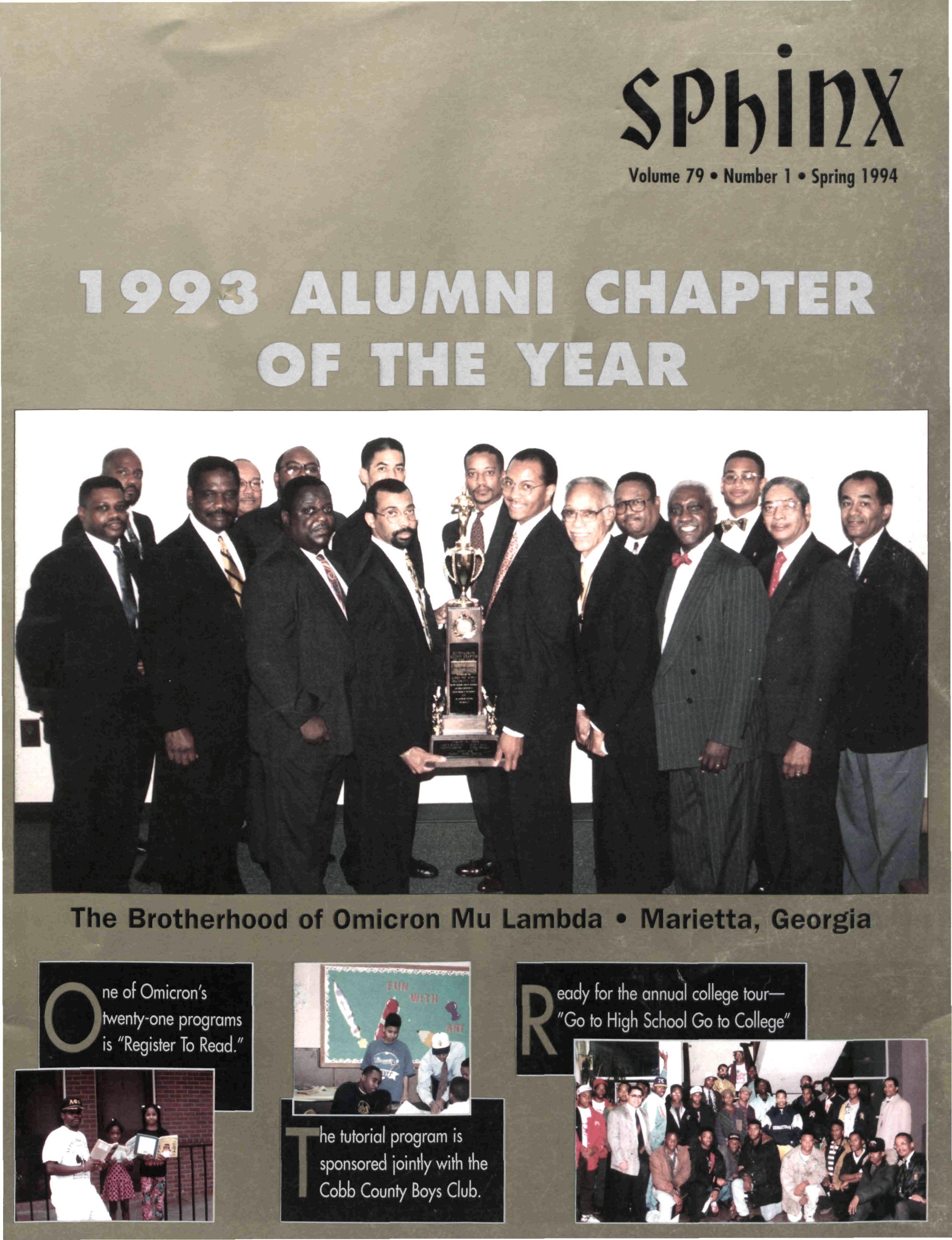
eady for the annual college tour— "Go to High School Go to College"
The Brotherhood of Omicron Mu Lambda • Marietta, Georgia

eady for the annual college tour— "Go to High School Go to College"
My brothers,
At its regular meeting in January 1994, the Board of Directors reviewed the activities of each region, particularly in the area of membership intake, and determined that it was in the best interest of our Fraternity to declare a moratorium on membership intake
I heartily endorse this action There is a need for Alpha Phi Alpha Fraternity, Inc to engage in a period of consultation with its active membership in order to critically review the customs, practices, procedures, and rules which govern our intake of new members We need to assure ourselves that the substantive lessons of Alpha Phi Alpha Fraternity, Inc. in regard to its history, programs, values and expectations are being adequately and thoroughly communicated to prospective brothers. A period of consultation will allow us to examine this requirement and restructure our materials and approaches accordingly
How do we assess the effectiveness of our chapters to do the work of our Fraternity? An assessment document is now developed that will enable us to monitor the proper organization, training, structure, and preparedness of each chapter to carry out the programs of our Fraternity This period of consultation will allow self-examination and evaluation of each chapter toward the end that all chapters will reflect the constitutional standards
I was among the National Presidents of the eight Greek letter organizations who met in late May 1994 to discuss some common concerns and challenges. Out of this meeting came the resolve that all of the presidents and their organizations would act concertedly to rid the malady of hazing from our midst
We additionally resolved to initiate a move for legislation to be adopted by all 50 states which would make it a punishable criminal offense for anyone who has been suspended, expelled, or is not a member of the organization to wear any name or insignia of the organization or participate in any manner in the activities of the organization. This law already exists in California and a major effort is now under way to provide this help to enforce the disciplinary decisions of our organizations
Some organizations have already adopted the practice of referring information and names of those they find guilty of hazing to the local district attorney for prosecution under criminal statutes Alpha Phi Alpha has this practice under review (Over 38 States now have criminal statutes prohibiting hazing.)
Other legal procedures to rid our Fraternity of those who haze potential members are being implemented The clear commitment by all of the leadership attending the Presidential Summit in May 1994 is to do everything possible to protect the innocent and to punish the guilty.
Alpha Phi Alpha Fraternity, Inc has been at the forefront of implementing policies and programs designed to educate its members regarding their legal and moral responsibilities to conduct themselves in a decent and respectful manner toward potential members The Standing Orders, our Risk Management Program, the elimination of pledging, and adoption of the Intake Program are all manifestations of positive initiatives on behalf of the Fraternity
We are again under way with serious review and revision to strengthen the Intake Program This effort once again focuses our membership on the real purpose of our organization and the quality and character of those we admit to our membership I invite each Brother to give us your comments, ideas, influence, and leadership as we together address our Intake Program The life and future of our Fraternity depend on our being successful in this work
During this period of consultation, let us put Alpha first.
Fraternally,
Milton C. Davis
Brother
Brother
Brother
The Sphinx (USPS 510-440) is published quarterly for $10 a year by Alpha Phi Alpha Fraternity, Inc., 2313 St Paul Street, Baltimore, MD 21218-5234 Second-class postage paid at Baltimore, MD and additional mailing offices Postmaster: Send address changes to The Sphinx, 2313 St Paul Street, Baltimore, MD 21213
The Sphinx is the official magazine of the Alpha Phi Alpha Fraternity, Inc Send all editorial mail and change of addresses to Alpha Phi Alpha Fraternity, Inc. The Fraternity assumes no responsibility for return of unsolicited manuscripts or art Opinions expressed in columns and articles do not necessarily reflect the views and policies of Alpha Phi Alpha Fraternity, Inc Use of any person's name in fiction, semifiction, articles or humorous features is to be regarded as a coincidence and not as die responsibility of The Sphinx, and is never done knowingly Copyright 1976 by The Sphinx, Alpha Phi Alpha Fraternity, Inc Reproduction, or use without written permission, of the editorial or pictorial content of trie magazine in any manner is prohibited The Sphinx has been published continuously since 1914. Organizing Editor: Brother Raymond W. Cannon. Organizing General President: Brother Henry Lake Dickason
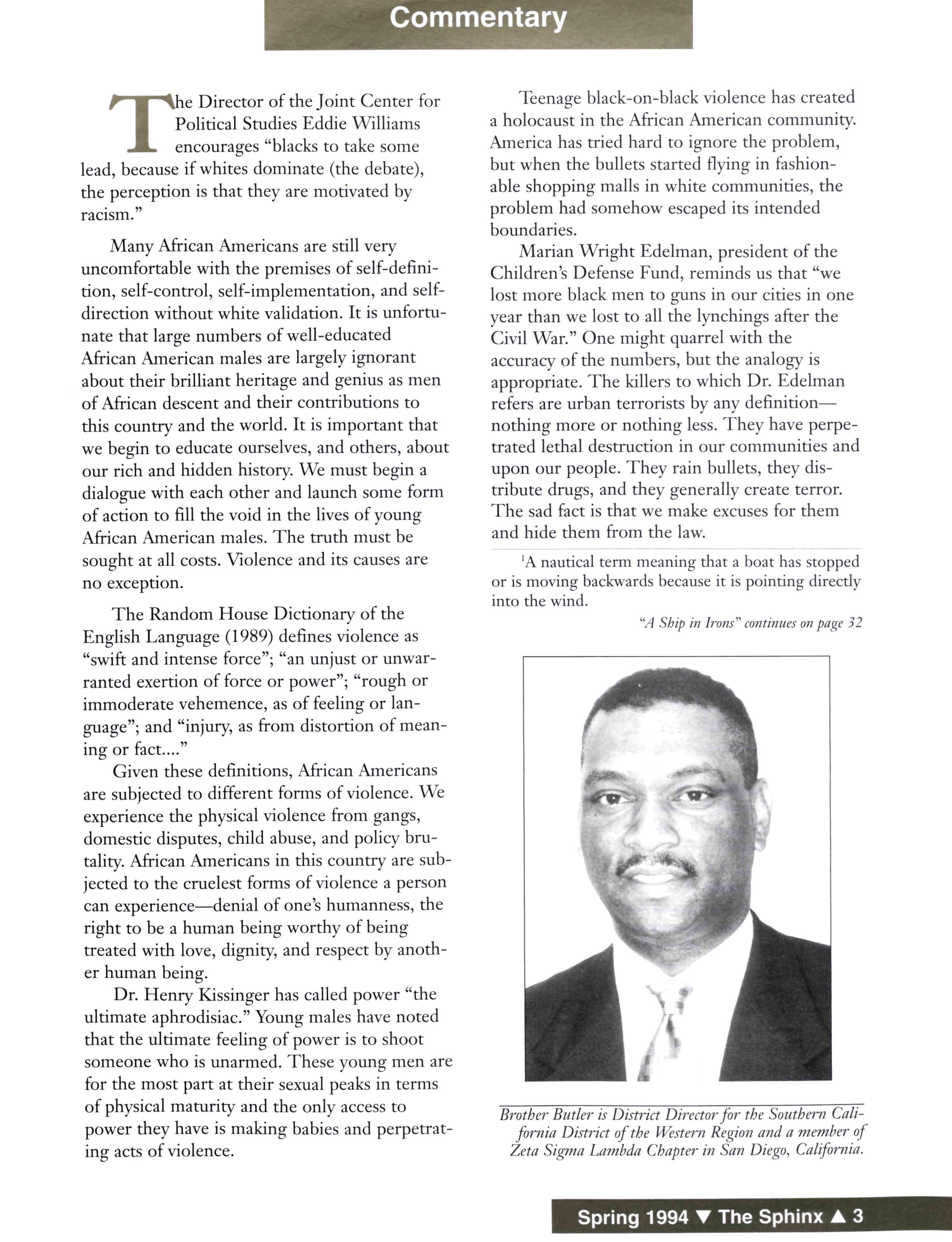
BROTHER CHARLES BUTLER
The leadership of African Americans is "In Irons,"' from the national to the local levels of our communities
The consequences of this "In Irons" predicament has caused a major breakdown of moral and ethical values and social conduct. The devastating example of this breakdown is teenage black-on-black violence. The members of our Fraternity must reach out with an open hand and grasp the unattended tiller to pull us back into the strong winds and fair seas of the mighty ocean we know as life in America.
currendy lead their professions throughout the country We must support these brothers in their efforts to guide the African American community out of harm's way
Our African American young men are subjected to a systematic and well-orchestrated strategic and tactical onslaught of racial negativisms designed to cause mayhem and chaos in the African American community throughout this country Every African American family is touched by the madness in some way If the ship is ever to get out of Irons, we must re-evaluate and redefine the African American family.
How long? The answer is: As long as we permit it. I say the Negro action can be decisive. I say that we ourselves have the power to end the terror and win for ourselves peace and security throughout the land. —BROTHER PAUL ROBESON
Alpha Phi Alpha Fraternity has always been in the vanguard of African American leadership—from Brother W.E.B. DuBois and the Niagara Movement to the many brothers who
We must devise a conduit to teach our young men to become good fathers, husbands, mentors, and friends with our women and other black men We have to develop systems that embrace, guide, and pass down the positive attributes of being a strong, intelligent African American male capable of taking care of his family and contributing in a positive manner to America, and specifically to the plight of African Americans We must support people like NAACPPresident Ben Chavis in his effort to unite African American leadership around the issue of ending black-onblack violence in America, the call for national gang summits, and meetings with the Nation of Islam These efforts must succeed despite the divisive rhetoric disseminated by the media and the self-serving agendas in the conservative and liberal ranks of so-called black leadership
Long-term remedies and plausible solutions to teenage black-on-black violence must be developed and implemented from an African American framework and not based on EuroAmerican models to which we are normally restricted for validity and legitimacy.
The Director of the Joint Center for Political Studies Eddie Williams encourages "blacks to take some lead, because if whites dominate (the debate), the perception is that they are motivated by racism."
Many African Americans are still very uncomfortable with the premises of self-definition, self-control, self-implementation, and selfdirection without white validation. It is unfortunate that large numbers of well-educated African American males are largely ignorant about their brilliant heritage and genius as men of African descent and their contributions to this country and the world. It is important that we begin to educate ourselves, and others, about our rich and hidden history. We must begin a dialogue with each other and launch some form of action to fill the void in the lives of young African American males The truth must be sought at all costs. Violence and its causes are no exception.
The Random House Dictionary of the English Language (1989) defines violence as "swift and intense force"; "an unjust or unwarranted exertion of force or power"; "rough or immoderate vehemence, as of feeling or language"; and "injury, as from distortion of meaning or fact...."
Given these definitions, African Americans are subjected to different forms of violence. We experience the physical violence from gangs, domestic disputes, child abuse, and policy brutality African Americans in this country are subjected to the crudest forms of violence a person can experience—denial of one's humanness, the right to be a human being worthy of being treated with love, dignity, and respect by another human being
Dr. Henry Kissinger has called power "the ultimate aphrodisiac." Young males have noted that the ultimate feeling of power is to shoot someone who is unarmed These young men are for the most part at their sexual peaks in terms of physical maturity and the only access to power they have is making babies and perpetrating acts of violence.
Teenage black-on-black violence has created a holocaust in the African American community America has tried hard to ignore the problem, but when the bullets started flying in fashionable shopping malls in white communities, the problem had somehow escaped its intended boundaries.
Marian Wright Edelman, president of the Children's Defense Fund, reminds us that "we lost more black men to guns in our cities in one year than we lost to all the lynchings after the Civil War." One might quarrel with the accuracy of the numbers, but the analogy is appropriate. The killers to which Dr. Edelman refers are urban terrorists by any definition— nothing more or nothing less. They have perpetrated lethal destruction in our communities and upon our people. They rain bullets, they distribute drugs, and they generally create terror The sad fact is that we make excuses for them and hide them from the law
'A nautical term meaning that a boat has stopped or is moving backwards because it is pointing direcdy into the wind
"A Ship in Irons'" continues on page 32
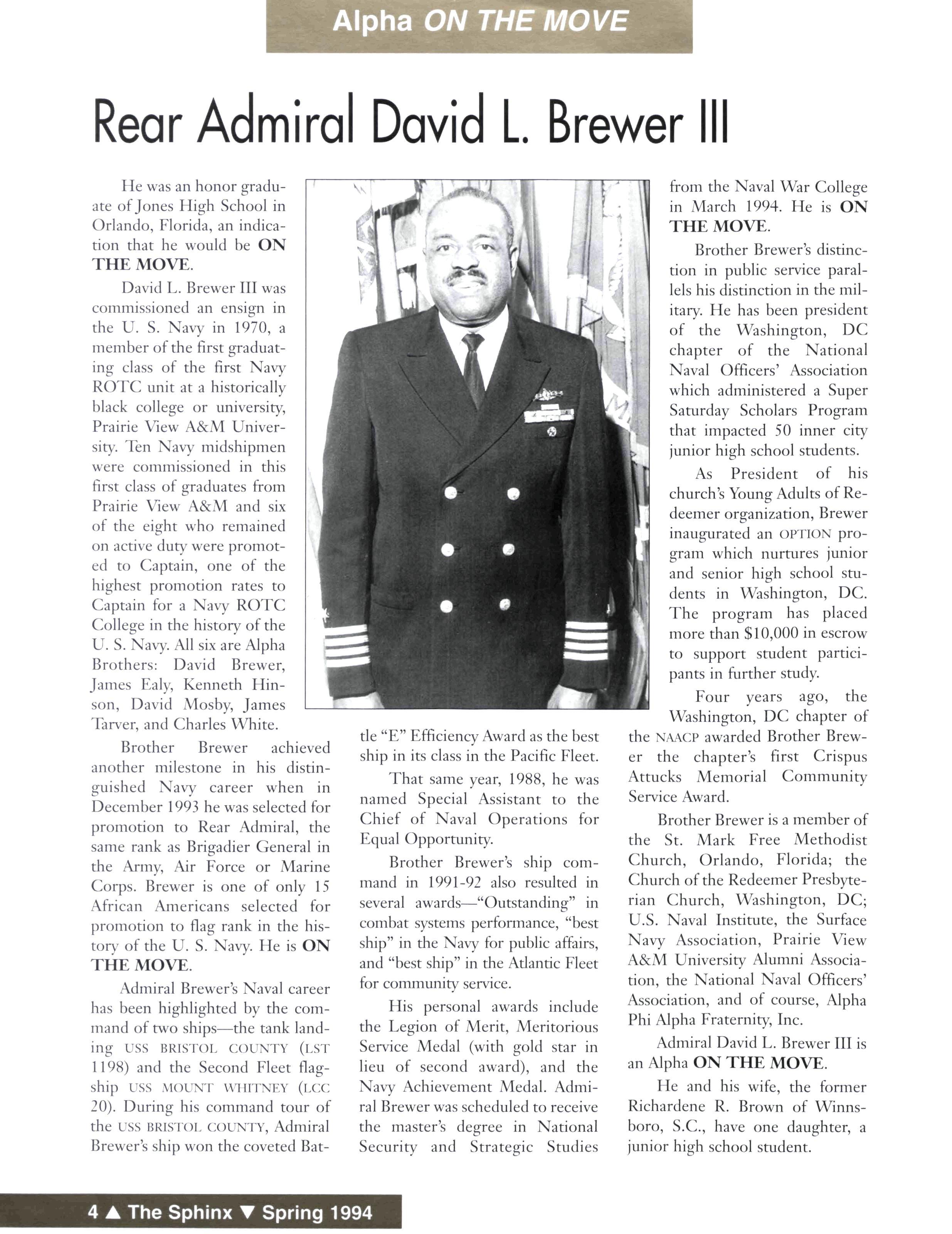
He was an honor graduate of Jones High School in Orlando, Florida, an indication that he would be ON THE MOVE.
David L Brewer III was commissioned an ensign in the U S Navy in 1970, a member of the first graduating class of the first Navy ROTC unit at a historically black college or university, Prairie View A&M University. Ten Navy midshipmen were commissioned in this first class of graduates from Prairie View A&M and six of the eight who remained on active duty were promoted to Captain, one of the highest promotion rates to Captain for a Navy ROTC College in the history of the U S Navy All six are Alpha Brothers: David Brewer, James Ealy, Kenneth Hinson, David Mosby, James Tarver, and Charles White.
Brother Brewer achieved another milestone in his distinguished Navy career when in December 1993 he was selected for promotion to Rear Admiral, the same rank as Brigadier General in the Army, Air Force or Marine Corps Brewer is one of only 15 African Americans selected for promotion to flag rank in the history of the U S Navy He is ON THE MOVE.
Admiral Brewer's Naval career has been highlighted by the command of two ships—the tank landing USS BRISTOL COUNTY (LST 1198) and die Second Fleet flagship USS MOUNT WHITNEY (LCC 20). During his command tour of the USS BRISTOL COUNTY, Admiral Brewer's ship won die coveted Bat-
de "E" Efficiency Award as the best ship in its class in the Pacific Fleet.
That same year, 1988, he was named Special Assistant to the Chief of Naval Operations for Equal Opportunity
Brother Brewer's ship command in 1991-92 also resulted in several awards—"Outstanding" in combat systems performance, "best ship" in the Navy for public affairs, and "best ship" in die Adantic Fleet for community service
His personal awards include the Legion of Merit, Meritorious Service Medal (with gold star in lieu of second award), and the Navy Achievement Medal Admiral Brewer was scheduled to receive the master's degree in National Security and Strategic Studies
from the Naval War College in March 1994. He is ON THE MOVE.
Brother Brewer's distinction in public service parallels his distinction in the military He has been president of the Washington, DC chapter of the National Naval Officers' Association which administered a Super Saturday Scholars Program that impacted 50 inner city junior high school students
SAs President of his church's Young Adults of Redeemer organization, Brewer inaugurated an OPTION program which nurtures junior and senior high school students in Washington, DC
The program has placed more than $10,000 in escrow to support student participants in further study
Four years ago, the Washington, DC chapter of the NAACP awarded Brother Brewer the chapter's first Crispus Attucks Memorial Community Service Award.
Brother Brewer is a member of the St Mark Free Methodist Church, Orlando, Florida; the Church of the Redeemer Presbyterian Church, Washington, DC; U.S Naval Institute, the Surface Navy Association, Prairie View A&M University Alumni Association, the National Naval Officers' Association, and of course, Alpha Phi Alpha Fraternity, Inc.
Admiral David L Brewer III is an Alpha ON THE MOVE.
He and his wife, the former Richardene R. Brown of Winnsboro, S.C., have one daughter, a junior high school student
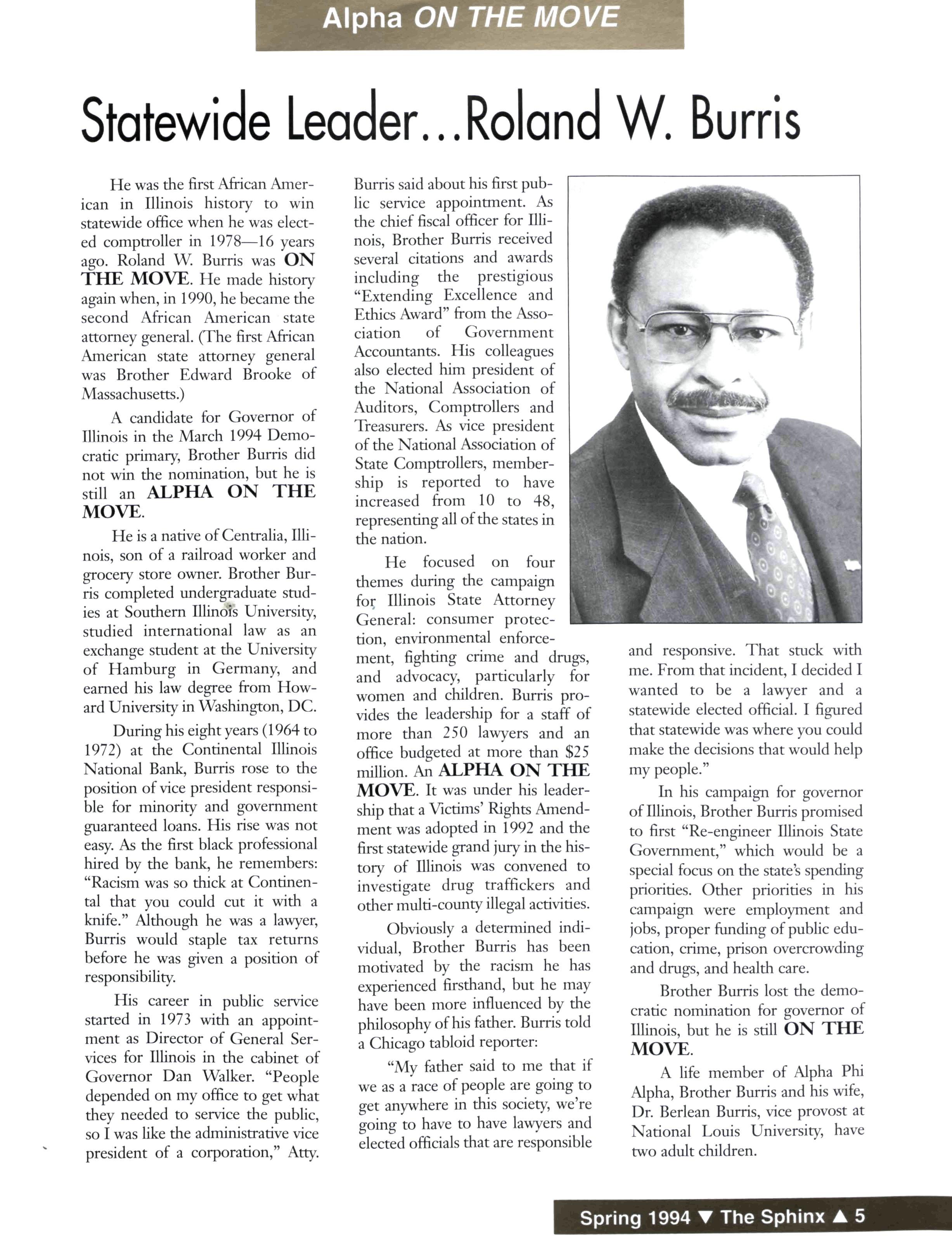
He was the first African American in Illinois history to win statewide office when he was elected comptroller in 1978—16 years ago Roland W Burris was O N THE MOVE. He made history again when, in 1990, he became the second African American state attorney general. (The first African American state attorney general was Brother Edward Brooke of Massachusetts.)
A candidate for Governor of Illinois in the March 1994 Democratic primary, Brother Burris did not win the nomination, but he is still an ALPHA O N THE MOVE.
He is a native of Centralia, Illinois, son of a railroad worker and grocery store owner Brother Burris completed undergraduate studies at Southern Illinois University, studied international law as an exchange student at the University of Hamburg in Germany, and earned his law degree from Howard University in Washington, DC
During his eight years (1964 to 1972) at the Continental Illinois National Bank, Burris rose to the position of vice president responsible for minority and government guaranteed loans His rise was not easy As die first black professional hired by the bank, he remembers: "Racism was so thick at Continental that you could cut it with a knife." Although he was a lawyer, Burris would staple tax returns before he was given a position of responsibility
His career in public service started in 1973 with an appointment as Director of General Services for Illinois in the cabinet of Governor Dan Walker "People depended on my office to get what they needed to service the public, so I was like the administrative vice president of a corporation," Atty
Burris said about his first public service appointment. As the chief fiscal officer for Illinois, Brother Burris received several citations and awards including the prestigious "Extending Excellence and Ethics Award" from the Association of Government Accountants. His colleagues also elected him president of the National Association of Auditors, Comptrollers and Treasurers. As vice president of the National Association of State Comptrollers, membership is reported to have increased from 10 to 48, representing all of the states in the nation.
He focused on four themes during the campaign for Illinois State Attorney General: consumer protection, environmental enforcement, fighting crime and drugs, and advocacy, particularly for women and children. Burris provides the leadership for a staff of more than 250 lawyers and an office budgeted at more than $25 million. An ALPHA ON THE MOVE. It was under his leadership that aVictims' Rights Amendment was adopted in 1992 and the first statewide grand jury in the history of Illinois was convened to investigate drug traffickers and other multi-county illegal activities.
Obviously a determined individual, Brother Burris has been motivated by the racism he has experienced firsthand, but he may have been more influenced by the philosophy of his father Burris told a Chicago tabloid reporter:
"My father said to me that if we as a race of people are going to get anywhere in this society, we're going to have to have lawyers and elected officials that are responsible
and responsive That stuck with me From that incident, I decided I wanted to be a lawyer and a statewide elected official I figured that statewide was where you could make the decisions that would help my people."
In his campaign for governor of Illinois, Brother Burris promised to first "Re-engineer Illinois State Government," which would be a special focus on the state's spending priorities. Other priorities in his campaign were employment and jobs, proper funding of public education, crime, prison overcrowding and drugs, and health care
Brother Burris lost the democratic nomination for governor of Illinois, but he is still ON THE MOVE.
A life member of Alpha Phi Alpha, Brother Burris and his wife, Dr Berlean Burris, vice provost at National Louis University, have two adult children.
He will leave the United States for England and Oxford University in September His program of study at Oxford starts in October 1994
Prior to his leaving for Oxford, he earned his bachelor's degree in English—with a minor in history—from the College of William and Mary in May 1994.
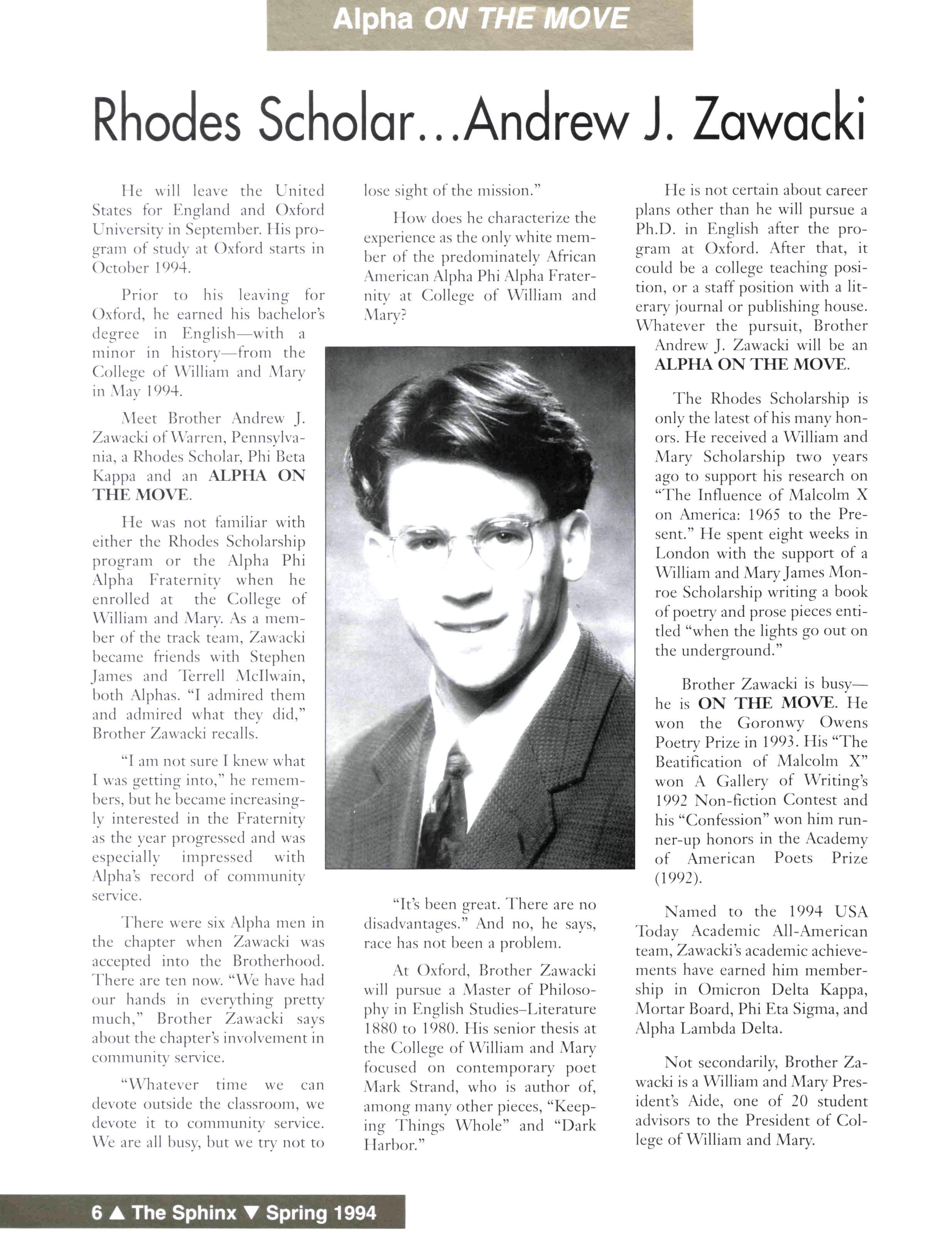
Meet Brother Andrew J. Zawacki of Warren, Pennsylvania, a Rhodes Scholar, Phi Beta Kappa and an ALPHA ON THE MOVE.
He was not familiar with eitlier the Rhodes Scholarship program or the Alpha Phi Alpha Fraternity when he enrolled at the College of William and Mary. As a member of the track team, Zawacki became friends with Stephen James and Terrell Mcllwain, both Alphas "I admired them and admired what they did," Brother Zawacki recalls.
"I am not sure I knew what I was getting into," he remembers, but he became increasingly interested in the Fraternity as the year progressed and was especially impressed with Alpha's record of community service.
There were six Alpha men in the chapter when Zawacki was accepted into the Brotherhood There are ten now "We have had our hands in everything pretty much," Brother Zawacki says about the chapter's involvement in community service.
"Whatever time we can devote outside the classroom, we devote it to community service We are all busy, but we try not to
lose sight of the mission."
How does he characterize the experience as the only white member of the predominately African American Alpha Phi Alpha Fraternity at College of William and Mary?
"It's been great. There are no disadvantages." And no, he says, race has not been a problem
At Oxford, Brother Zawacki will pursue a Master of Philosophy in English Studies-Literature 1880 to 1980 His senior diesis at the College of Wdliam and Mary focused on contemporary poet Mark Strand, who is author of, among many other pieces, "Keeping Things Whole" and "Dark Harbor."
He is not certain about career plans otlier than he will pursue a Ph.D in English after the program at Oxford After that, it could be a college teaching position, or a staff position witli a literary journal or publishing house. Whatever the pursuit, Brother Andrew J Zawacki will be an ALPHA ON THE MOVE.
The Rhodes Scholarship is only the latest of his many honors He received a William and Mary Scholarship two years ago to support his research on "The Influence of Malcolm X on America: 1965 to the Present." He spent eight weeks in London witli die support of a Wdliam and Mary James Monroe Scholarship writing a book of poetry and prose pieces entitled "when the lights go out on the underground."
Brother Zawacki is busy— he is ON THE MOVE. He won the Goronwy Owens Poetry Prize in 1993 His "The Beatification of Malcolm X" won A Gallery of Writing's 1992 Non-fiction Contest and his "Confession" won him runner-up honors in the Academy of American Poets Prize (1992).
Named to the 1994 USA Today Academic All-American team, Zawacki's academic achievements have earned him membership in Omicron Delta Kappa, Mortar Board, Phi Eta Sigma, and Alpha Lambda Delta.
Not secondarily, Brother Zawacki is a William and Mary President's Aide, one of 20 student advisors to the President of College of Wdliam and Mary
For years, members of historically black Greek-lettered organizations were the focus of attention on campuses during the pledge period, a time when every person knew that a specific group of men and women were entering the final stages of membership into one of the service-based Greek organizations Many people disagreed with the pledge practices, believing that the concept of lines, in and of themselves, were hazing, along with walking in step, wearing the same apparel, and chanting However, we were resilient in that we defended these practices as a living history, a replica of past and current practices of our brothers and sisters in Africa We basically said, "It's a black thang; you just wouldn't understand."
There were a few who could accurately defend the pledging practices. However, we decreased the level of cultural competence, and we increased the level of hazing, an increase that began to dominate the pledge period so that hazing became the focus of this period. Suddenly, the headlines convicted us daily:
"Pledge dies during beating!" "Brothers beat pledge with 2x4!" "Shots fired above pledges' head!"
The level of abuse rose to a point that the national organizations were at risk. Fraternities and sororities faced pressure from lawsuits that threatened their very existence, and from college presidents, particularly at historically black institutions, who gave us a mandate to straighten up or ship out. Yes, it was a black "thang," but sadly enough, we were the ones who just didn't understand.
The National Pan-Hellenic Council did what it had to do: eliminate pledging as it was
known This decision was not a popular one to say the least But many of those who fought to keep "pledging" used the rationale that it happened to me, it should happen to them, or that the new members would not have the same pledge stories to tell
No one argued the cultural significance of pledging simply because not many understood the cultural significance of pledging
We must reverse this trend and move back to our beginnings In the early 1900s, it was rare for blacks to be admitted into Phi Beta Kappa, although the first black man was inducted in 1877 Therefore, our fraternities and sororities became our version of Phi Beta Kappa, a symbol of academic excellence and not of social status However, it seems that, as of late, we have
We must select people with character and not characters. Persons who are the real leaders on campus are turned away by our foolishness, our petty disputes, and our poor academic performance. We make excuses for not selecting people with character, while we forge documents to help characters become members Given our current means, we must select the best we can, and once we make improvements we can analyze this process so that it becomes even more effective.
We wanted to keep pledging because it was fun, an opportunity to have personal slaves for six weeks Consequently, pledging died However, there are fundamental issues we must address in order to survive in the membership "intake" era, issues that will determine our fate as viable organizations
The most important issue we face is scholarship. It is of great amazement that we characterize our organizations initially and most often by this one word— scholarship—but we fail to actualize this founding principle. Fraternities and sororities on majority campuses keep continual residence at the bottom of any grade report and rarely lead all Greek organizations in scholarship. Many of our members fail to graduate, and if they are able to graduate, they do so on a six or seven-year plan.
overemphasized the social aspect of brotherhood and sisterhood, and have traded A's and B's for all-night parties and beer bashes
The second issue is our commitment to community service
When pressed into a corner and asked to justify our existence, we bring out our active community service We are not committed to service as we say we are, as chapters now struggle to get members to participate in community service programs The same few people plan and carry out the chapter's service agenda while the rest tend to personal agendas
The attitude prevalent among most undergraduates is that the graduate chapters can do the service; we'll plan the step shows
We have to re-emphasize the importance of our participation in the community.
Continued on page 9
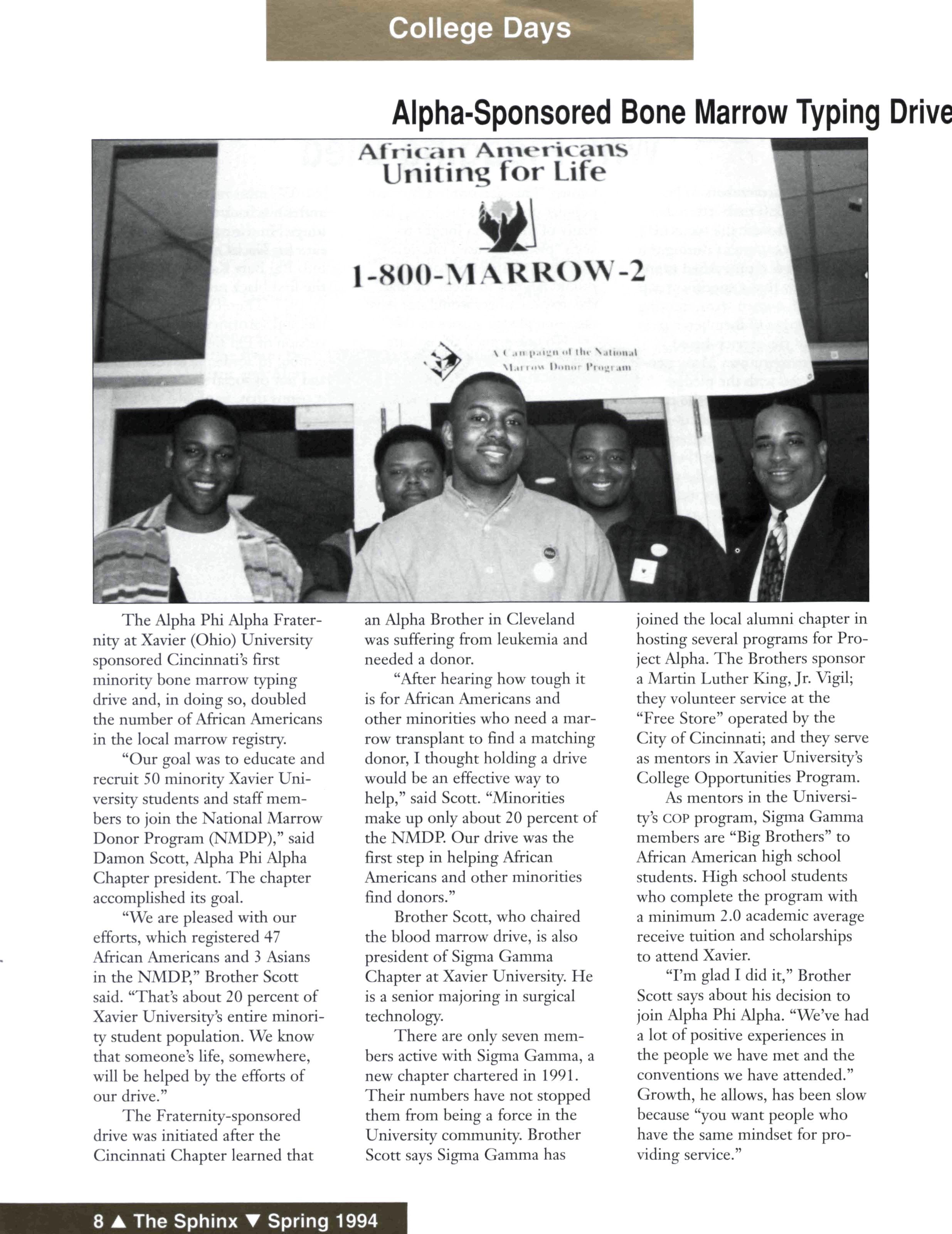
The Alpha Phi Alpha Fraternity at Xavier (Ohio) University sponsored Cincinnati's first minority bone marrow typing drive and, indoing so, doubled the number of African Americans in the local marrow registry
"Our goal was toeducate and recruit 50 minority Xavier University students and staff members tojoin the National Marrow Donor Program (NMDP)," said Damon Scott, Alpha Phi Alpha Chapter president. The chapter accomplished its goal.
"We are pleased witfr our efforts, which registered 47 African Americans and 3 Asians in the NMDP," Brother Scott said "That's about 20 percent of Xavier University's entire minority student population We know that someone's life, somewhere, will be helped by the efforts of our drive.
The Fraternity-sponsored drive was initiated after the Cincinnati Chapter learned tfrat
an Alpha Brother in Cleveland was suffering from leukemia and needed a donor.
"After hearing how tough it is for African Americans and otfrer minorities who need a marrow transplant to find a matching donor, I tbought holding a drive would be an effective wayto help," said Scott. "Minorities make up only about 20 percent of the NMDP. Our drive was the first step in helping African Americans and other minorities find donors."
Brother Scott, who chaired the blood marrow drive, isalso president ofSigma Gamma Chapter atXavier University.He is a senior majoring in surgical technology.
There are only seven members active with Sigma Gamma, a new chapter chartered in1991 Their numbers have not stopped them from being a force in the University community Brother Scott says Sigma Gamma has
joined the local alumni chapter in hosting several programs for Project Alpha The Brothers sponsor a Martin Luther King, Jr Vigil; they volunteer service at die "Free Store" operated by the City of Cincinnati; and they serve as mentors inXavier University's College Opportunities Program
As mentors in tfre University's COP program, Sigma Gamma members are "Big Brothers"to African American high school students. High school students who complete tfre program with a minimum 2.0 academic average receive tuition and scholarships to attend Xavier
"I'm glad I did it," Brother Scott says about his decision to join Alpha Phi Alpha. "We've had a lot of positive experiences in the people we have met and the conventions we have attended." Growth, he allows, has been slow because "you want people who have die same mindset for providing service."
Meanwhile, the bone marrow project was by far Sigma Gamma's major program. Thousands of minorities suffer from fatal blood diseases often curable by a marrow transplant For some, marrow is available from family members; for others, the situation is critical since they must find an unrelated donor or "match" — often someone of minority background whose marrow is compatible with their own
Because tissue types differ between ethnic groups, the chances of finding a related donor vary from 1 in a 100 to 1 in a 1,000,000, according to the patient's ethnic and racial background Donors of all backgrounds are needed, especially African American, Hispanic, Latino, Asian, and Native American
Becoming a member of the NMDP is easy, directors of the program say It is free for all racial and ethnic minorities, and it only takes about a half hour for the entire process. Potential donors must be between 18 and 55 years old and in good health Only about three tablespoons of blood are needed for testing. If test results "match" a patient needing a marrow transplant, the potential donor will be contacted for further testing
Bone marrow typing drives, such as the one sponsored by Alpha Phi Alpha Fraternity at Xavier University, help increase the pool of potential marrow donors, which then increases the odds of finding a match for the thousands of patients in need. To learn more about how you can give someone a chance to live by becoming a potential marrow donor, call 1-800-MARROW2.
Most undergraduates unaffiliated with black Greeks will seldom use service as a characteristic, which means that our presence is not being felt on college campuses to the same degree that it is in the working world. Active community involvement has given our members leadership roles in the community and commanded attention from political leaders as well Now, we are often overlooked by community leaders because we are not involved. President Calvin Coolidge met with the Grand Chapter of Kappa Alpha Psi in 1926 to honor the achievements of the Fraternity. In the 1980s, which of you did George Bush meet with, and is Bill Clinton interested in such an opportunity?
The final issue is the selection of new members. We have strayed from selecting the "talented tenth," and have reached down to the terrible twentieth, those persons at the bottom of the scale who have never strived to uphold any principles, are unconcerned about scholastic excellence, and are unwilling to serve the community.
But we say these people are "live"; they can "step"; they are "popular." All of this may be true, but if these become the standards for our organizations, we really have
no need to function on a college campus since these criteria are no different than those for a gang Coincidentally, these criteria have increased the comparisons of Greeks and gangs, even to the point that a current study analyzes the violence associated with black Greek organizations
Pledging is dead
All of the underground, pseudo-pledging is very dangerous in that it jeopardizes chapters and members, as well as perpetuates a process that was never understood It is analogous to the scientist with an honorary degree in chemistry attempting to synthesize a volatile substance The results are always explosive
The task is to take what we have, make it effective, and through self-assessments by individual chapters, we will be able to improve our standing on college campuses and in the communities where we live and serve. It is time for us to get back to the basics and reclaim our positions as leaders of our communities.
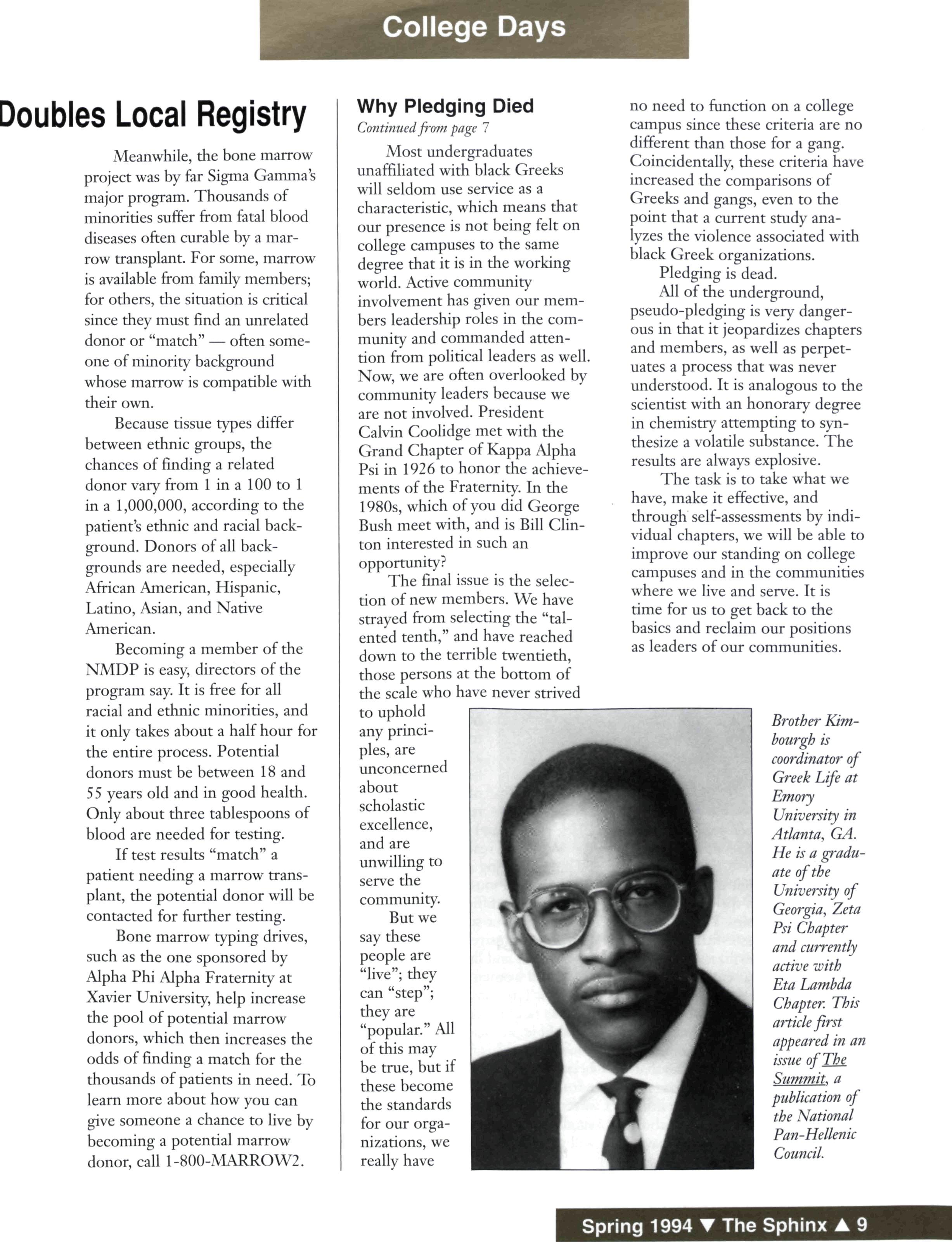
Brother Kimbourgh is coordinator of Greek Life at Emory University in Atlanta, GA. He is a graduate ofthe University of Georgia, Zeta Psi Chapter and currently active with Eta Lambda Chapter. This article first appeared in an issue of The Summit, a pidjlication of the National Pan-Hellenic Council.
BROTHER JARVIS HARRIS
February is the month in which we celebrate Black contributions to America. It is also the month in which we celebrate love I think the two need to be tied together and discussed because there seems to be trouble in the realm of "Black Love."
Many times I hear Brothers talking about Strong Sisters When Brothers talk about Sisters, they seem to speak about the negative aspects or the perceived negatives of our Sisters. Brothers speak about the attitudes of many women and their demanding nature. I believe mat the concerns Brothers raise about many women, particularly their attitudes and demands, are characteristics that make our women distinct and very special
had to serve as the provider, the father, the nurturer, the teacher, the healer, and everything else that African American society has called on them to do Most importantly, Black women had to do all of these things because the Black man was not around or was not able to fulfill his role in the partnership Brothers, realize that our women do love us, but they have struggled for us—and with us—for so long that they are tired and exhausted from the struggle They are ready for us to step up to the challenge of being Black men.
Support Black women in the positive things they are trying to do, Brothers, and respect them for trying to do what so many others are not willing to do—stand by you
Brothers, it is our job to be patient and understanding of the situation We need to try to give them some of the things that they ask for and deserve A little bit of our time and consideration will not leave us empty or less than men Acknowledging the importance of our women in large social settings will not rob us of our manhood, but will affirm the bond that is so special between the Black woman and the Black man
Yes, our women seem to display an attitude mat causes many of us to lose interest But Brothers we must realize that these same women have been the backbone of our society for years. These same women are the descendants of the mother of all of civilization and the queens of great empires. They stood by our side during slavery, Reconstruction, Jim Crow, the Civil Rights Movement, and even Reagonomics We must realize that they deserve the attitudes that they have. They have given so much and have been given so little, especially from Black men
Black women in America have
Black women are special and deserving of a special place in the hearts of Black men and society at large, but they are not totally absolved of all the blame that lies in the too often tenuous relations between Black women and Black men.
While we realize that it can be difficult being a Black woman, Black women must realize that it can be just as difficult being a Black man Our struggles are not mutually exclusive, but rather intertwined and linked.
Black women must know how hard it is for many Black men. We need to help Black women understand how the Black male feels knowing that his family could be better off financially if he were not in the home The Black woman is rewarded for being a single parent The government will provide all types of aid—from
free diapers to formula. Brothers should understand that there is more to being a father than providing money But how does a Brother reconcile those feelings and understandings when he sees his children going without clothes, shoes, and food?
I know that this is the nineties and the decade of the woman. Yet, Black women should not become so independent that they leave the Black man out of their plans and lives Although Black women are more independent and self-reliant than they have ever been before, they must still make the Black man feel that he is important—or at least don't make him feel insignificant
If a Brother is truly trying to be positive, Black women should "let him do his thing." Black women should not bombard Black men with unreasonable time expectations. Don't get me wrong: a Brother should give his lady some of his time But if he is busy, and not just hanging out with me boys, he should be supported in taking care of business regardless of the time it takes
Reciprocity is needed in relationships between Black males and Black females We need to understand that no one person is more important than the other in our interactions We must learn that our success is in part tied to the success of our mate Brothers—and Sisters—we must learn that in order to receive we must give The question is: Are we willing to make the sacrifices necessary to make sure our African American culture—especially our Black Love—survives?
Brother Harris is a member of Mil Zeta Chapter, University of North Carolina
BROTHER JOE C.THOMAS
Looking back though the history of Alpha Phi Alpha Fraternity, one will find that racism was at the core of its being from the inception of the Fraternity. The African American students who found themselves seeking an education at Cornell University were driven together as a matter of survival in a hostile, racist environment where they were denied, for the most part, the privileges and support that white students routinely enjoyed.
Their first priority, however, was to maintain their academic standing and remain in school Thus the organization of the Social Study Club and eventually the founding of Alpha Phi Alpha Fraternity, the first intercollegiate Greek-letter Fraternity established for African American college men
Observing the freedom whites enjoyed and which they were denied, men of Alpha Phi Alpha have from the beginning been on the cutting edge of the fight against racism in this country Alpha men were involved in the Niagara Movement and the subsequent founding of the National Association for the Advancement of Colored People (NAACP) and in the founding of the National Urban League Alpha Phi Alpha Fraternity has historically invested its money and the leadership and legal skills of its members in the struggle for equal rights for African Americans
A Committee on Discrimination, for example, was appointed in the 1940s by the General President, with Brother Raymond Pace Alexander as chairman, in response to discrimination in a Kansas City, Missouri, restaurant. Jewel Henry Arthur Callis said of the early Fraternity days: "Society offered us narrowly circumscribed opportunity and no security. Out of our need our Fraternity brought social purpose and social action."
Another of the Fraternity's social action projects involved the University of Maryland which, after Alpha and NAACP intervention, agreed to admit African American students to its graduate schools in 1935. There was a similar endeavor at the University of Texas where Brother Herman M. Sweatt sought entry in 1946. Alpha Brothers stood solidly behind Brother Sweatt.
Alpha Phi Alpha also sponsored and financed the case of Elmer W Henderson against the Southern Railway Company The brief in this case was filed in 1942 by General President Belford V Lawson In Kentucky, Alpha Lambda Chapter in Louisville was the center of activity dealing with the issue of equality of educational opportunity Brother Lyman T Johnson, a teacher in the Louisville Public Schools, was a pioneer in the project for admission to graduate school at the
University of Kentucky In Birmingham, Alabama, there was Brother Arthur D Shores of Omicron Lambda Chapter initiating court action in 1946 against Jim Crow zoning laws (in Huntsville and Birmingham), which were later declared unconstitutional by the Alabama Supreme Court
In the 1930s, Alpha Phi Alpha was well represented in the Scottsboro Case in Alabama
Years later, General President Milton C Davis, then an Alabama State Assistant Attorney General, was instrumental in gaining a pardon for the last of the men charged in the Scottsboro Case
This is only a snapshot of Alpha Phi Alpha's involvement in the struggle against racism and for equal rights for African Americans—Brothers who believed in the Fraternity's ideals and who put their service on the line in support of their beliefs
During the 87th Anniversary Convention in New Orleans, Louisiana, Alpha's Commission on RacialJustice reminded the Brotherhood that "RACISM in all of its forms—overt and covert, individual and institutional, conscious and unconscious, articulated and unarticulated, vehement and passive—is alive and well in the United States of America." The Commission called for a compassion for justice and a commitment to the struggle by Alpha Phi Alpha in all of its settings— national, regional, chapter and Alpha Phi Alpha households. And so the struggle continues.
It has become clear, the Commission also noted, that our Hispanic American Brothers and Sisters, Native Americans, Pacific Islanders and Asian Americans are similarly affected by the evils of racism Racism is a daily reality for racial and ethnic people in this country The Commission also recognized that there has been significant progress in the socioeconomic status of a small minority of racial and ethnic people and in the racial attitudes of many white Americans But at the same time the Commission voiced a keen awareness of the sobering truth that the quality of life for the majority of racial and ethnic people is worse today in many ways than it was during the 1960s
Where do we go from here? Alpha Phi Alpha can do little by itself to address the problems of racial injustice. However, we assume our historic role of leadership and work, as we are doing, with the NAACP, the NAACP Legal Defense Fund, the National Urban League, the National Rainbow Coalition, the Congressional Black Caucus, and similar national organizations in bringing an organized assault on racism in this country.
The Alpha Phi Alpha Commission on Racial Justice encourages all Brothers to become members of the
Continues on page 12
Continuedfromprevious page
NAACP and to assume leadership roles in that organization An NAACP membership form is available in this edition of The Sphinx. Brothers who can, and chapters of Alpha Phi Alpha that will, are encouraged to become Life Members of the NAACP
Another issue of concern to the Commission on RacialJustice is biased mortgage financing and other forms of discrimination by financial lending institutions African Americans and Hispanic Americans are disproportionately rejected by financial lending institutions than are whites Chapters of Alpha Phi Alpha are again asked to become leaders in their communities by conducting symposia on mortgage financing and other forms of lending Brothers are asked to seek member-
ship on boards of financial institutions Individuals, churches, fraternities, sororities and other organizations representing African Americans and other racial ethnic groups are asked to raise issues of biased lending practices with the financial institutions with whom they do business In addition to raising the issue of discrimination in lending practices, organizations are encouraged to take action against those whose records and commitment are in question
Freedom is a constant struggle and its price is eternal vigilance Alpha Phi Alpha must continue, as it has in the past, to make a difference in the lives of our African American brothers and sisters and in the lives of others who are in the struggle for justice
Brother Thomas is National Chair of the Alpha Phi Alpha Commission on RacialJustice
For 80 years NAACP has built the bridges of opportunity that put millions of African Americans on their road to sucess. It wasn't easy.
Our lives were threatened by lynchings and mob violence, and the NAACP watched our backs
Oppression met us at every turn and the NAACP was out front.
Today, with people of color facing challenges at every hand... the NAACP is where it's always been: ON OUR SIDE!
Working together we can make a difference One member at a time JOIN NOW Just fill out the application form below and mail today.
• Mr • Mrs • Ms
Address
City/State/Zip_
Area Code & Telephone Number
MasterCard and VISA welcome! ($25 minimum)
Account Number:
Signature
Dr. Benjamin F. Chavis, Executive Director
Dr William F Gibson, Chairman
• $15 Basic Adult Membership with Crisis magazine subscription
• $25 Contributing Adult Membership with Crisis magazine subscription
• $500 Subscribing Life with Crisis is $500 payable in ten annual $50-installments
Mail check or money order to: NAACP 4805 Mt. Hope Drive Baltimore, MD 21215 (410)358-8900
The term "Jewel" as a designation for those who founded our Fraternity is unique to Alpha Phi Alpha. It stems of course from the fact that there are seven jewels in the Fraternity pin. However, Brother Vertner Tandy was not seeking to memorialize the "original seven" in 1907 in the manner that the American flag honors the original 13 states. Formal use of the term came much later and was based upon a coincidence in our history.
There were seven men exclusive of Messrs Poindexter, Thompson, and Phillips who were not subjected to initiation None of the first three initiates were originally considered to be founders although they were all members of the Alpha Phi Alpha Society on December 4, 1906
Apparently the term was used unofficially prior to its adoption at the 22nd Annual Convention in Atlanta, Georgia, December 28-31, 1929, as the designation for the founders Until 1952 Brother James H Morton was recognized as the seventh "Jewel." He was a member of the Social Study Club and apparently not subjected to initiation although he was approved as an initiate (Thompkins was also approved but later received as an old member.)
The choice of the seventh founder continued in dispute for over two decades. It was argued by some that all of those who were members of the Society on December 4, 1906, were in fact founders,
especially Lemuel Graves, Gordon Jones and Eugene Kinckle Jones. Having adopted the term "Jewel" for the founders, the Brotherhood felt constrained to limit the number to seven. The problem could have been resolved easily by adding three jewels to the official badge in the same way that additional stars have been added to the American flag without changing its basic form. Such a change was never proposed, perhaps because the tradition of the "original seven" had become deeply entrenched. Perhaps also the furor which arose at the General Convention in Kansas City in 1950 when the Fraternal Design was first presented as an alternative symbol for the Shield may have served as
a deterrent to any proposal to add jewels to the pin.
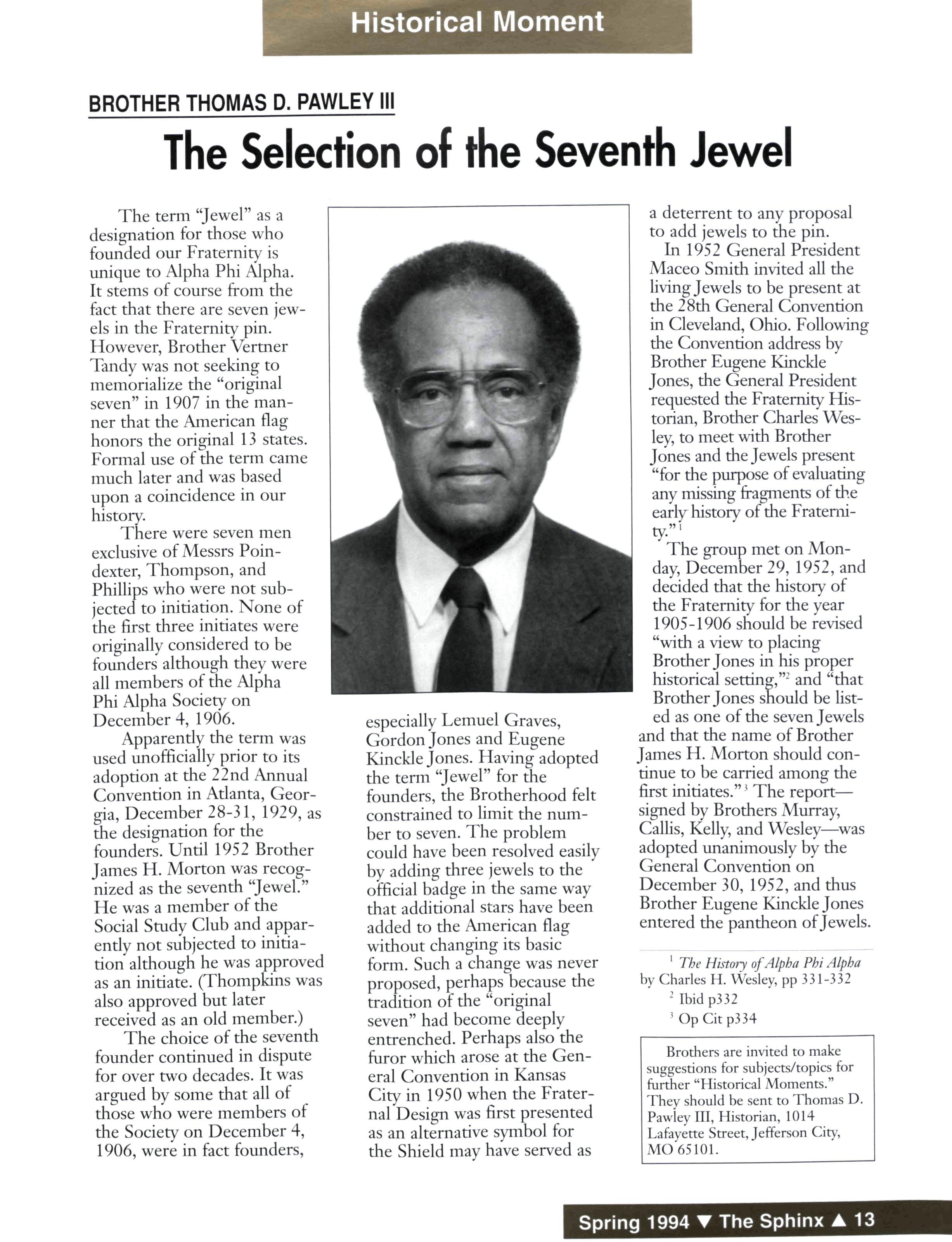
In 1952 General President Maceo Smith invited all the livingJewels to be present at the 28th General Convention in Cleveland, Ohio. Following the Convention address by Brother Eugene Kinckle Jones, the General President requested the Fraternity Historian, Brother Charles Wesley, to meet with Brother Jones and theJewels present "for the purpose of evaluating any missing fragments of the earlyhistory of the Frateniity."'
The group met on Monday, December 29, 1952, and decided that the history of the Fraternity for the year 1905-1906 should be revised "with a view to placing Brother Jones in his proper historical setting,"-1 and "that Brother Jones should be listed as one of the seven Jewels and that the name of Brother James H Morton should continue to be carried among the first initiates."' The report— signed by Brothers Murray, Callis, Kelly, and Wesley—was adopted unanimously by the General Convention on December 30, 1952, and thus Brother Eugene Kinckle Jones entered the pantheon ofJewels
1 The History ofAlpha Phi Alpha by Charles H Wesley, pp 331-332 : Ibid p332 i OpCitp334
Brothers are invited to make suggestions for subjects/topics for further "Historical Moments." They should be sent to Thomas D. Pawley HI, Historian, 1014 Lafayette Street, Jefferson City, MO 65101
BROTHER RONALD M. POWELL
A wealth of information on African American historic sites in America is readily available to travelers to such monuments and shrines honoring noteworthy contributions made by African Americans.
But it hasn't always been that easy!
To commemorate the centennial of the Emancipation Proclamation in 1963, a small travel guide listing black historic sites in the USA was published by American Oil Company Written by Phillip T Drotning, the booklet set a precedent and was greatly expanded when reissued five years later
Recognizing the phenomenal growth of the African American travel market, additional traveloriented books appeared in the 1970s
•D Parke Gibson, a New York publicist, wrote about the economics associated with this growing market
•San Francisco travel writer Bob Hayes recorded and published his visits to 12 U. S. cities from a black perspective
•William D Cunningham, a Washington, D.C., tour operator, was selected to co-author the official Bicentennial Black Guidebook to the Nation's Capital Published in 1976 with partial government funding, this unique publication (because of the special funding) set a new precedent for focusing on the African American travel market
Today, as this ethnic market continues to grow by leaps and bounds, the District of Columbia, State Departments of Tourism and Metropolitan City Visitors Bureaus have increased promotional budgets and accelerated marketing efforts aimed toward African American travelers.
•In Montgomery, where Dr Martin Luther King, Jr., served as pastor of Dexter Avenue Baptist Church; Mrs Rosa Parks sparked a lengthy bus boycott when she refused to move to the back of a city bus; and those who lost their lives during the civil right struggle are memorialized
•In Birmingham, where the Sixteenth Street Baptist Church was bombed in 1963 taking the lives of innocent children A comprehensive Civil Rights Museum chronicles the struggle in that city
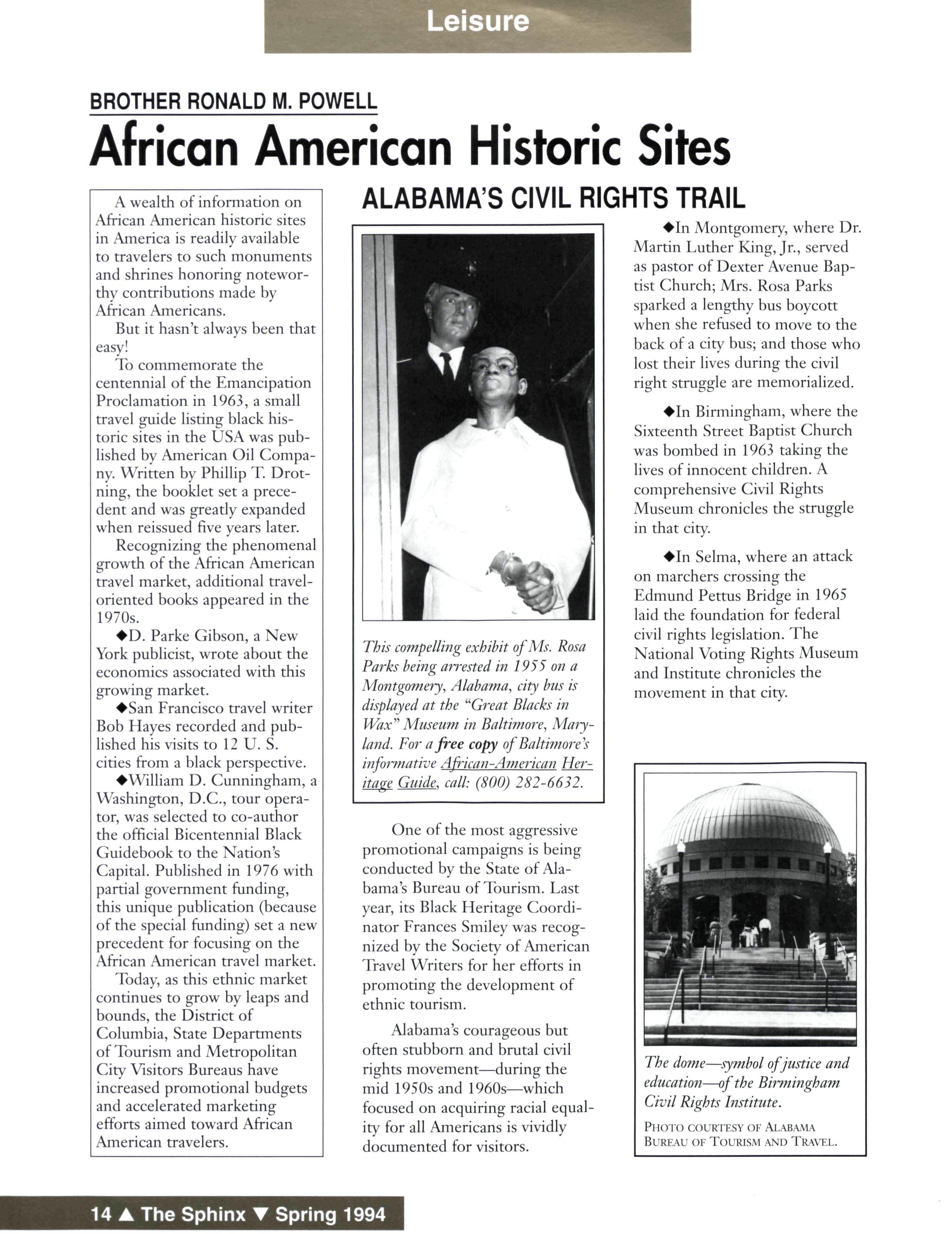
This compelling exhibit ofMs. Rosa Parks being arrested in 1955 on a Montgomery, Alabama, city bus is displayed at the ''Great Blacks in Wax" Museum in Baltimore, Maryland. For a free copy of Baltimore s informative African-American Heritage Guide, call: (800) 282-6632.
One of the most aggressive promotional campaigns is being conducted by the State of Alabama's Bureau of Tourism Last year, its Black Heritage Coordinator Frances Smiley was recognized by the Society of American Travel Writers for her efforts in promoting the development of ethnic tourism
Alabama's courageous but often stubborn and brutal civil rights movement—during the mid 1950s and 1960s—which focused on acquiring racial equality for all Americans is vividly documented for visitors.
•In Selma, where an attack on marchers crossing the Edmund Pettus Bridge in 1965 laid the foundation for federal civil rights legislation The National Voting Rights Museum and Institute chronicles the movement in that city
The dome symbol ofjustice and education ofthe Birmingham Civil Rights Institute.
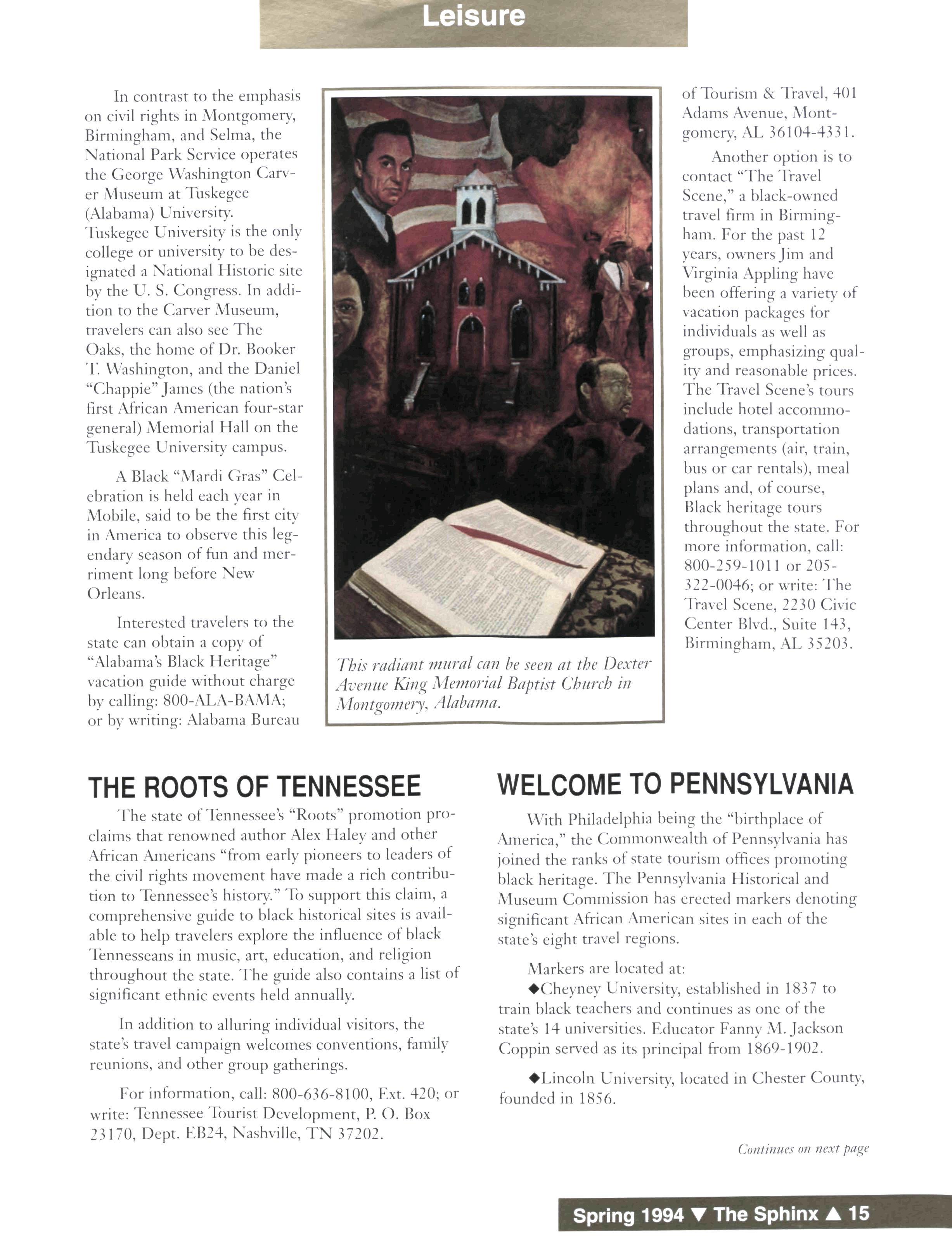
In contrast to the emphasis on civil rights in Montgomery, Birmingham, and Selma, the National Park Service operates the George Washington Carver Museum at Tuskegee (Alabama) University Tuskegee University is the only college or university to be designated a National Historic site by the U S Congress In addition to the Carver Museum, travelers can also see The Oaks, the home of Dr Booker T Washington, and the Daniel "Chappie" James (the nation's first African American four-star general) Memorial Hall on the Tuskegee University campus
A Black "Mardi Gras" Celebration is held each year in Mobile, said to be the first city in America to observe this legendary season of fun and merriment long before New Orleans
Interested travelers to the state can obtain a copy of "Alabama's Black Heritage" vacation guide without charge by calling: 800-ALA-BAMA; or by writing: Alabama Bureau
The state of Tennessee's "Roots" promotion proclaims that renowned author Alex Haley and other African Americans "from early pioneers to leaders of the civil rights movement have made a rich contribution to Tennessee's history." To support this claim, a comprehensive guide to black historical sites is available to help travelers explore the influence of black Tennesseans in music, art, education, and religion throughout the state The guide also contains a list of significant ethnic events held annually
In addition to alluring individual visitors, the state's travel campaign welcomes conventions, family reunions, and other group gatherings.
For information, call: 800-636-8100, Ext. 420; or write: Tennessee Tourist Development, P. O. Box 23170, Dept. EB24, Nashville, TN 37202.
of Tourism & Travel, 401 Adams Avenue, Montgomery, AL 36104-4331
Another option is to contact "The Travel Scene," a black-owned travel firm in Birmingham For the past 12 years, owners Jim and Virginia Appling have been offering a variety of vacation packages for individuals as well as groups, emphasizing quality and reasonable prices. The Travel Scene's tours include hotel accommodations, transportation arrangements (air, train, bus or car rentals), meal plans and, of course, Black heritage tours throughout the state. For more information, call: 800-259-1011 or 205322-0046; or write: The Travel Scene, 2230 Civic Center Blvd., Suite 143, Birmingham, AL 35203.
With Philadelphia being the "birthplace of America," the Commonwealth of Pennsylvania has joined the ranks of state tourism offices promoting black heritage The Pennsylvania Historical and Museum Commission has erected markers denoting significant African American sites in each of the state's eight travel regions.
Markers are located at:
•Cheyney University, established in 1837 to train black teachers and continues as one of the state's 14 universities. Educator Fanny M.Jackson Coppin served as its principal from 1869-1902.
•Lincoln University, located in Chester County, founded in 1856
Continues on next page
•Th e home of Harry T Burleigh on East 6th Street between French & Holland in Erie A singer, composer, and arranger, Burleigh wrote "Deep River," "Nobody Knows the Trouble I've Seen," and other spirituals
•Gettysburg College, 239 N. Washington Street in Gettysburg, a tribute to Daniel Alexander Payne, a free man who taught blacks attending the college as early as 1837. Payne later served as president of Wilberforce University.
Historical markers can be found in Pittsburgh at:
•Avery College (619 East Ohio Street) established by abolitionist Charles Avery in 1849 to provide classical education for blacks
•Th e office of Martin R Delany's (3rd Avenue & Market Street), a physician, publisher and commissioned officer during die Civil War
Philadelphia's listing includes several sites connected with the Underground Railroad:
•Mother Bethel AME Church (6th & Lombard Streets).
•African Zoar Methodist Episcopal Church (4th & Brown Streets).
•Th e home of anti-slavery writer and lecturer Frances Harper (1006 Bainbridge Street)
•Th e Pennsylvania Abolition Society (Front Street between Walnut & Chestnut) whose membership included Benjamin Franklin and Thomas Paine
For more information, contact the Pennsylvania Bureau of Travel Marketing by calling 800VISIT-PA; or writing: 453 Forum Building, Harrisburg, PA 17120
Complimentary copies of Philadelphia's African American Guide can be obtained by calling: 215-636-1666; or writing: Visitors Bureau, 1515 Market Street, Philadelphia, PA 19102
An Afro-American Historical Brochure for Washington Convention and Visitors Association, 1212 New York Avenue, NW, Suite 600, Washington, DC 20005 Telephone: 202-789-7077 The brochure is published by the city's Office of Multicultural Affairs.
In Washington, DC, plan to see: Frederick Douglass's National Home, the Bethune Museum; Howard University; the Benjamin Banneker Circle, die Malcolm X Park, among many other sites outlined in die brochure published by die Office of Multicultural Affairs
For information about Black Historic sites in states and cities not listed in this article, check telephone directories or information operators for state and city tourism offices.
Brother Powell lives in Mitchelville, Maryland, and operates Sold Journey Enterprises, Inc., Washington, DC. He is retired from the U.S. Postal Service.
Please forward story ideas and chapter news for consideration at this time. We would like to have materials on hand for consideration byJuly 25, 1994 However, don't wait for the deadline Mail material for consideration NOW. If you miss die July 25 deadline, or any deadline for that matter, mail the material anyway
The next issue of The Sphinx will be published following the National Convention in August 1994
We are especially interested in hearing from Brothers who are available to write 3-4 page essays for the Alpha Forum Don't write the essays, only indicate your availability to do so. College Brothers should indicate topics that are of special interest to them
We would also like to hear from Brothers who are willing to share historical photos from their personal files. Photos can be copied and returned overnight. Send material to: The SPHINX Alpha Phi Alpha Fraternity, Inc 2313 St Paul Street Baltimore, MD 21218-5234
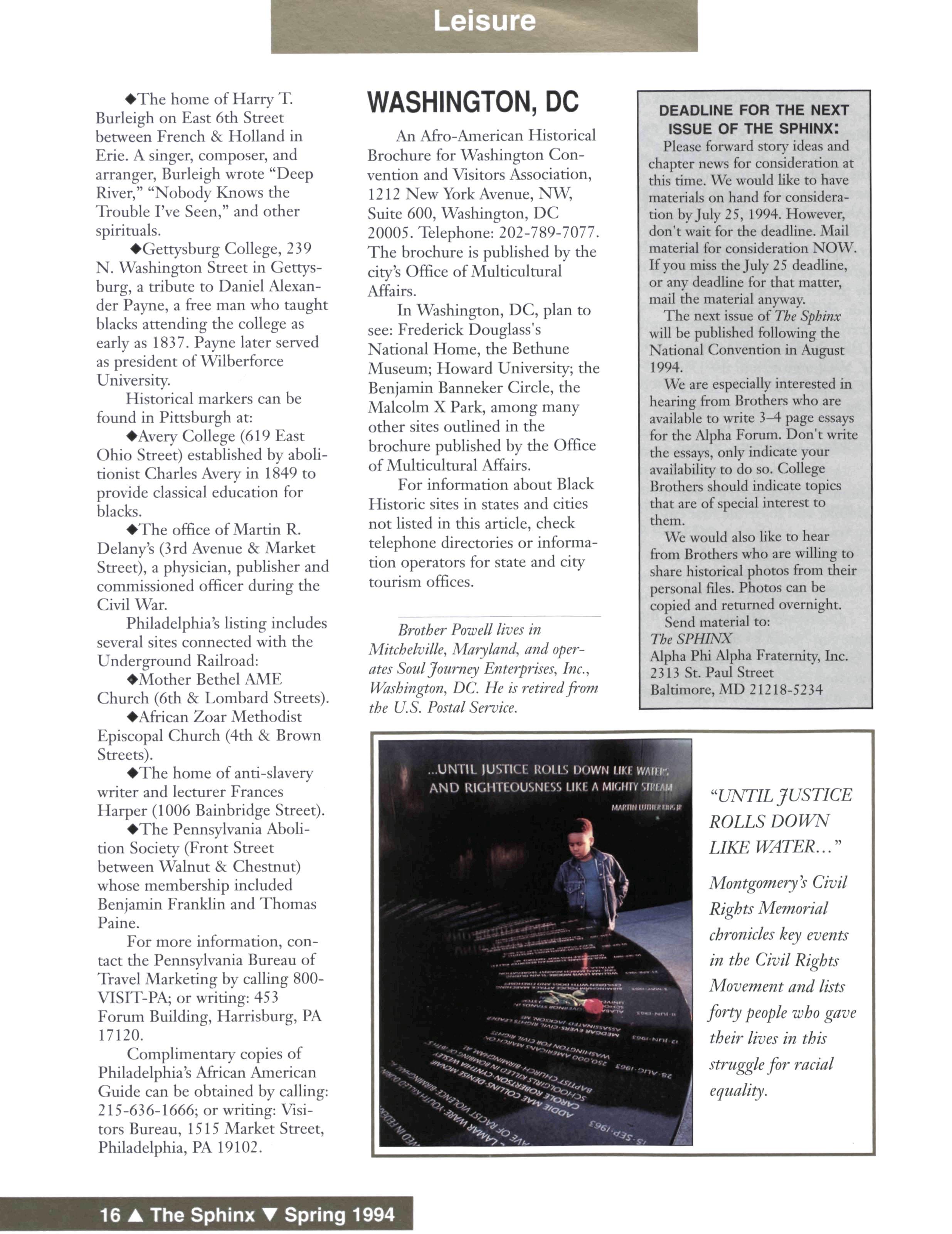
"UNTIL JUSTICE ROLLS DOWN LIKE WATER..."
Montgomery's Civil Rights Memorial chronicles key events in the Civil Rights Movement and lists forty people who gave their lives in this struggle for racial equality.
A special bond among black college men. We reflect anideal, ignite aspark and unfold a dream, that becomes reality.
Servants to our race, to our community, ourselves and others.
A fraternal body whose purpose represents a lifetime of commitment Sacrifice.
We are leaders
Our determination to uplift others. Who will one day stand onour shoulders, creating new paths and reaching even higher, toward the unknown.
A spirit ofcohesiveness
A single thought. One mind.
We are made of the past, represent the present, create the future.
We are the guardians, of that which we cherish dearly Rebirth.
We areour"Brother's Keeper."
—RICHARD T JAMES, JR March 1, 1993
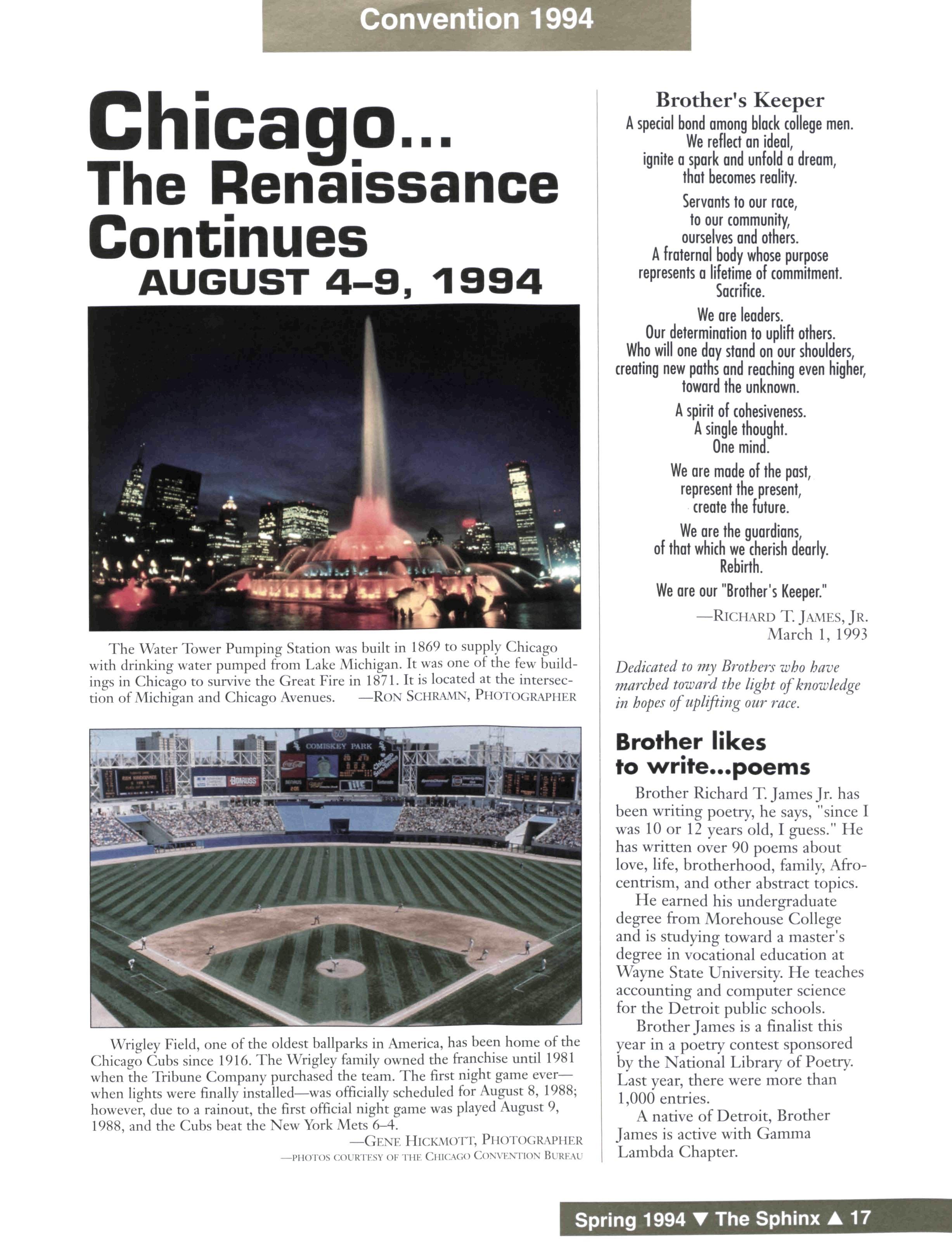
The Water Tower Pumping Station was built in 1869 to supply Chicago with drinking water pumped from Lake Michigan It was one of the few buildings in Chicago to survive the Great Fire in 1871. It is located at the intersection of Michigan and Chicago Avenues. —RON SCHRAMM, PHOTOGRAPHER
Wrigley Field, one of the oldest ballparks in America, has been home of the Chicago Cubs since 1916.The Wrigley family owned the franchise until 1981 when the Tribune Company purchased the team The first night game ever— when lights werefinallyinstalled—was officially scheduled for August 8, 1988; however, due to a rainout, the first official night game was played August 9, 1988, and the Cubs beat the New York Mets 6-4
—GENE HICKMOTT, PHOTOGRAPHER —PHOTOS COURTESY OF THE CHICAGO CONVENI lo \ BUREAU
Dedicated to my Brothers who have marched toward the light ofknowledge in hopes of uplifting our race.
Brother Richard T. James Jr. has been writing poetry, he says, "since I was 10 or 12 years old, I guess." He has written over 90 poems about love, life, brotherhood, family, Afrocentrism, and other abstract topics.
He earned his undergraduate degree from Morehouse College and is studying toward a master's degree in vocational education at Wayne State University. He teaches accounting and computer science for the Detroit public schools.
Brother James is a finalist this year in a poetry contest sponsored by the National Library of Poetry Last year, there were more than 1,000 entries.
A native of Detroit, Brother James is active with Gamma Lambda Chapter
There were 19 active Brothers when Omicron Mu Lambda won Alumni Chapter of the Year honors in 1993 Today, there are 26 active members The chapter's goal is to maintain an active roster of at least 35 active Brothers But if that goal is not met, no problem
"The programs still go on," says President Dennis Squirewell
And go on tliey do There are twenty-one in all: Register to Read; Go to High School Go To College; food, clothing and toy drives; Founders' Day, Martin Lutlier King, Jr., and African American History Celebrations; Project Alpha; Henry Artliur Callis Scholarship Dinner-Dance; Phonathon; Alpha Outreach; and of course, program focused montlily meetings.
Omicron Mu Lambda is growing accustomed to winning honors. In addition to National Alumni Chapter of the Year honors in 1993, Omicron Mu Lambda won Georgia Alumni Chapter of the Year honors in 1991-92 and 1992-93 and Southern
Regional Alumni Chapter of die Year honors in 1992 and 1993.
Brother Squirewell attributes die success of chapter programs to "commitment and organization We do most of die work in committees," he says. "When we get to die chapter meetings, most of die leg work is done.
"We also have good attendance at all chapter events That helps, also."
Omicron Mu Lambda is a significant player in die development of African American males in die Cobb (Marietta, GA) County area.
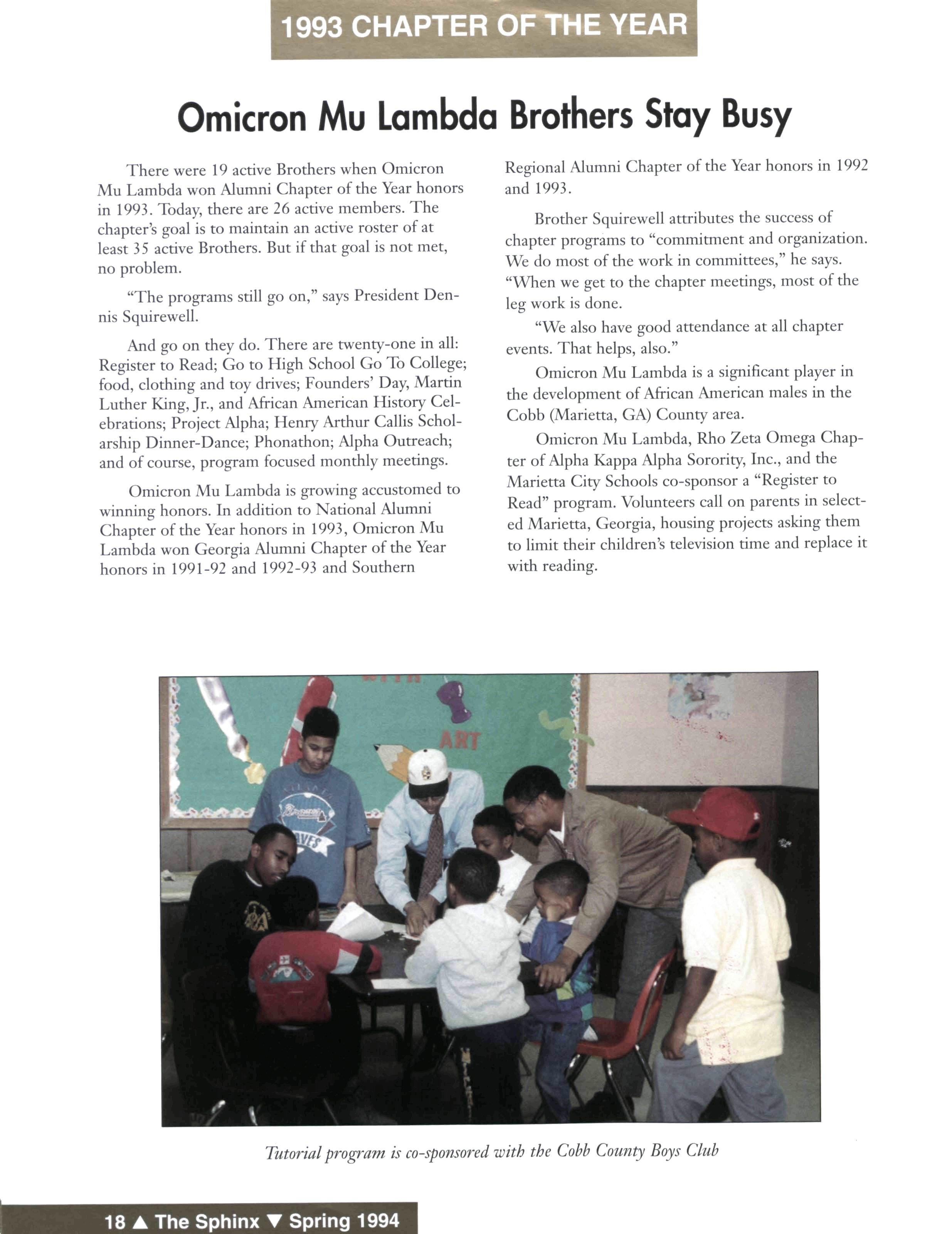
Omicron Mu Lambda, Rho Zeta Omega Chapter of Alpha Kappa Alpha Sorority, Inc., and die Marietta City Schools co-sponsor a "Register to Read" program Volunteers call on parents in selected Marietta, Georgia, housing projects asking diem to limit tlieir children's television time and replace it with reading. Tutorial program, is co-sponsored
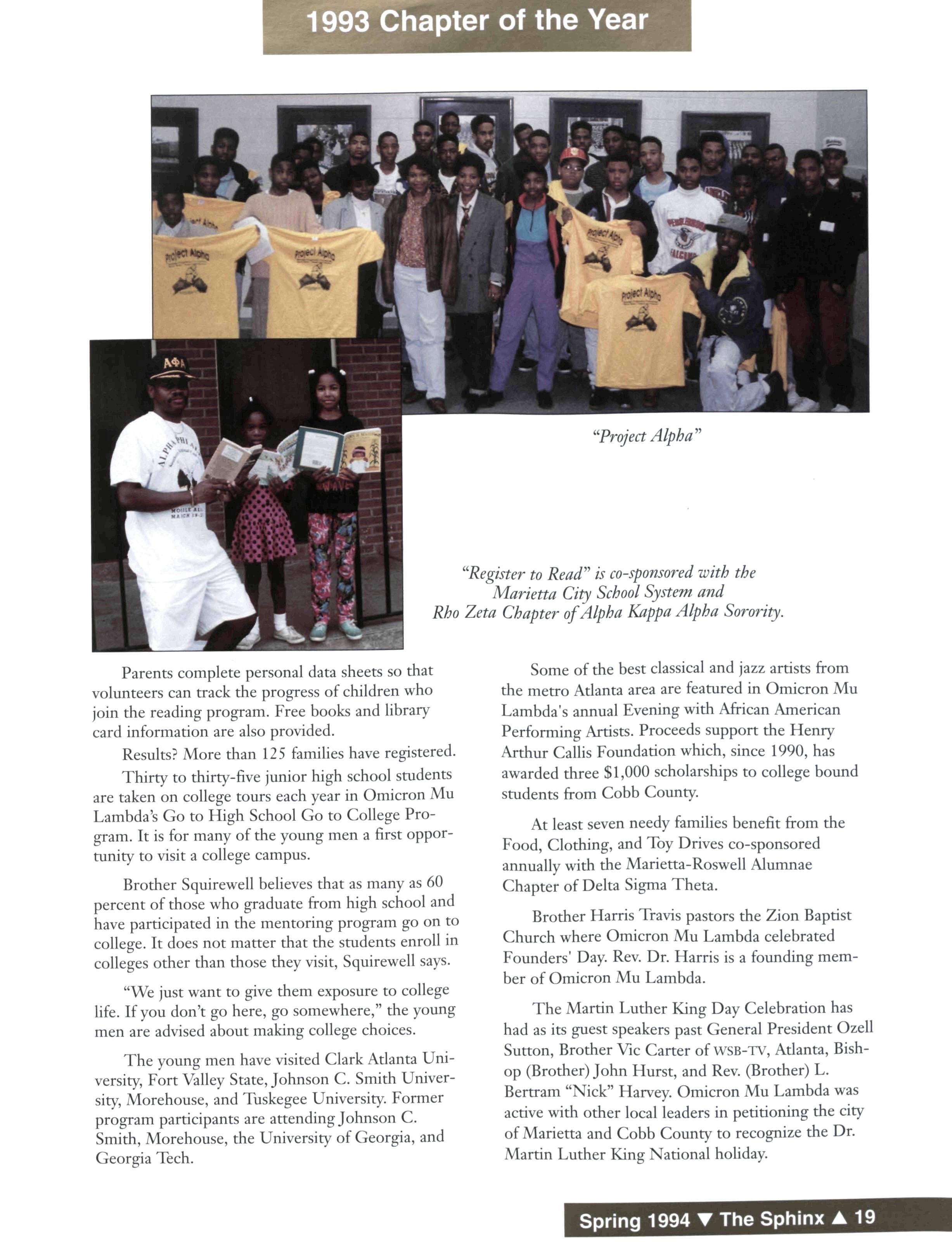
"Register to Read" is co-sponsored with the Marietta City School System and Rho Zeta Chapter of Alpha Kappa Alpha Sorority.
Parents complete personal data sheets so that volunteers can track the progress of children who join the reading program. Free books and library card information are also provided.
Results? More than 125 families have registered
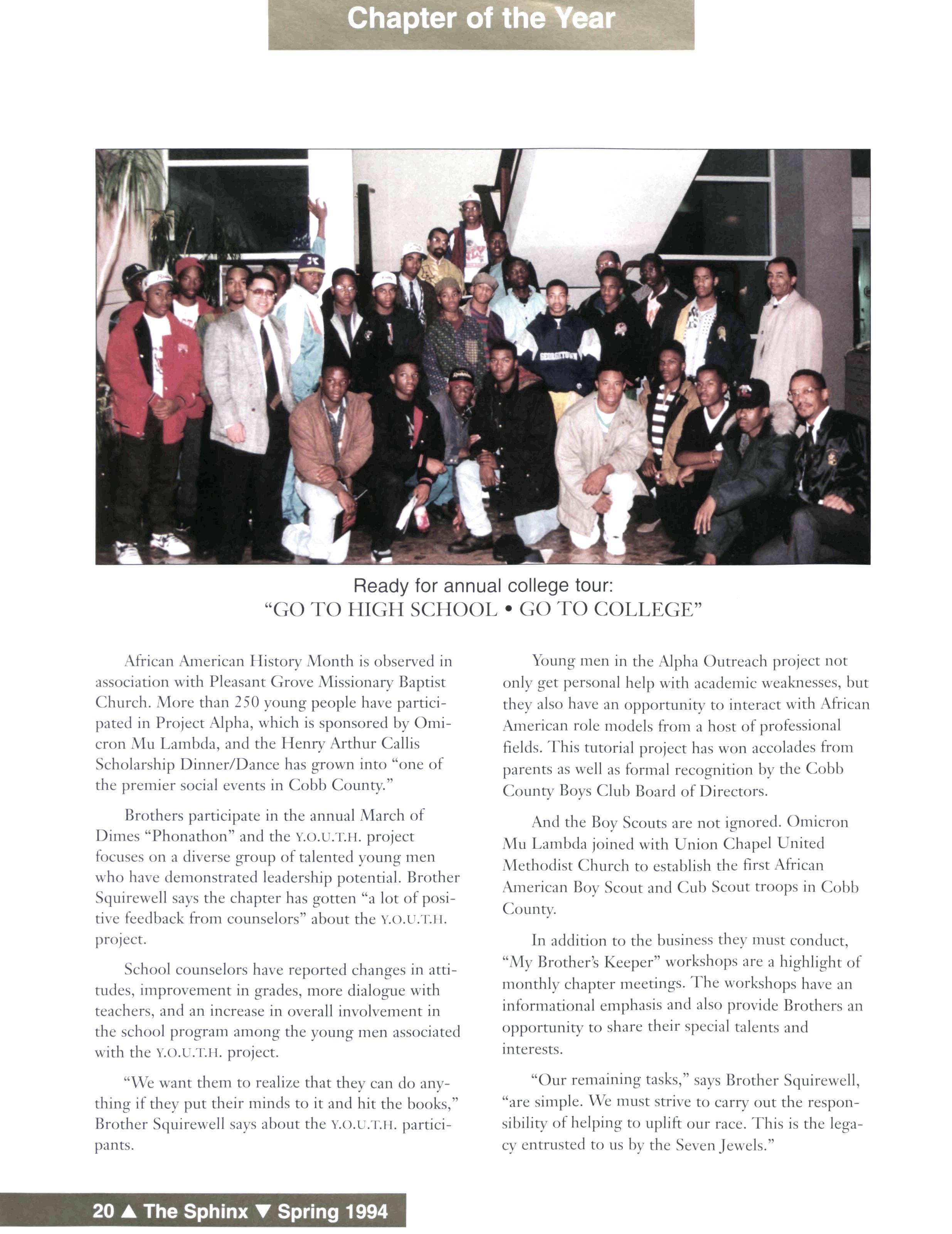
Thirty to diirty-five junior high school students are taken on college tours each year in Omicron Mu Lambda's Go to High School Go to College Program It is for many of the young men a first opportunity to visit a college campus.
Brother Squirewell believes that as many as 60 percent of those who graduate from high school and have participated in the mentoring program go on to college It does not matter that the students enroll in colleges other than those they visit, Squirewell says
"We just want to give them exposure to college life. If you don't go here, go somewhere," the young men are advised about making college choices.
The young men have visited Clark Atlanta University, Fort Valley State, Johnson C. Smith University, Morehouse, and Tuskegee University Former program participants are attending Johnson C Smith, Morehouse, the University of Georgia, and Georgia Tech
Some of the best classical and jazz artists from the metro Atlanta area are featured in Omicron Mu Lambda's annual Evening with African American Performing Artists. Proceeds support the Henry Arthur Callis Foundation which, since 1990, has awarded three $1,000 scholarships to college bound students from Cobb County.
At least seven needy families benefit from the Food, Clothing, and Toy Drives co-sponsored annually with the Marietta-Roswell Alumnae Chapter of Delta Sigma Theta.
Brother Harris Travis pastors die Zion Baptist Church where Omicron Mu Lambda celebrated Founders' Day Rev Dr Harris is a founding member of Omicron Mu Lambda
The Martin Ludier King Day Celebration has had as its guest speakers past General President Ozell Sutton, Brother Vic Carter of WSB-TV, Atlanta, Bishop (Brother) John Hurst, and Rev (Brother) L Bertram "Nick" Harvey. Omicron Mu Lambda was active with other local leaders in petitioning die city of Marietta and Cobb County to recognize die Dr Martin Luther King National holiday.
Ready for annual college tour: "GO TO HIGH SCHOOL • GO TO COLLEGE"
African American History Month is observed in association with Pleasant Grove Missionary Baptist Church. More than 250 young people have participated in Project Alpha, which is sponsored by Omicron Mu Lambda, and the Henry Arthur Callis Scholarship Dinner/Dance has grown into "one of die premier social events in Cobb County."
Brothers participate in the annual March of Dimes "Phonadion" and the Y.O.U.T.H. project focuses on a diverse group of talented young men who have demonstrated leadership potential. Brother Squirewell says the chapter has gotten "a lot of positive feedback from counselors" about the Y.O.U.T.H. project
School counselors have reported changes in attitudes, improvement in grades, more dialogue with teachers, and an increase in overall involvement in the school program among the young men associated with the Y.O.U.T.H project
"We want them to realize that they can do anything if tfiey put their minds to it and hit the books," Brother Squirewell says about the Y.O.U.T.H. participants
Young men in die Alpha Outreach project not only get personal help with academic weaknesses, but they also have an opportunity to interact with African American role models from a host of professional fields. This tutorial project has won accolades from parents as well as formal recognition by die Cobb County Boys Club Board of Directors.
And the Boy Scouts are not ignored Omicron Mu Lambda joined with Union Chapel United Methodist Church to establish the first African American Boy Scout and Cub Scout troops in Cobb County
In addition to the business they must conduct, "My Brother's Keeper" workshops are a highlight of monthly chapter meetings The workshops have an informational emphasis and also provide Brothers an opportunity to share their special talents and interests
"Our remaining tasks," says Brother Squirewell, "are simple. We must strive to carry out the responsibility of helping to uplift our race This is the legacy entrusted to us by the Seven Jewels."
They are 9th, 10th, 11th, and 12th graders. They are all doing well in school. They are focused and if they are not, they soon will be. Many of them are college bound. Those who are not college bound will be encouraged to give collegiate studies priority consideration.
"We all have our fair share of problems, but they should be worked out in a peaceful manner. Nowadays, that seems hard for many black males to do. Men of Tomorrow teaches us to think of the consequences of your actions If you do something violent, you have your entire life ahead of you to suffer the consequences."
—JERROD BULLARD Sophomore, Suncoast Community High School
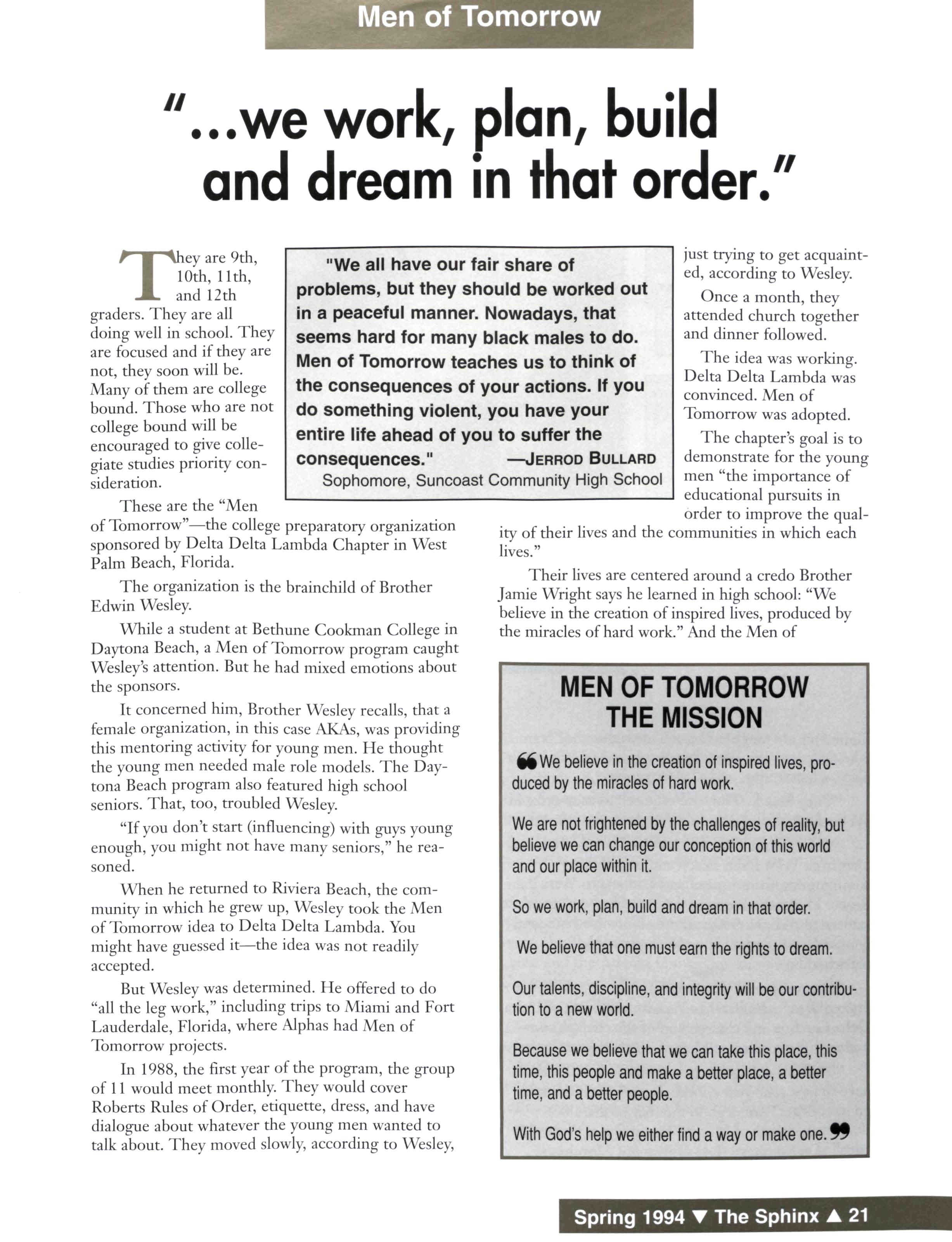
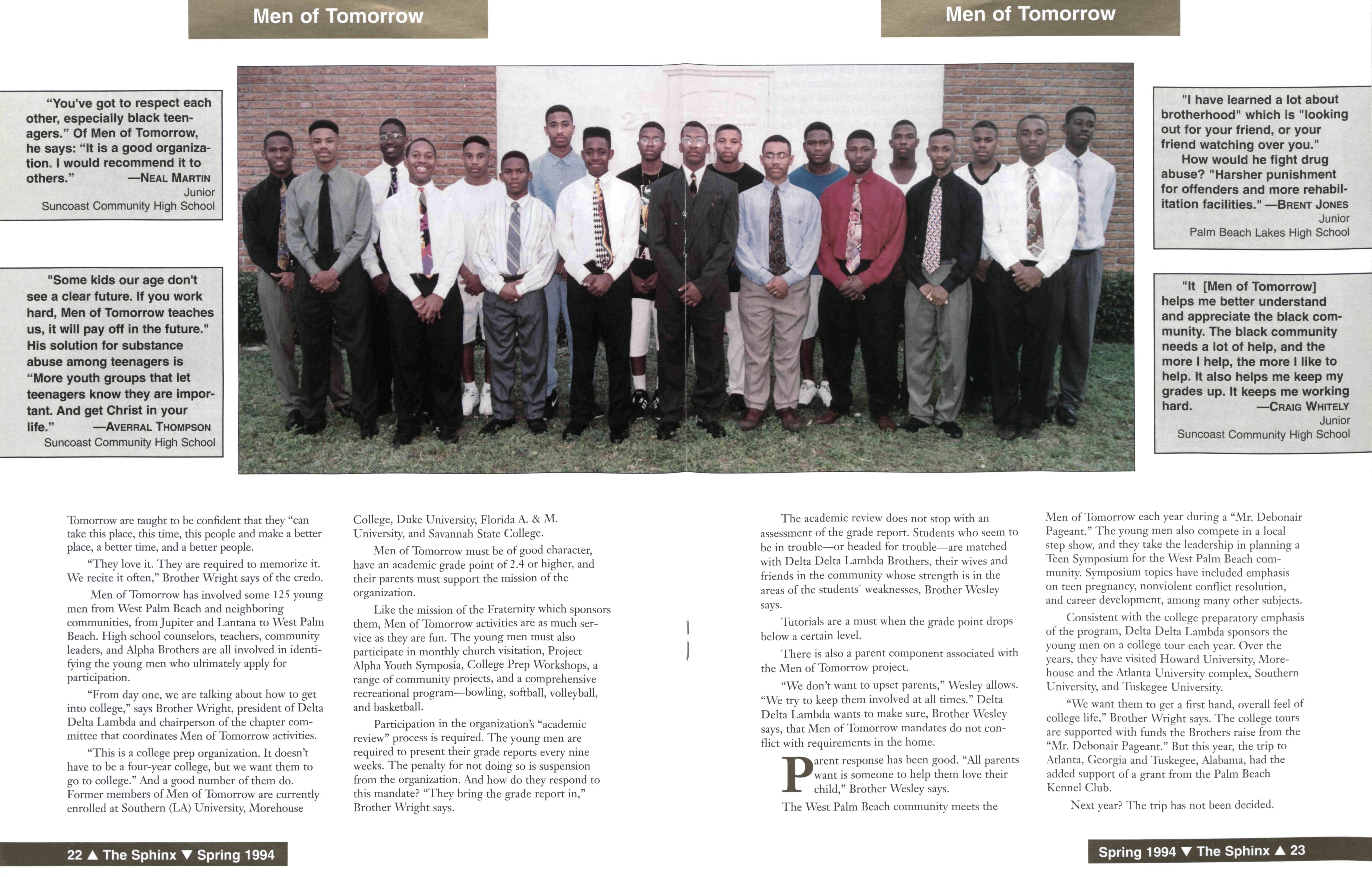
These are the "Men of Tomorrow"—the college preparatory organization sponsored by Delta Delta Lambda Chapter in West Palm Beach, Florida
The organization is the brainchild of Brother Edwin Wesley
While a student at Bethune Cookman College in Daytona Beach, a Men of Tomorrow program caught Wesley's attention. But he had mixed emotions about the sponsors.
It concerned him, Brother Wesley recalls, that a female organization, in this case AKAs, was providing this mentoring activity for young men He thought the young men needed male role models The Daytona Beach program also featured high school seniors That, too, troubled Wesley
"If you don't start (influencing) with guys young enough, you might not have many seniors," he reasoned.
When he returned to Riviera Beach, the community in which he grew up, Wesley took the Men of Tomorrow idea to Delta Delta Lambda You might have guessed it—the idea was not readily accepted
But Wesley was determined. He offered to do "all the leg work," including trips to Miami and Fort Lauderdale, Florida, where Alphas had Men of Tomorrow projects.
In 1988, the first year of the program, the group of 11 would meet monthly They would cover Roberts Rules of Order, etiquette, dress, and have dialogue about whatever the young men wanted to talk about They moved slowly, according to Wesley,
just trying to get acquainted, according to Wesley
Once a month, they attended church together and dinner followed
The idea was working Delta Delta Lambda was convinced Men of Tomorrow was adopted
The chapter's goal is to demonstrate for the young men "the importance of educational pursuits in order to improve the quality of their lives and the communities in which each lives."
Their lives are centered around a credo Brother Jamie Wright says he learned in high school: "We believe in the creation of inspired lives, produced by the miracles of hard work." And the Men of
iiW e believe in the creation of inspired lives, produced by the miracles of hard work
We are not frightened by the challenges of reality, but believe we can change our conception ofthis world and our place within it
So we work, plan, build and dream in that order
We believe that one must earn the rights to dream
Our talents, discipline, and integrity will be our contribution toa new world
Because we believe that we can take this place, this time, this people and make abetter place, a better time, and abetter people
With God's help we either find away or make one 99
"You've got to respect each other, especially black teenagers." Of Men of Tomorrow, he says: "It is a good organization I would recommend it to others."
—NEAL MARTIN Junior
Suncoast Community High School
"I have learned a lot about brotherhood" which is "looking out for your friend, or your friend watching over you."
How would he fight drug abuse? "Harsher punishment for offenders and more rehabilitation facilities."—BRENT JONES
Junior Palm Beach Lakes High School
"Some kids our age don't see a clear future If you work hard, Men of Tomorrow teaches us, it will pay off in the future." His solution for substance abuse among teenagers is "More youth groups that let teenagers know they are important And get Christ n your life."
"It [Men of Tomorrow] helps me better understand and appreciate the black community The black community needs a lot of help, and the more I help, the more I like to help It also helps me keep my grades up It keeps me working hard —CRAIG WHITELY
—AVERRAL THOMPSON
Suncoast Community High School
Junior Suncoast Community High School
Tomorrow are taught to be confident that they "can take this place, this time, this people andmake a better place, a better time, and a better people.
"They love it They are required to memorize it We recite it often," Brother Wright says of the credo
Men of Tomorrow has involved some 125 young men from West Palm Beach and neighboring communities, from Jupiter and Lantana to West Palm Beach. High school counselors, teachers, community leaders, andAlpha Brothers are all involved in identifying theyoung men who ultimately apply for participation.
"From day one, we are talking about how to get into college," says Brother Wright, president of Delta Delta Lambda and chairperson of the chapter committee that coordinates Menof Tomorrow activities
"This is a college prep organization. It doesn't have to be a four-year college, butwe want them to go to college." And a good number of them do Former members of Men of Tomorrow are currently enrolled at Southern (LA) University, Morehouse
College, Duke University, Florida A. & M. University, and Savannah State College
Men ofTomorrow must be of good character, have an academic grade point of 2.4 or higher, and their parents must support the mission of the organization
Like die mission of die Fraternity which sponsors diem, Menof Tomorrow activities are asmuch service asthey are fun. Theyoung menmust also participate in monthly church visitation, Project Alpha Youdi Symposia, College Prep Workshops, a range of community projects, and a comprehensive recreational program—bowling, Softball, volleyball, and basketball
Participation in the organization's "academic review" process is required Theyoung men are required to present their grade reports every nine weeks. The penalty for not doing so is suspension from die organization. Andhow do diey respond to this mandate? "They bring the grade report in," Brother Wright says
The academic review does not stop with an assessment of the grade report Students who seem to be in trouble—or headed for trouble—are matched widi Delta Delta Lambda Brothers, dieir wivesand friends in die community whose strength is inthe areas of die students' weaknesses, Brodier Wesley says
Tutorials are a must when the grade point drops below a certain level
There is also a parent component associated with die Menof Tomorrow project
"We don't want to upset parents," Wesley allows "We try to keep them involved at all times." Delta Delta Lambda wants to make sure, Brother Wesley says, diat Men of Tomorrow mandates do not conflict widi requirements in die home.
Parent response hasbeen good. "All parents want is someone to help diem love their child," Brotfrer Wesley says
The West Palm Beach community meets the
Men of Tomorrow each year during a "Mr Debonair Pageant." The young menalso compete in a local step show, and diey take die leadership in planning a Teen Symposium for the West Palm Beach community. Symposium topics have included emphasis on teen pregnancy, nonviolent conflict resolution, and career development, among many odier subjects
Consistent with the college preparatory emphasis of the program, Delta Delta Lambda sponsors die young men on a college tour each year. Over the years, diey have visited Howard University, Morehouse and die Atlanta University complex, Southern University, andTuskegee University
"We want diem to get a first hand, overall feel of college life," Brother Wright says The college tours are supported with funds the Brothers raise from the "Mr. Debonair Pageant." Butdiis year, die trip to Atlanta, Georgia andTuskegee, Alabama, had the added support of a grant from the Palm Beach Kennel Club.
Next year? The trip hasnot been decided

We as blacks survived the Middle Passage and we even survived approximately 400 years of slavery. But now, as we enter the last decade of the 20th century, we face the dangers of "black on black" crimes. What is most threatening and more final is the conspiracy to do away with the black man's presence today Although it is awful to even think about whether this conspiracy is true, it is up to us, not just blacks but as a nation of strong people, not to allow our black males to become endangered If we don't, then the myth will indeed become reality
Studies and media evidence suggest that a vast majority of our black males are on drugs, in prisons, or unemployed If that is not enough, many of these males are in the line of bullets, dying at the hands of other black males
Studies have also shown that more young black males have died from homicides in recent years than those who died in the ten years of the Vietnam War. As time progresses, things are going to get worse. My brothers and sisters, we need to come together as a family and stick by each other.
We as blacks are facing another doubleedged holocaust inflicted on ourselves. Because of the lack of love and the lack of one's commitment to help future generations, we have become an instrument for our own destruction Without the unity of black males as role models, our generation is left with our guard down and in the ring of diseases of adolescence
Where is our concern about each other?
Where is the unity that got us through 400 years of brutal slavery? Where is the concern for Blacks and the "black on black" crime?
Although we witness this violence on a day-today basis, we never really get the big picture until it hits home.
One day every man will see through the same eyes and have to face the reality that we are killing ourselves. The one thing that we as blacks must get away from is blaming others for our doings More and more of our young men are dying in the streets of Palm Beach County than died in the Gulf War
If you have a guilty conscience for not having reached out to touch a youth that was in trouble, then you are not helping solve the
problem. You remain a part of the problem. Love, caring, sharing, unity, and community support are the characteristics of a strong race. If I just touch one soul, one life, or even one heart, then my living will not be in vain. I have always believed that
If a child lives with encouragement, he learns confidence If a child lives with fairness, he learns justice If a child lives with approval, he learns to like himself If a child lives with acceptance and friendship, he learns to find love in this destroyed place we call a world
Shannon is a high schooljunior.
One of the major problems facing our country today is the increase of crime, especially violent crime. Black communities are specifically experiencing more violent crimes against one another. Our major cities, such as Miami, Chicago and New York, have become dangerous for both the residents and tourists with the advent of such acts as drive-by shootings In order to reduce violent acts of crime in the inner cities and our black communities, certain measures need to be taken
First, there is a severe lack of youth groups and positive role models in the inner cities today Many times, black youth find themselves getting into trouble because they have nowhere to go or nothing better to do with their free time A wider variety of youth groups, like "Men of Tomorrow" and "Twenty Pearls," would enable youth to focus on more positive and rewarding activities in their respective communities, thus less susceptible to participate in crime. Also, if more of our successful black entertainers, sports figures, politicians, and other role models would visit inner cities more often and work with the youth, the results would be immeasurable. Youth need to know that these leaders care about them and their future
Poverty and lack of jobs also contribute to the prevalence of crime in our communities
Many poor people feel that stealing is an easy way to earn money. They see stealing as their way out of poverty People have to be informed and made to realize that stealing can only lead to imprisonment and that working for a living is more rewarding and satisfying even diough die job may sometimes be boring. It could be that the United States is in a recession, but there are still jobs available through government and private business if one is truly interested in working
Low self-esteem among black youth is also a contributing factor to crime People think that they are worthless and the only thing they are good for is committing crimes They believe diat participating in crime makes them important to their peers and they may become popular or leaders within their peer group
High self-esteem needs to be instilled in youth today Youth should be made to feel good about themselves and they should be convinced that they can be successful in life without participating in crime Much of this self-esteem and motivation should come from our schools, church leaders, and various organizations within the communities. It will only take a little time from our role models, parents and other interested adults who care about the welfare of youth today.
Parents should begin at an early age in the child's life to build self-esteem and let children know that they are special and can make a difference in our world. This message needs to be continually instilled even well into die teen
years. Only tiien will youth realize that diey can make a difference in the world in which we live Drugs are another problem facing our inner cities and the world Drug addicts are die cause of many crimes in our black communities. A person using drugs is satisfied only when his habit has been fed; it does not matter who is hurt in the process.
Many youth feel diat they can make large amounts of money from dealing in drugs and, therefore, will forgo education and anything else of importance to themselves and family Drug dealers and users need to face stricter penalties, including more time in jail and particularly if they are habitual offenders
There is also a need for more programs to assist those who are addicted to drugs The drug problem will continue to grow in America unless drastic measures are taken to curtail thus disease. Drug abuse represents an American problem and not just a racial or family problem.
Finally, the biggest problem facing our community is a lack of belief in a divine providence, i.e., God. WitJiout a belief, people tend to have less values and are more apt to commit crime. Belief in a "higher being" will often alter the course of one's life and cause one to focus on what's right and respect for himself as well as others In order for crime to decrease, problems cited above must be dealt with by our local, state, and national leaders as well as our law enforcement agencies. And it will take more than talk. Viable solutions must be found, and die sooner the better for our country
Applications re being accepted from Brothers who are interested in being considered for Director of Communications on the Fraternity's corporate staff
As Director of Communications, die successful applicant will have primary but not sole responsibility for managing the Fraternity's publications program to include: The Sphinx, Alpha Spirit, occasional special mailings, and the Chapter Bulletin.
The Director of Communications will report to the Executive Director of die Fraternity and receive professional advice from die Publications Committee appointed by the General President. In addition to his primary responsibilities for publications, die Director of Communications is also expected to support a number of projects managed by die corporate office and special assignments made by the Executive Director.
The position will remain open until a successful candidate is identified Applicants should present some experience in writing and editing for publication and publication design. Experience with desktop publishing is desirable but not required.
Applications should be forwarded to:James B Blanton III, Executive Director, Alpha Phi Alpha Fraternity, Inc., 2313 Paul Street, Baltimore, MD 21218-5234
Applications should include a letter of interest, a resume supporting die interest, and the names of three professional references Applicants should be financially current with the Fraternity Brothers are, of course, encouraged to make recommendations.
rime as defined in Webster's Dictionary is an act committed in violation of the law
Growing up in the world today, we as individuals are confronted with numerous problems such as peer pressure and a lack of education which leads us to crime and violence within our communities.
Peer pressure seems to be one of the main characteristics on the forefront of the crime scene in our society today Peer pressure can be viewed as a form of hypnosis (under someone else's control) where you are coaxed into doing something that you know is wrong For example, if you know you shouldn't take drugs, but the people (peers) within your environment keep telling you to take them, you may eventually use them just to be accepted by the group The incident described may lead to other activities such as drug abuse, stealing, and possibly killing just because people would like to be accepted by their peers
The lack of education within the community also promotes crime and violence. If individuals acquired the proper education, then the incidence of robberies might decline, and there would be less drug abuse Self-esteem would be high, consequently people would have a better chance to obtain a job and that could provide for a successful lifestyle.
Crime and violence, though running rampant throughout many communities, can be conquered if we as individuals collaborate to solve conflict intelligently.
Thompson is a high schooljunior.
Two of the major contributors to crimes in our society are guns and drugs These two elements alone constitute 85 percent of all crimes reported The other 15 percent can be attributed to domestic crimes, but as we can clearly see, guns and drugs are serious problems
243,000 deaths occur each year from the use of guns This includes suicides, murders, and accidents—that is 639.8 people a day, 26.7 people an hour, 6.7 people every 20 minutes These statistics are utterly ridiculous People should not die at such a rate.
Guns are too accessible. The United States of America is the only country that allows its civilians to privately own guns. As a result, a gun is at hand in cases of conflict that could be solved without incident if properly handled Then there are young children who find their parents' gun and accidentally shoot themselves or someone else
The dictionary defines the word "drug" as an ingredient used in medicine But in reality, if you ask a young child to name a drug, he or she will not say Tylenol or aspirin, but will most likely give you an illegal drug, such as crack, cocaine, or marijuana
Drugs such as marijuana are not a problem any more, but more like a trend: everyone is doing it Thus, billions of dollars are invested in drugs, rather than in the community, each year.
Guns and drugs create community crimes in that guns give users a means of committing the crime and drugs the motive Drugs and guns are not the only problems, but they are the most evident. Therefore, we as a people in the community must take the necessary steps to reduce or possibly eliminate drugs and guns
Education would have a tremendous impact on drugs and the use of guns Education is the key that can change an entire generation Applying education to the problem will not be easy, but good things in life do not come easily
Let the children of today know the effects of drugs and guns in our community so they can tell the children of tomorrow. Pretty soon, the problem with crimes will decrease Hence, like a wise man once said, "To be ignorant is cripple; to be educated is flawless."
Morgan is a high school sophomore.
Photos this page courtesy of the Chicago Convention Bureau
RON SCHRAMN, PHOTOGRAPHER
Chicago is noted for its exciting and vibrant nightlife The city offers a variety of comedy clubs, dance clubs, blues and jazz clubs as well as the nightlife along Rush and Division Street and Ontario Street from Michigan Avenue to the Kennedy Expressway or North Pier Terminal on Grand
Located on State Street, die Chicago Theatre's marquee is an informal symbol of die Windy City Opened in 1921 for live entertainment and movies, die building has had a variety of tenants over the years. In 1975, the theatre was bought by Chicago Theater Restoration Associates and was renovated to its original splendor The Chicago Theater reopened on September 10, 1986, with a gala performance by Frank Sinatra singing "My Kind of Town."
My opinions do not apply to all African Americans and neither do they apply to all situations I do not offer these positions as profound or unique, but I do maintain that the points need to be reiterated because it appears that too many of us have not taken heed African Americans have endured, and continue to face, some extremely terrible injustices, not only in the United States but throughout the world. And through it all, we have persevered and made countless, important contributions to this world.
However, despite our contributions and achievements, I believe black people, African Americans, Afro Americans, the black community (whatever the politically correct cultural identifier) are their own worst enemy
Although it is easier said than done, the only way we are going to be accepted and respected members
afraid of us—if we fail to do these things for ourselves?
Our priorities and definition of success focus too much on material things, especially among our youth We should define success in terms of our focused and special effort to limit crime, stop the use of drugs, achieve successful marriages, excel in education, and wage an assault on teen pregnancy.
What many African Americans are today is the result of years of psychological warfare The intent of this warfare is to instill self-hatred and feelings of inadequacy. The bomb used in this warfare has been a time release mechanism in the form of images on television, in magazines, advertisements, music videos, and movies telling us what is beautiful and the material things we ought to possess in order to be considered successful
of this society, and prosper in this society, is to stop feeling sorry for ourselves and stop dwelling on the past. We've got to stop trying to put society through a guilt trip We've got to show our children, society, and world diat we are ready and able to move on Unless we are willing to change and take responsibility for our actions, we will continue to live at the bottom of this society and continue to be its laborers instead of its leaders
I do not mean by change that we must deny our ancestry, forget our history, or forget the struggles and sacrifices that have gotten us as far as we have come Rather, we've got to make the necessary changes and learn the things necessary to be self-sufficient and competitive We've got to be smart enough to adapt. We've got to be bilingual and bicultural
Racism quite clearly plays a role in the opportunities, or the lack of opportunities, afforded us in this country. Yet, I am weary of African Americans who use racism as an excuse for seemingly every negative thing that happens to us. Of course we must keep society aware of any verified case of racism, but racism should not become a crutch
How can we ask society to take us seriously—to respect us, to accept us, to include us, and not to be
At least one solution to overcoming the effects of this brainwashing is our willingness to take responsibility for controlling and regulating the images received by our youth, especially our black males, from whatever the source Extremely strict community standards must be initiated and reinforced with a zero tolerance level
The community standards to which I have reference should not be dictated from some central location or agency, or by political or religious leaders My definition of community is a family, a street, a neighborhood, a block, or whatever it takes to get the job done. The size of the community does not matter as long as the community agrees on what will and will not be tolerated
The community standards should focus on the kind of music our children listen to and are able to buy; the kinds of clothes they wear to school and the subjects taught in the schools; how late children stay out at night; what can be seen on television and at the movies; and what kind of activities will take place in the community.
The enforcement of community standards involves discipline, censorship, and denial of some things that we have learned to enjoy. It will take sacrifice to overcome the effects of this psychological warfare and for our children to have the will to aspire to greater things for our race and our country.
We must start teaching the fundamentals of humanity in all areas of our lives to restore among our youth a belief in the sanctity of human life and
respect for the property of others We must constantly remind our youth that all of the material things that they see in videos, on television, in movies, magazines and what they hear in rap songs has to be earned and worked for and not taken or killed for
As parents and as a community, the only viable answer to our plight is to stop the children before it becomes too late for them to have a chance. As much as it may hurt, we've got to show them that parents and the community will not tolerate unacceptable behavior and that we are willing to let them pay their debt to society.
Our unwillingness to tolerate unacceptable behavior does not mean that we stop caring and loving those who fall. It does mean that we've got to stop crying racism if we can't do what is expected by parents, the community, and the laws of the country
Otherwise misbehaving youth will continue to hurt others and themselves. We've got to be extremely strict for the good of us all
As soon as we realize that we aren't going to be given anything, then we can start moving ahead We've got to overcome what I call "The little train that couldn't" syndrome As Bob Marley puts it: "We've got to free ourselves from this mental slavery, because none but ourselves can fee our minds."
Brother Rayford graduatedfrom the University of Maryland, Asian Division, and is currently a graduate student at the University ofMaryland in Germany.
Please consider the following policy guidelines in preparing materials for publication in The Sphinx.
—News releases should be typed and double-spaced
—Use white paper and type on one side only
—Do not use all-capital typing elements
—Name, address and telephone number of the Associate Editor of The Sphinx should be included at the top or the article (s) submitted
—Avoid personal opinions and attempts to characterize events reported in the story Don't say the program was a "success," or the Brothers had a "good time."
—Do not embellish Don't "pad" the story Provide an accurate account of what took place or what is expected to take place
—You need not provide a step-bystep, chronological account of an activity, but provide significant details Don't start or stop with "we had our annual retreat for Boy Scouts this year." Tell us what took place at the retreat Give details that might be of interest to another chapter Report the unique activities in your Boy Scout program Quote the participants
Quotes give special life to the story
Quotes introduce readers to program participants
—When you report on the Brother named Man of the Year, provide background on the Brother's accomplishments The background is the meat of the story We also need background on award and scholarship recipients Again, quotes will strengthen the story. And tell us how to reach the honoree so that we might get good quotes
—Don't send stories about the naming of chapter officers and the elections of chapter committees On the contrary, we want to know about Brothers named to positions of responsibility in the local community
—Make a special effort to show collaborations and the impact of chapter activities on the community
—Send only 5x7 or 8x10 glossy, black and white photographs
—Horizontal or vertical formats are acceptable
—Avoid large group photos For instance, do not send a chapter picture taken following a Founders' Day program Photograph the speaker, chapter honorees and the chapter president
Identify persons in photo—name, title and chapter affiliation—where two or more are included Large groups, and they should be exceptions rather than the rule, need not carry individual identifications Identifications should be from left to right
—Do not send color photos unless asked to do so
—Avoid hand and facial gestures in photographs
—We welcome activity pictures but not photographs of annual dances But service projects, yes
We are always looking for story ideas Write us about story possibilities Ask your chapter members what stories they would like to see published in me Sphinx.
The young man to whom you award a scholarship could be the subject of a feature in The Sphinx. Tell us why he should be featured Tell us how to reach him If we decide to do the feature, we'll let you know and ask your assistance in developing the story and getting a photograph
You might feel that your chapter is so strong, it is so active in your community, mat it ought to be featured in The Sphinx. Make the case but don't write the story.
Look to hear from you soon Do not wait for a published deadline
Story ideas should develop without interruption
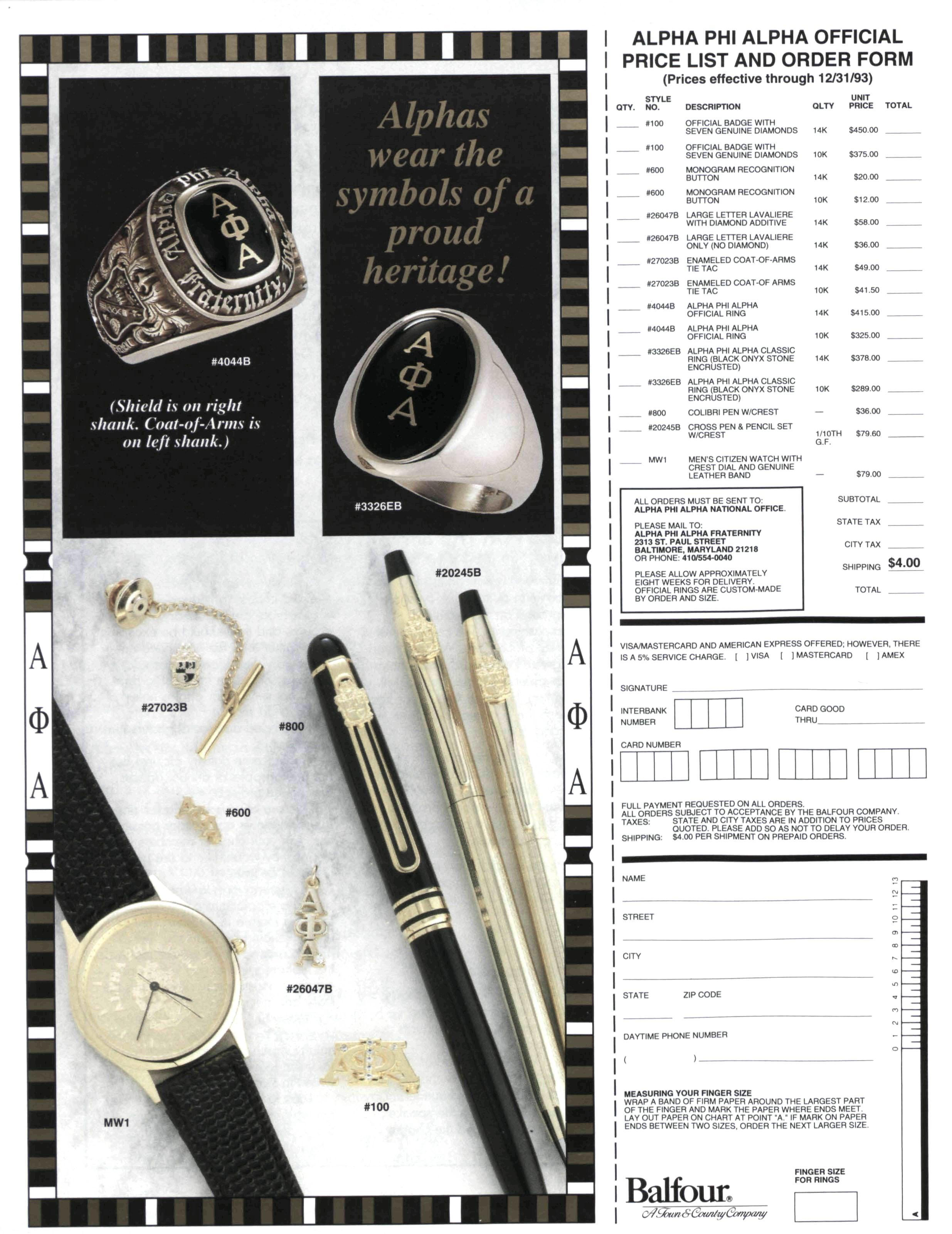
More than 200 guests attended a reception honoring 18 South African diplomatic corps trainees at Howard University's Blackburn Center in February The reception was sponsored by Alpha Phi Alpha Fraternity, Inc and hosted by Mu Lambda Chapter in Washington, DC
The trainees were welcomed and greeted by Mu Lambda President Clinton C Jones and General President Milton C. Davis,who spoke of the historic and continuing relationship Alpha Phi Alpha Fraternity has maintained with various African nations Each of the trainees was presented with a black and gold pen inscribed with the Fraternity's monicker commemorating the bond between it and the African peoples
Also appearing on the program was Mu Lambda's Dr Horace G Dawson, Jr., who was instrumental in developing the training program that involved South African civil servants and students from previously disadvantaged racial groups and political parties.
Heretofore, non-whites had been deprived of opportunities to work in South Africa's diplomatic corps
The training program followed a request from Nobel Peace Prize winner Nelson Mandela to prepare an inclusive foreign service representative of the incoming majority rule government and was a joint effort of Howard and Georgetown universities designed to train such diplomats. Mr. Mandela has since
been elected President of his native South Africa
Operating under a $250,000 grant from the Agency for International Development (AID), the trainees participated in a series of lectures, symposia, discussion groups, and simulation at both the Howard and Georgetown campuses.
In addition to attending classes at Howard and Georgetown, the participants also visited the United Nations in New York City and such institutions in Washington, D.C as the World Bank, World Health Organizations, the U.S. State Department, the U.S Information Agency, and the Organization for African Unity
LEFT. South African Diplomatic corps trainees were preparedfor service in a program developed by Brother Horace Dawson (third from left, front) shown here with General President Milton C. Davis.
BELOW LEFT: General President Milton C. Davis (third from left) greeted the several ambassadors who attended the Alpha Phi Alpha, Inc. reception honoring the South African diplomatic corps trainees. Brother Horace Dawson (second from right) is a retired U.S. Ambassador.
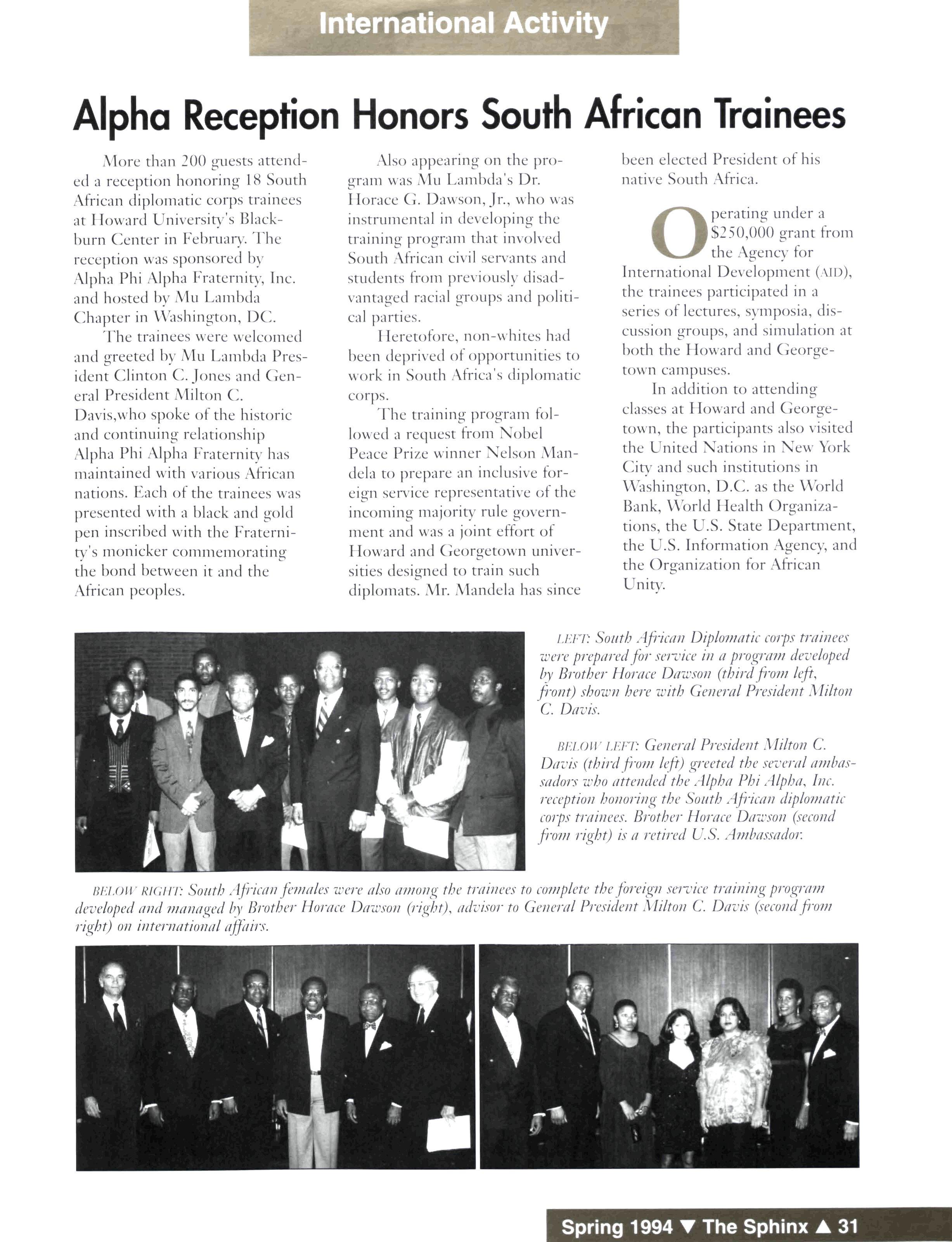
RIGHT.
Continuedfrom page 3
These young men—these terrorists—are the enemy, not the white man. If whites were killing blacks at the rate blacks are killing blacks, there would be unparalleled outrage at this senseless violence in the streets
After a few white students watched a classmate gunned down by a stray bullet, local media in San Diego called for counseling and psychiatric assistance for the "traumatized survivors." A U.S government study notes that many inner city youth suffer from "Post Traumatic Stress Disorder," a result of the violent experiences they daily witness in their communities. Yet, there is no public call for help—no outrage about die killing or the needs of the survivors— in African American communities We have left
but far too few to have a positive impact on tiie consciousness of the majority of people viewing movies
In a media-driven generation, with most of our children spending hours watching BET, MTV, and VH-1,we must get them appropriately involved in the Information Age. Computers must become more a part of the luggage for the college bound student than are televisions, VCRS, and stereo systems
Congress provides billions of dollars of economic aid to Israel Imagine that kind of money—or even a reasonable portion of it— being poured into U S black communities for housing, schools, day care programs, loans to minority businesses, and grants for college students? The ship is In Irons.
Dutch researchers are reported to have analyzed blood samples and identified people with inability to produce an enzyme called MAMO (manoamine oxidase) which breaks down the molecule that transmits signals within the brain. People with this defective gene are prone to commit more violent acts. A similar article suggests that African American men may carry this defective gene in greater proportions than white men.
the ship "In Irons"; we are not there to combat the forces that are destroying our seeds—our future
We allow the ACLU and the FCC to play games in court about the First Amendment and freedom of speech in relationship to issues so directly affecting us We tolerate black rap artists and their messages of violence, disrespect for self, black women, family, and community Meanwhile, white audiences hear different versions of these songs We are right there on BET television, MTV, and VH-1 with African American oriented videos promoting sex, violence, death, and a gangsta rap mentality.
Hollywood, too, is guilty of a penchant for violence, hopelessness, negative stereotyping and ignorance when portraying African Americans on the big screen. There are exceptions,
The infrastructure of the extended family, socioeconomic conditions, and the lack of educational opportunities all contribute to the violent behavior among our teens. However, foremost among the contributing factors is the absence of strong, intelligent African American men in the lives of these teens—-role models who are needed to develop, groom, and pass down the moral and social values and the physical and mental discipline it takes to play the game of life and win in socially responsible and legal ways We've got to redefine "win" for these young men.
We cannot overlook the relevance of spiritual consciousness and its relationship to violent behavior among young African American males African American young men have deserted the black church in significant numbers. The perceived whiteness of Christianity does not meet their spiritual expectations or requirements. The Rev. Walter A. McCray tells us in his book, The Black Presence in the Bible, about people of African descent who played major roles in the events of the Bible Many African American youth are seemingly unwilling to look the other way as many black Christians continue to deny their rightful heritage—accepting untruths as truths.
Meanwhile, where will those who are deserting die black church turn for spirituality? Will they accept God into their lives, wherever they decide to worship? The Nation of Islam offers a viable alternative as does El-Islam, Buddhism, and Hinduism. There are other traditional and nontraditional religions that many of our young people are investigating to find peace and love. We should help them in their search for spirituality and peace of mind.
Some would argue that young African American males have more options than did their counterparts of the sixties and late seventies In reality, these young men have fewer choices and opportunities than we had in the past. The Civil Rights Movement gave us hope of a better day, and there was promise of a better opportunity to progress in mainstream America with the support of affirmative action legislation. But today's youth grew up under 12 years of hostile attacks by the Reagan and Bush administrations General Colin Powell is quoted in U.S. News and World Report as saying: "If they (African American youth) don't feel they have a chance, then all is lost And even though they are trapped in some structural situations that are hard to break out, they've got to try to break out of it. They have no choice...you've got to swim against it...The only thing I can do is tell them to reach down inside themselves."
Many of us have bought into the notion that somehow if we reached down inside and attained an education and spoke the King's English we would be accepted as peers by white America But Ellis Cose tells a different story in his book, The Rage of a Privileged Class...
There is a lot of rage boiling in the African American male group from 30-50 years old I predict that we will see more violent acts of aggression directed toward whites in the near future African American males are looking for a way to vent their rage at the injustices and racism continually perpetuated by white America. Columnist Richard Brookhiser's comments
in the March 27, 1994,issue of the New York Times are instructive Referring to the Colin Furguson subway case, Brookhiser says: "The usual watchdogs of hate crime have fallen strangely silent in this case, however, for the obvious reason that Colin Ferguson's hatred was not the kind of hatred they expected to be punishing. The category of hate crime was meant to draw attention to the level of white racism in America."
And finally, the issue to be addressed is the relationship between the economic opportunities of drugs and violence among teenage African Americans
Many young African American youth see drugs as the only way to support their parents and siblings in a comfortable style Former drug czar William Bennett wrote in 1992 that street drugs constituted less than ten percent of drugs trafficked in the country in terms of quantity and dollars, but it represented the primary business in the black community for economic survival. Dr. Booker T Washington is reported to have said that "at the bottom of education, at the bottom of politics, even at the bottom of religion itself, there must be for our race...economic foundation, economic prosperity, economic independence." We cannot condone the decision to distribute drugs to make money, but neither can we ignore the prominence of economics and its role in problems facing African American communities, including violence among teenage African Americans
With the acceptance of integration, we lost control of and interest in many of the resources in our community—school teachers and administrators and local businesses. African Americans have become a part of a bureaucracy that cannot understand our problem and neither can they address them
Brothers, the only way to head the ship out of In Irons is to pull hard on the tiller to catch the wind If we don't catch it, the wind will keep blowing past us, and we will remain adrift on the ocean.
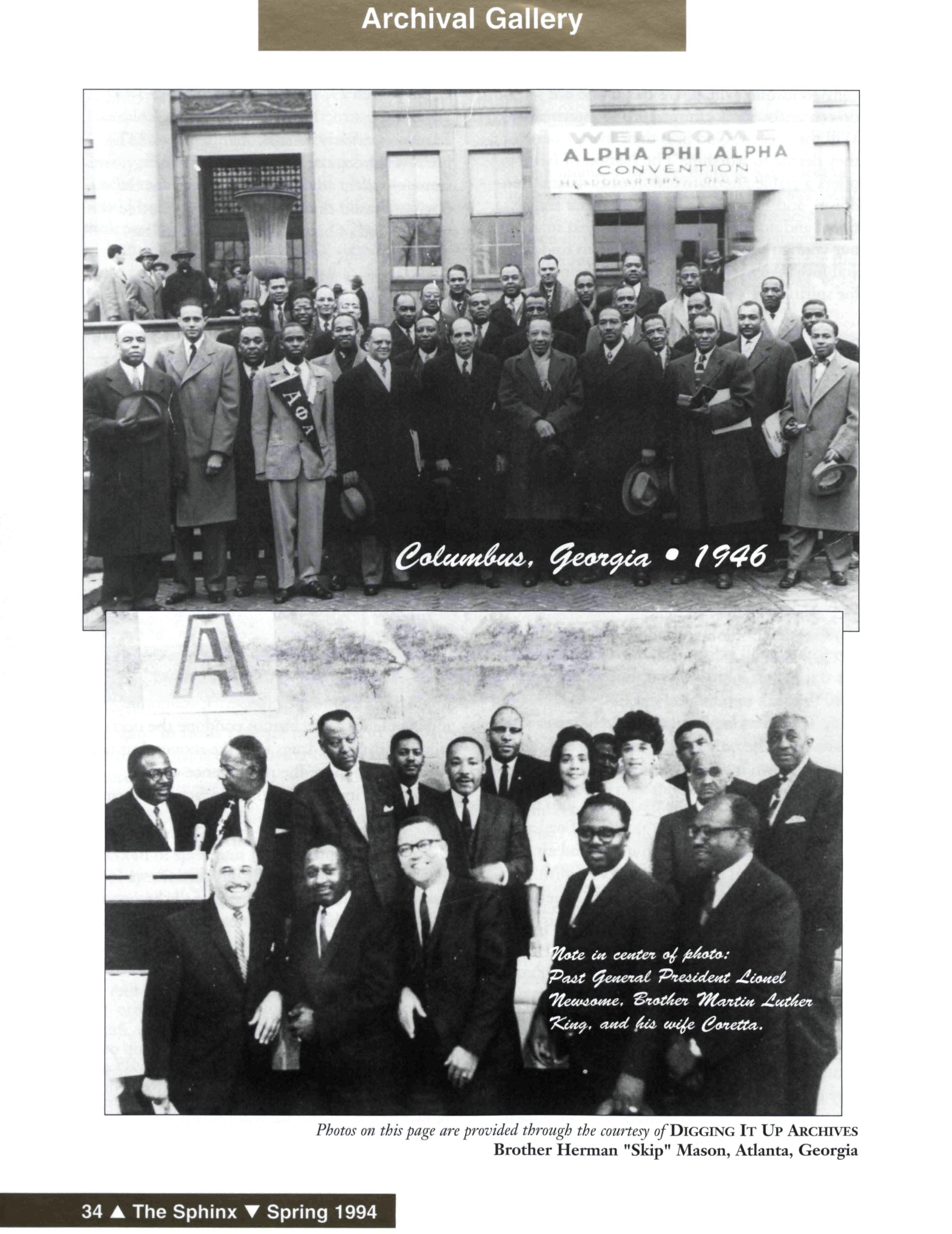
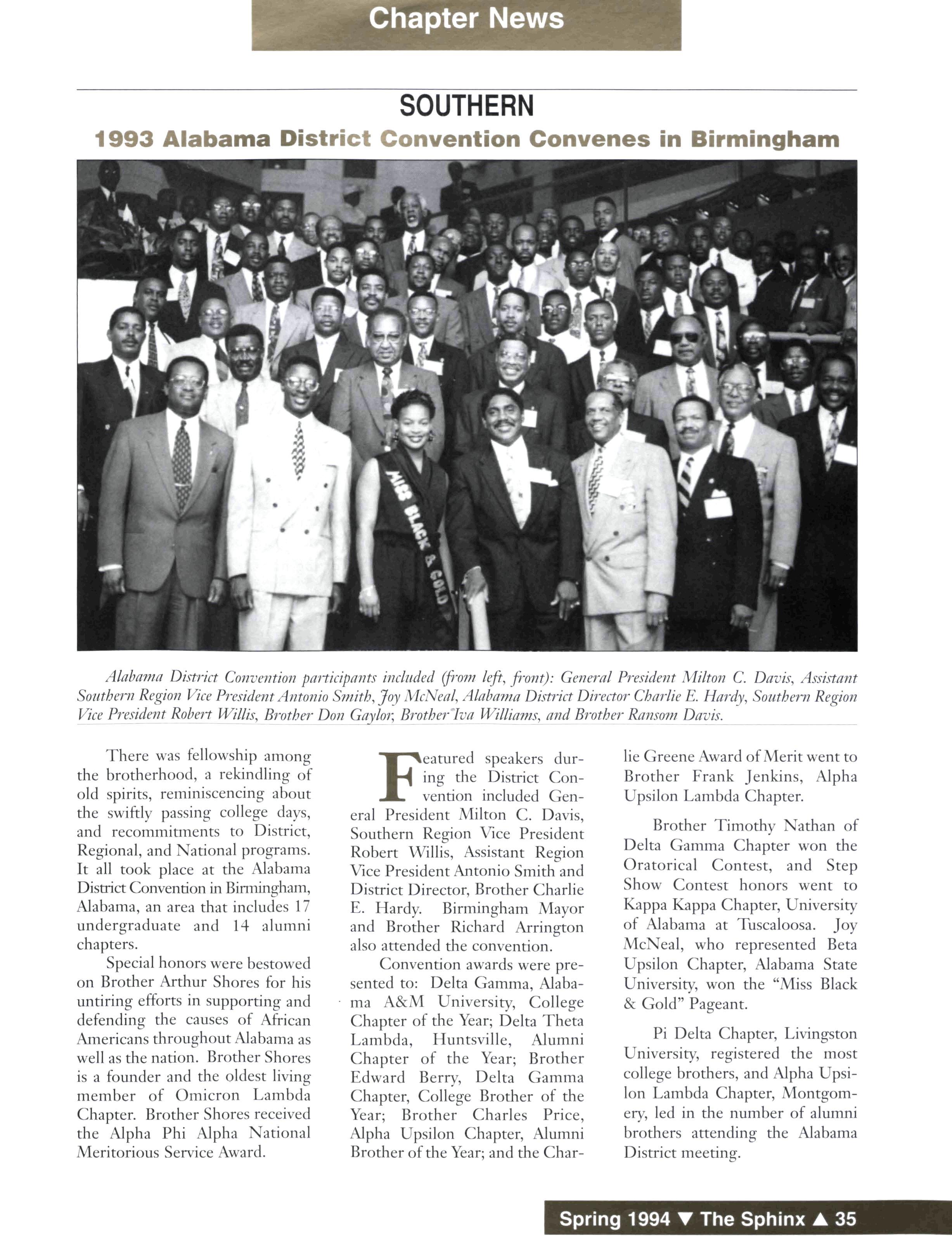
There was fellowship among the brotherhood, a rekindling of old spirits, reminiscencing about the swiftly passing college days, and recommitments to District, Regional, and National programs It all took place at the Alabama District Convention in Birmingham, Alabama, an area that includes 17 undergraduate and 14 alumni chapters
Special honors were bestowed on Brother Arthur Shores for his untiring efforts in supporting and defending the causes of African Americans throughout Alabama as well as the nation. Brother Shores is a founder and the oldest living member of Omicron Lambda Chapter. Brother Shores received the Alpha Phi Alpha National Meritorious Service Award.
Featured speakers during the District Convention included General President Milton C. Davis, Southern Region Vice President Robert Willis, Assistant Region Vice President Antonio Smith and District Director, Brother Charlie E. Hardy. Birmingham Mayor and Brother Richard Arrington also attended the convention.
Convention awards were presented to: Delta Gamma, Alabama A&M University, College Chapter of the Year; Delta Theta Lambda, Huntsville, Alumni Chapter of the Year; Brother Edward Berry, Delta Gamma Chapter, College Brother of the Year; Brother Charles Price, Alpha Upsilon Chapter, Alumni Brother of the Year; and the Char-
lie Greene Award of Merit went to Brother Frank Jenkins, Alpha Upsilon Lambda Chapter
Brother Timothy Nathan of Delta Gamma Chapter won the Oratorical Contest, and Step Show Contest honors went to Kappa Kappa Chapter, University of Alabama at Tuscaloosa Joy McNeal, who represented Beta Upsilon Chapter, Alabama State University, won the "Miss Black & Gold" Pageant
Pi Delta Chapter, Livingston University, registered the most college brothers, and Alpha Upsilon Lambda Chapter, Montgomery, led in the number of alumni brothers attending the Alabama District meeting.
"Learning from the Past, Living in the Present, Looking to the Future: A Hope for Black Males" was the theme of Beta Delta Lambda's Founders' Day workshops for African American males. Community consultants covered a range of topics—dangers of drugs, the influence of media, importance of education, spiritual life, and other current issues facing African American males.
During a dinner which followed the Founders' Day workshops, Brother Robin A Courtney was honored as "Alpha Man of the Year" and Brother Michael Bell of Delta Beta Chapter won applause for his participation in the Regional Oratorical Contest The chapter also presented plaques to three citizens for outstanding service in the communities where they live—Deland, Daytona Beach, and St Augustine
Special congratulations to Brother Sylvester Covington who has been appointed by the Governor to the Board of Directors of the Halifax Medical Center; Brother James E Hugher, former executive secretary of Alpha Phi Alpha, was honored by the City of Daytona Beach upon his retirement as Director of Community Development; the City of St Augustine honored Brother Otis Mason upon his retirement as Superintendent of St Johns County Public Schools; and 50-year
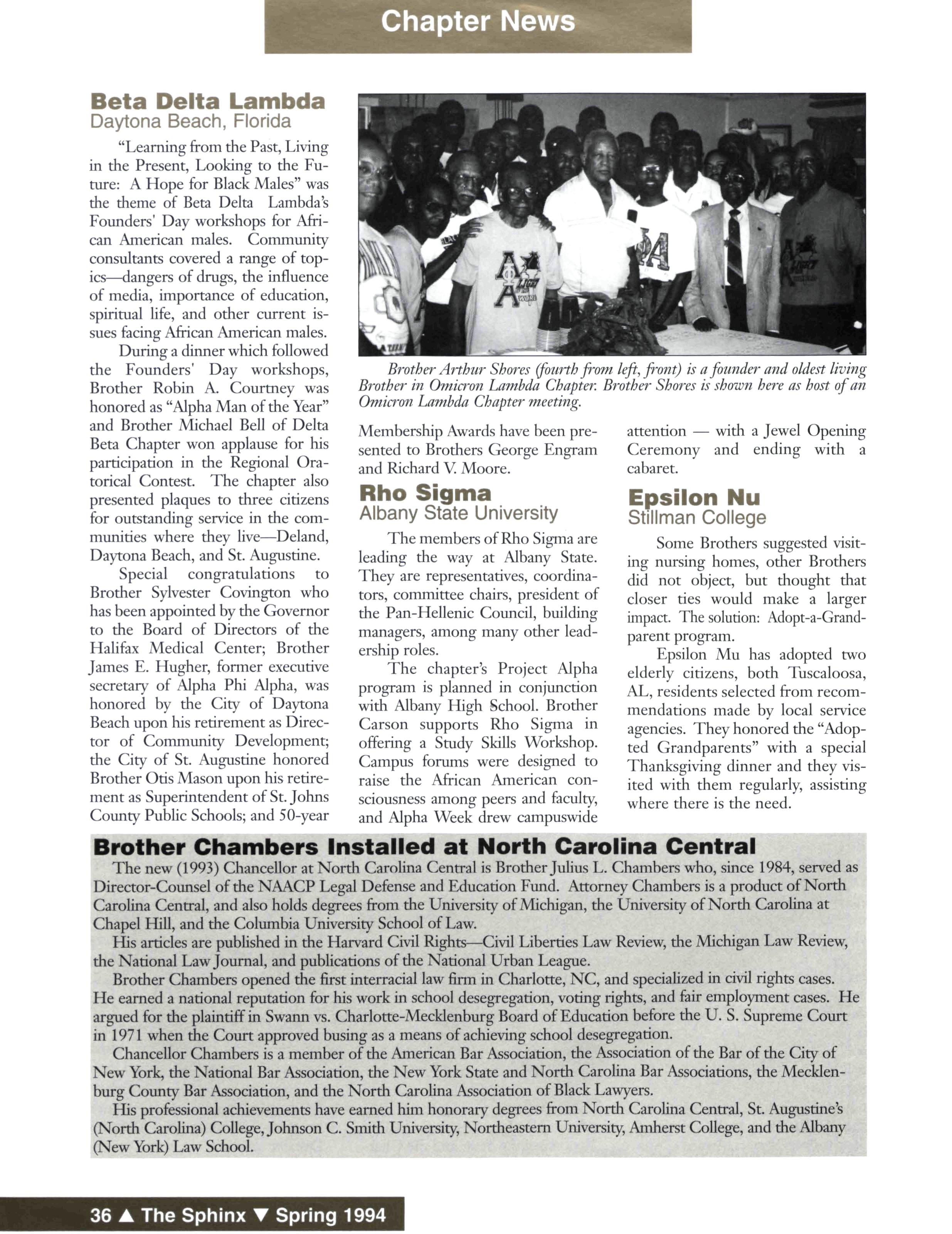
Lambda Chapter. Brother' Shores is shown here as host of an Omicron Lambda Chapter meeting.
Membership Awards have been pre- attention — sented to Brothers George Engram Ceremony and Richard V Moore cabaret
with a Jewel Opening and ending with a
The members of Rho Sigma are leading the way at Albany State. They are representatives, coordinators, committee chairs, president of the Pan-Hellenic Council, building managers, among many other leadership roles.
The chapter's Project Alpha program is planned in conjunction with Albany High School Brother Carson supports Rho Sigma in offering a Study Skills Workshop Campus forums were designed to raise the African American consciousness among peers and faculty,
Some Brothers suggested visiting nursing homes, other Brothers did not object, but thought that closer ties would make a larger impact. The solution: Adopt-a-Grandparent program.
Epsilon Mu has adopted two elderly citizens, both Tuscaloosa, AL, residents selected from recommendations made by local service agencies They honored the "Adopted Grandparents" with a special Thanksgiving dinner and they visited with them regularly, assisting where there is the need and Alpha Week drew campuswide
The new (1993) Chancellor at North Carolina Central is Brother Julius L. Chambers who, since 1984, served as Director-Counsel of the NAACP Legal Defense and Education Fund. Attorney Chambers is a product of North Carolina Central, and also holds degrees from the University of Michigan, die University of North Carolina at Chapel Hill, and the Columbia University School of Law.
His articles are published in the Harvard Civil Rights—Civil Liberties Law Review, the Michigan Law Review, the National LawJournal, and publications of the National Urban League.
Brother Chambers opened the first interracial law firm in Charlotte, NC, and specialized in civil rights cases. He earned a national reputation for his work in school desegregation, voting rights, and fair employment cases. He argued for the plaintiff in Swarm vs. Charlotte-Mecklenburg Board of Education before the U. S. Supreme Court in 1971 when the Court approved busing as a means of achieving school desegregation.
Chancellor Chambers is a member of the American Bar Association, the Association of the Bar of the City of New York, the National Bar Association, the New York State and North Carolina Bar Associations, the Mecklenburg County Bar Association, and the North Carolina Association of Black Lawyers.
His professional achievements have earned him honorary degrees from North Carolina Central, St. Augustine's (North Carolina) College,Johnson C. Smith University, Northeastern University, Amherst College, and the Albany (New York) Law School.
Brother Robert P Jordan Sr., a member of Zeta Alpha Lambda for 20 years, has been elected Lt Governor of Division 15, Kiwanis International of the Florida District
Some 500 members are reported to be active in the 15 clubs in the Kiwanis District for which Brother Jordan has been elected Lt Governor Brother Jordan is the first African American to be named Lt Governor in the 46
years of Division 15's existence The position covers Kiwanis Clubs in the Broward County and Fort Lauderdale areas of Florida
Brother Jordan is a former trustee of the First Baptist Church in Fort Lauderdale, and currently serves his church as treasurer and financial secretary
Upsilon Lambda has added several new projects to its chapter programs Acommunitywide food drive
Although he is retired now, don't be surprised if you try and fail to catch Brother Walter J Stanley,Jr., at home. Only if you keep trying will you catch him just before he leaves for an engagement, in between commitments, or after he has returned from the professional workshops he conducts or one of the community service projects in which he is involved.
Retired after 20 years in public education, Brother Stanley still conducts workshops on teaching reading and language arts and teaching English as a second language. But most of his time is spent with community service projects—mentoring young men from fatherless homes, tutoring problem children at the Jann Mann Opportunity School, and mentoring youth enrolled at Northwestern Senior High School.
Education has been Brother Stanley's life He has been professionally associated with the Dade County School System in Miami, Broward County School System in Fort Lauderdale, and Dade County Community College in Miami
"I had a teacher who touched my life when I was six years old," Brother Stanley recalls. It was in one of those one-room schools in his native Georgia, the kind, Brother Stanley says, where the teacher had several classes. "She impressed me. She was concerned about people, as I am."
Brother Stanley remembers his special teacher visiting the homes of children when they failed to attend school He has followed the same practice "Knowing the family helps you reach the child better," Stanley reasons If a parent failed to visit the school to inquire about the progress of the student, Stanley would visit the home to talk about the student's progress.
Stanley also remembers his special teacher securing school supplies, including clothing, for students who evidenced the need
In all of his mentoring activities, Brother Stanley says he promotes the same philosophy his special teacher taught him: "There is no such word as 'I can't.' It is always "I can' or 'I will.'"
helped spread joy among many needy families during Thankgiving, and many faces smiled at the toys distributed during the Christmas season.
The chapter expected to make an investment in the United Negro College Fund with proceeds from its annual Martin Luther King Amateur Gold Tournament.
Upsilon Lambda was instrumental in organizing Sigma Upsilon at the University of North Florida, and of course the annual Black and Gold Ball was a usual big hit.
"I always tell my children (his own and those he mentors) that no one can elevate you except you You determine what your future will be."
The so-called "problem children" he tutors and counsels, Brother Stanley says, need encouragement. "They need positive role models. They need to know that there are some good black men left, even though the media might not say so."
Stanley accuses the media of emphasizing what he calls "smash and grab" robberies and other crimes "They [the media] don't show the scholarship winners They don't show the young black men who are doing good things."
At the New Life Baptist Church he attends in Miramar, Florida, Brother Stanley is a choir member and Sunday School teacher. While a student at Bethune Cookman College, he remembers attending prayer meeting every Wednesday night and church every Sunday, a commitment he shares with the youth he now mentors
In addition to his degrees from Bethune Cookman College, Florida International University, and Nova University, Dr Stanley has studied at Northwestern University, Xavier (Ohio) University, and the University of Cincinnati A life member of Alpha Phi Alpha, Dr Stanley is corresponding secretary for Zeta Alpha Lambda Chapter in Fort Lauderdale, Florida.
He was initiated into Alpha Phi Alpha Fraternity at Bethune Cookman College where he was influenced by the late Brother and Rev J Harold Lovett who was Dean of Men at Bethune Cookman when Dr Stanley was a student there. Rev. Lovett befriended him, Stanley recalls, "like a big brother."
Is he optimistic about correcting the problems he sees among the youth he mentors and in the communities where they live? "It will take awhile, but we can make a big dent in it."
"You really have to get them [youth] from the cradle up Before the cradle, really, because you have to counsel mothers about the dangers of drug use and abuse."
Beta Epsilon has been honored with the Area and State Chapter of the Year Award for 1993-94 and also includes among its members the Area and State Oratorical Contest winner, Brother Thomas L Barksdale II
Beta Epsilon Brothers conducted a "A Voteless People is a Hopeless People" voter registration drive, joined a neighborhood church in preparing food baskets for needy and elderly families, tutored community youth, and conducted a "Go to High School Go to College" project
Information and entertainment were considered in planning the annual Alpha Week activities. One event focused on special programs confronting the African American male, another addressed the special plight of African American females, and the nationally-known E. Gwynn Dancers were featured in an African Fashion Show.
It was a surprise. When Brother Zimbalist Clark was asked to attend a special program in honor of Dr. Martin Luther King, Jr., he had no idea he too would be honored.
A native of Clarence, Louisiana, who currently resides in Hollywood, Florida, Brother Clark received the Dr Martin Luther King, Jr Outstanding Community Leader Award from the City of Hollywood's Parks and Recreation Department The department cited Brother Clark for his dedicated service to the community, both as a citizen and as a resource police officer
The Hollywood, Florida, police officer is assigned to the McNicol Middle School as a resource officer and shares his off duty time coaching Little League football, basketball, and baseball
Brother John N England is the first African American named a Circuit Judge in Tuscaloosa, Alabama In naming Brother England to the circuit judge slot, Alabama Governor Jim Folsom said he was confident England would "render a valuable service to the citizens of Alabama while serving in this important position."
A native of Uniontown, AL, Judge England is a graduate of Tuskegee University and the University of Alabama law school where he was a member of the first class that included African American students
Brother England was a member of the Tuscaloosa City Council and past president of the Alabama Lawyers Association He is president of the Alabama New South Coalition and is active with the Benjamin Barnes Branch of the YMCA and the McDonald Hughes Community Center
Judge England has served as attorney for the Greene County Commission and the Forkland and Union, AL, municipalities. Brother England is credited with responsibility for changing Tuscaloosa's form of government from City Commission to City Council.
A Life Member of Alpha Phi Alpha has been named interim director of the Waterbury campus of the University of Connecticut
Brother Otha N Brown Jr has an extensive record of public service in Connecticut A member of Zeta Phi Lambda Chapter in Stamford, Connecticut, Brother Brown served on the University of Connecticut's Board of Trustees for 18 years, 16 of those years as the Board's secretary
He is a former Deputy Mayor of Norwalk and President of the Norwalk Common Council He is currently serving a third six-year term as District Commissioner of
South Norwalk, Connecticut Chairman of the District Commission since 1982, Brother Brown is the first and only African American elected a District Commissioner of the Norwalk local government
The Commissioner governs the District's assets—an electric company, water company, and other properties
In addition to the role he has played in local government, Brother Brown served three terms in the Connecticut Legislature where he was the first African American to chair a standing committee. He chaired the State's Human Rights and Opportunities Committee,
served on the Governor's Executive Committee and Commission, and chaired the Connecticut Legislature's Corrections, Public Welfare, and Humane Institutions Committee
As a member of the Norwalk Common Council, Brother Brown was elected majority leader, council president, and deputy mayor
A real estate broker, Brother Brown is also a retired counselor of the Stamford Public Schools He received his graduate degree from the University of Connecticut and a professional diploma from the University of Bridgeport
The "Windy City" isthe home of the nationally-acclaimed Project Alpha and its founding chapter, Iota Delta Lambda
Sixty African American males, 14 to 18 years old, participated in Iota Delta Lambda's Project Alpha conference which focused on adolescent pregnancy, the male role in human reproduction, a mock trial of the legal responsibility of teenage fathers, and the importance of high goals and good moral standards
During its 2nd Annual Scholarship & Installation Luncheon honoring graduating high school seniors and college Brothers, some $4,000 in scholarships were awarded in memory of Brothers Michael Price, VincentJones, and Preston Yarber
"African Americans in the 21st Century" was the topic of Iota Delta Lambda's 5th Annual Oratorical Contest Chicago area elementary school students received $500 in cash prizes for their participation in this project, and 100 children and senior citizens at the Alpha Towers got a taste of the Alpha Spirit during Halloween
Alpha Phi Alpha has been providing community service at Grambling State University and in the local community for 42 years
Delta Sigma Chapter took the unprecedented step in organizing what may have been the first meeting of communitywide leaders to hear student concerns Concerned about the increasing amount of crime in the Grambling community, Delta Sigma organized a panel around the question: "Can we all just get along?"
More than 300 faculty, staff, students, and community leaders attended this public forum which
From Iota Delta Lambda, welcome to Chicago for the 1994 National Convention.
Dayton, Ohio
Theta Lambda has placed a high priority on implementing Project Alpha "There has been a great deal of disinformation and misinformation these teenage boys have received," says Brother Lt Col Charles Coffin, chairman of the chapter's Project Alpha program "We want these seminars to give them (the teenage participants) a sense of responsibility in their lives and an understanding of what goes along with the grown up responsibility of teenage sex and pregnancy."
The teenagers heard from a psychologist, a surgeon, an obstetrician, a child support agency counselor, and aJuvenile Court Judge
After chairing the Project Alpha program for three years, Brother Coffin has been reassigned to Washington, DC, and the duties have been assigned to Brother Leroy Edwards
In addition to its annual Project Alpha Seminar, Theta Lambda also
included law enforcement officials, college administrators, and local attorneys All agreed on the value of a united effort to combat crime
Delta Sigma's nine-member step team won the campus competition for the seventh consecutive year and went on to represent Grambling State at the Bayou Classic The team also won first place in step competition at the State Convention in New Orleans.
Meanwhile, ongoing chapter programs include Project Alpha, highway clean-up, and Little Brother Mentoring.
sponsored eight teenagers at the Midwest Leadership Education Citizen Institute held at Kent State University; includes teens with them when they visit the homeless at St. Vincent's Hotel; and sponsors youth recognition programs and youth attendance at cultural enrichment, sporting and career planning events.
The Brothers of Epsilon Xi have maintained a low profile in The Sphinx, but a high profile in their community The chapter's activities include: a high school peer mentor/mentee program; "Go to High School Go to College" campaign; a "Feed the Homeless Thanksgiving Dinner" co-sponsored with Alpha Kappa Alpha Sorority; a "Non-Violent Racial Insensitivity March"; and a program designed to heighten "appreciation of black women."
Epsilon Xi also celebrated the 30th annual Black and Gold Sweethearts Ball, crowned the first "Miss Black and Gold," and held the annual step competition for the second consecutive year
In 1996, he will become a 50-year member of Alpha Phi Alpha Fraternity. Meanwhile, Brother Willis "Bill" Williams retired from public school education but has been called out of retirement and named Interim Superintendent of Helena/West Helena (Arkansas) School District
During his 25 years in public school education, Brother Williams served as principal, superintendent of elementary programs, deputy superintendent, and interim superintendent of the school district. He was the first African American to be named Superintendent of the Helena/West Helena School District
The school district over which he superintends has over 4,500 students and over 600 certified and non-certified personnel Brother Williams has received a long list of honors and awards during his professional career, including appointment by the Governor to me Arkansas Black History Advisory Committee
Since he joined Theta Tau Lambda Chapter in 1969, Brother Williams has served as the chapter's president, secretary, and treasurer In the latter capacity, he is only the second treasurer in the history of Theta Tau Lambda. Theta Tau Lambda has also recognized Williams with "Brother of the Year" honors
Gamma Chi LambdaSan Francisco, California
Brother H Welton Flynn has been presented an award in recognition of his many contributions to Gamma Chi Lambda and the City of San Francisco
Brother Flynn was honored during Gamma Chi Lambda's Fraternal Luncheon which was attended by Brother Roland Chandler, president of Gamma Phi Lambda, Oakland, and Brother Joe C Thomas, Northern California Regional Director and Chairman of the National Commission on Racial Justice
Chapter officers were installed during the Fraternal Luncheon by Brother Marshall Whitley The guest speaker was Brother Horace Wheatley
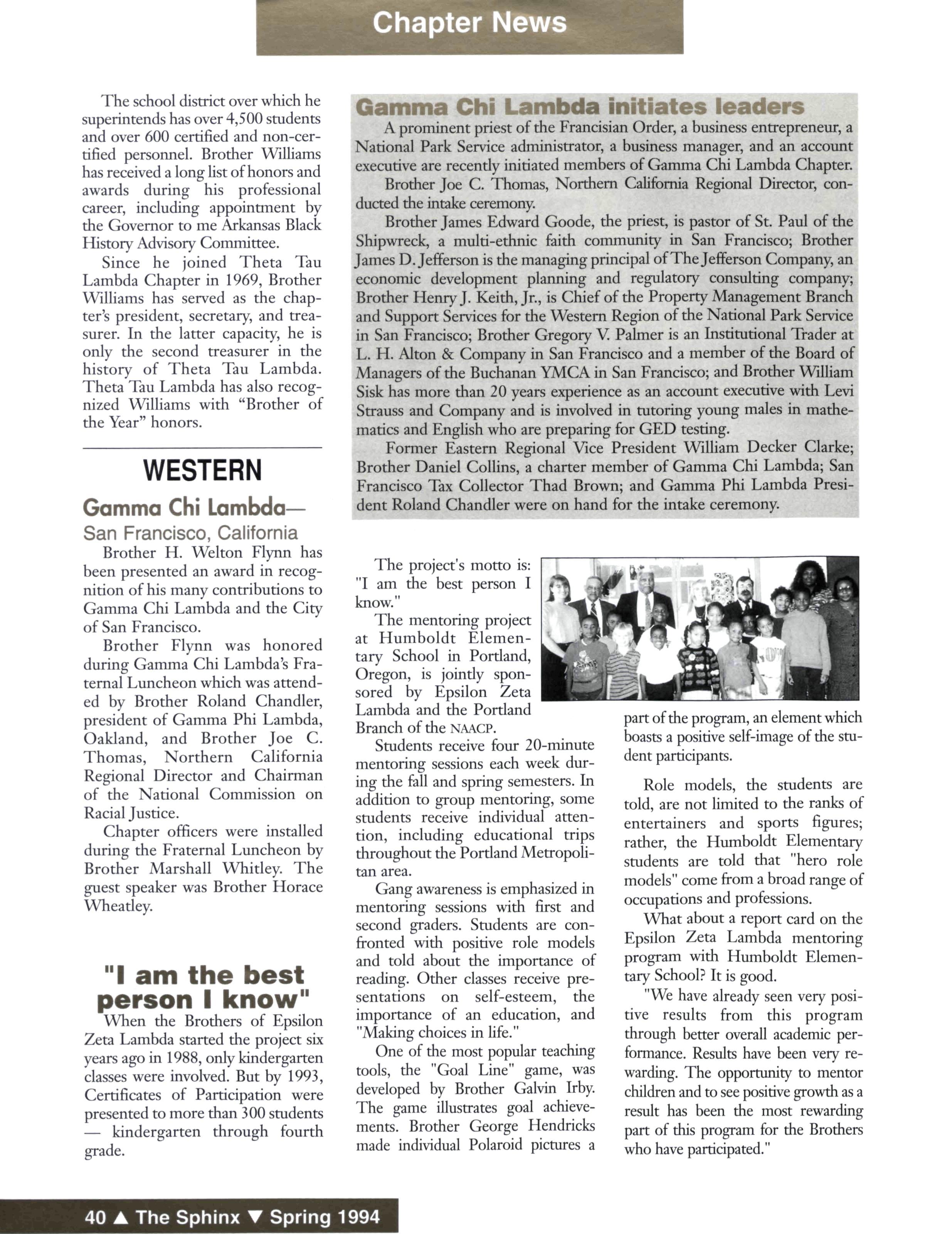
"I am the best person I know"
When the Brothers of Epsilon Zeta Lambda started the project six years ago in 1988, only kindergarten classes were involved But by 1993, Certificates of Participation were presented to more than 300 students kindergarten through fourth grade
A prominent priest of the Francisian Order, a business entrepreneur, a National Park Service administrator, a business manager, and an account executive are recently initiated members of Gamma Chi Lambda Chapter
Brother Joe C Thomas, Northern California Regional Director, conducted the intake ceremony
Brother James Edward Goode, the priest, is pastor of St Paul of the Shipwreck, a multi-ethnic faith community in San Francisco; Brother James D Jefferson is the managing principal of The Jefferson Company, an economic development planning and regulatory consulting company; Brother Henry J Keith, Jr., is Chief of the Property Management Branch and Support Services for die Western Region of the National Park Service in San Francisco; Brother Gregory V Palmer is an Institutional Trader at L H Alton & Company in San Francisco and a member of the Board of Managers of the Buchanan YMCA in San Francisco; and Brother William Sisk has more than 20 years experience as an account executive with Levi Strauss and Company and is involved in tutoring young males in mathematics and English who are preparing for GED testing
Former Eastern Regional Vice President William Decker Clarke; Brother Daniel Collins, a charter member of Gamma Chi Lambda; San Francisco Tax Collector Thad Brown; and Gamma Phi Lambda President Roland Chandler were on hand for the intake ceremony.
The project's motto is: "I am the best person I know."
The mentoring project at Humboldt Elementary School in Portland, Oregon, is jointly sponsored by Epsilon Zeta Lambda and the Portland Branch of theNAACP.
Students receive four 20-minute mentoring sessions each week during the fall and spring semesters. In addition to group mentoring, some students receive individual attention, including educational trips throughout the Portland Metropolitan area
Gang awareness is emphasized in mentoring sessions with first and second graders Students are confronted with positive role models and told about the importance of reading Other classes receive presentations on self-esteem, the importance of an education, and "Making choices in life."
One of the most popular teaching tools, the "Goal Line" game, was developed by Brother Galvin Irby The game illustrates goal achievements. Brother George Hendricks made individual Polaroid pictures a
part of the program, an element which boasts a positive self-image of the student participants
Role models, the students are told, are not limited to the ranks of entertainers and sports figures; rather, the Humboldt Elementary students are told that "hero role models" come from abroad range of occupations and professions.
What about a report card on the Epsilon Zeta Lambda mentoring program with Humboldt Elementary School? It is good
"We have already seen very positive results from this program through better overall academic performance. Results have been very rewarding The opportunity to mentor children and to seepositive growth as a result has been the most rewarding part of this program for the Brothers who have participated."
Iota Alpha Lambda Chapter is celebrating 29 years of service to die community, an accomplishment acknowledged during the chapter's annual Founders' Day program. Under die leadership of Brother J. Keidi Scroggins (1993), Iota Alpha Lambda is active with die Sickle Cell Anemia Walk-a-thon, the Harford County Public Schools' Speakers Program, and Alpha Phi Alpha's Project Alpha, and Go to High School Go to College. The chapter sponsors at least one student for two years at Harford or Cecil County Community College.
Iota Alpha Lambda supports the Harford County NAACP branch, Harford County Hospice, and helps raise the spirits of needy families with Christmas baskets
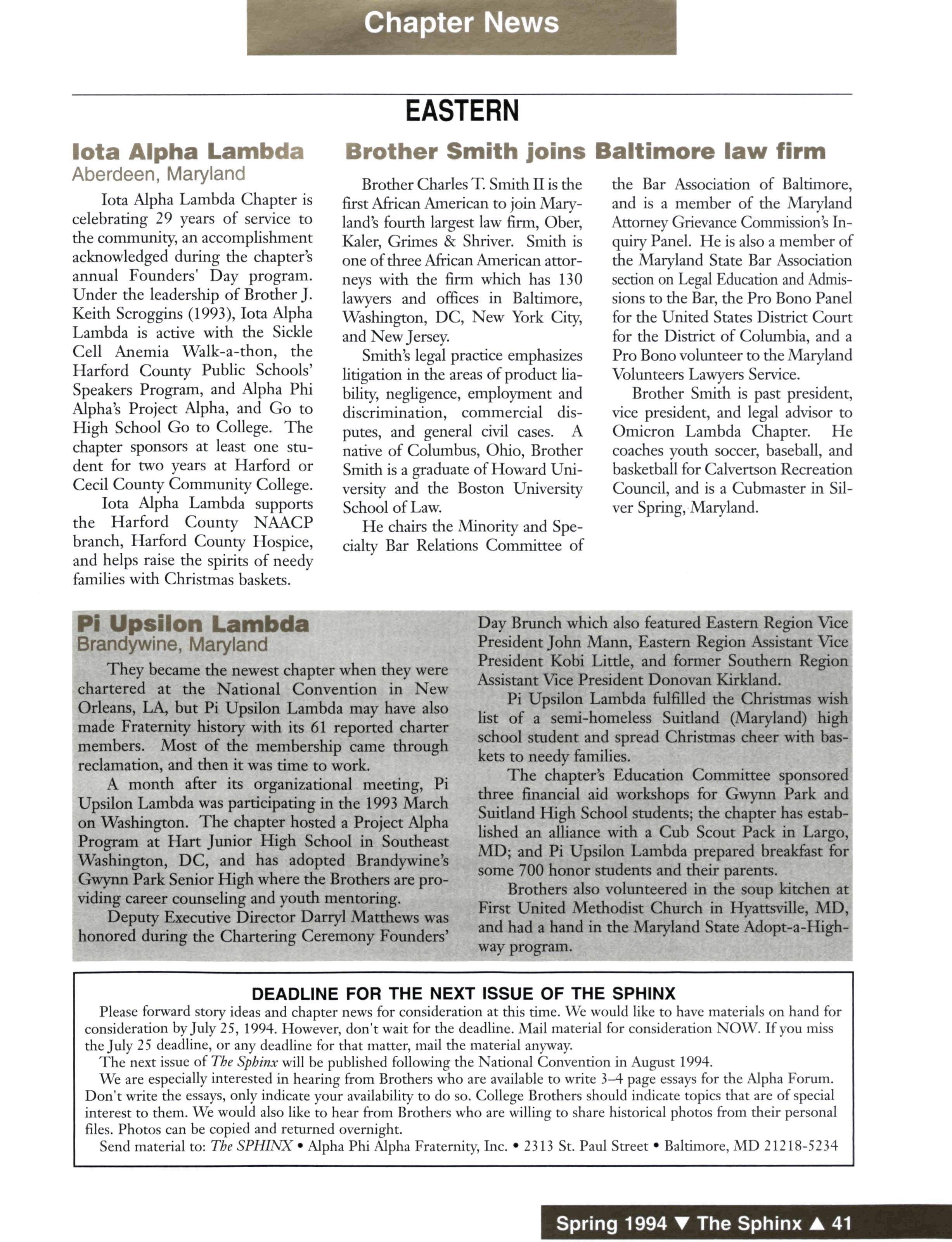
Brother Charles T Smith U is the first African American to join Maryland's fourth largest law firm, Ober, Kaler, Grimes & Shriver Smith is one of three African American attorneys with die firm which has 130 lawyers and offices in Baltimore, Washington, DC, New York City, and New Jersey
Smith's legal practice emphasizes litigation in the areas of product liability, negligence, employment and discrimination, commercial disputes, and general civil cases A native of Columbus, Ohio, Brother Smith is a graduate of Howard University and the Boston University School of Law
He chairs the Minority and Specialty Bar Relations Committee of the Bar Association of Baltimore, and is a member of die Maryland Attorney Grievance Commission's Inquiry Panel He is also a member of the Maryland State Bar Association section on Legal Education and Admissions to the Bar, the Pro Bono Panel for the United States District Court for the District of Columbia, and a Pro Bono volunteer to the Maryland Volunteers Lawyers Service
They became the newest chapter when they were chartered at the National Convention in New Orleans, LA, but Pi Upsilon Lambda may have also made Fraternity history with its 61 reported charter members. Most of the membership came through reclamation, and then it was time to work
A month after its organizational meeting, Pi Upsilon Lambda was participating in the 1993 March on Washington The chapter hosted a Project Alpha Program at Hart Junior High School in Southeast Washington, DC, and has adopted Brandywine's Gwynn Park Senior High where the Brothers are providing career counseling and youth mentoring
Deputy Executive Director Darryl Matthews was honored during the Chartering Ceremony Founders'
Brother Smith is past president, vice president, and legal advisor to Omicron Lambda Chapter He coaches youth soccer, baseball, and basketball for Calvertson Recreation Council, and is a Cubmaster in Silver Spring, Maryland
Day Brunch which also featured Eastern Region Vice President John Mann, Eastern Region Assistant Vice President Kobi Little, and former Southern Region Assistant Vice President Donovan Kirkland.
Pi Upsilon Lambda fulfilled the Christmas wish list of a semi-homeless Suitland (Maryland) high school student and spread Christmas cheer with baskets to needy families.
The chapter's Education Committee sponsored three financial aid workshops for Gwynn Park and Suitland High School students; the chapter has established an alliance with a Cub Scout Pack in Largo, MD; and Pi Upsilon Lambda prepared breakfast for some 700 honor students and their parents
Brothers also volunteered in the soup kitchen at First United Methodist Church in Hyattsville, MD, and had a hand in the Maryland State Adopt-a-Highway program.
Please forward story ideas and chapter news for consideration at this time We would like to have materials on hand for consideration byJuly 25, 1994. However, don't wait for the deadline. Mail material for consideration NOW. If you miss theJuly 25 deadline, or any deadline for that matter, mail the material anyway
The next issue of The Sphinx will be published following the National Convention in August 1994.
We are especially interested in hearing from Brothers who are available to write 3^4 page essays for the Alpha Forum Don't write the essays, only indicate your availability to do so. College Brothers should indicate topics that are of special interest to them We would also like to hear from Brothers who are willing to share historical photos from their personal files. Photos can be copied and returned overnight
Send material to: The SPHINX • Alpha Phi Alpha Fraternity, Inc. • 2313 St. Paul Street • Baltimore, MD 21218-5234
Brother Charles H. Davenport was a graduate of Mississippi Valley State and Fordham University. He completed additional studies at theJohn Jay College of Criminal Justice He retired after serving 24 years with the New York City police department and was named the first African American Chief of Police by the first African American Mayor of the City of Vicksburg, MS. He was Chief of Police for the City of Vicksburg for almost a year and was a consultant to the police department at the time of his death Brother Davenport was a member of the National Association of Black Law Enforcement Executives, the Knights of Columbus, Elks Lodge, and the Mississippi Valley Alumni Association He joined the ranks of Alphamen inJune 1993 and attended his first and only convention in New Orleans
Brother Herbert H. Willis began his professional career at Southern (Louisiana) University He was a native of Louisville, Kentucky, and earned degrees from Howard University and New York University Most of his professional life was spent at Central State University where he was associate professor of accounting, Business Manager and Treasurer, and Chairman of the Central State University Foundation. He received Professor Emeritus status in 1993. Brother Willis was an active member of the Wilberforce/Xenia Optimist Club, Promoters of Arts, Literature and Science (P.A.L.S.), Xenia YMCA Board, Zion Baptist Church, Kentucky Colonels, and Connecting Links. He was a life member of Alpha Phi Alpha Fraternity (Chi Lambda Chapter)
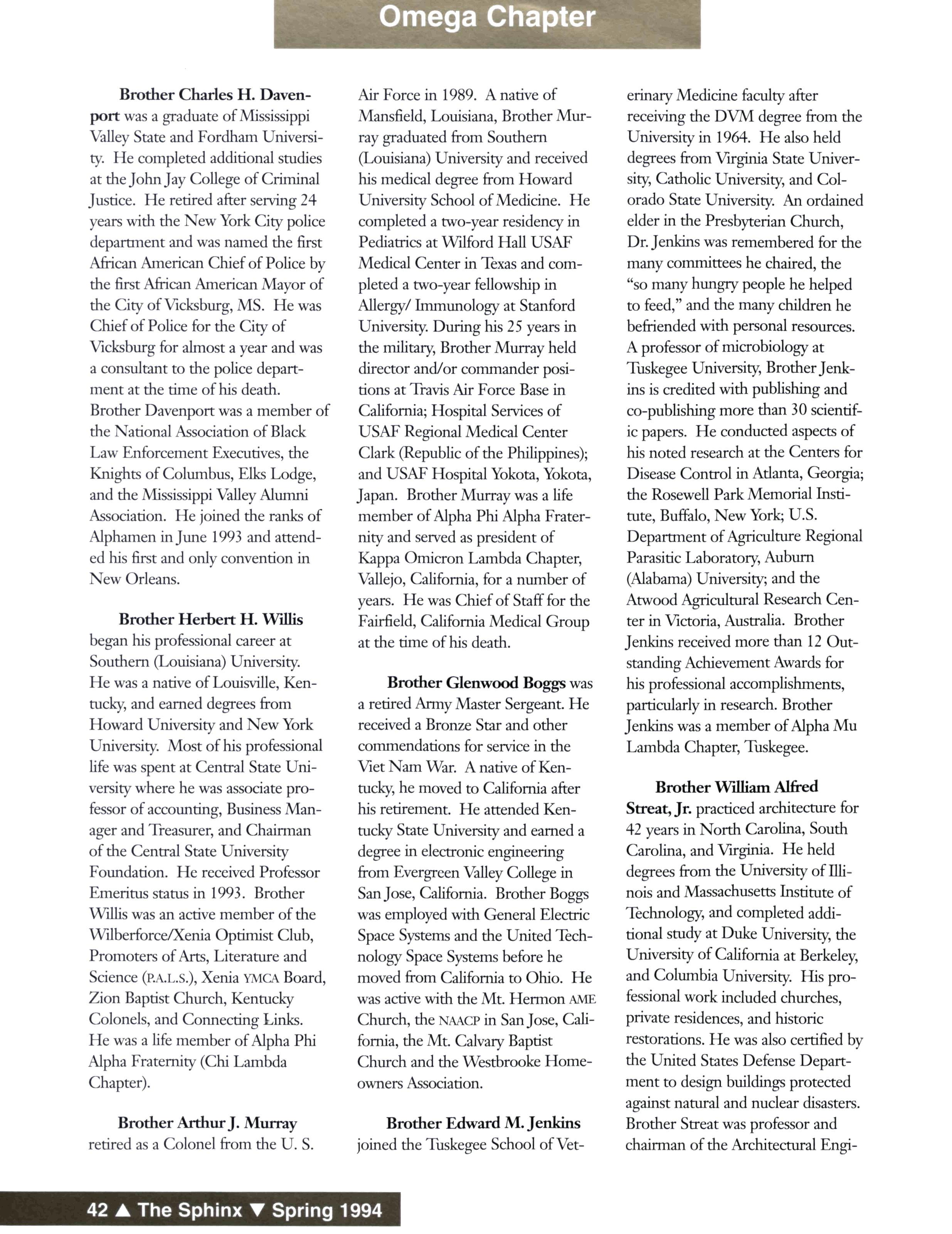
Brother ArthurJ. Murray retired as a Colonel from the U S
Air Force in 1989 A native of Mansfield, Louisiana, Brother Murray graduated from Southern (Louisiana) University and received his medical degree from Howard University School of Medicine He completed a two-year residency in Pediatrics at Wilford Hall USAF Medical Center in Texas and completed a two-year fellowship in Allergy/ Immunology at Stanford University. During his 25 years in the military, Brother Murray held director and/or commander positions at Travis Air Force Base in California; Hospital Services of USAF Regional Medical Center Clark (Republic of the Philippines); and USAF Hospital Yokota, Yokota, Japan. Brother Murray was a life member of Alpha Phi Alpha Fraternity and served as president of Kappa Omicron Lambda Chapter, Vallejo, California, for a number of years He was Chief of Staff for the Fairfield, California Medical Group at the time of his death.
Brother Glenwood Boggs was a retired Army Master Sergeant He received a Bronze Star and other commendations for service in the Viet Nam War Anative of Kentucky, he moved to California after his retirement. He attended Kentucky State University and earned a degree in electronic engineering from Evergreen Valley College in SanJose, California Brother Boggs was employed with General Electric Space Systems and the United Technology Space Systems before he moved from California to Ohio. He was active with the Mt. Hermon AME Church, the NAACP in SanJose, California, the Mt Calvary Baptist Church and the Westbrooke Homeowners Association
Brother Edward M. Jenkins joined the Tuskegee School of Vet-
erinary Medicine faculty after receiving the DVM degree from the University in 1964 He also held degrees from Virginia State University, Catholic University, and Colorado State University. An ordained elder in the Presbyterian Church, Dr Jenkins was remembered for the many committees he chaired, the "so many hungry people he helped to feed," and the many children he befriended with personal resources. A professor of microbiology at Tuskegee University, Brother Jenkins is credited with publishing and co-publishing more than 30 scientific papers He conducted aspects of his noted research at the Centers for Disease Control in Atlanta, Georgia; the Rosewell Park Memorial Institute, Buffalo, New York; U.S. Department of Agriculture Regional Parasitic Laboratory, Auburn (Alabama) University; and the Atwood Agricultural Research Center in Victoria, Australia Brother Jenkins received more than 12 Outstanding Achievement Awards for his professional accomplishments, particularly in research. Brother Jenkins was a member of Alpha Mu Lambda Chapter, Tuskegee
Brother William Alfred Streat,Jr. practiced architecture for 42 years in North Carolina, South Carolina, and Virginia He held degrees from the University of Illinois and Massachusetts Institute of Technology, and completed additional study at Duke University, the University of California at Berkeley, and Columbia University. His professional work included churches, private residences, and historic restorations He was also certified by the United States Defense Department to design buildings protected against natural and nuclear disasters Brother Streat was professor and chairman of the Architectural Engi-
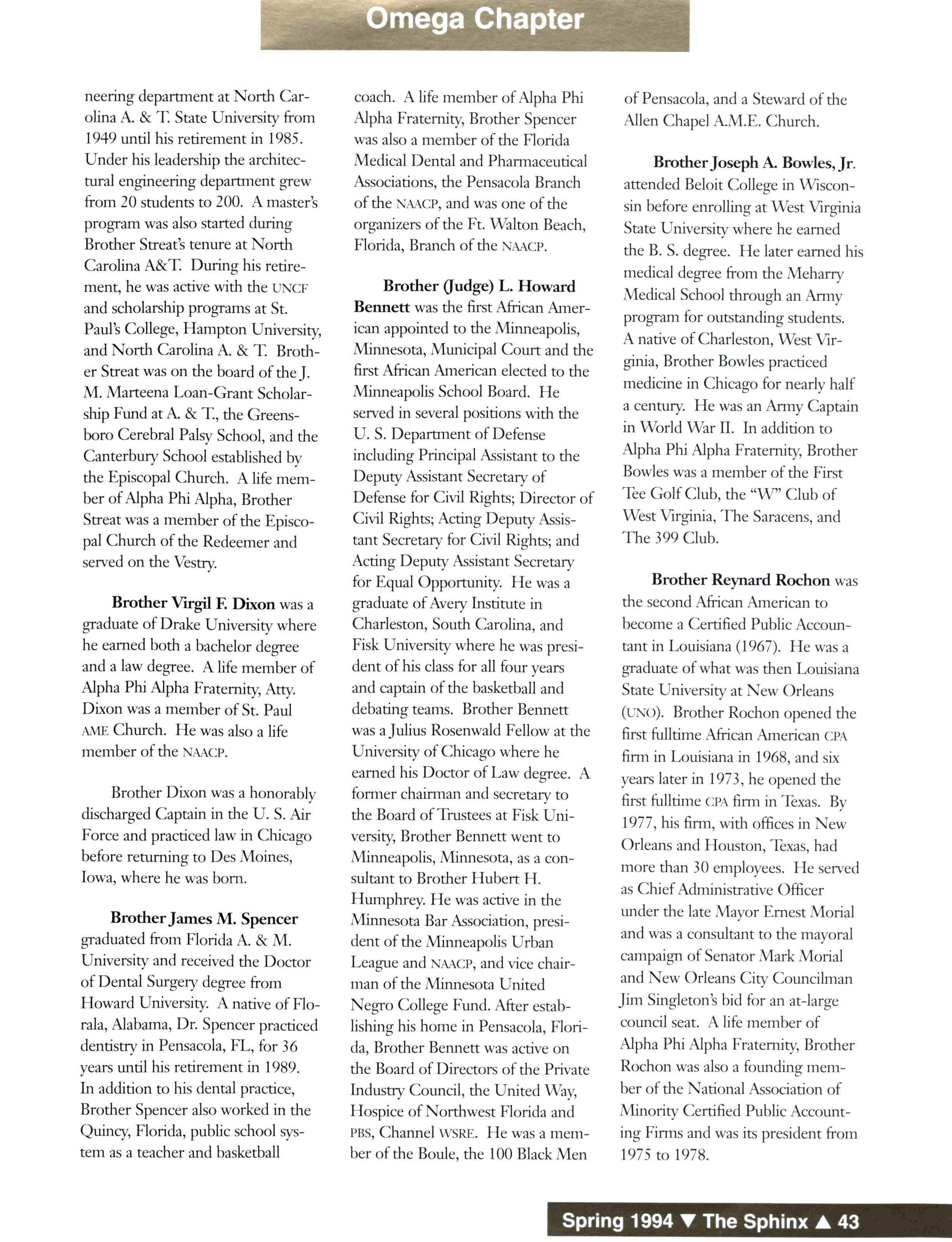
neering department at North Carolina A & T State University from 1949 until his retirement in 1985 Under his leadership the architectural engineering department grew from 20 students to 200 A master's program was also started during Brother Streat's tenure at North Carolina A&T. During his retirement, he was active with the UNCF and scholarship programs at St Paul's College, Hampton University, and North Carolina A & T Brother Streat was on the board of the J M. Marteena Loan-Grant Scholarship Fund atA. & T., the Greensboro Cerebral Palsy School, and the Canterbury School established by the Episcopal Church A life member of Alpha Phi Alpha, Brother Streat was a member of the Episcopal Church of the Redeemer and served on the Vestry.
Brother Virgil F. Dixon wasa graduate of Drake University where he earned both a bachelor degree and a law degree A life member of Alpha Phi Alpha Fraternity, Atty Dixon was a member of St Paul AME Church He was also a life member of the NAACP.
Brother Dixon was a honorably discharged Captain in the U S Air Force and practiced law in Chicago before returning to Des Moines, Iowa, where he was born
BrotherJames M. Spencer graduated from Florida A. & M. University and received the Doctor of Dental Surgery degree from Howard University A native of Florala, Alabama, Dr Spencer practiced dentistry in Pensacola, FL, for 36 years until his retirement in 1989. In addition to his dental practice, Brother Spencer also worked in the Quincy, Florida, public school system as a teacher and basketball
coach A life member of Alpha Phi Alpha Fraternity, Brother Spencer was also a member of the Florida Medical Dental and Pharmaceutical Associations, the Pensacola Branch of the NAACP, and was one of the organizers of the Ft. Walton Beach, Florida, Branch of the NAACP.
Brother (fudge)
Bennett was the first African American appointed to the Minneapolis, Minnesota, Municipal Court and the first African American elected to the Minneapolis School Board. He served in several positions with the U S Department of Defense including Principal Assistant to the Deputy Assistant Secretary of Defense for Civil Rights; Director of Civil Rights;Acting Deputy Assistant Secretary for Civil Rights; and Acting Deputy Assistant Secretary for Equal Opportunity. He wasa graduate of Avery Institute in Charleston, South Carolina, and Fisk University where he was president of his class for all four years and captain of the basketball and debating teams. Brother Bennett was aJulius Rosenwald Fellow at the University of Chicago where he earned his Doctor of Law degree A former chairman and secretary to the Board of Trustees at Fisk University, Brother Bennett went to Minneapolis, Minnesota, as a consultant to Brother Hubert H. Humphrey. He was active in the Minnesota Bar Association, president of the Minneapolis Urban League and NAACP, and vice chairman of the Minnesota United Negro College Fund After establishing his home in Pensacola, Florida, Brother Bennett was active on the Board of Directors of the Private Industry Council, the United Way, Hospice of Northwest Florida and PBS, Channel WSRE He was a member of the Boule, the 100 Black Men
of Pensacola, and a Steward of the Allen Chapel A.M.E. Church.
BrotherJoseph A. Bowles,Jr. attended Beloit College in Wsconsin before enrolling at West Virginia State University where he earned the B S degree He later earned his medical degree from the Meharry Medical School through an Army program for outstanding students. A native of Charleston, West Virginia, Brother Bowles practiced medicine in Chicago for nearly half a century. He was an Army Captain in World War II In addition to Alpha Phi Alpha Fraternity, Brother Bowles was a member of the First Tee Golf Club, the " W Club of West Virginia, The Saracens, and The 399 Club.
Brother Reynard Rochon was the second African American to become a Certified Public Accountant in Louisiana (1967). He was a graduate of what was then Louisiana State University at New Orleans (UNO) Brother Rochon opened the first fulltime African American CPA firm in Louisiana in 1968, and six years later in 1973, he opened the first fulltime CPAfirmin Texas By 1977, his firm, with offices in New Orleans and Houston, Texas, had more than 30 employees. He served as Chief Administrative Officer under the late Mayor Ernest Morial and was a consultant to the mayoral campaign of Senator Mark Morial and New Orleans City Councilman Jim Singleton's bid for an at-large council seat A life member of Alpha Phi Alpha Fraternity, Brother Rochon was also a founding member of the National Association of Minority Certified Public Accounting Firms and was its president from 1975 to 1978
When he applied to Western Reserve University Law School in 1928, Sidney A Jones, Jr., was rejected because, the law school dean said, "It is impossible for a Negro to succeed in the practice of law."
Northwestern University Law School disagreed and admitted Brother Sidney A.Jones, Jr., who subsequently graduated at the top of his class in 1931 before spending a lifetime of success after success as Attorney and Judge Jones.
Judge Jones, a life member of Alpha Phi Alpha Fraternity and a former General Secretary and Midwestern Vice President, entered Omega Chapter in November 1993 He was 84 years old Jones was the principal speaker at the Life Members Breakfast during the 1993 General Convention in New Orleans
During the 55 years of his professional career, Brother Jones served as attorney for the U.S Department of Labor; represented the 6th Ward as Alderman on the Chicago City Council; served asJudge of both the Municipal Court and Circuit Court of Cook County for 20 years between 1960 and 1980; and came out of retirement in 1983 to serve in the administration of Chicago Mayor Harold Washington as Director of the Mayor's License Commission.
In one of his landmark cases, Brother Jones represented dining car waiters and won for them substantial benefits, reportedly one of the largest settlements ever received by an African American lawyer in Chicago. Brother Jones was one of the lawyers who sued the University of Maryland for excluding African Americans from law school, and successfully brought proceedings to eliminate racial segregation in railroad dining car service.
A trustee of Atlanta University and a president of the Cook County Bar Association, Brother Jones was a life member of the NAACP, a member of the Northwestern University Alumni Association, chairman of the Board of the Woodlawn Boys Club, Trustee of Coppin Memorial AME Church, a member of the Board of the African Methodist Episcopal Church, and Board Member of the Chicago Urban League and NAACP
In addition to writing several law review articles in the 1940s, Brother Jones authored a history of the African Methodist Episcopal Church.
Avery, Fred, Omicron Lambda
Bovain, Marion, Alpha Gamma Lambda
Brown, Booker, Alpha Tau Lambda
Brown, Ron, Alpha Gamma Lambda
Burns, Samuel A., Alpha Tau Lambda
Clark, Darrick, Omicron Lambda
Clemons, Eugene, Alpha Gamma Lambda
Cosey, Larsell S., Xi Nu Lambda
Crossley, Emmett, Alpha Tau Lambda
Ellis, Don, Mu Psi Lambda
Fair, Leroy, Alpha Sigma Lambda
Fryer, Wynnton, Alpha Gamma Lambda
Gillis,James V, Epsilon Mu Lambda
Hall, Theodore, Alpha Tau Lambda
Jones, Frederick, Eta Mu
Keil, Houston P., Rho
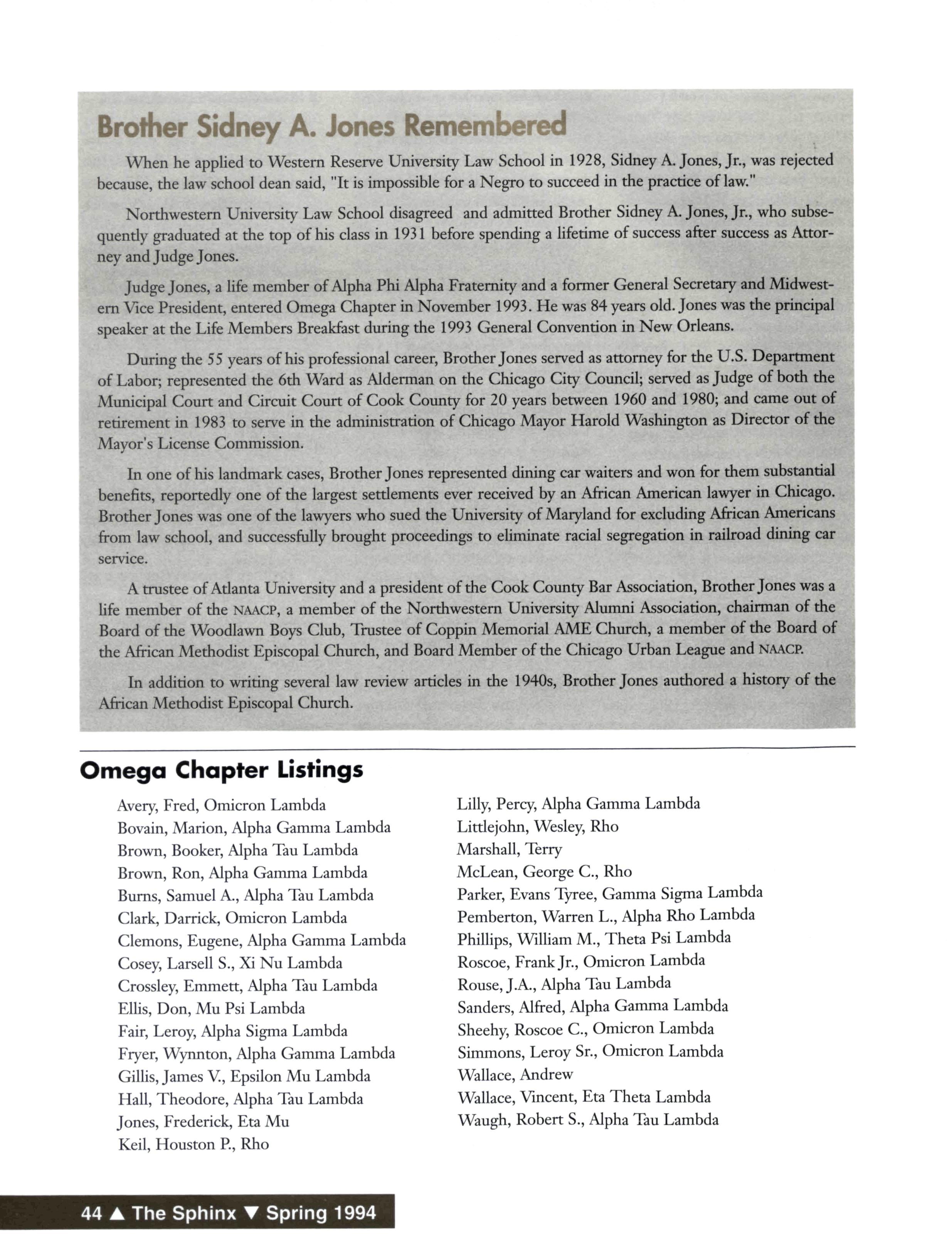
Lilly, Percy, Alpha Gamma Lambda
Littlejohn, Wesley, Rho
Marshall, Terry
McLean, George C, Rho
Parker, Evans Tyree, Gamma Sigma Lambda
Pemberton, Warren L., Alpha Rho Lambda
Phillips, William M., Theta Psi Lambda
Roscoe, Frank Jr., Omicron Lambda
Rouse,J.A., Alpha Tau Lambda
Sanders, Alfred, Alpha Gamma Lambda
Sheehy, Roscoe C, Omicron Lambda
Simmons, Leroy Sr., Omicron Lambda
Wallace, Andrew
Wallace, Vincent, Eta Theta Lambda
Waugh, Robert S., Alpha Tau Lambda
GENERAL PRESIDENT—Milton C. Davis. P.O. Box 509, Tuskegee, AL 36083
IMMEDIATE PAST GENERAL PRESIDENT—Henry Ponder, President's Office. Fisk University, Nashville, TN 37208
EXECUTIVE DIRECTOR—James B Blanton, III, 23113 St Paul Street, Baltimore, MD 21218-5234
GENERAL TREASURER—George N. Reaves, 2933 Balmoral Crescent, Flossmoor, IL 60422
COMPTROLLER—Frank Jenkins, 529 South Perry Street, Montgomery, AL 36104
GENERAL COUNSEL—Tyrone C. Means, P.O. Drawer 5058, Montgomery, AL 36103-5058
NATIONAL HISTORIAN—Thomas D. Pawley, III, 1014 Lafayette Street. Jefferson City. MO 65101
DIRECTOR-GENERAL CONVENTION—Al Rutherford, 8585 Stemmons Freeway, Suite 730N, Dallas, TX 75247
EASTERN—John A. (Tony) Mann, 9525 Heathwood Court, Burke, VA 22015
MIDWESTERN—Roy L. Manley, Sr., 2631 Coventry Road, Shaker Heights, OH 44120
SOUTHERN—Robert A Willis, 130 Old Fairburn Close, Atlanta, GA 30331
SOUTHWESTERN—Harry E Johnson, 8606 Running Bird Lane, Missouri City, TX 77485
WESTERN—Phillip Cochran, 1165 Drexel Avenue, Boulder, CO 80303
EASTERN—Kobi Little, Johns Hopkins University, 8505 Winands Road, Baltimore, MD 21208
MIDWESTERN—Kevin Cooke, P.O. Box 54565, Lexington, KY 40555
SOUTHERN—Antonio M. Smith, 1880 North Willow Avenue, #11, Cookville, TN 38501
SOUTHWESTERN—Richard Lee Scott, Jr., 404 Oak Park Drive, Little Rock, AR 72204
WESTERN—Richard E. Graham, 75 Main Street. #205, Seattle, WA 98104
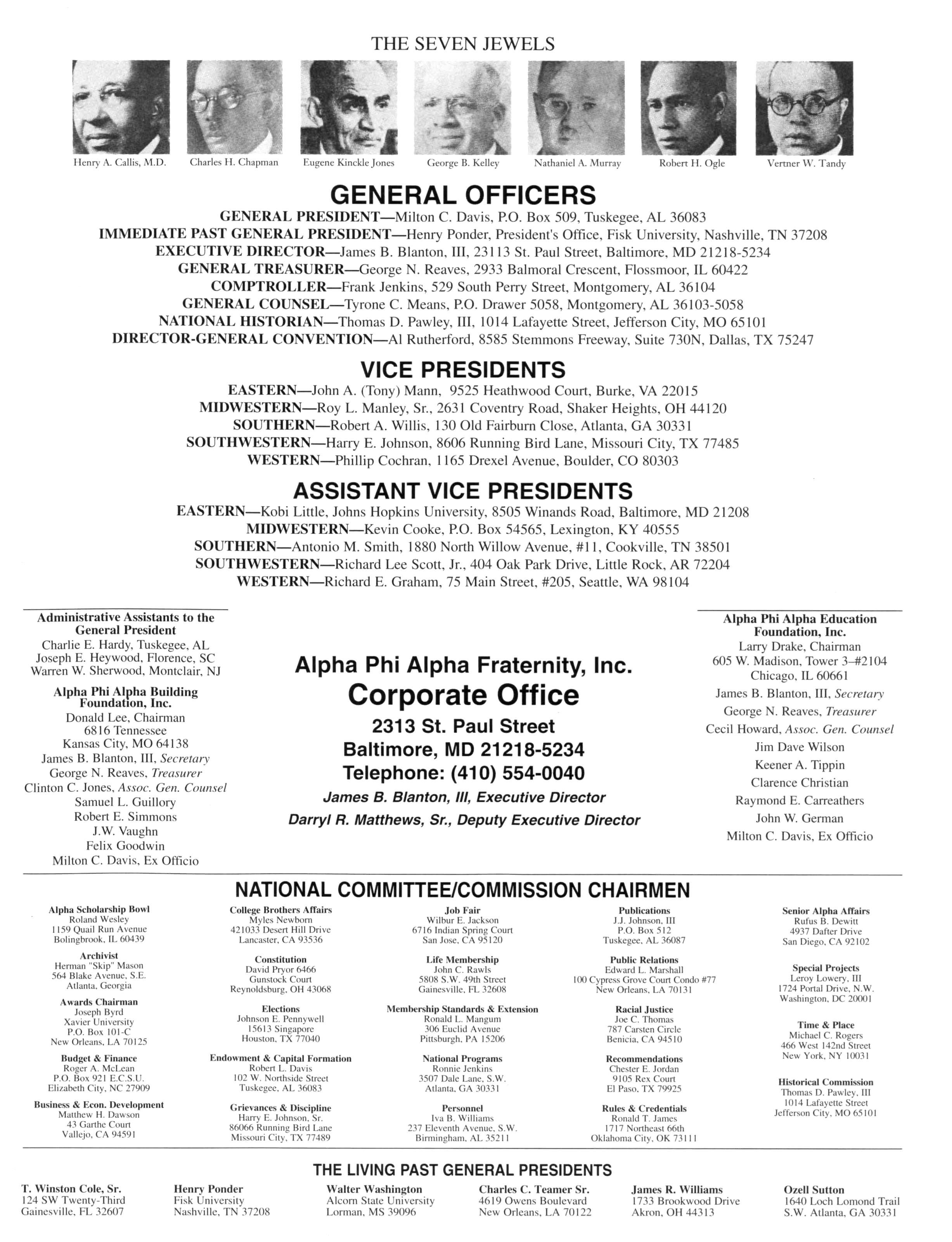
Administrative Assistants to the General President
Charlie E Hardy, Tuskegee, AL
Joseph E Heywood, Florence, SC
Warren W Sherwood Montclair, NJ
Alpha Phi Alpha Building Foundation, Inc.
Donald Lee Chairman 6816 Tennessee
Kansas City, MO 64138
James B Blanton, III Secretary
George N Reaves. Treasurer
Clinton C Jones Assoc. Gen. Counsel
Samuel L Guillory
Robert E. Simmons
J.W Vaughn
Felix Goodwin
Milton C. Davis. Ex Officio
Alpha Scholarship Bowl
Roland Wesley 1159 Quail Run Avenue Bolingorook, IL 60439
Awards Chairman Joseph Byrd Xavier University
P.O Box L01-C New Orleans
2313 St. Paul Street Baltimore, MD 21218-5234
Telephone: (410) 554-0040
James B. Blanton, III, Executive Director
Darryl R. Matthews, Sr., Deputy Executive Director
Alpha Phi Alpha Education Foundation, Inc.
Larry Drake, Chairman 605 W Madison, Tower 3-#2l04 Chicago, IL60661
James B Blanton, III, Secretary
George N. Reaves, Treasurer
Cecil Howard, Assoc. Gen. Counsel
Jim Dave Wilson
Keener A. Tippin
Clarence Christian
Raymond E. Carreathers
John W. German
Milton C Davis Ex Officio
199 4 National Convention AUGUST 4-9, 1994
Chicago, Illinois