COMPETITIONS GUIDE 2021




WHEN TO GET INVOLVED IN COMPETITIONS IN SEMESTER 2, 2021

WEEK 2
Novice Competitions Launch BBQ
Novice Competitions Signups Open
WEEK 3
Competitions Workshops
WEEKS 4-6
Preliminary Rounds
• Mooting: Monday
• Negotiations: Tuesday
• Client Interview: Wednesday
• Witness Examination: Friday
WEEK 7
Make-Up Rounds
WEEK 8
Semi Finals
WEEK 10
Grand Final
21. ADVICE FROM THE EXPERTS
22. MEET A CLIENT INTERVIEWS JUDGE
23. CLIENT INTERVIEWS 101 WITNESS EXAMINATION
25. WHAT IS WITNESS EXAMINATION
26. WITEX EXPERT ADVICE
27. MEET A WITEX JUDGE
28. WITEX 101
29. REFLECTIONS OF A WITNESS EXTERNAL COMPETITIONS
31. MEET THE EXTERNAL COMPS DIRECTOR
32. EXTERNAL OPPORTUNITIES
32. HSF COMPUTATIONAL LAW E-MOOT 33. ALSA CONFERENCE 34. ALSA COMP REFLECTIONS FIRM MATERIAL
35. FIRM SPONSORSHIPS
50. ACKNOWLEDGEMENTS

JESSICA THOO - VICE PRESIDENT (COMPETITIONS) ANU LAW STUDENTS' SOCIETY
It is my absolute pleasure to welcome you to the 2021 Competitions Guide! Whether you’re a longtime Suits fan, interested in advocacy, or just a touch curious about what competitions are, this document will provide you with (almost) everything you’ll need to know about ANU internal competitions, external competitions, the ALSA Championships, and more!
Before I proceed further, I would like to thank everyone who has been involved in the creation of the 2021 Competitions Guide. Without their time, hard work, and contributions, it simply would not have been possible to put this guide together. On behalf of the ANU Law Students’ Society, I would also like to extend our most sincere gratitude to our valued sponsors for their immense and ongoing support.
Many of you who are new to competitions may have a great deal of questions. What are competitions? What’s in it for me? What’s a submission? Who is Craig Collins?! But rest assured - this guide will hopefully provide you with all of the answers you seek.
Legal competitions are, in my opinion, the pièce de résistance of the law school experience. They offer students the opportunity to engage with the law beyond the lecture theatre, develop practical skills, and meet accomplished professionals in the field. Competitors are able to hone advocacy, communication, teamwork, and research skills fundamental to pursuing a career in law or otherwise. Perhaps most importantly, competitions are a rewarding way to meet other law students with similar interests, potential future colleagues, and people to have a beer with at Badger & Co.
Another incredible opportunity unique to competitions is the potential for students to represent ANU interstate or internationally. These include, among many others, the HSF-NLU Negotiations
Competition most recently held in New Delhi, the ALSA Championships, and the prestigious Philip C. Jessup International Law Moot Court Competition held in Washington D.C. Whilst these may seem like a far cry given the current COVID-19 pandemic, online competitions also allow students to experience online advocacy, which is an invaluable skill given that the legal profession is embracing new and exciting technologies to conduct hearings and alternative dispute resolution online. Additionally, COVID-19 (hopefully) won’t last forever, so it’s a great idea to invest in these skills and get some practice in to make yourself a competitive applicant.
At this point, you might be feeling overwhelmed by the dizzying array of opportunities on offer, and understandably so. Competitions can feel daunting, especially if you (like me) don’t have a background in Mock Trial or Debating. It is my hope that this Guide will allay your fears and provide you with everything you need to know before getting started on your journey. I encourage you to keep an eye out on our LSS Facebook page for updates on new opportunities and ways you can get involved in competitions.
Finally, I would like to thank the Competitions Team: Liam Taylor, Vinayak Kaushik, Sami Chaudhury, Ivy Lončar and John Grech. Their commitment every week ensures that competitions run like clockwork at the ANU. I would also like to extend my thanks to all of the judges and coaches who generously volunteer their time, as well as Adam Cass, the Publications Director, for helping to create and edit this Competitions Guide.
Please do not hesitate to contact me should you have any questions, queries or concerns relating to competitions at: lsscompetitions@anu.edu.au
Jessica Thoo is a final year Bachelor of International Relations/ Bachelor of Laws (Hons) student at the ANU. She has had experience competing in all competitions (bar Mooting, which she considers her ‘final boss’) and assisted in organising the inaugural Gender Identity and Sexuality eMoot in 2020 where the Grand Final was judged by former High Court Judge (and icon) the Hon Michael Kirby.


The competitions portfolio is the largest team in the LSS consisting of: one Vice-President (Competitions), four Competitions Directors, and one External Competitions Director. If you have any general enquiries about competitions, please direct them to the Vice-President (Competitions). Once you are involved in a specific competition, any questions or concerns arising in that competition are best directed to the relevant director. Our contact details can be found below.
Vice-President (Competitions)
Jessica Thoo: lsscompetitions@anu.edu.au
Mooting Director
Liam Taylor: liam.taylor@anu.edu.au
Negotiations Director
Vinayak Kaushik: vinayak.kaushik@anu.edu.au
Client Interview Director
Sami Chaudhury: sami.chaudhury@anu.edu.au
Witness Examination Director
Ivy Loncar: ivy.loncar@anu.edu.au*
External Competitions Director
Jonathan Grech: lssexternalcompetitions@anu.edu.au**
* The Witness Examination Director for Semester Two is Khushi Arora: u7120025@anu.edu.au
** The External Competitions Director for Semester Two is Diana Mukayeva: u7114743@anu.edu.au
Our role is to provide law students at ANU with opportunities to expand their interests in the law beyond the tutorial room and lecture theatre into the practical sides of the law, whether this be experiencing a simulated scenario where teams undertake negotiations to achieve the best outcome for their client or adducing favourable facts to their case in the process of witness examination. We seek to facilitate a smooth-running competition that spans five weeks including three preliminary rounds, a semi-final, and grand final round. Our internal competitions consist of Mooting, Negotiations, Client Interview, and Witness Examination. We offer both Novice and Senior levels, with the former tailored to students who have no prior experience in a particular competition before. Senior competitions are held in Semester Two. We are here to provide and assist you in your competition endeavours. If you are ever hesitant in getting involved or looking for some guidance, please feel free to send us an email and we can point you in the right direction.
If you have a keen interest in competitions, we strongly encourage you to run for a position in the competitions portfolio through annual elections held in October. Joining the LSS and Competitions provides you with the opportunity to meet some fantastic judges and practitioners in the field of law, as well as an avenue to meet likeminded law students at ANU.


Mooting involves a mock court case where the case goes to appeal. As an appeal case, agreed facts are given to both parties at the beginning of the competition. Similar to problem question assignments at law school, the teams must research the relevant areas of law to make submissions to the court on what the law is and how it applies to their particular circumstances. Competitors are also required to answer any questions raised by the bench during moots. Mooting tests one’s knowledge of the law, as well as advocacy skills.
Each team has two or three members, consisting of a senior counsel, junior counsel and an optional instructing solicitor. Each round, teams are assigned to represent either the Appellant or the Respondent. Novice Mooting questions are limited to the topics of torts or contracts. Teams will only be arguing the one case for all rounds, alternating randomly between presenting as the Appellant or Respondent. The question and draw are released a week prior
Introduction
to the first round and the competition typically runs for approximately one and a half hours.
Teams of: 2 or 3
Time commitment: High
I am the Mooting Director for 2021, and am in my final year of a Juris Doctor. I have previously competed in Mooting Competitions and Client Interview Competitions. I have a passion for getting involved in Competitions to boost practical legal skills and meeting like-minded people.
Why did you get involved with Competitions?
I initially got involved in competitions because I wanted to advance my skills and receive meaningful feedback on how to improve upon these skills. Students have the opportunity to get feedback from some of the best legal professionals in Canberra. Getting students involved, trying something new and developing new found friendships along the way are just some of the things that students will experience if they get involved in LSS Competitions. I encourage everyone to get involved in a competition throughout Law School.
What skills do you develop through Mooting?
Mooting is by far one of the most rewarding competitions that the LSS offers. Mooting allows students to be creative in their legal arguments, engage in problem questions, engage in dynamic debate and improve upon their written and advocacy skills. Mooting problem questions range from year to year from tort based scenarios, to issues involving contracts. I encourage anyone that is interested
in advocacy or wanting to improve upon their writing or oral skills, to get involved.
Preparation is essential. Have a clear direction when you are delivering your arguments, signpost your most important points, and make sure your written submissions are clear and succinct. But most importantly, have fun, meet new people, get involved and enjoy the ride.
Liam Taylor (2021 Mooting Director)

ADVICE FROM ASHURST SENIOR MOOTING CHAMPIONS Callum Davis & Skanda Panditharatne (2021 Senior Moot Winners)
Your written submissions are the first opportunity you get to develop your argument. They should be well-structured and reasonably detailed. You want to make sure that the person reading the submissions, whether they’re the judge or the opposing team, gets a good sense of what you’re arguing. It’s not worth trying to surprise anyone on the day with a killer argument. Instead, lay your best points down on the page and try to develop a narrative. You should also make sure that every authority you intend to rely on is referred to in your written submissions.
You could save yourself from a sticky situation by knowing the facts of your problem and of the cases you’re referring to in your submissions. Read, reread, and read your problem question once again – even the bits that might not seem relevant at first to your submissions. Also, consider making short factual summaries of important cases from your submissions and from your opponents’ – judges often like to ask about the factual basis behind your cases, to know how they differ from the problem question.
The judge’s questions are where you’ll make or break the moot for yourself. For all that your written submissions and oral delivery set the scene, the judge is really interested in how you respond to their curveballs. It’s all very well to say you shouldn’t get flustered, but nervousness attacks even the most experienced mooter when they’re facing down a sceptical judge. Take a break or a sip of water before diving into your answer. Focus on providing the most direct answer up front; if you can give a ‘yes’ or ‘no’ before you expand on the answer, then do. But you’ll need to provide more, and if you can provide a compelling authority or a brilliant analogy, then your answer will impress.
The judge has asked you a question and you don’t know the answer. Or perhaps the opposition has raised a point of law you can’t respond to. Don’t panic! Judges understand that there’s only so much you can know, and that the issues raised are often very challenging. If you don’t know an exact answer, say you can’t assist the court directly on that point – but then have your best guess if you can, using logic and analogies. Concede the opposition’s strong point where necessary, but then show how the issues you’re stronger on are more relevant to the legal question at hand.
Teamwork makes the dream work!
Rebuttal can be a tough part of a moot. Consider whether you want to make any rebuttal at all. Very often it can be a show of strength to simply say ‘we’re prepared to waive our rebuttal time’. But if you go ahead with it, you’ll want to adopt a different tone to your substantive submissions. Bring more energy to the rebuttal, and snappy responses that hit (1) what the opposing counsel said that you take issue with; (2) your stunning riposte (in a sentence or two); and (3) the legal authority supporting your claim. Generally, a rebuttal should not contain more than three points.
You’re probably a bit familiar with Zoom by now, and it’s likely that at least some of your moots will be on Zoom. Make sure you double check your internet connection and microphone/speakers before your moot, and if you can, it’s helpful to be in the same room as your mooting partner. Ensure the room is free of distractions (cats will always try to get in your way) and make your space professional with a clear desk, a glass of water, and by passing notes rather than speaking to your partner.
2021 Ashurst Senior Mooting Championships


TIPS FROM SOMEONE WHO'S JUDGED IT ALL BEFORE
The main thing to get out of the competition is practical experience that is closer to the realities of practice than most university courses are. Competitions are a great way of developing your writing, legal analysis, team work and time management skills, which are extremely important skills for the real world. Additionally, they are a great conversation topic in clerkship interviews.
A good set of written submissions should in essence read like a story that is easy to follow along with even if a judge has no idea about the area of law. It should have a clear structure that provides the judge with the facts and relevant legal principles in a logical order with the conclusion being that the judge should rule in your favour.
Additionally, your written submissions should be in the same order as your oral submissions so that the judge can just follow along. The following are key things to keep in mind when drafting submissions:
• White space is your friend (1.5 spacing if you can);
• Try not to waffle, just get to the point as you can expand in your oral submissions. A key tip I use is reading each sentence by itself to see if it adds value, if it does not, it gets deleted; and
• Check for the small things (typos, footnotes etc).
For me personally, I do not mind if people are nervous (as I
used to get very nervous when mooting), however, the big thing I look for is structure. A moot should begin with signposting, which will provide the judge with a road map as to where you are going and what topics/grounds you will be covering and the conclusion that you want the judge to reach.
Another thing is a good talking pace and volume, it is very easy to talk too quickly due to the stress, so it is vital that when making oral submissions, that you breathe and slow down. A way to do this, is to do a dry run with some friends and see how long it takes to complete your oral submissions.
For me personally, I hold a pen between my second, middle finger and thumb in my left hand when I make oral submissions. This is because, when you forget to breathe your hands will tense up and when I feel the pen dig into my fingers, it is a reminder for myself to breathe.
Any other tips you would like to impart?
Just have fun and do not burn yourself out preparing for a competition. While it is a fantastic opportunity, it is not worth sacrificing your mental health over.
Benjamin Bromfield (Ashurst Graduate)

Participating in the mooting competitions through the ANU LSS has been one of the most interesting and rewarding experiences in my time at law school. It gives you a real feel for something essentially no other law course offers – a taste at researching and presenting arguments in front of a ‘judge’ (and if you’re lucky enough to progress further in the competition, three ‘judges’). I have been part of the Novice Mooting Competition and the Ashurst Senior Mooting Competition. In the latter, our team was fortunate enough to make it to the final, where we lost in a split judgement.
Often, you will be mooting on an area of law you have either not studied yet or that you last looked at years ago. This, however, is part of the fun. Not only does it reinforce what you have learnt in key Priestley 11 courses, but your research will see you investigating complex areas of law in a depth which is unrivalled in other law courses. Often when mooting, issues crop up which puzzle even the most notable of legal scholars – and your job is to craft the best legal argument you can muster, which will inevitably be picked apart by some of the more earnest ‘judges.’ If you are considering mooting, do not be intimidated if there are teams who have more experience. It all depends on how you prepare and how you perform on the day. For the Ashurst Competition, two-thirds of our team had never mooted before! Hopefully, some of this advice can help you avoid repeating the same mistakes we made…
The best way to start your research if it is in an unfamiliar area of law – or one which was immediately erased from your brain following the exam – is resorting to a textbook. This will highlight the key issues, areas of contention, and the key cases which will be relevant to your argument. Many of these can be accessed for free through the ANU Law Library databases, so you won’t have to casually drop another $300 at Harry Hartog in Kambri for a textbook you look at three times in a semester.
From there, you need to read a bunch of cases. This seems like the most intimidating step of the process, but it is often the most interesting as these are the judgements which define the area of law about which you are mooting. Please treat this the same as reading cases for a law subject. Make case tables with a summary of the facts, the ratio decidendi, and exact citations. This is something our team did not do, and it will save you an abundance of time if you make effective notes in the first instance. Trust me, backtracking was no fun at all… During this process, be sure to look out for cases which have facts that are very analogous to the problem question – the question setters often draw heavily from particular cases when writing the Agreed Facts. It will also be very tempting to only prepare as either a Senior or a Junior Counsel (the two speaking roles), but it will significantly benefit your team if all members have an understanding of all the issues involved in the case.This is particularly necessary for effective rebuttal.
Preparation is essential, but to make this seem less intimidating I will emphasise two points. Firstly, you do not need to read thousands of cases to win a moot. In fact, often the team with a more nuanced understanding of a smaller number of cases will be able to respond
ADVICE FROM 2021 ASHURST SENIOR MOOT RUNNERS UP Charlie Yu, Lachie Pembroke & Harry Fell
much more effectively to the questions from the bench. Secondly, the question remains the same throughout the competition (including for the finals). That means you really reap what you sow during the first week – prioritise preparing exceptionally well for the first round, and not only will you most likely start off with a confidence-building win, but you will have a much lower workload for mooting when the Semester starts to kick into gear with your actual study.
Answering questions from the bench is by far the most intimidating aspect of mooting for most people. The best way to treat this is as a conversation between you and the judge(s). It is not debating – so, please leave your egos associated with your long, illustrious highschool debating resume at the door. You do not need to be an amazing public speaker to be a good mooter. Do not be afraid of taking pauses before answering questions or during your submissions. It is far better to sit for ten seconds and offer a considered response, than to rush into a rambling answer where you find your train of thought along the way.
One of the most important aspects is signposting. It is well worth sacrificing some time from your substantive arguments in order to deliver Oral Submissions which clearly indicate exactly which issues you will raise and the basis upon which you think they should be found in your favour. If you can distil this down to a sentence or two at the beginning of each issue, it will work wonders.
Never argue with the bench. The key to avoiding this is to know what points you can concede and what points you cannot (a key aspect of your preparation). Also, ensure you get the easy formalities right, including how to make your appearances, how to refer to the bench (Your Honour versus Registrar), how to phrase submissions (‘we submit’, not ‘we say’). These formalities will all be explained during the introductory meetings The best way to prepare for the Oral Submissions is to actually run through them with your teammates, allowing them to ask questions. This will raise issues which you may not have considered before, and will prepare you to effectively deliver your submissions. It also has the added benefit of testing the timing of your submissions – going over time is a very easy trap to fall into, especially when you are fielding numerous questions from the bench.



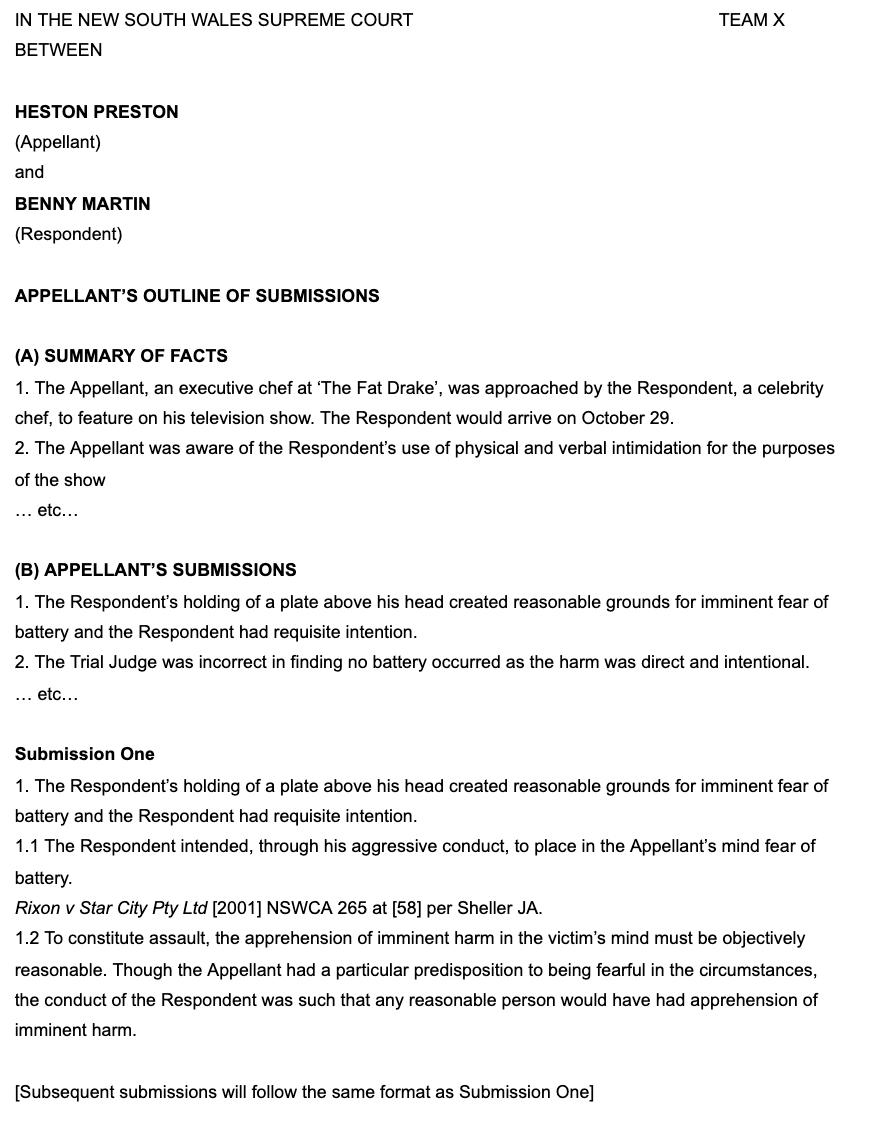
EXAMPLE OF A WRITTEN SUBMISSION FOR USE IN A MOOT

Negotiation is by far the bread and butter of a lawyer’s work. The majority of legal disputes are resolved at the negotiation stage, which usually occurs before litigation. Teams are assigned to represent different parties to a legal dispute and are given a common set of facts, as well as specific confidential information about their client. Competitors strive to achieve an outcome that satisfies the best interests of their respective parties. In determining a winning team, the judge will examine teamwork, strategy and also the ultimate outcome of the negotiation.
Teams consist of two students acting as solicitors. New scenarios/ questions are released every week. The negotiation sessions last for 40 minutes, after which teams will each have a short reflective period where they can discuss their performance and take questions from the judge. This reflection period is also assessed.
TEAMS: 2 people COMMITMENT: Moderate - Low
VINAYAK KAUSHIK - 2021 NEGOTIATIONS DIRECTOR
Hi! My name is Vin and I am in my 5th year of a Law/Commerce degree, and getting more involved with the LSS as a Competitions Director this year has been an absolute pleasure. As a Competitions Director, I was tasked with organising and running the negotiations competitions for ANU students. Running the competitions has involved liaising with legal professionals to organise judges, alongside ensuring we have fair questions and matchups for all the participants.
Having participated in many LSS competitions throughout my (long) time at ANU, I’ve had a great experience competing alongside my friends, and learning new skills that are still with me today. I’ve found the Negotiations competition to be especially great in this regard, as you are exposed to skills that are transferrable in any industry! As a bonus, you also get the opportunity to meet a diverse group professionals and students from around the university.
The experience of participating in the competitions is something I would recommend to anyone even remotely interested, and I would definitely do it again if I had my time in undergrad again (hopefully not!).

Vinayak Kaushik (2021 Negotiations Director)
We’re Henry and Bas, both second year law students (Henry is also studying PPE and Bas is studying Arts). We competed as novices in 2020, and really enjoyed the senior competition this year. We have also represented ANU in a number of intervarsity tournaments.
What did you get out of the competition?
More than anything, negotiations teaches you to understand the realities of law. Almost invariably, both in the fictional scenarios and in real life, it is preferable to both parties to avoid litigation and instead come to a negotiated agreement. Many matters that never make it to court will have been resolved more efficiently at the negotiating table. Coming to a mutually beneficial agreement in a negotiation is a satisfying process, and one that demands the negotiators position themselves in the shoes of the other party.
Behind every seemingly unreasonable position is a set of interests; it is your job as your client’s counsel to understand the other party’s interests, and work to satisfy them in a way that still safeguards those of your client.
However, negotiating isn’t all smiles and agreements. It is also a complex battle of the wits between you and the other side, with each side angling to secure any advantage they can. The interesting feature of negotiating is that fault attribution is almost entirely irrelevant. Advantages are won not through securing the moral high-ground, but by recognising possibilities for leverage
and using them to your advantage. Never make the mistake of underestimating the other team, because one carelessly answered question can tip the entire balance of the negotiation. Negotiating will teach you to take a careful, meticulous approach to what you do.
Teamwork: Our first major piece of advice is to find a teammate who you think you can spend long hours with, and enjoy yourself. Particularly in external competitions, late nights in libraries are required night after night over an extended period of time, so it's important you and your partner get along, and really enjoy the competition as well as being competitive. In the negotiation itself, good teamwork is best achieved through attributing clear roles to each person. We utilised a good cop, bad cop dynamic which we found to be successful.
Timing: The single most important consideration in a negotiation is timing. In particular, it's all about knowing the right time to stick the knife in and raise the stakes of the negotiation. This is a hard skill to teach, but be conscious of not showing your hand too early.
Agenda: Having a clear agenda is an effective way of structuring the negotiation, and is also a means for gaining control. Importantly, we suggest setting a clear agenda early on and then reflecting back on the agenda periodically throughout the neg to make sure you’re keeping on track. Saying things like “I just note we have moved on to agenda point 2” can be really effective.

ADVICE FROM A NEGOTIATIONS COMPETITION JUDGE
Negotiation is ‘the thing’ - both for law and for life. That’s my response to the question, ‘what is the single most important skill to cultivate as a law student and lawyer’?
Why develop negotiation skills?
You cannot become an Australian Lawyer without demonstrating ‘entry-level’ negotiation skills. So get to work on this at the earliest opportunity.
The word ‘negotiation’ means ‘to communicate in search of agreement’. When working with disputes and transactions, lawyers are all of the time ‘communicating in search of agreement’. Some 95% of all disputes commenced in court are actually resolved without being decided by a judge.
While law schools tend to focus upon the wording of statutes and what judges say when making a decision – in the small number of disputes that go so far - working as a lawyer is actually far more interesting. It is a ‘relational’ profession, full of human interaction and creative problem solving. And there are ways of doing these things effectively that you won’t find written down in textbooks. You have to learn by doing.
Leo Cussen Centre for Law - now based at the ANU Law School - coaches negotiation skills as part of our Graduate Diploma of Legal Practice. Before graduating in law and starting your GDLP, Law Student Society negotiation competitions are the best way to begin to practice this essential skill.
How are competitors scored?
You need to look at the judging criteria and shape your preparation and performance focus accordingly. The judging criteria reflects the way the negotiation is expected to unfold. It is great that you get to work in pairs, as a team, and how well you work as a team is also reflected in the scoring.
The way you carry yourself in a negotiation is often far more important than what you say. Cultivate a professional personawhich is composed, fair-minded and courteous. You need to be able to disagree with courtesy – and still see if holistic agreement can still be reached even if there is lots of disagreement and blame attribution on points of detail. Clear verbal communication, for most people, means speaking more slowly and in shorter sentences than in ordinary life. Tone of voice is important. Listen hard.
Two techniques, if well deployed, stand-out when judging. One is the conscious use of ‘open’ and ‘closed’ questions. When managing time in a negotiation, you need to set up a short, sharp kind of interactive dialogue with the other team, rather than long-winded monologues. It is vital to progress through the stages without getting too bogged down at any one stage.
The second technique is ‘reflecting back’. This is where you inject a pause to paraphrase and summarise what you have heard the opposing lawyer say. You can then ask them to correct or affirm your understanding. This is especially important in clarifying settlement proposals. Without this, there is a real risk of negotiators talking at cross-purposes - and the consequences of mistaken assumptions or miscommunication can be disastrous.
Any other tips you would like to impart?
Practice mindfulness. Listen carefully and respond in the moment to what you hear. Within the parameters of your structure and strategy, you just need to adapt to a range of situations and go with the flow. It is actually fun to start trusting yourself to respond appropriately in the moment and to do your best in an arena of grey uncertainty.
It is really empowering to become proficient at bringing people together towards reaching agreement. Negotiation is an essential skill not only for law, but also for making you a better person...
Craig Collins (Leo Cussen)

Isabel Gahan & Callum Wilson
Hello, future negotiators. We are Isabel and Callum; two fourth year law students and grand finalists of the 2021 Leo Cussen Senior Negotiations Competition. We got involved in negotiations in 2020 and we’ve thoroughly enjoyed the process. Negotiations are a great extra-curricular to get involved in and a valuable addition to your CVs. Negotiations have challenged our critical thinking skills and enhanced our understanding of dispute resolution, which we’re sure will come in handy once we commence our legal careers (because that’s what lawyers do… right?). See below a brief ‘negotiations 101’ to get you set-up for your first negotiation.
Recall: the five ‘Ps’ of success. Proper preparation prevents poor performance.
Tip 1: Know your facts: Preparation is key to success in a negotiation. For us, preparation involved reading the facts thoroughly and making detailed notes about our client’s interests, their instructions and any potential vulnerabilities. A detailed understanding of the facts will affirm your recollection skills and ability to think on the spot. Sometimes, the facts can offer sneaky clues which can make or break a potential agreement. It’s difficult to know what is relevant without knowing opposing team's ‘secret’ facts, but a good eye for detail does not go amiss.
Tip 2: Know your client: Clients come in a variety of needs, interests and personalities. Your client may be wanting an impossibly large sum of money, or even a simple apology - you should incorporate as many as possible into the final agreement. At times, you may even be given something that could be viewed as absurd, and it is up to you to either creatively justify or disregard completely. You need to make judgement calls as to what the client and opposing counsel will accept, being careful not to give too much away whilst also not being too stubborn.
Tip 3: Strategy: There are many successful strategies that you can employ, but keep in mind that they all have weaknesses. For example, “good cop, bad cop” can get a desirable final outcome out of a stubborn opposition, but does not work if the negotiation is less adversarial. In terms of structure, it is difficult to plan for every scenario you may be faced with, but a broad and flexible strategy may guide the process. Think of your client’s interests in the broader sense and let these interests form your agenda. We found it helpful to outline a best-case scenario and a BATNA (best alternative to negotiated agreement). It proved useful to brainstorm and hypothesise opposing counsel’s hidden agenda and outline a potential approach. A brainstorm of potential offers and counteroffers will prepare you for the inevitable curveballs which are part and parcel of the process.
There are a number of things to watch out for when negotiating.
Some of them you should do, and others you should observe in the opposing team. Remember that whilst a thorough plan is always great, you must be agile and adaptive to changing circumstances, for better or worse.
Time: 40 minutes is not a long period, and it is easy to get bogged down in the minutiae of blame games and compensation offers. Think about the big picture - what does your client ultimately want from these negotiations? In some circumstances, it might be best to put certain issues on hold whilst others are resolved, or even come to an interim agreement pending future negotiations (if the facts allow).
Specificity: Be specific in both your questions and answers. This not only prevents time wasting, but may create opportunities to get the upper hand. For example, in one negotiation, we were asked whether our client had found new employment and if they had spoken to the media. Strictly speaking, our client had not started a new job nor given an interview to the press, but had been offered employment and was approached by news organisations. These imprecise questions allowed us to answer literally, providing nothing of value to opposing team, and gave us leverage to use against a non-commensurate offer.
Ethics: Always remember that your ethical duties bind you not only to your client, but also to the law itself. You should not blatantly lie to the opposing team, as this reflects poorly on you and may even cause you to lose the round. Confidentiality should remain front of mind, and you should never disclose anything your client has told you to keep private.
This is often the deciding factor in a negotiation, and it has one main rule: Honesty. Objectively reflect on what went right and what went wrong with your strategy, as well as for the opposing counsel. Keep the questions of the judge in mind as you give your answer, and you should be all set. Being comfortable with constructive criticism from the judge (and your learned teammate!) is very much necessary, as it allows you to grow throughout the competition. Above all, enjoy the process. Negotiations offer a great opportunity to challenge yourself and to learn practical legal skills in a competitive environment. We had a blast and we hope you do too!
Isabel Gahan & Callum Wilson (2021 Leo Cusson Senior Negotiations Runners-up)

Client Interview is extremely important in real life legal practice and the skills acquired from this competition are highly transferable to interviews in any field. When representing a client, it is vital to ensure that you have all the relevant details and build a professional lawyer/ client relationship. Acting as solicitors, teams will receive a brief summary of the facts and must aim to extract as much information as possible from the client. This is done by relevant and precise questions.
This competition requires less preparation and less legal analysis than others, however, it requires excellent teamwork skills, oral communication and an ability to think quickly on one’s feet. Teams consist of two students acting as solicitors. A new question/ legal brief will be sent to students every week. Following the client interview, competitors must summarise the gathered information, give advice and come to a conclusion. At the end of the interview, there will be a reflection period for the teams and client. Each round lasts forty-five minutes per team.
Teams of: 2 people
Time commitment: Low
Clients are provided by the LSS, however, if you are interested in acting as a client (and are not a competitor), please email lsscompetitions@anu.edu.au to volunteer!

2021 CLIENT INTERVIEW DIRECTOR
My name is Sami, I’m a final year JD. Outside of anything university related my interests are in chess, online gaming, soccer, tennis and cricket (all of which I am bang average at).
Why I got involved with comps?
I got involved with competitions as a way to approach my law studies in a more dynamic environment. The competition element can be a whole lot more fun than grinding away at studies. As the competitions are mostly team based, it was a good way to collaborate and meet new people.
What skills can you develop through comps?
I think the best things competitions prepare you for is for a judge or client to sweep the rug from under you and see how you cope with high pressure situations. You often (but not always) know what law exams and assignments will test you on, but it’s a little more unpredictable with competitions.
This can seem daunting, but the outcome of winning or losing isn’t important, it is more so how you learn from those situations.
Any tips?
Perhaps the best tip I can impart is that success in these competitions is as much to do with working with a cool head in the moment rather than grinding away in preparation. That’s not to say you should not prepare, but always be ready for the unexpected. Specifically, in my experience for Client Interviews, success has very little to do with the extent of someone’s legal knowledge, and a whole lot more to do with how you can create a comfortable space for your client.
Sami Chaudhury (2021 Client Interview Director)

It might seem like an insignificant part of the interview, but the first few moments of the interview will not go unnoticed by your adjudicator. It’s not as easy as it sounds, either - there’s no real formula for how to approach your client when they first walk in (or when they log onto the Zoom call, as was the case this year), so there’s a lot of potential for awkward silences or clunky subject changes. That being said, there are a few things you can do to break the ice and earn the trust of your client.
1. Remember the brief: This might seem obvious, but make it clear that you know something about the client before they waltz in: their name, their occupation, how they behaved when they called your secretary. The interview brief is often deliberately vague, but you should always show the client you’re ready for them.
2. Etiquette: In pre-COVID times, standard interview etiquette applies - you should stand up and shake their hand when they enter the room, and ask them something general that shows you care about more than just taking their money (for example, “Did you get here okay? It’s cold out there!”). This is a bit more dicey over Zoom, but we developed a formula of checking they could see and hear us, and asking how they’re finding the transition to doing everything online.
These early interactions are also a critical opportunity to gauge your clients’ temperament and get an idea of how to approach the next thirty minutes. Just go with your gut here - if they seem impatient or agitated, keep the intro brief and move on to helping them. This is also a great opportunity to go through a “road map” of the interview, so they know what to expect. First, we’ll run you through a few housekeeping matters, and then we’ll give you an opportunity to tell us about your situation and what you want to achieve from this interview. Once you’re satisfied you’ve explained your situation and we have an idea of what you want, we’ll move on to giving you some information about the legal issues that apply, and how you can proceed from here.”
Once you’re done with pleasantries, you’ll have to go through a few ‘housekeeping’ matters, to let the client know what your own obligations are in the interview. This is arguably the easiest part of the interview, but doing it properly will impress the adjudicator and highlight your own professionalism. The trick here is to run through the “Three Cs”:
1. Conflicts: Once your client leaves the room or Zoom, you’ll have to run a conflict check to ensure that the firm isn’t already engaged with a party mentioned by the client. Let them know that you will contact them immediately if you do identify a conflict.
2. Confidentiality: Reassure the client that everything they say in the interview will be for the firm’s eyes only, but highlight the “exceptions” to this rule - for example, if you believe they are at an immediate risk of harming themselves or others, you have a duty to notify the police. This part can sound intimidating, so reassure them that if any such issue arises, you will let them know straight away,
TIPS FOR SMASHING A CLIENT INTERVIEW COMP
and give them the option to continue the interview.
3. Costs: Reassure them that this 30-minute consult is completely free. You and your partner should split these up between yourselves rather than one person barrelling through all three at once - it’s an easy way to show teamwork and prevent the client from getting overwhelmed with legal formalities.
Setting out a great framework to tease out facts is essential here. You could start off by asking the client what’s brought them to you today, and then go through the facts chronologically. If the client goes off on a tangent, do note if further inquiries may uncover additional facts but also remember to pull the client back towards finishing a full recount of their situation.
If your client begins to get defensive or shows signs of discomfort, use this as an opportunity to build rapport by demonstrating empathy and emphasising your intentions to support your client as best as possible. Don’t worry about jumping between different parts of the scenario to tease out questions - more often than not the client will be withholding some key information that greatly undermines the client’s case. Lastly, a great tip would be to relay a summary of the information your client has presented to you as an opportunity to not only ensure that you have all the facts, but also allow the client to offer any additional information that may be crucial in forming solutions for the client.
If applicable, do raise the option of pursuing Alternate Dispute Resolution (e.g. Mediation, Conciliation) as an alternative to litigation. You may want to emphasise on the significant costs involved in litigation, and the substantial length of proceedings which may create an unsatisfactory outcome for the client. An example could include suggesting for the client to apologise or speak directly to the opposing party to resolve the dispute, with the option of your assistance through accompanying the client or helping to draft communications.
Some scenarios may involve the client facing criminal charges. It is important to remind the client of their legal rights, and your capacities as a legal representative. Ultimately, in all situations, when dealing with the client’s potential liabilities, avoid making promises, and avoid drawing conclusions. If the client questions this or raises concerns relating to the lack of certainty, stress that making guarantees off the first meeting would be a huge disservice to your client, especially with the limited time you have for the first interview to conduct your factgathering. You can however stress your ability to craft and build on a strong defence for your client in future meetings, or give them some alternative “next steps” for managing costs if a defence looks unlikely.
Aislinn Grimley & Daniel Kang (2020 Senior Client Interview Champions)
TIPS FROM A CLIENT INTERVIEW COMP JUDGE
Craig Collins (Leo Cussen)
Client interviewing is an essential skill for law students to grow and cultivate. Virtually all legal work begins with an interview - whether the client is seeing you about a dispute or navigating a process or transaction.
You might well be asked to interview a client from the very earliest stages of your career. As the lawyer, you could well be the first point of contact the client has ever had with the law and the legal profession. This is precious time (and, for the client, precious money too), which might be wasted if done badly – or, if done well, the start of a special kind of client relationship which might even span your entire legal career. Client interviewing skills rarely feature in the academic curriculum at law schools. Most students obtain their first instruction and coaching when doing their GDLP, such as the program offered by the Leo Cussen Centre for Law. Before then, law students can gain build client interviewing skills though LSS competitions. When recruiting law graduates, I always gave weight to participation in student competitions. It shows initiative and awareness of what is valued in the workforce, over and above the law school curriculum. So this is one way, beyond course grades, that you can stand out in making the cut for a job interview.
You need to look at the judging criteria and shape your preparation and performance focus accordingly. There are 10 criteria, with each assessed across a sliding scale from 1 point (low performance) to 5 points (high). So you will be marked, as a team, out of 50. The judging criteria reflects the way the interview is expected to unfold.
The way you carry yourself in the interview is often more important than what you say. Cultivate a professional persona, which is composed, unruffled, objective and courteous. Clear verbal communication, for most people, means speaking more slowly and in shorter sentences than in ordinary life. Tone of voice is important –this might convey trust and safety or…the opposite. Two techniques, if well deployed, stand-out when judging:
The conscious use of ‘open’ and ‘closed’ questions
Since clients might either be reluctant to speak (perhaps due to embarrassment, trauma etc) or talk too much (anxiety, personality etc), you need to take control of pacing. You also need to progress through the interview stages without getting too bogged down at any one stage.
Aim for concrete detail – asking who, what, when, how, why towards constructing a clear chronology – rather than talking at the
level of vague generalities. Don’t over-sympathise with the client, and there is no need to accept at face value everything they have to say. Things might come out rather differently in the witness box under crossexamination. Be careful not to ‘over-promise’ on what you can deliver.
The second technique is ‘reflecting back’.
This is where you inject a pause to paraphrase and summarise what you have heard the client say. You can then ask the client to correct or affirm your understanding. Without this, there is a real risk of client and lawyer not being ‘on the same page’ – and the consequences of mistaken assumptions or miscommunication can be disastrous.
Any other tips you’d like to impart?
Practice mindfulness. Be warm and sincere, not robotic… Listen carefully and respond in the moment to what you hear. Try to avoid reverting to script and skipping to the next pre-planned question - and not following up immediately - when the client has just revealed an alarming fact. Within the parameters of your structure and developing skill-set, you just need to adapt to the situation and go with the flow…

Client interview is a fantastic way to develop those ‘soft skills’ which are essential to any legal practitioner, or really any professional! Talking to, fact finding from, and working with clients and teammates to obtain outcomes or to identify and resolve potential conflicts are all elements this competition prepared me for when I entered into practice. I was a competitor for a couple of years, and have been judging for a lot longer - I have been involved in LSS Comps since 2014, all the way through my time at ANU, and remain involved now I have graduated. I work in dispute resolution at AGS.
This competition imitates a preliminary consultation with a client. A ‘client’ will come to your ‘firm’, and you and your teammate will sit down with them for half an hour to:
• identify the client’s problem
• outline the legal issues arising
• propose solutions.
• Often you will have very little context going into the consultation, which makes for some interesting scenarios and novel surprises.
At the end of the consultation the judge will speak to the client for 5 minutes to gauge how they think you went, and then you will have the opportunity to speak with the judge for 10 minutes to debrief and self-evaluate.
As a judge, I would advise that you structure your interview in the following way to make the most out of your time with your client (and to impress your judges and maximise your points!):
Greeting: Meet the client at the door, welcome them in and introduce yourselves. Make them feel at ease by making brief small talk and acknowledging they might be in a difficult situation - it’s always good to ask if they have ever been to see a lawyer before
House keeping: Brief statement outlining lawyer-client confidentiality. Make sure client knows you will do a conflict check following the interview, why a conflict check is being done and what happens in the case of a conflict . Outline costs (ensure they know the first interview is free).
Open questions: Try to gain an understanding as to why the client is there: who, what, where, when, why and how. Make sure you know what the client would like to get out of the interview
Closed questions: Probe deeper, ask questions about things you are unsure of, or they might have been a bit vague about - this could be purposeful! Make sure the story is clear: how many drinks
had they consumed? Were there any witnesses? Have they sought psychological/medical advice since?
Summary: Reiterate facts, clarify what you are unsure of. Make sure there is a clear timeline. Ask if there is anything to add.
Legal information: Outline the key issues in their case
Offer brief information about the options they may pursue, and what your firm can help them with If applicable, mention Alternative Dispute Resolution: advise mediation/negotiation as a more timely and cost effective solution to litigation
If they would like to press ahead with litigation, outline the risks
• Answer any questions they have
• Give them their paperwork: retainer (explain briefly what this is, and that it outlines the fees of $200 an hour), plus any information/contact details about psychologists/doctors/business consultants applicable to their case, as well as a list of any further information you require from them
• Show them out, and tell them to contact you for any further information
Don’t stress about remembering everything, and fitting it all in all the time. You don’t have long, so focus on working with your teammate to deliver the best client experience possible. Competitions are a fun, low pressure way of learning new skills. Your judges will give you advice following every round, and this is invaluable in building confidence and working out what the best method is for you. Implement judges’ feedback, follow your gut and most importantly – enjoy!
Gabi Imperial (ANU Alum and long-time Judge)

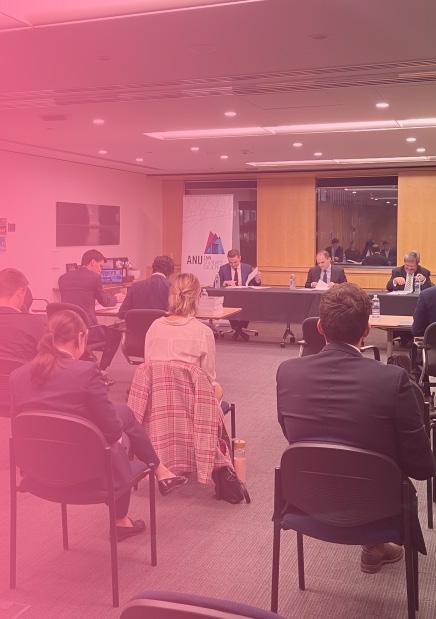
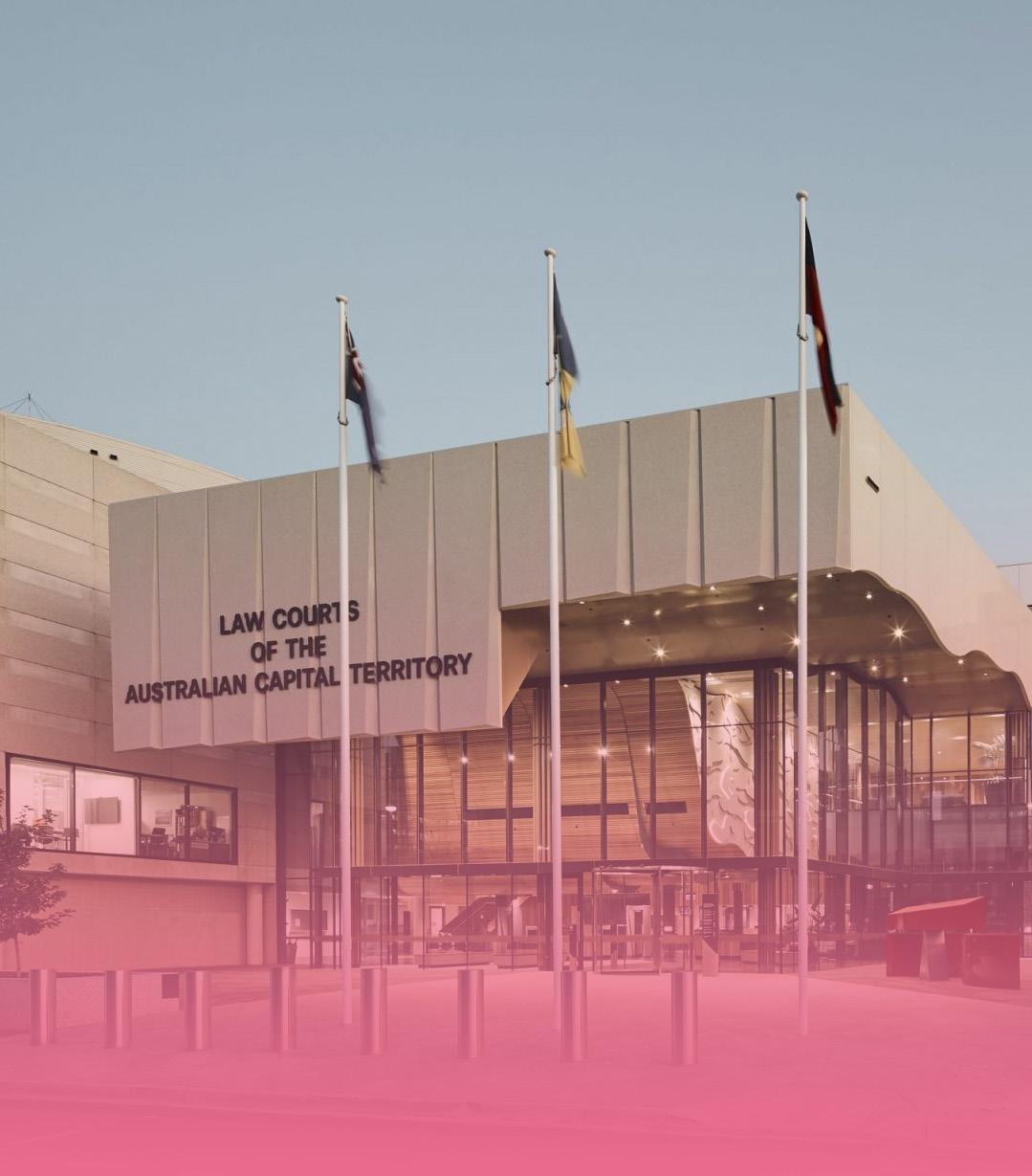
Witness Examination is a mock trial where each competitor examines their own witness and cross-examines their opponent’s witness, trying to adduce facts that are favourable to their case. Problems are generally based in criminal or tort law. The judge assesses a competitor’s ability to adduce and handle evidence and their witness. Familiarity with the rules of evidence is recommended but not essential. Ethical considerations and rules of evidence must be kept in mind at all times when speaking to a witness before and during the round; if your witness lies, or shows obvious signs of collusion, you may be excluded from the competition. Although an individual competition, witnesses are extremely important. Competitors will be given a factual scenario one hour before the trial begins. Half an hour into this period, competitors will be able to consult with (not coach!) their witnesses. Each round will last around ninety minutes, with competitors acting for the Prosecution or Defence.
Teams of: 1
Time commitment: Low
Witnesses
Witnesses are provided by the competitors and need not be ANU law students, nor does it have to be the same witness each round. Before competing, competitors must be sure that they are able to source a witness for every round.
My name is Ivy and I am the Senior Witness Examination director for 2021. I am in my final year of law at the ANU and this is my first year in the LSS.
I decided to get involved with competitions as I am a strong advocate for students developing practical, real-world skills during their university experience. I also wanted the opportunity to improve my organisational skills and to better understand how competitions are run. I think competitions are a great way for students to prepare themselves for professional life after university, as well as for later year law subjects such as Evidence and Litigation.
I was so impressed by the calibre of competitors last semester! I learnt so much about witness examination and public speaking from them and am sure that they will all make excellent lawyers.
My top tips are to see the competitions as being a learning opportunity, rather than being concerned about winning. Competitions are a great place to seek feedback from experienced legal professionals and fellow students without worrying about making mistakes.
Ivy Lončar (2021 Witness Exmination Director)

My name is Sara Warner, I am a fourth year Law/Arts student. I participated in Witness Examination in 2018 and 2019. In 2020 I ran the competition. The witness examination competition allowed me a chance to practice skills that you do not get to do a lot of in early Law subjects and helped give me more confidence.
Specific tips:
1. Build a case theory that centres the law you have been given: If you are prosecution make sure you find evidence that you can ascertain from the witnesses that addresses every element. If you are defence either identify an element that you can rebuke in the prosecution’s case or if you are given a legislative defence find evidence that you can ascertain from the witnesses in order to argue that that defence applies. Introduce this case theory in your introduction by quickly summarising the basic facts, relevant law, what your theory is and what the witnesses are going to say that will support your theory.
2. Utilise your time with your witness: In preparation time you get half an hour planning time by yourself and then half an hour with your witness. Whilst your witness can only give information that answers the questions you ask them, in preparation time you can tell them which facts you will be focusing on. You might even have time to practice a few questions which might calm you down.
3. Object: Learn the objections well and don’t be afraid to object. When preparing make note of evidence that if the other side provokes you can object to. Listen carefully to your opposition's questions and always be ready to object.
4. Don’t panic: it can be slightly overwhelming doing everything by yourself. The judges understand this though and are very encouraging.
5. Have fun: Witness examination is an incredibly rewarding competition. Enjoy the opportunity!
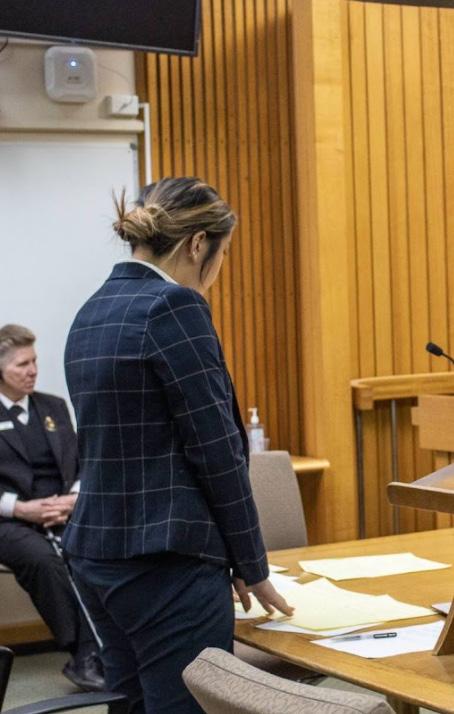
Sarah Warner (2020 Witness Examination Director, former competitor)

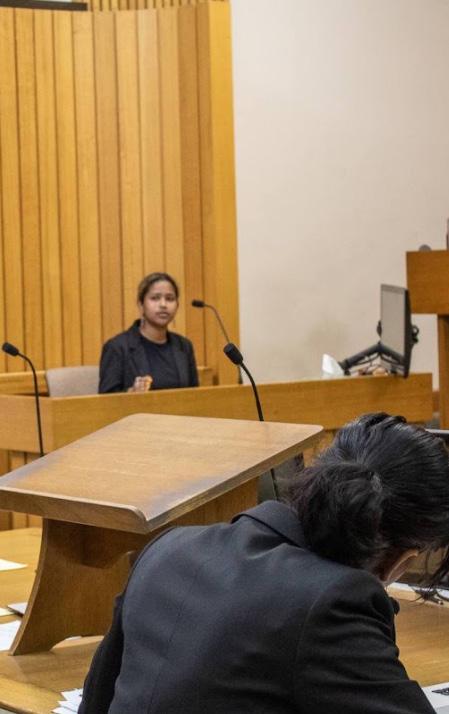
Witness Examination is a rare opportunity to explore the advocacy dimension of legal practice while you are still in law school. While a sound knowledge of evidence law is essential, the competition forces you to consider how to develop an effective line of questioning that supports your case theory. Competitions such as Witness Examination are less theoretical than your coursework assessments. My experience entering legal practice has been that legal research and reading cases are just one aspect of litigation and dispute resolution. They are important, but usually come second to legal strategy, understanding the parties’ interests and advocating effectively. Of course, negotiation is often undertaken with regard to the strengths and weaknesses of cases were they to proceed to court. Law competitions also allow you to meet legal practitioners. Many of the judges graduated not too long ago and are happy to provide advice and guidance.
Judges are given a score sheet, and some criteria are weighted more heavily than others. In Witness Examination, the emphasis is on furthering your case theory through questioning that complies with the rules of evidence.
For most Witness Examination competitors, particularly the brave ones who compete without having studied evidence, the challenge is understanding the rules of evidence and their primary exceptions. You should also prepare to respond to objections from opposing counsel and make objections of your own.
Cross-examination and examination-in-chief could not be more different in terms of your strategy and line of questioning. In crossexamination, all of your questions should be leading - this is a prime opportunity to build your case theory. Examination-in-chief does not allow leading questions, although a non-leading question can still support your case theory if it is directed towards an issue in dispute.
Time management is essential, as you cannot control how long a witness may take to answer a question. You must allow time to address all legal issues and perhaps adapt your questioning based on how the witness is responding.
What do judges look for in presentation?
The main thing is ensuring you are articulate and professional. Your case theory should go beyond whether or not the defendant’s conduct was unlawful or illegal. You should present a narrative of events in your opening statement, and your questioning should particularise that narrative.
At all times, your manner should be dispassionate. A real-life judge may attribute less significance to a witness’s response to your question if the tone or wording of the question was provocative. A witness examination is not an interrogation; it is a rather dry exercise and your sole objective is to furnish evidence for your case theory. Legal argument is best placed in your opening and closing statements.
Any other tips?
Above all, give it a go, and do not adopt a win-lose mentality. Competitions are a learning experience for all involved. And seriously, email your judge for further feedback or to learn more about real world legal practice.
Ben Game

Zach Oakes (2020 Novice WitEx & 2021 Senior WitEx Runner-up)
Witness examination is the ultimate challenge of thinking under pressure and formulating arguments on the fly. Moreover, it’s a great way to develop legal advocacy skills. While the competition formally starts at the opening statement, the one hour of prep work beforehand is equally important.
Read the rules and read the score sheet. Know where you score points and know the time limits for each stage. Once the clock starts its 2 hours until the end… it will feel like 2 minutes!
Problem release
Focus on crystalising your case theory. Determine what you need to prove, and what you need to extract from the facts to do so. Think about what holes need to be filled, where you can pick apart the opposing theory, why the person is guilty, or why not. By the time the competition starts having a clear case theory outlined will guide all other sections.
Witness conference
While it is against the rules to coach your witness, you can encourage them to read the charge and to understand what they think is trying to be proved. If you have time, prepare them for what you think they might be grilled on in cross-examination, again though, you can’t coach the witness.
Opening statement - ‘Tell the Judge what you’re going to tell them’.
As a minimum seek to highlight the relevant facts of the scenario, the charge, case theory, and then draw these elements together to state why the charge should be upheld or dismissed.
Examination in chief – ‘Tell the Judge what happened’
Aim to draw out more than what the statement of facts outlines. Ask why and how, not what. The art and skill of a good EIC is that this must be done by not asking leading questions. For example, if a witness states “The accused looked dangerous”, a good EIC will dig into this. “You said he looked dangerous, why did you think this?”. Not, “did he look dangerous because he was waving his arms around like a crazy person?”.
Aim to paint a detailed picture of the case theory and how it proves or disproves the charge.
Cross – ‘Tell the Judge why the other version of events should be doubted’
While trying to get the witness to have a breakdown and shout ‘you can’t handle the truth’ may seem alluring, an aggressive cross examination style will more likely put the witness on guard. Instead, draw out a non-contentious body of facts by asking leading questions.
Then, combined with facts from EIC, drill down on the inconsistencies and highlight why their story can’t be believed. If the opposing witness is waffling, command their attention and ask them to answer the specific question.
Closing – ‘Tell the judge what you told them’
If prosecution, go through each of the elements of the crime and highlight what evidence has been abducted to prove the charge. If defence, highlight which elements (the more the better) have not been proved and what evidence there was to prove it. Finally, conclude by asking the judge to find the person guilty or not guilty.
• Encourage your witness to think outside the statement of facts and to assume a persona.
• Don’t talk over the Judge. Ever. Just don’t do it.
• It’s possible to win the competition and lose the trial.
• After each round write down notes and build a structure you can use for the next round.
• Know your objections.
Zach Oakes (2021 Senior WitEx Runner-up)


Full disclosure: I have no law background; I hold an honours in molecular biology. So, when my law friend asked if I wanted to be his witness, I was nervous and had no idea what to expect. However, I soon discovered that there was nothing to be nervous about – being a witness is fun! My experience was extremely rewarding. Witnessing is an engaging, hands-on way of learning about legal processes and observing ‘what lawyers do’, without having to study law or be in a real trial. I also practised thinking and acting on-the-spot.
Being a witness is easy and does not consume much time. Briefly, the competition is run as such: shortly beforehand, you receive your ‘witness statement’, containing the case’s facts from your perspective. You then discuss the case with your competition partner (aka ‘lawyer’, your ‘learned friend’) – you get some tips on how to act, and what information to highlight while being examined. During the competition itself, you are first examined by your own lawyer, and then by the opposing party’s lawyer.
For me, the secret to being a successful witness is having fun! The cases are often interesting and funny – in my witnessing career I have been a crazy dog lady, a communist activist, a money forger, and a politician from the ‘boomer rights party’, amongst others. Whilst you should take your character seriously, if you conjure a backstory that fits in with your witness statement you will be a much stronger witness and better equipped to withstand a tricky cross examination. I sometimes even dressed up as my character, finding that it helped me empathise with them and act convincingly. Lastly, interpret your facts with liberty – you are a witness, not a robot!

JOHN GRECH (2021 EXTERNAL COMPETITIONS DIRECTOR)
Hi all! My name is John and I am in my final year of a Laws/ International Relations degree (unique, I know). As External Competitions Director, I am tasked with liaising with other universities, law societies, and other parties to coordinate, organise, and ultimately execute a variety of competitions for ANU law students. What has been most enjoyable about this position is providing fellow law students the platform to hone in on their skills, learn, develop, and compete in intervarsity competitions!
What inspired your involvement with comps?
My inspiration to join the competitions portfolio began when I competed in the Clayton Utz Intervarsity Negotiation Competition in 2020 which was, above all, an exhilarating experience. I have competed in internal negotiation competitions before but competing at an intervarsity level was incredibly interesting yet challenging. I highly encourage everyone to apply, get involved, and see what interests you!
What skills do you develop through external comps?
External competitions provide a multitude of both hard and soft skills to competitors which are similar, of course, to internal competitions. Mental agility, organisation, teamwork, communication, processing and synthesising information, grit, and public speaking are all critical skills learnt through external comps and are essential in the legal profession.
Get involved in internal competitions as soon as you can (novice comps start in semester 2)! This is a great way to familiarise yourself with the competitions and to find which one(s) you vibe with!
Do not be afraid or intimidated by competing! Nerves are completely natural and you are not the only ones experiencing them – even if many law students don’t admit it.
Speak to later year law students (and/or the LSS Competitions portfolio) about the various competitions and how best you can get involved. Later year students can provide you with more ‘real’ advice given they have gone through these feelings and processes before. Utilise this!
John Grech (2021 External Competitions Director)


External competitions allow students to travel, socialise, and compete with like-minded peers from other universities whilst being judged by high-profile legal experts. They are a great opportunity for students to learn and be exposed to different competitor and judging styles. As a result, the ANU Law Students’ Society highly encourages student participation in external competitions, and the ANU College of Law is keen to support competitors through coaching and other means. Registration for these competitions usually open one to two months before the competition is set to run, and will be advertised on our Facebook page. Highlights of the external competitions calendar include:
The first Ashurst ANU-University of Sydney Commercial Law Moot ran in 2020. This competition is based around a commercial law problem and brings our universities head to head in an exciting match-up featuring our best mooters. This year, the competition will run in late July.
The Administrative Appeals Tribunal (AAT) Moot is a national competition comprising five rounds at the state or territory level, and then one round at the national level. It focuses on merits review, so it is aimed at those who have completed and enjoyed Administrative Law. It takes place at the ACT Administrative Appeals Tribunal. This year, the competition will run in late July.
The Castan Centre Human Rights Moot is the only moot which focuses on human rights law in Australia, allowing interested students to hone their knowledge of human rights law. It is based on the Victoria Charter of Human Rights and Responsibilities Act 2006 and is held at Monash University. The competition usually runs in late August.
The annual Michael Kirby Contract Law Moot Competition is hosted by Victoria Law School in the College of Law and Justice at Victoria University. The moot has been running since 2011 and takes place at Victoria University. The competition usually runs in late August.
The Sir Harry Gibbs Constitutional Law Moot is hosted by Melbourne University Law Students’ Society in conjunction with the Australian Association of Constitutional Law and the Australian Government Solicitor. The moot comprises a round-robin structure followed by three knockout rounds. There will be a $1,500 prize award for the winning team, and a $500 prize award for the second placed team. The competition is usually held in mid to late September.
The Baker McKenzie National Women’s Moot is an intervarsity competition for law students who identify as women, and was started in 2011 by the Sydney University Law Society alongside the NSW Young Lawyers Special Committee of Law Students’ Societies. It came about to address equity issues for women at the Bar. In order to compete in this moot, you must identify as a woman. This year, the competition will be held in late September.
The UTS LSS Allens Intervarsity Legal Technology Moot allows students to explore legal technology, which is a rapidly evolving and increasingly important area of the law. In 2020, the moot saw 13 teams from across Australia consider a problem question involving defamation and deepfake technology. The competition will be held in late September to early October.
The ANU Gender Identity + Sexuality Moot ran for the first time in 2020 and was the first competition of its kind in Australia, offering students the opportunity to learn more about gender identity, sexuality, and the law. Last year, the Grand Final was judged by the Hon. Michael Kirby and the Hon. Justices Rachel Pepper and Melissa Perry. In 2020, the Moot was accompanied by a panel where prominent legal professionals in this area were invited to share their knowledge and experiences, and was open to all students. The competition usually runs in early October.
The Clayton Utz UTS Intervarsity Negotiation is an annual intervarsity tournament hosted by UTS and the largest intervarsity competition. This competition allows students to hone their skills at the negotiation table against some of the finest intervarsity competitors. This year, the competition will run in early October.
This year, the Multilateral Client Interviewing Competition will be hosted by the Sydney University Law Society in person, but will be moved online if COVID-19 restrictions prevent this. The competition ran for the first time in 2020 to increase the number of opportunities for skilled competitors to compete at the intervarsity level. This year, the competition will run in mid October.
The HSF Computational Law eMoot is an international mooting competition that is unique in its focus on the principles and significance of computational law, including: artificial intelligence; automation of trust; data governance; privacy protection; accountability of algorithms; and blockchain. The competition usually runs in late April to early May
The ANU LSS is always looking to expand its participation in new external competitions. Keep an eye out on our Facebook page to see when these new opportunities show up!
Nick Bradman, Grace Lee and Ella Sheppard
What made you decide to compete in the competition?
In the era of COVID-19 when international travel wasn’t permitted, I thought I may as well participate in an international competition and take up the chance to interact with university students and lawyers from different backgrounds.
What was your experience like?
The experience was time-consuming but ultimately very rewarding. I also think that - because of the useful legal skills we were able to develop - that we all would have felt that way even if we did not go on to win.
The computational moot was an additionally exciting experience because of its international nature. In the grand final, we were conducting our submissions from Canberra, against a team from Singapore Management University, with judges in Brisbane, Singapore and Germany. In earlier rounds, we also competed against teams from India and had judges in the UK. It was a particularly interesting experience to see the different mooting styles adopted and preferred by students and judges from different countries.
should
Your grades at law school will (most likely) improve! Mooting teaches (or, at least, improves) critical skills whilst you’re still at law school. These include legal research skills, synthesising an argument, and presenting your ‘case’ in a coherent, logical manner that enables your listener (or reader, in case of a legal essay) to follow along and make sense of your arguments.
Taking part in a moot (whether or not you go on to win), also demonstrates to potential employers that you have knowledge outside a textbook and experience beyond the classroom. Mooting experience can be a good way to present yourself as having morepractical legal skills and being ‘job-ready’.
How did the experience assist you to further develop your mooting skills?
Neither Grace nor I had ever mooted before, so it was a steep learning curve to go from zero mooting experience to the grand final of an international competition! The experience allowed us to develop a range of skills on both the substantive and stylistic front. In the substantive sense, we improved our legal research skills and our ability to condense legal arguments into a clear and concise
form. Stylistically, the moot advanced our presentation and public speaking capabilities in a general sense, while also providing the opportunity to develop those skills specific to mooting. Such skills include, for example: adapting to the increased formality of a court setting: integrating into our language the technical parlance required when conducting submissions and addressing judges; responding to difficult questions while maintaining your composure and not losing track of your argument.
Do you have any tips for interested students?
Don’t be afraid of giving any mooting competition a go - even if you have no prior experience (with any legal competition)!
Be prepared to spend a lot of time practising the actual presentation of the submissions. You might think that the hardest part of a moot is the legal research itself. However, in many cases, given that the fact scenarios are designed to be line-ball, the judges are just as interested in - if not more interested - in how you present those arguments (e.g., manner, pace, timing, responses to questions, use of formalities).
Accept that an ‘e-moot’ will present new challenges. For example, how to handle a situation where poor connection means you don’t hear a judge’s question properly. Or, for instance, how to gesticulate so it complements your presentation, rather than distracting from it. Hand gestures in a Zoom setting are very different to an in-person one - you have to be sure that they are actually being seen, without obscuring too much of the camera.
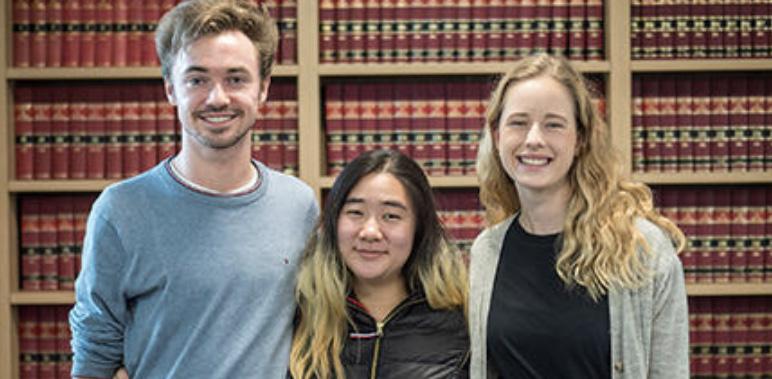
L-R: Nick Bradman, Grace Lee and Ella Sheppard
The Australian Law Students’ Association (ALSA) is a national not-for-profit association comprising many Law Students’ Societies and Associations. Every year, the ALSA Conference consists of a week of competitions, educational events, council meetings, and social events.
Winners of the senior internal Mooting, Negotiation, Client Interview, and Witness Examination Competitions (held in Semester One) represent ANU at the Conference every year. In 2019, the ALSA Conference was held in Melbourne and was an extremely rewarding experience as teams competed against universities from around Australia, New Zealand, and the Pacific.
Participating in Novice Competitions gives you the relevant skills and experience to compete in the Senior Internal Competitions, which puts you in the running to become an ANU ALSA representative.
Unfortunately, in 2020 and 2021, the conference was held online due to COVID-19.
WHAT'S IT LIKE TO COMPETE IN AN ALSA COMPETITION?
Competing on a national level was a daunting experience. You have ample time to prepare for the three preliminary negotiations, but just like any competition, you never know how it’s going to go until game day. After the pool stages, the competition went into a completely different gear, since the quarter-final, semi-final, and grand final all occurred over the course of two days. We had to learn to prepare extremely efficiently, and focus only on the elements that we thought were most important for success. We encountered high-quality opposition from all across the country, and it was a great opportunity to continue to hone our skills against such skilled opponents
What was it like competing online?
We’re actually quite used to competing online, as both our Novice season last year and our Senior season this year were online. However, we were not used to being in different cities rather than sitting next to each other, which presented its own host of challenges. It required us to be extremely confident in our understanding of our instructions and our strategies, and also means that you need complete trust in your teammate to execute the way you’ve planned. This trust is very important in negotiations - all the best teams we’ve negotiated against seem like they’re one brain in two bodies, and present a completely united front.
What was the most rewarding thing about competing in the ALSA Championships?
Negotiating in the national grand final shows you that you still have so much more to learn. We were lucky enough to be judged by a panel of both legal practitioners and former student negotiators, whose feedback afterwards demonstrated that there is always huge room for improvement. Competitions like this encourage you to be a ‘student of the game,’ because you pick up the best elements of other teams’ strategies and benefit from different judges’ perspectives. Go into these competitions as a blank sheet of paper, and you’ll reap the rewards.
Henry Palmerlee & Bas Braham (ALSA Negotiation Champions)





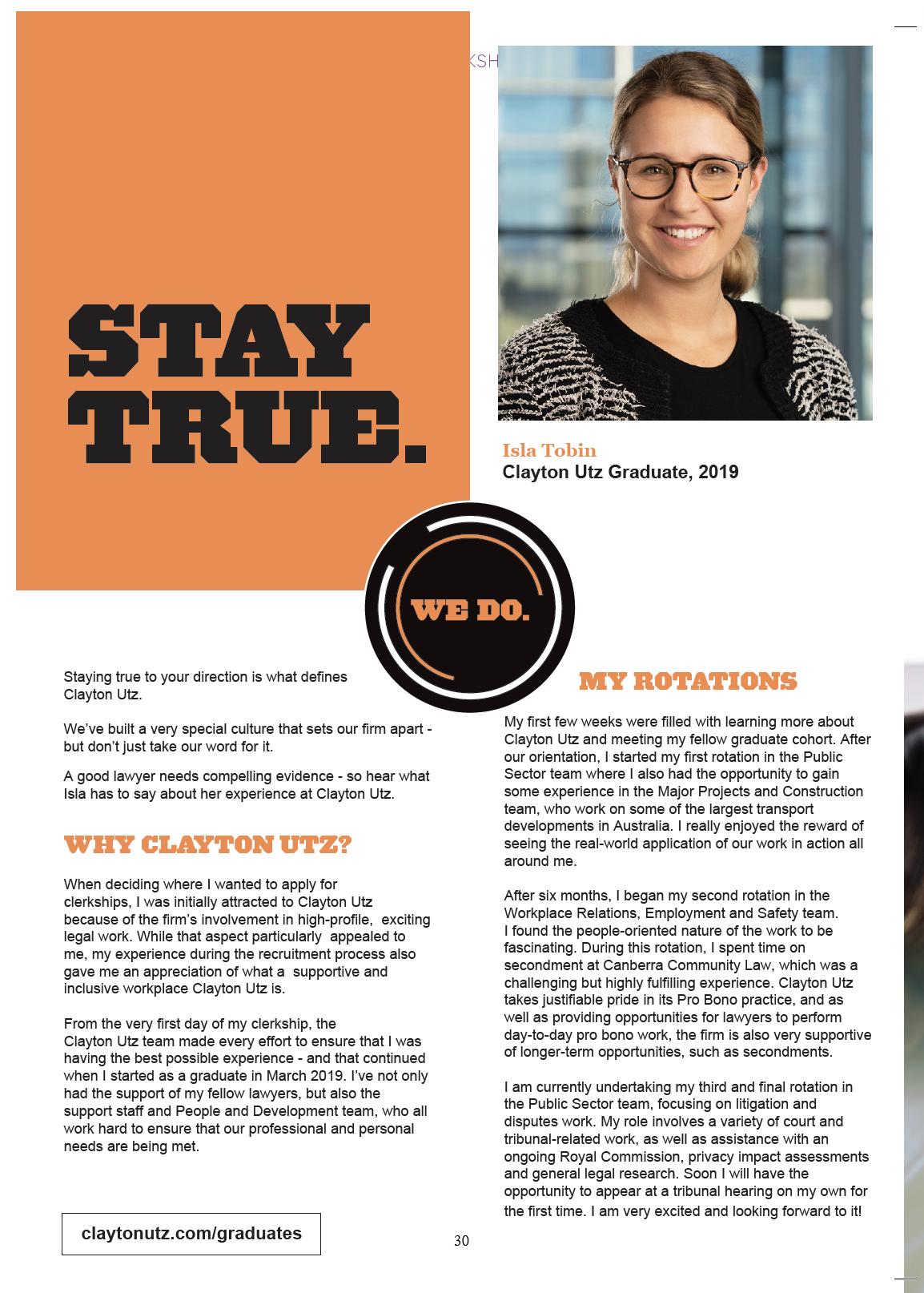
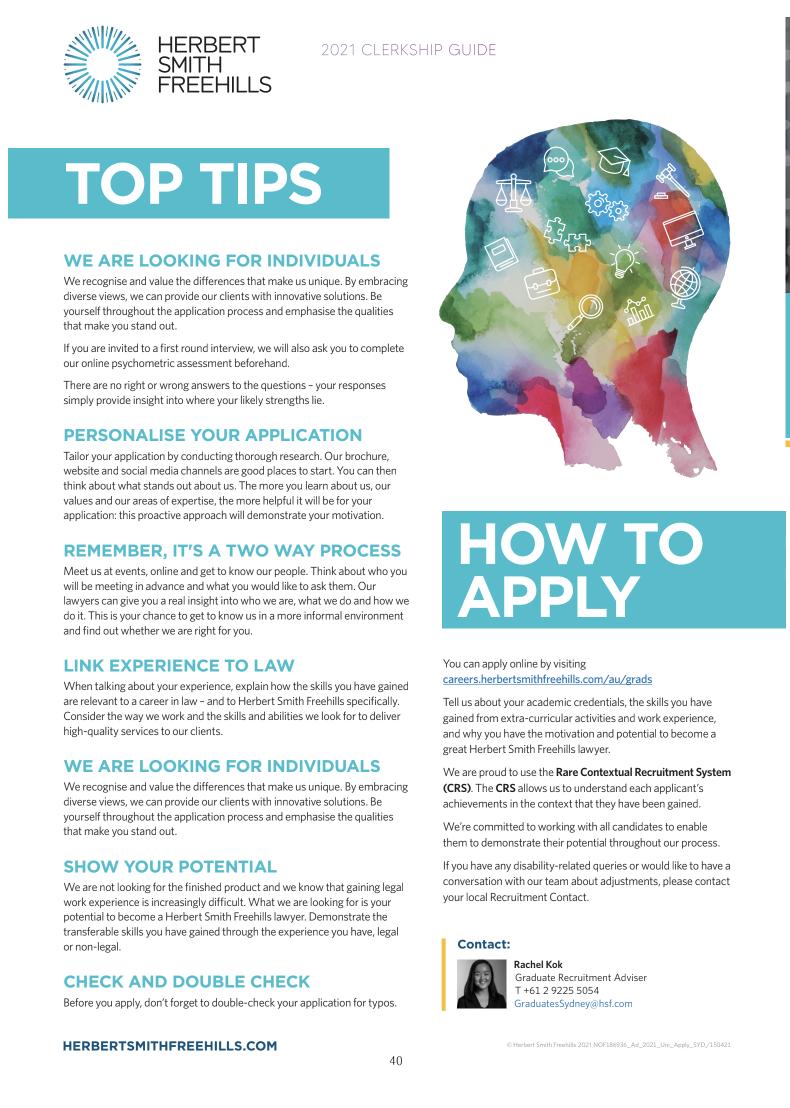

THANK YOU TO THE FOLLOWING FIRMS FOR SPONSORING THE LSS IN 2021
Premier Sponsors
Major Sponsors

General Sponsors