

CLERKSHIP GUIDE 2019
THE AUSTRALIAN NATIONAL UNIVERSITY
LAW STUDENTS’ SOCIETY



Clerkships 101
Acing the Application Process
ANU GDLP
College of Law
Premier Sponsors
Ashurst
Clayton Utz
King & Wood Mallesons
MinterEllison
Major Sponsors
Allens
Gilbert + Tobin
Herbert Smith Freehills
Jones Day
General

EDITOR’S NOTE
Dear Australian National University Law Students,
On behalf of the Australian National University Law Students’ Society, we are proud to welcome you to the 2019 Ashurst Clerkship Guide.
We would like to formally thank our sponsors, without whom this guide would not be possible. Your continuing support of the ANU Law Students’ Society is greatly appreciated.
Thank you to the ANU students and graduates who have contributed to the guide. Your insights into the clerkship program are invaluable. I am sure that students will find your advice engaging and encouraging. We wish you all the best for your future career and academic endeavours, and hope that you remain a vital part of the ANU Law community.
This year’s guide aims to provide all ANU Law Students with a thorough understanding of what Clerkships and the Clerkship application process entails. It also presents comprehensive material on an extensive range of firms. We hope that this Guide inspires you to consider a clerkship. To those applying for clerkships, we wish you all the best. We understand that the process can be stressful and daunting, but anticipate that this Guide will provide you the tools to ace your applica¬tions. To those who decide that a Clerkship is not for you or do not receive one it is important to remember that there are other legal career opportunities. Many of these pathways are high¬lighted in the 2019 AGS Careers Guide and by Semester Two ANU LSS Careers events. These can be be found at https://www.anulss.com/ careers/.
I would like to thank this year’s Careers Directors, Michelle and John, and our newly appointed First Year Officer Epi for their continued hard work.
If you wish to discuss anything in the guide or any of our upcoming events, please feel free to contact us at lsscareers@anu.edu.au.

Thanaya Naidu
Michelle Wang
Johnathon Grech
Epi Terbio
Vice-President (Careers) Careers Director
Careers Director
First Year Officer
DISCLAIMER: The views expressed in this publication do not necessarily reflect those of the editors or of the Australian National University Law Students’ Society. Best efforts have been made to ensure all information in this publication is correct as at April 2019 but is subject to change without notice. This information is merely advisory and should not be relied upon as being professional advice. This publication is distributed free of charge with the understanding that the authors, editors and any persons related to this publication are not responsible for the results of their actions or omissions on the basis of any information provided in this publication.
PRESIDENT’S WELCOME
Welcome to the 2019 Clerkship Guide, proudly supported by Ashurst.
I would firstly like to thank the Careers portfolio for their hard work in preparing a truly comprehensive and outstanding Clerkship Guide. I would also like to thank our Sponsors for their continued support of the ANU Law Students’ Society.
To the student reader, congratulations! This is an exciting moment in your legal journey and, for many, your first step into an illustrious legal career. The coveted clerkship often seems like an impossible prize at the end of a daunting application process – but, fear not! This Guide is here to demystify much about the clerkship application process and provide you with valuable advice on navigating your entry into the world of corporate law.
It is, however, important to remember that Clerkships are not for everyone and that is completely okay. Some of you may dabble with corporate law and others may not even engage with it. As an ANU Law student, your future employment opportunities are endless. There are so many legal careers available, whether that be in not-for-profits, government departments, academia, the courts or other public interest areas. You might not even end up involved with the law at all!
Regardless of where your career is headed, we hope that the skills and knowledge within this Guide are transferrable. The importance of conducting adequate research into your desired employer, preparing early and ensuring that your application remains true to you are just a few key takeaways.
I would also like to sincerely thank those who have contributed to our Guide. We hope that the advice and experiences of those who were once in a similar situation to you will be inspiring and practical.
Finally, I wish you the absolute best of luck in what will no doubt be a journey to success. Hopefully this Guide will leave you feeling informed and supported, and maybe even a little excited, as you begin to consider life beyond the ANU.
All the best,
Rocky Lagudi President
ANU Law Students Society lss@anu.edu.au


CLERKSHIPS 101

FREQUENTLY ASKED QUESTIONS
What is a Clerkship?
A clerkship is a paid internship typically undertaken by penultimate year law students, where clerks are placed under the supervision of a Partner and complete work within their team. In Australia, a majority of top-tier and mid-tier firms run clerkship programs.
In Sydney and Canberra, they are 8 to 12 weeks and most clerks are offered a graduate placement. Whilst in Melbourne and Brisbane, clerkship are 4 weeks. Students can do multiple 4-week clerkships at different firms. A limited number of clerks are offered graduate placements. Both types of clerkships have pros and cons – extended placements typically entail a more in-depth exposure to the practice areas, rotations, and firm culture; whereas shorter placements allow you to dabble in a variety of firms. It entirely depends on personal preference!
Some firms offer winter clerkships, and clerkship or internship opportunities available in firms overseas. The application processes, dates and locations for these are all firm dependent. Winter clerkships are an excellent alternative if you are unable to undertake a summer clerkship. International clerkships, internships and traineeships are competitive, but a great way to experience working and living in a different culture.
Why should I apply for a clerkship?
Clerkships are an excellent way to gain a more comprehensive understanding of different practice areas as well as a firm’s culture. If you are unsure of which area of law you would like to work in (which is totally normal!), clerking will help clarify this. If you are considering a career in commercial law– applying for a clerkship is highly recommended. Importantly, graduate positions are chosen almost exclusively from a firm’s clerkship pool.
Who is eligible to apply?
Clerkships are primarily targeted at penultimate year students (so second last year). However, some firms allow final year students to apply. Most firms have abolished official GPA/WAM cut-offs and do not require prior legal work experience, instead basing recruitment on an applicant’s personability, passions, and suitability to the firm.
I have no industry-specific experience – should I still apply?
Law firms understand there are practical limitations in gaining law-related work experience throughout University. Any work experience or participation in extracurricular activities will bolster your application. If you are considering applying for a clerkship and do not have an elaborate array of previous internships – you are not alone! Firms increasingly look for suitability, genuine interest, passion, what makes you unique, what you can bring to the firm, and how the firm can foster your professional development.
How competitive are clerkships really?
Clerkships are genuinely quite competitive; nailing each stage of the application process is necessary, and can be both demanding and stressful. Firms receive hundreds of applications and must filter, analyse, and ultimately choose who will best benefit their firm. However, this is not to say you will not receive one. Graduating from ANU Law and utilising the multitude of career-building opportunities available throughout your degree will provide you with a competitive edge. Make sure to do thorough research on each firm you apply for, understand how they are unique, and tailor your application accordingly.
SELF CARE DURING THE APPLICATION PROCESS

The clerkship process can be incredibly overwhelming and stressful. It is easy to get caught up and feel under the pump, especially between assignments, work, personal commitments and applications. As a result, this is a time where it is increasingly important to ensure you are taking proper care of yourself. Here are a few tips and tricks to ensure self-care during the clerkship application process:
Take a day off here and there
This day would be all about you, no thinking about study, assessments, or clerkship applications. For one day, forget about being in law school and relish in the fact that you have come so far. Spend the day doing things you enjoy, whether that is on your own or with someone you enjoy spending time with. It could be something adventurous, like going on a hike, or it could be spending the day at home relaxing. This is your time to take a break, and take care of you.
Don’t forget about daily self-care
Take an hour out of everyday to take care of you. In this hour, do anything you want, just remember to focus on self-care and clear your mind of everything else going on in life. Take a long bath, go for a walk, watch something on Netflix, go out for lunch with a good friend and check in with them, meditate or take a yoga class. Most importantly, remember to take a breath! There is a lot going on right now, and the important thing is to ensure you have time to take care of yourself also.
By Priya Mittal, Vice-President (Equity) ANU Law Students Society
Continue to exercise and eat healthy
Don’t let your good habits go astray. Continue to make healthy meals, time for exercise and adequate sleep to ensure you stay healthy. After-all, healthy body, healthy mind!
Enjoy the application process
Ultimately, your application will showcase all your achievements to date. And this in itself is a huge feat! Enjoy taking the time to reminisce over all your past and present achievements and look forward to what the future has to offer. You have made it this far, and no matter where you end up after law school, you will continue to achieve more great things.
Finally, don’t be disheartened by rejection
The harsh reality is that not everyone will receive a clerkship, and that is okay. There are plenty of other opportunities to get your foot in the door and advance your legal career. At this stage, you may feel quite rejected and disheartened. But it is important to remember your own self-worth and that not receiving a clerkship does not define you as a law student. Take some time to accept what has happened and then get back in the game and apply for other opportunities. Have a look at some of the volunteering and internship opportunities other firms and government departments have on offer!
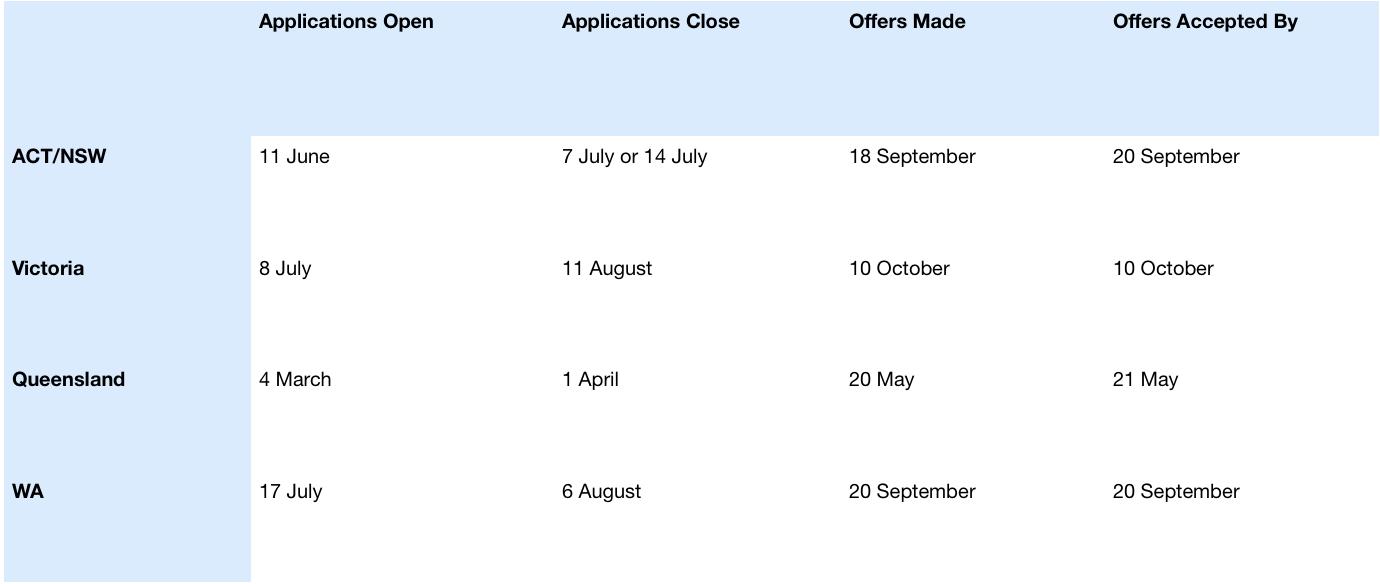
IMPORTANT DATES
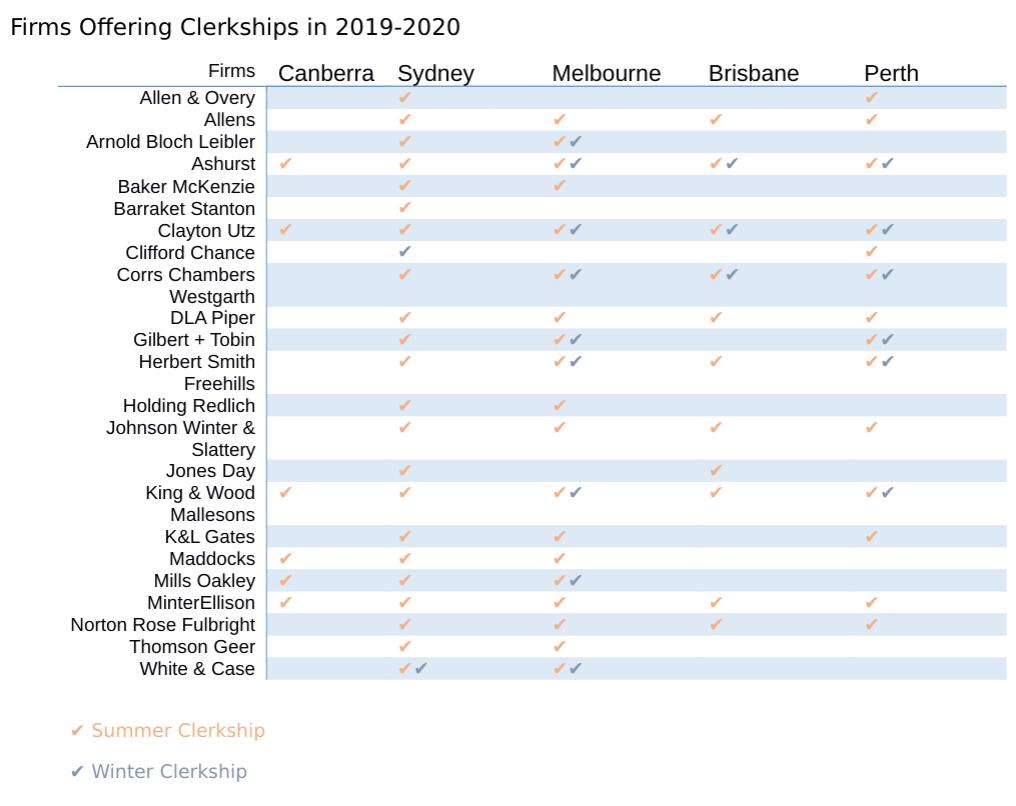
FIRMS OFFERING CLERKSHIPS IN
2019-2020
IMPORTANT RESOURCES TO ASSIST WITH YOUR APPLICATION

CV mail is an online application tool used by numerous top tier law firms around the world in the initial part of their clerkship, vacatiotioner and graduate application processes. It is run by Thomson Reuters. CV Mail allows you to enter your personal details, academic records and work experience only once, as it transfers the information between applications. It acts as an online job board for clerkship programs and has great resources on the application process. It is important to look at CV Mail early to assess which firms use their services.

InsideSherpa facilitates a virtual experience or internship program, where students can complete virtual work experience for a variety of top tier legal and financial firms. These programs are beneficial for those who are looking to gain legal work experience. They provide independently written firm and employer profiles.

Beyond Law offers additional resources to assist with stages of the application process including addressing selection criteria and interview skills. They have recently begun a paid CV and Cover Letter review service.

LegalVitae is a centralised job board run by the NSW Law Society. A range of private firms, government departments and other organisations have signed up to their services and they are growing each year. Their aim is to showcase the range of opportunities available to law students and graduates. Students can sign up for application alerts.

ANU Careers runs a variety of Resume and Cover Letter workshops. Additionally, they have weekly Resume and Cover Letter review sessions in which students can receive personalised feedback. There are also weekly careers consultant appointments which can cover career direction and opportunities, and review other parts of the application processes such as interview skills. Both services can be booked on ANU Career Hub.
ANU Career Hub has online resources on interviews, personal branding and networking. This is available for current and graduate ANU students.

ACING THE APPLICATION PROCESS
WRITING STELLAR COVER LETTERS
Clerkships have so many parts that the whole process can feel overwhelming. The good thing about cover letters is that you can write a template and mould it for each application.
There’s a pretty simple structure that works for cover letters.
1. Introductory paragraph. Include all your personal details: name, university, stage of degree. A quick sentence or two on why you want to do commercial law and why you want to work at that firm specifically . Then a concluding sentence on why you’re the best, why they should want you and why you are the biggest asset a firm could have.
2. Why you want to work at that firm. What made you apply to that firm above all others? What is the reason they are a perfect fit for you? Is it their pro bono department? Their amazing culture and vibe? Firms know you are applying to others, but you need to make them feel special.
3. Why should they want you. Now is your time to wow them. Talk about all your skills, experiences, and qualifications. Previous work, extra-curriculars, and interesting facts. This can be a couple of paragraphs sorted into different skills the firm is looking for (e.g. communication, research etc) or it can be divided into legal experience, extra-curriculars etc.
4. Conclude! Have a snappy final sentence that is respectful and intelligent, and tell them you are looking forward to hearing back from them (that way they can’t blank you).
You are probably now sitting on a strong credit cover letter, but if you want to get that HD, here are some additional tips.
1. Research smart. Anyone can find the last 4 cases the firm was involved in. Find a case that you are actually passionate about and can link to your experiences.
2. Try to find personal connections. I would use the LSS Clerkship Evening to chat to firm employees and then reference them in my cover letter. For example, in my paragraph about why I wanted to work at a firm I would say “at the ANU LSS Clerkship Night I chatted to Stacy, a graduate in the Employment team, and she told me the firm really values pro bono work. The way she described the firm’s values really showed me that I would fit in with the firm because…”
3. Take initiative! Utilise anything that makes you stand out from a crowd. They are reading hundreds and hundreds of cover letters, you want to be noticed and you want to impress.
Finally, cliché as it is, be yourself. If you are yourself, and you don’t get accepted, it means you may not have got along with the people at the firms not have enjoyed working there. If you write a cover letter that is a misrepresentation of who you are and you get in, you may discover you aren’t a match. There is no point saying you love property law when you hate it, because you don’t want to end up stuck in that area. Find a firm that you actually gel with for the best clerkship experience.

By Rebecca Kriesler
A 5th year LLB/Arts student who clerked at a top tier firm in 2018-19. Rebecca has paralegal experience in mid-tier and top tier firms. She is currently completing an internship at Legal Aid and working as a paralegal at the Attorney General’s Department.
PREPARING YOUR RESUME
Your resume is crucial during the application process. Not only will it be one of the key documents HR managers and lawyers will read when determining if you make the cut, it will also be a central point of reference for partners and lawyers when asking you questions during the interviews. You can tailor your resume early on to make sure it clearly highlights the skills and experiences that make you a top candidate for a clerkship.
Format and style
• Keep things concise and try to limit your resume to two pages.
• Header your name, address, phone number and email.
• Make use of bullet points – it will keep each point short, clear and easy to read.
• Don’t be afraid of using bold, italics, horizontal lines, and light shaded lines to make your resume easier to read.
• Separate your resume into sections – education and qualifications, legal and related experience, other work experience, and extra-curricular highlights.
Education
Write your educational history in reverse chronological order, along with your (expected) completion date and GPA/WAM for each program. You can also choose to list the courses you have excelled in which may be relevant for the clerkship, overseas exchange experiences, and academic awards.
Work Experience
A good way to tailor your resume for clerkship applications is to separate legal and non-legal work experiences. Please do not discount your non-legal work experience though, as skills like customer service are incredibly important to becoming a good lawyer. Make sure to also include any volunteering work such as work at community legal centres. For each experience, don’t forget to note the name of the employer, employer location, the name of your role, the number of hours
you worked each week, and the time period you worked there.
There is no strict rule as to how you describe each experience, but try to include detail and definitely mention any achievements at work you are especially proud of (your interviewer may catch this and ask for more detail during the interview).
Extra-curricular activities
You can organise this section chronologically or in categories. Don’t just list your roles and interests – try to highlight your best achievements, the activities you are most passionate about, and any transferable skills you have gained. Extra-curricular activities can really show the firms a glimpse of you as a person, and open up interesting conversation topics during the interviews!
Final tips
1. Think about what you really want the firm to know about you. If you have extra time, you can also consider tailoring your CV to specific law firms, e.g. more emphasis on your international awareness.
2. Ask someone to proofread your CV. They may be able to point out any typos or potential improvements.
3. When you are done, make the document a PDF before sending/uploading it.
Good luck!

By Sunny Li
A 6th year PPE/ JD student who clerked at top tier firm in 2018-19. Sunny previously completed an internship at a corporate law firm in Beijing and has worked as a legal assistant in Canberra.
ADDRESSING THE SELECTION CRITERIA
What does Addressing the Selection Criteria mean?
Addressing the selection criteria means making sure that your written application displays the qualities that firms are looking for. The majority of the firms will have selection criteria that are somewhat vague and are along the lines of good communication skills, ability to work in a team, intellectual curiosity, business acumen and a desire to learn. Many firms will also have written questions directed towards a particular quality such as teamwork or resilience. Often, whether a candidate addresses the selection criteria can be the difference between being offered a first round interview or a rejection.
What’s the best to way to address selection criteria?
Whether it be in a cover letter or in answering a question, there are two key things to remember when addressing selection criteria. The two things to keep in mind are:
1. Demonstrating your knowledge of the firm
2. Connecting your answers back to your personal story.
Demonstrating your knowledge of the firm.
The best way to demonstrate your knowledge is to do your research on firms. There is a wealth of knowledge available on the websites of firms and media articles. If you have any friends who have completed a clerkship or work at a firm you are applying to, they can be a really valuable resource. If you don’t have any contacts at a firm, going to the LSS Clerkship Evening can be a really great way to meet people at firms and make those valuable connections.
Apart from a firm’s website, online resources such as InsideSherpa are a great way to learn about a firm. InsideSherpa collates information on a firm’s strength, recent work and important people in firms. Chambers and Partners is also a great resource to get to know a firm better. They are the lawyer’s bible to rankings and
comprehensively rank the best firms in each practice area every year. Doing the research is the easy part, weaving your firm knowledge into your answers/cover letter is the more challenging.
Connecting your answers back to your personal story.
The best tip I was given when I was going through the clerkship process was to connect my answers to my personal story. If you are going to mention a piece of notable work a firm has done or a particular partner that you look up to, make sure that you connect it back to how this relates to you. The best answers and cover letters use firm knowledge and examples to demonstrate their personal alignment with a firm. This might be as simple as discussing how a subject you’ve taken has made you interested in a firm’s strong practice group.
Finally, an important tip is to try make your responses unique. Think of something that differentiates you from all the other candidates and shows your personality. Firms are looking to get to know you better, so give them something to remember your application by. This might be as simple as talking about one of your passions or hobbies in your application.
Good luck and Stay Positive!

By Kunal Vankadara
A 5th year LLB/ Economics who clerked at a top tier firm in 2018-19. Kunal has worked at the Australian Government Solicitors and various community legal centres.
TIPS AND TRICKS TO ACE YOUR INTERVIEW
Back yourself
First, congratulations on making it this far. You were one of hundreds of applicants. You were chosen as an interviewee because someone thought you were worth interviewing. You are probably smarter than you think you are. Go into your interview with confidence. Know that you can be a good clerk, graduate, or junior solicitor. Back yourself.
‘Tell me about yourself’ shouldn’t be interpreted literally…
You don’t need to dictate your autobiography. This is your chance to give an elevator pitch on your experience, why you want the role, and why you are fit for it.
…but you don’t need to be robotic
On the other hand, remember that you got here because you looked good on paper. Your interviewer wants to know whether they will enjoy spending every day with you as a clerk, or every evening with you as a graduate. Don’t be afraid at some point in the interview to talk about something that really interests you, or something unusual on your CV that you’re proud of.
Know your CV and written application
This sounds simple, but it’s my hottest tip. My interviews were light on behavioural questions (i.e. tell me about a time when…) and heavy on CV-combing questions (i.e. tell me about job X; what did you learn from it?). Plenty of questions were asked about what I had written in my first-round applications, too. Your mileage may vary. But be sure that you know the picture you have painted of yourself and be ready to account for it.
Cocktail nights aren’t tests
Prospective clerks have an irrational fear of cocktail nights. You will hear stories about video recordings, secret rooms with the candidates’ photos on the wall… They’re not true. Use these nights to your advantage.
Find some lawyers in a practice group that interests you and have an honest chat with them. Have a think about the discussions you had and reflect on them in your interview.
Prepare lots of firm-specific questions
Depending on your interviewer, you might find yourself with plenty of time for questions: in one ‘45-minute’ interview, I was left to ask questions at the 15-minute mark. Be ready to ask thoughtful questions that are specific to the firm you are interviewing at. If there’s one quality that the interviewers are looking for, it’s curiosity. Do your due diligence!
Do not panic
This may seem like the most important interview of your life. Strangely, it may also be one of the most casual. Clerkship interviewers often have an informal tone which you might struggle to reconcile with the legal profession’s apparent seriousness. Reconsider my earlier points: you are good enough, and they are looking for someone that they would enjoy spending time with. If they are looking for a chat, have a chat.

By Joseph Dean
A recent LLB/ Commerce graduate. He clerked at top tier firm in 2017-18 and works there as a graduate. During university Joseph worked as a Research Assistant at the ANU College of Law.
SAMPLE INTERVIEW QUESTIONS
General Questions
How do you deal with challenges?
What are your best three and worst three qualities?
Why do you want to work at this firm over other firms?
What are you hoping to learn/ achieve from this clerkship program? Why law?
Why corporate law?
Who is a role model in your life and why?
What do you like to do in your free time?
What is one quality that makes you unique?
What is a current news story that you find interesting?
Do you want to undertake further education?
Tell me something that is not on your resume/ application?
What qualities do you think makes a good clerk?
What are hoping to gain from this role?
Situational Questions
Describe a time you came up with an innovative solution to a problem?
Describe a time in which you showcased our firm’s value of (FIRM)?
Describe a time in which you dealt with a challenging team?
Describe a time you dealt with negative feedback?
How do you deal with stress?
Is your GPA a good reflection of your abilities?
Tell me about a major accomplishment.
What do you think is a major challenge facing a firm like this?
Questions for the interviewer
How do you nurture clerks?
How does your firm define success?
How is a work/ life balance achieved by the firm?
How often is feedback provided?
Who provides clerks feedback?
What are the long term career opportunities available at the firm?
What is the strongest quality of the firm?
What are your expectations of a clerk?
What are your expectations of a graduate solicitor?
BECOMING COMMERCIALLY AWARE
When I set out to apply for clerkships, I was pretty worried about a certain aspect of my application: most of my electives are international and public law oriented, and my experience ranged from the ALS in rural Western Australia to DFAT. In short, I do not exactly scream corporate lawyer.
There are simple things you can do to become more commercially aware.
First, don’t lie. This may seem fairly obvious, but it can feel like there is a strong incentive to lie and say you have always dreamed of working in a commercial law firm. If this is true, then fantastic! However, if you are like me and you chose to study other areas of law, it will be pretty obvious that this is untrue. It is entirely valid to have reached the conclusion over the course of your degree that corporate law is the career you want to pursue without having wished for it your whole life –embrace that side in your application.
Second, come up with a strong answer to why it is that you want to work in a commercial law firm. Read the Australian Financial Review, keep up to date with what is happening in the commercial world at the time, and find what actually interests you in those stories. Again, authenticity is palpable. If you are discussing something in an interview that truly interests you, this will be obvious. Remember that areas like politics will almost always have an impact in the commercial world, so keeping up to date with commercial policy proposals from major parties can be a way to ease into commercial awareness. Developing a strong, authentic answer to why you actually want to work in commercial law goes a long way to framing your application in a commercially viable way.
Finally, look at a specific firm’s clients, strong practice area and any commercial advocacy or reporting they do. Commercial firms do not just represent clients
– many write pieces on developments in the law, or advocate for how the law should develop in the future. This is a great way to not only get a feel for the work a firm does but also to understand the approach they take to different commercial issues.
It can be daunting applying for large commercial firms. Remember, it is rare for someone in university to have actual experience in many practice areas. Firms acknowledge that you do not need to have years of experience in Mergers & Acquisition to be a viable candidate. Think about the subjects you have studied, or articles that interest you, and from this work out a couple of practice areas that could interest you. Having areas that you think will interest you that you can talk about, but also being open-minded to the idea that there are many areas you have not tried that could interest you, is the best way to be both commercially viable and adaptable as a candidate.
Overall, be open and willing to learn about new areas and show authentic commercial awareness. This balance will serve you well as an applicant.

By Kate Renehan
A 6th year LLB/ IR student who clerked at a top tier firm in 2018-19. She has worked in a local, boutique law firm, the Australian Mission for the United Nations in New York, the Aboriginal Legal Service in Kalgoorlie, and the Department of Foreign Affairs and Trade. She was a part of ANU’s 2017/18 Jessup Moot team.
THE INS AND OUTS OF PSYCHOMETRIC TESTING
Psychometric testing is a widespread feature in clerkship recruitment. Not everyone requires it and it often looks quite different between firms. At a broad level, however, firms often use one or more of: personality, verbal reasoning/comprehension, numerical reasoning and/ or logical reasoning/pattern recognition tests.
I’ve now done more of these tests than one should ever have to do in a lifetime and have emerged relatively unscathed, so I’ve set out some tips below.
Personality tests
• Answer instinctively. These tests are designed for you to give your intuitive response, not to ruminate over the options. Answer quickly, go with your gut.
• Answer honestly. Recruiters have been at this game for a long time—they know when someone is manufacturing responses. The testing programs are also pretty good at picking up inconsistency. You’ve heard it a million times before: be yourself!
• Read the report at the end (if there is one). This may give you an insight into your values, cognition and working style; being self-aware is always a plus when going through these processes. Conversely, you may think it’s complete bull—a talking point for the interview!
Ability tests
• Clear your space (physical and virtual). Declutter your desk, close your tabs, and set yourself up with your computer, a notepad, a pen and a cup of tea. No distractions.
• Read the instructions. It can be tempting to skip the slabs of text when you’re anxious to get to the meat of it. Take your time and read the instructions thoroughly.
• Do the practice runs and take them seriously. Most tests will provide you with an opportunity to do a trial test before completing the scored one. Take the opportunity! Get a feel for the questions, and make sure you understand where you may have gone wrong before you proceed to the real deal.
• Answer everything. Most of these tests are timed and, frankly, you may not know the answer by the time the last few seconds are ticking away. Just click something! Go with your gut—a guessed answer is better than a blank one.
My top three tips
1. Give yourself the space to do well. Phone off, be in a quiet place free from distractions, and give yourself plenty of time.
2. Be in the right headspace. These tests can be stressful. Try to pick a time when you’re feeling calm and can put it all into perspective. If not, that’s okay—have another crack later.
3. It doesn’t actually matter that much! These tests are not a deal-breaker, and firms will attest to this. They are simply to help the firm understand you a bit better. I’ve had plenty of friends who have sworn they’ve absolutely crashed and burned who have gone on to be stellar clerks and grads.
Try to relax and take care of yourself this clerkship season. Remember that this whole process is just as much about you trying to figure out where you want to be.
Trust me, you’re all super employable.

By Bryce Robinson
A 6th year LLB/ Science and Diploma of Languages student. Bryce has completed 3 clerkships in Melbourne at top tier and international firms. He is working as a Research Assistant at the ANU College of Law and as law clerk at a local Canberra firm.
DOS AND DON’TS OF ATTENDING FIRM COCKTAIL EVENTS
Congratulations on making it through the written stage of the application process. My biggest tip is to relax a little, which I know is hard given the stakes. When walking into a cocktail event, take a deep breath and remember that the evening is all about the firm selling itself to you.
What are they?
Firms generally organise two to three events for candidates throughout the clerkship application process. These events range from formal sit-down dinners to Q&A style information sessions and can involve 20 to 150 candidates. Regardless of the format, the purpose of these events is provide you with information about the culture of the firm.
Do’s and Don’ts
Do dress as you would going to an interview, not a cocktail party. Go for a smart, slick look that you feel comfortable in.
Don’t pretend to be someone you’re not. Firms hire clerks with varied backgrounds, skill-sets and personalities – they aren’t necessarily looking for the “archetypal law student.”
Do be prepared to talk about a range of different topics. It’s a good idea to be across the major news stories of the day as well as knowing what you’ll answer to “why do you want to become a lawyer?” Sharing travel stories and talking about your interests beyond the law are also good ways to make yourself memorable.
Don’t embarrass yourself by ostentatiously boasting of your achievements – having an invitation means that you impressed the firm enough – no one wants to hear about your 99 ATAR.
Do your research on the firm. Know what practice areas the firm specialises in and understand their market.
Don’t ask questions for the sake of asking a question. A pre-rehearsed question aimed to stump a partner on “disruptive game-changing technological innovation” creates an awkward vibe.
Do leave conversations graciously. When you would like to leave a conversation, wait for an appropriate moment, thank them for taking the time to talk to you and wish them a pleasant evening. If you feel comfortable, ask them to introduce you to someone who works in a practice area that you are interested in. Try not to use the “toilet” excuse.
Applying for interstate clerkships whilst living in Canberra can be challenging, particularly when you have multiple cocktail evenings and interviews during the height of your university semester. On the flipside – it’s a great talking point.

By Sophie Rolph
A 6th year LLB/ International Security Studies student who clerked at an international law firm in 2018-19. Sophie has completed internships at the Treasury and Parliament House and studied international law subjects at Utrecht University and LSE.
CHOOSING WHICH FIRMS TO APPLY FOR
This can be a very difficult decision, especially when it seems like the firms all do similar work, and you have only a limited time to prepare applications. But don’t worry, there are things to keep in mind to make this decision a little easier.
The first is to be open and talk to previous clerks, as well as representatives of different firms at careers events to get a feel for what the firm is about, their culture, and what sort of opportunities they offer. You will be better prepared if you put yourself out there and ask as many questions as you feel comfortable.
Location can also be an important factor - for not only personal reasons, but also because it influences the type of work you will be doing. For instance, in the firm I work at, the majority of our work is for the Commonwealth government, rather than private sector clients. Related to this point is to think carefully about which firms will give you exposure to practice areas which interest you. Even just a brief look at a firm website, a browse through Lawyer’s Weekly, or a search for relevant cases, can give you a leg-up in interviews and a better picture of what differentiates commercial firms.
It is important to be strategic. Apply to a smaller number of firms so that you can spend the appropriate amount of time perfecting and tailoring each application. Align your applications with the firm’s ethos and practice areas, thinking about what maximises your chances of success, and what interests you and what you could offer to the firm.
Finally, give yourself an opportunity to choose which firm is the best fit for you.
But what does that mean, ‘best fit’ for me? This is always a nebulous question, but through research, meeting firms at fairs and events, and speaking to people you know who work there, you should have some idea about what the firm’s culture will be like. Ask yourself questions like: would I enjoy working in this environment? What opportunities can the firm offer me to develop my career? Does the firm’s work align with my personal interests and values?
Overall, it is worth investing some time and effort to identify a comprehensive list of firms to apply to.

By Matthew Staraj
A recent LLB/ IR graduate. He clerked at a top tier firm in 2017-18 and works there as a graduate. During university Matt was a Student Editor on the Australian Yearbook of International Law and competed at the Philip C. Jessup International Law Moot Court Competition. He also tutored Corporations Law at the ANU College of Business and Economics.
TRIAL AND ERROR: TIPS TO PICK A PRACTICE GROUP
In our later years of law school, it is drilled into us that “law school is nothing like legal practise”. This is useful advice but it makes figuring out what type of lawyer you want to be even more difficult. Like everything in the clerkship process remember to trust your instincts. One of major purposes of clerkships is to learn and try different areas of law so don’t feel like you need this perfectly figured out.
Do your research
Every firm is structured differently and has different names for their practise areas. You’ll find that some firms base their practise areas by industry (i.e. labour and employment, life sciences) or by subject matter (i.e. litigation, intellectual property) or a combination of both. This means that the type of work you might do in an intellectual property practice group in one firm may look completely different to another. Developing a robust understanding of the different practise groups will help you make a more informed and confident choice. Have a look at the “Our People” tab on each firm’s website – you’ll be able to see what type of work lawyers in each practise group have worked on in the past.
Try and figure you if you want to be a litigator
Practise groups can be roughly divided into three categories: litigious, transactional and advisory, and practise groups that are a mixture of both. Litigators are lawyers who handle disputes and spend most of their time preparing for court, settling disputes and are heavily involved with the discovery process. Did you enjoy the in-class moot in criminal law? Do you like public speaking? Figuring out if you are interested in litigation can help narrow the number of practise groups you need to choose from.
Talk to people and ask questions
No one knows these practise areas better than the lawyers who work in them every day. Use every opportunity to ask lawyers at workshops, information nights and cocktail nights about the type of work they do.
Ask them what they like about, the types of matters and clients they are working with, and what made them choose to settle in their practise areas. If they have gone through a clerkship and graduate program, they have probably gone through 5 or 6 different practise areas which means they might be able to give you a different perspective.
Draw on your other experiences
The most important thing when picking a practise group is finding something you are passionate about. You might be surprised how much your extracurricular activities have helped you developed your legal interests. If you enjoyed organising events at College maybe try a project based practise area like construction. If you have volunteered at a community legal centre maybe try employment or government. If you study a second degree, see if it relates to an area of legal practise. I absolutely loved my rotation through the intellectual property team (which is a biopharmaceutical litigation focused team) because I love my science degree and had a passion for dispute resolution which I realised while doing a Negotiation and Arbitration competition.

By Shani Horii-Watson
A 5th year LLB / Science student who clerked at an International firm in 2018-2019. Shani has worked in a civil litigation and at a national corporate law firm and has volunteered at Legal Aid and the ACT Tenants Union.
WORKING IN BANKING AND FINANCE AND COMMERCIAL LITIGATION

My clerkship involved the completion of two five-week rotations. In Banking and Finance, I had the opportunity to work for the corporate and structured finance team that focused on asset-based lending. My experience in this particular rotation was notably positive. Transactional areas of legal work, such as Banking and Finance as well as Mergers and Acquisitions tend to have specialised teams consisting of a particular group of lawyers. As a result, I was able to work with a close knit and welcoming team. Further, the ability to work on current matters, conduct legal research, complete transaction guides and attend a range of meetings including client presentations were invaluable learning opportunities.
By Nick Benecke
A 5th year LLB/ Commerce student who clerked at a top tier firm in 2018-19.
My second rotation was in the Commercial Litigation sector with a specific focus on financial matters of a litigious nature. This rotation involved completing work as part of a larger and broader legal team. Once again I was able to complete a range of tasks, including legal research, memo preparation and evidence collation. Moreover, the ability to learn from and work with senior lawyers on current and large-scale litigious matters was particularly beneficial. The contentious nature of the work, ability to contribute to what is effectively an enormous legal operation and work closely with others were highlights of this second rotation.
WORKING IN FAMILY LAW AND GOVERNMENT LAW

I completed four-week rotations in Family Law and Government Law. Prior to my clerkship, I had next to no legal experience and fired off a few applications on a whim. For many, a clerkship is a means to an end – a grad job. For me, after four years of law school, I genuinely just wanted to know what lawyers actually do.
In the Family Law team, I was lucky to spend a lot of time at Court accompanying the Family Law Partner. A typical day at Court would involve meeting with clients, negotiating Consent Orders and attending interim hearings. I quickly realised family law isn’t particularly legalistic, instead more an exercise of soft skills. Oftentimes clients would be emotional, and matters would be confronting. Learning how to approach these situations with sensitivity and without judgement, were the most important skills I developed during my rotation. When I wasn’t roaming the Court, I was tasked with preparing tender bundles and case outlines, conducting legal research and I even helped draft written submissions for a trial.
By Hugh Evans
A 5th year LLB/ Policy Studies student who clerked at a mid-tier firm in 2018-19.
My second rotation in the Government Law team was very different from Family Law and honestly not quite what I expected. ‘Government Law’, was used very loosely as an all-encompassing title of the practice group. However, this was ultimately a positive, as I gained exposure to many areas of law including: corporate, wills and estates, intellectual property, contract, consumer and anti-discrimination law. Many matters involved government departments or government bodies, adding a unique dimension to how we provided legal advice. Most notably, I worked on a major tech contract and learnt strategies to protect and properly licence intellectual property used in research and development.
I know the clerkship process is daunting and often demoralising. But it turns out that what lawyers actually do is a lot more interesting and rewarding than much of law school would suggest. So, put yourself out there and write a cover letter today!
WORKING IN CONSTRUCTION AND
PROPERTY, COMMERCIAL AND REGULATORY AND INSURANCE, CONTROVERSY AND RISK

I had been a paralegal at Minters since early 2018 and greatly enjoyed my time working in construction law, within the Infrastructure, Construction and Property (ICP) practice group. This was the team in which I completed my first of three rotations during my clerkship. In this team I was doing similar work to what I had done as a paralegal – stream leasing, reviewing leases, and property research. Although you only have three weeks in each rotation to ‘taste’ a practice area, the opportunity to work full time allows you to really sink your teeth in.
My second rotation was in Commercial and Regulatory (C&R), where most of the matters I was involved in centred around asset sales. In ICP I would work on many small matters a day, whereas in C&R I worked on two major matters. It was good to experience a different workflow while still working in the realm of transactional law.
By Elizabeth Harris
A 5th year LLB/ Arts student who clerked at a top tier firm in 2018-19.
My final rotation was in the administrative law team in Insurance, Controversy and Risk (ICR). Here I was mainly involved in appeals to the Administrative Appeals Tribunal. The workflow was similar to ICP (many matters in a day) but it allowed me to experience some disputes work. I also got to see administrative law in practice (and didn’t have to deal with jurisdictional error once!).
As clerks we took part in development activities, including a workshop on the importance of innovation, and training from Canberra Street Law on working with vulnerable clients. We also engaged in social activities such as organising trivia for the Christmas party and attending events run by the MinterEllison Junior Professionals Committee.
WORKING IN CORPORATE AND COMMERCIAL LITIGATION

Generally, commercial law firms in Australia are divided into a range of broad ‘practice groups’ which in turn contain smaller more specialised teams. While practice groups are largely the same amongst the large firms, the names given to these practice groups and the way that there are categorised can differ from firm to firm.
These practice groups can be broadly categorised into two classes: ‘front-end’ and ‘back-end’. ‘Frontend’ groups are transactional and advisory in nature whilst ‘back-end’ groups generally deal with disputes and litigation. As an example, a ‘front-end’ team, such as Banking or Property, might prepare transactional advice for a client. If those client’s dealings end up in a dispute then the client’s litigation would be handed to a ‘back-end’ team.
By Henry Matthys
A recent Juris Doctor graduate. He completed a clerkship at a top tier firm in Melbourne 2017- 18 and currently works there as a graduate.
During my clerkship, I rotated through two practice groups: Corporate and Commercial Litigation. The Corporate practice group at the firm I worked at is quite broad and is comprised of teams working in a number of areas including general corporate advisory, mergers and acquisitions, and equity capital markets. Generally speaking, a corporate group is a transactional and advisory ‘front-end’ group and during my clerkship most of the work I took part in was in regard to a large merger by way of a Scheme of Acquisition.
The Commercial Litigation practice group, on the other hand, is a ‘back-end’ team. The group covers a wide range of areas and is comprised of many smaller teams working in specialised litigation areas. In the Litigation group, I worked in the class-actions team mainly in the area of product liability.
Hopefully this has given you a small glimpse and a bit of an understanding of what practice groups are and how they are structured.
WHAT DOES A CLERK ACTUALLY DO?

By James Barrett
A recent ANU graduate. He clerked at a top tier firm and currently works there as a solicitor.
You’ve sipped sparkling water at cocktail parties, passed partner interviews and, somehow, fooled the online personality quiz. You’ve anointed yourself social leader or at least made friends during orientation week. Now – get to work! But what work does a clerk do? I offer my story as one illustration among many.
My firm rotates clerks in Sydney through two teams for about a month each (my schedule was odd because I was also competing in the Jessup Moot, which most firms accommodate, but that’s another matter).
My first rotation was in intellectual property litigation. Each day, from 8:30am to 5:30pm, I would stand by the printer and press “Start” spasmodically. Or so I would have expected if I listened to most comments about litigation. In fact I drafted: an advice on a copyright
dispute for a pro-bono client, a research memo on the availability of an unusual statutory remedy which incorporated recent cases, a business development table recording the current position of client contacts, and more. Once, I executed a reconnaissance mission to a Federal Court case management hearing.
My second rotation was in employment. There I type-edited and updated the Australian chapter of an international employment law loose-leaf. I created working folders and a chronology for a Federal Court claim by a high-profile employee. These are just a few examples.
Yes, you will learn a little bit about commercial practice. And although your tasks won’t be glamorous, you will learn just as much as observing and asking questions.
CLERKSHIP OPPORTUNITIES FOR

By Professor Jolyon Ford Associate Dean (International)
In principle, short-term and part-time work experience in law firms is open to international students. Once visa issues are taken into account, in theory there are no reasons why such students cannot apply for and undertake these positions.
In practice, it appears that international students ‘self-select’, or rather self-deselect. That is, it may be that they do not apply because they believe that they will not be considered due to their visa status. If this belief exists, it would be a pity. This is because many law firms in Australia might greatly value the perspective, contacts, insights and skills that international students might bring to the firm’s clerkship cohort. They might see international students not only as bringing their own skills to bear, but also as enriching the cultural and social make-up of the clerkship cohort, reflecting the reality of the transnational and global nature of much legal practice (at least in commercial law) these days. We lack good survey or other data on these issues,
but anecdotally we do know that firms are interested in international students, even (or perhaps especially) where these students intend to return home after their studies. This is because of the realisation that a globalised economy requires firms offering legal, assurance and advisory services to develop transnational networks of people.
Of course, it is always open to international students to explore law clerkship opportunities in their home countries, and to explore such opportunities with Australian firms (or firms with Australian ties) in those countries. One way to enhance one’s application to an Australia-based firm is to explore the opportunities for you to help that firm build links with new clients or partner firms in one’s home country.
For clerkships taking place outside of semester, there are no restrictions to the amount of hours an international student may work (subject to what follows below). It may be that employer firms are not aware of this or believe that hours are restricted (which they are during semester). The ANU website outlines guidelines for international students in terms of working and visa conditions: http://www.anu.edu.au/students/ health-wellbeing/mental-health/study-work.
As famous (infamous?) TV shows such as Border Control remind us, Australia strictly enforces visa conditions, including for international students. However, there is no reason for students to be concerned if they comply with their visa conditions. The ANU International Education Office (IEO) suggests that international students must normally seek permission to work while in Australia. The maximum allowable hours of employment are 20 hours per week during semester, and unlimited hours during semester breaks. International students can apply for permission to work in two ways:
INTERNATIONAL STUDENTS
1. For online applications, students need to send an e-mail to compliance.ieo@anu.edu.au asking for IEO to confirm course commencement for permission to work.
2. For in-person applications, students can visit the IEO reception and complete a ‘permission to work’ form.
The result of this is that during study breaks (especially the longer summer break in December-February), international students face no visa restrictions in undertaking a clerkship. During semester, they would be limited to work experience that has a maximum of 20 hours per week. I would always encourage students to refer to the Department of Home Affairs for more information if they are ever in doubt. The Department has a special page on work conditions for student visa holders: https://www.homeaffairs.gov.au/trav/stud/more/ work-conditions-for-student-visa-holders . Students can also view their specific visa conditions through the Visa Entitlement Verification Online (VEVO) service: https://www.homeaffairs.gov.au/busi/visas-and-migration/visa-entitlement-verification-online-(vevo).
The ANU has a careers advisory service, but the ANU College of Law does not run its own careers advisory service. Student representative bodies are one source of advice, but international students are also welcome to approach their lecturers for advice, contacts, references and other assistance with law-related employment – or indeed with any aspect of their studies here, from internships and other experiences, to support and care in relation to their time in our lovely capital city.

THE EXPERIENCE OF COMPLETING AN INTERNATIONAL CLERKSHIP
Applying for overseas opportunities may sound difficult. Some students may have concerns about language barriers and the gap between what we study in Australia and the operation of the local legal system.
In my experience, there was generally no language barriers in the online application process. After submitting a written application, there may be interviews and tests where your legal reasoning skills and research skills would be tested. Despite being a native Mandarin (the local language) speaker, this was challenging because I did not know all the relevant legal terms in Mandarin. However, it was the research and reasoning skills that mattered most and I was still able to secure the role. If you are looking at working in another English speaking country, this would not be a problem.
Another factor to consider is timing, as the longer Northern Hemisphere break (in which clerkships generally run) aligns with our winter break, it may be different to work around the university timetable. Paying attention to the timeline is very important when applying for overseas opportunities. Do remember that some firms are happy to accommodate this time.
Working overseas is not just about working at a law firm, it is also about living in a city. I imagine working in an overseas office of global law firms would be very similar to working in Australia in terms of working environment. New employees receive adequate training and everyone in the firm is welcoming and always happy to help.
From what I have observed, global law firms have employees from different countries and backgrounds, who often have obtained their degrees in different countries. In my team, I was actually not the only intern who did not have a Chinese law degree. English was the main working language, however multi-language skills are desirable. Mandarin (both writing and oral) was also involved in the daily work, so being able to communicate in the local language would make the experience better. My main job was to conduct legal research and draft documents in English, but sometimes I was required to deliver the outcome in Mandarin.
Living in Beijing is a totally different experience from living in Canberra. Applying for overseas opportunities enables us to experience the city. I am originally from Beijing, so I did not really need time to settle in. However, when applying for an overseas opportunity, especially when the job is in a city that you have never lived in, you may need to be prepared to spend some time getting used to a different pace of life, cuisine, and accommodation. Either way it is an amazing experience, one which I would recommend to anyone interested in working overseas and immersing themselves in another culture.

By Manling Zhu
A 4th year LLB/ Commerce student who clerked at a Magic Circle firm in Beijing in 2018-19. She has previously interned at a globally listed Equities Fund Management company.
DECIDING WHICH OFFER TO ACCEPT
Firstly, you should go into offer day with a list of the firms you had final round interviews with, which is ranked in order of personal preference. These rankings might go out the window on the day but the list will be a good place to fall back on.
Secondly, do not accept on the spot. For Sydney and Canberra you should have a few days and for Melbourne you should have a few hours to make a decision. You should clarify over the phone if you are unsure what the deadline is for the decision. Usually it is the interviewing partner who calls you so politely thank them and let them know you’ll think about it. Choosing between firms is hard because at the start of the process they all seem fairly similar. Here’s how to form a list of preferences:
Figure out what sort of law you’re interested in: Commercial law is pretty broad. Maybe you’re not sure and that’s fine but if you’ve got an inkling then research what the different firms have done in that space. I was interested in employment law, others prioritised regional engagement or pro bono. I researched the different firms’ employment practice groups, some of their high profile cases and how the market regarded their employment practice groups. This info is either on their website or easy to find on Google.
Use the cocktail evenings: You do not have to have to talk to every partner about bitcoin but you should be trying to have conversations with people at different levels of the firm about the work they do and their experiences. Ask them how they have fun at work. Yes, they are trying to sell the firm to you but I gained a lot
through those interactions to see what sort of personalities I gelled with and the culture of the firm. Also try to meet some of the other applicants. You can tell a lot about the firm based on who they offer second round interviews to so try and figure out if they are your sort of people.
Don’t panic: Any of these firms will be a fantastic place to start your career and even if a clerkship puts you off commercial law you would have met some incredible people and gained some invaluable experience.
Go with your gut: For all the cynicism people feed you about the firms being the same your gut is going to be telling you something different. That instinct will be a reflection of all your research and interactions with each firm so if you are still in doubt, trust it.
Good luck!

By James Connolly
A 6th year LLB/ Asia & Pacific Studies student who clerked at Herbert Smith Freehills in 2018-19. James works as a law clerk at a local Canberra law firm and has held in numerous roles in the ANU Community including President of ANUSA.
Complete your Practical Legal Training at
Australia’s #1 university
ANU Graduate Diploma of Legal Practice
The ANU Graduate Diploma of Legal Practice (GDLP) is ideal for those who have completed a Bachelor of Laws or Juris Doctor and are seeking to be admitted as a legal practitioner in Australia and some other jurisdictions.
> Start your Practical Legal Training with a 4-day intensive in Canberra, Sydney, Melbourne or Brisbane and complete the rest of the course online
> Finish in as little as 6 months
Apply now
WEB legalpractice.anu.edu.au/gdlp
EMAIL slp.studentadmin@anu.edu.au
FACEBOOK facebook.com/ANUGDLP
PHONE
+61 2 6125 3483




Megan Shellie completed her Graduate Diploma of Legal Practice at the Australian National University.
What’s your name and job title?
I’m Megan Shellie, and I’m a Consultant at Ernst & Young (EY) in our Risk Transformation team.
What have you studied?
ANU School of Legal Practice
I graduated from The Australian National University (ANU) with a Bachelor of Arts/ Bachelor of Laws (Honours) in 2017 and I’ve just gone back to complete my Graduate Diploma of Legal Practice (GDLP).
What does ANU School of Legal Practice consider the most valuable part of completing your ANU GDLP?
Completing your ANU GDLP will give you a postgraduate qualification from Australia’s leading university provider of Practical Legal Training (PLT). Your ANU GDLP will build on the knowledge you have obtained in your undergraduate studies, providing you with the practical skills that you will need to take the next step in your career.
Course
Graduate Diploma of Legal Practice
Tailor your ANU GDLP: You decide When to Start; Where to Complete your 4 day Face-to-Face ‘Becoming a Practitioner’ course; Who Your Individual Mentor will be; Your Electives; and When You Will Graduate.
More information legalpractice.anu.edu.au/gdlp
How did you get to your current position? I had decided that I didn’t want to go straight into legal practice during my last year at university, so I applied for a wide range of graduate positions in Canberra. I was initially unsuccessful at EY. In the ‘let down’ phone call from HR, I asked if there were any other opportunities. She must have taken a liking to me (or pity - I’ll take it!), and they put me in touch with my team. Funnily enough, not many people applied to be a consultant in risk management, but in the past 10 months, I have found myself in a winning team, with leaders who are committed to my professional development and who really support their graduates in riding a long and steep learning curve into the world of professional services.
Is the work experience component of your ANU GDLP placement, arranged by students individually, by ANU School of Legal Practice or a combination of both? How many hours must students complete?
in the course. Most recently, I’ve been working with my team on the ‘Property’ unit of the Professional Practice Core, which is the major 12-week program in the GDLP. We’ve been immersed in a property settlement, with our own clients, partners and opposing side, with the whole scenario playing out over two head-spinning weeks. It’s been a really great challenge to work with my team, and keep on top of the tasks that were due every few days.
What skills do you hope to gain from the GDLP?
What is the duration of your ANU GDLP in part-time and full-time study mode?
The duration of the course is up to you! You can complete your ANU GDLP in under 6 months – or you can take more time and complete it at a more steady pace.
Your ANU GDLP is completely flexible, designed to be able to fit in with your existing work and life commitments –you can tailor your course and study load to suit you!
Your ANU GDLP is comprised of 5 elements:
> Element 1 – Becoming a Practitioner (BAP): 4 day Face-to-Face in various locations across Australia.
What made you decide to progress with further study?
The ANU GDLP is very pragmatic and skills based. They tell you on your first day, ‘we know you know the law’, this course is about giving you the skills to practice it and hit the ground running as a newly admitted solicitor. The GDLP will teach you important skills like oral advocacy, negotiation, legal writing and research. All of the lecturers at the ANU School of Legal Practice are practitioners themselves, and they give great insight into managing yourself, using humour and wit to bamboozle your opponents, shaping client expectations, strategies for working in small jurisdictions and balancing competing priorities.
> Element 2 – Professional Practice Core (PPC): 12 weeks, online. Includes property law, commercial law, civil litigation practice, ethics and professional responsibility, and professionalism in practice.
Having completed six years of study at ANU, I felt a strong desire to finish off what I’d started and complete my legal training with the Graduate Diploma of Legal Practice. After six months away from studying, I was ready to reengage my ‘law brain’.
Legal Practice Experience (LPE) (also referred to as placement) is a requirement of all PLT courses.
What do you love most about your course?
The flexibility is the best aspect of the course. I’m able to do my regular working hours and complete my assignments in the evenings and on the weekends. All of the materials are selfpaced and the academic staff are always available for discussions about coursework, feedback and mentoring.
> Element 3 – Electives: the number of electives you are required to complete depends upon how many days of LPE you choose to complete. The electives you are able to choose from are broad and comprehensive, giving youscope to develop your skills in certain practice areas.
What advice would you give to current undergraduate law students?
What was the process to get accepted into your course?
Your ANU GDLP gives you the option to choose to complete 20 days, 50 days or 80 days LPE. We have exclusive opportunities available for ANU GDLP students to apply for placements with third parties – and we have relationships with community and private employers where applications from ANU GDLP students are preferred.
> Element 4 – Legal Practice Experience (LPE): You can choose to complete 20 days, 50 days or 80 days LPE.
The process was really easy, as simple as answering a few questions and submitting my application. I was notified of my acceptance within a few days and enrolled online. The prerequisites for my course were a law degree, specifically the ‘Priestley 11’ subjects, which I had completed at the ANU.
What is the delivery mode for your ANU GDLP? Is it onsite, online, or combination of both?
All of the lecturers at the ANU School of Legal Practice are practitioners themselves, and they give great insight into managing yourself, using humour and wit to bamboozle your opponents, shaping client expectations, strategies for working in small jurisdictions and balancing competing priorities.
> Element 5 – Ready for Practice (RFP): 3 weeks online. RFP is a capstone experience which enables you to draw together your learning in the GDLP.
Find good mentors. I met countless women who vouched for me and gave me good advice. Mentoring doesn’t have to be formal, but it does have to be authentic and investing time in getting to know smart people is always a good idea.
You are offered individual mentoring throughout your ANU GDLP, and you are able to choose your mentor from our range of experienced practitioner teachers.
What does your study involve?
The ANU GDLP is built to support those working full time, with the first four-day component ‘Becoming a Practitioner’ being the only mandatory face-to-face requirement
Your ANU GDLP is delivered online, and can be completed from anywhere in the world – with the exception of the 4 day Face-to-Face ‘Becoming a Practitioner’ (BAP) course.
The BAP course is offered at locations across Australia 15 times per year. You can apply at any location that suits you, and then complete the remainder of the ANU GDLP online.
Enquire: slp.studentadmin@anu.edu.au
What is the cost of completing your ANU GDLP?
> If you choose 20 days LPE, you will be required to complete 4 electives – cost of $12,561
> If you choose 50 days LPE, you will be required to complete 3 electives – cost of $11,361.
> If you choose 80 days LPE, you will be required to complete 2 electives – cost of $10,161.
Our fees are FEE-HELP eligible.
Megan Shellie
The largest range of flexible Practical Legal Training programs, all purposedriven to ensure you have the best start to your career.
• Just 5 days face-to-face learning
• Onsites held at the University of Canberra
• Study full-time or part-time - online
• Emphasis on task-based learning
• Four start dates in Canberra in 2019
Con
Pana
Lawyer, Federal Government of Australia Graduate of the Practical Legal Training program

Practical Legal Training
Study freedom
With delivery modes including full-time online and part-time online, you can select a program that will fit your work and personal commitments. You can also choose from four start dates a year in Canberra so you can complete your practical legal training at a time and location that suits you.
Hands-on learning
Practical, task-based and hands-on, our program ensures that you will transition into the workforce successfully. You will learn through everyday scenarios that parallel real affidavit or preparing a statement of claim.
Aligned with the legal industry
Developed in close consultation with employers, our program includes the communication, leadership, time management and client relationship skills that will ensure you have the profile that is more attractive to employers. Nine Australia’s top ten law firms have chosen The of Law to prepare their graduates to enter the profession.
Lecturer support
Passionate and experienced legal practitioners will support you throughout the program. You will have regular oneon-one contact with your lecturers who will provide advice and feedback via email, phone or via our online learning
Leading provider
The College of Law has been at the forefront of practical legal education since 1974 and over 60,000 of our graduates now work across all facets of our industry. Innovative and forward thinking, The College of Law has proven to be one the most trusted names in legal training.


FIRM MATERIAL

Make the difference at Ashurst
As a global law firm with a rich history spanning almost 200 years, we’ve established ourselves as a leading adviser to corporates, financial institutions and governments, on all areas of the law including finance, M&A, disputes and competition. We’re renowned for helping our clients navigate through a complex and constantly evolving global landscape. With 26 offices across the world’s leading financial and resource centres, we offer the reach and insight of a global network combined with deep local market knowledge. Our people are our greatest asset. We bring together lawyers of the highest calibre with the expertise, industry experience and regional know-how to provide the incisive advice our clients need. As a global team we have a reputation for successfully managing large and complex multi-jurisdictional transactions, disputes and projects.
Ashurst around the globe
Our Clerkship Experience
Elisa and Elizabeth, Seasonal Clerks
Studied: Bachelor of Laws / Bachelor of Arts at The University of Newcastle (Elisa) and Bachelor of Laws / Bachelor of Arts at The Australian National University (Elizabeth)

Rotations: Dispute Resolution, Infrastructure, Employment and Digital Economy Transactions Elisa Elizabeth

1. WHY ASHURST
Ashurst is an amazing place to begin your career as a budding lawyer. The firm prides itself on being an inclusive workplace, where you are encouraged to grow as a professional and are rewarded for the work you do. At Ashurst, everyone is working towards the common goal of providing the best service possible, which creates an amazing team environment to work in.
2. YOUR WORK AS A CLERK
As a clerk, you’ll be involved in all sorts of work, including reviewing contracts, drafting, taking notes at meetings and legal research. A lot of what you do will depend on which team you are in, but no matter who you’re working with, everyone will go out of their way to make sure you’re working on interesting and engaging projects!
3. SOCIAL ASPECTS OF THE CLERKSHIP
The social aspects of the clerkship are great too! Not only will you get an invite to the Christmas Party, the Canberra office has Friday Night Drinks every week. It’s a great opportunity to socialise and get to know other people in the office. The clerk cohort is smaller in Canberra which meant we built amazing friendships beyond being colleagues. There’s also an inter-firm clerk event which is a great way to get to know your colleagues at the other Canberra firms too.
4. CAREER DEVELOPMENT AT ASHURST
The firm is dedicated to not only helping you gain the knowledge and skills you need to succeed, but also to helping you feel confident in the work you undertake. There are so many opportunities available, from an Ashurst tailored Practical Legal Training program to numerous continued professional development seminars and workshops; the latter of which you are encouraged to attend as a clerk over summer! What’s more, you will never be short of amazing mentors who are there to support you no matter what your ambitions are within the firm.
5. ASHURST IN THE COMMUNITY
A highlight of the Seasonal Clerkship program was the opportunity to undertake pro-bono work for a nearby community legal centre. Whilst you are supported throughout by supervising lawyers, ultimately clerks are given a lot of autonomy over our pro-bono projects. It was a great feeling to be able to assist a local organisation and was also a fantastic exercise in collaboration between the clerk cohort.
6. APPLICATION TIPS
Make sure you include in your resume and application things about you beyond your academics and work experience. While those are important, Ashurst also wants to know who you are as a person so they can determine whether you will be a good fit. Your interests, hobbies and co-curriculars will often say more about you than how well you’ve done at university and will make you stand out in a sea of applications.
7. WHO SHOULD APPLY
I would recommend applying to Ashurst to anyone who wants to work in an exciting, challenging environment surrounded by talented and dedicated people. Ashurst will give you exposure to a wide range of commercial law areas, though the Canberra office is particularly suited to anyone who is interested in government work.
ASHURST
Areas of Practice at the Firm: Corporate: Corporate Transactions (M&A) and Digital Economy Transactions Projects & Real Estate: Infrastructure, Environment & Planning, (Native Title), Project Finance, Property and Hotels Strategic Advisory: Employment, IP/Media, Dispute Resolution, Tax and Competition Finance, Funds & Restructuring: Global Markets, Global Loans, Insolvency and Regulatory
Offices Offering Clerkships: Sydney, Melbourne, Canberra, Brisbane & Perth
Domestic Student Eligibility:
Completed degree by end of 2020. Application in one Ashurst office only.
International Student Eligibility: Must have permanent residency at time of application
Application Process: CV
Cover Letter
Academic Transcript Short Answer Responses Psychometric Testing
Clerkship Dates:
Sydney & Canberra: 11 June – 14 July
Melbourne: 8 July – 11 August
Perth: 15 July – 4 August
Clerkship Intake: See website
Firm Website: ashurts.com/students]ashurst.com/students
Contact person for each of the offices offering clerkships:
Canberra
Leah Fearnley
Human Resources Consultant
Perth Jacqueline Taylor
Human Resources Consultant
Sydney
Joanne Dean
Human Resources Manager National Graduate Programs
Melbourne
Tara Isaac Human Resources Consultant
What opportunities are there to work overseas in the Ashurst clerkship or graduate program?
A small number of international secondments are offered to graduates in their third rotation. There are also opportunities on settlement and post the graduate program to work in one of our international offices. Most recently, our graduates have been to Singapore and Hong Kong. We have also sent settling graduates and junior lawyers to our London, Abu Dhabi, Dubai, LA and New York offices to name a few.
What is a special feature of the Ashurst firm culture? Open-minded, collaborative, considerate. How we interact with each other leads naturally to collaboration. Working together is how we thrive. We’re a community, and we want you to feel part of it.
Performing at a high level is important, and that can mean working long hours, under pressure and to tight deadlines. We ask a lot of ourselves.
Support is everywhere – from structured training, supervision and honest feedback. On a personal and professional level, whether you’re a partner or a graduate you know there’s someone who cares about your wellbeing as well as your work.
Does Ashurst have any structures in place to promote women, LGBTI and/ or ATSI individuals?
The firm has implemented a number of initiatives and programs to support the firm’s focus on gender: The launch of the ‘Committed to Change’ Initiative which sees the partners of firm commit to taking an active role in promoting diversity and inclusion and taking part in programs such as reverse mentoring which are designed to build awareness and perspective of a range of diversity areas.
The Australian Women’s network which organises a range of events and discussions related to gender diversity issues. The Women’s Network aims to create a network of professionals to encourage, inspire and support women. Each year a program of events is organised to celebrate and raise awareness of International Women’s Day as well as other key topics throughout the year.
Our Global Managing Partner, Paul Jenkins is personally committed to building a diverse and inclusive culture as is a member of the Male Champions of Change initiative and is a WGEA Pay Equity Ambassador
The Australian Women’s network which organises a range of events and discussions related to gender diversity issues. The Women’s Network aims to create a network of professionals to encourage, inspire and support women. Each year a program of events is organised to celebrate and raise awareness of International Women’s Day as well as other key topics throughout the year. Our Global Managing Partner, Paul Jenkins is personally committed to building a diverse and inclusive culture as is a member of the Male Champions of Change initiative and is a WGEA Pay Equity Ambassador
Our LGBTI network, Spectrum, was launched in 2015 and supports the LGBTI population of the firm. It was established to raise awareness of issues relating to and affecting our staff members and the wider LGBTI community. Ashurst works with a range of LGBTI organisations such as Pride in Diversity (Australia) to help embed a more accepting and inclusive work culture. Ashurst’s Spectrum network were nominated as ‘Employee Network of the year’ at the 2019 Australian LGBTI Awards.
Spectrum’s remit is to:
• advise management and the Ashurst committee on issues which may affect the LGBTI population; provide a safe forum for discussion and debate of relevant issues;
• facilitate business development with LGBTI clients;
• provide a link with external LGBTI organisations such as Pride in Diversity, Wear it Purple and other support or networking groups; work with Graduate Recruitment on targeted recruitment initiatives; and
• foster a sense of LGBTI inclusiveness through informal social events and organised events with other internal or external networks.
Spectrum provides our Australian staff with a forum to discuss ideas, policies and events to help further develop the network. Formal events, talks and participation are open to all.
What opportunities are there to complete pro bono work or special interest projects during the Ashurst clerkship or graduate program?
At Ashurst, we take seriously our responsibility to ensure that everyone has access to legal advice and representation, regardless of means. As a law firm, the most effective contribution we can make is to use our knowledge and expertise to assist people and community organisations through the provision of legal services. Pro bono at Ashurst is a stand-alone legal practice with a focus on mental health, indigenous people, and rural, remote and regional communities. The firm has set pro bono targets, including an hours target of 52 hours per lawyer per year (from partners to graduates), ensuring that lawyers across the firm have opportunities to do pro bono work.
Through our pro bono work we advise not-for-profit organisations that provide support and dignity to people in need, and we act directly for disadvantaged and marginalised people. As a clerk or graduate in our Canberra office, you will be involved in:
• our Not-for-Profit Health Check Day, in which we provide seminars and consultations to not-for-profit organisations on how to more effectively run their organisations;
• our Women’s Legal Centre (WLC) Employment Law Clinic, in which our junior lawyers team up with senior lawyers to provide advice to WLC clients;
• our Canberra Community Law (CCL) Advice Line volunteering, in which our junior lawyers provide advice to public housing tenants under the supervision of CCL (starting May 2019); and
• ad hoc pro bono matters referred to Ashurst from community legal centres, not-for-profit organisations, the ACT Law Society and members of the public.
What does the Ashurst clerkship application process entail?
Online application form
Showcase your talent by sharing why you want to be a lawyer and why you want to join Ashurst. By providing concise responses to our short answer questions, you can share your insights into the legal industry and more details about yourself.
Online assessments
You will be required to complete two psychometric assessments. The first assessment – ‘Cognify’ – will require you to complete a series of online games measuring your problem solving and analytical skills. The second assessment – ‘Values Fit’ – helps us to identify candidates who have similar values to Ashurst and our staff. This assessment looks at key work factors and the importance you give each one, ensuring the best cultural fit for both yourself and Ashurst.
Information event
Attend our in-house information event to meet our people and learn more about our culture.
Interviews
Designed to assess the behaviours we’re looking for through competency-based questions. Also an opportunity for you to find out more about us, please come prepared with your questions.
Offer
Clerkship offers will be made to successful candidates based on your overall performance throughout the application process. After completing a successful clerkship you will be considered for the Ashurst Graduate Programme.
STAY TRUE.
As a junior lawyer, your enthusiasm is in overdrive. Everything is interesting. You have a million questions for everyone. You want to be the best. And for me, I wanted to be the best lawyer and leader I could be.
Right now I’m a corporate and tax lawyer, buying and selling companies, structuring investments and having the occasional battle with the ATO.
So, a little while after I started at Clayton Utz, I joined the social committee. A powerful assembly fuelled by lunchtime pizzawielding lawyers making important decisions like choosing the Christmas party theme. They knew I liked pizza, but had no idea I was gay. You see, I wasn’t out at work yet and this became a genuine source of anxiety for a good two years.
But In May 2015 this all changed...
To listen to Luke’s full story, go to: claytonutz.com/graduates
Academic brilliance certainly counts, but graduates who thrive here have something extra – a natural passion for connecting with people and a strong sense of self. That’s what staying true is all about. If you have these qualities, Clayton Utz is for you.

CLERKSHIP PROGRAM
If you’re a law student in your penultimate year, our Clerkship Programs will expose you to the fast pace of a full-service commercial law firm and show you the law in action. You’ll be working under the guidance of some of the sharpest legal minds in Australia, on challenging, complex and high-profile transactions and matters. You’ll be mentored by partners and lawyers who are leaders in their fields, in a firm where individuality is embraced and innovation actively encouraged.
GRADUATE PROGRAM
It’s not just about wearing a suit. There’s always a gap between theory and practice, and post-university prospects can be daunting. How do you make the leap to working in the industry?
That’s where we come in.
Once you’ve completed your studies, our national Graduate Program gives you the perfect foundation for your legal career. Our 2.5 week orientation program is designed to ensure that you’ll hit the ground running. It consists of PLT+, local training and a national orientation week in Sydney.
Our rotations will help you discover different areas and find the right fit. From day one you’ll be working on complex and sophisticated legal issues, and with our innovative learning and development approach, you’ll get the support to become the best you can be.
You’ll get…
• Three rotations of six months in our national practice groups
• mentoring from some of the best lawyers in the country
• a buddy who’ll give you the inside information
• meaningful performance feedback so you know you’re on the right track
We hire most of our Graduates from our Clerkship Programs. Occasionally, additional opportunities may arise. These opportunities will be listed on our website.

• continuing legal education programs and professional development support
• the chance to participate in our Community Connect and Pro Bono programs and really give back
• social and sporting activities, because we know it’s not all work and no play.
CLAYTON UTZ
Clayton Utz is Australia’s leading commercial and pro bono law firm, with over 150 partners and over 1,400 employees across six offices. We have a reputation for standing out - and for being outstanding - with confident, innovative and incisive legal advice, and an unshakeable sense of what’s possible for our clients and our people.
Our 11-week program gives you an orientation week in the Sydney office, followed by two rotations in different practice areas. You’ll also get additional training, networking opportunities and be part of our social activities.
Areas of practice at the Firm:
Banking & Financial Services, Commercial Litigation, Competition, Corporate, M&A and Capital Markets, Environment and Planning, Insurance, IP & Technology, Major Projects & Construction, Public Sector, Real Estate, Restructuring & Insolvency, Pro Bono, Tax, Workplace Relations, Employment & Safety and Forensic & Technology Services
Offices Offering Clerkships:
Sydney, Melbourne, Canberra, Perth and Brisbane.
Domestic Student Eligibility:
We consider applications from penultimate year students.
International Student Eligibility:
We are happy to consider international students for our clerkship and graduate programs, however they are required to be studying an Australian law degree (e.g. LLB or JD).
Application Process:
Applications for our legal programs are done via our online application form.
Once you’ve registered a user name and password, you can complete all the required fields and submit your CV, cover letter and university grades. Please address your cover letter to the person named in your state’s application process.
Once you submit this part of the application, you will receive the following emails, which you must action within 48 hours:
1. An email with an invitation to complete a short Rare Recruitment survey; and
2. An email invitation to complete an online activity.
What do we look for in our clerks?
Clayton Utz employs people with a wide range of backgrounds, skills, interests and competencies. We look for people who can contribute new ideas and who take a creative approach to solving problems.
We look for people who are:
• Flexible, and can stay effective while adjusting to a changing work environment;
• Excited by learning, and actively seek new ideas and different perspectives;
• Adept at building relationships with peers and clients to achieve goals;
• Focused on results and can drive a task or project through to completion.
We’re looking for people who are personable, practical, commercially-savvy, as well as flexible. Our lawyers undertake complex and innovative legal work, so it’s important that our clerks and graduates are motivated individuals who aren’t afraid of a challenge.
We are also interested in learning more about your outside interests. You need to be able to balance your professional and personal lives, and have fun!
Most importantly, we are looking for people we’d enjoy working alongside. We want clerks and graduates who embody the firm’s behavioural values of trust, respect and co-operation and our foundation value of highest ethical standards in all that they do.
Things you may consider including in your application:
• Why you are applying for the program;
• Why you have an interest in commercial law;
• Areas of interest, subjects have you enjoyed;
• Skills you have built from your experiences;
• Details of work experience (legal and/or non-legal); Activities you have been involved in at university or outside university;
• Contributions to the community/volunteer activities; and
• Interests.
What makes Clayton Utz unique?
Clayton Utz was named among the ten leading pro bono firms in the world in the inaugural Who’s Who Legal Global Pro Bono Survey. The survey recognises firms that are leading the way in their pro bono contributions, levels of participation and efforts to institutionalise pro bono work.
Pro bono is a fundamental part of Clayton Utz. Clayton Utz is serious about pro bono best practice. We were the first large Australian law firm to establish an in-house pro bono practice; the first to appoint a full-time pro bono partner; and the first to sign the National Pro Bono Target. Since 1997, our commitment to pro bono has helped to shape what it means to be a leading Australian law firm. In 2015, we became the first law firm in Australia to provide 500,000 hours of pro bono assistance (and counting). We have achieved this by focusing on our clients’ needs; collaborating with the legal assistance sector and other pro bono colleagues; and making pro bono work part of each of our lawyers’ everyday practice.
How does Clayton Utz approach Diversity & Inclusion?
Our people come from a wide range of backgrounds and have different skills, interests, personalities and capabilities. We are committed to an inclusive culture in which all of our people are recognised for their unique contributions and are encouraged and supported to achieve their full potential.
Diversity at Clayton Utz includes diversity of thought, background, experience, personal circumstances, education, religion, sexuality, gender, age, cultural background and ability/disability. That diversity helps to generate new ideas, creates more effective teams and relationships, and is a key enabler to attract, develop and retain the very best people. We are a proud member of the Diversity Council of Australia and have been a sponsor of its Gender Reporting Network for several years. Diversity & Inclusion (D&I) is central to the identity and culture of the firm. We have a comprehensive D&I strategy and action plans through which equal opportunity is promoted.
At its heart is:
• ongoing senior leadership commitment and setting the tone at the top;
• raising awareness and education;
• taking direct action; and
• measuring and monitoring.
The strategic imperatives that underpin our strategy are: gender, flexibility, LGBTI, ethnicity and disability. Our Chief Executive Partner is the chair of the firm’s Diversity Council, which sets the firm’s diversity inclusion policy, strategy and agenda.
How does Clayton Utz give back the community?
The law is what we do, but our community is part of who we are.
We understand that we are part of the wider Australian community and legal profession, and we have set serious goals to assist us in addressing disadvantage and support access to justice in the communities in which we live and work. Partners and employees have direct involvement with charities across Australia by volunteering and fundraising through Community Connect. This has enabled us to participate in numerous activities, with our Community Partners, including climbing mountains with children with Cerebral Palsy, holding mock job interviews in schools and setting up mobile libraries for people living on the streets. We have financially supported our charity partners through the Clayton Utz Foundation, distributing over $9.3 million since 2003. We are committed, through our Reconciliation Action Plan, to working with Aboriginal and Torres Strait Islander People to create positive and lasting change, and to reducing inequality between Aboriginal and Torres Strait Islander peoples and other Australians in the areas of access to justice, education and access to support services. We promote Environmental Sustainability through initiatives that assist us to understand our impacts and incorporate sustainability into our decision-making.

As an elite international law firm headquartered in Asia, we are reshaping the legal market by challenging our people and our clients to think differently about what a law firm can be today, tomorrow and beyond.
We thrive on exceeding the expectations of our clients, and as such the world’s leading organisations turn to us to unlock their biggest opportunities and deliver solutions to their most vexing challenges.
With ambitious thinking and innovation in our DNA, we partner with our clients to bring to life pioneering solutions which will help them to adapt, reinvent and grow. We believe innovation comes from giving our people room to grow, and as such actively encourage input and ideas from all levels of the firm.
Our people are encouraged to think differently and shape their own career path, supported at every step of the way, with world-class training, coaching and hands-on experience. There is no ‘one size fits all’ career model, and we offer multiple opportunities for our lawyers to gain experience and thrive.
At King & Wood Mallesons we provide you with the opportunities to reimagine a career in law to become what you want to be. Are you ready?
KEY STATISTICS:
• Most Popular Overall Law Employer in the 2018 AFR Top 100 Graduate Employers Rankings
• One of the Top 100 Graduate Employers in GradAustralia’s 2018 Student Survey
• Top 15 global brand*
• 27 international offices;
• One of the largest international legal networks in the Asia region with 500+ partners and more than 2000 lawyers;
• Our clients range from a mix of global financial and corporate powerhouses through to new industry-makers and all levels of government
• With an unmatched ability to practise Chinese, Hong Kong, Australian, English, US and a significant range of European laws under one integrated legal brand, we are connecting Asia to the world, and the world to Asia.
*Source: 2018 Acritas Global Elite Law Firm Brand Index
REGIONAL PRESENCE
The King & Wood Mallesons network extends across the following regions:
• Asia Pacific (Australia, Mainland China including Hong Kong, Japan, Singapore)
• Europe
• Middle East
• North America
OUR PROGRAMS
Seasonal Clerkship Program
Applications open: 11 June 2019
Applications close: 7 July 2019
How to apply: Via our online application system kwm.com/careers
Our clerkships give you a clear picture of what it’s like to be a lawyer at King & Wood Mallesons. You’ll get to know our people, the way we like to work, our culture, practice areas, clients and more.
During your clerkship, you’ll learn:
• The day-to-day skills to get you started – taking instructions, meeting with clients, drafting memos/documents, managing your practice and professional relationships.
• Our core practice teams – who they are, what they do, how they’re structured, the clients they work for, and of course, your role within them.
• Our culture – you’ll be exposed to (and encouraged) to get actively involved in the many activities and events that define KWM.
• Our people – you’ll find that people from every part of the business will help you by sharing their knowledge and ensuring you have everything you need to succeed.
Your role
Clerks usually work in one or two different practice groups, depending on the length of the clerkship.
You’ll be allocated a supervisor in each of your practice groups and you’ll work closely with the partners, senior associates and solicitors in that team. It’s a hands-on role, so you won’t just be watching from the sidelines.
Our people are encouraged to get involved in the many social and sporting activities that go on in the firm as well as the broader community.
Graduate Program
We offer a unique training experience with multiple rotations and a bespoke comprehensive learning and development program for our graduates. We invest heavily in development to support graduates in fulfilling their potential.
What you’ll learn
The program provides a practical business foundation for junior lawyers. You’ll receive:
• Meaningful work covering a wide range of practice areas
• Client contact and an in-depth understanding of how they operate in a commercial and regulatory environment
• The opportunity to work as part of a team with a range of partners, senior associates and solicitors in different practice groups
• A practical understanding of areas of our legal practice
• A comprehensive knowledge of the firm, our technology, our resources, our processes and, of course, the people you’ll work with.
As part of the Graduate Program, we also offer a Practical Legal Training (PLT) course with the College of Law to our Australian Law graduates, ensuring that you meet the requirements for admission to legal practice.
The program also promotes and supports the mobility of our staff across our offices by giving you the opportunity to apply to go on exchange in one of our interstate or overseas offices. Through this, you are able to access a greater choice and variety of destinations and on-thejob experience.

People & Development Coordinator, Canberra
T +61 2 6217 6751
bonnie.robinson@au.kwm.com
BONNIE ROBINSON


SUMMER CLERK INTAKE: 2018/19
AREAS OF ROTATION: Dispute Resolution; Mergers and Acquisitions
UNIVERSITY: The Australian National University
DEGREE: Bachelor of Laws (Honours) / Bachelor of Arts
INTRODUCTION:
I really enjoyed my clerkship at KWM – the two months went so quickly! I feel lucky to have worked beside so many kind, down-to-earth, brilliant people and I have learnt so much about commercial and government work.
THE APPLICATION AND INTERVIEW PROCESS:
The whole application process went very smoothly. I had a relaxed conversation with my interviewers, which really helped my nerves. I had two interviews and then attended the ‘Inside a Deal’ Information Night, where we had the chance to meet other lawyers at the firm and the other applicants. It gave us an insight into some of the firm’s legal work, such as their work on the Snowy Hydro Scheme 2.0.
THE WORK:
As a clerk, you get exposure to great matters – massive commercial deals and important government work. By rotating through Dispute Resolution and Mergers and Acquisitions (which are both very different practice groups), I did a range of legal work. In DR, I did so many interesting tasks–from looking for experts in chicken production, to researching the engineering of truck trailers!
In Mergers and Acquisitions, I attended client meetings, both in and out of the office – including a trip up to the Mount Stromlo Observatory –which was fantastic. I also spent a lot of time researching domestic and international space law for one of our upcoming matters.
THE CULTURE
The office is full of friendly, approachable people who go out of their way to make you feel welcome and part of the team. I have become close friends with the other clerks, which has made the program even more enjoyable.
THE SUPPORT:
Throughout the clerkship, we were provided with ample training. This made it easy to transition into the work, and we knew very clearly what was expected of us. Every clerk also gets a ‘buddy’, who is a second or third year solicitor who can show you around, share their career tips and insights, and discuss any questions over coffee. Having a buddy made it a lot easier to settle into the new practice groups.
PRO BONO AND COMMUNITY:
KWM has a great pro bono program –it’s a big focus at the firm. I was lucky enough to be able to spend a lot of time doing pro bono work for the RSPCA. I attended a meeting at the shelter, sat in on (and contributed to) multiple phone conversations, and spent a lot of my time working on that project. The RSPCA even brought a puppy into the office!
The summer clerks were also involved in a ‘Change Challenge’, where we had to come up with an innovative way to help students in rural and remote areas get access to legal education. It really impressed me how much KWM was focused on trying to make a difference in the community.
THE SOCIAL LIFE:
There are so many social events – from afternoon teas with scones and cheese boards, to triathlons, to lawn bowls, to after-work meetups. I was able to meet so many people through these events. In December we had our annual End of Year party at the National Museum and in our final week, the clerks got to try an Escape Room. KWM really encourages team bonding.
WHY I CHOSE KING & WOOD MALLESONS:
I chose KWM because I knew that I would get fantastic legal training at one of the leading commercial firms in the country. KWM also has a real presence in Asia, which appealed to me. As an international firm, KWM has great internal resources and a wealth of available knowledge.
MY CLERKSHIP VS. MY EXPECTATIONS:
Going into the clerkship, I had an expectation that the clerk dynamic would be competitive. I was relieved when it was the complete opposite –we have all become very close and we support each other.
I had also never done any work in Mergers and Acquisitions before, so I was worried that I would be out of my depth. But there was so much support and training, which made the transition easy – I became comfortable very quickly.
WHO WOULD I RECOMMEND A KWM CLERKSHIP TO:
I would recommend this clerkship to somebody who is interested in a range of complex commercial and government work, and someone who would like to be surrounded by down-to-earth and ambitious people.
Summer Clerk King & Wood Mallesons
Ada Sarno
KING & WOOD MALLESONS
Areas of Practice at the Firm:
King & Wood Mallesons offers a number of market-leading practice teams including; Banking & Finance, Dispute Resolution, Mergers & Acquisitions, Projects & Real Estate and Taxation.
Offices Offering Clerkships: Canberra, Melbourne, Sydney, Brisbane and Perth.
Domestic Student Eligibility:
We accept applications from penultimate year students and beyond (i.e. applications from final year students will be considered).
All applicants must hold Australian citizenship or permanent residency. If you are not an Australian citizen or permanent resident, you must hold all visas and other approvals necessary for you to work for the firm on a full-time permanent basis.
International Student Eligibility: Same as above
Application Process:
The application process for Canberra involves submitting an academic transcript, answering a few short questions and completion of a short task. We review all online applications carefully, before selecting candidates for interview. Our interview process occurs in two stages and you will also be invited to events during the recruitment process.
Clerkship Dates: November 2019 – February 2020. Exact dates to be confirmed.
Clerkship Intake:
Applications open Tuesday 11 June 2019 and close at 11.59pm Sunday 7 July 2019
Firm Website: www.kwm.com/en
Contact person for each of the offices offering clerkships: Canberra
Bonnie Robinson
People & Development Coordinator
Bonnie.Robinson@au.kwm.com
Perth
Shenae Djulbic
People & Development Advisor
Shenae.Djulbic@au.kwm.com
Sydney
Sofija Jovic
People & Development Advisor (Graduates)
Sofija.Jovic@au.kwm.com
Melbourne
Alana Arfi
Graduate Resoucing Consultant
Alana.Arfi@au.kwm.com
What does the King & Wood Mallesons clerkship application process entail?
Brisbane
Haley Fisher People & Development Advisor
Haley.Fisher@au.kwm.com
Choosing the right firm for you is a big decision. Through our recruitment process, we aim to give you every opportunity to find out more about us. To enhance our clerkship application process and ensure that candidates are considered on a more level playing field, King & Wood Mallesons is piloting revolutionary machine learning technology ‘Coeus AI’.
Using Coeus AI, candidates will be asked to complete a short task which replicates the work our graduates do each day. Coeus AI analyses submitted work and objectively assesses candidates based on their ability to perform commercial tasks and demonstrate the skills which are critical to becoming a high-performing graduate. Your outcome in the Coeus AI assessment is just one of many factors KWM looks at when reviewing applications. The program will run alongside our existing clerkship application system, which includes answering a few questions about yourself and attaching your academic transcript.
After you apply to us online we review every application carefully, before making the final selection of candidates for interview. Our interview process differs slightly dependent on the office you are applying for, the Canberra process is detailed below:
1. First interviews with two members of our recruitment committee plus a representative from People & Development
2. Inside a deal evening – This event is a great way to meet various people within the firm and to gain a feel for the culture at KWM. It will also help in providing insight to the groups you may be interested in and the type of work involved
3. Second interviews with two different members of the recruitment committee plus a representative from People & Development followed by coffee with a Solicitor.
What does a day in the life of a King & Wood Mallesons clerk look like?
Our clerkships give you a clear picture of what it’s like to be a lawyer at King & Wood Mallesons. You’ll get to know our people, the way we like to work, our culture, practice areas, clients and more.
During your clerkship, you’ll learn:
The day-to-day skills to get you started – taking instructions, meeting with clients, drafting memos/documents, managing your practice and professional relationships.
• Our core practice teams– who they are, what they do, how they’re structured, the clients they work for, and of course, your role within them.
• Our culture –you’ll be exposed to (and encouraged) to get actively involved in the many activities and events that define KWM.
• Our people – you’ll find that people from every part of the business will help you along, sharing their knowledge, and ensuring you have everything you need to succeed.
Clerks usually work in two different practice groups throughout the clerkship. In each practice group you’ll be allocated a supervisor and you’ll work closely with the partners, senior associates and solicitors in that team. It’s a hands-on role, you won’t just be watching from the sidelines.
What opportunities are there to work overseas in the King & Wood Mallesons clerkship or graduate program? Our graduate program promotes and supports the mobility of our staff across our offices by giving you the opportunity to apply to go on exchange in one of our interstate or overseas offices. Through this, you are able to access a greater choice and variety of destinations and on-the-job experience.
What opportunities are there to complete pro bono work or special interest projects during the King & Wood Mallesons clerkship or graduate program?
A core belief at KWM is that we have a responsibility, inherent in practising law, to use our legal skills to give back to the community. As such, the KWM Community Impact program was introduced in 2001 to formalise the firm’s ongoing commitment to pro bono and community work. Through this program, our staff provide support for our charity and community partners in a variety of forms. This includes pro bono advice, charitable giving and volunteering initiatives.
Our vision for the KWMCI program is to help those suffering disadvantage in our community by assisting the various organisations that support them. The specific charitable targets/priority areas of the firm are to:
• help children and young people at risk; education;
• help alleviate poverty and improve community welfare; and
• support the environment and sustainability.
What skills do students need to demonstrate to be a clerk at King & Wood Mallesons?
Our people are what makes the firm great. We are looking for the next generation of lawyers who are innovative, adaptable and strive for excellence, therefore we recruit broadly and not to a set formula. It’s important to get to know the real you during your clerkship. Here are some practical tips and information to stand out throughout your clerkship:
Get involved! – Join in with various social and team based activities.
• Ask questions - we have an open and honest culture, its fine to ask questions and we actively encourage you to do so.
• Share your thoughts and ideas - the ‘power of together’ is all about sharing your thoughts and ideas to improve what we do, think differently and create value for clients and each other.
• Build connections – genuine and authentic conversations, be yourself!
• Team player – help solve problems through team-work, collaboration and engagement.
• Legal Knowledge – aim to demonstrate a logical and systematic approach to understanding concepts and legal issues.
• Research – ensure you know the firm and show your interest.
The game has changed. Be part of it.
We are global leaders
MinterEllison is a prestigious, international law firm, headquartered in Australia. As one of AsiaPacific’s leading firms, we’re borderless. We have the best people, working on the best matters, regardless of location. Our multidisciplinary and industry-facing lawyers collaborate closely across our offices in Australia, New Zealand, Asia and the UK. Our independence means we can adapt in parallel with our clients and market demand. In fact, we often lead the way.
With MinterEllison, you can be a global leader too. You’ll have the opportunity to work with renowned lawyers and experts from around the world. And to build remarkable solutions that go beyond one region’s laws and grasp the global picture. Essentially, you can be as agile, innovative and creative as we are.
We support you to succeed
Our award-winning Clerk and Graduate Programs ensure a supportive and highly engaging experience to provide you with the best career start. Be assured that you will become a wellrounded lawyer; developing excellent technical and business skills; and collaborating with a highly reputable legal network.
Our graduates accelerate their legal and business acumen through exposure to our partners, lawyers and professionals in our collaborative and innovative work environment. You will have the opportunity to rotate across different practice areas, and be exposed to inspiring and challenging transactional, advisory and litigation work.
The world is being disrupted and market demands are changing. The next generation of graduates will transform the future of legal services – we can give you the skills you need to do it well.
Your success is our success
Which is why we celebrate and invest in our people. We consistently have a record number of promotions, and last year, won the award for ‘Best Learning & Development Program’ at the Australian HR Awards. We’re committed to helping our people achieve their best. And our development programs and initiatives are second to none.
We’re always working to open more doors for you. Recently, we restructured our organisation to make it even easier to collaborate across all our offices and access an international network of brilliant legal thinkers. Our structure also offers new career paths, allowing you to seamlessly work across multiple practice areas.
Contact
Refer to website
Number of positions available: >100 clerks
Opening and closing date: Refer to website
Method of application: graduates.minterellison.com
MinterEllison Virtual Internship
Want to experience a true-to-life day of a MinterEllison lawyer? Our interactive virtual internship offers you an insight into the commercial work we undertake here at MinterEllison. Curious?

I chose MinterEllison because of its emphasis on learning. There is a strong culture of knowledge-sharing and mentorship, which is particularly important for young lawyers. I find the people here are warm, knowledgeable and eager to teach.”
Ann Wen Vacation Clerk

The world is full of relentless disruption. Now is the time to reimagine the future as we know it.
The next generation of graduates will mark a change in closing the gap between who we are today and where we are headed to better meet market demands. More than ever, we need creative thinkers, innovators and agents of change.
The game has changed. Be part of it.
MINTERELLISON
Areas of practice at the firm:
International commercial law Firm headquartered in Australia. Practice areas are described by following four Lines of Business:
1. Capital Markets & Corporate
2. Risk, Regulatory, Insurance & Controversy
3. Infrastructure, Construction & Property
4. Consulting Solutions
Offices Offering Clerkships:
Adelaide, Brisbane, Canberra, Melbourne, Perth and Sydney
Domestic Student Eligibility:
Preference is given to penultimate year students. Final year students who were unable to complete a clerkship in their penultimate year may also apply
International Student Eligibility:
Penultimate year law students who have legal rights to work during the period of their clerkship and who will have legal rights to work on graduation
Clerkship Dates:
November 2019 (Sydney & Canberra) See website for others
Clerkship Intake: >100 clerks
Firm Website: http://www.graduates.minterellison.com
Contact person for each of the offices offering clerkships:
Adelaide:
Vanda Mutton
Talent Business Partner +61 8 8233 5682 vanda.mutton@minterellison.com
Melbourne:
Katherine Wood
Graduate Resourcing Consultant +61 3 8608 2699 katherine.wood@minterellison.com
Brisbane:
Tanya Dunbadin
Graduate Resourcing Consultant +61 7 3119 6186 tanya.dunbadin@minterellison.com
Perth:
Sandra D’Souza
Talent Business Partner +61 8 6189 7839 sandra.dsouza@minterellison.com
Canberra:
Gill Morphett
Talent Business Partner +61 2 6225 3270 gill.morphett@minterellison.com
Sydney:
Kevin Duong
Graduate Resourcing Consultant +61 2 9921 4880 kevin.duong@minterellison.com
What does the MinterEllison clerkship program entail?
If you choose to start your career at MinterEllison, your experience in the first few years will be full of challenging and exciting work, support and mentorship and professional and personal growth.
Our clerkship launch program gives you the opportunity to test out what life is like at MinterEllison and provides you with a taste of graduate life. Our program starts with a comprehensive orientation program where you will be given all the practical tools to set yourself up for success. You will also be allocated a supervisor for daily support who will help you manage your workload, and a ‘buddy’ for extra insight and advice.
Our clerkship program offers critical and meaningful work experience, structured by a comprehensive orientation program and learning on the job to build both technical skills and commercial knowhow.
During our program you will:
• work closely with partners and lawyers on active matters to meet deadlines
• produce quality and meaningful work
• participate in tangible learning & development activities and
• attend social and networking events
What does the MinterEllison clerkship application process entail?
MinterEllison’s application and interview process includes an online application form, cover letter, CV, transcript, psychometric testing and up to two rounds of interviews.
Partners, senior associates, lawyers and our Talent (Human Resources) team each play a role in the interview process. The interview will touch on the questions asked in the application form as well as your experience outside of the classroom.
What opportunities are there to complete pro bono work or special interest projects during the MinterEllison clerkship or graduate program?
At MinterEllison, we take great pride in developing genuine, long-term relationships with our community. Each year we provide support and assistance to people and organisations in a variety of different ways. The focus areas of our community work are driven by our people with a focus on breaking cycles of disadvantage.
Our community partnerships ensure that resources are targeted effectively where assistance is most needed, with our contribution including pro bono legal work, staff volunteer hours, in-kind support and financial assistance in the form of community grants and a matched workplace giving program.
In 2018 our people commitment to over 32,000 hours of pro bono work which had a commercial value of $9.7 million dollars. We have strong local pro bono practices and a national commitment to the Homeless Persons Legal Clinics in Brisbane and Melbourne, and the Homeless Persons Legal Service in Sydney. Some of the other initiatives we were involved in were the annual Darkness to Daylight Challenge, the Vinnies CEO Sleep out and partnership with the Westpac Foundation on a number of social enterprises.
Does MinterEllison have any structures in place to promote women, LGBTI and/ or ATSI individuals?
At MinterEllison we like to focus on diversity and inclusion holistically. For us it is about creating a high-performance culture that values individual contribution, teamwork, innovation and productivity regardless of background, race, ethnicity, disability, gender, faith, sexual orientation or family structures. Inclusion is at the core of our values and we firmly believe our people will be more successful and happier in their careers if they are able to bring their whole selves to work. We are committed to leveraging the advantage of a diverse and inclusive workforce through our Empower Program, our Pride Respect & Inclusion at MinterEllison (PRiME) network, and our Innovate Reconciliation Action Plan. MinterEllison is proud to be a WGEA Employer of Choice for Women which means we regularly analyse our talent management processes (remuneration, retention, promotions, training and development, and talent high potential identification) to ensure that we are achieving gender equality in everything we do. We are also a Silver AWEI Employer for the LGBTI+ community.
What skills do students need to demonstrate to be a clerk at MinterEllison?
At MinterEllison we are not looking for people to fit a mould. Academics are just one piece of the puzzle and we recognise the strength that diversity can bring to a team. Work experience, extra-curricular activities, sporting participation, music and travel are all important criteria to us. At MinterEllison we want you to bring your whole self to work - individual strengths and diversity are what build our teams up to be the successes they are. 53
Are you ready?
At Allens, we’re focused on equipping our people with the skills and experience they need to be the lawyers of the future. We’re ready to define tomorrow. Are you?
With us, you’ll be more than a lawyer. Our people are technical experts, but they’re also trusted business advisers who think bigger, more broadly and more strategically. Together, we solve complex legal challenges, and collaborate across practice areas and disciplines to guide our clients.
We work across borders too, thanks to our alliance with Linklaters. This provides opportunites for our firm and our people, including annual rotations in Linklaters London, Hong Kong and Singapore being available to our graduate lawyers.
An early legal career at Allens includes highly tailored training through the Allens Academy. Developed in partnership with the Australian National University, our Graduate Diploma in Legal Practice will help you transition from law graduate to legal expert and trusted business adviser.
In a rapidly changing world, we seek opportunities to innovate, embracing creative thinking , new approaches and emerging technology. We don’t just seek opportunities to benefit ourselves and our clients, we believe strongly in driving positive change to do right by our community too, as demonstrated through our strong pro bono practices.
Our teams are open, inclusive and encouraging , giving you the opportunity to learn and grow while feeling supported. You’ll have the flexibility to drive your own career, and we’ll recognise your achievements and hard work as you progress through the firm. Are you ready to begin?



Clerkship program

A clerkship at Allens is the first step in a rewarding legal career, and will give you invaluable insights into our work and culture. With support from a buddy and development supervisor, you’ll work on real matters for real clients and be involved in a variety of projects. The programs:
> run from three to 10 weeks;
> are available at our Brisbane, Melbourne, Perth and Sydney offices;
> feature ongoing support, including a buddy system; and
> include exposure to one or two practice groups.
Graduate program
In each rotation, you’ll gain a depth of experience that comes from seeing matters through to the end, and get exposure to stimulating legal challenges. At Allens, we don’t work in silos, meaning you won’t be limited to working with only one partner or by your practice areas. You’ll work alongside a range of partners and lawyers, giving you exposure to a wide variety of tasks. Working with different teams and leading organisations, you’ll grow a solid skills base and develop the agility needed to thrive in our ever‑changing world. The programs include:
> two 12‑month rotations in your areas of interest;
> secondment options in London or Asia, via our alliance with Linklaters;
> ongoing supervision, coaching and mentoring;
> completing a Graduate Diploma in Legal Practice (via Allens Academy); and
> a 12‑month weekly legal seminar series (Cornerstone Program).

Will Brown – ANU alumni & Allens Graduate
One of Allens 2019 Graduates and Australian National University JD alumni Will Brown shares his clerkship experience in a feature with Lawyers Weekly.
Having spent the best part of five years studying at the ANU, it felt like the right time to make the move from the nation’s capital to the place most commonly mistaken for the nation’s capital, Sydney. After several brief glimpses into life at Allens, it was with much excitement that I awaited the start of my Summer Clerkship. I could picture it – exciting work, new colleagues, and Christmas functions to boot. I did not, however, foresee a trip to the Sydney Children’s Hospital, an advanced screening of Jumanji, losing to a rival firm in soccer (controversially and in wet weather…) and karaoke on a Thursday night somewhere in Surry Hills.
Trying to imagine life inside a commercial law firm is quite difficult. Most of the work is confidential and each person’s experience and perspective differs greatly. I had always thought - or at least hopedthat I would fit in and that I would be given a chance to use my skills not just commercially, but in the context of helping other people too.
After several days of training and exploring the less travelled parts of Microsoft Word, we were let loose onto the floors to join the teams for our first rotation. For me, this was Technology, Media and Telecommunications (TMT). Here, I was met with genuine warmth and excitement. The arrival of clerks, I was told, meant it was almost Christmas.
In the weeks since, I have had the privilege to work on large-scale service agreements in addition to novation deeds, licences, advice on cryptocurrencies and even the issue of zero-ratings and net neutrality. It has been a process of constant learning, navigating new laws and trying to anticipate the regulation of new and exciting concepts.
By the same token (couldn’t help myself), I have also worked on a number of Allens Accelerate matters. Accelerate works with aspiring entrepreneurs in the embryonic stages of starting their own companies, many of which could have a big impact on a number of sectors in the coming years.
What has really rounded out my experience has been the chance to work on pro bono matters. While clients are always grateful for receiving advice, there is something really rewarding when you can make a difference for a client that would not ordinarily be in a position to access legal services. Allens has a strong commitment to pro bono work and clerks are encouraged to get involved from day one.
Aside from having front-row seats for a senior colleague’s rendition of Geri Halliwell’s It's Raining Men, the highlight of my Allens experience has been the people. There is a genuine team spirit among the clerks and it has been a pleasure getting to know so many interesting people from all over the country.
Special thanks must go to the entire TMT and People & Development teams, without whom my experience would not have been as seamless and enjoyable as it has been. In the last few weeks, a sense of confidence has been instilled in me by the lawyers I work alongside. Despite having complex matters to attend to before Christmas, they have all taken the time to explain new concepts to me and give me detailed feedback on their work.
Particular thanks must go to Ian McGill, my supervising partner. No matter how busy he has been, Ian has set aside time to review my work and provide feedback which has allowed me to increase the standard of my work immeasurably. His approachability has allowed me to ask questions and to work with confidence, without fear of making mistakes while I learn. I am also grateful to Connie Ye and Alice Williams who have also been formally involved in mentoring me during this process.
Now I can't wait to see where my career at Allens takes me!
ALLENS
Areas of practice at the firm:
Allens Accelerate, Arbitration, Asia, Banking & Finance, Capital Markets, Class Actions, Climate Change, Competition Law, Construction & Major Projects, Data Governance, Data Services, Privacy & Cyber, Employment & Safety, Energy, Environment & Planning, Financial Services, Regulation, Funds, Governance Insurance & Reinsurance, Intellectual Property, International Business Obligations, Litigation & Dispute Resolution, Mergers & Acquisitions, Patents & Trade Marks, Personal Property Securities, Regulatory Investigations, Resources, Restructuring & Insolvency, Superannuation, tax, Technology & Outsourcing, Water
Offices offering Clerkships: Sydney, Melbourne, Perth & Brisbane
Domestic Student Eligibility:
Penultimate year students for clerkship program, final year students for graduate program
International Student Eligibility:
Penultimate year students with a valid work visa for clerkship program, final year students with a valid work visa for graduate program
Clerkship Dates:
Please refer to our website
Clerkship Intake:
100+
Firm Website: www.allens.com.au/yourcareer
Contact person for each of the offices offering clerkships: Sydney:
What does the Allens clerkship program entail?
You will work with some of the most experienced lawyers in Australia, and get to know first hand the type of work you could do as a lawyer with us. You’ll get to work as part of a team on real matters . We encourage our clerks to make the most of the program and, to support this, we organise events throughout that allow them to meet with a variety of our people, get involved in our committees, have access to training and development, and be supported by their buddy and development supervisor. At Allens, we have a non-siloed approach, meaning you can work for a number of partners and senior lawyers in the practice group you’re allocated. You’ll also have the opportunity to work on pro bono matters, and have plenty of social opportunities too! In addition, many of our clerks go on to have graduate positions with us.
We offer clerkships in each of our Australian offices, Sydney, Melbourne, Perth and Brisbane, and the length of each clerkship differs from office to office. In line with our flexibility philosophy, we offer clerkships that suit your needs: for example, in Sydney, we offer a 10-week clerkship, a five-week clerkship, or part-time clerkships.
Lauren Kay Melbourne:
Manreet Singh
Rachel Bloom Perth
Rachel Bloom
What makes an application stand out to Allens?
Ultimately, we are looking for students who are driven and ambitious, with passions outside the law. Our people are our greatest asset, and we believe it’s the firm’s diversity and different personalities that set us apart. If you can demonstrate your ability to balance priorities, and exhibit that you’re a dedicated budding commercial lawyer, we would love to hear from you. As clichéd as it sounds, be yourself. We value authenticity. We want to work with clerks and graduates who value this too; we believe you’re able to build better relationships if you are true to yourself. And we appreciate the clerkship recruitment process is a lengthy one, and can be stressful on top of balancing your university, work and other commitments. We take this into consideration, especially in the case of ANU students, who have the added requirement of travelling to Sydney or Melbourne for interviews and cocktail events.
What is a special feature of the Allens firm culture?
It’s quite difficult for firms to explain their culture without offering something extra to their publications, social media, and online presence generally. For this reason, in 2018 we launched a new podcast, Allens Confidential. Created by two of our lawyers, Geneva Sekula and Roseanna Bricknell, it’s designed to give you a better insight into life at Allens, through interviews with the people who work here. Now in its second season, the podcast explores some of the most common questions we receive from future clerks and graduates, covering innovation, pro bono and community work, the day-to-day life of a junior lawyer, flexibility, secondments, and much more.
Generally, though, one special feature of the Allens culture is our people. It sounds clichéd, but ultimately we wouldn’t be where we are today – one of the largest law firms in Australasia, with some of the world’s longest ongoing client relationships, stretching back almost 150 years – if it weren’t for our people.
Allens has a strong commitment to inclusion and diversity: we celebrate the contribution that different backgrounds and life experiences make to our firm. We’re able to harness everyone’s unique contributions to help us connect with our clients, solve complex problems and innovate, and it also means we’re able to attract and retain great people.
Chaired by our managing partner, Allens’ Inclusion & Diversity Council supports the executive committee and board in creating a diverse firm and inclusive culture. We also have a number of employee network groups – Women at Allens, ALLin and RAP – that promote inclusive behaviour and outcomes, across the firm and in the community.
What opportunities are there to work overseas in the Allens graduate program?
Our alliance with Linklaters means we have access to strong teams in 39 offices across 28 countries. Our global teams act as one, sharing their knowledge, best-practice approaches and talents to help solve our clients’ most complex problems, seamlessly. Since the alliance was formed, we have had nearly 100 secondments between Allens and Linklaters; we’ve even made some Linklaters lawyers partners at Allens, and vice versa. What does this mean for junior lawyers? Well, we have a formal one-year secondment program, as part of our graduate program, for our second-year lawyers, in which we send six of our lawyers to London, Hong Kong or Singapore.
Separately from the formal secondment program, we’ve seconded people for both long- and short-term assignments to offices all over the world, including in New York, Abu Dhabi, Moscow and London.
What skills do students need to demonstrate to be a clerk at Allens?
We’re proud that there isn’t an ‘Allens’ type’. Again, we know that diverse perspectives help solve complex problems, strengthen teams and enrich client relationships. The more you enjoy working with a diverse range of people, the greater your success will be. But while we celebrate our differences, it’s important to understand what unites us, and helps us to succeed as a team and individually:
• Initiative: a curious mind is vital. The more adaptable you’re able to be, and the more energy you bring with you, the more you’ll get out of a career at Allens.
• Excellence: it’s a guarantee we give our clients. You need to be intellectually rigorous, driven and eager to learn.
• Commerciality: law is more than an academic pursuit; it’s about understanding the client – their objectives and the challenges they face – as well as the wider commercial environment in which we operate.
• Flexibility: a key priority for the firm is to ensure our people feel they are trusted to work in a way that allows them to balance the needs of the firm alongside the pursuit of their own career and life goals, irrespective of their gender, age or stage of life.
• Commitment: positive people thrive in our environment. We look for people who can build sustainable careers with us, and successfully juggle work and a personal life while maintaining their wellbeing.


What makes an application stand out to Gilbert + Tobin?
GILBERT + TOBIN
There is no ‘typical’ G+T clerk. We actively seek people from all types of backgrounds, and with very individual personalities. We look for applications which reflect a candidate’s ambition, determination and entrepreneurial spirit; qualities we believe it takes to succeed both at G+T and to meet the challenges of the future of law. Of course, candidates need to carefully consider the reasons they are applying to G+T and articulate these in their tailored application.
What is a special feature of the Gilbert + Tobin firm culture?
As a young and independent firm we’re not constrained by tradition, so we are always open to change, new ideas and different perspectives on how to deliver the best outcomes to our clients. We work within a flat structure, which means our clerks and graduates have direct access to lawyers and partners who are experts in their fields, as well as matters that will improve their skill sets and career prospects.
What opportunities are there to complete pro bono work or special interest projects during the Gilbert + Tobin clerkship or graduate program?
Everyone at G+T has the opportunity to get involved in pro bono matters. This work may be directly related to your practice area, or you may be asked to represent G+T at community legal centres or one of our many other external community programs. Sydney clerks undertake a pro bono project, and both clerks and graduates have the chance to complete a rotation in our Pro Bono team.
Clerks and graduates are actively encouraged to participate in legal innovation. You might be involved in a design jam session, exploring solutions to legal process pain points as part of a team, and your ideas may well be taken forward for development. As a graduate, you can now also undertake a rotation in our Legal Service Innovation team.
Does Gilbert + Tobin have any structures in place to promote women, LGBTI and/or ATSI individuals?
Each year we hold a range of events exploring issues relating to women, from career progression, to ‘leaning in’, to finding your voice. We have a range of flexible working arrangements and support structures available, including best-practice parental leave entitlements policy, part-time and job share opportunities, flexible working hours, return-to-work support and an on-site family room. All employees have access to a ‘work from home IT kit’ to enable greater flexibility in how people manage their personal commitments with the needs of clients.
Recently the firm announced a new target to increase the representation of women in its partnership to 40% by 2023, as a critical step towards becoming a gender-balanced partnership. In a recent report The Women Lawyers Association of NSW named G+T as a “gold firm” in its ranking of the best firms for women and those taking pay equity action that WLANSW considers will drive real change.
Our LGBTI and allies group was founded in 2012 and we are a proud member of Pride in Diversity, Australia’s leading workplace program for inclusion of LGBTI employees. In 2018, we have been recognised in the Australian Workplace Equality Index, as one of the top employers for LGBTI workplace inclusion in Australia.
G+T’s Reconciliation Action Plan supports an Indigenous Employment Strategy, which includes places for Indigenous people in non-legal roles and an Indigenous Cadetship Program for law students.

We're looking for those who see things differently, the kind of people who bring new ideas and create innovative opportunities for our clients.
EVERYTHING ABOUT US
With over 20 offices spanning Asia, Europe, Australasia, and the Middle east, we can show you exactly what a world class law firm has to offer, giving you the chance to work as part of an international team, on high-profile matters, for some of the most significant organisations in the market.
Our focus is on the future: the future needs of existing and new clients, the future of the legal profession and investing in our future lawyers. That’s why we aim to attract the best talent from a broad range of backgrounds, ensuring we are optimising our position as a progressive, forward thinking professional services business.
At Herbert Smith Freehills, you’ll be given the opportunity to develop the skills you need to help solve our clients’ most complex challenges in thoughtful and innovative ways.
WHAT WE LOOK FOR
Great lawyers are both curious and creative. We encourage you to challenge assumptions and open yourself up to new ideas. It’s this growth mindset that creates opportunities for you and your clients. So, what exactly are we looking for?
There’s no single path to becoming an exceptional commercial lawyer. We look beyond your academic record and your technical aptitude. We’re focussed on finding people who have the curiosity to explore all the angles and the empathy to place themselves in their client’s shoes. Building great relationships takes a certain understanding and as our global village gets ever smaller, we look for graduates who think of themselves as citizens of the world.
CLERKSHIP PROGRAM
There’s nothing more important than finding a role and an organisation that’s right for you and there’s no better way to really get to know our profession than gaining practical, hands-on experience. Our vacation clerkships will immerse you in our business, networks and the international world of law. We encourage students to participate in our vacation clerkship program and we fill the majority of our graduate positions through this program.
As a vacation clerk you’ll truly discover what it’s like to work at Herbert Smith Freehills, working alongside lawyers and partners. We’ll support you throughout your time with us with extensive training, touching on all aspects of the firm. We’ll also invite you to an exciting range of workshops and events, giving you the opportunity to network with people across the firm and the diverse groups we engage with. This is your unique opportunity to show us who you are.
With us, you’ll be a part of everything. From the very start, you’ll be client-facing, gathering insights across diverse matters. You’ll be working in highly-specialised teams, equipped with the resources you’d expect from a market leader.
JOINING US
We offer a range of summer and winter clerkships across our Australian offices. If you have queries about graduate or vacation clerk positions, please visit our website: careers.herbertsmithfreehills.com/au/grads/ vacation-clerkships or contact one of our graduate recruitment team.
KEY DATES/DEADLINES
Approximate number of positions 30-40
Clerkship programs Summer 2019/20
Applications for all 2019/20 programs open 11 June 2019
Applications for all 2019/20 programs close 14 July 2019
Offers made 18 September 2019
Please note: An application should only be submitted to the office where you intend to start your career as a graduate. Multiple applications will not be considered.
Our global practice groups
• Alternative Legal Services (ALT)
• Competition, Regulation and Trade
• Corporate
• Dispute Resolution
• Employment, Industrial Relations and Safety
• Finance
• Projects and Infrastructure
• Real Estate
Contacts

HERBERT SMITH FREEHILLS
What does the Herbert Smith Freehills clerkship program entail?
Our vacation clerkships will immerse you in our business, networks and the international world of law. We encourage students to participate in our vacation clerkship program and we fill the majority of our graduate positions through this program. As a vacation clerk, you will be given extensive training on all aspects of the firm, drafting and research skills. Current lawyers and partners will speak to you about what they do and the nature of work in each part of the firm. You’ll attend workshops and presentations that will give you an insight into the depth and breadth of our practice areas and international reach. You’ll also be invited to a range of events giving you the opportunity to network with partners, associates and graduates, as well as with your fellow vacation clerks.
What does the Herbert Sith Freehills clerkship application process entail?
Applications for vacation clerkships should be submitted via our online careers portal. Your application should include a brief cover letter, a current CV and a recent copy of your academic transcript. We ask all candidates to answer a few short questions about their interest in Herbert Smith Freehills and commercial law generally. Candidates who are invited to interview will be asked to complete an online assessment.
What is a special feature of the Herbert Smith Freehills firm culture?
We’re proud of our culture. It’s supportive and it’s non-hierarchical. When you join us as a graduate, you’ll find that your growth is supported at all levels across the firm – whether you’re working on a high-profile takeover, catching up with an overseas client or taking on some challenging pro bono work.
It’s an environment that will give you the skills you need to become a brilliant lawyer. And it’s an environment in which your perspective, ideas and experiences will make a real difference.
What opportunities are there to work overseas in the Herbert Smith Freehills clerkship or graduate program?
Much of our work has a cross-border element and we aim to offer a seamless, integrated service. Our international offices share a number of clients and work together to advise on multi-jurisdictional matters and regulatory issues. With over 20 offices spanning Asia, Europe, Australasia and the Middle East, we offer international opportunities to both graduates and experienced staff. You’ll be offered unrivalled secondment and transfer opportunities. In 2018 we sent 14 Australian Graduates on International secondments.
Does Herbert Smith Freehills have any structures in place to promote women, LGBTI and/ or ATSI individuals?
We have a range of global networks focused on gender equity. Gender diversity is a critical component of our firm’s past, present and future and we are proud that Herbert Smith Freehills was the first major Australian law firm to appoint a woman partner. We also have public targets in relation to women in partnership and leadership positions, ensuring we have a full and robust pipeline of female talent.





Working at Jones Day…
One Firm WorldwideSM
Jones Day is a global law firm with more than 2,500 lawyers in 43 offices across five continents. The Firm is distinguished by: a singular tradition of client service; the mutual commitment to, and the seamless collaboration of, a true partnership; formidable legal talent across multiple disciplines and jurisdictions; and shared professional values that focus on client needs.
The Firm’s 125 years of sustained growth—in experience, reputation and successful client interaction—have been built by its dedication to a ‘One Firm Worldwide’ philosophy, which fosters the creation of interoffice and cross-practice teams, assembled to ensure that clients receive the best possible guidance and representation, without regard to barriers conventionally imposed by geography, borders, time zones or language.
Australia
Jones Day’s presence in Australia has grown significantly. The Firm has added new offices in Melbourne, Perth and Brisbane over the last five years in addition to our office in Sydney, reflecting our commitment to expanding our service to the Australian market.
Our lawyers work in a dynamic and stimulating multidisciplinary environment by collaborating with colleagues from different practices and different offices worldwide.
We continue to attract many of the legal industry’s most highly regarded and sought-after lawyers while maintaining our focus on promoting internal talent through the ranks.
The New Lawyers Group
Jones Day recognizes that many law students leave law school not knowing which practice they want to enter. We also believe that a more well-rounded lawyer is a better lawyer and that a wide range of experience is valuable to a new lawyer. Accordingly, many years ago Jones Day created the New Lawyers Group, which allows new associates to gain exposure to different practice areas and lawyering styles at the Firm before making a commitment to a specific-practice.




We provide extensive training through the New Lawyers program. Each November, we bring together new associates from across the Firm at the “New Lawyers Academy” in Washington for three days of hands-on training and meetings with Firm leaders. In addition to helping them understand Jones Day’s culture, organization and operation, the Academy gives our new lawyers the opportu nity to meet their peers in the Firm’s other offices.
Graduate and Summer Clerkship Program
We ru n a summer clerkship program at Jones Day across our offices in Australia that offers selected positions to talented students who are at their penultimate year at university. We give our summer clerks real work for real clients, to provide them an opportunity to learn what the practice of law at a large firm is all about. Providing challenging assignments also allows us to assess summer clerks’ potential to deliver first-rate legal services and to flourish in Jones Day’s culture. We aim for summer clerks t o become future graduates of the Firm.
A Culture of Client Service and Collaboration
Jones Day’s commitment to client service means our lawyers work together in a collaborative atmosphere where teamwork is essential, respect for and from colleagues is the norm, and credit is shared for a job well done.
In fact, every facet of the Firm is structured to promote an environment that’s client-focused, but also professionally fulfilling for lawyers at any career stage. We expect our lawyers to focus completely on a client’s needs, with the full support and encouragement of their peers. We recognize that partners and associates alike contribute to the Firm in a variety of ways, and we reward lawyers for their overall contributions to the Firm and for promoting the Firm’s values.
What does the Jones Day clerkship application process entail?
Jones Day Sydney takes part in the NSW Law Society Summer Clerkship Scheme. There will be an Information Evening, held at our impressive Sydney offices. This is followed by two rounds of interviews and a lunch or dinner with two associates.
What does a day in the life of a Jones Day clerk look like?
As a Jones Day Summer Clerk, you will work closely with graduates, associates and partners, who are widely recognised as some of the leading lawyers in the country. Our size and structure means you will quickly become a key member of the team.
You will engage in a wide variety of tasks including attending court, drafting transactional documentation, conducting research, writing advices and learning about the mechanics of closing a deal.
Summer Clerks also have the benefit of training sessions and seminars that provide insight into the mechanics of legal practice, as well as the substantive legal work that we do at Jones Day. You will be assigned with mentors and supervising Partners to guide you through the clerkship and to assist with your career development.
You will also be involved with our other Australian and international offices. Jones Day is a global law firm with more than 2,500 lawyers in 43 offices across five continents. Our unique structure and philosophy of “One Firm Worldwide” fosters interoffice and cross-practice teams, assembled to ensure that clients receive the best possible representation.
What is a special feature of the Jones Day firm culture?
Jones Day’s key differentiator is that we are One Firm Worldwide. This means shared values, shared methodologies and a shared commitment to superior client service. This commitment, along with the Firm’s distinctive structure, ensures that lawyers work together collaboratively across offices and jurisdictions to gain the best outcome for the client.
Teamwork, respect for and from colleagues, and shared credit are essential and form the Firm’s core values. Every facet of the Firm is structured to promote an environment that’s client-focused and team-oriented.
What skills do students need to demonstrate to be a clerk at Jones Day?
Jones Day seeks employees who see and seize opportunities. We look for well-rounded, motivated individuals with the potential to develop into exceptional lawyers and leaders in the profession, and who will embrace the Firm’s principles and values.
To this end, we look for a record of academic excellence, superior written and analytical abilities, strong interpersonal skills, and interest in our Firm.
Our successful lawyers demonstrate a commitment to client service, a flexible and creative approach to legal practice, the ability to rise to a challenge, a spirit of teamwork and responsibility, and a willingness to grow and adapt in response to the demands of a dynamic professional marketplace.
A reputation for excellence & innovation
Arnold Bloch Leibler is the commercial law firm clients turn to for advice and support on their most complex legal matters, high stakes transactions, litigation and commercial decisions. With a reputation built on a long history of success, our lawyers are often at the centre of law reform and regularly advise on landmark matters.
Our firm advises entrepreneurial family-owned businesses, ASX listed companies, private clients and international corporations. We enjoy long-standing relationships with a select group of other professional advisors − including accountants, hedge funds, insolvency practitioners, private bankers and equity firms and overseas-based specialist law firms.
We pride ourselves on our ability to deliver innovative strategic guidance and solutions to complex problems related to our clients’ commercial interests, legal position and reputation.
What distinguishes ABL from other firms?
At Arnold Bloch Leibler we relish our exposure to a wide range of interesting and challenging matters that enable our lawyers to draw on their expertise and intellectual potential.
We encourage them to bring their whole selves to work each day, recognising that diversity of thought, background and life experience all contribute to our distinctive culture and the solutions we deliver for each of our clients.
Our internal structure is also a little different to our competitors. Our lawyers are trained to be ‘generalist specialists’ - able to straddle a range of different legal matters, as opposed to only being super specialised in a narrow field.
Kelly Seo | Lawyer | 2016 Graduate Banking & Finance and Commercial
“ABL’s graduate model allowed me to fast track my development well beyond what I expected. I surprised myself with how much I learnt in my first year. I am continually encouraged to think outside the square and contribute my ideas.”

Working in a broad based practice group this way, you’ll work across the full range of matters that the group deals with.
For example, you might choose to be a finance lawyer and work across corporate finance, property & development finance, restructuring and insolvency. In addition to core finance work, you’ll also be exposed to broader commercial transactions like shareholders and joint venture agreements, equity transactions, fund management and financial services - instead of specialising in just one of these areas.
This allows our lawyers to maintain a client-centric focus which is at the core of what we do. What’s the downside? Hard work and the ability to think differently. You have to cover more ground and be attuned to a larger range of issues. The feedback from our lawyers is that, while it’s more challenging, the satisfaction that comes from achieving excellent outcomes for our clients is unique. In fact, they say it’s pretty incredible.
For clerkship and graduate opportunities in our Sydney office, please visit our careers page on our website, www.abl.com.au . Expressions of interests are available year round as we hire on an ad hoc basis.
For further information about our clerkship and graduate program, please visit www.abl.grad.careers .




GET TO KNOW US
What areas of law do we practice?
Across Australia, our core areas of focus are Corporate, Banking & Finance, Litigation & Dispute Resolution and Antitrust & Competition.
Why are we different?
Firstly, our collaborative and adaptable culture. We work together across borders, languages and legal systems, sharing insights and expertise to achieve our clients’ commercial goals. Secondly, we’re pioneers, working on many ‘first of a kind’ deals. Finally, it’s the nature of our people. Highly professional and self-assured, with an entrepreneurial streak, they embrace our culture of learning and are more than happy to share their expertise and knowledge.
Your contacts
Kelly Byrnes, National HR Manager & Melissa Urquhart, HR Advisor
Grads.Sydney@cliffordchance.com
Grads.Perth@cliffordchance.com
Clerkships
Students must be at least penultimate year and eligible to participate in the 2021 Graduate Program
When are our clerkships held?
Our Clerkship program in Sydney runs in Winter; in 2019 it will run from 1 July – 19 July
Our Clerkship program in Perth runs in Summer; in 2019 it will run from 2 December to 20 December
How many clerks do we take?
Sydney: 4 – 6
Perth: 4 – 6

How many graduate jobs do we offer?
Sydney: 4 – 6
Perth: 2 – 4
Do we make graduate offers to the open market, or just through clerkships?
Graduate offers are primarily made from the clerkship pool however applications from students unable to complete a clerkship program are still accepted and considered.
How / when should students apply?
Sydney
Applications open: March 11, 2019
Applications close: May 19, 2019
Perth
Applications open: July 15, 2019
Applications close: August 4, 2019
What kind of work can a clerk expect to do?
Our clerkship program is designed to provide you with a real insight to life at Clifford Chance in Australia.
Throughout the program, you will work alongside all levels of lawyers, including partners, while you assist with real-time matters.
You will have two seat rotations, allowing you to experience two of our three practice areas.
Throughout the clerkship you will hear from various departments across the region, helping you to develop a comprehensive understanding of life in a magic circle law-firm.

Norton Rose Fulbright balances freedom for personal development with regular and consistent guidance.
Sydney Summer clerkship
Our summer clerkship offers you a real taste of life as a Graduate. The clerkship involves doing many of the things our Graduates do, including attending clients meetings and visits to court. You will also enjoy exposure to our deals, culture and practice areas.
There will also be lots of additional activities for you to take advantage of including:
• key skills training
• talks about practice areas and deals
• networking and social events
What are we looking for?
• Commercial awareness
• Global outlook
• Open mindedness
• Curiosity
• Strength beyond academia
• Long term motivation
Relevant dates
17 June 2019 - Applications open
14 July 2019 - Applications close
5 August 2019 - Interviews commence
18 September 2019 - Offers made
If you are successful in securing an interview, you will also be invited to an information evening to learn more about our firm.
To see how you could define your own path within our global legal practice, visit: nortonrosefulbrightgraduates.com/australia
Progress with purpose
Together we make a mark
Discover White & Case
Major offices: (by size) London, New York, Frankfurt and Paris. Melbourne is the largest office in Asia-Pacific.
Working across borders
Over the past 100 years, we have built an unrivalled network of 44 offices in 30 countries. That investment is the foundation for White & Case’s client work in 160 countries today.
Many White & Case clients are multinational organisations with complex needs that require the involvement of multiple Firm offices. You will work in a fast-paced, collaborative environment with colleagues across the global network on multijurisdictional matters, and experience the operational realities of cross-border law. We believe global exposure is an integral part of becoming a great lawyer, and our graduates are encouraged to take up international secondment opportunities, either as a part of their program, or early in their career.
What White & Case look for:
We’re proud to recruit people from all We’re looking for high achievers who want to be part of a dynamic, growing global business. There is no such thing as a typical White & Case associate— we do not have a template. We’re proud that our people are from a wide variety of diverse backgrounds. We attract people with a global mindset, who prioritise learning about different cultures, experiences, languages and viewpoints.
It goes without saying that we expect intelligence and academic excellence. But the way you think is crucial. You need to be able to analyse how the law works and be creative, yet pragmatic, in your interpretation of it.
We value collaboration and a teamoriented mindset. Clients and colleagues will depend on you to perform tasks accurately, efficiently, and to work in teams to complete work and meet deadlines.
Main Practice Areas – Asia-Pacific
Asset Finance
Bank Finance
Capital Markets
Commercial Litigation
Mergers & Acquisitions
Pro Bono
Project Development and Finance
Opportunities in Australia
Vacation Clerkships
Our Vacation Clerkship program offers law students a practical insight into life as a White & Case junior associate.
You will be welcomed into a team where you’ll undertake meaningful tasks (including drafting contracts and memoranda, researching and interpreting legislation and case law, preparing client alerts, and engaging in document review and due diligence work). You will also have the opportunity to attend client meetings, work on pro bono matters, and broaden your understanding of the life-cycle of the deals or matters that your team is working on.
Graduate Program
We structure our graduate program to meet both your short-term career goals and long-term aspirations. You will work through three six-month rotations, taking into account your preferences, to fully equip you with the necessary skills to become a skilled, global commercial lawyer.
From day one, you will work on fastpaced, cutting-edge and complex multijurisdictional projects, experiencing the operational realities of cross-border law. You will gain client exposure early on, as you handle substantive matters with first-rate guidance and supervision from leaders in their field.
As a truly global firm, we provide our graduates with unique opportunities to work on international matters—both commercial and pro bono—with our large global network of offices. We develop associates with a global mentality and international skillset. As part of this, we also offer international opportunities as a key part of the graduate program.
How to apply
We fill our graduate places from our vacation clerkship program. We offer both summer and winter clerkship opportunities. Applications are via our website.
For any general queries, please contact us at ausrecruitment@whitecase.com

ACKNOWLEDGEMENTS

PREMIER SPONSORS


MAJOR SPONSORS




GENERAL SPONSORS









Tips for clerkship success
Be self-aware and remember that first impressions count
• In locations with multi-clerkship opportunities, a 3.5 to 4 week clerkship is essentially a long interview for a graduate position
• Consider your personal brand and how you want to be perceived and remembered in terms of your strengths and fit with firm
• A great attitude, enthusiasm for any sort of task and the ability to quickly build rapport with others goes a long way
Show initiative and seek opportunities
• What do you want to get out of your clerkship? What do you want to learn about the firm and what work do you want to get involved in?
• Take the initiative to get to know your team as well as other practices across the firm, meet as many people as possible and try to get involved in different types of work, projects and activities
Keep your supervisor updated on workload and schedule
• Communication is key in a law firm. Take on a variety of work for different people across the team, but don’t forget the importance of managing your priorities and keeping your work providers up to date
• Clerkships involve a number of training sessions and other activities so it’s important to keep people informed as to where you will be if you are away from your desk for a long period of time
Remember to request feedback after completing tasks
• A clerkship is a great opportunity for you to learn and develop your legal knowledge and skills
• Take the time to follow up your work providers and get their thoughts on the work you have completed - however be aware of their workload and the timing of asking for feedback
• Acting on this feedback is a great way to demonstrate your ability to learn quickly –a key skill for junior lawyers
Develop your networks – speak to as many people as possible
• As well firms looking at your abilities and fit to the firm, it’s also your opportunity to find out if this is the place you want to start and establish your career
• Take every opportunity to meet people from across the firm to learn about the practice groups and if they are people you would like to work with in the future
• Lastly, take the time to get to know your fellow clerks – you may be colleagues one day