CAREERS GUIDE 2021
AUSTRALIAN NATIONAL UNIVERSITY LAW STUDENTS’ SOCIETY



Deciding on the firm that’s right for you is a big decision. Is the culture right for me? Will I receive quality work? Will there be people genuinely interested in my growth who can point me in the right direction? Does the firm embrace technology and take innovation seriously?
Sparke Helmore offers its lawyers a challenging and rewarding environment.
Working at Sparke Helmore provides all employees with a unique range of opportunities to expand their knowledge, with access to:
• Market-leading expertise—we are a full service national law firm. This means you will have the opportunity to gain experience in each of our Insurance, Government, Workplace and Corporate & Commercial practice groups.
• Real legal work—from your first day, you will have the opportunity to get involved in legal work that contributes to the firm and its clients.
• Training and development—a combination of formal and on-the-job training that covers technical and soft skills.
• Mentoring and networking—we have a proud reputation for mentoring and facilitating relationship building across the firm in a way that fosters personal and career development, networking and the sharing of knowledge, experience and learning.
• Opportunities to give back—through our Pro Bono and Community Programs.
Our people are key to our success. We are always on the look-out for lawyers with potential to progress, who fit with our culture and align with our values, and who demonstrate, among other things, intelligence, interpersonal skills, commitment, energy and commerciality.
Sparke Helmore lawyers are:
• all-rounders, who are engaged in extra-curricular pursuits as well as their studies
• team players
• clear and concise writers, and
• confident and articulate communicators.


EDITOR’S NOTE
PRESIDENT’S WELCOME
PRACTICE GROUPS
PRE-PENULTIMATE OPPORTUNITIES
APPLICATIONS 101
Writing a captivating cover letter
Creating an eye-catching cv
Application tips
Interview questions
Reflecting on the process
Extra curriculars
PRACTICAL LEGAL TRAINING
PRIVATE LAW
Allens
HWL Ebsworth
Herbert Smith Freehills
PUBLIC LAW
Aldermane
Attorney General’s Department
Department of Home Affairs
Employment diversity
COMMUNITY LEGAL CENTRES
Legal Aid ACT
CRIMINAL AND FAMILY LAW
Dr Faith Gordon
LEGAL ACADEMIA
International Law
Public Law

WORKING IN THE COURTS
Associateships
FIRM MATERIAL
VIRTUAL INTERNSHIPS
CLERKSHIP TRACKER
NON-LEGAL SECTOR
ACKNOWLEDGEMENTS
Dear ANU Law Students,
On behalf of the Australian National University Law Student’s Society, I would like to welcome you to the 2021 edition of the LSS Careers Guide, proudly sponsored by Sparkle Helmore Lawyers.
I wish to extend my deepest thanks to the continued support of all our sponsors, without whom, the publication of this guide would not be possible. Your continued support enables the provision of valuable student resources as they navigate these critical law school years.
I also wish to extend thanks this year’s contributors, all of whom are busy individuals taking the time to assist and inspire ANU Law School students. Your support allows for a comprehensive and tangible understanding of what life may look like post-law school.
The past couple of COVID-affected years have thrown endless challenges at Law Students and the legal sector alike. Whilst university exchange and secondment opportunities seem a distant memory, innovation and adaptation continue. For this reason, the 2021 guide has emphasised the value of seeking online opportunities and internships. Critically, this year we have included a section on Propsle’s Law Superfair and Forage’s Virtual Internship opportunities.
I hope that this guide can provide assistance as those tough career decisions loom. Please refer to the useful link sections throughout the guide for further information. Further, if you have any questions regarding this guide or LSS Careers more generally, please don’t hesitate to reach out via lsscareers@anu.edu.au

Disclaimer:
The views expressed in this publication do not necessarily reflect those of the editors or the Australian National University Law Student’s Society. Best efforts have been made to ensure all information in the publication is correct as at February 2021 but this is subject to change without notice. This information is merely advisory and should not be relied upon as being professional advice. This publication is distributed free of charge with the understanding that the authors, editors and any persons related to this publication are not responsible for the results of their actions or omissions on the basis of any information provided in this publication.

SASHA DANIEL Vice President - Careers
CAREERS DIRECTORS
Alana Stone, Adelaide Hayes, Khushi Singh
Welcome to the LSS’ Careers Guide for 2021, proudly sponsored by Sparke Helmore Lawyers!
First and foremost, I would like to thank the LSS’ Careers Portfolio for all of their hard work in compiling this Guide. I am sure that you will find it a valuable and engaging resource, and that is due largely to the time and effort which the Careers team put in to crafting the publication. Further thanks go to Adam Cass, our IT & Publications Director, for his immense contribution in getting this Guide to look as good as it does. Finally, I would like to pass on our thanks to all of the valued sponsors of the ANU LSS, without whose support we would not be able to provide the variety and quality of resources that we do.
The LSS has compiled the 2021 Careers Guide in the hopes that it will expose you to a variety of careers options, and enable you to think about where you might like your law degree to take you. I sincerely hope that you find this Guide a valuable resource as you begin to turn your attention to life after university- we have done our best to include lawyers and students from a range of disciplines and backgrounds, so hopefully there is something in here that strikes a chord with you!
It is worth noting that a law degree from the Australian National University is incredibly valuable, and leaves you with countless professional options after you graduate. While no guide could attempt to do justice to them all, we do believe that this publication is a really useful starting point, and we hope that you find the same!
Beyond reading this Guide, you can gain a clearer picture of where your legal interests lie by attending the other wonderful Careers events put on by the LSS throughout the year. These include our flagship Clerkship information evening, our Careers Skills workshops, and our Social Justice Careers panel. I really do encourage you to get involved in these events, and to use them as an opportunity to meet with different employers and people so that you can get an idea of what careers might fit you best! We also run firm visits throughout the year, which pre-penultimate and penultimate-year students can use as an opportunity to experience life at different firms firsthand.
I hope that the Careers Guide provides you with new insights into different legal pathways, and perhaps even opens your eyes to areas of law that you hadn’t considered pursuing before. Whichever path you end up taking, I wish you all the very best with your legal ventures both at ANU and beyond.

EMMA CAMPBELL President


From a humble law degree there arises a diverse range of career pathways, both directly within the legal sector and otherwise.
A mere snippet of these sectors include:
• Commercial Law
• Consumer and competition law
• Criminal law
• Environmental law
• Family law
• Human Rights law
• Intellectual property law
• International law
• Litigation and Dispute Resolution (LDR)
• Public and admin law
• Wills and Estates
Just to name a few!
This guide intends to provide a snapshot from some of these core areas, to best assist students in recognising potential interests and future pathways.
Stress inevitably arises for prepenultimate students in the search for experience and general resume building.
Thankfully, there is work out there! Skills and experience can be developed in these earlier years to better prepare students for later penultimate opportunities.
The positions and avenues listed below are inclusive of all students, be persistent and attentive to open positions available, such as:
• Paralegal work (Look to ‘LAW Students @ ANU’, ‘Jobs & Internships’ on Facebook and other such sites where roles are publicised online)
• Clerking at a Barrister’s chambers
• Volunteer or work experience for a Community Centre (think LegalAid ACT, Women’s Legal Centre, Aboriginal Legal Services – Canberra).
Pre-penultimate years are the time to slowly curate your CV.
The ability to demonstrate a wellrounded character, reflecting a balance of high academic standards, distinct interests and experiences is of great assistance in the later-year application processes.
Further tips and tricks for resumebuilding are discussed in the Applications 101 section of this guide.

https://www.legalaidact.org.au/aboutus/working-at-legal-aid https://womenslegalact.org/getinvolved/ https://www.alsnswact.org.au/ volunteer

Applications, whether for clerkships, internships or volunteer opportunities, whilst exciting, remains a challenging process. The following section seeks to break down this process, clarifying what firms expect, alongside the general timeline of the application process (as well as a few tips and tricks from successful candidates.)
When applying for any role it is important to plan ahead to provide for adequate time and planning. This includes taking note of key due dates, interview times and offers being released. This is particularly important for clerkship or graduate applications where a number of these roles close at the same time.
Your applications will likely include:
• A cover letter
• A resume; and
• A Statement of Claims – this is a separate document, similar to selection criteria requiring the applicant to outline how you meet the role’s requirements. The precise skills or qualifications will likely be stated outright. If a statement of claims is requested, you must do so in order to proceed to the interview or subsequent round.
A strong and engaging cover letter is critical in any profession, however, the scale of competition across the legal sector creates extra incentive to produce a strong cover letter.
A cover letting acts as your ‘get to know me’ on paper. It is the primary way recruiters will gain an initial impression of who you are as a candidate. Employers will read through a swarm of applications; it is therefore important to let your personality shine through. Draw attention to your significant achievements that may be overlooked on your resume. Be sure to clearly connect the dots between your existing experience and how this would aid in your position.
Many job advertisements will now provide a selection criterion that they to be addressed within your cover letter – don’t glaze over these points provided. They are of clear value to your potential employer and further, you want to reflect your due diligence as a candidate. The best way to ensure you have effectively covered the selection criteria is to check off the items as you write. Whilst often a tedious and time-consuming process, time and care spent on your CV is what will set you apart.
There are any number of ways a CV may be structured, this format provides merely one example.
• Paragraph 1: The Introduction
• Paragraph 2: The Organisation Itself
• Paragraph 3: How you meet the selection criteria/organisational expectations.
• Paragraph 4: How your personal values aign with that of the organisation.
• Paragraph 5: Conclusion and general thanks (you look forward to hearing from them!)
1. Plan your CV well in advance
2. Take the time to reflect on your admirable personal qualities, experience and academic achievements
3. Tailor your letter to each organisation – don’t rely on a cut and paste approach!
4. Be incredibly careful with spelling, grammar and punctuation – errors here may make or break the progression of your application

Frank Ashbury
27 Appleby Rd
Chapman ACT 2611 0412 345 678
Frank.ashbury@gmail.com
Mr James Smith, Graduate Recruitment Manager
ABC Bank 210 Bourke St Sydney NSW 2001
16 April 2020
Dear Mr Smith,
After speaking to Jason Williams at the Tertiary to Work careers fair in Canberra last week, I wish to apply for a graduate position in the investment baking stream with ABC Bank. My interest in investment banking has grown over the last several years, particularly after my summer internship experience at the Welnvest last year.
I am currently in my final year of a B. Commerce/B. Laws degree at the Australian National University (ANU) and I hold a distinction average. I have been an active member of the Finance and Banking Society (FINSOC) at ANU and the Financial Services Institute of Australasia (FINSIA) for the past two years.
I developed strong analytical skills through my essay into the deregulation of East-Asia’s financial sector in the past five years. I have enhanced my strong communication skills as a volunteer guide at the National Museum and my teamwork skills in my part-time assistant role at David Jones. My organisational skills have been further developed in my position as a paralegal with the commercial firm Smith & Partners. I enjoy playing rugby and as a rugby coach under 14s, I used initiative and my problem-solving ability in running local competitions.
ABC Bank’s global outlook and recent expansion into East-Asian markets appeal to both my legal and commerce backgrounds. I would enjoy contributing to ABC Bank’s growth in deregulated markets overseas, as well as the domestic sector. I would also welcome the opportunity to learn from the experienced staff in the mentoring program within ABC Bank’s graduate program.
Thank you for your time in this matter. I look forward to the opportunity to discuss my application further with you and can be contacted on 0412 345 678.
Yours sincerely,
Frank Ashbury Frank.ashbury@gmail.com
Discussing your interests enables you to present yourself as a wellrounded, interesting candidate. It further demonstrates your ability to effectively time manage and reflect a work/life balance.
Your resume provides a summary of your education, employment history, skills, professional and volunteer experience. It is a chance to market yourself, highlighting relevant suitability and experience to your desired role. A wellconstructed CV will take time and effort, however, as the first impression provided to employers, it is a necessary task.
This is a brief paragraph intended to inform potential employers of your intended career trajectory and aspirations. This should be a fairly short paragraph, as such, be sure to use short sentences, be specific and to the point.
Education should be presented in reverse chronological order, indicating the name of the course, institution and expected year of graduation. It is common practice for undergraduate students to list their place of secondary study – especially if you have an impressive ATAR/entrance mark worth including.
Also be sure to include any academic achievements, honours, awards or scholarships that you have received whilst studying. You may also choose to include your current GPA – this can be found online at ISIS.
Your interests may often be raised as talking points during the interview process, so make sure they are genuine!
This section explains your employment history, with your achievements and skills gained from each role. List your job title, start/finish date, duties and responsibilities alongside the name of your employer.
Ensure that you expressly highlight what made you a strong employee and be sure to use strong action words to characterise your achievements. Similar to your education, list work experience in reverse chronological order.
Referees are generally listed at the bottom of your CV. Generally, it will be two or three individuals that can speak well of your character, skills or work ethic. Ensure you include their full name, position, company name and contact number – you may also choose to provide an email address.
If you are going to include someone as a referee, ensure you have their permission, and further provide them with some context for discussion – skills you may want highlighted, other qualifications that may be relevant to the position etc.
Frank Ashbury
27 Appleby Rd Chapman ACT 2611 0412 345 678
Frank.ashbury@gmail.com
OBJECTIVE
Driven and Energetic. I am seeking to start my career in investment banking by using my strong problemsolving skills and further developing my leadership skills in a graduate position with a leading multinational investment bank.
Tailored to the organisation, your objective states your future career goals and how to position you’re applying for fits in.
EDUCATION
2020 – expected completion 2024
Bachelor of Laws/ Bachelor of Commerce, Australian National University, Distinction Average
2021 Semester Exchange to University of Amsterdam
2019 Narrabundah College, ACT, ATAR: 98.2
List your degree(s) and achievements in reverse chronological order
SKILLS SUMMARY
Communication
• Developed strong oral communication skills through my role as Community Volunteer with Oxfam Australia, presenting Oxfam’s work at community groups and schoolings, tailoring my language to different audiences
• Further developed written communication skills by drafting legal documents in my work as a paralegal with Smith and Partners
[Continue skills summary below]
Use the skills summary to highlight a number of relevant skills, developed in a variety of contexts. Choose your best examples, tailored to the organised and specific role. The summary is meant to provide a brief overview: you might not mention certain skills if they’re not relevant.
PROFESSIONAL EXPERIENCE
March 2020 - Present Paralegal, Smith & Partners, commercial law firm, ACT
• Drafting legal documents
• Trial preparation; including interviewing clients
ADDITIONAL EXPERIENCE
March 2020 – Present Committee member, Finance & Banking Society (FINSOC) – ANU Branch
• Contribute to regular committee meetings and decision-making on terms of reference and priorities and FINSOC events
[Continue experience below]
VOLUNTEER EXPERIENCE
2020 – Present Learning Community Ambassador, Global Challenges Learning Community
OTHER ACHIEVEMENTS
2020 ANU College of Business & Economics Undergraduate Merit Award
PROFESSIONAL MEMBERSHIPS
2020 – Present – Student member, Financial Services Institute of Australia (FINSIA)
REFEREES Sam Smith, Partner
Tracey Johnson, Finance Analyst Supervisor Supervisor
13 tips to ace your CV, application and interview by Penelope Han, Alyssa Ellwood, Sam Cass, Annika Reynolds, Charlotte Michalowski and Tiger Lin (2020 HSF Clerks).
Tip 1: Make sure you put the skills, experiences and interests you actually want to talk about in your CV! Your CV is one of the very few pieces of information your interviewer will have about you, and they will probably use it to try to break the ice and get to know you better.
Tip 2: Know the firm! Make sure you have done some solid research into the firm you are applying to – matters they have acted on, areas they specialise in, particular partners/lawyers you are interested to talk to. Often, you’ll be asked ‘why commercial law’ or ‘why [firm]’, so you definitely want a good answer prepared for that.
Tip 3: Create a narrative for your application that ultimately shows why you want to work at that particular firm. For example, if you’re passionate about environment and planning law, talk about how you’ve loved your enviro law courses, volunteered at the Environmental Defenders Office, and how you are really keen to get involved with the environment team at the firm. Or, if you haven’t had as much experience in the law itself, talk about your journey to date and why you are interested in giving commercial law a go!
Tip 4: Be clear and concise. Your CV should be laid out in such a way that it is easy and intuitive to read. The HR team goes through hundreds (if not thousands) of applications, and you want to make sure that your achievements are nice and clear so that they can absorb them even when bleary-eyed.
Tip 5: Prepare early. The clerkship process can be a gruelling few months, especially if you apply to quite a few firms, so start preparing your CV and application questions early to give yourself plenty of time to refine and perfect everything.
Tip 6: Be authentic. Often the interviewing partners/lawyers will have done many interviews over the years, and can spot a fake from a mile away. You should feel comfortable talking about your interests and showing your true personality – and if they don’t like it, you probably wouldn’t have liked working at that firm anyways!
Tip 7: Make sure you know your CV and application really well before the interview. There is nothing more awkward than an interviewer asking you about a minor point on your CV and you completely forgetting you briefly played Quidditch in high school…
Tip 8: Make sure you do practice interviews before the real thing! You can do practice interviews by recording yourself on your laptop, practising in front of the mirror or practising in front of your friends. Even though this may feel awkward or uncomfortable, it is really helpful to push yourself out of your comfort zone and practice in these contexts before the real thing. When you’re doing these practices, remember to think about how your various work, volunteer and other experiences demonstrate relevant skills and attributes that law firms are looking for. For example, you
shouldn’t worry if you lack legal work experience but you should think about how your other experiences demonstrate relevant attributes like teamwork and communication skills.
Tip 9: Different interviewers (and firms) have different interview styles. Some will be extremely fluid and conversational, and others will follow more of a script. If there is an HR representative in the interview, it’s likely that it will be a little more structured - so prepare for the more standard interview questions. Otherwise, the most important thing is to follow the lead of your interviewer.
Tip 10: Don’t be afraid to be a bit casual. As much as interviewers are looking to gauge your intelligence and motivation, they also want to know you are someone they and their colleagues would enjoy working with. Crack some jokes (Canberra is an easy way in) and try to develop a rapport. Asking personalised, interesting questions can be one way to do this.
Tip 11: Don’t be afraid to ask your interviewer or HR representative to put you in touch with other people in the firm that do work you are interested in! Not only does it show you are interested in the work the firm does, but it allows you to learn more about areas you are passionate about, and to form connections with people working in those areas.
Tip 12: It is good to ask followup questions, especially about the specific work your interviewer does. This also means doing some research on your interviewer and their area – it shows you’re really engaged with the interviewer and the firm in general. Plus – lawyers love the sound of their own voices so they’ll definitely have plenty of interesting things to say!
Tip 13: As cheesy as it may sound, don’t forget that the application
and interview process is a chance for you to figure out which firm you will ultimately choose. The process can be long and exhausting but at the end of it all, you will have to make a decision about which offer you accept, so take every opportunity you can to figure out which firm is the best fit for you.
Interviews are a great way to do this, particularly when you can ask your interviewers questions, so try to come up with questions that you genuinely want to know the answers to.


TIGER LIN
HSF Summer Clerk
Whilst you will not be asked this many questions, it is important to cover your bases and ensure quality answers are prepared for these expected questions below.
• Tell me about yourself.
• How do you deal with challenges?
• What are your best three and worst three qualities?
• Strengths/Weaknesses
• How would your classmates describe you?
• Who is a role model in your life and why? Who do you most admire (3 most)?
• What do you like to do in your free time? What do you do for fun? Hobbies/Interests?
• What is one quality that makes you unique?
• Do you want to undertake further education?
• Tell me something that is not on your resume/application?
• When is it better to follow than to lead?
• Describe a time in which you failed at something?
• Describe your biggest accomplishment
• Tell me about a risk you have taken in your life?
• Where do you see yourself in 3-5 years? 10?
• What book are you reading now?
• If you could have lunch with anybody, dead or alive, who would you have it with, and what would you ask them?
• If you could have any job in the world, what would it be?
• Why corporate/commercial law?
• Specific interests in law/ commercial law?
• What opportunities do you see in the changing legal environment?
• What is a current news story that you find interesting?
• Current issues/trends in commercial law?
• What do you think is a major challenge facing a firm like this?
• What qualities do you think make a good clerk?
• What are you hoping to gain from this role?
• Why not [your other degree/ other experience - i.e. consulting, banking, AGS etc.]?
• Do you work best when receiving clear instructions or when given flexibility in decision-making?
• Do you prefer working in teams or by yourself?
• Describe a time you came up with an innovative solution to a problem?
• Describe a time in which you showcased our firm’s value of XXX?
• Describe a time in which you dealt with a challenging team?
• When have you overcome a barrier?
• Describe a time you dealt with negative feedback?
• When have you helped/nurtured someone?
• Tell me about a time when you had to lead.
• When have you had trouble with other people accepting your views?
• How do you deal with stress?
• Is your GPA a good reflection of your abilities?
• Tell me about a major accomplishment.
• Tell me about a time you had group conflict, and how you responded.
• Tell us about a time when your manager wasn’t present and you had to do something
• What is the most unusual request you have had at work and how did you respond to it?
• Example of a time when you used good judgment and logic in solving a problem.
• Describe a time when you were faced with problems or stresses that tested your coping skills.
• Tell me when you set a goal and how did you achieve it.
• When have you gone above and beyond to do something?
• Time felt embarrassed
• Time felt overwhelmed?
• Hard time in a team environment and had to make a tough call/when have you had to make a hard decision?
• When did you have to make a decision that went against your morals and values but was necessary or appropriate in the situation?
• What was your path to FIRM and your path within the FIRM?
• What are some interesting projects you have been involved in; to the extent you can discuss them with me?
• How did you settle on your specific are?
• What do clerks in your team usually do?
• What does training for clerks and grads at FIRM look like?
• In terms of training, who do clerks get most feedback from, and how often would clerks get the opportunity to learn from Counsel or Partners?
• Would clerks only work for one main partner at a time, or are they shared among the team?
• I welcome challenges and embrace hard work, but how is a work/life balance achieved by the firm?
• How often is feedback provided? And by whom? Do we get a fair bit of partner interaction and opportunities to learn?
• In terms of pro bono work, how do these opportunities come up, and how do clerks and graduates usually structure this around their normal workload?



Rainer Gaunt & Ainslin Grimley Summer Clerks at HSF
• Prepare what you can prior to the application period so you can spend more time on the application questions. This includes preparing a CV, securing references, getting a transcript, and researching the firms likely to be your top picks. You’d be surprised how much material you can pre-prepare, rinse and repeat for all your applications.
• Look up tips for how to set your area up for a good video-interview experience.
• Finding a firm that is right for you is the most important thing. This means you should be yourself throughout the recruitment process so that the places you receive an offer for will likely be a good culture fit.
• Not getting a clerkship is not the end of the world. There are so many other opportunities to work as a lawyer. If you want to do corporate law, many lawyers join outside of the clerkship process.
• On the flipside, you shouldn’t sell yourself short or exclude yourself from the application process just because you don’t think you’re ‘commercially-minded’ enough. Big commercial firms do a huge variety of work, and you’d be surprised how much of that work involves things like administrative or public law. ANU students are considered to be very strong candidates, even if their transcript isn’t loaded with commercial lawrelated subjects.
• Apply to as many firms as you can. While the quantity of application questions and events can be overwhelming, you will give yourself the best opportunity to secure a clerkship if you invest a lot of time and effort during the application period.
• Proof-read and double check thoroughly. When juggling a lot of applications, things can easily go wrong. My most embarrassing moment was when I uploaded a cover letter to one firm that was addressed to a different firmsuffice it to say I did not get to the next stage!
• It seems to depend on the firm. The firm I clerked at seemed to want to create a cohort of people with different experiences, skills, hobbies, and backgrounds, so it is difficult to say precisely what experience they are looking for. You can usually get a general idea of what a firm wants from their major clients, and the types of deals or matters they write about on their social media pages - for example, if they engage a lot of tech companies they’ll want someone adaptable with some experience with or understanding of technology. If their best-known partner is in the Mergers and Acquisitions space, they’ll want someone hardworking who understands the market. But, overall, they know the clerkship is a learning experience, so your knowledge of a particular field won’t generally be a deciding factor.

• Things that seemed common to all were good grades and interests or hobbies outside of law school - whether that be related to work, sports, travel, music or other weird things you learned to do during lockdown (side note: a very common ‘icebreaker’ question in networking sessions, for which you should probably have a nonsourdough answer). Some placed more emphasis on commercial understanding or academic distinction than others, but a large purpose of the interview process is to confirm that your amazing CV and transcript didn’t come at the expense of your personal development - your interviewer may become your colleague, so they want someone capable who they’re happy to work with!
• I wanted to do a clerkship to see if corporate law was the right path for me. It’s designed for exactly that purpose, because it’s relatively short, gives you some visibility over a few different practice areas, and doesn’t lock you into anything long term.
• Importantly, if a firm offers you a clerkship, it means they’ve decided you’re right for them - they channel a lot of resources into the process, so they’ve put plenty of thought into that decision. But, it’s important to remember that it’s equally important to consider whether they’re right for you - that’s often a very personal decision, and you should take in factors beyond just the prestige of the firm or the values they list on their website (read: they’re all more or less the same on the box).
• HSF attracted me because of a number of factors, namely:
o the positive, welcoming culture I experienced throughout all of the clerkship events;
o the two one-on-one partner interviews, which were the most genuinely enjoyable experiences I had throughout the whole application process;
o the firm’s reputation and skills in my areas of interest; and
o the amount of time and effort the firm invested in us.
Laksshini Sundaramoorthy is a 6th Year Law/ International Relations student and a former Jessup mooter.
Law school can be a slog... You might find that you are working really hard but not achieving the results you want. Unfortunately, the sad reality is that just because you put in the hours, doesn’t mean you will succeed. In view of this, there are four tips I have for all first-year law students.
First, learn how to leverage digital technologies so that you can study as efficiently as possible. For example, learning how to use Boolean operators enables you to navigate through legal databases quickly. Learning how to automatically cross-reference and insert bibliographies are also essential skills that save a lot of time. Remember to work smarter, not harder!
Secondly, look for opportunities that are not advertised on traditional platforms. It’s very easy to apply only for jobs that are posted on the ANU College of Law Notice Board, or scholarships that are offered exclusively by the ANU College of Law. However, these positions are often very difficult to get given the sheer volume of applications. So

don’t be lazy and look a little bit harder! For example, it might be worthwhile investigating writing competitions, where you can submit an essay you’ve written for a course to win a neat cash prize. Make sure to think outside of the box!
Thirdly, try to learn as much as possible from ANU academics. The academics at ANU are truly brilliant. If you get a chance to work closely with them, then definitely take it up. There is greater scope for growth when you have the opportunity for oneon-one learning and personalised feedback. Some courses which facilitate this include the Jessup Moot (LAWS4010) and Supervised Research Paper (LAWS4300).
Fourthly, get involved in competitions. There are four major competitions that you can participate in: Mooting, Negotiations, Client Interviews and Witness Examination. Each competition will help you build a different set of skills. Choose which competition you want to compete in based on the skill set you want to develop and the career path you want to pursue. For example, if you wanted to go to the Bar, then Mooting is a great way to build your oral advocacy skills. And of course, don’t be afraid to try them all out!
Have fun and good luck!

LAKSSHINI SUNDARAMOORTHY
Zair Ahmed is a 2nd year Law/ PPE student and active member of the ANU Law Reform and Social Justice.
My name is Zair Ahmed and I am currently on the Media Team for ANU Law Reform and Social Justice, which provides fantastic opportunities for all students interested in moral advocacy and activism in the legal sphere. I am a second-year student enrolled in B Laws (Hons) and B PPE, originally hailing from the best capital city in Australia, Sydney. My role in the LRSJ primarily revolves around publicising the various research projects, events, panels, and everything else ANU LRSJ has planned, mostly through social media.
At any given time, there are many separate research projects being undertaken, which might entail their own events and initiatives, and thus it is vital that advertising and getting the word out there does not result in clashes and overlaps. Furthermore, the nature of social media and the ever-changing political landscape, fuelled by the news cycle, means that the ANU LRSJ engages with its followers on recent developments relating to law reform, sparking discussion, and providing fresh perspectives.
The most rewarding aspect of my role is seeing ANU students interact with and participate in ANU LRSJ.
Within the ANU cohort are some incredibly talented and passionate students, and getting the word out to them that a unique and enriching experience like LRSJ exists allows for this talent being used for some great causes. It was these strengths that initially attracted me to the role, as I am passionate about letting people know about the fantastic work the LRSJ does, such as current projects Greenlaw and Covid-19 and The Rule of Law, both especially pertinent in our times. All projects in the LRSJ are focused on addressing the various inequalities and injustices that exist in our society, as well as providing solutions to achieving progress and potentially remedying these issues.
However, it is quite challenging to wade through the multitude of societies and events that ANU provides and provide greater exposure to LRSJ above others. Another challenging aspect is overcoming misconceptions that might come with LRSJ, such as many believing that you must be a Law student (you do not) and that it only involves carrying out longterm research projects (roles like mine highlight the flexible and copious opportunities available to students of all talent pools). These necessitate adaptability, approachability, and being socialmedia savvy as skills required for publicising the work of LRSJ.
The LRSJ can connect students to various agencies, departments, and institutions that will enable them to network and thrive in their aspirations; it is a wonderful opportunity for any student of any discipline and can serve as a fantastic kickstart to personal career development.

ZAIR AHMED ANU Law Reform & Social Justice

There’s more to becoming a lawyer than simply 4 or 5 years of study. Those interested in practicing law must also complete Practical Legal Training (PLT) from which you will be awarded a Graduate Diploma of Legal Practice (GDLP.)
This generally involves a further 6 months of training, focussed on the practical skills necessary for an entry-level lawyer.
As Senior Mentor & Lawyer (ACT) for Leo Cussen Centre for Law –now based at ANU - I mentor law graduates through the Practical Legal Training (PLT) requirements for admission to practice as an Australian Lawyer.
Completing an LLB or JD satisfies academic requirements for admission, but PLT is a separate and necessary step - with a focus upon essential skills, values, attitudes and procedural knowledge for working as a lawyer.
For our ANU-based cohort, we begin with a face-to-face intensive week before interacting on simulated client files – where my role is much like acting as a supervising partner in a law firm.
My own journey is long and varied. I started out as an ANU law student, before doing articles of clerkship with Gadens Lawyers, Melbourne. Articles was as an alternative to PLT. Over 12 years with Gadens, I worked my way through to litigation Partner, handling some large and wonderfully complex cases.
I made a career change, becoming a law academic and returning to the ANU Law School as Senior Lecturer. I convened the Honours Thesis program and taught elective and compulsory courses for the LLB and JD, as well as GDLP and
Masters courses.
I also served as Board Secretary for a Community Legal Centre and had a stint as Lawyer Development Advisor for the Australian Government Solicitor (AGS), where I recruited and trained law graduates from around the country.
There are four things which you can do at law school which will lend tremendous value to your future career.
First, put in the time and effort necessary to achieve sound academic results. At times I wished I had studied harder because law school is the time and place for you to be mastering basic knowledge. You will be too busy working as a lawyer to cover this ground later, in the same kind of systematic way.
Secondly, while law schools tend not to focus upon practical skills, it is a real advantage to cultivate these whenever you can. Participating in competitions run by the ANU Law Students’ Society, such as negotiation and client interviewing, is a real advantage going forward. Also, Leo Cussen has partnered with Forage to offer free, online, virtual internships designed to develop practical lawyer skills.
Any law student at any stage of their degree can sign-up, with the option to select Human Rights Law, Criminal Law or both. These internships are also designed as something which can be added to your CV once completed.
These sorts of activities reflect well upon your efforts to better yourself in ways that are practically useful for the job market.

Thirdly, try to find a sustainable study-work-life balance. If you can build great habits and routines to stay well, rounded and productive, that capacity will be highly valued in the profession. Be sure to pursue interests and hobbies outside work and study.
Finally, make friends and connections at law school! ANU attracts students from all around Australia and the world, and after graduating, there is a similar dispersal. This presents an incredibly valuable network - and you will reconnect with law school friends in random ways as your work and career grows within and across jurisdictions – providing mutual care and support for years and decades


Flexible course options - Our course, your way. with PLT Get moving at Leo Cussen. with PLT Get moving at Leo Cussen.
Flexible course options - Our course, your way.


Australian Capital Territory
‘I worked full time during my PLT, but the juggle wasn’t hard. I received continual feedback on my work to bring it to the highest standard. This gave me a head start at work whenever I was faced with tricky tasks.’
Kiarah Grace Kelly Collaborative Family Lawyer Graduate of the Practical Legal Training Program


simporehendi nonse maio etur, ommodit, quissequis eicimillum cusantis ipiciusam culpa nonsendent.
Luptur apedi omnimusa vendam quam, oditati cori dolecatur? Ceri aut quae denderchita volupti nventiat.
No face-to-face attendance
Qui comnienditi ommo offictum reicia dolut at modio. Nequunditas essi acerisq uiditate lam, omnim doluptium rerovid ellandisciam conem de doluptus ventiosanto to te nessit apiti volest odicipsant, enihil id ut audicia debit aut hit, nate ni consenis quidund itibus.
Six start dates a year in Canberra
15 weeks full-time or 30 weeks part-time study options
Access to one-on-one appointments with a careers adviser
15 days or 75 days work experience options - or online alternative
Learn
Optiatur abor abor a sinulla ntorporit verorit ateseque solorae perspedit, aliam sitione mporem quiate sum ut voloreh endant ape ni quidemo dignimi nctatiae. Itassed eossimo et plabo. Sa cum quatum eum sequis niam assundae. Nem quatest ibusae exeri alis non rectatur aut in nemporrum assumet venime landanimint quiam siti assiti blabore pernamet mi, serspero volestrum eos pe cor aliquodipsum harum into id moloribus, qui que debitem porest, tem alibus et evenderferem non ne magnati nctore el et, occulle scimus, ipic tempost ionseque rerem dessitior aut pel et quias moloreperum autet voluptat viduci quunt landebis ention nime ratati beateca boreperovita voluptatia ipsumetur? Milicae nonsequatis digendi dolorio nsequaspera natibus et ma dolupta tibusa si ipsamus amendunt iuribus as doluptatur, illaudi coriorio ea diorept ibuscilia a pos sed exera dolore minctur aut modis et perias sunt quunt laborehent asperroviti as invenisi apit uteture dolupta quaepre soluptatquia vel id molende ssitiument.
ACT-specific content from local qualified lawyers
Fic tem fuga. Harcipsa aut officae dolecaborem quidis aut apernatiati dolores sundae ratus autemperum aciis siminve ndametur magnis nobit, ne prorem. Ta nosantus.
Preferred provider to 5 of Australia’s biggest 6 law firms


The Private law sector is one of the largest legal industries, dealing with matters between private parties, where the state is not directly concerned. It is incredibly diverse, with a mere snippet of areas including commercial, contract, tort, property and private international law.
The most well-known practitioners of private law are large corporate law firms. The size of the firm itself is often indicative of the clientele and nature of business. For example, the work of a sole practitioner is expectedly domestic and individualised in nature; contrasted with a large multinational firm, which is likely to be working on larger-scale, transnational issues.
When considering different options in private law, important considerations include:
• How your personal values align with the firm's
• Your specific areas of interest
• Specific programs or rotations available
• Location
A clerkship can be a valuable method to assess your suitability and interest, however, it is important to note that this is not the only way of doing so.

WILLIAM BROWN Lawyer at Allens
Throughout the Careers Guide you will see a vast array of strong, meaningful and concise corporate values which serve as guiding principles for each of the firms. Significant time is invested in refining these principles and, for the most part, they can often feel quite abstract in the course of day-to-day life at work. The same can be said for marketing materials which are used to attract the best and brightest people to join the firm. In the early days of the COVID-19 pandemic and in the face of great uncertainty, many law firms were faced with the prospect of making difficult decisions. How to protect the firm against economic instability? How to protect employees from exposure to the virus? How to ensure that the interests of all employees are preserved? How to act in accordance with firm values no matter the short-term cost?
At Allens, one of our key principles is that we are In it together, this, above all other values, has been central to Allens' response to COVID-19 and has permeated all levels of the business. In an immediate response to office closures, the firm provided an allowance to all employees to purchase equipment to work from home. This practical assistance was coupled with constant communications from the partnership outlining the firms approach to tackling the crisis. At all times, the firm was honest and open with all staff members about the challenges and opportunities presented by the crisis. As a junior lawyer, this made me feel
connected to the firm despite extensive periods working from home. Watching Allens respond in this way was incredibly gratifying, the firm did not seek to prioritise the interests of one group over another and did all it could to make sure that the burdens brought on by the pandemic were shared equally. As a result, the prevailing feeling was one of cautious optimism and camaraderie. Allens has stood by its values throughout the course of the pandemic when at times it may have been easier to take the path of least resistance.
From a personal perspective, I was concerned the time spent working from home would limit my opportunity to learn throughout my second rotation in the Restructuring and Insolvency team. This could not have been further from the truth. Microsoft Teams and other applications ensured that I was in constant touch with senior members of the team while continuing to develop both technical and client management skills. Interestingly, the extent of interoffice collaboration between various cities also increased and it was fantastic to get to know colleagues from our Melbourne office.
In last year's Careers Guide, I wrote that I would be completing a yearlong secondment to Linklaters' Singapore office. As you might have gathered, this did not go ahead. While a missed opportunity such as this is trivial in the grand scheme of the pandemic, it did provide me with an opportunity to learn more about myself and discover more about the characteristics which are essential to successfully navigating life as a junior lawyer, both during and after the pandemic. I have not always found it easy to accept that factors outside of my control can have such an impact on my choices but the last 12 months have forced me to confront this reality. In the face of uncertainty, I have learnt that it is important to concentrate
my energies on the important things within my control such as my relationships with family, friends, and colleagues. Not worrying about factors beyond your control allows you to be present, whether at home or at work, and in a better frame of mind to tackle the interesting and challenging questions our clients trust us with.
I would extend this advice to you, too. When preparing for clerkship applications do not buy into the campus rumour mill or where the outspoken person in your equity tutorial has said they are applying. Reflect on your own journey and the values which have made you successful and which will be the cornerstone for your career. Remember to try to enjoy the process and the people that you meet along the way, whether they are firm representatives or potential peers for the clerkship. Good luck and all the best for 2021 and beyond!

Shiban Shahid Paralegal at HWL Ebsworth
As a paralegal in HWL Ebsworth’s insurance team, my role entails a lot of personal injury groundwork. This largely involves issuing Subpoena’s, Summons to Produce and Notices for Non-Party production on the parties involved and various third parties (typically medical entities) to ensure that we have the complete picture in front of us when advising clients on their insurance liability. Beyond that,
regular tasks involve compiling briefs to counsel and expert witnesses when a matter goes to hearing, writing surveillance instructions to assess liability under insurance claims and working with the Administrative Appeals Tribunal when they review decisions.
The fast-paced nature of the work is one of its greatest challenges. When you’ve got things piling up and deadlines closing in, there is definitely a sense of pressure and the room for mistakes and inefficiencies is narrow. As a paralegal, this can get pretty challenging, as there will often be times when multiple solicitors need things done within the same time frame, so work can sometimes feel like a bit of a juggling act.
That being said, there is nothing quite as satisfying as when you successfully juggle all of the work. Even where there is no direct feedback, the solicitors will often increasingly give you tasks which, as a sign of trust and you having done your job well, is rewarding in its own right.
Without a doubt, patience is essential. As a paralegal, you are rarely going to get the most ‘exciting’ or ‘fast-paced’ work - your job is very much to support the solicitors in getting from point A to B. While compiling tribunal-documents or briefs to counsel might seem arduous and tiresome at times, the groundwork laid down by the paralegals is often foundational to securing a favourable outcome and it is super important that you take your time and keenly scrutinise
every detail so that someone else doesn’t have to. This is particularly important given that your work will have an effect, whether direct or indirect, on someone’s livelihood.
Don’t be afraid to show off your passions! Whether its passion about a particular area of law, a firm or a hobby, potential employers love to see that you’re passionate about something because it means that you’ll bring that same passion to the job. Technical skills can be taught, so passion and enthusiasm are the easiest way to make a lasting impression!


Jared Hee & Rosie Ethel Summer Clerks
Your daily tasks and how busy you are will vary greatly depending on your team and what kind of help they need while you are there. You might be filling out tables, creating bundles of documents or taking meeting notes. Proof-reading documents such as research memos, advices or contracts is another common task. Even simple tasks are an opportunity for you to demonstrate your enthusiasm, efficiency and attention to detail. You will likely also be asked to complete research tasks from looking for authorities to support an argument to looking for an answer to a legal question that your team hasn’t encountered yet. Where possible, ask for the background to your task so that you can make the most of the learning opportunity. Hopefully you will also get the chance to sit in on meetings with
clients or counsel, or shadow a solicitor in court. You will not be expected to know what type of work you will be doing or how to do everything asked of you. Having a can-do attitude is the most important thing. Remember that you are also there to have fun and experience life at the firm. Take the opportunity to speak with people in different parts of the firm to help you work out whether a career in commercial law is for you, and what practice areas might suit you.
The most challenging aspect of my role was its lack of familiarity. Having never worked in a legal role before, many of the tasks assigned to me were new and daunting at first. I had all the skills I needed but wasn’t sure how to apply them. Learning how to ask the right questions and navigate my working relationships early on really helped with this uncertainty.
The most rewarding aspect of my time with the firm was observing and learning from such talented people. There is no better way to work out whether commercial law is for you than by working with people who love their jobs and are the best in their respective fields.
My biggest takeaway was that a long life in the law is as much about the work as it is about finding your people. Find mentors, friends, and good supervisors – inevitably there will be a time where you will look to them for support. With this in mind, use your time in the application phase to speak to various people from the firm with a view to understanding what it is like to work there.

The proximity of the public sector and government opportunities place ANU students and graduates in a unique position. There is great scope to engage in government work via student experience or internship opportunities – just a few examples of this appear in the ‘Useful Links’ section of the guide below.
Public sector roles further place students in a prime position to directly engage with law reform and legislative change. This is a great avenue to pursue greater issues of justice and socially conscious policy development. With this can come a great sense of reward and personal satisfaction.
Due to the well-established structures in place for career progression, the public service can provide an immensely satisfying career path. There is no single avenue, rather numerous flexible paths, with a great deal of internal movement available between roles and departments. APS roles further provide job security, incentive through benefit schemes at the promotion of a health work-life balance.

Rory Alexander Manager Director Aldermane
I am the director of a consulting and legal firm called Aldermane, which advises Government clients on the legal and commercial issues faced in procurement and infrastructure projects.
Since leaving university, I’ve worked most closely with the Department of Defence on its military acquisition and sustainment programs. In my current role, I provide advice on Australia’s shipbuilding programs and the establishment of a sovereign Australian shipbuilding industry and workforce.
The phrase “no one day is ever the same” is almost a meme, but for me it is true. My days are never predictable – one day I might be advising a client on how best to structure an upcoming tender process for a new radar project and, the next, I could be negotiating a contract for a combat system with a major international Defence contractor.
Although I am a contract lawyer based in Canberra, my legal journey began in construction litigation at a small firm in Sydney! I had thought I was destined for the bar but, after a couple of years ‘tearing things down’ as a litigator, I decided I wanted to create something from the ground up – so I took a job in the Projects and Infrastructure team at Sparke Helmore drafting
contracts for the mining, energy and rail industries.
Soon after joining Sparkes, I was fortunate enough to meet some great mentors that introduced me to the world of Government and Defence procurement, and I have never looked back! After 5 years in this role, I felt that it was time for a change of pace, so I moved to Ashurst to work in their Government and Projects team (doing much of the same work I had done before).
I had a great time at Ashurst and met some amazing people but, as COVID forced a change to the psychology of work in 2020, it became obvious to me that law could be done better. I wanted to work directly with my clients and have the autonomy to make decisions in a truly flexible and agile way, without the constraints of working within a traditional law firm. To me, the bureaucracy of a large firm, timesheet and billing pressures, and competition among colleagues were getting in the way of doing what mattered most – building relationships with my clients, doing great work and, most importantly, having fun.
In November 2020, the scales finally tipped in favour of working for myself, so I resigned from Ashurst and founded Aldermane. Starting a firm is not easy, but I am very fortunate to have a network of wonderful clients who are keeping me (and my first employee!) very busy!
Is luck a personal quality? It has played a huge part in my career, and I wouldn’t be where I am without the people that have advocated for me. But working hard, learning lots, and building relationships transforms luck into reality.
I quickly learned after leaving university that studying law doesn’t prepare you to be a lawyer. Anyone that manages to finish a law degree is obviously intelligent – but law is about people and relationships, and book smarts will only take you so far. Being relatable, genuine, and collaborative (mixed with a dose of common sense) is the difference between a lawyer and a person that just knows the law.
As a new graduate, the most important things you can be are useful, reliable, and keen. You won’t be the smartest person in the room – nobody is – but a willingness to learn and a genuine interest in the work you’re doing will set you apart and lay the foundations for a rewarding career. During your early years of practise, you should expect to get paid more in experience than in dollars. Seek out great mentors and supporters, and the rewards will follow.
Lauren Burke Senior Legal Officer
I am a Senior Legal Officer in the Office of International Law in the Commonwealth Attorney-General’s Department (AGD). My role involves providing international law advice across the Commonwealth Government. Our Office covers all key areas of international law and we have the flexibility to work across different areas over time – I am currently working primarily on law of the sea and international environmental law issues and I have previously worked on international human rights and refugee law and international economic law matters.
There really is no typical day of work. We provide legal advice in many different ways, so my day might involve drafting formal legal advice; providing legal comments on cabinet submissions; reviewing draft legislation to ensure it is consistent with international legal obligations; supporting Australia’s ratification of a treaty; providing advice to an Australian delegation participating in an international meeting; or negotiating a new treaty with other States. Our work is dynamic, always interesting, and we have the opportunity to contribute to Australia’s policy responses to key global challenges.
I joined the Office of International Law after completing the AGD Graduate Program in 2016. The Graduate Program was a great introduction to the APS and the department, and I was able to complete the Graduate Diploma in Legal Practice through ANU at the same time. Prior to joining AGD I worked at the Australian National Centre for Ocean Resources and Security (ANCORS) at the University of Wollongong, where I built up my experience in law of the sea and international fisheries law through working on Pacific fisheries governance issues.
I am currently studying an LLM in International Law part-time at ANU. ANU is a fantastic university for those interested in international law. My advice to ANU law students wanting to pursue a career in international law would be to build strong relationships with your lecturers and make the most of the opportunities available to you at ANU: international law electives, moots such as Jessup, public
seminars by international law experts, research-based subjects which allow you to focus on specific international legal issues, courses in Geneva and elsewhere, assisting academics with research, etc. I would also suggest keeping an eye out for paralegal or summer intern opportunities within the APS, for instance, with AGD or the Department of Foreign Affairs and Trade. There are so many different ways to gain experience and demonstrate and develop your interest in international law, all of which will greatly assist when it comes to seeking graduate positions.
As a summer clerk at the Department of Home Affairs, I was placed in the Fast Track Litigation Section of the Legal Division. This section was devoted to dealing with the legacy caseload, which is comprised of the 30,000 unauthorised maritime arrivals between August 2012 and January 2014. Throughout my clerkship I was exposed to a range of fast-track cases and was involved in liaising with parcel firms that were responsible for each case. Moreover, I kept tabs on the relevant court hearing dates, reviewed submissions for the court hearings and looked at judgements that were handed down. I assisted my supervisor and ensured that all relevant information was provided to the firms that we worked with. My clerkship solidified my understanding of the merits review and judicial review processes and
gave me an invaluable opportunity to see administrative law in action.
The most rewarding aspect of the role was working in such a highprofile organisation. Throughout my clerkship I was exposed to cases that will go on to change administrative law as we know it, and cases that will probably be in the Admin Law curriculum next year! In particular the Love v Commonwealth of Australia and the Thoms v Commonwealth of Australia cases were being heard in the High Court of Australia in December 2019.
These cases are looking at whether members of an Aboriginal society have such a strong claim to the protection of the Crown that they may be said to owe permanent allegiance to the Crown. As part of my clerkship, I was able to go to the High Court and listen to the proceedings of these cases, which was extremely rewarding. The more challenging aspect of the role was understanding Australia’s fasttrack review process, a system that has often been criticised in Australia.


James Kwan Senior Analyst Commonwealth Superannuation Corporation
It’s hard to overstate how attractive a stable job can be in the middle of a global pandemic! Yet despite the stereotype of people seeking employment in the public sector only because of the ‘security’, a job in Government grants a person a unique vantage point into the contemporary issues concerning Australians, and the privilege of contributing to a solution. Far from being a homogenous workforce, candidates from a culturally linguistic and diverse (CALD) background should be encouraged to apply.
IMPORTANT: Australian citizenship is a requirement for nearly all positions with the Commonwealth Government. If you are not an Australian citizen, try looking at positions with smaller government agencies, state/territory governments, or employers who work adjacent to government (i.e. law firms, consultancies).
Currently, I’m working as a compliance analyst for the Commonwealth Superannuation Corporation (CSC) to ensure that CSC complies with the law in all of the jurisdictions it invests in. On any given day, I’ll be looking at financial regulation in Australia, the US, Europe and anything in between! One of the great things about my job is working with colleagues from different disciplines and backgrounds. As
fellow practitioners, I firmly believe that a diverse workforce produces better outcomes.
I definitely did not take a straight route to my position! My first job after graduating was with the ACT Government as a lawyer working in litigation. I then took some time off to pursue further studies overseas, before returning to Australia to work at the Treasury as a policy analyst. I then moved to CSC where I worked as in-house counsel before moving to my current location.
I feel really lucky to have worked in the Law in a variety of positions, as a practitioner, policy analyst and in-house counsel. My ANU law degree has always stood me in good stead for providing a framework for whatever problems I need to solve at work.
My first piece of advice would be to sell prospective employers on your individual strengths and qualities. The ANU is held in high esteem by employers in Australia, including within Government and the public sector, so you shouldn’t worry about not being ‘smart’ enough (Imposter syndrome is real!). While you shouldn’t neglect the qualifications and traits employers list in their position descriptions when preparing applications and for interviews, make sure you discuss what defines you as an individual in a clear way to distinguish yourself before the recruiters.
I feel that CALD candidates have a real advantage in that regard. Far from not fitting the mould of an ideal candidate, people with a CALD background often have a lifetime’s worth of experience of communicating and engaging
between cultures and audiences. The ability to connect and be ‘all things to all people’ is a desirable trait for Government employees responsible for fashioning policy for a multicultural society.
Finally, don’t underestimate the breadth of opportunity available in the public sector. I was completely ignorant to the work Government performed while I was at university, and thought that you needed a ‘numbers’ degree to work at the Treasury or Finance departments (you most definitely don’t- I still use my fingers to count to 10…).
If you’re unsure whether a public sector employer is a good fit for you, try following their initiatives in the news, or better yet, pull out a copy of their annual report. Not only will this equip you with a better understanding of what they do, it’ll help you tie your applications and interview responses to that employer’s current priorities and projects.

APS Jobs
https://www.apsjobs.gov.au/s/
Attorney General’s Department https://www.ag.gov.au/about-us/ careers
Australian Competition and Consumer Commission
Internships https://www.accc.gov.au/aboutus/employment-careers/internopportunities
Department of Home Affairs
Summer Clerk Program
https://law.anu.edu.au/sites/ all/files/media/documents/jobs/ department_of_home_affairs_-_ summer_clerk_program.pdf

Community Legal Centres (CLC’s) are established and run by each state and territory, which allows for centres to target the most pressing areas or issues. Centres are notfor-profit, differing from private firms or public organisations. The sector attempts to provide legal services where they would otherwise be inaccessible. Various CLCs will specialise or direct resources to certain members of the community. For example, Women’s Legal Services (WLS) and Aboriginal Legal Services (ALS.) Prior to applying, it is important to understand the nature and focus of each centre’s work.
Some CLCs have established graduate programs such as Legal Aid (NSW) or alternatively, dedicated internships available to students. Often, students may also register their interest to work or volunteer with a CLC. To integrate community law experience into your degree, ANU also offers LAWS4268, a clinical program, in which students elect to work one full day a week at a CLC.
Working with the community legal sector provides an avenue to advocate for pressing issues of social justice within the local and broader community. Further, it provides hands-on experience into the practical skills expected from young lawyers.

Ellie Wallis Solicitor Legal Aid ACT
My current role at Legal Aid ACT involves providing advice to clients and representing clients in criminal matters, primarily in the ACT Magistrates Court. I work with clients daily and am in court multiple times a week. This includes giving advice on a duty basis as well as a more ongoing basis, along with regular court appearances such as bail applications, pleas in mitigation (sentences) and various other applications.
My previous role in the Family Violence team at Legal Aid involved representing both applicants and respondents in the ACT Magistrates Court Protection Unit jurisdiction. Again, this included lots of court time including applications, interim hearings and conferenced negotiations.
The dynamic nature of the work at Legal Aid ACT is a feature of my role that suits me well. It means I am rarely at my desk –usually I’m running between court appearances, client interviews and case conferences – and that no two days are ever the same. I love the breadth of matters I get to work across and the amount of different legal areas I can explore. I’ve yet to be bored at work! Client work is also a big reason I love my role. I take great pride in assisting my
clients to achieve good outcomes, and feel particularly rewarded when I am able to get them a better outcome in court than they might have achieved as an unrepresented litigant. I also love the role because of the ample court appearances –these are always fun, an adrenaline rush and a good challenge!
I was one of those people who genuinely got into law to help people! During university, I was an Associate in the ACT Magistrates Court and felt drawn to criminal law. During this time, I admired the Legal Aid and Aboriginal Legal Service lawyers for the endless hard work they do to assist often very vulnerable and disadvantaged clients.
I started my career in legal practice at Clayton Utz, where I gained valuable experience and skills across a wide range of areas including major projects and construction, property, and administrative law litigation. After having an opportunity to pursue my passion for litigation in the community legal sector, I moved across to Legal Aid ACT.
Take up and seek out as many client-facing opportunities through university as you can – internships, paralegal positions and legal clinic subjects at ANU will all assist in building client work skills that are critical for working not just at Legal Aid ACT, but most areas of legal practice!


GENERAL ADVICE
https://www.actlawsociety.asn. au/for-the-public/legal-help/ community-legal-centres
LEGAL AID
https://www.legalaidact.org.au/ about-us/working-at-legal-aid
https://www.legalaidact.org.au/ about-us/working-at-legal-aid/ volunteers-workshop-placementswork-experience
WOMENS LEGAL CENTRE
https://womenslegalact.org/getinvolved/
ABORIGINAL LEGAL SERVICES
ACT
https://www.alsnswact.org.au/ work_with_us
CANBERRA COMMUNITY LAW
https://www. canberracommunitylaw.org.au/ jobvolunteer-opportunities.html
ANU COMMUNITY LAW CLINIC
https://programsandcourses.anu. edu.au/course/laws4268
ANU ACTIVE APPROACH TO LRSJ
https://law.anu.edu.au/sites/all/ files/media/browser/a5_an_active_ approach_web.pdf

Criminal lawyers may be characterised as either one of two categories: on the side of prosecution or defence. Prosecutors are employed by State, Territory or Commonwealth government and act as representatives of the Crown. Conversely, defence acts as representatives of the accused, working in both public organisations and private firms.
Family lawyers are exposed to a diverse range of matters, including but not limited to separation, divorce, child support, adoption and property matters. The work undertaken by family lawyers is highly individualised, with outcomes often relating to drastic life events.
Working in criminal and family law can be both challenging, yet highly rewarding. Compassion and empathy are valuable skills in ensuring constructive communication between parties, especially in the face of often emotionally charged, stressful matters.
Senior Lecturer Criminal Law
Dr Faith Gordon is a Senior Lecturer in Law at the ANU College of Law, The Australian National University. She convenes Criminal Law and Procedure LLB and JD and the Youth Law Clinic. She has previously held academic positions at Queen’s University Belfast, University of Westminster and Monash University. Faith is the Director of the Interdisciplinary International Youth Justice Network which she established in 2016. She is also a Research Associate at the Information Law & Policy Centre, Institute of Advanced Legal Studies, London. Faith has international expertise and research experience in youth justice; media representations; children’s rights; criminal law; digital technologies; regulation and privacy law. Her research on police release of children’s images has been referred to by the UN Committee on the Rights of the Child (2015), in the Northern Ireland High Court and in the UK Court of Appeal (2019).
I am originally from Northern Ireland and am the first in the family to get to University. I saw my University years as a real opportunity to immerse myself in the study of law and explore its practical application in the community. I had always wanted to become a children's lawyer, having witnessed in my community children and young people being discriminated against, treated differently and often blamed for things that they had not done. I saw inequalities and I also noticed the very few opportunities children and young people had to challenge how they were being treated.
I had gained hands-on experience volunteering with youth organisations in my teens and while at University studying law, I volunteered at the Children's Law Centre and Save the Children in Northern Ireland. My undergraduate thesis was my first opportunity to conduct qualitative and quantitative research on children's rights and I gained a greater insight into the challenges for advocates, lawyers and youth workers. It was awarded the Northern Ireland Law Society Prize for the best research dissertation and was referred to by several organisations in policy submissions. It was at this moment that I realised that research could make a real difference. This was the impetus for me embarking on a PhD.

I think being positive and "a people person" are essential qualities, as well as being emotionally intelligent. I do research in settings which are often challenging places, such as prisons and juvenile justice or detention facilities, you do need to be adaptable and Similarly in the context of pastoral care for students, being sensitive, supportive and a good listener are essential qualities.
I also think have an inquiring mind, an ability to work independently or supportively as a team-player in teaching teams or research teams is essential. Finally, being passionate and someone who perseveres, despite the "ups and downs" of academic life or life in general, is essential.
There are so many rewarding aspects of being an academic. I learn every day from my students, from my colleagues, from participants in the research I do and from the literature I read.
My role as a teacher is of great importance to me. I still keep in contact with a number of teachers who really inspired me as a law student. The most rewarding aspects of this part of my role are watching students grow in confidence, watching them develop new skills, and noticing that spark for wanting to achieve social justice for all. It is always a wonderful feeling when you receive an e-mail, tweet, or written card from a former student, with an update of the wonderful and inspiring things they have gone on to do and achieve on their own journey.
I am also extremely fortunate in my research to engage with children, young people, advocates, policy makers and others on a regular basis. My mission is to ensure that marginalised voices, in particular those of children and young people, are heard and respected. Seeing my research directly impact and provide the evidence for practitioners and policy officers to lobby for change and being used by practising lawyers in court, is an extremely rewarding aspect of being a researcher. I have been very fortunate that my research has been used in local and international settings. For example, my research on police release of children’s images has been referred to by the United Nations Committee on the Rights of the Child (2015), in the Northern Ireland High Court and in the UK Court of Appeal (2019) and my research on journalists' use of children's social media without
without consent, pushed for change to the UK national guidelines for journalists (2015/2016).
When your work involves people experiencing injustices, it can be difficult to switch off from the research and the issues it raises. This is the most challenging aspect for me personally.


Legal academia is a challenging, yet highly fulfilling career path. The role of a legal academic is oftentimes highly self-directed in its numerous elements. Namely, in teaching, research and writing. Legal academics themselves may also choose to continue practicing in some legal capacity, further adding to the professional workload.
The nature of the work requires high levels of self-discipline, seeing as you are not answering to partners or tracking billable hours. Rather, ensuring research is completed on time and syllabuses are effectively curated. As is the case across the legal sector, this is a highly competitive field that requires excellent research skills and academic history.

Dr Cassandra Steer
Dr. Cassandra Steer FHEA is a Mission Specialist with the ANU Institute of Space (InSpace), and a Senior Lecturer at the College of Law specialising in space law, space security and international law. Dr. Steer has more than a decade of international experience teaching at universities in Australia, Europe, North America and South America, and brings a comparative perspective to all her research and teaching.
Her current research focuses on space security, including space situational awareness and space traffic management, and the application of the law of armed conflict and use of force in outer space. She has been a consultant to military lawyers in the Canadian Judge Advocate General’s Office and to the U.S. and Australian Departments of Defence on these issues.
Formerly Dr. Steer has held positions as Acting Executive Director at the University of Pennsylvania’s Center for Ethics and Rule of Law, Executive Director of Women in International Security - Canada, Executive Director of the McGill Institute of Air and Space Law, and Senior Lecturer at the University of Amsterdam. She has a degree in philosophy (UNSW); undergraduate and Masters degrees in law and a PhD in International Criminal Law, all from the University of Amsterdam. In 2011 Dr Steer was a Fulbright Scholar at Cornell Law School, and she has been a Visiting Scholar at
McGill Faculty of Law, University of British Columbia Law School, and the Universidad Torcuato Di Tella in Buenos Aires.
I had a protracted journey of study over 10 years, and when I finished my Masters I hesitated about doing a PhD and heading into academia, or seeking a government job where I could practice international law.
I wanted to know the “best” path, but a friend said to me I just had to follow what felt right inside. I somehow knew teaching and research would fit me like a comfortable outfit, so I contacted a professor who I admired, and I was lucky to land a contract as a junior academic in the Netherlands. Right away I knew it was right for me. I pursued a PhD in international criminal law, taught domestic and comparative criminal law, and started to discover who I am as an academic, carving my own theoretical path as a researcher and engaging with interactive pedagogical techniques as a teacher.
When I completed my PhD, I felt like everyone around me was a specialist in international criminal law, and I wanted to find a field of law where my concern for human conflict could still be expressed, but where new questions could be asked about technology, war, and responsibility. Colleagues who specialised in military law pointed me to space law and space security, and it became my instant passion. I’m now excited to be a specialist in a truly burgeoning field of international law.

Success in academia can be measured in so many different ways. Research output is actually the most important, so a love for endless hours solving theoretical puzzles in your head, alone, in front of your computer, is definitely a desired quality. Not all successful academics are good teachers, but I consider the role of the educator to be an honour, and a responsibility.
So interpersonal skills are important: the ability to engage with students, to care about their learning, to support them in a pastoral role are really important. (Especially in the face of the impacts of a pandemic!) But this will not always be as valued by the institution, so self-confidence is needed. Also, some humility: to be comfortable with the fact that some students will go on to have much more illustrious careers than I! And a willingness to have a career that means you can never shut the door at 5pm and turn off the work in your head.
Don’t be discouraged by feeling like you don’t fit in (I really didn’t in my first years of law school!). Don’t be afraid of not knowing what comes next. All the things you care about in this world can be addressed by the law, even if they can’t be solved by the law, so keep doing all the reading, you’ll thank yourself later. Also, you really don’t know everything about the world or yourself yet, that journey has decades to go, so just chill.


Associate Professor Esmé Shirlow
My role as an academic at the ANU College of Law is divided between research (40% of my workload), teaching (40%) and service/ administration (20%). My research focusses on public international law, international dispute settlement, and international investment law and arbitration. I have significant freedom to select my research topics, and typically try to use my engagement in practice, as well as my networks with practitioners and government officials to identify topics with potential policy or other practical impacts. I research, for example, how international courts and tribunals give weight to domestic public policy decisions; how civil society benefits from increased transparency in international law and dispute settlement; how interdisciplinary research methodologies and theories can be used in international law scholarship to produce evidence-based research; and how individuals and corporations might be accorded rights and responsibilities under international law.
I currently teach at the undergraduate and postgraduate levels in international law, and supervise research students on international law projects. The 40% teaching load is roughly equivalent to teaching four courses per year. In my ‘service’ role, I work as an ANU Tuckwell Fellow (providing enrichment and one-to-one mentoring activities for ANU Tuckwell Scholars), an Editor of the Australian Year Book of International Law, and as a coopted member of the Council of the Australia and New Zealand Society
of International Law and CoChair of the Society’s 2021 Annual Conference Committee. I also engage in external service activities, including as an Associate Editor with Kluwer Arbitration Blog (managing the Europe team, and the investment arbitration team, of Assistant Editors) and as an Associate Editor of the ICSID Review – Foreign Investment Law Journal. I also continue to practice as a consultant/lawyer on international disputes.
My job allows me to learn new things every day. My research, teaching and service roles all allow me to have daily conversations with a wide array of people including academics in various disciplines; government officials both in Australia and overseas; practitioners in firms, at international courts and at the bar; international civil society groups; and students at various academic stages and in different degrees.
The diversity of my role and the types of people I get to spend time with means that I have interesting (often challenging!) conversations on a daily basis. This has helped me to look at myself, the law, and the world in different and everevolving ways.
I was originally attracted to a career in public service, so after graduating from my undergraduate degrees I applied for a place in several government graduate programs, eventually accepting a role with the Attorney-General’s Department’s Graduate Program. I was lucky enough to have a rotation through the Office of International Law, where I ultimately settled after the program. The Office is
responsible for providing advice to the federal Government on Australia’s international law obligations. Much of my job involved researching and writing advices for counsel and senior public servants on issues of international law. I loved this aspect of my role, and began using the various gaps in the literature that I identified to draft research articles. My mentors at the Department eventually encouraged me to apply for an LL.M. and, subsequently, a PhD in the United Kingdom.
I thoroughly enjoyed both experiences, which allowed me to interact with academics, government officials and practitioners through my research, and students through teaching. An academic career combines the skills and activities I have enjoyed my professional engagements and so was a logical choice after finishing my PhD.

CoL Scholarships and Grants
https://law.anu.edu.au/study/ scholarships-grants
External Scholarships
https://law.anu.edu.au/study/ external-scholarships
Planning your career path in legal academia
https://gradaustralia.com.au/ career-planning/planning-yourlaw-career-path-in-academia

There are three essential parts to my role, and I enjoy (and am challenged by) each of them.
The first point is hugely important –don’t take on a teaching job if you don’t like students and the time you will spend working with them. I enjoy working with students very much – my job would be very little fun if I didn’t.
Secondly, research is not a chore for me – in fact, it is something I genuinely enjoy. That includes not only the work I publish alone, but the chance to work with others, either senior or junior to me.
Thirdly, not everyone loves taking on management and service roles, but I do. Being the Deputy Head of School puts interesting (and sometimes difficult) issues on my desk. I truly enjoy being able to contribute to the management of the College by dealing with them. So, that’s a cop out – I have named three aspects, but I am rewarded and challenged by them all simultaneously.
I was a video store manager and then ran a liquor store. I didn’t start law school until ten years after I left school. When I got there
I immediately loved admin law and continued to write on the subject even when I was in practice as a solicitor. When I decided to start a PhD, I applied for full-time academic work – and didn’t get it. The next year, I didn’t get it either. Finally, I was hired at UNSW because their previous admin lawyer had moved to another job. Most law schools see one admin lawyer as plenty. This is my big tip: I got a job because I was lucky; being good wouldn’t have mattered if there was no vacancy. If you can’t be lucky, be persistent –which is to say, sometimes people get lucky because they turn up. Keep turning up.
My university aged self was older than most of the student cohort is now, so I’ll answer this by pretending that I was a little younger, not married and with no children. Although, not trying to do law school with babies in the house is worth considering – but that’s an issue for people to work out for themselves.
The thing that I reflect on with satisfaction is that my wife and I had no family in Sydney; we lived a frugal existence, and both worked. However, I always went to classes and did my reading and assessment work. The advice I would give is to remember that your lecturers are not scary people. In fact, they are people who genuinely want to help. Ask questions. Contribute to tutorials. Don’t be afraid of being wrong. Find out what you can learn from your lecturers that isn’t in the book. Really, these people are nicer than you think.


As a law graduate, a number of roles are available in a courtroom setting, namely working as an associate or tipstaff. The duties of both an associate and tipstaff vary depending on the jurisdiction they operate in. Both have a direct working relationship with judges, primarily engaging in legal research, drafting and general administrative tasks. These roles are both of immense value in building your network as well as providing an in-depth understanding of judicial reasoning and the innerworkings of our courts.
Employment opportunities are also available for current students in the form of Court Officer or alternately, as a Court Guide. of these roles provide exposure into a courtroom setting without the rigour and qualifications expected of the aforementioned positions. The role of a Court Officer entails, though is not limited to, running the courtroom for the judge and litigators. Tasks include managing of duty lists, swearing in witnesses, opening and closing court.
Keep an eye out for opportunities available, whether on the ANU Law Careers page or through word-ofmouth, opportunities are available.
ACT Supreme Court Associateship https://www.courts.act. gov.au/supreme/about-thecourts/corporate-information/ employment-as-an-associate-inthe-act-supreme-court
High Court Associateship https://www.hcourt.gov.au/ employment/applying-for-anassociateship-with-a-justice-ofthe-high-court-of-australia
Federal Court Associateship
https://www.fedcourt.gov.au/ about/employment/associates
ACT Magistrates Court Associateship https://www.cou rts.act.gov.au/ magistrates/about-the-courts/ corporate-information/working-asan-associate-or-research-assistto-a-magistrate
NSW Supreme Court Associateship
https://www.supremecourt.justice. nsw.gov.au/Pages/sco2_aboutus/ sco2_careers.aspx#associate_ roles
Lauren Skinner Judge's Associate ACT Magistrates & Supreme Court
In my final semester at the ANU, I was fortunate enough to be offered a position as an associate to Magistrate Campbell at the ACT Magistrates Court. After working at the Magistrates Court for the past seven months, I have recently commenced an associateship in the ACT Supreme Court with Justice Loukas-Karlsson.
As an associate, you are essentially the Judge’s personal assistant and in-court assistant. In the Magistrates Court, this involves preparing all files before Court, liaising with parties, registry, court listings and the Magistrates, ordering the court list, receiving tendered documents, opening and closing Court, and much more.
Essentially, your job is to organise and run the courtroom. Most days are spent in criminal lists, with the occasional civil hearing, protection unit application, or coronial inquest. A standard day can involve up to thirty matters in the morning, followed by up to four sentences in the afternoon. Other days are spent in contested hearings, where associates have the opportunity to see advocates in action making applications on evidence and cross-examining witnesses.
In the Supreme Court, associates also assist their Judge in court, however, the work is more legal in nature, and the primary role of the associate is to assist the Judge in preparing for and drafting judgments. This involves
summarising submissions, researching case law, and playing an active role in discussing and debating cases with the Judge.
By far the most rewarding part of being an associate is the opportunity to build a close working relationship with your Judge/ Magistrate, and to gain an inside perspective on life at court.
The exposure to court and to the deliberations of a judicial officer as an associate is unparalleled. That being said, it is a challenging role that requires a very high standard of work and involves significant responsibility for a graduate or young lawyer.
Associateships can be difficult to obtain, as hiring decisions are often just as much about your competence as they are about your personal compatibility with the Magistrate/Judge you are applying to. You will be spending 40+ hours a week with your judicial officer, so they are looking for someone who is not only capable, but whose work style is compatible with theirs.
To give yourself the best chance of gaining an associateship, you should focus on your resilience, your communication skills, your ability to work under pressure, your ability to think on your feet, and your willingness to work hard; these are all crucial to the associate role.


Melany Toombs Associate - Family Court of Australia
Working as an associate in the Family Court of Australia has been an immensely valuable experience that taught me about human nature, uncertainty, and the wild diversity of people’s problems. I have grown to appreciate the deep consideration the judges dedicate to each case. The specialist law of the Family Court helps it deal with significant unknowns and unprovable factors.
Cases often dispense with regular rules of evidence, focusing on fact-finding and how to weigh uncertainties when judging risk. Matters feature everything from financial coercion to mind-bending cryptocurrency, superannuation and unforgettably unique property assets. Performing court officer duties has also given me a great practical understanding of how the courtroom functions. It has been a privilege to work so closely with such a tight-knit and compassionate chambers team in navigating these cases.
I never expected to work in Family Law. Throughout my degree I developed an interest in how law affects women and migrants. I was consistently drawn to more theory-oriented subjects like ‘Law, Literature and Human Rights’, and ‘Feminist Critical Legal Theory’. When a friend suggested I apply for a position as an associate in the Family Court, I jumped at the opportunity to see the legal system from the inside. It gave me the
chance learn about how overlapping issues such as sexual violence, housing, and child protection play out in a legal context. You cannot make up the types of stories you encounter in Family Law, so if you thrive on variety I would encourage you to consider it. Family Law will consistently surprise, challenge and amaze you.
I would wholeheartedly recommend doing electives you enjoy, rather than slogging it out in subjects that you think employers will desire. Lectures and assignments that excite you can help in deciding on your career path, and you will likely perform better too! I combined my interests in colonial law and architecture in ‘Law and the Humanities’ to write about Islamic architecture in Southern Spain, which ended up taking me to Dublin for the Global Undergraduate Awards! Likewise I had a blast researching Moroccan witchcraft, colonial law and feminist theory for my Supervised Research paper. Whether it be pop music and intellectual property law, or sports law, consider what disparate areas of your life you can combine in your academic work! Finding these niches also makes you invaluable to potential employers.
I enthusiastically recommend reflecting on why you are here doing law (it is ok if you don't know). For me law is about loving God and loving others as best I can with the skills, time and energy given to me. This involves contributing to gender equality and seeking to provide high quality legal services to people as I start work as a family lawyer. Crossroads Christian church and the Fellowship of Christian Uni Students (FOCUS) which meet on the ANU campus are helpful and supportive communities in wrestling with big questions. Volunteering

and communities beyond law school such as the Vikings Cycling Club are great ways to re-centre yourself and remain grounded.
Do not worry if you have not studied the specific field that you wish to work in. While sector knowledge can be useful, employers are fundamentally concerned with employing proactive, smart people who learn well and contribute creatively to their workplace. How can you draw on your existing experiences to demonstrate your skills and strengths? Reach out to your lecturers, Access and Inclusion, academic skills office and Careers Hub for help in working out where you want to go with your degree and how to get there.

As a global law firm with a rich history spanning almost 200 years, we’ve established ourselves as a leading adviser to corporates, financial institutions and governments, on all areas of the law including finance, M&A, disputes and competition. We’re renowned for helping our clients navigate through a complex and constantly evolving global landscape. With 26 offices across the world’s leading financial and resource centres, we offer the reach and insight of a global network combined with deep local market knowledge. Our people are our greatest asset. We bring together lawyers of the highest calibre with the expertise, industry experience and regional know-how to provide the incisive advice our clients need. As a global team we have a reputation for successfully managing large and complex multi-jurisdictional transactions, disputes and projects.

Staying true to your direction is what defines Clayton Utz.
We’ve built a very special culture that sets our firm apartbut don’t just take our word for it.
A good lawyer needs compelling evidence - so hear what Isla has to say about her experience at Clayton Utz.
When deciding where I wanted to apply for clerkships, I was initially attracted to Clayton Utz because of the firm’s involvement in high-profile, exciting legal work. While that aspect particularly appealed to me, my experience during the recruitment process also gave me an appreciation of what a supportive and inclusive workplace Clayton Utz is.
From the very first day of my clerkship, the Clayton Utz team made every effort to ensure that I was having the best possible experience - and that continued when I started as a graduate in March 2019. I’ve not only had the support of my fellow lawyers, but also the support staff and People and Development team, who all work hard to ensure that our professional and personal needs are being met. claytonutz.com/graduates
My first few weeks were filled with learning more about Clayton Utz and meeting my fellow graduate cohort. After our orientation, I started my first rotation in the Public Sector team where I also had the opportunity to gain some experience in the Major Projects and Construction team, who work on some of the largest transport developments in Australia. I really enjoyed the reward of seeing the real-world application of our work in action all around me.
After six months, I began my second rotation in the Workplace Relations, Employment and Safety team. I found the people-oriented nature of the work to be fascinating. During this rotation, I spent time on secondment at Canberra Community Law, which was a challenging but highly fulfilling experience. Clayton Utz takes justifiable pride in its Pro Bono practice, and as well as providing opportunities for lawyers to perform day-to-day pro bono work, the firm is also very supportive of longer-term opportunities, such as secondments.
I am currently undertaking my third and final rotation in the Public Sector team, focusing on litigation and disputes work. My role involves a variety of court and tribunal-related work, as well as assistance with an ongoing Royal Commission, privacy impact assessments and general legal research. Soon I will have the opportunity to appear at a tribunal hearing on my own for the first time. I am very excited and looking forward to it!
If you’re a law student in your penultimate year, our Clerkship Programs will expose you to the fast pace of a full-service commercial law firm and show you the law in action. You’ll be working under the guidance of some of the sharpest legal minds in Australia, on challenging, complex and high-profile transactions and matters. You’ll be mentored by partners and lawyers who are leaders in their fields, in a firm where individuality is embraced and innovation actively encouraged.
It’s not just about wearing a suit. There’s always a gap between theory and practice, and post-university prospects can be daunting. How do you make the leap to working in the industry?
That’s where we come in.
Once you’ve completed your studies, our national Graduate Program gives you the perfect foundation for your legal career. Our 2.5 week orientation program is designed to ensure that you’ll hit the ground running. It consists of PLT+, local training and a national orientation week in Sydney.
Our rotations will help you discover different areas and find the right fit. From day one you’ll be working on complex and sophisticated legal issues, and with our innovative learning and development approach, you’ll get the support to become the best you can be.
• Three rotations of six months in our national practice groups
• mentoring from some of the best lawyers in the country
• a buddy who’ll give you the inside information
• meaningful performance feedback so you know you’re on the right track
We hire most of our Graduates from our Clerkship Programs. Occasionally, additional opportunities may arise. These opportunities will be listed on our website.

• continuing legal education programs and professional development support
• the chance to participate in our Community Connect and Pro Bono programs and really give back
• social and sporting activities, because we know it’s not all work and no play.
Clients expect more from their lawyers than ever before. They look to us as business partners on their journey to achieve their objectives.
It’s not just about precedents and compliance, but finding new ways to build relationships and deliver the results that matter.
Think global
Collaborate
Embrace new challenges
#1
Local excellence global standards
It takes immense drive and motivation to stay ahead in a world that’s changing as fast as ours. If you’re excited and inspired by that, Clifford Chance could be the right firm for you.
To learn more, scan the QR code below



What areas of law do we practice?
Across our two Australian offices, Perth and Sydney, we advise clients on their most complex matters in areas including Corporate, Banking & Finance, Litigation & Dispute Resolution, Antitrust & Competition and Global Financial Markets.
Why are we different?
Our teams work across borders, languages and jurisdictions and share insights and expertise to achieve our clients’ commercial goals.
Secondly, we’re pioneers and work on many ‘first-of-akind’ deals
Finally, it’s the nature of our people - highly professional and self-assured, with an entrepreneurial streak We embrace our culture of lear ning and collaboration.
CLERKSHIP PROGRAMME
Wh o i s e ligible f o r cle r k s hip s ?
Students must be at least in their penultimate year and are available to participate in the 2023 Graduate Programme.
Wh e n a re our clerkshi p p ro gr a m me s held ?
Sydney: 28 June 2021 – 16 July 2021
Perth: June to July 2022
How many clerks do we take?
Sydney: 4 – 6
Perth: 4 – 6
You can apply between these dates
Sydney: 8 March 2021 – 14 May 2021
Perth: 13 July 2021 – 2 August 2021
What kind of work can a clerk expect to do?
Our clerkship programme is designed to provide you with a real insight into a legal career at Clifford Chance in Australia. Throughout the program, you will work alongside all levels of lawyers, including partners, while you assist with real-time matters
You will have two rotations which allow you to experience two different practice areas.
Throughout the clerkship you will hear from various practice areas across the region which helps you develop a comprehensive understanding of life at a leading inter national law firm.
Do w e m ake g raduat e o ff er s t o
th e op e n m a r k e t, o r jus t th ro u g h cle r k s hips ?
Graduate offers are primarily made from our clerkship programme. However, we also consider applications from students who have not participated in our clerkship program
H o w m any g raduate job s d o w e o ff e r ?
Sydney: 4 – 6
Perth: 2 – 4

To submit your application, scan the QR code below Enquiries
Melissa Urquhart Grads.Australia@CliffordChance.com

As an elite international law firm headquartered in Asia, we are reshaping the legal market by challenging our people and our clients to think differently about what a law firm can be today, tomorrow and beyond. We thrive on exceeding the expectations of our clients, and as such the world’s leading organisations turn to us to unlock their biggest opportunities and deliver clever solutions to their most vexing challenges. Where others see limitations, we see possibility.

With a growth mindset and innovation in our DNA, we partner with our clients to bring to life pioneering solutions which will help them to adapt, reinvent and evolve. We believe innovation comes from giving our people room to grow, and as such actively encourage input and ideas from all levels of the firm.
Our people are encouraged to shape their own career path, supported at every step of the way, with world-class training, coaching and hands-on experience. There is no ‘one size fits all’ career model, and we offer multiple opportunities for our lawyers to gain experience and thrive.
KEY STATISTICS
• #1 ranked law firm in Australia and China*
• Top 15 global elite brand**
• 28 international offices;
• One of the largest international legal networks in the Asia region with 500+ partners and more than 2000 lawyers;
• Our clients range from a mix of global financial and corporate powerhouses through to new industry-makers and all levels of government
• With an unmatched ability to practise Chinese, Hong Kong, Australian, English, US and a significant range of European laws under one integrated legal brand, we are connecting Asia to the world, and the world to Asia.
The King & Wood Mallesons network extends across the following regions:
• Asia Pacific (Australia, Mainland China including Hong Kong, Japan, Singapore)
• Europe
• Middle EastNorth America
OUR PROGRAMS
SEASONAL CLERKSHIP PROGRAM
How to apply: Via our online application system at kwm.com/careers
We offer clerkships to give you a clear picture of what it’s like to be a lawyer at
King & Wood Mallesons. You’ll get to know our people, the way we like to work, our culture, practice areas, clients and more. During your clerkship, you’ll learn:
• The day-to-day skills to get you started – taking instructions, meeting with clients, drafting memos and documents, managing your practice and professional relationships.
• The core practice teams at King & Wood Mallesons – who they are, what they do, how they’re structured, the clients they work for, and of course, your role within them.
• Our culture – working within your team, you’ll be exposed to (and encouraged) to get actively involved in the many activities and events that help create our unique culture.
• Our people – you’ll find that people from every part of the business will help you by sharing their knowledge and ensuring you have everything you need to succeed.
Your role
Clerks usually work in one or two different practice groups, depending on the length of the clerkship.
You’ll be allocated a supervisor in each of your practice groups and you’ll work closely with the partners, senior associates and solicitors in that team. It’s a hands-on role, so you won’t just be watching from the sidelines.
We offer a unique future-focused training experience and invest heavily in development to support you to fulfil your potential. You

will benefit from a bespoke comprehensive learning and development program tailored specifically for our graduates.
As a graduate you will take part in graduate technology bootcamps. These bootcamps will provide you with exposure to the many different types of emerging legal technologies, which are available at our firm. These skills will help prepare you for the future and ensure that we continue to evolve to meet our clients’ changing needs.
We also offer a Practical Legal Training (PLT) course with the College of Law to our Australian Law graduates, ensuring that you meet the requirements for admission to legal practice.
The program also promotes and supports the mobility of our staff across our offices by giving you the opportunity to apply to go on exchange in one of our interstate or overseas offices. Through this, you can access a greater choice and variety of destinations and on-the-job experience.

Wherever you are in the world you can now experience what it is really like to be a lawyer at KWM with our Australian-first legal virtual work experience program (VEP). Originally launched in 2017, the platform features two programs – ‘Intro to Law’ and ‘Advanced Law’ – which each include five learning modules curated by KWM based on real life firm matters and activities. Through this program you can build real skills and the confidence to excel in a commercial law career before you even step into one of our offices.
We are redefining what a law firm can be. Working for some of the world’s most innovative organisations, our people go beyond the law. They are inventors, designers and pioneers – translating smart ideas into ground-breaking solutions.
KWM is a launchpad for endless opportunities. We want to help you think differently about yourself and the possibilities of where a career in the law might take you. WE OFFER:
• Culture of innovation, collaboration and high performance
• Multiple career pathways where you can shape your future
• World-class training and coaching to unleash your full potential
• High impact work for the world’s leading organisations
• Relationships that last a lifetime

graduate website careers.kwm.com/en/graduates-australia Forage virtual experience program theforage.com/kwm
Jones Day is a global law firm with more than 2,500 lawyers in 42 offices across five continents. The Firm is distinguished by: a singular tradition of client service; the mutual commit-ment to, and the seamless collaboration of, a tru e partner-ship; formidable legal talent across multiple disciplines and jurisdictions; and shared professional values that focus on client needs.
The Firm’s 125 years of sustained growth—in experience, reputation and successful client interaction—have been built by its dedication to a ‘One Firm Worldwide’ philosophy, which fosters the creation of interoffice and cross-practice teams, assembled to ensure that clients receive the best possible guidance and representation, without regard to barriers conventionally imposed by geography, borders, time zones or language.
Jones Day’s presence in Australia has grown significantly. The Firm has added new offices in Melbourne, Perth and Brisbane over the last five years in addition to our office in Sydney, reflecting our commitment to expanding our service to the Australian market.
Ou r lawyer s work i n a dynami c and stimulatin g multidisciplinary environment by collaborating with colleagues from different practices and different offices worldwide.
We c ontinue to attract many of the legal industry’s most highly regarded and sought-after lawyers while maintaining our focus on promoting internal talent through the ranks.
Jones Day recognizes that many law students leave law s chool not knowing which practice they want to enter. We also believe that a more well-rounded lawyer is a better lawyer and that a wide range of experience is valuable to a new lawyer. Accordingly, many years ago Jones Day created the New Lawyers Group, which allows new associates to gain exposure to different practice areas and lawyering styles at the Firm before making a commitment to a specific-practice.
We provide extensive training through the New Lawyers program Each year, we endeavor to bring together new associates from across the Firm at the “New Lawyers Academy” in Was hingto n fo r thre e da ys o f hands-o n trainin g an d meetings with Fi rm leaders. In addition to helping them understand Jones Day’s culture, organization and operation, the A c adem y give s ou r n ew lawyer s th e opportunit y t o meet their peers in the Firm’s other offices.


We run clerkship programs at Jones Day across our offices in Australia that offer selected positions to talented students who are in their penultimate year of university We give our clerks r eal work for real clients, to provide them an oppor -tunity to learn what the practice of law at a large firm is all about Providing challenging assignments also allows us to assess clerks’ potential to deliver first-rate legal services and to flourish in Jones Day’s culture We aim for clerks to become future graduates of the Firm.
J one s Day’ s c ommitment to c lient service mean s our law -y er s wo rk togethe r i n a collaborativ e atmospher e where teamwork is essential , r espect for an d fro m colleagues is the norm, and credit is shared for a job well done.
In fact , every facet of the Fir m i s s tructure d to promot e an environment that’s client-focused, but also professionally fulfillin g for lawyers a t any caree r stage W e expec t our lawyer s t o focu s c ompletely o n a c lient’ s needs , wit h the full s upport and encouragement of their peers We recog -nize that partners and associates alike contribute to the Firm in a variety of ways, and we reward lawyers for their overall contributions to the Firm and for promoting the Firm’s values.
Jones Day’s Australian offices, an integral part of the worldwide Firm, are seeking highly skilled graduates and lawyers who are interested in working as part of an integrated team of lawyers on a truly global scale. Joining Jones Day means starting your career in a dynamic global law firm, in which you will find ample opportunity to acquire the full array of skills and experience necessary to meet the legal-services needs of sophisticated clients on a worldwide basis.
LAWYERS WORLDWIDE
AUSTRALIAN OFFICES
Antitrust & Competition
Law
Banking, Finance & Securities
Business Restructuring & Reorganization
Capital Markets Energy
Environment
Financial Markets
Global Disputes
Intellectual Property
Labor & Employment
Mergers & Acquisitions
New Lawyers Group
Private Equity Pro Bono
CLERK RECRUITMENT
Sydney, Brisbane and Melbourne offices take part in the NSW Summer Clerkship Scheme, the Queensland Vacation Clerkship Program and the LIV Seasonal Clerkship Program.
Sydney: Applications open on 8 June 2021 Application close at 11.59 pm on 4 July 2021
Brisbane: Applications open on 5 July 2021 Applications close at 5pm on 13 August 2021
Melbourne: Applications open on 28 June 2021 Applications close at 11.59 pm on 15 August 2021
Applications must be made online.
Please visit us at www.jonesdaycareers.com/australia and follow the links to the relevant page.
Working at White & Case opens doors to experiences and relationships around the world that will help you build your career, wherever it takes you.
If you’re a team player with a global mindset, apply for our graduate opportunities in Australia.
Together we make a mark whitecase.com/careers
1 of the only law firms to offer a guaranteed overseas seat
44 offices across 30 countries
2 Australian offices in Melbourne and Sydney Tier 1 by The Legal 500 for Project Development and Project Finance
97 nationalities represented across the Firm Graduate careers in law
89 languages spoken across the Firm
“Learning to adapt has made me more effective as a lawyer.”
Callum
Fitzpatrick, Associate,
Singapore
When it came to deciding on where to go for his overseas seat, graduate Callum Fitzpatrick was clear about what he wanted.
“After just six months with the Firm, I wanted both the challenge of living and working abroad, but also some continuation in terms of the work that I was doing.” The promise of an overseas seat is something that sets White & Case apart, in Callum’s view. “When I was at law school, I knew that I wanted to work for a firm with an international presence. White & Case offered the mobility and fluid interactions between offices that I was looking for.”
Singapore has been home for the last few months—so has it lived up to his expectations? “Absolutely! In terms of work, Singapore is a real bridge between Asia-Pacific and Australia. I can build on the work that I was doing in Melbourne, and even continue to work on some of the same projects. There’s a strong connection between the offices and the work too.”
Working in Singapore has also opened new doors, as Callum explains. “This rotation has helped me develop new and different skills. For example, I have had a lot of client contact here and the chance to take on more responsibility.” The type of client varies too, as Callum explains. “I’ve really enjoyed working with some of the smaller clients from developing markets in Asia—it’s been a real learning curve in terms of culture and ways of working, and also with regard to legal jurisdictions and precedence.”
How easy was the move to working in a new office? “It was really simple, and that made it straightforward to concentrate on the work and on getting as much as possible out of the experience. For example, the resources that lawyers use every day are just the same.” There’s still plenty of work that’s
new and different, though: “The team in Singapore has the same diligence and work ethic as in Melbourne. However, they have a different approach on some issues, plus there are religious and cultural norms to take into account.
Apart from work, what have been the highlights of Singapore for Callum so far? The country’s location is a definite plus when it comes to exploring this part of the world. “I’ve been to Malaysia, Hong Kong and Indonesia—it’s amazing to be able to experience so many places so easily.” When he’s not taking weekend breaks, Callum says there’s plenty to enjoy in Singapore. “It’s a very multicultural place, with incredible cuisine and a great cultural life. I particularly enjoyed all the celebrations for Diwali and Chinese New Year.” Meeting others is easy, thanks to a 40-strong WhatsApp group of rotating graduates and associates from White & Case and other firms. “This made it so easy to meet people and get to know Singapore and the region.”
For Callum, this has been an opportunity to grow and develop. “It’s been professionally and personally enriching—a real chance to get out of my comfort zone. I truly believe that it will make me a more polished and professional lawyer.”



We're looking for those who see things differently, the kind of people who bring new ideas and create innovative opportunities for our clients.
With over 25 offices spanning Asia, Europe, Australasia, and the Middle east, we can show you exactly what a world class commercial law firm has to offer, giving you the chance to work as part of an international team, on high-profile matters, for some of the most significant organisations in the market.
Our focus is on the future: the future needs of existing and new clients, the future of the legal profession and investing in our future lawyers. That’s why we aim to attract the best talent from a broad range of backgrounds, ensuring we are optimising our position as a progressive, forward thinking professional services business. At Herbert Smith Freehills, you’ll be given the opportunity to develop the skills you need to help solve our clients’ most complex challenges in thoughtful and innovative ways.
Great lawyers are both curious and creative. We encourage you to challenge assumptions and open yourself up to new ideas. It’s this growth mindset that creates opportunities for you and your clients. So, what exactly are we looking for?
There’s no single path to becoming an exceptional commercial lawyer. We look beyond your academic record and your technical aptitude. We’re focussed on finding people who have the curiosity to explore all the angles and the empathy to place themselves in their client’s shoes. Building great relationships takes a certain understanding and as our global village gets ever smaller, we look for graduates who think of themselves as citizens of the world.
We select many of our graduates through our vacation clerkships. During this immersive experience, you’ll receive hands-on practical experience, actively contributing, as you work on some of the diverse challenges facing the team you’re collaborating with.
You will gain a deeper understanding of life at the firm and what your future could look like if you join us. Some key features include the opportunity to:
• Sit within a specific team, delivering real work for key clients
• Before you join, submit a preference for a team to tailor your experience
• Navigate the first step of your career with partner and graduate mentoring support
• Attend workshops and presentations covering all our practice areas
• Contribute to our pro bono practice
• Work with cutting edge technology through our innovation projects
• Networking opportunities to meet people across the firm
We offer a range of summer and winter clerkships across our Australian offices. If you have queries about graduate or vacation clerk positions, please visit our website:
careers.herbertsmithfreehills.com/au/grads/ vacation-clerkships or contact one of our graduate recruitment consultants.
SYDNEY
Approximate number of positions 30-35
Clerkship programs 1 Summer
Offers made
Please note: An application should only be submitted to the office where you intend to start your career as a graduate. Multiple applications will not be considered.
• Alternative Legal Services (ALT)
• Competition, Regulation and Trade
• Corporate
• Dispute Resolution
• Employment, Industrial Relations and Safety
• Finance
• Projects and Infrastructure
• Real Estate

Our clerks and graduates become well-rounded, technically excellent lawyers who help to solve some of our clients’ most complex challenges. But we’ll empower you to be so much more.
We’re driven by a strong sense of purpose: to create lasting impacts with our clients, our people and our communities.
As one of Asia Pacific’s leading law firms, our clients look to us to help them address their most complex legal challenges. But we know, in a world of relentless disruption, we also need to think beyond the law.
We’re driving digital transformation and embedding a culture of curiosity and innovation. We’re investing in adjacent consulting capabilities that enable us to provide seamlessly integrated solutions to our clients. And our people are committed to making a meaningful difference in the communities they live and work in.
Our award-winning clerk and graduate programs will expose you to a wide variety of business areas, skills, teams and challenges, helping you to understand where your strengths and interests lie. You’ll accelerate your legal and business acumen by working alongside high-performing partners, lawyers and professionals in a diverse, collaborative and innovative environment.
You’ll have the opportunity to gain international exposure through our broad network of offices and industry partnerships.
Your success is our success
We celebrate and invest in our people. We’re committed to helping our people achieve their best and progress in their careers.
Our development programs and initiatives are second to none. We’ll work with you to provide you with challenging and career-building experiences, and we’re always working to open more doors for you.
“The biggest impact I want to have as a lawyer is working with our clients to deliver a solution that not only meets their goals now, but also creates long-term, meaningful impacts for the future.”
Emily Hill Lawyer
For information and to apply visit graduates.minterellison.com
MinterEllison Virtual Internship
Want to experience a true-to-life day of a MinterEllison lawyer? Our interactive virtual internship offers you an insight into the commercial work we undertake here at MinterEllison. Curious?



From Day One you will have challenging, meaningful work, gain exposure to clients, be given a good level of responsibility, work in a supportive and collaborative team and have regular access to our partners.
The training you receive throughout your clerkship will ensure you are thoroughly prepared and ready to get involved in and contribute to client work straight away.
The program begins with a comprehensive orientation which includes training and development activities.
Join our clerkship program and become part of a firm where you’re involved from Day One.
Scan this QR code to find out what it’s like to work at Maddocks.

At Allens, we’re focused on equipping our people with the skills and experience they need to be the lawyers of the future. We’re ready to define tomorrow. Are you?
With us, you’ll be more than a lawyer. Our people are technical experts, but they’re also trusted business advisers who think bigger, more broadly and more strategically. Together, we solve complex legal challenges, and collaborate across practice areas and disciplines to guide our clients.
We work across borders too, thanks to our alliance with Linklaters. This provides opportunites for our firm and our people, including annual rotations in Linklaters London, Hong Kong and Singapore being available to our graduate lawyers.
An early legal career at Allens includes highly tailored training through the Allens Academy. Developed in partnership with the Australian National University, our Graduate Diploma in Legal Practice will help you transition from law graduate to legal expert and trusted business adviser.
In a rapidly changing world, we seek opportunities to innovate, embracing creative thinking , new approaches and emerging technology. We don’t just seek opportunities to benefit ourselves and our clients, we believe strongly in driving positive change to do right by our community too, as demonstrated through our strong pro bono practices.
Our teams are open, inclusive and encouraging , giving you the opportunity to learn and grow while feeling supported. You’ll have the flexibility to drive your own career, and we’ll recognise your achievements and hard work as you progress through the firm. Are you ready to begin?
A clerkship at Allens is the first step in a rewarding legal career, and will give you invaluable insights into our work and culture. With support from a buddy and development supervisor, you’ll work on real matters for real clients and be involved in a variety of projects. The programs:
run from three to 10 weeks;
are available at our Brisbane, Melbourne, Perth and Sydney offices;
feature ongoing support, including a buddy system; and
include exposure to one or two practice groups.
In each rotation, you’ll gain a depth of experience that comes from seeing matters through to the end, and get exposure to stimulating legal challenges. At Allens, we don’t work in silos, meaning you won’t be limited to working with only one partner or by your practice areas. You’ll work alongside a range of partners and lawyers, giving you exposure to a wide variety of tasks. Working with different teams and leading organisations, you’ll grow a solid skills base and develop the agility needed to thrive in our ever‑changing world. The programs include:
two 12‑month rotations in your areas of interest;
secondment options in London or Asia, via our alliance with Linklaters;
ongoing supervision, coaching and mentoring;
completing a Graduate Diploma in Legal Practice (via Allens Academy); and
a 12‑month weekly legal seminar series (Cornerstone Program).


There’s never been a better time to be part of Gilbert + Tobin.
From day one, our flat structure allows you to take ownership of challenging work and cutting-edge projects. Work directly with partners and team leaders – nobody is too important to take time to explain things clearly, or give a helping hand.
Our open and welcoming culture underpins our continued success in Australian corporate law. Through our pro bono practice, we are actively making a difference, every single day.
If you’re comfortable being challenged, as well as challenging us on the way we think and operate – you’ll fit right in. We’re not worried about you being you. We’re counting on it.
gtlaw.com.au/careers

In light of the numerous changes resulting from the COVID-19 Pandemic, another disruption faced within the sector is the accessibility to internship opportunities. As such, this year we have decided to include a section of an emerging trend: virtual internships.
Below we have provided information on two predominant providers: Prosple and Forage. For further information on both platforms, look to the useful link section below.
Forage currently offers virtual internships with firms including King Wood Mallesons, Allens, Ashurst and many more. This service can connect students with international firms and gain valuable skills from experienced legal professionals. Whilst these programs do require a time commitment, the service is free to all students. There is no application process, it is merely the goal to build skills and connections.
Once registered, students may browse any number of virtual internships and firm opportunities. These virtual internships are also not exclusively law based. For students interested in non-legal work, consulting, engineering and many other opportunities are available. Firms may choose to view student work, unless they opt out. There are also further specialisations available within a number of the programs; choose the module that best reflects your interests and complete the work at your own pace. Disciplines
available include intellectual property, risk management and many more. Given the current changes faced by students in completing in person programs, all Forage internships are completed online. Following which, students are left with greater skills and further, a boost to the CV.
Another growing platform is Propsle, used to assist students in seeking grad jobs, internships and other relevant work experience. The platform is designed to help students have clear access to available positions across a number of sectors, providing the convenience of having all listed openings available in the one place. Prosple may be of great benefit to those starting to seek a graduate position, or general legal experience to bolster the CV.
Scheduled for the 24th of April of this year, Propsle is also hosting a Law Careers Super Fair. The fair is open to all students exploring a career with a firm, in-house legal, government or non-profit sector. Students are able to directly connect to firm reps, HR and current grads from these aforementioned sectors. Students may communicate with as few or many firms as desired and are welcome to enter and exit the fair as they please.
For further information on the Super Fair, look to ANU LSS Facebook page in the coming months.
Law Careers Super Fair: https://prosple.com/super-fairs/ law-careers-super-fair-2021 Forage Virtual Internships: https://www.theforage.com/virtualinternships?id=Law&ref=byPrqFxs q7Lm55hnL

For penultimate students, the clerkship season is fast approaching. This section intends to clarify the key dates on the clerkship calendar.
It is important to take note of these dates early, so as to feel prepared and allocate the necessary time for applications. The key dates are provided below, and please note the slight changes between states.
The Forage Clerkship tracker is a highly useful resource that assists in staying on top of the clerkship process. Applicable for both domestic (top, mid, boutique) and international law firms, students may track their application progress and status. The page is into four columns, as seen below, there is a Wishlist (for firms of interest), shortlist, first draft and applied.
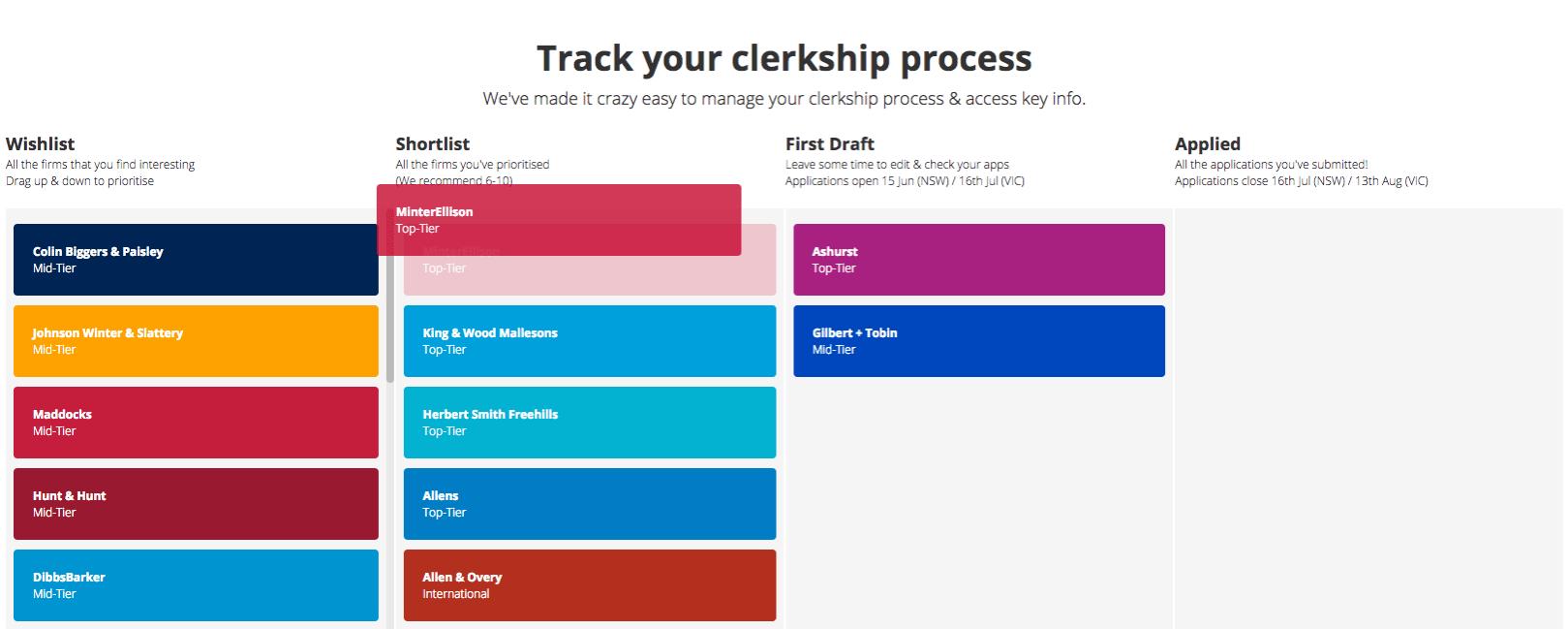
Forage Clerkship Tracker
https://www.theforage.com/clerkshiptracker?ref=byPrqFxsq7Lm55hnL
NSW Law Society Clerkship Info
https://www.lawsociety.com.au/legalcommunities/law-students/internshipprogram/clerkship-program
Law Institute of Victoria Clerkship Info
https://www.liv.asn.au/Membership/ Young-Lawyers/Seasonal-ClerkshipTraineeship-Guidelines
Law Society of South Australia
https://www.lawsocietysa.asn.au/


There is no strict pathway after attaining a law degree. Not everyone desires to spend time in a court room, or even practice the law in any capacity. Nonetheless, the critical thinking, writing and communicative skills developed during the 4 or so years spent at law school are invaluable in numerous other professions.
Just a few examples of professions where a law degree is of significant value includes;
• Journalism
• Consulting
• Advisory – political or otherwise
• Economics
• Marketing
• Business and Finance
And many, many more! The scope to apply a law degree is far wider than immediately expected.
The following links are simply a few examples of alternate, nonlegal pathways.
Consulting Internships
https://gradaustralia.com.au/ consulting-internships
Journalism https://workforus.theguardian.com
Policy Development https://cpd.org.au/about/careerand-intern/
Grattan Institute https://grattan.edu.au/about-us/ careers/

David Chieng Vacationer at EY and KPMG
I was a Vacationer in EY’s Business Consulting (Supply Chain and Operations) team, and at KPMG’s Management Consulting (Operations Advisory) division in their 2020 Summer intake.
The Vacationer role is a paid Summer/Winter internship and provides an opportunity to understand the firm culture, type of clients engaged, the nature of a specific service line and exposure to the experiences of different colleagues. In Canberra, the client base is primarily government, so most of the work and engagements
I have been involved in have been working with government clients to deliver large projects, organisational change and industry research. This included reviewing organisational structures to deliver recommendations for business transformation for a government client, drafting proposals for tenders, and researching legislation for the procurement of military capabilities. As a Vacationer you are exposed to huge variety of different work, so if you are curious to explore what a career in the private sector and consulting might look like, this might be the opportunity for you!
A bit of a cliché, but the most rewarding aspect of the work is the
the opportunity to work with incredibly bright and supportive people. Having the chance to learn about people’s individual journeys and their experiences is great for putting your own journey in perspective.
I found that the experience provided an invaluable opportunity to dive into understanding whether you can see yourself working with the firm and that area of work in the long term.
Do as much as you can and have a lot of fun! Balancing these two can be difficult but try your best to find the balance that works for you – I have personally not had as much energy and spare time as I had in my first year. Explore what it is you want to know more about, meet as many different people as possible and don’t forget to enjoy every step along the way. If you aren’t enjoying what you are doing, be willing to change what you do. First year is the best time to explore. Also, prioritise your studies and work to excel in every course you do, it will pay off down the line. Don’t compare yourself to others because the law school experience brings together people from all walks of life, on very separate journeys heading to very different destinations.






MAJOR SPONSORS







GENERAL SPONSORS









The first year of practising law can be daunting. Our graduate program is designed to guide you through the experience, providing you with comprehensive training and mentoring as well as networking opportunities. During the program, you will receive specialised soft skill training to equip you with the tools and knowledge you need to become a capable practitioner and allrounder. The training covers areas such as time management, business development and firm finances. You will also get to work on high-quality, complex matters with leading legal practitioners from day one.
Our graduate cohort also has access to the firm’s mentoring program, which pairs you with a senior lawyer in another practice group, to give you a broader understanding of the firm and its other practice areas.
Sparke Helmore Lawyers is a truly integrated national firm that looks to the future. Established in 1882, we have over 900 people flexibly working from nine offices across Australia. We offer the security and history of a long-established firm with the excitement and opportunity for growth. We operate in a way that puts our clients and our people at the heart of everything we do—we’re proud to be described as being down to earth, practical and easy to deal with.
Our firm values and celebrates diversity. We aim to increase the diversity of our workforce to better represent the communities in which we live and work. Our culture provides the foundations of a welcoming and inclusive environment, and we encourage people from all backgrounds to join us—and bring their whole selves to work.