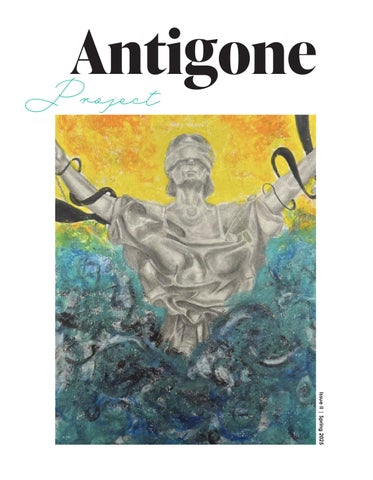
9x12 graphite, oil pastel, pencil The Dalton School
Antigone Project
SPRING 2025 Issue II
Antigone Project is a quarterly magazine dedicated to amplifying young voices in the world of Classics. We aim to foster the exploration of the many facets of Classics with a focus on the dynamic intersection of ancient and contemporary themes. Our magazine accepts submissions from young passionate writers exploring any aspect of Classics through any medium from essays, to poetry, prose and art. Antigone Project stands to push boundaries as we uplift young voices from around the world and contribute to modern understandings of ancient and classical stories.
06 Daedalus and Icarus Poem
Mia Gelder, The Nightingale Bamford School
07 Pygmalion Illustration
Mia Gelder, The Nightingale Bamford School
08 Portrait of Hera as Undercover Housewife
Adelaide Sendlenski, Saint Ann’s School
10 The Impact of Mythology on Modern Media
Belle F. The Geelong College
15 Vertumnus and Pomona Myth Rendition: Digital Devotion Waverly Moses, The Nightingale Bamford School
19 Eros and Psyche illustration
Anjali Lahey, The Nightingale Bamford School
22 Ready
Mischa Grigsby, The Geelong College
24 A Poet’s Tragedy: Orpheus and Eurydice
Asa Alexander, Dalton High School
36 Aeneid IV and VI: A Perhaps Controversial Defense of Aeneas
Eve Hecht, The Nightingale Bamford School (New York, USA)
38 A Return to Conventions: The Aeneid as a Cautionary Tale
Jami Huang, The Hotchkiss School
Daedalus and Icarus Poem
Father and son living in exile,
They are now going to live in Crete for a very long while They had helped Theseus defeat the Minotaur
Something no one else had ever done before
Simply walking would be such a bore
They begin to fly, as if they were flamingos!
Icarus, once in the air was so excited to fly, That h e forgot Daedalus told him “never too high!” It began to get super hot all around.
As the sun melted the wax holding his feathers, poor Icarus Also fell to the ground
With so much pride, he acted as of he had a crown, It ultimately caused poor little Icrus to drown
Mia Gelder, The Nightingale Bamford School
Pygmalion Illustration
Mia Gelder, The Nightingale Bamford School
Portrait of Hera as Undercover Housewife
Hera watched, eyes narrowed, as Zeus perused women along fluorescent Whole Foods aisles, gluttonously shedding the waxen peel of rosy apples, succulent oranges and even a stray grapefruit, sour tang scorching his lips as his teeth shredded the pulp. She scoffed, watching Zeus scoop a passionfruit from the palm of its rind, lasciviously leeching seeds pollinate others’ wombs as they leeched.
As bile scorched Hera’s throat, anger bubbled in her chest. The thought of His bastard babies swaddled in bugaboos turned the same Brooklyn sidewalks they once strolled to lava, His conquests awash in molten, pastel love—sweet maidens in cutoffs and bralettes, naively opening their legs to Him. Hera gripped His elusive fidelity fiercely to her chest.
The name of each of His conquests curdled in her mouth as it steeped in the Horizon milk Zeus delivered daily. She wrote and rewrote the list of nymphs & mortals, goddesses & halfbloods, satyrs & children Zeus had debauched, the ballpoint ink gliding—neat & blue—across her journal pages. (Her therapist’s request.)
I am a rag doll replaced by a litany of American Girls in shiny cardboard boxes.
He has discarded me so often, the anger is almost reassuring—the tepid saltwater I soak each burst blister in.
Pathetic Hera. The Hera who can’t satisfy her man, but can’t leave Him either. Psychotic Hera. The Hera who tortures her Husband’s conquests.
Then pronged tongues flicked from icy bodies sheathed in velvet skin. Hercules whimpered and opened his eyes. His eyes. Hera watched gleefully from the shadows, snakes coiling around the baby’s neck. Tiny flailing hands formed lethal fists. Then: a guttural crack. Then: Hera, deflated. Again, deflated. Defeated by a mere baby. Concrete filled her heart, angry flames licking her skin, propelling her into her next act of unfettered retribution: what Zeus dubbed most unpleasant, wholly unnecessary outbursts of emotion.
(Not everyone’s a prude, Hera.)
But, beneath her scorched exterior, He couldn’t perceive her brittle bones. Either way, he couldn’t weigh her down further than His wandering eyes already had.
Adelaide Sendlenski,
The Saint Ann’s School (New York, NY)
The Impact of Mythology on Modern Media
Mythology can be found all around us, but it is especially prevalent in media today. Most of our favorite books, TV shows, movies and comics take inspiration from a culture’s specific mythology, whether that be as obvious as a mythological character in a story, to the way a novel is structured, reminiscent of ancient epics. By looking a little deeper into modern media, we are able to observe how mythology’s impact is pervasive and omnipresent, and investigate why these ancient myths are still relevant today, thousands of years later.
There are many forms of media that are clearly influenced by a culture’s own unique mythology, that is then adapted slightly to produce classic movies and well-known heroes that dominate the media.
For example, animated movies like Disney’s Hercules, an adaptation of the Greek myth Heracles and the Roman myth of Hercules, or How to Train Your Dragon, referencing Norse mythology. Companies like Dreamworks or Pixar are known for drawing inspiration from different cultures, like in Brave, a movie about a young Scottish girl who encounters witchcraft and strikes a bargain, and must then deal with the consequences, a prevalent theme in Celtic mythology.
Superhero comics and movies also use aspects of mythology to create their iconic and lovable characters, the most obvious and notable one being Marvel’s Thor, the Norse god of thunder and lightning. His adventures in both comics and films are reminiscent of the Norse tales about his exploits, referencing things like Ragnarök, Jotunheim and the Bifröst, as well as including characters such as Loki and Odin.
DC takes inspiration from Egyptian myths and culture to create Hawkman. While he is lesser known, he is an obvious example of a character inspired, but
not directly taken, from mythological tales. His character is influenced by the Egyptian god Horus, as shown by the hawk motif associated with his superhero persona.
But these are just clear-cut examples of mythology’s influence, where elements of these age-old tales are directly used, but slightly adapted to fit modern day ideals. However, it’s not always so obvious, and by looking deeper we are able to see how mythology is woven through our favorite forms of media.
The idea of quests, adventures, and being “the chosen one” is a famous characteristic of the Harry Potter novels and films. Harry Potter is just a normal boy, but after being admitted to Hogwarts school of Witchcraft and Wizardry (a concept influenced by Hecate, the Greek goddess of Magic and Witchcraft) and being declared the “chosen one”, he goes on many quests and adventures to defeat a great evil.
Many of the Greek and Roman heroes were the same. They were good fighters, scholars, or had a special talent that made them slightly-aboveaverage human beings who became “chosen by the gods” (or the “chosen one”) and went on to fulfill some legendary destiny.
There are even hidden references to myths in everyday media. How about the Nike ad you saw today as you were scrolling on your phone? The company’s name is actually a refence to the Greek goddess of victory, Nike, showing how mythology is able to inspire almost all forms of media.
Mythology is not limited to genres like fantasy and supernatural though, as it able to walk the line between fiction and non-fiction, making it a very unique source, unlike many others. Myths are a part of a culture’s religion, so the original mythological stories are classified as fact or non-fiction. They also have historical aspects as well, usually reflective of a culture’s values and ideals at the time of their creation, giving us a glimpse into ancient society.
However, mythological stories also include ghosts, magic and monsters, things you would usually find in a fiction section of a library. This adaptability once again broadens mythology’s influence as it is able to seamlessly blend with different genres and shows.
But this versatility raises the question of cultural and ethical considerations, as when myths are directly adapted, they can sometimes become separated from their overall meanings and lose their cultural connection. This is an emerging issue as more direct examples of mythology in modern storytelling become popular, and we need to be sure we are using the amazing resource mythology is with both respect and ethical consideration.
Saying this, mythology is also a very fluid form of storytelling. There are usually multiple versions of the same story, whether that be from change over time, reflecting a shift in society, or an alteration in the text when translating or retelling. Usually, if the core message is still retained, myths are able to be changed and altered slightly without losing their meaning.
Another positive of including these specific instances of myths in the media, can be the preservation of culture and the reintroduction of these age-old tales into the modern scene, reviving them. For example, Rick Riordan’s Percy Jackson is an extremely popular series about a young demigod who goes on quests and adventures from the gods. The tales of Percy Jackson draw heavily upon Greek mythology with characters like the twelve Olympians, the Furies, Cyclopes, Pegasi and so much more. These novels have encouraged many young adults to become interested in Greek mythology, and after reading the adaptation of these myths, many have begun to research the original texts that have inspired one of their favorite stories, reiterating the importance of these mythological tales and showing why they have withstood the test of time.
But what draws us to these ancient myths, even today? Well, that comes down to the core elements of mythology. They are a constant in storytelling throughout history and include things like quests, family dramas, betrayals, loss and grief, treason, gods and higher beings, war and conflict, power and morality, grappling with the unknown... the list goes on and on.
When put together these elements can detail the human experience, the ups and downs of life; the morally grey characters found inside these ancient stories show how people are not inherently good or evil, and how one action does not have to define you. Mythology is also used to explain the unexplainable, to create order in our chaotic lives, and this is something people can relate to now more than ever.
Essentially, mythology’s web of influence spreads across many forms of media, influencing almost everything you hear, see or watch. The way mythology utilises adventures and epic quests while also focusing on flawed characters, morality, and what it means to be human, has resonated with people thought history and still dominates the media. Myths from many different cultures can, when used ethically and responsibly, create masterpieces.
So, the next time you read a comic or novel, watch a show or movie, or even see an ad on TV, dig a little deeper and you’re sure to find these epic tales playing out, just below the surface. And they will continue for centuries to come.
Belle F.,
The Geelong College (Victoria, Australia)
Vertumnus and Pomona Myth Rendition: Digital Devotion
In the year 2025, a girl named Nova resided in New York City. She attended a prestigious high school in Manhattan, and like most teenage girls, harbored an unspoken passion for a boy: Vertumnus. He was a student at a nearby school, and he was admired by seemingly every girl in the borough. The problem with Vertumnus was that there wasn’t one. Everyone from the area seemed to be infatuated with him. Much to Nova’s simultaneous relief and disappointment, Vertumnus remained indifferent to his suitors, dedicating himself instead to school and athletics. Although Nova realized she had fierce competition, she was sure her devotion and adoration were unparalleled, despite the fact that she and Vertumnus had never met in person.
Nova had always longed to talk to Vertumnus. She would casually linger outside his school during dismissal in hopes of a fleeting moment of acknowledgement, but he never seemed to notice. She would approach him at parties only to turn away as a flustered blush spread across her face.
Lacking the confidence to engage with him in person, Nova resorted to the coward’s approach: social media. Behind the comfort of her screen, it was much easier to craft the perfect message. Every night before bed she drafted a DM to send to his Instagram, scrutinizing every emoji, word choice, and punctuation mark. Yet, after much deliberation, she would sigh in resignation and delete the message. If only I were more beautiful, then I would feel confident enough to talk to him, she lamented.
This cycle of longing, doubt, and self-criticism persisted for many months, but in early spring, an idea struck Nova in the middle of English class. The revelation filled her with excitement, and she was eager to rush home and begin her transformation. After conducting research and downloading multiple apps, she commenced her change. Although her transformation occurred over her phone, it didn’t feel any less real.
What do boys find attractive? What qualities does Vertumnus look for in a girl? How can I appear more conventionally beautiful? Slowly but surely she began to craft her text message, pulling from the muscle memory of her latenight drafts, but now she was prepared to press “send.” Behind the security and relief of her phone, nothing could stop her. With each edit and filter she applied to her photo, she was no longer plain, boring Nova. She was blonder Nova, Nova with brighter eyes, Nova with a whiter smile. Some doubts lingered in her mind, Would he respond? What if he didn’t even see it? Her fingers trembled and her heart pounded as she hit send, releasing the enormous weight of her passion into a single word laden with meaning. Hi
She had launched her text into the digital void. She waited. And then she waited some more. Her phone battery was dying and so was that little piece of her that hoped that maybe, just maybe this would work. Suddenly, a notification appeared.
“Read”
He had seen her message; life was turning around again! Now he just needs to reply, please reply, she silently begged the screen. Yet, no reply came. That entire week in class, Nova hid her hands behind the cover of her book, secretly pulling out her phone to check for special notifications, but none came. Perhaps he is just as nervous as I am and is trying to think of a response, she hoped. Deep down, she knew this wasn’t the truth.
Nova was not one for giving up, and she metamorphosed again. This time she wasn’t holding back, determined to appear irresistible. She digitized her eyes to be bluer, her lips to be fuller, and even gave herself a deeper tan. Maybe my text was too generic, maybe it needs to be a little longer? Crafting herself was easy, that required technology’s work, writing the text was the hard part.
Hey, how are you?
Sadly, history repeated itself. Once again her message was merely read and ignored. Frustration turned into resolve. He will reply, he needs to.
Months passed with Nova continuing to play God, changing her persona after each silent rejection. With each account she created, her appearance strayed further away from reality until she formed an entirely different persona. Vertumnus continued to ignore her, with an occasional “typing” message but no real reply. Desperate for developments, Nova came up with an idea that would surely win her true love, an idea more drastic than ever before. If Vertumnus doesn’t talk to girls in school, she thought, why would he talk to one online? I have been looking at this all wrong! In order for him to actually listen to me, I have to be a boy. So Nova performed her biggest transition yet: she “became” a boy. Texting him will be much easier this time, she hoped.
You don’t know me but there’s this girl named Nova who’s really cool and I think you two would get along really well. I know her as well as I know myself, and a cute boy like you shouldn’t be single forever. It’s criminal! You could have your choice of girls, but I think you match Nova well.
I’m confused.
Think of it like a tree and a vine. You are the vine and you need a tree to wrap yourself around.
Ok, this must be a joke.
Whoever this is, send me a real photo of who you actually are.
Nova hesitated; she felt more vulnerable than ever before. Yet, frightened to lose Vertumnus’ attention and hopeful that he was beginning to see her point of view, she complied. She sent him an image of herself, free from edits and enhancements. She unadorned her disguise.
Are you the same person who has been messaging me from other accounts?
Nova felt queasy, but she was too deep into her confession to lie now.
Yes.
She attempted to type back an explanation for her past actions, but the screen froze. Confused, she tried exiting the app and going back in, only to uncover the terrible truth–she had been blocked. Blocked. The worst form of rejection. She frantically tried her other accounts that she had used to message him. Blocked. All blocked. It wasn’t just that he didn’t love her, but he chose to take deliberate measures to separate himself from her entirely. A silent tear slid down her cheek as she realized that, sometimes, a vine doesn’t always want a tree.
In this modern version of Metamorphoses, I chose to make the woman the one pursuing love and to change her name to Nova (rather than Pomona) to
Eros and Psyche
Anjali Lahey, The Nightingale Bamford School
foreshadow her transformation. Nova, meaning “new” in Latin, parallels Ovid’s decision of placing Vertumnus as the protagonist, who is the god of spring and change. The decision to move the myth to the present day and place their conversations over social media was made to recognize that stories about chasing love may be timeless, but romance plays out in new ways. In the original story, Vertumnus uses the transformation of disguise as a trick to win Pomona’s affection. Nova’s transformation is more focused on increasing her physical beauty, which is meant to highlight stereotypes about women’s insecurities about their physical appearance. In this story, a “vine doesn’t always need a tree,” whereas in Ovid’s work, “the vine was clinging to the tree.” This modernization portrays the double standard in romantic pursuits, where male persistence is seen as romantic and charming, while female persistence is often dismissed as clingy or desperate. Additionally, behaviors like Nova’s stalking and deception are frequently exhibited by young adults in today’s world, and these actions are often viewed as troubling or unsettling, while they were once seen as romantic in Ovid’s time. Like Mary Zimmerman, I sought to mirror and revitalize Ovid’s myth by preserving its themes of transformation and unrequited love, while exploring modern gender roles and how they play out in modern romance and in a world of social media.
The Nightingale Bamford School (New York, USA)
Waverly Moses,
ReadySunlight shines down on me.
My heart whines for what I can’t see.
Our futures in stone by a number or fate.
A trial of the unknown determined to overcompensate.
Fear and doubt become you as the deadlines swarm.
Lines we drew become our norm.
An ocean wide of chance.
Unwilling to hide behind a coward’s stance.
Dappled in sunlight and masked with hope.
I pick my fights and know the scope.
A ship set to sail towards a distant end.
My heart will wail and forever be on the mend.
Until this storm fades and all is clear, let fate be my blade and hope my spear.
Mischa Grigsby, The Geelong College (Victoria, Australia)
A Poet’s Tragedy: Orpheus and Eurydice
All tragedies start with love. Tragedies are stories which we are saddened by greatly, but all tragedies have a purpose for us mortals. Under the gods we mortals still roam to this day. This story is of course not from our time, but the time when the gods were truly involved with the many mortals of their time. Off in our ancient Greece in Thrace lived a boy who was born from the king of Thrace, King Oeagrus, and the Muse Goddess Calliope. This boy’s name was Orpheus, a muse’s son, one that became a poet. A poet with a lyre whose songs were so beautiful that it made people weep in happiness. Though, Orpheus had a longing wish to find someone with a heart for his heart. He went through and through all of Thrace, searching for a beautiful lady. Spreading his music and fame throughout the land. People came from far and wide to hear him sing.
One day, a beautiful young lady was born similar to the time of Orpheus. She was a nymph born from Apollo, a beautiful nymph of the woods. She was nearby where Orpheus was writing, and she heard him sing. It made her weep in happiness like the mortals, made her weep in love. Her name was Eurydice, and this is what begins the tale of Orpheus and Eurydice. Orpheus made eye contact with her, and she did in return. They fell in love instantly, their hearts pounding in sync. Orpheus began to write a song for her, a song that was the most beautiful of them all. It made even Lady Aphrodite cry in the love that was shared between the two of them. It made the gods fall in love, it made the mortals fall in love, it made the world spin in the love that was produced. The song of Orpheus still lives today.
“They say that love only favors the fortunate, they say that love never cares, but they were wrong, cause when I met you, you were there. My heart throbbed, my heart wept, now I hold you in my arms as we slept...”
The world sang in harmony for once in its life. The doors of Janus in Rome would have opened for him. The two lovers grew prosperous in wealth. The gods had truly touched this boy, blessing him with all the greatness of the world. Eurydice was Orpheus’, Orpheus was Eurydice’s. It was time for the wedding. The wedding was grand, so grand that even gods attended such as Apollo, Zeus, Hera, Ares and Aphrodite. Lovers from all over attended the grand wedding. The wedding was outside in the forest underneath arched trees. Springtime was slowly ending, and they made sure to use all they could of it. Flowers growing over the logs, and the leaves decorating the path. It was a grand celebration. Dancers, singers, actors, every artist came together to perform for the love of these two lovers. If the story ended here this is what many would consider to be a comedy, where it ends with a wedding. But may we remind you that this is no comedy, but a tragedy for a reason.
The wedding was concluded. Spring has concluded. The leaves began falling off their trees and withering away. The flowers have faded into a rotting corpse. The winds grow aggressive, the warm weather leaving away into the underworld. The Fates were following souls of the living, holding their scissors close to the strings of those who were slowly seeping away into the end of their time on the land above. As everything goes up, something has to go down. The mortals’ hearts grew cold as the earth did. The cycle of money slowed down until the wheel was no longer moving. The boy’s songs were still sung by him, but he had difficulty fighting against the anger of the world. Demeter’s nature began growing wilder, angrier, it was growing more dangerous everyday to be outside. Eurydice was a hungry young woman, she was home with her newly wedded husband. Orpheus in his room playing away his guitar, humming a tune, trying to form a new song. Eurydice was in the main room, practicing her dances.
Her body moved like flowing water, it was smooth and beautiful. “Eurydice! Can you go out and pick some of the fruit?”
“Yes, dear.” Her lower alto voice responded to the tenor singer. The dancing did not stop as the woman’s hips swayed left to right with every step. Moving out into the rotting garden where there were barely any ripe fruits left. All that was left was two fruits on one big tree. As she approached the plant a strong gust of wind blew against her face, Aeolus’s wind caused one of the fruits to drop down. Eurydice lowers herself, bending herself over flexibly as a dancer can. Her hand reached out to grasp the warm dying fruit.
“Hiss!” Rattlesnake. “Hiss!” chomps down two venomous fangs down against her hand. The venom shot through her veins. Her blood turned black with death, her throat began to swell, and no scream was able to come from her body. Her body fell down against the cold ground; her body turning just as cold. The fates were watching over the girl, and Atropos had cut her string. The girl was a soul, floating above her body as the world was black and white. Her soul was a dark gray color, a silhouette of the love that used to live. Where the rattlesnake was sitting there was a man. A man in a black cloak with a soft smile upon his face. “Hello, Eurydice.” His voice was of a low baritone.
“Who are you?” Her voice was now echoing as if the world was nothing but a void. “The rattlesnake.”
“Why? Why me?”
“Your time had come to an end.”
“Orpheus!” She calls out to the house.
“He isn’t listening.” The man reaches out his pale white hand. It was boney but not fully a skeleton. The woman took the man by the hand, and the
floor began to swirl. The ground turned red like hell, with shades of black consuming the color. The two dead beings slowly sunk away into the floor. The temperature would grow hotter and hotter, until eventually it would cool down once again. The black cloaked man stops in a black swampy land. Standing at the edge of a black river with the woman next to him. “Here is your stop.” He pulls out two coins and drops it in her palm.
“What is this?” She wraps her hand around the coins tightly.
“Your payment.” As if his words were magical in power, a boat rowed up next to the shore. The man in the boat wore a similar cloak to the man out of the water. “Charon.” nods the man to the other.
“Thanatos.” Nods the ferryman to the other. The cloaked figure reaches out his hand to the woman, she drops the two coins in his palm. His palm was all bone and no meat. His cold boney fingers grasp the coins. The two coins evaporated into dust. Charon groans an agonizing screech that echoes throughout the swamp and he grabs his oar. “GET IN!” He yells angrily, Eurydice out of fear quickly climbs in. As the boat soared throughout the river of Styx, screams of nightmares echoed throughout the swamp. Hands reaching out of the water trying to climb aboard the ship. Eurydice sits there in the center, weeping her eyes out. As for all she hears in her ears are the voices from her nightmares, the voice of Orpheus haunting her.
3.
The screams would all end when the boat ride concludes. “GET OUT!” Charon screams one last time, Eurydice quickly gets out of the boat. The boat man would row his boat away.
Eurydice looked up at where she landed, and what presented her was a large iron gate that slowly opened up. On the other side lead to a great hall with three stands. Eurydice would walk slowly looking at the banners along the walls that were all decorated with the symbol of Hades. She reached a middle podium and read the names on the three stands out loud to herself.
“Rhadamanthus, Aeacus, and Minos. The judges.” As she listed them, lights would shine down on each podium. Three men would slowly raise from the darkness, being much larger than the woman who stood below them. It was time for judgement. Eurydice bows to them in honor, the three men nod to her.
“I call for a fair trial with judgement of our wisdom, and justice given to the soul. Eurydice, a nymph of Apollo. Cause of death, Thanatos. The Fates were not friendly to you.” The man in the middle podium speaks down upon the soul.
“Minos, if I may speak my case.” It was Aeacus who spoke next, known for his fairness. “The girl was innocently killed pre-maturely in her love life. Newly wedded, growing artist, send her away to the Asphodel Meadows and allow her to rest.”
“Brother, do not care for this Aeacus. If the Fates decided that she were to die now then she surely died for a reason. The gods do not make harsh decisions on a whim, surely you are smarter enough to know that.” Rhadamanthus chuckles to himself as he crosses his arms staring down at the poor soul. “If the gods viewed her as a threat, send her away to Tartarus and that is that.”
“Tartarus is too harsh of a punishment, Rhadamanthus!” Aeacus lashes out. “The Asphodel Meadows will do.”
“SILENCE! Both of you. Rhadamanthus, Aeacus is correct. The Asphodel Meadows will do for the poor girl. Eurydice, it has been chosen for you. May you see loved ones from years past, and so might it be that you rest peacefully.” Minos’ hand raises and a new door opens up for the young woman.
“Thank you, sirs.” Eurydice walks quietly through the door and is greeted by a large meadow. Full of people around in their own groups hanging out.
She looks around, and the sickening feeling begins filling her stomach. The realization that she is alone, her true first friend, her true first love, was Orpheus. All the other nymphs never cared for her, nor truly did her father until the wedding. As for Orpheus the boy was saddened. Soon after the wedding came quickly a funeral. The boy believed the gods had taken his wife too soon, and his love for her lived deep in his heart and soul. He swore to himself that one day he will go down into the underworld and return his wife to the living world. He would not take death, but he would go down in life. It took the boys weeks upon weeks of searching and speaking to prophets. Speaking to the gods for answers. Singing his songs in the darkness spreading the little light that he could. Then one day he sang his song as he walked, and there stood the entrance to the underworld. It was a dark hole in the ground, it was sickening to view. The only way down was to jump, and he could not see how far down it would go. In his love, and in his trust of the gods he jumped down into the black void. The cavern walls scraped against his skin as he lowered faster and faster. Cutting and engraving the stone into his flesh. Finally the boy reached the ground, his legs buckling underneath him as his screams finally reached his mouth. His body bloody but functional. He raised himself up out of the ground and he glared out at the spot he had landed.
4.
It was a tight squeeze to get through this cave, but eventually he would climb his way to a clearing. The clearing was lit by a few lanterns of red flames. Banners along the walls with Hades’ symbol embroidered on them. Orpheus walks closer to the edge of the wall where a door should be, but before he could make it a huff of breath blew on him. Slobbery breath blew over his body, the spit aching his wounds. Orpheus turns his body slowly to view six yellow eyes glaring at him.
“Easy boy...easy boy” he says to the creature. As three heads slowly entered the light they snarled their teeth at him. Hungry was Cerberus looming in closer and closer to the boy. Who quickly pulled out his lyre and began to sing the
song of his love once more. The song was so soothing and calming, it caused the large canine to lower its heads against the floor. Enjoying every moment of the sound, until he fell asleep. His loud snores could have been easily mistaken for growls. The song ended swiftly, and the boy moved past the canine into the gates of the underworld. A view from a high up cliff would be where Orpheus stood, staring out into the vast kingdom of the king of the underworld. Seeing the barriers of each area of where many souls live throughout. Tartarus, Asphodel, Elysium, and the very middle where the throne of Hades sits. The only question the boy had to ask himself now was where is she? Legends say there is a man who was a prophet of the underworld. Tiresias was his name; so Orpheus would go and find the last prophet of his journey. The one who would be able to help Orpheus find his true love once again. Tiresias was in the Asphodel Meadows, where Eurydice so happened to also be. Orpheus wanders the treacherous underworld moving along past the cries and screams of those who fail to find peace. Once he got past all the nightmares he was able to enter Asphodel, having avoided any high authorities viewing him. Though many beings sense the boy does not belong, no god, nor demigod has questioned his presence. Orpheus walks through the many peaceful souls of the Asphodel Meadows, eventually he would find a man resting upon a rock. His eyes gray with blindness. Though Orpheus made no noise when he approached the man, his eyes met Orpheus and he spoke.
“Come, Orpheus, I had been expecting your presence for sometime now.” His old beard almost touched the ground from where he sat.
“Then you know why I came?”
“Yes, you come to me to seek help to find your lost love. I see the future, the past, and your present. You loved the girl so dearly, and so forever you will love her. Your love for her will be your folly, but it will also be your will. You will take her towards home, but it won’t be the way you wish. The one way for you to take her home is through Hades’ poisonous lips. Find the girl, but you may not
leave. Until a debt is paid in grief. Find the girl! Find the king! Make the deal! Go on the road to take her home!” Tiresias stood up, his body beginning to glow a whitish color.
“Wait, what do you mean it will be my folly? What deal?!”
“GO!” The old man vanishes. Leaving Orpheus alone once again. The boy was confused, lost, but took this knowledge to find his lover once again. Going out to find his love and then to find the king of the underworld was no simplistic task. The underworld was highly populated and only growing in size everyday. There was only one way for the boy to find his love; that was to sing the song once again. The boy strummed his lyre and the peaceful souls began to gather around him in a crowd.
5.
“They say that love only favors the fortunate, they say that love never cares, but they were wrong, cause when I met you, you were there. My heart throbbed, my heart wept, now I hold you in my arms as we slept...”
“Orpheus!” Yelled out a voice in the crowd, and the beautiful woman came rushing through. The crowd cheered as a collective; the soul and the boy hugged in harmony once again. A party began within the Asphodel Meadows. The party was loud, echoing throughout the entire underworld. Eurydice danced as Orpheus played his songs, it was a beautiful sight once again. It felt like forever that the party lasted, but everything that goes up must come down. Eurydice kissed her newly returned husband. “I missed you.”
“I missed you too. Now I can take you home!”
“How? We just leave?”
“No, we have to go through Hades. It will be ok! I will sing to him and his wife, it will soothe them so calmly that they will let us go!”
“Alright, let’s go!” The two lovers took each other by the hand. Leaving the Asphodel Meadows, out towards the very center of the underworld. The palace was tall and wide, made of black stone and white brick. Walking through the gates Orpheus and Eurydice would walk into the throne hall of the palace. Similar to every hallway there is decoration with the symbols of Hades’, in addition this time there were plants and greens around the palace. At the back of the throne hall sat the grand red velvet seat. In the seat sat a man with a shaven face, a black suit, and white underclothing. He had a stern expression, his hands gripped into fists, and his face curious on why two lost mortals had entered his home. Sitting across the man’s lap was a lady in a tight green outfit that truly formed her figure. The opposite of the man’s pale skin, she was darker in color. She had her head leaned against the man’s cheek, she had a warm smile upon her face. The two mortals bow themselves down on the floor; their hands facing the ground in the formation of praying to the gods of the underworld.
“Mighty King Hades, my name is Orpheus. I come to you for a request.” The man did not respond but stayed silent. Fixing his posture, leaning closer to the boy. It was an awkward silence; Orpheus spoke once more. “My love, Eurydice, has been taken from my life to the underworld. I wish to take her home.”
“HAHAHAHAHAH! Young man!” Laughs out the booming bass voice. “What are you saying? You want to leave with her?! How’d you get down here in the first place?”
“Hades.” The lady says to her husband, rubbing his chin. The man takes a deep breath, sighing.
“Please, sir.” Orpheus raises his body up to the man, staring him in the eyes. His eyes held the love that was in his heart. Hades stared back, and so did his wife. Eurydice would stay with her head down, doubt creeping into her skin. Orpheus slowly brings up his lyre into his palms; he strums the strings in a beautiful chord. Singing his song once again.
“They say that love only favors the fortunate, they say that love never cares, but they were wrong, cause when I met you, you were there. My heart throbbed, my heart wept, now I hold you in my arms as we slept...”
The king wept. The Queen cried. It was a song of their love as it was Orpheus’.
6.
The king spoke to the boy, “You may go.” He nodded to the boy with a smile. Orpheus and Eurydice rose to their feet in joyfulness and hugged each other in the cold. The lady on the king’s lap whispers something soft within his ear. Hades nods to his wife, giving her a kiss on the lips. “But.” The but was low and heavy, sickness dropped the two mortals’ stomachs. “There’s a condition my wife has proposed. Orpheus, boy, you will walk out of the underworld freely. It will not be hand in hand as you wish, you will walk in front of her and can not look back! If you turn your head around to see if she is coming, she goes back to the underworld, and so will you. Eurydice goes back to Asphodel, but for you and me? We need a jester, a court musician that can play us songs. You will stay here in the palace where you belong.” The king bellows out his laughter, his wife does too.
“Why?!” Cries out the two loves.
“A test to see your faith and love. If you truly love the girl, as my husband loves me, you won’t turn back your head, will you?” The woman says as she caresses her husband.
“I won’t, lady Persephone.” Orpheus grips Eurydice’s hand in a death grip. “My love for her is too strong for me to lose her again.”
“Then prove it to the gods.” She points her finger to the exit. The two mortals are sent away, prepared to walk, so off they go into the darkness. The boy walks in front, only a few steps ahead. The two of them talked to each other, to keep the silence out of their heads. It was not long after that the silence was filled, their voices no longer being given to each of their ears. The darkness of the caverns got darker and darker. Doubt comes in, howling in their heads, filling their veins, consuming their minds. Orpheus and Eurydice go out past the gates, past the sleeping canine, and up slowly the cavern walls. Climbing up, up, up where there was a little light. Orpheus reaches up and his fingertips touch fresh soil once again. Three voices surround the boy’s ears, and whisper in his mind.
“She’s Gone.” Orpheus turns around. Failed to escape fate. His string was cut right then and there. Eurydice stares at him deep in the eyes, her flesh melting away to nothing but bone then dust. Orpheus screams in agony as his eyes begin to bleed. His hand slips off the entrance of the underworld, falling back down into the endless abyss. It’s a tragedy, this much is true. Forever separated in the underworld, always one door away from each other. One forced to dance, the other forced to sing. There is no one to blame, not the boy, not the king, not the girl, nor the wife. It’s fate, that’s all.
Asa Alexander, Dalton High School (Georgia, USA)
Aeneid IV and VI: A Perhaps Controversial Defense of Aeneas
The question debated by Classics scholars spanning generations is how to interpret Aeneas’ Sudden departure from Carthage in Book IV of The Aeneid. Throughout this story, Aeneas has been divinely led; firstly, he is the son of Venus, making him inherently divine; secondly, the gods prophesied that he would found Latium and the “toga-clad” race; and the gods tell him everywhere to go from his departure from Troy to his ultimate arrival on Italian soil. When Mercury comes to Aeneas in his dream, Mercury pushes Aeneas to stop waiting around with Dido in Carthage and to fulfill his destiny, complicating how much control Aeneas has over his actions. He deliberates “with what words to go around a queen raging” because he genuinely cares about Dido and does not want to hurt her. Even though he takes the cowardly way out, “Mnesthea Sergestumque vocat fortemque Serestum, classem aptent taciti sociosque ad litora cogant,” (4.288-89) by leaving in secret, this does not mean that he is entirely selfish. Aeneas takes on the epithet of being pious, so he does everything he can to fulfill the Gods’ wishes, even if that means putting their wishes above his own (and Dido’s). Although Aeneas and Dido consummate their marriage, Vergil writes “coniugium vocat, hoc praetexit nomine culpam” (4.172) effectively delegitimizing their union; he suggests that their marriage is a means to soften the guilt Dido carries for falling in love with Aeneas after the death of Sycharus. To that end, Juno, as the goddess of marriage, oversees their union, and considering her desperate desire for Aeneas not to found Latium, is a biased source, further delegitimizing their marriage. By emphasizing Dido’s guilt, Vergil suggests that Aeneas is merely a pawn in her attempt not to feel guilty. So, despite his cowardly actions, his departure from Dido is notunjustified.
During the katabasis in Book VI, Aeneas sees Dido in the Underworld and is genuinely confused about why she is there because he regrets that he could have caused her death; he is especially distraught, considering the gods forced him to leave in the first place. He is brought to tears, indicating his guilt, and tries to hug her three times. Dido is accompanied by Sycheus and seems to want nothing to do with Aeneas, which could hold two meanings: the first is now that he is in the Underworld, she is no longer forced to be in love with Aeneas, which is why she goes back to Sycheus’ side. The second meaning could be that she feels so betrayed by Aeneas that she cannot look at him. Regardless, when Aeneas asks her “quem fugis” (6.466), he offers a chilling reiteration of how Aeneas did love Dido, and his indiscretion is unwarranted. Again, he assures her he had no choice in the matter because he feels so guilty about her death and cares for her. However, he also might say this to soften his own guilt. Given Aeneas’ devotion to the gods and his naturally pious nature, everything he does is to fulfill his prophecy. Aeneas truly connects with Dido in Carthage, but in the end, his devotion to the gods is overwhelming. The impact of divine intervention precludes Aeneas from fully being in control of his actions. He does end up hurting others (emotionally and physically), but the gods are more to blame than he is, as he is a mere tool for fulfilling prophecy.
Eve Hecht, The Nightingale Bamford School (New York, USA)
A Return to Conventions: The Aeneid as a Cautionary
Tale
Most people, when prompted to contemplate a typical woman in ancient Greece and Rome, would immediately envision one who faithfully tends to domestic duties, prepares meals, weaves at the loom, and embodies other stereotypical feminine traits. When considering the role of men, the prevailing image conjured is often that of figures like Achilles or Caesar: fearless warriors and dedicated statesmen. In the ancient world, the concept of a woman embodying traits typically associated with prominent male citizens would have been quite rare, even frowned upon. However, in the epic poem the Aeneid, written between 30-19 BC after a period of social unrest and political disharmony, the author Vergil deliberately portrays his female characters not only as resistant but also as bearing the consequences of their defiance of traditional gender norms. Specifically, Dido, the queen of Carthage, Penthesilea, the leader of the Amazons, and Camilla, a woman warrior, stand out for embodying qualities typically associated with noteworthy men. Yet, their narratives converge as they all meet their tragic fates, illustrating the consequence of women daring to transcend conventional roles. Vergil’s Aeneid, crafted as sophisticated propaganda during the Augustan era to reaffirm traditional Roman values in the aftermath of political turmoil, portrays cautionary tales involving characters such as Dido, Penthesilea, and Camilla to emphasize and reinforce established gender norms.
The societal expectations and roles imposed on Roman women were deeply entrenched in notions of familial duty, chastity, and loyalty, as exemplified through Roman legends. These virtues in Roman terms– pietas, pudicitia, and concordia– stood larger than life for all women, guiding their behavior and commanding their respect. Pietas held the utmost significance for all Roman citizens, as it refers to one’s dutiful respect towards the gods, fatherland, and family. Women were especially expected to embody it, as symbolized
by the portrayal of pietas as a goddess on the reverse of Roman Imperial coins. This emphasized the esteemed role of women in upholding piety within society.1 Pudicitia was a cardinal virtue of women that was required to be displayed to and seen by others. It was a mix of sexual modesty, chastity, and fertility, tightly woven into a woman’s duties as mother and wife, her true place in society. The virtue concordia, also related to a woman’s domestic roles, emphasized the importance of harmony within marital relationships. Women achieved this harmony by exemplifying loyalty, empathy, and support towards their husbands.2 A woman’s fulfillment of familial roles was central to how she would be judged. As historical data show, the average life expectancy for women during the Republic era was estimated to be 25 years old, while the minimum age of marriage was 12 years old. By the age of twenty, 59% of Roman women were married and 26% would already have at least one child.3 The focus on a woman’s domestic roles, then, becomes understandable when considering this data on how a vast majority of her life is spent within her marriage. Moreover, there were no records documenting unmarried aristocratic Roman women during the Republic era, which suggests that deviating from the conventional path of marriage and domesticity was very uncommon within the aristocratic circles of Roman society.4
These core values were embodied by historical women in cultural narratives, who were seen as role models for all Roman women to observe and emulate. Lucretia was one such woman. According to the first book of Livy’s famous Ab Urbe Condita, she was the beautiful wife of the nobleman Lucius Tarquinius Collatinus, but in 510 BCE, she was raped by Sextus Tarquinius, the tyrannical Etruscan king of Rome. Famously, having lost her honor, Lucretia exclaims to her friends and husband, “Vos videritis quid illi debeatur: ego me etsi peccato absolvo, supplicio non libero; nec ulla deinde impudica Lucretiae
1 Bill Welch, “Pietas— Their Pious Duty,” Piety and Pious Duty on Roman Coins, accessed May 19, 2024, https://www. forumancientcoins.com/moonmoth/reverse_pietas.html.
2 “Feminae Romanae: The Role of Women in Ancient Rome,” Honors Program in Rome, accessed May 19, 2024, https://depts. washington.edu/hrome/Authors/boogieon/FeminaeRomanaeTheRoleofWomeninAncientRome/pub_zbarticle_view_printable.html.
3 Ibid.
4 Ibid.
exemplo vivet”5 (it is your responsibility to see that he gets what he deserves, I will absolve myself of blame, and I will not free myself from punishment. No woman shall use Lucretia as her example in dishonor).6 This quote encapsulates Lucretia’s determination to uphold her virtue despite the injustice done to her. The phrase “vos videritis quid illi debeatur” demonstrates her demand for justice, as she calls upon her friends and husband to ensure that the perpetrator receives the punishment he deserves. However, it also reveals her vulnerability as a woman, as she is not able to take direct action herself. She asserts her innocence by stating “ego me etsi peccato absolvo,” yet still accepts blame because of what happened to her: “supplicio non libero.” As a result, she commits suicide by plunging a knife into her heart. This action of hers, retold throughout Roman history, emphasizes that women who lost their virtue were expected to kill themselves, as they would bring dishonor and be a burden to the family. Most significantly, Lucretia was a woman who influenced the course of Roman history, as her enraged father, Spurius Lucretius, and husband, Collatinus, led a revolt against King Tarquin, eventually overthrowing him and establishing the Roman Republic in 509 BCE. Her pivotal role in precipitating political change, along with her embodiment of Roman virtues, cements her status as the model Roman woman whose piety and virtue shaped the course of history.
In the Aeneid, Vergil depicts Dido as the formidable founder and ruler of Carthage, a woman who was initially praised for her prominent leadership and chastity. However, her later departure from a celibate lifestyle, having succumbed to her love for Aeneas, after she has already abandoned the traditional gender roles of a wife and mother in favor of being a political ruler, ultimately sealed her tragic fate. When Dido first appears in Book 1, she is compared to “in Eurotae ripis aut per iuga Cynthi exercet Diana choros” (Diana work[ing] the dances on the banks of the Eurotas or through the ridge of Cynthus), and “talem se laeta ferebat per medios, instans operi regnisque
5 Livy. The Early History of Rome. Books I-V of The History of Rome from Its Foundation. [Harmondsworth, Eng.] :Penguin, 1971.
6 Jody Valentine, “Livy, Ab Urbe Condita, Volume I. 57 – 60: Tarquinius and Lucretia,” Gender and Sexuality in Ancient Rome, accessed May 19, 2024, https://pressbooks.claremont.edu/clas112pomonavalentine/chapter/livy-i-49-1-60/.
futuris…Iura dabat legesque viris, operumque laborem partibus aequabat iustis, aut sorte trahebat”7 (she, happy, was carrying such a great self through the middle of the men, urging on the labor of her rising empire…she was giving rules and laws to men, and she was making equal the labor of work with just division or drawing off a lot). Vergil’s comparison of Dido to Diana, the virgin goddess of the hunt, accentuates Dido’s autonomy and strength as a ruler. Like Diana, who leads her followers in a dance on the banks of the Eurotas River or over the ridges of Mount Cynthus, Dido takes charge of the construction and governance of Carthage. This portrayal elevates her to a position of authority traditionally reserved for males, as she “iura dabat legesque viris” (gives laws and rules to men). She is dedicated, just, and a wellexperienced ruler, but these great qualities were conventionally masculine traits in ancient Rome. Thus, since her very first appearance in the book, Vergil establishes Dido as a character who oversteps gender boundaries.
Another reason why Dido was compared to Diana at the outset of the story was her virtuous commitment to celibacy, honoring the memory of her deceased husband Synchaeus. However, as fate intertwines her path with that of the hero Aeneas, Dido gets caught up in the irresistible pull of love. Despite the looming threat to her kingdom and the weight of her responsibilities, she surrenders to her lust for Aeneas and the consequent madness she is driven to. Dido’s madness originates from divine intervention, as it was Cupid who “paulatim abolere Sychaeum incipit, et vivo temptat praevertere amore iam pridem resides animos desuetaque corda”8 (gradually began to burn off the memory of Synchaeus and tried with a living love to turn her long-idle mind and her unaccustomed heart). This quote encapsulates Dido’s descent into madness as she abandons the virtues of pietas, pudicitia, and concordia. She not only neglects her duties to her country but also violates her oath to honor Synchaeus’ memory by remaining faithful. In the end, Dido dies of suicide, her reputation tarnished and the support of her people lost. She embodies the potential for all women, even those who had 7 Vergil.
already established themselves as an able ruler, to be driven mad by love and forsake all their obligations. In employing Dido’s tragic fate as a cautionary tale, Vergil emphasizes the importance for women to adhere to conventional roles and uphold virtuous principles.
Penthesilea and Camilla are both formidable female warriors in the Aeneid who defy typical feminine traits of modesty and submission, but whose unconventional behavior ultimately causes their deaths. The first time Penthesilea appears is in a painting in the Temple of Juno, in which she is described as a “furens bellatrix” (raging female warrior) who “audetque viris concurrere”9 (dares to run alongside men). Penthesilea was the leader of the Amazons, a group of women warriors who fought against the Greeks in the Trojan War, but she is another example of a female who is not an ideal Roman woman. The Amazons represent a culture that Romans were fascinated with, evident from their frequent portrayals in classical art and mentions in literature. One significant reason behind this intrigue was the Amazons’ possession of skills highly esteemed in Roman society, deemed far more civilized than their own, notably the mastery of weaponry.10 Moreover, these traits were embodied not by men, as expected, but by a group of women who rejected the advances of men. This contradicted Roman beliefs and values. Penthesilea’s depiction as “raging,” “daring,” and a warrior further positions her as someone who challenges traditional gender norms. Nevertheless, her fate was one of tragedy as well, as she was defeated and killed at the hands of the Greek hero Achilles. Although she is not an active character and only receives five lines in the epic poem, Penthesilea is deliberately included last in the literary and visual catalog of scenes from the Trojan War to underscore the restricted roles that women should play in a civilized society, despite their impressive leadership and battlefield prowess.
9 Ibid, lines 489-493
10 Colleen Reilly, “Women in the Aeneid : Foreign, Female, and a Threat to Traditional Roman Society or Examples of Model Male Citizens?” (2015). Senior Honors Projects. 60. https://collected.jcu.edu/honorspapers/60
Camilla is a native Italian woman whom Aeneas encounters in Book 7. Vergil makes it clear since her first introduction as a character that she does not perform the standard tasks of a woman. Just like Penthesilea, she is also a “bellatrix” (female warrior), “agmen agens equitum et florentis aere catervas” (leading a battleline of horses and troops gleaming with bronze), “non illa colo calathisve Minervae femineas adsueta manus, sed proelia virgo dura pati cursuque pedum praevertere ventos”11 (her hands not trained to Minerva’s distaff and a basket of wool, but toughened to endure a fight, and, with her quickness of foot, outstrip the winds). Unlike the ideal woman, who engages in domestic tasks like spinning wool or weaving baskets under the guidance of Minerva, the goddess of wisdom and crafts, Camilla’s hands are toughened by combat, and her swiftness is likened to outstripping the winds. She is similar to Penthesilea in that she embodies traits associated with masculinity, such as independence, physical strength, and assertiveness. However, despite these laudable qualities, her gender remains a defining part of her identity as she is often addressed in a derogatory manner because of it. For instance, she is referred to as a “horrenda virgo”12 (dreadful virgin) in Book 11 as she leads her followers into battle, and her identity as “femina” is often mentioned in war. Consequently, it becomes clear that despite Camilla’s ability to conquer enemies in battle, she is perceived as being out of her element in a maledominated society. She eventually meets her death at the hands of the Trojan Arruns, who resorts to ambushing her as he knows he cannot defeat her in direct combat. Vergil’s portrayal of Camilla’s fate suggests that her fearless demeanor and lack of passivity mean she should not be emulated.
Vergil wrote the Aeneid during Augustus’ reign, which followed a period in Roman history characterized by political turmoil and social change. Before Julius Caesar was murdered in 44 BC, he adopted his great-nephew, Octavius, in his will and made him his chief personal heir. The Senate gave Octavius the name Augustus (“the illustrious one”), and after more than a decade of civil
11 Vergil. The Aeneid, Book 7. Lines 803-807.
12 Vergil. The Aeneid, Book 11. Line 507.
wars, the Republic fell and Augustus became the first Emperor of Rome in 27 BC.13 Vergil’s Aeneid was written during this period when “the unity of Italy (and of Roman citizens outside Italy) was recent and unsteady: his audience’s generation, and their parents’ and grandparents’, had been torn and tortured by increasingly destructive civil wars reaching right back to the 90s BC.”14 The national identity of Roman Italy was new during the reign of Augustus, and the memories of civil wars and political upheavals were still fresh in the minds of Vergil’s audience. Characterizing the previous generations’ experience as being “torn and tortured” shows that though Italy had just recently been unified under Roman control, it was a collection of diverse regions, each with its own unique culture, language, and traditions, rather than a homogeneous entity. People in different parts of Italy often identified more closely with their regional identities than with a broader Roman identity. As emperor, then, Augustus’ primary goal was to establish a “return to traditional Roman moral values” and to have the Roman population “view their nation as an empire and not merely a republic.”15 This agenda is reflected in Vergil’s writing, as he crafted the Aeneid to explore the main theme of national identity and to remind his audience of the traditional duties, virtues, and roles of Roman citizens after a period of turmoil and discord. He establishes the qualities and legacies that Romans of his day have inherited by tracing the nation’s history back to its shared founder, Aeneas.
Furthermore, he also uses female characters such as Dido, Penthesilea, and Camilla as counterexamples, effectively warning against the consequences of women overstepping gender boundaries. In Vergil’s writing, while these women exhibit laudable qualities, their perceived masculinity renders them incompatible with a society intent on reverting to traditional norms.
The Aeneid was a national identity piece that offered Romans a platform from which to contemplate the essence of Romanhood. Within its metered lines, notions like piety, leadership, and ferocity in battle often emerged as central
13 Joshua J. Mark, “Augustus Timeline,” World History Encyclopedia RSS, May 21, 2024, https://www.worldhistory.org/timeline/augustus/.
14 Katharine Toll. “Making Roman-Ness and the ‘Aeneid.’” Classical Antiquity 16, no. 1 (1997): 34–56. https://doi.org/10.2307/25011053.
15 Reilly, “Women in the Aeneid,” 8.
virtues praised by society. However, it is noteworthy that in Roman society, these laudable qualities were predominantly ascribed to men, while women were expected to embody traits such as femininity, submissiveness, and loyalty. According to Roman legends, such as the story of the rape of Lucretia, the ideal woman dutifully adhered to her roles within the domestic sphere and prioritized her moral integrity above even her own life. In comparison, Vergil’s characterization of Dido presents a striking departure from these traditional gender norms, as she not only excels as a competent ruler but also indulges in her own desires unabashedly. Penthesilea and Camilla, both fierce female warriors, not only symbolize a challenge to standard gender roles but also pose a tangible threat to male soldiers with their formidable strength. All three characters symbolize women striving to assert their independence in a world where male dominance was considered rightful and necessary, which is the reason behind their downfall. While this theme may be conveyed with subtlety, the impact of Vergil’s message is unmistakable.
Jami Huang , The Hotchkiss School (Connecticut, USA)
Bibliography
“Feminae Romanae: The Role of Women in Ancient Rome.” Honors Program in Rome. Accessed May 19, 2024. https://depts.washington.edu/hrome/Authors/boogieon/ FeminaeRomanaeTheRoleofWomeninAncientRome/pub_zbarticle_view_printable.html.
Livy. The Early History of Rome. Books I-V of The History of Rome from Its Foundation. [Harmondsworth, Eng.]: Penguin, 1971.
Mark, Joshua J. “Augustus Timeline.” World History Encyclopedia RSS, May 21, 2024. https:// www.worldhistory.org/timeline/augustus/.
Reilly, Colleen, “Women in the Aeneid: Foreign, Female, and a Threat to Traditional Roman Society or Examples of Model Male Citizens?” (2015). Senior Honors Projects. 60. https:// collected.jcu.edu/honorspapers/60
Toll, Katharine. “Making Roman-Ness and the ‘Aeneid.’” Classical Antiquity, vol. 16, no. 1, 1997, pp. 34–56. JSTOR, https://doi.org/10.2307/25011053. Accessed 24 May 2024.
Valentine, Jody. “Livy, Ab Urbe Condita, Volume I. 57 – 60: Tarquinius and Lucretia.” Gender and Sexuality in Ancient Rome. Accessed May 19, 2024. https://pressbooks. claremont.edu/clas112pomonavalentine/chapter/livy-i-49-1-60/.
Vergil. Aeneid. Edited by Randall T. Ganiban. Vol. Book 1. Newburyport, Mass: Focus, 2008.
Welch, Bill. “Pietas— Their Pious Duty.” Piety and Pious Duty on Roman Coins. Accessed May 19, 2024. https://www.forumancientcoins.com/moonmoth/reverse_pietas.html.