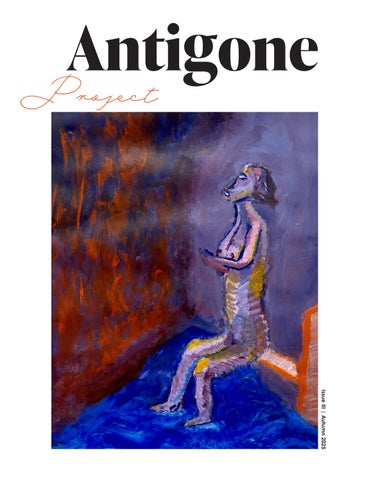
Antigone Project Issue III, Autumn 2025

Page 1


ProjectAntigone

Adelaide Sendlenski Editor-in-Chief and Founder of Antigone Project

Waverly Moses Assistant Editor

Many thanks to everyone who submitted to make this issue possible.

Copyright ©️ 2025

www.antigoneproject.com

Image p18 courtesy of Wolfgang Rottmann, Unsplash

Cover Art

Roman Despair, acrylic on paper

James R

Saint Ann’s School, Brooklyn, NY

Antigone Project

Autumn 2025 Issue III

Antigone Project is a quarterly magazine dedicated to amplifying young voices in the world of Classics. We aim to foster the exploration of the many facets of Classics with a focus on the dynamic intersection of ancient and contemporary themes. Our magazine accepts submissions from young passionate writers exploring any aspect of Classics through any medium from essays, to poetry, prose and art. Antigone Project stands to push boundaries as we uplift young voices from around the world and contribute to modern understandings of ancient and classical stories.

depiction of The Underworld (with Orpheus and Eurydice) and Roman Forum

Nonstop: the Continuous Intersection of The Aeneid and Hamilton

The Legend of Irryl: A Tale of Hubris

Many moons ago, Maximus lived in the quiet town of Pompeii. He was a highly sought-after blacksmith, known to make the finest gold swords. He was also known to be a prideful man. Despite his success and comfortable life, he was unsatisfied and suffered from a craving for more praise and riches.

One day, a summons arrived from the town elder. “My long-lost son,Vulcan, has been seen in Hibernia, chasing gold. Anyone who finds him will be generously rewarded.” Tempted by glory and the promise of wealth, Maximus set sail across the sea. After a long journey, he arrived in a place called Gleaming Moor, a town in the country of Hibernia that had gilded buildings and glistened at dusk. He heard that Vulcan resided there but was no longer a man. He’d become a god-like figure worshipped for bringing prosperity to the town

Maximus found Vulcan and befriended him. One day, Vulcan revealed a sad truth to his new companion. He shared that his father had banished him as a boy to this foreign land to harvest gold for his father’s gain/ Instead, Vulcan used the riches to build a gilded city. He created beauty from betrayal, bringing wealth to the area. Maximus, however, was still blinded by ambition/ One evening, he held one of his own gold swords to Vulcan’s neck, saying, “You may be a god, but I will take you back to Pompeii and claim my reward”. This proved to be a fatal mistake.

“How dare you threaten me! I am a god and you are a mortal blacksmith,” Vulcan thundered. With a wave of his hand, he cursed Maximus, “you shall

become Irryl, a flickering light that lingers at dusk. Forever you will wander, attracting the greedy and prideful into the bog as a warning of what hubris brings”.

Maximus, now Irryl, was reduced to a glimmering, golden fog and fled to the marshes. When he tried to return to his ship, he found it shattered to dust. He drifted back across the waters, glowing faintly, a prisoner of his own pride/

To this day, travelers speak of a strange, golden, and glimmering light in the moors. It appears to dance at dusk, calling those who seek gold or power. It leads them to their doom/ That light is Iryll, condemned to remind mortals that hubris, unchecked pride, is a sin even gods will punish.

Mia Gelder, The Nightingale Bamford School New York USA

Nonstop: the Continuous Intersection of The Aeneid and Hamilton

Lin Manuel Miranda’s modern retelling of Alexander Hamilton reinterprets both the history of the United States and ancient epics. Similar to Virgil’s Aeneid, Hamilton incorporates timeless themes of finding a home, death, and legacy. Both epics include the introduction of the hero, refrains, and themes of finding home.

Virgil opens the Aeneid using the word “condere” (to plant or found) to describe how Aeneas will found Latium. He also writes this at the end of the epic when describing how he plants his sword into Turnus, representing the death and strife that goes into founding a country. Also, “condere” mirrors the legacy that Aeneas plants in Latium, lasting throughout the era.

Similarly, Miranda uses refrains often in his musical. He repeats the phrase “who lives, who dies, who tells your story” which is another example of how legacy shapes Alexander Hamilton’s conscience, Miranda’s musical, and connects this work to Virgil’s epic.

In both The Aeneid and Hamilton, refrains and the inversion of refrains highlight the characters’ weaknesses and strengths. In Book IV of The Aeneid, Aeneas abandons Dido, to which she asks, “mene fugis?” (are you fleeing me?) (4.314). Virgil mirrors this in Book VI, turning the feeling of being fled back onto Aeneas, which is evident when he asks Dido in the underworld, “Quem fugis” (whom do you flee) (6.466). Virgil’s version of a refrain shifts the emphasis from Aeneas to Dido and vice versa, showing how at some point in the epic they both feel abandoned. Miranda certainly emulates this style of writing as seen when he repeats “I’m not throwing away my shot.” The line that began as a means to show Hamilton’s ambition endsup foreshadowing the reason for his untimely death: a literal gunshot.

Clay depiction of The Underworld (with Orpheus and Eurydice) and Roman Forum

Additionally, Hamilton and The Aeneid are filled with references to escape and flight. InThe Aeneid, Aeneas approaches the Sibyl’s home and sees depictions of the story of Daedalusand Icarus on the wall. Ovid’s story of Daedalus and Icarus is also mentioned during the Act 2song entitled “Burn,” where Eliza recounts something her sister Angelica had said to her, comparing Alexander Hamilton to Icarus. Both Icarus and Hamilton fly too close to the sun (whether literal or metaphorical). She literally burns all of Hamilton’s letters, mirroring how Icarus’ wings burned because of the strength of the sun. Hamilton and Aeneas are consumed By excitement and ambition, so much so, that it ultimately leads to their downfall: Icarus’ wings melt from the heat of the sun and Hamilton’s ambition makes him a target of politicalDestruction.

The journeys of Aeneas and Hamilton reinforce the idea of finding a new home: while both ultimately have a lasting impact on their settlements, they grapple with feelings of being outsiders. Just like how Aeneas’ home of Troy was destroyed during the Trojan War, Hamilton’s birthplace, Saint Kitts and Nevis, was destroyed during a hurricane. Aeneas and Hamilton leave their homes and search for Troy and the United States respectively. As a result, both Aeneas and Hamilton focus intently on their legacies. Aeneas obsesses over his legacy because the gods have put such a great emphasis on his obligation to found Latium. His epithet refers to being “pius Aeneas” (pious Aeneas) (1.220), which is why he does everything he can to establish Latium, even if it means leaving his wife, Dido behind. Likewise, Hamilton sacrifices the respect of his family when he reveals his affair with Mariah Renyolds before his opponents threaten to expose Him.

Ultimately, the two works converge with one most distinct similarity: Lin Manuel Miranda bases his musical off of Ron Cherrow’s Alexander Hamilton just like Virgil bases his epic off of Homer’s Odyssey. Both works serve as a poignant reminder that heroism and founding a new home is bigger than the hero themselves; they sacrifice their family, time, and even lives to build a place that will last eternally.

The Nightingale Bamford School

The Rome We Fashion

Watching Paris Fashion Week this fall, I was eager to see if any designers were channeling their inner Juno again in their Spring-Summer 2026 collections. I had hopes of perhaps catching a few drapey, stola-inspired fall dresses or pleated, warrior-style winter skirts. This seemed reasonable after looking at pictures of Dior’s Spring-Summer Ready to Wear show from last year, featuring divine, flowy, goddess-like dresses and sparkly gladiator sandals that even Venus would covet. Wondering what elements of ancient Roman fashion might influence today’s designers, I began reading more about our perceptions of fashion from that era and learned that what we often imagine as typical of antiquity is not so Classic after all.

Much of how we picture the ancient world comes from the moving pictures of cinema, and as Harvard classics professor and history consultant for the original 2000 Gladiator film Kathleen M. Coleman explains, a lot of that is not historically accurate. In her book, The Pedant Goes to Hollywood, Coleman explains that movies tend to meet audiences where they are in terms of their understanding of the world: “most of the historical distortions in cinema are probably . . . conscious decisions based upon esthetics, pragmatism, or an estimation of the public appetite” (Coleman 51). In other words, creative and artistic choices for movies are often driven by more practical considerations, such as modern audience tastes and preferences or even convention in film. She explains that directors and costume designers are often guided by a “perception that the past has to be presented in a recognizable package. Sir Lawrence Alma-Tadema, for instance, conceived of the Romans in PreRaphaelite mode; his legacy as “the painter who inspired Hollywood” determines the look that makes the Romans familiar even today” (Coleman 50). Coleman explains that filmmakers often use costumes they think a movie audience will recognize or identify with, regardless of accuracy. For example, most actors in Ancient Roman movies are dressed in clothes of the PreRaphaelite era that came some 2,000

years after the height of the Roman Empire. Filmmakers make this choice because the public thinks this is what people wore in 30 BCE , largely due to the ubiquitous paintings of Sir Lawrence Alma-Tadema in which figures are set in classic Roman settings but dressed in Pre-Raphaelite style clothing. Once a historical inaccuracy like this becomes a cinematic trend, it persists as audiences mistake it for reality.

For me, looking at images of fashion shows or movies with beautiful costumes has oftenbeen a momentary escape into a dreamy world of the ideal. I have always been aware of that, to some extent. What sometimes slips into the subconscious, however, is a belief that parts of what I see, even in seemingly inconsequential details like clothing in a movie, is real. Over time I don’t even question an image of a Roman woman ca. 30 BC dressed nearly the same as British women of the mid 19th century. As I perused the images and articles chronicling the recent fashions on parade in Paris for the 2026 spring and summer season, I did not see any of the double vittae that made me think of Ancient Rome as I did when looking at images of Dior’s show from the previous year. What I realized after reading The Pedant Goes to Hollywood, however, is that I was looking for details not of the actual ancient Rome, but rather, reinventions of it through artistic liberties and imagination. That made me wonder . . . what else might we misunderstand about Ancient Rome and the women who wore the true fashions of that era?

Sophie Filer

New Trier Township High School

Works Cited:

Coleman, Kathleen M. “The Pedant Goes to Hollywood: The Role of the Academic Consultant.” Gladiator: Film and History, Blackwell, 2004, pp. 43–52. http://nrs.harvard.edu/urn-3:HUL.InstRepos:42664230 Accessed 19 Oct. 2025

Dior Photo Credits: https://www.dior.com/en_us/fashion/womens-fashion/ready-to-wear-shows/spring-summer-2025ready-to-wear-show

Alma-Tadema Image Credit: https://commons.wikimedia.org/wiki/File:Alma-Tadema,_Lawrence_-_The_Colosseum_-_1896.png

Sappho 31 translation

who’s that man who sits beside you, soaking the park bench, unwanted dew with mousetrap fingers?

he lounges close to you, one arm slung slightly across the chair and listens to your soft words & laughter that slips like silk through my fingers. it sets my heart alight like paper, matches, kindling, then detonation.

no, i won’t: my tongue fractures, your surgeon’s scalpel slits me, weedy fires blooming

under cool blue skin. my eyes are windows with the shutters folded. the hooves of a thousand pinto horses ride roughshod over my ears.

the worst: a cold sweat carries me through the marsh, the bog and the whipping grasses

at my feet. there is more jealousy in my fingertip than could ever be a single blade of grass.

in fact, i almost seem to be dead.

all thrown to the wind, even as one without a dime in your pocket.

On the detritus of Partus Sequitur Ventrem

That Which is Brought Forth Follows the Belly

Justinian’s Digest, compiled in 533 AD, was foundational in defining slavery as a legal construct, “an institution of the law” (1), and formalised the Latin legal doctrine partus sequitur ventrem. Centuries later, in 1685, the afterlife of this document maintained its potency. King Louis XIV heavily drew on this in the Code Noir, a document that defined the conditions of slavery in the French colonial rule, and further codified the notion of matrilineal kinship. This code inextricably bound an enslaved woman’s reproductive rights to the production of slaves. It served to commodify her, and thus entirely alienated her from her own body. This essay argues that Louis XIV’s Code Noir weaponised the Roman legal doctrine of partus sequitur ventrem to justify and systematically entrench racialized chattel slavery in the French colonies. While Justinian’s Digest used the principle as a practical legal mechanism in a non-racialized slave system, Code Noir used it as a deliberate tool of racial and colonial domination. These both culminate in a brutal afterlife of the trauma of partus sequitur ventrem; In his 1867, The Modern Medea, Thomas Satterwhite paints Margeret Garner with the child she has killed on the ground to prevent his

re-enslavement. We can trace the afterlife of Justinian’s Digest to Garner’s devastating act of infanticide. Satterwhite’s painting depicts the ultimate indictment of a doctrine that mutilated enslaved women’s identity and reproductive rights.

It is first important to establish the differing roles and structures of slavery under Justinian’s Digest, Louis XIV’s Code Noir and the later Transatlantic slave trade. Slavery in the 6th-century Roman Empire was deeply embedded in society. Historians estimate that 10–20 percent of the population was enslaved, amounting to as many as 10 million people within a population of 50 million (2). Therefore, Roman slavery cannot be homogenized into a single group: slaves ranged from laborers on the farm to educated household servants and even public administrators. Legal references to slaves are scattered throughout broader discussions of property, contract, and family law. Roman law did not produce a coherent or standalone “law of slavery”; instead, legal treatment of slaves was diffuse, appearing across laws concerning property, family, contracts, and status. Justinian’s Digest was not a radical innovation, but a unification of centuries of existing Roman legal thought. It was a collation of the fragmented legal principles of a society in which slavery was omnipresent but legally disaggregated.

By contrast, enslaved people subjected to French colonial rule primarily worked on plantations, with extremely high mortality rates due to the arduous labor conditions, though they still cannot be placed into an entirely monolithic group. Furthermore, Code Noir represented a more racialized and centralized approach to slavery. It explicitly defined the legal status of enslaved Africans, prescribing their forced baptism (3), permitting their marriage (4), and outlining scarce provisions for food and clothing (5). These legal developments laid the groundwork for the even more brutal chattel slavery in the 19th-century American South, where the doctrine of partus sequitur ventrem, first was weaponized to an extreme degree. Here, enslaved women’s reproductive capacity was central to slavery’s expansion, as every child born to an enslaved woman inherited her status, regardless of the father’s identity. Thus, while Justinian’s Digest featured a pervasive but legally dispersed system of

The Modern Medea, Thomas Satterwhite, 1867.

slavery grounded in social hierarchy, the Code Noir and U.S. slave codes represent deliberate, centralized legal frameworks built to enforce racialized domination and reproductive violence. This historical progression—from legal indifference to codified racial control—marks a broader shift in imperial and capitalist logic. Justinian’s Digest and the Code Noir are not merely legal texts, but instruments of domination that sustained systems of human exploitation across many centuries.

Under Justinian’s legal code, partus sequitur ventrem represented a critical mechanism for maintaining and expanding the enslaved population, yet had more nuances than the later code noir. For example, the digest asserts that when the mother “is free at conception, but a slave at the time of the birth, the law is that the child is born free; and it matters not whether the mother conceived in lawful wedlock or in random intercourse ; the mother’s ill fortune ought not to prejudice the unborn child.” (6) This thus underscores the fluidity of slavery, while also introducing somewhat of an ethical concern for the unborn child. However, under Louis XIV’s Code Noir, this evolved into a far more explicitly violent and racialized system. There is no regard for whether the mother had once been free, nor any protection of the child’s potential liberty. Code Noir states that “If the father is free and the mother is a slave, the children shall also be slaves.” This legal codification explicitly denies any possibility that a child born to an enslaved woman could be free. Here, partus sequitur ventrem was no longer just a legal technicality, but physically manifested as a cornerstone of a brutal reproductive regime. Jennifer Morgan writes that to be enslaved as a woman meant to have every function of one’s body, productive and reproductive, harnessed for another’s accumulation of capital (7). This exacerbated the alienation of enslaved women’s bodily autonomy from the creation of family or kinship through converting it into a mechanism for the self-perpetuation of the slave economy. Just as in Roman law, the Code Noir fundamentally reduced enslaved women to their reproductive functions, while also racialising slavery, suggesting instead that it was a born condition.

The legal commodification of their children produced inhumane and enormously dehumanising consequences for enslaved mothers. Probate records reveal that unborn or newborn children could be assigned to heirs, used to pay off debts, or even mortgaged, thus reducing the maternal relationship to a financial transaction (8). Enslaved women feared not just the pain of childbirth, but the psychological agony of knowing their children might be sold, divided, or lost to the machinery of slavery. For example, their milk was not for their own infants but for the biological offspring of their enslavers, and recent mothers were often rented out specifically for their capacity to nurse, which Morgan identified as a second economy of reproductive exploitation. This differs from ancient Rome, where enslaved women’s family lives were still frangible, yet since the condition of slavery was less fixed, if the women were later freed they were not always systematically destroyed by the law. “Persons are ingenui who are born of a free mother ; it is enough that the mother should be free at the moment when the child is born, though she should have been a slave at the time of conception” (9), which suggested a legal recognition of individual status that could shift and a protection of the child’s freedom regardless of the mother’s prior condition. This underscores a degree of fluidity and ethical concern absent in later colonial slave codes, which rigidly fixed both mother and child into lifelong bondage without room for change.

This later evolved into the Code Noir’s facilitation of an ongoing assault on enslaved women’s emotional, physical, and reproductive autonomy. Here, the trauma was not just individual, but generational in that families were legally denied the right to exist. The evolution from Justinian’s pragmatic though incredibly inhumane use of reproductive law to the Code Noir’s racialized and gendered legal machinery marks a turning point in the history of slavery. It was not only a system of labor, but one of reproductive terror. While the fundamentally dehumanising manner of Roman slavery was not yet explicitly racialized, this grim precedent would become far more entrenched in the modern world centuries later. Code Noir drew on the legal residue of Roman slavery, warping it into one where racialized slavery was presented as a natural, even a divinely sanctioned condition. Where Justinian’s laws had justified slavery through pragmatism and economic utility, the Code Noir

redefined it as an innate and hereditary trait, inseparable from race itself. Through the Code Noir’s very name, “the black code,” this document inexorably tied race with the conditions of slavery. This shift symbolically marks a pivotal transformation in the global history of slavery, initially one instigated by war, debt, or crime to one that under colonial law was a permanent, biological fate.

The Code Noir not only institutionalized this idea but guised it under the idea of Christian paternalism. “All slaves must be baptized and instructed in the Catholic, Apostolic, and Roman religion.” (10) This mandated baptism framed enslaved Africans as Christian subjects, ostensibly cared for under the Church’s guidance, creating a veneer of spiritual “protection” that masked systemic violence. They claimed that enslaved Africans were to be baptized and treated with a certain degree of “care” by their owners; a facade which served to only deepen the brutality. Unlike Justinian’s laws, which made little pretense about the humanity of slaves, even acknowledging the condition of slavery to be “contrary to nature,” the Code Noir hypocritically attempts to mask its violence in the language of order, Christian duty, and natural hierarchy. This allowed slavery to become not only normalized but moralised. It was thus imbued in the colonial psyche with the insidious justification of a divinely ordered system. Moreover, by making slavery hereditary and explicitly linked to African ancestry, Code Noir cemented irrevocable changes with regards to freedom. Slavery almost became biological, and this legal racialization reverberated through colonial and postcolonial societies, producing long-lasting consequences for concepts of citizenship, belonging, and systemic inequality that persist to this day. By contrast to Ancient Rome, it rendered emancipation rare and socially disruptive. This represented a qualitative escalation in cruelty that morphed Justinian’s already oppressive structures into a globalized system of racial capitalism. As Saidiya Hartman observes, slavery under these regimes was not merely a condition of labor, but “a mode of being in the world,” one in which the enslaved were socially dead—stripped not only of freedom but of personhood itself (11).

Thomas Satterwhite’s painting of Margaret Garner, a brutal and haunting depiction of infanticide, serves as a powerful visual afterlife of Justinian’s Digest and the legal doctrine partus sequitur ventrem. This historical trajectory, and even nuances within Justinian’s regime are sanitized and reach a terrifying climax in acts like those depicted in Satterwhite’s painting. The painting shows Margaret Garner surrounded by four dead children, an intensely violent image that encapsulates the most brutal manifestation of the Digest’s legacy. Garner’s posture is deeply significant in that it presents her not as a villainous aggressor, but as a figure embodying both defiance and despair. Her act of infanticide is not senseless violence, but a desperate resistance against a system that would condemn her children to slavery. The Cincinnati press reported that she said she would “rather kill every one of her children than have them taken back across the river” to slavery. This statement underscores the tragic logic forced upon enslaved mothers: a choice between unbearable loss and the destruction of their own offspring. Satterwhite’s artistic choices, such as depicting a grisly pile of bodies rather than the actual one child Garner killed, may reflect attempts to shape public sympathy by amplifying the horror of the scene while avoiding prevalent racialized stereotypes of the time that portrayed Black people as inherently violent. (12) Yet, the painting also unsettles conventional 19th-century ideals of motherhood, which glorified selfless maternal devotion, especially in white society. Margaret Garner’s act of infanticide challenges dominant steryotupes by depicting a Black woman who exerts agency in the most harrowing circumstances, complicating the narrative of Black women as submissive or acquiescent. Instead, Garner emerges as a figure of devastating autonomy.

The ‘afterlife’ of partus sequitur ventrem, as embodied in Thomas Satterwhite’s painting of Margaret Garner, radically diverges from its original Roman legal context. In Justinian’sDigest, the principle served a largely administrative function in a non-racialized, hierarchical society where the status of the child followed the mother for pragmatic economic purposes. It allowed for certain fluidities—such as children being born free if their mother was free at birth— reflecting a system more focused on legal status than racial identity. However, in its afterlife through the Code Noir and into 19th-century American slavery,

this doctrine was violently racialized and weaponized to enforce hereditary bondage and to control enslaved women’s reproductive autonomy. The Modern Medea thus reflects not a misuse, but rather a radical intensification and distortion of the original principle. To interpret such ‘afterlives’ responsibly requires situating classical texts within the full scope of their historical reception and transformation, resisting the temptation to treat them as static or universally applicable. Ancient legal doctrines, such as partus sequitur ventrem, must be understood not only in their original Roman context but also in the ways they were reinterpreted and racialized within colonial and modern regimes of domination. Responsible interpretation involves acknowledging the continuity of harm that can emerge from such legal principles when abstracted from their original function and embedded within new systems of oppression. The obligation to a wider audience lies in demystifying classical texts and exposing the structural violence that has otherwise been lost. Rather than preserving an academic distance, interpreters must act as mediators between specialist knowledge and public understanding. It is crucial that we must understand how ancient frameworks have been informed and warped within modern histories of race, gender, and power.

To conclude, the notion of an “afterlife” implies a continued existence, even after a culture, civilisation, or language has died or morphed into something else. The legal doctrine partus sequitur ventrem, born first of Roman law, did not die with the fall of the Roman Empire. Instead, it endured, changed form, and became further weaponized into the modern colonial world. It became a central mechanism of racial capitalism and reproductive violence. The transition from Justinian’s use of the law to Louis XIV’s Code Noir is part of so much more than a legal evolution, and Thomas Satterwhite’s harrowing painting of Margaret Garner captures this trajectory in visual form. What began as a principle of legal inheritance became the foundation for multigenerational bondage, quite literally reducing a woman’s womb to a site of capital accumulation. This idea of an ‘afterlife’ suggests how past regimes of domination continue to animate and corrupt the present. The detritus that partus sequitur ventrem left behind manifests in contemporary forms of reproductive control, systemic racism, and structural violence. Justinian’s

Digest and the Code Noir are not merely relics but rather living pieces of writing that continue to shape societies and individual autonomy today, ultimately leaving indelible marks on our world.

The Westminster School, London

(1) Justinian. The Digest of Justinian. Translated by Alan Watson, University of Pennsylvania Press, 1985, Book 1, Title 5, Section 4 (Digest 1.5.4).

(2) “Slavery in Ancient Rome.” Nero: Man Behind the Myth, British Museum, https://www. britishmuseum.org/exhibitions/nero-man-behind-myth/slavery-ancient-rome.

(3) Louis XIV. Code Noir. 1685. Article II.

(4) Louis XIV. Code Noir. 1685. Articles X–XI.

(5) Louis XIV. Code Noir. 1685. Article XXII.

(6) Justinian. The Digest of Justinian. Translated by Alan Watson, University of Pennsylvania Press, 1985, Book 1, Title 5, Law 5.

(7) Morgan, Jennifer L. Laboring Women: Reproduction and Gender in New World Slavery. University of Pennsylvania Press, 2004.

(8) Stevenson, Brenda E. Life in Black and White: Family and Community in the Slave South Oxford University Press, 1996, pp. 47–49.

(9) Justinian. The Digest of Justinian. Translated by Alan Watson, University of Pennsylvania Press, 1985, Book 1, Title 5, Law 5.

(10) Louis XIV. Code Noir. 1685. Article 2.

(11) Hartman, Saidiya V. Scenes of Subjection: Terror, Slavery, and Self-Making in Nineteenth-Century America. Oxford UP, 1997, p. 6.

(12) Furth, Leslie. “The Modern Medea and Race Matters: Thomas Satterwhite Noble’s Margaret Garner.” American Art, vol. 12, no. 2, Summer 1998, pp. 36–57. The University of Chicago Press on behalf of the Smithsonian American Art Museum, http://www.jstor.com/ stable/3109271.

The Gods as Dresses

Libby Grossman

The Nightingale-Bamford School

Poseidon Zeus Demeter Artemis

Interpreting Defiance: Eunus, Bussa, and the Afterlives of Slave

Revolt in Public Memory

In Morgantina, a city once famed for its terracotta splendor, King Antiochus met his end—bound to a prison wall, his wrists enclosed in cold bands of iron. He died not in combat, nor with honor, but in a disease-ridden death unfit for a king. Yet the question of whether his followers genuinely regarded him as king is obscured by the partisan nature of historical accounts. The only surviving anecdotes of his story portray him with scornful undertones, leaving the truth obscured by the authors’ intentions. This was because King Antiochus was not a crowned “king” at all, but a former slave who led one of the most formidable slave uprisings in ancient Rome, stirring fear and hostility among Roman citizens whose interests were bound to the institution of slavery. Born Eunus, a Syrian and a former household slave, he rose to prominence in 135 BC amid the grain fields and crowded slave estates of central Sicily. He led a rebellion that began with approximately 400 individuals and quickly grew to include tens of thousands, primarily Celtiberians, Thracians, and Syrians, many of whom were connected by common language and origin and drawn together by circulating reports of divine sanction and promises of liberation[1].

The life of Eunus remains a historiographical lacuna with minimal comprehensive scholarship on his career beyond his most vivid portrayal in Epitome by Florus. This essay contends that how Eunus is remembered, misremembered, and reimagined reveals a larger imperative for how the ancient world must be responsible. Comparing the triangulation of three mutually corrective lenses—the Roman literary tradition that vilifies him, the post-war monument that sanctifies him, and the silence left by the fragmentary record—with General Bussa’s statue from the more recent 1800s abolitionist movement, this essay argues that figures like Eunus must be approached not as fixed subjects, but as entry points into the ethics and politics of classical interpretation. In this triangulation, ideology, absence, and artistic form continually renegotiate the meaning of resistance.

The opening line of Book III, Chapter 19 of Epitome makes the author’s disdain for slaves immediately and unmistakably clear: “Although we fought with allies—in itself an impious act—yet we fought with men who enjoyed liberty and were of free birth; but who could tolerate with equanimity wars waged by a sovereign people against slaves?”[2] The rhetorical question emphasizes the contrast between the honorable struggle of battling freeborns and the shameful indignity of fighting against slaves. Florus seems to be in disbelief that slaves, those socially inferior, could rise against Rome. This prefigures the dehumanization of the enslaved throughout the chapter and reflects a pathos-driven appeal, designed to stir contempt and moral panic in the Roman reader. Florus proceeds to minimize the political grievances of the slaves and downplays their capacity for organized action through deeming their initial effort as a “local uprising rather than a war.” This rhetorical framing strategy primes the reader to view the Sicilian revolt as an aberrant escalation rather than as a serious challenge to Roman authority or the structural violence of the slave-based society. By claiming the revolt “laid more waste to Sicily than the Punic War,”[4] Florus again appeals to pathos: he uses historical exaggeration to cast the uprising as a threat on par with one of Rome’s greatest military crises and magnifying its audacity and justifying its suppression. Just as the reader falls into Florus’s manipulative arc—a carefully structured narrative progression from outrage to scapegoating—Eunus is introduced. Florus notes how “the seriousness of the defeats [by Eunus] causes his name to be remembered,”[5] introducing him dismissively and marking him as foreign by calling him “a certain Syrian” and describing him “waving his dishevelled hair in honour of the Syrian goddess” (likely Atargatis)[6], framing him as deceitful, un-Roman, and religiously other. Eunus is further described as a fraud who uses pretence and religious manipulation, not legitimate grievance or leadership—a continuation of character assassination rooted in Roman anxieties about charisma outside sanctioned authority. The passage then descends into a tone of theatrical ridicule, as Florus recounts how Eunus “secreted in his mouth a nut...filled with sulphur and fire,”[7] using a staged illusion to breathe flames as he spoke. This description paints Eunus not as a revolutionary leader, but a cheap conjurer that exploits his followers with

spectacle rather than substance. Florus’s rhetorical strategy here is one of mockery and satire, undermining Eunus’s credibility through caricature by framing his prophetic claims as a literal parlor trick. The focus on his “dishevelled hair”[8] and imitation of divine inspiration not only strips him of dignity, but also reinforces the stereotype of the enslaved as irrational and easily swayed by superstition, deepening the pathos-based appeal to Roman superiority and order. By emphasizing deceit and dramatics over strategic intent, Florus discredits both Eunus and the rebellion itself, reducing a widespread uprising to the product of delusion. This calculated portrayal sustains the broader narrative effort to delegitimize resistance and reaffirm the moral and cultural ethos of Roman imperial authority. Rather than offering a balanced account, Florus crafts a performance intended to glorify conquest and suppress the legitimacy of rebellion, revealing as much about Roman ideology as about historical fact.

More than two thousand years later, in the mid-20th century–though the exact date of the statue’s commissioning remains undocumented publically–Eunus’s memorial was built outside the walls of the citadel at Enna. Commissioned by the municipality and designed by the Enna School of Art, the bronze statue stands approximately three meters tall, asserting a monumental presence over its rocky hillside base. Eunus is depicted nude except for a cloth draped at the waist, his body exaggerated in musculature with sharply defined abdominal and pectoral features that evoke classical heroic nudity. His right foot rests forcefully atop a smooth stone, a pose that recalls contrapposto but is exaggerated to suggest explosive forward momentum. His left leg bends slightly at the knee, as if he is mid-step, lending the figure a sense of tension and emergence. His right arm is lifted high, fist clenched around a broken chain, while his left hand holds the remaining length of shackles loosely at his side. This asymmetry between the raised and grounded arms activates the statue’s vertical axis, drawing the eye upward from the base toward his open mouth, which releases a visceral cry. His head is tilted back, eyes cast skyward in a gesture of defiance, agony, or divine invocation. The stylized proportions and dramatic stance not only break the stillness typically associated with commemorative monuments but also suggest perpetual resistance. The

who spread the rumor, Leith tries to insulate the plantocracy from charges of mistreatment, but in doing so he concedes that the rebels were motivated by an informed understanding of British debates over slavery rather than simple discontent. Colonel Edward Codd’s field report goes further: he decries a “system of plunder and devastation … alarming in its extent” and records prisoners’ insistence that “the island belonged to them and not to white men.”[10] Such language, meant to underscore the rebellion’s threat and justify massive troop deployments, also attests to a disciplined strategy that targeted cane fields, the economic center of slavery, and to a revolutionary claim of sovereignty. Together, these documents reveal that contemporaries regarded Bussa as a capable and strategic organizer of coordinated, materially disruptive action unlike the publicly ridiculed figure of Eunus. However, the private nature of the reports on Bussa may have tempered the exaggeration that characterizes accounts of Eunus.

In 1985, he was officially recognized as one of the eleven National Heroes of Barbados, and a monument was erected in his honor to mark the anniversary of emancipation.

The statue contains two inscriptions. The first reads:

“Lick an Lock-up Done Wid, Hurray fuh Jin-Jin (Queen Victoria)

De Queen come from England to set we free

Now Lick an Lock-up Done Wid, Hurray fuh Jin-Jin.”

Sung with exuberance, this folk chant is one of the oldest Barbadian songs celebrating emancipation in 1838. Over 70,000 people of African descent marched to this chorus, declaring an end to violence and incarceration. The chant’s use of “Jin-Jin,” a local nickname for Queen Victoria, reflects a communal voice that both acknowledges and reinterprets imperial authority through cultural language. Rather than depending solely on official narratives, the inscription draws from oral tradition to assert ownership over the meaning of freedom.

broken chains, displayed rather than discarded, mark the body as both agent and archive of bondage. Set against the rough terrain of Enna, the statue reclaims both site and figure, transforming Eunus from a vilified rebel in Roman historiography into a transhistorical emblem of liberation. Its monumental scale, forward-driven posture, and defiant gesture do not merely memorialize Eunus but reframe him. This statue’s creation may not have been simply for show, but a global message reflecting the post-war effort to reclaim local and regional heroes who represented justice, resistance, and the common people. This heroic depiction of Eunus stands in sharp contrast to the version presented by Florus, reimagining a once-ridiculed slave as a timeless symbol of struggle and emancipation.

After the fall of Mussolini’s regime in 1943 and the establishment of the Italian Republic in 1946, Italy entered a period of rebuilding democratic identity. Though little concrete information exists about the exact motivations behind the statue’s creation, it is possible to speculate that casting Eunus in bronze was not a random gesture of commemoration, but rather a deliberate attempt to reclaim a figure who had once dared to upend an imperial order.

Built in the 20th-century post-war period during a global wave of anti-colonial movements and civil rights awakenings, the monument may have been meant to reflect not merely local pride but also broader ideals of freedom, resistance, and justice. By honoring a Syrian-born slave who defied Rome, the city of Enna may have sought to reassert Sicily’s distinct historical voice, one that, even in antiquity, spoke from the margins. In the absence of official records, this remains only speculative, yet the timing and symbolism suggest that Eunus’s revival was a quiet but powerful mirror to the struggles of the present. But such an unqualified celebration risks both misunderstanding and oversimplification. Without any visible context or explanation except for a plaque reading “AD EUNO LO SCHIAVO RIBELLE ARALDO DI LIBERTA (TO EUNUS THE REBEL SLAVE HERALD OF FREEDOM),” the statue transforms Eunus from the ambiguous, often ridiculed figure found in classical sources into a symbol and messenger of liberation. Florus portrays him as a deceitful performer: a man who relied on spectacle and illusion rather than courage or strategy. The statue, by contrast, shows none of that. It tells a story almost entirely opposite

Untitled, pastel on paper, James R Saint Ann’s School, Brooklyn, NY

to the ancient texts. This dramatic shift invites important questions about audience and accessibility.

Who, then, is the intended audience for this version of Eunus? For local residents and casual visitors, the monument functions as an immediate and visually striking symbol of resistance. To tourists, it may present a simplified narrative: a heroic underdog who challenged Rome and momentarily prevailed. Yet in the absence of interpretive framing, the statue fails to offer deeper context. It omits reference to the complexity of the revolt, the contested nature of Eunus’s leadership, or the hostility of the sources that have shaped his historical image. In doing so, the memorial risks becoming a vessel for uncritical projection. It invites admiration, but leaves little space for nuance. This is where the risk lies. The historical Eunus, as he appears in classical texts, is far from an unambiguous figure. He is described alternately as a prophetic visionary, cunning charlatan, skilled leader, and theatrical manipulator. To assess his legacy responsibly and holistically, one must engage in multiple perspectives: the ancient portrayal steeped in elite suspicion and bias, and the modern reinterpretation, likely shaped by post-war ideals of liberation, justice, and modern views on enslavement. Even then, the historical record remains fragmentary. Nearly all surviving accounts were written by Roman and Greek elites with little interest in dignifying a slave rebellion. No writings from Eunus survive, nor do we have testimony from his followers or allies. As such, while the statue may serve as a potent reclamation of a marginalized figure, it also underscores how easily historical memory can be flattened into iconography, and how a figure as complex and contested as Eunus can be recast as a fixed symbol, stripped of the ambiguity that once made him so unsettling.

The shattered chain is a recurring motif in abolition sculpture, a visual shorthand for the rupture of bondage and the assertion of freedom. Yet the way this motif is represented shapes the narrative it delivers. In many nineteenth-century emancipation monuments—Thomas Ball’s Freedmen’s Memorial in Washington, D.C. (1876) is a canonical example—the formerly enslaved figure kneels, half-nude and deferential, while Abraham Lincoln stands upright, holding a scroll in one hand and extending the other over him

in a paternalistic manner. The visual composition positions emancipation as something granted rather than claimed. In these memorials, the agency of the freed subject is acknowledged but ultimately subordinated, with liberty framed as a gift bestowed rather than a right seized.

In light of this visual tradition, the statues of Eunus in Enna, Italy and General Bussa in Bridgetown, Barbados present an opportunity to consider how public art engages with histories shaped by incomplete or biased sources. While they emerge from different historical and geographic contexts, their commemorative forms bear a striking resemblance. There is no definitive evidence that Karl Broodhagen, the sculptor of the 1985 Emancipation Statue (The statue of General Bussa), directly referenced the figure of Eunus. Yet the visual parallels between the two are almost impossible to ignore. Both statues stand around three meters tall, bare-chested, are forged in bronze, and rendered mid-motion. Each figure raises their arms toward the sky, fists clenched, with the distinctive symbol of broken chains trailing from manacles around the wrists. The torso in each case is muscular and anatomically detailed, emphasizing physical endurance. Their gazes tilt upward, mouths powerfully open, as if caught in the instant of speech, song, or cry.

In early nineteenth-century Barbados, the British Parliament had begun debating measures to improve the conditions of enslaved people, sparking rumors that freedom was approaching. When the House of Assembly rejected the Imperial Registry Bill, which aimed to regulate the slave trade and better document enslaved populations, many viewed it as a retreat from promised reform. In this climate, Bussa, an African-born ranger at Bayley’s plantation, led a coordinated rebellion on April 14, 1816. Although little is known about Bussa personally, colonial letters—such as those from Governor James Leith and Colonel Edward Codd—suggest that he likely held the trust of both the black community and plantation owners, which helped him organize across estates. Governor James Leith labels the uprising a “serious insurrection of the slaves,” yet immediately attributes its cause to the belief that “their emancipation was desired by the British Parliament.”[9] By shifting blame to “mischievous persons”

The second inscription quotes the 1833 Abolition Act:

“‘...Be therefore enacted…that from and after the first day of August one thousand eight hundred and thirty-four all persons who in conformity with the laws now in forces in the said colonies respectively shall on or before (August 1, 1834) have been duly registered as enslaved people in and such colony and who on (August 1, 1834) shall be actually within any such colony and who shall by such registries appear to be (August 1, 1834) of the full age of six years and upwards shall by force and virtue of this act...become and be apprenticed laborers…’

Though the act marked a formal end to slavery, the use of the term “apprenticeship” reveals how coercion continued under new terms. Rather than offering total emancipation, the law introduced a transitional system that kept formerly enslaved people tied to the plantation economy. By placing the folk chant alongside the legal text, the monument acknowledges both the cultural and structural dimensions of emancipation. It presents a fuller narrative: one rooted in celebration and resistance while also documenting the restrictions that shaped what freedom actually looked like. This duallayered record reflects how memory can intervene where the official archive falls short.

Eunus’s statue, by contrast, contains no inscriptions. Its silence reflects the limitations of the historical record. His own voice, like those of many enslaved people in antiquity, was never recorded. As a result, the statue cannot narrate Eunus’s intentions or beliefs, or any of his followers in that matter. His image is constructed by those who opposed him.

Bussa’s statue is composed in a similarly iconic form but its posture, proportions, and texture carry a vastly different emotional and ideological weight. Located in the center of a heavily trafficked roundabout in Bridgetown, Karl Broodhagen’s depiction of Bussa is cast in the visual idiom of grounded realism. The figure’s shorts are torn and uneven, the hem jagged, clearly sculpted to evoke the texture of worn fabric rather than abstract drapery. His abdominal

muscles are visible but not exaggerated; his chest and shoulders carry a naturalistic softness that diverges from the stylized anatomical sharpness often found in neoclassical statuary. His legs bend in a wide, planted stance of balance instead of being raised in victory. The chains on his wrists hang downward, rather than being gripped or hoisted, and his head tilts slightly back with his mouth parted in what appears to be an outcry, or perhaps a breathless release. Every element of the sculpture evokes a man who has endured rather than conquered.

These artistic choices reflect a stylistic departure and a different relationship to historical immediacy. Broodhagen, a Barbadian artist born in the early twentieth century, lived in the generational aftermath of emancipation. He was intimately connected to the landscape, folklore, and community memory that shaped the figure of Bussa. His representation is informed by lived experience and the cultural residue of slavery within Barbados’s postcolonial identity. This proximity enables the statue to embody a history to portray Bussa not as a legendary abstraction but as a figure forged in the collective experiences of his descendants.

By contrast, the artist responsible for the Eunus statue in Enna was interpreting a fragmentary figure more than two millennia removed. The absence of firsthand records—no surviving images, testimonies, or writings from Eunus himself— meant that the artist was reconstructing rather than recovering. This temporal and archival distance inevitably shaped the aesthetic outcome: the rendition of a symbolic abstraction of revolt. In the absence of direct cultural lineage, the figure becomes stylized, idealized, and stripped of historical specificity. What we see in Enna is an artistic imagination shaped more by contemporary values and inherited myths than by lived or remembered truth. The result is a monument that monumentalizes, rather than memorializes. When only fragmented information about a figure or event is available, as is often the case in classical studies, there is a crucial difference between interpreting the past and merely receiving what survives of it. In the age of algorithmic media, where content circulates faster than context, it becomes increasingly easy to

absorb received narratives without questioning their origins or silences. The case of Eunus underscores why this matters; his legacy and the aesthetic interpretations of slavery, shaped by vilification, idealization, and absence, reveals how classical figures are not stable truths but contested terrains. To engage with them responsibly demands an active awareness of how and why memory is constructed, refracted, and continually revised.

Statue of General Bussa

Statue of Eunus

May Shen Sage Hill School

California USA

Sources

EUNUS: THE COWARDLY KING* | The Classical Quarterly | Cambridge Core https://mikedashhistory.com/2016/07/16/king-magician-general-slave-eunus-and-the-firstservile-war-against-rome/

https://penelope.uchicago.edu/Thayer/E/Roman/Texts/Florus/Epitome/2B*.html#VII https://en.wikipedia.org/wiki/Eunus#CITEREFLivy_Per. https://www.slaverymonuments.org/items/show/1142 https://www.nationalarchives.gov.uk/education/resources/bussas-rebellion/source-4b/

[1] Peter Morton, “Eunus: The Cowardly King,” The Classical Quarterly 63, no. 1 (2013): 310, https://doi.org/10.1017/S000983881300008X.

[2] Florus, Epitome of Roman History, III.19, in The Servile War, trans. E. S. Forster, Loeb Classical Library 231 (Cambridge, MA: Harvard University Press, 1929), accessed via LacusCurtius, https://penelope.uchicago.edu/Thayer/E/Roman/Texts/Florus/Epitome/3*.html#19.

[3] Florus, Epitome III.19.

[4] Florus, Epitome III.19.

[5] Florus, Epitome III.19.

[6] Francis Redding Walton and Antony Spawforth, “Atargatis,” The Oxford Classical Dictionary, https://doi.org/10.1093/acrefore/9780199381135.013.896 (published online December 22, 2015).

[7] Florus, Epitome III.19.

[8] Florus, Epitome III.19.

[9]Governor James Leith to Earl Bathurst, 30 April 1816, CO 28/85, National Archives, United Kingdom.

[10] Colonel Edward Codd to Governor James Leith, report on the insurrection, 1816, CO 28/85, National Archives, United Kingdom.

Turn static files into dynamic content formats.

Create a flipbook