
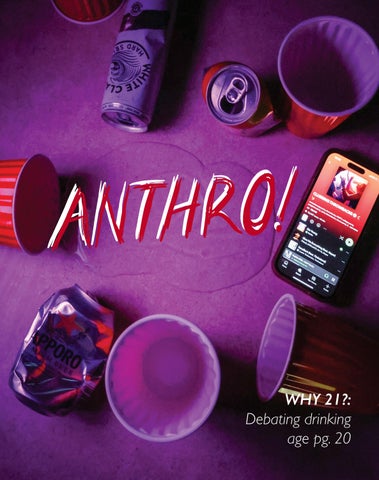
WHY 21?: Debating drinking age pg. 20
WHY 21?: Debating drinking age pg. 20
The goals of Anthro magazine, Palo Alto High School’s activism-focused journalism publication, are to highlight the impact of local and global activism on the Paly community, serve as a safe place to discuss these issues, and ensure that student voices are heard. Along the way, we hope to promote diversity, inclusion and respect, use respectful language and not engage in or support hate speech or the targeting of individuals.
Dear Readers,
We are excited to present the second edition of Anthro magazine this year! In this edition, we continue to report on advocacy and highlight activists in the local community.
A constant question by teens in America is why the drinking age is so high here. Reporter Naomi Espinoza explores the reasons behind the United States’ unique legal drinking age in “Why 21?”
School is a place where all students’ needs should be put first. One controversial take that has seemed to plague our school district for years is the choice of offering Multivariable Calculus. In December, the school board will be voting on whether it will be included in the course catalog. In this issue’s editorial, we urge students to research and to go to the meeting to share their opinions, so that everyone’s voices are heard and taken into account for a decision that could impact the entire student body.
As the Trump administration continues to change the country, people are expressing their frustration through protests, such as the second nationwide “No Kings” protest. Writers Julia Curtis and Alex Rytokoski cover the thousands of people in Palo Alto who gathered together to protest against President Trump’s administration.
Another key moment during this cycle was the California special election on Nov. 4 for Prop. 50, which emerged in response to a redistricting effort in Texas. Reporter Chapin Walker interviews locals to get their reaction to this legislation passing and what it may mean for the future.
In a more Palo Alto High School-centered angle, Doreen Hou covers the use of the wellness center as a resource for English classes in “Beyond the limits of the classroom.”
In our opinion section, reporters explain the benefits of keeping our current class-to-class phone ban, as opposed to a bell-to-bell one. Jeshurun Wang and Joyce Ma then explore the devastating effect that political polarization is having on our society and what you can do to mitigate it.
We are thankful for your continued support and hope you enjoy reading this issue. Enjoy Anthro Volume 8.2! – Editors-in-chief Hadrien de Martel and Mihika Sridhar
Editors-in-Chief
Hadrien de Martel
Mihika Sridhar
Managing Editors
Motoko Iwata
Amily Zhang
Features Editor
Jeshurun Wang
Business Manager
Richard Zhang
Staff Writers
Julia Curtis
Naomi Espinoza
Doreen Hou
Alexander Lawson
Joyce Ma
Chiara Martin
Alex Rytokoski
Juni Thurston
Chapin Walker
Xander Yap
Artists
Chapin Walker
Joy Tan
Joyce Ma Adviser
Paul Kandell

Letters to the Editors
The staff welcomes letters to the editors. We reserve the right to edit all submissions for length, grammar, potential libel, invasion of privacy and obscenity. Send all letters to anthromagazine. paly@gmail.com or to 50 Embarcadero Road, Palo Alto, CA 94301.
Printing & Distribution
Anthro is printed by Folger Graphics in Hayward, California. The Palo Alto Parent Teacher Association mails Anthro to every student’s home. Past issues are available at anthromagazine.org.
Publication Policy
Anthro, a social activism magazine published by students in Palo Alto High School Incubator class, is a designated limited open forum for student expression and discussion of issue of concern to its readership. Anthro is distributed to its readers and the student body at no cost. For more on our policies please visit anthromagazine.org.
MVC affects everyone
News briefs
Activism around the world
Boosting biodiversity
Appliances for everyone
“No Kings” protest
Palo Alto voters react to Prop. 50
Budget cuts threaten allcove
Incubator spotlight
Seniors’ voting experience
Beyond the limits of the classroom
Why 21?
Bell-to-bell phone ban
We must change the narrative now


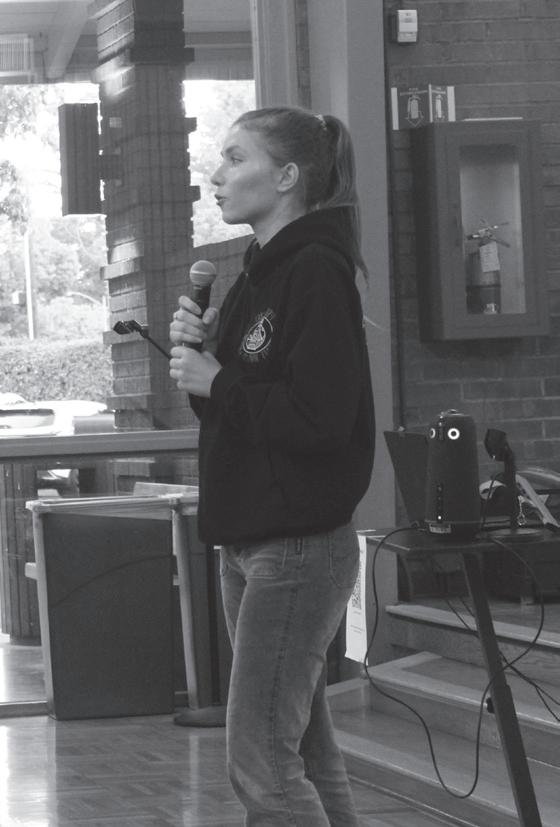
Quiet whispers as a student walks up to the podium. There’s crinkling as a piece of binder paper is unfolded onto the podium. A student’s throat clears. The timer clicks, signaling the beginning of a minute — one minute for a student to speak.
Student voices have been a central part of school board discussions in the past. The back-and-forth on Multi-Variable Calculus is no exception; and the debate is not over. The Palo Alto Unified School Board will be voting about whether to offer Multi-Variable Calculus as an official on-campus class at a board meeting on Dec. 16. Anthro Magazine urges students to make their voices heard.
as an after-school class at Gunn, extending from 4:30 p.m. to 7 p.m. twice a week. Students have raised concerns, including a short window of time to get home, a lack of availability for extracurriculars, and less engaged learning.
Atlas Gerristen, a student taking MVC at DeAnza online, said that the schedule has introduced inconveniences to his schedule.
“So far it’s been a little annoying to have to stay at school until 7 p.m. or rush
“That’s one reason I’m here. Hearing what students have to say, who are in schools, and experiencing the policies and procedures that the board might decide on, is incredibly important.”
— ALISON KAMHI, PAUSD board member
The debate over whether to provide MVC has persisted in the district for years and was even a key topic for school board elections last year. At that time, Palo Altans voted for board representatives with overall positive viewpoints on academic acceleration — offering more opportunities for high-achieving students.
Acceleration is at the heart of the MVC debate. The district currently allows for students to take a skip test after fifth, sixth and seventh grade, enabling them to take geometry in eighth grade. This sets them up to eventually complete BC Calculus in 11th grade and, if they can find a class off-site outside the school day, take MVC in their senior year.
Currently, Paly students are taking MVC as an online course at DeAnza or



there’s a large demand in the community for this [MVC course],” Nguyen said. “I’m just trying to heed their call and give them this. I help them learn this information and these concepts that I personally find very interesting. I’m sure they’ll be engaged with it too.”
The Paly Math Department recommended the course 12-1, with two abstentions. Following this, the proposal went to Paly Ed Council, which on Sept. 30, considered and voted to reject MVC. Despite Ed Council choosing not to recommend the

This supports previous community concerns about increased pressure on students to accelerate and take harder level courses.
In a Midpeninsula Post article covering student perspectives on MVC expressed at the PAUSD board meetings, Henry M. Gunn student board representative Daniel Pan said that offering the course could harm student mental health.
“If students feel that they’re not challenged in math, they should seek other options outside the school,” Pan said. “We should not be changing a system to promote more competition and continue brewing our already toxic culture.”
There is a demand for the course: Of 54 AP Calculus BC students at Paly who are qualified to take the MVC course next year, 46 would consider taking the course.
According to Anika Deshpande, a junior currently taking AP Calculus BC, she hopes to have the chance to take MVC in school.
“I would love it if the board voted to offer the course on campus,” Deshpande said. “It is offered at Gunn High School (outside the school day), and has been successful from what I’ve heard. In fact, I know that many Paly kids opted to take MVC at Gunn this year, and I am planning to take it there next year if Paly fails to offer it.”
According to Paly student board representative Dylan Chen, he has seen student support growing for MVC on campus.
“In regard to my personal
views on Multi-Variable Calculus, as far as what I’ve seen online and heard from teachers and from students, there is an increase in support for Multi-Variable Calculus this year,” Chen said. “If there is student demand, we have teachers willing to teach and we have a district willing to support this course in the future, currently I do not see a reason why we should reject Multi-Variable Calculus on the board level.”
MVC is not an issue just for the students qualified to take the course. According to Cernoborni’s testimony, implementing MVC would affect students across campus, and so we recommend that all students be advocates in this issue. While we commend the students who have advocated for MVC, they greatly outnumber the students who have quietly expressed their dissent. All sides need to make their ideas heard on an issue that affects all students.
In a mid-November conversation with the Paly Incubator and The Voice, PAUSD board member Alison Kamhi underlined the significance of student advocacy.
“Student voice is incredibly important,” Kamhi said. “That’s one reason I’m here. Hearing what students have to say, who are in schools, and experiencing the policies and procedures that the board might decide on, is incredibly important. Even in a lot of the ways that we do procedures, student comment is first. That, to me, is a very demonstra-
tive way of saying we value student voice.”
With previous issues such as the bell-tobell ban and the advanced diploma, student voice was significant in changing the opinion of the school board and the resulting policies.
According to Kamhi, her mind was changed by students with the phone ban.
“I can only speak to my own opinion, but I was obviously in favor of a bell-to-bell ban,” Kamhi said. “I went into the meeting being in favor of it and came out being in favor of it.”
Students have opportunities to express their opinion. The board will continue to hold meetings with open forums for students to express their thoughts. Chen says he will be holding a Town Hall on Dec. 4 on the topic of MVC.

Whether supporting or opposing the implementation of MVC, students must be an advocate for themselves and for their community in this conversation. Have conversations with your friends over your thoughts on the course. Read more about the history of the debate on MVC. Come to the school board meeting and speak up. Who knows? Your words could change the course of MVC’s future.
Text
NAOMI ESPINOZA and PRIYA TAMURA
Acourt case filed by the Stanford Daily newspaper against U.S. Secretary of State Marco Rubio is facing a onemonth delay following a Nov.19 hearing in the San Jose Federal Courthouse.
The court will meet again on Jan. 6 to after the judge and attorneys resolve procedural issues related to the plaintiff’s complaint.
In August, the Daily filed a complaint challenging the government’s use of the Immigration and Naturalization Act to revoke visas and deport legally present noncitizens for their political speech.
Stanford Daily Managing Editor Rani Chor told Anthro in the hallway outside the courtroom that protecting student voic-
es is important because immigrants should be able to share their political perspectives freely and without hesitation.
“[We live] in a country that traditionally has had non-citizens be very vocal about their opinions, and that’s highly contributed to American culture,” Chor said.
Noël Wise, the judge for this case, said she understands the weight of this lawsuit and its implications on free speech rights across the United Statesl today. She added that the court recognizes the broader implications of this case.
“The court is prepared to address that substance quickly,” Wise said. “The idea that the First Amendment speech could be chilled or punished by the government is very troubling indeed.”
Gov. Gavin Newsom has signed new legislation aimed at strengthening protections for dogs sold in California. These laws were prompted by a Los Angeles Times report that found a network of resellers were posing as local breeders and masking where the puppies were from. These puppy mills were shipping puppies across the country in illegally and in a fashion dangerousness to the puppies.
Assembly Bills 519 and 506 and Senate Bill 312 provide protections for buyers and the dogs themselves. The laws, which will become active Jan. 1, tighten rules on online and out-of-state
Zohran Mamdani has won the New York Mayoral race, becoming the first Muslim mayor of New York City and the city’s youngest mayor since 1892.
Mamdani’s campaign used many of the same grassroot techniques that activism organizations use. He organized a door-to-door knocking campaign with over 100,000 volunteers, according to Bernie Sanders, over the course of the race. Mamdani grew a massive social media audience, amassing 13 million followers across Instagram and Tiktok.
Paly senior Micheal Li said that he feels more hopeful about America’s democracy after seeing the higher turn out of young voters.
“It’s just been really refreshing to see young people‘s voices reflected in politics, and I really feel like Instagram and other social media platforms have really helped that happen,” Li said. “It’s made me hopeful for the future.”

puppy sales, require health and breeding records for all dogs sold, and impose stricter penalties on unlicensed breeders. They also strengthen prior state bans on retail pet store sales of animals not sourced from shelters or rescues.
Assemblymember Steve Bennett stated these bills will protect california families and dogs.
“These bills (AB 506, AB 519, and SB 312) ensure that predatory out of state breeders are no longer able to take advantage of California families looking to bring a furry family member home,” Bennett said.
ATesla Diner may be opening in Palo Alto, according to a recent post on X from Tesla CEO Elon Musk. On Oct. 31, Musk wrote that it “probably makes sense to open one near our Giga Texas HQ in Austin and engineering HQ in Palo Alto,” suggesting the city could be the next site for Tesla’s retro-futuristic diner concept.
The first Tesla Diner opened in Hollywood in July, featuring 24-hour service, robot servers, and a vintage American diner menu. It also includes numerous Tesla charging stations. The location includes a drive-in movie theater, which was designed to create an all-in-one entertainment, food, and charging experience.
Although Musk did not provide an exact timeline or specific details for the opening, the X post has sparked controversy among locals who are curious about what a Tesla Diner in Palo Alto might look like.


ens of thousands of protestors flooded onto the roads leading up to Novi Sad railway station on Nov. 1. According to the BBC, this event was held to remember the people killed when the railway station collapsed last year, killing 16 people.
Serbian protesters gathered for 16 minutes of silence, one for each victim killed in the tragedy. After the silence, family members laid flowers in front of the sta-
The collapse of the train station, which stood for the country’s symbol of progress,
No to Execution Tuesdays” is a weekly hunger strike by prisoners in Iranian prisons, which started in 2024, according to Iran HRM. The movement has called for stopping the increasing executions.
Heba Morayef, regional director for the Middle East and North Africa, said that Iran is using executions to punish political dissent.
“The ongoing escalation of executions in Iran has reached horrific proportions as the Iranian authorities continue to systematically weaponize the death penalty as a tool of repression and to quash dissent while displaying a chilling assault on the right to life,” Morayef told Amnesty International.

According to the National Council of Resistance of the in-prison hunger strikes led to public out-
sparked citizens to take to the streets, protesting against the corruption of the government.
The BBC also states that due to the distrust for both political parties in Serbia, student activists have risen to take their place in calling for change.
According to the same BBC article, a student activist expresses how the people trust student activists more than political parties in the country.
“We are the most trusted group in the country,” Aleksa, a 23-year-old management student at Novi Sad University, told the BBC. “That’s why, even though we have made mistakes, people believe in us.”
cry in October, as families of prisoners held protests outside government offices. A, protesters rallied peacefully outside of Tehran’s Baharestan Square on October 19th, holding various signs and pictures of imprisoned family members.
However, these peaceful demonstrations have created violent clashes with the government. Officers used batons and excessive force to disperse the crowd. Despite the crackdown, the majority of the protesters stood their ground and continued to shout “No to executions!”

Gen Z is taking to the streets in Morocco to protest against government corruption. According to a PBS news article, with over half of the country’s population under 35, youth activists are using social media apps, including Discord, to organize protests.
According to the Middle East Council on Global Affairs, protesters are fueled by anger over the billions of dirhams being spent on new stadiums for the 2030 World Cup, while roads remain unpaved, hospitals lack doctors, and schools remain underfunded.
According to Associated Press, protesters have called for complete, total reforms rather than incremental ones.
“There is no hope,” Youssef, a 27-year-old engineer, told the AP, “I not only want health and education reforms, I want a whole system reform.”
The protests have advocated for an increase in funds allocated to people rather than an international appeal to foreigners.
In response to this, protesters have taken to the streets with some slogans reading “Stadiums are here, but where are the hospitals?”
According to the same AP article, in response to public demonstrations, the Moroccan authorities have arrested protesters en masse. Moroccan courts have also handed down numerous convictions ranging from four to 20 years of imprisonment for vandalism and incitement.
Text by JESHURUN WANG and ALEXANDER LAWSON
Photo by ALEXANDER LAWSON

The City of Palo Alto is constructing a new levee system in the Baylands Nature Preserve to improve water quality and increase the habitat’s resilience to sea-level rise.
The horizontal levee, which began in September, is different from a traditional vertical levee, which disrupts animals and the natural environment. According to the city’s website, a horizontal levee allows a natural transition zone that is sloped to mimic nature. It does this by creating a large, gentle slope that reduces wave energy and erosion.
the downsides of a traditional levee are that many animals and aquatic plants would be heavily impacted by its separation of the floodplain from the river.
“Its gentle slope will support many more wildlife species than a traditional vertical levee.”
— RYAN LEUNG, Paly Baylands Club President
“Levees that border the river channel isolate the floodplain from the river and, as a consequence, the many species of aquatic plants and animals that require access to seasonally inundated floodplains to complete their life history are heavily impacted or extirpated,” the report states.
engineering. Unlike traditional levees, horizontal levees allow vegetation and animals to thrive.
The project has already been underway since the spring of 2025 and is projected to be finished in early 2026.
Overall, the project aims to increase biodiversity while still maintaining the natural habitat of the environment here in Palo Alto.
Palo Alto High School Baylands Club president Ryan Leung says that the levee will be beneficial for biodiversity in the reserve.
According to a govlink.org review,
Another advantage of the horizontal levee in the Palo Alto levee is that it allows habitat to still thrive despite human
“It will be a great addition and help to improve native biodiversity,” Leung said. “Since the levee is horizontal, its gentle slope will support many more wildlife species than a traditional vertical levee.”
A new California bill will require landlords to install basic appliances
Landlords are required to install basic appliances in apartments following Gov. Gavin Newsom’s signing AB 628 into law on Oct. 28.
The law is in response to low numbers of apartments rented out with refrigerators. According to an article by the Los Angeles Times in 2022, rental listings provided by Apartments.com showed that Los Angeles and Orange County had the fewest number of apartments with refrigerators among national cities.
In Palo Alto, rental prices have jumped by 3.3% in the past year, averaging $108 per month. With these increasing prices, renters are welcoming the new policy to require appliances.
Elsa Lagerblad, a renter in Palo Alto, said that she has had issues with appliances in the past.
“One time my dishwasher caught on fire,” Lagerblad said. “The whole thing started melting and our house was filled with toxic fumes. We were able to get that replaced eventually, but the landlord did not pay for that for us.”
The California Apartment Association negotiated to remove a mandate in the originally drafted bill which required all appliances to be replaced every 10 years; the law will now only mandate appliances to be replaced if they aren’t working.
Debra Carlton, Executive Vice President, State Government Affairs for the CAA, said she believes that the bill initially went too far with added restrictions such as this one.
“In the beginning she [Tina McKinnor, the Assemblymember who sponsored the bill] had language that said, ‘an owner of rental property should provide a refrigerator and a stove that is less than 10 years old’ and we objected to that,” Carlton said. “That’s wasteful and environmental folks didn’t like it either, so she took that out.”
The policy follows increasing regula-
Art by JOY TAN
tion of the rental housing market over the past few years. In 2025, California passed multiple laws, including rent reporting in regards to affordable housing and improvements in renters’ eviction rights.
Lagerblad says she believes that the policy will benefit renters.
“Overall I would say that this [the policy] is really good,” Lagerblad said. “I feel it’s good, especially for lower income families who can’t necessarily afford to replace things the way my family can.”
“I don’t really see any reason for them to rent out apartments in the first place without these appliances ... It’s not a good quality of living.”
– ELSA LAGERBLAD, Paly senior

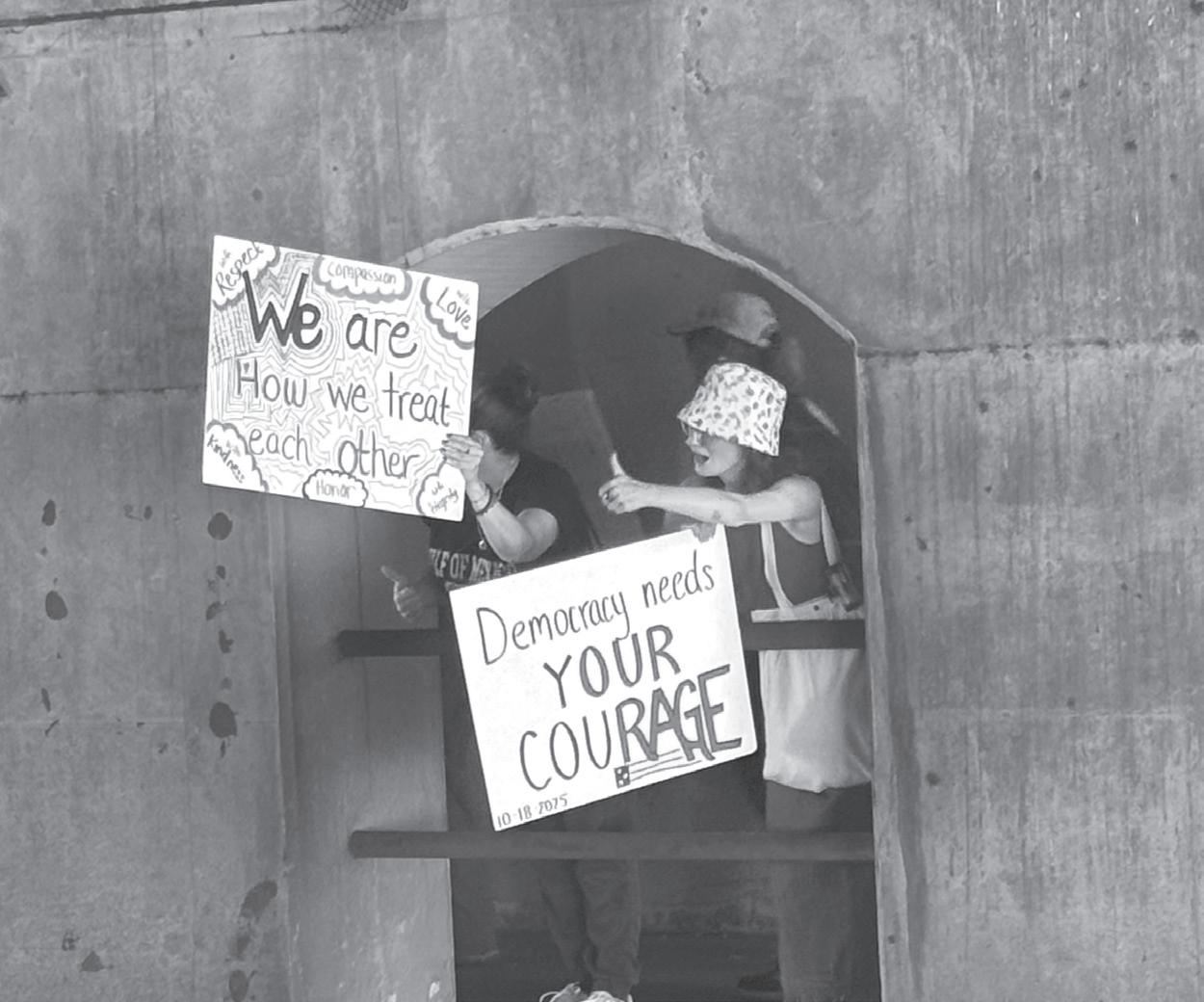
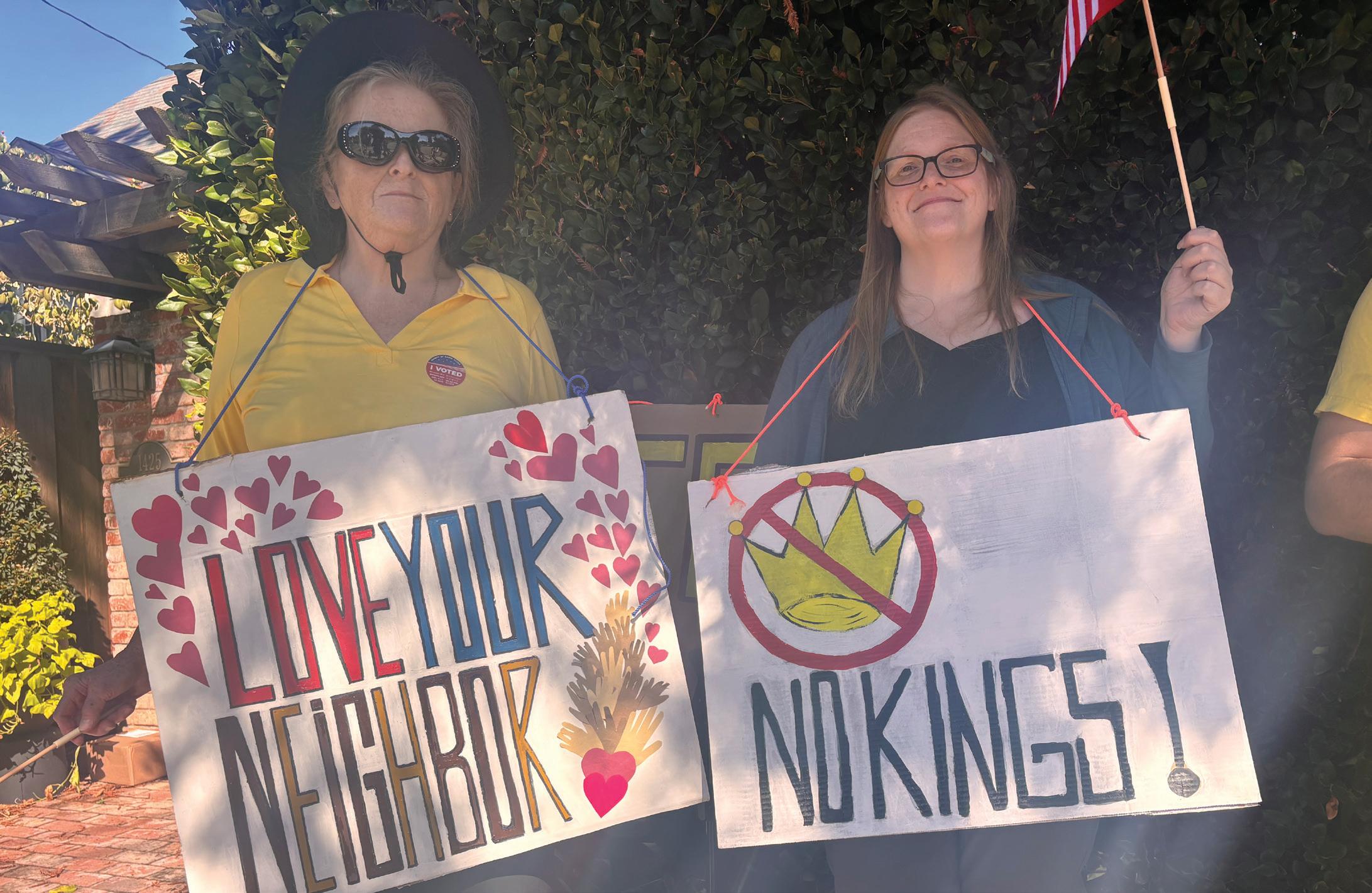
Marching for a better future for America, Palo Alto protesters demonstrating against the Trump administration lined El Camino Real on Saturday, October 18.
Many Americans feel targeted by leading politicians such as President Trump on free speech, immigration policies, and alleged unconstitutionality. According to CNN, approximately seven million of them protested nationwide for the second No King’s protest, an increase of two million since June’s protest.
As anti-Trump turnout increases, many protesters say change is under way. According to young people like 17-year-old-student Kate, demonstrating helps to ensure a better future by showing active opposition
to the Trump administration.
“I showed up to support this because I really value my rights, and I really want to have the right to vote in the future,” Kate says. “My ideas are in line with the founding ideas of this country — that it’s a democracy.”
Parents like Ava, a Palo Alto local, also supported the cause to provide better futures for their kids in hopes that more parents will join.
“What’s happening in this country is really disturbing and disgusting, and I want a good future for my kids and all of the American people,” Ava says. “We need to be visible. We need to be loud, and if anyone is on the fence, maybe seeing us can get them to see the truth.”
Following the protest, Rinconada Park held a “Democracy Fair” where speakers like representative Sam Liccardo spoke out against the Trump administration and reassured protesters of the changes they are making.
“There’s a moment when it’s so imperative that
Americans stand up against everything we’re facing together,” Liccardo told the Mountain View Voice. “I think as we see more people standing up, it gives courage to others. People get more engaged and they start volunteering.”
During former Judge Ladoris Cordell’s speech, around 10 counter-protesters in support of the Trump Administration came, sporting MAGA hats and proTrump signs while chanting.
“We should be thanking this MAGA king who, today, is at the White House,” Trump supporter Nancy Githoitho told ABC News.
According to Githoitho, the group sought to bring awareness to California’s pro-Trump minority, and protested Prop. 50 which will temporarily change congressional district lines in favor of Democrats. Both groups of protesters were nonviolent, each chanting respective slogans. However, the counter-protesters were quickly surrounded by security personnel and escorted away from the park.
Despite the counter demonstration, many anti-Trump protesters were optimistic about the effects of No King’s Day 2.0 since larger crowds spreads more awareness about the ongoing issues.
Anne Frahn is an active member and organizer of Swing Left Peninsula, an organization at the Democracy fair pushing close electoral races over the edge in favor of the Democratic Party. She thinks the movement is gaining more traction and making a difference.

“I think it’s very uplifting in these really difficult times to see so many people showing up on a Saturday to parade for democracy and human rights,” Frahn says. “It’s [the protest] bigger than the first time. I’ve seen a lot of returning faces, a lot of smiles, and they’re bringing friends. So I don’t know what the attendance is gonna be, but I’d be shocked if it wasn’t significantly larger than last time.”
“I think it’s very uplifting in these really difficult times to see so many people showing up on a Saturday to parade for democracy and human rights.”
cerning for current pro-Trump administration members. According to ABC News, Speaker of the House, Mike Johnson, has labeled “No Kings” protests as “anti-American.”
— ANNE FRAHN, Active member and organizer for Swing Left Peninsula
Larger turnout, however, is con-
“If President Trump was a king, the government would be open right now,” Johnson told ABC, referring to the government shutdown.
Although the Palo Alto protest was peaceful, many pro-Trump Republicans
fear violence stemming from similar demonstrations.
“We have video and photos of pretty violent rhetoric calling out the president, saying fascists must die and all the rest,” Johnson said. “So it’s not about the people [Democrats], it’s about the message.”
To combat this violent image, some anti-Trump protesters dressed up as unicorns, like Nia, who came to the second No King’s protest after frustration with the current government.
“The administration’s trying to say these are violent protests, and that narrative falls apart if people are in ridiculous costumes and being peaceful,” Nia says. “So we kind of take the wind out of their sails if we show that we’re here peacefully and protesting, which is our civic duty.”


Turning Point California voters approved Proposition 50 Nov. 4, allowing for the state to redraw its congressional districts. According to The Associated Press, the measure could give Democrats up to five additional U.S. House seats in the 2026 midterms, offsetting the Republican redistricting in Texas. Mid-decade redistricting is rare, as states typically redraw district lines only after the national census every ten years.
Palo Alto voters are feeling cautiously optimistic about the passage Nov. 4 of Proposition 50, which allows for the state to redraw its Congressional districts — adding five more likely Democrat seats — in a major win for Democrats in the national redistricting battle.
Ted Alper, a long time resident, said he believes Prop. 50 is vital to protect the nation’s democracy.
“Trump is acting as an autocratic dictator,” Alper said. “If Democrats do not win the midterm elections and retake the majority in the house, we may never have a real democracy again.”
David Richardson, another Palo Alto resident, said he initially opposed Prop. 50 because he supported California’s independent redirecting commission but changed his mind after learn-
ing the measure was temporary.
“It’s clear that democracy is under attack by the Republican Party,” he said. “Prop. 50 is a serious step to keep America a democracy which can benefit all Americans, not just the super wealthy.”
Others expressed hesitation about the partisan approach.
Janel Moses, a resident who voted yes on the measure, said she had mixed feelings about Prop. 50 but understood why it was necessary.
"Prop. 50 is a serious step to keep America a democracy which can benefit all Americans, not just the super wealthy,"
ties and safety nets,” she said. “But Prop. 50 also shows how broken our two-party system is. Recently, our whole system has become this toxic back and forth between the two parties and it's not a real democracy anymore.”The approval of Prop 50 marks a significant moment in California’s role in national politics.
— DAVID RICHARDSON, Palo Atlo Resident
“We need more balance in the House and Senate to preserve civil liber-
As Associated Press noted, during the 2026 midterm elections California is positioned as a key battleground in the fight for control of Congress.
Text by HADRIEN DE MARTEL and MIHIKA SRIDHAR NEWS
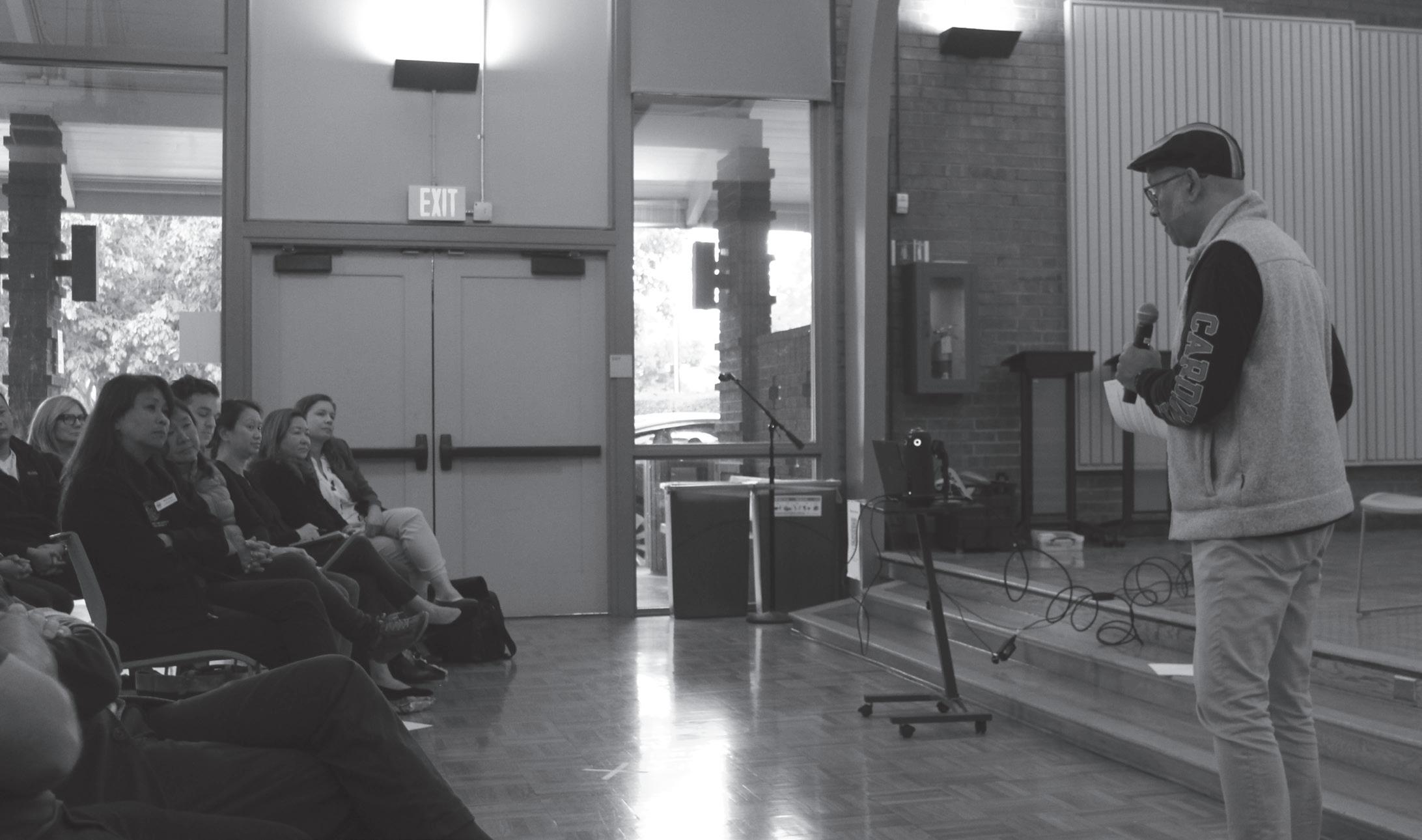
Allcove Palo Alto, a mental health support center, is facing budget cuts and possible closure due to the passage of the HR-1 bill, better known as the “Big Beautiful Bill.”
Allcove first opened in 2021 and is a first-of-its-kind mental health center for youth in California. Different from traditional mental health services, allove provides mental health services for low or zero costs.
However, these benefits may soon disappear. Santa Clara County Supervisor Margaret Abe-Koga, who spoke on Oct 28 at a town hall meeting at the Palo Alto Art Center, warns funding cuts will directly impact all Santa Clara County’s services, including allcove.
“We are looking at changes with allcove,” Abe-Koga said. “Right now it’s a county-funded program, but again, because of our budget cuts, we are looking at having to make some changes.”
Currently, there is a target of $800 million to cut in the coming year’s budget. This includes a cut of $145 million in behavioral health services, which allcove falls in.
The closure of allcove could affect hundreds of youth. Behavioral Health Services Division Director Jennifer Pham spoke more on the impact allcove has had on the community.
“Since the inception [of allcove] in June 2021, we’ve seen roughly 1400 youth at the center,” Pham said. “951 of them have been there for ongoing, repeated service.”
Stanford Professor of Psychiatry Shashank Joshi, who has worked closely in suicide prevention for over a decade, also expressed his desire for allcove to stay open, citing his own personal experience with the program.
trict and community beacons like allcove,” Joshi said.
Joshi said he believes that allcove has become a valuable community pillar for mental health.
“Seventy percent who visit allcove say they would not have sought help elsewhere,” Joshi said. “This is not just a mental health clinic, it’s a lifeline. It’s a community home for young people.”
“Our young people have told us what they need. They built it. They trust us with it, now it’s our turn to stand by them and make sure it remains.”
— SHASHANK JOSHI Stanford Professor of Psychiatry
“One of my kids really struggled and got a lot of support from community resources, including those offered by the dis-
Joshi ended with a statement emphasizing the importance of allcove in our community.
“We’d be silencing a model of hope that young people have built from the ground up,” Joshi said. “Our young people have told us what they need. They built it. They trust us with it, now it’s our turn to stand by them and make sure it remains.”

Palo Alto High School’s Incubator journalism class currently houses eight publications: Anthro Magazine, Via Verde, Ink, Proof, Chomp, Veritas, KPLY, and The Paly Voice. Anthro Magazine has compiled some of the content of these publications’ recent issues to share what the Incubator journalism class has been doing. We encourage you to check out each of these unique publications!

Chomp is Incubator’s magazine for everything food. Looking at food deeply and critically, Chomp aims to highlight local food and the stories behind it through features, restaurant reviews, opinions, and more.
Editor-in-Chief: Chiara Martin
Submit your story ideas to chompmagazine2@gmail.com
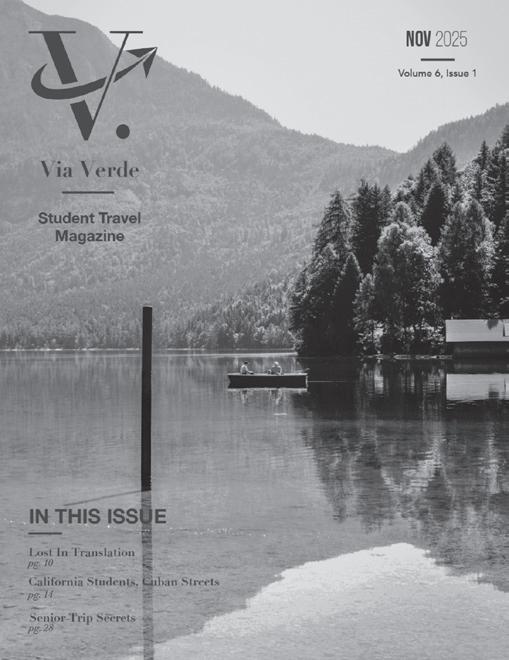
In our November issue of Via Verde, Paly’s travel magazine, we feature captivating stories from rural China to Cuba, photo essays, and various travel-based content from the Paly community.
Editor-in-Chief: Cailey Quita
Submit your travel photos and stories to: viaverdemagazine@gmail.com
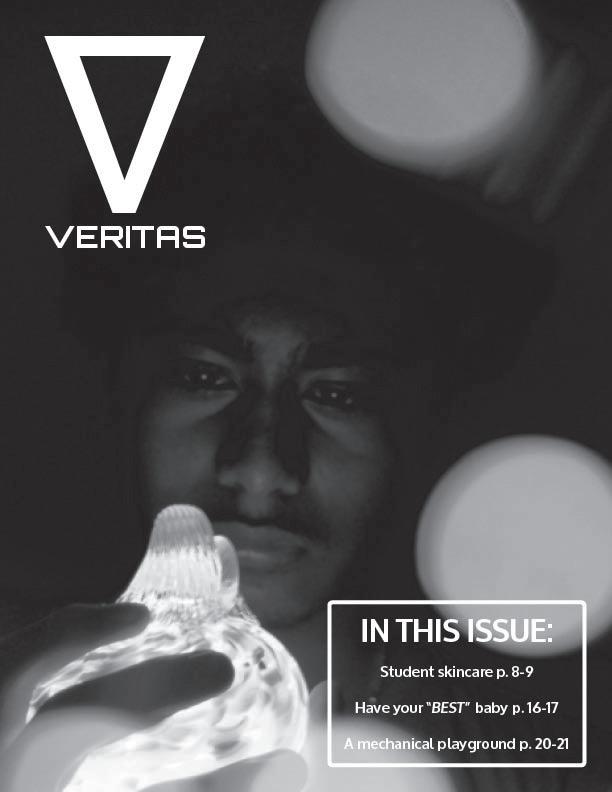
Our technology magazine, Veritas, continues to report on some of the most pressing tech-based developments and issues. From local Waymo progress to embryo selection discussion, Veritas is a mustread.
Editor-in-Chief: William Xue and Arjun Jindal
Submit your story ideas to: veritas.paly@gmail.com



Ink, Incubator’s literary magazine, features student writing — fiction, nonfiction, poetry — as well as features, opinions, and reviews about aspects of literature and writing important to Paly students.
Editor-in-Chief: Xander Yap
Submit your writing to: literarymagazineink@gmail. com
Published three times anually, [proof] magazine is Paly’s fine arts and photography magazine, aiming to feature students’ creative works and facilitate discussion about the arts.
Editor-in-Chief: Alexander Lawson
Submit your photography to: proof.paly@gmail.com
KPLY is Paly’s online podcasting publication, keeping the Paly community up-to-date on campus events and providing original content on anything from features or student opinions to cultural analysis.
Editor-in-Chief: Mack Reller
Visit at: soundcloud.com/palyradio
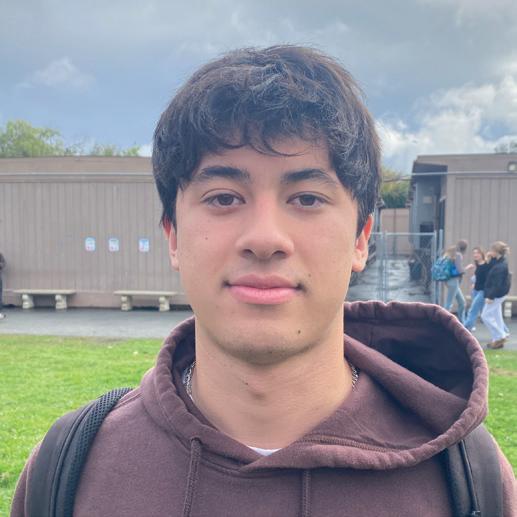
California held a special election for Prop. 50 on Nov. 4th, a measure which would allow the state to redraw its congressional lines and grant Democrats up to 5 additional U.S. House seats in the 2026 midterm, according to the Associated Press. For students who turned 18 before the election, this was their first opportunity to vote. Some students chose to vote, while others didn’t. Anthro interviewed eligible students on how their voting experience was, and why they chose to vote, or not to vote.

“I was really excited just because it was my first time voting and that’s a big thing that you can do here is you have the right to vote. I decided to vote because I felt that it’s not a duty of a citizen but it kind of is, and you have that right so why not use it. Personally I feel like if you can educate yourself on these issues, it’s important that you do vote, so that your opinion is heard and that’s really important for a democracy.”
“My first voting experience was super easy. Registration was quick and voting in person was very gratifying. In fact, a veteran shouted out that I was a first time voter and everyone clapped, which was cool and kind of funny. I decided to vote because I believe I have a civic duty as a U.S. citizen to do what I can to propel my country in the direction I see fit.”
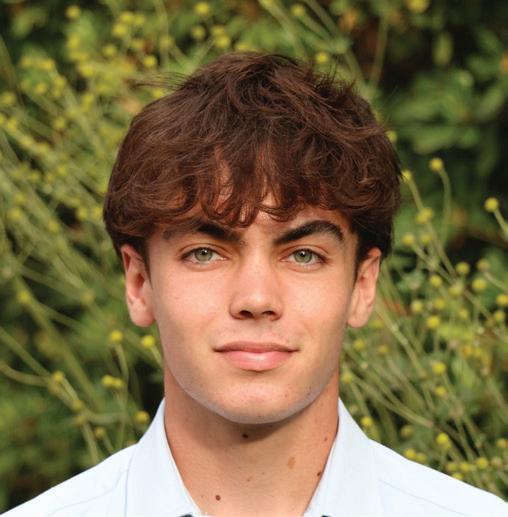
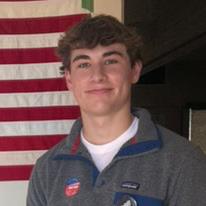
“I didn’t vote. I really just don’t follow politics at all anymore, it feels like a big joke now, and I felt that if I voted it would’ve just been whatever my parents voted for.“
“I did not vote because I was swamped with school work and college applications. I felt unsure because I didn’t know what elections were happening or what bills they were trying to pass. I was also unsure on the process I had to do to even vote.”





Bekki Casalco, Paly’s English teacher, is one of the many teachers who taught 9th grade standard curriculum in Palo Alto High School. Though she is the only teacher who has made revolutionary steps in integrating wellness into literacy, aiming to improve students’ agency.
During her time in teaching her freshman English class, Casalco recognized that stigma is a barrier that keeps students from seeking help.
“From my experience, I think it [a barrier] will be the stigma,” Casalco said. “Like if you reach out for help, you are deemed as weak, or ‘only crazy people get help in the wellness center’, and the last one is a quote from one of my students when we asked them why they think we’re [wellness workers are] here.”
Casalco made an effort to partner with the Paly Wellness Center to lower the barrier. The partnership works on a collaborative model. Casalco meets with Wellness workers to brainstorm how the themes of each of the novels she teaches can be linked to the resources available at the wellness center.
“We work together, we brainstorm,” Casalco said. “[...]I tell them [Wellness workers] the key things that we’re focusing on in the book, and the key things that are relevant to them and what I hope the students take away from the book. Then we brainstorm and put everything together.”
The program weaves social-emotion-

al learning directly into the standard 9thgrade English curriculum by using literature as a bridge to real-world challenges. The goal is to provide students with tangible tools to navigate complex situations.
“The idea is to equip students with social-emotional tools, where they will be able to use those tools in their real life to combat these situations,” Casalco said. “ When we come across our characters and our novels, most of the situations are relatable.”
Moving beyond the standard curriculum of reading and writing, Casalco’s distinctive approach aims to empower students, enhancing their confidence, and problem-solving skills to endure diverse scenarios in life.
because all these resources are free. Once you become an adult, a lot of these resources you need to pay for.”
Casalco said that the first activity that the students participated in was taking a tour inside the Wellness center and getting to know the resources the center offers.
“The goal is to get them [students] from being spectators or just passively a passive engagement to active engagement.”
— BEKKI CASALCO, English teacher
“We’ve only had one activity so far,” Casalco said. “We’re planning for a second one, which is coming up in two weeks. So our first one [event], is an introduction to the wellness center. They got a tour of the wellness center, and they got to explore the therapy spaces.”
situations in life.”
In increasing the agency of her students, Casalco noted that the network effect of how those students affect their friends can be effective in spreading its impacts.
“Friends talk to each other, and they share personal things,” Casalco said. “So they can be like, ‘hey, that’s a situation, why don’t you go to the wellness center?’ And I think that’s something that would be a huge win if we get more and more students participating in the wellness center and be part of it.”
OASIS OF CALM (upper left) — Students painting their imagination of the term “oasis of calm” using water color. This is their third activity in the journey of self discovery within. Students share out their painting with beach, pets, rainbow, etc.
“The goal is to get them [students] from being spectators or just passively a passive engagement to active engagement,” Casalco said. “It’s also about promoting student agency.”
Casalco believes that the best time to provide students with the necessary tools to approach problems is during school.
“I have always believed that students need to know how to navigate life,” Casalco said. “And school is the perfect place
It’s not common for classes to focus on mitigating the barrier in asking for help or to spend time discussing available resources around campus, but Casalco’s action aims to change that.
“It’s so easy just to talk about it and do it alone,” Casalco said. “But the idea that a teacher and a center are collaborating on not just English topics, but also on the social emotional piece of it. So it’s equipping students to become active agents of their own life and taking control of how they respond or how they react to
CIRCLE UP (lower left) — Students circle up on the carpet upon entering the tower building. A carpet were placed in the center of the room to allow students sitting comfortably. Students quickly starts their conversation after settling themselves.
PAINTING RAINBOW (above) —One of Casalco student paints her own vision of where would give her calmness. She started with a stroke of arc, and finishes off with rainbow. While the student next to her have painted a gradient of sunset.

Experts explain the reasoning behind America’s unorthodox drinking age
Alaw-abiding American can drink their first sip of alcohol at 21, while, according to the World Health Organization, more than 60% of countries worldwide have a drinking age of 18. So why are we so far from the norm?
John McCardell, historian and emeritus president of Middlebury College, says the 21-year-old minimum legal drinking age (MLDA) is harmful because it is frequently broken without consequence, setting a concerning precedent.
“On college campuses, students have figured out how to circumvent it and administrators have figured out how to cope with it, in some cases, by just looking the other way,” McCardell said. ”If a law exists that is being routinely violated, where does the logic that leads to that violation end?”
(Continued on next page)

(Continued from previous page)
McCardell led an effort to relax restrictions on alcohol in the early 2000s when he started the Amethyst Initiative, garnering the support of 135 college and university presidents. The Amethyst Initiative went to Congress in 2008, asking Congress to reconsider the bill that has maintained an MLDA of 21 years old across the U.S. since 1984. Before the National Minimum Drinking Age Act of 1984, the MLDA varied from 18 to 21 across states. This act stated that any state with an MLDA lower than 21 would receive a 10% cut to its federal highway funding, and resulted in uniform restrictions across the nation.
the higher drinking age has had unintended consequences.
“Drinking didn't really subside [after the MLDA was raised],” McCardell said. “It retreated into dark corners and clandestine locations — places where it could not be very easily observed, never mind policed.”
"We need to empower young people to think critically about why they’re using.”
–– RALPH CASTRO, director of Stanford’s Office of Substance Use Programs, Education & Resources
According to McCardell, the hearings were never held because of the economic depression in 2008.
McCardell says this bill was created largely due to Mothers Against Drunk Driving (MADD), a nonprofit organization that campaigned for a higher drinking age on a platform of public safety.
“MADD is a pretty powerful organization,” McCardell said. “There continues to be this understandable emotional appeal that MADD makes that the drinking age is responsible for alcohol related traffic fatalities.”
However, McCardell says

According to McCardell, the standardization of a higher drinking age made alcohol taboo, which has had significant health repercussions.
“It eroded opportunities for young people in the presence of adults to learn how to consume alcohol responsibly,” McCardell said. “Clandestine binge drinking became a much more serious problem.”
McCardell says enforceable restrictions that promote education in a system similar to that of driver’s licensing would be more effective than the current MLDA.
“In order to be permitted to drink at age 18, you would have to take an alcohol education course, just like driver’s ed,” McCardell said. “If you pass that successfully, you would receive a permit, which could be revoked automatically if you were caught driving under the influence, and then you'd have to wait until you were 21.”
McCardell claims this revised system would encourage both respect for the law and responsible behavior.
“There would be an incentive for young people to behave up until they turn 18, a greater incentive to behave once they got their permit and an immediate penalty for anyone who violated the rules under any circumstances,” McCardell said.
Palo Alto High School junior Zoe Ferring compares America’s MLDA to restrictions in other countries.
“It’s not consistent with the rest of the world, where most countries have their drinking age at 18,” Ferring said. “It’s better that individuals can drink legally and safely instead of trying to do it under the radar.”
According to the European Union Agency for Fundamental Rights, the majority of European countries have an MLDA of 18 years old.
23% of PAUSD high school juniors have had at least one full drink of alcohol
–– California Healthy Kids Survey, 2024
Ralph Castro, director of Stanford’s Office of Substance Use Programs, Education & Resources, says the culture in Europe allows its lower drinking age to succeed.
“In France and in Italy, alcohol is more culturally family-centric and it’s introduced in a family structure early on … which is different than it is here in the United States,” Castro said. “We tend to be a much more binge-drinking focused society.”
Castro says there are also infrastructural differences which allow lower drinking ages to succeed in Europe.
“There are fewer opportunities to drive [and] there are more walkable cities,” Castro said. ”There’s a more protective factor involved.”
Castro also emphasizes the importance of education, saying that discussions with young people allow them to make better choices.
“We underestimate the brains of young people quite a bit,” Castro said. “There are ways to have conversations with people to build resilience, to build flourishing skills, [and] to build critical thinking skills.”
Castro says that open dialogue is more effective than fear-mongering when discussing underage drinking with teenagers.

“Those aren’t true correlaries,” Castro said. “They are false dichotomies. Drinking and voting are not necessarily the same thing. You have to think strategically: Why? Why would you want it lower?”
This sentiment is shared by Aliya Benabou, the Bay Area program specialist at MADD.
Benabou, who manages local programs at MADD and gives presentations to middle and high schoolers, says it is important to educate young people about the dangers of alcohol.
“If a law exists that is being routinely violated, where does the logic that leads to that violation end?”
–– JOHN MCCARDELL, emeritus president of Middlebury College
“Too many times we’ve utilized scare tactics and unreliable research methodology to try to cajole teens intov not drinking,” Castro said. “We need to empower young people to think critically about why they're using.”
Paly junior Dalia Saal says that preventing 18-year-olds from drinking contradicts their status as legal adults, since they can serve in the military and on juries, sign contracts and vote.
“It's inconsistent with so many other rights you get,” Saal said. “When you’re not allowed to do something, there’s a rebellious side of you that really wants to do it.”
Castro advises caution when comparing these rights.
“A lot of people don't know … the dangers of drinking underage and what kind of health implications that causes that carry into adulthood,” Benabou said. “I wish they [teenagers] knew that alcohol was not a toy. It can get bad really fast.”
Benabou is especially aware of the risks of alcohol use because of her frequent interaction with people who are the most affected by drunk driving accidents.
“I see everyone who has lasting injuries, [who] can’t drive anymore, is paralyzed on their right side or doesn’t have a mom and a dad,” Benabou said. “I see that and I work with them and I know them.”
Because of her experience, Benabou believes that a lower MLDA would only create more harm.
“I think it [efforts to lower the MLDA] just stems back to being ignorant,” Benabou said. ”It’s just because they haven't been impacted. Because, if they have, why would they want to do that? What good is going to come out of that?”
PAUSD should teach students responsible phone use by keeping to a classroom-only phone ban
For most Palo Alto High School students, phones are a part of everyday life. They’re calendars, calculators, cameras, and most importantly, communication. However, school administrators often seem to see them as nothing but a distraction.
To address this concern, California Gov. Gavin Newsom’s PhoneFree School Act requires schools to enact a policy limiting cell phone use in classrooms by July 1. However, the act states that the individual policies are up to the judgement of respective school districts.

doesn’t back it up. A major study in 2025 from the University of Birmingham found that schools with a strict, full-day smartphone ban showed no improvement in students’ mental health, physical activity, sleep, or academic performance.
High school should be a place where students are being prepared for adult life. Locking their phones away will do the exact opposite.
In the beginning of the school year, The Palo Alto Unified school board hadn’t made a decision, and so the choice was left to each school. The board held a meeting in November to decide what the PAUSDwide policy should be for high schools, and they decided to keep the classroom-only phone ban that was already in effect at Palo Alto High School.
We believe the PAUSD school board made the right decision. While having phone-less classrooms can increase focus and improve learning, there is no need for an entirely phone-less school day. In fact, we believe a bell-to-bell phone ban would have more negative than positive effects.
Despite the proposed idea that removing phones in schools boosts mental health, the evidence
Confiscating phones won’t magically make students happier or more focused. Teens’ mental health and productivity are shaped by many more factors, such as family and social life, not just the amount of time kids spend on screens. Especially at Paly, where the pressure is already high, banning phones will make students dread school even more, increasing burnout.
Many teachers believe that banning phones will automatically make students more productive, saying that fewer distractions will mean better focus. While that may sound logical, a 2023 Common Sense Media study showed that teens only used their phones for a median of 43 minutes in school compared to almost four and a half hours daily, showing that most teens’ excessive phone use is outside of school.
Instead of targeting limited in-school use, districts such as PAUSD could make a bigger impact by teaching responsible phone habits outside of class, where the majority of use actually happens.
Another major flaw in bell-to-bell phone bans is how they cut off communication. This is especially important during emergencies such as lockdowns, where the ability to contact a parent is a necessity. According to a Nation Parents Union poll, 78% of parents believe their child should be able to use their phone during school hours if there is an emergency and they need to contact their kids. Having phones available doesn’t mean they must be used in class, but students should be able to have the option of using their phone in case of an emergency.
In addition to extreme cases, commu-
nication through technology is fundamental to how society functions today. Many Paly students go off campus to Town and Country Village during brunch and lunch, and students should be able to call and coordinate with their friends.
A full day phone ban also raises many questions and concerns. How will the administration take care of 2,000 phones? What about people with health issues? What about people with prep periods who are leaving school? These issues are easily avoided with a classroom-only phone ban.
Even when schools are able to enforce a total phone ban successfully, new problems emerge. A 2025 National Bureau of Economics Research study analyzing Florida districts found that the first year after the phone ban was put in place, schools saw an increase in student suspensions due to rebellion against the policy. Instead of focusing on teaching, educators would be managing discipline, damaging the very relationship that makes learning possible.
High school should be a place where students are being prepared for adult life. Locking their phones away will do the exact opposite. Post-high school, there’s no one stopping people from using their phones. Not teaching students how to use their phones responsibly at a younger age will lead to more phone abuse in the future.
Administrators can also emphasize the importance of using phones responsibly through education rather than discipline. The best way to fight this isn’t with total abolishment, it is with education instead.
At Paly, where independence and initiative defines the student
body, the solution isn’t to lock phones away. It’s to build trust and teach balance, creating a campus that values both focus and freedom, which is why the school board made the right decision.

That disturbing message on a random Discord server was how we found out about the death of Blackstone executive Wesley LePatner. Moments later, another member referenced the shooting of Brian Thompson, the CEO of United Healthcare.
Their deaths were celebrated because some people did not support the kind of people the CEOs represented, but that doesn’t change the fact that, at the end of the day, they were still human beings.
Just a few months later, in September, right-wing Conservative activist Char-
killing of political figures simply because of their ideology. According to a survey by CloudResearch, a leading online research platform, 22% of Americans under 30 said Kirk’s death was justified. The main reason? Karmic justice for gun rights advocacy.
There have been multiple cases of politically motivated violence in our country.
Pennsylvania Governor Josh Shapiro was firebombed at his home for his stance on Palestine. Our current President, Donald J. Trump, was himself the target of multiple assassination attempts. There have been numerous cases of politically motivated violence in our country.
Just a few months be-
to understand one another. After Kirk’s shooting, Politico reported that Democratic Reps. Delia Ramirez of Illinois and Sydney Kamlager-Dove of California moved events indoors, while CBS found that many others postponed or canceled public engagements.
Rep. Jared Moskowitz (D-FL) described the atmosphere inside Congress after the murder of Kirk.
“People are scared to death in this building. … They’re running to the House Speaker, talking about security. … People are scared, really scared,” he told NBC News.
“In a democratic republic, sometimes we ‘win,’ sometimes we ‘lose,’ but we’re not going to hurt each other in the process.”
— KATYA VILLALOBOS , AP U.S. history teacher
We must be able to compromise with those who disagree with us, for that is the foundation of democracy. But rising polarization has made that increasingly difficult. As early as 2014, the Pew Research Center found deep partisan animosity, Americans increasingly viewing the opposing party’s policies as an existential threat to the nation’s stability and future.

In our diverse country, we’ll always have some disagreements. Former U.S. President and diplomat Jimmy Carter said that we should prioritize peace over vio-
“There should be an honest attempt at the reconciliation of differences before re-
When compromise erodes, violence fills the void. It’s a failure of communication. According to a 2023 study by U.C. Davis with 8,620 participants, 32.8% considered violence to be usually or always justified to advance a political objective.
However, most respondents who endorsed political violence were unwilling to resort to violence themselves. Still, by endorsing this behavior, it normalizes it to the
few that are willing to engage in political violenceAccording to AP U.S. History teacher Katya Villalobos, political violence is incompatible with democratic governance.
“We are not always going to agree with things,” Villalobos said. “In a democratic republic, sometimes we ‘win,’ sometimes we ‘lose,’ but we’re not going to hurt each other in the process.”
‘lose,’ but we’re not going to hurt each other in the process.”
“There should be an honest attempt at the reconciliation of differences before resorting to combat.”
Public awareness of political violence appears to be rising. A 2025 Pew survey found that 85% of respondents believe the rate of politically motivated violence is increasing. Awareness of the problem is a good start, but it’s not enough — we need action, not fear.
— JIMMY CARTER , former U.S. president
Public awareness of political violence appears to be rising. A 2025 Pew survey found that 85% of respondents believe the rate of politically motivated violence is increasing. Awareness of the problem is a good start, but it’s not enough — we need action, not fear.
Villalobos also warns of
online echo chambers that could block us from listening to other opinions.
“[There is] your truth and my truth, but then the facts get lost. … You stay in a bubble, and that bubble becomes a cement bubble, where no information can come through.”
Do we want a nation where people are shot for disagreeing on policy? Do we want the image of the United States to be one of perpetual turmoil and unrest?
If not, then it is up to all of us to change that narrative. Violent political rhetoric should never be tolerated. Normalize keeping an open mind, not violence.
Villalobos also warns of online echo chambers that could block us from listening to other opinions.
“[There is] your truth and my truth, but then the facts get lost. … You stay in a bubble, and that bubble becomes a cement bubble, where no information can come through.”
Do we want a nation where people are shot for disagreeing on policy? Do we want the image of the United States to be one of perpetual turmoil and unrest?
If not, then it is up to all of us to change that narrative. Violent political rhetoric should never be tolerated. Normalize keeping an open mind, not violence. were unwilling to resort to violence themselves. Still, by endorsing this behavior, it normalizes it to the few who are willing to engage in political violence. According to AP U.S. History teacher Katya Villalobos, political violence is incompatible with democratic governance.
“We are not always going to agree with things,” Villalobos said. “In a democratic republic, sometimes we ‘win,’ sometimes we

Palo Alto Unified School District
Palo Alto High School
50 Embarcadaro Road