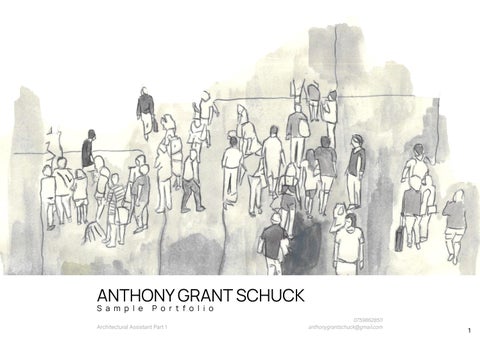
Portfolio: Anthony Grant Schuck

Page 1


ANTHONY GRANT SCHUCK

Sample Portfolio

Curated within this portfolio is a selection of work produced during my BA (Hons) Architecture baccalaureate at Birmingham City University. The projects included are: ‘Biblioteca Vasconcelos’ and ‘Inside and Out’.

I am grateful for the time you have taken to look through my portfolio, I look forward to hearing from you.

Biblioteca Vasconcelos

Completed in 2022, for this project we were allocated a case study to investigate its successful design features and environmental properties. The project investigates themes of structure and user circulation.

Materiality Collage Precident Study

In this project, we analysed Biblioteca Vasconcelos in Mexico City, a prime example of how structure and materiality align with a building’s functional requirements. Our research highlighted the library’s design, which accommodates user needs and enhances their journey through the space. The circulation strategy is crucial, balancing the flow of people passing through with those who dwell within, ensuring a fluid movement across floors and zones without disturbance. Notably, the hanging cubist bookshelves and staircases define both form and function, creating a dynamic spatial experience. Additionally, the library’s acoustic properties are thoughtfully designed; quiet study areas are strategically placed to minimize noise, fostering an environment conducive to concentration and reflection.

Environmental Section
Presentation Board
Circulation Strategy sketch.
Model of Staircase structure.
Watercolour - Transparent Walkway.

Inside and Out

Completed in 2024, this project investigates themes of city planning, urban layout and human scale. A project where sustainable design meets urban theory. Building spaces to improve relationships between local communities and their urban surroundings at an appropriate scale.

The Eixample district was designed by Ildefons Cerdà. Cerdà’s original vision was to create spacious green courtyards that would foster community interaction and socialization, with pedestrians being a priority. However, due to the city’s urgent need to house more people, Cerdà’s plan was only partially realized. The final implementation prioritized vehicular movement, enclosing courtyards within blocks and isolating pedestrians to the exterior roads. This compromise led to the courtyards being under utilised, ultimately reducing the social connectivity that Cerdà had initially envisioned for the city.

Intended: 28m2 per pserson Today: 7m2 per person
Green Space intended in Cerda’s original plan across Eixample region.
Superblock Divisions
Superblocks - Wider site.
Abstract Mapping - straight and curverd forms study.

The Superblock intervention transforms traditional road junctions within the Eixample district into pedestrian-friendly plazas. By grouping blocks into three-by-three grids and restricting vehicular access within the inner streets, these intersections become vibrant public spaces. The newly created plazas offer opportunities for social interaction, leisure, and community activities, while also enhancing environmental sustainability by reducing traffic congestion and air pollution. This re-imagining of urban space aligns with Cerdà’s original vision, reconnecting residents with the city through green, pedestrian-oriented areas that prioritize social engagement over vehicular movement.

Superblock Wider Site Analysis
The spaces that do exist and how they can be transformed. Superblock intervention allows junctions at pedestrianised roads to be transformed into pedestrianised plaza’s.
Photos of model showing concept development, exploring ideas of play and objects in the urban space without an obvious function.
Inspired by the work of Aldo van Eyck.
Semester One Proposal Model for: Human Scale Interactive Play Space Plaza
Semester One Proposal Plan
Plaza Space

My primary goal for this project was to restore the relationship between the inside and outside of the Eixample blocks, which had been lost due to the dominance of vehicular movement. I aimed to create a more seamless connection between public and private spaces within each block, encouraging greater interaction and accessibility.

Additionally, I sought to implement sustainable design strategies, where nature could be seen as reclaiming the urban fabric. By introducing green corridors, rooftop gardens, and rainwater harvesting systems, I aimed to create a more eco-conscious environment that enhances the quality of life for residents.

Finally, I envisioned the creation of mini-communities within each Superblock, where local residents could come together in shared spaces like plazas, allotments, and community gardens. These spaces would foster a sense of belonging and encourage social interaction, making each Superblock a selfsustaining community within the larger urban fabric.

Visuals - Autodesk Revit + Photoshop

The shift toward prioritizing vehicular traffic over pedestrian accessibility created a disconnect between the public streets and the enclosed courtyards. My goal was to re-establish this connection by opening up the courtyards and integrating them with the surrounding streets, creating a more fluid relationship between indoor and outdoor spaces. Through the implementation of pedestrianized areas, green spaces, and social hubs within each block, I sought to revive Cerdà’s original vision, ensuring that both the interior and exterior spaces of the block serve the community equally, fostering social cohesion and accessibility.

Site Sketch

The concept of Superblock Micro-Communities in my project aimed to foster a stronger sense of individuality and belonging within each Superblock. By designing spaces that allow residents to interact and engage in communal activities, I sought to cultivate mini-communities within the larger urban fabric. Each Superblock was envisioned as having its own identity, shaped by shared public spaces such as plazas, community gardens, and allotments.

In addition to building a sense of community, a key goal was to integrate nature into the urban environment, allowing greenery to reclaim and transform the built fabric. This was achieved through green corridors, rooftop gardens, and pedestrianized streets, where natural elements are woven into the everyday experience of residents. The result is a more sustainable, liveable space where both individuality and communal spirit can thrive amidst a re-imagined urban landscape.

Projection for green corridors across entire Eixample.
Superblocks to act as mini-communities within the larger Eixample community.
Development sketch model. Natures reclaiming of urban fabric.

In my project, the structural choices were deeply symbolic of the contrast between Barcelona’s rigid urban grid and the more personal, fluid spaces within the Superblock. The concrete base, representing the solid, unyielding rigidity of Barcelona’s gridded layout, serves as a foundation that grounds the design within the structured urban context. This choice of material emphasizes the city’s historical emphasis on order and function.

In contrast, the light steel structure, particularly the staircases, introduces a sense of fragility and individuality. The airy, open feel of the steel stairs juxtaposes the solidity of the concrete, symbolizing the more random, personal, and intimate experiences that occur within the spaces. This contrast between the concrete’s rigidity and the steel’s delicate nature highlights the shift from the city’s structured grid to the unique, individualistic environments that foster community interaction and personal expression within the Superblock.

Mending relationship between interior and exterior of block

A key aspect of my project was the creation of dedicated relaxation spaces for local residents, designed to offer respite from the fastpaced urban environment. These spaces, integrated within the Superblocks, include rooftop gardens, shaded courtyards, and green plazas that provide quiet areas for relaxation and social interaction.

By incorporating natural elements and tranquil environments, the design promotes well-being and encourages locals to gather, unwind, and connect with their surroundings. These relaxation spaces are essential in fostering a sense of community while also enhancing the quality of life for residents, offering an escape from the city’s busier, more structured public spaces.

Outside of architecture, my hobbies span a diverse range of creative and recreational activities. I have a passion for the visual arts, including drawing and painting. My interest in fashion reflects my appreciation for style and design. I also love playing football, futsal, chess and the guitar/music.

I try to involve myself in as many hobbies that might be considered ‘outside’ of the architectural realm- I believe that all such artistic forms are intertwined. These forms have provided another outlet of expression, to take what I have learnt through all outlets of life.

To conclude, over the past three years at Birmingham City University, my journey in architecture has been both challenging and rewarding. Each project has deepened my understanding of the built environment and the role of architecture in shaping communities. From concept development to technical execution, I have gained a solid foundation in the principles of design, sustainability, and innovation.

Turn static files into dynamic content formats.

Create a flipbook
Issuu converts static files into: digital portfolios, online yearbooks, online catalogs, digital photo albums and more. Sign up and create your flipbook.