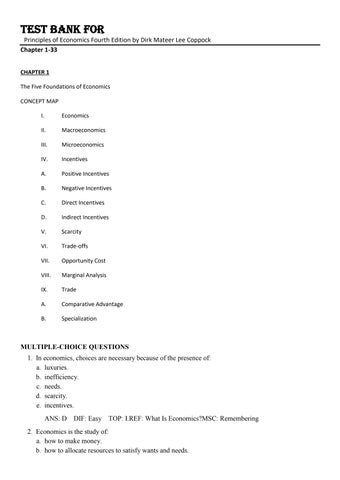
Test Bank For Principles of Economics Fourth Edition by Dirk Mateer Lee Coppock Chapter 1-33 CHAPTER 1 The Five Foundations of Economics CONCEPT MAP I.
Economics
II.
Macroeconomics
III.
Microeconomics
IV.
Incentives
A.
Positive Incentives
B.
Negative Incentives
C.
Direct Incentives
D.
Indirect Incentives
V.
Scarcity
VI.
Trade-offs
VII.
Opportunity Cost
VIII.
Marginal Analysis
IX.
Trade
A.
Comparative Advantage
B.
Specialization
MULTIPLE-CHOICE QUESTIONS 1. In economics, choices are necessary because of the presence of: a. luxuries. b. inefficiency. c. needs. d. scarcity. e. incentives. ANS: D
DIF: Easy TOP: I.REF: What Is Economics?MSC: Remembering
2. Economics is the study of: a. how to make money. b. how to allocate resources to satisfy wants and needs.
c. capitalism. d. how to make workers more productive and firms more profitable. e. markets. ANS: B DIF: Easy TOP: I.REF: What Is Economics?MSC: Remembering 3. Thomas Malthus’s prediction of mass starvation failed to come true because of increases in: a. population. b. productivity. c. temperature. d. government involvement. e. income. ANS: B DIF: Medium
TOP: I.REF: What Is Economics?MSC: Remembering
4. The basic goal of economics is: a. controlling the effects of government actions. b. determining how to distribute all that is produced in an economy. c. addressing the scarcity problem created because the population’s desire for goods exceeds the ability to produce them. d. matching limited resources to people’s limited wants and needs. e. controlling tastes and wishes so that there will be enough resources to produce all the goods and services that people want. ANS: C
DIF: Medium
TOP: I.REF: What Is Economics?MSC: Remembering
5. An economist is an individual who would be least able to answer which research question? a. how much of a product is purchased at a specific price b. how the tastes and preferences of consumers are determined c. what firms decide to produce d. how goods and services are distributed to the population e. how firms decide to produce a good or service ANS: B DIF: Easy TOP: I.REF: What Is Economics?MSC: Understanding 6. The need to study economics would cease to exist if: a. the government stopped controlling people’s actions. b. people were free to make decisions on their own. c. people put forth the effort required to attain the goods and services they wanted. d. people earned more than they spent. e. there were enough resources to produce all the goods and services people would like to obtain. ANS: E
DIF: Easy TOP: I.REF: What Is Economics?MSC: Understanding
7. As a discipline, economics is best described by which of the following? a. the study of how to control the effects of government actions b. the study of how to control the preferences of consumers so that there will be enough resources to produce all the goods and services that consumers want c. the study of how to use scarce resources to satisfy unlimited wants and needs d. the study of how to dispose of excess goods and services that nobody wants e. the study of how to maximize profits for firms ANS: C
DIF: Medium
TOP: I.REF: What Is Economics?MSC: Understanding
8. When a parent tells you not to study economics because it is a pointless discipline, why is he or she incorrect? a. The government continues to play a role in our daily lives. b. People have the freedom to do whatever they want, and economists have nothing to add to their decision-making process. c. There are not enough resources to produce all the goods and services that are wanted and needed. d. Economics has nothing to offer in terms of understanding the stock market. e. Economics has nothing to offer in terms of understanding government programs like Social Security. ANS: C
DIF: Medium
TOP: I.REF: What Is Economics?MSC: Understanding
9. When consumers discard their gasoline-powered automobiles for electric-powered ones, this partially reflects the ________ of gasoline: a. scarcity b. luxury c. necessity d. specialization e. incentive ANS: A
DIF: Medium
TOP: I.REF: What Is Economics?MSC: Applying
10. As a new firm in the apple-picking business, you have considered adding an economist to your management team. What would this economist be unable to help your managerial team with? a. Determining the lowest cost way of picking apples b. Determining how many apples consumers will purchase at different prices c. Determining why people eat apples d. Determining the effect government regulations would have on the price of apples e. Determining the lowest cost way of distributing apples ANS: C
DIF: Medium
TOP: I.REF: What Is Economics?MSC: Applying
11. A good is ________ if it takes even a small amount of time, energy, or money to acquire. a. abundant b. in shortage c. cheap d. scarce e. virtually free ANS: D
DIF: Medium
TOP: V.REF: What Is Economics?MSC: Understanding
12. Because of scarcity: a. individuals and societies are allowed no choice about which wants and needs to satisfy. b. individuals and societies must choose which wants and needs to satisfy. c. all choices about wants and using resources must be made by the government. d. choices can be made about which wants to satisfy, but not about which resources to use. e. choices must be made about which resources to use, but not about which wants to satisfy. ANS: B DIF: Medium
TOP: V.REF: What Is Economics?MSC: Understanding
13. Which of the following statements best represents the fact that I cannot put in extra hours of work because of scarcity?
a. I don’t have enough time for additional work because I need to spend time with my family and there are only so many hours in the day. b. I don’t like going to work, so why would I work more than I have to? c. I don’t think that overtime pay is high enough. d. I am worried that if I work extra hours, I will get bored with my job. e. I don’t want my coworkers to feel pressure to work more because I am working additional hours. ANS: A
DIF: Medium
TOP: V.REF: What Is Economics?MSC: Applying
14. Which scenario describes studying for an economics course without applying the scarcity principle? a. I study two hours for every one hour I am in the classroom. b. I study three afternoons a week until I understand the material or until dinner, whichever comes first. c. I study with my roommate who is also taking the course, and we discuss economic concepts during any free time we can find. d. I study for this course and do nothing else. e. I talk to an economist whenever I have a chance to do so. ANS: D
DIF: Medium
TOP: V.REF: What Is Economics?MSC: Applying
15. What is the strongest argument for why we need more economists today than ever before? a. We have a need for more wealth given the higher standard of living that individuals demand. b. Economists are needed to address the allocation of scarce resources as a result of the world’s growing population. c. Economists are needed to make sure that firms continue to make profits. d. Economists are needed to make sure that consumers are well informed about their possible purchase options and that they budget their finances appropriately. e. Economists are needed to make sure that the government doesn’t involve itself too much in the economy. ANS: B DIF: Medium TOP: V.REF: What Is Economics?MSC: Evaluating 16. Macroeconomics is the study of: a. the economic motives of voters and elected officials. b. individual decision-making units such as households and businesses. c. how government purchases affect specific markets. d. the operation of the economy as a whole. e. the interaction between the government and businesses. ANS: D
DIF: Easy TOP: II.REF: Microeconomics and MacroeconomicsMSC: Remembering
17. Which of the following is a macroeconomic question? a. How many textbooks should be published by a publisher? b. How much should English majors earn after college? c. How do members of a household decide whether to clean their own house or hire someone else to do it? d. What is the rate of unemployment? e. What is the price of a new 40-inch television? ANS: D
DIF: Easy TOP: II.REF: Microeconomics and MacroeconomicsMSC: Applying
18. Microeconomics is the study of:
a. how government activities affect the economy. b. individual decision-making units. c. collective decision-making. d. the operation of the economy as a whole. e. the interaction between the government and businesses. ANS: B DIF: Easy TOP: III.REF: Microeconomics and MacroeconomicsMSC: Remembering 19. Microeconomics is the branch of economics that focuses on the: a. entire economy. b. production side of the economy. c. consumption side of the economy. d. involvement of the government in the entire economy. e. choices and decision-making of individuals and firms. ANS: E
DIF: Easy TOP: III.REF: Microeconomics and MacroeconomicsMSC: Remembering
20. Which of the following is a microeconomic question? a. What are the total production levels in the economy? b. How can we best encourage economic growth? c. What is the overall price level in the economy? d. What are the variables that determine the price of a specific good? e. How can we reduce the unemployment rate among Hispanic men? ANS: D
DIF: Easy TOP: III.REF: Microeconomics and MacroeconomicsMSC: Applying
21. Which of the following is not a type of incentive? a. positive b. negative c. complementary d. indirect e. direct ANS: C
DIF: Easy TOP: IV.REF: IncentivesMSC: Remembering
22. The patent system: a. acts as a direct positive incentive. b. acts as a direct negative incentive. c. acts as an indirect positive incentive. d. acts as an indirect negative incentive. e. does not provide an incentive. ANS: A
DIF: Easy TOP: IV.REF: IncentivesMSC: Remembering
23. Which of the following concepts do economists focus their study on when explaining how humans behave? a. fairness b. money c. emotions d. incentives e. justice ANS: D
DIF: Medium
TOP: IV.REF: IncentivesMSC: Remembering