Exam Name___________________________________
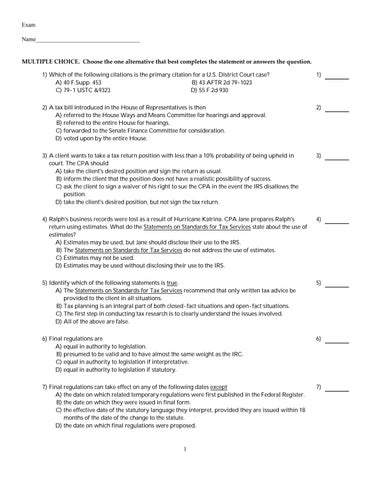
MULTIPLE CHOICE. Choose the one alternative that best completes the statement or answers the question. 1) Which of the following citations is the primary citation for a U.S. District Court case? A) 40 F.Supp. 453 B) 43 AFTR 2d 79-1023 C) 79-1 USTC &9323 D) 55 F.2d 930
1)
2) A tax bill introduced in the House of Representatives is then A) referred to the House Ways and Means Committee for hearings and approval. B) referred to the entire House for hearings. C) forwarded to the Senate Finance Committee for consideration. D) voted upon by the entire House.
2)
3) A client wants to take a tax return position with less than a 10% probability of being upheld in court. The CPA should A) take the client's desired position and sign the return as usual. B) inform the client that the position does not have a realistic possibility of success. C) ask the client to sign a waiver of his right to sue the CPA in the event the IRS disallows the position. D) take the client's desired position, but not sign the tax return.
3)
4) Ralph's business records were lost as a result of Hurricane Katrina. CPA Jane prepares Ralph's return using estimates. What do the Statements on Standards for Tax Services state about the use of estimates? A) Estimates may be used, but Jane should disclose their use to the IRS. B) The Statements on Standards for Tax Services do not address the use of estimates. C) Estimates may not be used. D) Estimates may be used without disclosing their use to the IRS.
4)
5) Identify which of the following statements is true. A) The Statements on Standards for Tax Services recommend that only written tax advice be provided to the client in all situations. B) Tax planning is an integral part of both closed-fact situations and open-fact situations. C) The first step in conducting tax research is to clearly understand the issues involved. D) All of the above are false.
5)
6) Final regulations are A) equal in authority to legislation. B) presumed to be valid and to have almost the same weight as the IRC. C) equal in authority to legislation if interpretative. D) equal in authority to legislation if statutory.
6)
7) Final regulations can take effect on any of the following dates except A) the date on which related temporary regulations were first published in the Federal Register. B) the date on which they were issued in final form. C) the effective date of the statutory language they interpret, provided they are issued within 18 months of the date of the change to the statute. D) the date on which final regulations were proposed.
7)
1