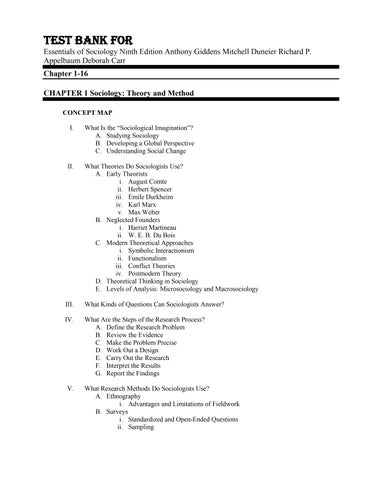
Test Bank For Essentials of Sociology Ninth Edition Anthony Giddens Mitchell Duneier Richard P. Appelbaum Deborah Carr Chapter 1-16 CHAPTER 1 Sociology: Theory and Method CONCEPT MAP I.
What Is the ―Sociological Imagination‖? A. Studying Sociology B. Developing a Global Perspective C. Understanding Social Change
II.
What Theories Do Sociologists Use? A. Early Theorists i. August Comte ii. Herbert Spencer iii. Émile Durkheim iv. Karl Marx v. Max Weber B. Neglected Founders i. Harriet Martineau ii. W. E. B. Du Bois C. Modern Theoretical Approaches i. Symbolic Interactionism ii. Functionalism iii. Conflict Theories iv. Postmodern Theory D. Theoretical Thinking in Sociology E. Levels of Analysis: Microsociology and Macrosociology
III.
What Kinds of Questions Can Sociologists Answer?
IV.
What Are the Steps of the Research Process? A. Define the Research Problem B. Review the Evidence C. Make the Problem Precise D. Work Out a Design E. Carry Out the Research F. Interpret the Results G. Report the Findings
V.
What Research Methods Do Sociologists Use? A. Ethnography i. Advantages and Limitations of Fieldwork B. Surveys i. Standardized and Open-Ended Questions ii. Sampling
C. Experiments D. Comparative and Historical Research VI.
What Ethical Dilemmas Do Sociologists Face?
VII.
How Does the Sociological Imagination Affect Your Life?
MULTIPLE CHOICE 1. Sociologists recognize that "personal" troubles, if occurring in patterned ways and to large numbers of individuals, reflect a. public issues. c. anomie. b. individualized problems. d. organic solidarity. ANS: A DIF: Easy MSC: Remembering
REF: What Is the "Sociological Imagination"? (I)
2. Tori's father loses his job during a time of economic crisis when many people are losing their jobs. Her mother is a skilled daycare worker with years of experience, but like many daycare workers, she cannot find any jobs that pay well. Sociologists would likely see the struggle of Tori's parents as a. a personal trouble. b. the fault of Tori's father for not providing for the family. c. the result of a socialist economy. d. a public issue. ANS: D MSC: Applying
DIF: Easy
REF: What Is the "Sociological Imagination"? (I)
3. In America, obesity has emerged as a major public health concern. How might a sociologist using the "sociological imagination" examine obesity among teenagers? a. by exploring the role that genetic factors play in a teenager's potential to develop obesity b. by speaking to teenagers to understand the role that laziness plays in their eating habits c. by examining obesity rates among teenagers and factors like social class and neighborhood conditions d. by examining how food metabolizes in the bodies of teenagers ANS: C MSC: Analyzing
DIF: Difficult
REF: What Is the "Sociological Imagination"? (I)
4. Parents living in Boston noticed that many of their adolescent children regularly became distressed in early September. Based on what you know about adolescent suicides in the United States and Japan, sociologists might attempt to understand this phenomenon by looking into what? a. parent–student communication b. genetic predispositions to depression c. students' experiences with bullying d. school lunch programs in Boston ANS: C MSC: Applying
DIF: Difficult
REF: What Is the "Sociological Imagination"? (I)
5. Following C. Wright Mills, sociologists refer to breaking free from the immediacy of personal circumstances and putting things in a wider social context as the a. materialist conception of history. c. emergence of a double consciousness.
b. sociological imagination. ANS: B DIF: Easy MSC: Remembering
d. recognition of self. REF: What Is the "Sociological Imagination"? (I)
6. Jenna and her family lose their home because her parents can no longer pay the mortgage during a time of economic crisis when foreclosures have become a common feature of her country. Jenna would be using a sociological imagination to think about this if she were to a. blame her mother for not working hard enough. b. wonder why her father does not just find a new job. c. consider why her society allows people to be thrown out of their homes. d. think about ways she can contribute financially to buying their house back. ANS: C MSC: Applying
DIF: Moderate
REF: What Is the "Sociological Imagination"? (I)
7. ________ refers to how human societies are reconstructed at every moment by the very "building blocks" that compose them—human beings. a. ―Survival of the fittest‖ c. Structuration b. The materialist conception of history d. Social physics ANS: C DIF: Moderate MSC: Remembering
REF: Studying Sociology (I.A)
8. Women began entering the workforce in larger numbers in the United States until it eventually became normal, altering women's structural place in society. This is an example of a. structuration. c. postmodernism. b. triangulation. d. globalization. ANS: A MSC: Applying
DIF: Moderate
REF: Studying Sociology (I.A)
9. Which question about the transformations that accompanied industrialization in West would a sociologist be MOST likely to explore? a. Which marriage ideals preceded the romantic love ideal, and why did the shift occur? b. What are key differences between an industrial economy and information economy? c. How are ideals of romantic love connected with industrialization? d. How do people manage workplace stress in industrial settings? ANS: C MSC: Applying
DIF: Difficult
REF: Studying Sociology (I.A) | InQuizitive
10. What is the concept that sociologists use to understand the economic, political, and social interconnectedness of individuals throughout the world? a. globalization c. sociological imagination b. structuration d. organic solidarity ANS: A DIF: Moderate MSC: Remembering
REF: Developing a Global Perspective (I.B)
11. When Juan drinks his morning coffee, he thinks about its production in Colombia, its transportation through many countries, the taxes and tariffs applied for international commerce, and the diverse array of social relations behind his drink. According to the textbook, one might say that Juan is using a ________ perspective. a. bureaucratic b. postmodern
c. global d. domestic ANS: C MSC: Applying
DIF: Moderate
REF: Developing a Global Perspective (I.B)
12. At the height of the most developed traditional civilizations, such as ancient Rome or preindustrial China, a. most of the population lived in urban areas. b. most people engaged in food production. c. most people fell in love. d. ―falling in love‖ was a precondition for marriage. ANS: B DIF: Easy MSC: Remembering
REF: Understanding Social Change (I.C)
13. Sociology was founded by thinkers who sought to understand the initial impact of transformations that accompanied a. the domestication of animals. b. the invention of writing. c. the invention of the printing press. d. industrialization in the West. ANS: D DIF: Moderate MSC: Remembering
REF: Understanding Social Change (I.C)
14. According to the textbook, ________ involve(s) constructing abstract interpretations that can be used to explain a wide variety of situations. a. factual research c. theories b. triangulation d. formulating hypotheses ANS: C DIF: Easy MSC: Remembering
REF: What Theories Do Sociologists Use? (II)
15. Which of the following statements related to the development of sociology is most accurate? a. At the start of the Industrial Revolution in Europe, sociology as a scientific discipline had been firmly established. b. Major historical events in the late 1700s and early 1800s forced thinkers to develop new understandings of both the social and natural worlds. c. Questions about human nature and why societies change had largely been solved by the late 1700s. d. The scientific study of human behavior dates back to the Middle Ages. ANS: B DIF: Moderate MSC: Understanding 16. ________ invented the word sociology. a. Karl Marx b. Auguste Comte ANS: B DIF: Easy MSC: Remembering
REF: Early Theorists (II.A)
c. Émile Durkheim d. Max Weber REF: Auguste Comte (II.A.i)
17. According to August Comte, what is the proper role of sociology? a. to observe human behavior without influencing it b. to study human society scientifically
c. to restore religion to its proper central role in human society d. to overthrow the established social order ANS: B DIF: Easy MSC: Remembering
REF: Auguste Comte (II.A.i) | InQuizitive
18. Which phrase best represents the beliefs of Herbert Spencer? a. "equality for all" b. "survival of the fittest" c. ―all human history thus far is the history of class struggles‖ d. ―the problem of the twentieth century is the problem of the color line‖ ANS: B MSC: Evaluating
DIF: Moderate
REF: Herbert Spencer (II.A.ii)
19. According to ________, sociology must study social facts—aspects of social life that shape our actions as individuals—in order to become a science. a. Karl Marx c. Émile Durkheim b. Auguste Comte d. Max Weber ANS: C DIF: Easy MSC: Remembering
REF: Émile Durkheim (II.A.iii)
20. Émile Durkheim believed that for a society to function and persist over time, its specialized institutions must work in harmony with each other and function as an integrated whole. He referred to this as a. social facts. c. ideology. b. social constraint. d. organic solidarity. ANS: D DIF: Moderate MSC: Remembering
REF: Émile Durkheim (II.A.iii)
21. Kevon believes that society should be looked at like a body, with each of the parts necessary to the functioning of the whole. His ideas most closely mirror those of which theorist? a. Karl Marx c. Harriet Martineau b. Émile Durkheim d. Max Weber ANS: B DIF: Moderate MSC: Understanding
REF: Émile Durkheim (II.A.iii)
22. What makes a social fact a social constraint? a. Any theory that cannot account for the social fact is proven false. b. Any society that does not respect the social fact will not survive. c. Any group that does not respect the social fact cannot become dominant. d. Any person who ignores the social fact will encounter difficulty. ANS: D MSC: Analyzing
DIF: Moderate
REF: Émile Durkheim (II.A.iii) | InQuizitive
23. ________ argued that class struggles were what led to historical progress and development. a. Karl Marx c. Émile Durkheim b. Auguste Comte d. Max Weber ANS: A DIF: Easy MSC: Understanding
REF: Karl Marx (II.A.iv)
24. The ideas of Karl Marx might be criticized for what reason?