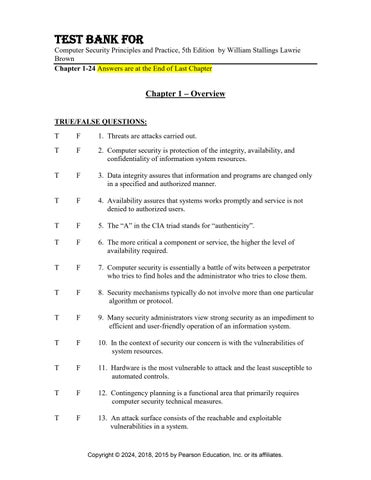
Test Bank For Computer Security Principles and Practice, 5th Edition by William Stallings Lawrie Brown Chapter 1-24 Answers are at the End of Last Chapter
Chapter 1 – Overview TRUE/FALSE QUESTIONS: T
F
1. Threats are attacks carried out.
T
F
2. Computer security is protection of the integrity, availability, and confidentiality of information system resources.
T
F
3. Data integrity assures that information and programs are changed only in a specified and authorized manner.
T
F
4. Availability assures that systems works promptly and service is not denied to authorized users.
T
F
5. The ―A‖ in the CIA triad stands for ―authenticity‖.
T
F
6. The more critical a component or service, the higher the level of availability required.
T
F
7. Computer security is essentially a battle of wits between a perpetrator who tries to find holes and the administrator who tries to close them.
T
F
8. Security mechanisms typically do not involve more than one particular algorithm or protocol.
T
F
9. Many security administrators view strong security as an impediment to efficient and user-friendly operation of an information system.
T
F
10. In the context of security our concern is with the vulnerabilities of system resources.
T
F
11. Hardware is the most vulnerable to attack and the least susceptible to automated controls.
T
F
12. Contingency planning is a functional area that primarily requires computer security technical measures.
T
F
13. An attack surface consists of the reachable and exploitable vulnerabilities in a system.
Copyright © 2024, 2018, 2015 by Pearson Education, Inc. or its affiliates.
T
F
T
F
14. The first step in devising security services and mechanisms is to develop a security policy.
15. Assurance is the process of examining a computer product or system with respect to certain criteria. MULTIPLE CHOICE QUESTIONS: 1. __________ assures that individuals control or influence what information related to them may be collected and stored and by whom and to whom that information may be disclosed. A. Availability
B. System Integrity
C. Privacy
D. Data Integrity
2. ________ assures that a system performs its intended function in an unimpaired manner, free from deliberate or inadvertent unauthorized manipulation of the system. A. System Integrity
B. Data Integrity
C. Availability
D. Confidentiality
3. A loss of _________ is the unauthorized disclosure of information. A. confidentiality
B. integrity
C. authenticity
D. availability
4. A ________ level breach of security could be expected to have a severe or catastrophic adverse effect on organizational operations, organizational assets, or individuals. A. low
B. normal
C. moderate
D. high
5. A flaw or weakness in a system’s design, implementation, or operation and management that could be exploited to violate the system’s security policy is a(n) __________. A. countermeasure
B. vulnerability
C. adversary
D. risk
6. An assault on system security that derives from an intelligent act that is a deliberate attempt to evade security services and violate the security policy of a system is a(n) __________. A. risk
B. asset
C. attack
D. vulnerability
Copyright © 2024, 2018, 2015 by Pearson Education, Inc. or its affiliates.
7. A(n) __________ is an action, device, procedure, or technique that reduces a threat, a vulnerability, or an attack by eliminating or preventing it, by minimizing the harm it can cause, or by discovering and reporting it so that correct action can be taken. A. attack
B. countermeasure
C. adversary
D. protocol
8. A(n) _________ is an attempt to learn or make use of information from the system that does not affect system resources. A. passive attack
B. inside attack
C. outside attack
D. active attack
9. Masquerade, falsification, and repudiation are threat actions that cause __________ threat consequences. A. unauthorized disclosure
B. deception
C. disruption
D. usurpation
10. A threat action in which sensitive data are directly released to an unauthorized entity is __________. A. corruption
B. disruption
C. intrusion
D. exposure
11. An example of __________ is an attempt by an unauthorized user to gain access to a system by posing as an authorized user. A. masquerade
B. interception
C. repudiation
D. inference
12. The _________ prevents or inhibits the normal use or management of communications facilities. A. passive attack
B. traffic encryption
C. denial of service
D. masquerade
13. A __________ is any action that compromises the security of information owned by an organization. A. security mechanism
B. security attack
C. security policy
D. security service
Copyright © 2024, 2018, 2015 by Pearson Education, Inc. or its affiliates.
14. The assurance that data received are exactly as sent by an authorized entity is __________. A. authentication
B. data confidentiality
C. access control
D. data integrity
15. __________ is the insertion of bits into gaps in a data stream to frustrate traffic analysis attempts. A. Traffic padding
B. Traffic routing
C. Traffic control
D. Traffic integrity
SHORT ANSWER QUESTIONS: 1. __________ is the protection afforded to an automated information system in order to attain the applicable objectives of preserving the integrity, availability, and confidentiality of information system resources. 2. Confidentiality, Integrity, and Availability form what is often referred to as the _____. 3. A loss of _________ is the disruption of access to or use of information or an information system. 4. Patient allergy information is an example of an asset with a high requirement for __________. 5. A(n) _________ is a threat that is carried out and, if successful, leads to an undesirable violation of security, or threat consequence. 6. A(n) _________ is any means taken to deal with a security attack. 7. Misappropriation and misuse are attacks that result in ________ threat consequences. 8. The assets of a computer system can be categorized as hardware, software, communication lines and networks, and _________. 9. Release of message contents and traffic analysis are two types of _________ attacks. 10. Replay, masquerade, modification of messages, and denial of service are example of _________ attacks. 11. Establishing, maintaining, and implementing plans for emergency response, backup operations, and post disaster recovery for organizational information systems to ensure the availability of critical information resources and continuity of operations in emergency situations is a __________ plan. 12. A(n) _________ assessment is periodically assessing the risk to organizational operations, organizational assets, and individuals, resulting from the operation of Copyright © 2024, 2018, 2015 by Pearson Education, Inc. or its affiliates.
organizational information systems and the associated processing, storage, or transmission or organizational information. 13. Standards have been developed to cover management practices and the overall architecture of security __________ and services. 14. __________ means the design should minimize the functions shared by different users, providing mutual security. 15. Security implementation involves four complementary courses of action: prevention, detection, response, and _________.
Chapter 2 – Cryptographic Tools
Copyright © 2024, 2018, 2015 by Pearson Education, Inc. or its affiliates.