Name:
Class:
Date:
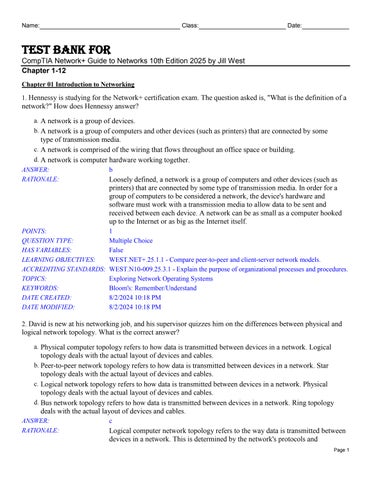
Test Bank For CompTIA Network+ Guide to Networks 10th Edition 2025 by Jill West Chapter 1-12 Chapter 01 Introduction to Networking 1. Hennessy is studying for the Network+ certification exam. The question asked is, "What is the definition of a
network?" How does Hennessy answer? a. A network is a group of devices. b. A network is a group of computers and other devices (such as printers) that are connected by some
type of transmission media. c. A network is comprised of the wiring that flows throughout an office space or building. d. A network is computer hardware working together. ANSWER: RATIONALE:
b
Loosely defined, a network is a group of computers and other devices (such as printers) that are connected by some type of transmission media. In order for a group of computers to be considered a network, the device's hardware and software must work with a transmission media to allow data to be sent and received between each device. A network can be as small as a computer hooked up to the Internet or as big as the Internet itself.
POINTS: 1 QUESTION TYPE: Multiple Choice HAS VARIABLES: False LEARNING OBJECTIVES: WEST.NET+.25.1.1 - Compare peer-to-peer and client-server network models. ACCREDITING STANDARDS: WEST.N10-009.25.3.1 - Explain the purpose of organizational processes and procedures. TOPICS: Exploring Network Operating Systems KEYWORDS: Bloom's: Remember/Understand DATE CREATED: 8/2/2024 10:18 PM DATE MODIFIED: 8/2/2024 10:18 PM 2. David is new at his networking job, and his supervisor quizzes him on the differences between physical and
logical network topology. What is the correct answer? a. Physical computer topology refers to how data is transmitted between devices in a network. Logical
topology deals with the actual layout of devices and cables. b. Peer-to-peer network topology refers to how data is transmitted between devices in a network. Star topology deals with the actual layout of devices and cables. c. Logical network topology refers to how data is transmitted between devices in a network. Physical topology deals with the actual layout of devices and cables. d. Bus network topology refers to how data is transmitted between devices in a network. Ring topology deals with the actual layout of devices and cables. ANSWER: RATIONALE:
c
Logical computer network topology refers to the way data is transmitted between devices in a network. This is determined by the network's protocols and Page 1