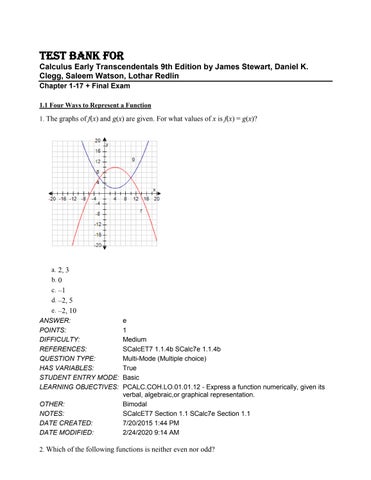
Test Bank for Calculus Early Transcendentals 9th Edition by James Stewart, Daniel K. Clegg, Saleem Watson, Lothar Redlin Chapter 1-17 + Final Exam 1.1 Four Ways to Represent a Function 1. The graphs of f(x) and g(x) are given. For what values of x is f(x) = g(x)?
a. 2, 3 b. 0 c. –1 d. –2, 5 e. –2, 10 ANSWER: e POINTS: 1 DIFFICULTY: Medium REFERENCES: SCalcET7 1.1.4b SCalc7e 1.1.4b QUESTION TYPE: Multi-Mode (Multiple choice) HAS VARIABLES: True STUDENT ENTRY MODE: Basic LEARNING OBJECTIVES: PCALC.COH.LO.01.01.12 - Express a function numerically, given its verbal, algebraic,or graphical representation. OTHER: Bimodal NOTES: SCalcET7 Section 1.1 SCalc7e Section 1.1 DATE CREATED: 7/20/2015 1:44 PM DATE MODIFIED: 2/24/2020 9:14 AM 2. Which of the following functions is neither even nor odd?
a.
b. c. ANSWER: b POINTS: 1 DIFFICULTY: Medium REFERENCES: SCalcET7 1.1.78 SCalc7e 1.1.78 QUESTION TYPE: Multi-Mode (Multiple choice) HAS VARIABLES: True STUDENT ENTRY MODE: Basic LEARNING OBJECTIVES: PCALC.COH.LO.01.04.03 - Determine if a function is odd or even algebraically. OTHER: Bimodal NOTES: SCalcET7 Section 1.1 SCalc7e Section 1.1 DATE CREATED: 7/20/2015 1:44 PM DATE MODIFIED: 1/18/2021 10:52 AM 3. If the point
is on the graph of an even function, what other point must also be on the graph?
a. b. c. (0, 0) d. e. None of these ANSWER: d POINTS: 1 DIFFICULTY: Medium REFERENCES: SCalcET7 1.1.71a SCalc7e 1.1.71a QUESTION TYPE: Multi-Mode (Multiple choice) HAS VARIABLES: True STUDENT ENTRY MODE: Basic LEARNING OBJECTIVES: PCALC.COH.LO.01.04.05 - Describe the symmetry present in the graph of an even function. OTHER: Bimodal NOTES: SCalcET7 Section 1.1 SCalc7e Section 1.1 DATE CREATED: 7/20/2015 1:44 PM DATE MODIFIED: 1/29/2020 2:43 AM
4. If
, evaluate the difference quotient a. 2a + h – 8 b. 2a – 8
.
c. 2a – h – 8 d. h e. none of these ANSWER: e POINTS: 1 DIFFICULTY: Medium REFERENCES: SCalcET7 1.1.28 SCalc7e 1.1.28 QUESTION TYPE: Multi-Mode (Multiple choice) HAS VARIABLES: True STUDENT ENTRY MODE: Basic LEARNING OBJECTIVES: PCALC.COH.LO.01.01.08 - Evaluate functions for given values of the independent variable. OTHER: Bimodal NOTES: SCalcET7 Section 1.1 SCalc7e Section 1.1 DATE CREATED: 7/20/2015 1:44 PM DATE MODIFIED: 1/29/2020 2:48 AM 5. A box with an open top is to be constructed from a rectangular piece of card board with
dimensions b = 6 in. by a = 25 in. by cutting out equal squares of side x at each corner and then folding up the sides as in the figure. Express the volume V of the box as a function of x.
a. b. c. d. e. ANSWER: e POINTS: 1 DIFFICULTY: Medium REFERENCES: SCalcET7 1.1.63 SCalc7e 1.1.63 QUESTION TYPE: Multi-Mode (Multiple choice) HAS VARIABLES: True STUDENT ENTRY MODE: Basic LEARNING OBJECTIVES: PCALC.COH.LO.01.01.11 - Express a function algebraically, given its verbal or numerical representation. OTHER: Bimodal
NOTES: DATE CREATED: DATE MODIFIED:
SCalcET7 Section 1.1 SCalc7e Section 1.1 7/20/2015 1:44 PM 2/10/2020 1:32 AM
6. Find an expression for the function y = f(x) whose graph is the bottom half of the parabola
. a. b. c. d. e. ANSWER: a POINTS: 1 DIFFICULTY: Medium REFERENCES: SCalcET7 1.1.53 SCalc7e 1.1.53 QUESTION TYPE: Multi-Mode (Multiple choice) HAS VARIABLES: True STUDENT ENTRY MODE: Basic LEARNING OBJECTIVES: PCALC.COH.LO.01.01.11 - Express a function algebraically, given its verbal or numerical representation. OTHER: Bimodal NOTES: SCalcET7 Section 1.1 SCalc7e Section 1.1 DATE CREATED: 7/20/2015 1:44 PM DATE MODIFIED: 1/29/2020 3:39 AM 7. A rectangle has perimeter 14 m. Express the area of the rectangle as a function A(l) of the length
l of one of its sides. a. b. c. d. e. ANSWER: a POINTS: 1 DIFFICULTY: Medium REFERENCES: SCalcET7 1.1.57 SCalc7e 1.1.57 QUESTION TYPE: Multi-Mode (Multiple choice) HAS VARIABLES: True STUDENT ENTRY MODE: Basic
LEARNING OBJECTIVES: PCALC.COH.LO.01.01.11 - Express a function algebraically, given its verbal or numerical representation. OTHER: Bimodal NOTES: SCalcET7 Section 1.1 SCalc7e Section 1.1 DATE CREATED: 7/20/2015 1:44 PM DATE MODIFIED: 1/29/2020 3:44 AM
8. If
, find and simplify
, where h ≠ 0.
a. b. c. d. ANSWER: d POINTS: 1 DIFFICULTY: Easy REFERENCES: SCalcET7 1.1.27 SCalc7e 1.1.27 QUESTION TYPE: Multi-Mode (Multiple choice) HAS VARIABLES: True STUDENT ENTRY MODE: Basic LEARNING OBJECTIVES: PCALC.COH.LO.01.01.08 - Evaluate functions for given values of the independent variable. OTHER: Bimodal NOTES: SCalcET7 Section 1.1 SCalc7e Section 1.1 DATE CREATED: 7/20/2015 1:44 PM DATE MODIFIED: 1/29/2020 3:59 AM DNAsequencing,biochemicalanalysis,andcomputationalbiology.**CurrentChallengesandFrontiers**:Discussiononcontemporarychallengesfacingbiology,such asemerginginfectiousdiseases,climatechangeimpacts,biodiversityloss,andtheapplicationofbiotechnologicalinnovations.**SummaryandKeyConcepts**:Thech apterconcludeswithasummaryofkeyconceptsdiscussed,reinforcingthefoundationalprinciplesofbiologyandpreparingstudentsforfurtherexplorationinsubsequent chapters.Chapter1of"EssentialsofBiology"aimstoprovidestudentswithacomprehensiveintroductiontothescientificstudyoflife,emphasizingitsbreadth,significance ,andrelevanceinunderstandingthenaturalworldandaddressingglobalchallenges.Itsetsthestagefordeeperexplorationintobiologicalconceptsandprinciplescovere dthroughoutthetextbook.IfyouhavespecificquestionsaboutanyofthesetopicsorwouldlikemoredetailedinformationonaparticularaspectofChapter1,feelfreetoask!Chapter2Chapter2of"E ssentialsofBiology"bySylviaMaderandMichaelWindelspecht,titled"TheChemicalBasisofLife,"typicallydelvesintothefoundationalprinciplesofchemistryastheyrelatetobiologicalsystems.Her e’sanoverviewofwhatyoumightfindinthischapter:**IntroductiontoBiochemistry**:Definitionofbiochemistryasthebranchofchemistryconcernedwiththechemicalprocessesandsubstancesthat occurwithinlivingorganisms.**ElementsandAtoms**:Explanationofbasicchemicalelementsessentialtolife,theiratomicstructure(protons,neutrons,electrons),andhowatomscombinetoform molecules.**ChemicalBonds**:Discussionondifferenttypesofchemicalbonds(covalent,ionic,hydrogenbonds)andtheirroleinholdingatomstogetherinmoleculesandcompounds.**Properties ofWater**:Explorationofwaterasapolarmolecule,itsuniqueproperties(highcohesion,adhesion,surfacetension,highspecificheatcapacity),anditsimportanceinbiologicalsystems.**Acids,Bas es,andpH**:Definitionofacidsandbases,theirroleinchemicalreactions,andtheconceptofpHasameasureofhydrogenionconcentration.ImportanceofpHregulationinbiologicalprocesses.**Org anicMolecules**:Introductiontoorganicmoleculesessentialforlife,includingcarbohydrates,lipids,proteins,andnucleicacids.Structure,function,andbiologicalsignificanceofeachgroupofmolec ules.**Carbohydrates**:Structureofcarbohydrates(monosaccharides,disaccharides,polysaccharides),theirrolesasenergysourcesandstructuralcomponentsincells.**Lipids**:Classification oflipids(fats,phospholipids,steroids),theirstructure,functions(energystorage,cellmembranes),androlesinbiologicalprocesses.**Proteins**:Structureofproteins(aminoacids,primary,second ary,tertiary,andquaternarystructure),functions(enzymes,structuralproteins,antibodies),andproteinsynthesis.**NucleicAcids**:Structureandfunctionofnucleicacids(DNAandRNA),includin gnucleotidestructure,DNAreplication,transcription,andtranslation.**EnzymesandCatalysis**:Roleofenzymesasbiologicalcatalysts,enzymesubstrateinteractions,enzymespecificity,factorsinfluencingenzymeactivity,andregulationofenzymefunction.**EnergyandMetabolism**:Overviewofenergytransformationsinbiologicalsyste ms,includinganintroductiontometabolism,energycarriers(ATP),andmetabolicpathways(e.g.,glycolysis,Krebscycle).**SummaryandKeyConcepts**:Thechapterconcludeswithasummaryof keyconceptsrelatedtothechemicalbasisoflife,reinforcingunderstandingofthefoundationalprinciplesofbiochemistryandtheirsignificanceinbiologicalprocesses.Chapter2providesacomprehe nsiveintroductiontothechemicalfoundationsthatunderpinbiologicalsystems.Itestablishesacrucialunderstandingofhowchemicalprinciplesgovernthestructure,function,andinteractionsofbiol ogicalmoleculesessentialforlife.Thisknowledgeservesasabasisforfurtherexplorationintocellularprocesses,genetics,andphysiologicalmechanismscoveredinsubsequentchaptersofthetext book.IfyouhavespecificquestionsaboutanyofthesetopicsorwouldlikemoredetailedinformationonaparticularaspectofChapter2,feelfreetoask!Chapter3Chapter3of"EssentialsofBiology"byS ylviaMaderandMichaelWindelspecht,titled"TheOrganicMoleculesofLife,"focusesspecificallyonthemajorclassesoforganicmoleculesessentialforbiologicalsystems.Here’sanoverviewofwh atyoumightfindinthischapter:**IntroductiontoOrganicMolecules**:Definitionoforganicmoleculesandtheirimportanceasthebuildingblocksoflife.Overviewofthemajorclassesoforganicmolecul es:carbohydrates,lipids,proteins,andnucleicacids.**Carbohydrates**:Detailedexplorationofcarbohydrates,including:**Monosaccharides**:Structure(e.g.,glucose,fructose),functionasene rgysources,androlesincellularprocesses.**Disaccharides**:Formationfrommonosaccharides(e.g.,sucrose,lactose)andbiologicalsignificance.**Polysaccharides**:Structure(e.g.,starch,gl ycogen,cellulose),functionasenergystorage(starch,glycogen)andstructuralsupport(cellulose).**Lipids**:Examinationoflipids,including:**FatsandOils**:Structure(triglycerides),functionas energystorageandinsulation.**Phospholipids**:Structure,roleincellmembranes(phospholipidbilayer),andamphipathicnature.**Steroids**:Structure(e.g.,cholesterol),rolesashormones(e.g .,estrogen,testosterone)andmembranecomponents.**Proteins**:In-depthcoverageofproteins,including:**AminoAcids**:Structureofaminoacids,classification(essentialvs.non-
9. Find the domain and sketch the graph of the function. What is its range?