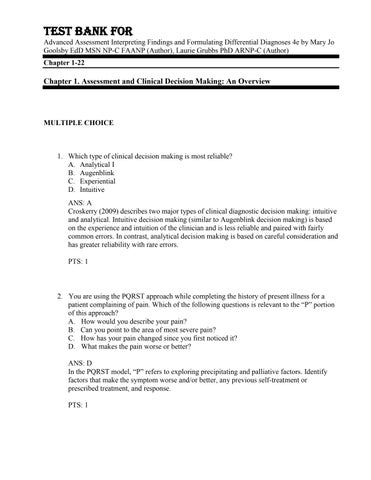
Test Bank For Advanced Assessment Interpreting Findings and Formulating Differential Diagnoses 4e by Mary Jo Goolsby EdD MSN NP-C FAANP (Author), Laurie Grubbs PhD ARNP-C (Author) Chapter 1-22
Chapter 1. Assessment and Clinical Decision Making: An Overview
MULTIPLE CHOICE
1. Which type of clinical decision making is most reliable? A. Analytical I B. Augenblink C. Experiential D. Intuitive ANS: A Croskerry (2009) describes two major types of clinical diagnostic decision making: intuitive and analytical. Intuitive decision making (similar to Augenblink decision making) is based on the experience and intuition of the clinician and is less reliable and paired with fairly common errors. In contrast, analytical decision making is based on careful consideration and has greater reliability with rare errors. PTS: 1
,
2. You are using the PQRST approach while completing the history of present illness for a patient complaining of pain. Which of the following questions is relevant to the ―P‖ portion of this approach? A. How would you describe your pain? B. Can you point to the area of most severe pain? C. How has your pain changed since you first noticed it? D. What makes the pain worse or better? ANS: D In the PQRST model, ―P‖ refers to exploring precipitating and palliative factors. Identify factors that make the symptom worse and/or better, any previous self-treatment or prescribed treatment, and response. PTS: 1