Exam Name___________________________________
SHORT ANSWER. Write the word or phrase that best completes each statement or answers the question. Provide an appropriate response. 1) Which terms, n and m, in the arithmetic sequence 175, 250, 325, . . . and the geometric sequence 1, 10, 100, . . ., respectively, have the same value? What is the value?
1)
2) At what term will the geometric sequence 1, 2, 4, 8, . . . become greater than the arithmetic sequence 0, 20, 40, 60, . . .?
2)
3) What is the sum of three consecutive integers in terms of the middle number x? What would the sum be in terms of the middle number for five and seven consecutive integers? What can you generalize about the sum of n consecutive integers where n is odd?
3)
4) Use the strategy of writing equations to justify that if y = 2x and z = y + 5, then z is greater than x.
4)
MULTIPLE CHOICE. Choose the one alternative that best completes the statement or answers the question. Find the requested term in the sequence.
5) The 19th term in 8, 40, 120, 40 · 3 2 , 40 · 3 3 , . . . A) 40 · 3 18 B) 40 · 3 21
C) 40 · 3 17
D) 40 · 3 19
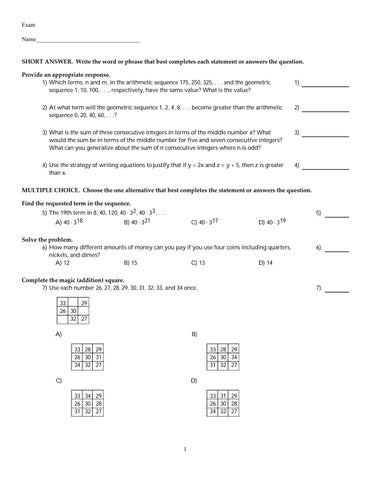
Solve the problem. 6) How many different amounts of money can you pay if you use four coins including quarters, nickels, and dimes? A) 12 B) 15 C) 13 D) 14 Complete the magic (addition) square. 7) Use each number 26, 27, 28, 29, 30, 31, 32, 33, and 34 once.
B) 33 28 29 26 30 31 34 32 27
33 28 29 26 30 34 31 32 27
C)
D) 33 34 29 26 30 28 31 32 27
33 31 29 26 30 28 34 32 27
1
6)
7)
33 29 26 30 32 27
A)
5)