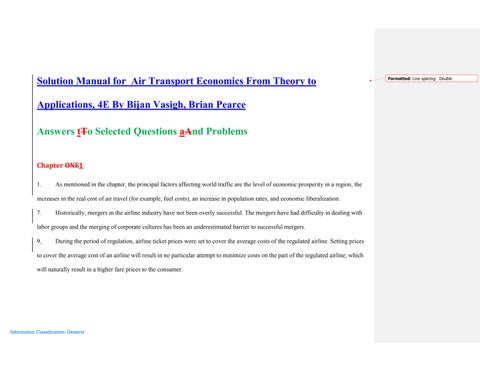
Solution Manual for Air Transport Economics From Theory to Applications, 4E By Bijan Vasigh, Brian Pearce Answers tTo Selected Questions aAnd Problems Chapter ONE1 1.
As mentioned in the chapter, the principal factors affecting world traffic are the level of economic prosperity in a region, the
increases in the real cost of air travel (for example, fuel costs), an increase in population rates, and economic liberalization. 7.
Historically, mergers in the airline industry have not been overly successful. The mergers have had difficulty in dealing with
labor groups and the merging of corporate cultures has been an underestimated barrier to successful mergers. 9.
During the period of regulation, airline ticket prices were set to cover the average costs of the regulated airline. Setting prices
to cover the average cost of an airline will result in no particular attempt to minimize costs on the part of the regulated airline, which will naturally result in a higher fare prices to the consumer.
Information Classification: General
Formatted: Line spacing: Double
11. The direct effects of the economic impacts of air transportation are the direct payments that are made to the participants in the industry. An example of this would be salaries paid to the employees of an airport or airlines that use the airport. The indirect economic impacts are those that are not directly attributable to the industry itself but come about because of the presence of the industry. An example of this would be to salaries of people employed in a hotel that is adjacent to the airport. 13. Low-cost carriers generally have an inherent cost advantage over legacy carriers due to the fact that they are free to negotiate wages and prior agreements without the encumbrance of contracts that were negotiated during the regulated era, or even more recent contracts shaped by attitudes and labor culture that are still influenced by traditions established in the regulated era. 14. International routes have traditionally been less competitive than domestic routes because of the fact that political considerations are always involved in international air travel and airlines must get political approval before instituting new international routes. 15. The principal advantage that airline travel has over all other modes of transportation is the speed of travel, particularly over distances in excess of 300 to –400 miles.
Chapter TWO2 1.
Opportunity cost, as it is used in economics, is defined as the alternative cost of using a resource; that is, the benefits that
would accrue if the resource resources were being used in its next best allocation.
Information Classification: General
3. Economics may be defined as the science of decision-making and resource allocation under scarcity. 4. Microeconomics deals with the behavior of individual households and businesses; that is, individual decision-making units who that are responding to either the supply or demand for scarce resources. On the other hand, macroeconomics studies the decision-making process for the entire economy; movements in gross domestic product, interest rates, inflation rates, exchange rates, balancing trays, and their interrelationships are all considered macroeconomic. 6. The two main categories of market failures are externalities and the lack of any competitive outcome in the market; in other words, some type of monopoly pricing. 7. What is unique about the regulatory environment of the airline industry is the fact that the delivery of the product, that is, an airline seat to a specific destination, has been completely controlled by the federal government. Therefore, airlines have generally not been free to adjust their schedules and reactions to market conditions, but must respond to the control of the Federal Aviation Administration with respect to the delivery of their product. Pockets of such oppressive regulation continue, and even in more deregulated markets, the FAA‟s ATC and influence on airport policies continue to hinder airlines‟ decisions. 11. Prices constitute the central allocating mechanism in economics and are the decision-making parameters by which individuals and businesses organize their actions. Prices in market economies reflect both the scarcity of resources and the valuation that consumers place on the products that are produced by those resources.
Information Classification: General
13. If a freeway has one lane reserved for only those drivers who were are considered to be on urgent business, as defined by themselves, the economic principle of self-interest (not greed) would result in that lane being as crowded as all the other lanes, since Formatted: Centered, Line spacing: Double
the majority of drivers would naturally consider that their own business is urgent. 16. Some amount of unemployment is essential to the functioning of a market economy, since individuals must be free to change
Formatted: Font: (Default) Times New Roman, 12 pt, Font color: Custom Color(RGB(153,0,153)) Formatted Table
occupations and to search for those jobs that they are best suited for. This specialization increases the overall output of the economy. 25.
Formatted: Font: (Default) Times New Roman, 12 pt, Font color: Custom Color(RGB(153,0,153)) Formatted: Centered, Line spacing: Double
Total
In Labor
Employe
In Labor
Employe
Population
Force
d
Force
d
Employ
Unemploym
Formatted: Centered, Indent: First line: 0", Line spacing: Double
ed
ent
Formatted: Centered, Indent: First line: 0", Line spacing: Double
Rate
Rate
Formatted: Centered, Indent: First line: 0", Line spacing: Double Formatted: Centered, Line spacing: Double
High School
35,450,000
23,042,500
21,199,1
High School
23,042,500
00 Bachelors
45,233,000
29,401,450
Degree
21,199,1
Formatted: Line spacing: Double
0.92
0.08
BachelorsBachelor‟s
49
Degree
25,945,0
Post Graduate
29,401,450
27,343,3
Formatted: Font: Font color: Auto Formatted: Line spacing: Double
00
27,343,3
Formatted: Indent: First line: 0", Line spacing: Double
0.93
0.07
Formatted: Indent: First line: 0", Line spacing: Double Formatted: Font: Font color: Auto Formatted: Font: Font color: Auto
49
Formatted: Line spacing: Double
Post Graduate
41,150,000
26,747,500
26,747,500
25,945,0
0.97
0.03
Formatted: Indent: First line: 0", Line spacing: Double Formatted: Font: Font color: Auto
Information Classification: General
75
75 Formatted: Line spacing: Double
ChapterCHAPTER THREE3 1.
. Price elasticity of demand is defined as the percentage change in the quantity demanded divided by the percentage change in the
price. A product with elastic demand might be fresh tomatoes, since there are a variety of good substitutes for tomatoes. A product with inelastic demand might be gasoline, since it is difficult to change driving patterns right away. 3. Give an example for the airline industry and show it graphically. The law of demand states that, all else equal, consumers will buy less of a given time when the price of a product increases and buy more as the price decreases. The law of supply states that the higher the price, the more producers are willing and able to produce. All else constant, the quantity supplied increases as the price increases and decreases as price decreases. An increase in demand is a shift in the entire demand curve. An increase in the quantity demanded is a movement along a given demand curve. 4.
We would expect that the elasticity of demand in short-haul markets would be more elastic than long-haul markets because the
automobile and rail transportation can compete with airlines in a short-haul market, whereas it is more difficult for other modes of transportation to compete with airline travel in the long-haul market, especially with regard to time of travel.
Information Classification: General