Solution Manual for The Mechanics of Biological Materials, 1E By Manuel Elices, Gustavo Guinea, John

Page 1

Solution Manual for The Mechanics of Biological Materials, 1E By Manuel Elices, Gustavo Guinea, John Morton

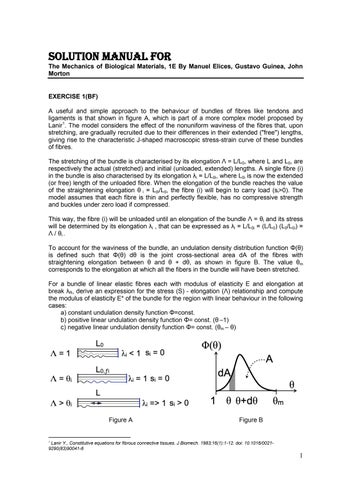
EXERCISE 1(BF) A useful and simple approach to the behaviour of bundles of fibres like tendons and ligaments is that shown in figure A, which is part of a more complex model proposed by Lanir1. The model considers the effect of the nonuniform waviness of the fibres that, upon stretching, are gradually recruited due to their differences in their extended ("free") lengths, giving rise to the characteristic J-shaped macroscopic stress-strain curve of these bundles of fibres. The stretching of the bundle is characterised by its elongation Λ = L/L0, where L and L0, are respectively the actual (stretched) and initial (unloaded, extended) lengths. A single fibre (i) in the bundle is also characterised by its elongation λi = L/L0i, where L0i is now the extended (or free) length of the unloaded fibre. When the elongation of the bundle reaches the value of the straightening elongation θ i = L0i/L0, the fibre (i) will begin to carry load (si>0). The model assumes that each fibre is thin and perfectly flexible, has no compressive strength and buckles under zero load if compressed. This way, the fibre (i) will be unloaded until an elongation of the bundle Λ = θi and its stress will be determined by its elongation λi , that can be expressed as λi = L/L0i = (L/L0) (L0/L0i) = Λ / θi . To account for the waviness of the bundle, an undulation density distribution function Φ(θ) is defined such that Φ(θ) dθ is the joint cross-sectional area dA of the fibres with straightening elongation between θ and θ + dθ, as shown in figure B. The value θm corresponds to the elongation at which all the fibers in the bundle will have been stretched. For a bundle of linear elastic fibres each with modulus of elasticity E and elongation at break λR, derive an expression for the stress (S) - elongation (Λ) relationship and compute the modulus of elasticity E* of the bundle for the region with linear behaviour in the following cases: a) constant undulation density function Φ=const. b) positive linear undulation density function Φ= const. (θ –1) c) negative linear undulation density function Φ= const. (θm – θ)

Figure A

Figure B

1

Lanir Y., Constitutive equations for fibrous connective tissues. J Biomech. 1983;16(1):1-12. doi: 10.1016/00219290(83)90041-6

1


Turn static files into dynamic content formats.

Create a flipbook
Solution Manual for The Mechanics of Biological Materials, 1E By Manuel Elices, Gustavo Guinea, John by AnswerDone - Issuu