Solution Manual For All Chapters
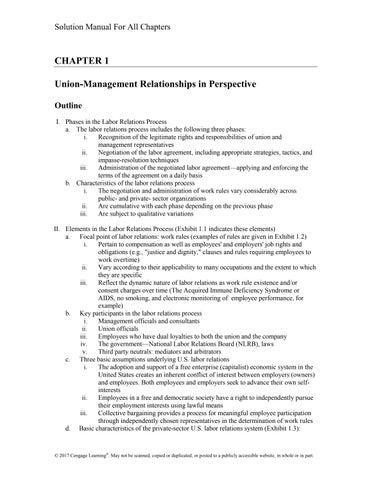
CHAPTER 1 Union-Management Relationships in Perspective Outline I. Phases in the Labor Relations Process a. The labor relations process includes the following three phases: i. Recognition of the legitimate rights and responsibilities of union and management representatives ii. Negotiation of the labor agreement, including appropriate strategies, tactics, and impasse-resolution techniques iii. Administration of the negotiated labor agreement—applying and enforcing the terms of the agreement on a daily basis b. Characteristics of the labor relations process i. The negotiation and administration of work rules vary considerably across public- and private- sector organizations ii. Are cumulative with each phase depending on the previous phase iii. Are subject to qualitative variations II. Elements in the Labor Relations Process (Exhibit 1.1 indicates these elements) a. Focal point of labor relations: work rules (examples of rules are given in Exhibit 1.2) i. Pertain to compensation as well as employees' and employers' job rights and obligations (e.g., "justice and dignity," clauses and rules requiring employees to work overtime) ii. Vary according to their applicability to many occupations and the extent to which they are specific iii. Reflect the dynamic nature of labor relations as work rule existence and/or consent charges over time (The Acquired Immune Deficiency Syndrome or AIDS, no smoking, and electronic monitoring of employee performance, for example) b. Key participants in the labor relations process i. Management officials and consultants ii. Union officials iii. Employees who have dual loyalties to both the union and the company iv. The government—National Labor Relations Board (NLRB), laws v. Third party neutrals: mediators and arbitrators c. Three basic assumptions underlying U.S. labor relations i. The adoption and support of a free enterprise (capitalist) economic system in the United States creates an inherent conflict of interest between employers (owners) and employees. Both employees and employers seek to advance their own selfinterests ii. Employees in a free and democratic society have a right to independently pursue their employment interests using lawful means iii. Collective bargaining provides a process for meaningful employee participation through independently chosen representatives in the determination of work rules d. Basic characteristics of the private-sector U.S. labor relations system (Exhibit 1.3):
© 2017 Cengage Learning®. May not be scanned, copied or duplicated, or posted to a publicly accessible website, in whole or in part.