SOLUTION MANUAL FOR THE EXERCISES in THE CRC BOOK: Situation Assessment in Aviation: Bayesian Networks and Fuzzy Logic Approaches. (By Jitendra, R, Raol, Sudesh K. Kashyap, and Lakshmi, S.) Chapter 2 2.1 Definition of SAW: Within the given volume of space and time, perception of environmental elements, understanding the meaning of them and projecting the status of them in the near future. The four qualitative methods of describing the SAW are: • • • •
Using a model for processing information or data to define and explain SAW; Using cycle of actions-perceptions to define and explain SAW; Comparison of SAW with the expertise; Using SAW to describe the phenomena of behaviour.
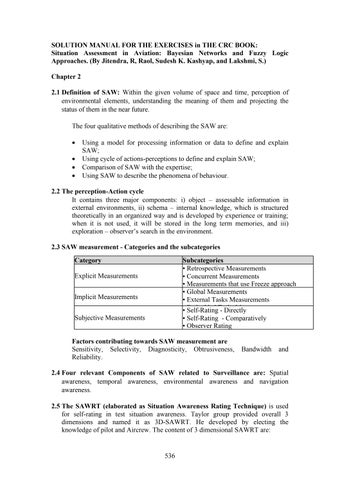
2.2 The perception-Action cycle It contains three major components: i) object – assessable information in external environments, ii) schema – internal knowledge, which is structured theoretically in an organized way and is developed by experience or training; when it is not used, it will be stored in the long term memories, and iii) exploration – observer’s search in the environment. 2.3 SAW measurement - Categories and the subcategories Category
Subcategories • Retrospective Measurements • Concurrent Measurements • Measurements that use Freeze approach • Global Measurements • External Tasks Measurements •• Embedded Measurements Self-RatingTasks - Directly
Explicit Measurements Implicit Measurements
• Self-Rating - Comparatively • Observer Rating
Subjective Measurements
Factors contributing towards SAW measurement are Sensitivity, Selectivity, Diagnosticity, Obtrusiveness, Reliability.
Bandwidth
and
2.4 Four relevant Components of SAW related to Surveillance are: Spatial awareness, temporal awareness, environmental awareness and navigation awareness. 2.5 The SAWRT (elaborated as Situation Awareness Rating Technique) is used for self-rating in test situation awareness. Taylor group provided overall 3 dimensions and named it as 3D-SAWRT. He developed by electing the knowledge of pilot and Aircrew. The content of 3 dimensional SAWRT are:
536