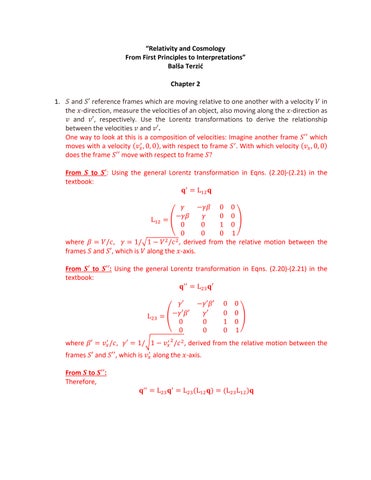
“Relativity and Cosmology From First Principles to Interpretations” Balša Terzić Chapter 2 1. 𝑆 and 𝑆′ reference frames which are moving relative to one another with a velocity 𝑉 in the 𝑥-direction, measure the velocities of an object, also moving along the 𝑥-direction as 𝑣 and 𝑣′, respectively. Use the Lorentz transformations to derive the relationship between the velocities 𝑣 and 𝑣′. One way to look at this is a composition of velocities: Imagine another frame 𝑆′′ which moves with a velocity (𝑣!" , 0, 0), with respect to frame 𝑆 " . With which velocity (𝑣! , 0, 0) does the frame 𝑆′′ move with respect to frame 𝑆? From 𝑺 to 𝑺′: Using the general Lorentz transformation in Eqns. (2.20)-(2.21) in the textbook: 𝐪" = L#$ 𝐪 𝛾 −𝛾𝛽 0 0 −𝛾𝛽 𝛾 0 0 L#$ = 1 6 0 0 1 0 0 0 0 1 where 𝛽 = 𝑉/𝑐, 𝛾 = 1/91 − 𝑉 $ /𝑐 $ , derived from the relative motion between the frames 𝑆 and 𝑆′, which is 𝑉 along the 𝑥-axis. From 𝑺′ to 𝑺′′: Using the general Lorentz transformation in Eqns. (2.20)-(2.21) in the textbook: 𝐪"" = L$% 𝐪′ 𝛾′ L$% = 1−𝛾′𝛽′ 0 0
−𝛾′𝛽′ 𝛾′ 0 0
0 0 0 06 1 0 0 1
where 𝛽′ = 𝑣!" /𝑐, 𝛾′ = 1/:1 − 𝑣!" $ /𝑐 $ , derived from the relative motion between the frames 𝑆′ and 𝑆′′, which is 𝑣!" along the 𝑥-axis. From 𝑺 to 𝑺′′: Therefore,
𝐪"" = L$% 𝐪" = L$% (L#$ 𝐪) = (L$% L#$ )𝐪