Solution Manual For Real Estate Principles A Value Approach 7e David Ling and Wayne Archer Chapter 1-23
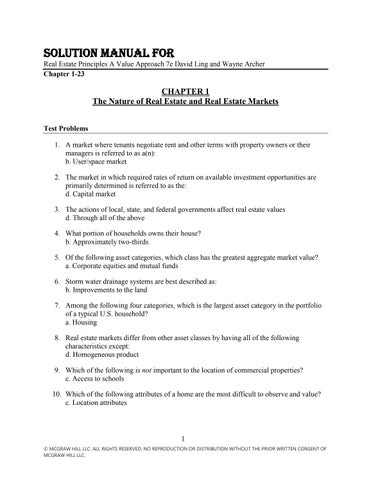
CHAPTER 1 The Nature of Real Estate and Real Estate Markets Test Problems 1. A market where tenants negotiate rent and other terms with property owners or their managers is referred to as a(n): b. User/space market 2. The market in which required rates of return on available investment opportunities are primarily determined is referred to as the: d. Capital market 3. The actions of local, state, and federal governments affect real estate values d. Through all of the above 4. What portion of households owns their house? b. Approximately two-thirds 5. Of the following asset categories, which class has the greatest aggregate market value? a. Corporate equities and mutual funds 6. Storm water drainage systems are best described as: b. Improvements to the land 7. Among the following four categories, which is the largest asset category in the portfolio of a typical U.S. household? a. Housing 8. Real estate markets differ from other asset classes by having all of the following characteristics except: d. Homogeneous product 9. Which of the following is not important to the location of commercial properties? c. Access to schools 10. Which of the following attributes of a home are the most difficult to observe and value? c. Location attributes
1 © MCGRAW HILL LLC. ALL RIGHTS RESERVED. NO REPRODUCTION OR DISTRIBUTION WITHOUT THE PRIOR WRITTEN CONSENT OF MCGRAW HILL LLC.
Study Questions 1. The term real estate can be used in three fundamental ways. List these three alternative uses or definitions. Solution: Real estate is most commonly defined as land and any improvements made to, or on, the land, including fixed structures and infrastructure components. The term is also used to describe the ―bundle of rights‖ associated with the ownership and use of the physical characteristics of space and location. Finally, real estate may be described as the business activities related to the development, construction, acquisition, operation, leasing, and disposition of real property assets. 2. The U.S. represents about 6 percent of the earth’s land service, or approximately 2.3 billion acres. Who actually owns this land? What is the distribution of this land among the various uses (e.g., urban land, crop land, land, forest land). Solution: Urban land, consisting of residential, industrial, commercial, and institutional land, represents approximately 3 percent of the total land in the U.S. Crop land occupies about 17 percent of the land; and pasture and range land comprises about 29 percent of the land. Forest use land accounts for 28 percent. 3. Describe the value of U.S. real estate by comparing it to the values of the other major asset classes (e.g., corporate stocks, bonds, mortgages, U.S. Treasury securities). Solution: As of the end of 2021, real estate (including owner-occupied housing and commercial real estate, but excluding real estate held by governments and non-real estate corporations) was the second largest asset class in the U.S., valued at approximately $54 trillion. The value of exchange-listed corporate equities and mutual funds at that time was $102 trillion. The value of mortgage debt (on all property types) was $18 trillion. This is larger than the existing stock of both corporate and foreign bonds and less than the outstanding value of U.S. Treasury Securities. 4. How much of the wealth of a typical U.S. household is tied up in housing? How does this compare to the role that other assets and investments play in the portfolios of U.S. households? Solution: Housing is the second largest asset in the typical/average U.S. household’s portfolio, representing approximately 23 percent of total assets in late 2021. In comparison, the total value of stocks and mutual fund shares represents 27 percent of household assets. Pension assets/reserves, excluding stocks, represent 19 percent of household assets. Deposits and money market funds represent 11 percent of household assets. 5. Real estate assets and markets are unique when compared to other assets or markets. Discuss the primary ways that real estate markets are different from the markets for other asset that trade in well-developed public markets. 2 © MCGRAW HILL LLC. ALL RIGHTS RESERVED. NO REPRODUCTION OR DISTRIBUTION WITHOUT THE PRIOR WRITTEN CONSENT OF MCGRAW HILL LLC.
Solution: Real estate is unlike other asset classes because it is heterogeneous and immobile. Real estate assets have unique and distinctive characteristics, such as age, building design, and location. Real estate is also immobile; therefore, location is an important attribute. Because real estate assets are heterogeneous and immobile, real estate markets are illiquid and localized. Potential users of real property and competing real estate are typically located in the same area or region. Additionally, real estate markets are highly segmented because of their heterogeneous nature. Therefore, potential users of a specific type of real property generally do not seek to substitute one property type/category for another. Finally, most real estate transactions are privately negotiated and have relatively high transaction costs. 6. Explain the role of government in real estate at the federal, state, and local level. Which has the most significant impact on real estate markets? Solution: Local governments typically have the most influence on real estate markets. They affect the supply and cost of real estate through zoning and land use regulations, fees on new land development, and restrictive building codes. They also affect rental rates through the assessment of property taxes. Local governments also affect the supply and quality of real estate through the provision of community infrastructure and through building codes. The Federal government influences real estate through income tax policy, housing subsidy programs, federal financial reporting requirements, fair housing laws, and disclosure laws. State governments generally have the least influence on real estate, although they affect real estate through the licensing of real estate professionals, establishment of statewide building codes, the creation of fair housing and disclosure laws, and through numerous housing related subsides for low and moderate income households. In addition, states may protect some environmentally sensitive lands from development. 7. Identify and describe the interaction of the three economic sectors that affect real estate value. Solution: The three economic sectors that influence real estate value are user/space markets, capital markets, and government. In real estate user markets, households and firms compete for physical locations and space. This competition determines who will obtain the use of a specific property (or space within a property) and how much rent will be paid for the use of this property. Capital markets provide the financial resources (capital) necessary for the development and acquisition of real estate assets. Real estate competes for the capital of potential investors against other investment opportunities in the capital market (such as stocks and bonds) based on investors’ required rates of returns and risk considerations. Capital markets are segregated into two categories: equity interests and debt interests. Government influences the interaction between the user/space markets and capital markets through tax policy, regulations, provisions of services and infrastructure, subsidies and other means. 8. Real estate construction is a volatile process determined by the interaction of the user, capital, and property markets. What signals do real estate producers (i.e., developers) use to manage this process? What other factors affect the volatility of real estate production? 3 © MCGRAW HILL LLC. ALL RIGHTS RESERVED. NO REPRODUCTION OR DISTRIBUTION WITHOUT THE PRIOR WRITTEN CONSENT OF MCGRAW HILL LLC.
Solution: When real estate market prices (values) exceed the total cost of production, this signals to producers that they should build, or add additional supply. As the supply of real estate increases relative to demand, rental rates decline in the user market (al else equal), which lowers property values and signals the real estate market to slow the production of new real estate. Furthermore, shocks in the capital markets and the volatility of construction costs add to the volatility of real estate production. For example, higher interest rates adversely affect property values, all else equal, thereby reducing the attractiveness of new construction. Additionally, shortages of key building materials and organized labor disputes may contribute to the volatility of real estate production. 9. Contrast what ―price‖ is determined in space/user market with what price is determined in property markets. Solution: Rental rates (and other leasing terms) are determined in space/user markets; the market values of equity ownership interests, and therefore transaction prices, are determined in property markets. The required rates of return (discount rates), largely determined obtained in capital markets, are used by investors to discount current and future rental rates from the user/space market into values/prices in the property market.
CHAPTER 2 Legal Foundations to Value
Test Problems 1. Which of the following is not a form of property right? d. License 2. Which of these easements is most likely to be an easement in gross? d. Power line easement 3. Rules used by courts to determine whether something is a fixture include all except c. Law of capture. 4. Which of these is a titled estate? e. All of these 5. Which of these forms of co-ownership could best be described as ―normal ownership,‖ except that multiple owners share identically in one bundle of rights? a. Tenancy in common 6. Which of these marriage-related forms of co-ownership gives each spouse a one-half 4 © MCGRAW HILL LLC. ALL RIGHTS RESERVED. NO REPRODUCTION OR DISTRIBUTION WITHOUT THE PRIOR WRITTEN CONSENT OF MCGRAW HILL LLC.
interest in any property that is ―fruits of the marriage‖? c. Community property 7. Which of these liens has the highest priority? c. Property tax lien 8. Restrictive covenants for a subdivision usually can be enforced by: d. a and b, but not c. 9. Timeshare programs can involve which of the following claims or interests? e. All of these are possible. 10. Every condominium buyer needs to know the details of which document(s): d. a and b, but not c.
Study Questions 1. Explain how rights differ from power or force, and from permission. Solution: Rights have three characteristics. First, rights are claims or demands that our government is obligated to enforce. Second, rights are nonrevocable and cannot be canceled, ignored, or otherwise lessened by other private citizens. Third, rights are enduring and do not fade away with time. Rights are different from power because the government is obligated to honor and support the claims arising from rights. Government will not support claims without right, based merely on the use of force or threat. The government is obligated to defend property rights in subsequent generations, and it does not have the power to abandon this obligation. Unlike permission, which is revocable, rights are nonrevocable and cannot be taken away or lessened in stature by other private citizens. 2. A developer of a subdivision wants to preserve the open space and natural habitat that runs along the back portion of a series of large lots in the proposed subdivision. He is debating whether to use restrictive covenants to accomplish this or to create a habitat easement on the same space. What are the pros and cons of each choice? Solution: A developer may choose to use restrictive covenants to limit the use of the land for environmental purposes, while maintaining the quality, stability, and value of the surrounding lots. Restrictive covenants are strictly private because only parties of interest can enforce the covenant. In the case of an isolated deed restriction, the owner who created the restriction or that owner's heirs are the only persons who can enforce the restriction. Court decisions frequently follow common law, which holds that property should be used productively, and favor fewer restrictions over the use of land. Whether the restriction is in an isolated deed or part of a general set of subdivision restrictions, the courts have 5 © MCGRAW HILL LLC. ALL RIGHTS RESERVED. NO REPRODUCTION OR DISTRIBUTION WITHOUT THE PRIOR WRITTEN CONSENT OF MCGRAW HILL LLC.