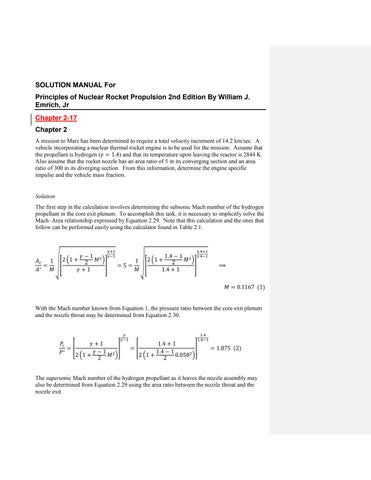
SOLUTION MANUAL For Principles of Nuclear Rocket Propulsion 2nd Edition By William J. Emrich, Jr Chapter 2-17 Chapter 2 A mission to Mars has been determined to require a total velocity increment of 14.2 km/sec. A vehicle incorporating a nuclear thermal rocket engine is to be used for the mission. Assume that the propellant is hydrogen ( ) and that its temperature upon leaving the reactor is 2844 K. Also assume that the rocket nozzle has an area ratio of 5 in its converging section and an area ratio of 300 in its diverging section. From this information, determine the engine specific impulse and the vehicle mass fraction.
Solution The first step in the calculation involves determining the subsonic Mach number of the hydrogen propellant in the core exit plenum. To accomplish this task, it is necessary to implicitly solve the Mach–Area relationship expressed by Equation 2.29. Note that this calculation and the ones that follow can be performed easily using the calculator found in Table 2.1.
√6
(
) 7
√6
(
) 7
With the Mach number known from Equation 1, the pressure ratio between the core exit plenum and the nozzle throat may be determined from Equation 2.30.
6
7 (
)
6
7 (
)
The supersonic Mach number of the hydrogen propellant as it leaves the nozzle assembly may also be determined from Equation 2.29 using the area ratio between the nozzle throat and the nozzle exit.