Chapter 1
Gases and the Zeroth Law of Thermodynamics 1.2.
1.4.
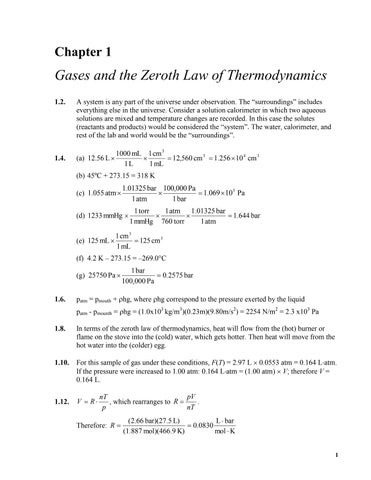
A system is any part of the universe under observation. The “surroundings” includes everything else in the universe. Consider a solution calorimeter in which two aqueous solutions are mixed and temperature changes are recorded. In this case the solutes (reactants and products) would be considered the “system”. The water, calorimeter, and rest of the lab and world would be the “surroundings”.
1000 mL 1 cm 3 12,560 cm 3 1.256 10 4 cm 3 (a) 12.56 L 1L 1 mL (b) 45ºC + 273.15 = 318 K (c) 1.055 atm
1.01325 bar 100,000 Pa 1.069 10 5 Pa 1 atm 1 bar
(d) 1233 mmHg
1 torr 1 atm 1.01325 bar 1.644 bar 1 mmHg 760 torr 1 atm
1 cm 3 125 cm 3 (e) 125 mL 1 mL (f) 4.2 K – 273.15 = –269.0°C (g) 25750 Pa 1.6.
1 bar 0.2575 bar 100,000 Pa
patm = pmouth + hg, where hg correspond to the pressure exerted by the liquid patm - pmounth = hg = (1.0x10³ kg/m3)(0.23m)(9.80m/s2) = 2254 N/m2 = 2.3 x10³ Pa
1.8.
In terms of the zeroth law of thermodynamics, heat will flow from the (hot) burner or flame on the stove into the (cold) water, which gets hotter. Then heat will move from the hot water into the (colder) egg.
1.10.
For this sample of gas under these conditions, F(T) = 2.97 L 0.0553 atm = 0.164 Latm. If the pressure were increased to 1.00 atm: 0.164 Latm = (1.00 atm) V; therefore V = 0.164 L.
1.12.
V R
pV nT , which rearranges to R . p nT
Therefore: R
(2.66 bar)(27.5 L) L bar 0.0830 (1.887 mol)(466.9 K) mol K 1