Chapter 1: An Overview of Strategic Marketing
1
CHAPTER 1
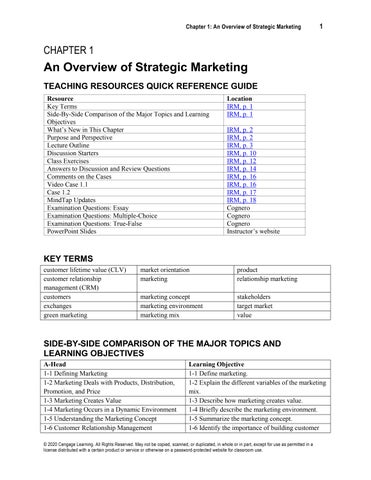
An Overview of Strategic Marketing TEACHING RESOURCES QUICK REFERENCE GUIDE Resource Key Terms Side-By-Side Comparison of the Major Topics and Learning Objectives What’s New in This Chapter Purpose and Perspective Lecture Outline Discussion Starters Class Exercises Answers to Discussion and Review Questions Comments on the Cases Video Case 1.1 Case 1.2 MindTap Updates Examination Questions: Essay Examination Questions: Multiple-Choice Examination Questions: True-False PowerPoint Slides
Location IRM, p. 1 IRM, p. 1 IRM, p. 2 IRM, p. 2 IRM, p. 3 IRM, p. 10 IRM, p. 12 IRM, p. 14 IRM, p. 16 IRM, p. 16 IRM, p. 17 IRM, p. 18 Cognero Cognero Cognero Instructor’s website
KEY TERMS customer lifetime value (CLV) customer relationship management (CRM) customers exchanges green marketing
market orientation marketing
product relationship marketing
marketing concept marketing environment marketing mix
stakeholders target market value
SIDE-BY-SIDE COMPARISON OF THE MAJOR TOPICS AND LEARNING OBJECTIVES A-Head 1-1 Defining Marketing 1-2 Marketing Deals with Products, Distribution, Promotion, and Price 1-3 Marketing Creates Value 1-4 Marketing Occurs in a Dynamic Environment 1-5 Understanding the Marketing Concept 1-6 Customer Relationship Management
Learning Objective 1-1 Define marketing. 1-2 Explain the different variables of the marketing mix. 1-3 Describe how marketing creates value. 1-4 Briefly describe the marketing environment. 1-5 Summarize the marketing concept. 1-6 Identify the importance of building customer
© 2020 Cengage Learning. All Rights Reserved. May not be copied, scanned, or duplicated, in whole or in part, except for use as permitted in a license distributed with a certain product or service or otherwise on a password-protected website for classroom use.
Chapter 1: An Overview of Strategic Marketing
1-7 The Importance of Marketing in Our Global Economy
2
relationships. 1-7 Explain why marketing is important to our global economy.
WHAT’S NEW IN THIS CHAPTER • • • • • • • • • •
A new Marketing Insights feature explores how Amazon satisfies customer needs and how the company can create more value for its customers New data on Hispanic consumers New content on supply-chain management New content in The Promotion Variable section about how promotion is more than just advertising New content on drones in Understanding the Marketing Concept section A new Disruptive Marketing boxed feature highlights Zappos’ customer relationship management strategy A new Snapshot features top marketing challenges A new Entrepreneurship in Marketing boxed feature shares the story of Blue Bottle Coffee New Video Case 1.1 shares Apple’s new retail store concepts and explores the impact they will have on retailing New Case 1.2 explores TOMS’ social entrepreneurship
PURPOSE AND PERSPECTIVE
The purpose of this chapter is to give students an overview of strategic marketing and provide a general framework for studying the field of marketing. First, we develop a definition of marketing and explore each element of the definition in detail. Next, we explore the importance of value-driven marketing. We also introduce the marketing concept and consider several issues associated with its implementation. Additionally, we take a look at the management of customer relationships and relationship marketing. Finally, we examine the importance of marketing in a global society.
© 2020 Cengage Learning. All Rights Reserved. May not be copied, scanned, or duplicated, in whole or in part, except for use as permitted in a license distributed with a certain product or service or otherwise on a password-protected website for classroom use.
Chapter 1: An Overview of Strategic Marketing
I.
3
LECTURE OUTLINE Defining Marketing
A. Marketing is the process of creating, distributing, promoting, and pricing goods, services, and ideas to facilitate satisfying exchange relationships with customers and to develop and maintain favorable relationships with stakeholders in a dynamic environment. B. This definition is consistent with the American Marketing Association definition of marketing which defines marketing as “the activity, set of institutions, and processes for creating, communicating, delivering, and exchanging offerings that have value for customers, clients, partners, and society at large.” 1. The essence of marketing is to develop satisfying exchanges from which both customers and marketers benefit. Both customer and marketer expect to gain something of value from the exchange. C. The marketing mix variables are often viewed as controllable because they can be modified. 1. However, competitive forces, economic conditions, political forces, laws and regulations, technology, and sociocultural forces shape the decision-making environment for controllable variables. D. Marketing Focuses on Customers 1. As the purchasers of the products that organizations develop, promote, distribute, and price, customers are the focal point of all marketing activities. 2. The essence of marketing is to develop satisfying exchanges from which both customers and marketers benefit. Both customer and marketer expect to gain something of value from the exchange. 3. Organizations generally focus their marketing efforts on a specific group of customers, or target market.
II.
a. Marketing managers may define a target market as a vast number of people or a relatively small group. Marketing Deals with Products, Distribution, Promotion, and Price A. Marketing is more than simply advertising or selling a product; it involves developing and managing a product, making the product available in the right place and at a price acceptable to buyers, and communicating information to help customers determine if the product will satisfy their needs. 1. These activities—product, distribution, promotion, and pricing—are known as the marketing mix because marketers decide what type of each element to use and in what amounts. 2. Marketers must aim to create and maintain the right mix of elements to satisfy customers in the target market. 3. Marketers must collect detailed and up-to-date information on their target market, consumer preferences, and competitors in order to develop the marketing mix. a. Such information might include data about the age, income, ethnicity, gender, and educational level of people in the target market, their preferences for product features, their attitudes toward competitors’ products, and the frequency with which they use the product. B. The Product Variable
© 2020 Cengage Learning. All Rights Reserved. May not be copied, scanned, or duplicated, in whole or in part, except for use as permitted in a license distributed with a certain product or service or otherwise on a password-protected website for classroom use.
Chapter 1: An Overview of Strategic Marketing
4
1. The product variable of the marketing mix deals with researching customers’ needs and wants and designing a product that satisfies them. 2. A product can be a good, a service, or an idea. a. Good—a physical entity that you can touch b. Service—the application of human and mechanical efforts to people or objects to provide intangible benefits to customers c. Idea—concept, philosophy, image, or issue 3. The product variable includes the creation or modification of brand names and packaging. It may also include decisions regarding warranty and repair services. 4. Product variable decisions and activities directly impact the creation of products that meet customers’ needs and wants. C. The Distribution Variable 1. Distribution helps a marketing manager make products available in the quantities desired to as many target market customers as possible. 2. Must keep total inventory, transportation, and storage costs as low as possible. 3. Must also select and motivate intermediaries, establish inventory control procedures, and manage transportation and storage. 4. Supply chain management involves maintaining a flow of products through physical distribution activities including: acquiring resources, inventory, and the interlinked networks that make products available to customers through purchasing, logistics, and operations. D. The Promotion Variable 1. The promotion variable relates to activities used to inform individuals or groups about an organization and its products. It can be aimed at increasing public awareness of an organization and new or existing products. 2. Promotion is more than just advertising. It includes personal selling, sales promotions, and publicity. 3. Promotional activities can: a. Educate customers about product features b. Urge people to take a stance on a political or social issue c. Sustain interest in established products E. The Price Variable 1. The price variable relates to decisions and actions associated with establishing pricing objectives and policies and determining product prices. 2. Price is a critical component of the marketing mix because customers are concerned about the value obtained in an exchange. 3. Price is a competitive tool but can lead to intense price competition. 4. Marketing mix variables are often viewed as controllable because they can be modified; however, economic conditions, competitive structure, or government regulations may limit a marketing manager’s influence. © 2020 Cengage Learning. All Rights Reserved. May not be copied, scanned, or duplicated, in whole or in part, except for use as permitted in a license distributed with a certain product or service or otherwise on a password-protected website for classroom use.
Chapter 1: An Overview of Strategic Marketing
III.
5
Marketing Creates Value A. Value is a customer’s subjective assessment of benefits relative to costs in determining the worth of a product (customer value = customer benefits – customer costs). 1. Customer benefits include anything a buyer receives in an exchange. 2. Customer costs include anything a buyer must give up to obtain the benefits provided by the product. Costs include the monetary price of the product as well as less obvious nonmonetary costs, such as time and effort. 3. The process people use to determine value may vary widely. 4. In developing marketing activities, it is important to recognize that customers receive benefits based on their experiences. 5. The marketing mix, especially promotional activities and extra services or features, can be used to enhance perceptions of value. B. Marketing Builds Relationships with Customers and Other Stakeholders 1. Individuals and organizations engage in marketing to facilitate exchanges—the provision or transfer of goods, services, or ideas in return for something of value. 2. Four conditions must exist for an exchange to occur: a. Two or more individuals, groups, or organizations must participate, and each must possess something of value desired by the other party. b. The exchange should provide a benefit or satisfaction to both parties involved in the transaction. c. Each party must have confidence in the promise of the “something of value” held by the other. d. To build trust, the parties to the exchange must meet expectations. 3. An exchange will not necessarily take place just because these conditions exist; marketing activities can occur even without an actual transaction or sale. (Figure 1.2 depicts the exchange process). 4. Marketing activities should attempt to create and maintain satisfying exchange relationships. a. To maintain an exchange relationship, buyers must be satisfied with the good, service, or idea obtained, and sellers must be satisfied with the financial reward or something else of value received. 5. Marketers are also concerned with building relationships with relevant stakeholders who have a “stake,” or claim, in some aspect of a company’s products, operations, markets, industry, and outcomes; these may include customers, employees, investors and shareholders, suppliers, governments, communities, competitors, and many others.
IV.
Marketing Occurs in a Dynamic Environment A. The marketing environment, which includes competitive, economic, political, legal and regulatory, technological, and sociocultural forces that surround the customer and affect the marketing mix. The effects of these forces can be difficult to predict. B. The forces of the marketing environment affect marketers’ abilities to facilitate exchanges in three ways: 1. They affect customers’ lifestyles, standards of living, and preferences and needs for products. © 2020 Cengage Learning. All Rights Reserved. May not be copied, scanned, or duplicated, in whole or in part, except for use as permitted in a license distributed with a certain product or service or otherwise on a password-protected website for classroom use.