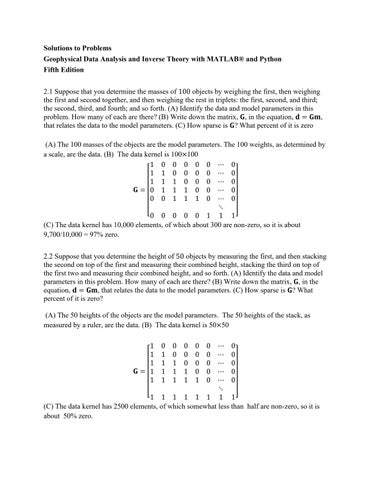
Solutions to Problems Geophysical Data Analysis and Inverse Theory with MATLAB® and Python Fifth Edition 2.1 Suppose that you determine the masses of 100 objects by weighing the first, then weighing the first and second together, and then weighing the rest in triplets: the first, second, and third; the second, third, and fourth; and so forth. (A) Identify the data and model parameters in this problem. How many of each are there? (B) Write down the matrix, 𝐆, in the equation, 𝐝 = 𝐆𝐦, that relates the data to the model parameters. (C) How sparse is 𝐆? What percent of it is zero (A) The 100 masses of the objects are the model parameters. The 100 weights, as determined by a scale, are the data. (B) The data kernel is 100×100 1 0 0 0 0 0 ⋯ 0 1 1 0 0 0 0 ⋯ 0 1 1 1 0 0 0 ⋯ 0 𝐆= 0 1 1 1 0 0 ⋯ 0 0 0 1 1 1 0 ⋯ 0 ⋱ [0 0 0 0 0 1 1 1 ] (C) The data kernel has 10,000 elements, of which about 300 are non-zero, so it is about 9,700/10,000 = 97% zero. 2.2 Suppose that you determine the height of 50 objects by measuring the first, and then stacking the second on top of the first and measuring their combined height, stacking the third on top of the first two and measuring their combined height, and so forth. (A) Identify the data and model parameters in this problem. How many of each are there? (B) Write down the matrix, 𝐆, in the equation, 𝐝 = 𝐆𝐦, that relates the data to the model parameters. (C) How sparse is 𝐆? What percent of it is zero? (A) The 50 heights of the objects are the model parameters. The 50 heights of the stack, as measured by a ruler, are the data. (B) The data kernel is 50×50 1 1 1 𝐆= 1 1
0 1 1 1 1
0 0 1 1 1
0 0 0 1 1
0 0 0 0 1
0 0 0 0 0
⋯ 0 ⋯ 0 ⋯ 0 ⋯ 0 ⋯ 0 ⋱ [1 1 1 1 1 1 1 1 ] (C) The data kernel has 2500 elements, of which somewhat less than half are non-zero, so it is about 50% zero.