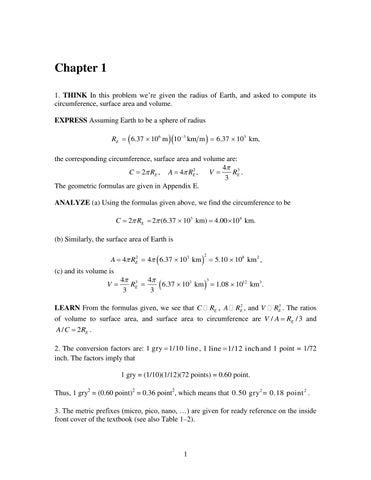
Chapter 1 1. THINK In this problem we’re given the radius of Earth, and asked to compute its circumference, surface area and volume. EXPRESS Assuming Earth to be a sphere of radius RE 6.37 106 m 103 km m 6.37 103 km,
the corresponding circumference, surface area and volume are: 4 3 C 2 RE , A 4 RE2 , V RE . 3 The geometric formulas are given in Appendix E. ANALYZE (a) Using the formulas given above, we find the circumference to be C 2 RE 2 (6.37 103 km) 4.00 104 km.
(b) Similarly, the surface area of Earth is
A 4 RE2 4 6.37 103 km
(c) and its volume is V
5.10 10 km , 2
8
2
3 4 3 4 6.37 103 km 1.08 1012 km3 . RE 3 3
LEARN From the formulas given, we see that C RE , A RE2 , and V RE3 . The ratios of volume to surface area, and surface area to circumference are V / A RE / 3 and A / C 2RE . 2. The conversion factors are: 1 gry 1/10 line , 1 line 1/12 inch and 1 point = 1/72 inch. The factors imply that 1 gry = (1/10)(1/12)(72 points) = 0.60 point. Thus, 1 gry2 = (0.60 point)2 = 0.36 point2, which means that 0.50 gry2 = 0.18 point 2 . 3. The metric prefixes (micro, pico, nano, …) are given for ready reference on the inside front cover of the textbook (see also Table 1–2).
1