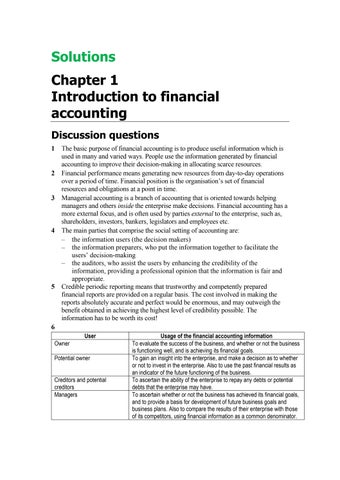
Solutions Chapter 1 Introduction to financial accounting Discussion questions 1 The basic purpose of financial accounting is to produce useful information which is used in many and varied ways. People use the information generated by financial accounting to improve their decision-making in allocating scarce resources. 2 Financial performance means generating new resources from day-to-day operations over a period of time. Financial position is the organisation’s set of financial resources and obligations at a point in time. 3 Managerial accounting is a branch of accounting that is oriented towards helping managers and others inside the enterprise make decisions. Financial accounting has a more external focus, and is often used by parties external to the enterprise, such as, shareholders, investors, bankers, legislators and employees etc. 4 The main parties that comprise the social setting of accounting are: – the information users (the decision makers) – the information preparers, who put the information together to facilitate the users’ decision-making – the auditors, who assist the users by enhancing the credibility of the information, providing a professional opinion that the information is fair and appropriate. 5 Credible periodic reporting means that trustworthy and competently prepared financial reports are provided on a regular basis. The cost involved in making the reports absolutely accurate and perfect would be enormous, and may outweigh the benefit obtained in achieving the highest level of credibility possible. The information has to be worth its cost! 6 User Owner Potential owner Creditors and potential creditors Managers
Usage of the financial accounting information To evaluate the success of the business, and whether or not the business is functioning well, and is achieving its financial goals. To gain an insight into the enterprise, and make a decision as to whether or not to invest in the enterprise. Also to use the past financial results as an indicator of the future functioning of the business. To ascertain the ability of the enterprise to repay any debts or potential debts that the enterprise may have. To ascertain whether or not the business has achieved its financial goals, and to provide a basis for development of future business goals and business plans. Also to compare the results of their enterprise with those of its competitors, using financial information as a common denominator.